

Matthew 5:30
Greek (Tischendorf 8th ed.) Matthew 5:30 appears in the Greek New Testament. The text above is from the Tischendorf 8th edition. Each word links to its Strong’s number and a concise gloss. Click any word for its full Thayer’s Greek Lexicon entry.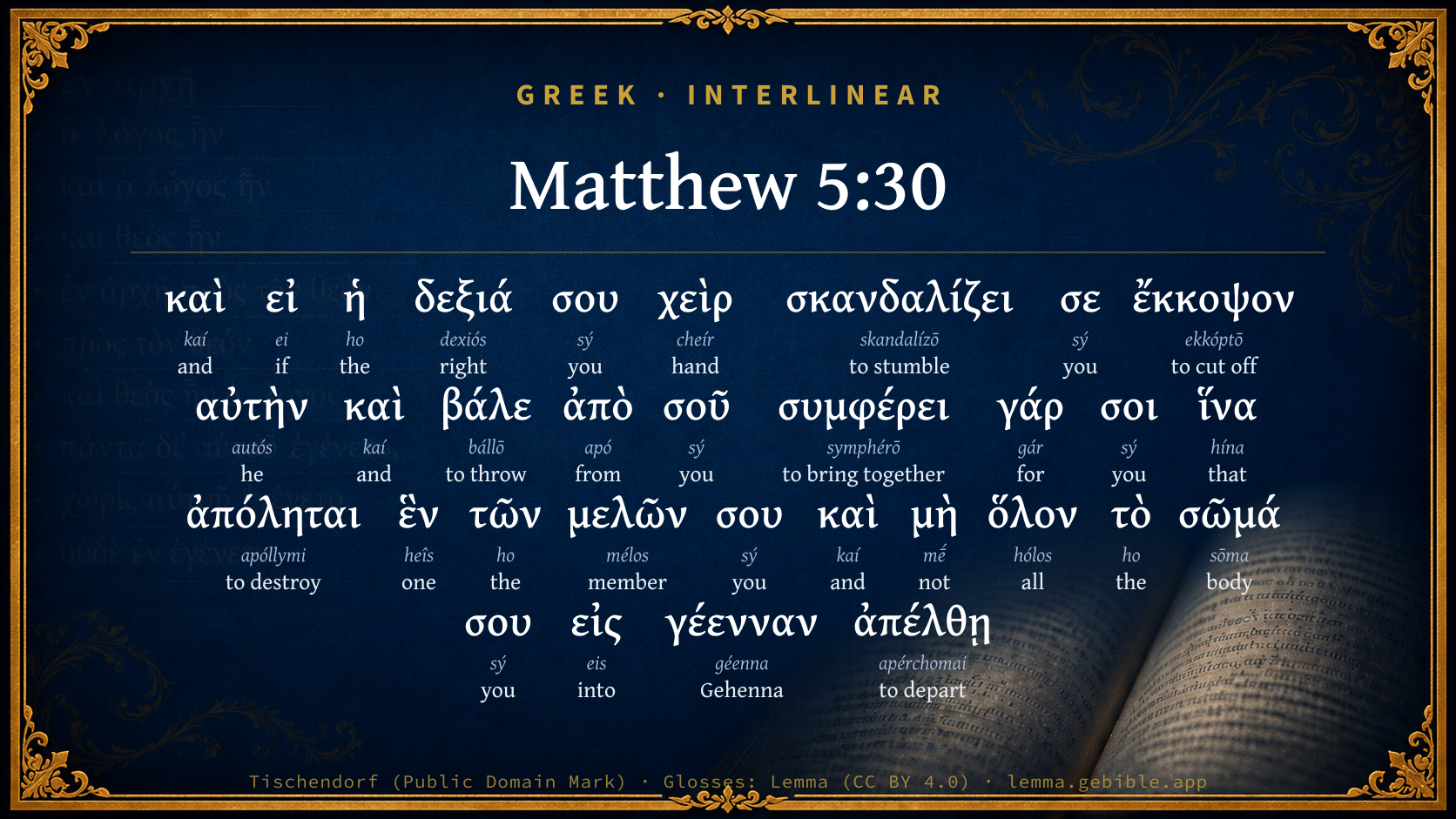
If your right hand causes you to stumble, cut it off, and throw it away from you: for it is profitable for you that one of your members should perish, and not your whole body be thrown into Gehenna.
Download a study sheet
One document with this verse’s original text, its word-by-word gloss line, the meaning frame, cross-references with their text, attributed commentary, and full source and license credits — printable, and it pastes into notes with its structure intact.
This verse Autodidact and up
A passage Seminary Student
Up to 50 verses in one chapter. A passage sheet keeps up to 6 commentary sources and 12 cross-references per verse, in the order this page ranks them, and says so on the sheet whenever that leaves anything out. Ask for a single verse and you get the Autodidact verse sheet above.
Everything on this page stays free to read, with no account — the sheet is a download of what is already on screen, not access to it.
Compare translations 3
The same verse in 3 English versions, stacked beneath the original-language interlinear above. Click any original word for its lexicon entry.
Each is an independent rendering of the whole verse — the interlinear is not word-aligned to these translations.
Highlighted words mark where these versions differ — a whole-verse word diff, not a word-by-word alignment.
-
World English Bible Public Domain
If your right hand causes you to stumble, cut it off, and throw it away from you: for it is profitable for you that one of your members should perish, and not your whole body be thrown into Gehenna.
-
King James Version Public Domain
And if thy right hand offend thee, cut it off, and cast it from thee: for it is profitable for thee that one of thy members should perish, and not that thy whole body should be cast into hell.
-
unfoldingWord Literal Text CC BY-SA 4.0
And if your right hand causes you to stumble, cut it off and throw away from you. For it is better for you that one of your members would perish and your whole body would not go into Gehenna.
unfoldingWord Literal Text — © unfoldingWord, licensed CC BY-SA 4.0. Word-aligned USFM3 via Door43 (git.door43.org/unfoldingWord/en_ult).
Show all 19 translations
Every available English version of this verse, each an independent rendering of the whole verse.
-
World English Bible Public Domain
If your right hand causes you to stumble, cut it off, and throw it away from you: for it is profitable for you that one of your members should perish, and not your whole body be thrown into Gehenna.
-
Berean Standard Bible Public Domain
And if your right hand causes you to sin, cut it off and throw it away. It is better for you to lose one part of your body than for your whole body to depart into hell.
-
Majority Standard Bible Public Domain
And if your right hand causes you to sin, cut it off and throw it away. It is better for you to lose one part of your body than for your whole body to be cast into hell.
-
King James Version Public Domain
And if thy right hand offend thee, cut it off, and cast it from thee: for it is profitable for thee that one of thy members should perish, and not that thy whole body should be cast into hell.
-
American Standard Version (1901) Public Domain
And if thy right hand causeth thee to stumble, cut it off, and cast it from thee: for it is profitable for thee that one of thy members should perish, and not thy whole body go into hell.
-
Revised Version (1885) Public Domain
And if thy right hand causeth thee to stumble, cut it off, and cast it from thee: for it is profitable for thee that one of thy members should perish, and not thy whole body go into hell.
-
Geneva Bible (1599) Public Domain
Also if thy right hand make thee to offend, cut it off, and cast it from thee: for better it is for thee that one of thy members perish, then that thy whole body should be cast into hell.
-
Douay-Rheims (1899) Public Domain
And if thy right hand scandalize thee, cut it off, and cast it from thee: for it is expedient for thee that one of thy members should perish, rather than that thy whole body be cast into hell.
-
Young's Literal Translation Public Domain
`And, if thy right hand doth cause thee to stumble, cut it off, and cast from thee, for it is good to thee that one of thy members may perish, and not thy whole body be cast to gehenna.
-
Literal Standard Version CC BY-SA 4.0
And if your right hand causes you to stumble, cut it off, and cast from you, for it is good to you that one of your members may perish, and not your whole body be cast into Gehenna.
-
Unlocked Literal Bible CC BY-SA 4.0
If your right hand causes you to stumble, cut it off and throw it away from you. For it is better for you that one of your body parts should perish than that your whole body should go into hell.
-
unfoldingWord Literal Text CC BY-SA 4.0
And if your right hand causes you to stumble, cut it off and throw away from you. For it is better for you that one of your members would perish and your whole body would not go into Gehenna.
-
Darby Bible Public Domain
And if thy right hand be a snare to thee, cut it off and cast it from thee: for it is profitable for thee that one of thy members perish, and not thy whole body be cast into hell.
-
World Messianic Bible Public Domain
If your right hand causes you to stumble, cut it off, and throw it away from you. For it is more profitable for you that one of your members should perish, than for your whole body to be cast into Gehinnom.
-
Webster's Bible Public Domain
And if thy right hand shall cause thee to sin, cut it off, and cast it from thee: for it is profitable for thee that one of thy members should perish, and not that thy whole body should be cast into hell.
-
Free Bible Version CC BY-SA 4.0
If your right hand leads you to sin, then cut it off and throw it away, for it's better for you to lose one of your limbs than for your whole body to go into the fire of Gehenna.
-
Bible in Basic English Public Domain
And if your right hand is a cause of trouble to you, let it be cut off and put it away from you; because it is better to undergo the loss of one part, than for all your body to go into hell.
-
Text-Critical English NT CC BY 4.0
And if yoʋr right hand causes yoʋ to stumble, cut it off and throw it away from yoʋ. For it is better for yoʋ to have one of yoʋr members perish, than for yoʋr whole body to be thrown into hell.
-
Tyndale New Testament (1534) Public Domain
Also if thy right honde offend the cut hym of and caste hym from the. Better that ys that one of thy membres perisshe then that all thy body shulde be caste in to hell.
Literal Standard Version (2020), Covenant Press — licensed CC BY-SA 4.0. Text via the HelloAO Bible API (eBible.org). Unlocked Literal Bible (unfoldingWord) — licensed CC BY-SA 4.0. Text via the HelloAO Bible API (eBible.org). unfoldingWord Literal Text — © unfoldingWord, licensed CC BY-SA 4.0. Word-aligned USFM3 via Door43 (git.door43.org/unfoldingWord/en_ult). Free Bible Version, Dr. Jonathan Gallagher — licensed CC BY-SA 4.0. Text via the HelloAO Bible API (eBible.org).
Word by word
More ways to search: Search by grammar → Find every occurrence → Compare this word →
Practice this passage: Drill this verse → Learn its vocabulary →
- Appears 10× in the Greek New Testament
- First appears at Matthew 3:10
- Part of Speech
- Verb
- Tense
- Aorist
- Voice
- Active
- Mood
- Imperative
- Person
- 2nd person
- Number
- Singular
Full Thayer's Definition
- καὶ kaí G2532 “and” Conjunction
- εἰ ei G1487 “if” Conditional
- ἡ ho G3588 “the” Article, Nominative, Singular, Feminine
- δεξιά dexiós G1188 “right” Adjective, Nominative, Singular, Feminine
- σου sý G4771 “you” Personal pronoun, 2nd person, Genitive, Singular
- χεὶρ cheír G5495 “hand” Noun, Nominative, Singular, Feminine
- σκανδαλίζει skandalízō G4624 “to stumble” Verb, Present, Active, Indicative, 3rd person, Singular
- σε sý G4771 “you” Personal pronoun, 2nd person, Accusative, Singular
- ἔκκοψον ekkóptō G1581 “to cut off” Verb, Aorist, Active, Imperative, 2nd person, Singular
- αὐτὴν autós G846 “he” Personal pronoun, Accusative, Singular, Feminine
- καὶ kaí G2532 “and” Conjunction
- βάλε bállō G906 “to throw” Verb, Aorist, Active, Imperative, 2nd person, Singular
- ἀπὸ apó G575 “from” Preposition
- σοῦ sý G4771 “you” Personal pronoun, 2nd person, Genitive, Singular
- συμφέρει symphérō G4851 “to bring together” Verb, Present, Active, Indicative, 3rd person, Singular
- γάρ gár G1063 “for” Conjunction
- σοι sý G4771 “you” Personal pronoun, 2nd person, Dative, Singular
- ἵνα hína G2443 “that” Conjunction
- ἀπόληται apóllymi G622 “to destroy” Verb, Aorist, Middle, Subjunctive, 3rd person, Singular
- ἓν heîs G1520 “one” Adjective, Nominative, Singular, Neuter
- τῶν ho G3588 “the” Article, Genitive, Plural, Neuter
- μελῶν mélos G3196 “member” Noun, Genitive, Plural, Neuter
- σου sý G4771 “you” Personal pronoun, 2nd person, Genitive, Singular
- καὶ kaí G2532 “and” Conjunction
- μὴ mḗ G3361 “not” Particle, Negative
- ὅλον hólos G3650 “all” Adjective, Nominative, Singular, Neuter
- τὸ ho G3588 “the” Article, Nominative, Singular, Neuter
- σῶμά sōma G4983 “body” Noun, Nominative, Singular, Neuter
- σου sý G4771 “you” Personal pronoun, 2nd person, Genitive, Singular
- εἰς eis G1519 “into” Preposition
- γέενναν géenna G1067 “Gehenna” Noun, Accusative, Singular, Feminine
- ἀπέλθῃ apérchomai G565 “to depart” Verb, Aorist, Active, Subjunctive, 3rd person, Singular
About this verse
These counts appear in no published source. They are computed here, from the morphology-tagged text and Lemma’s own curated glosses. What Lemma adds →
- 32
- words
- 23
- distinct lemmas
- Gospels
- section
Cross-references
16Topical passages linked to Matthew 5:30 in the Treasury of Scripture Knowledge — connected by theme and wording, ordered by reader-vote popularity; previews shown in the World English Bible.
- Mark 9:43 If your hand causes you to stumble, cut it off. It is better for you to enter into life maimed, rather than having your two hands to go into Gehenna, into the unquenchable fire,
- Matthew 5:29 If your right eye causes you to stumble, pluck it out and throw it away from you. For it is more profitable for you that one of your members should perish, than for your whole body to be cast into Gehenna.
- 1 Peter 2:8 and, "A stone of stumbling, and a rock of offense." For they stumble at the word, being disobedient, whereunto also they were appointed.
- Romans 14:20–21 Don't overthrow God's work for food's sake. All things indeed are clean, however it is evil for that man who creates a stumbling block by eating.
- Matthew 18:6–7 but whoever causes one of these little ones who believe in me to stumble, it would be better for him that a huge millstone should be hung around his neck, and that he should be sunk in the depths of the sea.
- Luke 17:2 It would be better for him if a millstone were hung around his neck, and he were thrown into the sea, rather than that he should cause one of these little ones to stumble.
- 1 Corinthians 8:13 Therefore, if food causes my brother to stumble, I will eat no meat forevermore, that I don't cause my brother to stumble.
- Matthew 13:21 yet he has no root in himself, but endures for a while. When oppression or persecution arises because of the word, immediately he stumbles.
- Luke 12:5 But I will warn you whom you should fear. Fear him, who after he has killed, has power to cast into Gehenna. Yes, I tell you, fear him.
- Matthew 22:13 Then the king said to the servants, 'Bind him hand and foot, take him away, and throw him into the outer darkness; there is where the weeping and grinding of teeth will be.'
- Matthew 26:31 Then Jesus said to them, "All of you will be made to stumble because of me tonight, for it is written, 'I will strike the shepherd, and the sheep of the flock will be scattered.'
- Romans 9:33 even as it is written, "Behold, I lay in Zion a stumbling stone and a rock of offense; And no one who believes in him will be disappointed."
- Galatians 5:11 But I, brothers, if I still preach circumcision, why am I still persecuted? Then the stumbling-block of the cross has been removed.
- Matthew 11:6 Blessed is he who finds no occasion for stumbling in me."
- Matthew 16:23 But he turned, and said to Peter, "Get behind me, Satan! You are a stumbling-block to me, for you are not setting your mind on the things of God, but on the things of men."
- Matthew 25:20 He who received the five talents came and brought another five talents, saying, 'Lord, you delivered to me five talents. Behold, I have gained another five talents besides them.'
Cross-references courtesy of OpenBible.info (CC BY 4.0).
Where the printed editions differ
1 variantPlaces in this verse where the major printed Greek editions disagree on the wording in a way that affects the translation — a comparison of editions, not a manuscript-by-manuscript collation. The editions are the modern critical texts (Nestlé-Aland 28/27, SBL, Westcott-Hort, Tregelles, Tyndale House) and the traditional texts behind the KJV (the Textus Receptus and the Byzantine/Majority text). It is not a claim about which reading is original.
-
Different wording
ἀπέλθῃ.
“may depart.”
In NA28NA27TynSBLWHTreg Not in TRByzβληθῇ (blēthēa) 'may be cast' occurs in traditional manuscripts (TR+Byz) instead of ἀπέλθῃ.¶ (apelthē) 'may depart.' in older manuscripts (NA28+NA27+Tyn+SBL+WH+Treg)
Textual data: Translators Amalgamated Greek New Testament (STEPBible TAGNT) · CC BY 4.0.
Lesson kit
Teaching starters — assembled from the data on this page, not authored interpretation. Every prompt links to the verse data it draws on. Edit before teaching.
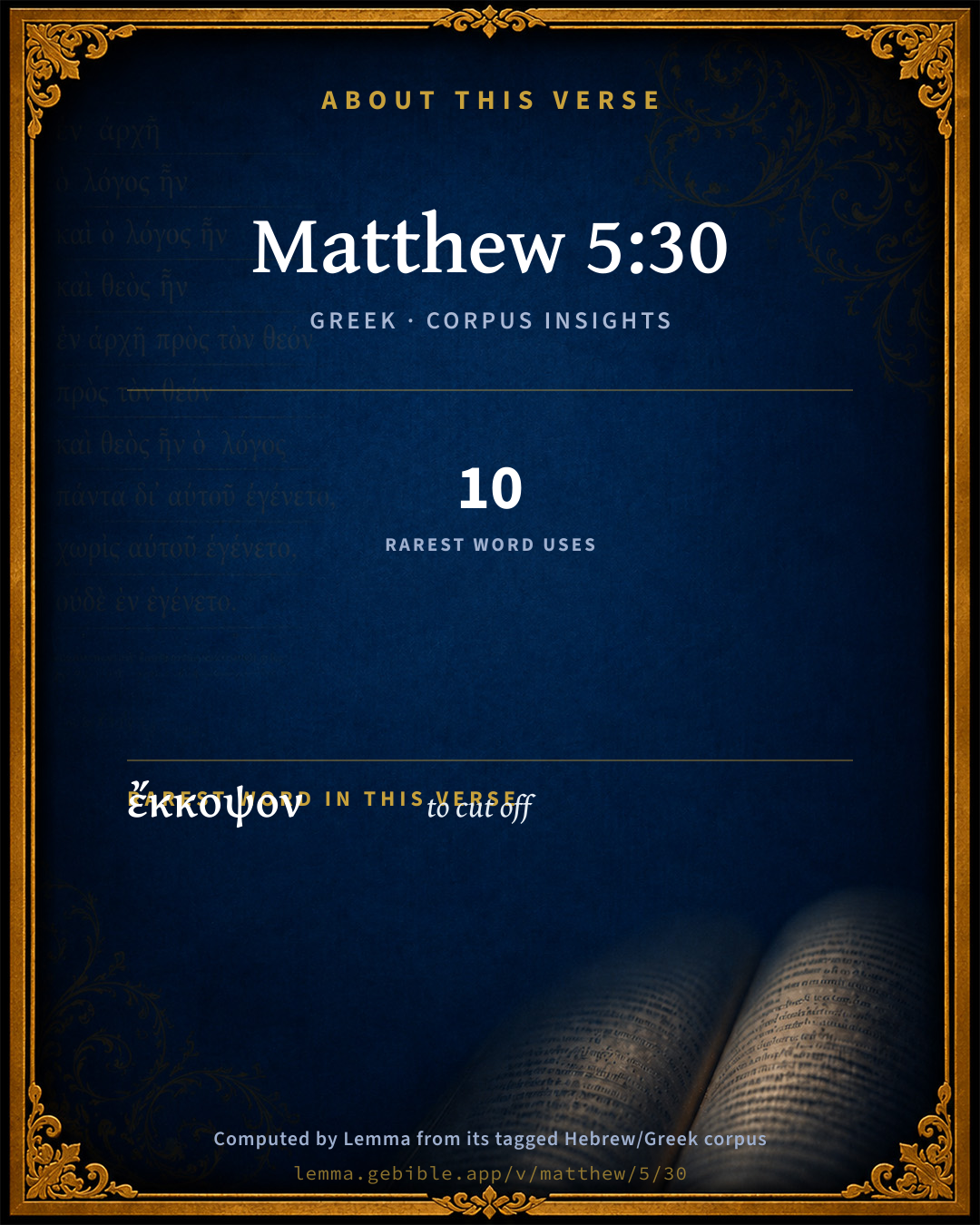
Matthew, in the Gospels, opens this verse with 32 words (23 distinct Greek lemmas). Its most distinctive word is ekkóptō (“to cut off”). A historical commentator’s framing appears above. Read the whole chapter for the surrounding context.
Discussion questions
- The word ekkóptō carries the sense “to cut off.” How does it shape the verse?
- Matthew 3:10 shares the word «to cut off» with this verse. How do the two illuminate each other?
- “you” occurs 6× in this one verse. What is the effect of the repetition?
- These translations render this verse differently; the difference is in the English rendering, not the original. What questions does that raise?
- Reading how The Biblical Illustrator and Bengel's Gnomon read this verse, where do the two commentators agree and where do they part?
Things to notice
- These translations choose different wording for 15 words in this verse.
- “you” occurs 6× in this single verse.
- 23 distinct Greek lemmas span 32 words in this verse.
Commentary
Notes on Matthew 5:30 from classic Christian and Jewish commentators (each source and its license shown beneath its notes). The classic Christian expositions comment on the surrounding passage and are grouped to its opening verse, so a note may address several verses; the Jewish commentaries on the Tanakh (Rashi and others) are per-verse, so they appear only where the commentator wrote on this verse.
Lemma curates 59 commentaries, every one of them public domain or Creative Commons licensed, each selected and text-cleaned for this edition rather than reprinted as found. About our sources →
The Biblical Illustrator
Joseph S. Exell
The Biblical Illustrator, edited by Joseph S. Exell (c. 1880s–1900s) — public domain. Text from a community e-Sword module.
Bengel's Gnomon
Johann Albrecht Bengel
Bengel's Gnomon of the New Testament — English translation (T&T Clark, Edinburgh, 1860) — public domain. Text from a community e-Sword module.
Jamieson, Fausset & Brown
Robert Jamieson, A. R. Fausset & David Brown
Jamieson, Fausset & Brown — Commentary Critical and Explanatory on the Whole Bible (1871) — public domain (CC PDM 1.0). Text via the HelloAO Bible API.
Ellicott's Commentary for English Readers
A Bible Commentary for English Readers, edited by Charles John Ellicott (1878–1897) — public domain. Text from a community e-Sword module.
John Gill's Exposition
John Gill's Exposition of the Whole Bible (1746–1763) — public domain (CC PDM 1.0). Text via the HelloAO Bible API.
Trapp's Complete Commentary
John Trapp
John Trapp, A Commentary or Exposition upon All the Books of the Old and New Testament (1647–1656) — public domain. Text from a community e-Sword module.
Albert Barnes' Notes on the Bible
Albert Barnes' Notes on the Bible (1834–1885) — public domain. Text from a community e-Sword/MySword module.
The Pulpit Commentary
The Pulpit Commentary (1880–1919), ed. H.D.M. Spence-Jones & Joseph S. Exell — public domain. Text from a community e-Sword module.
The People's New Testament
B. W. Johnson
B. W. Johnson's The People's New Testament with Notes (1889–1891) — public domain. Electronic text from the Christian Classics Ethereal Library (CCEL) ThML edition.
International Critical Commentary
International Critical Commentary — older volumes (1896–1929), various authors — public domain. Text from a community e-Sword module.