Luke 1:30

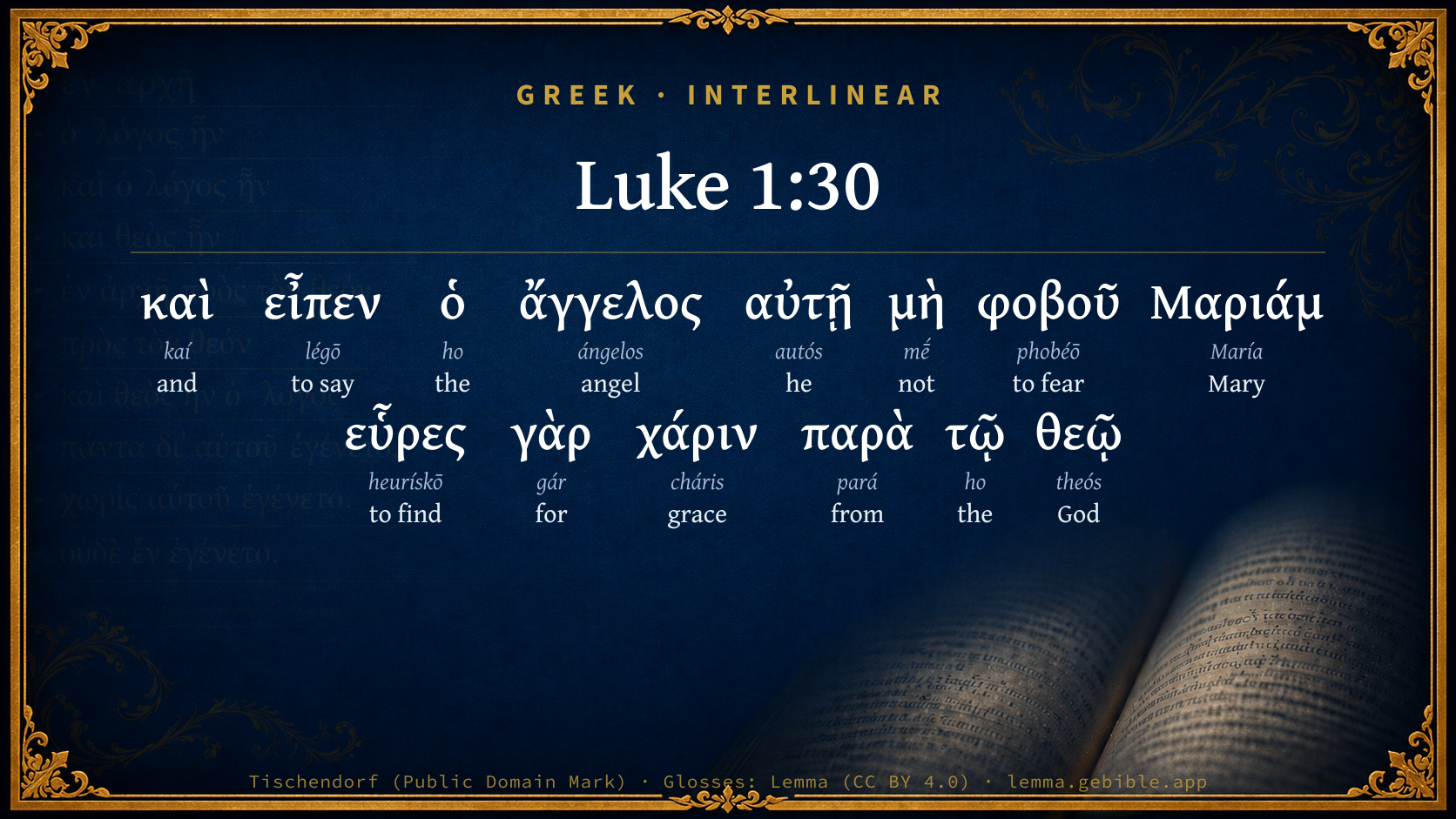
Greek (Tischendorf 8th ed.) Luke 1:30 appears in the Greek New Testament. The text above is from the Tischendorf 8th edition. Each word links to its Strong’s number and a concise gloss. Click any word for its full Thayer’s Greek Lexicon entry.
Download image
Cite this verse

Luke 1:30 (World English Bible). Public Domain. Lemma interlinear Bible study tool, https://lemma.gebible.app/v/luke/1/30.

Show BibTeX & RIS
BibTeX
RIS
English Translation
The angel said to her, "Don't be afraid, Mary, for you have found favor with God.
World English Bible · Public Domain
Highlights
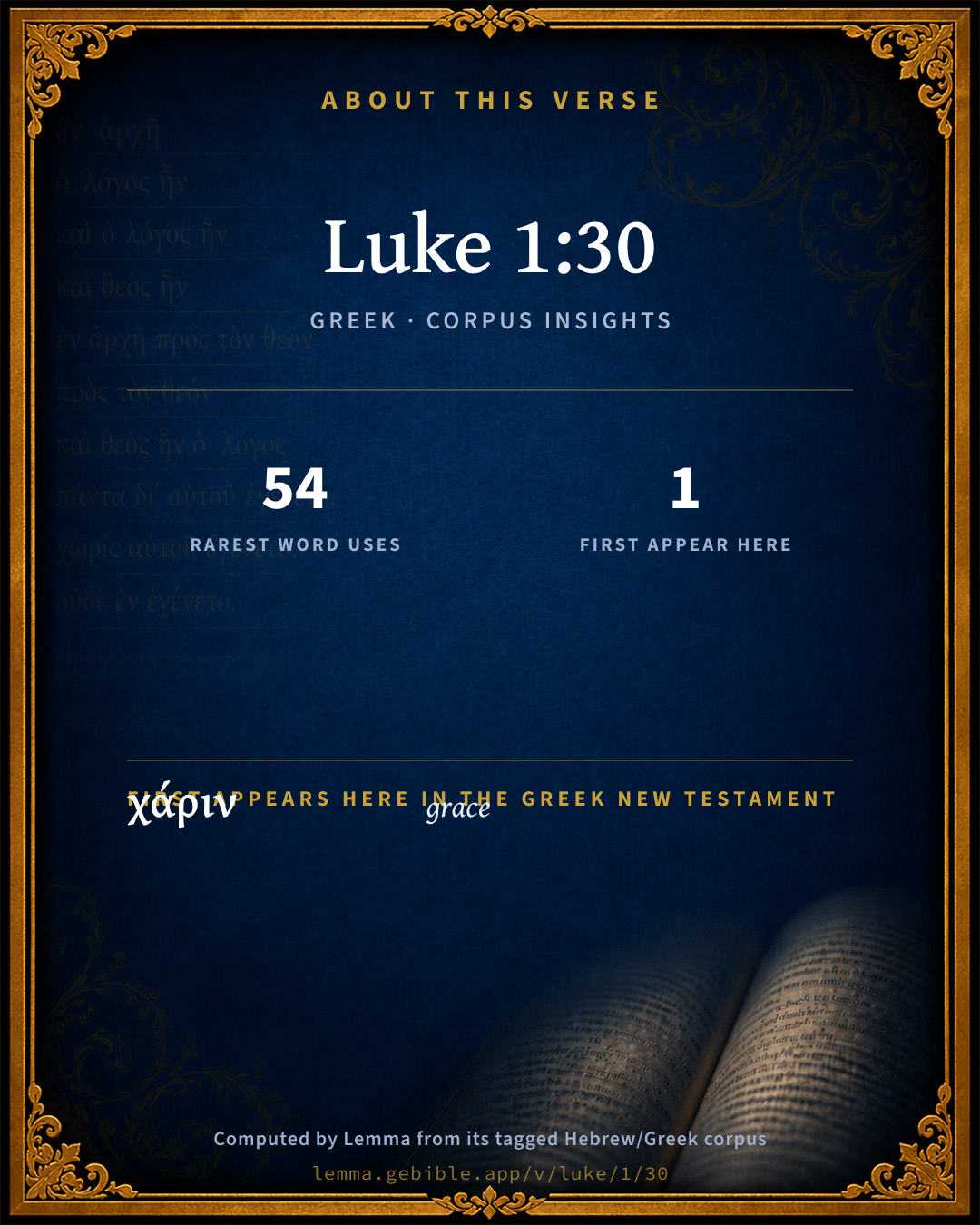
  • 1 first appearance in the Greek New Testament
Full analysis ↓
Download a study sheet

One document with this verse’s original text, its word-by-word gloss line, the meaning frame, cross-references with their text, attributed commentary, and full source and license credits — printable, and it pastes into notes with its structure intact.

This verse Autodidact and up

Study sheet (.html) Plain text (.txt)

A passage Seminary Student

Up to 50 verses in one chapter. A passage sheet keeps up to 6 commentary sources and 12 cross-references per verse, in the order this page ranks them, and says so on the sheet whenever that leaves anything out. Ask for a single verse and you get the Autodidact verse sheet above.

Everything on this page stays free to read, with no account — the sheet is a download of what is already on screen, not access to it.

Want to remove ads? Support Godless Engineer
Compare translations 3

The same verse in 3 English versions, stacked beneath the original-language interlinear above. Click any original word for its lexicon entry.

Each is an independent rendering of the whole verse — the interlinear is not word-aligned to these translations.

Highlighted words mark where these versions differ — a whole-verse word diff, not a word-by-word alignment.

  • World English Bible Public Domain
    The angel said to her, "Don't be afraid, Mary, for you have found favor with God.
  • King James Version Public Domain
    And the angel said unto her, Fear not, Mary: for thou hast found favour with God.
  • unfoldingWord Literal Text CC BY-SA 4.0
    And the angel said to her, “Do not be afraid, Mary, for you have found favor with God.

unfoldingWord Literal Text — © unfoldingWord, licensed CC BY-SA 4.0. Word-aligned USFM3 via Door43 (git.door43.org/unfoldingWord/en_ult).

Versions to compare (up to 4)

3 of 4 selected

Show all 19 translations

Every available English version of this verse, each an independent rendering of the whole verse.

  • World English Bible Public Domain
    The angel said to her, "Don't be afraid, Mary, for you have found favor with God.
  • Berean Standard Bible Public Domain
    So the angel told her, “Do not be afraid, Mary, for you have found favor with God.
  • Majority Standard Bible Public Domain
    So the angel told her, “Do not be afraid, Mary, for you have found favor with God.
  • King James Version Public Domain
    And the angel said unto her, Fear not, Mary: for thou hast found favour with God.
  • American Standard Version (1901) Public Domain
    And the angel said unto her, Fear not, Mary: for thou hast found favor with God.
  • Revised Version (1885) Public Domain
    And the angel said unto her, Fear not, Mary: for thou hast found favour with God.
  • Geneva Bible (1599) Public Domain
    Then the Angel saide vnto her, Feare not, Marie: for thou hast found fauour with God.
  • Douay-Rheims (1899) Public Domain
    And the angel said to her: Fear not, Mary, for thou hast found grace with God.
  • Young's Literal Translation Public Domain
    And the messenger said to her, `Fear not, Mary, for thou hast found favour with God;
  • Literal Standard Version CC BY-SA 4.0
    And the messenger said to her, “Do not fear, Mary, for you have found favor with God;
  • Unlocked Literal Bible CC BY-SA 4.0
    The angel said to her, “Do not be afraid, Mary, for you have found favor with God.
  • unfoldingWord Literal Text CC BY-SA 4.0
    And the angel said to her, “Do not be afraid, Mary, for you have found favor with God.
  • Darby Bible Public Domain
    And the angel said to her, Fear not, Mary, for thou hast found favour with God;
  • World Messianic Bible Public Domain
    The angel said to her, “Don’t be afraid, Miriam, for you have found favor with God.
  • Webster's Bible Public Domain
    And the angel said to her, Fear not, Mary: for thou hast found favor with God.
  • Free Bible Version CC BY-SA 4.0
    “Don't worry, Mary,” the angel went on, “for God has shown his graciousness to you.
  • Bible in Basic English Public Domain
    And the angel said to her, Have no fear, Mary, for you have God's approval.
  • Text-Critical English NT CC BY 4.0
    Then the angel said to her, “Do not be afraid, Mary, for yoʋ have found favor with God.
  • Tyndale New Testament (1534) Public Domain
    And the angell sayde vnto her: feare not Mary: for thou hast founde grace with god.

Literal Standard Version (2020), Covenant Press — licensed CC BY-SA 4.0. Text via the HelloAO Bible API (eBible.org). Unlocked Literal Bible (unfoldingWord) — licensed CC BY-SA 4.0. Text via the HelloAO Bible API (eBible.org). unfoldingWord Literal Text — © unfoldingWord, licensed CC BY-SA 4.0. Word-aligned USFM3 via Door43 (git.door43.org/unfoldingWord/en_ult). Free Bible Version, Dr. Jonathan Gallagher — licensed CC BY-SA 4.0. Text via the HelloAO Bible API (eBible.org).

Word by word

More ways to search: Search by grammar → Find every occurrence → Compare this word →

Practice this passage: Drill this verse → Learn its vocabulary →

Μαριάμ
María
G3137
“Mary”
Noun, Proper, indeclinable
Part of Speech
Noun · Proper, indeclinable
Full Thayer's Definition

Origin: of hebrew origin H4813

TDNT: None

Mary or Miriam = "their rebellion" 1. Mary the mother of Jesus 2. Mary Magdalene, a women from Magdala 3. Mary, the sister of Lazarus and Martha 4. Mary of Cleophas the mother of James the less 5. Mary the mother of John Mark, a sister of Barnabas 6. Mary, a Roman Christian who is greeted by Paul in Rom. 16:6
  1. καὶ kaí G2532 “and” Conjunction
  2. εἶπεν légō G3004 “to say” Verb, Aorist, Active, Indicative, 3rd person, Singular
  3. ὁ ho G3588 “the” Article, Nominative, Singular, Masculine
  4. ἄγγελος ángelos G32 “angel” Noun, Nominative, Singular, Masculine
  5. αὐτῇ autós G846 “he” Personal pronoun, Dative, Singular, Feminine
  6. μὴ mḗ G3361 “not” Particle, Negative
  7. φοβοῦ phobéō G5399 “to fear” Verb, Present, Middle or Passive deponent, Imperative, 2nd person, Singular
  8. εὗρες heurískō G2147 “to find” Verb, Aorist, Active, Indicative, 2nd person, Singular
  9. γὰρ gár G1063 “for” Conjunction
  10. χάριν cháris G5485 “grace” Noun, Accusative, Singular, Feminine
  11. παρὰ pará G3844 “from” Preposition
  12. τῷ ho G3588 “the” Article, Dative, Singular, Masculine
  13. θεῷ theós G2316 “God” Noun, Dative, Singular, Masculine

About this verse

These counts appear in no published source. They are computed here, from the morphology-tagged text and Lemma’s own curated glosses. What Lemma adds →

14
words
13
distinct lemmas
Gospels
section

First appearance in Scripture

This word makes its first canonical appearance in the Greek New Testament here:

Shared distinctive vocabulary

Μαριάμ Mary G3137 occurs in 46 verses of the Greek New Testament. Also found in:

Repetition

A word recurs within this verse:

Cross-references

12

Topical passages linked to Luke 1:30 in the Treasury of Scripture Knowledge — connected by theme and wording, ordered by reader-vote popularity; previews shown in the World English Bible.

  • Luke 1:13 But the angel said to him, "Don't be afraid, Zacharias, because your request has been heard, and your wife, Elizabeth, will bear you a son, and you shall call his name John.
  • Luke 12:32 Don't be afraid, little flock, for it is your Father's good pleasure to give you the Kingdom.
  • Romans 8:31 What then shall we say about these things? If God is for us, who can be against us?
  • Isaiah 41:10 Don't you be afraid, for I am with you; don't be dismayed, for I am your God; I will strengthen you; yes, I will help you; yes, I will uphold you with the right hand of my righteousness.
  • Matthew 14:27 But immediately Jesus spoke to them, saying "Cheer up! I AM! Don't be afraid."
  • Matthew 28:5 The angel answered the women, "Don't be afraid, for I know that you seek Jesus, who has been crucified.
  • Acts 18:9–10 The Lord said to Paul in the night by a vision, "Don't be afraid, but speak and don't be silent;
  • Isaiah 44:2 Thus says Yahweh who made you, and formed you from the womb, who will help you: Don't be afraid, Jacob my servant; and you, Jeshurun, whom I have chosen.
  • Isaiah 41:14 Don't be afraid, you worm Jacob, and you men of Israel; I will help you, says Yahweh, and your Redeemer is the Holy One of Israel.
  • Isaiah 43:1–4 But now thus says Yahweh who created you, Jacob, and he who formed you, Israel: Don't be afraid, for I have redeemed you; I have called you by your name, you are mine.
  • Acts 27:24 saying, 'Don't be afraid, Paul. You must stand before Caesar. Behold, God has granted you all those who sail with you.'
  • Hebrews 13:6 So that with good courage we say, "The Lord is my helper. I will not fear. What can man do to me?"

Cross-references courtesy of OpenBible.info (CC BY 4.0).

Commentary

Notes on Luke 1:30 from classic Christian and Jewish commentators (each source and its license shown beneath its notes). The classic Christian expositions comment on the surrounding passage and are grouped to its opening verse, so a note may address several verses; the Jewish commentaries on the Tanakh (Rashi and others) are per-verse, so they appear only where the commentator wrote on this verse.

Lemma curates 59 commentaries, every one of them public domain or Creative Commons licensed, each selected and text-cleaned for this edition rather than reprinted as found. About our sources →

Bengel's Gnomon

Johann Albrecht Bengel

Luk 1:30. Εὗρες γὰρ χάριν, for thou hast found favour) Hebr. מצא חן. So Act 7:46; Heb 4:16.

Bengel's Gnomon of the New Testament — English translation (T&T Clark, Edinburgh, 1860) — public domain. Text from a community e-Sword module.

Vincent's Word Studies in the New Testament

Marvin R. Vincent

Grace [χαριν] . From the same root as cairw, to rejoice.

1. Primarily that which gives joy or pleasure; and hence outward beauty, loveliness, something which delights the beholder. Thus Homer, of Ulysses going to the assembly : "Athene shed down manly grace or beauty upon him" (Odyssey, "2 12); and Septuagint, Psa 45:3," grace is poured into thy lips. " See also Pro 1:9; Pro 3:22. Substantially the same idea, agreeableness, is conveyed in Luk 4:22, respecting the gracious words, lit., words of grace, uttered by Christ. So Eph 4:29.

2. As a beautiful or agreeable sentiment felt and expressed toward another; kindness, favor, good will. 2Co 8:6, 7, 9; 2Co 9:8; Luk 1:30; Luk 2:40; Act 2:47. So of the responsive sentiment of thankfulness. See Luk 6:32, 33, 34; Luk 17:9; but mostly in the formula thanks to God; Rom 6:17; 1Co 14:57; 2Co 2:14; 2Ti 1:3.

3. The substantial expression of good will; a boon, a favor, a gift; but not in New Testament. See Rom 5:15, where the distinction is made between cariv, grace, and dwrea ejn cariti, a gift in grace. So a gratification or delight, in classical Greek only; as the delight in battle, in sleep, etc.

4. The higher Christian signification, based on the emphasis of freeness in the gift or favor, and, as commonly in New Testament, denoting the free, spontaneous, absolute loving kindness of God toward men, and so contrasted with debt, law, works, sin. The word does not occur either in Matthew or Mark.

Marvin R. Vincent, Word Studies in the New Testament (1887–1900) — public domain. Text from a community e-Sword/MySword module.

Godet's Commentaries

Frédéric Louis Godet

2. The message of the angel: Luk 1:30-33.—“And the angel said unto her, Fear not, Mary; for thou hast found favour with God. 31. And, behold, thou shalt conceive in thy womb, and bring forth a son, and shalt call His name Jesus. 32. He shall be great, and shall be called the Son of the Highest; and the Lord God shall give unto Him the throne of His father David: 33. And He shall reign over the house of Jacob for ever; and of His kingdom there shall be no end.”

By long continuance, Mary’s trouble would have degenerated into fear. The angel prevents this painful impression: “Fear not.” The term εὗρες χάριν, thou hast found favour, reproduces the idea of κεχαριτωμένη; this expression belongs to the Greek of the LXX. The angel proceeds to enumerate the striking proofs of this assertion, the marks of divine favour: 1 st, a Song of Solomon 2 d, His name, a sign of blessing; 3 d, His personal superiority; 4 th, His divine title; lastly, His future and eternal sovereignty.—᾿Ιδού, behold, expresses the unexpected character of the fact announced.—᾿Ιησοῦς, Jesus, is the Greek form of יַשׁוּעָה, H3802, Jeschovah, which was gradually substituted for the older and fuller form יַהוֹשֻׁעַ, H3397, Jehoschovah, of which the meaning is, Jehovah saves. The same command is given by the angel to Joseph, Mat 1:21, with this comment: “For He shall save His people from their sins.” Criticism sees here the proof of two different and contradictory traditions. But if the reality of these two divine messages is admitted, there is nothing surprising in their agreement on this point. As to the two traditions, we leave them until we come to the general considerations at the end of chap. 2

The personal quality of this son: He shall be great—first of all, in holiness; this is true greatness in the judgment of Heaven; then, and as a consequence, in power and influence.

His title: Son of the Highest. This title corresponds with His real nature. For the expression, He shall be called, signifies here, universally recognised as such, and that because He is such in fact. This title has been regarded as a simple synonym for that of Messiah. But the passages cited in proof, Mat 26:63 and Joh 1:50, prove precisely the contrary: the first, because had the title Son of God signified nothing more in the view of the Sanhedrim than that of Messiah, there would have been no blasphemy in assuming it, even falsely; the second, because it would be idle to put two titles together between which there was no difference. On the other hand, the Trinitarian sense should not be here applied to the term Son of God. The notion of the preexistence of Jesus Christ, as the eternal Son of God, is quite foreign to the context. Mary could not have comprehended it; and on the supposition that she had comprehended or even caught a glimpse of it, so far from being sustained by it in her work as a mother, she would have been rendered incapable of performing it. The notion here expressed by the title Son of God is solely that of a personal and mysterious relation between this child and the Divine Being. The angel explains more clearly the meaning of this term in Luk 1:35.

Lastly, the dignity and mission of this child: He is to fulfil the office of Messiah. The expressions are borrowed from the prophetic descriptions, 2Sa 7:12-13, Isa 9:5-7. The throne of David should not be taken here as the emblem of the throne of God, nor the house of Jacob as a figurative designation of the Church. These expressions in the mouth of the angel keep their natural and literal sense. It is, indeed, the theocratic royalty and the Israelitish people, neither more nor less, that are in question here; Mary could have understood these expressions in no other way. It is true that, for the promise to be realized in this sense, Israel must have consented to welcome Jesus as their Messiah. In that case, the transformed theocracy would have opened its bosom to the heathen; and the empire of Israel would have assumed, by the very fact of this incorporation, the character of a universal monarchy. The unbelief of Israel foiled this plan, and subverted the regular course of history; so that at the present day the fulfilment of these promises is still postponed to the future. But is it likely, after the failure of the ministry of Jesus amongst this people, that about the beginning of the second century, when the fall of Jerusalem had already taken place, any writer would have made an angel prophesy what is expressed here? This picture of the Messianic work could have been produced at no other epoch than that to which this narrative refers it—at the transition period between the old and new covenants. Besides, would it have been possible, at any later period, to reproduce, with such artless simplicity and freshness, the hopes of these early days?

Frédéric Louis Godet — Commentaries on Luke, John, Romans, and 1 Corinthians — English translation (T&T Clark, Edinburgh, 1870s–1890s) — public domain. Text from a community e-Sword module.

Geneva Bible (1599)

Geneva Bible translators

So speak the Hebrews, saying, that men have found favor, which are in favor.

Geneva Bible (1599) marginal notes — public domain. Text via Bolls.life.

Ellicott's Commentary for English Readers

(30) Thou hast found favour with God.—The noun is the same as that elsewhere translated “grace,” but the latter word, though fit enough in itself, has become so associated with the technicalities of theology that it is better, in this place, to retain “favour.”

A Bible Commentary for English Readers, edited by Charles John Ellicott (1878–1897) — public domain. Text from a community e-Sword module.

John Gill's Exposition

And the angel said unto her, &c. Observing the consternation and confusion she was in,

fear not, Mary; he calls her by her name, signifying that she was well known to him, as the saints are to the ministering angels, who are often sent unto them, encamp about them, and do them many good offices; and bids her not be afraid, he had no ill design upon her, nor brought any ill news to her:

for thou has found favour, or "found grace with God"; and what that particular grace and favour was, is expressed in the following verses.

John Gill's Exposition of the Whole Bible (1746–1763) — public domain (CC PDM 1.0). Text via the HelloAO Bible API.

Trapp's Complete Commentary

John Trapp

30 And the angel said unto her, Fear not, Mary: for thou hast found favour with God.

Ver. 30. Fear not, Mary] We are not fit to hear till quit of carnal affections and passions. The ear which tastes words as the mouth doth meat, when killed with choler or other ill humours, can relish no comfort.

John Trapp, A Commentary or Exposition upon All the Books of the Old and New Testament (1647–1656) — public domain. Text from a community e-Sword module.

Albert Barnes' Notes on the Bible

Fear not, Mary - Do not be alarmed at this appearance of an angel. He only comes to announce to you good tidings. Similar language was addressed by an angel to Joseph. See the notes at Mat 1:20.

Thou hast found favour with God - Eminent favor or mercy in being selected to be the mother of the Messiah.

Albert Barnes' Notes on the Bible (1834–1885) — public domain. Text from a community e-Sword/MySword module.

Matthew Poole's English Annotations

This expounds those words, thou that art highly favoured, Luk 1:28, and lets her know that he came upon no ill design unto her, neither upon any human errand, nor yet with any message of evil tidings from God, for she was one for whom God had a favour.

Matthew Poole's English Annotations on the Holy Bible (1683–1685) — public domain. Text from a community e-Sword/MySword module.

Whedon's Commentary on the Bible

Daniel D. Whedon

30. Fear not—He prefaces his announcement to Mary, as to Zacharias, with an encouraging fear not. The Gospel dispensation opens with a dismissal of fear and a promise of salvation.

Daniel D. Whedon (gen. ed.), Commentary on the Old and New Testaments (1874–1909) — public domain. Text from a community e-Sword module.

Scofield Reference Notes

C. I. Scofield

angel

(See Scofield "Heb 1:4")

The Scofield Reference Bible (1917 edition), notes by C. I. Scofield — public domain. Text from a community e-Sword module.

The People's New Testament

B. W. Johnson

30–33. Fear not. In the angel's message we have, (1) An assurance, Fear not. (2) A promise, Thou shalt bring forth a son. (3) A command, Thou shalt call his name Jesus. (4) A prophecy, He shall be great, the Son of the Highest, sit on David's throne, reign forever.

B. W. Johnson's The People's New Testament with Notes (1889–1891) — public domain. Electronic text from the Christian Classics Ethereal Library (CCEL) ThML edition.

unfoldingWord translationNotes

Door43 World Missions Community

Do not be afraid, Mary

The angel does not want Mary to be afraid of his appearance, because God sent him with a positive message.

you have found favor with God

The idiom "to find favor" means to be positively received by someone. The sentence can be altered to show God as the actor. AT: "God has decided to give you his grace" or "God is showing you his kindness" (See: Idiom)

you will conceive in your womb and bear a son ... Jesus ... the Son of the Most High

Mary will bear "a son" who will be called "the Son of the Most High." Jesus is therefore a human son born of a human mother, and he is also the Son of God. These terms should be translated very carefully.

will be called

Possible meanings are 1) "people will call him" or 2) "God will call him" (See: Active or Passive)

Son of the Most High

This is an important title for Jesus, the Son of God. (See: Translating Son and Father)

give him the throne of his ancestor David

The throne represents the king's authority to rule. AT: "give him authority to rule as king as his ancestor David did" (See: Metonymy)

there will be no end to his kingdom

The negative phrase "no end" emphasizes that it continues forever. It could also be stated with a positive phrase. AT: "his kingdom will never end" (See: Litotes)

translationWords

Jesus

Son of God

Most High

throne

ancestor

David

reign

Jacob

eternity

kingdom

unfoldingWord translationNotes — © Distant Shores Media and the Door43 World Missions Community, licensed CC BY-SA 4.0. Source: git.door43.org/Door43/en_tn.

International Critical Commentary

30. Μὴ φοβοῦ Μαριάμ, εὗρες γὰρ χάριν παρὰ τῷ Θεῷ. See on ver. 13. The εὗρες χάριν π.τ. Θ. explains κεχαριτωμένη. The phrase is Hebraic: Νῶε εὗρεν χάριν ἐναντίον Κυρίου τοῦ Θεοῦ (Gen 6:8; comp. 18:3, 39:4). See on 4:22.

συλλήμψῃ. For the word see on ver. 24, and for the form comp. 2:21, 20:47; Act 1:8, Act 1:2:38, Act 1:23:27; Joh 5:43, Joh 5:16:14, Joh 5:24. In Ionic we have fut. λάμψομαι. Veitch, p. 359; Win. v. 4f, P. 54.

ἐν γαστρὶ καὶ τέξῃ υἱόν, καὶ καλέσεις τὸ ὂνομα. The same wording is found Gen 16:11, of Ishmael, and Isa 7:14 of Immanuel. Comp. Gen 27:19 of Isaac, and Mat 1:21 of Jesus. In all cases the καλέσεις is not a continuation of the prophecy, but a command, as in most of the Ten Commandments (Mat 5:21, Mat 5:27, Mat 5:33; comp. Luk 4:12; Act 23:5, etc.). Win. 43:5, 100, p. 396. The name Ἰησοῦς was revealed independently to Joseph also (Mat 1:21). It appears in the various forms of Oshea, Hoshea, Jehoshua, Joshua, Joshua, and Jesus. Its meaning is “Jehovah is help,” or “God the Saviour.” See Pearson, On the Creed, art. 2. sub init. p. 131; ed. 1849. See also Resch, Kindheitsev. pp. 80, 95.

International Critical Commentary — older volumes (1896–1929), various authors — public domain. Text from a community e-Sword module.

Lesson kit

Teaching starters — assembled from the data on this page, not authored interpretation. Every prompt links to the verse data it draws on. Edit before teaching.

Luke, in the Gospels, opens this verse with 14 words (13 distinct Greek lemmas). Its most distinctive word is María (“Mary”). A historical commentator’s framing appears above. Read the whole chapter for the surrounding context.

Discussion questions

  1. The word María carries the sense “Mary.” How does it shape the verse?
  2. This is the first place “grace” appears in Scripture (first appears here). What does its debut here establish?
  3. How does Matthew 1:16, which shares the word «Mary», read alongside this verse?
  4. What does the repetition of “the” (2× in this one verse) do in this verse?
  5. The translations on this page render this verse differently — a whole-verse word diff, not a word-by-word alignment. What might account for the different wordings?
  6. Compare how Bengel's Gnomon and Vincent's Word Studies in the New Testament read this verse. Where do they agree or differ?

Things to notice

  • 1 word makes its first canonical appearance in Scripture here.
  • These translations choose different wording for 8 words in this verse.
  • “the” occurs 2× in this single verse.
  • 13 distinct Greek lemmas span 14 words in this verse.

Reading settings

Reading text

Shown beneath each verse's original-language words.

Old Testament
Old Testament edition

Read the OT as the Masoretic Hebrew (MT) or the Greek Septuagint (LXX).

English shown for the Greek Septuagint (in the Hebrew ↔ Greek comparison).

Comparing translations? Open the Compare panel on any verse page to stack up to four side by side.