
Matthew 12:30

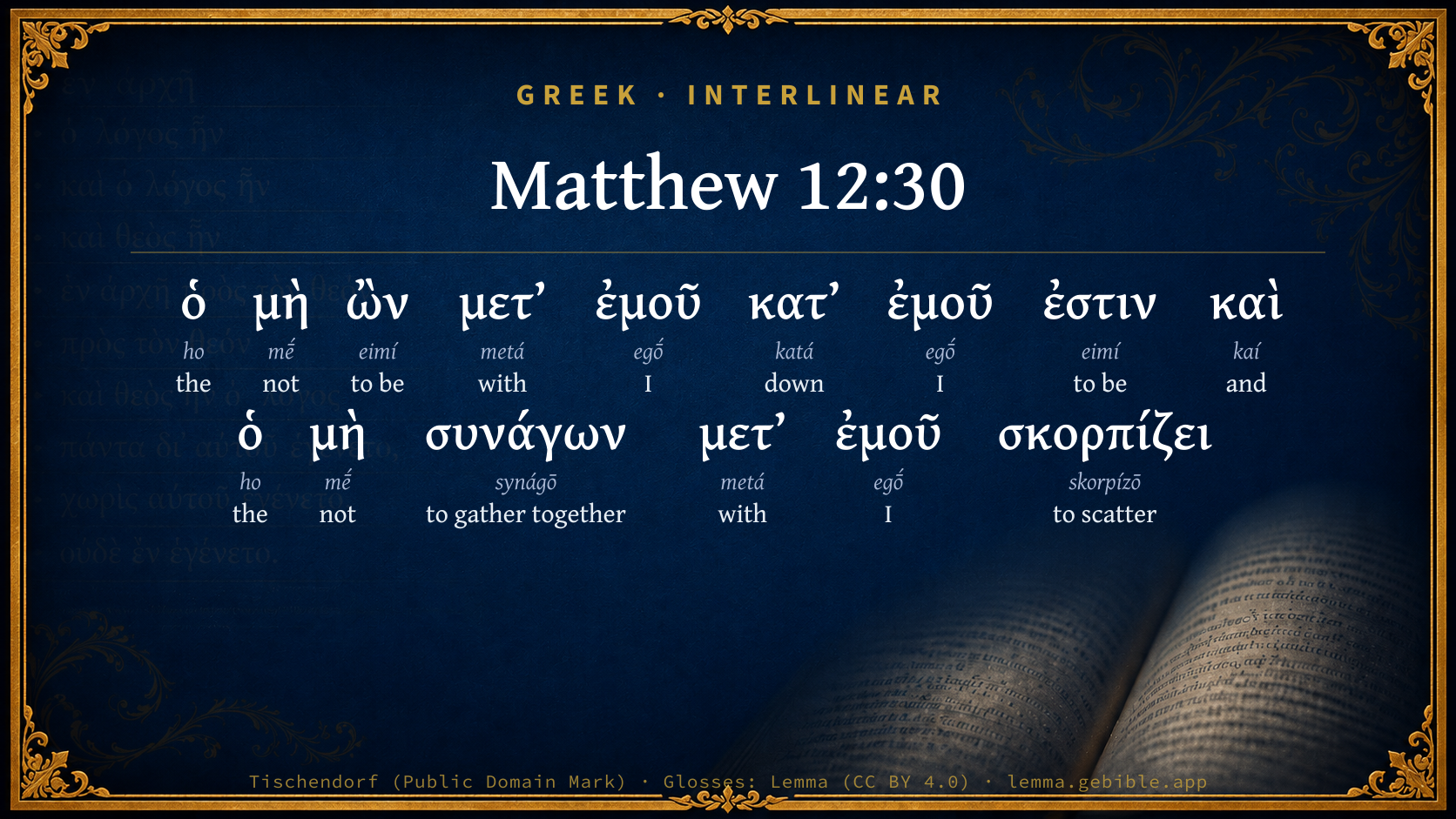
Greek (Tischendorf 8th ed.) Matthew 12:30 appears in the Greek New Testament. The text above is from the Tischendorf 8th edition. Each word links to its Strong’s number and a concise gloss. Click any word for its full Thayer’s Greek Lexicon entry.
Download image
Cite this verse

Matthew 12:30 (World English Bible). Public Domain. Lemma interlinear Bible study tool, https://lemma.gebible.app/v/matthew/12/30.

Show BibTeX & RIS
BibTeX
RIS
English Translation
"He who is not with me is against me, and he who doesn't gather with me, scatters.
World English Bible · Public Domain
Highlights
  • 1 first appearance in the Greek New Testament
Full analysis ↓
Download a study sheet

One document with this verse’s original text, its word-by-word gloss line, the meaning frame, cross-references with their text, attributed commentary, and full source and license credits — printable, and it pastes into notes with its structure intact.

This verse Autodidact and up

Study sheet (.html) Plain text (.txt)

A passage Seminary Student

Up to 50 verses in one chapter. A passage sheet keeps up to 6 commentary sources and 12 cross-references per verse, in the order this page ranks them, and says so on the sheet whenever that leaves anything out. Ask for a single verse and you get the Autodidact verse sheet above.

Everything on this page stays free to read, with no account — the sheet is a download of what is already on screen, not access to it.

Want to remove ads? Support Godless Engineer
Compare translations 3

The same verse in 3 English versions, stacked beneath the original-language interlinear above. Click any original word for its lexicon entry.

Each is an independent rendering of the whole verse — the interlinear is not word-aligned to these translations.

Highlighted words mark where these versions differ — a whole-verse word diff, not a word-by-word alignment.

  • World English Bible Public Domain
    "He who is not with me is against me, and he who doesn't gather with me, scatters.
  • King James Version Public Domain
    He that is not with me is against me; and he that gathereth not with me scattereth abroad.
  • unfoldingWord Literal Text CC BY-SA 4.0
    The one not being with me is against me, and the one not gathering with me scatters.

unfoldingWord Literal Text — © unfoldingWord, licensed CC BY-SA 4.0. Word-aligned USFM3 via Door43 (git.door43.org/unfoldingWord/en_ult).

Versions to compare (up to 4)

3 of 4 selected

Show all 19 translations

Every available English version of this verse, each an independent rendering of the whole verse.

  • World English Bible Public Domain
    "He who is not with me is against me, and he who doesn't gather with me, scatters.
  • Berean Standard Bible Public Domain
    He who is not with Me is against Me, and he who does not gather with Me scatters.
  • Majority Standard Bible Public Domain
    He who is not with Me is against Me, and he who does not gather with Me scatters.
  • King James Version Public Domain
    He that is not with me is against me; and he that gathereth not with me scattereth abroad.
  • American Standard Version (1901) Public Domain
    He that is not with me is against me, and he that gathereth not with me scattereth.
  • Revised Version (1885) Public Domain
    He that is not with me is against me; and he that gathereth not with me scattereth.
  • Geneva Bible (1599) Public Domain
    He that is not with me, is against me: and he that gathereth not with me, scattereth.
  • Douay-Rheims (1899) Public Domain
    He that is not with me, is against me: and he that gathereth not with me, scattereth.
  • Young's Literal Translation Public Domain
    `He who is not with me is against me, and he who is not gathering with me, doth scatter.
  • Literal Standard Version CC BY-SA 4.0
    He who is not with Me is against Me, and he who is not gathering with Me, scatters.
  • Unlocked Literal Bible CC BY-SA 4.0
    The one who is not with me is against me, and the one who does not gather with me scatters.
  • unfoldingWord Literal Text CC BY-SA 4.0
    The one not being with me is against me, and the one not gathering with me scatters.
  • Darby Bible Public Domain
    He that is not with me is against me, and he that gathers not with me scatters.
  • World Messianic Bible Public Domain
    “He who is not with me is against me, and he who doesn’t gather with me, scatters.
  • Webster's Bible Public Domain
    He that is not with me, is against me; and he that gathereth not with me, scattereth abroad.
  • Free Bible Version CC BY-SA 4.0
    Those who are not with me are against me, and those who do not gather together with me do the opposite: they are scattering.
  • Bible in Basic English Public Domain
    Whoever is not with me is against me; and he who does not take part with me in getting people together, is driving them away.
  • Text-Critical English NT CC BY 4.0
    Whoever is not with me is against me, and whoever does not gather with me scatters.
  • Tyndale New Testament (1534) Public Domain
    He that is not with me is agaynst me. And he that gaddereth not with me scattereth abrode.

Literal Standard Version (2020), Covenant Press — licensed CC BY-SA 4.0. Text via the HelloAO Bible API (eBible.org). Unlocked Literal Bible (unfoldingWord) — licensed CC BY-SA 4.0. Text via the HelloAO Bible API (eBible.org). unfoldingWord Literal Text — © unfoldingWord, licensed CC BY-SA 4.0. Word-aligned USFM3 via Door43 (git.door43.org/unfoldingWord/en_ult). Free Bible Version, Dr. Jonathan Gallagher — licensed CC BY-SA 4.0. Text via the HelloAO Bible API (eBible.org).

Word by word

More ways to search: Search by grammar → Find every occurrence → Compare this word →

Practice this passage: Drill this verse → Learn its vocabulary →

σκορπίζει
skorpízō
G4650
“to scatter”
Verb, Present, Active, Indicative, 3rd person, Singular
Part of Speech
Verb
Tense
Present
Voice
Active
Mood
Indicative
Person
3rd person
Number
Singular
Full Thayer's Definition

Origin: apparently from the same as G4651 (through the idea of penetrating)

TDNT: 13:58,1

1. to scatter a. of those who, routed or terror stricken or driven by some other impulses, fly in every direction b. to scatter abroad (what others may collect for themselves), or one dispensing blessings literally
  1. ὁ ho G3588 “the” Article, Nominative, Singular, Masculine
  2. μὴ mḗ G3361 “not” Particle, Negative
  3. ὢν eimí G1510 “to be” Verb, Present, Active, Participle, Nominative, Singular, Masculine
  4. μετ’ metá G3326 “with” Preposition
  5. ἐμοῦ egṓ G1473 “I” Personal pronoun, 1st person, Genitive, Singular
  6. κατ’ katá G2596 “down” Preposition
  7. ἐμοῦ egṓ G1473 “I” Personal pronoun, 1st person, Genitive, Singular
  8. ἐστιν eimí G1510 “to be” Verb, Present, Active, Indicative, 3rd person, Singular
  9. καὶ kaí G2532 “and” Conjunction
  10. ὁ ho G3588 “the” Article, Nominative, Singular, Masculine
  11. μὴ mḗ G3361 “not” Particle, Negative
  12. συνάγων synágō G4863 “to gather together” Verb, Present, Active, Participle, Nominative, Singular, Masculine
  13. μετ’ metá G3326 “with” Preposition
  14. ἐμοῦ egṓ G1473 “I” Personal pronoun, 1st person, Genitive, Singular

About this verse

These counts appear in no published source. They are computed here, from the morphology-tagged text and Lemma’s own curated glosses. What Lemma adds →

15
words
9
distinct lemmas
Gospels
section

Notable vocabulary

The rarest word here is σκορπίζει to scatter G4650 — appearing just 5 times in the whole Greek New Testament.

First appearance in Scripture

This word makes its first canonical appearance in the Greek New Testament here:

  • σκορπίζει to scatter G4650

Shared distinctive vocabulary

σκορπίζει to scatter G4650 occurs in 5 verses of the Greek New Testament. Also found in:
Repetition

Words recur within this verse:

Cross-references

10

Topical passages linked to Matthew 12:30 in the Treasury of Scripture Knowledge — connected by theme and wording, ordered by reader-vote popularity; previews shown in the World English Bible.

  • Mark 9:40 For whoever is not against us is on our side.
  • Luke 11:23 "He that is not with me is against me. He who doesn't gather with me scatters.
  • Joshua 24:15 If it seem evil to you to serve Yahweh, choose you this day whom you will serve; whether the gods which your fathers served that were beyond the River, or the gods of the Amorites, in whose land you dwell: but as for me and my house, we will serve Yahweh.
  • Luke 9:50 Jesus said to him, "Don't forbid him, for he who is not against us is for us."
  • 1 John 2:19 They went out from us, but they didn't belong to us; for if they had belonged to us, they would have continued with us. But they left, that they might be revealed that none of them belong to us.
  • Matthew 6:24 "No one can serve two masters, for either he will hate the one and love the other; or else he will be devoted to one and despise the other. You can't serve both God and Mammon.
  • 2 Corinthians 6:15–16 What agreement has Christ with Belial? Or what portion has a believer with an unbeliever?
  • Revelation 3:15–16 "I know your works, that you are neither cold nor hot. I wish you were cold or hot.
  • Joshua 5:13 It happened, when Joshua was by Jericho, that he lifted up his eyes and looked, and, behold, there stood a man over against him with his sword drawn in his hand: and Joshua went to him, and said to him, Are you for us, or for our adversaries?
  • 1 Chronicles 12:17–18 David went out to meet them, and answered them, If you be come peaceably to me to help me, my heart shall be knit to you; but if [you be come] to betray me to my adversaries, seeing there is no wrong in my hands, the God of our fathers look thereon, and rebuke it.

Cross-references courtesy of OpenBible.info (CC BY 4.0).

Commentary

Notes on Matthew 12:30 from classic Christian and Jewish commentators (each source and its license shown beneath its notes). The classic Christian expositions comment on the surrounding passage and are grouped to its opening verse, so a note may address several verses; the Jewish commentaries on the Tanakh (Rashi and others) are per-verse, so they appear only where the commentator wrote on this verse.

Lemma curates 59 commentaries, every one of them public domain or Creative Commons licensed, each selected and text-cleaned for this edition rather than reprinted as found. About our sources →

The Biblical Illustrator

Joseph S. Exell

Mat_12:30

He that is not with Me is against Me.

Neutrality in religion impossible

I. The character described.

1. Let us direct our attention to the openly profane.

2. There are others not habitually profane.

3. The honest and well-disposed.

4. The outwardly religious.

II. The light in which they are regarded by Christ. All who are not with Christ are against Him, and will be chargeable-

(1) With rejecting His salvation;

(2) With inducing others to reject it;

(3)With preventing as far as they can the display of the Saviours glory. Learn:

1. How inevitable is the destruction of the Saviours enemies.

2. How awfully severe will be their destruction. (Steer.)

The necessity of gathering with Christ

I. Describe the man who is with Christ. Union and companionship.

II. The proof of an interest in Christ, as afforded by our gathering with him. (T. Dale, M. A.)

With Christ, or against? Gathering, or Scattering?

The principle illustrated is the impossibility of a state of neutrality in the service of Christ: illustrations are fetched first from the battlefield-He that is not with Me, etc. And, secondly, from the harvest-field-He that gathereth not, etc. The immediate occasion of the text was the blasphemous imputation of the Pharisees, that Jesus cast out devils by Beelzebub. In reply our Lord appeals to reason Every kingdom divided against itself, etc. He also appeals to the acknowledged duct. Thus He must be the stronger.

I. Make a personal application of the subject. In the battlefield of life, whose side have you chosen? In the great harvest-field of the world, whose interests are you serving?

1. The battlefield is the world. We are soldiers. Are we fighting? Are we clad in armour?

2. The harvest-field. Are you gathering or wasting?

II. Make a national application of the subject. Has England gathered with Christ, or scattered? (C. R. Alford, M. A.)

I. That those who are not with Christ in discipleship and in the profession of faith are against christ, as the disciples of another master, and in the disobedience of unbelief.

II. Those who are not with Christ in the purpose and design of his death, are against christ in defeating the purpose of his death

(1) The first purpose was to make an atonement for our sins;

(2) To give repentance and pardon to guilty men;

(3) To make meet for the glory of heaven. We can be with Christ by enjoyment and participation.

We are against Christ by defeating the purpose of His death.

(1) By rejecting it altogether in a spirit of infidelity;

(2) By embracing a system which does not contain any of its grand principles;

(3) By careless unconcern.

III. Those who are not with Christ in the affections of the heart, are against him in its enmities and in its indifference. To love Christ is an essential of Christianity; we may be against Christ by enmity or indifference.

IV. Those who are not with Christ in gathering, are against him in scattering abroad. Neutrality here is opposition. (J. Dixon.)

No neutrality in religion

In those days when there was war in heaven, and Satan and his angels rebelled against the Almighty, one circle of angels alone, it is said, remained neutral. They would not join the arch-rebel, neither would they range themselves among the hosts of their Almighty Sovereign. At the final discomfiture of the rebellious angels, that circle which had not joined in their rebellion could not justly be associated with them in their punishment; nor, on the other hand, did it deserve the blessedness of heaven. Those angels, therefore, were consigned to the earth, and bound irrevocably to its fortunes. These are the fairies. They enjoy all the pleasures and all the happiness which their new habitation can afford; but it is on a lease, as it were, and every seven years their lease expires. It is renewable as long as the earth lasts, and they are always reinstated in their privileges on paying to Satan a quit rent of one of their number. Now this is an allegory. Whenever we have been neglectful of our duty, whenever we have refused to fight the battles of Him whose soldiers we have vowed ourselves, we may be forgiven, indeed, and reinstated in our former privileges; but it is always at the expense of some sacrifice to the principle of evil, whose power we should have resisted from the first, but did not. (Newland.)

No neutrality in religion

I. Who are allied with Christ?

1. They who are delivered from the power of Satan.

2. They who are in co-operation with Christ.

II. All not thus with Christ are of necessity against him.

1. That mans natural state is one of antagonism to God.

2. That it is a necessity of mans nature to influence for good or evil all with whom He may associate.

3. That our allegiance is Christs righteous and inalienable due. (H. C. H.)

I. The human heart cannot be in a state in which neither Christ nor the world has the supremacy. Man must have a master and a God, etc.

II. Neither Christ nor His enemy will accept of, or allow of, neutrality-serving both in turn, and hence warring against both in turn.

III. Neutrality is impossible, inasmuch as Christ holds it to be war against Himself. Christ requires the whole heart, life, etc.

IV. Neutrality is seen to be practical hostility to the kingdom of Christ-enemies of Christ. (J. Stewart.)

No via media in morals or religion

Christs words contain a principle and an appeal. We cannot occupy a neutral position in relation to either morals or religion now when life is before us, or by and by when the issues of life are manifested.

I. This truth. Border-countries are proverbially bad to live in. The two clauses of the text may be read thus:

1. He that is not in heart with Me is against Me. No externality of observance will suffice: no mere association will suffice. There must be personal heart-union with Christ.

2. He that is not in life-service with Me is against Me. Unpractical sentimentality will not suffice. Loudest professions will not suffice. Christs words appeal searchingly to two classes.

(a) Those who excuse wrong life by right creed.

(b) Those who excuse wrong creed by good life.

II. The qualifications of this truth. Temporary uncertainty may be good, or at least may be excused. Such as comes in

(a) Mental states of indecision;

(b) Beginnings of religious life;

(c) Occasions of religious doubt. There is no excuse for uncertainty or indecision in relation to Christ. We ought to follow Him wholly. (R. Tuck.)

The Biblical Illustrator, edited by Joseph S. Exell (c. 1880s–1900s) — public domain. Text from a community e-Sword module.

Bengel's Gnomon

Johann Albrecht Bengel

Mat 12:30. Ὁ μὴ ὢν, κ.τ.λ., he that is not, etc.) The latter part of the dilemma contained in Mat 12:27-28, is confirmed by Mat 12:29; the former by Mat 12:30, with this meaning, your sons are not against Me, nor do they scatter abroad; therefore they are with Me, and gather with Me. There is no neutrality in the kingdom of God; that activity which is natural to man is exercised either in good or in evil, especially in the case of those who hear the word of God. The work and cause of Christ is, however, simple and pure; and though it has so many enemies and adversaries, it overpowers them all, nor does it enter into collusion with them: see Luk 12:51. This verse forms a Divine axiom.—συνάγων, that gathereth) The work of Christ and of Christians is to gather; see ch. Mat 23:37, Joh 11:52. This word corresponds with the Hebrew קהלת,[573] one that gathereth, or a preacher.

[573] ק̇הֶלֶת, Koheleth is the appellation by which Solomon is designated in the book which bears this name, viz. Ecclesiastes. On the signification and derivation, see Gesenius in voc.—(I. B.)

Bengel's Gnomon of the New Testament — English translation (T&T Clark, Edinburgh, 1860) — public domain. Text from a community e-Sword module.

Meyer's Critical & Exegetical Commentary

Heinrich August Wilhelm Meyer

Mat_12:30. Jesus is speaking neither of the Jewish exorcists (Bengel, Schleiermacher, Neander), nor of the uncertain, fickle multitude (Elwert in the Stud. d. Wirtemb. Geistl. IX. 1, p. 111 ff.; Ullmann in the Deutsch. Zeitschr. 1851, p. 21 ff.; Bleek), neither of which would suit the context; but as little is He expressing Himself in general terms; so that μετʼ ἐμοῦ must be applied to Satan, while Jesus is understood to be representing Himself as Satans enemy (Jerome, Beza, Grotius, Wetstein, Kuinoel, de Wette, Baumgarten-Crusius); for the truth is, He, previously as well as subsequently, speaks of Himself in the first person (vv, 28, 31), and He could not be supposed, He who is the Messiah, to represent Himself as taking up a neutral attitude toward Satan. On the contrary, He is speaking of the Pharisees and their bearing toward Him, which must necessarily be of a hostile character, since they had refused to make common cause with Him as it behoved them to have done: He that is not with me is, as is seen in your case, my enemy, and so on.

συνάγων] illustration borrowed from harvest operations; Mat_3:12, Mat_6:26; Joh_4:36.

Meyer — Critical and Exegetical Commentary on the New Testament — English translation by Peter Christie, edited by Frederick Crombie (T&T Clark, 1880) — public domain. Text from a community e-Sword module.

Expositor's Greek Testament

ed. W. Robertson Nicoll

Mat 12:30 . ne begins at this point to have the feeling that here, as elsewhere, our evangelist groups sayings of kindred character instead of exactly reproducing Christ’s words as spoken to the Pharisees. The connection is obscure, and the interpretations therefore conflicting. On first view one would say that the adage seems more appropriate in reference to lukewarm disciples or undecided hearers than to the Pharisees, who made no pretence of being on Christ’s side. Some accordingly ( e.g. , Bleek, after Elwert and Ullmann) have so understood it. Others, including Grotius, Wetstein, De Wette, take the ἐγώ of the adage to be Satan, and render: he who, like myself, is not with Satan is against him. Kypke, Observ. Sac. , says: “Prima persona posita est a servatore pro quacunque alia, proverbialiter, hoc sensu: qui socius cujusdam bella cum alio gerentis non est, is pro adversario censeri solet. Cum igitur ego me re ipsa adversarium Satanae esse ostenderim, nulla specie socius ejus potero vocari .” This certainly brings the saying into line with the previous train of thought, but if Jesus had meant to say that He surely would have expressed Himself differently. The Fathers (Hilary, Jerome, Chrys.) took the ἐγώ to be Jesus and the ὁ μὴ ὢν to be Satan. So understood, the adage contains a fourth concluding argument against the notion of a league between Jesus and Satan. Most modern interpreters refer the ὁ μ . ω . to the Pharisees. Schanz, however, understands the saying as referring to the undecided among the people. The only serious objection to this view is that it makes the saying irrelevant to the situation. σκορπίζει : late for the earlier σκεδάννυμι , vide Lob., Phryn., p. 218. As to the metaphor of gathering and scattering, its natural basis is not apparent. But in all cases, when one man scatters what another gathers their aims and interests are utterly diverse. Satan is the arch-waster, Christ the collector, Saviour.

The Expositor's Greek Testament, edited by W. Robertson Nicoll (1897–1910) — public domain. Text from a community e-Sword module.

Jamieson, Fausset & Brown

Robert Jamieson, A. R. Fausset & David Brown

He that is not with me is against me; and he that gathereth not with me scattereth abroad--On this important parable, in connection with the corresponding one (Mat 12:43-45), see on Luk 11:21-26.

Jamieson, Fausset & Brown — Commentary Critical and Explanatory on the Whole Bible (1871) — public domain (CC PDM 1.0). Text via the HelloAO Bible API.

Adam Clarke's Commentary

Verse 30. He that is not with me is against me] In vain do men seek for methods to reconcile God and mammon. There is no medium between loving the Lord and being his enemy - between belonging to Christ or to Satan. If we be on the side of the devil, we must expect to go to the devil's hell; if we be on the side of Christ, we may expect to go to his heaven. When Christ, his truth, and his servants are assaulted, he who does not espouse their cause is not on Christ's side, but incurs the guilt of deserting and betraying him. There are many, (it is to be feared,) in the world who are really against Christ, and scatter abroad, who flatter themselves that they are workers together with him, and of the number of his friends!

Scattereth abroad.] This seems to have been a proverbial form of speech, and may be a metaphor taken from shepherds. He who does not help the true shepherd to gather his flock into the fold is, most likely, one who wishes to scatter them, that he may have the opportunity of stealing and destroying them. I do not find any parallel to this proverbial mode of speech in the Jewish rabbins, if it be one, nor have I met with it among the Greek or Roman writers.

Adam Clarke's Commentary on the Bible (1810–1826) — public domain. Text from a community e-Sword/MySword module.

Ellicott's Commentary for English Readers

(30) He that is not with me is against me.—The words seem at first at variance with the answer to the sons of Zebedee, when they reported that they had seen one casting out devils in the name of Christ, and had forbidden him “because he followed not” with them. Then they heard,” Forbid him not: for he that is not against us is for us” (Luk_9:50); and those words have naturally been the watchword of those who rejoice when Christ is preached every way, and by whatever organisation. In reality, however, the two formulæ do but present the opposite poles of the same truth. In the great struggle between light and darkness, good and evil, God and the enemy of God, there is no neutrality. The man of whom the two disciples complained was fighting against the devil in the name of Christ, and was therefore with Him. The Pharisees were hindering and slandering that work, and therefore were on the side of Satan. They were not gathering in God’s harvest of souls, and therefore they were scattering and wasting.

A Bible Commentary for English Readers, edited by Charles John Ellicott (1878–1897) — public domain. Text from a community e-Sword module.

The Cambridge Bible for Schools and Colleges

gen. ed. J. J. S. Perowne

30. He that is not with me is against me] The thought of the contest between Christ and Satan is continued. Satan is not divided against himself, neither can Christ be. Neutrality is impossible in the Christian life. It must be for Christ or against Christ. The metaphor of gathering and scattering may be from collecting and scattering a flock of sheep, or from gathering and squandering wealth, money, &c.

The Cambridge Bible for Schools and Colleges (gen. ed. J. J. S. Perowne; Cambridge University Press, 1878–1918) — public domain. Text from a community e-Sword module.

John Gill's Exposition

A good man, out of the good treasure of the heart,.... "A good man", is a regenerated man, one that is renewed by the Spirit of God, a believer in Christ, a sincere lover of him, and one that follows him, wheresoever he goes, and who has the grace of God implanted in him: for "the good treasure the heart", is not what he is naturally possessed of, but what is put into him: and is no other than the superabundant grace of God, or that grace for grace, which he has received out of Christ's fulness, and the rich experience of it he is blessed with: and may well be called a "treasure"; for as a treasure is a collection of riches, so this consists of various graces, each of which is more precious than gold, silver, and precious stones; a "good" one, both from the quality and quantity of it; and "of the heart", though this is left out in many copies, from the seat and subject of it; and out of this the gracious man

bringeth forth good things; tells his experience, speaks of what God has done for his soul; says many things to the glory of the grace of God; of the person, offices, blood, righteousness, and fulness of Christ; and of the operations and influences of the blessed Spirit; and which are pleasant, profitable, useful, and edifying to the saints:

and an evil man, out of the evil treasure bringeth forth evil things. The "evil man", is a man as he was born; who is wholly flesh, carnal, and in a state of nature; destitute of the Spirit, and having no principle of grace in him: "the evil treasure", is the corruption of his nature, the desperate wickedness of his heart; and those swarms of lusts, and all manner of sin that dwell there; from whence are continually proceeding evil and corrupt communications, which not only defile himself, but others; and among the rest, not only vain words and unprofitable talk, but blasphemies against God, Christ, and the blessed Spirit; all which men will be accountable for another day.

John Gill's Exposition of the Whole Bible (1746–1763) — public domain (CC PDM 1.0). Text via the HelloAO Bible API.

Trapp's Complete Commentary

John Trapp

30 He that is not with me is against me; and he that gathereth not with me scattereth abroad.

Ver. 30. He that is not with me, is against me] "But the devil is not with me," saith Christ, "for all I do or suffer is to destroy his works." Let this sentence also be noted against neutals and Nicodemites, who stand halting betweem two, and will be sure to hold themselves on the warm side of the hedge howsoever. Such were of old the Samaritans, Nazarites, Ebionites, and those Corinthians that would neither "be of Paul, nor Apollos, nor Cephas, but of Christ," 1Co 1:12; that is, as some neutals say today, they are neither Cavaliers nor Roundheads, but good Protestants; others are neither Papists nor Protestants, but Christians, that is, just nothing, Atheists. Christ hates neutrality, and counts it enmity; he loathes lukewarmness, accepts not any excuse in that case, Jdg 5:16-17; Dan and Ephraim are passed by in the reckoning up of the tribes, Rev 7:5-8, as if they were soldiers put out of pay, and cut out of the rolls. So are all testable indifferents, out of God’s book of remembrance, Mal 3:16-17.

John Trapp, A Commentary or Exposition upon All the Books of the Old and New Testament (1647–1656) — public domain. Text from a community e-Sword module.

Haydock's Catholic Bible Commentary

He that is not with me. This sentence is not to be understood as directly spoken of heretics and schismatics, although at first sight it may appear so, but of the devil, who wishes to dead the souls of men captive, whilst Christ wishes to free them. He entices men to wickedness, Jesus Christ draws them to virtue: how therefore can the works of Christ be compared with those of Satan! (St. Jerome) --- There is no medium. We must either be with Christ, or against Christ: if we are not of Christ, whose then must we be, when nothing but sin can separate us from Christ and God? Oh, where will the generality of Christians, who shew themselves so indifferent with regard to salvation, find themselves at the last day? Can they say they are with Christ?

George Leo Haydock (1774–1849), Haydock's Catholic Family Bible and Commentary, 1859 edition — public domain. Excludes Psalms (Douay-Rheims chapter numbering differs from Protestant) and Deuterocanonical books (Catholic canon only).

Matthew Poole's English Annotations

Luke hath the same, Luk 11:23. Some understand this concerning the devil, whom he was so far from favouring, that his work was quite opposite. Some understand it concerning some neuters, that would neither show themselves for Christ nor against him. Our Saviour tells them, that this cause would bear no neutrality, they must be either for him or against him. But possibly it is best understood concerning the scribes and Pharisees, whom he lets know, that he was one who showed men the true way of life and salvation, and those that complied not with him were his enemies, and instead of gathering, scattered the sheep of God.

Matthew Poole's English Annotations on the Holy Bible (1683–1685) — public domain. Text from a community e-Sword/MySword module.

Whedon's Commentary on the Bible

Daniel D. Whedon

30. Not with me is against me — Our Lord here illustrates by a proverbial maxim the contrariety of Satan’s kingdom and his own, as shown by the opposite works of the two.

He — Any one; here spoken in allusion to Satan. Not with me — That does not harmonize with me in spirit and in action. Is against me — And therefore one is not to be considered the ally of the other, as you charge me with being the ally of Satan. Gathereth… scattereth — These words allude to a gathering in harvest. Co-labourers gather in concert; the ravager of their fields scattereth the produce.

Daniel D. Whedon (gen. ed.), Commentary on the Old and New Testaments (1874–1909) — public domain. Text from a community e-Sword module.

The Pulpit Commentary

Parallel passage: Luk_11:23, omitted in Mark. The aim of this verse is doubtful.

(1) It may be addressed to the Pharisees, with the object of showing them what their words really implied. They were not due, as some might think, to mere indifferentism or to a judicial neutrality; such a relation to him was impossible. They were due to opposition of inner life and of outward energy. Thus their words denoted complete separation from him. This he brings out more clearly in the two following verses.

(2) This interpretation, however, would attribute to the Pharisees too great an ignorance of their own feelings of opposition to Christ, and it is therefore best to understand the verse as addressed to the many bystanders. Christ has do-fended himself from the accusation brought against him, and now urges these waverers not to be content with only not opposing him, but to take sides for, in fact, they cannot help doing so. Indifference in this case is only another name for opposition; not actively to help is really to hinder. Thus understood, the lesson of this verse finds its parallel in vers. 43-45, by which, indeed, it is immediately followed in Luke. He that is not with me is against me; and he that gathereth not with me scattereth abroad. The first clause speaks of the inner disposition, that which forms the real being of the man; the second, of his energy. Observe that the figure of the second clause appears to be connected with that of ver. 29. If Christ"s property is not collected, it is driven further from him. Christ and Christians must gather. (Joh_11:52; cf. Bengel) For gathereth (sunagwn), cf. also Mat_3:12 Mat_13:30. In scattereth abroad (skorpizei) the thought almost leaves the simile of the skeuh , and regards the persons signified. Notice that in Joh_11:52, referred to above, the two verbs sunagein and (dia) skorpizein , also occur; the figure there, however, appears to be taken from sheep. (cf. Joh_10:12) Further, Mar_9:40 and Luk_9:50 record the saying, "He that is not against us is for us," which was addressed to our Lord"s disciples. Both sayings are necessary; earnest Christians need to remember that when outsiders do anything in Christ"s name, it must, on the whole, forward his cause; (Php_1:18) the undecided must face the fact that neutrality is impossible.

The Pulpit Commentary (1880–1919), ed. H.D.M. Spence-Jones & Joseph S. Exell — public domain. Text from a community e-Sword module.

John Wesley's Explanatory Notes

He that is not with me is against me - For there are no him; either a loyal subject or a rebel. And there are none upon earth, who neither promote nor obstruct his kingdom. For he that does not gather souls to God, scatters them from him.

John Wesley, Explanatory Notes Upon the Whole Bible (1754–1765) — public domain. Text via the GEBible commentary corpus.

The People's New Testament

B. W. Johnson

30. He that is not for me, etc. The two kingdoms of Satan and of Christ are opposed. No neutrality is possible. He that is not for me is against me.

B. W. Johnson's The People's New Testament with Notes (1889–1891) — public domain. Electronic text from the Christian Classics Ethereal Library (CCEL) ThML edition.

Cambridge Greek Testament for Schools and Colleges

30. ὁ μὴ ὢν μετʼ ἐμοῦ κατʼ ἐμοῦ ἐστίν] The thought of the contest between Christ and Satan is continued. Satan is not divided against himself, neither can Christ be. Neutrality is impossible in the Christian life. It must be for Christ or against Christ. The metaphor of gathering and scattering may be from collecting and scattering a flock of sheep, as καὶ ὁ λύκος ἁρπάζει αὐτὰ καὶ σκορπίζει τὰ πρόβατα (Joh 10:12), or from gathering and squandering wealth, money, &c., the resources given by God to his stewards to spend for him: cp. Luk 16:1, διεβλήθη αὐτῷ ὡς διασκορπίζων τὰ ὑπάρχοντα αὐτοῦ.

σκορπίζειν, an Ionic word for the Attic σκεδάννυμι. It is found in Lucian, Strabo and other late writers (Lob. Phryn. 218).

Cambridge Greek Testament for Schools and Colleges (Cambridge University Press, 1896; 21 vols, various authors incl. Carr, Maclear, Plummer, Farrar, Lumby, Moule, M. R. James, Simcox) — public domain. Text from a community e-Sword module.

Alford’s Greek Testament

Henry Alford

30.] These words have been variously understood. Chrysostom and Euthymius understand them to refer to the devil: Bengel, Schleiermacher, and Neander, to the Jewish exorcists named above. Grotius and others understand it as merely a general proverb, and the ἐμοῦ to mean ‘any one,’ and here to apply to Satan, the sense being, ‘If I do not promote Satan’s kingdom, which I have proved that I do not, then I must be his adversary.’ But this is on all accounts improbable: see below on συνάγων and σκορπίζει. I believe Stier is right in regarding it as a saying setting forth to us generally the entire and complete disjunction of the two kingdoms, of Satan and God. There is and can be in the world no middle party: they who are not with Christ, who do not gather with Him,—are against Him and his work, and as far as in them lies are undoing it. See Rom 8:7. And thus the saying connects itself with the following verse:—this being the case, διὰ τοῦτο λέγω ὑμῖν,—the sin of an open belying of the present power of the Holy Spirit of God working in and for His Kingdom, assumes a character surpassingly awful. This saying is no way inconsistent with that in Mar 9:40: Luk 9:50. That is not a conversion of this, for the terms of the respective propositions are not the same. See note on Mar 9:40.

As usual, this saying of our Lord reached further than the mere occasion to which it referred, and spoke forcibly to those many half-persuaded hesitating persons who flattered themselves that they could strike out a line avoiding equally the persecution of men and the rejection of Christ. He informed them (and informs us also) of the impossibility of such an endeavour.

In the συνάγων there is an allusion to the idea of gathering the harvest: see ch. 13:30: Joh 11:52, and for σκορπίζει, Joh 10:12, in all which places the words exactly bear out their sense here.

31,

Henry Alford, The Greek Testament (1849–1861) — public domain. Text from a community e-Sword module.

International Critical Commentary

30.

31, 32b = 3:28-30.

(L) 30. He that is not with Me is against Me: and he that gathereth not with me scattereth.] So Lk v. 23.

In this war against Satan’s strongholds there are only two sides: for Christ or against Him, gathering with Him or scattering with Satan.

International Critical Commentary — older volumes (1896–1929), various authors — public domain. Text from a community e-Sword module.

Lesson kit

Teaching starters — assembled from the data on this page, not authored interpretation. Every prompt links to the verse data it draws on. Edit before teaching.

Matthew, in the Gospels, opens this verse with 15 words (9 distinct Greek lemmas). Its most distinctive word is skorpízō (“to scatter”). A historical commentator’s framing appears above. Read the whole chapter for the surrounding context.

Discussion questions

  1. What does “to scatter” (skorpízō) contribute to the verse as a whole?
  2. The word “to scatter” first appears here in Scripture. What is being introduced at this debut?
  3. Luke 11:23 shares the word «to scatter» with this verse. How do the two illuminate each other?
  4. “to be” occurs 2× in this one verse. What is the effect of the repetition?
  5. These translations render this verse differently; the difference is in the English rendering, not the original. What questions does that raise?
  6. Reading how The Biblical Illustrator and Bengel's Gnomon read this verse, where do the two commentators agree and where do they part?

Things to notice

  • 1 word makes its first canonical appearance in Scripture here.
  • These translations choose different wording for 10 words in this verse.
  • “to be” occurs 2× in this single verse.
  • 9 distinct Greek lemmas span 15 words in this verse.

Reading settings

Reading text

Shown beneath each verse's original-language words.

Old Testament
Old Testament edition

Read the OT as the Masoretic Hebrew (MT) or the Greek Septuagint (LXX).

English shown for the Greek Septuagint (in the Hebrew ↔ Greek comparison).

Comparing translations? Open the Compare panel on any verse page to stack up to four side by side.