
Matthew 11:6

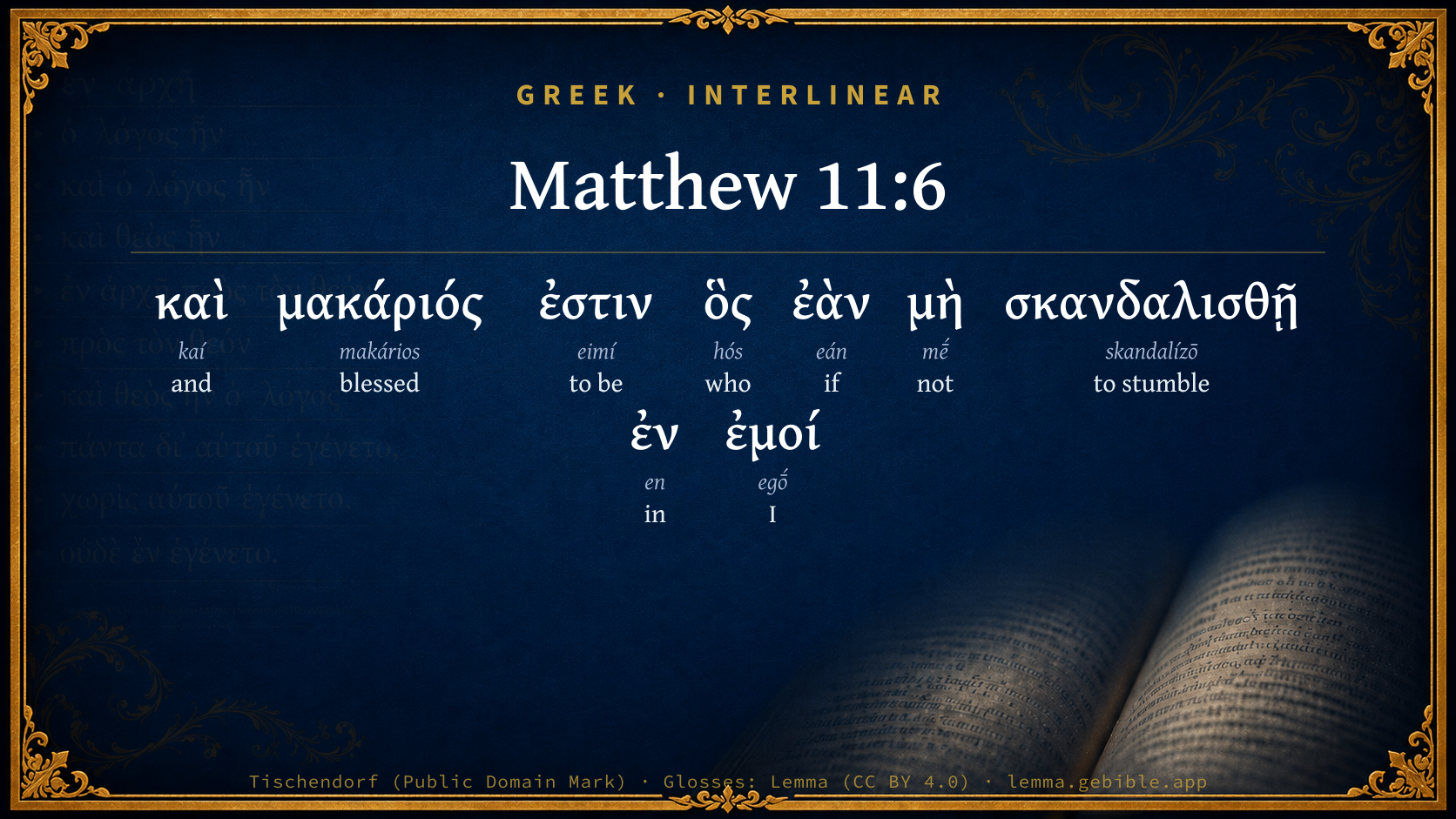
Greek (Tischendorf 8th ed.) Matthew 11:6 appears in the Greek New Testament. The text above is from the Tischendorf 8th edition. Each word links to its Strong’s number and a concise gloss. Click any word for its full Thayer’s Greek Lexicon entry.
Download image
Cite this verse

Matthew 11:6 (World English Bible). Public Domain. Lemma interlinear Bible study tool, https://lemma.gebible.app/v/matthew/11/6.

Show BibTeX & RIS
BibTeX
RIS
English Translation
Blessed is he who finds no occasion for stumbling in me."
World English Bible · Public Domain
Download a study sheet

One document with this verse’s original text, its word-by-word gloss line, the meaning frame, cross-references with their text, attributed commentary, and full source and license credits — printable, and it pastes into notes with its structure intact.

This verse Autodidact and up

Study sheet (.html) Plain text (.txt)

A passage Seminary Student

Up to 50 verses in one chapter. A passage sheet keeps up to 6 commentary sources and 12 cross-references per verse, in the order this page ranks them, and says so on the sheet whenever that leaves anything out. Ask for a single verse and you get the Autodidact verse sheet above.

Everything on this page stays free to read, with no account — the sheet is a download of what is already on screen, not access to it.

Want to remove ads? Support Godless Engineer
Compare translations 3

The same verse in 3 English versions, stacked beneath the original-language interlinear above. Click any original word for its lexicon entry.

Each is an independent rendering of the whole verse — the interlinear is not word-aligned to these translations.

Highlighted words mark where these versions differ — a whole-verse word diff, not a word-by-word alignment.

  • World English Bible Public Domain
    Blessed is he who finds no occasion for stumbling in me."
  • King James Version Public Domain
    And blessed is he, whosoever shall not be offended in me.
  • unfoldingWord Literal Text CC BY-SA 4.0
    And blessed is whoever is not caused to stumble on me.”

unfoldingWord Literal Text — © unfoldingWord, licensed CC BY-SA 4.0. Word-aligned USFM3 via Door43 (git.door43.org/unfoldingWord/en_ult).

Versions to compare (up to 4)

3 of 4 selected

Show all 19 translations

Every available English version of this verse, each an independent rendering of the whole verse.

  • World English Bible Public Domain
    Blessed is he who finds no occasion for stumbling in me."
  • Berean Standard Bible Public Domain
    Blessed is the one who does not fall away on account of Me.”
  • Majority Standard Bible Public Domain
    Blessed is the one who does not fall away on account of Me.”
  • King James Version Public Domain
    And blessed is he, whosoever shall not be offended in me.
  • American Standard Version (1901) Public Domain
    And blessed is he, whosoever shall find no occasion of stumbling in me.
  • Revised Version (1885) Public Domain
    And blessed is he, whosoever shall find none occasion of stumbling in me.
  • Geneva Bible (1599) Public Domain
    And blessed is he that shall not be offeded in me.
  • Douay-Rheims (1899) Public Domain
    And blessed is he that shall not be scandalized in me.
  • Young's Literal Translation Public Domain
    and happy is he who may not be stumbled in me.'
  • Literal Standard Version CC BY-SA 4.0
    and blessed is he who may not be stumbled in Me.”
  • Unlocked Literal Bible CC BY-SA 4.0
    Blessed is anyone who is not offended by me.”
  • unfoldingWord Literal Text CC BY-SA 4.0
    And blessed is whoever is not caused to stumble on me.”
  • Darby Bible Public Domain
    and blessed is whosoever shall not be offended in me.
  • World Messianic Bible Public Domain
    Blessed is he who finds no occasion for stumbling in me.”
  • Webster's Bible Public Domain
    And blessed is he to whom I shall not be the cause of his falling into sin.
  • Free Bible Version CC BY-SA 4.0
    Blessed are those who don't reject me!”
  • Bible in Basic English Public Domain
    And a blessing will be on him who has no doubts about me.
  • Text-Critical English NT CC BY 4.0
    And blessed is anyone who does not take offense at me.”
  • Tyndale New Testament (1534) Public Domain
    And happy is he that is not offended by me.

Literal Standard Version (2020), Covenant Press — licensed CC BY-SA 4.0. Text via the HelloAO Bible API (eBible.org). Unlocked Literal Bible (unfoldingWord) — licensed CC BY-SA 4.0. Text via the HelloAO Bible API (eBible.org). unfoldingWord Literal Text — © unfoldingWord, licensed CC BY-SA 4.0. Word-aligned USFM3 via Door43 (git.door43.org/unfoldingWord/en_ult). Free Bible Version, Dr. Jonathan Gallagher — licensed CC BY-SA 4.0. Text via the HelloAO Bible API (eBible.org).

Word by word

More ways to search: Search by grammar → Find every occurrence → Compare this word →

Practice this passage: Drill this verse → Learn its vocabulary →

σκανδαλισθῇ
skandalízō
G4624
“to stumble”
Verb, Aorist, Passive, Subjunctive, 3rd person, Singular
Part of Speech
Verb
Tense
Aorist
Voice
Passive
Mood
Subjunctive
Person
3rd person
Number
Singular
Full Thayer's Definition

Origin: from G4625

TDNT: 12:39,1

1. to put a stumbling block or impediment in the way, upon which another may trip and fall, metaph. to offend a. to entice to sin b. to cause a person to begin to distrust and desert one whom he ought to trust and obey 1. to cause to fall away 2. to be offended in one, i.e. to see in another what I disapprove of and what hinders me from acknowledging his authority 3. to cause one to judge unfavourably or unjustly of another c. since one who stumbles or whose foot gets entangled feels annoyed 1. to cause one displeasure at a thing 2. to make indignant 3. to be displeased, indignant
  1. καὶ kaí G2532 “and” Conjunction
  2. μακάριός makários G3107 “blessed” Adjective, Nominative, Singular, Masculine
  3. ἐστιν eimí G1510 “to be” Verb, Present, Active, Indicative, 3rd person, Singular
  4. ὃς hós G3739 “who” Relative pronoun, Nominative, Singular, Masculine
  5. ἐὰν eán G1437 “if” Conditional
  6. μὴ mḗ G3361 “not” Particle, Negative
  7. ἐν en G1722 “in” Preposition
  8. ἐμοί egṓ G1473 “I” Personal pronoun, 1st person, Dative, Singular

About this verse

These counts appear in no published source. They are computed here, from the morphology-tagged text and Lemma’s own curated glosses. What Lemma adds →

9
words
9
distinct lemmas
Gospels
section

Shared distinctive vocabulary

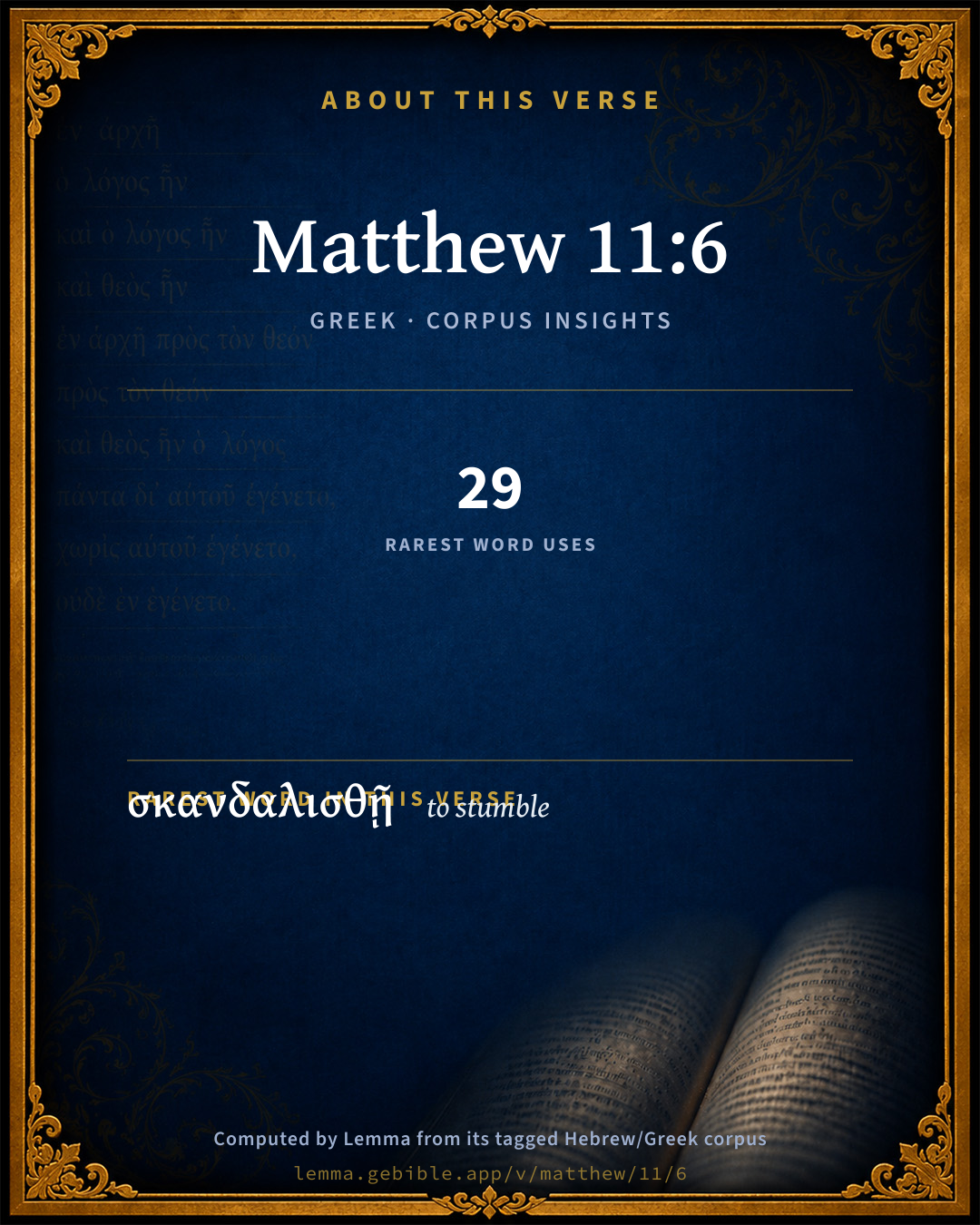
σκανδαλισθῇ to stumble G4624 occurs in 27 verses of the Greek New Testament. Also found in:
Cross-references

21

Topical passages linked to Matthew 11:6 in the Treasury of Scripture Knowledge — connected by theme and wording, ordered by reader-vote popularity; previews shown in the World English Bible.

  • Isaiah 8:14–15 He shall be for a sanctuary; but for a stone of stumbling and for a rock of offense to both the houses of Israel, for a gin and for a snare to the inhabitants of Jerusalem.
  • 1 Corinthians 2:14 Now the natural man doesn't receive the things of God's Spirit, for they are foolishness to him, and he can't know them, because they are spiritually discerned.
  • Matthew 26:31 Then Jesus said to them, "All of you will be made to stumble because of me tonight, for it is written, 'I will strike the shepherd, and the sheep of the flock will be scattered.'
  • John 6:66 At this, many of his disciples went back, and walked no more with him.
  • Matthew 24:10 Then many will stumble, and will deliver up one another, and will hate one another.
  • Luke 4:23–29 He said to them, "Doubtless you will tell me this parable, 'Physician, heal yourself! Whatever we have heard done at Capernaum, do also here in your hometown.'"
  • Luke 11:27–28 It came to pass, as he said these things, a certain woman out of the multitude lifted up her voice, and said to him, "Blessed is the womb that bore you, and the breasts which nursed you!"
  • John 6:60–61 Therefore many of his disciples, when they heard this, said, "This is a hard saying! Who can listen to it?"
  • Romans 9:32–33 Why? Because they didn't seek it by faith, but as it were by works of the law. They stumbled over the stumbling stone;
  • Matthew 13:55–57 Isn't this the carpenter's son? Isn't his mother called Mary, and his brothers, James, Joses, Simon, and Judas?
  • 1 Peter 2:8 and, "A stone of stumbling, and a rock of offense." For they stumble at the word, being disobedient, whereunto also they were appointed.
  • Matthew 15:12–14 Then the disciples came, and said to him, "Do you know that the Pharisees were offended, when they heard this saying?"
  • Matthew 18:7 "Woe to the world because of occasions of stumbling! For it must be that the occasions come, but woe to that person through whom the occasion comes!
  • 1 Corinthians 1:22–23 For Jews ask for signs, Greeks seek after wisdom,
  • Psalms 1:1–2 Blessed is the man who doesn't walk in the counsel of the wicked, Nor stand in the way of sinners, Nor sit in the seat of scoffers;
  • Psalms 32:1–2 Blessed is he whose disobedience is forgiven, Whose sin is covered.
  • Psalms 119:1 Blessed are those whose ways are blameless, Who walk according to Yahweh's law.
  • Galatians 5:11 But I, brothers, if I still preach circumcision, why am I still persecuted? Then the stumbling-block of the cross has been removed.
  • Luke 2:34 and Simeon blessed them, and said to Mary, his mother, "Behold, this child is set for the falling and the rising of many in Israel, and for a sign which is spoken against.
  • John 7:41–42 Others said, "This is the Christ." But some said, "What, does the Christ come out of Galilee?
  • Matthew 5:3–12 "Blessed are the poor in spirit, For theirs is the Kingdom of Heaven.

Cross-references courtesy of OpenBible.info (CC BY 4.0).

Commentary

Notes on Matthew 11:6 from classic Christian and Jewish commentators (each source and its license shown beneath its notes). The classic Christian expositions comment on the surrounding passage and are grouped to its opening verse, so a note may address several verses; the Jewish commentaries on the Tanakh (Rashi and others) are per-verse, so they appear only where the commentator wrote on this verse.

Lemma curates 59 commentaries, every one of them public domain or Creative Commons licensed, each selected and text-cleaned for this edition rather than reprinted as found. About our sources →

The Biblical Illustrator

Joseph S. Exell

Mat_11:6

And blessed is he, whosoever shall not be offended in Me.

The prejudices against Christianity considered

I. Those prejudices and objections which the world had against the saviour and his religion at their first appearance; also to inquire into those which men at this day insist upon; and to show the unreasonableness of them.

1. That Christianity was a great innovation, and contrary to the received institutions of the world.

2. They objected against the plainness and simplicity of the doctrine.

3. That it wanted demonstration.

4. That the low and suffering condition of our Saviour was unsuitable to one that pretended to be the Son of God.

II. To consider the prejudices and objections which men at this day insist upon against our saviour and his religion.

1. Some that relate to the incarnation of our Saviour.

2. To the time of His appearance. Why did He not come sooner?

3. That we have not now sufficient evidence of the truth of Christianity.

4. That the terms of it seem very hard, and to lay too great restraints upon human nature.

5. That it is apt to despoil men, and to break the vigour and courage of their minds.

6. The divisions and factions that are among Christians.

7. The wicked lives of the greatest part of the professors of Christianity.

III. How happy a thing it is to escape the common prejudices men are apt to entertain against religion-Blessed is he, etc. This will appear if we consider-

1. That prejudice does many times sway and bias men against the plainest truths.

2. Prejudice will bias men in matters of the greatest concernment, in things that concern the honour of God and the good of others and our own welfare.

3. The consequences of mens prejudices in these things prove many times fatal and destructive.

4. There are few in comparison who have the happiness to escape and overcome the common prejudices which men are apt to entertain against religion. (J. Tillotson, D. D.)

Taking offence at the gospel

I. what are the offences which are generally taken at the gospel of Christ?

1. The poverty and meanness in which our Saviour appeared was the earliest objection to the gospel. This prejudice arises from a false conception of the power and majesty of God, as if the success of His purposes depended upon the visible fitness of the instruments He made choice of; or as if the majesty of God wants the little supports of outward pomp as that of man does. But would the advantages with respect to men have been greater had Christ appeared in greater splendour? The majesty of God must be veiled to be seen by the human eye. But did not Christ give sight to the blind, and triumph over death? Do princes and greatest men perform such works? Do these not manifest Divine power?

2. The next offence is that men do not find the wisdom they seek after in the gospel.

(1) But this objection must rise to our creation, with God for not making us wiser than we are.

(2) This objection does not affect the practice of religion.

(3) That the gospel has given us the greatest evidence for the certainty of those things that can be desired.

3. The last offence is that the gospel contains mysterious truths.

(1) This objection does not reach the gospel use of the word, nor can affect the mysteries contained in the gospel.

(2) That the use of the word, which is liable to this objection, does not in any way belong to the gospel; nor are there any such mysteries in the gospel as may justify the complaint made against them. (T. Sherlock, D. D.)

Offended with Christ

I. There are some who are so offended in christ that they never, trust him at all or accept him as their Saviour.

1. Some in His own day were offended with Him because of the humbleness of His appearance. They said, He is the sun of a carpenter.

2. There are others who reject Him because of the fewness of His followers.

3. Some are offended with Christ because of the grandeur of His claims. He claims to be God.

4. Some are offended with our Lord because of His atonement.

5. Some are offended because of the graciousness of the gospel. They prefer works.

6. Some are offended because of the holiness of His precepts. They like liberty to sin.

II. There are some who join the church of Jesus Christ who after a time are offended.

1. Because the novelty wears off.

2. Because they thought that they were always going to be happy.

3. Because they have met an opposition they did not expect from their enemies.

4. Because they began to find that religion entailed more self-denial than they had reckoned upon.

5. Because of the hard speeches of those who ought to have encouraged them.

6. Because of the ill conduct of professors.

7. Through trials of providence.

III. There are some who are not offended in Christ, and they are declared to be blessed.

1. Apart from anything else it is a blessed thing to have grace enough given you to hold fast to Christ under all circumstances.

2. Then you shall find a blessedness growing out of your fidelity,

3. But what blessedness awaits you. (C. H. Spurgeon.)

I. Who are the persons that are offended at Christ?

1. Those who discredit the authenticity of His Word.

2. Who deny the Divinity of His Person.

3. Who reject the efficacy of His atonement.

4. Wide despise the influences of His Spirit.

5. Who backslide from the profession of His name.

II. The things at which they are offended.

1. The meanness of His birth.

2. The sufferings of His life.

3. The simplicity of His doctrines,

4. The poverty of His followers.

5. The ignominy of His death.

III. The blessedness of those who are not offended at Christ.

1. Divine peace (Psa_119:1-176.).

2. Divine comforts (Psa_89:16).

3. Divine care (1Pe_5:7).

4. Divine honours (1Sa_2:30).

5. Eternal reward,

6. To be offended at Christ displays the greatest ignorance. (The Pulpit.)

The offence of Christ

I. With regard to those things which render the redeemer an offence to the world.

1. The mysterious constitution of His nature.

2. The humbling tendency of the doctrines.

3. The exclusive character of His religion.

II. The blessedness of those who are not offended in the Saviour. How is it that some embrace the Saviour, and others are offended at Him? The reception of Him is the result of Divine illumination.

III. The best means of attaining this blessedness.

1. Earnest Prayer.

2. Seek God in His Word.

3. A holy life. (E. Thompson, M. A.)

Offences against Christianity no just grounds for infidelity

1. The objections grounded on the nature of the religion, and what it has effected.

2. On the controversies about it.

3. On the conduct of its professors. (S. Jenner, B. A.)

Offended in Christ

The fact that our Lord directed His reply to John himself, for his personal satisfaction. John knew that Jesus was Messiah, but he did not know that His kingdom was to be a spiritual, not a temporal one. Two objections were taken against Christ of old. Jews pretended that His condition of life was too low and mean for what their prophets had taught them to expect; and the Gentiles objected to His doctrine, as not displaying enough of what they called wisdom. He should have come as a philosopher, or as a temporal king. But He did come, unassisted by human power, or dignity, or wisdom, and thus He was-

I. Enabled to be the pattern of all virtue.

II. The spread of His kingdom in so short a time, the more fully displays the hand of God.

III. His miracles acquire a greater degree of evidence, and-

IV. What He taught is now not liable to be charged with those suspicions, which royalty and conquest would justly have raised. (Zachary Pearce.)

Offences taken at Christianity

I. It is not to be expected that a religion, though truly Divine, should be entirely exempt from everything of difficulty, or liable to no manner of objection.

II. Not a few of the offences taken at religion, at that of Jesus in particular, may, they do in fact, arise entirely from men themselves, rather than from any real occasion that religion gives for them.

III. Many of the particular occasions of offence taken at the Saviour had been themselves actually predicted.

IV. No objections brought against Christianity should be considered alone; they, and the evidence it produces in its favour, should be considered together. The chief objections are-

(1) The needlessness of any supernatural revelation;

(2) the want of universality in Christianity;

(3) the weakness of the evidence produced in its favour;

(4) the difficulties found in some of the peculiar and sublime doctrines of the gospel;

(5) the disagreements among those who profess the gospel;

(6) the stress which Christianity lays upon faith;

(7) the difficulties of its precepts;

(8) the inconsistencies of professors. (John Hodge.)

Message of Christ to one beginning to be offended

John, in prison, hears of the great progress of the kingdom he has heralded, and cannot understand why he is left unaided, seemingly unpitied, to perish. Not for want of power, surely; the hand that healed the sick could open the prison. If for want of will, can this be the real King? Why does the axe not smite the overshadowing tree of wickedness; why does the fan not winnow the evil from the good? So he sends his message of remonstrance and indignation. To this Christ gives a twofold answer. He bids Johns disciples tell their master of His works and of His word, of His miracles and of His teaching.

I. Miracles, i.e., not merely things to wonder at, but signs that the supernatural kingdom of righteousness wrought by a power, a will, a voice outside of and acting on nature; telling us that this order of nature may yet be completely changed for a higher and better, in which it shall be as unnatural for man to suffer, sorrow, and die, as it is now natural. But the exercise of this power was limited. Only some of the sick were healed and dead raised. To assure us that eventually all shall be, we need, besides the evidence of Christs works, the declaration of His-

II. Word-to the poor the gospel is preached. Why is this significant? Because poverty is only another word for human imperfection and weakness. The life of humanity on earth is a life of struggle with nature. In proportion as man subdues the earth, progress, civilization, and wealth increase. But all are not equally fitted for this struggle; hence, while the strong frame, keen intellect, resolute will, conquer circumstances, the weak suffer and hunger. But in the kingdom of heaven there is a gospel for the poor. God has another world, in which to redress the inequalities of this, where the poor shall hunger and thirst no more, and where God shall wipe away the tears from all eyes. This gospel for the poor is no myth or mirage begotten of the fevered thirst of mans soul. Deeprooted in historic fact lie the reasons of this promise. The city of God that is to come down from heaven has had its foundation-stone laid already upon earth. The gospel for the poor is the gospel of the resurrection. He who preaches it, stands beside an open grave. Moreover, the glory to come is linked with present suffering as its result and fruit. The law of the heavenly kingdom requires that the sin which hinders our happiness should be burnt out by sorrow, and that we should bear the chastening cross in this life. While the rich man is told that if he would walk heavenward he must be ready to part with riches and become poor at Christs bidding, the poor man is comforted with the knowledge that weariness, sorrow, toil, suffering, and disappointment, if taken up as a cross, if lifted as a burden the Saviour has appointed, will bear rich fruit in heaven. Thus, out of suffering comes joy; out of sorrow, eternal peace; and so the trials of the poor man in this world are made his spiritual wealth in the world to come. (Bishop W. C. Magee.)

Offended by faithful preaching

Mr. Dodd, having preached against the profanation of the Sabbath, which much prevailed in his parish, and especially among the more wealthy inhabitants, the servant of a nobleman, who was one of them, came to him and said, Sir, you have offended my lord to-day. Mr. Dodd replied, I should not have offended your lord, except he had been conscious to himself that he had first offended my Lord; and if your lord will offend my Lord, let him be offended.

The ready way to blessedness

I. What it is to be offended in Christ.

1. It supposes some offer and revelation made to us, that grace is brought home to us and salvation offered to us.

2. It implieth such an offence that either they are kept off from Christ, or else drawn away from Him.

II. Upon what occasions men were offended in Christ.

1. They were displeased with His Person.

2. They were offended at His doctrine.

3. The great stumbling-block of all was His sufferings.

III. Was it not proper to that age only? There is danger still:-

1. Because, though the name of Christ be had in honour, yet the stricter profession of godliness is under reproach.

2. It may happen that the stricter sort of Christians are the poorer, and so may be despised of men.

3. Though men be not distasted against Christianity as a whole, yet in part, at some of its ways.

4. There is no man but if he run up his refusal of Christ to its proper principle he will find it to be some dislike, either from the inward constitution of his own mind, or the external state of religion in the world.

What is likely to offend since Christs exaltation into heaven?

1. The many calamities which attend the profession of religion.

2. They may take offence at Christs doctrine, at the purity, self-denial, the simplicity, the mysteriousness of it.

IV. The kinds of this sin of being offended in Christ.

1. There is an offence with contempt, and an offence with discouragement.

2. There is an offence of ignorance, and an offence of malice and opposition.

3. There is a total, and there is a partial, offence.

V. How is it true that those that escape this sin are in the ready way to salvation?

1. He that is not offended but evangelized, hath the power and virtue of the gospel stamped upon his heart.

2. The esteem produceth uniform obedience.

3. We are better fortified against temptations to apostasy-errors, scandals, and persecutions.

VI. Make use of this caution. Take heed of being offended in Christ.

1. Who are in danger of it.

2. The heinousness of it.

(1) It is unreasonable.

(2) Natural.

(3) Dangerous.

3. What shall we do to avoid it?

(1) Get a clear understanding;

(2) a mortified heart;

(3) a fervent love. (T. Manton, D. D.)

The Biblical Illustrator, edited by Joseph S. Exell (c. 1880s–1900s) — public domain. Text from a community e-Sword module.

Tyndale Open Study Notes

Tyndale Open Resources

11:6 who do not fall away because of me: The works listed in 11:5 were intended to drive John and his disciples to a decision regarding Jesus. Jesus was aware, however, that certain unexpected elements of his ministry would cause some to reject him.

Tyndale Open Study Notes — © Tyndale Open Resources, licensed CC BY-SA 4.0. Text via the HelloAO Bible API.

Bengel's Gnomon

Johann Albrecht Bengel

Mat 11:6. Μακάριος, blessed) A rare felicity. That very circumstance, that many should be offended in Him, was foretold as a sign of the Messiah.[514] He loaded others with benefits; He Himself was weak, poor, despised.—ὃς ἐὰν, whosoever) especially of the disciples of John, who saw the difference between his mode of living and that of our Lord. See Mat 11:18-19.

[514] Isa 52:14. That very fact was an argument likely to be easily appreciated, especially by the disciples of John. See Mat 11:18, with which comp. Mat 11:19.—V. g.

Bengel's Gnomon of the New Testament — English translation (T&T Clark, Edinburgh, 1860) — public domain. Text from a community e-Sword module.

Expositor's Greek Testament

ed. W. Robertson Nicoll

Mat 11:6 . μακάριος ( vide Mat 5:3 ), possessed of rare felicity. The word implies that those who, on some ground or other, did not stumble over Jesus were very few. Even John not among them! On σκανδαλίζω vide ad. Mat 5:29 . ἐν ἐμοί , in anything relating to my public ministry, as appearing inconsistent with my Messianic vocation.

The Expositor's Greek Testament, edited by W. Robertson Nicoll (1897–1910) — public domain. Text from a community e-Sword module.

Adam Clarke's Commentary

Verse 6. Blessed is he whosoever shall not be offended in me.] Or, Happy is he who will not be stumbled at me; for the word σκανδαλιζεσθαι, in its root, signifies to hit against or stumble over a thing, which one may meet with in the way. The Jews, as was before remarked, expected a temporal deliverer. Many might he tempted to reject Christ, because of his mean appearance, c., and so lose the benefit of salvation through him. To instruct and caution such, our blessed Lord spoke these words. By his poverty and meanness he condemns the pride and pomp of this world. He who will not humble himself, and become base, and poor, and vile in his own eyes, cannot enter into the kingdom of God. It is the poor, in general, who hear the Gospel the rich and the great are either too busy, or too much gratified with temporal things, to pay any attention to the voice of God.

Adam Clarke's Commentary on the Bible (1810–1826) — public domain. Text from a community e-Sword/MySword module.

Ellicott's Commentary for English Readers

(6) Blessed is he.—The words at once confirm the view that the question which the messengers had brought came from the Baptist himself, and show how tenderly our Lord dealt with the impatience which it implied. A warning was needed, but it was given in the form of a beatitude which it was still open to him to claim and make his own. Not to find a stumbling-block in the manner in which the Christ had actually come, that was the condition of entering fully into the blessedness of His kingdom.

A Bible Commentary for English Readers, edited by Charles John Ellicott (1878–1897) — public domain. Text from a community e-Sword module.

The Cambridge Bible for Schools and Colleges

gen. ed. J. J. S. Perowne

6. And blessed is he] Blessed are all who see that these works of mine are truly the works of the Messiah. Some had thought only of an avenging and triumphant Christ.

blessed] A term that denotes spiritual insight and advance in the true life.

The Cambridge Bible for Schools and Colleges (gen. ed. J. J. S. Perowne; Cambridge University Press, 1878–1918) — public domain. Text from a community e-Sword module.

John Gill's Exposition

And blessed is he whosoever shall not be offended in me. The Jews were offended at Christ's parentage and birth, at the poverty of his parents, and at the manner of his birth, by a virgin; and at the place of his birth, which they thought to be Galilee; at his education, because he had not learnt letters, and was brought up to a mechanical employment; at his mean appearance in his public ministry, in his own person, and in his attendants: his company and audience being the poorer sort, the more ignorant, and who had been loose and scandalous persons, publicans and sinners; at the doctrines he preached, particularly, which respected his own deity and eternity, the distinguished grace of God, and living by faith upon his flesh and blood. The disciples of John also were offended in him, because he and his disciples did not fast, and lead such an austere life as they and their master did; because of the meanness and obscurity of Christ's kingdom; the imprisonment of John, and the many reproaches, afflictions, and persecutions, which did, and were likely to attend a profession of Christ: this our Lord knew, and had a peculiar respect to them in these words; but happy are those persons, who, notwithstanding all these difficulties and discouragements, are so far from stumbling at Christ, and falling from him, that they heartily receive him and believe in him, make a profession of him, and hold it fast; greatly love, highly value, and esteem him, and are willing to part with all, and bear all for his sake: these are blessed, notwithstanding all their sufferings for him even now; they have spiritual peace, joy, and comfort in their souls, and shall be happy in the full enjoyment of him to all eternity.

And blessed is he whosoever shall not be offended in me. The Jews were offended at Christ's parentage and birth, at the poverty of his parents, and at the manner of his birth, by a virgin; and at the place of his birth, which they thought to be Galilee; at his education, because he had not learnt letters, and was brought up to a mechanical employment; at his mean appearance in his public ministry, in his own person, and in his attendants: his company and audience being the poorer sort, the more ignorant, and who had been loose and scandalous persons, publicans and sinners; at the doctrines he preached, particularly, which respected his own deity and eternity, the distinguished grace of God, and living by faith upon his flesh and blood. The disciples of John also were offended in him, because he and his disciples did not fast, and lead such an austere life as they and their master did; because of the meanness and obscurity of Christ's kingdom; the imprisonment of John, and the many reproaches, afflictions, and persecutions, which did, and were likely to attend a profession of Christ: this our Lord knew, and had a peculiar respect to them in these words; but happy are those persons, who, notwithstanding all these difficulties and discouragements, are so far from stumbling at Christ, and falling from him, that they heartily receive him and believe in him, make a profession of him, and hold it fast; greatly love, highly value, and esteem him, and are willing to part with all, and bear all for his sake: these are blessed, notwithstanding all their sufferings for him even now; they have spiritual peace, joy, and comfort in their souls, and shall be happy in the full enjoyment of him to all eternity.

Matthew 11:7

mat 11:7

mat 11:7

mat 11:7And as they departed,.... That is, the messengers of John, Luk 7:24 when they returned to their master, to give an account to him of what they had heard and seen,

Jesus began to say unto the multitudes concerning John; he took this opportunity before the whole company, who had heard what passed in conversation between him and the disciples of John, to say some things concerning his character and ministry: and which he did, partly to rectify and remove any wrong opinion they might have conceived of him, from this message of his, as if he had retracted his former sentiments concerning Christ, at least was wavering and doubtful about him; and partly, to put them in mind of their former zeal and attachment to John's ministry, when they went out in large bodies to attend upon it; and to revive a good opinion of him; and signifies, that they would do well to ask themselves, what views they had in attending on him, and how they came to grow indifferent to so great a man: and Christ, by giving an account of his character and office, confirms his own Messiahship; and this commendation of John, he chose to enter into, after the departure of his messengers, lest what he said of him should be interpreted as mere flattery:

what went ye out in the wilderness to see? This refers to Mat 3:5 where we read, that great numbers from Jerusalem, Judea, and the country round about Jordan, went out into the wilderness of Judea, where John came preaching, to hear him, and be baptized by him; and our Lord asks, what was it that led such multitudes of them into the wilderness? What did they expect to see there?

A reed shaken with the wind? This may either refer to John's gesture in preaching, who might wave to and fro as a reed does, when shaken by the wind; and Christ's question is, did ye go out only to see and observe the preacher's gesture, to see him move his body to and fro? Was it not to hear his doctrine, and receive benefit for your souls? And did you not? Wherefore, you ought still to retain a valuable respect for him. Or this may regard their opinion of him; and the sense of the interrogation is, when you first went out to him, did you take him to be an unstable, inconstant man? Like a reed shaken with every wind! If you did, you were mistaken; he was firm and stable in his sentiments and ministry, his preaching was not yea and nay, his doctrine was all of a piece; he stood to it, that he was not the Messiah, but his forerunner; the testimony he bore was always alike, consistent with himself, and he is the same man now he ever was. The Jews use this comparison of a man to a reed, in a sense just the reverse, and make it to signify constancy, and not inconstancy, as well as tenderness, in opposition to roughness, severity, and stubbornness.

"Let a man (say they (w)) be always , "tender as a reed", and let him not be hard and stubborn as a cedar: when the four winds of the world go out, the reed goes and comes with them; and when the winds are still, the reed stands in its place.''

So they observe (x), that it is said, that "the Lord shall smite Israel, as a reed shaken in the water", Kg1 14:15 which they interpret by way of blessing.

"As a reed (say they) stands in a place of water, its body waves about, and its roots are many; and though all the winds in the world come and blow upon it, they cannot move it out of its place, but it goes and comes with them; and when the winds are still, the reed stands in its place.''

(w) Derech Eretz, fol. 18. 1. (x) T. Bab. Taanith, fol. 20. 1.

John Gill's Exposition of the Whole Bible (1746–1763) — public domain (CC PDM 1.0). Text via the HelloAO Bible API.

Trapp's Complete Commentary

John Trapp

6 And blessed is he, whosoever shall not be offended in me.

Ver. 6. And blessed is he, &c.] This he adds, as correcting the preposterous emulation of John’s disciples, who stumbled also at his meanness. Howbeit our Saviour saith not, Cursed be ye for being offended in me; but, Blessed is he, &c. God’s tender lambs must be gently handled. Evangelizatum, non maledictum missus es, said Oecolampadius to Farellus, who was a most excellent preacher, but over carried perhaps sometimes by his zeal for God. Laudo zelum, mode non desideretur mansuetudo, &c. I commend thine earnestness (as he there goeth on), so thou mingle it with mildness. Wine and oil are in their several seasons to be poured into men’s wounds. Show thyself to be a gentle evangelist, and not a tyrannical law maker.

John Trapp, A Commentary or Exposition upon All the Books of the Old and New Testament (1647–1656) — public domain. Text from a community e-Sword module.

Albert Barnes' Notes on the Bible

And blessed is he ... - The word “offence” means a “stumbling-block.” See the notes at Mat 5:29. This verse might be rendered, “Happy is he to whom I shall not prove a stumbling-block.” That is, happy is he who shall not take offence at my poverty and lowliness of life, so as to reject me and my doctrine. Happy is the one who can, notwithstanding that poverty and obscurity, see the evidence that I am the Messiah, and follow me. It is not improbable that John wished Jesus publicly to proclaim himself as the Christ, instead of seeking retirement. Jesus replied that he gave sufficient evidence of that by his works; that a man might discover it if he chose; and that he was blessed or happy who should appreciate that evidence and embrace him as the Christ, in spite of his humble manner of life.

Albert Barnes' Notes on the Bible (1834–1885) — public domain. Text from a community e-Sword/MySword module.

Haydock's Catholic Bible Commentary

Scandalized in me. That is, who shall not take occasion of scandal or offence from my humility, and the disgraceful death of the cross which I shall endure: (Challoner) or on my account, that is, at the doctrine of the cross; or when I shall die on an infamous cross. (Witham) --- Blessed is he, &c. That is, who shall not be offended by my doctrine or manners; for Christ was a stumbling block to many, but this was entirely their own fault. He seems indeed directly to mark the disciples of St. John, and at the same time to shew that he knew their hearts. (Menochius)

George Leo Haydock (1774–1849), Haydock's Catholic Family Bible and Commentary, 1859 edition — public domain. Excludes Psalms (Douay-Rheims chapter numbering differs from Protestant) and Deuterocanonical books (Catholic canon only).

Whedon's Commentary on the Bible

Daniel D. Whedon

6. Offended in me — The word offended, here as elsewhere means to be made to stumble; that is, to fall into sin by some misunderstanding. The Lord here utters a warning to John. To John, we say, for the singular pronoun, “Blessed is HE,” is so pointed as to be very unaccountable if it be not intended. The Baptist is not in wickedness; but he is in danger of being offended in Jesus. This brief and somewhat stern procedure constitutes the whole of his reply to John; and the disciples of John departed with it to their master.

Daniel D. Whedon (gen. ed.), Commentary on the Old and New Testaments (1874–1909) — public domain. Text from a community e-Sword module.

The Pulpit Commentary

And blessed is he, whosoever shall not be offended (Mat_5:29, note) in me; shall find none occasion of stumbling in me (Revised Version). But exhibits perfect trust under delay and disappointment. (Jam_1:12)

The Pulpit Commentary (1880–1919), ed. H.D.M. Spence-Jones & Joseph S. Exell — public domain. Text from a community e-Sword module.

John Wesley's Explanatory Notes

Happy is he who shall not be offended at me - Notwithstanding all these proofs that I am the Messiah.

John Wesley, Explanatory Notes Upon the Whole Bible (1754–1765) — public domain. Text via the GEBible commentary corpus.

Scofield Reference Notes

C. I. Scofield

blessed

In prison, the King rejected, John’s faith wavers; the Lord exhorts and encourages His servant. Cf. Joh 15:20; Isa 42:3.

The Scofield Reference Bible (1917 edition), notes by C. I. Scofield — public domain. Text from a community e-Sword module.

Burkitt's Expository Notes on the New Testament

William Burkitt

Our Saviour here, by pronouncing them blessed that are not offended in him, doth intimate the misery of those who stumble at him, and to whom he is the rock of offence. Some are offended at the poverty of his person, others at the sublimity and sanctity of his doctrine. Some are offended at his cross, others are offended at his free grace: but such as, instead of being offended at Christ, believe in him, and bottom their expectations of heaven and salvation upon him, are in a happy and blessed condition: Blessed is he that shall not be offended in me.

William Burkitt's Expository Notes on the New Testament (1700–1703) — public domain. Text from a community e-Sword module.

The People's New Testament

B. W. Johnson

6. Blessed is he whosoever shall not be offended in me. This is suggested by John's seeming to have stumbled, not fallen, because Christ had not publicly declared his mission. The Lord does not upbraid, but gives in this way a tender rebuke, implying that he knew what to do with reference to his kingdom.

B. W. Johnson's The People's New Testament with Notes (1889–1891) — public domain. Electronic text from the Christian Classics Ethereal Library (CCEL) ThML edition.

Cambridge Greek Testament for Schools and Colleges

6. καὶ μακάριος, κ.τ.λ. Blessed are all who see that these works of mine are truly the works of the Messiah. Some had thought only of an avenging and triumphant Christ.

μακάριος. A term that denotes spiritual insight and advance in the true life.

σκανδαλισθῇ. See note, ch. Mat 5:29. In this passage σκανδαλίζεσθαι has the force of being entrapped or deceived by false notions.

Cambridge Greek Testament for Schools and Colleges (Cambridge University Press, 1896; 21 vols, various authors incl. Carr, Maclear, Plummer, Farrar, Lumby, Moule, M. R. James, Simcox) — public domain. Text from a community e-Sword module.

Alford’s Greek Testament

Henry Alford

6.] See note on ver. 2.

Henry Alford, The Greek Testament (1849–1861) — public domain. Text from a community e-Sword module.

Vincent's Word Studies in the New Testament

Marvin R. Vincent

Be offended [σκανδαλισθη] . See on ch. Mt 5:29. Rev., shall find none occasion of stumbling. Compare Wyc., shall not be slandered.

Marvin R. Vincent, Word Studies in the New Testament (1887–1900) — public domain. Text from a community e-Sword/MySword module.

Lesson kit

Teaching starters — assembled from the data on this page, not authored interpretation. Every prompt links to the verse data it draws on. Edit before teaching.

Matthew, in the Gospels, opens this verse with 9 words (9 distinct Greek lemmas). Its most distinctive word is skandalízō (“to stumble”). A historical commentator’s framing appears above. Read the whole chapter for the surrounding context.

Discussion questions

  1. What does “to stumble” (skandalízō) contribute to the verse as a whole?
  2. Matthew 5:29 shares the word «to stumble» with this verse. How do the two illuminate each other?
  3. These translations render this verse differently. What is at stake in choosing one wording over another?
  4. Reading how The Biblical Illustrator and Tyndale Open Study Notes read this verse, where do the two commentators agree and where do they part?

Things to notice

Reading settings

Reading text

Shown beneath each verse's original-language words.

Old Testament
Old Testament edition

Read the OT as the Masoretic Hebrew (MT) or the Greek Septuagint (LXX).

English shown for the Greek Septuagint (in the Hebrew ↔ Greek comparison).

Comparing translations? Open the Compare panel on any verse page to stack up to four side by side.