
Matthew 6:34

Greek (Tischendorf 8th ed.) Matthew 6:34 appears in the Greek New Testament. The text above is from the Tischendorf 8th edition. Each word links to its Strong’s number and a concise gloss. Click any word for its full Thayer’s Greek Lexicon entry.
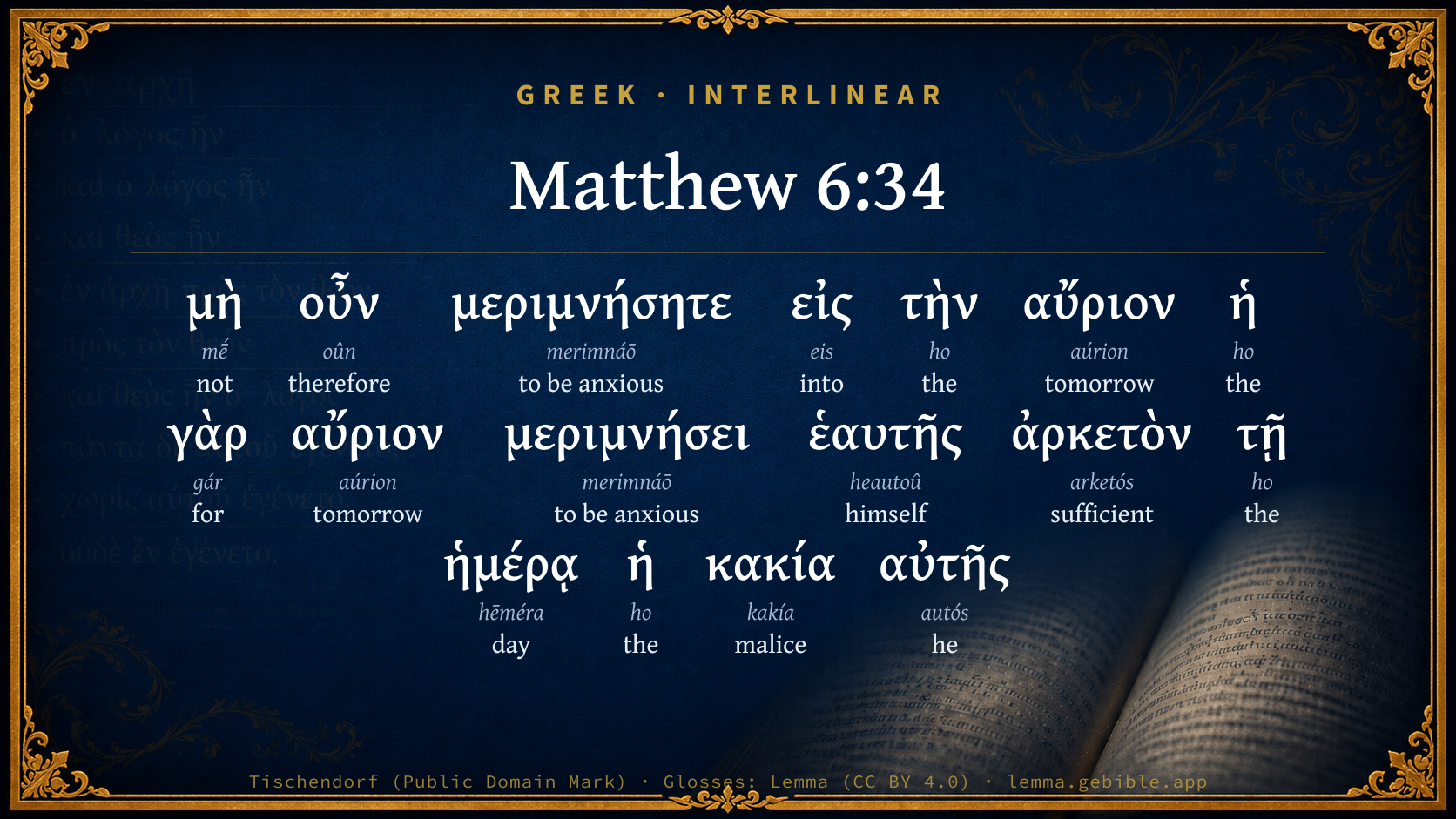
Download image
Cite this verse

Matthew 6:34 (World English Bible). Public Domain. Lemma interlinear Bible study tool, https://lemma.gebible.app/v/matthew/6/34.

Show BibTeX & RIS
BibTeX
RIS
English Translation
Therefore don't be anxious for tomorrow, for tomorrow will be anxious for itself. Each day's own evil is sufficient.
World English Bible · Public Domain
Highlights
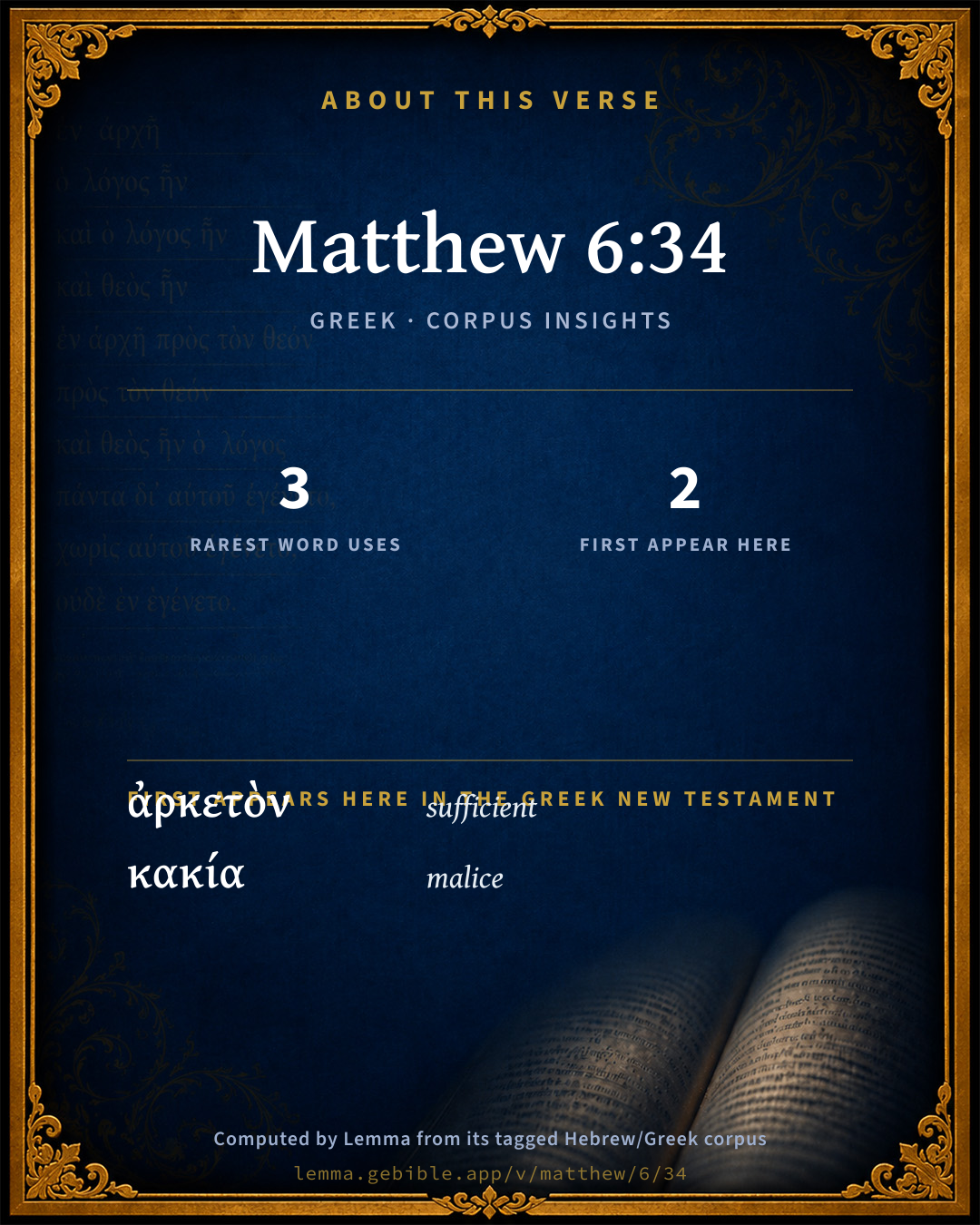
  • 2 first appearances in the Greek New Testament
Full analysis ↓
Download a study sheet

One document with this verse’s original text, its word-by-word gloss line, the meaning frame, cross-references with their text, attributed commentary, and full source and license credits — printable, and it pastes into notes with its structure intact.

This verse Autodidact and up

Study sheet (.html) Plain text (.txt)

A passage Seminary Student

Up to 50 verses in one chapter. A passage sheet keeps up to 6 commentary sources and 12 cross-references per verse, in the order this page ranks them, and says so on the sheet whenever that leaves anything out. Ask for a single verse and you get the Autodidact verse sheet above.

Everything on this page stays free to read, with no account — the sheet is a download of what is already on screen, not access to it.

Want to remove ads? Support Godless Engineer
Compare translations 3

The same verse in 3 English versions, stacked beneath the original-language interlinear above. Click any original word for its lexicon entry.

Each is an independent rendering of the whole verse — the interlinear is not word-aligned to these translations.

Highlighted words mark where these versions differ — a whole-verse word diff, not a word-by-word alignment.

  • World English Bible Public Domain
    Therefore don't be anxious for tomorrow, for tomorrow will be anxious for itself. Each day's own evil is sufficient.
  • King James Version Public Domain
    Take therefore no thought for the morrow: for the morrow shall take thought for the things of itself. Sufficient unto the day is the evil thereof.
  • unfoldingWord Literal Text CC BY-SA 4.0
    Therefore, you should not be anxious for tomorrow, for tomorrow will be anxious for itself. Sufficient for the day its evil.

unfoldingWord Literal Text — © unfoldingWord, licensed CC BY-SA 4.0. Word-aligned USFM3 via Door43 (git.door43.org/unfoldingWord/en_ult).

Versions to compare (up to 4)

3 of 4 selected

Show all 19 translations

Every available English version of this verse, each an independent rendering of the whole verse.

  • World English Bible Public Domain
    Therefore don't be anxious for tomorrow, for tomorrow will be anxious for itself. Each day's own evil is sufficient.
  • Berean Standard Bible Public Domain
    Therefore do not worry about tomorrow, for tomorrow will worry about itself. Today has enough trouble of its own.
  • Majority Standard Bible Public Domain
    Therefore do not worry about tomorrow, for tomorrow will worry about the things of itself. Today has enough trouble of its own.
  • King James Version Public Domain
    Take therefore no thought for the morrow: for the morrow shall take thought for the things of itself. Sufficient unto the day is the evil thereof.
  • American Standard Version (1901) Public Domain
    Be not therefore anxious for the morrow: for the morrow will be anxious for itself. Sufficient unto the day is the evil thereof.
  • Revised Version (1885) Public Domain
    Be not therefore anxious for the morrow: for the morrow will be anxious for itself. Sufficient unto the day is the evil thereof.
  • Geneva Bible (1599) Public Domain
    Care not then for the morowe: for the morowe shall care for it selfe: the day hath ynough with his owne griefe.
  • Douay-Rheims (1899) Public Domain
    Be not therefore solicitous for to morrow; for the morrow will be solicitous for itself. Sufficient for the day is the evil thereof.
  • Young's Literal Translation Public Domain
    Be not therefore anxious for the morrow, for the morrow shall be anxious for its own things; sufficient for the day `is' the evil of it.
  • Literal Standard Version CC BY-SA 4.0
    Therefore do not be anxious for tomorrow, for tomorrow will be anxious for its own things; sufficient for the day [is] the evil of it.”
  • Unlocked Literal Bible CC BY-SA 4.0
    Therefore, do not be anxious for tomorrow, for tomorrow will be anxious for itself. Each day has enough evil of its own.
  • unfoldingWord Literal Text CC BY-SA 4.0
    Therefore, you should not be anxious for tomorrow, for tomorrow will be anxious for itself. Sufficient for the day its evil.
  • Darby Bible Public Domain
    Be not careful therefore for the morrow, for the morrow shall be careful about itself. Sufficient to the day [is] its own evil.
  • World Messianic Bible Public Domain
    Therefore don’t be anxious for tomorrow, for tomorrow will be anxious for itself. Each day’s own evil is sufficient.
  • Webster's Bible Public Domain
    Therefore be not anxious for the morrow: for the morrow will be solicitous for the things of itself. Sufficient to the day is its own evil.
  • Free Bible Version CC BY-SA 4.0
    So don't worry about tomorrow, because tomorrow can worry about itself. There's already enough evil in every day.”
  • Bible in Basic English Public Domain
    Then have no care for tomorrow: tomorrow will take care of itself. Take the trouble of the day as it comes.
  • Text-Critical English NT CC BY 4.0
    “Therefore do not be anxious about tomorrow, for tomorrow will be anxious about its own matters. Sufficient for the day is its own trouble.
  • Tyndale New Testament (1534) Public Domain
    Care not then for the morow but let the morow care for it selfe: for the daye present hath ever ynough of his awne trouble.

Literal Standard Version (2020), Covenant Press — licensed CC BY-SA 4.0. Text via the HelloAO Bible API (eBible.org). Unlocked Literal Bible (unfoldingWord) — licensed CC BY-SA 4.0. Text via the HelloAO Bible API (eBible.org). unfoldingWord Literal Text — © unfoldingWord, licensed CC BY-SA 4.0. Word-aligned USFM3 via Door43 (git.door43.org/unfoldingWord/en_ult). Free Bible Version, Dr. Jonathan Gallagher — licensed CC BY-SA 4.0. Text via the HelloAO Bible API (eBible.org).

Word by word

More ways to search: Search by grammar → Find every occurrence → Compare this word →

Practice this passage: Drill this verse → Learn its vocabulary →

ἀρκετὸν
arketós
G713
“sufficient”
Adjective, Nominative, Singular, Neuter
Part of Speech
Adjective
Case
Nominative
Number
Singular
Gender
Neuter
Full Thayer's Definition

Origin: from G714

TDNT: 08:44,8

1. sufficient, enough
  1. μὴ mḗ G3361 “not” Particle, Negative
  2. οὖν oûn G3767 “therefore” Conjunction
  3. μεριμνήσητε merimnáō G3309 “to be anxious” Verb, Aorist, Active, Subjunctive, 2nd person, Plural
  4. εἰς eis G1519 “into” Preposition
  5. τὴν ho G3588 “the” Article, Accusative, Singular, Feminine
  6. αὔριον aúrion G839 “tomorrow” Adverb
  7. ἡ ho G3588 “the” Article, Nominative, Singular, Feminine
  8. γὰρ gár G1063 “for” Conjunction
  9. αὔριον aúrion G839 “tomorrow” Adverb
  10. μεριμνήσει merimnáō G3309 “to be anxious” Verb, Future, Active, Indicative, 3rd person, Singular
  11. ἑαυτῆς heautoû G1438 “himself” Reflexive pronoun, 3rd person, Genitive, Singular, Feminine
  12. τῇ ho G3588 “the” Article, Dative, Singular, Feminine
  13. ἡμέρᾳ hēméra G2250 “day” Noun, Dative, Singular, Feminine
  14. ἡ ho G3588 “the” Article, Nominative, Singular, Feminine
  15. κακία kakía G2549 “malice” Noun, Nominative, Singular, Feminine
  16. αὐτῆς autós G846 “he” Personal pronoun, Genitive, Singular, Feminine

About this verse

These counts appear in no published source. They are computed here, from the morphology-tagged text and Lemma’s own curated glosses. What Lemma adds →

17
words
12
distinct lemmas
Gospels
section

Notable vocabulary

The rarest word here is ἀρκετὸν sufficient G713 — appearing just 3 times in the whole Greek New Testament.

First appearance in Scripture

These words make their first canonical appearance in the Greek New Testament here:

  • ἀρκετὸν sufficient G713
  • κακία malice G2549

Shared distinctive vocabulary

ἀρκετὸν sufficient G713 occurs in 3 verses of the Greek New Testament. Also found in:
Repetition

Words recur within this verse:

  • μεριμνήσητε to be anxious G3309 ×2
  • αὔριον tomorrow G839 ×2
  • τὴν the G3588 ×4

Cross-references

14

Topical passages linked to Matthew 6:34 in the Treasury of Scripture Knowledge — connected by theme and wording, ordered by reader-vote popularity; previews shown in the World English Bible.

  • Matthew 6:25 Therefore, I tell you, don't be anxious for your life: what you will eat, or what you will drink; nor yet for your body, what you will wear. Isn't life more than food, and the body more than clothing?
  • John 14:27 Peace I leave with you. My peace I give to you; not as the world gives, give I to you. Don't let your heart be troubled, neither let it be fearful.
  • Hebrews 13:5–6 Be free from the love of money, content with such things as you have, for he has said, "I will in no way leave you, neither will I in any way forsake you."
  • John 16:33 I have told you these things, that in me you may have peace. In the world you have oppression; but cheer up! I have overcome the world."
  • Luke 11:3 Give us day by day our daily bread.
  • Lamentations 3:23 They are new every morning; great is your faithfulness.
  • 1 Kings 17:14–16 For thus says Yahweh, the God of Israel, The jar of meal shall not empty, neither shall the jar of oil fail, until the day that Yahweh sends rain on the earth.
  • Matthew 6:11 Give us today our daily bread.
  • 1 Kings 17:4–6 It shall be, that you shall drink of the brook; and I have commanded the ravens to feed you there.
  • 1 Thessalonians 3:3–4 that no one be moved by these afflictions. For you know that we are appointed to this task.
  • Acts 14:22 confirming the souls of the disciples, exhorting them to continue in the faith, and that through many afflictions we must enter into the Kingdom of God.
  • Exodus 16:18–20 When they measured it with an omer, he who gathered much had nothing over, and he who gathered little had no lack. They gathered every man according to his eating.
  • 2 Kings 7:1–2 Elisha said, Hear you the word of Yahweh: thus says Yahweh, Tomorrow about this time shall a measure of fine flour be [sold] for a shekel, and two measures of barley for a shekel, in the gate of Samaria.
  • Deuteronomy 33:25 Your bars shall be iron and brass; As your days, so shall your strength be.

Cross-references courtesy of OpenBible.info (CC BY 4.0).

Commentary

Notes on Matthew 6:34 from classic Christian and Jewish commentators (each source and its license shown beneath its notes). The classic Christian expositions comment on the surrounding passage and are grouped to its opening verse, so a note may address several verses; the Jewish commentaries on the Tanakh (Rashi and others) are per-verse, so they appear only where the commentator wrote on this verse.

Lemma curates 59 commentaries, every one of them public domain or Creative Commons licensed, each selected and text-cleaned for this edition rather than reprinted as found. About our sources →

Joseph Benson's Commentary

Mat 6:34. Take therefore no thought for the morrow — That is, for futurity, according to the Hebrew idiom, as the word is used, Gen 30:33. Since the extent and efficacy of the divine providence is so great, and since you are the objects of its peculiar care, you need not vex yourselves about futurity. For the morrow shall take thought for the things of itself — That is, be careful for the morrow when it comes. Sufficient unto the day is the evil thereof — Speaking after the manner of men. Every time has abundant necessary troubles of its own; so that it is foolish to increase present distresses by anticipating those that are to come, especially as by that anticipation it is not in your power to prevent any future evil. All trouble, however, is upon the whole a real good. It is good physic which God dispenses daily to his children, according to the need and strength of each. Here we may reasonably reflect, with the pious Dr. Doddridge, How kind are these precepts! The substance of which is only this, Do thyself no harm! Let us not be so ungrateful to him, nor so injurious to ourselves, as to harass and oppress our minds with that burden of anxiety, which he has so graciously taken off. Every verse speaks at once to the understanding, and to the heart. We will not therefore indulge these unnecessary, these useless, these mischievous cares. We will not borrow the anxieties and distresses of the morrow, to aggravate those of the present day. Rather we will cheerfully repose ourselves on that heavenly Father, who knows we have need of these things; who has given us the life, which is more than meat, and the body, which is more than raiment. And thus instructed in the philosophy of our heavenly Master, we will learn a lesson of faith and cheerfulness from every bird of the air, and every flower of the field.

Joseph Benson's Commentary on the Old and New Testaments (1811–1818) — public domain. Text from a community e-Sword module.

Bengel's Gnomon

Johann Albrecht Bengel

Mat 6:34. Ἠ αὒριον, κ.τ.λ., the morrow, etc.) A precept remarkable for Asteismus,[298] by which care, though apparently permitted on the morrow, is in fact forbidden altogether; for the careful make present cares even of those which are future, wherefore, to put off care is almost the same as to lay it aside. There is also a personification of the morrow (cf. Psa 19:2): “the day,” says our Lord, (not you) “shall take care.” He who has learnt this, will contract his cares at length from the day to the present hour, or altogether unlearn them.—μεριμνήσει ἑαυτῇ,[299] shall take care for itself) A Dativus Commodi,[300] as in Mat 6:25, μὴ μεριμνᾶτε τῇ ψυχῇ—μηδὲ τῷ σώματι, κ.τ.λ., take no care for your LIFE—nor yet for your Body, etc.—ἀρκετὸν, sufficient) God indeed distributes our adversity and prosperity, through all the periods of our life, after a wonderful manner, so that they temper each other.—ἡ κακία, the evil) i.e. the sorrow; therefore there were no cares in the beginning.—κακία, though originally meaning badness (wickedness), signifies here sorrow; just as the Hebrew טוב (ἀγαθὸς, good) means joyful in Pro 15:15.—ΑὐΤῆς, thereof) Although it be not increased by the sorrow of either the past or the coming day.

[298] i.e. For skilfully conveying a stern truth in such a manner as not to repel, offend, or startle the hearer: in the original, “monitum mire ἀστεῖον.”—(I. B.) See on Asteismus in the Append.—ED.

[299] The Ed. Maj. regarded ἑαυτῇ, as a less reliable reading than τα ἑαυτῆς. But Gnom. Ed. 1 (1742 A.D.) and Marg. Ed. 2, and Vers. Germ, prefer ἑαυτῇ—E. B.

[300] See explanation of Technical Terms.—(I. B.)

Sollicitus erit sibi ipse. Vulg.

BGLabc Vulg. Cypr. 210, 307, Hil. 635, read μεριμνήσει ἑαυτῆς. Rec. Text has τὰ ἑαυτῆς, evidently a correction to introduce the more usual construction of μεριμνάω with the accusative.—ED.

Bengel's Gnomon of the New Testament — English translation (T&T Clark, Edinburgh, 1860) — public domain. Text from a community e-Sword module.

Meyer's Critical & Exegetical Commentary

Heinrich August Wilhelm Meyer

Mat_6:34. Concluding saying of this sectionpractical, fresh, bold, and taken from the life.

Fritzsche arranges the words thus: ἡ γὰρ αὔριον μεριμνήσει. Τὰ ἑαυτῆς ἀρκετὸν τῇ ἡμέρᾳ, ἡ κακία αὐτῆς. He takes ἡ κακ. αὐτῆς as in apposition with τὰ ἑαυτῆς; which is forced in itself, and precluded by the reading ἑαυτῆς without τά. If this reading be adopted, the meaning will be as follows: Therefore (inference from all that has been said from Mat_6:25 onwards) have no care about to-morrow; for to-morrow will care for itselfwill have itself as the object of its care, which you ought not, to-day, to take away from to-morrow (ἡ αὔριον is personified). The day, i.e. every day (Bernhardy, p. 315) as it comes round, has enough (does not need to have anything more added, as would be the case if we cared for to-morrow) in its own evil, i.e. in its evil nature, as represented by dangers, sorrows, and so on. Luther well observes: Why wilt thou be concerned beyond to-day, and take upon thyself the misfortunes of two days? Abide by that which to-day lays upon thee: to-morrow, the day will bring thee something else. Comp. on κακία (Chrysostom: ταλαιπωρία), Luk_16:25; Ecc_7:15; Ecc_12:1; Amo_3:7; Sir_19:6; 2Ma_4:47. In classical writers, commonly κακοτής; Hom. Il. xi. 382; Od. v. 290; Herod. ii. 128; Soph. El. 228. Comp. however, also κακία, Thucyd. iii. 58. 1; Plato, Legg. vii. p. 814 A. μεριμνᾶν does not occur elsewhere with the genitive, but, like φροντίζειν τινος, may be connected with it; Bernhardy, p. 176 f.; Krüger, § 47. 11; Kühner, IV. 1, p. 325. On the well-known neuter usage, ἄρκετον, sufficient, see Kühner, II. 1, p. 52 f.

Meyer — Critical and Exegetical Commentary on the New Testament — English translation by Peter Christie, edited by Frederick Crombie (T&T Clark, 1880) — public domain. Text from a community e-Sword module.

Expositor's Greek Testament

ed. W. Robertson Nicoll

Mat 6:34 . Final exhortation against care . Not in Luke’s parallel section, therefore regarded by Weiss as a reflection appended by the evangelist, not drawn from apostolic doctrine. But it very fitly winds up the discourse. Instead of saying, Care not about food and raiment, the Teacher now says finally, Care not with reference to to-morrow, εἰς τὴν αὔριον ( ἡμέραν understood). It comes to the same thing. To restrict care to to-day is to master it absolutely. It is the future that breeds anxiety and leads to hoarding. μεριμνήσει : future, with force of an imperative = let it, with genitive ( αὐτῆς , W. H [46] ) like other verbs of care; in Mat 6:25 , with accus. ἀρκετὸν : a neuter adjective, used as a noun; a sufficiency. τῇ ἡμέρᾳ , for each successive day, the article distributive. ἡ κακία , not the moral evil but the physical, the misery or affliction of life (not classical in this sense). In the words of Chrys. H. xxii., κακίαν φησι , οὐ τὴν πονηρίαν , μὴ γένοιτο , ἀλλὰ τὴν ταλαιπωρίαν , καὶ τὸν πόνον , καὶ τὰς συμφόρας . Every day has some such troubles: “suas afflictiones, quas nihil est necesse metu conduplicare”. Erasmus, Paraph . Fritzsche proposes a peculiar arrangement of the words in the second and third clauses. Putting a full stop after μεριμνήσει , and retaining the τὰ of T.R. before ἑαυτῆς , he brings out this sense: The things of itself are a sufficiency for each day, viz. , the evil thereof.

[46] Westcott and Hort.

The Expositor's Greek Testament, edited by W. Robertson Nicoll (1897–1910) — public domain. Text from a community e-Sword module.

Jamieson, Fausset & Brown

Robert Jamieson, A. R. Fausset & David Brown

Take therefore no thought--anxious care.

for the morrow: for the morrow shall take thought for the things of itself--(or, according to other authorities, "for itself")--shall have its own causes of anxiety.

Sufficient unto the day is the evil thereof--An admirable practical maxim, and better rendered in our version than in almost any other, not excepting the preceding English ones. Every day brings its own cares; and to anticipate is only to double them.

SERMON ON THE MOUNT--concluded.

Next: Matthew Chapter 7

Jamieson, Fausset & Brown — Commentary Critical and Explanatory on the Whole Bible (1871) — public domain (CC PDM 1.0). Text via the HelloAO Bible API.

Adam Clarke's Commentary

Verse 34. Take therefore no thought] That is, Be not therefore anxiously careful.

The eighth and last reason, against this preposterous conduct, is - that carking care is not only useless in itself, but renders us miserable beforehand. The future falls under the cognizance of God alone: we encroach, therefore, upon his rights, when we would fain foresee all that may happen to us, and secure ourselves from it by our cares. How much good is omitted, how many evils caused, how many duties neglected, how many innocent persons deserted, how many good works destroyed, how many truths suppressed, and how many acts of injustice authorized by those timorous forecasts of what may happen; and those faithless apprehensions concerning the future! Let us do now what God requires of us, and trust the consequences to him. The future time which God would have us foresee and provide for is that of judgment and eternity: and it is about this alone that we are careless!

Sufficient unto the day is the evil thereof] Αρκετον τη ἡμερα ἡ κακια αυτης, Sufficient for each day is its own calamity. Each day has its peculiar trials: we should meet them with confidence in God. As we should live but a day at a time, so we should take care to suffer no more evils in one day than are necessarily attached to it. He who neglects the present for the future is acting opposite to the order of God, his own interest, and to every dictate of sound wisdom. Let us live for eternity, and we shall secure all that is valuable in time.

There are many valuable reflections in the Abbe Quesnel's work, on this chapter; and from it several of the preceding have been derived.

Adam Clarke's Commentary on the Bible (1810–1826) — public domain. Text from a community e-Sword/MySword module.

Ellicott's Commentary for English Readers

(34) Take therefore no thought for the morrow.—No precept of divine wisdom has found so many echoes in the wisdom of the world. Epicurean self-indulgence, Stoic apathy, practical common-sense, have all preached the same lesson, and bidden men to cease their questionings about the future. That which was new in our Lord’s teaching was the ground on which the precept rested. It was not simply the carpe diem—“make the most of the present”—of the seeker after a maximum of enjoyment, nor the acceptance by man’s will of an inevitable destiny, nor the vain struggle to rise above that inevitable fate. Men were to look forward to the future calmly, to avoid the temper

“Over-exquisite

To cast the fashion of uncertain evils,”

because they had a Father in heaven who cared for each one of them with a personal and individualising love.

Sufficient unto the day is the evil thereof.—The word rendered “evil” occurs in the Gospels only in this passage, and in the Epistles has commonly the sense of “wickedness.” That meaning would be too strong here; but it reminds us that our Lord is speaking not of what we call the simple accidents or misfortunes of life, but of the troubling element which each day brings with it, and against which we have to contend, lest it should lead us into sin. That conflict is more than enough for the day, without anticipating a further mischief.

A Bible Commentary for English Readers, edited by Charles John Ellicott (1878–1897) — public domain. Text from a community e-Sword module.

The Cambridge Bible for Schools and Colleges

gen. ed. J. J. S. Perowne

34. the morrow shall take thought for the things of itself] The morrow shall have its own anxieties; sufficient for the day is its own distracting evil or distress. This seems to be the force of the Greek word for “evil.” See Schleusner sub voc.

The Cambridge Bible for Schools and Colleges (gen. ed. J. J. S. Perowne; Cambridge University Press, 1878–1918) — public domain. Text from a community e-Sword module.

Trapp's Complete Commentary

John Trapp

34 Take therefore no thought for the morrow: for the morrow shall take thought for the things of itself. Sufficient unto the day is the evil thereof.

Ver. 34. Take therefore no thought for the morrow] The Lord Christ, well knowing which way our heart hangs and pulse beats, beats much upon this string, drives this nail home to the head. When things are over and over again repeated and inculcated, it imports, 1. the difficulty, 2. the necessity, of the duty, 3. our utter averseness, or, at least, dulness to the doing of it. How hardly we come off with God in this most necessary but much-neglected duty, who knows not, feels not, bewails not? The world is a most subtle, sly enemy: and by reason of her near neighbourhood, easily and insensibly insinuates into us, and insnares the best hearts. Our Saviour saw cause to warn his disciples of the cares of life: and where was Thomas, when Jesus appeared to the rest of the disciples, the doors being shut, but either lurking for fear of the Jews (in probability), or packing up, and providing for one, now that his Master was slain, and taken from him? Whatever the cause was, the effect was woeful, Joh 20:24-25. And albeit in both Testaments (as Scultetus observeth) the saints of God have been noted to be subject to divers infirmities, yet not tainted with this enormity of covetousness. Yet St John saw cause to say to those that were fathers also: "Love not the world, nor the things that are in the world," 1Jn 2:15. And David prays heartily, "Incline my heart to thy testimonies, and not to covetousness," Psa 119:36. Satan will be busy with the best this way, as he was with our Saviour himself: he knew it a most prevailing bait. And when this would not work, he fleeth from him, as if despairing of victory. "Be sober therefore" (in the pursuit and use of these earthly things) "and watch, for your adversary the devil" watcheth you a shrewd turn by them, 1Pe 5:7. They are so near and so natural to us, that, through Satan’s policy and malice, when we think upon them (that we may the better learn to flee and slight them) they stick to our fingers when we should throw them away; they catch us when we should flee from them; they come over us with feigned words usually, 2Pe 2:3; to hide our faults from the view of others, or subtle thoughts and evasions, to blindfold the conscience, with colour of Christ, necessary thrift, &c. Whence it is called, cloaked and coloured covetousness, 1Th 2:5. A Christian hath ever God for his chief end, and will not, deliberately, forego him upon any terms. He errs in the way, thinking he may mind earthly things and keep God too: so being insnared with these worldly lime-twigs (like the silly bird), before he is aware, the more he struggleth the more he is entangled and disabled. All this, and more than this, our Saviour well knew; and therefore reiterates his exhortation, and sets it on with so many arguments. "Care not for the morrow," &c. "I will be careless, according to my name," said that martyr John Careless; "for now my soul is turned to her old rest again, and hath taken a sweet nap in Christ’s lap. I have cast my care upon the Lord, who careth for me," &c. And Bishop Hooper, in a letter to certain good people taken praying in Bow churchyard, and now in trouble, writeth thus: "Read the second chapter of Luke; there the shepherds that watched upon their sheep all night, as soon as they heard Christ was born at Bethlehem, by and by they went to seek him. They did not reason, nor debate with themselves, who should keep the wolf from the sheep in the mean time; but did as they were commanded, and committed their sheep to him, whose pleasure they obeyed; so let us do now we be called, commit all other things to him that calleth us. He will take heed that all things shall be well; he will help the husband, comfort the wife, guide the servants, keep the house, preserve the goods, yea, rather than it shall be undone, he will wash the dishes and rock the cradle. Cast therefore all your care upon God," &c. Judea (as one hath well observed) {a} lay utterly waste for seventy years. Insomuch that after the slaughter of Gedaliah, when all, man, woman, and child, fled into Egypt, there was not a Jew left in the country. Neither find we any colonists sent thither, or any displaced to make room at their return. A wonderful providence, that so pleasant a country, left destitute of inhabitants, and compassed about with such warlike nations, was not invaded not replanted for seventy years’ time; but the land kept her sabbaths, resting from tillage, &c., and God kept the room empty, till the return of the naturals. Jeremiah, immediately after he had foretold the captivity, and the Chaldeans were now besieging the city, was bidden to buy a field of his uncle’s son; which also he did, weighing him the money, and sealing the evidences: for although it might seem an ill time to make a purchase, yet he took no further care than to trust God, who had said, Houses, and fields, and vineyards shall be possessed again in this land. Now God’s promises, he knew, were the best freehold, Jer 32:15. So in every seventh year’s rest, the people were taught to depend on God’s providence by faith. For though the owner of the field might gather, even on that year, for the maintenance of himself and family, Lev 25:6, yet he was neither to sow his field, thereby to greaten his harvest, nor to hedge his field, or lock up his vineyard.

For the morrow shall take thought for the things of itself] That is, the providence that brings the day shall also bring new events to comfort us over all the evils of the day. First, no man is sure of life till tomorrow, -thou knowest not what this great bellied day may bring forth. {b} Petrarch tells of a good old man, that being invited to a feast the next day, answered, "If you would have anything with me now, here I am: what is to be done tomorrow, think on it, you that have time before you, Ego enim, a multis annis, crastinum non habui: For I have not had, for these many years, a morrow to dispose of." Young men, he knew, may die, old men must die. Senibus mors in ianuis, adolescentibus in insidiis, saith Bernard. Old men may say, as Job, {Job 17:1} "My breath is corrupt, my days extinct, the graves are ready for me." The young man, as Job, {Job 16:22} "When a few years (perhaps a few hours) are come, I shall go the way whence I shall not return." Secondly, grant a man had a lease of his life, as Hezekiah had, yet who seeth it not to be extreme folly to anticipate future cares and combats before they come, yea, even those of the next day; seeing they will come time enough to our sorrow, though we send not for them by our distrustful fore thoughts, and so re-double our vexation? It is possible that we may never feel the evils we fear. God may repent upon our repentance, and be better to us than our fears. And therefore what a weakness is it, to undergo certain trouble and care about uncertainties? Or if they shall happen, we may have wit to foresee them, but no power to prevent them: and therefore to vex ourselves before they come is to be miserable before the time. It is excellent counsel, doubtless, that Solomon giveth us in this case: "Consider the works of God, for who can make that straight that he hath made crooked? In the day of prosperity be joyful," make the best of thy present comfort, "but in the day of adversity consider; God also hath set one against the other, to the end that man should find nothing after him," to wit, of those things that may come upon him in the course of his life, and later times, Ecc 7:14. He cannot by wit foresee, or by policy prevent, ensuing changes. Therefore it is a greater part of his wisdom to let certain and inevitable evils sleep, and keep in their stings till the time appointed; and not to make himself a thousand times miserable by one individual misery. Let us manage the affairs and master the miseries of the present day; and not, by too much fore thoughtfulness and painful preconceit, suffer feigned or future evils before they seize upon us. I grant that a moderate (Christian) provident care and forecast is both convenient and commanded, both for provision of necessaries and prevention of dangers. See 1Ti 5:8; 2Co 12:14; We read, Rev 6:6; "A measure of wheat for a penny," &c. The word signifieth properly, such a measure of grain (χοινιξ) as was usually allowed for a day to servants. Hence that speech of Pythagoras, Super choenice non sedendum, Rest not in the provision that sufficeth for the day; but take care for the morrow. But this lawful care of necessaries both for ourselves and ours after us, Pro 13:22; (such as was that of Jacob for his own house, Gen 30:30, and that of the good housewife, Pro 26:15; Pro 26:21), is not distressful, but delightful, because enjoined by God, who sendeth us to the ant, to learn this care of hereafter, Pro 6:6.

Sufficient to the day is the evil thereof] {c} The strongest mind and best composed is weak enough to sustain the brunt and encounter of every day’s crosses, whereof he is sure to have his back burden. Troubles without and terrors within are the saints’ portion here. And what day shines so fair over them, wherein they meet not with a sharp shower ere night? Since therefore every day brings forth sufficient sorrow, and the heartiest man shall have his hands full, what a base and unworthy weakness is it (saith a reverend divine) to unfit and disable our already too weak minds, for a comfortable despatch, and digesting of dally uncomfortable occurrences, by such needless, fruitless, senseless distractions, vagaries of vanity, and utopian peregrinations? &c.

{a} Pemble on Zec 7:14.

{b} Nescis quid serus vesper vehat.

{c} κακια, id est κακωσις, labor improbus.

John Trapp, A Commentary or Exposition upon All the Books of the Old and New Testament (1647–1656) — public domain. Text from a community e-Sword module.

Albert Barnes' Notes on the Bible

Take therefore no thought ... - That is, no anxiety. Commit your way to God. The evil, the trouble, the anxiety of each day as it comes, is sufficient without perplexing the mind with restless cares about another day. It is wholly uncertain whether you live to see another day. If you do, it will bring its own trouble, and it will also bring the proper supply of your needs. God will be the same Father then as today, and will make then, as he does now, proper provision for your wants.

The morrow shall take thought - The morrow will have anxieties and cares of its own, but it will also bring the proper provision for those cares. Though you will have needs, yet God will provide for them as they occur. Do not, therefore, increase the cares of today by borrowing trouble from the future. Do your duty faithfully now, and depend upon the mercy of God and his divine help for the troubles which are yet to come.

Remarks On Matthew 6

1. Christ has here forcibly taught the necessity of charity, of prayer, and of all religious duties.

2. We see the necessity of sincerity and honesty in our religious duties. They are not to be done to be seen by people. If they are, they cannot be performed acceptably. God looks upon the heart, nor is it possible to deceive Him. And of what avail is it to deceive people? How poor and pitiable is the reward of a hypocrite! How contemptible the praise of people when God is displeased! How awful will be the condition of such a one beyond the grave!

3. Christ has here, in a particular manner, urged the duty of prayer. He has given a model for prayer. Nothing can equal this composition in simplicity, beauty, and comprehensiveness. At the same time that it is so simple that it can be understood by a child, it contains the expression of all the needs of man at any age and in every rank of life.

The duty of prayer is urged by every consideration. None but God can provide for us; none but He can forgave, and guide, and support us; none but He can bring us into heaven. He is always ready to hear us. The humble He sends not empty away. Those who ask receive, and they who seek find. How natural and proper, then, is prayer! How strange that any man can live, and not pour out his desires to God! How strange that anyone is willing to go to eternity with this sad reflection: “I have gone through this world, spent my probation, wasted my strength, and am dying, and have never prayed!” How awful will be the reflection of the soul through all eternity: “I was offered eternal life, but I never asked for it. I lived from day to day and from year to year in God’s world, breathed His air, rioted on His beneficence, forgot His goodness, and never once asked Him to save my soul!” Who will be to blame if the prayerless soul is lost?

Secret and family prayer should be daily. We daily have the same necessities, are exposed to the same dangers, tread upon the borders of the same heaven or hell. How should the voice of praise and prayer go up as incense in the morning, and rise as a rich perfume in the shades of each evening! What more lovely object on earth is there than that of one in the bloom of health and the dew of youth, bending with reverence before the King of heaven, seeking forgiveness, peace, guidance, and salvation! And what a strange, misguided, and piteous object is a soul that never prays!

4. Forgiveness is essential in prayer. If we come to God harboring malice and unwilling to forgive, we have his solemn assurance that we shall not be ourselves forgiven.

5. “Avarice” is alike foolish and an insult to God, Mat 6:19-24. It is the parent of many foolish and hurtful lusts. It alienates the affections from God produces envy of another’s prosperity; leads to fraud, deception, and crime to obtain wealth, and degrades the soul. Man is formed for nobler pursuits than the mere desire to be rich. He lives for eternity, where silver will not be needed and where gold will be of no value. That eternity is near; and though we have wealth like Solomon, and though we be adorned as the lily, yet like Solomon we must soon die, and like the lily our beauty will soon fade. Death will lay us alike low; the rich and the poor will sleep together; and the worm will feed no more sweetly on the unfed and unclothed son of poverty, than on the man clothed in fine linen, and the daughter of beauty and pride. As avarice is moreover the parent of discontent, he only that is contented with the allotments of Providence, and is not restless for a change, is happy. After all, this is the true source of enjoyment. Anxiety and care, perplexity and disappointment, find their way more readily to the mansions of the rich than to the cottages of the poor. It is the mind, not mansions, and gold, and adorning, that gives ease; and he that is content with his situation will “smile upon his stool, while Alexander weeps upon the throne of the world.”

6. We see how comparatively valueless is “beauty.” How little it is regarded by God! He gives it to the lily, and in a day it fades and is gone. He gives it to the wings of the butterfly, and soon it dies and its beauty is forgotten. He gives it to the flowers of the spring, soon to fall; to the leaves of the forest, soon to grow yellow and decay in the autumn. How many lilies and roses does he cause to blossom in solitude where no man is, where they “waste their sweetness on the desert air!” How many streams ripple in the wilderness, and how many cataracts age after age, have poured their thunders on the air, unheard and unseen by mortals! So little does God think of beauty. So the human form and “face divine.” How soon is all that beauty marred; and, as in the lily, how soon is its last trace obliterated! In the cold grave, among the undistinguished multitudes of the dead, who can tell which of all the mouldering host was blessed with a “lovely set of features or complexion?” Alas, all has faded like the morning flower. How vain, then, to set the affections on so frail a treasure!

7. We see the duty and privilege of depending for our daily needs on the bounties of Providence. Satisfied with the troubles of today, let us not add to those troubles by anxieties about tomorrow. The pagan, and they who know not God, will be anxious about the future; but they who know him, and have caught the spirit of Jesus, may surely trust him for the supply of their wants. The young lions do roar, and seek their meat at the hand of God, Psa 104:21. The fowls of heaven are daily supplied. Shall man only, of all the creatures on earth, vex himself and be filled with anxious cares about the future? Rather, like the rest of the creation, let us depend on the aid of the universal Parent, and feel that he who hears the young ravens which cry will also supply our necessities.

8. Especially is the remark just made of value in reference to those in early life. Life is a stormy ocean. Over that ocean no being presides but God. He holds the winds in his hands, and can still their howlings, and calm the heaving billows. On that ocean the young have just launched their frail bark. Daily they will need protection; daily will they need supplies; daily will they be in danger, and exposed to the rolling of the billows that may ingulf them forever. Ignorant, inexperienced, and in danger, how should they look to God to guide and aid them! Instead of vexing themselves with anxious cares about the future, how should they place humble reliance on God! Safe in His hand, we shall outride the storm and come to a haven of peace. he will supply our wants if we trust him, as he does those of the songsters of the grove. He will be the guide of our youth and the strength of our manhood. If we seek Him, He will be found of us; if we forsake Him, He will cast us off forever, 1Ch 28:9.

9. From all this, how manifest is the propriety of seeking first the kingdom of God! First in our affections, first in the objects of pursuit, first in the feelings and associations of each morning, be the desire and the aim for heaven. Having this, we have assurance of all that we need. God, “our” Father, will then befriend us, and in life and death all will be well.

Albert Barnes' Notes on the Bible (1834–1885) — public domain. Text from a community e-Sword/MySword module.

Haydock's Catholic Bible Commentary

The morrow will bring with it cares enough, to occupy you in providing what will then be necessary for you. Christ does not prohibit all care about temporal concerns, but only what hinders us from seeking the kingdom of heaven in the first instance; or what makes us esteem more the things of this world, than those of the next. (Menochius) --- The affliction and labour which each day brings with it is a sufficient trial, nor ought we seek by our anxiety for labour and affliction before it arrive; for why should man forestall the evil day, which has not arrived, and perhaps may never arrive? But again, this does not prohibit us from making a provision for the morrow, for Jesus Christ does not say to us, provide not for the morrow, but, be not solicitous for to-morrow. (Estius, in different location) He who supplied our wants to-day, will supply them also to-morrow. The evil of the day is sufficient, without borrowing to-morrow’s burden to increase the load. It is the curse of the envious and wicked to be self-tormented, whilst they who live by faith, can always rejoice in hope, the true balm of every Christian’s breast, the best friend of all in distress.

George Leo Haydock (1774–1849), Haydock's Catholic Family Bible and Commentary, 1859 edition — public domain. Excludes Psalms (Douay-Rheims chapter numbering differs from Protestant) and Deuterocanonical books (Catholic canon only).

Matthew Poole's English Annotations

No such thoughts as before mentioned, for God will provide for you tomorrow when tomorrow cometh. Besides, every new day will bring forth some new cares; you know not what tomorrow will bring forth, nor what you will have need of tomorrow; and if you did, why should you torment yourselves before the time? It will be time enough when you feel the evils of a succeeding time. You need not torment yourselves with prophesying against yourselves, what it may be shall never be; or if it be, you had not need weaken yourselves for the encountering such evils, by a previous disturbance of your thoughts about them.

Matthew Poole's English Annotations on the Holy Bible (1683–1685) — public domain. Text from a community e-Sword/MySword module.

Whedon's Commentary on the Bible

Daniel D. Whedon

34. Morrow… take thought — The morrow is here finely personified. Do you take care for the morrow? Do duty for to-day and the morrow will be God’s messenger, when it comes, to take care of you. Day… evil thereof — Do not bring to-morrow’s trials into to-day; for to-day has its own sufficient concern, as to-morrow has its.

No man is so safe as the child of God. No man is bound to be so cheerful. If he rise into the true position of the man of faith, no one can be so fearless, so brave, so generous, so patient, so manly. Buoyancy is with him a duty, and despondency is a sin. Let him toil, for that is duty; but let no care, that is, double-minded distrust, cloud his brow, for that is usurping the prerogative of God. Let him earnestly labour, lavishly do good, serenely suffer, and great are his treasures above.

Daniel D. Whedon (gen. ed.), Commentary on the Old and New Testaments (1874–1909) — public domain. Text from a community e-Sword module.

The Pulpit Commentary

Take therefore no thought for the morrow: for,the morrow shall take thought for the things of itself. Sufficient unto the day is the evil thereof. Matthew only. Luke"s conclusion to this section ("Fear not, little flock; for it is your Father"s good pleasure to give you the kingdom") is perhaps more closely connected with the preceding verse, and also grander as dwelling upon God"s side; but Matthew"s is more practical, dealing with the subject from man"s side. Christ says, "Because all needful things shall be added, do not have one anxious thought for the future, even for what is coming on the very next day." Such anxiety shows a want of common sense, for each day brings its own burden of anxiety for itself. Christ here seems to allow anxiety for each day as it comes round. "But," he says, "put off your to-morrow"s anxiety until to-morrow." If this be done, the greater part of all our anxiety is put aside at once, and, for the rest of it, the principle will apply to each hour as well as to each day (cf. Bengel). The Christian will ever try to follow the inspired advice of St. Paul (Php_4:6) and St. Peter. (1Pe_5:7) The morrow shall take thought for; "be anxious" as supra. The things of itself; for itself (Revised Version); authv . The unique construction of the genitive after merimnaw led to the insertion of ta by the copyists. (cf. 1Co_7:32-34) Sufficient unto the day, etc.; Tyndale, "For the day present hath ever enough of his own trouble." Sufficient . (Mat_10:25, note)

The Pulpit Commentary (1880–1919), ed. H.D.M. Spence-Jones & Joseph S. Exell — public domain. Text from a community e-Sword module.

John Wesley's Explanatory Notes

The morrow shall take thought for itself - That is, be careful for the morrow when it comes. The evil thereof - Speaking after the manner of men. But all trouble is, upon the whole, a real good. It is good physic which God dispenses daily to his children, according to the need and the strength of each.

John Wesley, Explanatory Notes Upon the Whole Bible (1754–1765) — public domain. Text via the GEBible commentary corpus.

Kretzmann's Popular Commentary

Paul E. Kretzmann

v. 34. Take therefore no thought for the morrow; for the morrow shall take thought for the things of itself. Sufficient unto the day is the evil thereof.

Each day brings its own evil, for it is an evil world, and the enemies without and within are ever busy devising schemes to beset the heart with care. These conditions must be met with patient cheerfulness, and each problem taken care of as it comes. To add to the difficulties and troubles of the present day by worrying about what the morrow might bring will not ease the situation confronting you now. To restrict all care to the moment when it begins to nag is to conquer it absolutely. It is only the future that brings anxiety. Put each successive day into the hands of God, and it will bring its own help and deliverance from the love of the heavenly Father, Lam 3:23.

Summary.The Lord gives instructions concerning the giving of alms, and on prayer and fasting, and warns against avarice, covetousness, and care, pointing out, incidentally, the seeking of the kingdom of God as the prime duty of every Christian.

Paul E. Kretzmann, Popular Commentary of the Bible (1921–1924) — public domain. Text from a community e-Sword module.

Burkitt's Expository Notes on the New Testament

William Burkitt

Here our Saviour re-inforces his exhortation from solicitous care for worldly things, assuring us, that every day will bring with it a sufficient burden of trouble, and therefore we ought not to torment ourselves, by antedating our own sorrows, and foretelling what may or may not come to pass.

Learn, That it is a painful sinful and unprofitable evil, to perplex ourselves with distrustful and distracting fears of what may come upon us: every day has its own duty and difficulty; and though sufferings must be expected and prepared for, yet we must not torment ourselves to-day with fears of what may be tomorrow; but every day cast our burden of care upon that God who daily careth for us.

William Burkitt's Expository Notes on the New Testament (1700–1703) — public domain. Text from a community e-Sword module.

The People's New Testament

B. W. Johnson

34. Take, therefore, no thought for the morrow. Again, it should read, as in the Revision, “Have no anxiety about to-morrow.” The morrow will take thought for itself. Not “take care of itself,” but bring its own cares, anxieties and troubles. We should not foolishly increase our present burden by borrowing trouble about to-morrow.

B. W. Johnson's The People's New Testament with Notes (1889–1891) — public domain. Electronic text from the Christian Classics Ethereal Library (CCEL) ThML edition.

Cambridge Greek Testament for Schools and Colleges

34. μὴ οὖν μεριμνήσητε εἰς τὴν αὔριον. Lightfoot, Hor. Hebr., quotes a Rabbinical saying in illustration: ‘there is enough of trouble in the very moment.’

ἡ κακία. Here in the unclassical sense of ‘trouble,’ ‘sorrow,’ cp. Amo 3:6, εἰ ἔσται κακία ἐν πόλει ἣν Κύριος οὐκ ἐποίησεν;

Cambridge Greek Testament for Schools and Colleges (Cambridge University Press, 1896; 21 vols, various authors incl. Carr, Maclear, Plummer, Farrar, Lumby, Moule, M. R. James, Simcox) — public domain. Text from a community e-Sword module.

Alford’s Greek Testament

Henry Alford

34. ἡ γὰρ αὔρ.] for the morrow will care for it, viz. for ἡ αὔριον mentioned above: i.e., will bring care enough about its own matters: implying,—“after all your endeavour to avoid worldly cares, you will find quite enough, and more of them when to-morrow comes, about to-morrow itself: do not then increase those of to-day by introducing them before their time.’ A hint, as is the following κακία, that in this state of sin and infirmity the command of ver. 31 will never be completely observed.

ἀρκετὸν—κακία: thus, οὐκ ἀγαθὸν πολυκοιρανίη, Il. β. 204. And the same construction frequently occurs, both in Greek and Latin authors.

Henry Alford, The Greek Testament (1849–1861) — public domain. Text from a community e-Sword module.

International Critical Commentary

34. Be not therefore careful against the morrow; for the morrow will be careful of its own (affairs). Sufficient for the day is its evil.]

Cf. Sanhedrin 100b “Trouble thyself not about the trouble of the morrow, for thou knowest not what a day brings forth. Perhaps on the morrow thou wilt not exist, and so wilt have troubled about that which does not exist for thee.”

ἀρκετός] a late and rare word; cf. Deissm. Bib. Stud. p. 257: “Outside the N.T. only authenticated hitherto in Chrysippus (in Athen. iii. 79, p. 113b); is also found in the Fayûm Papyri, BU 531, ii. 24 (second cent. a.d.) and 33. 5 (second to third cent. a.d.).” Add Jos. Wars, iii. 130: ἀρκετὴν δύναμιν.

34. μεριμνήσει ἑαντῆς] the harsh construction is due to translation from Aramaic. See Wellhausen, in loc. E K al have τὰ ἑαυτῆς to ease the Greek.

L the Matthæan Logia.

Deissm. Deissmann.

S Syriac version: Sinaitic MS.

E editorial passages.

al i.e. with other uncial MSS.

S Syriac version: Curetonian.

Ditt. Dittenberger Sylloge.

O quotations from the Old Testament borrowed from a collection of Messianic prophecies. See pp.61 f.

S Syriac version: Peshitta.

B. Babylonian Talmud.

1 See Charles, Hibbert Journal, April 1905, p. 563.

2 Mr. W. T. Lendrum (Class. Rev. July 1906, 307) quotes the following parallel from Pindar, Frag. 22:

Διὸς παῖ ὸ χρυσός.

κεῖνον οὑ σῆς οὐδὲ λὶς δάπτει.

Dalm. Dalman.

Ps.-Sol. The Psalms of Solomon.

BU Aegyptische Urkunden aus den Koenig lichen Museum zu Berlin, 1892 ff.

Jos. Josephus.

latt. Manuscripts of the Old Latin Version.

International Critical Commentary — older volumes (1896–1929), various authors — public domain. Text from a community e-Sword module.

Lesson kit

Teaching starters — assembled from the data on this page, not authored interpretation. Every prompt links to the verse data it draws on. Edit before teaching.

Matthew, in the Gospels, opens this verse with 17 words (12 distinct Greek lemmas). Its most distinctive word is arketós (“sufficient”). A historical commentator’s framing appears above. Read the whole chapter for the surrounding context.

Discussion questions

  1. The word arketós carries the sense “sufficient.” How does it shape the verse?
  2. 2 words make their first appearance in Scripture here. What does this debut establish?
  3. How does Matthew 10:25, which shares the word «sufficient», read alongside this verse?
  4. What does the repetition of “to be anxious” (2× in this one verse) do in this verse?
  5. These translations render this verse differently. What is at stake in choosing one wording over another?
  6. Compare how Joseph Benson's Commentary and Bengel's Gnomon read this verse. Where do they agree or differ?

Things to notice

  • 2 words make their first canonical appearance in Scripture here.
  • These translations choose different wording for 16 words in this verse.
  • “to be anxious” occurs 2× in this single verse.
  • 12 distinct Greek lemmas span 17 words in this verse.

Reading settings

Reading text

Shown beneath each verse's original-language words.

Old Testament
Old Testament edition

Read the OT as the Masoretic Hebrew (MT) or the Greek Septuagint (LXX).

English shown for the Greek Septuagint (in the Hebrew ↔ Greek comparison).

Comparing translations? Open the Compare panel on any verse page to stack up to four side by side.