Mark 4:12

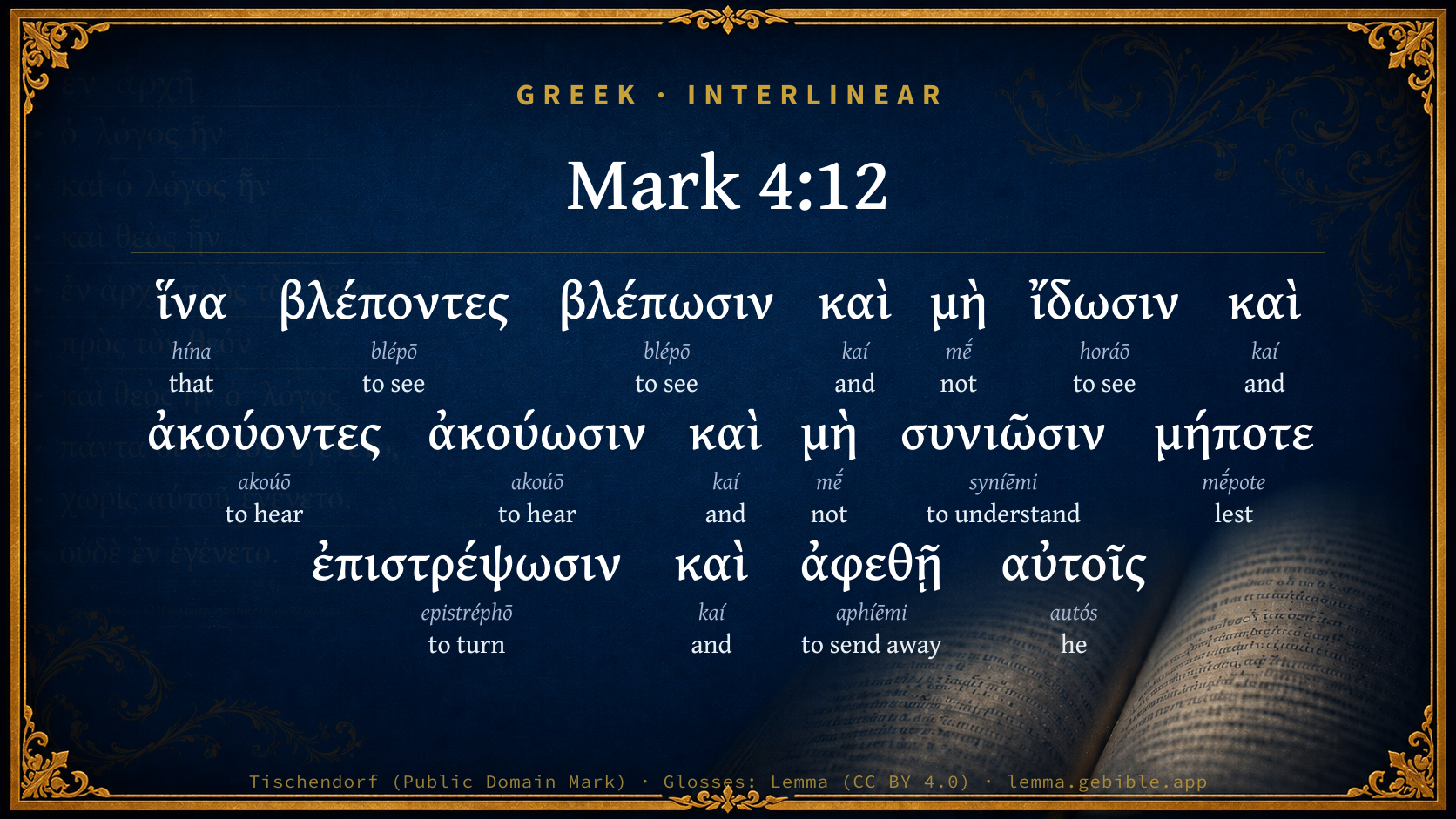
Greek (Tischendorf 8th ed.) Mark 4:12 appears in the Greek New Testament. The text above is from the Tischendorf 8th edition. Each word links to its Strong’s number and a concise gloss. Click any word for its full Thayer’s Greek Lexicon entry.
Download image
Cite this verse

Mark 4:12 (World English Bible). Public Domain. Lemma interlinear Bible study tool, https://lemma.gebible.app/v/mark/4/12.

Show BibTeX & RIS
BibTeX
RIS
English Translation
that 'seeing they may see, and not perceive; and hearing they may hear, and not understand; lest perhaps they should turn again, and their sins should be forgiven them.'"
World English Bible · Public Domain
Download a study sheet

One document with this verse’s original text, its word-by-word gloss line, the meaning frame, cross-references with their text, attributed commentary, and full source and license credits — printable, and it pastes into notes with its structure intact.

This verse Autodidact and up

Study sheet (.html) Plain text (.txt)

A passage Seminary Student

Up to 50 verses in one chapter. A passage sheet keeps up to 6 commentary sources and 12 cross-references per verse, in the order this page ranks them, and says so on the sheet whenever that leaves anything out. Ask for a single verse and you get the Autodidact verse sheet above.

Everything on this page stays free to read, with no account — the sheet is a download of what is already on screen, not access to it.

Want to remove ads? Support Godless Engineer
Compare translations 3

The same verse in 3 English versions, stacked beneath the original-language interlinear above. Click any original word for its lexicon entry.

Each is an independent rendering of the whole verse — the interlinear is not word-aligned to these translations.

Highlighted words mark where these versions differ — a whole-verse word diff, not a word-by-word alignment.

  • World English Bible Public Domain
    that 'seeing they may see, and not perceive; and hearing they may hear, and not understand; lest perhaps they should turn again, and their sins should be forgiven them.'"
  • King James Version Public Domain
    That seeing they may see, and not perceive; and hearing they may hear, and not understand; lest at any time they should be converted, and their sins should be forgiven them.
  • unfoldingWord Literal Text CC BY-SA 4.0
    so that, ‘Looking, they may look but may not see, and hearing, they may hear but may not understand, lest they might turn back, and it might be forgiven to them.’”

unfoldingWord Literal Text — © unfoldingWord, licensed CC BY-SA 4.0. Word-aligned USFM3 via Door43 (git.door43.org/unfoldingWord/en_ult).

Versions to compare (up to 4)

3 of 4 selected

Show all 19 translations

Every available English version of this verse, each an independent rendering of the whole verse.

  • World English Bible Public Domain
    that 'seeing they may see, and not perceive; and hearing they may hear, and not understand; lest perhaps they should turn again, and their sins should be forgiven them.'"
  • Berean Standard Bible Public Domain
    so that, ‘they may be ever seeing but never perceiving, and ever hearing but never understanding; otherwise they might turn and be forgiven.’”
  • Majority Standard Bible Public Domain
    so that, ‘they may be ever seeing but never perceiving, and ever hearing but never understanding; otherwise they might turn and be forgiven their sins.’”
  • King James Version Public Domain
    That seeing they may see, and not perceive; and hearing they may hear, and not understand; lest at any time they should be converted, and their sins should be forgiven them.
  • American Standard Version (1901) Public Domain
    that seeing they may see, and not perceive; and hearing they may hear, and not understand; lest haply they should turn again, and it should be forgiven them.
  • Revised Version (1885) Public Domain
    that seeing they may see, and not perceive; and hearing they may hear, and not understand; lest haply they should turn again, and it should be forgiven them.
  • Geneva Bible (1599) Public Domain
    That they seeing, may see, and not discerne: and they hearing, may heare, and not vnderstand, least at any time they should turne, and their sinnes should be forgiuen them.
  • Douay-Rheims (1899) Public Domain
    That seeing they may see, and not perceive; and hearing they may hear, and not understand: lest at any time they should be converted, and their sins should be forgiven them.
  • Young's Literal Translation Public Domain
    that seeing they may see and not perceive, and hearing they may hear and not understand, lest they may turn, and the sins may be forgiven them.'
  • Literal Standard Version CC BY-SA 4.0
    that seeing they may see and not perceive, and hearing they may hear and not understand, lest they may turn, and the sins may be forgiven them.”
  • Unlocked Literal Bible CC BY-SA 4.0
    so that when they look, yes they look, but do not see, and so that when they hear, yes they hear, but do not understand, or else they would turn and God would forgive them.”
  • unfoldingWord Literal Text CC BY-SA 4.0
    so that, ‘Looking, they may look but may not see, and hearing, they may hear but may not understand, lest they might turn back, and it might be forgiven to them.’”
  • Darby Bible Public Domain
    that beholding they may behold and not see, and hearing they may hear and not understand, lest it may be, they should be converted and they should be forgiven.
  • World Messianic Bible Public Domain
    that ‘seeing they may see and not perceive, and hearing they may hear and not understand, lest perhaps they should turn again, and their sins should be forgiven them.’”
  • Webster's Bible Public Domain
    That seeing they may see, and not perceive; and hearing they may hear, and not understand; lest at any time they should be converted, and their sins should be forgiven them.
  • Free Bible Version CC BY-SA 4.0
    so that even though they see, they don't really ‘see,’ and even though they hear, they don't understand, otherwise they might turn to me and be forgiven.”
  • Bible in Basic English Public Domain
    So that seeing they may see, and it will not be clear to them; and hearing it, they will not get the sense; for fear that they may be turned again to me and have forgiveness.
  • Text-Critical English NT CC BY 4.0
    so that ‘they may see but not perceive, and hear but not understand, lest they should turn back and be forgiven of their sins.’ ”
  • Tyndale New Testament (1534) Public Domain
    That when they se they shall se and not discerne: and when they heare they shall heare and not vnderstonde: leste at any tyme they shulde tourne and their synnes shuld be forgeve them.

Literal Standard Version (2020), Covenant Press — licensed CC BY-SA 4.0. Text via the HelloAO Bible API (eBible.org). Unlocked Literal Bible (unfoldingWord) — licensed CC BY-SA 4.0. Text via the HelloAO Bible API (eBible.org). unfoldingWord Literal Text — © unfoldingWord, licensed CC BY-SA 4.0. Word-aligned USFM3 via Door43 (git.door43.org/unfoldingWord/en_ult). Free Bible Version, Dr. Jonathan Gallagher — licensed CC BY-SA 4.0. Text via the HelloAO Bible API (eBible.org).

Word by word

More ways to search: Search by grammar → Find every occurrence → Compare this word →

Practice this passage: Drill this verse → Learn its vocabulary →

μήποτε
mḗpote
G3379
“lest”
Adverb, Negative
Part of Speech
Adverb
Degree
Negative
Full Thayer's Definition

Origin: from G3361 and G4218

TDNT: None

1. that ... not, lest, whether perhaps, whether or not, in no way, perhaps
  1. ἵνα hína G2443 “that” Conjunction
  2. βλέποντες blépō G991 “to see” Verb, Present, Active, Participle, Nominative, Plural, Masculine
  3. βλέπωσιν blépō G991 “to see” Verb, Present, Active, Subjunctive, 3rd person, Plural
  4. καὶ kaí G2532 “and” Conjunction
  5. μὴ mḗ G3361 “not” Particle, Negative
  6. ἴδωσιν horáō G3708 “to see” Verb, Aorist, Active, Subjunctive, 3rd person, Plural
  7. καὶ kaí G2532 “and” Conjunction
  8. ἀκούοντες akoúō G191 “to hear” Verb, Present, Active, Participle, Nominative, Plural, Masculine
  9. ἀκούωσιν akoúō G191 “to hear” Verb, Present, Active, Subjunctive, 3rd person, Plural
  10. καὶ kaí G2532 “and” Conjunction
  11. μὴ mḗ G3361 “not” Particle, Negative
  12. συνιῶσιν syníēmi G4920 “to understand” Verb, Present, Active, Subjunctive, 3rd person, Plural
  13. ἐπιστρέψωσιν epistréphō G1994 “to turn” Verb, Aorist, Active, Subjunctive, 3rd person, Plural
  14. καὶ kaí G2532 “and” Conjunction
  15. ἀφεθῇ aphíēmi G863 “to send away” Verb, Aorist, Passive, Subjunctive, 3rd person, Singular
  16. αὐτοῖς autós G846 “he” Personal pronoun, Dative, Plural, Masculine

About this verse

These counts appear in no published source. They are computed here, from the morphology-tagged text and Lemma’s own curated glosses. What Lemma adds →

17
words
11
distinct lemmas
Gospels
section

Notable vocabulary

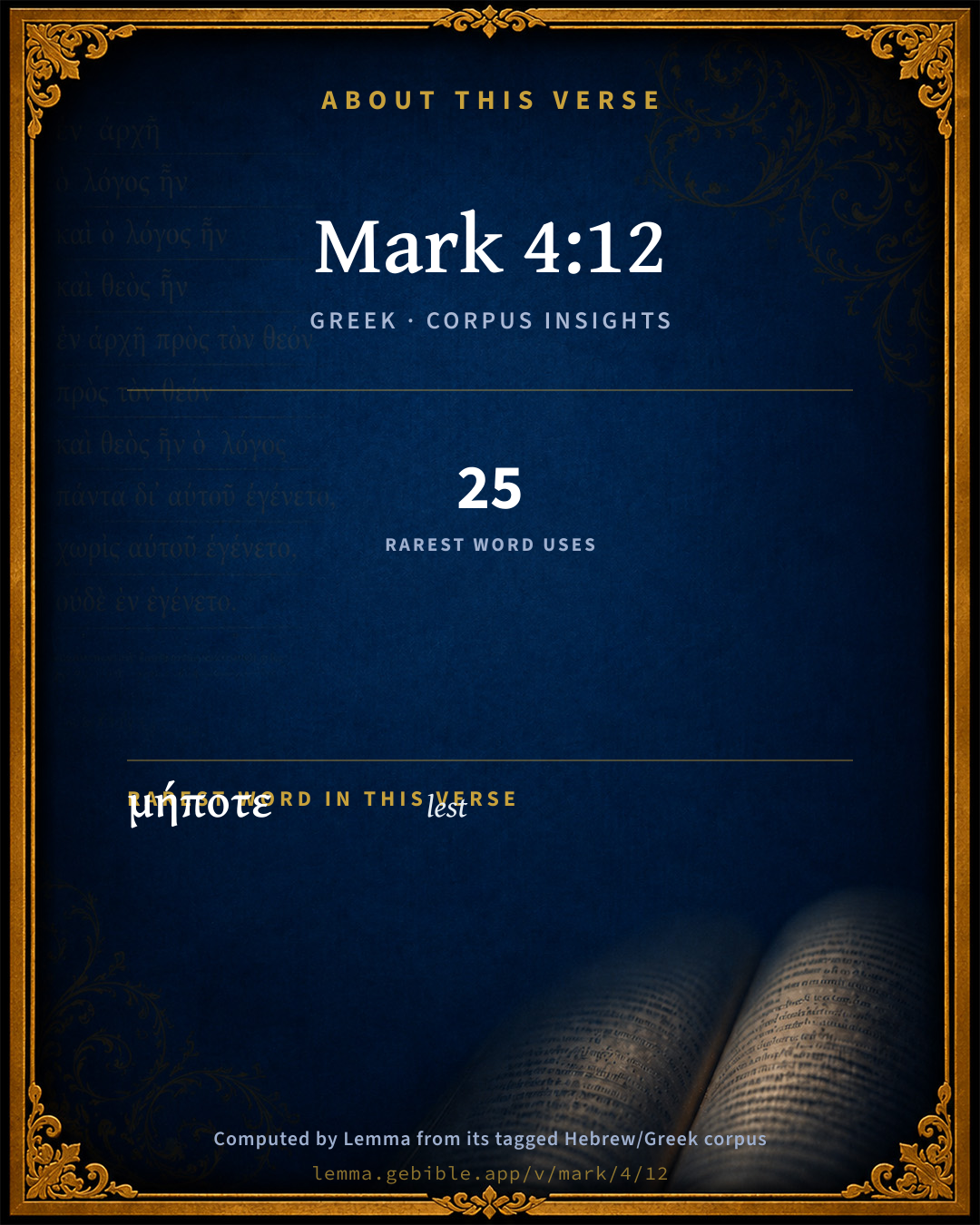
The rarest word here is μήποτε lest G3379 — appearing just 25 times in the whole Greek New Testament.

Shared distinctive vocabulary

μήποτε lest G3379 occurs in 25 verses of the Greek New Testament. Also found in:

Repetition

Words recur within this verse:

  • βλέποντες to see G991 ×2
  • ἀκούοντες to hear G191 ×2
  • καὶ and G2532 ×4
  • μὴ not G3361 ×2

Cross-references

15

Topical passages linked to Mark 4:12 in the Treasury of Scripture Knowledge — connected by theme and wording, ordered by reader-vote popularity; previews shown in the World English Bible.

  • Isaiah 6:9–10 He said, "Go, and tell this people, 'You hear indeed, But don't understand; And you see indeed, But don't perceive.'
  • Isaiah 44:18 They don't know, neither do they consider: for he has shut their eyes, that they can't see; and their hearts, that they can't understand.
  • Matthew 13:14–15 In them the prophecy of Isaiah is fulfilled, which says, 'By hearing you will hear, And will in no way understand; Seeing you will see, And will in no way perceive:
  • Jeremiah 5:21 Hear now this, foolish people, and without understanding; who have eyes, and don't see; who have ears, and don't hear:
  • Deuteronomy 29:4 but Yahweh has not given you a heart to know, and eyes to see, and ears to hear, to this day.
  • John 12:37–41 But though he had done so many signs before them, yet they didn't believe in him,
  • Luke 8:10 He said, "To you it is given to know the mysteries of the Kingdom of God, but to the rest in parables; that 'seeing they may not see, and hearing they may not understand.'
  • 2 Timothy 2:25 in gentleness correcting those who oppose him: perhaps God may give them repentance leading to a full knowledge of the truth,
  • Ezekiel 12:2 Son of man, you dwell in the midst of the rebellious house, who have eyes to see, and don't see, who have ears to hear, and don't hear; for they are a rebellious house.
  • Romans 11:8–10 According as it is written, "God gave them a spirit of stupor, eyes that they should not see, and ears that they should not hear, to this very day."
  • Hebrews 6:6 and then fell away, it is impossible to renew them again to repentance; seeing they crucify the Son of God for themselves again, and put him to open shame.
  • Jeremiah 31:18–20 I have surely heard Ephraim bemoaning himself [thus], You have chastised me, and I was chastised, as a calf unaccustomed [to the yoke]: turn you me, and I shall be turned; for you are Yahweh my God.
  • Acts 28:25–27 When they didn't agree among themselves, they departed after Paul had spoken one word, "The Holy Spirit spoke rightly through Isaiah, the prophet, to our fathers,
  • Ezekiel 18:27–32 Again, when the wicked man turns away from his wickedness that he has committed, and does that which is lawful and right, he shall save his soul alive.
  • Acts 3:19 "Repent therefore, and turn again, that your sins may be blotted out, so that there may come times of refreshing from the presence of the Lord,

Cross-references courtesy of OpenBible.info (CC BY 4.0).

Commentary

Notes on Mark 4:12 from classic Christian and Jewish commentators (each source and its license shown beneath its notes). The classic Christian expositions comment on the surrounding passage and are grouped to its opening verse, so a note may address several verses; the Jewish commentaries on the Tanakh (Rashi and others) are per-verse, so they appear only where the commentator wrote on this verse.

Lemma curates 59 commentaries, every one of them public domain or Creative Commons licensed, each selected and text-cleaned for this edition rather than reprinted as found. About our sources →

The Biblical Illustrator

Joseph S. Exell

Mar_4:12

That seeing, they may see, and not perceive.

The derelict

Terrible, but just and adorable, is this conduct of God towards those who have deserved to be left to themselves. This dereliction has several degrees-

1. Their being abandoned to their own darkness.

2. Their not being able to understand the truths of salvation.

3. Their not obeying them.

4. Their remaining in their sins.

5. Their being condemned.

God is pleased to give examples of this, that the children of promise may know how much they owe to grace. It is a mistake to imagine that whatever appears most severe and rigorous in the conduct of God ought to be concealed from Christians. He Himself instructs us in it, on purpose that we should take great notice of it on proper occasions, and glorify Him on the account of all the good we do, and of all the evil which we avoid. (Quesnel.)

The Biblical Illustrator, edited by Joseph S. Exell (c. 1880s–1900s) — public domain. Text from a community e-Sword module.

Bengel's Gnomon

Johann Albrecht Bengel

Mar 4:12. Ἵνα, that) They already before saw not, Mat 13:13. Now there is added [to their voluntary blindness] divinely—sent judicial blindness.—ἵνα, so that: LXX. Gen 22:14.—καὶ ἀφεθήσεται αὐτοῖς τὰ ἁμαρτήματα, and their sins should be forgiven them) This is the true healing, spoken of Mat 13:15; Psa 103:3.

Bengel's Gnomon of the New Testament — English translation (T&T Clark, Edinburgh, 1860) — public domain. Text from a community e-Sword module.

Expositor's Greek Testament

ed. W. Robertson Nicoll

Mar 4:12 seems to state the aim of the parabolic method of teaching as being to keep the people in the dark, and prevent them from being converted and forgiven. This cannot really have been the aim of Jesus. Vide notes on the parable of the Sower in Mt., where the statement is softened somewhat.

The Expositor's Greek Testament, edited by W. Robertson Nicoll (1897–1910) — public domain. Text from a community e-Sword module.

Ellicott's Commentary for English Readers

(12) That seeing they may see. . . .—St. Mark characteristically gives the words of Isa_6:9, but not as a quotation, and perhaps in a less accurate form, and omits the addition in Matthew, “Blessed are your ears . . .” The form in this instance, at first sight, suggests the thought that our Lord’s purpose was to produce the blindness and deafness of which He speaks. The real meaning of the words is, however, plain. This was to be the result of the wilful blindness of those who rejected Him; and the acceptance of a foreseen result was, in Hebrew forms of thought, expressed as the working out of an intention. (See Notes on Mat_13:14-15.)

A Bible Commentary for English Readers, edited by Charles John Ellicott (1878–1897) — public domain. Text from a community e-Sword module.

The Cambridge Bible for Schools and Colleges

gen. ed. J. J. S. Perowne

12. that seeing they may see, and not perceive] At the beginning of His ministry our Lord did not teach by Parables. “The Sermon on the Mount may be taken as the type of the ‘words of grace’ which He spake ‘not as the Scribes.’ Beatitudes, laws, promises were uttered distinctly, not indeed without similitudes, but with similitudes that explained themselves.” And so He continued for some time. But His direct teaching was met with scorn, unbelief, and hardness. From this time forward “parables” entered largely into His recorded teaching, and were at once attractive and penal. (a) Attractive, as “instruments of education for those who were children in age or character,” and offering in a striking form much for the memory to retain, and for the docile and truth-loving to learn; (b) Penal, as testing the disposition of those who listened to them; withdrawing the light from such as loved darkness and were wilfully blind, and protecting the truth from the mockery of the scoffer; finding out the fit hearers, and leading them, but them only, on to deeper knowledge. See Article on Parables in Smith’s Bible Dict.

The Cambridge Bible for Schools and Colleges (gen. ed. J. J. S. Perowne; Cambridge University Press, 1878–1918) — public domain. Text from a community e-Sword module.

John Gill's Exposition

The sower soweth the word. Though our Lord thought fit to give the above gentle rebuke to his disciples for their dulness; yet he condescends to favour them with an interpretation of the above parable, which here begins: by this it appears, that the seed in the parable, before delivered, and which fell on different sorts of ground, is the word of God, which was preached to hearers of different dispositions: the word is the word of life and truth; the word of peace and reconciliation; the word of faith and righteousness; the word of salvation; the word which publishes and declares all these to be in and by Jesus Christ.

The sower soweth the word. Though our Lord thought fit to give the above gentle rebuke to his disciples for their dulness; yet he condescends to favour them with an interpretation of the above parable, which here begins: by this it appears, that the seed in the parable, before delivered, and which fell on different sorts of ground, is the word of God, which was preached to hearers of different dispositions: the word is the word of life and truth; the word of peace and reconciliation; the word of faith and righteousness; the word of salvation; the word which publishes and declares all these to be in and by Jesus Christ.

Mark 4:15

mar 4:15

mar 4:15

mar 4:15And these are they by the way side, where the word is sown,.... Such hearers are represented by the way side, in which the seed fell; who, coming where the Gospel is preached, stop awhile and hear it, and so are only casual and accidental hearers of it:

but when they have heard; and indeed whilst they are hearing, and before they are well got out of the place of hearing,

Satan cometh immediately and taketh away the word that was sown in their hearts. The devil, signified by the fowl, or fowls of the air, immediately takes notice of such hearers, and is very busy with them; filling their minds with other things suitable to their dispositions, and setting before them other objects, whereby their minds are, at once, taken off from what they have been hearing; so that all that they have observed, and laid up in their memories, is lost at once, and never thought of any more.

John Gill's Exposition of the Whole Bible (1746–1763) — public domain (CC PDM 1.0). Text via the HelloAO Bible API.

Trapp's Complete Commentary

John Trapp

12 That seeing they may see, and not perceive; and hearing they may hear, and not understand; lest at any time they should be converted, and their sins should be forgiven them.

Ver. 12. {See Trapp on "Mat 13:14"} {See Trapp on "Mat 13:15"} {See Trapp on "Mat 13:16"} {See Trapp on "Mat 13:17"}

John Trapp, A Commentary or Exposition upon All the Books of the Old and New Testament (1647–1656) — public domain. Text from a community e-Sword module.

Haydock's Catholic Bible Commentary

That seeing they may see, &c. In punishment of their wilfully shutting their eyes, (Matthew xiii. 15.) God justly withdrew those lights and graces which otherwise he would have given them, for their effectual conversion. (Challoner) --- these speeches here and elsewhere, we are not to understand as if the spoke in parables to this end that the hearers might not understand, lest they should be converted; but we must learn the true sense from the corresponding texts in Matthew xiii, and Acts xxviii, where our Saviour and St. Paul render it thus: with their ears they have been dull of hearing, and their eyes they have shut. lest, perhaps, they may see, and understand, and be converted, and I heal them. Whereby it is evident, that the speaking in parables was not the cause, (for many besides the apostles heard and understood) but themselves, who would not hear and understand, and be converted: and thus they were the real cause of they own wilful and obstinate infidelity. And therefore also he spoke in parables, because they were not worthy to understand, as the others were to whom he expounded them. (Bristow)

George Leo Haydock (1774–1849), Haydock's Catholic Family Bible and Commentary, 1859 edition — public domain. Excludes Psalms (Douay-Rheims chapter numbering differs from Protestant) and Deuterocanonical books (Catholic canon only).

Whedon's Commentary on the Bible

Daniel D. Whedon

12. That — Many learned men understand this that to mean so that. Others interpret it in order that. The former meaning indicates that parables were here used so that the effects described in this verse do really follow, but not with the divine intention that they should follow. The latter indicates that parables are used with the intention and purpose that such results should follow. Now the latter is the more ordinary sense, though not the necessary one, of the Greek word here rendered that. It here indicates that parables were used for the purpose that men who chose might remain blind. Not that their blindness is a primary purpose of the Almighty; but that blindness which is their choice may be accorded to them. These negative verbs not perceive and not understand, express intentional unintelligence. These men do not fall into passive ignorance, but they actively ignore. Lest — This lest depends upon this ignoring. They ignore lest they should be converted. Obdurate sinners are sometimes afraid they will be converted. They fear that the truth will become so clearly truth that they cannot stand, and will in the trying moment yield to it. To prevent the evil use they would make of his truth Jesus wraps it in parables, and so accommodates their wish to his truth in order to avoid conversion. And their sins should be forgiven them — Silly are these men who are so afraid of conversion. For what is the worst that would happen if they should be converted? Simply this: their sins would be forgiven, and they would be healed.

Daniel D. Whedon (gen. ed.), Commentary on the Old and New Testaments (1874–1909) — public domain. Text from a community e-Sword module.

John Wesley's Explanatory Notes

So that seeing they see and do not perceive - They would not see before now they could not, God having given them up to the blindness which they had chosen.

John Wesley, Explanatory Notes Upon the Whole Bible (1754–1765) — public domain. Text via the GEBible commentary corpus.

Scofield Reference Notes

C. I. Scofield

sins

Sin. (See Scofield "Rom 3:23")

The Scofield Reference Bible (1917 edition), notes by C. I. Scofield — public domain. Text from a community e-Sword module.

The People's New Testament

B. W. Johnson

12. That seeing they may see. Matthew gives this saying more fully and clearly. See note on Matt. 13:13.

B. W. Johnson's The People's New Testament with Notes (1889–1891) — public domain. Electronic text from the Christian Classics Ethereal Library (CCEL) ThML edition.

Cambridge Greek Testament for Schools and Colleges

12. WH. write συνίωσιν from the unused συνίω: συνιῶσιν is from συνίημι or the unused συνιέω. [723][724][725][726] omit τὰ ἁμαρτήματα.

[723] Codex Sinaiticus. 4th cent. Discovered by Tischendorf in 1859 at the Monastery of St Katharine on Mount Sinai. Now at St Petersburg. The whole Gospel, ending at Mar 16:8. Photographic facsimile, 1911.

[724] Codex Vaticanus. 4th cent., but perhaps a little later than א. In the Vatican Library almost since its foundation by Pope Nicolas V., and one of its greatest treasures. The whole Gospel, ending at Mar 16:8. Photographic facsimile, 1889.

[725] Codex Ephraemi. 5th cent. A palimpsest: the original writing has been partially rubbed out, and the works of Ephraem the Syrian have been written over it; but a great deal of the original writing has been recovered; of Mark we have Mar 1:17 to Mar 6:31, Mar 8:5 to Mar 12:29, Mar 13:19 to Mar 16:20. In the National Library at Paris.

[726] Codex Regius. 8th cent. An important witness. At Paris. Contains Mar 1:1 to Mar 10:15; Mar 10:30 to Mar 15:1; Mar 15:20 to Mar 16:20, but the shorter ending is inserted between Mar 16:8 and Mar 16:9, showing that the scribe preferred it to the longer one.

12. ἵνα βλέποντες κ.τ.λ. An adaptation of the LXX. of Isa 6:9-10, but in LXX. there is no ἵνα. It intimates that parables may serve as a judgment on those who have rejected Christ’s teaching. They have shut their eyes so persistently to the truth that now they are unable to see it, and this is in accordance with God’s purpose. “He that hath not, from him shall be taken away even that which he hath.” But this judgment is a merciful one. The parable which the cold-hearted multitudes hear without understanding they remember, because of its penetrating and impressive form; and when their hearts become able to receive its meaning, the meaning will become clear to them. Meanwhile they are saved from the guilt of rejecting plain truth. See below on Mar 4:22. Failure to see this point has caused some to say that it is incredible that Jesus can have given this explanation of the purpose of parabolic teaching, and the difficulty is perhaps the cause of Mt. substituting ὅτι for ἵνα. Hastings’ D.B. and D.C.G. art. “Parable.” Vulg. here ignores the difference between βλέπωσι and ἰδῶσιν, ut videntes videant et non videant, but in Act 28:27, et videntes videbitis et non perspicietis. Syr-Sin. has “that seeing they may not see.” See on Mar 8:24.

μή ποτε ἐπιστρέψωσιν. It is possible that here tradition has carried the quotation from Isa 6:10 further than Christ did, or has confused His use of it. In LXX. it is the people who hardened their hearts μή ποτε ἐπιστρέψωσιν, not Jehovah who did so; they refused to understand and be healed. Lk. (Luk 8:10) does not carry the quotation beyond συνίωσιν, and Mt. preserves καὶ ἰάσομαι αὐτούς, as in LXX., for which Mk has καὶ ἀφεθῇ αὐτοῖς. Their not being converted and forgiven was the just consequence of their own obstinacy; in that sense, and in that only, was it part of the Divine purpose. See on Mat 13:13. βλἑποντες· τοῦτο τοῦ θεοῦ. μὴ βλέπωσι· τοῦτο τῆς κακίας αὐτῶν (Theoph.).

Cambridge Greek Testament for Schools and Colleges (Cambridge University Press, 1896; 21 vols, various authors incl. Carr, Maclear, Plummer, Farrar, Lumby, Moule, M. R. James, Simcox) — public domain. Text from a community e-Sword module.

Alford’s Greek Testament

Henry Alford

12.] We must keep the ἵνα strictly to its telic meaning—in order that. When God transacts a matter, it is idle to say that the result is not the purpose. He doeth all things after the counsel of His own will. Matt., as usual, quotes a prophecy; Mark hardly ever—except at the beginning of his Gospel; Luke, very seldom.

ἀφ. αὐτ. = ἰάσομαι αὐτούς Matt., it should be forgiven them; i.e. ‘forgiveness should be extended to them:’ no need to supply any thing, as the gloss of the . does: the expression is impersonal.

Henry Alford, The Greek Testament (1849–1861) — public domain. Text from a community e-Sword module.

International Critical Commentary

12. ἵνα βλέποντες βλέπωσι, καὶ μὴ ἴδωσι—in order that seeing, they may see, and not perceive. It is evident that ἴδωσι expresses a more inward and real sight than βλέπωσι. The idea is expressed thus, in order that in the act of seeing, there may be merely outward seeing and not perception. The contrast is more exactly expressed by the difference between ἀκούωσι and συνιῶσι, hearing and understanding. μήποτε ἐπιστρέψωσιν καὶ ἀφεθῇ αὐτοῖς—lest perchance they may turn, and it be forgiven them. ἀφεθῇ is used impersonally.

Omit τὰ ἁμαρτήματα, their sins, after ἀφεθῇ Tisch. Treg. txt. WH. RV. א BCL 1, 22, 118, 209, 251, 340, * one ms. Lat. Vet. Memph.

The whole verse is a translation of Isa 6:9, adapted freely from the Sept. It takes these phrases ἀκοῇ ἀκούσετε κ. οὐ μὴ συνῆτε, κ. βλέποντες βλέψουσιν κ. οὐ μὴ ἴδητε and μήποτε ἐπιστρέψωσιν κ. ἰάσομαι αὐτούς out of their connection and pieces them together.

In explaining this difficult passage, it is to be noticed, first, that the difference between the form of the quotation in Mk. and Lk. on the one hand, and Mt. on the other, corresponds to a like difference between the original Hebrew and the LXX. In the Hebrew, God says to his prophet, “Go, … make the heart of this people fat and make their ears heavy, and shut their eyes, lest they see with their eyes, and hear with their ears, and understand with their heart, and turn again and be healed.” That is, God is represented as sending his prophet to harden the heart of the people by his prophetic message, as if Rubinstein should have been told to deaden people’s musical sense by his playing, or Bishop Brooks to stifle their religious sense by his preaching. In the LXX., on the contrary, the hardening is the cause, not the purpose. The people will not hear the prophet’s message because their heart is hardened, and they have shut their eyes. So in Mt., following the LXX., Jesus speaks to them in parables because their heart is waxed gross, and their ears dull of hearing. And especially, the obnoxious μήποτε ἐπιστρέψωσιν κ. ἰάσομαι αὐτούς is included in the result of their own conduct, and not in the Divine purpose. Mk. and Lk., however, follow the original in making the failure to hear and see to be the purpose of the parable. But Lk. omits the obnoxious μήποτε ἐπιστρέψωσιν κ. ἀφεθῇ αὐτοῖς. And yet, there is no doubt, from the identity of language, that Mk., and following him, Lk., quote from the LXX., while modifying it for some reason. That reason would seem to be, that Mk. had in mind the form in which Jesus quotes the passage, and that this was conformed to some Targum, preserving the spirit of the original. This confirms what is otherwise probable, that Mk., rather than Mt., preserves the original form of Jesus’ saying. But while Mk., and according to the above, Jesus himself, conforms to the original Hebrew, he does not preserve the irony which is the saving element of the passage in Isaiah. It is only ironically that God commands the prophet to harden the people by his pungent preaching, because he sees that this will be the inevitable result. Whereas, it is evidently in all seriousness, that Jesus describes this as the result of the parable. The parable is evidently regarded by Jesus as a form of teaching intended to veil the truth conveyed, and adapted, therefore, to esoteric teaching. Moreover, the teaching is esoteric; it concerns the mysteries of the kingdom of God, not the ordinary facts in regard to it, but certain things intended not for the common ear, but only for the disciples. And the parable does so veil the meaning that it has to be explained even to them. There is a key to each of the parables, some fundamental analogy, which is necessary to its explanation. In the Parable of the Sower, this is found in the statement that the seed is the word. Without this, the meaning is obscure. That is, the language of Isaiah, applied to the teaching of Jesus as a whole, would have the irony of the original; but applied to the parables, it is to be taken seriously. This makes all plain sailing until we come to the obnoxious μήποτε ἐπιστρέψωσιν κ. ἀφεθῇ αὐτοῖς. There the irony reappears, for it would evidently be only ironically, and not earnestly, that Jesus would say of any of his teaching, that it was intended to prevent the forgiveness and conversion of the people. It makes the proper climax to the original passage, but is out of place in Jesus’ use of it. But, after the mechanical fashion, which often marks the reporting of discourse, Mk., remembering only that Jesus used this quotation, reproduced the passage as he found it in the original, without omitting its irrelevant clauses. Mt., on the other hand, quoting from the LXX., without the modification introduced by Mk., has not involved himself in the same difficulty, but has not reproduced for us what Jesus said. Lk., seeing the difficulty involved in Mk.’s report, has omitted the obnoxious clause, giving us probably the genuine form of the quotation. Our Lord’s statement, then, is simply this, that the mystery of the kingdom, or its secret, is not intended for those outside of it, and that therefore he uses in conveying it to his disciples the contrivance of the parable, so that outsiders who have not the clue may hear without hearing.

International Critical Commentary — older volumes (1896–1929), various authors — public domain. Text from a community e-Sword module.

Lesson kit

Teaching starters — assembled from the data on this page, not authored interpretation. Every prompt links to the verse data it draws on. Edit before teaching.

Mark, in the Gospels, opens this verse with 17 words (11 distinct Greek lemmas). Its most distinctive word is mḗpote (“lest”). A historical commentator’s framing appears above. Read the whole chapter for the surrounding context.

Discussion questions

  1. How does “lest” (mḗpote) shape what this verse is saying?
  2. Matthew 4:6 shares the word «lest» with this verse. How do the two illuminate each other?
  3. “to see” occurs 2× in this one verse. What is the effect of the repetition?
  4. These translations render this verse differently; the difference is in the English rendering, not the original. What questions does that raise?
  5. Reading how The Biblical Illustrator and Bengel's Gnomon read this verse, where do the two commentators agree and where do they part?

Things to notice

Reading settings

Reading text

Shown beneath each verse's original-language words.

Old Testament
Old Testament edition

Read the OT as the Masoretic Hebrew (MT) or the Greek Septuagint (LXX).

English shown for the Greek Septuagint (in the Hebrew ↔ Greek comparison).

Comparing translations? Open the Compare panel on any verse page to stack up to four side by side.