

Mark 10:30
Greek (Tischendorf 8th ed.) Mark 10:30 appears in the Greek New Testament. The text above is from the Tischendorf 8th edition. Each word links to its Strong’s number and a concise gloss. Click any word for its full Thayer’s Greek Lexicon entry.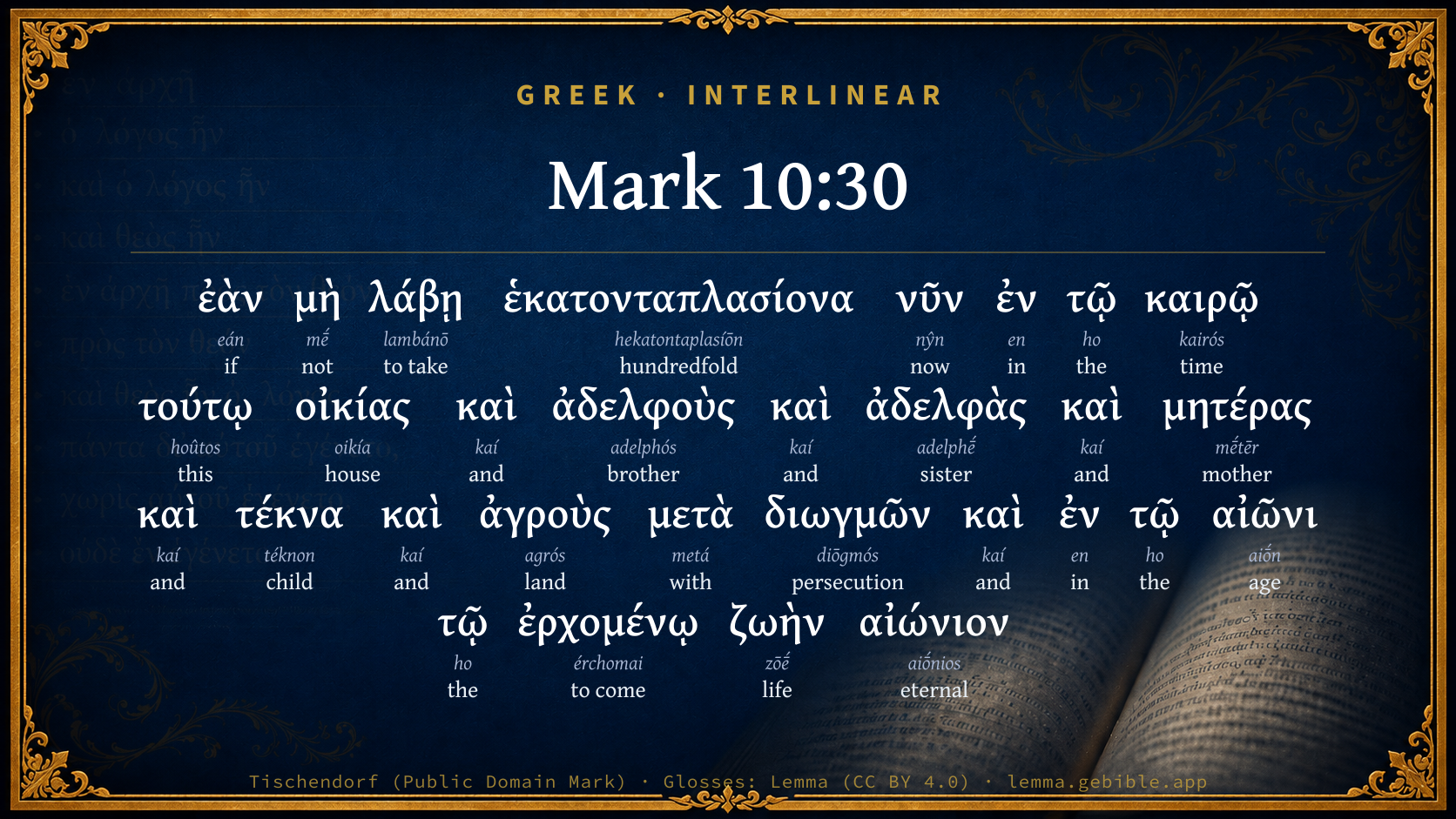
but he will receive one hundred times more now in this time, houses, brothers, sisters, mothers, children, and land, with persecutions; and in the age to come eternal life.
Download a study sheet
One document with this verse’s original text, its word-by-word gloss line, the meaning frame, cross-references with their text, attributed commentary, and full source and license credits — printable, and it pastes into notes with its structure intact.
This verse Autodidact and up
A passage Seminary Student
Up to 50 verses in one chapter. A passage sheet keeps up to 6 commentary sources and 12 cross-references per verse, in the order this page ranks them, and says so on the sheet whenever that leaves anything out. Ask for a single verse and you get the Autodidact verse sheet above.
Everything on this page stays free to read, with no account — the sheet is a download of what is already on screen, not access to it.
Compare translations 3
The same verse in 3 English versions, stacked beneath the original-language interlinear above. Click any original word for its lexicon entry.
Each is an independent rendering of the whole verse — the interlinear is not word-aligned to these translations.
Highlighted words mark where these versions differ — a whole-verse word diff, not a word-by-word alignment.
-
World English Bible Public Domain
but he will receive one hundred times more now in this time, houses, brothers, sisters, mothers, children, and land, with persecutions; and in the age to come eternal life.
-
King James Version Public Domain
But he shall receive an hundredfold now in this time, houses, and brethren, and sisters, and mothers, and children, and lands, with persecutions; and in the world to come eternal life.
-
unfoldingWord Literal Text CC BY-SA 4.0
who will not receive 100 times now in this time: houses and brothers and sisters and mothers and children and lands with persecutions, and in the age that is coming, eternal life.
unfoldingWord Literal Text — © unfoldingWord, licensed CC BY-SA 4.0. Word-aligned USFM3 via Door43 (git.door43.org/unfoldingWord/en_ult).
Show all 19 translations
Every available English version of this verse, each an independent rendering of the whole verse.
-
World English Bible Public Domain
but he will receive one hundred times more now in this time, houses, brothers, sisters, mothers, children, and land, with persecutions; and in the age to come eternal life.
-
Berean Standard Bible Public Domain
will fail to receive a hundredfold in the present age—houses and brothers and sisters and mothers and children and fields, along with persecutions—and in the age to come, eternal life.
-
Majority Standard Bible Public Domain
will fail to receive a hundredfold in the present age—houses and brothers and sisters and mothers and children and fields, along with persecutions—and in the age to come, eternal life.
-
King James Version Public Domain
But he shall receive an hundredfold now in this time, houses, and brethren, and sisters, and mothers, and children, and lands, with persecutions; and in the world to come eternal life.
-
American Standard Version (1901) Public Domain
but he shall receive a hundredfold now in this time, houses, and brethren, and sisters, and mothers, and children, and lands, with persecutions; and in the world to come eternal life.
-
Revised Version (1885) Public Domain
but he shall receive a hundredfold now in this time, houses, and brethren, and sisters, and mothers, and children, and lands, with persecutions; and in the world to come eternal life.
-
Geneva Bible (1599) Public Domain
But he shall receiue an hundred folde, now at this present, houses, and brethren, and sisters, and mothers, and children, and lands with persecutions, and in the world to come, eternall life.
-
Douay-Rheims (1899) Public Domain
Who shall not receive an hundred times as much, now in this time; houses, and brethren, and sisters, and mothers, and children, and lands, with persecutions: and in the world to come life everlasting.
-
Young's Literal Translation Public Domain
who may not receive an hundredfold now in this time, houses, and brothers, and sisters, and mothers, and children, and fields, with persecutions, and in the age that is coming, life age-during;
-
Literal Standard Version CC BY-SA 4.0
who may not receive a hundredfold now in this time, houses, and brothers, and sisters, and mothers, and children, and fields, with persecutions, and in the age that is coming, continuous life;
-
Unlocked Literal Bible CC BY-SA 4.0
who will not receive a hundred times as much now in this world: houses, and brothers, and sisters, and mothers, and children, and lands, with persecutions, and in the world to come, eternal life.
-
unfoldingWord Literal Text CC BY-SA 4.0
who will not receive 100 times now in this time: houses and brothers and sisters and mothers and children and lands with persecutions, and in the age that is coming, eternal life.
-
Darby Bible Public Domain
that shall not receive a hundredfold now in this time: houses, and brethren, and sisters, and mothers, and children, and lands, with persecutions, and in the coming age life eternal.
-
World Messianic Bible Public Domain
but he will receive one hundred times more now in this time: houses, brothers, sisters, mothers, children, and land, with persecutions; and in the age to come eternal life.
-
Webster's Bible Public Domain
But he shall receive a hundred-fold now in this time, houses, and brethren, and sisters, and mothers, and children, and lands, with persecutions; and in the world to come, eternal life.
-
Free Bible Version CC BY-SA 4.0
will receive in return in due course a hundred times as many homes and brothers and sisters and children and lands—as well as persecution. In the world to come they will receive eternal life.
-
Bible in Basic English Public Domain
Who will not get a hundred times as much now in this time, houses, and brothers, and sisters, and mothers, and children, and land--though with great troubles; and, in the world to come, eternal life.
-
Text-Critical English NT CC BY 4.0
who will not receive now in this age a hundred times as many houses, brothers, sisters, mothers, children, and fields—along with persecutions—and in the age to come, eternal life.
-
Tyndale New Testament (1534) Public Domain
which shall not receave an houndred foolde nowe in this lyfe: houses and brethren and sisters and mothers and chyldren and londes with persecucions: and in the worlde to come eternall lyfe.
Literal Standard Version (2020), Covenant Press — licensed CC BY-SA 4.0. Text via the HelloAO Bible API (eBible.org). Unlocked Literal Bible (unfoldingWord) — licensed CC BY-SA 4.0. Text via the HelloAO Bible API (eBible.org). unfoldingWord Literal Text — © unfoldingWord, licensed CC BY-SA 4.0. Word-aligned USFM3 via Door43 (git.door43.org/unfoldingWord/en_ult). Free Bible Version, Dr. Jonathan Gallagher — licensed CC BY-SA 4.0. Text via the HelloAO Bible API (eBible.org).
Word by word
More ways to search: Search by grammar → Find every occurrence → Compare this word →
Practice this passage: Drill this verse → Learn its vocabulary →
- Appears 2× in the Greek New Testament
- First appears here
- Part of Speech
- Adjective
- Case
- Accusative
- Number
- Plural
- Gender
- Neuter
Full Thayer's Definition
- ἐὰν eán G1437 “if” Conditional
- μὴ mḗ G3361 “not” Particle, Negative
- λάβῃ lambánō G2983 “to take” Verb, Aorist, Active, Subjunctive, 3rd person, Singular
- ἑκατονταπλασίονα hekatontaplasíōn G1542 “hundredfold” Adjective, Accusative, Plural, Neuter
- νῦν nŷn G3568 “now” Adverb
- ἐν en G1722 “in” Preposition
- τῷ ho G3588 “the” Article, Dative, Singular, Masculine
- καιρῷ kairós G2540 “time” Noun, Dative, Singular, Masculine
- τούτῳ hoûtos G3778 “this” Demonstrative pronoun, Dative, Singular, Masculine
- οἰκίας oikía G3614 “house” Noun, Accusative, Plural, Feminine
- καὶ kaí G2532 “and” Conjunction
- ἀδελφοὺς adelphós G80 “brother” Noun, Accusative, Plural, Masculine
- καὶ kaí G2532 “and” Conjunction
- ἀδελφὰς adelphḗ G79 “sister” Noun, Accusative, Plural, Feminine
- καὶ kaí G2532 “and” Conjunction
- μητέρας mḗtēr G3384 “mother” Noun, Accusative, Plural, Feminine
- καὶ kaí G2532 “and” Conjunction
- τέκνα téknon G5043 “child” Noun, Accusative, Plural, Neuter
- καὶ kaí G2532 “and” Conjunction
- ἀγροὺς agrós G68 “land” Noun, Accusative, Plural, Masculine
- μετὰ metá G3326 “with” Preposition
- διωγμῶν diōgmós G1375 “persecution” Noun, Genitive, Plural, Masculine
- καὶ kaí G2532 “and” Conjunction
- ἐν en G1722 “in” Preposition
- τῷ ho G3588 “the” Article, Dative, Singular, Masculine
- αἰῶνι aiṓn G165 “age” Noun, Dative, Singular, Masculine
- τῷ ho G3588 “the” Article, Dative, Singular, Masculine
- ἐρχομένῳ érchomai G2064 “to come” Verb, Present, Middle or Passive deponent, Participle, Dative, Singular, Masculine
- ζωὴν zōḗ G2222 “life” Noun, Accusative, Singular, Feminine
- αἰώνιον aiṓnios G166 “eternal” Adjective, Accusative, Singular, Feminine
About this verse
These counts appear in no published source. They are computed here, from the morphology-tagged text and Lemma’s own curated glosses. What Lemma adds →
- 30
- words
- 22
- distinct lemmas
- Gospels
- section
Notable vocabulary
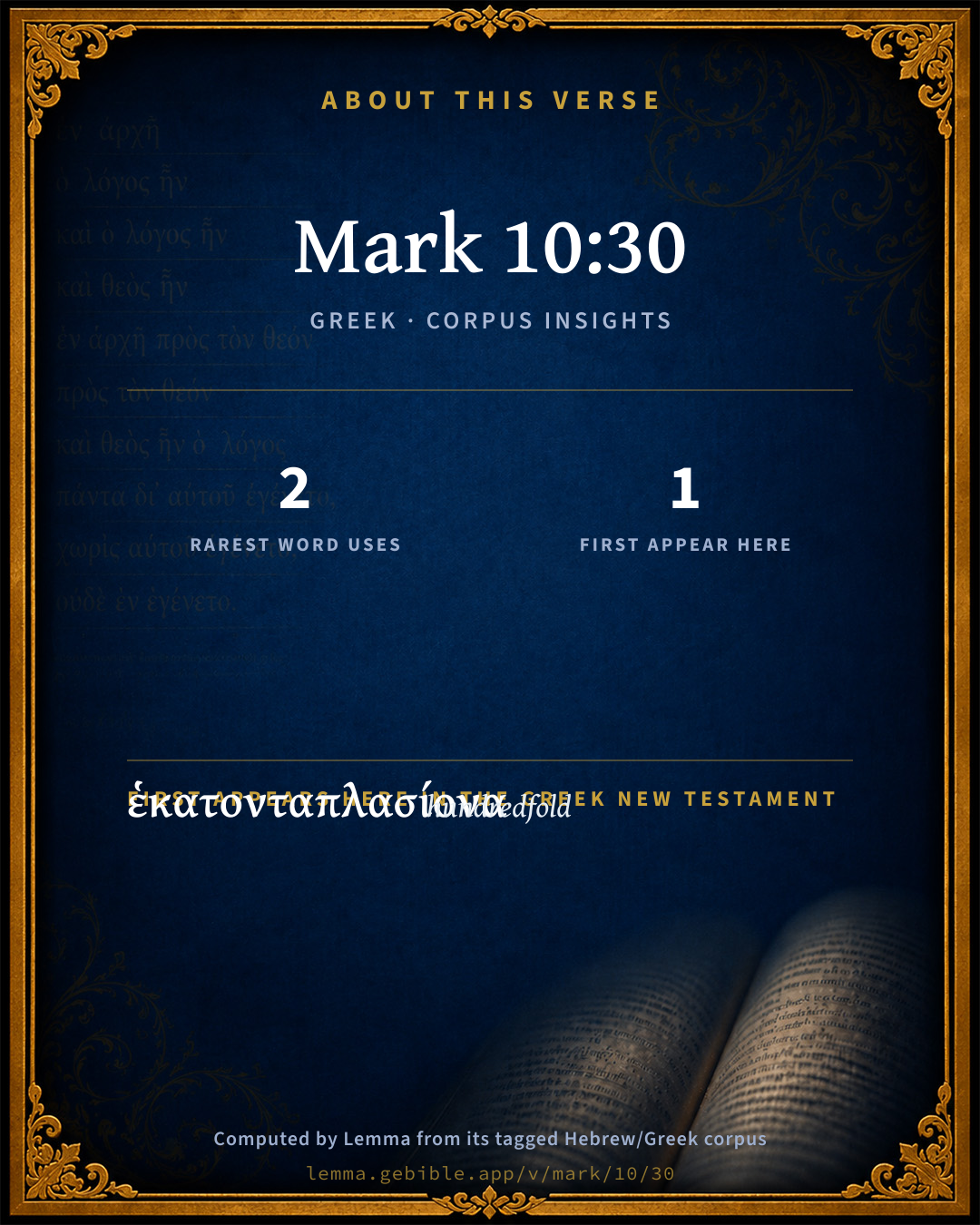
The rarest word here is ἑκατονταπλασίονα hundredfold G1542 — appearing just 2 times in the whole Greek New Testament.
First appearance in Scripture
This word makes its first canonical appearance in the Greek New Testament here:
- ἑκατονταπλασίονα hundredfold G1542
Shared distinctive vocabulary
ἑκατονταπλασίονα hundredfold G1542 occurs in 2 verses of the Greek New Testament. Also found in:
Cross-references
29Topical passages linked to Mark 10:30 in the Treasury of Scripture Knowledge — connected by theme and wording, ordered by reader-vote popularity; previews shown in the World English Bible.
- Luke 18:30 who will not receive many times more in this time, and in the world to come, eternal life."
- Philippians 3:8 Yes most assuredly, and I count all things to be loss for the excellency of the knowledge of Christ Jesus, my Lord, for whom I suffered the loss of all things, and count them nothing but refuse, that I may gain Christ
- 2 Corinthians 6:10 as sorrowful, yet always rejoicing; as poor, yet making many rich; as having nothing, and yet possessing all things.
- Malachi 3:10 Bring the whole tithe into the store-house, that there may be food in my house, and test me now in this," says Yahweh of hosts, "if I will not open you the windows of heaven, and pour you out a blessing, that there shall not be room enough for.
- Matthew 5:11–12 "Blessed are you when people reproach you, persecute you, and say all kinds of evil against you falsely, for my sake.
- James 1:12 Blessed is the man who endures temptation, for when he has been approved, he will receive the crown of life, which the Lord promised to those who love him.
- Proverbs 3:9–10 Honor Yahweh with your substance, With the first fruits of all your increase:
- Proverbs 16:16 How much better it is to get wisdom than gold! Yes, to get understanding is to be chosen rather than silver.
- James 1:2–4 Count it all joy, my brothers, when you fall into various temptations,
- James 5:11 Behold, we call them blessed who endured. You have heard of the patience of Job, and have seen the Lord in the outcome, and how the Lord is full of compassion and mercy.
- 2 Chronicles 25:9 Amaziah said to the man of God, But what shall we do for the hundred talents which I have given to the army of Israel? The man of God answered, Yahweh is able to give you much more than this.
- John 16:22–23 Therefore you now have sorrow, but I will see you again, and your heart will rejoice, and no one will take your joy away from you.
- Acts 5:41 They therefore departed from the presence of the council, rejoicing that they were counted worthy to suffer dishonor for Jesus' name.
- 2 Corinthians 9:8–11 And God is able to make all grace abound to you, that you, always having all sufficiency in everything, may abound to every good work.
- 1 Timothy 6:6 But godliness with contentment is great gain.
- 1 Peter 4:12–16 Beloved, don't be astonished at the fiery trial which has come upon you, to test you, as though a strange thing happened to you.
- Revelation 3:18 I counsel you to buy from me gold refined by fire, that you may become rich; and white garments, that you may clothe yourself, and that the shame of your nakedness may not be revealed; and eye salve to anoint your eyes, that you may see.
- Matthew 6:33 But seek first God's Kingdom, and his righteousness; and all these things will be given to you as well.
- Matthew 12:32 Whoever speaks a word against the Son of Man, it will be forgiven him; but whoever speaks against the Holy Spirit, it will not be forgiven him, neither in this age, nor in that which is to come.
- Matthew 13:44–46 "Again, the Kingdom of Heaven is like a treasure hidden in the field, which a man found, and hid. In his joy, he goes and sells all that he has, and buys that field.
- John 10:23 It was winter, and Jesus was walking in the temple, in Solomon's porch.
- Acts 16:25 But about midnight Paul and Silas were praying and singing hymns to God, and the prisoners were listening to them.
- Romans 5:3 Not only this, but we also rejoice in our sufferings, knowing that suffering works perseverance;
- Romans 6:23 For the wages of sin is death, but the free gift of God is eternal life in Christ Jesus our Lord.
- 2 Thessalonians 2:16 Now our Lord Jesus Christ himself, and God our Father, who loved us and gave us eternal comfort and good hope through grace,
- 1 John 3:1 Behold, how great a love the Father has bestowed on us, that we should be called children of God! For this cause the world doesn't know us, because it didn't know him.
- Psalms 84:11 For Yahweh God is a sun and a shield. Yahweh will give grace and glory. He withholds no good thing from those who walk blamelessly.
- Revelation 2:9 "I know your works, oppression, and your poverty (but you are rich), and the blasphemy of those who say they are Jews, and they are not, but are a synagogue of Satan.
- 1 John 2:25 This is the promise which he promised us, the eternal life.
Cross-references courtesy of OpenBible.info (CC BY 4.0).
Lesson kit
Teaching starters — assembled from the data on this page, not authored interpretation. Every prompt links to the verse data it draws on. Edit before teaching.
Mark, in the Gospels, opens this verse with 30 words (22 distinct Greek lemmas). Its most distinctive word is hekatontaplasíōn (“hundredfold”). A historical commentator’s framing appears above. Read the whole chapter for the surrounding context.
Discussion questions
- How does “hundredfold” (hekatontaplasíōn) shape what this verse is saying?
- This is the first place “hundredfold” appears in Scripture (first appears here). What does its debut here establish?
- How does Luke 8:8, which shares the word «hundredfold», read alongside this verse?
- What does the repetition of “and” (6× in this one verse) do in this verse?
- These translations render this verse differently. What is at stake in choosing one wording over another?
- Compare how Bengel's Gnomon and Expositor's Greek Testament read this verse. Where do they agree or differ?
Things to notice
- 1 word makes its first canonical appearance in Scripture here.
- These translations choose different wording for 17 words in this verse.
- “and” occurs 6× in this single verse.
- 22 distinct Greek lemmas span 30 words in this verse.
Commentary
Notes on Mark 10:30 from classic Christian and Jewish commentators (each source and its license shown beneath its notes). The classic Christian expositions comment on the surrounding passage and are grouped to its opening verse, so a note may address several verses; the Jewish commentaries on the Tanakh (Rashi and others) are per-verse, so they appear only where the commentator wrote on this verse.
Lemma curates 59 commentaries, every one of them public domain or Creative Commons licensed, each selected and text-cleaned for this edition rather than reprinted as found. About our sources →
Bengel's Gnomon
Johann Albrecht Bengel
Bengel's Gnomon of the New Testament — English translation (T&T Clark, Edinburgh, 1860) — public domain. Text from a community e-Sword module.
Expositor's Greek Testament
ed. W. Robertson Nicoll
The Expositor's Greek Testament, edited by W. Robertson Nicoll (1897–1910) — public domain. Text from a community e-Sword module.
Geneva Bible (1599)
Geneva Bible translators
Geneva Bible (1599) marginal notes — public domain. Text via Bolls.life.
Adam Clarke's Commentary
Adam Clarke's Commentary on the Bible (1810–1826) — public domain. Text from a community e-Sword/MySword module.
Ellicott's Commentary for English Readers
A Bible Commentary for English Readers, edited by Charles John Ellicott (1878–1897) — public domain. Text from a community e-Sword module.
The Cambridge Bible for Schools and Colleges
gen. ed. J. J. S. Perowne
The Cambridge Bible for Schools and Colleges (gen. ed. J. J. S. Perowne; Cambridge University Press, 1878–1918) — public domain. Text from a community e-Sword module.
John Gill's Exposition
John Gill's Exposition of the Whole Bible (1746–1763) — public domain (CC PDM 1.0). Text via the HelloAO Bible API.
Trapp's Complete Commentary
John Trapp
John Trapp, A Commentary or Exposition upon All the Books of the Old and New Testament (1647–1656) — public domain. Text from a community e-Sword module.
The Pulpit Commentary
The Pulpit Commentary (1880–1919), ed. H.D.M. Spence-Jones & Joseph S. Exell — public domain. Text from a community e-Sword module.
John Wesley's Explanatory Notes
John Wesley, Explanatory Notes Upon the Whole Bible (1754–1765) — public domain. Text via the GEBible commentary corpus.
Cambridge Greek Testament for Schools and Colleges
Cambridge Greek Testament for Schools and Colleges (Cambridge University Press, 1896; 21 vols, various authors incl. Carr, Maclear, Plummer, Farrar, Lumby, Moule, M. R. James, Simcox) — public domain. Text from a community e-Sword module.
Alford’s Greek Testament
Henry Alford
Henry Alford, The Greek Testament (1849–1861) — public domain. Text from a community e-Sword module.
Vincent's Word Studies in the New Testament
Marvin R. Vincent
Marvin R. Vincent, Word Studies in the New Testament (1887–1900) — public domain. Text from a community e-Sword/MySword module.