Genesis 24:33

Hebrew (Westminster Leningrad Codex) Genesis 24:33 appears in the Hebrew Old Testament. The text above is from the Westminster Leningrad Codex. Each word links to its Strong’s number, a concise gloss, and parsing drawn from the Open Scriptures Hebrew Bible morphology. Click any word for its full Brown-Driver-Briggs (BDB) entry.
Download image
Cite this verse

Genesis 24:33 (World English Bible). Public Domain. Lemma interlinear Bible study tool, https://lemma.gebible.app/v/genesis/24/33.

Show BibTeX & RIS
BibTeX
RIS
English Translation
Food was set before him to eat. But he said, "I will not eat until I have told my message." He said, "Speak on."
World English Bible · Public Domain
Highlights
  • 1 first appearance in the Hebrew Bible
Full analysis ↓
Download a study sheet

One document with this verse’s original text, its word-by-word gloss line, the meaning frame, cross-references with their text, attributed commentary, and full source and license credits — printable, and it pastes into notes with its structure intact.

This verse Autodidact and up

Study sheet (.html) Plain text (.txt)

A passage Seminary Student

Up to 50 verses in one chapter. A passage sheet keeps up to 6 commentary sources and 12 cross-references per verse, in the order this page ranks them, and says so on the sheet whenever that leaves anything out. Ask for a single verse and you get the Autodidact verse sheet above.

Everything on this page stays free to read, with no account — the sheet is a download of what is already on screen, not access to it.

Want to remove ads? Support Godless Engineer
Compare translations 3

The same verse in 3 English versions, stacked beneath the original-language interlinear above. Click any original word for its lexicon entry.

Each is an independent rendering of the whole verse — the interlinear is not word-aligned to these translations.

Highlighted words mark where these versions differ — a whole-verse word diff, not a word-by-word alignment.

  • World English Bible Public Domain
    Food was set before him to eat. But he said, "I will not eat until I have told my message." He said, "Speak on."
  • King James Version Public Domain
    And there was set meat before him to eat: but he said, I will not eat, until I have told mine errand. And he said, Speak on.
  • unfoldingWord Literal Text CC BY-SA 4.0
    Then food was set before him to eat, but he said, “I will not eat until I have spoken my words.” So he said, “Speak.”

unfoldingWord Literal Text — © unfoldingWord, licensed CC BY-SA 4.0. Word-aligned USFM3 via Door43 (git.door43.org/unfoldingWord/en_ult).

Versions to compare (up to 4)

3 of 4 selected

Show all 18 translations

Every available English version of this verse, each an independent rendering of the whole verse.

  • World English Bible Public Domain
    Food was set before him to eat. But he said, "I will not eat until I have told my message." He said, "Speak on."
  • Berean Standard Bible Public Domain
    Then a meal was set before the man, but he said, “I will not eat until I have told you what I came to say.” So Laban said, “Please speak.”
  • Majority Standard Bible Public Domain
    Then a meal was set before the man, but he said, “I will not eat until I have told you what I came to say.” So Laban said, “Please speak.”
  • King James Version Public Domain
    And there was set meat before him to eat: but he said, I will not eat, until I have told mine errand. And he said, Speak on.
  • American Standard Version (1901) Public Domain
    And there was set food before him to eat. But he said, I will not eat, until I have told mine errand. And he said, Speak on.
  • Revised Version (1885) Public Domain
    And there was set meat before him to eat: but he said, I will not eat, until I have told mine errand. And he said, Speak on.
  • Geneva Bible (1599) Public Domain
    Afterward the meate was set before him: but he saide, I will not eate, vntill I haue saide my message: And he said, Speake on.
  • Douay-Rheims (1899) Public Domain
    And bread was set before him. But he said: I will not eat, till I tell my message. He answered him: Speak.
  • Young's Literal Translation Public Domain
    and setteth before him to eat; but he saith, `I do not eat till I have spoken my word;' and he saith, `Speak.'
  • Literal Standard Version CC BY-SA 4.0
    and sets before him to eat; but he says, “I do not eat until I have spoken my word”; and he says, “Speak.”
  • Unlocked Literal Bible CC BY-SA 4.0
    They set food before him to eat, but he said, “I will not eat until I have said what I have to say.” So Laban said, “Speak on.”
  • unfoldingWord Literal Text CC BY-SA 4.0
    Then food was set before him to eat, but he said, “I will not eat until I have spoken my words.” So he said, “Speak.”
  • Darby Bible Public Domain
    And there was set [meat] before him to eat; but he said, I will not eat until I have made known my business. And he said, Speak on.
  • World Messianic Bible Public Domain
    Food was set before him to eat, but he said, “I will not eat until I have told my message.” Laban said, “Speak on.”
  • Webster's Bible Public Domain
    And there was set food before him to eat: but he said, I will not eat, until I have told my errand. And he said, Speak on.
  • Free Bible Version CC BY-SA 4.0
    Then Laban had food brought in. But the man told him, “I'm not going to eat until I've explained why I'm here.” “Please explain,” Laban replied.
  • Bible in Basic English Public Domain
    And meat was put before him, but he said, I will not take food till I have made my business clear to you. And they said, Do so.
  • JPS Tanakh (1917) Public Domain
    And there was set food before him to eat; but he said: 'I will not eat, until I have told mine errand.' And he said: 'Speak on.'

Literal Standard Version (2020), Covenant Press — licensed CC BY-SA 4.0. Text via the HelloAO Bible API (eBible.org). Unlocked Literal Bible (unfoldingWord) — licensed CC BY-SA 4.0. Text via the HelloAO Bible API (eBible.org). unfoldingWord Literal Text — © unfoldingWord, licensed CC BY-SA 4.0. Word-aligned USFM3 via Door43 (git.door43.org/unfoldingWord/en_ult). Free Bible Version, Dr. Jonathan Gallagher — licensed CC BY-SA 4.0. Text via the HelloAO Bible API (eBible.org).

Word by word

More ways to search: Search by grammar → Find every occurrence → Compare this word →

Practice this passage: Drill this verse → Learn its vocabulary →

ויישם
yâsam
H3455
“and · to place”
Conjunction + Verb, Qal Passive, Sequential Imperfect, 3rd Person, Masculine, Singular
Part of Speech
Conjunction + Verb
Stem
Qal Passive
Form
Sequential Imperfect
Person
3rd Person
Gender
Masculine
Number
Singular
Full BDB Definition

Origin: a primitive root

TWOT: 2243

to put, place, set, appoint, make - (Qal) to put, place
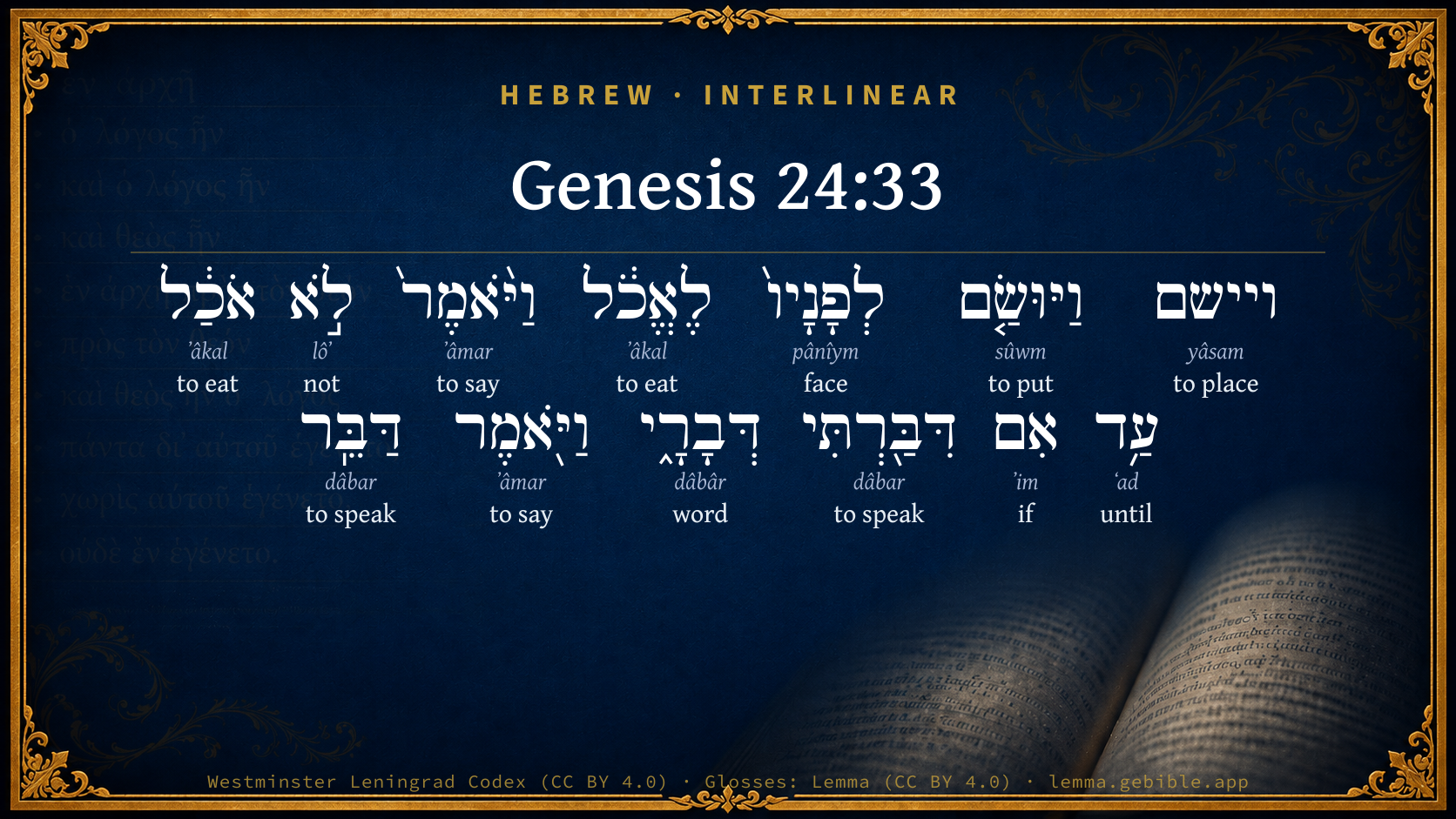
  1. וַיּוּשַׂ֤ם sûwm H7760 “and · to put” Conjunction + Verb, Hophal, Sequential Imperfect, 3rd Person, Masculine, Singular
  2. לְפָנָיו֙ pânîym H6440 “to/for · face(s) · his” Preposition + Noun, Common, Both, Plural, Construct + Suffix, Personal, 3rd Person, Masculine, Singular
  3. לֶאֱכֹ֔ל ʼâkal H398 “to eat” Preposition + Verb, Qal, Infinitive Construct
  4. וַיֹּ֨אמֶר֙ ʼâmar H559 “and · to say” Conjunction + Verb, Qal, Sequential Imperfect, 3rd Person, Masculine, Singular
  5. לֹ֣א lôʼ H3808 “not” Particle, Negative
  6. אֹכַ֔ל ʼâkal H398 “to eat” Verb, Qal, Imperfect, 1st Person, Common, Singular
  7. עַ֥ד ʻad H5704 “until” Preposition
  8. אִם ʼim H518 “if” Conjunction
  9. דִּבַּ֖רְתִּי dâbar H1696 “to speak” Verb, Piel, Perfect, 1st Person, Common, Singular
  10. דְּבָרָ֑י dâbâr H1697 “words · my” Noun, Common, Masculine, Plural, Construct + Suffix, Personal, 1st Person, Common, Singular
  11. וַיֹּ֖אמֶר ʼâmar H559 “and · to say” Conjunction + Verb, Qal, Sequential Imperfect, 3rd Person, Masculine, Singular
  12. דַּבֵּֽר dâbar H1696 “speak” Verb, Piel, Imperative, 2nd Person, Masculine, Singular

About this verse

These counts appear in no published source. They are computed here, from the morphology-tagged text and Lemma’s own curated glosses. What Lemma adds →

13
words
10
distinct lemmas
Pentateuch
section

Notable vocabulary

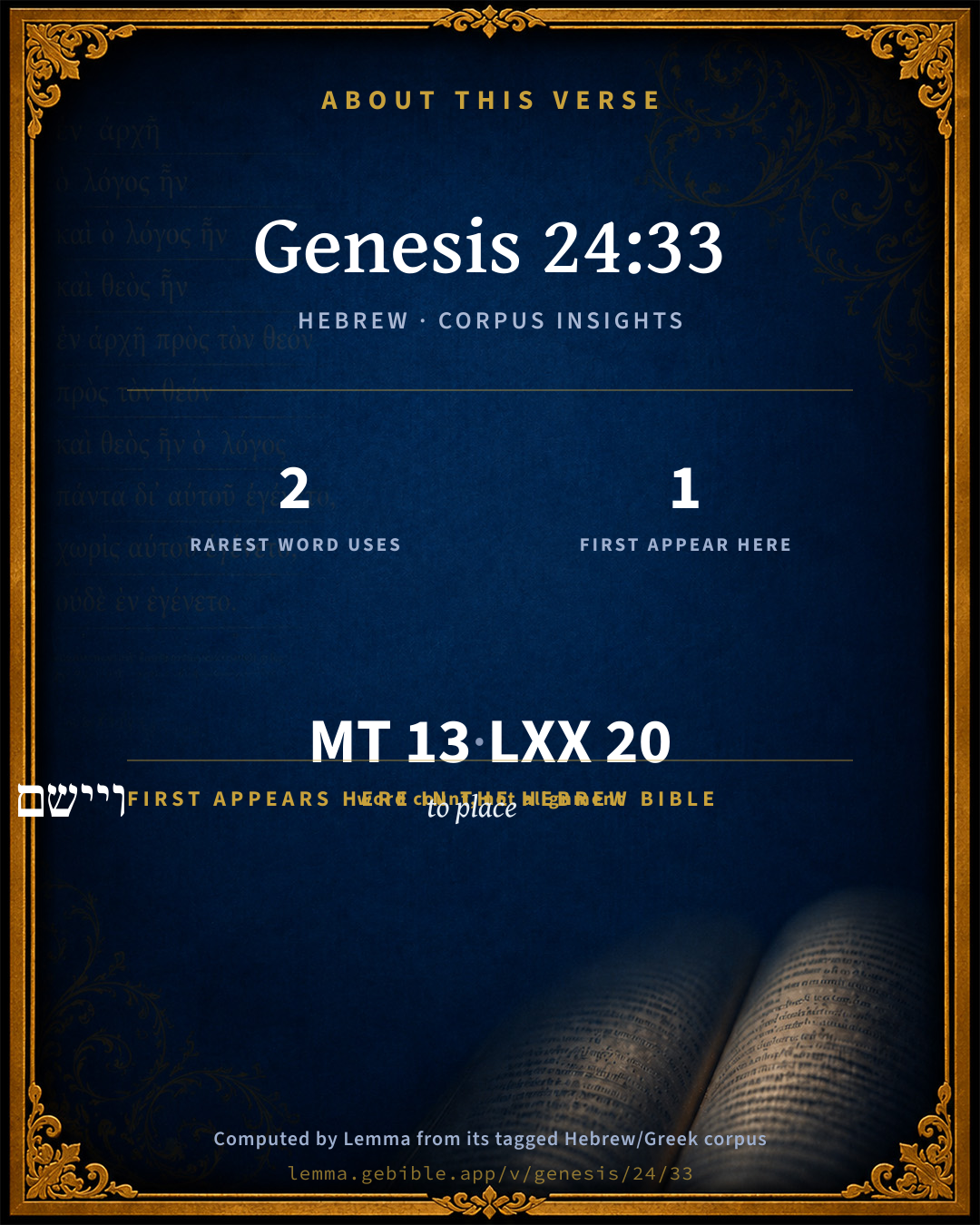
The rarest word here is ויישם to place H3455 — appearing just 2 times in the whole Hebrew Bible.

First appearance in Scripture

This word makes its first canonical appearance in the Hebrew Bible here:

  • ויישם to place H3455

Shared distinctive vocabulary

ויישם to place H3455 occurs in 2 verses of the Hebrew Bible. Also found in:

Grammatical profile

  • 8 verbs
  • 2 nouns
  • 1 preposition
  • 1 conjunction
  • 1 particle

Verb forms

  • ויישם Qal Passive · Sequential Imperfect
  • וַיּוּשַׂ֤ם Hophal · Sequential Imperfect
  • לֶאֱכֹ֔ל Qal · Infinitive Construct
  • וַיֹּ֨אמֶר֙ Qal · Sequential Imperfect
  • אֹכַ֔ל Qal · Imperfect
  • דִּבַּ֖רְתִּי Piel · Perfect
  • וַיֹּ֖אמֶר Qal · Sequential Imperfect
  • דַּבֵּֽר Piel · Imperative

Repetition

Words recur within this verse — often emphatic in Hebrew:

  • לֶאֱכֹ֔ל to eat H398 ×2
  • וַיֹּ֨אמֶר֙ to say H559 ×2
  • דִּבַּ֖רְתִּי to speak H1696 ×2

Hebrew & Septuagint length

In English translation the verse runs 24 words from the Hebrew and 26 from the Septuagint (LXX English) — closely comparable.

A rough comparison of the two English renderings, which tokenize alike — not a word-level alignment.

Word counts can differ between the Hebrew and the Greek without any difference in meaning — e.g. the Hebrew direct-object marker אֵת has no separate Greek word, and Greek often adds the article ὁ.

In the original languages it is 13 Hebrew tokens and 20 Greek tokens — but the two are counted differently (Hebrew bundles its prefixes and suffixes into one token; the Greek is in lemma form), so that isn’t a like-for-like length.

Cross-references

8

Topical passages linked to Genesis 24:33 in the Treasury of Scripture Knowledge — connected by theme and wording, ordered by reader-vote popularity; previews shown in the World English Bible.

  • Psalms 132:3–5 "Surely I will not come into the structure of my house, Nor go up into my bed;
  • Ephesians 6:5–8 Servants, be obedient to those who according to the flesh are your masters, with fear and trembling, in singleness of your heart, as to Christ;
  • 1 Timothy 6:2 Those who have believing masters, let them not despise them, because they are brothers, but rather let them serve them, because those who partake of the benefit are believing and beloved. Teach and exhort these things.
  • Job 23:12 I haven't gone back from the commandment of his lips. I have treasured up the words of his mouth more than my necessary food.
  • Proverbs 22:29 Do you see a man skilled in his work? He will serve kings; He won't serve obscure men.
  • Ecclesiastes 9:10 Whatever your hand finds to do, do it with your might; for there is no work, nor device, nor knowledge, nor wisdom, in Sheol, where you are going.
  • John 4:14 but whoever drinks of the water that I will give him will never thirst again; but the water that I will give him will become in him a well of water springing up to eternal life."
  • John 4:31–34 In the meanwhile, the disciples urged him, saying, "Rabbi, eat."

Cross-references courtesy of OpenBible.info (CC BY 4.0).

Hebrew and Greek witnesses Masoretic Hebrew ↔ Greek Septuagint

The same verse in the two great witnesses to the Old Testament, shown verse-for-verse.

These are two independent witnesses, not word-aligned to each other, and the Septuagint is shown in lemma (dictionary) form.

Hebrew Genesis 24:33 Masoretic · Westminster Leningrad Codex

ויישם וַיּוּשַׂ֤ם לְפָנָיו֙ לֶאֱכֹ֔ל וַיֹּ֨אמֶר֙ לֹ֣א אֹכַ֔ל עַ֥ד אִם דִּבַּ֖רְתִּי דְּבָרָ֑י וַיֹּ֖אמֶר דַּבֵּֽר

Food was set before him to eat. But he said, "I will not eat until I have told my message." He said, "Speak on."

World English Bible · Public Domain

Greek LXX Genesis 24:33 Septuagint · lemma form

καί παρατίθημι αὐτός ἄρτος ἐσθίω καί εἶπον οὐ μή ἐσθίω ἕως ὁ λαλέω ἐγώ ὁ ῥῆμα ἐγώ καί εἶπον λαλέω

And he set before them loaves to eat; but he said, I will not eat, until I have told my errand. And he said, Speak on.

LXX2012 (modern English Septuagint) · Public Domain

On this verse, The Pulpit Commentary discusses the Septuagint’s reading. Read the note in Commentary ↓

Hebrew: Westminster Leningrad Codex (CC BY 4.0). Greek: Septuagint (public domain); English from LXX2012 (modern English Septuagint) (Public Domain). How the Septuagint differs from the Hebrew →

Targum (Aramaic paraphrase)

2

The Targum is the ancient Jewish Aramaic paraphrase of the Hebrew Scriptures — an interpretive translation, not the Hebrew text itself. Onkelos (literal) and Pseudo-Jonathan (expansive) render the Torah, and Jonathan the Prophets. Coverage is partial: where no permissively-licensed English translation exists for a verse, only the Aramaic is shown. This is verse-level text, not a word-by-word alignment to the Hebrew.

  1. Targum Onkelos Torah (Genesis–Deuteronomy)
    וְשַׁוִּיאוּ קֳדָמוֹהִי לְמֵיכָל וַאֲמַר לָא אֵיכוּל עַד דַּאֲמַלֵּל פִּתְגָּמָי וַאֲמַר מַלֵּיל

    (no public-domain English translation for this verse)

    Targum Onkelos — Aramaic: “Onkelos Genesis” (public domain); “Onkelos Exodus” (public domain); “Onkelos Leviticus” (public domain); “Onkelos Numbers” (public domain); “Onkelos Deuteronomy” (public domain). English: “Sefaria Community Translation” (CC0 1.0 (public-domain dedication)); “J.W. Etheridge. The Targums of Onkelos and Jonathan Ben Uzziel on the Pentateuch. London: Longmans, Green, 1862” (public domain). Text via Sefaria.

  2. Targum Pseudo-Jonathan Torah (Genesis–Deuteronomy)
    וְסַדָרוּ קוּמֵיהּ לְמֵכוּל תַּבְשִׁילָה דְבֵיהּ סַמָא דִקְטוֹל וְאַרְגִישׁ בֵּיהּ וַאֲמַר לָא אֵיכוּל עַד דַאֲמַלֵיל פִּתְגָמָי וַאֲמַר מַלֵיל

    And he set in order before him to eat, prepared food in which was poison to kill; but he objected to it, and said, I will not eat, until I have spoken my words. And he said, Speak.

    Targum Pseudo-Jonathan — Aramaic: “Targum Jonathan on Genesis” (public domain); “Targum Jonathan on Exodus” (public domain); “Targum Jonathan on Leviticus” (public domain); “Targum Jonathan on Numbers” (public domain); “Targum Jonathan on Deuteronomy” (public domain). English: “The Targum of Jonathan ben Uzziel, trans. J. W. Etheridge, London, 1862” (public domain). Text via Sefaria.

Commentary

Notes on Genesis 24:33 from classic Christian and Jewish commentators (each source and its license shown beneath its notes). The classic Christian expositions comment on the surrounding passage and are grouped to its opening verse, so a note may address several verses; the Jewish commentaries on the Tanakh (Rashi and others) are per-verse, so they appear only where the commentator wrote on this verse.

Lemma curates 59 commentaries, every one of them public domain or Creative Commons licensed, each selected and text-cleaned for this edition rather than reprinted as found. About our sources →

Trapp's Complete Commentary

John Trapp

Gen 24:33 And there was set [meat] before him to eat: but he said, I will not eat, until I have told mine errand. And he said, Speak on.

Ver. 33. I will not eat, till I have told mine errand.] He preferred his work before his food. So did our Saviour at the well of Samaria. {Joh 4:6-8; Joh 4:31-38} And another time, when he thought to have slaked his hunger at the barren fig tree, and found nothing but leaves, he went on to Jerusalem; and forgetting his hunger, as he had before forgot his breakfast, he turned not into a victualling house, but went to the temple and taught the people; and confuted the elders all that day long till the evening. {Mat 21:18-27 Mar 11:13-15} Job "esteemed God’s word more than his necessary food"; {Job 23:12} not only more than his dainties or superfluities.

John Trapp, A Commentary or Exposition upon All the Books of the Old and New Testament (1647–1656) — public domain. Text from a community e-Sword module.

Joseph Benson's Commentary

Gen 24:33. I will not eat till I have told my errand — What a fine picture of diligence and zeal for a master’s service is this! How worthy to be imitated by all servants! Though it was after a long journey, and much fatigue, yet so impatient is he to do his master’s business, that he will not eat till he has proceeded in it.

Joseph Benson's Commentary on the Old and New Testaments (1811–1818) — public domain. Text from a community e-Sword module.

Tyndale Open Study Notes

Tyndale Open Resources

24:33-48 The servant was not diverted from his mission; he insisted on telling his story before he would eat. He recounted his mission and acknowledged God’s providence in directing him to Rebekah before attending to his personal needs. The servant wanted everyone to know that this was God’s work, not a chance or humanly arranged meeting.

Tyndale Open Study Notes — © Tyndale Open Resources, licensed CC BY-SA 4.0. Text via the HelloAO Bible API.

Geneva Bible (1599)

Geneva Bible translators

The fidelity that servants owe to their masters, causeth them to prefer their master’s business to their own necessity.

Geneva Bible (1599) marginal notes — public domain. Text via Bolls.life.

Adam Clarke's Commentary

Verse 33. I will not eat until I have told] In Hindoostan it is not unusual for a Brahmin to enter a house and sit down, and when meat is offered, refuse to eat till he has obtained the object of his errand. Here is a servant who had his master's interest more at heart than his own. He refuses to take even necessary refreshment till he knows whether he is likely to accomplish the object of his journey. Did not our blessed Lord allude to the conduct of Abraham's servant, Joh 4:34: My meat is to do the will of him that sent me, and to finish his work?

Adam Clarke's Commentary on the Bible (1810–1826) — public domain. Text from a community e-Sword/MySword module.

John Calvin's Commentaries

33. I will not eat until I have told my errand Moses begins to show by what means the parents of Rebekah were induced to give her in marriage to their nephew. That the servant, when food was set before him, should refuse to eat till he had completed his work is a proof of his diligence and fidelity; and it may with propriety be regarded as one of the benefits which God had vouchsafed to Abraham, that he should have a servant so faithful, and so intent upon his duty. Since, however, this was the reward of the holy discipline which Abraham maintained, we cannot wonder that very few such servants are to be found, seeing that everywhere they are so ill-governed.

Moreover, although the servant seems to weave a superfluous story, yet there is nothing in it which is not available to his immediate purpose. He knew that it was a feeling naturally inherent in parents, not willingly to send away their children to a distance. He therefore first commemorates Abraham’s riches, that they might not hesitate to connect their daughter with a husband so wealthy. He secondly explains that Isaac was born of his mother in her old age; not merely for the purpose of informing them that he had been miraculously given to his father, whence they might infer that he had been divinely appointed to this greatness and eminence; but that an additional commendation might be given on account of Isaac’s age. In the third place, he affirms that Isaac would be the sole heir of his father. Fourthly, he relates that he had been bound by an oath to seek a wife for his master Isaac, from among his own kindred; which special choice on the part of Abraham was very effectual in moving them to compliance. Fifthly, he states that Abraham, in full confidence that God would be the leader of his journey, had committed the whole business to him. Sixthly, he declares, that whatever he had asked in prayer he had obtained from the Lord; whence it appeared that the marriage of which he was about to treat was according to the will of God. We now see the design of his narration: First, to persuade the parents of Rebekah that he had not been sent for the purpose of deceiving them, that he had not in anything acted craftily, or by oblique methods, but in the fear of the Lord, as the religious obligation of marriage requires. Secondly, that he was desiring nothing which would not be profitable and honorable for them. And lastly, that God had been the director of the whole affair.

Moreover, since the servant of Abraham, though persuaded that the angel of God would be the guide of his journey, yet neither directs his prayers nor his thanksgivings to him, we may hence learn that angels are not, in such a sense, constituted the ministers of God to us, as that they should be invoked by us, or should transfer to themselves the worship due to God; a superstition which prevails nearly over the whole world to such a degree, that men turn aside a portion of their faith from the only fountain of all good to the rivulets which flow from it. The clause, the Lord, before whom I walk, (Genesis 24:40,) which some refer to the probity and good conscience of Abraham, I rather explain as applying to the faith, by which he set God before him, as the governor of his life, being confident that he was the object of God’s care, and dependent upon his grace.

If ye will deal kindly I have lately related the force of this expression; namely, to act with humanity and good faith. He thus modestly and suppliantly asks them to consent to the marriage of Isaac and Rebekah: should he meet with a repulse from them, he says, he will go either to the right hand or to the left; that is, he will look around elsewhere. For he places the right hand and the left in contrast with the straight way in which he had been led to them. It is, however, with fertile ingenuity that some of the Hebrews explain the words as meaning, that he would go to Lot, or to Ishmael.

John Calvin's Commentaries (1540-1563) — public domain. Text from the Calvin Translation Society English edition (1840s-50s) via the Christian Classics Ethereal Library (ccel.org). Calvin's coverage is partial (roughly two-thirds of the Bible); uncommented books and verses are honest gaps, never fabricated. The 19th-century editor's footnotes and remarks are omitted so the notes are faithfully Calvin's own voice.

Ellicott's Commentary for English Readers

(33) I will not eat, until I have told mine errand.—Two points in Oriental manners are here brought into view: the first, that hospitality, so necessary in a country where there are no inns, was, and still is, a religion to the Bedouin; the second, that consequently he will concede anything rather than have his hospitality refused. Aware of this feeling, Abraham’s servant will not partake of Laban’s bread and salt until he has told his request. After he had become Laban’s guest, Laban would have been free to do as he liked; but he must now grant what is asked, or the stranger would decline to enter his dwelling.

Mr. Fraser (Historical Description of Afghanistan Genesis 11 p. 424: Edinburgh, 1834) and Ferrier (L’Af ghanistan, Genesis 11, p. 119: ed. 1842) mention a remarkable custom connected with Afghan hospitality which admirably illustrates the behaviour of Abraham’s servant. It is called menawâti, from two words signifying I am come in. Any one who has a favour to ask goes to the tent or house of the person from whom he expects it, but refuses to sit on his carpet or partake of his food until he has granted the required boon. And custom makes it a point of honour to concede it, if it be in the power of the person thus appealed to.

A Bible Commentary for English Readers, edited by Charles John Ellicott (1878–1897) — public domain. Text from a community e-Sword module.

The Cambridge Bible for Schools and Colleges

gen. ed. J. J. S. Perowne

33. meat] i.e. “food.” See note on Gen_1:29.

I will not eat] The courtesies of the East would prohibit an enquiry into the stranger’s name before he had partaken of food. The name might possibly reveal relations, e.g. those of blood-feud, which would exclude hospitality.

The Cambridge Bible for Schools and Colleges (gen. ed. J. J. S. Perowne; Cambridge University Press, 1878–1918) — public domain. Text from a community e-Sword module.

John Gill's Exposition

And there was set meat before them to eat,.... By the order of Bethuel or Laban, or both; or, "afterwards was set" (l); that is after care had been taken the camels, then food being provided was set before the men to refresh them:

but he said, I will not eat until I have told mine errand; or, "spoke my words" (m); delivered the message he was sent with, and declared the business he came about; which shows him to be a diligent faithful servant, who had his master's interest at heart, and preferred it to his necessary food:

and he said; either Bethuel or Laban, for both were present, to whom the servant directed his discourse, Gen 24:47; perhaps Laban spoke in the name of his father, and bid him

speak on; go on with his discourse until he had said all he had to say, signifying that they were ready to give attention to him.

(l) "post appositum", Drusius, Schmidt. (m) "donec loquar sermones meos", V. L. "vel mea verba", Pagninus, Montanus, Piscator.

John Gill's Exposition of the Whole Bible (1746–1763) — public domain (CC PDM 1.0). Text via the HelloAO Bible API.

Whedon's Commentary on the Bible

Daniel D. Whedon

33. I will not eat — Too important is his errand to be delayed until after the ceremonies of hospitality are over. Gen_24:34.

And he said — This address of Abraham’s servant (Gen_24:34-39) is a masterpiece of its kind. It is a narrative, says Kalisch, “graced by every charm of simplicity, rivalling the most beautiful episodes of the Homeric writings, and pervaded by a beautiful spirit of sustained calmness. The repetitions which it contains are like the echo of truth; and the measured step by which it advances, carries it to its aim with enhanced dignity.”

Daniel D. Whedon (gen. ed.), Commentary on the Old and New Testaments (1874–1909) — public domain. Text from a community e-Sword module.

The Pulpit Commentary

And there was set appositus eat (Vulgate); i.e. if the first word be taken, as in the Keri, as the hophal of but if the Kethib be preferred, then is the fur. Kal of signifying, "and he set;" pareqhken (LXX) meat before him to eat (the crowning act of an Oriental reception): but he said, I will not eat, until I have told mine errand. Oriental politeness deferred the interrogation of a guest till after he had supped ("Odyss." 3:69); but Abraham"s servant hastened to communicate the nature of his message before partaking of the offered hospitality an instance of self-forgetful zeal of which Christ was the highest example (vide Mar_6:31; Joh_4:34) And he (i.e. Laban) said, Speak on.

The Pulpit Commentary (1880–1919), ed. H.D.M. Spence-Jones & Joseph S. Exell — public domain. Text from a community e-Sword module.

unfoldingWord translationNotes

Door43 World Missions Community

They set

Here, the word "they" refers to Laban's family members or to the household servants.

set food before him

"gave food to the servant"

said what I have to say

"spoken my words" or "told you why I am here"

he has become great

Here the word "he" refers to Abraham.

become great

"become very wealthy"

He has given

The word "he" refers to Yahweh.

translationWords

Laban

Abraham

servant

Yahweh

lord

flocks

silver

gold

donkey

unfoldingWord translationNotes — © Distant Shores Media and the Door43 World Missions Community, licensed CC BY-SA 4.0. Source: git.door43.org/Door43/en_tn.

Rashi

Rabbi Shlomo Yitzchaki (Rashi)

עד אם דברתי UNTIL THAT I HAVE SPOKEN — This is the same as עד אשר, so that you see that אם has the meaning of both אשר and כי, an example of the latter usage being (49:10) “Until that (עד כי) men come to Shiloh” (where עד כי is equivalent to עד אם in our verse). That is what our Sages, of blessed memory, have said (Rosh Hashanah 3a): The word כי is used in four meanings. One of these they say, is אי which is the Aramaic for the Hebrew word "im".

Rashi on the Tanakh — English translations: “The Judaica Press complete Tanach with Rashi, translated by A. J. Rosenberg” (CC BY 4.0); “Pentateuch with Rashi's commentary by M. Rosenbaum and A.M. Silbermann, 1929-1934” (public domain); “The Metsudah Tanach series, Lakewood, N.J” (CC BY 4.0); and “The Book of Joshua, Metsudah Publications, 1997” (CC BY 4.0). Text via Sefaria.

Radak

Rabbi David Kimhi (Radak)

ויושם, the word is spelled ויישם, “he placed,” although it is read as vayussam, “it was placed.” We find a similar anomaly in Genesis 50,26 when placing Joseph’s remains in a coffin is reported. The root of the verb is ישם.

ויאמר דבר, either Lavan or Betuel is the subject

Radak on the Tanakh — English translations: “Sefaria Community Translation” (CC0 1.0 (public-domain dedication)); “Eliyahu Munk, HaChut Hameshulash” (CC BY 4.0); “Rabbi Mike Feuer, Jerusalem Anthology” (CC BY 4.0); and “R. David Kimhi on the first book of Psalms, Translated by R.G. Finch, London, 1919” (public domain). Text via Sefaria.

Lesson kit

Teaching starters — assembled from the data on this page, not authored interpretation. Every prompt links to the verse data it draws on. Edit before teaching.

Genesis, in the Pentateuch, opens this verse with 13 words (10 distinct Hebrew lemmas). Its most distinctive word is yâsam (“to place”). A historical commentator’s framing appears above. Read the whole chapter for the surrounding context.

Discussion questions

  1. What does “to place” (yâsam) contribute to the verse as a whole?
  2. The word “to place” first appears here in Scripture. What is being introduced at this debut?
  3. Genesis 50:26 shares the word «to place» with this verse. How do the two illuminate each other?
  4. “to eat” occurs 2× in this one verse. What is the effect of the repetition?
  5. These translations render this verse differently; the difference is in the English rendering, not the original. What questions does that raise?
  6. The verb «ויישם» is Qal Passive Sequential Imperfect. How does its form color the action?
  7. Reading how Trapp's Complete Commentary and Joseph Benson's Commentary read this verse, where do the two commentators agree and where do they part?

Things to notice

Reading settings

Reading text

Shown beneath each verse's original-language words.

Old Testament
Old Testament edition

Read the OT as the Masoretic Hebrew (MT) or the Greek Septuagint (LXX).

English shown for the Greek Septuagint (in the Hebrew ↔ Greek comparison).

Comparing translations? Open the Compare panel on any verse page to stack up to four side by side.