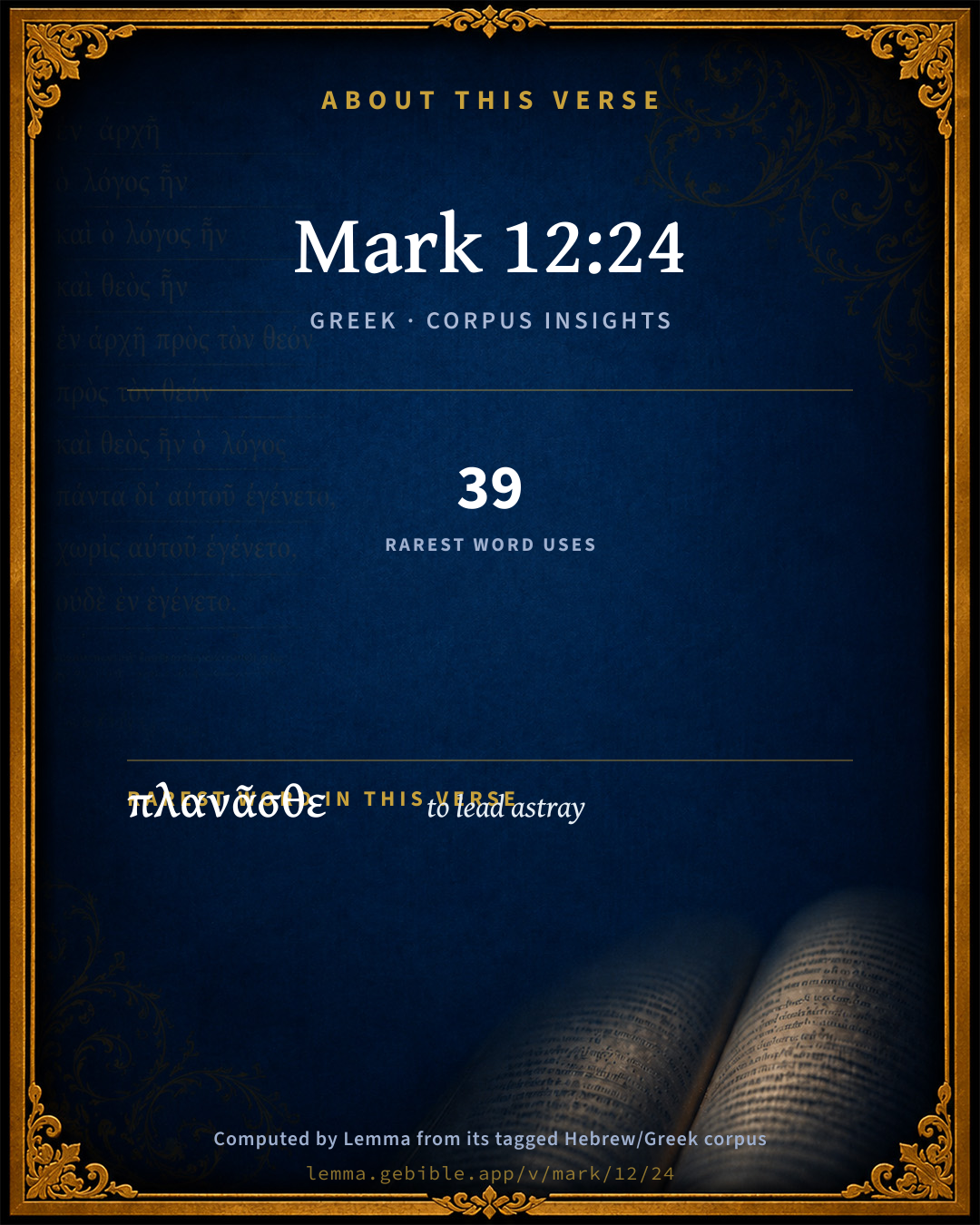
Mark 12:24

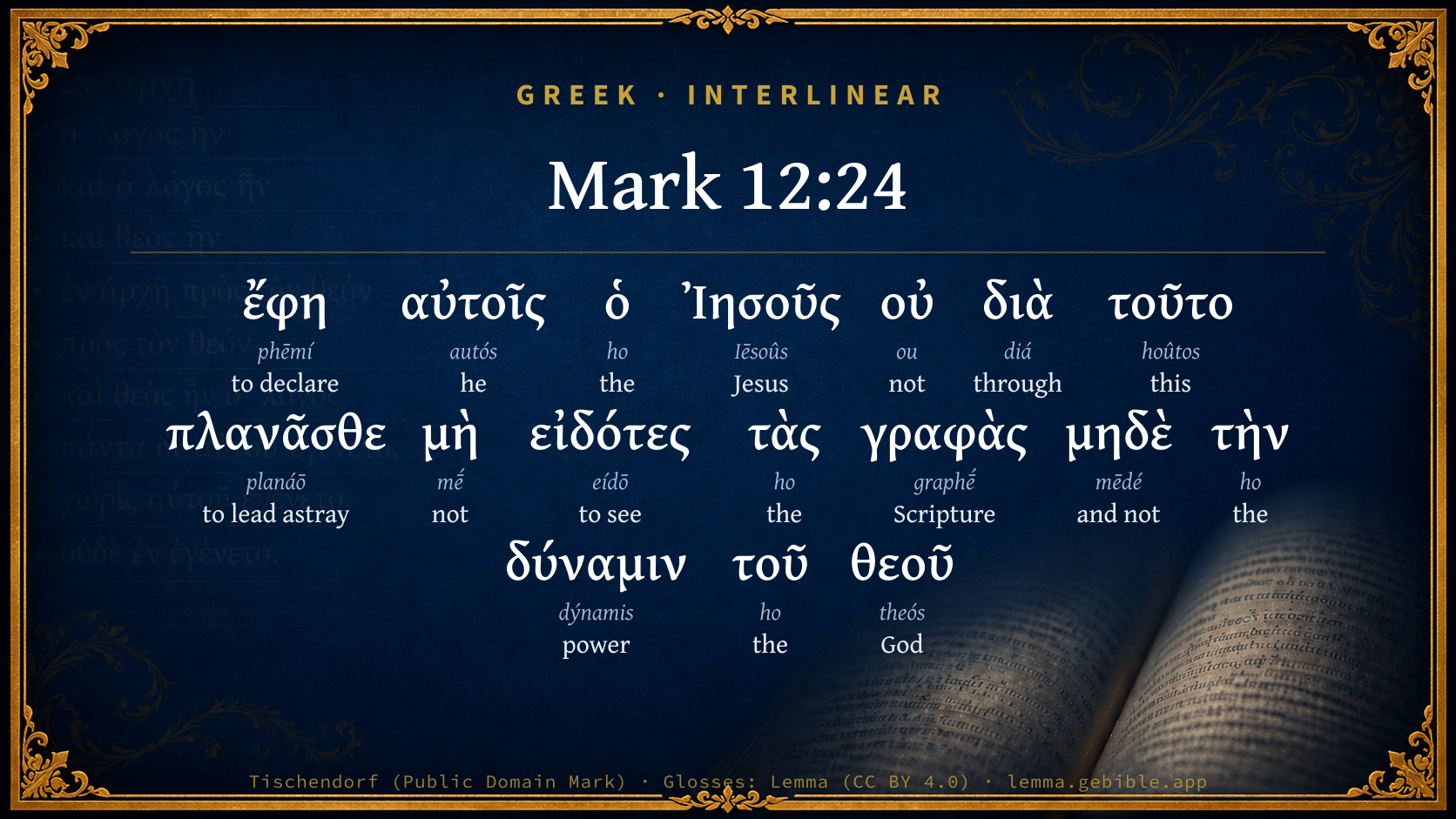
Greek (Tischendorf 8th ed.) Mark 12:24 appears in the Greek New Testament. The text above is from the Tischendorf 8th edition. Each word links to its Strong’s number and a concise gloss. Click any word for its full Thayer’s Greek Lexicon entry.
Download image
Cite this verse

Mark 12:24 (World English Bible). Public Domain. Lemma interlinear Bible study tool, https://lemma.gebible.app/v/mark/12/24.

Show BibTeX & RIS
BibTeX
RIS
English Translation
Jesus answered them, "Isn't this because you are mistaken, not knowing the Scriptures, nor the power of God?
World English Bible · Public Domain
Download a study sheet

One document with this verse’s original text, its word-by-word gloss line, the meaning frame, cross-references with their text, attributed commentary, and full source and license credits — printable, and it pastes into notes with its structure intact.

This verse Autodidact and up

Study sheet (.html) Plain text (.txt)

A passage Seminary Student

Up to 50 verses in one chapter. A passage sheet keeps up to 6 commentary sources and 12 cross-references per verse, in the order this page ranks them, and says so on the sheet whenever that leaves anything out. Ask for a single verse and you get the Autodidact verse sheet above.

Everything on this page stays free to read, with no account — the sheet is a download of what is already on screen, not access to it.

Want to remove ads? Support Godless Engineer
Compare translations 3

The same verse in 3 English versions, stacked beneath the original-language interlinear above. Click any original word for its lexicon entry.

Each is an independent rendering of the whole verse — the interlinear is not word-aligned to these translations.

Highlighted words mark where these versions differ — a whole-verse word diff, not a word-by-word alignment.

  • World English Bible Public Domain
    Jesus answered them, "Isn't this because you are mistaken, not knowing the Scriptures, nor the power of God?
  • King James Version Public Domain
    And Jesus answering said unto them, Do ye not therefore err, because ye know not the scriptures, neither the power of God?
  • unfoldingWord Literal Text CC BY-SA 4.0
    Jesus said to them, “Are you not being led astray because of this, not knowing the Scriptures nor the power of God?

unfoldingWord Literal Text — © unfoldingWord, licensed CC BY-SA 4.0. Word-aligned USFM3 via Door43 (git.door43.org/unfoldingWord/en_ult).

Versions to compare (up to 4)

3 of 4 selected

Show all 19 translations

Every available English version of this verse, each an independent rendering of the whole verse.

  • World English Bible Public Domain
    Jesus answered them, "Isn't this because you are mistaken, not knowing the Scriptures, nor the power of God?
  • Berean Standard Bible Public Domain
    Jesus said to them, “Aren’t you mistaken, because you do not know the Scriptures or the power of God?
  • Majority Standard Bible Public Domain
    Jesus answered them, “Aren’t you mistaken, because you do not know the Scriptures or the power of God?
  • King James Version Public Domain
    And Jesus answering said unto them, Do ye not therefore err, because ye know not the scriptures, neither the power of God?
  • American Standard Version (1901) Public Domain
    Jesus said unto them, Is it not for this cause that ye err, that ye know not the scriptures, nor the power of God?
  • Revised Version (1885) Public Domain
    Jesus said unto them, Is it not for this cause that ye err, that ye know not the scriptures, nor the power of God?
  • Geneva Bible (1599) Public Domain
    Then Iesus answered, and saide vnto them, Are ye not therefore deceiued, because ye knowe not the Scriptures, neither the power of God?
  • Douay-Rheims (1899) Public Domain
    And Jesus answering, saith to them: Do ye not therefore err, because you know not the scriptures, nor the power of God
  • Young's Literal Translation Public Domain
    And Jesus answering said to them, `Do ye not because of this go astray, not knowing the Writings, nor the power of God?
  • Literal Standard Version CC BY-SA 4.0
    And Jesus answering said to them, “Do you not go astray because of this, not knowing the Writings, nor the power of God?
  • Unlocked Literal Bible CC BY-SA 4.0
    Jesus said, “Is this not the reason you are mistaken, because you do not know the scriptures nor the power of God?
  • unfoldingWord Literal Text CC BY-SA 4.0
    Jesus said to them, “Are you not being led astray because of this, not knowing the Scriptures nor the power of God?
  • Darby Bible Public Domain
    And Jesus answering said to them, Do not ye therefore err, not knowing the scriptures, nor the power of God?
  • World Messianic Bible Public Domain
    Yeshua answered them, “Isn’t this because you are mistaken, not knowing the Scriptures nor the power of God?
  • Webster's Bible Public Domain
    And Jesus answering, said to them, Do ye not therefore err, because ye know not the scriptures, neither the power of God?
  • Free Bible Version CC BY-SA 4.0
    Jesus told them, “This proves you're mistaken, and that you don't know the Scriptures or the power of God.
  • Bible in Basic English Public Domain
    Jesus said to them, Is not this the reason for your error, that you have no knowledge of the holy Writings or of the power of God?
  • Text-Critical English NT CC BY 4.0
    Jesus answered them, “Is this not why you are in error, because you know neither the Scriptures nor the power of God?
  • Tyndale New Testament (1534) Public Domain
    Iesus answered and sayde vnto them: Are ye not therfore deceaved and vnderstonde not the scryptures nether the power of God?

Literal Standard Version (2020), Covenant Press — licensed CC BY-SA 4.0. Text via the HelloAO Bible API (eBible.org). Unlocked Literal Bible (unfoldingWord) — licensed CC BY-SA 4.0. Text via the HelloAO Bible API (eBible.org). unfoldingWord Literal Text — © unfoldingWord, licensed CC BY-SA 4.0. Word-aligned USFM3 via Door43 (git.door43.org/unfoldingWord/en_ult). Free Bible Version, Dr. Jonathan Gallagher — licensed CC BY-SA 4.0. Text via the HelloAO Bible API (eBible.org).

Word by word

More ways to search: Search by grammar → Find every occurrence → Compare this word →

Practice this passage: Drill this verse → Learn its vocabulary →

πλανᾶσθε
planáō
G4105
“to lead astray”
Verb, Present, Passive, Indicative, 2nd person, Plural
Part of Speech
Verb
Tense
Present
Voice
Passive
Mood
Indicative
Person
2nd person
Number
Plural
Full Thayer's Definition

Origin: from G4106

TDNT: 09:48,9

1. to cause to stray, to lead astray, lead aside from the right way a. to go astray, wander, roam about 2. metaph. a. to lead away from the truth, to lead into error, to deceive b. to be led into error c. to be led aside from the path of virtue, to go astray, sin d. to sever or fall away from the truth 1. of heretics e. to be led away into error and sin
  1. ἔφη phēmí G5346 “to declare” Verb, Imperfect, Active, Indicative, 3rd person, Singular
  2. αὐτοῖς autós G846 “he” Personal pronoun, Dative, Plural, Masculine
  3. ὁ ho G3588 “the” Article, Nominative, Singular, Masculine
  4. Ἰησοῦς Iēsoûs G2424 “Jesus” Noun, Nominative, Singular, Masculine
  5. οὐ ou G3756 “not” Particle, Negative
  6. διὰ diá G1223 “through” Preposition
  7. τοῦτο hoûtos G3778 “this” Demonstrative pronoun, Accusative, Singular, Neuter
  8. μὴ mḗ G3361 “not” Particle, Negative
  9. εἰδότες eídō G1492 “to see” Verb, Perfect, Active, Participle, Nominative, Plural, Masculine
  10. τὰς ho G3588 “the” Article, Accusative, Plural, Feminine
  11. γραφὰς graphḗ G1124 “Scripture” Noun, Accusative, Plural, Feminine
  12. μηδὲ mēdé G3366 “and not” Conjunction, Negative
  13. τὴν ho G3588 “the” Article, Accusative, Singular, Feminine
  14. δύναμιν dýnamis G1411 “power” Noun, Accusative, Singular, Feminine
  15. τοῦ ho G3588 “the” Article, Genitive, Singular, Masculine
  16. θεοῦ theós G2316 “God” Noun, Genitive, Singular, Masculine

About this verse

These counts appear in no published source. They are computed here, from the morphology-tagged text and Lemma’s own curated glosses. What Lemma adds →

17
words
14
distinct lemmas
Gospels
section

Shared distinctive vocabulary

πλανᾶσθε to lead astray G4105 occurs in 37 verses of the Greek New Testament. Also found in:

Repetition

A word recurs within this verse:

Cross-references

23

Topical passages linked to Mark 12:24 in the Treasury of Scripture Knowledge — connected by theme and wording, ordered by reader-vote popularity; previews shown in the World English Bible.

  • 2 Timothy 3:15–17 From infancy, you have known the sacred writings which are able to make you wise for salvation through faith, which is in Christ Jesus.
  • Matthew 22:29 But Jesus answered them, "You are mistaken, not knowing the Scriptures, nor the power of God.
  • John 20:9 For as yet they didn't know the Scripture, that he must rise from the dead.
  • Ephesians 1:19 and what is the exceeding greatness of his power toward us who believe, according to that working of the strength of his might
  • Isaiah 25:8 He has swallowed up death forever; and the Lord Yahweh will wipe away tears from off all faces; and the reproach of his people will he take away from off all the earth: for Yahweh has spoken it.
  • Jeremiah 32:17 Ah Lord Yahweh! behold, you have made the heavens and the earth by your great power and by your outstretched arm; there is nothing too hard for you,
  • Hosea 6:2 After two days will he revive us. On the third day he will raise us up, And we will live before him.
  • Mark 10:27 Jesus, looking at them, said, "With men it is impossible, but not with God, for all things are possible with God."
  • Acts 17:11 Now these were more noble than those in Thessalonica, in that they received the word with all readiness of the mind, examining the Scriptures daily to see whether these things were so.
  • Romans 15:4 For whatever things were written before were written for our learning, that through patience and through encouragement of the Scriptures we might have hope.
  • Philippians 3:21 who will change the body of our humiliation to be conformed to the body of his glory, according to the working by which he is able even to subject all things to himself.
  • Isaiah 26:19 Your dead shall live; my dead bodies shall arise. Awake and sing, you who dwell in the dust; for your dew is [as] the dew of herbs, and the earth shall cast forth the dead.
  • Hosea 6:6 For I desire mercy, and not sacrifice; And the knowledge of God more than burnt offerings.
  • Hosea 13:14 I will ransom them from the power of Sheol. I will redeem them from death! Death, where are your plagues? Sheol, where is your destruction? Compassion will be hidden from my eyes.
  • Luke 1:37 For everything spoken by God is possible."
  • John 5:39 "You search the Scriptures, because you think that in them you have eternal life; and these are they which testify about me.
  • Job 19:25–27 But as for me, I know that my Redeemer lives. In the end, he will stand upon the earth.
  • Isaiah 8:20 To the law and to the testimony! if they don't speak according to this word, surely there is no morning for them.
  • Jeremiah 8:7–9 Yes, the stork in the sky knows her appointed times; and the turtle-dove and the swallow and the crane observe the time of their coming; but my people don't know Yahweh's law.
  • Ezekiel 37:1–14 The hand of Yahweh was on me, and he brought me out in the Spirit of Yahweh, and set me down in the midst of the valley; and it was full of bones.
  • Daniel 12:2 Many of those who sleep in the dust of the earth shall awake, some to everlasting life, and some to shame and everlasting contempt.
  • Genesis 18:14 Is anything too hard for Yahweh? At the set time I will return to you, when the season comes round, and Sarah will have a son."
  • Hosea 8:12 I wrote for him the many things of my law; But they were regarded as a strange thing.

Cross-references courtesy of OpenBible.info (CC BY 4.0).

Commentary

Notes on Mark 12:24 from classic Christian and Jewish commentators (each source and its license shown beneath its notes). The classic Christian expositions comment on the surrounding passage and are grouped to its opening verse, so a note may address several verses; the Jewish commentaries on the Tanakh (Rashi and others) are per-verse, so they appear only where the commentator wrote on this verse.

Lemma curates 59 commentaries, every one of them public domain or Creative Commons licensed, each selected and text-cleaned for this edition rather than reprinted as found. About our sources →

Tyndale Open Study Notes

Tyndale Open Resources

12:24-27 Jesus’ response had two elements. First, he rebuked the Sadducees’ ignorance of the Scriptures (i.e., the Old Testament), where the resurrection of the dead is referred to most clearly in the Prophets (Isa 26:19; Ezek 37:1-14) and the Writings (Job 19:26; Pss 16:9-11; 49:15; 73:23-26; Dan 12:2). However, the Sadducees accepted only the Torah (Genesis—Deuteronomy), so Jesus answered them from the Torah. The reference to God as the God of Abraham, the God of Isaac, and the God of Jacob (see Exod 3:6, 15-16) showed that God’s covenant with the patriarchs could not be broken by death. They were still alive (Matt 8:11-12; 13:17; Luke 16:19-31; John 8:56), for God is the God of the living, not the dead. God’s covenant relationship with his people extends beyond their physical death, which means that the afterlife must be a reality. • Second, Jesus challenged the Sadducees’ ignorance of God’s power. They thought that life in the resurrection would have to be an extension of mortal life. Instead, it is life raised to an entirely new level. In this new existence, there is no need for sexual reproduction because there is no more death. The intimacy of marriage is superseded by fellowship with a multitude of fellow believers and with God (Mark 10:29-30; Matt 19:28-29; Luke 18:29-30; Rev 21:1-4). It is in this respect that resurrected believers will be like the angels in heaven. • Jesus’ argument demonstrates his wisdom before his opponents and affirms the hope of the resurrection for his followers. Jesus is “the resurrection and the life” (John 11:25); he has conquered death and assured those who believe in him that they will “not perish but have eternal life” (John 3:16).

Tyndale Open Study Notes — © Tyndale Open Resources, licensed CC BY-SA 4.0. Text via the HelloAO Bible API.

Bengel's Gnomon

Johann Albrecht Bengel

Mar 12:24. Διὰ τοῦτο, on this account) The particle strengthens the refutation: your very words betray your error, Lat. atqui. Psalms 66(65):19.

Bengel's Gnomon of the New Testament — English translation (T&T Clark, Edinburgh, 1860) — public domain. Text from a community e-Sword module.

Expositor's Greek Testament

ed. W. Robertson Nicoll

Mar 12:24 . οὐ πλανᾶσθε , do ye not err? not weaker but stronger than a positive assertion: “pro vehementi affirmatione,” Grotius. διὰ τοῦτο usually refers to something going before, and it may do so here, pointing to their question as involving ignorant presuppositions regarding the future state, an ignorance due, in turn, to ignorance of Scripture teaching and the power of God. But it is more natural to connect it with the following clause, as in cases when the expression precedes ὅτι , ἵνα , ὅταν , etc., for μὴ εἰδότες is = ὅτι οὐκ οἴδατε . So De Wette and others, vide Winer, sec. xxiii. 5.

The Expositor's Greek Testament, edited by W. Robertson Nicoll (1897–1910) — public domain. Text from a community e-Sword module.

Ellicott's Commentary for English Readers

(24) Because ye know not the scriptures.—More literally, as in St. Matthew, not knowing the scriptures.

A Bible Commentary for English Readers, edited by Charles John Ellicott (1878–1897) — public domain. Text from a community e-Sword module.

The Cambridge Bible for Schools and Colleges

gen. ed. J. J. S. Perowne

24. because ye know not] Our Lord traces their error to ignorance (i) of the Scriptures, and (ii) of the power of God. He deals with the latter phase of ignorance first.

The Cambridge Bible for Schools and Colleges (gen. ed. J. J. S. Perowne; Cambridge University Press, 1878–1918) — public domain. Text from a community e-Sword module.

John Gill's Exposition

And as touching the dead, that they rise,.... For the proof of the doctrine of the resurrection of the dead,

have ye not read in the book of Moses; that is, in the law of Moses; for though it was divided into five parts, it was but one book; just as the Psalms are called the Book of Psalms, Act 1:20, and the Prophets, the Book of the Prophets, Act 7:42. The book of Exodus is particularly intended; for the passage referred to is in Exo 3:6,

how in the bush God spake unto him, or "out of the bush", as the Syriac and Persic versions read;

saying, I am the God of Abraham, and the God of Isaac, and the God of Jacob? See Gill on Mat 22:31, Mat 22:32.

John Gill's Exposition of the Whole Bible (1746–1763) — public domain (CC PDM 1.0). Text via the HelloAO Bible API.

Trapp's Complete Commentary

John Trapp

24 And Jesus answering said unto them, Do ye not therefore err, because ye know not the scriptures, neither the power of God?

Ver. 24. Not knowing the Scriptures] And yet they alleged and argued out of Scripture, but upon a false ground; viz. that the state of men should continue in the other world such as it is here; as to eat, drink, marry, generate, &c.

John Trapp, A Commentary or Exposition upon All the Books of the Old and New Testament (1647–1656) — public domain. Text from a community e-Sword module.

The Pulpit Commentary

These Sadducees erred in two ways:

(1) They did not know or remember the Scriptures, such as that in Job, (Job_21:25) "I know that my Redeemer liveth," etc., or in Isaiah, (Isa_26:19) "Thy dead men shall live, together with my dead body shall they arise;" or in Daniel, (Dan_12:2) "Many of them that sleep in the dust of the earth shall awake," etc.

(2) They did not know the power of God, namely, that he can raise the bodies of the dead again to life, even as at first he created them out of nothing; for a greater power is required to make that to be which was not, than to make that again to be which once was. But then the resurrection life will be a new life, spiritual, glorious, eternal, like that of the angels.

So in these words our Lord struck at the double root of the error of the Sadducees:

(1) ignorance of the Scriptures, which plainly teach the resurrection; and

(2) ignorance of the power of God, which led them to interpret these Scriptures, which speak of the resurrection, to mean only a mystical resurrection from vice to virtue.

Sorces of heresy.

I PRINCIPAL CAUSES OF RELIGIOUS ERROR.

1. Ignorance of Holy Scripture.

(1) Unaided human nature is prone to error. Bather might it be said that of itself human nature cannot possibly know the truth. We have but to remember the idola of which philosophy warns us, to perceive how much there is in the circumstances and very constitution of the human mind to interfere with the attainment of intellectual truth. Difficulties of this nature, however, may be practically overcome by diligence, candour, and careful study; and the phenomena of the senses will yield up the secret of their working to the educated thinker. But there are things beyond sense concerning which the methods of intellectual research can give us no information. The agnosticism of science concerning these things is therefore, as a whole, to be accepted as real. Were it not that there are moral as well as purely intellectual and constitutional causes for this ignorance, no fault need be found with it. But any view of mental error which omitted consideration of the fact of human depravity could not be considered adequate. The natural mind "loves darkness rather than light.

(2) Scripture is intended to correct human error. "The entrance of thy words giveth light". (Psa_119:130) They reveal the existence, works, character, and purpose of God. By so doing they solve the mysteries attaching to human life and duty. They are the Word of God, anticipating and transcending the findings of the world"s experience. This is done, not only by communicating what is above sensible perception, but by affording a discipline to the spiritual nature. "For the Word of God is quick, and powerful, and sharper than any two-edged sword, piercing even to the dividing asunder of soul and spirit, and of the joints and marrow, and is a discerner of the thoughts and intents of the heart". (Heb_4:12) "Every Scripture inspired of God is also profitable for teaching, for reproof, for correction, for instruction which is in righteousness: that the man of God may be complete, furnished completely unto every good work". (2Ti_3:16) "Ye search the Scriptures, because ye think that in them ye have eternal life; and these are they which bear witness of me". (Joh_5:39)

2. Lack of spiritual experience. "Nor the power of God." This ignorance may consist partly in ignorance of the facts of the Divine history of mankind as recorded in Scripture; but it is chiefly due to absence of personal, experimental consciousness of God in the spiritual nature. It is the darkness of the heart" which exaggerates and intensifies the effects of general ignorance. "The power of God" works its miracles in the inward as well as the outward life; in conversion, sanctification, communion, and providential grace.

II IN WHOM THESE MAY EXIST. The Sadducees were, according to the standards of their day, educated men. With the letter of the books of Moses they were familiar (ver. 26); and they were most careful to preserve them from addition or intermixture.

1. Highly educated men may err in Divine things. "Thou didst hide these things from the wise and understanding, and didst reveal them unto babes". (Mat_11:25) Secular culture has not furnished an atom of the transcendental knowledge upon which religion is based; the Bible is not its product, nor can it be interpreted by it. Yet is not literature, art, or science to be discarded as a secondary aid to the interpretation of Scripture. If God does not require our knowledge, neither does he, as it has been finely said, require our ignorance.

2. There are many who know the letter of God"s Word without knowing its spirit. Religious training may bestow an acquaintance with Scriptural history and doctrine and the chief outlines of moral duty, but it cannot ensure the inward knowledge of the heart. The interpretation of Scripture is only possible to those who are spiritually enlightened. Knowing the Bible externally may actually prove a hindrance to an inward knowledge of it, if it be made too much of, or imagined sufficient in itself. Superficial acquaintance with Biblical literature, doctrine, etc., puffeth up;" and it requires the sternest and most frequent assaults ere its true character is exposed to itself.

III HOW THEY ARE TO BE REMOVED.

1. The teaching of Christ; awakening a sense of inward need and repentance, and revealing the correspondence of the Word of God to the expanding and maturing spiritual consciousness.

2. The gift of the Holy Spirit; which takes of the things of God and reveals them to us. "Things which eye saw not, and ear heard not, and which entered not into the heart of man, whatsoever things God prepared for them that love him. But unto us God revealed them through the Spirit: for the Spirit searcheth all things, yea, the deep things of God". (1Co_2:9) Not least of the enlightening influence of the Holy Ghost is due to the purification of the heart. M.

The Pulpit Commentary (1880–1919), ed. H.D.M. Spence-Jones & Joseph S. Exell — public domain. Text from a community e-Sword module.

Scofield Reference Notes

C. I. Scofield

said unto them

See margin ref., (See Scofield "Mat 22:29")

The Scofield Reference Bible (1917 edition), notes by C. I. Scofield — public domain. Text from a community e-Sword module.

Kretzmann's Popular Commentary

Paul E. Kretzmann

The decisive answer of Jesus:

v. 24. And Jesus, answering, said unto them, Do ye not therefore err because ye know not the Scriptures, neither the power of God?

v. 25. For when they shall rise from the dead, they neither marry, nor are given in marriage, but are as the angels which are in heaven.

v. 26. And as touching the dead, that they rise: have ye not read in the book of Moses how in the bush God spake unto him, saying, I am the God of Abraham and the God of Isaac and the God of Jacob?

v. 27. He is not the God of the dead, but the God of the living; ye therefore do greatly err.

The question which Jesus uses: Do ye not err on account of this fact?. is stronger than a positive statement as to their wrong belief and argument. He says, in effect: Don’t you see how absolutely foolish you are in your belief and in your discussion? The point of your story is based upon a wrong supposition. Two grave facts must be noted against the Sadducees and all that follow them in similar arguments: They do not know the Scriptures; they do not know the power of God. Most of the most rabid and radical enemies of the Bible-truths have never even read the Bible, and yet they presume to judge it in the minutest details. And they have no conception of the great power of God; their finite minds cannot grasp infinity, and yet they make futile attempts to make matters beyond their ken clear to themselves and to others by theories that are subject to change without notice. Marrying and giving in marriage will no longer be practiced in heaven, after the resurrection. All physical needs will then be ended definitely, and all the believers in bliss will be sexless. The terms male and female, husband and wife, will no longer be in use, because there will be no need of them. The loved ones will be in heaven, not in the former relation of blood, but in the closer, happier relation of spirit, in union with Christ the Savior. But Jesus gives the Sadducees a lesson also concerning the resurrection of the dead. Since they rejected all the Old Testament writings but the five books of Moses, He takes His proof from one of these, from Exo 3:6-15. In speaking to Moses at the burning bush, God expressly called Himself the God of Abraham, the God of Isaac, the God of Jacob. All of these patriarchs, at this time, had died, and they were presumably dead, so far as men could see and judge. But, Jesus explains to the Sadducees, the fact that God so designates Himself, shows that these men, though dead in body, were yet alive, that their soul, the most essential part of them, was alive. The living God is the God of the living only, His work concerns the living only. This is true of all believers. All, to whom the Lord is God, live unto God, even when they have closed their eyes in temporal death. Death, to them, is only a temporary sleep, in the midst of which God considers them as living. And therefore God will truly awaken all the dead that have fallen asleep in Him to a new and blessed life in all eternity.

Paul E. Kretzmann, Popular Commentary of the Bible (1921–1924) — public domain. Text from a community e-Sword module.

unfoldingWord translationNotes

Door43 World Missions Community

Is this not the reason you are mistaken ... power of God?

Jesus rebukes the Sadducees because they are mistaken about God's law. This may be written as a statement. AT: "You are mistaken because ... power of God." (See: Rhetorical Question)

you do not know the scriptures

This means that they do not understand what is written in the Old Testament scriptures.

the power of God

"how powerful God is"

For when they rise

Here the word "they" refers to the brothers and the woman from the example.

rise

Waking and getting up from sleep is a metaphor for becoming alive after having been dead. (See: Metaphor)

from the dead

From among all those who have died. This expression describes all dead people together in the underworld. To rise from among them speaks of becoming alive again.

they neither marry nor are given in marriage

"they do not marry, and they are not given in marriage"

are given in marriage

This can be stated in active form. AT: "and no one gives them in marriage" (See: Active or Passive)

heaven

This refers to the place where God lives.

translationWords

Jesus

know

word of God

power

God

raise

die

angel

heaven

unfoldingWord translationNotes — © Distant Shores Media and the Door43 World Missions Community, licensed CC BY-SA 4.0. Source: git.door43.org/Door43/en_tn.

Cambridge Greek Testament for Schools and Colleges

24. [2759][2760][2761][2762][2763] omit καὶ ἀποκριθείς. See on Mar 12:17.

[2759] Codex Sinaiticus. 4th cent. Discovered by Tischendorf in 1859 at the Monastery of St Katharine on Mount Sinai. Now at St Petersburg. The whole Gospel, ending at Mar 16:8. Photographic facsimile, 1911.

[2760] Codex Vaticanus. 4th cent., but perhaps a little later than א. In the Vatican Library almost since its foundation by Pope Nicolas V., and one of its greatest treasures. The whole Gospel, ending at Mar 16:8. Photographic facsimile, 1889.

[2761] Codex Ephraemi. 5th cent. A palimpsest: the original writing has been partially rubbed out, and the works of Ephraem the Syrian have been written over it; but a great deal of the original writing has been recovered; of Mark we have Mar 1:17 to Mar 6:31, Mar 8:5 to Mar 12:29, Mar 13:19 to Mar 16:20. In the National Library at Paris.

[2762] Codex Regius. 8th cent. An important witness. At Paris. Contains Mar 1:1 to Mar 10:15; Mar 10:30 to Mar 15:1; Mar 15:20 to Mar 16:20, but the shorter ending is inserted between Mar 16:8 and Mar 16:9, showing that the scribe preferred it to the longer one.

[2763] Codex Sangallensis. 9th or 10th cent. Contains the Gospels nearly complete, with an interlinear Latin translation. The text of Mark is specially good, agreeing often with CL. At St Gall.

24. ἔφη αὐτοῖς. See crit. note, and for the rare kind of asyndeton cf. Mar 9:38, Mar 10:29. Syr-Sin. has “Our Lord answered and said.”

Οὐ διὰ τοῦτο. Is it not because of this that ye go astray, that ye know not, etc.? See on Mar 12:10 for similar questions asked by Christ. They thought that they had Scripture on their side, and what was still worse (μηδέ as in Mar 6:11), they did not realize the power of God (cf. 1Co 15:34). The latter kind of ignorance is corrected first. But Christ expresses no opinion of the Levirate law; He neither condemns nor confirms it. See on Mar 13:5 for πλανάω.

Cambridge Greek Testament for Schools and Colleges (Cambridge University Press, 1896; 21 vols, various authors incl. Carr, Maclear, Plummer, Farrar, Lumby, Moule, M. R. James, Simcox) — public domain. Text from a community e-Sword module.

Alford’s Greek Testament

Henry Alford

24.] διὰ τοῦτο refers to the following participle μὴ εἰδότες: for his reason … because ye know not.

Henry Alford, The Greek Testament (1849–1861) — public domain. Text from a community e-Sword module.

International Critical Commentary

24. Ἔφη αὐτοῖς ὁ Ἰησοῦς, Οὐ διὰ τοῦτο πλανᾶσθε, μὴ εἰδότες τὰς γραφάς, μηδὲ τὴν δύναμιν τοῦ Θεοῦ; Jesus said to them, Is it not on this account that you err, because you know not the Scriptures, nor the power of God? διὰ τοῦτο points forward to the μὴ εἰδότες,1 the part. being used causally. What follows in v. 25, 26, develops these two defects in their consideration of the matter. Their ignorance of the power of God is taken up first, in v. 25.

Ἒφη αὐτοῖς ὁ Ἰησοῦς, instead of Καὶ ἀποκριθεὶς ὁ Ἰησοῦς εἶπεν αὐτοῖς, Tisch. Treg. WH. RV. א BCL Δ 33, Memph. Pesh.

International Critical Commentary — older volumes (1896–1929), various authors — public domain. Text from a community e-Sword module.

Vincent's Word Studies in the New Testament

Marvin R. Vincent

Therefore [δια τουτο] . A rendering which obscures the meaning. The words point forward to the next two clauses. The reason of your error is your ignorance of the scriptures and the power of God. Hence Rev., correctly, Is it not for this cause that ye err?

Err [πλανασθε] . Lit., wander out of the way. Compare Latin errare. Of the wandering sheep, Mt 18:12; 1Pe 2:25. Of the martyrs wandering in the deserts, Heb 11:38. Often rendered in the New Testament deceive. See Mr 13:5, 6. Compare ajsterev planhtai, wandering stars (Jude 1:13), from which our word planet.

Marvin R. Vincent, Word Studies in the New Testament (1887–1900) — public domain. Text from a community e-Sword/MySword module.

Lesson kit

Teaching starters — assembled from the data on this page, not authored interpretation. Every prompt links to the verse data it draws on. Edit before teaching.

Mark, in the Gospels, opens this verse with 17 words (14 distinct Greek lemmas). Its most distinctive word is planáō (“to lead astray”). A historical commentator’s framing appears above. Read the whole chapter for the surrounding context.

Discussion questions

  1. How does “to lead astray” (planáō) shape what this verse is saying?
  2. Matthew 18:12 shares the word «to lead astray» with this verse. How do the two illuminate each other?
  3. “the” occurs 4× in this one verse. What is the effect of the repetition?
  4. The translations on this page render this verse differently — a whole-verse word diff, not a word-by-word alignment. What might account for the different wordings?
  5. Reading how Tyndale Open Study Notes and Bengel's Gnomon read this verse, where do the two commentators agree and where do they part?

Things to notice

Reading settings

Reading text

Shown beneath each verse's original-language words.

Old Testament
Old Testament edition

Read the OT as the Masoretic Hebrew (MT) or the Greek Septuagint (LXX).

English shown for the Greek Septuagint (in the Hebrew ↔ Greek comparison).

Comparing translations? Open the Compare panel on any verse page to stack up to four side by side.