Genesis 18:14

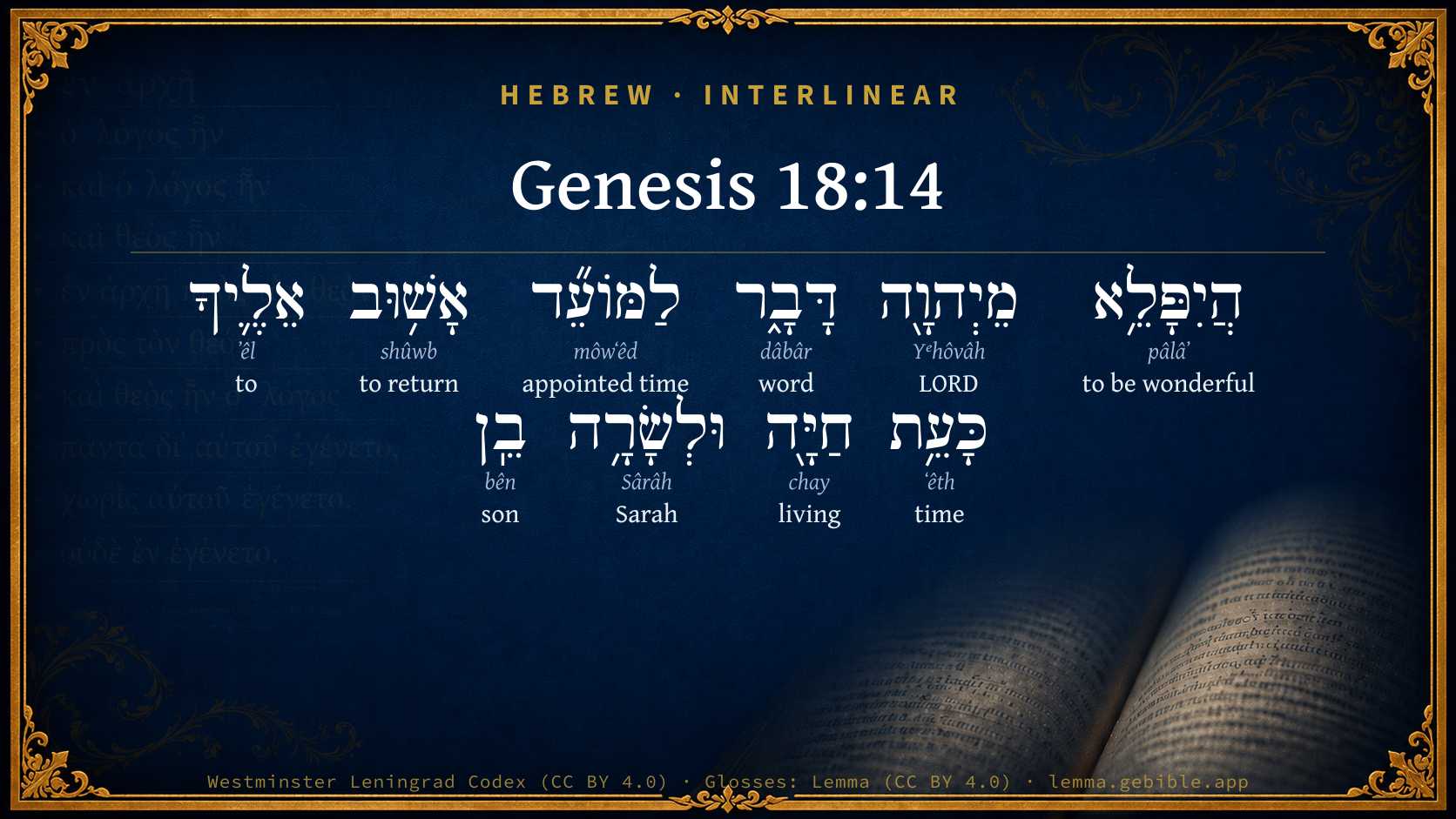
Hebrew (Westminster Leningrad Codex) Genesis 18:14 appears in the Hebrew Old Testament. The text above is from the Westminster Leningrad Codex. Each word links to its Strong’s number, a concise gloss, and parsing drawn from the Open Scriptures Hebrew Bible morphology. Click any word for its full Brown-Driver-Briggs (BDB) entry.
Download image
Cite this verse

Genesis 18:14 (World English Bible). Public Domain. Lemma interlinear Bible study tool, https://lemma.gebible.app/v/genesis/18/14.

Show BibTeX & RIS
BibTeX
RIS
English Translation
Is anything too hard for Yahweh? At the set time I will return to you, when the season comes round, and Sarah will have a son."
World English Bible · Public Domain
Highlights
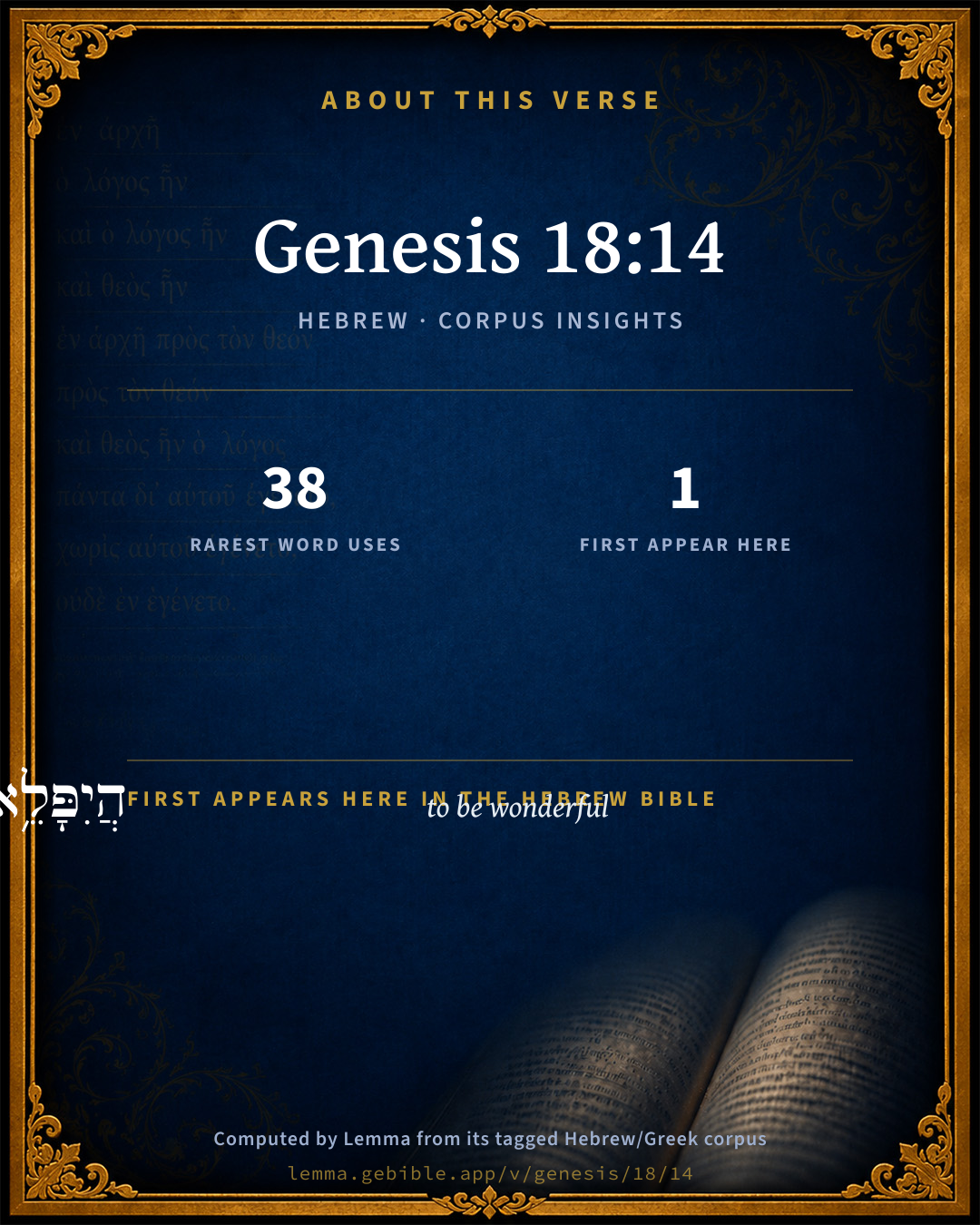
  • 1 first appearance in the Hebrew Bible
Full analysis ↓
Download a study sheet

One document with this verse’s original text, its word-by-word gloss line, the meaning frame, cross-references with their text, attributed commentary, and full source and license credits — printable, and it pastes into notes with its structure intact.

This verse Autodidact and up

Study sheet (.html) Plain text (.txt)

A passage Seminary Student

Up to 50 verses in one chapter. A passage sheet keeps up to 6 commentary sources and 12 cross-references per verse, in the order this page ranks them, and says so on the sheet whenever that leaves anything out. Ask for a single verse and you get the Autodidact verse sheet above.

Everything on this page stays free to read, with no account — the sheet is a download of what is already on screen, not access to it.

Want to remove ads? Support Godless Engineer
Compare translations 3

The same verse in 3 English versions, stacked beneath the original-language interlinear above. Click any original word for its lexicon entry.

Each is an independent rendering of the whole verse — the interlinear is not word-aligned to these translations.

Highlighted words mark where these versions differ — a whole-verse word diff, not a word-by-word alignment.

  • World English Bible Public Domain
    Is anything too hard for Yahweh? At the set time I will return to you, when the season comes round, and Sarah will have a son."
  • King James Version Public Domain
    Is any thing too hard for the LORD? At the time appointed I will return unto thee, according to the time of life, and Sarah shall have a son.
  • unfoldingWord Literal Text CC BY-SA 4.0
    Is anything too hard for Yahweh? At the appointed time I will return to you, at the time of life, and Sarah will have a son.”

unfoldingWord Literal Text — © unfoldingWord, licensed CC BY-SA 4.0. Word-aligned USFM3 via Door43 (git.door43.org/unfoldingWord/en_ult).

Versions to compare (up to 4)

3 of 4 selected

Show all 18 translations

Every available English version of this verse, each an independent rendering of the whole verse.

  • World English Bible Public Domain
    Is anything too hard for Yahweh? At the set time I will return to you, when the season comes round, and Sarah will have a son."
  • Berean Standard Bible Public Domain
    Is anything too difficult for the LORD? At the appointed time I will return to you—in about a year—and Sarah will have a son.”
  • Majority Standard Bible Public Domain
    Is anything too difficult for the LORD? At the appointed time I will return to you—in about a year—and Sarah will have a son.”
  • King James Version Public Domain
    Is any thing too hard for the LORD? At the time appointed I will return unto thee, according to the time of life, and Sarah shall have a son.
  • American Standard Version (1901) Public Domain
    Is anything too hard for Jehovah? At the set time I will return unto thee, when the season cometh round, and Sarah shall have a son.
  • Revised Version (1885) Public Domain
    Is any thing too hard for the LORD? At the set time I will return unto thee, when the season cometh round, and Sarah shall have a son.
  • Geneva Bible (1599) Public Domain
    (Shall any thing be hard to the Lord? at the time appointed will I returne vnto thee, euen according to the time of life, and Sarah shall haue a sonne.)
  • Douay-Rheims (1899) Public Domain
    And the Lord said to Abraham: Why did Sera laugh, saying: Shall I who am an old woman bear a child indeed?
  • Young's Literal Translation Public Domain
    And Jehovah saith unto Abraham, `Why `is' this? Sarah hath laughed, saying, Is it true really -- I bear -- and I am aged? Is any thing too wonderful for Jehovah? at the appointed time I return unto thee, about the time of life, and Sarah hath a son.'
  • Literal Standard Version CC BY-SA 4.0
    Is anything too wonderful for YHWH? At the appointed time I return to you, about the time of life, and Sarah has a son.”
  • Unlocked Literal Bible CC BY-SA 4.0
    Is anything too hard for Yahweh? At the time appointed by me, in the spring, I will return to you. About this time next year Sarah will have a son.”
  • unfoldingWord Literal Text CC BY-SA 4.0
    Is anything too hard for Yahweh? At the appointed time I will return to you, at the time of life, and Sarah will have a son.”
  • Darby Bible Public Domain
    Is [any] matter too wonderful for Jehovah? At the time appointed I will return to thee, at [this] time of the year, and Sarah shall have a son.
  • World Messianic Bible Public Domain
    Is anything too hard for the LORD? At the set time I will return to you, when the season comes around, and Sarah will have a son.”
  • Webster's Bible Public Domain
    Is any thing too hard for the LORD? At the time appointed I will return to thee, according to the time of life, and Sarah shall have a son.
  • Free Bible Version CC BY-SA 4.0
    Is anything too difficult for the Lord to do? I will come back next year when I said I would, in the spring, and Sarah will have a son.”
  • Bible in Basic English Public Domain
    Is there any wonder which the Lord is not able to do? At the time I said, in the spring, I will come back to you, and Sarah will have a child.
  • JPS Tanakh (1917) Public Domain
    Is any thing too hard for the LORD. At the set time I will return unto thee, when the season cometh round, and Sarah shall have a son.'

Literal Standard Version (2020), Covenant Press — licensed CC BY-SA 4.0. Text via the HelloAO Bible API (eBible.org). Unlocked Literal Bible (unfoldingWord) — licensed CC BY-SA 4.0. Text via the HelloAO Bible API (eBible.org). unfoldingWord Literal Text — © unfoldingWord, licensed CC BY-SA 4.0. Word-aligned USFM3 via Door43 (git.door43.org/unfoldingWord/en_ult). Free Bible Version, Dr. Jonathan Gallagher — licensed CC BY-SA 4.0. Text via the HelloAO Bible API (eBible.org).

Word by word

More ways to search: Search by grammar → Find every occurrence → Compare this word →

Practice this passage: Drill this verse → Learn its vocabulary →

וּלְשָׂרָ֥ה
Sârâh
H8283
“and · to/for · Sarah”
Conjunction + Preposition + Noun, Proper
Part of Speech
Conjunction + Preposition + Noun
Type
Proper
Full BDB Definition

Origin: the same as H8282

TWOT: None

Sarah = "noblewoman" - wife of Abraham and mother of Isaac
  1. הֲיִפָּלֵ֥א pâlâʼ H6381 “to be wonderful” Particle, Interrogative + Verb, Niphal, Imperfect, 3rd Person, Masculine, Singular
  2. מֵיְהוָ֖ה Yᵉhôvâh H3068 “from · LORD” Preposition + Noun, Proper
  3. דָּבָ֑ר dâbâr H1697 “word” Noun, Common, Masculine, Singular, Absolute
  4. לַמּוֹעֵ֞ד môwʻêd H4150 “to/for the · appointed time” Preposition, Determined + Noun, Common, Masculine, Singular, Absolute
  5. אָשׁ֥וּב shûwb H7725 “to return” Verb, Qal, Imperfect, 1st Person, Common, Singular
  6. אֵלֶ֛יךָ ʼêl H413 “to · you” Preposition + Suffix, Personal, 2nd Person, Masculine, Singular
  7. כָּעֵ֥ת ʻêth H6256 “like/as the · time” Preposition, Determined + Noun, Common, Both, Singular, Absolute
  8. חַיָּ֖ה chay H2416 “living” Adjective, Adjective, Feminine, Singular, Absolute
  9. בֵֽן bên H1121 “son” Noun, Common, Masculine, Singular, Absolute

About this verse

These counts appear in no published source. They are computed here, from the morphology-tagged text and Lemma’s own curated glosses. What Lemma adds →

10
words
10
distinct lemmas
Pentateuch
section

First appearance in Scripture

This word makes its first canonical appearance in the Hebrew Bible here:

  • הֲיִפָּלֵ֥א to be wonderful H6381

Shared distinctive vocabulary

וּלְשָׂרָ֥ה Sarah H8283 occurs in 32 verses of the Hebrew Bible. Also found in:

Grammatical profile

  • 2 verbs
  • 6 nouns
  • 1 adjective
  • 1 preposition

Verb forms

  • הֲיִפָּלֵ֥א Niphal · Imperfect
  • אָשׁ֥וּב Qal · Imperfect

Hebrew & Septuagint length

In English translation the verse runs 26 words from the Hebrew and 22 from the Septuagint (LXX English) — closely comparable.

A rough comparison of the two English renderings, which tokenize alike — not a word-level alignment.

Word counts can differ between the Hebrew and the Greek without any difference in meaning — e.g. the Hebrew direct-object marker אֵת has no separate Greek word, and Greek often adds the article ὁ.

Cross-references

30

Topical passages linked to Genesis 18:14 in the Treasury of Scripture Knowledge — connected by theme and wording, ordered by reader-vote popularity; previews shown in the World English Bible.

  • Luke 1:37 For everything spoken by God is possible."
  • Matthew 19:26 Looking at them, Jesus said, "With men this is impossible, but with God all things are possible."
  • Mark 10:27 Jesus, looking at them, said, "With men it is impossible, but not with God, for all things are possible with God."
  • Jeremiah 32:27 Behold, I am Yahweh, the God of all flesh: is there anything too hard for me?
  • Ephesians 3:20 Now to him who is able to do exceedingly abundantly above all that we ask or think, according to the power that works in us,
  • Job 42:2 "I know that you can do all things, And that no purpose of yours can be restrained.
  • Philippians 4:13 I can do all things through Christ, who strengthens me.
  • Jeremiah 32:17 Ah Lord Yahweh! behold, you have made the heavens and the earth by your great power and by your outstretched arm; there is nothing too hard for you,
  • Romans 4:21 and being fully assured that what he had promised, he was able also to perform.
  • Numbers 11:23 Yahweh said to Moses, Has Yahweh's hand grown short? now shall you see whether my word shall happen to you or not.
  • 2 Kings 4:16 He said, At this season, when the time comes round, you shall embrace a son. She said, No, my lord, you man of God, do not lie to your handmaid.
  • Deuteronomy 7:21 You shall not be scared of them; for Yahweh your God is in the midst of you, a great and awesome God.
  • Genesis 18:10 He said, "I will certainly return to you when the season comes round. Behold, Sarah your wife will have a son." Sarah heard in the tent door, which was behind him.
  • Matthew 14:31 Immediately Jesus stretched out his hand, took hold of him, and said to him, "You of little faith, why did you doubt?"
  • Luke 1:13 But the angel said to him, "Don't be afraid, Zacharias, because your request has been heard, and your wife, Elizabeth, will bear you a son, and you shall call his name John.
  • Deuteronomy 30:3 that then Yahweh your God will turn your captivity, and have compassion on you, and will return and gather you from all the peoples, where Yahweh your God has scattered you.
  • Psalms 95:3 For Yahweh is a great God, A great King above all gods.
  • Zechariah 8:6 Thus says Yahweh of Hosts: "If it is marvelous in the eyes of the remnant of this people in those days, should it also be marvelous in my eyes?" says Yahweh of Hosts.
  • Genesis 17:21 But my covenant I establish with Isaac, whom Sarah will bear to you at this set time in the next year."
  • Micah 7:18 Who is a God like you, who pardons iniquity, And passes over the disobedience of the remnant of his heritage? He doesn't retain his anger forever, Because he delights in loving kindness.
  • Job 36:5 "Behold, God is mighty, and doesn't despise anyone. He is mighty in strength of understanding.
  • Luke 8:50 But Jesus hearing it, answered him, "Don't be afraid. Only believe, and she will be healed."
  • Hebrews 11:19 accounting that God is able to raise up even from the dead. Figuratively speaking, he also did receive him back from the dead.
  • 1 Samuel 14:6 Jonathan said to the young man who bore his armor, Come, and let us go over to the garrison of these uncircumcised: it may be that Yahweh will work for us; for there is no restraint to Yahweh to save by many or by few.
  • Luke 1:18 Zacharias said to the angel, "How can I be sure of this? For I am an old man, and my wife is well advanced in years."
  • Psalms 93:1 Yahweh reigns! He is clothed with majesty! Yahweh is armed with strength. The world also is established. It can't be moved.
  • Matthew 3:9 Don't think to yourselves, 'We have Abraham for our father,' for I tell you that God is able to raise up children to Abraham from these stones.
  • Philippians 3:21 who will change the body of our humiliation to be conformed to the body of his glory, according to the working by which he is able even to subject all things to himself.
  • 2 Kings 7:1–2 Elisha said, Hear you the word of Yahweh: thus says Yahweh, Tomorrow about this time shall a measure of fine flour be [sold] for a shekel, and two measures of barley for a shekel, in the gate of Samaria.
  • Psalms 90:13 Relent, Yahweh! How long? Have compassion on your servants!

Cross-references courtesy of OpenBible.info (CC BY 4.0).

Hebrew and Greek witnesses Masoretic Hebrew ↔ Greek Septuagint

The same verse in the two great witnesses to the Old Testament, shown verse-for-verse.

These are two independent witnesses, not word-aligned to each other, and the Septuagint is shown in lemma (dictionary) form.

Hebrew Genesis 18:14 Masoretic · Westminster Leningrad Codex

הֲיִפָּלֵ֥א מֵיְהוָ֖ה דָּבָ֑ר לַמּוֹעֵ֞ד אָשׁ֥וּב אֵלֶ֛יךָ כָּעֵ֥ת חַיָּ֖ה וּלְשָׂרָ֥ה בֵֽן

Is anything too hard for Yahweh? At the set time I will return to you, when the season comes round, and Sarah will have a son."

World English Bible · Public Domain

Greek LXX Genesis 18:14 Septuagint · lemma form

μή ἀδυνατέω παρά ὁ θεός ῥῆμα εἰς ὁ καιρός οὗτος ἀναστρέφω πρός σύ εἰς ὥρα καί εἰμί ὁ σαρρα υἱός

Shall anything be impossible with the Lord? At this time I will return to you seasonably, and Sarrha shall have a son.

LXX2012 (modern English Septuagint) · Public Domain

On this verse, Adam Clarke's Commentary discusses the Septuagint’s reading. Read the note in Commentary ↓

Hebrew: Westminster Leningrad Codex (CC BY 4.0). Greek: Septuagint (public domain); English from LXX2012 (modern English Septuagint) (Public Domain). How the Septuagint differs from the Hebrew →

Targum (Aramaic paraphrase)

2

The Targum is the ancient Jewish Aramaic paraphrase of the Hebrew Scriptures — an interpretive translation, not the Hebrew text itself. Onkelos (literal) and Pseudo-Jonathan (expansive) render the Torah, and Jonathan the Prophets. Coverage is partial: where no permissively-licensed English translation exists for a verse, only the Aramaic is shown. This is verse-level text, not a word-by-word alignment to the Hebrew.

  1. Targum Onkelos Torah (Genesis–Deuteronomy)
    הַיִתְכַּסֵּי מִן קֳדָם יְיָ פִּתְגָּמָא לִזְמַן אִתּוּב לְוָתָךְ כְּעִדָּן דְּאַתּוּן קַיָּמִין וּלְשָׂרָה בָר

    (no public-domain English translation for this verse)

    Targum Onkelos — Aramaic: “Onkelos Genesis” (public domain); “Onkelos Exodus” (public domain); “Onkelos Leviticus” (public domain); “Onkelos Numbers” (public domain); “Onkelos Deuteronomy” (public domain). English: “Sefaria Community Translation” (CC0 1.0 (public-domain dedication)); “J.W. Etheridge. The Targums of Onkelos and Jonathan Ben Uzziel on the Pentateuch. London: Longmans, Green, 1862” (public domain). Text via Sefaria.

  2. Targum Pseudo-Jonathan Torah (Genesis–Deuteronomy)
    הַאֶפְשַׁר דְיִתְכַּסֵי מִן קֳדָם יְיָ מִדָעָם לִזְמַן חַגָא אֵיתוּב בְּעִידָנָא הָדֵין וְאַתּוּן קַיָימִין וּלְשָרָה בָּר

    Is it possible to hide anything from before the Lord? At the gracious time I will return to thee, in the time when you shall be revived, and Sarah shall have a son.

    Targum Pseudo-Jonathan — Aramaic: “Targum Jonathan on Genesis” (public domain); “Targum Jonathan on Exodus” (public domain); “Targum Jonathan on Leviticus” (public domain); “Targum Jonathan on Numbers” (public domain); “Targum Jonathan on Deuteronomy” (public domain). English: “The Targum of Jonathan ben Uzziel, trans. J. W. Etheridge, London, 1862” (public domain). Text via Sefaria.

Commentary

Notes on Genesis 18:14 from classic Christian and Jewish commentators (each source and its license shown beneath its notes). The classic Christian expositions comment on the surrounding passage and are grouped to its opening verse, so a note may address several verses; the Jewish commentaries on the Tanakh (Rashi and others) are per-verse, so they appear only where the commentator wrote on this verse.

Lemma curates 59 commentaries, every one of them public domain or Creative Commons licensed, each selected and text-cleaned for this edition rather than reprinted as found. About our sources →

Trapp's Complete Commentary

John Trapp

Gen 18:14 Is any thing too hard for the LORD? At the time appointed I will return unto thee, according to the time of life, and Sarah shall have a son.

Ver. 14. Is anything too hard for the Lord?] He can do all things possible and honourable. He cannot lie, die, deny himself, for that implieth impotency. "He could do no mighty work" in his own country "because of their unbelief." {Mar 6:5-6} He could not, because he would not. He can do more than he will, as "of stones raise up" churches, {Mat 3:9} call for "legions of angels," {Mat 26:53} create more worlds in an instant. But whatsoever he willeth, that he doeth in heaven and earth, and none can say, what doest thou? "Our God can deliver us". {Dan 3:17} "Lord, if thou wilt, thou canst make me clean". {Mat 8:2, &c.}

I will return to thee, according to the time of life.] He returned not personally, that we read of; but virtually he did, by making good his promise at the appointed time. That of Dr Sands, afterwards Bishop of Worcester, is wonderful, and worth relating. He, departing the land for fear of Queen Mary, took his leave of his host and hostess, who was childless, and had been married eight years. When the wind served, as he went toward the ship, he gave his hostess a fine handkerchief, and an old royal of gold in it, thanking her much, and said, Be of good comfort; ere that one whole year be past, God shall give you a child, a boy. And it came to pass, that day twelve months later, lacking one day, God gave her a fair son. {a}

{a} Act. and Mon., fol. 1894.

John Trapp, A Commentary or Exposition upon All the Books of the Old and New Testament (1647–1656) — public domain. Text from a community e-Sword module.

Tyndale Open Study Notes

Tyndale Open Resources

18:14 Is anything too hard for the Lord? The question is rhetorical. God is able to do marvelous things. Nothing is incredible to those in covenant fellowship with the Lord, because nothing is too difficult for him.

Tyndale Open Study Notes — © Tyndale Open Resources, licensed CC BY-SA 4.0. Text via the HelloAO Bible API.

Geneva Bible (1599)

Geneva Bible translators

Or, hid.

Geneva Bible (1599) marginal notes — public domain. Text via Bolls.life.

Adam Clarke's Commentary

Verse 14. Is any thing too hard for the Lord?] היפלא מיהוה דבר hayippale meihovah dabar, shall a word (or thing) be wonderful from the Lord? i.e., Can any thing be too great a miracle for him to effect? The Septuagint translate the passage, Μη αδυνατησει παρα τῳ Θεῳ ῥημα; which St. Luke adopts almost literatim, only making it an affirmative position instead of a question: Ουκ αδυνατησει παρα τῳ Θεῳ παν ῥημα, which we translate, "With God nothing shall be impossible," Lu 1:37. Many copies of the Septuagint insert the word παν before ῥημα, as in St. Luke; but it makes little difference in the sense. It was to correct Sarah's unbelief, and to strengthen her faith, that God spoke these most important words; words which state that where human wisdom, prudence, and energy fall, and where nature herself ceases to be an agent, through lack of energy to act, or laws to direct and regulate energy, there also God has full sway, and by his own omnific power works all things after the counsel of his own will. Is there an effect to be produced? God can produce it as well without as with means. He produced nature, the whole system of causes and effects, when in the whole compass of his own eternity there was neither means nor being. HE spake, and it was done; HE commanded, and it stood fast. How great and wonderful is God!

Adam Clarke's Commentary on the Bible (1810–1826) — public domain. Text from a community e-Sword/MySword module.

Ellicott's Commentary for English Readers

(14) Is anything too hard for the Lord?—Heb., Is anything too wonderful for Jehovah? At last it is made evident that the travellers are messengers from God; but until this declaration, there could have been, at most, only a dim feeling that the visitation was more than human. Though the angel does not claim for himself divinity, yet the narrator prefixes to his words, And Jehovah said. In some ineffable way there was an identity between Jehovah and the angel.

A Bible Commentary for English Readers, edited by Charles John Ellicott (1878–1897) — public domain. Text from a community e-Sword module.

The Cambridge Bible for Schools and Colleges

gen. ed. J. J. S. Perowne

14. too hard for the Lord] Lit., as marg, wonderful. The LXX rendering μὴ ἀδυνατεῖ παρὰ τῷ θεῷ ῥῆμα finds an echo in St Luk_1:37. Compare Jer_32:17, “Ah! Lord God! behold, thou hast made, the heaven and the earth by thy great power …: there is nothing too hard for thee.”

He who thus speaks of Jehovah, is Himself Jehovah. Cf. Gen_16:11, Gen_19:13.

The Cambridge Bible for Schools and Colleges (gen. ed. J. J. S. Perowne; Cambridge University Press, 1878–1918) — public domain. Text from a community e-Sword module.

John Gill's Exposition

Is anything too hard for the Lord?.... Whose power is infinite; or "too wonderful" (x), so wonderful and beyond all belief, that it can never be thought it will be done by him; and why then should it be thought incredible or impossible that Sarah should have a child, though she is old? Or, is "anything hidden from the Lord" (y)? Nothing can be, not Sarah's laughter.

At the time appointed will I return to thee, according to the time of life, and Sarah shall have a son; which words are repeated not merely for the confirmation of Abraham's faith, which staggered not, but to remove Sarah's unbelief, and to encourage her faith in the divine promise.

(x) "nunquid mirabile vel mirificabitur", Munster, Piscator, Schmidt. (y) "Nunquid abscondetur", Pagninus, Cartwright; "an potest occultari", Junius & Tremellius, Fagius; so the Targum of Jonathan and Aben Ezra.

John Gill's Exposition of the Whole Bible (1746–1763) — public domain (CC PDM 1.0). Text via the HelloAO Bible API.

Haydock's Catholic Bible Commentary

Hard. So Gabriel says to the blessed Virgin: there is nothing impossible to God, Luke i. 37.

George Leo Haydock (1774–1849), Haydock's Catholic Family Bible and Commentary, 1859 edition — public domain. Excludes Psalms (Douay-Rheims chapter numbering differs from Protestant) and Deuterocanonical books (Catholic canon only).

Matthew Poole's English Annotations

Is any thing too hard for the Lord? Heb. Hid from God? So the sense is: Though she laughed only in her heart, it is not unknown to me. Or rather, too wonderful for God to effect? Which best suits with the following words.

Matthew Poole's English Annotations on the Holy Bible (1683–1685) — public domain. Text from a community e-Sword/MySword module.

The Pulpit Commentary

Is any thing too hard for the Lord? Literally, Is any word too wonderful, i.e. impossible, for Jehovah mhsei para tw qew rJhma (LXX), with which may be compared Luk_1:37. At the time appointed I will return unto thee, according to the time of life (vide supra, Ver. 10), and Sarah shall have a son. "Is anything too hard for the Lord?

I TAKE IT AS THE QUESTION WHICH GOD ASKS OF MAN.

1. Remonstrance. The history of Divine manifestations proves that nothing is demanded of faith which is not justified by the bestowments of the past.

2. Invitation. We connect the question with the promise. He opens the gate of life; is it too hard for him to give us the victory? "At the time appointed" his word will be fulfilled. He would have us rest on himself. "Believe that he is, and that he is the rewarder," &c. What he is, what he says, are blended into one in the true faith of his waiting children. ;

II TAKE THE QUESTION AS ONE WHICH MEN ASK OF ONE ANOTHER.

1. When they set forth the goodness of Divine truth. The possibility of miracles. The hardness of the world"s problems no justification of unbelief.

2. When they proclaim a gospel of supernatural gifts, a salvation not of man, but of God. Why should we doubt conversion? Why should a regenerated, renewed nature be so often mocked at?

3. When they would encourage one another to persevere in Christian enterprise. The methods may be old, but the grace is ever new. The world may laugh, but the true believer should see all things possible. The times are cur measures. Eternity is God"s. R.

The Pulpit Commentary (1880–1919), ed. H.D.M. Spence-Jones & Joseph S. Exell — public domain. Text from a community e-Sword module.

Rashi

Rabbi Shlomo Yitzchaki (Rashi)

היפלא IS TOO HARD? — As the Targum takes it: is anything hidden — far distant and apart (מופלא) from Me that I cannot do as I would wish?

למועד AT THE APPOINTED TIME — at the special time that I fixed for you yesterday (i.e. on a previous occasion) when I said, (17:21) “at this set time next year”.

Rashi on the Tanakh — English translations: “The Judaica Press complete Tanach with Rashi, translated by A. J. Rosenberg” (CC BY 4.0); “Pentateuch with Rashi's commentary by M. Rosenbaum and A.M. Silbermann, 1929-1934” (public domain); “The Metsudah Tanach series, Lakewood, N.J” (CC BY 4.0); and “The Book of Joshua, Metsudah Publications, 1997” (CC BY 4.0). Text via Sefaria.

Ramban (Nachmanides)

Rabbi Moshe ben Nachman (Ramban / Nachmanides)

IS ANYTHING TOO HARD (‘HAYIPALEI’) FOR THE ETERNAL? Is anything too hard and improbable for G-d to cause to happen? This expression is similar to the verse, For all things come of Thee, and of Thine own have we given Thee. Likewise, Out of Asher his fat bread, meaning “Out of Asher will come fat bread.”Onkelos translated: “Is anything hidden?” He interpreted it as similar to the expression, If there arise a matter hidden (‘yipalei’) for thee in judgment. If so, there is a hidden secret here.Rashi’s language: “Hayipalei, is anything apart and hidden from Me that I cannot do as I would wish?” Rashi has thus grafted together in [the word hayipalei] two separate concepts.

Ramban (Nachmanides) on the Tanakh — English translation: “Commentary on the Torah by Ramban (Nachmanides). Translated and annotated by Charles B. Chavel. New York, Shilo Pub. House, 1971-1976” (CC BY 4.0). Text via Sefaria.

Radak

Rabbi David Kimhi (Radak)

?היפלא, these matters appear miraculous in the eyes of human beings, and they cannot fathom how such things can be. However, in light of G’d’s omnipotence, nothing is impossible for Him to accomplish. He who created the universe, has no problem making changes in His universe.

Radak on the Tanakh — English translations: “Sefaria Community Translation” (CC0 1.0 (public-domain dedication)); “Eliyahu Munk, HaChut Hameshulash” (CC BY 4.0); “Rabbi Mike Feuer, Jerusalem Anthology” (CC BY 4.0); and “R. David Kimhi on the first book of Psalms, Translated by R.G. Finch, London, 1919” (public domain). Text via Sefaria.

Lesson kit

Teaching starters — assembled from the data on this page, not authored interpretation. Every prompt links to the verse data it draws on. Edit before teaching.

Genesis, in the Pentateuch, opens this verse with 10 words (10 distinct Hebrew lemmas). Its most distinctive word is Sârâh (“Sarah”). A historical commentator’s framing appears above. Read the whole chapter for the surrounding context.

Discussion questions

  1. What does “Sarah” (Sârâh) contribute to the verse as a whole?
  2. The word “to be wonderful” first appears here in Scripture. What is being introduced at this debut?
  3. Genesis 17:15 shares the word «Sarah» with this verse. How do the two illuminate each other?
  4. These translations render this verse differently. What is at stake in choosing one wording over another?
  5. The verb «הֲיִפָּלֵ֥א» is Niphal Imperfect. How does its form color the action?
  6. Reading how Trapp's Complete Commentary and Tyndale Open Study Notes read this verse, where do the two commentators agree and where do they part?

Things to notice

Reading settings

Reading text

Shown beneath each verse's original-language words.

Old Testament
Old Testament edition

Read the OT as the Masoretic Hebrew (MT) or the Greek Septuagint (LXX).

English shown for the Greek Septuagint (in the Hebrew ↔ Greek comparison).

Comparing translations? Open the Compare panel on any verse page to stack up to four side by side.