

Mark 6:11
Greek (Tischendorf 8th ed.) Mark 6:11 appears in the Greek New Testament. The text above is from the Tischendorf 8th edition. Each word links to its Strong’s number and a concise gloss. Click any word for its full Thayer’s Greek Lexicon entry.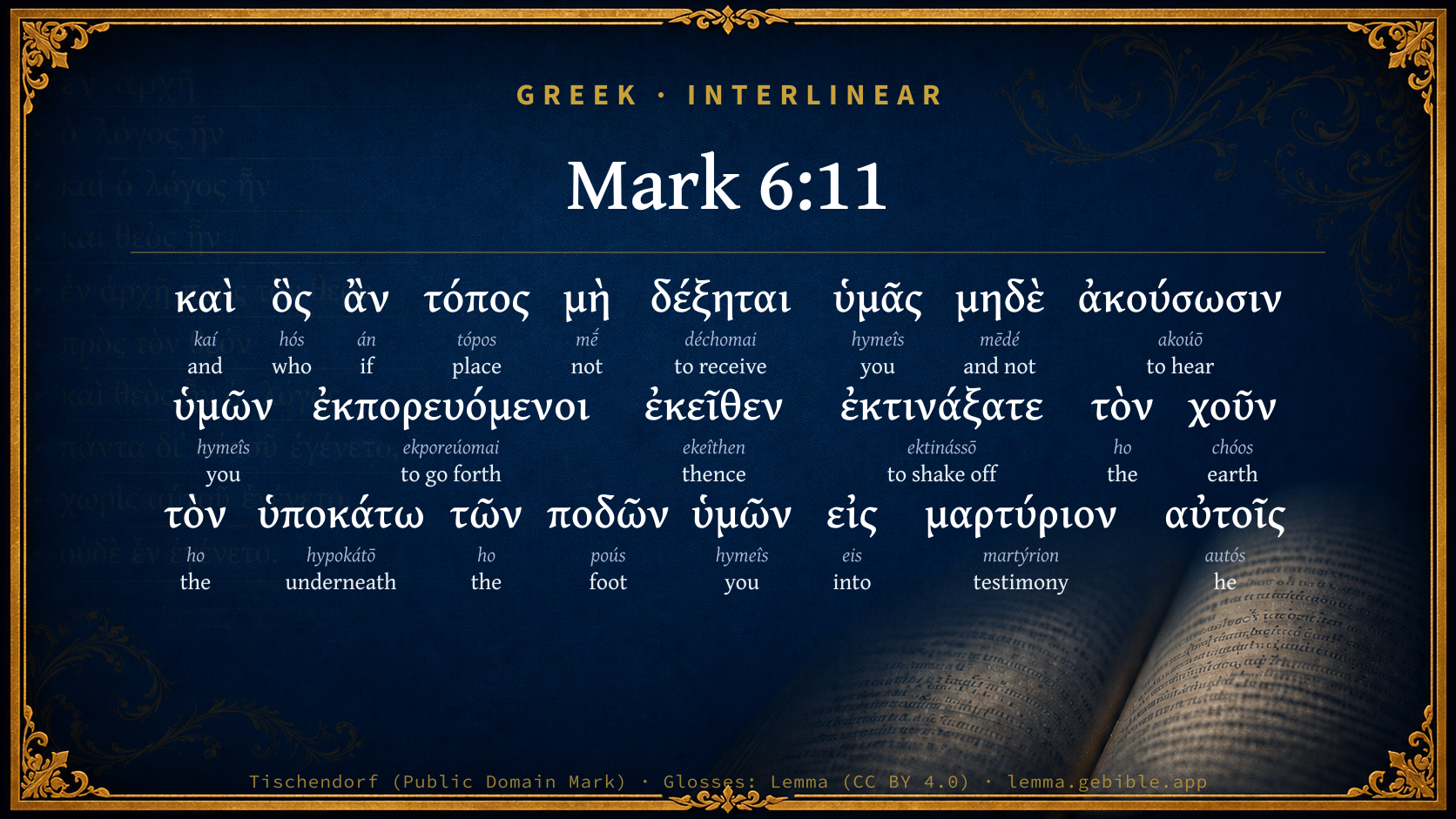
Whoever will not receive you nor hear you, as you depart from there, shake off the dust that is under your feet for a testimony against them. Assuredly, I tell you, it will be more tolerable for Sodom and Gomorrah in the day of judgment than for that city!"
Download a study sheet
One document with this verse’s original text, its word-by-word gloss line, the meaning frame, cross-references with their text, attributed commentary, and full source and license credits — printable, and it pastes into notes with its structure intact.
This verse Autodidact and up
A passage Seminary Student
Up to 50 verses in one chapter. A passage sheet keeps up to 6 commentary sources and 12 cross-references per verse, in the order this page ranks them, and says so on the sheet whenever that leaves anything out. Ask for a single verse and you get the Autodidact verse sheet above.
Everything on this page stays free to read, with no account — the sheet is a download of what is already on screen, not access to it.
Compare translations 3
The same verse in 3 English versions, stacked beneath the original-language interlinear above. Click any original word for its lexicon entry.
Each is an independent rendering of the whole verse — the interlinear is not word-aligned to these translations.
Highlighted words mark where these versions differ — a whole-verse word diff, not a word-by-word alignment.
-
World English Bible Public Domain
Whoever will not receive you nor hear you, as you depart from there, shake off the dust that is under your feet for a testimony against them. Assuredly, I tell you, it will be more tolerable for Sodom and Gomorrah in the day of judgment than for that city!"
-
King James Version Public Domain
And whosoever shall not receive you, nor hear you, when ye depart thence, shake off the dust under your feet for a testimony against them. Verily I say unto you, It shall be more tolerable for Sodom and Gomorrha in the day of judgment, than for that city.
-
unfoldingWord Literal Text CC BY-SA 4.0
And whatever place does not receive you nor listen to you, going out from there, shake off the dust that under your feet for a testimony against them.”
unfoldingWord Literal Text — © unfoldingWord, licensed CC BY-SA 4.0. Word-aligned USFM3 via Door43 (git.door43.org/unfoldingWord/en_ult).
Show all 19 translations
Every available English version of this verse, each an independent rendering of the whole verse.
-
World English Bible Public Domain
Whoever will not receive you nor hear you, as you depart from there, shake off the dust that is under your feet for a testimony against them. Assuredly, I tell you, it will be more tolerable for Sodom and Gomorrah in the day of judgment than for that city!"
-
Berean Standard Bible Public Domain
If anyone will not welcome you or listen to you, shake the dust off your feet when you leave that place, as a testimony against them.”
-
Majority Standard Bible Public Domain
If anyone will not welcome you or listen to you, shake the dust off your feet when you leave that place, as a testimony against them. Truly I tell you, it will be more bearable for Sodom and Gomorrah on the day of judgment than for that town.”
-
King James Version Public Domain
And whosoever shall not receive you, nor hear you, when ye depart thence, shake off the dust under your feet for a testimony against them. Verily I say unto you, It shall be more tolerable for Sodom and Gomorrha in the day of judgment, than for that city.
-
American Standard Version (1901) Public Domain
And whatsoever place shall not receive you, and they hear you not, as ye go forth thence, shake off the dust that is under your feet for a testimony unto them.
-
Revised Version (1885) Public Domain
And whatsoever place shall not receive you, and they hear you not, as ye go forth thence, shake off the dust that is under your feet for a testimony unto them.
-
Geneva Bible (1599) Public Domain
And whosoeuer shall not receiue you, nor heare you, when ye depart thence, shake off the dust that is vnder your feete, for a witnes vnto them. Verely I say vnto you, It shalbe easier for Sodom, or Gomorrha at the day of iudgement, then for that citie.
-
Douay-Rheims (1899) Public Domain
And whosoever shall not receive you, nor hear you; going forth from thence, shake off the dust from your feet for a testimony to them.
-
Young's Literal Translation Public Domain
and as many as may not receive you, nor hear you, going out thence, shake off the dust that is under your feet for a testimony to them; verily I say to you, It shall be more tolerable for Sodom or Gomorrah in a day of judgment than for that city.'
-
Literal Standard Version CC BY-SA 4.0
and as many as may not receive you nor hear you, going out from there, shake off the dust that is under your feet for a testimony to them; [[truly I say to you, it will be more tolerable for Sodom or Gomorrah in [the] day of judgment than for that city.”]]
-
Unlocked Literal Bible CC BY-SA 4.0
If any town will not receive you or listen to you, when you leave that place, shake the dust off your feet as a testimony to them.”
-
unfoldingWord Literal Text CC BY-SA 4.0
And whatever place does not receive you nor listen to you, going out from there, shake off the dust that under your feet for a testimony against them.”
-
Darby Bible Public Domain
And whatsoever place shall not receive you nor hear you, departing thence, shake off the dust which is under your feet for a testimony to them.
-
World Messianic Bible Public Domain
Whoever will not receive you nor hear you, as you depart from there, shake off the dust that is under your feet for a testimony against them. Assuredly, I tell you, it will be more tolerable for Sodom and Gomorrah in the day of judgment than for that city!”
-
Webster's Bible Public Domain
And whoever shall not receive you, nor hear you, when ye depart thence shake off the dust under your feet, for a testimony against them. Verily I say to you, It shall be more tolerable for Sodom and Gomorrah in the day of judgment, than for that city.
-
Free Bible Version CC BY-SA 4.0
“If you're not welcomed and not listened to, then shake the dust from your feet as you leave as a sign you have given up on them.”
-
Bible in Basic English Public Domain
And whatever place will not take you in and will not give ear to you, when you go away, put off the dust from your feet as a witness against them.
-
Text-Critical English NT CC BY 4.0
If anyone will not receive you or listen to you, shake the dust off your feet as you leave that place, as a testimony against them. Truly I say to you, it will be more tolerable for Sodom and Gomorrah on the day of judgment than for that city.”
-
Tyndale New Testament (1534) Public Domain
And whosoever shall not receave you nor heare you when ye departe thence shake of the duste that is vnder youre fete for a witnesse vnto them. I saye verely vnto you it shalbe easyer for zodom and Gomor at the daye of iudgement then for that cite.
Literal Standard Version (2020), Covenant Press — licensed CC BY-SA 4.0. Text via the HelloAO Bible API (eBible.org). Unlocked Literal Bible (unfoldingWord) — licensed CC BY-SA 4.0. Text via the HelloAO Bible API (eBible.org). unfoldingWord Literal Text — © unfoldingWord, licensed CC BY-SA 4.0. Word-aligned USFM3 via Door43 (git.door43.org/unfoldingWord/en_ult). Free Bible Version, Dr. Jonathan Gallagher — licensed CC BY-SA 4.0. Text via the HelloAO Bible API (eBible.org).
Word by word
More ways to search: Search by grammar → Find every occurrence → Compare this word →
Practice this passage: Drill this verse → Learn its vocabulary →
- Appears 2× in the Greek New Testament
- First appears here
- Part of Speech
- Noun
- Case
- Accusative
- Number
- Singular
- Gender
- Masculine
Full Thayer's Definition
- καὶ kaí G2532 “and” Conjunction
- ὃς hós G3739 “who” Relative pronoun, Nominative, Singular, Masculine
- ἂν án G302 “if” Particle
- τόπος tópos G5117 “place” Noun, Nominative, Singular, Masculine
- μὴ mḗ G3361 “not” Particle, Negative
- δέξηται déchomai G1209 “to receive” Verb, Aorist, Middle deponent, Subjunctive, 3rd person, Singular
- ὑμᾶς hymeîs G5210 “you” Personal pronoun, 2nd person, Accusative, Plural
- μηδὲ mēdé G3366 “and not” Conjunction, Negative
- ἀκούσωσιν akoúō G191 “to hear” Verb, Aorist, Active, Subjunctive, 3rd person, Plural
- ὑμῶν hymeîs G5210 “you” Personal pronoun, 2nd person, Genitive, Plural
- ἐκπορευόμενοι ekporeúomai G1607 “to go forth” Verb, Present, Middle or Passive deponent, Participle, Nominative, Plural, Masculine
- ἐκεῖθεν ekeîthen G1564 “thence” Adverb
- ἐκτινάξατε ektinássō G1621 “to shake off” Verb, Aorist, Active, Imperative, 2nd person, Plural
- τὸν ho G3588 “the” Article, Accusative, Singular, Masculine
- χοῦν chóos G5522 “earth” Noun, Accusative, Singular, Masculine
- τὸν ho G3588 “the” Article, Accusative, Singular, Masculine
- ὑποκάτω hypokátō G5270 “underneath” Adverb
- τῶν ho G3588 “the” Article, Genitive, Plural, Masculine
- ποδῶν poús G4228 “foot” Noun, Genitive, Plural, Masculine
- ὑμῶν hymeîs G5210 “you” Personal pronoun, 2nd person, Genitive, Plural
- εἰς eis G1519 “into” Preposition
- μαρτύριον martýrion G3142 “testimony” Noun, Accusative, Singular, Neuter
- αὐτοῖς autós G846 “he” Personal pronoun, Dative, Plural, Masculine
About this verse
These counts appear in no published source. They are computed here, from the morphology-tagged text and Lemma’s own curated glosses. What Lemma adds →
- 23
- words
- 19
- distinct lemmas
- Gospels
- section
Notable vocabulary
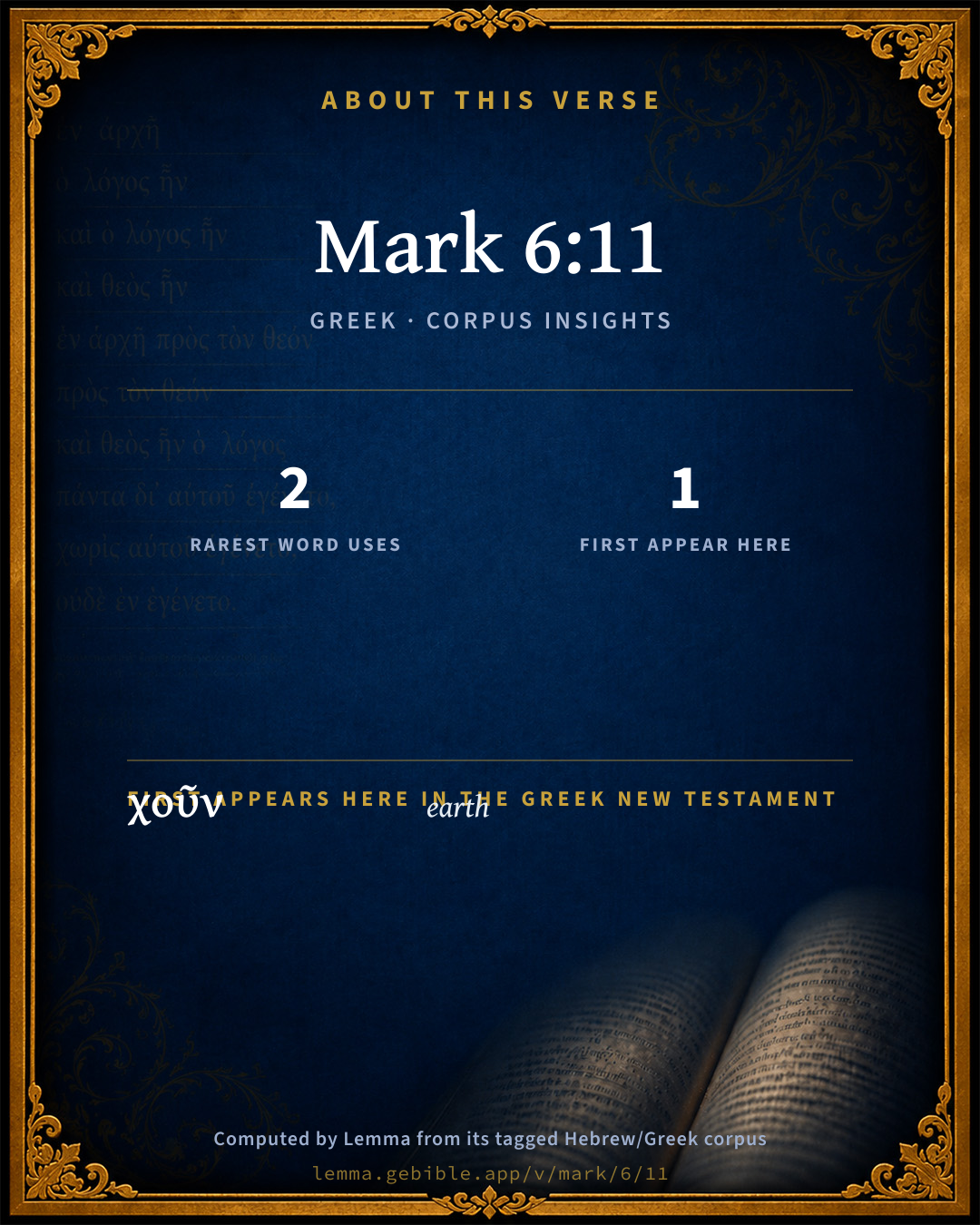
The rarest word here is χοῦν earth G5522 — appearing just 2 times in the whole Greek New Testament.
First appearance in Scripture
This word makes its first canonical appearance in the Greek New Testament here:
- χοῦν earth G5522
Shared distinctive vocabulary
χοῦν earth G5522 occurs in 2 verses of the Greek New Testament. Also found in:
Cross-references
19Topical passages linked to Mark 6:11 in the Treasury of Scripture Knowledge — connected by theme and wording, ordered by reader-vote popularity; previews shown in the World English Bible.
- Matthew 10:14–15 Whoever doesn't receive you, nor hear your words, as you go out of that house or that city, shake off the dust from your feet.
- Acts 18:6 When they opposed him and blasphemed, he shook out his clothing and said to them, "Your blood be on your own heads! I am clean. From now on, I will go to the Gentiles!"
- Luke 10:10–15 But into whatever city you enter, and they don't receive you, go out into the streets of it and say,
- Nehemiah 5:13 Also I shook out my lap, and said, So God shake out every man from his house, and from his labor, that doesn't perform this promise; even thus be he shaken out, and emptied. All the assembly said, Amen, and praised Yahweh. The people did according to this promise.
- Jude 1:7 Even as Sodom and Gomorrah, and the cities around them, having, in the same way as these, given themselves over to sexual immorality and gone after strange flesh, are set forth as an example, suffering the punishment of eternal fire.
- Matthew 11:20–24 Then he began to denounce the cities in which most of his mighty works had been done, because they didn't repent.
- Acts 13:50–51 But the Jews stirred up the devout and prominent women and the chief men of the city, and stirred up a persecution against Paul and Barnabas, and threw them out of their borders.
- Romans 2:16 in the day when God will judge the secrets of men, according to my Gospel, by Jesus Christ.
- Hebrews 10:26–31 For if we sin willfully after we have received the knowledge of the truth, there remains no more a sacrifice for sins,
- Ezekiel 16:48–51 As I live, says the Lord Yahweh, Sodom your sister has not done, she nor her daughters, as you have done, you and your daughters.
- Matthew 12:36 I tell you that every idle word that men speak, they will give account of it in the day of judgment.
- Luke 9:5 As many as don't receive you, when you depart from that city, shake off even the dust from your feet for a testimony against them."
- John 15:22–24 If I had not come and spoken to them, they would not have had sin; but now they have no excuse for their sin.
- Romans 2:5 But according to your hardness and unrepentant heart you are treasuring up for yourself wrath in the day of wrath, revelation, and of the righteous judgment of God;
- Hebrews 6:4–8 For concerning those who were once enlightened and tasted of the heavenly gift, and were made partakers of the Holy Spirit,
- 2 Peter 2:6 and turning the cities of Sodom and Gomorrah into ashes, condemned them to destruction, having made them an example to those who would live ungodly;
- 2 Peter 2:9 the Lord knows how to deliver the godly out of temptation and to keep the unrighteous under punishment for the day of judgment;
- 2 Peter 3:7 But the heavens that now are, and the earth, by the same word have been stored up for fire, being reserved against the day of judgment and destruction of ungodly men.
- 1 John 4:17 In this love has been made perfect among us, that we may have boldness in the day of judgment, because as he is, even so are we in this world.
Cross-references courtesy of OpenBible.info (CC BY 4.0).
Where the printed editions differ
1 variantPlaces in this verse where the major printed Greek editions disagree on the wording in a way that affects the translation — a comparison of editions, not a manuscript-by-manuscript collation. The editions are the modern critical texts (Nestlé-Aland 28/27, SBL, Westcott-Hort, Tregelles, Tyndale House) and the traditional texts behind the KJV (the Textus Receptus and the Byzantine/Majority text). It is not a claim about which reading is original.
-
Extra text
Ἀμὴν λέγω ὑμῖν, ἀνεκτότερον ἔσται Σοδόμοις ἢ Γομόρροις ἐν ἡμέρᾳ κρίσεως, ἢ τῇ πόλει ἐκείνῃ.
“Amen I say to you more tolerable will be for Sodom or for Gomorrah in day of judgment than for the for city that [one].”
In TRByz Not in NA28NA27TynSBLWHTregἈμὴν λέγω ὑμῖν, ἀνεκτότερον ἔσται Σοδόμοις ἢ Γομόρροις ἐν ἡμέρᾳ κρίσεως, ἢ τῇ πόλει ἐκείνῃ. (Amēn legō humin anektoteron estai Sodomois ē Gomorrois en hēmera kriseōs ē tēa polei ekeinē) 'Amen I say to you more tolerable will be for Sodom or for Gomorrah in day of judgment than for the for city that [one].' is only in traditional manuscripts (TR+Byz)
Textual data: Translators Amalgamated Greek New Testament (STEPBible TAGNT) · CC BY 4.0.
Lesson kit
Teaching starters — assembled from the data on this page, not authored interpretation. Every prompt links to the verse data it draws on. Edit before teaching.
Mark, in the Gospels, opens this verse with 23 words (19 distinct Greek lemmas). Its most distinctive word is chóos (“earth”). A historical commentator’s framing appears above. Read the whole chapter for the surrounding context.
Discussion questions
- How does “earth” (chóos) shape what this verse is saying?
- This is the first place “earth” appears in Scripture (first appears here). What does its debut here establish?
- How does Revelation 18:19, which shares the word «earth», read alongside this verse?
- What does the repetition of “you” (3× in this one verse) do in this verse?
- The translations on this page render this verse differently — a whole-verse word diff, not a word-by-word alignment. What might account for the different wordings?
- Compare how Tyndale Open Study Notes and Expositor's Greek Testament read this verse. Where do they agree or differ?
Things to notice
- 1 word makes its first canonical appearance in Scripture here.
- These translations choose different wording for 28 words in this verse.
- “you” occurs 3× in this single verse.
- 19 distinct Greek lemmas span 23 words in this verse.
Commentary
Notes on Mark 6:11 from classic Christian and Jewish commentators (each source and its license shown beneath its notes). The classic Christian expositions comment on the surrounding passage and are grouped to its opening verse, so a note may address several verses; the Jewish commentaries on the Tanakh (Rashi and others) are per-verse, so they appear only where the commentator wrote on this verse.
Lemma curates 59 commentaries, every one of them public domain or Creative Commons licensed, each selected and text-cleaned for this edition rather than reprinted as found. About our sources →
Tyndale Open Study Notes
Tyndale Open Resources
Tyndale Open Study Notes — © Tyndale Open Resources, licensed CC BY-SA 4.0. Text via the HelloAO Bible API.
Expositor's Greek Testament
ed. W. Robertson Nicoll
The Expositor's Greek Testament, edited by W. Robertson Nicoll (1897–1910) — public domain. Text from a community e-Sword module.
Geneva Bible (1599)
Geneva Bible translators
Geneva Bible (1599) marginal notes — public domain. Text via Bolls.life.
Adam Clarke's Commentary
Adam Clarke's Commentary on the Bible (1810–1826) — public domain. Text from a community e-Sword/MySword module.
Ellicott's Commentary for English Readers
A Bible Commentary for English Readers, edited by Charles John Ellicott (1878–1897) — public domain. Text from a community e-Sword module.
The Cambridge Bible for Schools and Colleges
gen. ed. J. J. S. Perowne
The Cambridge Bible for Schools and Colleges (gen. ed. J. J. S. Perowne; Cambridge University Press, 1878–1918) — public domain. Text from a community e-Sword module.
John Gill's Exposition
John Gill's Exposition of the Whole Bible (1746–1763) — public domain (CC PDM 1.0). Text via the HelloAO Bible API.
Trapp's Complete Commentary
John Trapp
John Trapp, A Commentary or Exposition upon All the Books of the Old and New Testament (1647–1656) — public domain. Text from a community e-Sword module.
The Pulpit Commentary
The Pulpit Commentary (1880–1919), ed. H.D.M. Spence-Jones & Joseph S. Exell — public domain. Text from a community e-Sword module.
Cambridge Greek Testament for Schools and Colleges
Cambridge Greek Testament for Schools and Colleges (Cambridge University Press, 1896; 21 vols, various authors incl. Carr, Maclear, Plummer, Farrar, Lumby, Moule, M. R. James, Simcox) — public domain. Text from a community e-Sword module.
International Critical Commentary
International Critical Commentary — older volumes (1896–1929), various authors — public domain. Text from a community e-Sword module.