
Matthew 6:3

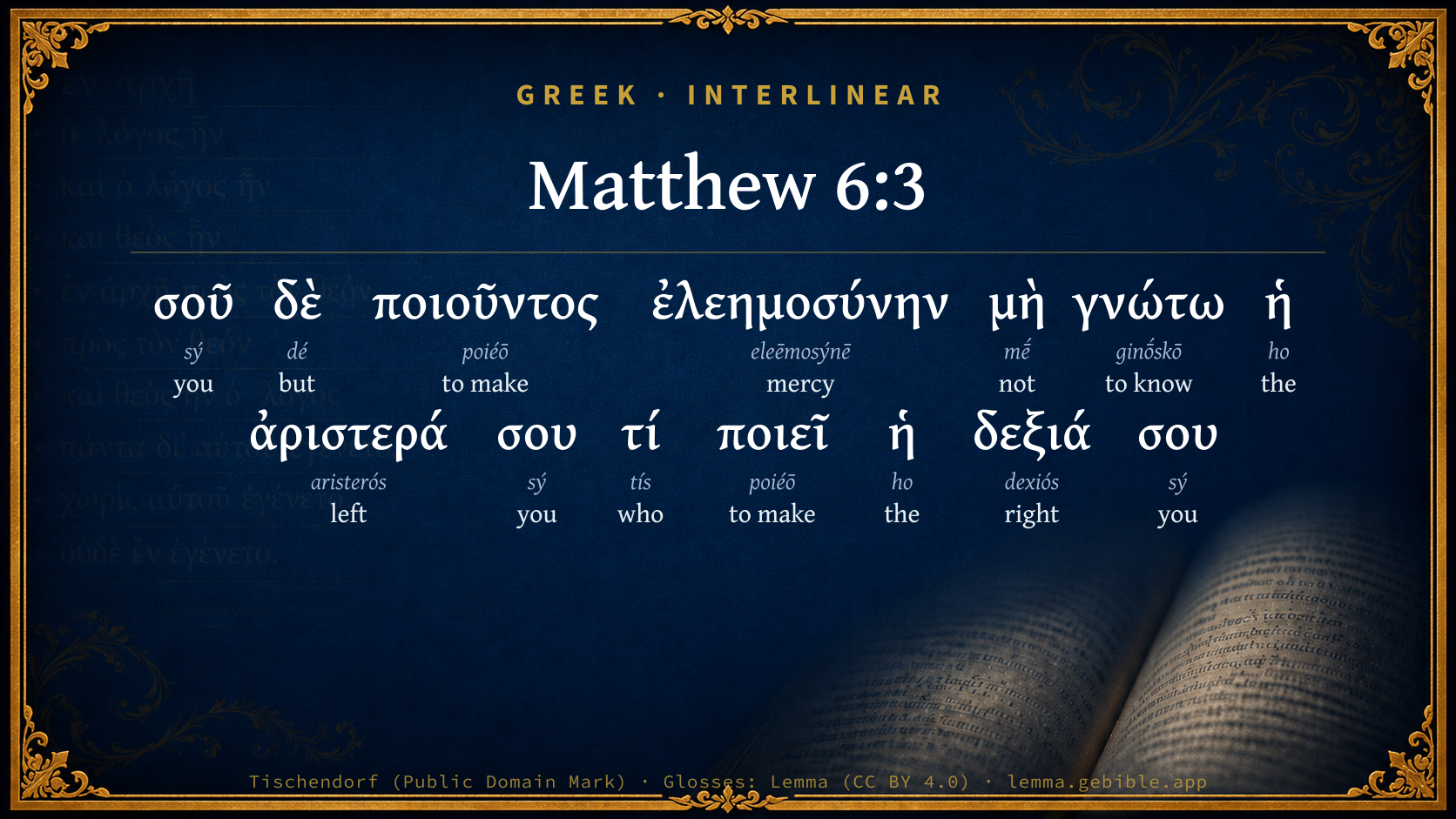
Greek (Tischendorf 8th ed.) Matthew 6:3 appears in the Greek New Testament. The text above is from the Tischendorf 8th edition. Each word links to its Strong’s number and a concise gloss. Click any word for its full Thayer’s Greek Lexicon entry.
Download image
Cite this verse

Matthew 6:3 (World English Bible). Public Domain. Lemma interlinear Bible study tool, https://lemma.gebible.app/v/matthew/6/3.

Show BibTeX & RIS
BibTeX
RIS
English Translation
But when you do merciful deeds, don't let your left hand know what your right hand does,
World English Bible · Public Domain
Highlights
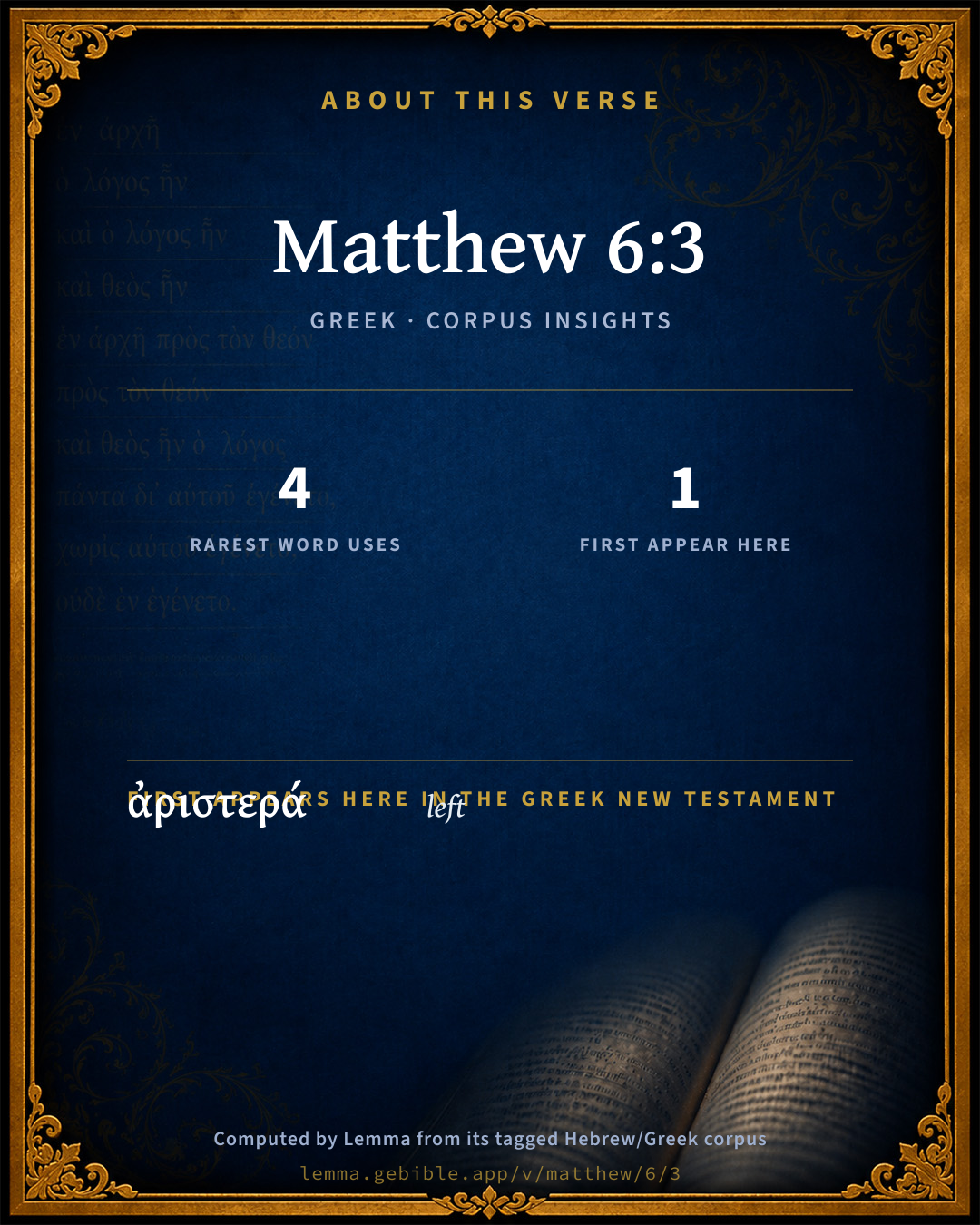
  • 1 first appearance in the Greek New Testament
Full analysis ↓
Download a study sheet

One document with this verse’s original text, its word-by-word gloss line, the meaning frame, cross-references with their text, attributed commentary, and full source and license credits — printable, and it pastes into notes with its structure intact.

This verse Autodidact and up

Study sheet (.html) Plain text (.txt)

A passage Seminary Student

Up to 50 verses in one chapter. A passage sheet keeps up to 6 commentary sources and 12 cross-references per verse, in the order this page ranks them, and says so on the sheet whenever that leaves anything out. Ask for a single verse and you get the Autodidact verse sheet above.

Everything on this page stays free to read, with no account — the sheet is a download of what is already on screen, not access to it.

Want to remove ads? Support Godless Engineer
Compare translations 3

The same verse in 3 English versions, stacked beneath the original-language interlinear above. Click any original word for its lexicon entry.

Each is an independent rendering of the whole verse — the interlinear is not word-aligned to these translations.

Highlighted words mark where these versions differ — a whole-verse word diff, not a word-by-word alignment.

  • World English Bible Public Domain
    But when you do merciful deeds, don't let your left hand know what your right hand does,
  • King James Version Public Domain
    But when thou doest alms, let not thy left hand know what thy right hand doeth:
  • unfoldingWord Literal Text CC BY-SA 4.0
    But you, giving alms, do not let your left hand know what your right hand is doing

unfoldingWord Literal Text — © unfoldingWord, licensed CC BY-SA 4.0. Word-aligned USFM3 via Door43 (git.door43.org/unfoldingWord/en_ult).

Versions to compare (up to 4)

3 of 4 selected

Show all 19 translations

Every available English version of this verse, each an independent rendering of the whole verse.

  • World English Bible Public Domain
    But when you do merciful deeds, don't let your left hand know what your right hand does,
  • Berean Standard Bible Public Domain
    But when you give to the needy, do not let your left hand know what your right hand is doing,
  • Majority Standard Bible Public Domain
    But when you give to the needy, do not let your left hand know what your right hand is doing,
  • King James Version Public Domain
    But when thou doest alms, let not thy left hand know what thy right hand doeth:
  • American Standard Version (1901) Public Domain
    But when thou doest alms, let not thy left hand know what thy right hand doeth:
  • Revised Version (1885) Public Domain
    But when thou doest alms, let not thy left hand know what thy right hand doeth:
  • Geneva Bible (1599) Public Domain
    But when thou doest thine almes, let not thy left hand knowe what thy right hand doeth,
  • Douay-Rheims (1899) Public Domain
    But when thou dost alms, let not thy left hand know what thy right hand doth.
  • Young's Literal Translation Public Domain
    `But thou, doing kindness, let not thy left hand know what thy right hand doth,
  • Literal Standard Version CC BY-SA 4.0
    But you, doing kindness, do not let your left hand know what your right hand does,
  • Unlocked Literal Bible CC BY-SA 4.0
    But when you give alms, do not let your left hand know what your right hand is doing,
  • unfoldingWord Literal Text CC BY-SA 4.0
    But you, giving alms, do not let your left hand know what your right hand is doing
  • Darby Bible Public Domain
    But thou, when thou doest alms, let not thy left hand know what thy right hand does;
  • World Messianic Bible Public Domain
    But when you do merciful deeds, don’t let your left hand know what your right hand does,
  • Webster's Bible Public Domain
    But when thou doest alms, let not thy left hand know what thy right hand doeth:
  • Free Bible Version CC BY-SA 4.0
    When you give to the poor, don't let your left hand know what your right hand's doing.
  • Bible in Basic English Public Domain
    But when you give money, let not your left hand see what your right hand does:
  • Text-Critical English NT CC BY 4.0
    But when yoʋ give to the needy, do not let yoʋr left hand know what yoʋr right hand is doing,
  • Tyndale New Testament (1534) Public Domain
    But when thou doest thine almes let not thy lyfte had knowe what thy righte had doth

Literal Standard Version (2020), Covenant Press — licensed CC BY-SA 4.0. Text via the HelloAO Bible API (eBible.org). Unlocked Literal Bible (unfoldingWord) — licensed CC BY-SA 4.0. Text via the HelloAO Bible API (eBible.org). unfoldingWord Literal Text — © unfoldingWord, licensed CC BY-SA 4.0. Word-aligned USFM3 via Door43 (git.door43.org/unfoldingWord/en_ult). Free Bible Version, Dr. Jonathan Gallagher — licensed CC BY-SA 4.0. Text via the HelloAO Bible API (eBible.org).

Word by word

More ways to search: Search by grammar → Find every occurrence → Compare this word →

Practice this passage: Drill this verse → Learn its vocabulary →

ἀριστερά
aristerós
G710
“left”
Adjective, Nominative, Singular, Feminine
Part of Speech
Adjective
Case
Nominative
Number
Singular
Gender
Feminine
Full Thayer's Definition

Origin: apparently a comparative of the same as G712

TDNT: None

1. left
  1. σοῦ sý G4771 “you” Personal pronoun, 2nd person, Genitive, Singular
  2. δὲ dé G1161 “but” Conjunction
  3. ποιοῦντος poiéō G4160 “to make” Verb, Present, Active, Participle, Genitive, Singular, Masculine
  4. ἐλεημοσύνην eleēmosýnē G1654 “mercy” Noun, Accusative, Singular, Feminine
  5. μὴ mḗ G3361 “not” Particle, Negative
  6. γνώτω ginṓskō G1097 “to know” Verb, Aorist, Active, Imperative, 3rd person, Singular
  7. ἡ ho G3588 “the” Article, Nominative, Singular, Feminine
  8. σου sý G4771 “you” Personal pronoun, 2nd person, Genitive, Singular
  9. τί tís G5101 “who” Interrogative pronoun, Accusative, Singular, Neuter
  10. ποιεῖ poiéō G4160 “to make” Verb, Present, Active, Indicative, 3rd person, Singular
  11. ἡ ho G3588 “the” Article, Nominative, Singular, Feminine
  12. δεξιά dexiós G1188 “right” Adjective, Nominative, Singular, Feminine
  13. σου sý G4771 “you” Personal pronoun, 2nd person, Genitive, Singular

About this verse

These counts appear in no published source. They are computed here, from the morphology-tagged text and Lemma’s own curated glosses. What Lemma adds →

14
words
10
distinct lemmas
Gospels
section

Notable vocabulary

The rarest word here is ἀριστερά left G710 — appearing just 4 times in the whole Greek New Testament.

First appearance in Scripture

This word makes its first canonical appearance in the Greek New Testament here:

  • ἀριστερά left G710

Shared distinctive vocabulary

ἀριστερά left G710 occurs in 4 verses of the Greek New Testament. Also found in:
Repetition

Words recur within this verse:

  • ποιοῦντος to make G4160 ×2
  • σοῦ you G4771 ×3
  • ἡ the G3588 ×2

Cross-references

4

Topical passages linked to Matthew 6:3 in the Treasury of Scripture Knowledge — connected by theme and wording, ordered by reader-vote popularity; previews shown in the World English Bible.

  • John 7:4 For no one does anything in secret, and himself seeks to be known openly. If you do these things, reveal yourself to the world."
  • Matthew 9:30 Their eyes were opened. Jesus strictly charged them, saying, "See that no one knows about this."
  • Mark 1:44 and said to him, "See you say nothing to anybody, but go show yourself to the priest, and offer for your cleansing the things which Moses commanded, for a testimony to them."
  • Matthew 12:19 He will not strive, nor shout; Neither will anyone hear his voice in the streets.

Cross-references courtesy of OpenBible.info (CC BY 4.0).

Commentary

Notes on Matthew 6:3 from classic Christian and Jewish commentators (each source and its license shown beneath its notes). The classic Christian expositions comment on the surrounding passage and are grouped to its opening verse, so a note may address several verses; the Jewish commentaries on the Tanakh (Rashi and others) are per-verse, so they appear only where the commentator wrote on this verse.

Lemma curates 59 commentaries, every one of them public domain or Creative Commons licensed, each selected and text-cleaned for this edition rather than reprinted as found. About our sources →

Bengel's Gnomon

Johann Albrecht Bengel

Mat 6:3. Μὴ γνώτω ἡ ἀριστερὰ, κ.τ.λ., let not thy left hand know, etc.) So far from holding a trumpet, let it not even know what thy right hand doeth. Do not thou even consider over again the good that thou doest.

Bengel's Gnomon of the New Testament — English translation (T&T Clark, Edinburgh, 1860) — public domain. Text from a community e-Sword module.

Meyer's Critical & Exegetical Commentary

Heinrich August Wilhelm Meyer

Mat_6:3. Σοῦ δέ] in emphatic contrast to hypocrites.

μὴ γνώτω ἡ ἀριστερά σου, κ.τ.λ.] The right hand gives, let not the left hand know it. Proverbial way of expressing entire freedom from the claiming anything like self-laudation. For sayings of a similar kind among the Fathers, see Suicer, Thes. I. p. 508. De Wette, following Paulus, thinks that what is referred to is the counting of the money into the left hand before it is given away with the right. This is out of place, for the warning is directed, not against a narrow calculating, but against an ostentatious almsgiving. For the same reason we must object to the view of Luther, who says: When you are giving alms with the right hand, see that you are not seeking to receive more with the left, but rather put it behind your back, and so on.

Meyer — Critical and Exegetical Commentary on the New Testament — English translation by Peter Christie, edited by Frederick Crombie (T&T Clark, 1880) — public domain. Text from a community e-Sword module.

Expositor's Greek Testament

ed. W. Robertson Nicoll

Mat 6:3 . μὴ γνώτω : in proverbial form a counsel to give with simplicity. Let not even thy left hand, if possible even thyself, know, still less other men; give without self-consciousness or self-complacency, the root of ostentation. ἐν τῷ κρυπτῷ : known to the recipient, of course, but to no other, so far as you are concerned, hardly even to yourself. “Pii lucent, et tamen latent,” Beng. ὁ βλέπων ἐ . τ . κ ., who seeth in the dark. “Acquainted with all my ways.” Psalms 139, a comfort to the sincerely good, not to the counterfeits. ἀποδώσει σοι : a certainty, and not merely of the future. The reward is present; not in the form of self-complacency, but in the form of spiritual health, like natural buoyancy, when all physical functions work well. A right-minded man is happy without reflecting why; it is the joy of living in summer sunshine and bracing mountain air. The ἐν τῷ φανερῷ here and in Mat 6:6 and Mat 6:18 , a gloss by some superficial copyist, ignores the inward present reward, and appeals in a new form to the spirit of ostentation.

The Expositor's Greek Testament, edited by W. Robertson Nicoll (1897–1910) — public domain. Text from a community e-Sword module.

Jamieson, Fausset & Brown

Robert Jamieson, A. R. Fausset & David Brown

But when thou doest alms, let not thy left hand know what thy right hand doeth--So far from making a display of it, dwell not on it even in thine own thoughts, lest it minister to spiritual pride.

Jamieson, Fausset & Brown — Commentary Critical and Explanatory on the Whole Bible (1871) — public domain (CC PDM 1.0). Text via the HelloAO Bible API.

Adam Clarke's Commentary

Verse 3. Let not thy left hand know] In many cases, works of charity must be hidden from even our nearest relatives, who, if they knew, would hinder us from doing what God has given us power and inclination to perform. We must go even farther; and conceal them as far as is possible from ourselves, by not thinking of them, or eyeing them with complacency. They are given to GOD, and should be hidden in HIM.

Adam Clarke's Commentary on the Bible (1810–1826) — public domain. Text from a community e-Sword/MySword module.

Ellicott's Commentary for English Readers

(3) Let not thy left hand know.—The phrase was probably proverbial, and indicates, in the form of free hyperbole, extremest secrecy. It is possible that there may be some reference to the practice of using the right hand in offering gifts at the altar. The symbolical application, though an afterthought, is yet suggestive. The “right hand” is the higher spiritual element in us that leads to acts of true charity, the “left” is the baser, self-seeking nature. We ought, as it were, to set a barrier between the two, as far as possible, i.e., to exclude that mingling of motives, which is at least the beginning of evil.

A Bible Commentary for English Readers, edited by Charles John Ellicott (1878–1897) — public domain. Text from a community e-Sword module.

The Cambridge Bible for Schools and Colleges

gen. ed. J. J. S. Perowne

3. when thou doest alms] Observe that the singular number is used throughout these instructions on the subject of almsgiving and prayer, and in these only. These duties are essentially personal and individual. The teaching of the Talmud commends secrecy in almsgiving in such sayings as “he that doeth alms in secret is greater than Moses.” But the spirit of hypocrisy prevailed; the Pharisees taught and did not.

The Cambridge Bible for Schools and Colleges (gen. ed. J. J. S. Perowne; Cambridge University Press, 1878–1918) — public domain. Text from a community e-Sword module.

John Gill's Exposition

But when thou dost alms,.... Do it so privately, and with so much secrecy, that, if it was possible, thou mightest not know it thyself, much less make it known to others:

let not thy left hand know what thy right hand doth; acquaint not thy nearest and dearest friend with it; let not one that sits at thy left hand know what thou art doing with thy right hand; it is a proverbial and hyperbolical phrase, expressing the secrecy of the action. It is a Jewish canon (p), that

"he that gives a gift to his friend out of love, may make it known, , "but not if it be by way of alms".''

(p) Piske Tosephot in Sabbat. c. 1. art. 134.

John Gill's Exposition of the Whole Bible (1746–1763) — public domain (CC PDM 1.0). Text via the HelloAO Bible API.

Trapp's Complete Commentary

John Trapp

3 But when thou doest alms, let not thy left hand know what thy right hand doeth:

Ver. 3. But thou when thou doest thine alms] The godly Christian must walk in a diverse way to a world of wicked people, as Noah did, {a} really reproving their darkness by his light, their pride by his lowliness, their vainglory by his modesty, their ostentation by his secret devotion; not only (planet-like) keeping a constant counter motion to the corrupt manners of the most, but also shining forth fair with a singularity of heavenly light, spiritual goodness, and God’s sincere service, in the darkest midnight of damned impiety.

Let not thy left hand know, &c.] A proverbial speech, q.d. secrete thyself as much as may be, cast away the vain affectation of human applause. Let not thy left hand (if it had so much skill) understand what thou givest, and to whom, how much, how often, at what time, &c. God sets down every circumstance in his book of remembrance, Mal 3:16, as our Saviour (that true Archdeacon, as well as Archshepherd, 1Pe 5:4) sat and viewed the estate, mind, and gift of every one that cast money into the treasury, Mar 12:41; and as he took special observation of those that came to hear him, how far they had come, how long they had been there, how little opportunity they had of providing for themselves, and how soon they might faint if sent away empty, Mat 15:32. In pugillaribus suis omnia notat. "I know thy work and thy labour," Rev 2:2, saith Christ to that Church: so to us, -I know thine alms, and thy privacy. Many give much, and are little noted or noticed. It matters not, saith our Saviour, though thy left hand should not know what thy right hand doth; there is no loss in that. Some talents are best improved by being laid up. A treasure that is hid is safer from thieves. Steal we therefore benefits upon men, as Joseph did the money into the sacks. And as he made a gain of the famine, and bought Egypt; so may we of the poor we relieve, and buy heaven, Luk 16:9; Rom 2:10. Ex fame quaestum captabat Iosephus, et benignitate sua emit Egyptum, nos coelum.

{a} Solus ipse diversa ambulavit via. Chrys. de Noa.

John Trapp, A Commentary or Exposition upon All the Books of the Old and New Testament (1647–1656) — public domain. Text from a community e-Sword module.

Albert Barnes' Notes on the Bible

Let not thy left hand know ... - This is a proverbial expression, signifying that the action should be done as secretly as possible. The Hebrews often attribute actions to members which properly belong to persons. The encouragement for performing our acts of charity in secret is that it will be pleasing to God; that he will see the act, however secret it may be, and will openly reward it. If the reward is not granted in this life, it will be in the life to come. In multitudes of cases, however, alms given to the poor are “lent to the Lord” Pro 19:17, and will be repaid in this life. Rarely, perhaps never, has it been found that the man who is liberal to the poor has ever suffered by it in his worldly circumstances.

Albert Barnes' Notes on the Bible (1834–1885) — public domain. Text from a community e-Sword/MySword module.

Haydock's Catholic Bible Commentary

Be content to have God for witness to your good works, who alone has power to reward you for them. They will be disclosed soon enough to man, when at the day of general retribution the good and the evil will be brought to light, and every one shall be rewarded according to his works. (Haydock)

George Leo Haydock (1774–1849), Haydock's Catholic Family Bible and Commentary, 1859 edition — public domain. Excludes Psalms (Douay-Rheims chapter numbering differs from Protestant) and Deuterocanonical books (Catholic canon only).

Whedon's Commentary on the Bible

Daniel D. Whedon

3. Left hand — If it had perception. A striking symbol of secrecy. “The right hand,” says Mr. Roberts in his Oriental Illustrations, “always dispenses gifts because ‘it is more honourable than the other;’ the left hand, therefore, was to be unacquainted with the charities of the other; that is, there was to be no ostentation; to be perfect secrecy. The Hindoos say of things which are not to be revealed: ‘The left ear is not to hear that which went into the right, nor the right to be acquainted with that which was heard by the left.’“

Daniel D. Whedon (gen. ed.), Commentary on the Old and New Testaments (1874–1909) — public domain. Text from a community e-Sword module.

The Pulpit Commentary

But when thou; thou" emphatic. Let not thy left hand know, etc. So little effect should thy kind action have upon thy memory. There should be no self-consciousness in it.

The Father"s open rewards.

"Shall reward thee openly." This turn of the sentence somewhat surprises us. It is not precisely what we expected. Making so much of giving in secret, and the Father seeing in secret, we expect to read, "shall reward thee in secret ways." Probably the "open reward" is promised because the man who makes a show of religion does so in order to get open and public fame. (It should, however, be duly noticed that the best manuscripts and most modern editors omit the word "openly.") Plumptre thinks the addition of the word "openly" weakens and lowers the force of the truth asserted. The difficulty of dealing with the word is clearly seen in the notion of some writers that "openly" must mean "before men and angels at the resurrection of the just," about which, at the time, our Lord was neither speaking nor thinking. A good point, and one which is practically important, is this: sincere and humble piety, finding gracious expression in kindly, thoughtful, generous, and self-denying service, will be sure to gain open and public recognition. Christian goodness is no violet "born to blush unseen, and waste its sweetness on the desert air." Men want that Christian goodness in all the life-spheres; and they are quick enough at recognizing it when they see it.

I CHRISTLY-TONED CHARITIES WIN MEN"S ADMIRATION. We are all keen enough to discern the differences in gifts. We qualify our admiration when we recognize giving on mere impulse; or to get credit; or to outdo others; or to bring business. We keep our highest admiration for evident cases of self-denial, simple benevolence, and Christian principle. Those who abuse Christianity admire the Christian charity which it inspires.

II CHRISTLY-TONED CHARITIES WIN MEN"S CONFIDENCE. This is clearly shown in the very patent fact that, whenever there is a local or a national calamity, application is first made for help to the Christian people. There is a universal public confidence that, if any good work needs to be done, the Christians will be found ready for the doing. This is their open reward. Place, influence, power, in every generation comes into the hands of the sincerely good; and in this way God gives the reward which men are ever seeking, to those who do not seek it. R.T.

The Pulpit Commentary (1880–1919), ed. H.D.M. Spence-Jones & Joseph S. Exell — public domain. Text from a community e-Sword module.

John Wesley's Explanatory Notes

Let not thy left hand know what thy right hand doth - A proverbial expression for doing a thing secretly. Do it as secretly as is consistent,

1. With the doing it at all.

2. With the doing it in the most effectual manner.

John Wesley, Explanatory Notes Upon the Whole Bible (1754–1765) — public domain. Text via the GEBible commentary corpus.

Kretzmann's Popular Commentary

Paul E. Kretzmann

The right way to practice charity:

v. 3. But when thou doest alms, let not thy left hand know what thy right hand doeth,

v. 4. that thine alms may be in secret; and thy Father which seeth in secret, Himself shall reward thee openly.

Not the act of almsgiving was condemned by Christ, but only the manner. The work was well-pleasing to Him. Give with simplicity of heart, with so little show of self-glorification that even the left hand, so to speak, shall not be admitted into the secret, lest the satisfaction which one may feel on account of having done another good work detract from God’s glory. The works shall shine brightly, but the donor shall, remain hidden to all but God, who knows the secrets of men’s hearts and actions. He knows all the sacrifices that are made, and at the proper time He will give the reward of mercy; He will make public announcement on the day when He will reveal everything.

Paul E. Kretzmann, Popular Commentary of the Bible (1921–1924) — public domain. Text from a community e-Sword module.

The People's New Testament

B. W. Johnson

3, 4. Let not thy left hand know what thy right hand doeth. A strong expression, to indicate that there must be no publishing of our alms deeds.

That thine alms may be in secret. It is not concealment that is required, so much as to avoid ostentation. Openly. Literally, “in the open place,” in the last day, when every secret thing is made manifest.

B. W. Johnson's The People's New Testament with Notes (1889–1891) — public domain. Electronic text from the Christian Classics Ethereal Library (CCEL) ThML edition.

unfoldingWord translationNotes

Door43 World Missions Community

Connecting Statement:

Jesus continues to teach his disciples about alms.

General Information:

Jesus is talking to a group of people about what they as individuals should and should not do. All occurrences of "you" and "your" are plural. (See: Forms of You)

do not let your left hand know what your right hand is doing

This is a metaphor for total secrecy. Just as hands usually work together and each can be said to "know" what the other is doing at all times, you should not let even those closest to you know when you are giving to the poor. (See: Metaphor)

your gift may be given in secret

This can be stated in active form. AT: "you can give to the poor without other people knowing" (See: Active or Passive)

translationWords

alms

hand

God the Father

unfoldingWord translationNotes — © Distant Shores Media and the Door43 World Missions Community, licensed CC BY-SA 4.0. Source: git.door43.org/Door43/en_tn.

Cambridge Greek Testament for Schools and Colleges

3. σοῦ δὲ ποιοῦντος. Observe the singular number here and Mat 6:6; the duties of prayer and almsgiving are taught in their personal and individual aspect. The teaching of the Talmud commends secresy in almsgiving in such sayings as ‘he that doeth alms in secret is greater than Moses.’ But the spirit of hypocrisy prevailed; the Pharisees taught and did not.

Cambridge Greek Testament for Schools and Colleges (Cambridge University Press, 1896; 21 vols, various authors incl. Carr, Maclear, Plummer, Farrar, Lumby, Moule, M. R. James, Simcox) — public domain. Text from a community e-Sword module.

Alford’s Greek Testament

Henry Alford

3.] σοῦ, emphatic: see ch. 5:48.

μὴ γνώτω] Another popular saying, not to be pressed so as to require a literal interpretation of it in the act of almsgiving, as De Wette and others have done, but implying simplicity, both of intention and act. Equally out of place are all attempts to explain the right and left hand symbolically, as was once the practice. The sound sense of Chrysostom preserves the right interpretation, where even Augustine strays into symbolism: πάλιν ἐνταῦθα οὐ χεῖρας αἰνίττεται, ἀλλʼ ὑπερβολικῶς αὐτὸ τέθεικεν. εἰ γὰρ οἷόν τέ ἐστι, φησί, σεαυτὸν ἀγνοῆσαι, περισπούδαστον ἔστω σοι τοῦτο, κἂν αὐτὰς δυνατὸν ᾖ τὰς διακονουμένας χεῖρας λαθεῖν. Hom. xix. 2, p. 246.

Henry Alford, The Greek Testament (1849–1861) — public domain. Text from a community e-Sword module.

International Critical Commentary

3. But when thou doest alms, let not thy left hand know what thy right hand doeth.]—σοῦ δὲ ποιοῦντος] For the construction of the participle, see Blass, p. 252; Moulton, p. 74.

(L)

International Critical Commentary — older volumes (1896–1929), various authors — public domain. Text from a community e-Sword module.

Lesson kit

Teaching starters — assembled from the data on this page, not authored interpretation. Every prompt links to the verse data it draws on. Edit before teaching.

Matthew, in the Gospels, opens this verse with 14 words (10 distinct Greek lemmas). Its most distinctive word is aristerós (“left”). A historical commentator’s framing appears above. Read the whole chapter for the surrounding context.

Discussion questions

  1. How does “left” (aristerós) shape what this verse is saying?
  2. This is the first place “left” appears in Scripture (first appears here). What does its debut here establish?
  3. How does Mark 10:37, which shares the word «left», read alongside this verse?
  4. What does the repetition of “to make” (2× in this one verse) do in this verse?
  5. These translations render this verse differently; the difference is in the English rendering, not the original. What questions does that raise?
  6. Compare how Bengel's Gnomon and Meyer's Critical & Exegetical Commentary read this verse. Where do they agree or differ?

Things to notice

  • 1 word makes its first canonical appearance in Scripture here.
  • These translations choose different wording for 12 words in this verse.
  • “to make” occurs 2× in this single verse.
  • 10 distinct Greek lemmas span 14 words in this verse.

Reading settings

Reading text

Shown beneath each verse's original-language words.

Old Testament
Old Testament edition

Read the OT as the Masoretic Hebrew (MT) or the Greek Septuagint (LXX).

English shown for the Greek Septuagint (in the Hebrew ↔ Greek comparison).

Comparing translations? Open the Compare panel on any verse page to stack up to four side by side.