Genesis 19:21

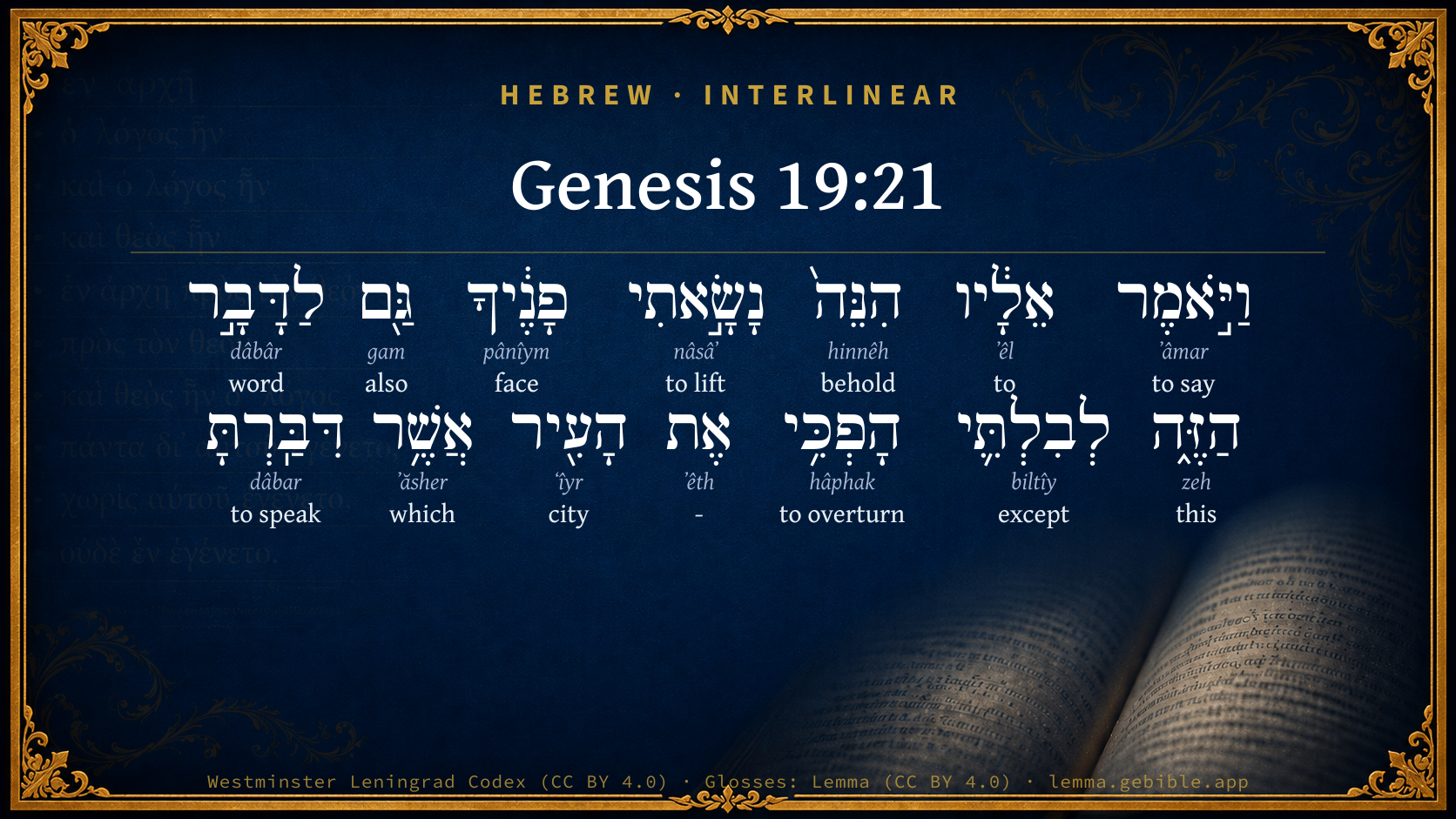
Hebrew (Westminster Leningrad Codex) Genesis 19:21 appears in the Hebrew Old Testament. The text above is from the Westminster Leningrad Codex. Each word links to its Strong’s number, a concise gloss, and parsing drawn from the Open Scriptures Hebrew Bible morphology. Click any word for its full Brown-Driver-Briggs (BDB) entry.
Download image
Cite this verse

Genesis 19:21 (World English Bible). Public Domain. Lemma interlinear Bible study tool, https://lemma.gebible.app/v/genesis/19/21.

Show BibTeX & RIS
BibTeX
RIS
English Translation
He said to him, "Behold, I have granted your request concerning this thing also, that I will not overthrow the city of which you have spoken.
World English Bible · Public Domain
Download a study sheet

One document with this verse’s original text, its word-by-word gloss line, the meaning frame, cross-references with their text, attributed commentary, and full source and license credits — printable, and it pastes into notes with its structure intact.

This verse Autodidact and up

Study sheet (.html) Plain text (.txt)

A passage Seminary Student

Up to 50 verses in one chapter. A passage sheet keeps up to 6 commentary sources and 12 cross-references per verse, in the order this page ranks them, and says so on the sheet whenever that leaves anything out. Ask for a single verse and you get the Autodidact verse sheet above.

Everything on this page stays free to read, with no account — the sheet is a download of what is already on screen, not access to it.

Want to remove ads? Support Godless Engineer
Compare translations 3

The same verse in 3 English versions, stacked beneath the original-language interlinear above. Click any original word for its lexicon entry.

Each is an independent rendering of the whole verse — the interlinear is not word-aligned to these translations.

Highlighted words mark where these versions differ — a whole-verse word diff, not a word-by-word alignment.

  • World English Bible Public Domain
    He said to him, "Behold, I have granted your request concerning this thing also, that I will not overthrow the city of which you have spoken.
  • King James Version Public Domain
    And he said unto him, See, I have accepted thee concerning this thing also, that I will not overthrow this city, for the which thou hast spoken.
  • unfoldingWord Literal Text CC BY-SA 4.0
    Then he said to him, “Behold, I have also lifted up your face concerning this thing, so I will not overthrow the town that you are talking about.

unfoldingWord Literal Text — © unfoldingWord, licensed CC BY-SA 4.0. Word-aligned USFM3 via Door43 (git.door43.org/unfoldingWord/en_ult).

Versions to compare (up to 4)

3 of 4 selected

Show all 18 translations

Every available English version of this verse, each an independent rendering of the whole verse.

  • World English Bible Public Domain
    He said to him, "Behold, I have granted your request concerning this thing also, that I will not overthrow the city of which you have spoken.
  • Berean Standard Bible Public Domain
    “Very well,” he answered, “I will grant this request as well, and will not demolish the town you indicate.
  • Majority Standard Bible Public Domain
    “Very well,” he answered, “I will grant this request as well, and will not demolish the town you indicate.
  • King James Version Public Domain
    And he said unto him, See, I have accepted thee concerning this thing also, that I will not overthrow this city, for the which thou hast spoken.
  • American Standard Version (1901) Public Domain
    And he said unto him, See, I have accepted thee concerning this thing also, that I will not overthrow the city of which thou hast spoken.
  • Revised Version (1885) Public Domain
    And he said unto him, See, I have accepted thee concerning this thing also, that I will not overthrow the city of which thou hast spoken.
  • Geneva Bible (1599) Public Domain
    Then he said vnto him, Beholde, I haue receiued thy request also concerning this thing, that I will not ouerthrow this citie, for the which thou hast spoken.
  • Douay-Rheims (1899) Public Domain
    And he said to him: Behold also in this, I have heard thy prayers, not to destroy the city for which thou hast spoken.
  • Young's Literal Translation Public Domain
    And he saith unto him, `Lo, I have accepted thy face also for this thing, without overthrowing the city `for' which thou hast spoken;
  • Literal Standard Version CC BY-SA 4.0
    And he says to him, “Behold, I have also accepted your face for this thing, without overthrowing the city [for] which you have spoken;
  • Unlocked Literal Bible CC BY-SA 4.0
    He said to him, “Alright, I am granting this request also, that I will not destroy the city which you have mentioned.
  • unfoldingWord Literal Text CC BY-SA 4.0
    Then he said to him, “Behold, I have also lifted up your face concerning this thing, so I will not overthrow the town that you are talking about.
  • Darby Bible Public Domain
    And he said to him, Behold, I have accepted thee concerning this thing also, that I will not overthrow the city of which thou hast spoken.
  • World Messianic Bible Public Domain
    He said to him, “Behold, I have granted your request concerning this thing also, that I will not overthrow the city of which you have spoken.
  • Webster's Bible Public Domain
    And he said to him, See, I have accepted thee concerning this thing also, that I will not overthrow this city, for which thou hast spoken.
  • Free Bible Version CC BY-SA 4.0
    “Fine—I'll do as you ask,” he replied. “I won't destroy this town you've mentioned.
  • Bible in Basic English Public Domain
    And he said, See, I have given you your request in this one thing more: I will not send destruction on this town.
  • JPS Tanakh (1917) Public Domain
    And he said unto him: 'See, I have accepted thee concerning this thing also, that I will not overthrow the city of which thou hast spoken.

Literal Standard Version (2020), Covenant Press — licensed CC BY-SA 4.0. Text via the HelloAO Bible API (eBible.org). Unlocked Literal Bible (unfoldingWord) — licensed CC BY-SA 4.0. Text via the HelloAO Bible API (eBible.org). unfoldingWord Literal Text — © unfoldingWord, licensed CC BY-SA 4.0. Word-aligned USFM3 via Door43 (git.door43.org/unfoldingWord/en_ult). Free Bible Version, Dr. Jonathan Gallagher — licensed CC BY-SA 4.0. Text via the HelloAO Bible API (eBible.org).

Word by word

More ways to search: Search by grammar → Find every occurrence → Compare this word →

Practice this passage: Drill this verse → Learn its vocabulary →

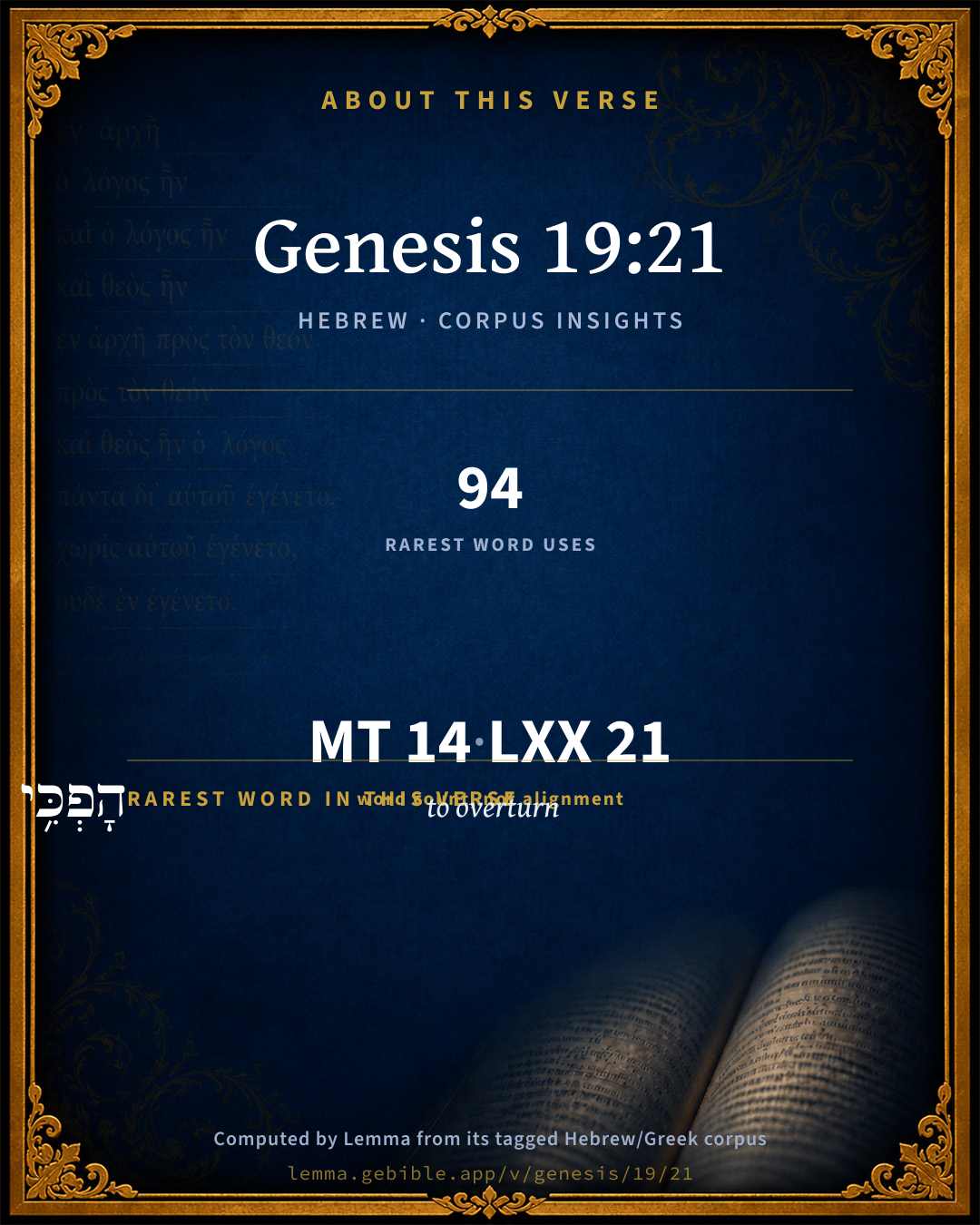
הָפְכִּ֥י
hâphak
H2015
“to overturn · me”
Verb, Qal, Infinitive Construct + Suffix, Personal, 1st Person, Common, Singular
Part of Speech
Verb
Stem
Qal
Form
Infinitive Construct
Full BDB Definition

Origin: a primitive root

TWOT: 512

to turn, overthrow, overturn - (Qal) - to overturn, overthrow - to turn, turn about, turn over, turn around - to change, transform - (Niphal) - to turn oneself, turn, turn back - to change oneself - to be perverse - to be turned, be turned over, be changed, be turned against - to be reversed - to be overturned, be overthrown - to be upturned - (Hithpael) - to transform oneself - to turn this way and that, turn every way - (Hophal) to turn on someone
  1. וַיֹּ֣אמֶר ʼâmar H559 “and · to say” Conjunction + Verb, Qal, Sequential Imperfect, 3rd Person, Masculine, Singular
  2. אֵלָ֔יו ʼêl H413 “to · him” Preposition + Suffix, Personal, 3rd Person, Masculine, Singular
  3. הִנֵּה֙ hinnêh H2009 “behold” Particle, Demonstrative
  4. נָשָׂ֣אתִי nâsâʼ H5375 “to lift” Verb, Qal, Perfect, 1st Person, Common, Singular
  5. פָנֶ֔יךָ pânîym H6440 “face(s) · your” Noun, Common, Both, Plural, Construct + Suffix, Personal, 2nd Person, Masculine, Singular
  6. גַּ֖ם gam H1571 “also” Particle, Accusative
  7. לַדָּבָ֣ר dâbâr H1697 “to/for the · word” Preposition, Determined + Noun, Common, Masculine, Singular, Absolute
  8. הַזֶּ֑ה zeh H2088 “the · this” Particle, Definite Article + Pronoun, Demonstrative, Masculine, Singular
  9. לְבִלְתִּ֛י biltîy H1115 “to/for · except” Preposition + Conjunction
  10. אֶת ʼêth H853 “-” Particle, Direct Object
  11. הָעִ֖יר ʻîyr H5892 “the · city” Particle, Definite Article + Noun, Common, Feminine, Singular, Absolute
  12. אֲשֶׁ֥ר ʼăsher H834 “which” Particle, Relative
  13. דִּבַּֽרְתָּ dâbar H1696 “to speak” Verb, Piel, Perfect, 2nd Person, Masculine, Singular

About this verse

These counts appear in no published source. They are computed here, from the morphology-tagged text and Lemma’s own curated glosses. What Lemma adds →

14
words
14
distinct lemmas
Pentateuch
section

Grammatical profile

  • 4 verbs
  • 3 nouns
  • 1 pronoun
  • 1 preposition
  • 1 conjunction
  • 4 particles

Verb forms

  • וַיֹּ֣אמֶר Qal · Sequential Imperfect
  • נָשָׂ֣אתִי Qal · Perfect
  • הָפְכִּ֥י Qal · Infinitive Construct
  • דִּבַּֽרְתָּ Piel · Perfect

Hebrew & Septuagint length

In English translation the verse runs 26 words from the Hebrew and 28 from the Septuagint (LXX English) — closely comparable.

A rough comparison of the two English renderings, which tokenize alike — not a word-level alignment.

Word counts can differ between the Hebrew and the Greek without any difference in meaning — e.g. the Hebrew direct-object marker אֵת has no separate Greek word, and Greek often adds the article ὁ.

In the original languages it is 14 Hebrew tokens and 21 Greek tokens — but the two are counted differently (Hebrew bundles its prefixes and suffixes into one token; the Greek is in lemma form), so that isn’t a like-for-like length.

Cross-references

12

Topical passages linked to Genesis 19:21 in the Treasury of Scripture Knowledge — connected by theme and wording, ordered by reader-vote popularity; previews shown in the World English Bible.

  • Psalms 145:19 He will fulfill the desire of those who fear him. He also will hear their cry, and will save them.
  • Job 42:8–9 Now therefore, take to yourselves seven bulls and seven rams, and go to my servant Job, and offer up for yourselves a burnt offering; and my servant Job shall pray for you, for I will accept him, that I not deal with you according to your folly. For you have not spoken of me the thing that is right, as my servant Job has."
  • Psalms 34:15 Yahweh's eyes are toward the righteous. His ears listen to their cry.
  • Psalms 102:17 He has responded to the prayer of the destitute, And has not despised their prayer.
  • Genesis 4:7 If you do well, will it not be lifted up? If you don't do well, sin crouches at the door. Its desire is for you, but you are to rule over it."
  • Genesis 12:2 I will make of you a great nation. I will bless you, and make your name great. You will be a blessing.
  • Genesis 18:24 What if there are fifty righteous within the city? Will you consume and not spare the place for the fifty righteous who are therein?
  • Matthew 12:20 He won't break a bruised reed. He won't quench a smoking flax, Until he leads justice to victory.
  • Luke 11:8 I tell you, although he will not rise and give it to him because he is his friend, yet because of his persistence, he will get up and give him as many as he needs.
  • Hebrews 2:17 Therefore he was obligated in all things to be made like his brothers, that he might become a merciful and faithful high priest in things pertaining to God, to make atonement for the sins of the people.
  • Hebrews 4:15–16 For we don't have a high priest who can't be touched with the feeling of our infirmities, but one who has been in all points tempted like we are, yet without sin.
  • Jeremiah 14:10 Thus says Yahweh to this people, Even so have they loved to wander; they have not refrained their feet: therefore Yahweh does not accept them; now will he remember their iniquity, and visit their sins.

Cross-references courtesy of OpenBible.info (CC BY 4.0).

Hebrew and Greek witnesses Masoretic Hebrew ↔ Greek Septuagint

The same verse in the two great witnesses to the Old Testament, shown verse-for-verse.

These are two independent witnesses, not word-aligned to each other, and the Septuagint is shown in lemma (dictionary) form.

Hebrew Genesis 19:21 Masoretic · Westminster Leningrad Codex

וַיֹּ֣אמֶר אֵלָ֔יו הִנֵּה֙ נָשָׂ֣אתִי פָנֶ֔יךָ גַּ֖ם לַדָּבָ֣ר הַזֶּ֑ה לְבִלְתִּ֛י הָפְכִּ֥י אֶת הָעִ֖יר אֲשֶׁ֥ר דִּבַּֽרְתָּ

He said to him, "Behold, I have granted your request concerning this thing also, that I will not overthrow the city of which you have spoken.

World English Bible · Public Domain

Greek LXX Genesis 19:21 Septuagint · lemma form

καί εἶπον αὐτός ἰδού θαυμάζω σύ ὁ πρόσωπον καί ἐπί ὁ ῥῆμα οὗτος ὁ μή καταστρέφω ὁ πόλις περί ὅς λαλέω

And he said to him, Behold, I have had respect to you also about this thing, that I should not overthrow the city about which you have spoken.

LXX2012 (modern English Septuagint) · Public Domain

Hebrew: Westminster Leningrad Codex (CC BY 4.0). Greek: Septuagint (public domain); English from LXX2012 (modern English Septuagint) (Public Domain). How the Septuagint differs from the Hebrew →

Targum (Aramaic paraphrase)

2

The Targum is the ancient Jewish Aramaic paraphrase of the Hebrew Scriptures — an interpretive translation, not the Hebrew text itself. Onkelos (literal) and Pseudo-Jonathan (expansive) render the Torah, and Jonathan the Prophets. Coverage is partial: where no permissively-licensed English translation exists for a verse, only the Aramaic is shown. This is verse-level text, not a word-by-word alignment to the Hebrew.

  1. Targum Onkelos Torah (Genesis–Deuteronomy)
    וַאֲמַר לֵהּ הָא נְסֵיבִית אַפָּךְ אַף לְפִתְגָּמָא הָדֵין בְּדִיל דְּלָא לְמֵהְפַּךְ יָת קַרְתָּא דִּבְעִיתָא עֲלַהּ

    (no public-domain English translation for this verse)

    Targum Onkelos — Aramaic: “Onkelos Genesis” (public domain); “Onkelos Exodus” (public domain); “Onkelos Leviticus” (public domain); “Onkelos Numbers” (public domain); “Onkelos Deuteronomy” (public domain). English: “Sefaria Community Translation” (CC0 1.0 (public-domain dedication)); “J.W. Etheridge. The Targums of Onkelos and Jonathan Ben Uzziel on the Pentateuch. London: Longmans, Green, 1862” (public domain). Text via Sefaria.

  2. Targum Pseudo-Jonathan Torah (Genesis–Deuteronomy)
    וַאֲמַר לֵיהּ הָא נְסִיבִית אַפָּךְ אוּף לְפִתְגָמָא הָדֵין בְּדִיל דְלָא אֶהֱפּוֹךְ יַת קַרְתָּא דְמַלֵילְתָּא לְאִשְׁתֵּזְבָא בָּהּ

    And He said, Behold, I have accepted thee in this matter also, that I will not overthrow the city for which thou hast spoken, to destroy it, that thou mayest escape to it.

    Targum Pseudo-Jonathan — Aramaic: “Targum Jonathan on Genesis” (public domain); “Targum Jonathan on Exodus” (public domain); “Targum Jonathan on Leviticus” (public domain); “Targum Jonathan on Numbers” (public domain); “Targum Jonathan on Deuteronomy” (public domain). English: “The Targum of Jonathan ben Uzziel, trans. J. W. Etheridge, London, 1862” (public domain). Text via Sefaria.

Commentary

Notes on Genesis 19:21 from classic Christian and Jewish commentators (each source and its license shown beneath its notes). The classic Christian expositions comment on the surrounding passage and are grouped to its opening verse, so a note may address several verses; the Jewish commentaries on the Tanakh (Rashi and others) are per-verse, so they appear only where the commentator wrote on this verse.

Lemma curates 59 commentaries, every one of them public domain or Creative Commons licensed, each selected and text-cleaned for this edition rather than reprinted as found. About our sources →

Trapp's Complete Commentary

John Trapp

Gen 19:21 And he said unto him, See, I have accepted thee concerning this thing also, that I will not overthrow this city, for the which thou hast spoken.

Ver. 21. I will not overthrow this city.] Zoar, of all the five cites, was preserved by Lot’s prayer, saith Jerome. See Deu 29:23 Isa 15:5.

John Trapp, A Commentary or Exposition upon All the Books of the Old and New Testament (1647–1656) — public domain. Text from a community e-Sword module.

Geneva Bible (1599)

Geneva Bible translators

Hebrew, thy face.

Geneva Bible (1599) marginal notes — public domain. Text via Bolls.life.

Jamieson, Fausset & Brown

Robert Jamieson, A. R. Fausset & David Brown

See, I have accepted thee concerning this . . . also--His request was granted him, the prayer of faith availed, and to convince him, from his own experience, that it would have been best and safest at once to follow implicitly the divine directions.

Jamieson, Fausset & Brown — Commentary Critical and Explanatory on the Whole Bible (1871) — public domain (CC PDM 1.0). Text via the HelloAO Bible API.

Adam Clarke's Commentary

Verse 21. See, I have accepted thee] How prevalent is prayer with God! Far from refusing to grant a reasonable petition, he shows himself as if under embarrassment to deny any.

Adam Clarke's Commentary on the Bible (1810–1826) — public domain. Text from a community e-Sword/MySword module.

John Calvin's Commentaries

21. See, I have accepted thee concerning this thing also. Some ignorantly argue from this expression, that Lot’s prayer was pleasing to God, because he assented to his request, and gave him what he sought. For it is no new thing for the Lord sometimes to grant, as an indulgence, what he, nevertheless, does not approve. And he now indulges Lot, but in such way, that he soon afterwards corrects his folly. Meanwhile, however, since God so kindly and gently bears with the evil wishes of his own people, what will he not do for us if our prayers are regulated according to the pure direction of his Spirit, and are drawn from his word? But after the angel has granted him his wish respecting the place, he again reproves his indolence, by exhorting him to make haste.

John Calvin's Commentaries (1540-1563) — public domain. Text from the Calvin Translation Society English edition (1840s-50s) via the Christian Classics Ethereal Library (ccel.org). Calvin's coverage is partial (roughly two-thirds of the Bible); uncommented books and verses are honest gaps, never fabricated. The 19th-century editor's footnotes and remarks are omitted so the notes are faithfully Calvin's own voice.

Ellicott's Commentary for English Readers

(21) I have accepted thee.—Heb., I have lifted up thy face. (See Note on Gen_4:6-7.)

A Bible Commentary for English Readers, edited by Charles John Ellicott (1878–1897) — public domain. Text from a community e-Sword module.

The Cambridge Bible for Schools and Colleges

gen. ed. J. J. S. Perowne

21. I have accepted thee] Heb. “I have received,” or “lifted up thy countenance,” see note on Gen_4:7. Compare the expression “respecter of persons,” e.g. Act_10:34. Here Jehovah is a “receiver,” or “favourer,” of the person of Lot: cf. Gen_32:20; Mal_1:8.

The Cambridge Bible for Schools and Colleges (gen. ed. J. J. S. Perowne; Cambridge University Press, 1878–1918) — public domain. Text from a community e-Sword module.

John Gill's Exposition

And he said unto him, see, I have accepted thee concerning this thing also,.... Accepted thy prayer and granted thy request, as well as in other things; shown grace and mercy to thee: or, "have lifted up thy face" (e); alluding to the custom of the eastern countries, where persons, when they come into the presence of their superiors, used to prostrate their faces to the ground; when, as a token of their acceptance of them, and good will to them, they used to order them to be lifted up, or them to lift up their faces, and stand before them:

that I will not overthrow this city for the which thou hast spoken; for, though he had not in express words petitioned that the city might be spared, yet he had tacitly done it, insomuch as he had requested he might flee unto it, where he could not have been safe had it been destroyed.

(e) "suscepi faciem tuam", Pagninus, Moatanus, Vatablus, Drusius, Piscator.

John Gill's Exposition of the Whole Bible (1746–1763) — public domain (CC PDM 1.0). Text via the HelloAO Bible API.

Matthew Poole's English Annotations

I have accepted thee; Heb. I have lift up thy countenance, i.e. granted thy request. The manner of the expression possibly may be taken from the custom of the eastern parts; where petitioners used not to fall upon their knees as we do, but to prostrate themselves with their face to the ground; and the person to whom they addressed themselves, in token of his favourable acceptance of their petitions, commanded them to be lifted up.

Matthew Poole's English Annotations on the Holy Bible (1683–1685) — public domain. Text from a community e-Sword/MySword module.

Whedon's Commentary on the Bible

Daniel D. Whedon

21. I have accepted thee — Hebrews, I have lifted up thy face. Metaphorically, the supplicant is supposed to have his face bowed down to the earth, and a granting of the prayer thus offered was a lifting up of the face.

Daniel D. Whedon (gen. ed.), Commentary on the Old and New Testaments (1874–1909) — public domain. Text from a community e-Sword module.

The Pulpit Commentary

And he said unto him, See, I have accepted thee (literally, I have lifted up thy face, the petitioner usually supplicating with his face toward the ground, so that the elevation of his countenance expressed the granting of his request) concerning this thing also, that I will not overthrow this city, for the which thou hast spoken.

The Pulpit Commentary (1880–1919), ed. H.D.M. Spence-Jones & Joseph S. Exell — public domain. Text from a community e-Sword module.

unfoldingWord translationNotes

Door43 World Missions Community

I am granting this request also

"I will do what you have asked"

cannot do anything

This can be made more explicit. AT: "cannot destroy the other cities" (See: Assumed Knowledge and Implicit Information)

Zoar

Translators may add a footnote that says "The name Zoar sounds like the Hebrew word that means 'little.' Lot called this town 'little' in Genesis 19:20."

translationWords

Zoar

unfoldingWord translationNotes — © Distant Shores Media and the Door43 World Missions Community, licensed CC BY-SA 4.0. Source: git.door43.org/Door43/en_tn.

Rashi

Rabbi Shlomo Yitzchaki (Rashi)

גם לדבר הזה CONCERNING THIS THING ALSO — Not only will you be saved, but I will also save the whole city for Your sake.

הפכי means I OVERTHROW, just as (48:5) “until I come (בואי), and (16:13) “after I have seen (רואי)” and (Jeremiah 31:19) “whenever I speak (דברי) of him)”.

Rashi on the Tanakh — English translations: “The Judaica Press complete Tanach with Rashi, translated by A. J. Rosenberg” (CC BY 4.0); “Pentateuch with Rashi's commentary by M. Rosenbaum and A.M. Silbermann, 1929-1934” (public domain); “The Metsudah Tanach series, Lakewood, N.J” (CC BY 4.0); and “The Book of Joshua, Metsudah Publications, 1997” (CC BY 4.0). Text via Sefaria.

Radak

Rabbi David Kimhi (Radak)

ויאמר אליו הנה נשאתי פניך, from this verse we may deduce that when G’d dispatches an angel on a major mission, He gives the angel some discretion in the manner in which he is to carry out the task assigned to him. The angel or angels may use their own intelligence in this respect. Clearly, an angel is not like a golem, but is an intelligent being.

Radak on the Tanakh — English translations: “Sefaria Community Translation” (CC0 1.0 (public-domain dedication)); “Eliyahu Munk, HaChut Hameshulash” (CC BY 4.0); “Rabbi Mike Feuer, Jerusalem Anthology” (CC BY 4.0); and “R. David Kimhi on the first book of Psalms, Translated by R.G. Finch, London, 1919” (public domain). Text via Sefaria.

Lesson kit

Teaching starters — assembled from the data on this page, not authored interpretation. Every prompt links to the verse data it draws on. Edit before teaching.

Genesis, in the Pentateuch, opens this verse with 14 words (14 distinct Hebrew lemmas). Its most distinctive word is hâphak (“to overturn”). A historical commentator’s framing appears above. Read the whole chapter for the surrounding context.

Discussion questions

  1. How does “to overturn” (hâphak) shape what this verse is saying?
  2. How does Psalms 145:19, which shares this passage’s theme, read alongside this verse?
  3. These translations render this verse differently. What is at stake in choosing one wording over another?
  4. «וַיֹּ֣אמֶר» is a Qal Sequential Imperfect verb. How does that grammatical form shape the action described?
  5. Compare how Trapp's Complete Commentary and Geneva Bible (1599) read this verse. Where do they agree or differ?

Things to notice

Reading settings

Reading text

Shown beneath each verse's original-language words.

Old Testament
Old Testament edition

Read the OT as the Masoretic Hebrew (MT) or the Greek Septuagint (LXX).

English shown for the Greek Septuagint (in the Hebrew ↔ Greek comparison).

Comparing translations? Open the Compare panel on any verse page to stack up to four side by side.