
Matthew 1:20

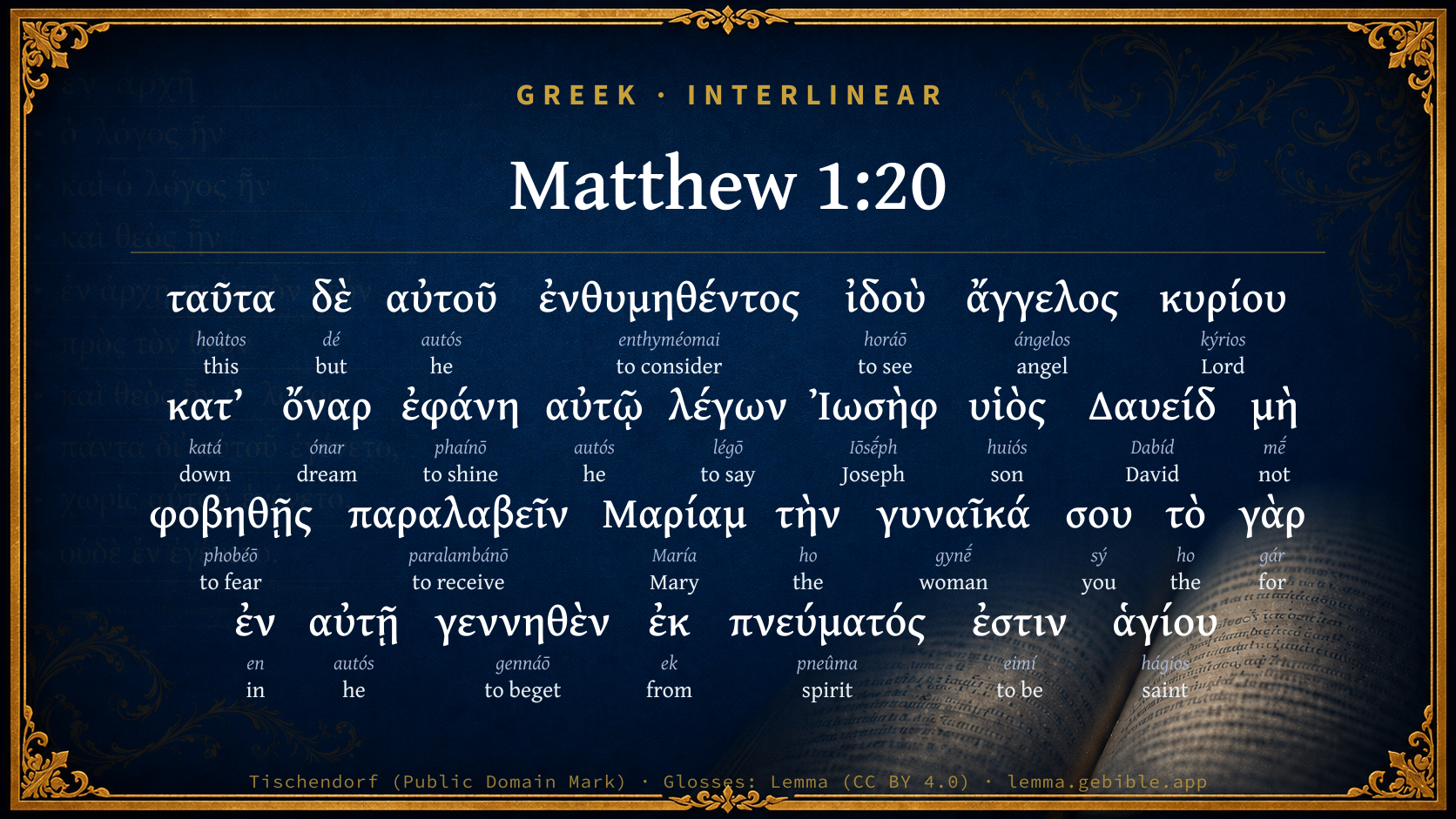
Greek (Tischendorf 8th ed.) Matthew 1:20 appears in the Greek New Testament. The text above is from the Tischendorf 8th edition. Each word links to its Strong’s number and a concise gloss. Click any word for its full Thayer’s Greek Lexicon entry.
Download image
Cite this verse

Matthew 1:20 (World English Bible). Public Domain. Lemma interlinear Bible study tool, https://lemma.gebible.app/v/matthew/1/20.

Show BibTeX & RIS
BibTeX
RIS
English Translation
But when he thought about these things, behold, an angel of the Lord appeared to him in a dream, saying, "Joseph, son of David, don't be afraid to take to yourself Mary, your wife, for that which is conceived in her is of the Holy Spirit.
World English Bible · Public Domain
Highlights
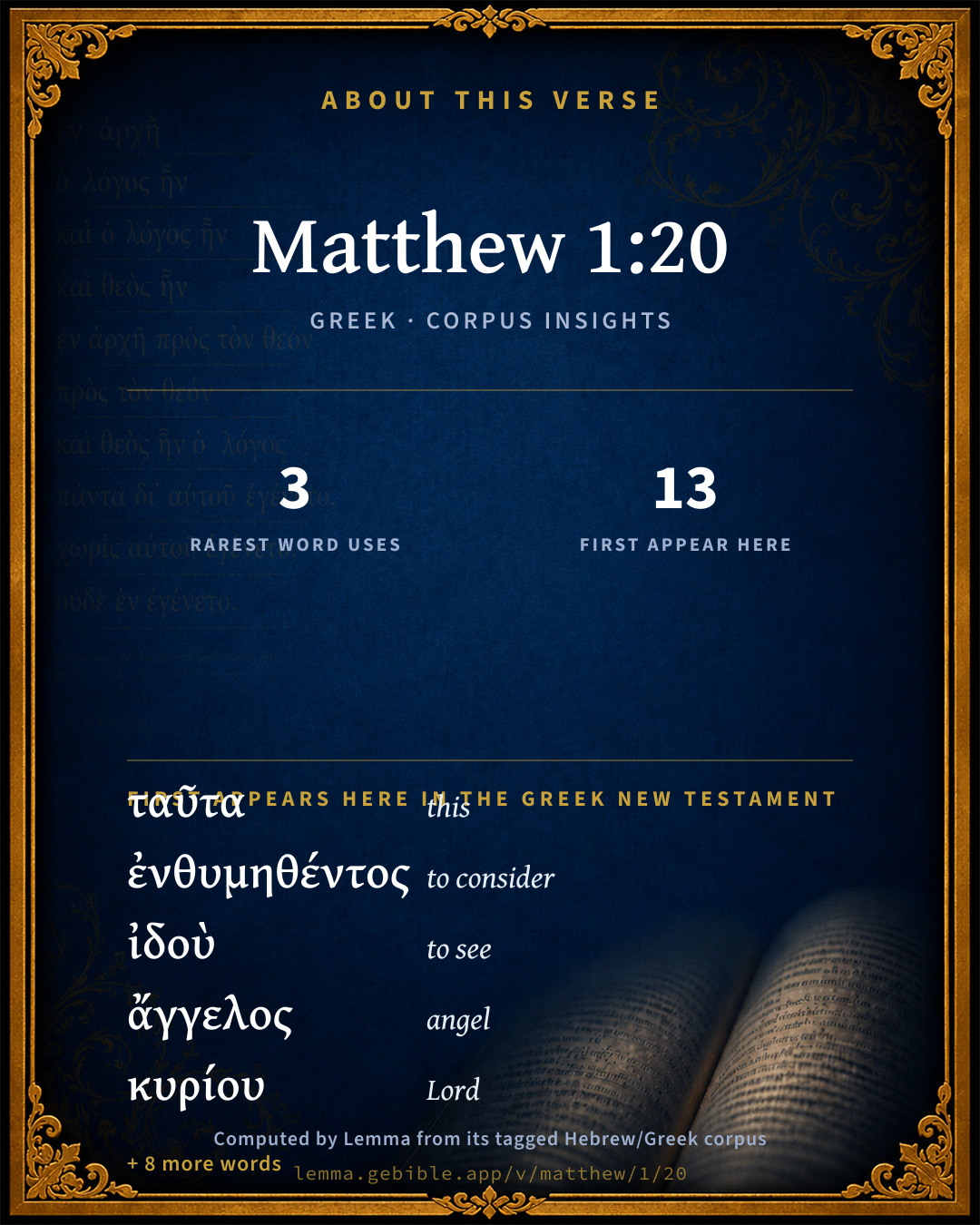
  • 13 first appearances in the Greek New Testament
Full analysis ↓
Download a study sheet

One document with this verse’s original text, its word-by-word gloss line, the meaning frame, cross-references with their text, attributed commentary, and full source and license credits — printable, and it pastes into notes with its structure intact.

This verse Autodidact and up

Study sheet (.html) Plain text (.txt)

A passage Seminary Student

Up to 50 verses in one chapter. A passage sheet keeps up to 6 commentary sources and 12 cross-references per verse, in the order this page ranks them, and says so on the sheet whenever that leaves anything out. Ask for a single verse and you get the Autodidact verse sheet above.

Everything on this page stays free to read, with no account — the sheet is a download of what is already on screen, not access to it.

Want to remove ads? Support Godless Engineer
Compare translations 3

The same verse in 3 English versions, stacked beneath the original-language interlinear above. Click any original word for its lexicon entry.

Each is an independent rendering of the whole verse — the interlinear is not word-aligned to these translations.

Highlighted words mark where these versions differ — a whole-verse word diff, not a word-by-word alignment.

  • World English Bible Public Domain
    But when he thought about these things, behold, an angel of the Lord appeared to him in a dream, saying, "Joseph, son of David, don't be afraid to take to yourself Mary, your wife, for that which is conceived in her is of the Holy Spirit.
  • King James Version Public Domain
    But while he thought on these things, behold, the angel of the LORD appeared unto him in a dream, saying, Joseph, thou son of David, fear not to take unto thee Mary thy wife: for that which is conceived in her is of the Holy Ghost.
  • unfoldingWord Literal Text CC BY-SA 4.0
    But he having reflected on these things, behold, an angel of the Lord appeared to him by way of a dream, saying, “Joseph, son of David, you should not fear to take Mary as your wife, because the one having been conceived in her is from the Holy Spirit.

unfoldingWord Literal Text — © unfoldingWord, licensed CC BY-SA 4.0. Word-aligned USFM3 via Door43 (git.door43.org/unfoldingWord/en_ult).

Versions to compare (up to 4)

3 of 4 selected

Show all 19 translations

Every available English version of this verse, each an independent rendering of the whole verse.

  • World English Bible Public Domain
    But when he thought about these things, behold, an angel of the Lord appeared to him in a dream, saying, "Joseph, son of David, don't be afraid to take to yourself Mary, your wife, for that which is conceived in her is of the Holy Spirit.
  • Berean Standard Bible Public Domain
    But after he had pondered these things, an angel of the Lord appeared to him in a dream and said, “Joseph, son of David, do not be afraid to embrace Mary as your wife, for the One conceived in her is from the Holy Spirit.
  • Majority Standard Bible Public Domain
    But after he had pondered these things, an angel of the Lord appeared to him in a dream and said, “Joseph, son of David, do not be afraid to embrace Mary as your wife, for the One conceived in her is from the Holy Spirit.
  • King James Version Public Domain
    But while he thought on these things, behold, the angel of the LORD appeared unto him in a dream, saying, Joseph, thou son of David, fear not to take unto thee Mary thy wife: for that which is conceived in her is of the Holy Ghost.
  • American Standard Version (1901) Public Domain
    But when he thought on these things, behold, an angel of the Lord appeared unto him in a dream, saying, Joseph, thou son of David, fear not to take unto thee Mary thy wife: for that which is conceived in her is of the Holy Spirit.
  • Revised Version (1885) Public Domain
    But when he thought on these things, behold, an angel of the Lord appeared unto him in a dream, saying, Joseph, thou son of David, fear not to take unto thee Mary thy wife: for that which is conceived in her is of the Holy Ghost.
  • Geneva Bible (1599) Public Domain
    But whiles he thought these things, behold, the Angel of the Lord appeared vnto him in a dreame, saying, Ioseph, the sonne of Dauid, feare not to take Mary thy wife: for that which is conceiued in her, is of the holy Ghost.
  • Douay-Rheims (1899) Public Domain
    But while he thought on these things, behold the angel of the Lord appeared to him in his sleep, saying: Joseph, son of David, fear not to take unto thee Mary thy wife, for that which is conceived in her, is of the Holy Ghost.
  • Young's Literal Translation Public Domain
    And on his thinking of these things, lo, a messenger of the Lord in a dream appeared to him, saying, `Joseph, son of David, thou mayest not fear to receive Mary thy wife, for that which in her was begotten `is' of the Holy Spirit,
  • Literal Standard Version CC BY-SA 4.0
    And on his thinking of these things, behold, a messenger of the LORD appeared to him in a dream, saying, “Joseph, son of David, you may not fear to receive your wife Mary, for that which was begotten in her is of [the] Holy Spirit,
  • Unlocked Literal Bible CC BY-SA 4.0
    As he thought about these things, an angel of the Lord appeared to him in a dream, saying, “Joseph, son of David, do not fear to take Mary as your wife, because the one who is conceived in her is conceived by the Holy Spirit.
  • unfoldingWord Literal Text CC BY-SA 4.0
    But he having reflected on these things, behold, an angel of the Lord appeared to him by way of a dream, saying, “Joseph, son of David, you should not fear to take Mary as your wife, because the one having been conceived in her is from the Holy Spirit.
  • Darby Bible Public Domain
    but while he pondered on these things, behold, an angel of [the] Lord appeared to him in a dream, saying, Joseph, son of David, fear not to take to [thee] Mary, thy wife, for that which is begotten in her is of [the] Holy Spirit.
  • World Messianic Bible Public Domain
    But when he thought about these things, behold, an angel of the Lord appeared to him in a dream, saying, “Joseph, son of David, don’t be afraid to take to yourself Miriam as your wife, for that which is conceived in her is of the Holy Spirit.
  • Webster's Bible Public Domain
    But while he thought on these things, the angel of the Lord appeared to him in a dream, saying, Joseph, thou son of David, fear not to take to thee Mary thy wife: for that which is conceived in her is by the Holy Spirit.
  • Free Bible Version CC BY-SA 4.0
    While he was thinking about all of this, an angel of the Lord appeared to him in a dream and told him, “Joseph, son of David, don't be afraid to marry Mary because she is pregnant by the Holy Spirit.
  • Bible in Basic English Public Domain
    But when he was giving thought to these things, an angel of the Lord came to him in a dream, saying, Joseph, son of David, have no fear of taking Mary as your wife; because that which is in her body is of the Holy Spirit.
  • Text-Critical English NT CC BY 4.0
    But as he thought about these things, behold, an angel of the Lord appeared to him in a dream and said, “Joseph, Son of David, do not be afraid to receive Mary as yoʋr wife, for the child that is conceived in her is from the Holy Spirit.
  • Tyndale New Testament (1534) Public Domain
    Whill he thus thought behold the angell of the Lorde appered vnto him in a dreame saynge: Ioseph the sonne of David feare not to take vnto ye Mary thy wyfe. For that which is conceaved in her is of the holy goost.

Literal Standard Version (2020), Covenant Press — licensed CC BY-SA 4.0. Text via the HelloAO Bible API (eBible.org). Unlocked Literal Bible (unfoldingWord) — licensed CC BY-SA 4.0. Text via the HelloAO Bible API (eBible.org). unfoldingWord Literal Text — © unfoldingWord, licensed CC BY-SA 4.0. Word-aligned USFM3 via Door43 (git.door43.org/unfoldingWord/en_ult). Free Bible Version, Dr. Jonathan Gallagher — licensed CC BY-SA 4.0. Text via the HelloAO Bible API (eBible.org).

Word by word

More ways to search: Search by grammar → Find every occurrence → Compare this word →

Practice this passage: Drill this verse → Learn its vocabulary →

ἐνθυμηθέντος
enthyméomai
G1760
“to consider”
Verb, Aorist, Passive deponent, Participle, Genitive, Singular, Masculine
Part of Speech
Verb
Tense
Aorist
Voice
Passive deponent
Mood
Participle
Case
Genitive
Number
Singular
Gender
Masculine
Full Thayer's Definition

Origin: from a compound of G1722 and G2372

TDNT: 05:52,3

1. to bring to mind, revolve in mind, ponder 2. to think, to deliberate
  1. ταῦτα hoûtos G3778 “this” Demonstrative pronoun, Accusative, Plural, Neuter
  2. δὲ dé G1161 “but” Conjunction
  3. αὐτοῦ autós G846 “he” Personal pronoun, Genitive, Singular, Masculine
  4. ἰδοὺ horáō G3708 “to see” Verb, Aorist, Middle, Imperative, 2nd person, Singular
  5. ἄγγελος ángelos G32 “angel” Noun, Nominative, Singular, Masculine
  6. κυρίου kýrios G2962 “Lord” Noun, Genitive, Singular, Masculine
  7. κατ’ katá G2596 “down” Preposition
  8. ὄναρ ónar G3677 “dream” Noun, Indeclinable
  9. ἐφάνη phaínō G5316 “to shine” Verb, Aorist, Passive, Indicative, 3rd person, Singular
  10. αὐτῷ autós G846 “he” Personal pronoun, Dative, Singular, Masculine
  11. λέγων légō G3004 “to say” Verb, Present, Active, Participle, Nominative, Singular, Masculine
  12. Ἰωσὴφ Iōsḗph G2501 “Joseph” Noun, Proper, indeclinable
  13. υἱὸς huiós G5207 “son” Noun, Nominative, Singular, Masculine
  14. Δαυείδ Dabíd G1138 “David” Noun, Proper, indeclinable
  15. μὴ mḗ G3361 “not” Particle, Negative
  16. φοβηθῇς phobéō G5399 “to fear” Verb, Aorist, Passive deponent, Subjunctive, 2nd person, Singular
  17. παραλαβεῖν paralambánō G3880 “to receive” Verb, Aorist, Active, Infinitive
  18. Μαρίαμ María G3137 “Mary” Noun, Accusative, Singular, Feminine
  19. τὴν ho G3588 “the” Article, Accusative, Singular, Feminine
  20. γυναῖκά gynḗ G1135 “woman” Noun, Accusative, Singular, Feminine
  21. σου sý G4771 “you” Personal pronoun, 2nd person, Genitive, Singular
  22. τὸ ho G3588 “the” Article, Nominative, Singular, Neuter
  23. γὰρ gár G1063 “for” Conjunction
  24. ἐν en G1722 “in” Preposition
  25. αὐτῇ autós G846 “he” Personal pronoun, Dative, Singular, Feminine
  26. γεννηθὲν gennáō G1080 “to beget” Verb, Aorist, Passive, Participle, Nominative, Singular, Neuter
  27. ἐκ ek G1537 “from” Preposition
  28. πνεύματός pneûma G4151 “spirit” Noun, Genitive, Singular, Neuter
  29. ἐστιν eimí G1510 “to be” Verb, Present, Active, Indicative, 3rd person, Singular
  30. ἁγίου hágios G40 “saint” Adjective, Genitive, Singular, Neuter

About this verse

These counts appear in no published source. They are computed here, from the morphology-tagged text and Lemma’s own curated glosses. What Lemma adds →

31
words
28
distinct lemmas
Gospels
section

Notable vocabulary

The rarest word here is ἐνθυμηθέντος to consider G1760 — appearing just 3 times in the whole Greek New Testament.

First appearance in Scripture

These words make their first canonical appearance in the Greek New Testament here (13 in total — showing 8):

  • ταῦτα this G3778
  • ἐνθυμηθέντος to consider G1760
  • ἰδοὺ to see G3708
  • ἄγγελος angel G32
  • κυρίου Lord G2962
  • κατ’ down G2596
  • ὄναρ dream G3677
  • ἐφάνη to shine G5316

Shared distinctive vocabulary

ἐνθυμηθέντος to consider G1760 occurs in 3 verses of the Greek New Testament. Also found in:
Repetition

Words recur within this verse:

  • αὐτοῦ he G846 ×3
  • τὴν the G3588 ×2

Cross-references

32

Topical passages linked to Matthew 1:20 in the Treasury of Scripture Knowledge — connected by theme and wording, ordered by reader-vote popularity; previews shown in the World English Bible.

  • Proverbs 3:5–6 Trust in Yahweh with all your heart, And don't lean on your own understanding.
  • Luke 1:19 The angel answered him, "I am Gabriel, who stands in the presence of God. I was sent to speak to you, and to bring you this good news.
  • Matthew 1:18 Now the birth of Jesus Christ was like this; for after his mother, Mary, was engaged to Joseph, before they came together, she was found pregnant by the Holy Spirit.
  • Joel 2:28 "It will happen afterward, that I will pour out my Spirit on all flesh; And your sons and your daughters will prophesy. Your old men will dream dreams. Your young men will see visions.
  • Matthew 2:19 But when Herod was dead, behold, an angel of the Lord appeared in a dream to Joseph in Egypt, saying,
  • Luke 2:4 Joseph also went up from Galilee, out of the city of Nazareth, into Judea, to the city of David, which is called Bethlehem, because he was of the house and family of David;
  • Genesis 31:11 The angel of God said to me in the dream, 'Jacob,' and I said, 'Here I am.'
  • Judges 13:3 The angel of Yahweh appeared to the woman, and said to her, See now, you are barren, and don't bear; but you shall conceive, and bear a son.
  • Isaiah 26:3 You will keep [him] in perfect peace, [whose] mind [is] stayed [on you]; because he trusts in you.
  • Matthew 28:5 The angel answered the women, "Don't be afraid, for I know that you seek Jesus, who has been crucified.
  • Luke 1:10–13 The whole multitude of the people were praying outside at the hour of incense.
  • Matthew 2:22 But when he heard that Archelaus was reigning over Judea in the place of his father, Herod, he was afraid to go there. Being warned in a dream, he withdrew into the region of Galilee,
  • Luke 1:26–38 Now in the sixth month, the angel Gabriel was sent from God to a city of Galilee, named Nazareth,
  • Psalms 94:19 In the multitude of my thoughts within me, Your comforts delight my soul.
  • Psalms 119:125 I am your servant. Give me understanding, That I may know your testimonies.
  • Psalms 143:8 Cause me to hear your loving kindness in the morning, For I trust in you. Cause me to know the way in which I should walk, For I lift up my soul to you.
  • Luke 2:8–14 There were shepherds in the same country staying in the field, and keeping watch by night over their flock.
  • 1 Kings 17:13 Elijah said to her, Don't be afraid; go and do as you have said; but make me of it a little cake first, and bring it forth to me, and afterward make for you and for your son.
  • Job 4:13–16 In thoughts from the visions of the night, When deep sleep falls on men,
  • Proverbs 12:5 The thoughts of the righteous are just, But the advice of the wicked is deceitful.
  • Isaiah 30:21 and your ears shall hear a word behind you, saying, This is the way, walk you in it; when you turn to the right hand, and when you turn to the left.
  • Jeremiah 33:26 then will I also cast away the seed of Jacob, and of David my servant, so that I will not take of his seed to be rulers over the seed of Abraham, Isaac, and Jacob: for I will cause their captivity to return, and will have mercy on them.
  • Matthew 2:13 Now when they had departed, behold, an angel of the Lord appeared to Joseph in a dream, saying, "Arise and take the young child and his mother, and flee into Egypt, and stay there until I tell you, for Herod will seek the young child to destroy him."
  • Genesis 46:3 He said, "I am God, the God of your father. Don't be afraid to go down into Egypt; for there I will make of you a great nation.
  • Numbers 12:6 He said, Hear now my words: if there be a prophet among you, I Yahweh will make myself known to him in a vision, I will speak with him in a dream.
  • Judges 13:8–9 Then Manoah entreated Yahweh, and said, Oh, Lord, please let the man of God whom you did send come again to us, and teach us what we shall do to the child who shall be born.
  • Job 33:15–17 In a dream, in a vision of the night, When deep sleep falls on men, In slumbering on the bed;
  • Psalms 25:8–9 Good and upright is Yahweh, Therefore he will instruct sinners in the way.
  • Isaiah 51:7 Listen to me, you who know righteousness, the people in whose heart is my law; don't you fear the reproach of men, neither be you dismayed at their insults.
  • Jeremiah 31:22 How long will you go here and there, you backsliding daughter? for Yahweh has created a new thing in the earth: a woman shall encompass a man.
  • Jeremiah 40:9 Gedaliah the son of Ahikam the son of Shaphan swore to them and to their men, saying, Don't be afraid to serve the Chaldeans: dwell in the land, and serve the king of Babylon, and it shall be well with you.
  • Isaiah 7:2 It was told the house of David, saying, "Syria is allied with Ephraim." His heart trembled, and the heart of his people, as the trees of the forest tremble with the wind.

Cross-references courtesy of OpenBible.info (CC BY 4.0).

Commentary

Notes on Matthew 1:20 from classic Christian and Jewish commentators (each source and its license shown beneath its notes). The classic Christian expositions comment on the surrounding passage and are grouped to its opening verse, so a note may address several verses; the Jewish commentaries on the Tanakh (Rashi and others) are per-verse, so they appear only where the commentator wrote on this verse.

Lemma curates 59 commentaries, every one of them public domain or Creative Commons licensed, each selected and text-cleaned for this edition rather than reprinted as found. About our sources →

Joseph Benson's Commentary

Mat 1:20. But while he thought on these things — While he was revolving them in his mind, in the night season, ignorant as he then was of the divine conception in Mary; while he was inclined to divorce her in this private way, but had not absolutely determined upon it; and while there was a conflict in his breast from opposite considerations; justice showing, on the one hand, what was due to himself; and on the other, what was due to one of Mary’s character; — while he was thus deliberating with himself, and in danger of innocently doing wrong, the angel of the Lord appeared unto him — Here we have a remarkable instance of the care which God takes of good men, both in keeping them from sin, and in affording them direction in time of need. Joseph had formed that determination which every prudent and wise man would have formed in similar circumstances; and yet, if he had executed his design, he would have greatly injured the holy virgin, in deserting her, and exposing her to censure and reproach. He kept the matter in his own breast, and discovered it to no living creature. But it was not concealed from God, who is privy to the most secret things, and who cannot suffer any that fear him, and look for his direction, to take any step that will be to the injury or loss of the innocent. So constantly does the divine providence superintend the affairs of men, and watch for the salvation of the righteous, even while they sleep. — An angel foretold to Mary, that she should be the mother of Christ; and an angel appointed Joseph to be the foster-father of the child, when born; angels ministered to Christ after his temptation; angels strengthened him in his agony; angels bore testimony, as to his nativity, so also to his resurrection, for it was proper that they should pay a peculiar respect to him by whom they had been created, and to whom they were, and were to be, subject.

In a dream — The angel appeared to Mary while awake, because faith and consent were required in her that she might conceive by the Holy Ghost; but he appeared to Joseph while sleeping, because that was sufficient in his case, and he was about to believe easily. For we more easily believe those things possible to have been done, which are done already by the divine power, and contrary to the law of nature, than the things which are yet to be done. Hence it was, that the matter was not signified to Joseph before the virgin had conceived, which, indeed, if it had been, might have left room for suspicion. In proportion as Joseph was the more and the longer perplexed with doubt, so much the stronger and more weighty is his testimony, after he is informed of the truth. Saying, Joseph, thou son of David — The angel reminds Joseph of the nobility of the stock from whence he sprung, that he might not think of any thing mean, but might raise his mind to the expectation of great things. He who made David, who was the son of a shepherd, a king, why should he not also give a carpenter a son that should be a king? Who promised David that the Messiah should arise from his posterity, He will certainly make his promise good, and will sooner change the whole order of nature than suffer what he hath foretold to fail of accomplishment. Fear not to take unto thee Mary thy wife — i.e, Who is betrothed to thee to be thy wife. For it is a mistake to interpret these words, as some have done, as if she had been already married to Joseph, and he had abstained from all conjugal intercourse with her, in consequence of some vow he had made. Dr. Waterland reads this clause, Scruple not the taking of Mary thy wife. It seems that Joseph had been induced, by a fear of offending God, to think of divorcing his wife, either because he thought she belonged to another man, or because he knew it was by no means lawful or honourable for him to cherish an adulteress. The angel’s words imply, Fear not to take her home to thee, and treat her kindly as a wife ought to be treated, according to the espousals that have passed between you, though there may seem to be some danger of bringing a reflection on thyself and family; for that which is conceived in her is of no human original, but produced by the miraculous and unexampled operation of the Holy Ghost. Thus, after Matthew has related how Christ was of royal descent, he now shows that he was also of much higher birth, and had a divine original. Now, although no example be extant of such a wonderful nativity, it nevertheless ought not to be rashly called in question by any especially by the Jews, since they believe that Abraham, the father of the nation, had a son by Sarah after she was past child-bearing; since they believe that Adam, the first man, was produced without father or mother; and that all the dead will be restored to life. That Joseph’s scruples about taking Mary did not proceed, as some of the fathers supposed, from veneration, appears from the reason here given by the angel why he should take her, which, in that case, would have been the only reason against taking her. And we may observe, too, that the angel’s terming her his wife, and encouraging him to take her, shows on what a flimsy foundation the belief of her perpetual virginity, entertained by the papists and others, is built.

Joseph Benson's Commentary on the Old and New Testaments (1811–1818) — public domain. Text from a community e-Sword module.

The Pulpit Commentary

But while he thought on these things; when (Revised Version); tauta de autou enyumhyentov . The tense lays stress, not on the continuance of his meditation, (contrast Act_10:19) but on the fact that the determination to which he had already come (vide supra) was already in his mind at the time when the following event happened. "These things;" his determination and its causes. Behold; unexpectedly. Though common in St. Matthew, it never lacks the connotation of surprise. The angel of the Lord; an angel of the Lord (Revised Version). In Mary"s case it was the angel Gabriel; (Luk_1:26) but here not defined. (so in Mat_2:13, 19 Luk_1:11 Luk_2:9) (On angels, of especially Dorner, "System.," 2:96.) Appeared unto him in a dream. Joseph received his communications by dream; (Mat_2:13, Mat_2:19, Mat_2:22) to Mary, doubtless the more holy person, the vision was vouchsafed to her bodily eyes. If Joseph, as seems probable, was old, we here have a beginning of the fulfilment of the promise concerning Messianic times, "Your old men shall dream dreams". (Joe_2:28) Saying, Joseph, thou son of David. In reminding Joseph of the greatness of his ancestry, the angel probably desired

(1) to accept Joseph"s resolution as right in so far as Joseph knew the circumstances, because with the promise of 2Sa_7:12-16 there was special need to keep the line pure;

(2) but, under the true circumstances, to urge him to take Mary, that so the promise might be fully carried out in his family and no other. Fear not to take unto thee Mary thy wife (ver. 15, note). For that which if conceived in her ("borun," Wickliffe; quod natum est, Vulgate); "Gr. begotten" (Revised Version margin), for gennhyen generally refers to the father rather than the mother, (yet see Mat_11:11) and here lays special stress on the Divine origin. Is of the Holy Ghost. "Of Spirit (not flesh), and that the Holy Spirit (ek Pneumatov estin Agiou)" (ver. 18, note).

Dreams as revelations.

It has been said that dreams represent the usual mode of Divine communication with persons who are outside the covenant. But this view is not fully maintained by a study of all the incidents narrated. It is true of Abimelech, (Gen_20:3-7) of Laban, (Gen_31:24) of Pharaoh"s butler and baker, (Gen_40:5-19) of Pharaoh, (Gen_41:1-7) of the Midianite, (Jud 7:13-15) of Nebuchadnezzar, (Dan_2:1, 31 4:5, 8) of the Wise Men, (Mat_2:11, Mat_2:12) of Pilate"s wife. (Mat_27:19) But it is not true of Jacob, (Gen_28:12 Gen_31:10) of Joseph, (Gen_37:5-9) of Solomon, (1Ki_3:5-15) of Daniel, (Da 7) or of Joseph. (Mat_1:20, 21 2:13, 19, 20) It is said that communication by dreams is the lowest form of revelation, because it deals with man when the senses and the will are asleep, and the panorama of the contents of the mind keeps passing, and there is no intelligent selection and arrangement of them. Dreams are much regarded in heathen religions. They are very sparingly used in the Jehovah-religion; and all Divine directions, whether by dreams or otherwise, are dependent upon the inward earnestness and sincerity of the heart. Perhaps it may be said that God used dreams in revealing his will to those who were not specially sensitive to spiritual things. Poets, prophets, mystics, see visions. Common men, or men in ordinary moods and conditions of mind, dream dreams, which God fills with meaning. See how far this is illustrated in the several cases mentioned above. Note that Joseph takes no place as a prophet or specially gifted or spiritual man; and therefore what may be called the commonplace mode of Divine communication was employed in his case.

I DREAMS ARE USUALLY WITHOUT SIGNIFICANCE. They represent the workings of the mind apart from the control of the will. They may or may not be connected. They may or may not be remembered. They bear no relation to character or culture. They can only nourish superstition if unduly regarded.

II DREAMS ARE SOMETIMES FULL OF DIVINE SIGNIFICANCE. NO sphere of man"s life can be thought of as beyond God"s control and use. He can be the will that guides, shapes, arranges, our dreams, so that they shall convey to us some message from him. He has done this. He still does this. Though his working in us, by the movings and guidings of the Holy Ghost, makes special and external forms of revelation seldom, if ever, necessary. R.T.

The Pulpit Commentary (1880–1919), ed. H.D.M. Spence-Jones & Joseph S. Exell — public domain. Text from a community e-Sword module.

Tyndale Open Study Notes

Tyndale Open Resources

1:20 The angel of the Lord declared to Joseph in a dream (see 2:12-13, 19, 22) that Mary had been neither seduced nor violated; instead, the baby was conceived by the Holy Spirit (Luke 1:34-35), who often has a creative and life-generating role (Gen 1:2; Ezek 37:1-14; John 3:5-8).

Tyndale Open Study Notes — © Tyndale Open Resources, licensed CC BY-SA 4.0. Text via the HelloAO Bible API.

Bengel's Gnomon

Johann Albrecht Bengel

Mat 1:20. ἰδοῦ, behold) He was not left long in doubt.[56]—κατʼ ὄναρ, in a dream) Dreams are mentioned also in Act 2:17, in a quotation from the Old Testament. With this exception, St Matthew is the only writer of the New Testament who has recorded dreams; viz., one of Pilate’s wife, ch. Mat 27:19; one of the Magi, ch. Mat 2:12; one of Joseph, in this passage; a second in ch. Mat 2:13; a third in ch. Mat 2:19; and a fourth in Mat 2:22. This mode of instruction was suitable to those early times of the New Dispensation.[57]—αὐτῷ, to him) In the first instance, Gabriel was sent to Mary, afterwards the remaining particulars were revealed to Joseph. Thus all things were made sure to both of them.—Ἰωσὴφ, Joseph) In visions, those to whom they are vouchsafed are generally addressed by name, as if already well known [to the speaker].—See Act 9:4; Act 9:10; Act 10:3; Act 10:13.—παραλαβεῖν, to take unto thee) sc. to the companionship of life and board, under the name of wedlock: on which ground the angel adds the words, τὴν γυναῖκά σου (thy wife).—Μαριὰμ, Mary) This termination was more usual in early times (from the example of the Hebrew and the LXX.) than the Greek form Μαρία, which soon, however, prevailed. St Matthew, therefore, uses Μαριὰμ here, in the angel’s address, for the name of our Lord’s mother; but Μαρίας [the genitive case of the Greek form Μαρία] when speaking of her (Mat 1:16; Mat 1:18) in his own person; and in like manner, he employs the Greek form when mentioning other women of the same name. And St Luke does mostly the same. Miriam, according to Hiller, signifies Rebellion, sc. of the Israelites in Egypt. Scripture teaches us to look to the etymology of the name, not of Mary, but of JESUS.—τὸ γὰρ ἐν αὐτῇ γεννηθὲν, for that which is conceived in her) The foetus, as yet unborn, is usually spoken of in the neuter gender.—Cf. note on Luk 1:35.

[56] Thus God guides His own, and teaches them at the right time, what they have to do.—B. G. V.

[57] Shortly after men prophesied concerning Christ; as also Christ Himself acted the part of an interpreter of their prophecies.—Vers. Germ.

Bengel's Gnomon of the New Testament — English translation (T&T Clark, Edinburgh, 1860) — public domain. Text from a community e-Sword module.

Meyer's Critical & Exegetical Commentary

Heinrich August Wilhelm Meyer

Mat_1:20. Ἰδού] as in Hebrew and in Greek writers, directs attention quickly to an object brought into view. Very frequent in Matthew.

κατʼ ὄναρ] in somnis, Vulg., Virg. Aen. ii. 270; ἐν ὀνείροις, Niceph. Schol. in Synes. p. 442. Frequent in later Greek, but not in the LXX. and Apocrypha; rejected by Photius, p. 149. 25, as βάρβαρον; amongst the old writers, commonly only ὄναρ. See Phrynichus, ed. Lobeck, p. 423 f.; κατά serves to designate the manner and way, and yields the adverbial meaning, in a dream, ὄψις ὀνείρου ἐν τῷ ὕπνῳ, Herod. i. 38. The appearance of the angel was an appearance in a dream; see Kühner, II. 1, p. 413. It might denote the time, if, as in Joseph. Antiq. xi. 9. 3, κατὰ τοὺς ὕπνους, or καθʼ ὕπνον (Gen_20:6), had been employed. Express visions in dreams in the N. T. are related only by Matthew. Comp. besides, Act_2:17.

υἱὸς Δ.] The reason of this address (nominative, see Kühner, II. 1, p. 43) is not difficult to see (de Wette); it is highly natural in the case of the angel, because he has to bring news of the Messiah. B.-Crusius says too little: Joseph is so addressed as one favoured by God, or, as he for whom something miraculous was quite appropriate. Fritzsche says too much: ut ad Mariam ducendam promtiorem redderet. The former neglects the special connection, the latter imports a meaning.

τὴν γυναῖκά σου] apposition to Μαριάμ: the Mary, who is thy wife: in which proleptic designation there lies an element stating the cause. This view (in answer to Fritzsche, who explains: Mary, as thy wife) is required by Mat_1:24.

ἐν αὐτῇ) not for ἐξ αὐτῆς, but also not to be translated, with Fritzsche: per eam, as ἐν with persons is never merely instrumental, and as the context (Mat_1:18 : ἐν γαστρὶ ἔχουσα ἐκ. πν. ἁγ.) demands a different rendering; but, quite literally, in utero Mariae, that which has been begotten in her.

The neuter places the embryo still under the impersonal, material point of view. Comp., first, Mat_1:21 : τέξεται δὲ υἱόν. See Wetstein, and on Luk_1:35.

ἐκ πν. ἐστιν ἁγίου] proceeds from the Holy Ghost as author, by whom, accordingly, your suspicions are removed. Observe the emphatic position, which lays the determining emphasis upon πνεύματος, in opposition to sexual intercourse. Upon the distinction between ἐνθυμεῖσθαι with the genitive (rationem habere alic. rei) and the accusative (when he had considered this), see Kühner, ad Xen. Memorabilia, i. 1. 17; Krüger on Thucyd. i. 42. 1.

Meyer — Critical and Exegetical Commentary on the New Testament — English translation by Peter Christie, edited by Frederick Crombie (T&T Clark, 1880) — public domain. Text from a community e-Sword module.

Expositor's Greek Testament

ed. W. Robertson Nicoll

Mat 1:20-21 . Joseph delivered from his perplexity by angelic interposition . How much painful, distressing, distracting thought he had about the matter day and night can be imagined. Relief came at last in a dream, of which Mary was the subject. ταῦτα … ἐνθυμηθέντος : the genitive absolute indicates the time of the vision, and the verb the state of mind: revolving the matter in thought without clear perception of outlet. ταῦτα , the accusative, not the genitive with περί : ἐνθ . περί τινος = Cogitare de re , ἐνθ . τι = aliauid secum reputare . Kühner, § 417, 9. ἰδού : often in Mt after genitive absolute; vivid introduction of the angelic appearance (Weiss Meyer). κατʼ ὄναρ (late Greek condemned by Phrynichus. vide Lobeck Phryn., p. 423. ὄναρ , without preposition, the classic equivalent), during a dream reflecting present distractions. υἱὸς Δαβίδ : the angel addresses Joseph as son of David to awaken the heroic mood. The title confirms the view that the genealogy is that of Joseph. μὴ φοβηθῇς : he is summoned to a supreme act of faith similar to those performed by the moral heroes of the Bible, who by faith made their lives sublime. τὴν γυναῖκά σου : to take Mary, as thy wife, so in Mat 1:24 . τὸ … ἁγίου : negativing the other alternative by which he was tormented. The choice lies between two extremes: most unholy, or the holiest possible. What a crisis!

The Expositor's Greek Testament, edited by W. Robertson Nicoll (1897–1910) — public domain. Text from a community e-Sword module.

Geneva Bible (1599)

Geneva Bible translators

Of the mother’s substance by the holy Ghost.

Which was promised, and made sure to thee to be thy wife.

Receive her at her parents’ and kinsfolk’s hands.

Geneva Bible (1599) marginal notes — public domain. Text via Bolls.life.

Jamieson, Fausset & Brown

Robert Jamieson, A. R. Fausset & David Brown

But while he thought on these things--Who would not feel for him after receiving such intelligence, and before receiving any light from above? As he brooded over the matter alone, in the stillness of the night, his domestic prospects darkened and his happiness blasted for life, his mind slowly making itself up to the painful step, yet planning how to do it in the way least offensive--at the last extremity the Lord Himself interposes.

behold, the angel of the Lord appeared to him in a dream, saying, Joseph thou son of David--This style of address was doubtless advisedly chosen to remind him of what all the families of David's line so early coveted, and thus it would prepare him for the marvellous announcement which was to follow.

fear not to take unto thee Mary thy wife, for that which is conceived in her is of the Holy Ghost--Though a dark cloud now overhangs this relationship, it is unsullied still.

Jamieson, Fausset & Brown — Commentary Critical and Explanatory on the Whole Bible (1871) — public domain (CC PDM 1.0). Text via the HelloAO Bible API.

Adam Clarke's Commentary

Verse 20. That which is conceived (or formed) in her] So I think γεννηθεν should be translated in this place: as it appears that the human nature of Jesus Christ was a real creation in the womb of the virgin, by the power of the Holy Spirit. The angel of the Lord mentioned here was probably the angel Gabriel, who, six months before, bad been sent to Zacharias and Elisabeth, to announce the birth of Christ's forerunner, John the Baptist. See Lu 1:36.

Adam Clarke's Commentary on the Bible (1810–1826) — public domain. Text from a community e-Sword/MySword module.

Ellicott's Commentary for English Readers

(20) While he thought on these things.—The words imply a conflict, a perplexity; and the words of the angel came as the solution of his doubts.

In a dream.—From the Jewish point of view, dreams were the received channels of divine communications to the aged, open visions in the state of ecstasy to the young (Joe_2:28). This, at least, falls in with what has been inferred as to Joseph’s age.

Joseph, thou son of David.—The latter words were, in the highest degree, significant. His character as the heir of Messianic hopes, which was indeed at the root of his fears, was fully recognised. That which he was bidden to do would not be inconsistent with that character, and would bring about the fulfilment of those hopes.

Thy wife.—Here again stress is laid on the fact that Mary was already entitled to that name, and had done nothing to forfeit it.

Conceived.—Better, perhaps, begotten.

A Bible Commentary for English Readers, edited by Charles John Ellicott (1878–1897) — public domain. Text from a community e-Sword module.

John Gill's Exposition

But while he thought on these things,.... While he was revolving them in his mind, considering what was most fit and proper to be done, whether to dismiss her publicly or privately; while he was consulting within himself the glory of God, the peace of his own conscience, and the credit of Mary,

behold the Angel of the Lord appeared to him in a dream; probably the same Angel which appeared to Zacharias, and brought him tidings that his wife should have a son, and who also appeared to Mary, and acquainted her that she should conceive, and bring forth the Messiah, Whose name was Gabriel, Luk 1:11. If we will believe the Jews, this Angel must be Gabriel, since he is the Angel who they say (d) "is appointed over dreams"; for he appeared to

Joseph in a dream, which is one of the ways and methods in which the Lord, or an Angel of his, has appeared to the saints formerly, and has answered them, see Gen 31:11 and is reckoned by the Jews (e) one of the degrees or kinds of prophecy: and so the Angel here not only encourages Joseph to take to him his wife,

saying Joseph, thou son of David; which is said partly to attest his being of the house and lineage of David, and partly to raise his expectations and confirm his faith, that his wife should bring forth the promised son of David; and chiefly to engage his attention to what he was about to say,

fear not to take unto thee Mary thy wife; do not be afraid either that thou shalt offend the Lord, or bring any reproach or scandal upon thyself as if thou didst connive at an adulteress; but as she is thine espoused wife, solemnly betrothed to thee, take her home to thyself, live with her as thy wife, and openly avow her as such. To which he is encouraged by the following reason or argument,

for that which is conceived in her is of the Holy Ghost; she has not been guilty of any criminal conversation with men; this conception of her's is of the Holy Ghost, and entirely owing to his coming upon her, and overshadowing her in a wonderful and miraculous manner. I say, the Angel not only encourages Joseph after this manner, but delivers something to him by way of prophecy, in the following verse.

(d) Zohar in Gen. fol. 103. 3. (e) Zohar in Gen. fol. 103. 3. & Maimon. Yesode Hattorah. c. 7. l. 13.

John Gill's Exposition of the Whole Bible (1746–1763) — public domain (CC PDM 1.0). Text via the HelloAO Bible API.

Trapp's Complete Commentary

John Trapp

20 But while he thought on these things, behold, the angel of the Lord appeared unto him in a dream, saying, Joseph, thou son of David, fear not to take unto thee Mary thy wife: for that which is conceived in her is of the Holy Ghost.

Ver. 20. But while he thought on these things] And was not so well advised upon his course, God, who reserveth his holy hand for a dead lift, expedites him. The Athenians had a conceit that Minerva (their goddess) drove all their ill counsels to a happy conclusion. The superstitious Romans thought that an idol, which they called Vibilia, kept them from erring out of their way. {a} The Divine providence is our Vibilia, that will not allow us to miscarry, so long as we have an eye to the pattern that was showed us in the mount, Exo 25:40. In the mount will the Lord be seen, {b} Gen 22:14; Pro 3:26.

Behold, the angel of the Lord appeared unto him] As of old he had done to Daniel, being caused to fly swiftly, or with weariness of flight (as the Hebrew hath it), with so good a will he did it, as thinking he could never come soon enough. Dan 9:21; Rev 1:9.

Joseph, thou son of David] Albeit a poor carpenter. A man may be as high in God’s favour and as happy in russet {c} as in tissue. "I know thy poverty" (saith Christ to that Church), but that is nothing, "thou art rich," Rev 2:9.

Fear not to take unto thee] viz. from the hands of her parents, who have, by all right, the disposal of their children as a chief part of their goods. Therefore when Satan obtained leave to vex Job and to touch him in his possession, he dealt with his children also, Job 1:11-19.

For that which is conceived in her] "That holy thing," Luk 1:35, that Holy of Holies wherein the "Godhead dwelleth bodily," that is, personally; and is called the Son of God, saith the angel there. Yet not in respect of his human nature, for then there should be in the person of Christ two sons, viz. one of the Father and another of the Holy Ghost. Besides, Heb 7:3, he is "without father," as man, and "without mother;" as God. All that can be gathered out of that place in Luke is, that he that was so conceived of the Holy Ghost was the natural Son of God. The union of three persons into one nature, and of two natures into one person, these are the great mysteries of godliness. The well is deep, as she said, and we want wherewith to draw (αντλημα), Joh 4:11.

Is of the Holy Ghost] As the efficient, not as the material cause. The virtus formatrix, the formative faculty which the Virgin had not, is ascribed to the power of the Holy Ghost, framing and fashioning Christ of the substance of the Virgin sanctified miraculously and without man’s help. But if no mother knows the manner of her natural conception, what presumption shall it be for flesh and blood to search how the Son of God took flesh from his creature? It is enough for us to know that he was conceived of the Holy Ghost, not spermatically, but operatively, yet secretly and mystically; the Virgin herself knew not how. Fearfully and wonderfully he was made, and curiously wrought in the lowest parts of the earth. Psa 139:14-15 Eph 4:9.

{a} Jun. Emblem. Ab erroribus viarum Dea Vibilia liberat. Arnob. adver. Gentes.

{b} Becilleia in stultitia tua (ait Rab. Solomon ex Talmud. Hieros.), i.e. in rebus in quibus es stultus, aderit tamen tibi Dominus.

{c} A coarse homespun woollen cloth of a reddish-brown, grey or neutral colour, formerly used for the dress of peasants and country folk. ŒD

John Trapp, A Commentary or Exposition upon All the Books of the Old and New Testament (1647–1656) — public domain. Text from a community e-Sword module.

Albert Barnes' Notes on the Bible

He thought on these things - He did not act hastily. He did not take the course which the law would have permitted him to do, if he had been hasty, violent, or unjust. It was a case deeply affecting his happiness, his character, and the reputation and character of his chosen companion. God will guide the thoughtful and the anxious. And when we have looked patiently at a perplexed subject, and know not what to do, then God, as in the case of Joseph, will interpose to lead us and direct our way. Psa 25:9.

The angel of the Lord - The word “angel” literally means a messenger. It is applied chiefly in the Scriptures to those invisible holy beings who have not fallen into sin: who live in heaven (1Ti 5:21; compare Jud 1:6); and who are sent forth to minister to those who shall be heirs of salvation. See the Heb 1:13-14 notes, and Dan 9:21 note. The word is sometimes applied to men, as messengers Luk 7:24; Luk 9:52; Jam 2:25; to the winds Psa 104:4; to the pestilence Psa 78:49; or to whatever is appointed to make known or to execute the will of God. It is commonly applied, however, to the unfallen, happy spirits that are in heaven, whose dignity and pleasure it is to do the will of God. Various ways were employed by them in making known the will of God, by dreams, visions, assuming a human appearance, etc.

In a dream - This was a common way of making known the will of God to the ancient prophets and people of God, Gen 20:3; Gen 30:1, Gen 30:11, Gen 30:24; Gen 37:5; Gen 41:1; 1Ki 3:5; Dan 7:1; Job 4:13-15; compare my notes at Isaiah. In what way it was ascertained that these dreams were from God cannot now be ascertained, It is sufficient for us to know that in this way many of the prophecies were communicated, and to remark that there is no evidence that we are to put reliance on our dreams. Dreams are wild, irregular movements of the mind when it is unshackled by reason, and it is mere superstition to suppose that God now makes known His will in this way.

Son of David - Descendant of David. See Mat 1:1. The angel put him in mind of his relation to David perhaps to prepare him for the intelligence that Mary was to be the mother of the Messiah - the promised heir of David.

Fear not - Do not hesitate, or have any apprehensions about her virtue and purity. Do not fear that she will be unworthy of you, or will disgrace you.

To take unto thee Mary thy wife - To take her as thy wife; to recognize her as such, and to treat her as such.

For that which is conceived in her is of the Holy Ghost - Is the direct creation of divine power. A body was thus prepared pure and holy, and free from the corruption of sin, in order that he might be qualified for his great work the offering of a pure sacrifice to God. As this was necessary in order to the great work which he came to perform, Joseph is directed by an angel to receive her as pure and virtuous, and as every way worthy of his love. Compare the notes at Heb 10:5.

Albert Barnes' Notes on the Bible (1834–1885) — public domain. Text from a community e-Sword/MySword module.

Haydock's Catholic Bible Commentary

Fear not to take, &c. i.e., fear not to marry her, if we suppose them not yet married, or if married already, the sense is, fear not to keep and remain with thy chaste wife; lay aside all thoughts of dismissing and leaving her. (Witham) --- As the incarnation of the Son of God was effected by the whole blessed Trinity, it may be asked why this operation is peculiarly attributed to the Holy Ghost, not only here, but in Luke ii., and in the apostles’ creed? The answer is, because as power is attributed to the Father, wisdom to the Son, so goodness is attributed to the Holy Ghost, and the gifts of grace which proceed from it. (Estius in different location)

George Leo Haydock (1774–1849), Haydock's Catholic Family Bible and Commentary, 1859 edition — public domain. Excludes Psalms (Douay-Rheims chapter numbering differs from Protestant) and Deuterocanonical books (Catholic canon only).

Matthew Poole's English Annotations

What we have in this verse assures us, that Joseph was not only inclined, by the kindness and benignity of his own natural temper, and by his charity, to that moderate resolution he had taken up, but also more immediately influenced by God, who was now sending a messenger to him to tell him what he would have him to do in this case. Whether this angel was the angel Gabriel, who Luke tells us, Luk 1:26, was sent to Mary, to tell her that the power of the Most High should overshadow her, or some other angel, none can assert; an angel it was. He appeareth to Joseph while he was asleep, and in and by a dream. By dreams was one way by which God revealed his mind to people formerly, Heb 1:1; one of those ways by which God made himself known to prophets, Num 12:6; and not to prophets only, but to pagan princes sometimes, as appeareth by the instances we have in Scripture of the dreams which Pharaoh and Nebuchadnezzar both had. Dreams are either natural, or supernatural, or preternatural. How to distinguish the former from the two latter is not my work in this place, and possibly a difficult task, especially in our times, when God, having spoken to us by his Son, and given us his word as a perfect rule, hath left off ordinary speaking to his prophets by dreams and visions, though not limited himself but that he may sometimes so speak. We are assured of the truth of a Divine revelation to Joseph by this way of dreams, while his head was full of thoughts what he was to do in this case. God thinks of us when we sleep, and one way or other will not be wanting to our inquisition in sincerity to know his will, in the difficult cases of our lives. The angel saith unto Joseph,

Joseph, thou son of David; by which compellation he lets him know he was to be the supposed and legal, though not the natural, father of the Messias, who was by the confession of all men to be the Son of David.

Fear not to take unto thee Mary thy wife; she that is thy betrothed wife, and so thy wife in my sight; thou hast espoused her, and called me to witness that thou wilt consummate this marriage with her in a due time, and take her to thine house. I see what hath happened which troubleth thy thoughts; possibly thou art afraid lest thou shouldest offend me, marrying one who appeareth unto thee to be defiled; or thou art afraid of bringing a blot upon thyself if thou shouldest consummate this marriage; but do not fear any of these things, but go on, and consummate thy marriage. She is not, as you supposeth, or mayest fear, defiled by man,

for that which is conceived in her is of the Holy Ghost. That holy thing, ( as Luke speaks), that human body which is in her womb, is created in her, and is of the Holy Ghost. The Holy Ghost, by his almighty creating power, hath supplied what is wanting from the help of the creature, as to ordinary productions of this nature.

Matthew Poole's English Annotations on the Holy Bible (1683–1685) — public domain. Text from a community e-Sword/MySword module.

Whedon's Commentary on the Bible

Daniel D. Whedon

20. Angel of the Lord — During the four hundred years intervening between the Old Testament and the New, prophecy, miracle, inspiration, and angelic appearance had ceased. This interval of cessation and silence was broken by the preparation for the appearance of Jesus the Saviour.

The first phenomenon opening his new dispensation was the appearance of the angel GABRIEL in the temple, announcing to Zechariah the birth of John the Baptist, forerunner of the Messiah. This Epiphany was followed by a profusion of miraculous displays of every variety of nature, preceding the birth, attending the ministry, and following the ascension of the Son of God. Angels appear in their splendour, devils in their malignity; dreams, miracles, and divine operations of various nature surround and attend the sacred person of the Lord. It was a miraculous dispensation, a supernatural epoch, in which the powers of heaven and hell came forth in manifestations extraordinary and unparalleled, and not to be tested by the experience of ordinary ages. It is not for us to say, who live in the common level of human history, that angelic appearances and demoniacal possessions did not transpire during the period in which God’s own Son was incarnate. That greatest of miracles might well imply, and properly be attended by, a retinue of inferior but kindred facts.

The angel of the Lord appeared to our Lord’s ostensible father, to announce the birth of the human Son of God. The word angel signifies messenger, and is chiefly used in Scripture to designate a living spiritual being sent by God to perform some supernatural ministry. It is not true that angels first appear in Scripture at the Babylonish captivity. Angelic appearances to Abraham and to Lot are narrated in Genesis, and to Manoah in Judges. A reference to a concordance will show that the word angel, as a term for a superhuman being, abounds in the Old Testament.

Yet it is no doubt true that there are names for the angels, which appear for the first time, in the Scriptures, after the captivity. These names may have been matters of a later revelation to the Jews. Or the Persians may have retained, traditionally, a primitive revelation of their names. Or, more probably than either supposition, the names were of human origin; but being of significant meaning, these angelic beings, when appearing to human eyes, adapt themselves to the human conception by adopting the human significant name appropriate to themselves. It cannot be supposed that these angels retain these human names in the spiritual world. As they adapt themselves to human form, and speak with a human voice, so do they identify themselves to human acquaintance by some familiar yet descriptive appellation. So the angel appearing to Zechariah (Luk_1:19) says: “I am Gabriel that stands in the presence of God.” And in the 26th verse, this same Gabriel is named as announcing to Mary the approaching birth of the Messiah. Now this Gabriel appears in Dan_8:16, to explain the vision of the ram and he goat; and what is still more striking, he interprets to Daniel (Dan_9:21-27) the vision of the seventy weeks. Thus the same Gabriel announces the most striking prediction of the Messiah to Daniel, of the harbinger of the Messiah to Zechariah, and of the incarnation of the Messiah to Mary. And the very appropriate appellation by which he declares himself to men is “God’s strong one,” for such is the import of the name.

No systematical view is given us of the angel worlds. No reverence or worship of them is required or justified. Human fancies among Jewish, Mohammedan, and some imaginative Christian writers, have constructed schemes and systems and worlds of angelology. But the references of Scripture to this class, or series of classes of beings, are incidental and reserved. The inference is that we have ordinarily little to do with them.

Self-sufficient philosophers, like Strauss, have announced that the age for the belief in such superior beings is past. Natural philosophy has shown that the natural operations of the world are effected by natural forces, and the demand for such beings is crowded out of existence. As truly might they say that the exact forces of nature exclude all voluntary agents, human as well as superhuman. Nor can any philosophy prove that there are no personal intelligent beings in the universe superior in rank or power to man. On the contrary, the opinion is improbable even to absurdity, that the vast interval between little, finite man and the infinite One is entirely vacant, and filled by no living, intelligent occupants. Hence the existence of systems of beings of angelic rank is perpetually reasonable, and can never be superseded in any age by any advance of philosophy.

In a dream — Though dreams are usually the vain vagaries of our sleeping hours, which no sensible man usually regards, yet God has often made them the means of communicating warnings and directions. God, who made the mind, can shape its conceptions in sleep, as well as in wakefulness, to present supernatural information. Dreams were, however, considered by the Jews as an inferior sort of revelation. We may add that while an angel appeared in open sight both to Zechariah and to Mary to announce the illustrious births, and that angel no less than Gabriel, “that stands in the presence of God,” to Joseph, as of inferior importance, appears an unnamed angel in a dream.

Thou son of David — A man simple in character, but illustrious by descent. It was absolutely essential that Mary should be a daughter of David, in order that Jesus might be truly of the seed of David according to the flesh. And it was important, though not essential, that Joseph should be of the line of David, in order that Christ should also seem, by his reputed father, a son of David, to the eyes of men.

That Messiah should be son, that is, descendant, of David, was so clearly and abundantly revealed in Old Testament prophecy as to be a settled point in Jewish theology. The Chaldee paraphrase, (which was the free translation of the Old Testament books, prepared after the return from the captivity, as the received expositor of Scripture, and read in the public service,) when it comes to the passage, (Isa_11:1,) “There shall come forth a rod out of the stem of Jesse,” etc., construes it thus: “A king shall come out of the sons of Jesse, and the Messiah out of his son’s sons.” And that this Davidic origin was the doctrine of the learned Jews in the Saviour’s day, is evident from Mar_12:35 : “Say the scribes that Christ is the son of David.” And so Mat_22:42 : “What think ye of Christ, whose son is he? They say unto him, The son of David.”

That Jesus was reputed to be, according to this doctrine, the son of David, is plentifully evident. Joseph and Mary went to Bethlehem to be taxed, “because they were of the house and lineage of David.” Luk_2:11. The blind men of Jericho cried: “Jesus, thou son of David, have mercy on us.” The multitudes at the capital cry: “Hosanna to the son of David.” And the heading of his genealogy is: “The book of the generation of Jesus Christ, the son of David.” Mat_1:1. And hence the angel of the annunciation is sent (Luk_1:22) to a virgin of the house of David. And of her offspring he promises, (Luk 1:32,) the Lord God shall give unto him the throne of his father David.

Is of the Holy Ghost — It is part of the impurity of our depraved nature, that the subject of our own origin by birth should suggest other than pure thoughts. But the divine law hath established that through all nature a new life should be produced only from the method of double parentage. When therefore from a single human parent a new human person takes origin, a miracle of surpassing power, over and above nature, is performed, it may be truly believed to take place only “of the Holy Ghost.”

This phrase is not to be so understood as to imply that the Holy Ghost is the father of our Lord Jesus Christ. In Luke the angel declares to Mary; “The Holy Ghost shall come upon thee, and the power of the Highest shall overshadow thee; therefore that holy thing which shall be born of thee shall be called the Son of God.” By this we are to understand simply that divine power was imparted to the human person of the virgin, from which a being of perfect holiness should be conceived and born, blending the divine and the human natures. From this whole matter all but the truly impious and profane will banish every impure and gross thought. Even in the most minute conceptions that our minds, in their trains of meditation, may be called upon to frame, our reverence will compel us to think of this one holy conception and birth with a purity and an awe suitable to the real sacredness and grandeur of so supernatural a fact and being.

Daniel D. Whedon (gen. ed.), Commentary on the Old and New Testaments (1874–1909) — public domain. Text from a community e-Sword module.

Kretzmann's Popular Commentary

Paul E. Kretzmann

It was here that God interfered in behalf of the mother of His Son, according to His humanity:

v. 20. But while he thought on these things, behold, the angel of the Lord appeared unto him in a dream, saying: Joseph, thou son of David, fear not to take unto thee Mary, thy wife; for that which is conceived in her is of the Holy Ghost.

Joseph’s mind was still busily engaged with the perplexing problem; he was wrestling with painful, distressing, distracting thoughts, and even his kind expedient may have seemed harsh to him. But, behold!—a vivid introduction of the angelic appearance to emphasize the intervention of God. In a dream the vision came to Joseph to save him and his betrothed from an act which would result in disastrous consequences. The appearance of an angel in a dream was one of the methods which God used to "make known His will, or to reveal the future in special cases. The angel addresses Joseph, "Thou son of David," not to awaken the heroic mood, as has been suggested, but to emphasize the thought of the legal acknowledgment and adoption of the child. He should not fear to take home, publicly to accept, Mary as his wife. This simple acceptance of the angel’s words meant for Joseph an act of faith similar to those performed by the great heroes of the Old Testament, to believe the Lord absolutely, in spite of all the evidences of the senses. This public recognition would save the honor of Mary and also that of her child. For instead of being the fruit of adulterous and licentious intercourse, the product of a most unholy cohabitation, the child which was to be born of her was of the Holy Ghost, begotten by deliberate intervention of God, against the course of nature.

Paul E. Kretzmann, Popular Commentary of the Bible (1921–1924) — public domain. Text from a community e-Sword module.

Burkitt's Expository Notes on the New Testament

William Burkitt

Two things here are observable; namely, the care that Almighty God takes; 1. For Joseph’s satisfaction.

2. For vindicating the virgin’s reputation. For Joseph’s satisfaction, an angel is dispatched to give him assurance that the virgin was not defiled by a man, but overshadowed by the Holy Ghost.

Whence note, that Almighty God will certainly find out ways and means for his peoples’ satisfaction, when they are willing and desirous above all things to come to the knowledge and right understanding of their duty.

Observe, 2. How the angel clears the virgin’s innocency, as well as satisfies Joseph’s doubtings, by assuring, that what was conceived in her, was by the Holy Ghost.

Learn hence, that God will, in his own time, clear the innocency of such as suffer in their name and reputation for the sake of Christ, through for the present they may lie under the burden of disgrace and shame.

William Burkitt's Expository Notes on the New Testament (1700–1703) — public domain. Text from a community e-Sword module.

The People's New Testament

B. W. Johnson

20. While he thought. Reflected, still in doubt, perplexed. An angel. Gabriel appeared to Mary (Luke 1:26); the name of the angel is not here given. Angels are messengers; an angel of the Lord is the Lord's messenger. These messengers are usually superhuman, but not always. In a dream. Often messages were conveyed by impressions made in sleep. Three times revelations were thus made to Joseph. Thou son of David. It was fitting that he should now be reminded that he belonged to the family from whence the Messiah was to come. Fear not. His betrothed was pure.

B. W. Johnson's The People's New Testament with Notes (1889–1891) — public domain. Electronic text from the Christian Classics Ethereal Library (CCEL) ThML edition.

unfoldingWord translationNotes

Door43 World Missions Community

As he thought

"As Joseph thought"

appeared to him in a dream

"came to him while Joseph was dreaming"

son of David

Here "son" means "descendant."

the one who is conceived in her is conceived by the Holy Spirit

This can be stated in active form. AT: "the Holy Spirit caused Mary to become pregnant with this child" (See: Active or Passive)

She will give birth to a son

Because God sent the angel, the angel knew the baby was a boy.

you will call his name

"you must name him" or "you must give him the name." This is a command.

for he will save

Translator may add a footnote that says "The name 'Jesus' means 'the Lord saves.'"

his people

This refers to the Jews.

translationWords

angel

lord

dream

son

David

Jesus

save

sin

unfoldingWord translationNotes — © Distant Shores Media and the Door43 World Missions Community, licensed CC BY-SA 4.0. Source: git.door43.org/Door43/en_tn.

Cambridge Greek Testament for Schools and Colleges

20. ἰδού. Used like the Hebr. hinneh as a particle of transition. See note ch. Mat 2:7.

κατʼ ὄναρ for classical ὄναρ.

παραλαβεῖν, the technical word for receiving a bride from her parents: καὶ τί ἄν, ἔφη ὁ Σωκράτης, ἐπισταμένην αὐτὴν παρέλαβες (Xen. Œcon.).

Cambridge Greek Testament for Schools and Colleges (Cambridge University Press, 1896; 21 vols, various authors incl. Carr, Maclear, Plummer, Farrar, Lumby, Moule, M. R. James, Simcox) — public domain. Text from a community e-Sword module.

Alford’s Greek Testament

Henry Alford

20.] ἰδού answers to the Hebrew הִנֵּה, and is frequently used by Matt. and Luke to introduce a new event or change of scene: not so often by Mark, and never with this view in John.

ἄγγελος κ.] The announcement was made to Mary openly, but to Joseph in a dream; for in Mary’s case faith and concurrence of will were necessary,—the communication was of a higher kind,—and referred to a thing future; but here it is simply an advertisement for caution’s sake of an event which had already happened, and is altogether a communication of an inferior order: see Gen 20:3. But see on the other hand the remarks at the close of the notes on ver. 21.

κατʼ ὄναρ] ὄναρ, simply, is the classical equivalent,—κατʼ ὄναρ belonging to later writers, Strabo, Plutarch, &c. οὐ χρὴ κατʼ ὄναρ λέγειν, ὥσπερ οὐδὲ καθʼ ὕπαρ, ἀλλὰ ὄναρ καὶ ὕπαρ οἷον; ὄναρ εἶδον τὸν δεῖνα, Thom. Mag. See Lobeck on Phrynichus, p. 423.

υἱὸς Δαυείδ] These words would recall Joseph’s mind to the promised seed, the expectation of the families of the lineage of David, and at once stamp the message as the announcement of the birth of the Messiah. May it not likewise be said, that this appellation would come with more force, if Mary also were a daughter of David?

The nom. for the vocative is frequent in the Gospels: generally with an article. See Luk 8:54: ch. 11:26, al., and particularly Joh 20:28.

τὴν γυν. σου] Not ‘as thy wife:’ but in apposition with Μαριάμ, Mary thy wife: see ver. 24, which decides this, as Meyer, Exo_3, now acknowledges. The addition serves to remind Joseph of that relation which she already held by betrothal, and which he was now exhorted to recognize. See above on ver. 19.

τὸ γὰρ ἐν αὐ. γ.] ἐν is here not instrumental, ‘that which is conceived by her,’ but local, that which is begotten in her. The gender here is not to be pressed as involving any doctrinal consequence, but to be regarded as the usual way of speaking of the unborn fœtus: we have υἱόν first after τέξεται, ver. 21. See also Joh 3:6: 1Jn 5:4.

Henry Alford, The Greek Testament (1849–1861) — public domain. Text from a community e-Sword module.

International Critical Commentary

(P) 20. And whilst he purposed this, behold, an angel of the Lord appeared to him in a dream, saying, Joseph, son of David, fear not to lake Mary thy wife: for that which is begotten in her is of the Holy Spirit.]—ἰδού] Exclusive of quotations, ἰδού occurs 30 times in Mt., 29 in Lk., 7 in Mk.; καὶ ἰδόυ, 28 in Mt., 26 in Lk., 0 in Mk.—κατʼ ὄναρ] 6 times in Mt., not elsewhere in NT; cf. Ditt. Syll. 780. 5, 781. 4, 782. 4.—παραλαβεῖν] According to Jewish law, marriage begun in the betrothal, was completed in the “taking” of the bride to the house of her husband; cf. Merx, op. cit. p. 11.

20. τἠν γυναῖκἀ σον] S2 has “thy betrothed.” Cf. the omission of ὁ ἁνἠρ αὐτῆς, v. 19.

International Critical Commentary — older volumes (1896–1929), various authors — public domain. Text from a community e-Sword module.

Lesson kit

Teaching starters — assembled from the data on this page, not authored interpretation. Every prompt links to the verse data it draws on. Edit before teaching.

Matthew, in the Gospels, opens this verse with 31 words (28 distinct Greek lemmas). Its most distinctive word is enthyméomai (“to consider”). A historical commentator’s framing appears above. Read the whole chapter for the surrounding context.

Discussion questions

  1. The word enthyméomai carries the sense “to consider.” How does it shape the verse?
  2. 13 words make their first appearance in Scripture here. What does this debut establish?
  3. How does Matthew 9:4, which shares the word «to consider», read alongside this verse?
  4. What does the repetition of “he” (3× in this one verse) do in this verse?
  5. These translations render this verse differently; the difference is in the English rendering, not the original. What questions does that raise?
  6. Compare how Joseph Benson's Commentary and The Pulpit Commentary read this verse. Where do they agree or differ?

Things to notice

  • 13 words make their first canonical appearance in Scripture here.
  • These translations choose different wording for 19 words in this verse.
  • “he” occurs 3× in this single verse.
  • 28 distinct Greek lemmas span 31 words in this verse.

Reading settings

Reading text

Shown beneath each verse's original-language words.

Old Testament
Old Testament edition

Read the OT as the Masoretic Hebrew (MT) or the Greek Septuagint (LXX).

English shown for the Greek Septuagint (in the Hebrew ↔ Greek comparison).

Comparing translations? Open the Compare panel on any verse page to stack up to four side by side.