
Matthew 22:12

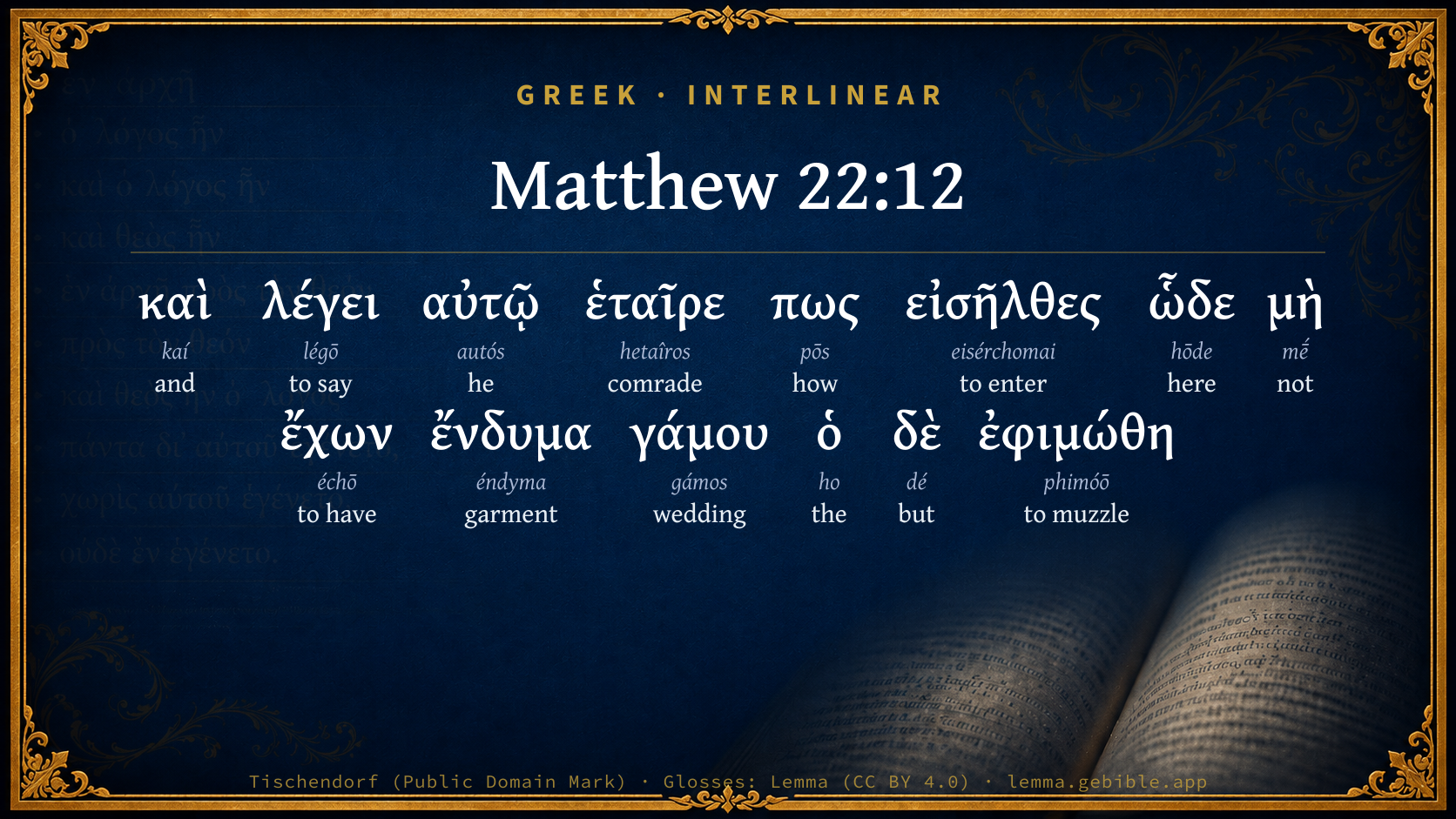
Greek (Tischendorf 8th ed.) Matthew 22:12 appears in the Greek New Testament. The text above is from the Tischendorf 8th edition. Each word links to its Strong’s number and a concise gloss. Click any word for its full Thayer’s Greek Lexicon entry.
Download image
Cite this verse

Matthew 22:12 (World English Bible). Public Domain. Lemma interlinear Bible study tool, https://lemma.gebible.app/v/matthew/22/12.

Show BibTeX & RIS
BibTeX
RIS
English Translation
and he said to him, 'Friend, how did you come in here not wearing wedding clothing?' He was speechless.
World English Bible · Public Domain
Highlights
  • 1 first appearance in the Greek New Testament
Full analysis ↓
Download a study sheet

One document with this verse’s original text, its word-by-word gloss line, the meaning frame, cross-references with their text, attributed commentary, and full source and license credits — printable, and it pastes into notes with its structure intact.

This verse Autodidact and up

Study sheet (.html) Plain text (.txt)

A passage Seminary Student

Up to 50 verses in one chapter. A passage sheet keeps up to 6 commentary sources and 12 cross-references per verse, in the order this page ranks them, and says so on the sheet whenever that leaves anything out. Ask for a single verse and you get the Autodidact verse sheet above.

Everything on this page stays free to read, with no account — the sheet is a download of what is already on screen, not access to it.

Want to remove ads? Support Godless Engineer
Compare translations 3

The same verse in 3 English versions, stacked beneath the original-language interlinear above. Click any original word for its lexicon entry.

Each is an independent rendering of the whole verse — the interlinear is not word-aligned to these translations.

Highlighted words mark where these versions differ — a whole-verse word diff, not a word-by-word alignment.

  • World English Bible Public Domain
    and he said to him, 'Friend, how did you come in here not wearing wedding clothing?' He was speechless.
  • King James Version Public Domain
    And he saith unto him, Friend, how camest thou in hither not having a wedding garment? And he was speechless.
  • unfoldingWord Literal Text CC BY-SA 4.0
    And he says to him, ‘Friend, how did you come in here, not having wedding clothes?’ But he was silent.

unfoldingWord Literal Text — © unfoldingWord, licensed CC BY-SA 4.0. Word-aligned USFM3 via Door43 (git.door43.org/unfoldingWord/en_ult).

Versions to compare (up to 4)

3 of 4 selected

Show all 19 translations

Every available English version of this verse, each an independent rendering of the whole verse.

  • World English Bible Public Domain
    and he said to him, 'Friend, how did you come in here not wearing wedding clothing?' He was speechless.
  • Berean Standard Bible Public Domain
    ‘Friend,’ he asked, ‘how did you get in here without wedding clothes?’ But the man was speechless.
  • Majority Standard Bible Public Domain
    ‘Friend,’ he asked, ‘how did you get in here without wedding clothes?’ But the man was speechless.
  • King James Version Public Domain
    And he saith unto him, Friend, how camest thou in hither not having a wedding garment? And he was speechless.
  • American Standard Version (1901) Public Domain
    and he saith unto him, Friend, how camest thou in hither not having a wedding-garment? And he was speechless.
  • Revised Version (1885) Public Domain
    and he saith unto him, Friend, how camest thou in hither not having a wedding-garment? And he was speechless.
  • Geneva Bible (1599) Public Domain
    And he sayd vnto him, Friend, how camest thou in hither, and hast not on a wedding garment? And he was speachlesse.
  • Douay-Rheims (1899) Public Domain
    And he saith to him: Friend, how camest thou in hither not having a wedding garment? But he was silent.
  • Young's Literal Translation Public Domain
    and he saith to him, Comrade, how didst thou come in hither, not having clothing of the marriage-feast? and he was speechless.
  • Literal Standard Version CC BY-SA 4.0
    and he says to him, Friend, how did you come in here, not having wedding clothes? And he was speechless.
  • Unlocked Literal Bible CC BY-SA 4.0
    The king said to him, 'Friend, how did you come in here without wedding clothes?' But the man was speechless.
  • unfoldingWord Literal Text CC BY-SA 4.0
    And he says to him, ‘Friend, how did you come in here, not having wedding clothes?’ But he was silent.
  • Darby Bible Public Domain
    And he says to him, [My] friend, how camest thou in here not having on a wedding garment? But he was speechless.
  • World Messianic Bible Public Domain
    and he said to him, ‘Friend, how did you come in here not wearing wedding clothing?’ He was speechless.
  • Webster's Bible Public Domain
    And he saith to him, Friend, how camest thou in hither, not having a wedding-garment? And he was speechless.
  • Free Bible Version CC BY-SA 4.0
    He asked him, ‘My friend, how did you get in here without a wedding robe?’ The man had nothing to say.
  • Bible in Basic English Public Domain
    And he says to him, Friend, how came you in here not having a guest's robe? And he had nothing to say.
  • Text-Critical English NT CC BY 4.0
    So he said to him, ‘Friend, how did yoʋ get in here without a wedding garment?’ But the man was speechless.
  • Tyndale New Testament (1534) Public Domain
    and sayde vnto him: frende how fortuned it that thou camest in hither and hast not on a weddyng garment? And he was even spechlesse.

Literal Standard Version (2020), Covenant Press — licensed CC BY-SA 4.0. Text via the HelloAO Bible API (eBible.org). Unlocked Literal Bible (unfoldingWord) — licensed CC BY-SA 4.0. Text via the HelloAO Bible API (eBible.org). unfoldingWord Literal Text — © unfoldingWord, licensed CC BY-SA 4.0. Word-aligned USFM3 via Door43 (git.door43.org/unfoldingWord/en_ult). Free Bible Version, Dr. Jonathan Gallagher — licensed CC BY-SA 4.0. Text via the HelloAO Bible API (eBible.org).

Word by word

More ways to search: Search by grammar → Find every occurrence → Compare this word →

Practice this passage: Drill this verse → Learn its vocabulary →

ἑταῖρε
hetaîros
G2083
“comrade”
Noun, Vocative, Singular, Masculine
Part of Speech
Noun
Case
Vocative
Number
Singular
Gender
Masculine
Full Thayer's Definition

Origin: from etes (a clansman)

TDNT: 13:39,3

1. a comrade, mate, partner 2. in kindly address a. friend, (my good friend)
  1. καὶ kaí G2532 “and” Conjunction
  2. λέγει légō G3004 “to say” Verb, Present, Active, Indicative, 3rd person, Singular
  3. αὐτῷ autós G846 “he” Personal pronoun, Dative, Singular, Masculine
  4. πως pōs G4459 “how” Adverb, Interrogative
  5. εἰσῆλθες eisérchomai G1525 “to enter” Verb, Aorist, Active, Indicative, 2nd person, Singular
  6. ὧδε hōde G5602 “here” Adverb
  7. μὴ mḗ G3361 “not” Particle, Negative
  8. ἔχων échō G2192 “to have” Verb, Present, Active, Participle, Nominative, Singular, Masculine
  9. ἔνδυμα éndyma G1742 “garment” Noun, Accusative, Singular, Neuter
  10. γάμου gámos G1062 “wedding” Noun, Genitive, Singular, Masculine
  11. ὁ ho G3588 “the” Article, Nominative, Singular, Masculine
  12. δὲ dé G1161 “but” Conjunction
  13. ἐφιμώθη phimóō G5392 “to muzzle” Verb, Aorist, Passive, Indicative, 3rd person, Singular

About this verse

These counts appear in no published source. They are computed here, from the morphology-tagged text and Lemma’s own curated glosses. What Lemma adds →

14
words
14
distinct lemmas
Gospels
section

Notable vocabulary

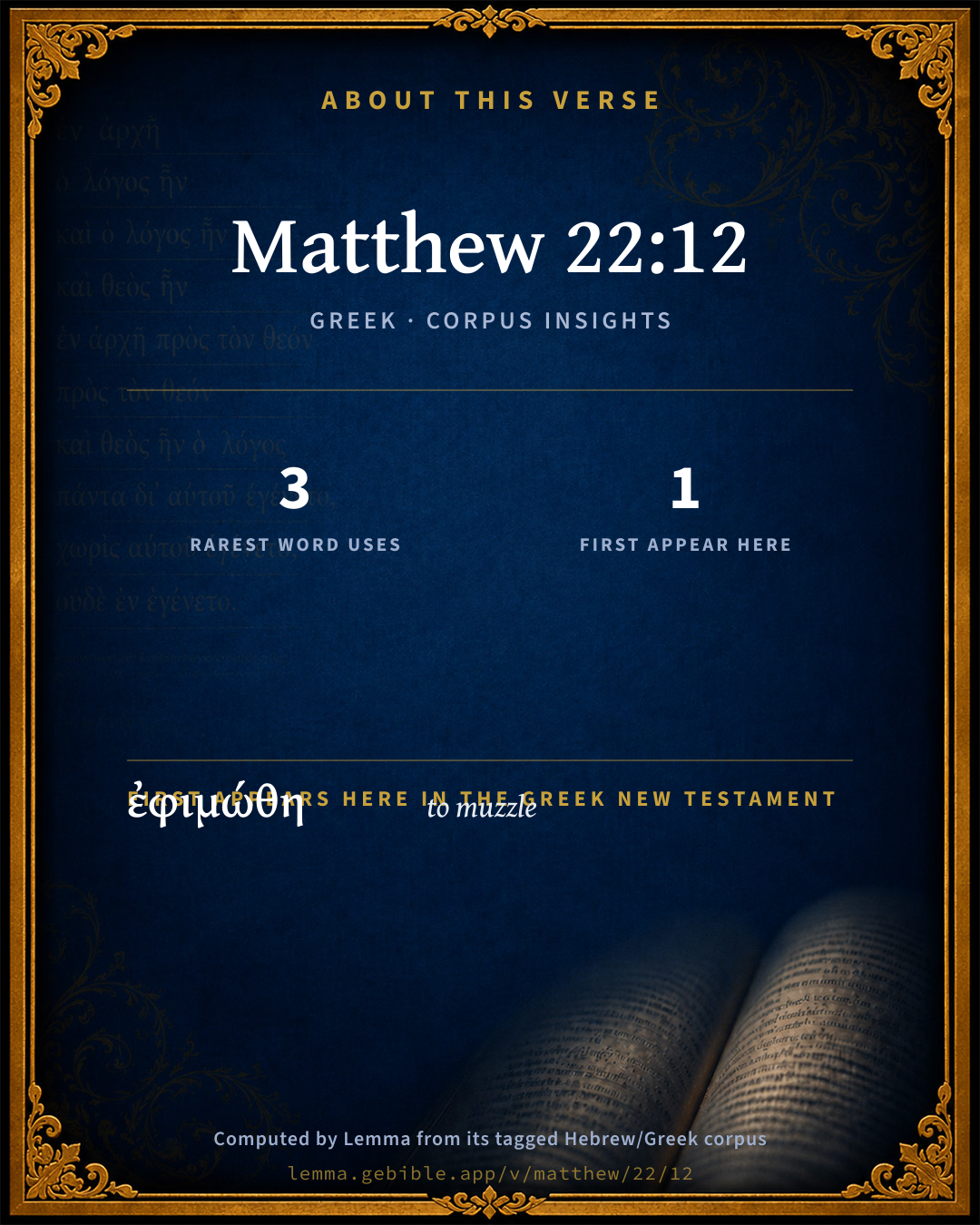
The rarest word here is ἑταῖρε comrade G2083 — appearing just 3 times in the whole Greek New Testament.

First appearance in Scripture

This word makes its first canonical appearance in the Greek New Testament here:

  • ἐφιμώθη to muzzle G5392

Shared distinctive vocabulary

ἑταῖρε comrade G2083 occurs in 3 verses of the Greek New Testament. Also found in:
Cross-references

13

Topical passages linked to Matthew 22:12 in the Treasury of Scripture Knowledge — connected by theme and wording, ordered by reader-vote popularity; previews shown in the World English Bible.

  • 1 Samuel 2:9 He will keep the feet of his holy ones; But the wicked shall be put to silence in darkness; For by strength shall no man prevail.
  • Job 5:16 So the poor has hope, And injustice shuts her mouth.
  • Matthew 20:13 "But he answered one of them, 'Friend, I am doing you no wrong. Didn't you agree with me for a denarius?
  • Psalms 107:42 The upright will see it, and be glad. All the wicked will shut their mouths.
  • Jeremiah 2:23 How can you say, I am not defiled, I have not gone after the Baals? see your way in the valley, know what you have done: [you are] a swift dromedary traversing her ways;
  • Jeremiah 2:26 As the thief is ashamed when he is found, so is the house of Israel ashamed; they, their kings, their princes, and their priests, and their prophets;
  • Matthew 26:50 Jesus said to him, "Friend, why are you here?" Then they came and laid hands on Jesus, and took him.
  • Acts 5:2–11 and kept back part of the price, his wife also being aware of it, and brought a certain part, and laid it at the apostles' feet.
  • Titus 3:11 knowing that such a one is perverted, and sins, being self-condemned.
  • Acts 8:20–23 But Peter said to him, "May your silver perish with you, because you thought you could obtain the gift of God with money!
  • Romans 3:19 Now we know that whatever things the law says, it speaks to those who are under the law, that every mouth may be closed, and all the world may be brought under the judgment of God.
  • Matthew 5:20 For I tell you that unless your righteousness exceeds that of the scribes and Pharisees, there is no way you will enter into the Kingdom of Heaven.
  • 1 Corinthians 4:5 Therefore judge nothing before the time, until the Lord comes, who will both bring to light the hidden things of darkness, and reveal the counsels of the hearts. Then each man will get his praise from God.

Cross-references courtesy of OpenBible.info (CC BY 4.0).

Commentary

Notes on Matthew 22:12 from classic Christian and Jewish commentators (each source and its license shown beneath its notes). The classic Christian expositions comment on the surrounding passage and are grouped to its opening verse, so a note may address several verses; the Jewish commentaries on the Tanakh (Rashi and others) are per-verse, so they appear only where the commentator wrote on this verse.

Lemma curates 59 commentaries, every one of them public domain or Creative Commons licensed, each selected and text-cleaned for this edition rather than reprinted as found. About our sources →

Joseph Benson's Commentary

Mat 22:12-13. Friend, how camest thou in hither — How camest thou to presume to enter into my church, by taking upon thee a profession of my religion, and to sit down among the guests, or associate thyself with my disciples; not having on a wedding-garment? — Not having put off the old man and put on the new, not being made a new creature, not having put on the Lord Jesus Christ in holy graces and moral virtues. “It is needless to dispute,” says Calvin, “about the wedding-garment, whether it be faith, or a pious, holy life. For neither can faith be separated from good works, nor can good works proceed except from faith. Christ’s meaning is only that we are called in order that we may be renewed in our minds after his image. And therefore, that we may remain always in his house, the old man, with his filthiness, must be put off, and a new life designed, that our attire may be such as is suitable to so honourable an invitation.” And he was speechless — Gr. εφιμωθη, he was struck speechless. “This is the true import of the original word, which is rendered very improperly in our translation, he was speechless; as from hence the English reader is led to conceive that the man was dumb, and so could not speak; whereas he was made dumb only by self-condemnation and conviction, even as Christ made dumb — εφιμωσε, — or put to silence, the Sadducees, Mat 22:34; and as Peter would have us to make speechless, or put to silence, (φιμουν,) the ignorance of foolish men.” See Gerhard’s Continuation. Then said the king to his servants, Bind him hand and foot, &c. — Thus, 1st, Christ commands the ministers of his gospel, to whom the exercise of discipline in his church is committed, to exclude from the society of the faithful all who, by walking disorderly, bring a reproach upon the gospel, and to leave them to outer darkness, or the darkness without the pale of the church; that is, heathenish darkness. In other words, as is expressed Mat 18:17, to let such be unto them as heathen and as publicans. But, 2d, This clause of the sentence is to be chiefly referred to the last judgment, when Christ will command his angels to gather out of his kingdom not only all things that offend, but them which do iniquity, and to cast them into the darkness which is without the heavenly city, namely, into the darkness of hell, where there is weeping and gnashing of teeth. The mention of outer darkness in the parable, in the connection in which it stands, “would incline one to think, either that the word αριστον, rendered dinner, Mat 22:4, may signify supper as well as dinner; or that the king is represented as visiting the guests in the evening. But not to insist on this, which is of little moment, it is well known that banquets of this kind were generally celebrated in rooms richly adorned: and considering how splendid and magnificent the entertainments of the eastern princes were, it cannot be thought an unnatural circumstance, that such an affront as this, offered to the king, his son, his bride, and the rest of the company, should be punished with such bonds and thrown into a dungeon.”

Joseph Benson's Commentary on the Old and New Testaments (1811–1818) — public domain. Text from a community e-Sword module.

Bengel's Gnomon

Johann Albrecht Bengel

Mat 22:12. Ἐταῖρε, comrade) A word of ambiguous meaning, which is also applied to those with whom we are not on terms of intimacy or friendship.—πῶς, κ.τ.λ., how, etc.) by what culpable indulgence of the servants? by what audacity on thine own part?—[ἐφιμώθη, he was speechless) By this speechlessness [implying, as it does, that the lost perish altogether through their own fault] all objections whatever that are directed against Christianity are dissipated.—V. g.]

Bengel's Gnomon of the New Testament — English translation (T&T Clark, Edinburgh, 1860) — public domain. Text from a community e-Sword module.

Expositor's Greek Testament

ed. W. Robertson Nicoll

Mat 22:12 . ἑταῖρε , as in Mat 20:13 . πῶς εἰσῆλθες ὦδε : the question might mean, By what way did you come in? the logic of the question being, had you entered by the door you would have received a wedding robe like the rest, therefore you must have come over a wall or through a window, or somehow slipped in unobserved (Koetsveld). This assumes that the guests were supplied with robes by the king’s servants, which in the circumstances is intrinsically probable. All had to come in a hurry as they were, and some would have no suitable raiment, even had there been time to put it on. What the custom was is not very clear. The parable leaves this point in the background, and simply indicates that a suitable robe was necessary, however obtained. The king’s question probably means, how dared you come hither without, etc.? μὴ ἔχων : μὴ this time, not οὐ , as in Mat 22:11 , implying blame. Euthymius includes the question as to how the man got in among the matters not to be inquired into, διὰ τὴν αὐτονομίαν (freedom) τῆς παραβολῆς . ὁ δὲ ἐφιμώθη , he was dumb, not so much from a sense of guilt as from confusion in presence of the great king finding fault, and from fear of punishment.

The Expositor's Greek Testament, edited by W. Robertson Nicoll (1897–1910) — public domain. Text from a community e-Sword module.

Geneva Bible (1599)

Geneva Bible translators

Word for word, haltered, that is to say, he held his peace, as though he had had a bridle or an halter about his neck.

Geneva Bible (1599) marginal notes — public domain. Text via Bolls.life.

Jamieson, Fausset & Brown

Robert Jamieson, A. R. Fausset & David Brown

Friend, how camest thou in hither, not having a wedding garment? And he was speechless--being self-condemned.

Jamieson, Fausset & Brown — Commentary Critical and Explanatory on the Whole Bible (1871) — public domain (CC PDM 1.0). Text via the HelloAO Bible API.

Adam Clarke's Commentary

Verse 12. He saith unto him, Friend] Rather, companion: so εταιρε should be translated. As this man represents the state of a person in the visible Church, who neglects to come unto the master of the feast for a marriage garment, for the salvation which Christ has procured, he cannot be with any propriety called a friend, but may well be termed a companion, as being a member of the visible Church, and present at all those ordinances where Christ's presence and blessing are found, by all those who sincerely wait upon him for salvation.

How camest thou in hither] Why profess to be called by my name while living without a preparation for my kingdom?

He was speechless.] εφιμωθη, he was muzzled, or gagged. He had nothing to say in vindication of his neglect. There was a garment provided, but he neither put it on, nor applied for it. His conduct, therefore, was in the highest degree insulting and indecorous. As this man is the emblem, by general consent, of those who shall perish in the last day, may we not ask, without offence, Where does the doctrine of absolute reprobation or preterition appear in his case? If Christ had never died for him, or if he had applied for the garment, and was refused, might he not well have alleged this in behalf of his soul? - and would not the just God have listened to it? But there is not the smallest excuse for him: Christ died, the sacrifice was offered, for him; the ministers of the Gospel invited him; the Holy Spirit strove with him; he might have been saved, but he was not: and the fault lies so absolutely at his own door that the just God is vindicated in his conduct, while he sends him to hell, not for the lack of what he could not get, but for the lack of what he might have had, but either neglected or refused it.

Then said the king to the servants] To the ministering angels, executors of the Divine will.

Cast him into outer darkness] The Jewish marriages were performed in the night season, and the hall where the feast was made was superbly illuminated; the outer darkness means, therefore, the darkness on the outside of this festal hall; rendered still more gloomy to the person who was suddenly thrust out into it from such a profusion of light. See all this largely treated of on Mt 8:12.

Adam Clarke's Commentary on the Bible (1810–1826) — public domain. Text from a community e-Sword/MySword module.

Ellicott's Commentary for English Readers

(12) Friend.—(See Note on Mat_20:13.) The question implies that the act was strange, unlooked-for, inexcusable.

He was speechless.—The verb is the same as the “put to silence” of Mat_22:34, and points literally to the silence of one who has been gagged.

A Bible Commentary for English Readers, edited by Charles John Ellicott (1878–1897) — public domain. Text from a community e-Sword module.

The Cambridge Bible for Schools and Colleges

gen. ed. J. J. S. Perowne

12. was speechless] See Mat_22:34.

The Cambridge Bible for Schools and Colleges (gen. ed. J. J. S. Perowne; Cambridge University Press, 1878–1918) — public domain. Text from a community e-Sword module.

John Gill's Exposition

And he saith unto him, friend,.... Either in an ironical way, or because he professed to be a friend of God and Christ:

how camest thou in hither, not having a wedding garment? Which way didst thou come in hither? since he did not come in by faith, in the righteousness of Christ; intimating, that he climbed up some other way, and was a thief and robber; or with what face, or how couldest thou have the assurance to come in hither in such a dress, having nothing but the filthy rags of thine own righteousness? How couldest thou expect to meet with acceptance with me, or to be suitable company for my people, not being arrayed with the garments of salvation, and robe of righteousness, as they are?

And he was speechless: or muzzled: his mouth was stopped, he had nothing to say for himself: not but that there will be pleas made use of by hypocrites, and formal professors, another day; who will plead either their preaching and prophesying in Christ's name; or their attendance on outward ordinances; or the works they have done, ordinary or extraordinary; but then these will all be superseded and silenced, their own consciences will condemn them, their mouths will be stopped, and they will have nothing to say in vindication of themselves; their righteousness will not answer for them in a time to come. The Jews have a tradition (l), that

"Esau the wicked, will veil himself with his garment, and sit among the righteous in paradise, in the world to come; and the holy blessed God will draw him, and bring him out from thence, which is the sense of those words, Oba 1:4. "Though thou exalt thyself as the eagle, and though thou set thy nest among the stars, thence will I bring thee down, saith the Lord."''

(l) T. Hieros. Nedarim, fol. 38. 1.

John Gill's Exposition of the Whole Bible (1746–1763) — public domain (CC PDM 1.0). Text via the HelloAO Bible API.

Trapp's Complete Commentary

John Trapp

12 And he saith unto him, Friend, how camest thou in hither not having a wedding garment? And he was speechless.

Ver. 12. Friend, how camest? &c.] Not wretch, rebel, reprobate. Hard reproofs administered in soft language break the bones. See the notes above on Mat 20:13.

Not having a wedding garment] Is it fit to come to such a feast in thy worst? in the leathern coats, in the tattered rags and menstruous clouts of wretched old Adam?

And he was speechless] He was muzzled or haltered up, {a} that is, he held his peace, as though he had had a bridle or a halter in his mouth. This is the import of the Greek word here used. He was αυτοκατακριτος, self-condemned, Tit 3:11, and could not ανταποκρινεσθαι, chat at God, Rom 9:30, as he used to do; he was gagged, as it were.

{a} εφιμωθη. Occlusum est illi os quasi capistro et fraeno ac si brutum animal fuisset, ratione prorsus viduum. Novarin.

John Trapp, A Commentary or Exposition upon All the Books of the Old and New Testament (1647–1656) — public domain. Text from a community e-Sword module.

Albert Barnes' Notes on the Bible

Friend - Rather, “companions.” The word does not imply friendship.

He was speechless - He had no excuse. So it will be with all hypocrites.

Albert Barnes' Notes on the Bible (1834–1885) — public domain. Text from a community e-Sword/MySword module.

Haydock's Catholic Bible Commentary

Not having a wedding garment. By this one person, are represented all sinner void of the grace of God. (Witham) --- To enter with unclean garments, is to depart out of this life in the guilt of sin. For those are no less guilty of manifesting a contempt for the Deity, who presume to sit down in the filth of an unclean conscience, than those who neglected to answer the invitations of the Almighty. He is said to be silent, because having nothing to advance in his own defence, he remains self-condemned, and is hurried away to torments; the horrors of which words can never express. (St. John Chrysostom, hom. lxx)

George Leo Haydock (1774–1849), Haydock's Catholic Family Bible and Commentary, 1859 edition — public domain. Excludes Psalms (Douay-Rheims chapter numbering differs from Protestant) and Deuterocanonical books (Catholic canon only).

Whedon's Commentary on the Bible

Daniel D. Whedon

12. Friend — There is here the politeness of solemn rebuke. Speechless — The spirit of brave contempt has deserted him at the trying time. Men, who are now loquacious and brave in sin and ungodly error, will be terribly dumb in the hour when conscious guilt within responds to the terrible voice of God’s judgment without.

It is plainly presupposed that he was fully able to have been clothed with the proper garments. Poor though he was, it is not his poverty but his neglect, or his contempt, which has prevented his supplying himself with the proper garments. And this is illustrated by the fact that in Eastern countries, and in some degree among the Romans, the custom existed of supplying to the guests the proper vesture for the festal occasion. That this custom existed in ancient times is rendered probable by such passages as Gen_46:22; 2Ki_10:22; Est_6:8; Rev_3:5. So Charden narrates that the vizier of a Persian Shah lost his life for not appearing before his sovereign in a gift robe.

It will then be noted this man represents the Pharisee who rejects the offered righteousness of Christ, and appears in judgment in his own righteousness. It is not the case of the thousands who pay no attention to the invitation of the feast, or those who persecute the inviters. It is one of those men good enough, in their own esteem, to come and stand the gaze of the host in their own natural character, slighting the robe of “the righteousness of God.” What was this but the case of the very men with whom our Lord is now contending?

But why does our Lord suppose but one man of this character? Doubtless for two reasons. One is, that to suppose many would be to destroy the good order of the feast by supposing too great a breaking up. The second is, that any Pharisee in the company who might have conscience enough left, might feel it to be his own single case and tremble.

And he who reads, as well as those who heard, has abundant reason to be earnest lest this one be a true picture of his own case. Unless clothed in “the fine linen which is the righteousness of the saints,” we shall be found guilty of a sad contempt when we appear before God, for which we shall be speechless when he puts the awful, How?

Daniel D. Whedon (gen. ed.), Commentary on the Old and New Testaments (1874–1909) — public domain. Text from a community e-Sword module.

The Pulpit Commentary

Friend; etaire , as Mat_20:13. It was thus that Christ addressed Judas in the garden. (Mat_26:50) The term here has in it something of distrust and disapprobation. How camest thou in hither? The question may mean How couldst thou presume to approach this solemn festival without the indispensable requisite? Or, how couldst thou elude the vigilance of the servants, and enter in this unseemly garb? The former is doubtless the signification of the inquiry. The contemptuous rejection of.propriety is an outrage offered to the majesty of the king, and one worthy of severest punishment. He was speechless; efimwyh : literally, he was muzzled, tongue tied, as if his mouth were closed with a muzzle. (comp. ver. 34; and Luk_4:35) He could make no reply; he had no excuse to offer. His silence condemned him. It is observed that gags were used for rebellious slaves or criminals on their way to execution (Webst. and Wilk.).

Wilfulness spoiling our blessings.

"Not having a wedding garment." The incident is a distinctly Eastern one. So motley a crowd would be very out of place in a king"s palace. It was not only kindly consideration which provided an all-covering, handsome robe for guests whose own clothes were shabby; it was a sense of appropriateness which required all the guests to be suitably arrayed. In treating this parable it should be kept in mind that he who gave the feast was a king, and so sent his invitations, and made his arrangements and conditions, with an authority which all were bound to respect. As illustration of this custom, it may be mentioned that, "every guest invited to the wedding at the royal marriage of Sultan Mahmoud, had made expressly for him, at the expense of the sultan, a wedding garment. No one, however dignified his station, was permitted to enter into the presence-chamber of that sovereign without a change of raiment. This was formerly the universal custom in the East.

I THE REASON FOR BRINGING IN THIS PARTICULAR MAN. It is an unexpected addition to the parable, and at first one does not see how its point of teaching bears on, or runs in harmony with, the things our Lord is enforcing. It seems as if it suddenly struck our Lord that what he had been saying was open to misconstruction. "The perception of the absolute, unconditioned freedom of entrance, the sense borne in on their mind that they were the objects of God"s love and invitation, might possibly lead them to overlook the great moral change requisite in all who enter God"s presence and propose to hold intercourse with him." It is true that salvation is freely offered, but a man must be in a certain frame of mind to receive it. One so unresponsive to the kindness and authority of the king as this man, who would not have the wedding garment, was clearly unfitted for and unable to receive the king"s grace.

II THE REASON FOR THE BEHAVIOUR OF THIS PARTICULAR MAN. Nothing explains his act but the uppishness of self-will. He was not going to be ordered about to be made to do what somebody else wished. If the king wanted him at the feast, he must take him just as he was. See in this no sense of gratitude for the king"s kindness; no sense of submissive obedience to the king"s will; no lowly estimates of his own unfitness. So the man who was just upon getting a big blessing lost it altogether through his own stubborn wilfulness. R.T.

The Pulpit Commentary (1880–1919), ed. H.D.M. Spence-Jones & Joseph S. Exell — public domain. Text from a community e-Sword module.

John Wesley's Explanatory Notes

A wedding garment - The righteousness of Christ, first imputed, then implanted. It may easily be observed, this has no relation to the Lord's Supper, but to God's proceeding at the last day.

John Wesley, Explanatory Notes Upon the Whole Bible (1754–1765) — public domain. Text via the GEBible commentary corpus.

The People's New Testament

B. W. Johnson

12. How camest thou in hither not having a wedding garment? The fact that he had not was proof that he had no right to be there. All invited might be very different before, good and bad, but they must be clothed alike when the guests of the Lord.

B. W. Johnson's The People's New Testament with Notes (1889–1891) — public domain. Electronic text from the Christian Classics Ethereal Library (CCEL) ThML edition.

Cambridge Greek Testament for Schools and Colleges

12. ἑταῖρε. See note, ch. Mat 20:13.

πῶς εἰσῆλθες. ‘How didst thou presume to enter’.

ἐφιμώθη. See Mat 22:34.

Cambridge Greek Testament for Schools and Colleges (Cambridge University Press, 1896; 21 vols, various authors incl. Carr, Maclear, Plummer, Farrar, Lumby, Moule, M. R. James, Simcox) — public domain. Text from a community e-Sword module.

Alford’s Greek Testament

Henry Alford

12.] This second part of the parable is in direct reference to the word of prophecy, Zep 1:7, 8: cf. especially ver. 8, καὶ ἔσται ἐν ἡμέρᾳ θυσίας κυρίου καὶ ἐκδικήσω.… ἐπὶ πάντας τοὺς ἐνδεδυμένους ἐνδύματα ἀλλότρια. The coming of the King to see his guests is the final and separating Judgment of the Church, see ch. 25:19,—when that distinction shall be made, which God’s ministers have no power nor right to make in admissions into the visible Church. Yet as Trench remarks (Parables, p. 207), this coming of the King is not exclusively the final one, but every trying and sifting judgment adumbrates it in some measure. With regard to the ἔνδυμα γάμου, we must not, I think, make too much of the usually cited Oriental custom of presenting the guests with such garments at feasts. For (1) it is not distinctly proved that such a custom existed; the passages usually quoted (Gen 45:22: Jdg 14:12: 2Ki 5:22) are nothing to the purpose; 2Ki 10:22 shews that the worshippers of Baal were provided with vestments, and at a feast: and at the present day those who are admitted to the presence of Royalty in the East are clothed with a caftan: but all this does not make good the assumption: and (2) even granting it, it is not to be pressed, as being manifestly not the punctum saliens of this part of the parable. The guest was bound to provide himself with this proper habit, out of respect to the feast and its Author: how this was to be provided, does not here appear, but does elsewhere. The garment is the imputed and inherent righteousness of the Lord Jesus, put on symbolically in Baptism (Gal 3:27), and really by a true and living faith (ib. ver. 26),—without which none can appear before God in His Kingdom of Glory;—Heb 12:14: Php 3:7, Php 3:8: Eph 4:24: Col 3:10: Rom 8:14:—which truth could not be put forward here, but at its subsequent manifestation threw its great light over this and other such similitudes and expressions. This guest imagines his own garment will be as acceptable, and therefore neglects to provide himself. See 1Jn 5:10: Isa 64:6; Isa 61:10: Rev 19:8.

ἑταῖρε] see note on ch. 20:13: and, as a curiosity of exegetical application, Wordsw.’s note here.

13,

Henry Alford, The Greek Testament (1849–1861) — public domain. Text from a community e-Sword module.

International Critical Commentary

12. And he saith to him, Friend, how camest thou in here not having a wedding garment? And he was reduced to silence.]—ἑταῖρε] See on 20:13.

(L)

International Critical Commentary — older volumes (1896–1929), various authors — public domain. Text from a community e-Sword module.

Vincent's Word Studies in the New Testament

Marvin R. Vincent

Not having [μη εχων] . It is hardly possible to convey the subtle sense of the negative particle [μη] to the English reader. A different word for not [ουκ] is used in the preceding verse, expressing an outward, objective fact which attracted the king's notice. The man had not [ουκ] a wedding garment. When the king addresses the guest, he is thinking not so much of the outward token of disrespect, as of the guest 's mental attitude toward the proprieties of the occasion. It is as if he had said, "What were you thinking of, where was your respect for me and for my guests, when you allowed yourself to come hither not [μη] having the proper garment, as you knew you ought to have?" It implies, as Dr. Morison observes, that the man was conscious of the omission when he entered, and was intentionally guilty of the neglect. This distinction between the two negative particles rests on the law of the Greek language, according to which ouj and its compounds stand where something is to be denied as a matter of fact, and mh and its compounds when something is to be denied as a matter of thought.

He was speechless [εφιμωθη] . Lit., he was muzzled or gagged. It is used of muzzling the ox (1Ti 5:18), and is addressed by Christ to the demon (Mr 1:25), and to the raging sea (Mr 4:39). Peter uses it of putting the ignorant and foolish to silence (1Pe 2:15).

The outer darkness. See on Mt 8:12.

Marvin R. Vincent, Word Studies in the New Testament (1887–1900) — public domain. Text from a community e-Sword/MySword module.

Lesson kit

Teaching starters — assembled from the data on this page, not authored interpretation. Every prompt links to the verse data it draws on. Edit before teaching.

Matthew, in the Gospels, opens this verse with 14 words (14 distinct Greek lemmas). Its most distinctive word is hetaîros (“comrade”). A historical commentator’s framing appears above. Read the whole chapter for the surrounding context.

Discussion questions

  1. The word hetaîros carries the sense “comrade.” How does it shape the verse?
  2. This is the first place “to muzzle” appears in Scripture (first appears here). What does its debut here establish?
  3. How does Matthew 20:13, which shares the word «comrade», read alongside this verse?
  4. These translations render this verse differently; the difference is in the English rendering, not the original. What questions does that raise?
  5. Compare how Joseph Benson's Commentary and Bengel's Gnomon read this verse. Where do they agree or differ?

Things to notice

  • 1 word makes its first canonical appearance in Scripture here.
  • These translations choose different wording for 15 words in this verse.
  • 14 distinct Greek lemmas span 14 words in this verse.

Reading settings

Reading text

Shown beneath each verse's original-language words.

Old Testament
Old Testament edition

Read the OT as the Masoretic Hebrew (MT) or the Greek Septuagint (LXX).

English shown for the Greek Septuagint (in the Hebrew ↔ Greek comparison).

Comparing translations? Open the Compare panel on any verse page to stack up to four side by side.