Mark 7:3

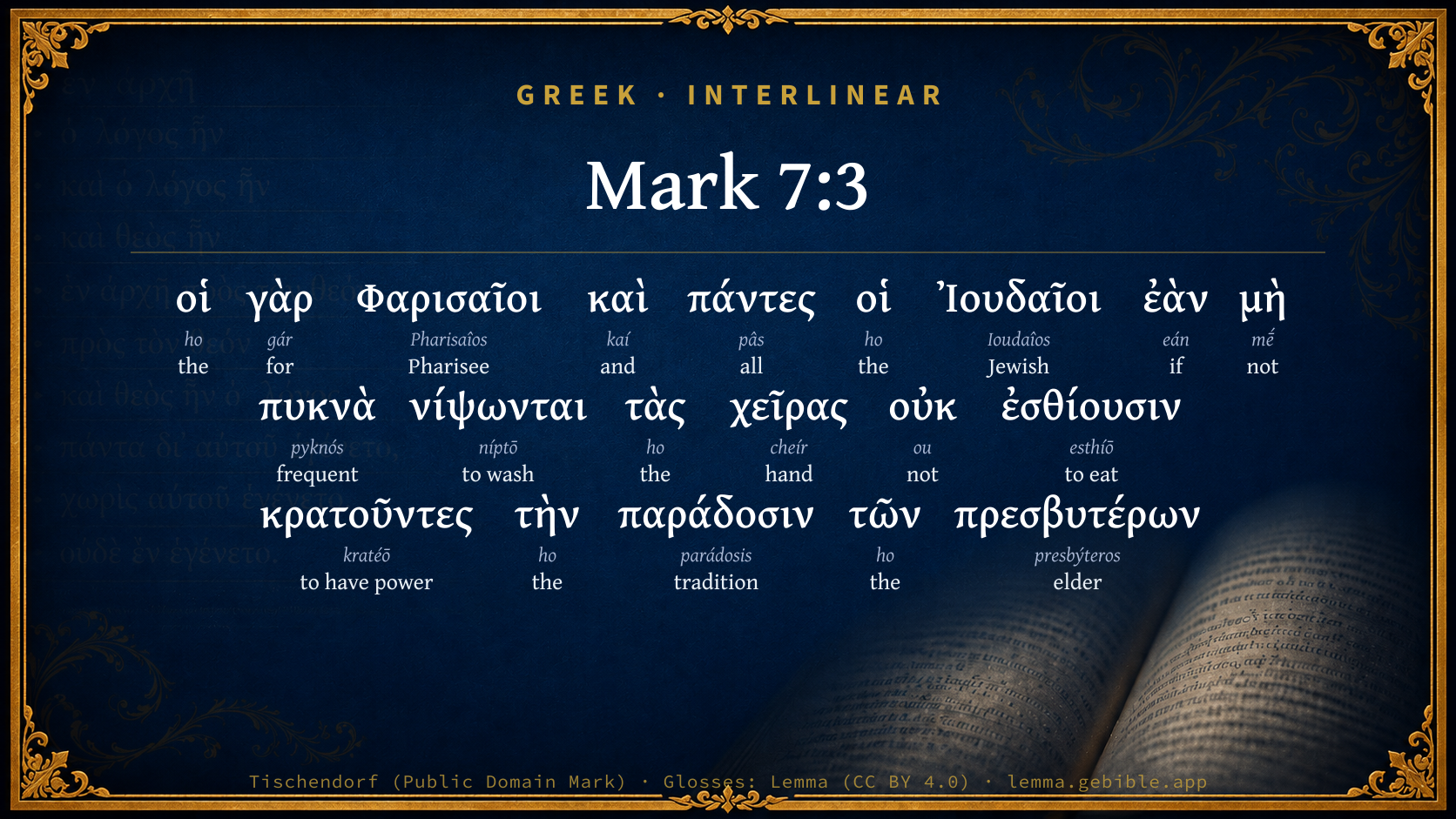
Greek (Tischendorf 8th ed.) Mark 7:3 appears in the Greek New Testament. The text above is from the Tischendorf 8th edition. Each word links to its Strong’s number and a concise gloss. Click any word for its full Thayer’s Greek Lexicon entry.
Download image
Cite this verse

Mark 7:3 (World English Bible). Public Domain. Lemma interlinear Bible study tool, https://lemma.gebible.app/v/mark/7/3.

Show BibTeX & RIS
BibTeX
RIS
English Translation
(For the Pharisees, and all the Jews, don't eat unless they wash their hands and forearms, holding to the tradition of the elders.
World English Bible · Public Domain
Highlights
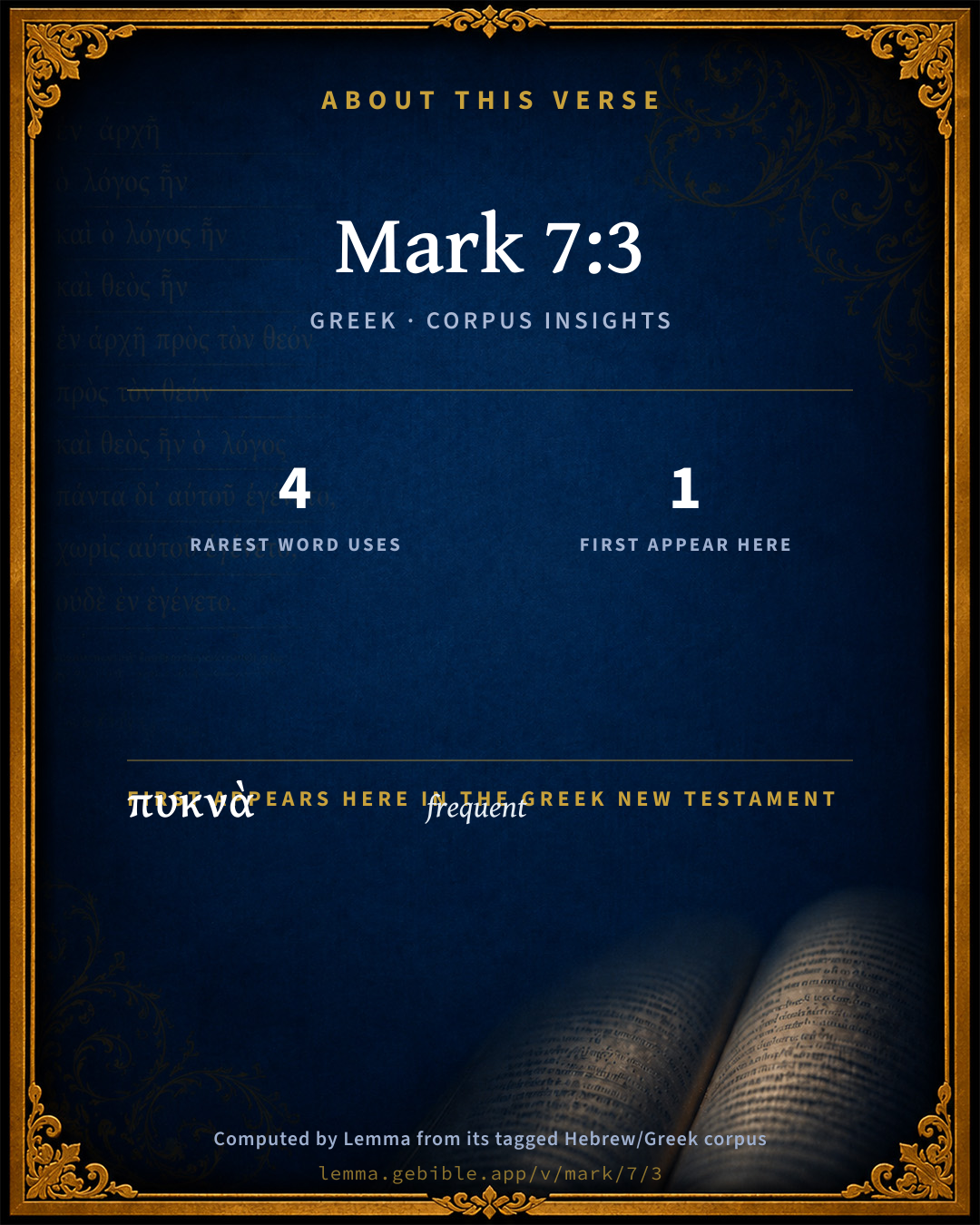
  • 1 first appearance in the Greek New Testament
Full analysis ↓
Download a study sheet

One document with this verse’s original text, its word-by-word gloss line, the meaning frame, cross-references with their text, attributed commentary, and full source and license credits — printable, and it pastes into notes with its structure intact.

This verse Autodidact and up

Study sheet (.html) Plain text (.txt)

A passage Seminary Student

Up to 50 verses in one chapter. A passage sheet keeps up to 6 commentary sources and 12 cross-references per verse, in the order this page ranks them, and says so on the sheet whenever that leaves anything out. Ask for a single verse and you get the Autodidact verse sheet above.

Everything on this page stays free to read, with no account — the sheet is a download of what is already on screen, not access to it.

Want to remove ads? Support Godless Engineer
Compare translations 3

The same verse in 3 English versions, stacked beneath the original-language interlinear above. Click any original word for its lexicon entry.

Each is an independent rendering of the whole verse — the interlinear is not word-aligned to these translations.

Highlighted words mark where these versions differ — a whole-verse word diff, not a word-by-word alignment.

  • World English Bible Public Domain
    (For the Pharisees, and all the Jews, don't eat unless they wash their hands and forearms, holding to the tradition of the elders.
  • King James Version Public Domain
    For the Pharisees, and all the Jews, except they wash their hands oft, eat not, holding the tradition of the elders.
  • unfoldingWord Literal Text CC BY-SA 4.0
    for the Pharisees and all the Jews do not eat unless they would wash their hands with a fist, holding to the tradition of the elders;

unfoldingWord Literal Text — © unfoldingWord, licensed CC BY-SA 4.0. Word-aligned USFM3 via Door43 (git.door43.org/unfoldingWord/en_ult).

Versions to compare (up to 4)

3 of 4 selected

Show all 19 translations

Every available English version of this verse, each an independent rendering of the whole verse.

  • World English Bible Public Domain
    (For the Pharisees, and all the Jews, don't eat unless they wash their hands and forearms, holding to the tradition of the elders.
  • Berean Standard Bible Public Domain
    Now in holding to the tradition of the elders, the Pharisees and all the Jews do not eat until they wash their hands ceremonially.
  • Majority Standard Bible Public Domain
    Now in holding to the tradition of the elders, the Pharisees and all the Jews do not eat until they wash their hands ceremonially.
  • King James Version Public Domain
    For the Pharisees, and all the Jews, except they wash their hands oft, eat not, holding the tradition of the elders.
  • American Standard Version (1901) Public Domain
    (For the Pharisees, and all the Jews, except they wash their hands diligently, eat not, holding the tradition of the elders;
  • Revised Version (1885) Public Domain
    For the Pharisees, and all the Jews, except they wash their hands diligently, eat not, holding the tradition of the elders:
  • Geneva Bible (1599) Public Domain
    (For the Pharises, and all the Iewes, except they wash their hands oft, eate not, holding the tradition of the Elders.
  • Douay-Rheims (1899) Public Domain
    For the Pharisees, and all the Jews eat not without often washing their hands, holding the tradition of the ancients:
  • Young's Literal Translation Public Domain
    for the Pharisees, and all the Jews, if they do not wash the hands to the wrist, do not eat, holding the tradition of the elders,
  • Literal Standard Version CC BY-SA 4.0
    for the Pharisees, and all the Jews, if they do not wash the hands to the wrist, do not eat, holding the tradition of the elders,
  • Unlocked Literal Bible CC BY-SA 4.0
    (For the Pharisees and all the Jews do not eat unless they wash their hands, because they hold to the tradition of the elders.
  • unfoldingWord Literal Text CC BY-SA 4.0
    for the Pharisees and all the Jews do not eat unless they would wash their hands with a fist, holding to the tradition of the elders;
  • Darby Bible Public Domain
    (for the Pharisees and all the Jews, unless they wash their hands diligently, do not eat, holding what has been delivered by the ancients;
  • World Messianic Bible Public Domain
    (For the Pharisees and all the Jews don’t eat unless they wash their hands and forearms, holding to the tradition of the elders.
  • Webster's Bible Public Domain
    For the Pharisees, and all the Jews, except they wash their hands often eat not, holding the tradition of the elders.
  • Free Bible Version CC BY-SA 4.0
    (The Pharisees and all Jews don't eat until they wash their hands, following the tradition of their ancestors.
  • Bible in Basic English Public Domain
    Now the Pharisees, and all the Jews, do not take food without washing their hands with care, keeping the old rule which has been handed down to them:
  • Text-Critical English NT CC BY 4.0
    (For none of the Pharisees or Jews eat unless they wash their hands properly, holding to the tradition of the elders.
  • Tyndale New Testament (1534) Public Domain
    For the pharises and all the Iewes excepte they washe their hondes ofte eate not observinge the tradicions of the elders.

Literal Standard Version (2020), Covenant Press — licensed CC BY-SA 4.0. Text via the HelloAO Bible API (eBible.org). Unlocked Literal Bible (unfoldingWord) — licensed CC BY-SA 4.0. Text via the HelloAO Bible API (eBible.org). unfoldingWord Literal Text — © unfoldingWord, licensed CC BY-SA 4.0. Word-aligned USFM3 via Door43 (git.door43.org/unfoldingWord/en_ult). Free Bible Version, Dr. Jonathan Gallagher — licensed CC BY-SA 4.0. Text via the HelloAO Bible API (eBible.org).

Word by word

More ways to search: Search by grammar → Find every occurrence → Compare this word →

Practice this passage: Drill this verse → Learn its vocabulary →

πυκνὰ
pyknós
G4437
“frequent”
Adjective, Accusative, Plural, Neuter
Part of Speech
Adjective
Case
Accusative
Number
Plural
Gender
Neuter
Full Thayer's Definition

Origin: from the same as G4635

TDNT: None

1. thick, dense, compact a. in reference to time 1. frequently, often, recurring b. vigorously, diligently c. often, more frequently, the oftener
  1. οἱ ho G3588 “the” Article, Nominative, Plural, Masculine
  2. γὰρ gár G1063 “for” Conjunction
  3. Φαρισαῖοι Pharisaîos G5330 “Pharisee” Noun, Nominative, Plural, Masculine
  4. καὶ kaí G2532 “and” Conjunction
  5. πάντες pâs G3956 “all” Adjective, Nominative, Plural, Masculine
  6. οἱ ho G3588 “the” Article, Nominative, Plural, Masculine
  7. Ἰουδαῖοι Ioudaîos G2453 “Jewish” Adjective, Nominative, Plural, Masculine
  8. ἐὰν eán G1437 “if” Conditional
  9. μὴ mḗ G3361 “not” Particle, Negative
  10. νίψωνται níptō G3538 “to wash” Verb, Aorist, Middle, Subjunctive, 3rd person, Plural
  11. τὰς ho G3588 “the” Article, Accusative, Plural, Feminine
  12. χεῖρας cheír G5495 “hand” Noun, Accusative, Plural, Feminine
  13. οὐκ ou G3756 “not” Particle, Negative
  14. ἐσθίουσιν esthíō G2068 “to eat” Verb, Present, Active, Indicative, 3rd person, Plural
  15. κρατοῦντες kratéō G2902 “to have power” Verb, Present, Active, Participle, Nominative, Plural, Masculine
  16. τὴν ho G3588 “the” Article, Accusative, Singular, Feminine
  17. παράδοσιν parádosis G3862 “tradition” Noun, Accusative, Singular, Feminine
  18. τῶν ho G3588 “the” Article, Genitive, Plural, Masculine
  19. πρεσβυτέρων presbýteros G4245 “elder” Adjective, Genitive, Plural, Masculine, Comparative

About this verse

These counts appear in no published source. They are computed here, from the morphology-tagged text and Lemma’s own curated glosses. What Lemma adds →

20
words
16
distinct lemmas
Gospels
section

Notable vocabulary

The rarest word here is πυκνὰ frequent G4437 — appearing just 4 times in the whole Greek New Testament.

First appearance in Scripture

This word makes its first canonical appearance in the Greek New Testament here:

  • πυκνὰ frequent G4437

Shared distinctive vocabulary

πυκνὰ frequent G4437 occurs in 4 verses of the Greek New Testament. Also found in:

Repetition

A word recurs within this verse:

Cross-references

8

Topical passages linked to Mark 7:3 in the Treasury of Scripture Knowledge — connected by theme and wording, ordered by reader-vote popularity; previews shown in the World English Bible.

  • Galatians 1:14 I advanced in the Jews' religion beyond many of my own age among my countrymen, being more exceedingly zealous for the traditions of my fathers.
  • Mark 7:13 making void the word of God by your tradition, which you have handed down. You do many things like this."
  • Colossians 2:8 Be careful that you don't let anyone rob you through his philosophy and vain deceit, after the tradition of men, after the elements of the world, and not after Christ.
  • Colossians 2:21–23 "Don't handle, nor taste, nor touch"
  • Matthew 15:2–6 "Why do your disciples disobey the tradition of the elders? For they don't wash their hands when they eat bread."
  • Mark 7:5 The Pharisees and the scribes asked him, "Why don't your disciples walk according to the tradition of the elders, but eat their bread with unwashed hands?"
  • Mark 7:7–10 But in vain do they worship me, Teaching as doctrines the commandments of men.'
  • 1 Peter 1:18 knowing that you were redeemed, not with corruptible things, with silver or gold, from the useless way of life handed down from your fathers,

Cross-references courtesy of OpenBible.info (CC BY 4.0).

Commentary

Notes on Mark 7:3 from classic Christian and Jewish commentators (each source and its license shown beneath its notes). The classic Christian expositions comment on the surrounding passage and are grouped to its opening verse, so a note may address several verses; the Jewish commentaries on the Tanakh (Rashi and others) are per-verse, so they appear only where the commentator wrote on this verse.

Lemma curates 59 commentaries, every one of them public domain or Creative Commons licensed, each selected and text-cleaned for this edition rather than reprinted as found. About our sources →

Joseph Benson's Commentary

Mar 7:3-5. For the Pharisees, &c., except they wash their hands oft — Greek, εαν μη πυγμη νιψωνται τας χειρας, except they wash their hands with their fist: or, as some render it, to the wrist. Theophylact translates it, unless they wash up to their elbows; affirming that πυγμη denotes the whole of the arm, from the bending to the ends of the fingers. But this sense of the word is altogether unusual. For πυγμη, properly, is the hand, with the fingers contracted into the palm, and made round. “Theophylact’s translation, however,” says Macknight, “exhibits the evangelist’s meaning. For the Jews, when they washed, held up their hands, and, contracting their fingers, received the water that was poured on them by their servants, (who had it for a part of their office, 2Ki 3:11,) till it ran down their arms, which they washed up to their elbows. To wash with the fist, therefore, is to wash with great care.” A MS. termed Codex Bezæ, instead of πυγμη, the fist, or wrist, has πυκνη, frequently. And when they come from the market, except they wash — Greek, βαπτισωνται, bathe themselves, as the word probably ought here to be rendered, (see Lev 15:11,) they eat not — Having the highest opinion of the importance of these institutions. Indeed, some of their rabbis carried this to such a ridiculous height, that one of them determined the neglect of washing to be a greater sin than whoredom; and another declared, it would be much better to die than to omit it. See many instances of this kind in Hammond and Whitby on the place. The Pharisees, therefore, viewing these washings in this important light, did not doubt but our Lord, by authorizing his disciples to neglect them, would expose himself to universal censure, as one who despised the most sacred services of religion; services to which a sanction was given by the approbation and practice of the whole nation. Accordingly, they asked him, Why walk not thy disciples according to the tradition of the elders? — Hast thou taught them to despise these institutions? But while they pretended nothing but a sorrowful concern for the contempt which the disciples cast on institutions so sacred, their real intention was to make Jesus himself to be detested by the people as a deceiver. But the charge of impiety which they thus brought against him and his disciples, he easily retorted upon them with ten-fold strength. For he shows clearly, that notwithstanding their pretended regard for the duties of godliness, they were themselves guilty of the grossest violations of the divine law. And as they thus transgressed, not through ignorance, but knowingly, they were the worst of sinners, mere hypocrites, who deserved to be abhorred by all good men; and the rather, as God had long ago testified his displeasure against them, in the prophecy which Isaiah had uttered concerning them. He answered, Well hath Esaias prophesied, &c. — See note on Mat 15:7-9.

Joseph Benson's Commentary on the Old and New Testaments (1811–1818) — public domain. Text from a community e-Sword module.

Bengel's Gnomon

Johann Albrecht Bengel

Mar 7:3. Πυγμῇ) Πυγμὴ, the fist.—πυγμῇ, עד הפרק, up to the wrist. See Lightf.—παράδοσιν, the tradition) Its correlative is παρέλαβον, they have received, Mar 7:4.

Bengel's Gnomon of the New Testament — English translation (T&T Clark, Edinburgh, 1860) — public domain. Text from a community e-Sword module.

Expositor's Greek Testament

ed. W. Robertson Nicoll

Mar 7:3-4 . Explanatory statement about Jewish customs, not in Mt. πάντες οἱ Ἰουδ .: the Pharisees, the thorough-going virtuosi in religion, were a limited number; but in this and other respects the Jews generally followed ancient custom. The expression reminds us of the Fourth Gospel in its manner of referring to the people of Israel the Jews as foreigners. Mark speaks from the Gentile point of view. πυγμῇ ., with the first, the Vulgate has here crebro , answering to πυκνά , a reading found in [61] . Most recent interpreters interpret πυγμῇ as meaning that they rubbed hard the palm of one hand with the other closed, so as to make sure that the part which touched food should be clean. (So Beza.) For other interpretations vide Lightfoot, Bengel, and Meyer.

[61] Codex Sinaiticus (sæc. iv.), now at St. Petersburg, published in facsimile type by its discoverer, Tischendorf, in 1862.

The Expositor's Greek Testament, edited by W. Robertson Nicoll (1897–1910) — public domain. Text from a community e-Sword module.

Cambridge Greek Testament for Schools and Colleges

3. πυγμῇ ([1382][1383][1384][1385][1386][1387][1388]) rather than πυκνά ([1389], Vulg.). [1390] has πυκμη. Syr-Sin. omits.

[1382] Codex Alexandrinus. 5th cent. Brought by Cyril Lucar, Patriarch of Constantinople, from Alexandria, and afterwards presented by him to King Charles I. in 1628. In the British Museum. The whole Gospel. Photographic facsimile, 1879.

[1383] Codex Vaticanus. 4th cent., but perhaps a little later than א. In the Vatican Library almost since its foundation by Pope Nicolas V., and one of its greatest treasures. The whole Gospel, ending at Mar 16:8. Photographic facsimile, 1889.

[1384] Codex Regius. 8th cent. An important witness. At Paris. Contains Mar 1:1 to Mar 10:15; Mar 10:30 to Mar 15:1; Mar 15:20 to Mar 16:20, but the shorter ending is inserted between Mar 16:8 and Mar 16:9, showing that the scribe preferred it to the longer one.

[1385] Codex Purpureus. 6th cent. Full text in Texts and Studies v. No. 4, 1899. Contains Mar 5:20 to Mar 7:4; Mar 7:20 to Mar 8:32; Mar 9:1 to Mar 10:43; Mar 11:7 to Mar 12:19; Mar 14:25 to Mar 15:23; Mar 15:33-42. See below on Ψ.

[1386] Codex Monacensis. 10th cent. Contains Mar 6:47 to Mar 16:20. Many verses in 14, 15, 16 are defective.

[1387] Codex Oxoniensis. 9th cent. Contains Mark, except Mar 3:35 to Mar 6:20.

[1388] Codex Petropolitanus. 9th cent. Gospels almost complete. Mar 16:18-20 is in a later hand.

[1389] Codex Sinaiticus. 4th cent. Discovered by Tischendorf in 1859 at the Monastery of St Katharine on Mount Sinai. Now at St Petersburg. The whole Gospel, ending at Mar 16:8. Photographic facsimile, 1911.

[1390] Codex Bezae. 6th cent. Has a Latin translation (d) side by side with the Greek text, and the two do not quite always agree. Presented by Beza to the University Library of Cambridge in 1581. Remarkable for its frequent divergences from other texts. Contains Mark, except Mar 16:15-20, which has been added by a later hand. Photographic facsimile, 1899.

3. οἱ γὰρ Φαρισαῖοι. Another explanation inserted for Gentile readers. Mt. has nothing corresponding to Mar 7:3-4.

πάντες οἱ Ἰουδαῖοι. “All strict Jews,” those who wished to be δίκαιοι according to the regulations of the Scribes (Luk 1:6; Luk 2:25; Luk 18:9). The regulations of the Law (Leviticus 11-15; Num 5:1-4; Num 5:19) had been enormously increased by the Scribes, with the result that the right sense of proportion had been lost. People confounded what was ceremonially trivial with what was ceremonially important, and also what was purely ceremonial with what was moral, the former being often preferred to the latter. The longest of the six books of the Mishna (Tohârôth) treats of purification, and thirty chapters are given to the cleansing of vessels. Schürer, II. ii. pp. 106 f. D.C.G. art. “Purification.”

πυγμῇ. The word remains a puzzle in this connexion. “Up to the elbow” and “up to the fist” are impossible translations. “With the fist” is the best rendering; and this may be explained either literally, of rubbing a closed hand in the palm of the other hand, or metaphorically, of vigorous washing, = “diligently” (A.V. marg.).

νίψωνται. The verb is used of washing part of the body (Mat 6:17; Mat 15:2; 1Ti 5:10; Gen 18:4; etc.), λούομαι being used of bathing the whole body (Act 9:37; Heb 10:22; etc.), and πλύνω of washing clothes, nets, etc. (Rev 7:14; Rev 22:14; Luk 5:2). In Lev 15:11 we have all three verbs thus distinguished. See on Joh 13:10.

τὴν παράδοσιν τῶν πρεσβυτέρων. Traditions handed down for generations and sanctioned by great teachers were regarded by the Pharisees and their followers as of equal obligation with Scripture. The traditions were seldom wrong in themselves, but they were treated as of such importance that moral duties were neglected. This inevitably follows when right conduct is regarded as keeping certain rules. The acc. is used because the whole of the tradition (Mar 3:21, Mar 6:17), and not a part (Mar 1:31, Mar 5:41), is held. Only in this and the parallel passage (Mat 15:2-6) is παράδοσις used in the Gospels. In 2Th 2:15, κρατεῖτε τὰζ παραδόσεις is said of holding Christian traditions; cf. 1Co 11:2.

Cambridge Greek Testament for Schools and Colleges (Cambridge University Press, 1896; 21 vols, various authors incl. Carr, Maclear, Plummer, Farrar, Lumby, Moule, M. R. James, Simcox) — public domain. Text from a community e-Sword module.

Geneva Bible (1599)

Geneva Bible translators

Observing diligently.

Geneva Bible (1599) marginal notes — public domain. Text via Bolls.life.

Adam Clarke's Commentary

Verse 3. Except they wash their hands] πυγμη, the hand to the wrist-Unless they wash the hand up to the wrist, eat not. Several translations are given of this word; that above is from Dr. Lightfoot, who quotes a tradition from the rabbins, stating that the hands were to be thus washed. This sort of washing was, and still continues to be, an act of religion in the eastern countries. It is particularly commanded in the Koran, Surat v. ver. 7, "O believers, when ye wish to pray, wash your faces, and your hands up to the elbows - and your feet up to the ankles." Which custom it is likely Mohammed borrowed from the Jews. The Jewish doctrine is this: "If a man neglect the washing, he shall be eradicated from this world." But instead of πυγμη, the fist or hand, the Codex Bezae has πυκνη, frequently: and several of the Itala have words of the same signification. Bathing is an indispensable prerequisite to the first meal of the day among the Hindoos; and washing the hands and the feet is equally so before the evening meal. WARD'S Customs.

Adam Clarke's Commentary on the Bible (1810–1826) — public domain. Text from a community e-Sword/MySword module.

Ellicott's Commentary for English Readers

(3) For the Pharisees, and all the Jews.—For the sake of the same class of readers, St. Mark adds another explanatory note. The custom of which he speaks was not, he says, peculiar to the Pharisees as a sect; it had passed, through their influence, to the whole body of the people.

Oft.—The Greek MSS. present two readings, one of which this is the natural meaning; another, which means literally, “with the fist,” and figuratively, “with might and main.” The evidence is, on the whole, in favour of the former.

A Bible Commentary for English Readers, edited by Charles John Ellicott (1878–1897) — public domain. Text from a community e-Sword module.

The Cambridge Bible for Schools and Colleges

gen. ed. J. J. S. Perowne

3. except they wash their hands oft] Oft, literally, with the fist. “When they washed their hands, they washed the fist unto the jointing of the arm. The hands are polluted, and made clean unto the jointing of the arm.” Lightfoot Hor. Heb. upon St Mark. When water was poured on the hands, they had to be lifted, yet so that the water should neither run up above the wrist, nor back again upon the hand; best, therefore, by doubling the fingers into a fist. The Israelites, who, like other Oriental nations, fed with their fingers, washed their hands before meals, for the sake of cleanliness. But these customary washings were distinct from the ceremonial ablutions; in the former water was poured upon the hands; in the latter the hands were plunged in water. When, therefore, some of the Pharisees remarked that our Lord’s disciples ate with “unwashen hands,” it is not to be understood literally that they did not at all wash their hands, but that they did not wash them ceremonially according to their own practice. And this was expected of them only as the disciples of a religious teacher; for these refinements were not practised by the class of people from which the disciples were chiefly drawn.

eat not] “The Jews of later times related with intense admiration how the Rabbi Akiba, when imprisoned and furnished with only sufficient water to maintain life, preferred to die of starvation rather than eat without the proper washings.” Buxtorf, Syn. Jud.; quoted in Farrar’s Life of Christ, i. p. 443; Geikie, ii. 203–205.

the tradition of the elders] The Rabbinical rules about ablutions occupy a large portion of one section of the Talmud.

The Cambridge Bible for Schools and Colleges (gen. ed. J. J. S. Perowne; Cambridge University Press, 1878–1918) — public domain. Text from a community e-Sword module.

John Gill's Exposition

For the Pharisees, and all the Jews,.... The far greater part of them; all, excepting the Sadducees; and especially the Pharisees, were very tenacious of this tradition of washing hands before eating: hence Pharisees are described as such, , "that eat their common food with cleanness" (n), i.e. of hands: these,

except they wash their hands oft, eat not; or except they wash very cautiously, with great care, diligence, and exactness, as the Syriac version suggests; and about which there are various rules given, to be observed with great strictness (o). Some render the words, "they wash their hands to the elbow"; and this is a rule with the Jews, which is closely to be abode by, that the washing of hands is to be, , "to the joint", which joins the hand and arm together (p): particularly it is observed (q), that

"washing of the hands for the eating of the offering, is unto the elbow, and for common food, to the joints of the fingers: he that eats with an ancient man, and does not wash his hands to the elbow, he may not eat with him.''

Well may it be added,

holding the tradition of the elders; nor do the Jews pretend the authority of the Scriptures as obliging them to such rules; for, they say, the command concerning washing of hands is, , "from the words of the Scribes" (r); and is , "a command of the wise men" (s). The tradition is this:

"they wash hands for common food, but for the tithe, and for the first offering, and for that which is holy, they dip them, and for the sin offering; for if the hands are defiled; the body is defiled (t).''

And this tradition of the elders, the Scribes, and Pharisees, strictly observed.

(n) Gloss in T. Bab. Chagiga, fol. 18. 2. Maimon. & Bartenora in Misn. Chagiga, c. 2. sect. 7. (o) Vid. Maimon. Hilch. Bcracot, c. 6. (p) T. Bab. Cholin, fol. 106. 1, 2. Maimon. Hilch. Beracot, c. 6. 4. Maimon. & Bartenora in Misn. Eracin, c. 5. sect. 1. Zohar in Deut. fol. 115. 2. (q) T. Hieros. Betacot, fol. 12. 1. (r) Maimon. Hilch. Mikvaot, c. 11. sect. 1. (s) Ib. Beracot, c. 6. sect. 2. (t) Misn. Chagiga, c. 2. sect. 5.

John Gill's Exposition of the Whole Bible (1746–1763) — public domain (CC PDM 1.0). Text via the HelloAO Bible API.

Trapp's Complete Commentary

John Trapp

3 For the Pharisees, and all the Jews, except they wash their hands oft, eat not, holding the tradition of the elders.

Ver. 3. Except they wash their hands oft] Or up to the elbow, or with utmost diligence, sedulo et accurate. (Syr.) The Pharisees deemed it as great a sin to eat with unwashen hands, as to commit fornication. {a} Do not our modern Pharisees the Papists as much? Fornication is a money matter with them; but to eat an egg in Lent, or the like, a deadly sin. You may see them sometimes in Italy go along the streets with a great rope about their necks, as if they were dropped down from the gallows. And sometimes they wear a sausage or a swines’ pudding in place of a silver or gold chain. Is not this sufficient to deserve heaven by?

{a} Godwin’s Antiq. Heb.

John Trapp, A Commentary or Exposition upon All the Books of the Old and New Testament (1647–1656) — public domain. Text from a community e-Sword module.

Haydock's Catholic Bible Commentary

Often washing, &c.[1] Some would have the Greek to signify unless they wash up to the elbows, but I think without sufficient grounds. (Witham)

===============================

[BIBLIOGRAPHY]

Crebo, Greek: ean me pugme. Mr. Bois, prebend of Ely, defends the Latin version, and says Greek: pugme comes from Greek: pukna and Greek: puknos. But Theophylactus would have it to signify, up to the elbows; Greek: achri tou agkonos.

George Leo Haydock (1774–1849), Haydock's Catholic Family Bible and Commentary, 1859 edition — public domain. Excludes Psalms (Douay-Rheims chapter numbering differs from Protestant) and Deuterocanonical books (Catholic canon only).

Whedon's Commentary on the Bible

Daniel D. Whedon

3. Wash their hands oft — Mark writes for Gentiles, and therefore explains Jewish customs at some length. The word here rendered oft has received very various interpretations. It properly signifies with the fists or clenched hand, and it describes the ceremonial mode of washing one hand with the other.

Daniel D. Whedon (gen. ed.), Commentary on the Old and New Testaments (1874–1909) — public domain. Text from a community e-Sword module.

The Pulpit Commentary

Except they wash their hands oft. The Greek word here rendered "oft" is pugmh : literally, with the fist, i.e. with the closed hand, rubbing one against the other. This word has caused a vast amount of criticism; and the difficulty of explaining it seems to have led to the adoption of a conjectural reading (puknwv or puknh) rendered "oft;" crebro in the Vulgate. But the Syriac Peshito Version renders the Greek word by a word which means "diligently," and it is interesting and helpful, as a matter of exegesis, to know that it also renders the Greek word (epimelwv) in Luk_15:8 by the same Syriac synonym, "diligently." The "clenched fist" implies vigor and resolution, and points to "diligence," and there are very high authorities in favor of this rendering, as, Epiphanius, Isaac Casaubon, and Cornelius a Lapide, to say nothing of our best modern expositors. It is also adopted in the Revised Version. Holding the tradition of the elders. The Pharisees pretended that this tradition had been orally delivered by God to Moses on Mount Sinai, and then transmitted orally down to their time. These oral precepts were afterwards embodied in the Talmud.

The Pulpit Commentary (1880–1919), ed. H.D.M. Spence-Jones & Joseph S. Exell — public domain. Text from a community e-Sword module.

The People's New Testament

B. W. Johnson

3. For the Pharisees … except they wash diligently, eat not. The duty of washing before meat is not inculcated in the law, but only in the tradition of the scribes. So rigidly did the Jews observe it, that Rabbi Akiba, being imprisoned, and having water scarcely sufficient to sustain life given him, preferred dying of thirst to eating without washing his hands.

B. W. Johnson's The People's New Testament with Notes (1889–1891) — public domain. Electronic text from the Christian Classics Ethereal Library (CCEL) ThML edition.

Alford’s Greek Testament

Henry Alford

3. πυγμῇ] This word has perplexed all the Commentators. Of the various renderings which have been given of it, two are excluded by their not being grammatical—(1) that which makes it mean ‘up to the elbow’ ( and Thl.); ‘including the hand as far as the wrist’ Lightf.: (2) ‘having clenched the hand,’ ‘facto pugno’ (Grot. and others).

The two meanings between which our choice lies are, (3) ‘frequently’ (as E. V. ‘oft,’ and Vulg. ‘crebro’), taking πυγμῇ = πυκνῇ = πυκνῶς, which however is not very probable: or (4), to which I most incline, and which Kuinoel gives, ‘sedulo,’ ‘fortiter,’ diligently; πυγμή, he observes, meaning ‘the fist,’ answers in the LXX to the word אֶגְרֹף, see reff. But this same word אֶגְרֹף is used to signify strength and fortitude, and strong men are called in the Rabbinical writings בעלי אגרופין, ‘lords of fists.’ And the . interpreter renders it by the same word as he does ἐπιμελῶς, Luk 15:8.

Henry Alford, The Greek Testament (1849–1861) — public domain. Text from a community e-Sword module.

International Critical Commentary

3. Φαρισαῖοι καὶ πάντες οἱ Ἰουδαῖοι—The Pharisees and all the Jews. This custom had become general among the Jews, though it originated with the Pharisees. πυγμῇ—this means with the fist. But the awkwardness of the process has led to doubt from the very first, whether this is the meaning intended. But the doubt has not led to the substitution of any justifiable alternative rendering. The meanings, up to the wrist, or elbow, RV.marg. are both linguistically and grammatically disallowed. With a fist full of water needs too much read between the lines, and, besides, the word denotes the closed fist. Finally, frequently, or diligently, RV., was probably taken in the first instance, in the Lat. Vet. and Syrr., from the reading πυκνὰ. The supposition that πυγμῇ had come to have this figurative meaning, seems forced, and besides, there is no warrant for it in actual usage. Edersheim quotes from the Jewish ordinance the provision that the hands should be held up in order that the water might run down to the wrist, and says that the provision that washing should be performed with the fist is not found in the Jewish law. This is, of course, a serious consideration, but does not seem to compare in importance with the other fact, that the Greek word does not mean this, nor the Greek case. The custom was not necessarily a part of the law, and may have been merely a usage arising from a desire for scrupulous observance. The very fact that the reading πυγμῇ occasions this difficulty, makes the strong external evidence for that reading still more convincing, and with this reading the only translation possible seems to be with the fist.

πυκνὰ, Tisch. א mss. Lat. Vet. Vulg. Syrr.

τὴν παράδοσιν—the tradition. It is the Greek etymological equivalent of tradition, and denotes what is passed along from one to another, and among the Jews, the body of Rabbinical interpretation of the written law, preserved by oral transmission from one generation to another. The word occurs in the Gospels only in this account and in the parallel passage in Mt. In attacking this, Jesus was assailing the very citadel of the Judaism of his time.1

τῶν πρεσβυτέρων—the elders. The word is used here in the sense of fathers, or ancestors.

International Critical Commentary — older volumes (1896–1929), various authors — public domain. Text from a community e-Sword module.

Lesson kit

Teaching starters — assembled from the data on this page, not authored interpretation. Every prompt links to the verse data it draws on. Edit before teaching.

Mark, in the Gospels, opens this verse with 20 words (16 distinct Greek lemmas). Its most distinctive word is pyknós (“frequent”). A historical commentator’s framing appears above. Read the whole chapter for the surrounding context.

Discussion questions

  1. What does “frequent” (pyknós) contribute to the verse as a whole?
  2. This is the first place “frequent” appears in Scripture (first appears here). What does its debut here establish?
  3. How does Luke 5:33, which shares the word «frequent», read alongside this verse?
  4. What does the repetition of “the” (5× in this one verse) do in this verse?
  5. These translations render this verse differently. What is at stake in choosing one wording over another?
  6. Compare how Joseph Benson's Commentary and Bengel's Gnomon read this verse. Where do they agree or differ?

Things to notice

  • 1 word makes its first canonical appearance in Scripture here.
  • These translations choose different wording for 8 words in this verse.
  • “the” occurs 5× in this single verse.
  • 16 distinct Greek lemmas span 20 words in this verse.

Reading settings

Reading text

Shown beneath each verse's original-language words.

Old Testament
Old Testament edition

Read the OT as the Masoretic Hebrew (MT) or the Greek Septuagint (LXX).

English shown for the Greek Septuagint (in the Hebrew ↔ Greek comparison).

Comparing translations? Open the Compare panel on any verse page to stack up to four side by side.