Mark 5:10

Greek (Tischendorf 8th ed.) Mark 5:10 appears in the Greek New Testament. The text above is from the Tischendorf 8th edition. Each word links to its Strong’s number and a concise gloss. Click any word for its full Thayer’s Greek Lexicon entry.
Download image
Cite this verse

Mark 5:10 (World English Bible). Public Domain. Lemma interlinear Bible study tool, https://lemma.gebible.app/v/mark/5/10.

Show BibTeX & RIS
BibTeX
RIS
English Translation
He begged him much that he would not send them away out of the country.
World English Bible · Public Domain
Download a study sheet

One document with this verse’s original text, its word-by-word gloss line, the meaning frame, cross-references with their text, attributed commentary, and full source and license credits — printable, and it pastes into notes with its structure intact.

This verse Autodidact and up

Study sheet (.html) Plain text (.txt)

A passage Seminary Student

Up to 50 verses in one chapter. A passage sheet keeps up to 6 commentary sources and 12 cross-references per verse, in the order this page ranks them, and says so on the sheet whenever that leaves anything out. Ask for a single verse and you get the Autodidact verse sheet above.

Everything on this page stays free to read, with no account — the sheet is a download of what is already on screen, not access to it.

Want to remove ads? Support Godless Engineer
Compare translations 3

The same verse in 3 English versions, stacked beneath the original-language interlinear above. Click any original word for its lexicon entry.

Each is an independent rendering of the whole verse — the interlinear is not word-aligned to these translations.

Highlighted words mark where these versions differ — a whole-verse word diff, not a word-by-word alignment.

  • World English Bible Public Domain
    He begged him much that he would not send them away out of the country.
  • King James Version Public Domain
    And he besought him much that he would not send them away out of the country.
  • unfoldingWord Literal Text CC BY-SA 4.0
    And he was begging him much that he would not send them out of the region.

unfoldingWord Literal Text — © unfoldingWord, licensed CC BY-SA 4.0. Word-aligned USFM3 via Door43 (git.door43.org/unfoldingWord/en_ult).

Versions to compare (up to 4)

3 of 4 selected

Show all 19 translations

Every available English version of this verse, each an independent rendering of the whole verse.

  • World English Bible Public Domain
    He begged him much that he would not send them away out of the country.
  • Berean Standard Bible Public Domain
    And he begged Jesus repeatedly not to send them out of that region.
  • Majority Standard Bible Public Domain
    And he begged Jesus repeatedly not to send them out of that region.
  • King James Version Public Domain
    And he besought him much that he would not send them away out of the country.
  • American Standard Version (1901) Public Domain
    And he besought him much that he would not send them away out of the country.
  • Revised Version (1885) Public Domain
    And he besought him much that he would not send them away out of the country.
  • Geneva Bible (1599) Public Domain
    And hee prayed him instantly, that hee would not send them away out of the countrey.
  • Douay-Rheims (1899) Public Domain
    And he besought him much, that he would not drive him away out of the country.
  • Young's Literal Translation Public Domain
    and he was calling on him much, that he may not send them out of the region.
  • Literal Standard Version CC BY-SA 4.0
    and he was calling on Him much, that He may not send them out of the region.
  • Unlocked Literal Bible CC BY-SA 4.0
    He begged him again and again not to send them out of the region.
  • unfoldingWord Literal Text CC BY-SA 4.0
    And he was begging him much that he would not send them out of the region.
  • Darby Bible Public Domain
    And he besought him much that he would not send them away out of the country.
  • World Messianic Bible Public Domain
    He begged him much that he would not send them away out of the country.
  • Webster's Bible Public Domain
    And he besought him much that he would not send them away out of the country.
  • Free Bible Version CC BY-SA 4.0
    He also repeatedly pleaded with Jesus not to send them a long way away.
  • Bible in Basic English Public Domain
    And he made strong prayers to him not to send them away out of the country.
  • Text-Critical English NT CC BY 4.0
    And he earnestly begged Jesus not to send them out of that region.
  • Tyndale New Testament (1534) Public Domain
    And he prayd him instantly that he wolde not sende the awaye out of the countre.

Literal Standard Version (2020), Covenant Press — licensed CC BY-SA 4.0. Text via the HelloAO Bible API (eBible.org). Unlocked Literal Bible (unfoldingWord) — licensed CC BY-SA 4.0. Text via the HelloAO Bible API (eBible.org). unfoldingWord Literal Text — © unfoldingWord, licensed CC BY-SA 4.0. Word-aligned USFM3 via Door43 (git.door43.org/unfoldingWord/en_ult). Free Bible Version, Dr. Jonathan Gallagher — licensed CC BY-SA 4.0. Text via the HelloAO Bible API (eBible.org).

Word by word

More ways to search: Search by grammar → Find every occurrence → Compare this word →

Practice this passage: Drill this verse → Learn its vocabulary →

χώρας
chṓra
G5561
“region”
Noun, Genitive, Singular, Feminine
Part of Speech
Noun
Case
Genitive
Number
Singular
Gender
Feminine
Full Thayer's Definition

Origin: from a derivative of the base of G5490 through the idea of empty expanse

TDNT: None

1. the space lying between two places or limits 2. a region or country i.e. a tract of land a. the (rural) region surrounding a city or village, the country b. the region with towns and villages which surround a metropolis 3. land which is ploughed or cultivated, ground
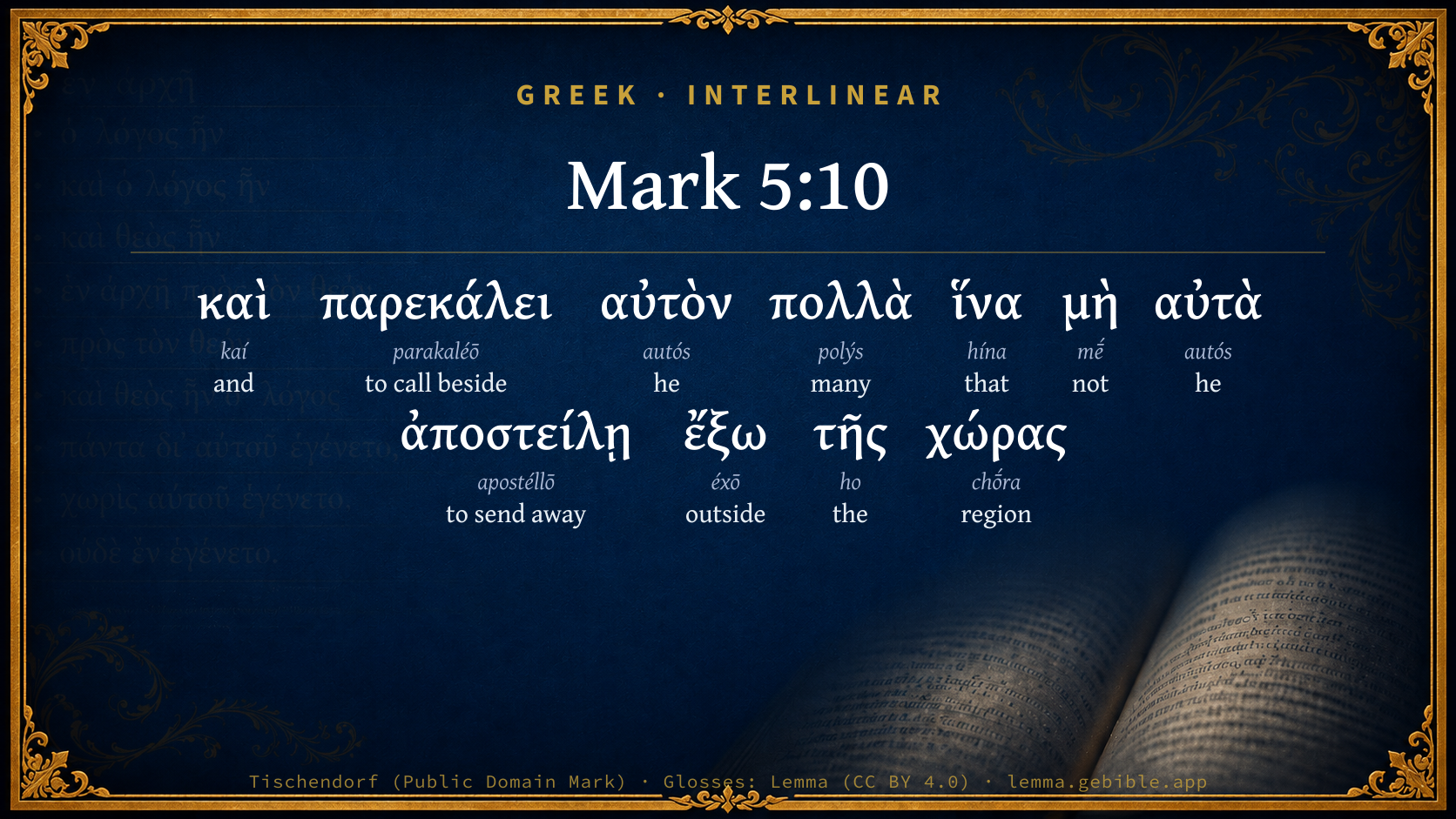
  1. καὶ kaí G2532 “and” Conjunction
  2. παρεκάλει parakaléō G3870 “to call beside” Verb, Imperfect, Active, Indicative, 3rd person, Singular
  3. αὐτὸν autós G846 “he” Personal pronoun, Accusative, Singular, Masculine
  4. πολλὰ polýs G4183 “many” Adjective, Accusative, Plural, Neuter
  5. ἵνα hína G2443 “that” Conjunction
  6. μὴ mḗ G3361 “not” Particle, Negative
  7. αὐτὰ autós G846 “he” Personal pronoun, Accusative, Plural, Neuter
  8. ἀποστείλῃ apostéllō G649 “to send away” Verb, Aorist, Active, Subjunctive, 3rd person, Singular
  9. ἔξω éxō G1854 “outside” Adverb
  10. τῆς ho G3588 “the” Article, Genitive, Singular, Feminine

About this verse

These counts appear in no published source. They are computed here, from the morphology-tagged text and Lemma’s own curated glosses. What Lemma adds →

11
words
10
distinct lemmas
Gospels
section

Shared distinctive vocabulary

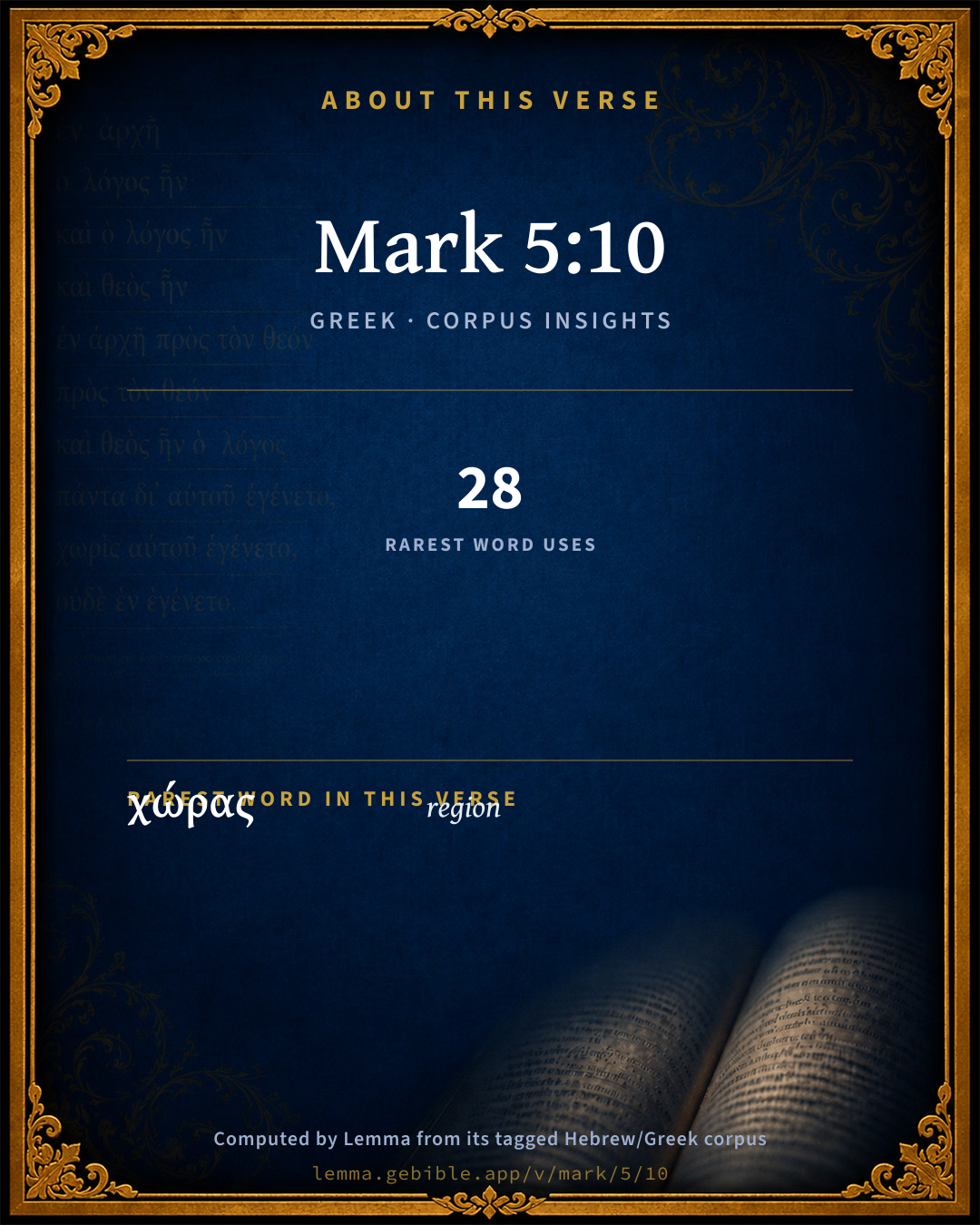
χώρας region G5561 occurs in 28 verses of the Greek New Testament. Also found in:

Repetition

A word recurs within this verse:

  • αὐτὸν he G846 ×2

Cross-references

2

Topical passages linked to Mark 5:10 in the Treasury of Scripture Knowledge — connected by theme and wording, ordered by reader-vote popularity; previews shown in the World English Bible.

  • Mark 3:22 The scribes who came down from Jerusalem said, "He has Beelzebul," and, "By the prince of the demons he casts out the demons."
  • Mark 5:13 At once Jesus gave them permission. The unclean spirits came out and entered into the pigs. The herd of about two thousand rushed down the steep bank into the sea, and they were drowned in the sea.

Cross-references courtesy of OpenBible.info (CC BY 4.0).

Commentary

Notes on Mark 5:10 from classic Christian and Jewish commentators (each source and its license shown beneath its notes). The classic Christian expositions comment on the surrounding passage and are grouped to its opening verse, so a note may address several verses; the Jewish commentaries on the Tanakh (Rashi and others) are per-verse, so they appear only where the commentator wrote on this verse.

Lemma curates 59 commentaries, every one of them public domain or Creative Commons licensed, each selected and text-cleaned for this edition rather than reprinted as found. About our sources →

Tyndale Open Study Notes

Tyndale Open Resources

5:10-13 The spirits’ persistent begging shows Jesus’ mastery over them. They were permitted to enter a herd of about 2,000 pigs, whose presence marks this as Gentile territory. Some have focused on the economic loss of the pigs or have speculated about why Jesus let the demons destroy them, but Mark and his readers were interested in how Jesus saved the man.

Tyndale Open Study Notes — © Tyndale Open Resources, licensed CC BY-SA 4.0. Text via the HelloAO Bible API.

Bengel's Gnomon

Johann Albrecht Bengel

Mar 5:10. Παρεκάλει, he besought) The singular number; the plural occurs in Mar 5:12.—χώρας, the country) which they loved, and were then dwelling in. [And so, therefore, being acquainted with the men of that country, they were meditating to inflict the more injury by means of their acquaintance with them.—V. g.] But it is marvellous that they did not avoid the locality in which the Messiah, the destroyer of their power, was sojourning.

Bengel's Gnomon of the New Testament — English translation (T&T Clark, Edinburgh, 1860) — public domain. Text from a community e-Sword module.

Expositor's Greek Testament

ed. W. Robertson Nicoll

Mar 5:10 . παρεκάλει : he , Legion, in the name of the demons, beseeches earnestly ( πολλὰ ) that He would not send them ( αὐτὰ ) out of the region ( χώρας ). Decapolis, beloved by demons, suggests Grotius, because full of Hellenising apostate Jews, teste Joseph. (A. J., xvii., 11).

The Expositor's Greek Testament, edited by W. Robertson Nicoll (1897–1910) — public domain. Text from a community e-Sword module.

Geneva Bible (1599)

Geneva Bible translators

That devil that played the messenger for his fellows.

Geneva Bible (1599) marginal notes — public domain. Text via Bolls.life.

Adam Clarke's Commentary

Verse 10. Out of the country.] Strange that these accursed spirits should find it any mitigation of their misery to be permitted to exercise their malevolence in a particular district! But as this is supposed to have been a heathen district, therefore the demons might consider themselves in their own territories; and probably they could act there with less restraint than they could do in a country where the worship of God was established. See Clarke on Mr 5:1.

Adam Clarke's Commentary on the Bible (1810–1826) — public domain. Text from a community e-Sword/MySword module.

Ellicott's Commentary for English Readers

(10) He besought him much that he would not send them.—The words are singularly significant of the state of the demoniac as half-conscious of his own personal being, and half-identifying himself with the disturbing demoniac forces which were tormenting him, and yet in so doing were leading him to look on the great Healer as his tormentor.

A Bible Commentary for English Readers, edited by Charles John Ellicott (1878–1897) — public domain. Text from a community e-Sword module.

The Cambridge Bible for Schools and Colleges

gen. ed. J. J. S. Perowne

10. out of the country] i. e. as it is expressed in St Luke, into “the abyss of hell” (Mar_8:31).

The Cambridge Bible for Schools and Colleges (gen. ed. J. J. S. Perowne; Cambridge University Press, 1878–1918) — public domain. Text from a community e-Sword module.

John Gill's Exposition

And he besought him much,.... The devil that was at the head of this legion, who had the rest under his command, he, in their name, and on their behalf, entreated Jesus with great earnestness. This shows the authority Christ has over the devils, and their subjection to him; they are not only obliged to quit their former possession, when he gives orders, but they cannot go any where else, or where they would, without his leave: though the man they were in could not be bound and held with chains and fetters of iron, through the great strength they put forth in him; yet these themselves are bound and held in chains, and cannot move without Christ's permission, or as he is pleased to lengthen out the chain unto them: and though they are no humble supplicants to him for grace and mercy, yet they are, that they may continue where they are; or be suffered to be somewhere else, to do mischief to the souls and bodies of men: and though they are such proud spirits, they be, they are very willing to humble themselves and in the most submissive and pressing manner ask a favour, even of him whom they hate, when they have an end to answer by doing injury to others; and in this, as well as in many other things, they are imitated by them who are truly called the children of the devil, and do the lusts of him their father.

That he would not send them away out of the country; that if he did think fit to dispossess them from that man, that however he would permit them to stay in that country, and not drive them wholly from thence; and which they might be the more desirous of, because it was an Heathen country, inhabited by the blind Gentiles, that knew not God, or apostate Jews, or both; among whom their power and authority were very great; and where they had long been, and had had a large experience of the tempers and dispositions of men, and knew how to bait their temptations with success.

John Gill's Exposition of the Whole Bible (1746–1763) — public domain (CC PDM 1.0). Text via the HelloAO Bible API.

Trapp's Complete Commentary

John Trapp

10 And he besought him much that he would not send them away out of the country.

Ver. 10. He would not send them away, &c.] Because, saith Cajetan, they have several regions where they most haunt, and do hurt; and are therefore loth to be put out of their old quarters.

John Trapp, A Commentary or Exposition upon All the Books of the Old and New Testament (1647–1656) — public domain. Text from a community e-Sword module.

Whedon's Commentary on the Bible

Daniel D. Whedon

10. He besought him — The demon besought the Lord. He knows his master. It is a demon’s prayer. And it is heard! But he utters no petition to have his diabolical nature changed. He only asks a boon suited to his demoniac nature. Luke (Luk_8:31) says: “They besought him that he would not command them to go out into the deep;” that is, the abyss, or “bottomless pit.” Rev_20:3.

Not send them… out of the country — Our Lord only assumed to expel the devils from their abode in the particular human being. He did not shape their subsequent course, or mark out their path. And Stier well argues with those who impute immorality to Jesus for giving this permission, that it is even less liable to the imputation of immorality than the divine permission, not withheld from demons, to possess men; or, we may add, the divine permission yielded to evil men to rule in the world. That a Mohammed, a Nero, or a Napoleon should rule mankind with bloodshed, is the mystery of God.

Daniel D. Whedon (gen. ed.), Commentary on the Old and New Testaments (1874–1909) — public domain. Text from a community e-Sword module.

The Pulpit Commentary

And he besought him much that he would not send them away out of the country. It would appear as though this evil spirit felt (speaking in the name of the other evil spirits) that if they were driven out from their present dwelling-places, their condition would be changed for the worse; and that until the time should come when they were to be cast into the abyss, their best relief was to possess some materialism, to occupy flesh and blood, and that flesh and blood tenanted by a spiritual being, through whom they might torment others. They could find no rest, no relief, but in this. "The unclean spirit, when he is gone out of the man, passeth through waterless places, seeking rest, and findeth it not". (Mat_12:43) Even the swine were better than nothing; but that dwelling did not serve the evil spirits long.

Vers. 10; 12, 13; 17- 19. Prayers granted and denied.

No caprice visible in our Lord"s decisions. On the contrary, great moral principles are revealed. The whole conduct of Christ on this occasion, therefore, is of importance for the practical guidance of Christians.

I THE PETITION OF THE DEMONIAC. (Ver. 10) "He besought him much that he would not send them away out of the country." No heed is paid to this request, notwithstanding its passionate earnestness. Why?

1. The man himself was not praying. He was depersonalized and besotted by the possession of the devils, and not responsible for his words or actions. It was to free him from this thraldom Christ had undertaken his case.

2. It would have neutralized the intended mercy to the man to inflict the evil upon others.

3. There was no real submission in the real petitioners. They were still devils, unchanged in their character, and desirous of working further mischief. Powerless, they still desired to do evil.

II THE REQUEST OF THE DEVILS. (Vers. 12, 13) This was granted, notwithstanding the character of those who made it. A marvel, truly; devils heard and answered by Christ! Is he in league with them?

1. It was a choke of a lesser of two evils. It seemed necessary that some visible form should receive the dispossessed spirits, that all, especially the man himself (cf. on the probable principle of cure, the preceding sketch), might be able to realize that the dispossession had actually taken place. As simply dispossessed, they might have taken up their abode in some other soul; but by giving direction to them after dispossession, they were confined to brutes; and the catastrophe that resulted was probably foreseen by Christ. In the destruction of the swine the demons were dismissed speedily right out of the terrestrial sphere.

2. And in that destruction a punishment was inflicted upon the Gadarenes, who as yet were sordid, neglectful of the Law (forbidding the rearing of swine), and unspiritual.

III THE ENTREATY OF THE GADARENES. (Vers. 17, 18) It was at once answered, Because:

1. It involved a deliberate and intelligent rejection of the Saviour. They had seen his wondrous moral triumph and the destruction of the swine; but in their estimate the material loss far outweighed the spiritual gain.

2. There were others elsewhere who were waiting for him.

3. The healed demoniac might be even more effectual as a preacher than himself. He was a lasting monument of his power and grace. Time might be needed to let the miracle sink into the popular conscience.

IV THE PRAYER OF THE RESTORED MAN. (Vers. 18, 19) A natural desire under the circumstances. Fear lest the devils should return if he were left to himself, cud gratitude and love for his Benefactor, doubtless actuated him. But he is denied! This must have wounded his feelings, and disappointed him. But:

1. It was not prudent for Christ at that time to have one so closely identified with devils in his company and occupied in his service. The charge had been made (Mar_3:22) that he was in league with Satan.

2. It was not the best life for him to lead in his present condition. Privation and excitement were not suited to one who had been emaciated and weakened by the devils.

3. A work of greater use and personal obligation awaited him where he was. He was the only disciple of Christ in that benighted land. Those who had been scandalized by his previous life, and had suffered from it, were to be first considered. The home that had been desolated was to be revisited, and cheered by the kindly presence and saving influence of the redeemed one.

GENERAL LESSONS.

1. Prayers may be granted in anger, and denied in love.

2. Lesser evils may be allowed to prevent greater ones.

3. Duties are to be considered before privileges. M.

The Pulpit Commentary (1880–1919), ed. H.D.M. Spence-Jones & Joseph S. Exell — public domain. Text from a community e-Sword module.

The People's New Testament

B. W. Johnson

10. Besought … that he would not send them out of the country. In other words, “Do not send us back to the place of perdition from whence we came.” They confess the power of Christ.

B. W. Johnson's The People's New Testament with Notes (1889–1891) — public domain. Electronic text from the Christian Classics Ethereal Library (CCEL) ThML edition.

Cambridge Greek Testament for Schools and Colleges

10. παρεκάλει. In spite of the masc. πολλοί ἐσμεν, the sing, is retained, because the demons use the man as their organ. Lk. has παρεκάλουν (as [1075][1076] here), marking the plurality of the hostile forces, although neut. plur. (δαιμόνια πολλά) has preceded.

[1075] Codex Alexandrinus. 5th cent. Brought by Cyril Lucar, Patriarch of Constantinople, from Alexandria, and afterwards presented by him to King Charles I. in 1628. In the British Museum. The whole Gospel. Photographic facsimile, 1879.

[1076] Codex Sangallensis. 9th or 10th cent. Contains the Gospels nearly complete, with an interlinear Latin translation. The text of Mark is specially good, agreeing often with CL. At St Gall.

πολλά. Adverbial, as usual, deprecabatur illum multum (Vulg.). See on Mar 1:45, and for ἵνα on Mar 3:9.

ἔξω τῆς χώρας. If this expresses the wish of the man, it means that he fears to be sent away from his familiar haunts and his home (Mar 5:19). If, as Lk. takes it, it expresses the wish of the demons, it means that they fear to be sent εἰς τὴν ἄβυσσον, which probably means the penal part of Hades.

Cambridge Greek Testament for Schools and Colleges (Cambridge University Press, 1896; 21 vols, various authors incl. Carr, Maclear, Plummer, Farrar, Lumby, Moule, M. R. James, Simcox) — public domain. Text from a community e-Sword module.

Alford’s Greek Testament

Henry Alford

10.] ἀποστ. ἔξω τ. χ. = ἐπιτάξῃ αὐτ. εἰς τ. ἄβυσσον ἀπελθεῖν Luke: see on Matt. ver. 30.

Henry Alford, The Greek Testament (1849–1861) — public domain. Text from a community e-Sword module.

International Critical Commentary

10. καὶ παρεκάλει αὐτὸν πολλὰ ἵνα μὴ αὐτὰ ἀποστείλῃ—And he besought him much that he would not send them.

αὐτὰ, instead of αὐτοὺς, Tisch. Treg. WH. BC Δ etc. But αὐτὰ looks like an emendation.

Here, again, the man identifies himself with the demons, but not so as to protest any longer against their expulsion. Only one demon has been mentioned before, vv. 2, 8. But with v. 9, it begins to be assumed that there is a host of them, and the plural is used.

ἔξω τῆς χώρας—out of the country.1 Lk. says εἰς τὴν ἄβυσσον, into the abyss, i.e. into Gehenna, the place of evil spirits. And it has been supposed that our phrase means out of the earth, making it equivalent to this. But plainly, χώρα does not mean the earth as distinguished from the under world, but one part of the earth as distinct from another. γῆ is the proper word for earth, or world. But just as plainly, the translation, out of the country (put into the mouth of the demons, so to speak), creates another difficulty. What preference they should have for one country over another is one of the mysteries connected with these stories of demoniacal possession. It can be explained only as part of the hallucination of the demoniac, to be referred possibly to his terror of city or town, and his unwillingness to be driven out of the solitary wild district haunted by him. Lk.’s statement is probably an attempt to remove the difficulty.

International Critical Commentary — older volumes (1896–1929), various authors — public domain. Text from a community e-Sword module.

Lesson kit

Teaching starters — assembled from the data on this page, not authored interpretation. Every prompt links to the verse data it draws on. Edit before teaching.

Mark, in the Gospels, opens this verse with 11 words (10 distinct Greek lemmas). Its most distinctive word is chṓra (“region”). A historical commentator’s framing appears above. Read the whole chapter for the surrounding context.

Discussion questions

  1. What does “region” (chṓra) contribute to the verse as a whole?
  2. How does Matthew 2:12, which shares the word «region», read alongside this verse?
  3. What does the repetition of “he” (2× in this one verse) do in this verse?
  4. These translations render this verse differently. What is at stake in choosing one wording over another?
  5. Compare how Tyndale Open Study Notes and Bengel's Gnomon read this verse. Where do they agree or differ?

Things to notice

Reading settings

Reading text

Shown beneath each verse's original-language words.

Old Testament
Old Testament edition

Read the OT as the Masoretic Hebrew (MT) or the Greek Septuagint (LXX).

English shown for the Greek Septuagint (in the Hebrew ↔ Greek comparison).

Comparing translations? Open the Compare panel on any verse page to stack up to four side by side.