Mark 5:36

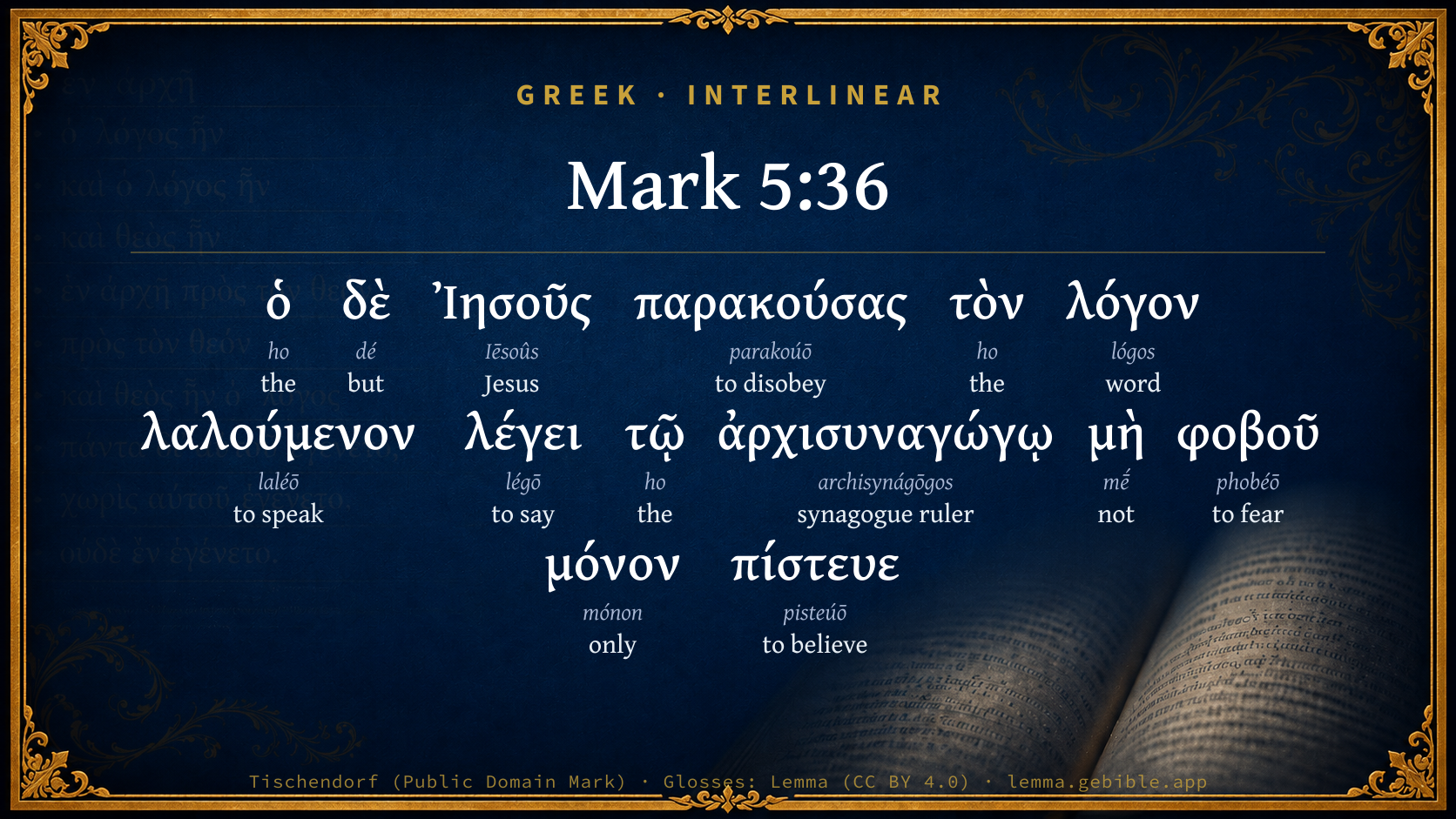
Greek (Tischendorf 8th ed.) Mark 5:36 appears in the Greek New Testament. The text above is from the Tischendorf 8th edition. Each word links to its Strong’s number and a concise gloss. Click any word for its full Thayer’s Greek Lexicon entry.
Download image
Cite this verse

Mark 5:36 (World English Bible). Public Domain. Lemma interlinear Bible study tool, https://lemma.gebible.app/v/mark/5/36.

Show BibTeX & RIS
BibTeX
RIS
English Translation
But Jesus, when he heard the message spoken, immediately said to the ruler of the synagogue, "Don't be afraid, only believe."
World English Bible · Public Domain
Download a study sheet

One document with this verse’s original text, its word-by-word gloss line, the meaning frame, cross-references with their text, attributed commentary, and full source and license credits — printable, and it pastes into notes with its structure intact.

This verse Autodidact and up

Study sheet (.html) Plain text (.txt)

A passage Seminary Student

Up to 50 verses in one chapter. A passage sheet keeps up to 6 commentary sources and 12 cross-references per verse, in the order this page ranks them, and says so on the sheet whenever that leaves anything out. Ask for a single verse and you get the Autodidact verse sheet above.

Everything on this page stays free to read, with no account — the sheet is a download of what is already on screen, not access to it.

Want to remove ads? Support Godless Engineer
Compare translations 3

The same verse in 3 English versions, stacked beneath the original-language interlinear above. Click any original word for its lexicon entry.

Each is an independent rendering of the whole verse — the interlinear is not word-aligned to these translations.

Highlighted words mark where these versions differ — a whole-verse word diff, not a word-by-word alignment.

  • World English Bible Public Domain
    But Jesus, when he heard the message spoken, immediately said to the ruler of the synagogue, "Don't be afraid, only believe."
  • King James Version Public Domain
    As soon as Jesus heard the word that was spoken, he saith unto the ruler of the synagogue, Be not afraid, only believe.
  • unfoldingWord Literal Text CC BY-SA 4.0
    But Jesus, having overheard the word being spoken, says to the synagogue ruler, “Do not fear. Only believe.”

unfoldingWord Literal Text — © unfoldingWord, licensed CC BY-SA 4.0. Word-aligned USFM3 via Door43 (git.door43.org/unfoldingWord/en_ult).

Versions to compare (up to 4)

3 of 4 selected

Show all 19 translations

Every available English version of this verse, each an independent rendering of the whole verse.

  • World English Bible Public Domain
    But Jesus, when he heard the message spoken, immediately said to the ruler of the synagogue, "Don't be afraid, only believe."
  • Berean Standard Bible Public Domain
    But Jesus overheard their conversation and said to Jairus, “Do not be afraid; just believe.”
  • Majority Standard Bible Public Domain
    But Jesus overheard their conversation and immediately said to Jairus, “Do not be afraid; just believe.”
  • King James Version Public Domain
    As soon as Jesus heard the word that was spoken, he saith unto the ruler of the synagogue, Be not afraid, only believe.
  • American Standard Version (1901) Public Domain
    But Jesus, not heeding the word spoken, saith unto the ruler of the synagogue, Fear not, only believe.
  • Revised Version (1885) Public Domain
    But Jesus, not heeding the word spoken, saith unto the ruler of the synagogue, Fear not, only believe.
  • Geneva Bible (1599) Public Domain
    Assoone as Iesus heard that word spoken, he said vnto the ruler of the Synagogue, Be not afraide: onely beleeue.
  • Douay-Rheims (1899) Public Domain
    But Jesus having heard the word that was spoken, saith to the ruler of the synagogue: Fear not, only believe.
  • Young's Literal Translation Public Domain
    And Jesus immediately, having heard the word that is spoken, saith to the chief of the synagogue, `Be not afraid, only believe.'
  • Literal Standard Version CC BY-SA 4.0
    And Jesus immediately, having heard the word that is spoken, says to the chief of the synagogue, “Do not be afraid, only believe.”
  • Unlocked Literal Bible CC BY-SA 4.0
    But when Jesus overheard what they said, he said to the leader of the synagogue, “Do not be afraid. Just believe.”
  • unfoldingWord Literal Text CC BY-SA 4.0
    But Jesus, having overheard the word being spoken, says to the synagogue ruler, “Do not fear. Only believe.”
  • Darby Bible Public Domain
    But Jesus [immediately], having heard the word spoken, says to the ruler of the synagogue, Fear not; only believe.
  • World Messianic Bible Public Domain
    But Yeshua, when he heard the message spoken, immediately said to the ruler of the synagogue, “Don’t be afraid, only believe.”
  • Webster's Bible Public Domain
    As soon as Jesus heard the word that was spoken, he saith to the ruler of the synagogue, Be not afraid, only believe,
  • Free Bible Version CC BY-SA 4.0
    But Jesus paid no attention to what they said. He told the synagogue leader, “Don't be afraid, just trust in me. ”
  • Bible in Basic English Public Domain
    But Jesus, giving no attention to their words, said to the ruler of the Synagogue, Have no fear, only have faith.
  • Text-Critical English NT CC BY 4.0
    But when Jesus heard what they said, he immediately said to the ruler of the synagogue, “Do not be afraid; just believe.”
  • Tyndale New Testament (1534) Public Domain
    Assone as Iesus herde that worde spoke he sayde vnto the ruler of the synagoge: be not afrayed only beleve.

Literal Standard Version (2020), Covenant Press — licensed CC BY-SA 4.0. Text via the HelloAO Bible API (eBible.org). Unlocked Literal Bible (unfoldingWord) — licensed CC BY-SA 4.0. Text via the HelloAO Bible API (eBible.org). unfoldingWord Literal Text — © unfoldingWord, licensed CC BY-SA 4.0. Word-aligned USFM3 via Door43 (git.door43.org/unfoldingWord/en_ult). Free Bible Version, Dr. Jonathan Gallagher — licensed CC BY-SA 4.0. Text via the HelloAO Bible API (eBible.org).

Word by word

More ways to search: Search by grammar → Find every occurrence → Compare this word →

Practice this passage: Drill this verse → Learn its vocabulary →

παρακούσας
parakoúō
G3878
“to disobey”
Verb, Aorist, Active, Participle, Nominative, Singular, Masculine
Part of Speech
Verb
Tense
Aorist
Voice
Active
Mood
Participle
Case
Nominative
Number
Singular
Gender
Masculine
Full Thayer's Definition

Origin: from G3844 and G191

TDNT: 04:43,3

1. to hear aside a. causally or carelessly or amiss 2. to be unwilling to hear a. on hearing to neglect, to pay no heed to b. to refuse to hear, pay no regard to, disobey
  1. ὁ ho G3588 “the” Article, Nominative, Singular, Masculine
  2. δὲ dé G1161 “but” Conjunction
  3. Ἰησοῦς Iēsoûs G2424 “Jesus” Noun, Nominative, Singular, Masculine
  4. τὸν ho G3588 “the” Article, Accusative, Singular, Masculine
  5. λόγον lógos G3056 “word” Noun, Accusative, Singular, Masculine
  6. λαλούμενον laléō G2980 “to speak” Verb, Present, Passive, Participle, Accusative, Singular, Masculine
  7. λέγει légō G3004 “to say” Verb, Present, Active, Indicative, 3rd person, Singular
  8. τῷ ho G3588 “the” Article, Dative, Singular, Masculine
  9. ἀρχισυναγώγῳ archisynágōgos G752 “synagogue ruler” Noun, Dative, Singular, Masculine
  10. μὴ mḗ G3361 “not” Particle, Negative
  11. φοβοῦ phobéō G5399 “to fear” Verb, Present, Middle or Passive deponent, Imperative, 2nd person, Singular
  12. μόνον mónon G3440 “only” Adverb
  13. πίστευε pisteúō G4100 “to believe” Verb, Present, Active, Imperative, 2nd person, Singular

About this verse

These counts appear in no published source. They are computed here, from the morphology-tagged text and Lemma’s own curated glosses. What Lemma adds →

14
words
12
distinct lemmas
Gospels
section

Notable vocabulary

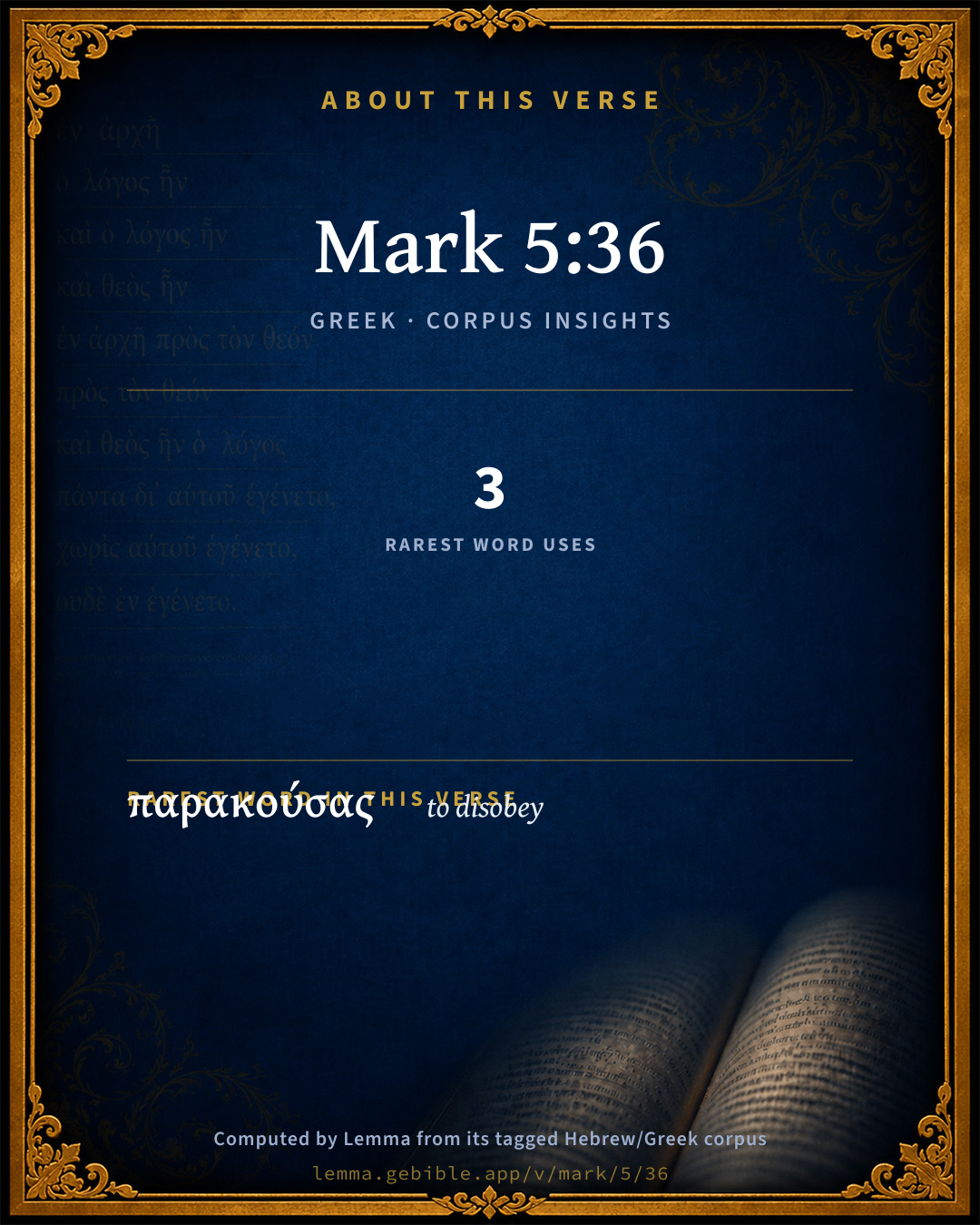
The rarest word here is παρακούσας to disobey G3878 — appearing just 3 times in the whole Greek New Testament.

Shared distinctive vocabulary

παρακούσας to disobey G3878 occurs in 2 verses of the Greek New Testament. Also found in:

Repetition

A word recurs within this verse:

Cross-references

9

Topical passages linked to Mark 5:36 in the Treasury of Scripture Knowledge — connected by theme and wording, ordered by reader-vote popularity; previews shown in the World English Bible.

  • Luke 8:50 But Jesus hearing it, answered him, "Don't be afraid. Only believe, and she will be healed."
  • Matthew 9:28–29 When he had come into the house, the blind men came to him. Jesus said to them, "Do you believe that I am able to do this?" They told him, "Yes, Lord."
  • John 11:40 Jesus said to her, "Didn't I tell you that if you believed, you would see God's glory?"
  • Mark 9:23 Jesus said to him, "If you can believe, all things are possible to him who believes."
  • Romans 4:18–24 Who in hope believed against hope, to the end that he might become a father of many nations, according to that which had been spoken, "So will your seed be."
  • Mark 5:34 He said to her, "Daughter, your faith has made you well. Go in peace, and be cured of your disease."
  • John 4:48–50 Jesus therefore said to him, "Unless you see signs and wonders, you will in no way believe."
  • 2 Chronicles 20:20 They rose early in the morning, and went forth into the wilderness of Tekoa: and as they went forth, Jehoshaphat stood and said, Hear me, Judah, and you inhabitants of Jerusalem: believe in Yahweh your God, so shall you be established; believe his prophets, so shall you prosper.
  • Matthew 17:20 He said to them, "Because of your unbelief. For most assuredly I tell you, if you have faith as a grain of mustard seed, you will tell this mountain, 'Move from here to there,' and it will move; and nothing will be impossible for you.

Cross-references courtesy of OpenBible.info (CC BY 4.0).

Where the printed editions differ

2 variants

Places in this verse where the major printed Greek editions disagree on the wording in a way that affects the translation — a comparison of editions, not a manuscript-by-manuscript collation. The editions are the modern critical texts (Nestlé-Aland 28/27, SBL, Westcott-Hort, Tregelles, Tyndale House) and the traditional texts behind the KJV (the Textus Receptus and the Byzantine/Majority text). It is not a claim about which reading is original.

  1. Extra text
    εὐθέως

    “immediately”

    In TRByz Not in NA28NA27TynSBLWHTreg

    εὐθέως (eutheōs) 'immediately' is only in traditional manuscripts (TR+Byz)

  2. Different wording
    παρακούσας

    “having ignored”

    In NA28NA27TynSBLWHTreg Not in TRByz

    ἀκούσας (akousas) 'having heard' occurs in traditional manuscripts (TR+Byz) instead of παρακούσας (parakousas) 'having ignored' in older manuscripts (NA28+NA27+Tyn+SBL+WH+Treg)

Textual data: Translators Amalgamated Greek New Testament (STEPBible TAGNT) · CC BY 4.0.

Commentary

Notes on Mark 5:36 from classic Christian and Jewish commentators (each source and its license shown beneath its notes). The classic Christian expositions comment on the surrounding passage and are grouped to its opening verse, so a note may address several verses; the Jewish commentaries on the Tanakh (Rashi and others) are per-verse, so they appear only where the commentator wrote on this verse.

Lemma curates 59 commentaries, every one of them public domain or Creative Commons licensed, each selected and text-cleaned for this edition rather than reprinted as found. About our sources →

The Biblical Illustrator

Joseph S. Exell

Mar_5:36

Be not afraid, only believe.

Only believe

The circumstances in which our Lord uttered these simple but memorable words … Did He say this for the sake of Jairus alone? Nay, surely not! I take these precious words of our Lord, and now especially apply them to one who is seeking forgiveness, but who feels as if he need scarcely hope, as if he could never be a child of God, etc. If you have some such feelings, it is just to you I say, Be not afraid, only believe!

1. There are some, many, alas! and the Bible scarcely contains a word which I should not sooner think of addressing to them than, Be not afraid! O that I could make them be afraid! Who are they? Persons who are not, and perhaps never were troubled with fear about their souls. God is too merciful to cast them out, or they are not wicked enough to be lest, or they are sure to be converted before they die, or they can make up for past defects by good living for the future.

2. But to thee who like Jairus art troubled in heart and seeking help from Christ, and over whose hopes dark feelings pass, as if it was all in vain, all too late-to thee I say, Be not afraid! While a man remains indifferent as to his soul, the great deceiver seeks to persuade him that nothing is so easy as salvation; but the moment conscience becomes awake, and the man begins in earnest to ask, What must I do to be saved? the deceiver changes his voice. Now, nothing is so difficult, so impossible, as salvation. Before, it was too soon; now, it is too late. Be not afraid, only believe!

(1) Be not afraid that the day of grace is past. Why are you thinking upon your soul? Because God is still calling you, etc. While you have one desire in your heart to say, Lord Jesus, if Thou wilt have mercy on such as I, here I lay me at Thy feet, O save me! your day of grace is not, cannot be, past.

(2) Be not afraid that your sins are too many. I do not believe you have any idea how many they really are. But you must not think that they are greater than the mercies of God.

3. When He said to Jairus, Only believe, what idea did it convey? Simply, trust to Me. You are not walking with Him side by side; you cannot look into His countenance or hear the unearthly power of His words. But He is as close to you as he was to Jairus. When He said Only believe, the hopeless father had no alternative but either to feel He is not trusted, or to feel He will save her after all. Had he looked down to the ground, probably he would have felt the first. If he looked full into the face of Jesus, he would feel, He cannot lie: it seems impossible, but I must trust Thee. So with you.

(1) Believe that He is able to save thee. Make out as bad a case against yourself as ever you can. In full knowledge of this, fix your helpless soul upon His atonement, upon His intercession.

(2) Believe that He is willing to save you. The Lord has sealed His willingness with these words, Him that cometh to Me, I will in no wise cast out.

(3) Believe that He is ready to save you. But I am not prepared: He is.

(4) Believe that He will save you. This you must do. The woman came saying, If I may but touch the hem of His garment, I shall be made whole. It was this faith that saved her. (William Arthur, M. A.)

Be not afraid, only believe

This exhortation has two sides-the negative and the positive.

I. In its negative aspect.

(1) it does not apply to the reckless and the ungodly, for there is never a period of their lives in which they ought not to fear. They have to fear-life and death, present, past, and future, earth and heaven, time and eternity. The very breath they breathe may be charged with its mission of judicial punishment;

(2) but to those who are striving to live in accordance with the requirements of the Divine will. When the soul has found her foundation to be the Rock of Ages, and her rest in God; when the earnest of the Divine Spirit is received and felt as a quickening power, then there is no need for alarm.

II. In its positive aspect.

(1) it indicates a means by which we may obtain release from causes which justify fear. Christ is the central object of trust. He is able to save, and He is willing. Here is a strong and lasting foundation;

(2) it is just the message needed by those who are turning away from the spirit of the world, who feel it cannot meet their wants when the heart stoops with grief, and when its fondest ties are being broken. It may be, that when they turn to God, great difficulties present themselves. Old habits are strong, the tendencies of the passions are earthward, and religion seems gloomy and unattractive. Besides, a deep sense of guilt and shame oppress the soul. Thus the trial of faith is severe. Still the remedy is simple. Trust wholly in God, and submit yourself to Him. Only believe is to acknowledge Gods power and ones own helplessness. It is a thing of instinct and of reason. (W. D. Horwood.)

Only believe

I. Faith. It is faith that sends him on this errand; faith in Jesus as a healer, for at first his faith only reached thus far. But Jesus leads him on; and ends with realizing in Him the raiser of the dead. Faith often begins with little and ends in much; it begins with a trickling streamlet, and ends with a full broad river.

II. Faith giving way. Does not faith often fail thus? We can go to Him for a little thing; not for a great. Instead of feeling that the worse the case the greater the glory to His power and love, we stop short, and cease to expect anything from Him.

III. Faith strengthened. Fear not, etc.

IV. Faith victorious. The victory is resurrection.

V. Unbelief rebuked. Excluded from the glorious spectacle. (H. Bonar, D. D.)

Only believe

I. Concerning this fear.

1. Fearfulness is common in applicants to the Saviour, and it springs from such sources as the following:

(1) Ignorance of the power and resources of the Saviour. We may believe that He can heal disease, but doubt that He can raise the dead.

(2) From morbid imagination of danger and of mischief. These we exaggerate.

(3) Hardness of heart towards Christs chief display of love, especially that manifestation of His mercy which He has given by dying for us.

(4) Then there is the memory and the consciousness of sin.

2. There can be nothing in the circumstances of an applicant to Jesus Christ to justify fear. Jesus does not reject you for sin, weakness, sadness-nothing is difficult to Him. He will do all at the right time.

3. Fearfulness when cherished is positively displeasing to the Saviour. It is groundless, dishonouring, injurious to ourselves.

II. Concerning trust.

1. Trust in Jesus is His due.

2. It is not always easy.

3. Are you all applicants to Jesus Christ? Be not afraid. Trust for the knowledge which is essential to life and salvation. (S. Martin.)

The charge of Christ under affliction

1. When difficulties are numerous and complicated.

2. When temptations are powerful and malignant.

3. When sickness occurs and is continued.

4. When bereaving providences are experienced.

5. What is the character and influence of our faith under these painful circumstances? (T. Wallace.)

Faith

Much is said in the Word of God of the principle of faith. The place that it occupies in the scheme of redemption is a very important one. It is essential to salvation. Without it we must remain destitute of all its blessings. This will be evident if we apply it-

I. To the general doctrine of salvation. To every inquirer for salvation we say, Only believe. Not that faith is the originating cause of salvation, for that were to deny the free grace of God; nor that faith is the procuring cause of salvation, for that were to set aside the efficacy of Christs atonement; nor that faith is the efficient cause of salvation, for that were to set aside the agency of the Holy Spirit: but we say that faith is the instrumental cause of salvation, that without the exercise of which no individual can experience salvation. This is the doctrine of the gospel (Act_16:31; Act_13:39; Eph_2:8; Rom_3:20-28; Rom_5:1).

1. This method of salvation conveys most glory to God.

2. This method of salvation alone produces real obedience.

3. This method is in accordance with the other parts of redemption. Let us apply the principle before us-

II. To the case of the true penitent.

III. To Christian believers.

IV. To the trials and sufferings of the Christian life. It is applicable-

1. To seasons of temptation.

2. To seasons of afflictive providences. (W. M. Bunting.)

Believing

I. The persons to whom the text is applicable. The case of Jairus. There was an evil he wanted to remove. A danger he wanted to prevent. A blessing he wanted to procure.

1. The first qualification of souls coming to Jesus is a sense of want, some evil to be removed, etc.

2. This sense of want brings us out of ourselves-out of dependence on mere external means.

3. The expression of our wants in earnest supplication.

4. Jairus came to Christ in faith.

II. The nature of the delightful duty and privilege.

1. Fear is a painful feeling, arising from the apprehension of some evil. A man at the feet of Jesus need not indulge in tormenting fear, for there is no evil he is in danger of but he may be saved from-no blessing he needs but he may secure. Fear not, etc.

2. What is this believing-what is faith? Sometimes it is called looking, receiving, etc.

III. The right you have to all the encouragement in the text.

1. If you have the sense of need, and if you are at the feet of Jesus, then you have an absolute, personal, Scriptural right to appropriate the salvation of God as your own. You are just where a sinner ought to be, etc.

2. You have a right because you comply with the invitation.

3. You are at the central point of all the promises. All yea and amen in Him.

4. Will you still indulge in tormenting fear? Yes, says one, You dont know what reason I have to fear, etc. Enumerate the various sources of fear, and show that no sinner need fear who is truly penitent and at the feet of Jesus. (W. Dawson.)

Only believe

Mr. Moody was one night preaching in Philadelphia; near the pulpit sat a young lady, who listened with eager attention, drinking in every word. After he had done talking he went to her. Are you a Christian? No, she replied, I wish I was; Ive been seeking Jesus for three years. Mr. Moody replied, There must be some mistake. Dont you believe me? said the distressed girl. Well, no doubt you think you have been seeking Jesus; but, believe me, it dont take three years for a seeking soul to meet a seeking Saviour. What am I to do, then? You have been trying to do long enough; you must just believe on the Lord Jesus Christ. Oh! said the young lady, I am so tired of that word: Believe, believe, believe! I dont know what it means. Then well change the word, and say, trust. If I say, Ill trust Him, will He save me? I dont say that, for you may say ten thousand things; but if you do trust Him, He certainly will. Well, said she, I do trust him; but I dont feel any better! Ah! said Mr. Moody, I see; youve been looking for feelings for three years, instead of looking to Jesus. If the translators of the Bible had everywhere inserted feelings instead of faith, what a run there would be upon the book. But God does not say a word about feelings from Genesis to Revelation. With men seeing is believing but with the believer believing is seeing. An orphan child was once asked by her little friend, What do you do without a mother to tell your troubles to? Mother told me to go to Jesus; He was mothers Friend, and Hes my Friend too, was the simple reply. But He is a long way off; He wont stop to mind you. Her face brightened, as she said: I dont know about that, but I know He says He will, and thats enough for me. And should not that be enough for you and me? (Anon.)

The Biblical Illustrator, edited by Joseph S. Exell (c. 1880s–1900s) — public domain. Text from a community e-Sword module.

Tyndale Open Study Notes

Tyndale Open Resources

5:36 Just have faith: As the woman had (5:28).

Tyndale Open Study Notes — © Tyndale Open Resources, licensed CC BY-SA 4.0. Text via the HelloAO Bible API.

Bengel's Gnomon

Johann Albrecht Bengel

Mar 5:36. Λαλούμενον, that was spoken) as it were privately.

Bengel's Gnomon of the New Testament — English translation (T&T Clark, Edinburgh, 1860) — public domain. Text from a community e-Sword module.

Expositor's Greek Testament

ed. W. Robertson Nicoll

Mar 5:36 . παρακούσας : might mean to disregard, as in Mat 18:17 (with genitive). So Meyer; but here probably it means overhearing a word not spoken directly to Him. The two senses are quite compatible. Jesus might overhear what was said and disregard its import, i.e. , act contrary to the implied suggestion that nothing could now be done in the case. The latter He certainly did. πίστευε , present, continue in a believing mood, even in presence of death .

The Expositor's Greek Testament, edited by W. Robertson Nicoll (1897–1910) — public domain. Text from a community e-Sword module.

Geneva Bible (1599)

Geneva Bible translators

Fathers apprehend by faith the promises of life even for their children.

Geneva Bible (1599) marginal notes — public domain. Text via Bolls.life.

Adam Clarke's Commentary

Verse 36. Jesus - saith] These words were spoken by our Lord to the afflicted father, immediately on his hearing of the death of his child, to prevent that distress which he otherwise must have felt on finding that the case was now, humanly speaking, hopeless.

Adam Clarke's Commentary on the Bible (1810–1826) — public domain. Text from a community e-Sword/MySword module.

The Cambridge Bible for Schools and Colleges

gen. ed. J. J. S. Perowne

36. heard] Perhaps according to a better reading, “overheard.” The very instant the Lord heard the message, He hastens to reassure the ruler with a word of confidence and encouragement.

The Cambridge Bible for Schools and Colleges (gen. ed. J. J. S. Perowne; Cambridge University Press, 1878–1918) — public domain. Text from a community e-Sword module.

John Gill's Exposition

As soon as Jesus had heard the word that was spoken,.... By those that came from the ruler's house; as that his daughter was dead, and it was to no purpose to give him any further trouble, since all hope of recovery was now gone:

he saith unto the ruler of the synagogue; who was overwhelmed with trouble, and quite dispirited, and ready to swoon and die away;

be not afraid, only believe: do not be discouraged at these tidings, or distrust my power to help thee, only believe that I am able to raise her, even from the dead; and fear not, but it will be done. If a man can but believe, he has no reason to fear; for what is it that almighty power cannot do? it can raise the dead; there is nothing can stand in its way, or stop its course; and faith in it surmounts difficulties which are insuperable to carnal sense and reason: this was the support and foundation of Abraham's faith; hence he was strong in the exercise of it, and believed in hope against hope, because he was fully persuaded that God was able to perform what he had promised, Rom 4:18. And whereas the ruler had expressed some faith in Christ, that his daughter, though at the point of death, would be, healed by him and live, provided he would but come and lay his hands on her; and Christ had assented to go along with him, and had given him an intimation that he would restore her; he had nothing to do but to believe in him, that even though she was dead, he was able to raise her from the dead, as well as to recover her at the point of death, and that he would do it, but, oh! this thing, "only believe", how hard a matter is it, though there is so much encouragement to it both in the power and will of Christ! Faith is not of a man's self at first; it is the gift of God, and the operation of his Spirit; and the lively and comfortable exercise of it is owing to the influence of efficacious grace: but if Christ, who is the author and finisher of faith, says "believe", or "only believe"; such power goes along with his words, as doubtless did at this time, as causes souls to exercise faith in him; and the more faith, the less fear; and such walk most comfortably in themselves, and most to the glory of Christ, who walk by faith on him. This word "only" does not exclude the exercise of other graces, but rather implies it, for where this grace is in exercise, generally speaking, others are; nor the performance of good works, which are the fruits and effects of true faith, and without which faith is dead; but it stands opposed to fears and doubting, and to all carnal reasonings, as well as to all trust and confidence in other objects besides Christ.

John Gill's Exposition of the Whole Bible (1746–1763) — public domain (CC PDM 1.0). Text via the HelloAO Bible API.

Trapp's Complete Commentary

John Trapp

36 As soon as Jesus heard the word that was spoken, he saith unto the ruler of the synagogue, Be not afraid, only believe.

Ver. 36. Be not afraid, only believe] Faith quelleth and killeth distrustful fear; but awful dread it breedeth, feedeth, fostereth, and cherisheth.

John Trapp, A Commentary or Exposition upon All the Books of the Old and New Testament (1647–1656) — public domain. Text from a community e-Sword module.

Haydock's Catholic Bible Commentary

Only believe. Dissenters grossly abuse this and other similar texts of Scripture, to prove that faith alone will suffice for justification; whereas God only declares, that he requires a faith in his almighty power for the performance of miracles, and that without this necessary predisposition, he will not do any miracles. See ver. 5, of the following chapter.

George Leo Haydock (1774–1849), Haydock's Catholic Family Bible and Commentary, 1859 edition — public domain. Excludes Psalms (Douay-Rheims chapter numbering differs from Protestant) and Deuterocanonical books (Catholic canon only).

Whedon's Commentary on the Bible

Daniel D. Whedon

36. Believe — Trust even beyond the gates of death.

Daniel D. Whedon (gen. ed.), Commentary on the Old and New Testaments (1874–1909) — public domain. Text from a community e-Sword module.

The Pulpit Commentary

The words of the narrative, as they stand in the Authorized Version, are: As soon as Jesus heard the word that was spoken, he saith unto the ruler of the synagogue, Be not afraid, only believe. But there is good authority for the reading parakousav instead of euyewv akousav which requires the rendering, but Jesus, not heeding, or overhearing. This word (parakouw) occurs in one other place in the Gospels, namely, in Mat_18:17, "And if he refuse to hear them (ea parakoush autwn)." Here the word can only have th e meaning of "not heeding," or "refusing to hear." This seems to be a strong reason for giving the word a somewhat similar meaning in this passage. And therefore, on the whole, "not heeding" seems to be the best rendering. Indeed, it seems to cover both meanings. Our Lord would overhear, and yet not heed, the word spoken.

The Pulpit Commentary (1880–1919), ed. H.D.M. Spence-Jones & Joseph S. Exell — public domain. Text from a community e-Sword module.

Scofield Reference Notes

C. I. Scofield

As soon as

But Jesus, overhearing that word, said to the synagogue-ruler, Fear not, simply have faith. Cf. Luk 7:50

The Scofield Reference Bible (1917 edition), notes by C. I. Scofield — public domain. Text from a community e-Sword module.

unfoldingWord translationNotes

Door43 World Missions Community

General Information:

The information in verses 37 and 38 may be reordered to present the events in the order that they happened, as in the UDB. (See: Order of Events) and Verse Bridges)

Just believe

If necessary, you can state what Jesus is commanding Jairus to believe. AT: "Just believe I can make you daughter live"

He did not ... he saw

In these verses the word "he" refers to Jesus.

to accompany him

"to come with him." It may be helpful to state where they were going. AT: "to accompany him to Jairus' house" (See: Assumed Knowledge and Implicit Information)

translationWords

Jesus

synagogue

fear

believe

Peter

James (son of Zebedee)

John (the apostle)

unfoldingWord translationNotes — © Distant Shores Media and the Door43 World Missions Community, licensed CC BY-SA 4.0. Source: git.door43.org/Door43/en_tn.

Cambridge Greek Testament for Schools and Colleges

36. παρακούσας ([1013][1014][1015][1016][1017]) rather than ἀκούσας ([1018]c[1019][1020][1021] [1022][1023][1024][1025][1026] omit εὐθέως. See on Mar 5:13.

[1013] Codex Sinaiticus. 4th cent. Discovered by Tischendorf in 1859 at the Monastery of St Katharine on Mount Sinai. Now at St Petersburg. The whole Gospel, ending at Mar 16:8. Photographic facsimile, 1911.

[1014] An asterisk denotes that the word is not found elsewhere in N.T., and such words are included in the index, even if there is no note on them in the commentary.

[1015] Codex Vaticanus. 4th cent., but perhaps a little later than א. In the Vatican Library almost since its foundation by Pope Nicolas V., and one of its greatest treasures. The whole Gospel, ending at Mar 16:8. Photographic facsimile, 1889.

[1016] Codex Regius. 8th cent. An important witness. At Paris. Contains Mar 1:1 to Mar 10:15; Mar 10:30 to Mar 15:1; Mar 15:20 to Mar 16:20, but the shorter ending is inserted between Mar 16:8 and Mar 16:9, showing that the scribe preferred it to the longer one.

[1017] Codex Sangallensis. 9th or 10th cent. Contains the Gospels nearly complete, with an interlinear Latin translation. The text of Mark is specially good, agreeing often with CL. At St Gall.

[1018] Codex Sinaiticus. 4th cent. Discovered by Tischendorf in 1859 at the Monastery of St Katharine on Mount Sinai. Now at St Petersburg. The whole Gospel, ending at Mar 16:8. Photographic facsimile, 1911.

[1019] Codex Alexandrinus. 5th cent. Brought by Cyril Lucar, Patriarch of Constantinople, from Alexandria, and afterwards presented by him to King Charles I. in 1628. In the British Museum. The whole Gospel. Photographic facsimile, 1879.

[1020] Codex Ephraemi. 5th cent. A palimpsest: the original writing has been partially rubbed out, and the works of Ephraem the Syrian have been written over it; but a great deal of the original writing has been recovered; of Mark we have Mar 1:17 to Mar 6:31, Mar 8:5 to Mar 12:29, Mar 13:19 to Mar 16:20. In the National Library at Paris.

[1021] odex Bezae. 6th cent. Has a Latin translation (d) side by side with the Greek text, and the two do not quite always agree. Presented by Beza to the University Library of Cambridge in 1581. Remarkable for its frequent divergences from other texts. Contains Mark, except Mar 16:15-20, which has been added by a later hand. Photographic facsimile, 1899.

[1022] Codex Sinaiticus. 4th cent. Discovered by Tischendorf in 1859 at the Monastery of St Katharine on Mount Sinai. Now at St Petersburg. The whole Gospel, ending at Mar 16:8. Photographic facsimile, 1911.

[1023] Codex Vaticanus. 4th cent., but perhaps a little later than א. In the Vatican Library almost since its foundation by Pope Nicolas V., and one of its greatest treasures. The whole Gospel, ending at Mar 16:8. Photographic facsimile, 1889.

[1024] Codex Bezae. 6th cent. Has a Latin translation (d) side by side with the Greek text, and the two do not quite always agree. Presented by Beza to the University Library of Cambridge in 1581. Remarkable for its frequent divergences from other texts. Contains Mark, except Mar 16:15-20, which has been added by a later hand. Photographic facsimile, 1899.

[1025] Codex Regius. 8th cent. An important witness. At Paris. Contains Mar 1:1 to Mar 10:15; Mar 10:30 to Mar 15:1; Mar 15:20 to Mar 16:20, but the shorter ending is inserted between Mar 16:8 and Mar 16:9, showing that the scribe preferred it to the longer one.

[1026] Codex Sangallensis. 9th or 10th cent. Contains the Gospels nearly complete, with an interlinear Latin translation. The text of Mark is specially good, agreeing often with CL. At St Gall.

36. παρακούσας. Not heeding (R.V.) rather than “overhearing” (R.V. marg.). So Mat 18:17 bis and always (7 times) in LXX. The aor. part. of antecedent action is often rightly translated by pres. part. Cf. ἐπιγνούς in Mar 5:30, and perhaps φοβηθεῖσα, Mar 5:33. Burton, § 138.

Μὴ φοβοῦ, μόνον πίστευε. The pres. imperat. in each case has its full force; Cease to fear; only continue to believe. Fear that his petition to Christ would now be useless had begun to shake the father’s faith. See on Mar 6:38.

Cambridge Greek Testament for Schools and Colleges (Cambridge University Press, 1896; 21 vols, various authors incl. Carr, Maclear, Plummer, Farrar, Lumby, Moule, M. R. James, Simcox) — public domain. Text from a community e-Sword module.

Alford’s Greek Testament

Henry Alford

36.] But Jesus having [straightway] overheard the message being spoken: a mark of accuracy which is lost in the . text.

Henry Alford, The Greek Testament (1849–1861) — public domain. Text from a community e-Sword module.

International Critical Commentary

36. Ἰησοῦς παρακούσας—Jesus having overheard, i.e. heard what was not addressed to him.

Omit εὐθέως before παρακούσας, Tisch. Treg. WH. RV. א BDL Δ 1, 28, 40, 209, 225, 271, mss. Lat. Vet. Vulg. Memph. Pesh. etc. παρακούσας, instead of ἀκούσας, Tisch. Treg. WH. RV. א* et cb BL Δ one ms. Lat. Vet.

μόνον πίστευε—In accordance with the ordinary use of the present imp., this means, hold on to your faith, do not lose it.2

International Critical Commentary — older volumes (1896–1929), various authors — public domain. Text from a community e-Sword module.

Vincent's Word Studies in the New Testament

Marvin R. Vincent

Heard. This is from the reading ajkousav (Luk 8:50). The correct reading is parakousav, which may be rendered either not heeding, as Rev. (compare Mt 28:17), or over - hearing, as Rev. in margin, which, on the whole, seems the more natural. Disregarding would be more appropriate if the message had been addressed to Jesus himself; but it was addressed to the ruler. Jesus overheard it. The present participle, laloumenon, being spoken, seems to fall in with this.

Marvin R. Vincent, Word Studies in the New Testament (1887–1900) — public domain. Text from a community e-Sword/MySword module.

Lesson kit

Teaching starters — assembled from the data on this page, not authored interpretation. Every prompt links to the verse data it draws on. Edit before teaching.

Mark, in the Gospels, opens this verse with 14 words (12 distinct Greek lemmas). Its most distinctive word is parakoúō (“to disobey”). A historical commentator’s framing appears above. Read the whole chapter for the surrounding context.

Discussion questions

  1. How does “to disobey” (parakoúō) shape what this verse is saying?
  2. How does Matthew 18:17, which shares the word «to disobey», read alongside this verse?
  3. What does the repetition of “the” (3× in this one verse) do in this verse?
  4. The translations on this page render this verse differently — a whole-verse word diff, not a word-by-word alignment. What might account for the different wordings?
  5. Compare how The Biblical Illustrator and Tyndale Open Study Notes read this verse. Where do they agree or differ?

Things to notice

Reading settings

Reading text

Shown beneath each verse's original-language words.

Old Testament
Old Testament edition

Read the OT as the Masoretic Hebrew (MT) or the Greek Septuagint (LXX).

English shown for the Greek Septuagint (in the Hebrew ↔ Greek comparison).

Comparing translations? Open the Compare panel on any verse page to stack up to four side by side.