Mark 13:7

Greek (Tischendorf 8th ed.) Mark 13:7 appears in the Greek New Testament. The text above is from the Tischendorf 8th edition. Each word links to its Strong’s number and a concise gloss. Click any word for its full Thayer’s Greek Lexicon entry.
Download image
Cite this verse

Mark 13:7 (World English Bible). Public Domain. Lemma interlinear Bible study tool, https://lemma.gebible.app/v/mark/13/7.

Show BibTeX & RIS
BibTeX
RIS
English Translation
"When you hear of wars and rumors of wars, don't be troubled. For those must happen, but the end is not yet.
World English Bible · Public Domain
Download a study sheet

One document with this verse’s original text, its word-by-word gloss line, the meaning frame, cross-references with their text, attributed commentary, and full source and license credits — printable, and it pastes into notes with its structure intact.

This verse Autodidact and up

Study sheet (.html) Plain text (.txt)

A passage Seminary Student

Up to 50 verses in one chapter. A passage sheet keeps up to 6 commentary sources and 12 cross-references per verse, in the order this page ranks them, and says so on the sheet whenever that leaves anything out. Ask for a single verse and you get the Autodidact verse sheet above.

Everything on this page stays free to read, with no account — the sheet is a download of what is already on screen, not access to it.

Want to remove ads? Support Godless Engineer
Compare translations 3

The same verse in 3 English versions, stacked beneath the original-language interlinear above. Click any original word for its lexicon entry.

Each is an independent rendering of the whole verse — the interlinear is not word-aligned to these translations.

Highlighted words mark where these versions differ — a whole-verse word diff, not a word-by-word alignment.

  • World English Bible Public Domain
    "When you hear of wars and rumors of wars, don't be troubled. For those must happen, but the end is not yet.
  • King James Version Public Domain
    And when ye shall hear of wars and rumours of wars, be ye not troubled: for such things must needs be; but the end shall not be yet.
  • unfoldingWord Literal Text CC BY-SA 4.0
    But when you hear of wars and rumors of wars, do not be troubled; it is necessary to happen, but the end not yet.

unfoldingWord Literal Text — © unfoldingWord, licensed CC BY-SA 4.0. Word-aligned USFM3 via Door43 (git.door43.org/unfoldingWord/en_ult).

Versions to compare (up to 4)

3 of 4 selected

Show all 19 translations

Every available English version of this verse, each an independent rendering of the whole verse.

  • World English Bible Public Domain
    "When you hear of wars and rumors of wars, don't be troubled. For those must happen, but the end is not yet.
  • Berean Standard Bible Public Domain
    When you hear of wars and rumors of wars, do not be alarmed. These things must happen, but the end is still to come.
  • Majority Standard Bible Public Domain
    When you hear of wars and rumors of wars, do not be alarmed. For these things must happen, but the end is still to come.
  • King James Version Public Domain
    And when ye shall hear of wars and rumours of wars, be ye not troubled: for such things must needs be; but the end shall not be yet.
  • American Standard Version (1901) Public Domain
    And when ye shall hear of wars and rumors of wars, be not troubled: `these things' must needs come to pass; but the end is not yet.
  • Revised Version (1885) Public Domain
    And when ye shall hear of wars and rumours of wars, be not troubled: these things must needs come to pass; but the end is not yet.
  • Geneva Bible (1599) Public Domain
    Furthermore when ye shall heare, of warres, and rumours of warres, be ye not troubled: for such things must needes be: but the end shall not be yet.
  • Douay-Rheims (1899) Public Domain
    And when you shall hear of wars and rumours of wars, fear ye not. For such things must needs be, but the end is not yet.
  • Young's Literal Translation Public Domain
    and when ye may hear of wars and reports of wars, be not troubled, for these behove to be, but the end `is' not yet;
  • Literal Standard Version CC BY-SA 4.0
    and when you may hear of wars and reports of wars, do not be troubled, for these ought to be, but the end [is] not yet;
  • Unlocked Literal Bible CC BY-SA 4.0
    When you hear of wars and rumors of wars, do not worry; these things must happen, but the end is not yet.
  • unfoldingWord Literal Text CC BY-SA 4.0
    But when you hear of wars and rumors of wars, do not be troubled; it is necessary to happen, but the end not yet.
  • Darby Bible Public Domain
    But when ye shall hear of wars and rumours of wars, be not disturbed, for [this] must happen, but the end is not yet.
  • World Messianic Bible Public Domain
    “When you hear of wars and rumors of wars, don’t be troubled. For those must happen, but the end is not yet.
  • Webster's Bible Public Domain
    And when ye shall hear of wars, and rumors of wars, be ye not troubled: for such things must needs be; but the end will not be yet.
  • Free Bible Version CC BY-SA 4.0
    Don't be troubled when you hear of wars nearby and wars far away. These things must happen but this is not the end.
  • Bible in Basic English Public Domain
    And when you have news of wars and talk of wars, do not be troubled; these things have to be, but it is still not the end.
  • Text-Critical English NT CC BY 4.0
    When you hear of wars and rumors of wars, do not be alarmed, for these things must take place, but the end is not yet.
  • Tyndale New Testament (1534) Public Domain
    When ye shall heare of warre and tydinges of warre be ye not troubled. For soche thinges muste nedes be. But the ende is not yet.

Literal Standard Version (2020), Covenant Press — licensed CC BY-SA 4.0. Text via the HelloAO Bible API (eBible.org). Unlocked Literal Bible (unfoldingWord) — licensed CC BY-SA 4.0. Text via the HelloAO Bible API (eBible.org). unfoldingWord Literal Text — © unfoldingWord, licensed CC BY-SA 4.0. Word-aligned USFM3 via Door43 (git.door43.org/unfoldingWord/en_ult). Free Bible Version, Dr. Jonathan Gallagher — licensed CC BY-SA 4.0. Text via the HelloAO Bible API (eBible.org).

Word by word

More ways to search: Search by grammar → Find every occurrence → Compare this word →

Practice this passage: Drill this verse → Learn its vocabulary →

θροεῖσθε
throéō
G2360
“to cry aloud”
Verb, Present, Passive, Imperative, 2nd person, Plural
Part of Speech
Verb
Tense
Present
Voice
Passive
Mood
Imperative
Person
2nd person
Number
Plural
Full Thayer's Definition

Origin: from threomai to wail

TDNT: None

1. to cry aloud, make a noise by outcry a. in the NT, to trouble, frighten b. to be troubled in mind, to be frightened, alarmed
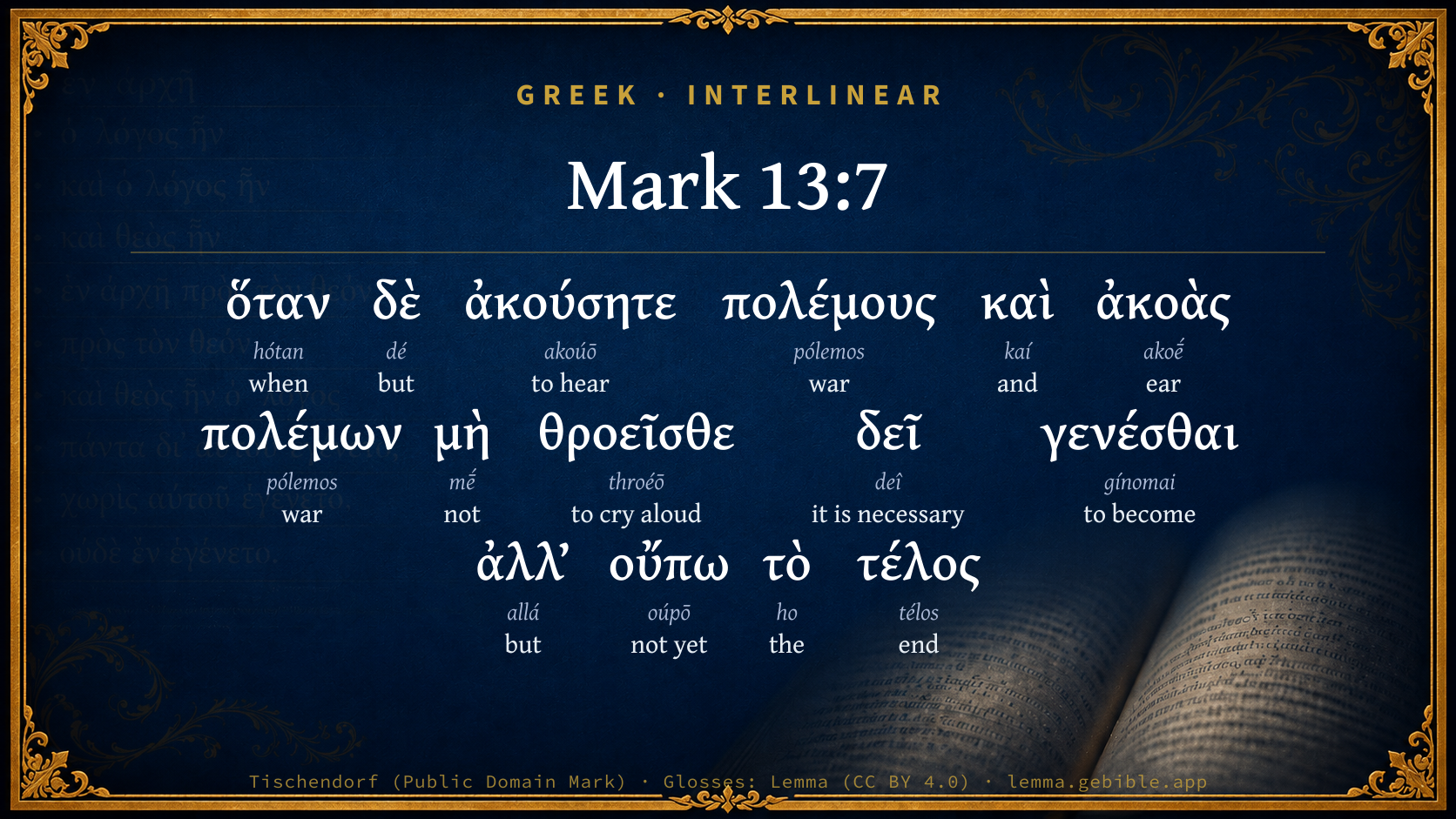
  1. ὅταν hótan G3752 “when” Conjunction
  2. δὲ dé G1161 “but” Conjunction
  3. ἀκούσητε akoúō G191 “to hear” Verb, Aorist, Active, Subjunctive, 2nd person, Plural
  4. πολέμους pólemos G4171 “war” Noun, Accusative, Plural, Masculine
  5. καὶ kaí G2532 “and” Conjunction
  6. ἀκοὰς akoḗ G189 “ear” Noun, Accusative, Plural, Feminine
  7. πολέμων pólemos G4171 “war” Noun, Genitive, Plural, Masculine
  8. μὴ mḗ G3361 “not” Particle, Negative
  9. δεῖ deî G1163 “it is necessary” Verb, Present, Active, Indicative, 3rd person, Singular
  10. γενέσθαι gínomai G1096 “to become” Verb, Aorist, Middle deponent, Infinitive
  11. ἀλλ’ allá G235 “but” Conjunction
  12. οὔπω oúpō G3768 “not yet” Adverb, Negative
  13. τὸ ho G3588 “the” Article, Nominative, Singular, Neuter
  14. τέλος télos G5056 “end” Noun, Nominative, Singular, Neuter

About this verse

These counts appear in no published source. They are computed here, from the morphology-tagged text and Lemma’s own curated glosses. What Lemma adds →

15
words
14
distinct lemmas
Gospels
section

Notable vocabulary

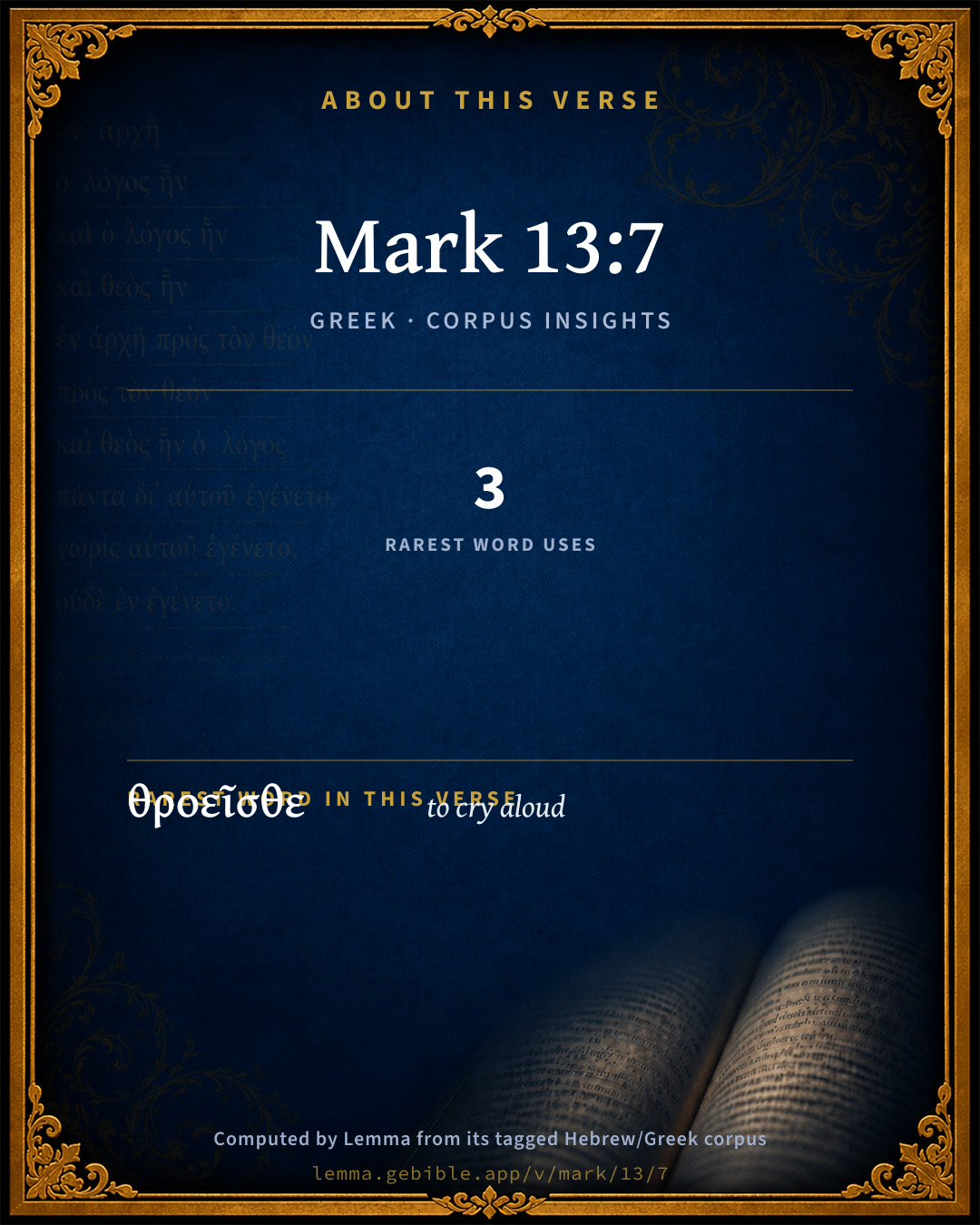
The rarest word here is θροεῖσθε to cry aloud G2360 — appearing just 3 times in the whole Greek New Testament.

Shared distinctive vocabulary

θροεῖσθε to cry aloud G2360 occurs in 3 verses of the Greek New Testament. Also found in:

Repetition

A word recurs within this verse:

  • πολέμους war G4171 ×2

Cross-references

14

Topical passages linked to Mark 13:7 in the Treasury of Scripture Knowledge — connected by theme and wording, ordered by reader-vote popularity; previews shown in the World English Bible.

  • Luke 21:9–11 When you hear of wars and disturbances, don't be terrified, for these things must happen first, but the end won't come immediately."
  • John 14:27 Peace I leave with you. My peace I give to you; not as the world gives, give I to you. Don't let your heart be troubled, neither let it be fearful.
  • Matthew 24:6–7 You will hear of wars and rumors of wars. See that you aren't troubled, for all this must happen, but the end is not yet.
  • Psalms 27:3 Though a host should encamp against me, My heart shall not fear. Though war should rise against me, Even then I will be confident.
  • Psalms 112:7 He will not be afraid of evil news. His heart is steadfast, trusting in Yahweh.
  • Acts 17:3 explaining and demonstrating that the Christ had to suffer and rise again from the dead, and saying, "This Jesus, whom I proclaim to you, is the Christ."
  • 2 Samuel 14:14 For we must needs die, and are as water split on the ground, which can't be gathered up again; neither does God take away life, but devises means, that he who is banished not be an outcast from him.
  • Psalms 46:1–3 God is our refuge and strength, A very present help in trouble.
  • Proverbs 3:25 Don't be afraid of sudden fear, Neither of the desolation of the wicked, when it comes:
  • Isaiah 8:12 Don't you say, "A conspiracy!" concerning all about which this people shall say, "A conspiracy!" neither fear their fear, nor be in dread [of it].
  • Jeremiah 4:19–21 My anguish, my anguish! I am pained at my very heart; my heart is disquieted in me; I can't hold my peace; because you have heard, O my soul, the sound of the trumpet, the alarm of war.
  • Jeremiah 51:46 Don't let your heart faint, neither fear for the news that shall be heard in the land; for news shall come one year, and after that in another year [shall come] news, and violence in the land, ruler against ruler.
  • Matthew 18:7 "Woe to the world because of occasions of stumbling! For it must be that the occasions come, but woe to that person through whom the occasion comes!
  • John 14:1 "Don't let your heart be troubled. Believe in God. Believe also in me.

Cross-references courtesy of OpenBible.info (CC BY 4.0).

Commentary

Notes on Mark 13:7 from classic Christian and Jewish commentators (each source and its license shown beneath its notes). The classic Christian expositions comment on the surrounding passage and are grouped to its opening verse, so a note may address several verses; the Jewish commentaries on the Tanakh (Rashi and others) are per-verse, so they appear only where the commentator wrote on this verse.

Lemma curates 59 commentaries, every one of them public domain or Creative Commons licensed, each selected and text-cleaned for this edition rather than reprinted as found. About our sources →

The Biblical Illustrator

Joseph S. Exell

Mar_13:7

And when ye shall hear of wars.

Troublous times

I. We are here forewarned to expect trouble, Ye shall hear of wars and rumours of wars; and it follows, such things must needs be; look for no other. Is not our life a warfare?

1. This points immediately at those wars which brought on the final ruin and overthrow of the Jewish church and nation.

2. It looks further, and is intended as an intimation to us all, and to all Christians, to count upon trouble in this world. When ye hear wars (so the word is), when ye hear war at home, the noise of it, for war in a country makes a noise; never more than since the invention of guns, the most noisy way of fighting; yet of old they complained of the noise of war (Nah_3:2; Exo_32:17-18). When we hear the rumours of wars, the reports or tidings of wars. We commonly call uncertain reports rumours, and in time of war we often hear such, but the original word signifies intelligences, that of which we hear. Doctrine: That though it be very sad, yet it is not at all strange in this world, to hear of wars and rumours of wars.

There are three sorts of wars:

1. Law wars among neighbours and relations, bad enough, and very common, through too much love of the world, and too little of our brother. There are few of the spirit of Abram (Gen_13:8).

2. Book wars among scholars and Christians. Different sentiments maintained by each side with great heat, too often greater than the occasion demands.

3. Sword wars among nations and public interests: of these the text speaks. Whence is it that so much mischief should be done in the world by wars? considering

(1) What principles there are in the nature of man. Is there not such a thing as humanity? Man is not born for war, but naked and unarmed; not fierce, as birds and beasts of prey.

(2) What promises there are in the Word of God. It seems hard to reconcile this text with Isa_2:4. and with Isa_11:6, etc. The Jews object it, Christ Himself has said otherwise (Luk_12:51, and in the text). How shall we reconcile these two? I reply, Those promises are in part fulfilled already. Christ was born at a time of general peace. The gospel has prevailed much to the civilizing of the nations, and as far as it is received, it disposes men to peace. The primitive Christians were of a peaceable disposition. They will have a more full accomplishment in the latter days. Though contrary events come between, that word shall not fall to the ground. Yet the commonness of war in every age takes off the strangeness of it. What do we hear of at this day so much as of wars? Now this we are not to think strange. Because men are so provoking to God, and He does thus in a way of righteous judgment punish them for their sins (Isa_34:5). War is one of Gods sore judgments, with which He corrects the people of His wrath (Eze_14:17; Eze_14:21). Sometimes God thus makes wicked men a scourge one to another, as Nebuchadnezzar was to the nations. Sometimes a scourge to His own people (Isa_10:6). Because men are so provoking one to another, and they do thus give way to their own lusts (Jam_4:1-2). No war carried on but there is certainly a great deal of sin on both sides, as 2Ch_28:9.

But as to the cause of war.

1. Sometimes mens lusts on both sides begin the war, and where there may be a right and colour of reason on both sides, yet not such as on either to justify the taking up of arms, and while there are such follies set in great dignity (Ecc_10:6), no marvel if we hear much of wars; punctilios of honour, inconsiderable branches of right, to which lives and countries are sacrificed by jealous princes; the mouth justly opened to denounce war, but the ear unjustly deaf to the proposals of peace.

2. Where the war on the one side is just and necessary, it is mens lusts on the other side that make it so. And if we see it, we need not marvel at the matter. Here is the original of war and bloodshed.

(1) Mens pride and ambition sometimes make a war just and necessary.

(2) Mens covetousness and injustice sometimes make a war just and necessary.

(3) Mens treachery sometimes makes war. No marvel we hear of wars, when all men are liars, and no confidence is to be put in them.

(4) Oppression and persecution sometimes make war just.

II. We are here forearmed against the trouble we are bid to expect. When you are yourselves disturbed with the alarms of war, be not troubled, i.e., be not inordinately dejected and cast down, be not terrified, whatever happens; keep trouble from your heart (Joh_14:1) if war come to your door. It is both for caution and comfort. You need not be troubled, therefore give not way to it. Doctrine: That the faithful disciples of Jesus Christ ought not to be inordinately troubled, when there are wars and rumours of wars.

1. As for others, they have reason to be troubled. Those that are not the disciples of Jesus Christ, and are not interested in His merit and grace, have cause for trouble when Gods judgments are abroad (see Isa_33:14). Terrors belong to them, and as for comforts, they have no part nor lot in the matter (see Luk_21:25-26). Those that have the most cause to be troubled commonly put trouble furthest from them.

2. There is cause for the disciples of Christ themselves, upon some accounts, and in some degree, to be troubled. Christ would not have His followers to be without feeling. God calls to mourning at such a time. This is a doctrine that needs explication and limitation. When you hear of wars be ye troubled after a godly sort. There is a three-fold trouble commendable:

(1) Sympathy with the sufferers.

(2) Sorrow for sin. It is sin that makes all the mischief. Mourn for the sin that is the cause of the war, and the sin that is the effect of it.

(3) Solicitude for the ark of God. For this our hearts should tremble, lest religion in its various interests suffer damage. The desolations of the sanctuary should trouble us more than the desolations of the earth: this is a holy fear.

3. Christians ought not to be inordinately troubled. When ye hear this, be not troubled, i.e.,

(1) Be not disquieted, but make the best of it. It is not our wisdom to aggravate to ourselves the causes of trouble, nor to make them worse than they are.

(2) Be not affrighted, but hope the best from it. When we hear the rumours of war, we must not be of doubtful mind; not as Ahaz (Isa_7:2; Isa_8:11-12). We must not give up all for lost upon every disaster and disappointment. Courage is an excellent virtue in time of war, and needful at home as well as abroad.

(3) Be not amazed, but prepare for worse after it. There seems to be this also intended in the caution; compare Mar_5:8, These are the beginnings of sorrows. Weep not for this, but get ready for the next (Luk_23:28-29.) Faint not in these lesser conflicts, for then what will you do when greater come (see Jer_12:5). Several considerations will be of use to keep trouble from the heart of good Christians, when we hear of wars.

(a) The righteous God sits in the throne judging right, therefore be not troubled. God is King of nations, and presides in the affairs of nations. Men talk of the fortune of war, but it is not a blind fortune; the issue is determined by a wise God.

(b) The church is built upon a rock, and the gates of hell shall not prevail against it, therefore be not troubled.

(c) Christ is His peoples peace, therefore be not troubled. The remnant of those that fear God, find rest in Christ, even in troublous times (see Mic_5:5; Joh_16:33).

(d) The name of the Lord is a strong tower, therefore be not troubled. Into this citadel the vanquished may retire and find shelter, and a refuge that they cannot be beaten out of (Pro_18:10). This is a stronghold, inaccessible, insuperable, and which cannot be taken. The power and providence of God are fortifications which cannot be scaled, nor battered, nor undermined. What need good people fear? (Psa_46:1-2) They have always a God to whom they may go.

(e) Men are Gods hand, therefore be not troubled. God is doing their own work by them all this while, and they are accomplishing His purpose, though they mean not so (Isa_10:5; Isa_10:7; Isa_10:15; Psa_17:13-14).

(f) There will come a reckoning day, when all these things shall be reviewed; therefore be not troubled. Behold, the Judge standeth before the door and the mighty men shall shortly stand at His bar (Isa_26:21; Rev_6:10).

(g) The wars of the nations perhaps may end in the peace of the church. God can bring light out of darkness and meat out of the eater.

(h) However, we are sure in heaven there are no wars nor rumours of wars, therefore be not troubled. All will be well there. To conclude:

1. Let us thankfully own Gods great goodness to us in this nation-that we have peace at home, a happy government, peaceable habitations, a defence on our glory (Isa_33:20).

2. Let us not complain of the inconveniences that attend our being interested in the present war; the expense of it, or the abridging and exposing of our trade and property.

3. Let rumours of wars drive us to our knees. Pray, pray, and do not prophesy. Spread the matter before God, and you may greatly help the cause by your supplications.

4. Patiently wait the issue with a humble submission to the will of God. Do not limit Him, nor prescribe to Him. Let Him do His own work in His own way and time. (Matthew Henry.)

The sorrow of war

The conqueror of Bonaparte at Waterloo wrote, on the day after the 19th of June, to the Duke of Beaufort:-The losses we have sustained have quite broken me down, and I have no feeling for the advantages we have acquired. On the same day, too, he wrote to Lord Aberdeen:-I cannot express to you the regret and sorrow with which I look round me and contemplate the loss which I have sustained, particularly in your brother. The glory resulting from such actions, so dearly bought, is no consolation to me, and I cannot suggest it as any to you and his friends; but I hope that it may be expected that this last one has been so decisive as that no doubt remains that our exertions and our individual losses will be rewarded by the early attainment of our just object. It is then that the glory of the actions in which our friends and relations have fallen will be some consolation for their loss. He who could write thus had already attained a greater victory than that of Waterloo; and the less naturally follows the greater. (Julius C. Hare.)

The Biblical Illustrator, edited by Joseph S. Exell (c. 1880s–1900s) — public domain. Text from a community e-Sword module.

Tyndale Open Study Notes

Tyndale Open Resources

13:7 The Greek word translated must is also used in 8:31. In both instances, God’s sovereignty over events is emphasized. • but the end won’t follow immediately: These things would occur, and just as birth pains are followed by childbirth, God’s judgment on Jerusalem would follow. However, these events did not indicate that it was going to happen right away.

Tyndale Open Study Notes — © Tyndale Open Resources, licensed CC BY-SA 4.0. Text via the HelloAO Bible API.

Expositor's Greek Testament

ed. W. Robertson Nicoll

Mar 13:7 πολέμους : first pseudo-Messiahs preaching national independence; then, naturally, as a second σημεῖον , wars , actual or threatened ( ἀκοὰς πολ .). μὴ θροεῖσθε : good counsel, cheerful in tone, laconic in expression = be not scared; they must happen; but the end not yet. The disconnected style, no γὰρ after δεῖ ( [120] [121] ), suits the emotional prophetic mood. τὸ τέλος , the crisis of Jerusalem.

[120] Codex Sinaiticus (sæc. iv.), now at St. Petersburg, published in facsimile type by its discoverer, Tischendorf, in 1862.

[121] Codex Vaticanus (sæc. iv.), published in photographic facsimile in 1889 under the care of the Abbate Cozza-Luzi.

The Expositor's Greek Testament, edited by W. Robertson Nicoll (1897–1910) — public domain. Text from a community e-Sword module.

Cambridge Greek Testament for Schools and Colleges

7. πολέμους καὶ ἀκοὰς πολ. Josephus and Tacitus tell us of plenty; see esp. Tac. Hist. i. 2. For ἀκοάς see on Mar 1:28.

δεῖ γένεσθαι. In all three; from Dan 2:29; cf. Rev 1:1. God has so decreed. Cf. Mar 13:10 and Mar 8:31 and mark the characteristic asyndeton; γάρ in Mar 13:5; Mar 13:7 is an interpolation. “The epigrammatic brevity of Mk is specially striking in this context” (Swete).

οὔπω τὸ τέλος. Not yet is the end; Looking back to the disciples’ question about συντεῖσθαι.

Cambridge Greek Testament for Schools and Colleges (Cambridge University Press, 1896; 21 vols, various authors incl. Carr, Maclear, Plummer, Farrar, Lumby, Moule, M. R. James, Simcox) — public domain. Text from a community e-Sword module.

Ellicott's Commentary for English Readers

(7) For such things must needs be.—Better, for it must needs be.

A Bible Commentary for English Readers, edited by Charles John Ellicott (1878–1897) — public domain. Text from a community e-Sword module.

John Gill's Exposition

And when ye shall hear of wars, and rumours of wars,.... Among the Jews themselves, and with the Romans:

be not troubled; keep your place, abide by your work, go on preaching the Gospel, without distressing yourselves about the event of things:

for such things must needs be: being decreed by God, foretold by Christ, and made necessary by the sins of the people:

but the end shall not be yet; of the temple, of Jerusalem, and of the Jewish state and nation; See Gill on Mat 24:6.

John Gill's Exposition of the Whole Bible (1746–1763) — public domain (CC PDM 1.0). Text via the HelloAO Bible API.

Trapp's Complete Commentary

John Trapp

6 For many shall come in my name, saying, I am Christ; and shall deceive many.

7 And when ye shall hear of wars and rumours of wars, be ye not troubled: for such things must needs be; but the end shall not be yet.

Ver. 7. The end shall not be yet] Neither of the world, nor of the temple.

John Trapp, A Commentary or Exposition upon All the Books of the Old and New Testament (1647–1656) — public domain. Text from a community e-Sword module.

Matthew Poole's English Annotations

Matthew adds pestilences. Luke saith, pestilences, and fearful sights and great signs from heaven. See Poole on "Mat 24:6", and following verses to Mat 24:8. Here are two or three more signs put together:

1. Wars, and rumours of wars; great commotions in nations, which though they may be at other times, yet probably may be more extraordinary before the day of judgment.

2. Famines, pestilences, and earthquakes.

3. Fearful sights, and apparitions in the air and the heavens. Such there were (as Josephus tells us) before the destruction of Jerusalem; and though these things be seen before the last day, yet it is most probable they will be greater before the day of judgment than at any time before; and for fearful sights, and great signs from heaven, they ordinarily go before some great judgment of God upon places, and therefore the observation of them by the heathen (as we learn by Livy and others) seems but to be a piece of natural religion; and Christ giving these things as signs of the approaching ruin, first of Jerusalem, then of the world, will make thinking Christians behold them with a religious fear, though not to undertake to expound them particularly or prophesy upon them.

Certainly we ought to look upon them as prognosticating some great work of God, and usually of judgment upon sinners.

Matthew Poole's English Annotations on the Holy Bible (1683–1685) — public domain. Text from a community e-Sword/MySword module.

Whedon's Commentary on the Bible

Daniel D. Whedon

7. Wars and rumours of wars — The SECOND SIGN, of wars and warlike rumours, was abundantly fulfilled. At our Lord’s birth the temple of Janus was closed for the second time in history, in token of universal peace. From his death to the destruction of Jerusalem the Jewish people knew little of perfect and peaceful repose. It is not necessary to detail the long train of turbulences during the interval of forty years. But that Jerusalem was in constant terror from threatened or actual war, for a protracted period before her downfall, will abundantly appear from the history of the times.

Daniel D. Whedon (gen. ed.), Commentary on the Old and New Testaments (1874–1909) — public domain. Text from a community e-Sword module.

The Pulpit Commentary

Wars and rumors of wars. "Rumours of wars" are mentioned, because they are often worse and more distressing than wars themselves; according to the saying, "Pejor est belle timer ipse belli." Be not troubled; be not troubled, that is, so as to let go your faith in me, through fear of the enemy, or through despair of any fruit of your apostolic labors; but persevere steadfastly to preach faith in me and in my gospel. These things must needs come to pass; but the end is not yet. There would be a succession of calamities, one leading on to another. But they must take courage, and prepare themselves for greater evils, not hoping for lasting peace on earth, but by patient endurance of evils here, reach onwards to a blessed and eternal rest in heaven. Our Lord, when his disciples asked him, as in one breath, about the destruction of their city, replied obscurely and ambiguously; mingling together the two events, in order that his disciples and the faithful through all times might be prepared, and never taken by surprise. Some of our Lord"s predictions, however, clearly refer to the generation then living on the earth.

The Pulpit Commentary (1880–1919), ed. H.D.M. Spence-Jones & Joseph S. Exell — public domain. Text from a community e-Sword module.

unfoldingWord translationNotes

Door43 World Missions Community

hear of wars and rumors of wars

"hear of wars and reports about wars." Possible meanings are 1) "hear the sounds of wars close by and news of wars far away" or 2) "hear of wars that have started and reports about wars that are about to start"

but the end is not yet

"but it is not yet the end" or "but the end will not happen until later" or "but the end will be later"

the end

This probably refers to the end of the world. (See: Assumed Knowledge and Implicit Information)

will rise against

This idiom means to fight against one another. AT: "will fight against" (See: Idiom)

kingdom against kingdom

The words "will rise" are understood from the previous phrase. AT: "kingdom will rise against kingdom" or "the people of one kingdom will fight against the people of another kingdom" (See: Ellipsis)

These are the beginnings of birth pains

Jesus speaks of these disasters as the beginnings of birth pains because more severe things will happen after them. AT: "These events will be like the first pains a woman suffers when she is about to bear a child" (See: Metaphor)

translationWords

nation

kingdom

famine

unfoldingWord translationNotes — © Distant Shores Media and the Door43 World Missions Community, licensed CC BY-SA 4.0. Source: git.door43.org/Door43/en_tn.

International Critical Commentary

7. πολέμους κ. ἀκοὰς πολέμων—wars and rumors of wars. Jesus speaks first of false Messiahs, against whom he warns them. Now, he comes to those commotions which are apt to be taken by men living in critical times and looking forward to great events, as signs of the future. μὴ θροεῖσθε—be not alarmed.2 The reason of this injunction is given in what follows, δεῖ γενέσθαι, they have to come, although γὰρ after δεῖ is to be omitted.3 These wars and rumors of wars are necessary, being involved in the nature of things; they are always happening, and so men are not to be disturbed by them as if they were things out of the ordinary course to be construed as signs. They are necessary, but they are not signs of the end; the end is not yet.

Omit γὰρ, for, after δεῖ, it is necessary, Tisch. (Treg. marg.) WH. RV. א* B Egyptt.

International Critical Commentary — older volumes (1896–1929), various authors — public domain. Text from a community e-Sword module.

Vincent's Word Studies in the New Testament

Marvin R. Vincent

Rumors of wars. Wyc., opinions of battles. Such as would be a cause of terror to the Hebrew Christians; as the three threats of war against the Jews by Caligula, Claudius, and Nero. There were serious disturbances at Alexandria, A. D. 38, in which the Jews were the especial objects of persecution; at Seleucia about the same time, in which more than fifty thousand Jews were killed; and at Jamnia, near Joppa.

Troubled [θροεισθε] . Qroew is, literally, to cry aloud.

Earthquakes. Between the prophecy and the destruction of Jerusalem (A. D. 70) occurred : A great earthquake in Crete, A. D. 46 or 47 at Rome, on the day on which Nero entered his majority, A. D 51 at Apameia, in Phrygia, A. D. 53; "on account of which," says Tacitus, "they were exempted from tribute for five years :" at Laodicea, in Phrygia, A. D 60 in Campania, A. D. 63, by which, according to Tacitus, the city of Pompeii was largely destroyed.

Famines. During the reign of Claudius, A. D. 41 - 54, four famines are recorded : One at Rome, A. D. 41, 42; one in Judaea, A. D. 44; one in Greece, A. D. 50; and again at Rome, A. D. 52, when the people rose in rebellion and threatened the life of the emperor. Tacitus says that it was accompanied by frequent earthquakes, which levelled houses. The famine in Judaea was probably the one prophesied by Agabus, Act 11:28. Of the year 65 A. D., Tacitus says : "This year, disgraced by so many deeds of horror, was further distinguished by the gods with storms and sicknesses. Campania was devastated by a hurricane which overthrew buildings, trees, and the fruits of the soil in every direction, even to the gates of the city, within which a pestilence thinned all ranks of the population, with no atmospheric disturbance that the eye could trace. The houses were choked with dead, the roads with funerals : neither sex nor age escaped. Slaves and freemen perished equally amid the wailings of their wives and children, who were often hurried to the pyre by which they had sat in tears, and consumed together with them. The deaths of knights and senators, promiscuous as they were, deserved the less to be lamented, inasmuch as, falling by the common lot of mortality, they seemed to anticipate the prince 's cruelty" (" Annals, " 16, 10 - 13).

Marvin R. Vincent, Word Studies in the New Testament (1887–1900) — public domain. Text from a community e-Sword/MySword module.

Lesson kit

Teaching starters — assembled from the data on this page, not authored interpretation. Every prompt links to the verse data it draws on. Edit before teaching.

Mark, in the Gospels, opens this verse with 15 words (14 distinct Greek lemmas). Its most distinctive word is throéō (“to cry aloud”). A historical commentator’s framing appears above. Read the whole chapter for the surrounding context.

Discussion questions

  1. What does “to cry aloud” (throéō) contribute to the verse as a whole?
  2. Matthew 24:6 shares the word «to cry aloud» with this verse. How do the two illuminate each other?
  3. “war” occurs 2× in this one verse. What is the effect of the repetition?
  4. These translations render this verse differently. What is at stake in choosing one wording over another?
  5. Reading how The Biblical Illustrator and Tyndale Open Study Notes read this verse, where do the two commentators agree and where do they part?

Things to notice

Reading settings

Reading text

Shown beneath each verse's original-language words.

Old Testament
Old Testament edition

Read the OT as the Masoretic Hebrew (MT) or the Greek Septuagint (LXX).

English shown for the Greek Septuagint (in the Hebrew ↔ Greek comparison).

Comparing translations? Open the Compare panel on any verse page to stack up to four side by side.