

Mark 4:6
Greek (Tischendorf 8th ed.) Mark 4:6 appears in the Greek New Testament. The text above is from the Tischendorf 8th edition. Each word links to its Strong’s number and a concise gloss. Click any word for its full Thayer’s Greek Lexicon entry.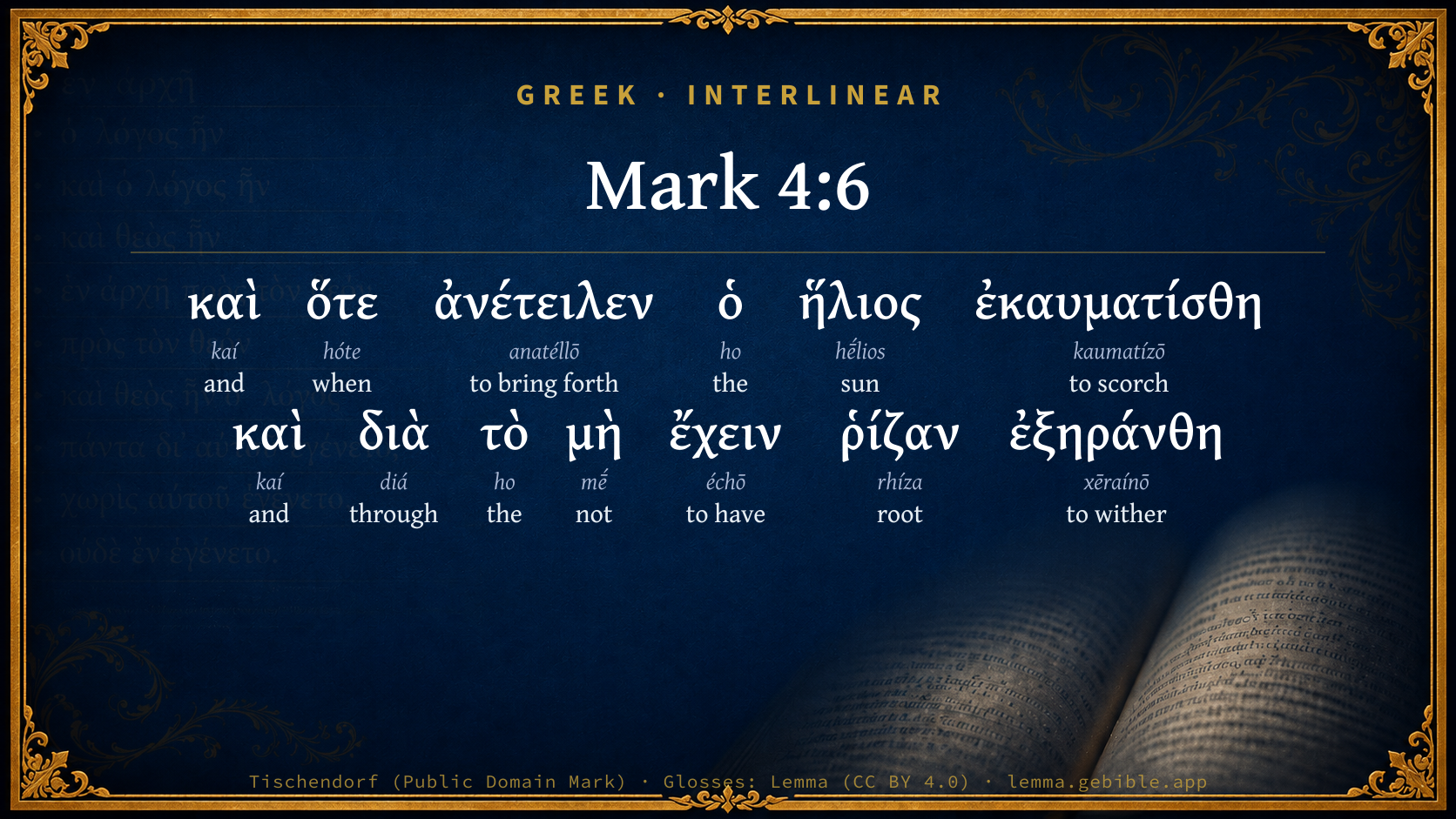
When the sun had risen, it was scorched; and because it had no root, it withered away.
Download a study sheet
One document with this verse’s original text, its word-by-word gloss line, the meaning frame, cross-references with their text, attributed commentary, and full source and license credits — printable, and it pastes into notes with its structure intact.
This verse Autodidact and up
A passage Seminary Student
Up to 50 verses in one chapter. A passage sheet keeps up to 6 commentary sources and 12 cross-references per verse, in the order this page ranks them, and says so on the sheet whenever that leaves anything out. Ask for a single verse and you get the Autodidact verse sheet above.
Everything on this page stays free to read, with no account — the sheet is a download of what is already on screen, not access to it.
Compare translations 3
The same verse in 3 English versions, stacked beneath the original-language interlinear above. Click any original word for its lexicon entry.
Each is an independent rendering of the whole verse — the interlinear is not word-aligned to these translations.
Highlighted words mark where these versions differ — a whole-verse word diff, not a word-by-word alignment.
-
World English Bible Public Domain
When the sun had risen, it was scorched; and because it had no root, it withered away.
-
King James Version Public Domain
But when the sun was up, it was scorched; and because it had no root, it withered away.
-
unfoldingWord Literal Text CC BY-SA 4.0
And when the sun rose, it was scorched, and because it had no root, it withered.
unfoldingWord Literal Text — © unfoldingWord, licensed CC BY-SA 4.0. Word-aligned USFM3 via Door43 (git.door43.org/unfoldingWord/en_ult).
Show all 19 translations
Every available English version of this verse, each an independent rendering of the whole verse.
-
World English Bible Public Domain
When the sun had risen, it was scorched; and because it had no root, it withered away.
-
Berean Standard Bible Public Domain
But when the sun rose, the seedlings were scorched, and they withered because they had no root.
-
Majority Standard Bible Public Domain
But when the sun rose, the seedlings were scorched, and they withered because they had no root.
-
King James Version Public Domain
But when the sun was up, it was scorched; and because it had no root, it withered away.
-
American Standard Version (1901) Public Domain
and when the sun was risen, it was scorched; and because it had no root, it withered away.
-
Revised Version (1885) Public Domain
and when the sun was risen, it was scorched; and because it had no root, it withered away.
-
Geneva Bible (1599) Public Domain
But assoone as ye Sunne was vp, it was burnt vp, and because it had not roote, it withered away.
-
Douay-Rheims (1899) Public Domain
And when the sun was risen, it was scorched; and because it had no root, it withered away.
-
Young's Literal Translation Public Domain
and the sun having risen, it was scorched, and because of not having root it did wither;
-
Literal Standard Version CC BY-SA 4.0
and the sun having risen, it was scorched, and because of having no root it withered;
-
Unlocked Literal Bible CC BY-SA 4.0
But when the sun rose, the plants were scorched, and because they had no root, they dried up.
-
unfoldingWord Literal Text CC BY-SA 4.0
And when the sun rose, it was scorched, and because it had no root, it withered.
-
Darby Bible Public Domain
and when the sun arose it was burnt up, and because of its not having any root, it withered.
-
World Messianic Bible Public Domain
When the sun had risen, it was scorched; and because it had no root, it withered away.
-
Webster's Bible Public Domain
But when the sun had risen, it was scorched; and because it had no root, it withered away.
-
Free Bible Version CC BY-SA 4.0
they were scorched when the sun came up. Since they didn't have any real roots, they soon withered.
-
Bible in Basic English Public Domain
And when the sun was high, it was burned; and because it had no root, it became dry and dead.
-
Text-Critical English NT CC BY 4.0
But when the sun rose, it was scorched; and because it had no root, it withered away.
-
Tyndale New Testament (1534) Public Domain
but as sone as the sunne was vp it caught heet and because it had not rotynge wyddred awaye.
Literal Standard Version (2020), Covenant Press — licensed CC BY-SA 4.0. Text via the HelloAO Bible API (eBible.org). Unlocked Literal Bible (unfoldingWord) — licensed CC BY-SA 4.0. Text via the HelloAO Bible API (eBible.org). unfoldingWord Literal Text — © unfoldingWord, licensed CC BY-SA 4.0. Word-aligned USFM3 via Door43 (git.door43.org/unfoldingWord/en_ult). Free Bible Version, Dr. Jonathan Gallagher — licensed CC BY-SA 4.0. Text via the HelloAO Bible API (eBible.org).
Word by word
More ways to search: Search by grammar → Find every occurrence → Compare this word →
Practice this passage: Drill this verse → Learn its vocabulary →
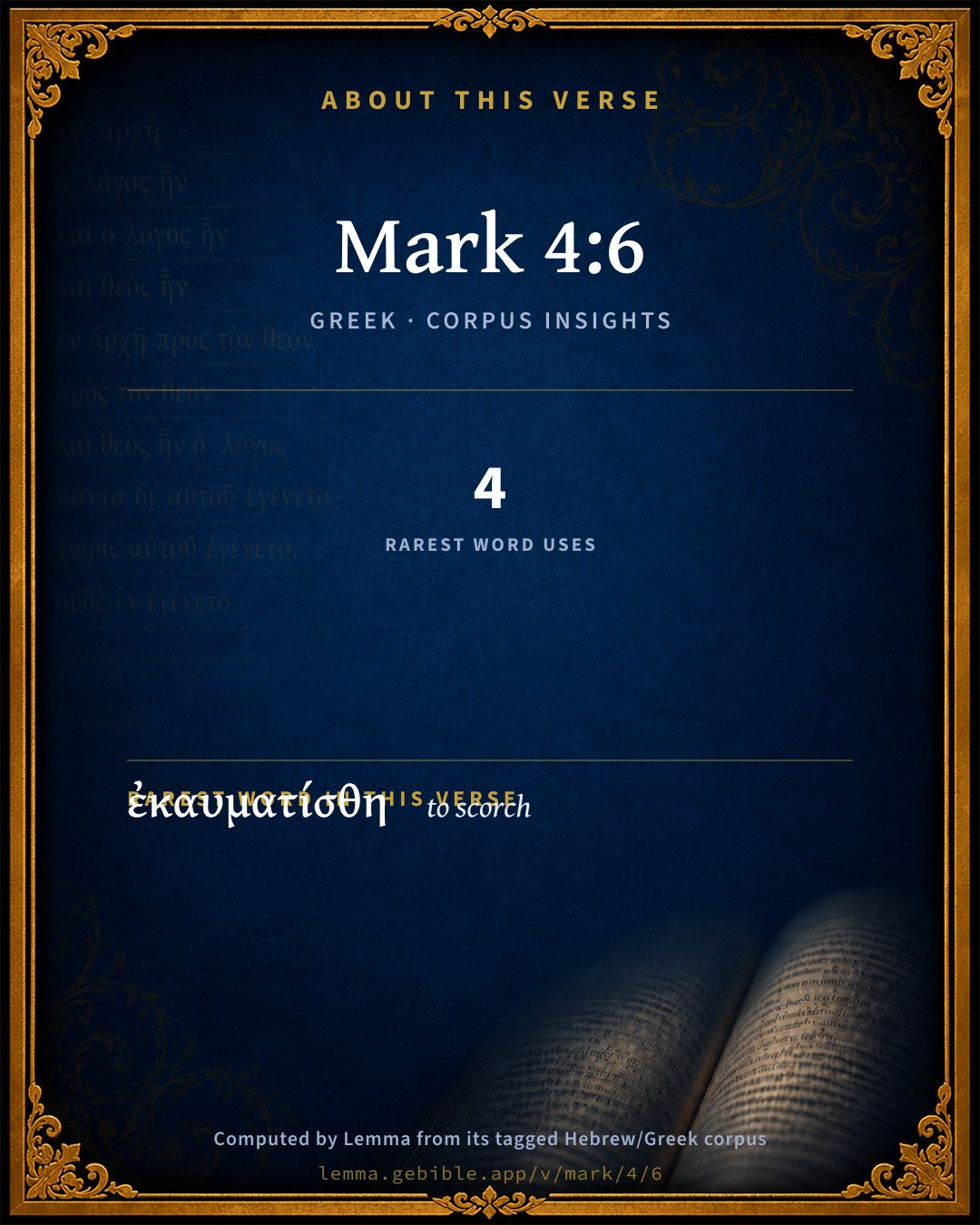
- Appears 4× in the Greek New Testament
- First appears at Matthew 13:6
- Part of Speech
- Verb
- Tense
- Aorist
- Voice
- Passive
- Mood
- Indicative
- Person
- 3rd person
- Number
- Singular
Full Thayer's Definition
- καὶ kaí G2532 “and” Conjunction
- ὅτε hóte G3753 “when” Adverb
- ἀνέτειλεν anatéllō G393 “to bring forth” Verb, Aorist, Active, Indicative, 3rd person, Singular
- ὁ ho G3588 “the” Article, Nominative, Singular, Masculine
- ἥλιος hḗlios G2246 “sun” Noun, Nominative, Singular, Masculine
- ἐκαυματίσθη kaumatízō G2739 “to scorch” Verb, Aorist, Passive, Indicative, 3rd person, Singular
- καὶ kaí G2532 “and” Conjunction
- διὰ diá G1223 “through” Preposition
- τὸ ho G3588 “the” Article, Accusative, Singular, Neuter
- μὴ mḗ G3361 “not” Particle, Negative
- ἔχειν échō G2192 “to have” Verb, Present, Active, Infinitive
- ῥίζαν rhíza G4491 “root” Noun, Accusative, Singular, Feminine
- ἐξηράνθη xēraínō G3583 “to wither” Verb, Aorist, Passive, Indicative, 3rd person, Singular
About this verse
These counts appear in no published source. They are computed here, from the morphology-tagged text and Lemma’s own curated glosses. What Lemma adds →
- 13
- words
- 11
- distinct lemmas
- Gospels
- section
Cross-references
12Topical passages linked to Mark 4:6 in the Treasury of Scripture Knowledge — connected by theme and wording, ordered by reader-vote popularity; previews shown in the World English Bible.
- Jeremiah 17:5–8 Thus says Yahweh: Cursed is the man who trusts in man, and makes flesh his arm, and whose heart departs from Yahweh.
- Jonah 4:8 It happened, when the sun arose, that God prepared a sultry east wind; and the sun beat on Jonah's head, so that he fainted, and requested for himself that he might die, and said, "It is better for me to die than to live."
- James 1:11 For the sun arises with the scorching wind, and withers the grass, and the flower in it falls, and the beauty of its appearance perishes. So also will the rich man fade away in his pursuits.
- Psalms 1:3–4 He will be like a tree planted by the streams of water, That brings forth its fruit in its season, Whose leaf also does not wither. Whatever he does shall prosper.
- Psalms 92:13–15 They are planted in Yahweh's house. They will flourish in our God's courts.
- Isaiah 25:4 For you have been a stronghold to the poor, a stronghold to the needy in his distress, a refuge from the storm, a shade from the heat, when the blast of the awesome ones is as a storm against the wall.
- Ephesians 3:17 that Christ may dwell in your hearts through faith; to the end that you, being rooted and grounded in love,
- Colossians 2:7 rooted and built up in him, and established in the faith, even as you were taught, abounding in it in thanksgiving.
- 2 Thessalonians 2:10 and with all deception of wickedness for those who are being lost, because they didn't receive the love of the truth, that they might be saved.
- Jude 1:12 These are hidden rocky reefs in your love feasts when they feast with you, shepherds who without fear feed themselves; clouds without water, carried along by winds; autumn leaves without fruit, twice dead, plucked up by the roots;
- Revelation 7:16 They will never be hungry, neither thirsty any more; neither will the sun beat on them, nor any heat;
- Song of Solomon 1:6 Don't stare at me because I am dark, Because the sun has scorched me. My mother's sons were angry with me. They made me keeper of the vineyards. I haven't kept my own vineyard.
Cross-references courtesy of OpenBible.info (CC BY 4.0).
Where the printed editions differ
1 variantPlaces in this verse where the major printed Greek editions disagree on the wording in a way that affects the translation — a comparison of editions, not a manuscript-by-manuscript collation. The editions are the modern critical texts (Nestlé-Aland 28/27, SBL, Westcott-Hort, Tregelles, Tyndale House) and the traditional texts behind the KJV (the Textus Receptus and the Byzantine/Majority text). It is not a claim about which reading is original.
-
Extra text
ὅτε
“after”
In NA28NA27TynSBLWHTreg Not in TRByzὅτε (hote) 'after' is only in older manuscripts (NA28+NA27+Tyn+SBL+WH+Treg)
Textual data: Translators Amalgamated Greek New Testament (STEPBible TAGNT) · CC BY 4.0.
Lesson kit
Teaching starters — assembled from the data on this page, not authored interpretation. Every prompt links to the verse data it draws on. Edit before teaching.
Mark, in the Gospels, opens this verse with 13 words (11 distinct Greek lemmas). Its most distinctive word is kaumatízō (“to scorch”). A historical commentator’s framing appears above. Read the whole chapter for the surrounding context.
Discussion questions
- How does “to scorch” (kaumatízō) shape what this verse is saying?
- How does Matthew 13:6, which shares the word «to scorch», read alongside this verse?
- What does the repetition of “and” (2× in this one verse) do in this verse?
- These translations render this verse differently. What is at stake in choosing one wording over another?
- Compare how The Cambridge Bible for Schools and Colleges and John Gill's Exposition read this verse. Where do they agree or differ?
Things to notice
- These translations choose different wording for 4 words in this verse.
- “and” occurs 2× in this single verse.
- 11 distinct Greek lemmas span 13 words in this verse.
Commentary
Notes on Mark 4:6 from classic Christian and Jewish commentators (each source and its license shown beneath its notes). The classic Christian expositions comment on the surrounding passage and are grouped to its opening verse, so a note may address several verses; the Jewish commentaries on the Tanakh (Rashi and others) are per-verse, so they appear only where the commentator wrote on this verse.
Lemma curates 59 commentaries, every one of them public domain or Creative Commons licensed, each selected and text-cleaned for this edition rather than reprinted as found. About our sources →
The Cambridge Bible for Schools and Colleges
gen. ed. J. J. S. Perowne
The Cambridge Bible for Schools and Colleges (gen. ed. J. J. S. Perowne; Cambridge University Press, 1878–1918) — public domain. Text from a community e-Sword module.
John Gill's Exposition
John Gill's Exposition of the Whole Bible (1746–1763) — public domain (CC PDM 1.0). Text via the HelloAO Bible API.
Trapp's Complete Commentary
John Trapp
John Trapp, A Commentary or Exposition upon All the Books of the Old and New Testament (1647–1656) — public domain. Text from a community e-Sword module.
unfoldingWord translationNotes
Door43 World Missions Community
unfoldingWord translationNotes — © Distant Shores Media and the Door43 World Missions Community, licensed CC BY-SA 4.0. Source: git.door43.org/Door43/en_tn.
International Critical Commentary
International Critical Commentary — older volumes (1896–1929), various authors — public domain. Text from a community e-Sword module.