Matthew 24:6

Greek (Tischendorf 8th ed.) Matthew 24:6 appears in the Greek New Testament. The text above is from the Tischendorf 8th edition. Each word links to its Strong’s number and a concise gloss. Click any word for its full Thayer’s Greek Lexicon entry.
Download image
Cite this verse

Matthew 24:6 (World English Bible). Public Domain. Lemma interlinear Bible study tool, https://lemma.gebible.app/v/matthew/24/6.

Show BibTeX & RIS
BibTeX
RIS
English Translation
You will hear of wars and rumors of wars. See that you aren't troubled, for all this must happen, but the end is not yet.
World English Bible · Public Domain
Highlights
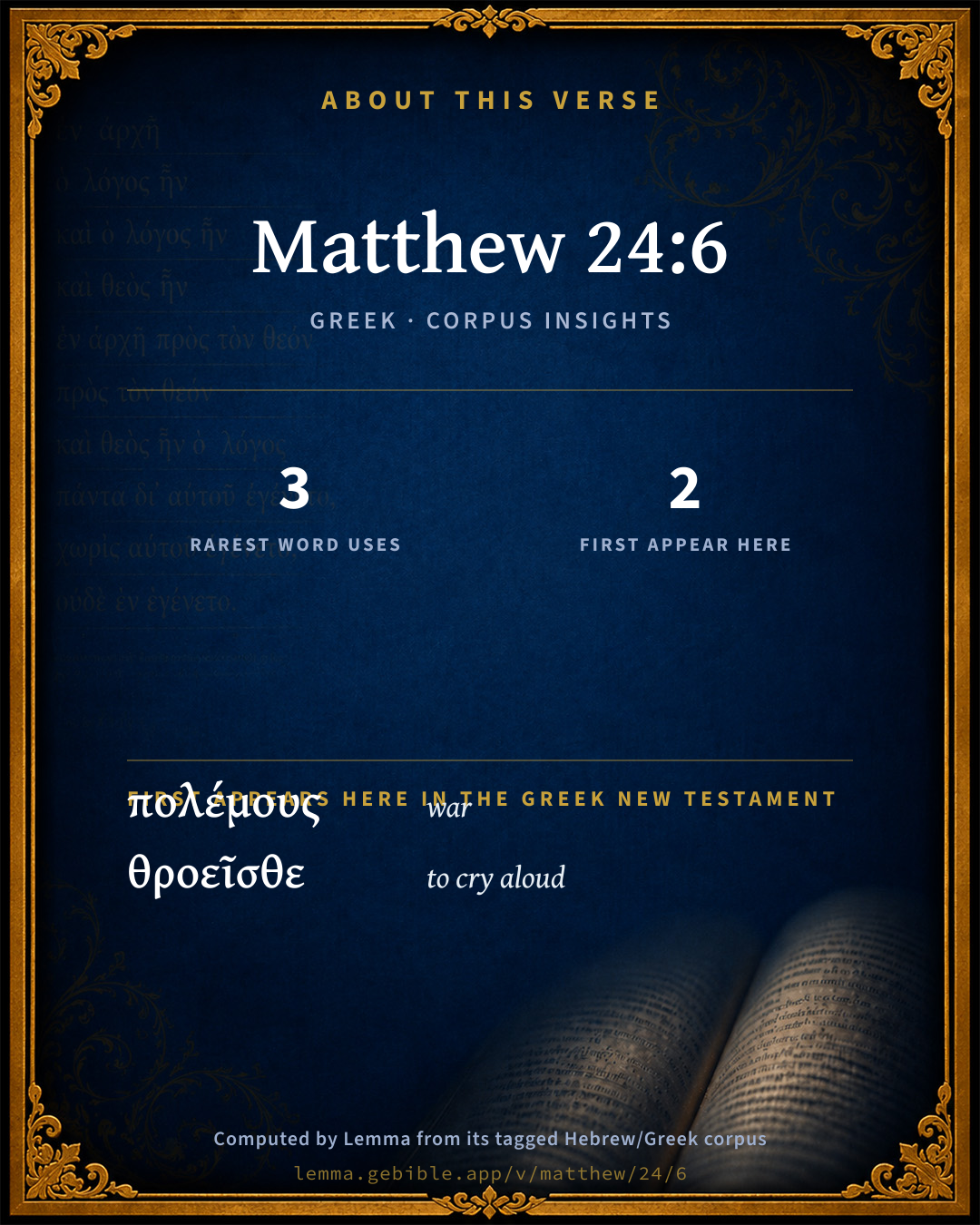
  • 2 first appearances in the Greek New Testament
Full analysis ↓
Download a study sheet

One document with this verse’s original text, its word-by-word gloss line, the meaning frame, cross-references with their text, attributed commentary, and full source and license credits — printable, and it pastes into notes with its structure intact.

This verse Autodidact and up

Study sheet (.html) Plain text (.txt)

A passage Seminary Student

Up to 50 verses in one chapter. A passage sheet keeps up to 6 commentary sources and 12 cross-references per verse, in the order this page ranks them, and says so on the sheet whenever that leaves anything out. Ask for a single verse and you get the Autodidact verse sheet above.

Everything on this page stays free to read, with no account — the sheet is a download of what is already on screen, not access to it.

Want to remove ads? Support Godless Engineer
Compare translations 3

The same verse in 3 English versions, stacked beneath the original-language interlinear above. Click any original word for its lexicon entry.

Each is an independent rendering of the whole verse — the interlinear is not word-aligned to these translations.

Highlighted words mark where these versions differ — a whole-verse word diff, not a word-by-word alignment.

  • World English Bible Public Domain
    You will hear of wars and rumors of wars. See that you aren't troubled, for all this must happen, but the end is not yet.
  • King James Version Public Domain
    And ye shall hear of wars and rumours of wars: see that ye be not troubled: for all these things must come to pass, but the end is not yet.
  • unfoldingWord Literal Text CC BY-SA 4.0
    And you are going to hear of wars and rumors of wars. See that you are not troubled, for it is necessary to happen, but the end is not yet.

unfoldingWord Literal Text — © unfoldingWord, licensed CC BY-SA 4.0. Word-aligned USFM3 via Door43 (git.door43.org/unfoldingWord/en_ult).

Versions to compare (up to 4)

3 of 4 selected

Show all 19 translations

Every available English version of this verse, each an independent rendering of the whole verse.

  • World English Bible Public Domain
    You will hear of wars and rumors of wars. See that you aren't troubled, for all this must happen, but the end is not yet.
  • Berean Standard Bible Public Domain
    You will hear of wars and rumors of wars, but see to it that you are not alarmed. These things must happen, but the end is still to come.
  • Majority Standard Bible Public Domain
    You will hear of wars and rumors of wars, but see to it that you are not alarmed. All these things must happen, but the end is still to come.
  • King James Version Public Domain
    And ye shall hear of wars and rumours of wars: see that ye be not troubled: for all these things must come to pass, but the end is not yet.
  • American Standard Version (1901) Public Domain
    And ye shall hear of wars and rumors of wars; see that ye be not troubled: for `these things' must needs come to pass; but the end is not yet.
  • Revised Version (1885) Public Domain
    And ye shall hear of wars and rumours of wars: see that ye be not troubled: for these things must needs come to pass; but the end is not yet.
  • Geneva Bible (1599) Public Domain
    And ye shall heare of warres, and rumours of warres: see that ye be not troubled: for all these things must come to passe, but the end is not yet.
  • Douay-Rheims (1899) Public Domain
    And you shall hear of wars and rumours of wars. See that ye be not troubled. For these things must come to pass, but the end is not yet.
  • Young's Literal Translation Public Domain
    and ye shall begin to hear of wars, and reports of wars; see, be not troubled, for it behoveth all `these' to come to pass, but the end is not yet.
  • Literal Standard Version CC BY-SA 4.0
    and you will begin to hear of wars, and reports of wars; see, do not be troubled, for it is necessary for all [these] to come to pass, but the end is not yet.
  • Unlocked Literal Bible CC BY-SA 4.0
    You will hear of wars and reports of wars. See that you are not troubled, for these things must happen; but the end is not yet.
  • unfoldingWord Literal Text CC BY-SA 4.0
    And you are going to hear of wars and rumors of wars. See that you are not troubled, for it is necessary to happen, but the end is not yet.
  • Darby Bible Public Domain
    But ye will hear of wars and rumours of wars. See that ye be not disturbed; for all [these things] must take place, but it is not yet the end.
  • World Messianic Bible Public Domain
    You will hear of wars and rumors of wars. See that you aren’t troubled, for all this must happen, but the end is not yet.
  • Webster's Bible Public Domain
    And ye will hear of wars, and rumors of wars: see that ye be not troubled: for all these things must come to pass, but the end is not yet.
  • Free Bible Version CC BY-SA 4.0
    You'll hear about wars, and rumors about wars, but don't be anxious. These things have to happen, but this isn't the end.
  • Bible in Basic English Public Domain
    And news will come to you of wars and talk of wars: do not be troubled, for these things have to be; but it is still not the end.
  • Text-Critical English NT CC BY 4.0
    You will hear of wars and rumors of wars. Do not be alarmed, for all these things must take place, but the end is not yet.
  • Tyndale New Testament (1534) Public Domain
    Ye shall heare of warres and of the fame of warres: but se that ye be not troubled. For all these thinges must come to passe but the ende is not yet.

Literal Standard Version (2020), Covenant Press — licensed CC BY-SA 4.0. Text via the HelloAO Bible API (eBible.org). Unlocked Literal Bible (unfoldingWord) — licensed CC BY-SA 4.0. Text via the HelloAO Bible API (eBible.org). unfoldingWord Literal Text — © unfoldingWord, licensed CC BY-SA 4.0. Word-aligned USFM3 via Door43 (git.door43.org/unfoldingWord/en_ult). Free Bible Version, Dr. Jonathan Gallagher — licensed CC BY-SA 4.0. Text via the HelloAO Bible API (eBible.org).

Word by word

More ways to search: Search by grammar → Find every occurrence → Compare this word →

Practice this passage: Drill this verse → Learn its vocabulary →

θροεῖσθε
throéō
G2360
“to cry aloud”
Verb, Present, Passive, Imperative, 2nd person, Plural
Part of Speech
Verb
Tense
Present
Voice
Passive
Mood
Imperative
Person
2nd person
Number
Plural
Full Thayer's Definition

Origin: from threomai to wail

TDNT: None

1. to cry aloud, make a noise by outcry a. in the NT, to trouble, frighten b. to be troubled in mind, to be frightened, alarmed
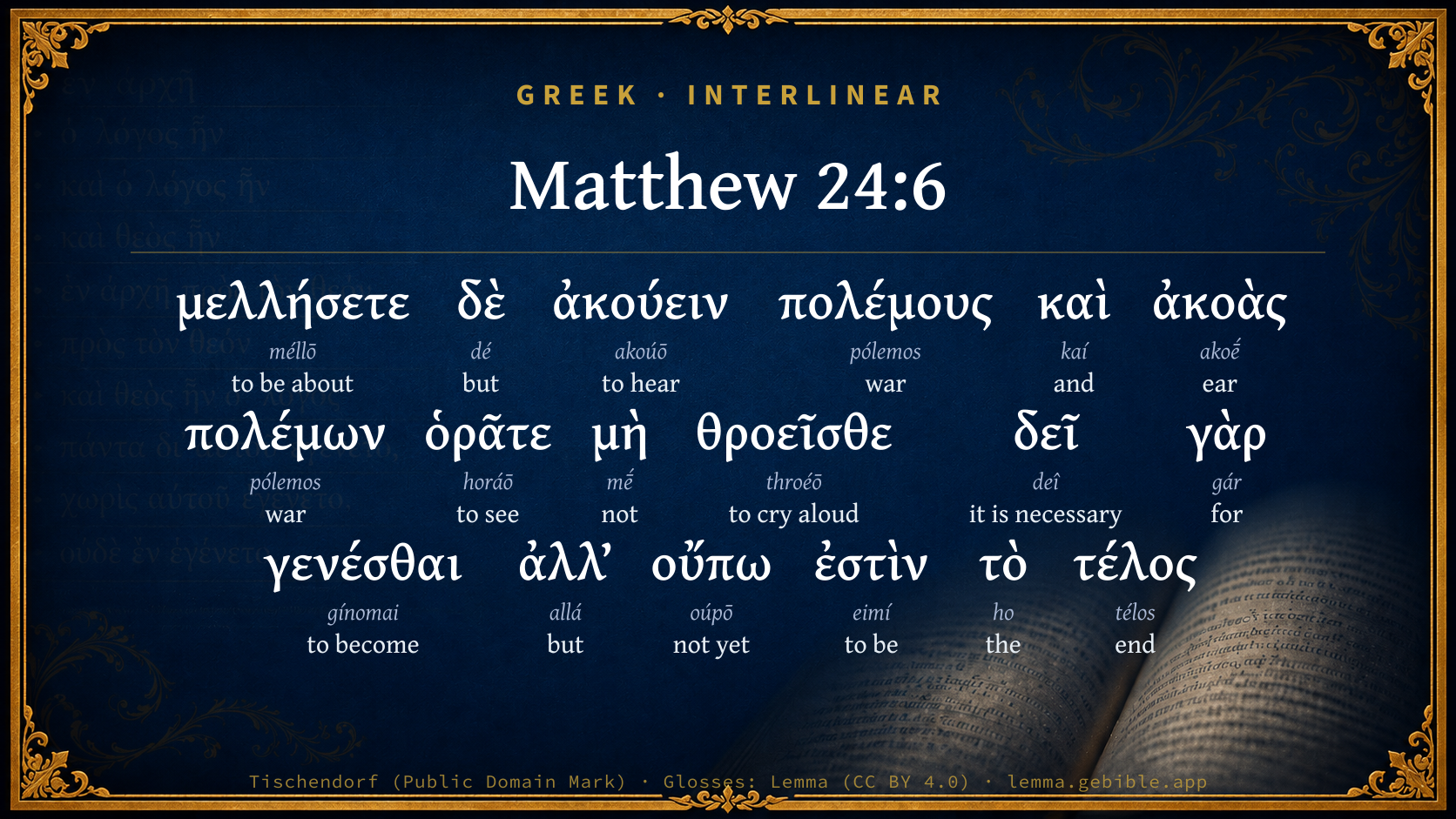
  1. μελλήσετε méllō G3195 “to be about” Verb, Future, Active, Indicative, 2nd person, Plural
  2. δὲ dé G1161 “but” Conjunction
  3. ἀκούειν akoúō G191 “to hear” Verb, Present, Active, Infinitive
  4. πολέμους pólemos G4171 “war” Noun, Accusative, Plural, Masculine
  5. καὶ kaí G2532 “and” Conjunction
  6. ἀκοὰς akoḗ G189 “ear” Noun, Accusative, Plural, Feminine
  7. πολέμων pólemos G4171 “war” Noun, Genitive, Plural, Masculine
  8. ὁρᾶτε horáō G3708 “to see” Verb, Present, Active, Imperative, 2nd person, Plural
  9. μὴ mḗ G3361 “not” Particle, Negative
  10. δεῖ deî G1163 “it is necessary” Verb, Present, Active, Indicative, 3rd person, Singular
  11. γὰρ gár G1063 “for” Conjunction
  12. γενέσθαι gínomai G1096 “to become” Verb, Aorist, Middle deponent, Infinitive
  13. ἀλλ’ allá G235 “but” Conjunction
  14. οὔπω oúpō G3768 “not yet” Adverb, Negative
  15. ἐστὶν eimí G1510 “to be” Verb, Present, Active, Indicative, 3rd person, Singular
  16. τὸ ho G3588 “the” Article, Nominative, Singular, Neuter
  17. τέλος télos G5056 “end” Noun, Nominative, Singular, Neuter

About this verse

These counts appear in no published source. They are computed here, from the morphology-tagged text and Lemma’s own curated glosses. What Lemma adds →

18
words
17
distinct lemmas
Gospels
section

Notable vocabulary

The rarest word here is θροεῖσθε to cry aloud G2360 — appearing just 3 times in the whole Greek New Testament.

First appearance in Scripture

These words make their first canonical appearance in the Greek New Testament here:

  • πολέμους war G4171
  • θροεῖσθε to cry aloud G2360

Shared distinctive vocabulary

θροεῖσθε to cry aloud G2360 occurs in 3 verses of the Greek New Testament. Also found in:

Repetition

A word recurs within this verse:

  • πολέμους war G4171 ×2

Cross-references

29

Topical passages linked to Matthew 24:6 in the Treasury of Scripture Knowledge — connected by theme and wording, ordered by reader-vote popularity; previews shown in the World English Bible.

  • Mark 13:7–8 "When you hear of wars and rumors of wars, don't be troubled. For those must happen, but the end is not yet.
  • Luke 21:9 When you hear of wars and disturbances, don't be terrified, for these things must happen first, but the end won't come immediately."
  • 1 Peter 3:14–15 But even if you should suffer for righteousness' sake, you are blessed. "Don't fear what they fear, neither be troubled."
  • Isaiah 8:12–14 Don't you say, "A conspiracy!" concerning all about which this people shall say, "A conspiracy!" neither fear their fear, nor be in dread [of it].
  • John 14:1 "Don't let your heart be troubled. Believe in God. Believe also in me.
  • Psalms 46:1–3 God is our refuge and strength, A very present help in trouble.
  • Psalms 112:7 He will not be afraid of evil news. His heart is steadfast, trusting in Yahweh.
  • John 14:27 Peace I leave with you. My peace I give to you; not as the world gives, give I to you. Don't let your heart be troubled, neither let it be fearful.
  • 2 Thessalonians 2:2 not to be quickly shaken in your mind, nor yet be troubled, either by spirit, or by word, or by letter as from us, saying that the day of Christ had come.
  • Matthew 24:14 This Gospel of the Kingdom will be preached in the whole world for a testimony to all the nations, and then the end will come.
  • Habakkuk 3:16–18 I heard, and my body trembled. My lips quivered at the voice. Rottenness enters into my bones, and I tremble in my place, Because I must wait quietly for the day of trouble, For the coming up of the people who invade us.
  • Luke 21:19 By your endurance you will win your lives.
  • Psalms 27:1–3 Yahweh is my light and my salvation. Whom shall I fear? Yahweh is the strength of my life. Of whom shall I be afraid?
  • Isaiah 12:2 Behold, God is my salvation. I will trust, and will not be afraid; for Yah, Yahweh, is my strength and song; and he has become my salvation."
  • Isaiah 26:3–4 You will keep [him] in perfect peace, [whose] mind [is] stayed [on you]; because he trusts in you.
  • Isaiah 26:20–21 Come, my people, enter you into your chambers, and shut your doors about you: hide yourself for a little moment, until the indignation be past.
  • Ezekiel 7:24–26 Therefore I will bring the worst of the nations, and they shall possess their houses: I will also make the pride of the strong to cease; and their holy places shall be profaned.
  • Ezekiel 14:17–21 Or if I bring a sword on that land, and say, Sword, go through the land; so that I cut off from it man and animal;
  • Ezekiel 21:9–15 Son of man, prophesy, and say, Thus says Yahweh: Say, A sword, a sword, it is sharpened, and also furbished;
  • Ezekiel 21:28 You, son of man, prophesy, and say, Thus says the Lord Yahweh concerning the children of Ammon, and concerning their reproach; and say you, A sword, a sword is drawn, for the slaughter it is furbished, to cause it to devour, that it may be as lightning;
  • Matthew 26:54 How then would the Scriptures be fulfilled that it must be so?"
  • Luke 22:37 For I tell you that this which is written must still be fulfilled in me: 'He was counted with the lawless.' For that which concerns me has an end."
  • Jeremiah 4:19–22 My anguish, my anguish! I am pained at my very heart; my heart is disquieted in me; I can't hold my peace; because you have heard, O my soul, the sound of the trumpet, the alarm of war.
  • Jeremiah 6:22–24 Thus says Yahweh, Behold, a people comes from the north country; and a great nation shall be stirred up from the uttermost parts of the earth.
  • Jeremiah 8:15–16 We looked for peace, but no good came; [and] for a time of healing, and, behold, dismay!
  • Daniel 11:1–45 "As for me, in the first year of Darius the Mede, I stood up to confirm and strengthen him.
  • Acts 27:24–26 saying, 'Don't be afraid, Paul. You must stand before Caesar. Behold, God has granted you all those who sail with you.'
  • Jeremiah 47:6 You sword of Yahweh, how long will it be before you be quiet? put up yourself into your scabbard; rest, and be still.
  • Daniel 9:24–27 Seventy weeks are decreed on your people and on your holy city, to finish disobedience, and to make an end of sins, and to make reconciliation for iniquity, and to bring in everlasting righteousness, and to seal up vision and prophecy, and to anoint the most holy.

Cross-references courtesy of OpenBible.info (CC BY 4.0).

Commentary

Notes on Matthew 24:6 from classic Christian and Jewish commentators (each source and its license shown beneath its notes). The classic Christian expositions comment on the surrounding passage and are grouped to its opening verse, so a note may address several verses; the Jewish commentaries on the Tanakh (Rashi and others) are per-verse, so they appear only where the commentator wrote on this verse.

Lemma curates 59 commentaries, every one of them public domain or Creative Commons licensed, each selected and text-cleaned for this edition rather than reprinted as found. About our sources →

The Biblical Illustrator

Joseph S. Exell

Mat_24:6

But the end is not yet.

The end is not yet

I. So far as we have any means of judging, the end is not yet. The negative argument is that there are no conclusive indications of a speedy end, afforded either by the Word of God or the condition of the world. Such are alleged, but rest upon gratuitous assumptions. It is assumed that a certain form or pitch of moral depravation is incompatible with the continued existence of society; but we do not know how much evil is necessary to the end in question. The same is true as to the predictions of the Word of God; they may not be sure signs. Experience renders this clear; all these signs have been misapplied before. Let us look at the positive arguments in favour of the same position; that the fulfilment of Scripture is still incomplete, and will require a long time for its completion. Refer to the grand and comprehensive scale on which the Divine purposes are projected in the Scripture. The language of the Bible indicates a long continued process of change and dissolution. The spread of the gospel; the general vindication of Scriptures from doubt; to exhibit society in its normal state, and the effects of holiness as compared with sin; all will take ages.

II. It is better to assume that the end is not yet, than to assume the contrary.

1. The doubt in which Scripture leaves the day creates a presumption that it was not meant to influence our conduct by the expectation of this great event as just at hand. The expectation of a speedy end would paralyze effort, while the opposite belief invigorates it.

2. No less dissimilar is the effect of these two causes in relation to the credit and authority of Scripture. The constant failure of the predicted signs discredits Scripture.

3. The preparation for death is not secured by a belief in the approach of the great final catastrophe. If men are unprepared to die, they will be as much surprised by death as by the coming of the end. Let us prepare to die and thus prepare to live. The end is not yet. Let us not imagine our work done. (J. A. Alexander, D. D.)

The magnitude of the Divine purpose indicates the end of the world as far distant

The natural impression made, perhaps, on all unbiassed readers is, that in the Bible there are vast beginnings, which require proportionate conclusions, even in the present life. There are germs which were never meant to be developed in the stunted shrub, but in the spreading oak. There are springs, in tracing which we cannot stop short at the brook or even at the river, but are hurried on, as if against our will, to the lake, the estuary, and the ocean. Every such reader of the Bible feels that it conducts him to the threshold of a mighty pile, and opens many doors, through which he gets a distant glimpse of long-drawn aisles, vast halls, and endless passages; and how can he believe that this glimpse is the last that he shall see, and that the edifice itself is to be razed before he steps across the threshold? (J. A. Alexander, D. D.)

The Biblical Illustrator, edited by Joseph S. Exell (c. 1880s–1900s) — public domain. Text from a community e-Sword module.

Joseph Benson's Commentary

Mat 24:6-8. And ye shall hear of wars, &c. — This is the second sign. That there were wars and rumours of wars, appears by all the historians of those times, and above all by Josephus. To relate the particulars would be to transcribe a great part of his history of the Jewish wars. There were more especially rumours of wars when Caligula, the Roman emperor, ordered his statue to be set up in the temple at Jerusalem, which the Jews refused to suffer, and persisted in their refusal: and having therefore reason to apprehend a war from the Romans, were in such a consternation, that they omitted even the tilling of their lands. But this storm was soon blown over, and their fear dissipated by the timely death of that emperor. For nation shall rise against nation, &c. — Here Christ declares that greater disturbances than those which happened under Caligula, should fall out in the latter times of Claudius, and in the reign of Nero. The rising of nation against nation portended the dissensions, insurrections, and mutual slaughters of the Jews, and those of other nations, who dwelt in the same cities together; as particularly at Cesarea, where the Jews and Syrians contended about the right of the city, which contention at length proceeded so far that above twenty thousand Jews were slain, and the city was cleared of the Jewish inhabitants. At this blow the whole nation of the Jews was exasperated; and, dividing themselves into parties, they burned and plundered the neighbouring cities and villages of the Syrians, and made an immense slaughter of the people. The Syrians, in revenge, destroyed not a less number of Jews, and every city was divided into two armies. At Scythopolis the inhabitants compelled the Jews who resided among them to fight against their own countrymen, and, after the victory, basely setting upon them by night, murdered above thirteen thousand of them, and spoiled their goods. At Ascalon they killed two thousand five hundred; at Ptolemais two thousand, and made not a few prisoners. The Tyrians put many to death, and imprisoned more. The people of Gadara did likewise; and all the other cities of Syria, in proportion as they hated or feared the Jews. At Alexandria the old enmity was revived between the Jews and heathen, and many fell on both sides, but of the Jews to the number of fifty thousand. The people of Damascus, too, conspired against the Jews of the same city, and, assaulting them unarmed, killed ten thousand of them. The rising of kingdom against kingdom portended the open wars of different tetrarchies and provinces against one another: as that of the Jews who dwelt in Peræa against the people of Philadelphia, concerning their bounds, while Cuspius Fadus was procurator; and that of the Jews and Galileans against the Samaritans, for the murder of some Galileans going up to the feast at Jerusalem, while Cumanus was procurator; and that of the whole nation of the Jews against the Romans and Agrippa, and other allies of the Roman empire. But there was not only sedition and civil war throughout Judea, but likewise in Italy, Otho and Vitellius contending for the empire. There shall be famines and pestilences — The third sign. There were famines, as particularly that prophesied of by Agabus, and mentioned Act 11:28; and by Suetonius, and other profane historians referred to by Eusebius, which came to pass in the days of Claudius Cesar, and was so severe at Jerusalem, that many perished for want of victuals — And pestilences, the usual attendants upon famine. Scarcity and badness of provisions almost always end in some epidemical distemper. Many died by reason of the famine in the reign of Claudius: and when Niger was killed by the Jewish zealots, he imprecated, besides other calamities, famine and pestilence upon them, (λιμοντε και λοιμον, the very words used by the evangelist,) all which, says Josephus, God ratified and brought to pass against the ungodly — And earthquakes in divers places — The fourth sign. In the time of Claudius and Nero there were great earthquakes at Smyrna, Miletus, Chios, Samos, Laodicea, Hierapolis, and Colosse; in Crete also and Campania, and one at Rome in the reign of Galba. In Judea, likewise, there were judgments of the same kind. For Josephus tells us, Bell., 4. cap. 4, “There happened a most terrible tempest and violent winds, with the most vehement showers, and continual lightnings, and horrid thunderings, and prodigious bellowings of the shaken earth;” so that many were led to believe that these things portended no common calamity. St. Luke mentions a fifth sign, namely, Fearful sights and great signs from heaven, Luk 21:11; where see the notes, as also on Isa 66:6. All these are the beginning of sorrows — Gr. ωδινων, a word which is properly used of the pains of travailing women. As if he had said, All these are only the first pangs and throes; and are nothing to that hard labour that shall follow.

Joseph Benson's Commentary on the Old and New Testaments (1811–1818) — public domain. Text from a community e-Sword module.

Tyndale Open Study Notes

Tyndale Open Resources

24:6 these things must take place: Tumultuous times are part of God’s sovereign plan as he brings history to a close (see 24:7, 29-30; 2 Thes 2:8-12). • The end could refer to the close of an epoch (such as at AD 70) or the end of human history as we now know it (cp. Matt 24:13-14; see also 10:22; 13:39-40, 49).

Tyndale Open Study Notes — © Tyndale Open Resources, licensed CC BY-SA 4.0. Text via the HelloAO Bible API.

Bengel's Gnomon

Johann Albrecht Bengel

Mat 24:6. Μελλήσετε δὲ ἀκούειν, but ye shall be about to hear) A compound future. The writings of the Evangelists having been published before the fulfilment of this prediction, were greatly confirmed when it took place. About to hear: Christians rather hear of than wage wars.—πολέμους, wars) sc. close at hand.—ἀκοὰς πολέμων, rumours of wars) sc. at a distance.—μὴ θροεῖσθε, be ye not troubled) A case of metonymy of the antecedent; i.e. do not immediately take to flight. The verb θροέομαι (to be troubled) is peculiarly appropriate in this place, for θρόος[1034] is from θρέω,[1035] which signifies σὺν θορύβῳ βοῶ ἢ λαλῶ, i.e. to cry, or speak with tumult.—δεῖ γὰρ πάντα γένεσθαι, for all these things must come to pass) This is the ground of the believer’s tranquility.—οὔπω, not yet) The godly are always prone to think that evils have reached their utmost limit: therefore they are warned.—τὸ τέλος, the end) mentioned in Mat 24:2; Mat 24:14, is not yet; nor is it yet time to fly; see Mat 24:15; Mat 24:18; Luk 21:20-21. The beginning is only mentioned in Mat 24:8.

[1034] A noise as of many voices, … a murmuring of discontented people, … a report. Lat., Rumor.—Liddell and Scott.—(I. B.)

[1035] Whence comes θρῆνος, a dirge.—ED.

Bengel's Gnomon of the New Testament — English translation (T&T Clark, Edinburgh, 1860) — public domain. Text from a community e-Sword module.

Meyer's Critical & Exegetical Commentary

Heinrich August Wilhelm Meyer

Mat_24:6. Δέ] continuative: but to turn now from this preliminary warning to your question itselfye will hear, etc. This reply to the disciples question as to the events that were to be the precursors of the destruction of the temple (comp. πότε, Mat_24:3), is so framed that the prophetic outlook is directed first to the more general aspect of things (to what is to take place on the theatre of the world at large, Mat_24:6-8), and then to what is of a more special nature (to what concerns the disciples and the community of Christians, Mat_24:9-14). For the future μελλής. (you will have to), comp. 2Pe_1:12; Plat. Ep. vii. p. 326 C.

πολέμους κ. ἀκοὰς πολέμων] said with reference to wars near at hand, the din and tumult of which are actually heard, and to wars at a distance, of which nothing is known except from the reports that are brought home.

ὁρᾶτε, μὴ θροεῖσθε] take care, be not terrified. For θροεῖσθε, comp. 2Th_2:2; Son_5:4; on the two imperatives, as in Mat_8:4; Mat_8:15, Mat_9:30, see Buttmann, Neut. Gr. p. 209 [E. T. 243].

δεῖ γὰρ πάντα γενέσθαι] they are not to be terrified, because it is necessary that all that should take place. The reflection that it is a matter of necessity in pursuance of the divine purpose (Mat_26:54), is referred to as calculated to inspire a calm and reassured frame of mind. πάντα is to be understood as meaning: everything that is then to happen, not specially (τὰ πάντα, ταῦτα πάντα, comp. critical notes) the matters indicated by μελλήσετε … πολέμων, but rather that: nothing, which begins to take place, can stop short of its full accomplishment. The emphasis, however, is on δεῖ.

ἀλλʼ οὔπω ἐστὶ τὸ τέλος] however, this will not be as yet the final consummation, so that you will require to preserve your equanimity still further. Comp. Hom. Il. ii. 122: τέλος δʼ οὔ πώ τί πέφανται. τὸ τέλος cannot mean the συντέλεια, Mat_24:3 (Chrysostom, Ebrard, Bleek, Lange, Cremer, Auberlen, Hoelemann, Gess), but, as the context proves by the correlative expression ἀρχὴ ὠδίνων, Mat_24:8, and by τὸ τέλος, Mat_24:14, comp. with οὖν, Mat_24:15, the end of the troubles at present under consideration. Inasmuch, then, as these troubles are to be straightway followed by the worlds last crisis and the signs of the Messiahs advent (Mat_24:29-30), τὸ τέλος must be taken as referring to the end of the dolores Messiae. This end is the laying waste of the temple and the unparalleled desolation of the land that is to accompany it. Mat_24:15 ff. This is also substantially equivalent to de Wettes interpretation: the decisive winding up of the present state of things (and along with it the climax of trouble and affliction).

Meyer — Critical and Exegetical Commentary on the New Testament — English translation by Peter Christie, edited by Frederick Crombie (T&T Clark, 1880) — public domain. Text from a community e-Sword module.

Expositor's Greek Testament

ed. W. Robertson Nicoll

Mat 24:6 . econd sign: wars . πολέμους καὶ ἀκοὰς π .: vague phrase suitable to the prophetic style, not ex eventu ; well rendered in A. V [132] “wars and rumours of wars” = wars near and remote (Bengel, Meyer), or better: “actual and threatened” (Speaker’s Com. ). The reference is not to wars anywhere in the world, but to those in the Holy Land, arising, as they were sure sooner or later to do, out of Messianic fanaticisms. Christ speaks not out of foreknowledge of the actual facts as reported by contemporary historians and collected by modern commentators (Grotius, etc.), but by prophetic logic: given Messianic hopes misdirected, hence wars, hence ruin. μελλήσετε , future of a verb, whose very meaning points to the future: ye will be about to hear, by-and-by, not for a while; often delusive times of peace before tragic times of war. Vide Carlyle’s French Revolution , book i. ὁρᾶτε , μὴ θροεῖσθε , see, be not scared out of your wits ( θροέω , originally = cry aloud; later use = to terrify, as if with a scream; here passive in neuter sense). This reference to coming wars of liberation was natural, and necessary if the aim was to fortify disciples against future events. Nevertheless at this point, in the opinion of many critics, begins the so-called “Jewish apocalypse,” which Mk. and after him Mt. and Lk. have interwoven with the genuine utterance of Jesus. The latter embraces all about false Christs and apostolic tribulations (Mat 24:4-5 ; Mat 24:9-14 ; Mat 24:22-23 ), the former all about war, flight, and the coming of the Son of Man with awful accompaniments (Mat 24:7-8 ; Mat 24:15-22 ; Mat 24:29-31 ). Vide Wendt, L. J., i., p. 10 f., where the two series are given separately, from Mk., following in the main Weiffenbach. This critical analysis is ingenious but not convincing. Pseudo-Christs in the sense explained and wars of liberation went together in fact, and it was natural they should go together in prophetic thought. The political Messiahs divorced from the politics become mere ghosts, which nobody need fear. δεῖ γὰρ γ . Their eventual coming is a divine necessity, let even that consideration act as a sedative; and for the rest remember that the beginning of the tragedy is not the end ἀλλʼ οὔπω τ . τ .: the end being the thing inquired about the destruction of the temple and all that went along with it.

[132] Authorised Version.

The Expositor's Greek Testament, edited by W. Robertson Nicoll (1897–1910) — public domain. Text from a community e-Sword module.

Geneva Bible (1599)

Geneva Bible translators

That is, when those things are fulfilled, yet the end shall not come.

Geneva Bible (1599) marginal notes — public domain. Text via Bolls.life.

Adam Clarke's Commentary

The SECOND sign, wars and commotions.

Verse 6. The next signs given by our Lord are wars and rumours of wars, c.] These may be seen in Josephus, Ant. b. xviii. c. 9 War, b. ii. c. 10; especially as to the rumours of wars, when Caligula ordered his statue to be set up in the temple of God, which the Jews having refused, had every reason to expect a war with the Romans, and were in such consternation on the occasion that they even neglected to till their land.

Adam Clarke's Commentary on the Bible (1810–1826) — public domain. Text from a community e-Sword/MySword module.

Ellicott's Commentary for English Readers

(6) Ye shall hear . . .—Literally, ye shall be about to hear—a kind of double future, or possibly an example of the transition between the older future tense and the use of an auxiliary verb.

Wars and rumours.—St. Luke adds “commotions.” The forty years that intervened before the destruction of Jerusalem were full of these in all directions; but we may probably think of the words as referring specially to wars, actual or threatened, that affected the Jews, such, e.g., as those of which we read under Caligula, Claudius, and Nero (Jos. Ant. xx. 1, 6). The title which the historian gave to his second book, “The Wars of the Jews,” is sufficiently suggestive. As the years passed on, the watchword, “Be not troubled,” must have kept the believers in Christ calm in the midst of agitation. They were not to think that the end was to follow at once upon the wars which were preparing the way for it.

A Bible Commentary for English Readers, edited by Charles John Ellicott (1878–1897) — public domain. Text from a community e-Sword module.

The Cambridge Bible for Schools and Colleges

gen. ed. J. J. S. Perowne

6. wars and rumours of wars] The second sign. Philo and Josephus describe the disturbed state of Judæa from this date to the siege of Jerusalem. Massacres of the Jews were perpetrated at Cæsarea, at Alexandria, in Babylonia and in Syria.—See Milman’s History of the Jews, Bks. xii.–xv. Tacitus, characterising the same period, says “opus adgredior opimum casibus, atrox præliis, discors seditionibus, ipsa etiam pace sævum.” Hist. i. 2.

The Cambridge Bible for Schools and Colleges (gen. ed. J. J. S. Perowne; Cambridge University Press, 1878–1918) — public domain. Text from a community e-Sword module.

John Gill's Exposition

And ye shall hear of wars and rumours of wars,.... This is the second sign of the destruction of Jerusalem: it is observable that this, and some of the following signs, are given by the Jews, as signs of the Messiah's coming; whereas they were forerunners of their ruin, for the rejection of him who was already come. They suppose the Messiah will come in the seventh year, or the year of rest and release:

"On the seventh year (they say (h)) will be "wars": and in the going out, or at the close of the seventh year, the son of David will come.''

Which wars, the gloss says, will be between the nations of the world, and Israel. Here wars may mean the commotions, insurrections, and seditions, against the Romans, and their governors; and the intestine slaughters committed among them, some time before the siege of Jerusalem, and the destruction of it. Under Cureanus the Roman governor, a sedition was raised on the day of the passover, in which twenty thousand perished; after that, in another tumult, ten thousand were destroyed by cut-throats: in Ascalon two thousand more, in Ptolemais two thousand, at Alexandria fifty thousand, at Damascus ten thousand, and elsewhere in great numbers (i). The Jews were also put into great consternation, upon hearing the design of the Roman emperor, to put up his image in their temple:

see that ye be not troubled; so as to leave the land of Judea as yet, and quit the preaching of the Gospel there, as if the final destruction was just at hand;

for all these things must come to pass; these wars and the reports of them and the panic on account of them; these commotions and slaughters, and terrible devastations by the sword must be; being determined by God, predicted by Christ, and brought upon the Jews by their own wickedness; and suffered in righteous judgment, for their sin:

but the end is not yet; meaning not the end of the world, but the end of Jerusalem, and the temple, the end of the Jewish state; which were to continue, and did continue after these disturbances in it.

(h) T. Bab. Sanhedrin, fol. 97. 1. & Megilia, fol. 17. 2. Zohar in Exod. fol. 3. 3, 4. (i) Vid. Joseph. Antiq. l. 20. c. 6. & de Bello Jud. l. 2, &c.

John Gill's Exposition of the Whole Bible (1746–1763) — public domain (CC PDM 1.0). Text via the HelloAO Bible API.

Trapp's Complete Commentary

John Trapp

6 And ye shall hear of wars and rumours of wars: see that ye be not troubled: for all these things must come to pass, but the end is not yet.

Ver. 6. See that you be not troubled] μη θροεισθε, or frighted, as soldiers are by sudden alarm. Quid timet hominem homo in sinu dei positus? David was undaunted, Psa 3:6; Psa 27:3. He looked not downward on the rushing and roaring streams of dangers that run so swiftly under him, for that would have made him giddy: but steadfastly fastened on the power and promise of God all-sufficient, and was safe. So at the sack of Ziglag, 1Sa 30:6.

John Trapp, A Commentary or Exposition upon All the Books of the Old and New Testament (1647–1656) — public domain. Text from a community e-Sword module.

Albert Barnes' Notes on the Bible

And ye shall hear of wars ... - It is recorded in the history of Rome that violent agitations prevailed in the Roman empire previous to the destruction of Jerusalem. Four emperors, Nero, Galba, Otho, and Vitellius, suffered violent deaths in the short space of eighteen months. In consequence of these changes in the government, there were commotions throughout the empire. Parties were formed, and bloody and violent wars were the consequence of attachment to particular emperors. This is the more remarkable, as at the time that the prophecy was made, the empire was in a state of peace.

Rumours of wars - Wars declared or threatened, but not carried into execution. Josephus says that Bardanes, and after him Vologeses, declared war against the Jews, but it was not carried into execution, Antig. xx. 34. He also says that Vitellius, governor of Syria, declared war against Aretas, king of Arabia, and wished to lead his army through Palestine, but the death of Tiberius prevented the war, Antiq. xviii. 5. 3.

The end is not yet - The end of the Jewish economy; the destruction of Jerusalem will not immediately follow. Be not, therefore, alarmed when you hear of those commotions. Other signs will warn you when to be alarmed and seek security.

Albert Barnes' Notes on the Bible (1834–1885) — public domain. Text from a community e-Sword/MySword module.

Haydock's Catholic Bible Commentary

Shall hear of wars. Most authors understand this second sign of the Jewish wars which preceded the ruin of Jerusalem; others of the wars of Antichrist, previous to the end of the world. Both are very probable. The first is proved from history, and from the events; the latter, from what we learn from the Apocalypse, will certainly happen. (Menochius) --- These things must happen, as is said of scandals and heresies, not absolutely, but considering the malice of man, and the decree of God, by which he had determined to punish the Jews. (Maldonatus)

George Leo Haydock (1774–1849), Haydock's Catholic Family Bible and Commentary, 1859 edition — public domain. Excludes Psalms (Douay-Rheims chapter numbering differs from Protestant) and Deuterocanonical books (Catholic canon only).

Matthew Poole's English Annotations

Mark hath the same, Mar 13:7,8. Luke hath also much the same, Luk 21:9-11, only he addeth, fearful sights and great signs shall there be from heaven. Interpreters think this prophecy did chiefly respect the destruction of Jerusalem, for the time from our Saviour’s death to that time was full of seditions and insurrections, both in Judea and elsewhere. The truth of our Saviour’s words as to this is attested by Josephus largely, from the eleventh chapter of his second book of the Wars of the Jews to the end of the fourth book. Besides that there were great wars between Otho, and Vitellius, and Vespasian, the Roman emperor who succeeded Nero, we read of one famine, Act 11:28, which Agabus there prophesied should be in the time of Claudius Caesar. Of earthquakes in several places mention is made in divers histories. Our Saviour tells them that these things should be, but the end should not be presently, which any one that will read Josephus’s history of the Wars of the Jews, will see abundantly verified upon the taking of Jerusalem by the Roman armies.

Matthew Poole's English Annotations on the Holy Bible (1683–1685) — public domain. Text from a community e-Sword/MySword module.

Whedon's Commentary on the Bible

Daniel D. Whedon

6. Wars and rumours of wars — Wars actually occurring, and wars rumoured as likely to take place. These things — These words are in italics, being added by the translators from the parallel passage in Luke. The phrase these things stands here in precise contrast with the end. The most obvious principles of interpretation require, as before stated, that this end in the answer should be the same as the end in the question asked but a moment ago. The meaning, moreover, is not that these troubles are not themselves the end; but (what is important) that they are not the tribulation which portends or precedes the end of the world. Our Lord denies that these troubles will be followed by the end. It was indeed a doctrine of the Jews, as it is of Scripture, that a terrible tribulation will precede the coming of the Messiah. But our Lord forewarns them that these troubles, though they must be, as foreseen and predicted, yet they are not the true tribulation that precedes the second advent.

Daniel D. Whedon (gen. ed.), Commentary on the Old and New Testaments (1874–1909) — public domain. Text from a community e-Sword module.

The Pulpit Commentary

Ye shall hear (mellhsete akouein). Ye are about, ye are destined, to hear. "Futurum complicatum, audituri eritis" (Bengel). He addresses the apostles as representatives of the whole body of believers. Wars and rumours of wars; i.e. wars near at hand, and distant wars of which the rumour only reaches you, but which threaten to approach and menace your peace. (cf. Jer_4:19) The peace which reigned at Christ"s birth was rudely shattered after his death, though the wars before the destruction of Jerusalem were of no great importance. We hear of an in. tended expedition against Aretas (Josephus, "Ant.," 18:5. 3), of one of Caligula against the Jews (ibid., 18:8. 2), both of which, however, came to nothing. Then there were certain insurrections in the reigns of Claudius (ibid., 20:5, 3) and Nero (ibid., 20:8. 6-10). The Roman empire was disturbed; four emperors Nero, Galba, Otho, and Vitellius died by violence within a short space of time; the restless Parthians were a continual source of trouble. But these and such-like occurrences do little to exhaust the meaning of Christ"s prediction. He is looking forward to a distant future, and sees with prophetic eye the state of warfare which has prevailed from the disruption of the Roman empire, and which shall continue unto the end. See that ye be not troubled; rather, see, be ye not troubled, Look on it all, and yet be not affrighted. All these things (panta) must come to pass. All that I announce is sure to occur, not from any absolute necessity, but because of men"s passions and perverseness, which will bring it to pass. (see on Mat_18:7; and Jam_4:1) The end is not yet. These signs might lead men to think that the final consummation was close at hand. Our Lord warns against such a conclusion. St. Paul speaks of "the end" as occurring in Christ"s second advent. (1Co_15:24)

The Christian attitude in times of civil commotion.

There is always a tendency to exaggerate their importance. It is strange to find Christian people able to find some high prophetic allusion for every little war or social disturbance within the sphere of their knowledge. Every national trouble is manufactured into a sign of the "coming end." Precisely of this strange tendency our Lord so anxiously warned his disciples in this discourse. "Do not run away into extravagant imaginations under the impulse of every bit of local civil commotion. There will be a good deal of that sort of thing, but the "end is not yet." The world is not going to fall to ruin, even if Jerusalem should become a desolation." Our Lord bade the disciples take warning from passing events, so that they might secure their personal safety; but he intimated that they would be wise to leave the world"s future altogether in God"s hands, and not attempt to be wise above what was written.

I CHRISTIANS SHOULD LET PASSING EVENTS HELP TO GUIDE THEIR CONDUCT. Our Lord commended observing the "signs of the times." Illustrate by reference to the anticipated siege and destruction of Jerusalem. Our Lord pointed out certain events which the disciples should take as distinct warnings. They should respond to them by instant flight; and, as a matter of fact, the Christians of Jerusalem did note those signs, and did effect their escape to Pella. For Christians civil commotion is warning and education. It decides conduct, and it develops and tests character. Through the Christian ages this has been fully illustrated. There have been times of faction fight, of civil war, of invasion and national ruin.

Christ prepares his disciples for such times, which give them the chance of showing noble examples and exerting holy influences.

II CHRISTIANS SHOULD AVOID TRYING TO FIT PASSING EVENTS INTO GOD"S SECRET PLANS.

1. Because Christians never can know God"s secret, plans.

2. Because Christians could never fit their little pieces into the plan, even if they knew it. It is extraordinary that there has always been a strong disposition to expect a speedy termination of the whole system under which we live. It may be one of the forms of human conceit. We cannot imagine that things can last much longer after we are gone.

J.A. Alexander works out these two points.

1. So far as we have any means of judging, the "end is not yet.

2. So far as it remains a matter of doubt, it is better to assume that "the end is not yet," than to assume the contrary. R.T.

The Pulpit Commentary (1880–1919), ed. H.D.M. Spence-Jones & Joseph S. Exell — public domain. Text from a community e-Sword module.

John Wesley's Explanatory Notes

Wars - Near: Rumours of wars - At a distance. All these things must come to pass - As a foundation for lasting tranquillity. But the end - Concerning which ye inquire, is not yet - So far from it, that this is but the beginning sorrows.

John Wesley, Explanatory Notes Upon the Whole Bible (1754–1765) — public domain. Text via the GEBible commentary corpus.

Kretzmann's Popular Commentary

Paul E. Kretzmann

Other external signs:

v. 6. And ye shall hear of wars and rumors of wars. See that ye be not troubled; for all these things must come to pass, but the end is not yet.

v. 7. For nation shall rise against nation and kingdom against kingdom; and there shall be famines and pestilences and earthquakes in divers places.

v. 8. All these are the beginning of sorrows.

Christ’s recital is impressive, dramatic: It will so happen, there is no question about it. he multiplicity of wars, the restlessness preceding, following wars, leading to new wars, wars in which the nations to which the Christians belong are involved, and wars of which they only hear by way of report and rumor; all these things are bound to happen, they are the result of the rejection of the Messiah; and so the Christians should not give way to perturbation, to excessive terror. They need calmness and strength, for that is not yet the end of sorrows. It was not the end before the destruction of Jerusalem, and it will not be the last thing before the end of the world. The wars, on the contrary, will assume a definite form. There will be uprisings, rebellions, of nation against nation, of people against people, of kingdom against kingdom, the Jews against the Syrians, the Tyrians against the Jews, the Jews and Galileans against the Samaritans, the Jews against the Romans and Agrippa, and civil war in Rome itself. As it was in the days before the destruction of Jerusalem, so the instances could be cited and multiplied from contemporaneous history, presaging the dissolution of the world, according to Christ’s word. Even so it is with famines and pestilences and earthquakes: A famine in the days of Claudius Caesar, Act 21:28, famines involving millions of people in our days; pestilences mentioned by the historians of those days, a most fearful, unexplainable pestilence sweeping over the earth in our times; earthquakes in Crete, in Asia Minor, on the islands of the Aegean, at Rome, in Judea, in those days, similar ones in our days devastating large cities and whole provinces. And these are only the beginning of the intolerable dolors.

Paul E. Kretzmann, Popular Commentary of the Bible (1921–1924) — public domain. Text from a community e-Sword module.

Burkitt's Expository Notes on the New Testament

William Burkitt

The next sign which our Saviour gives his disciples of Jerusalem’s destruction, is the many broils and commotions, civil discords and dissensions, that should be found amongst the Jews: famines, pestilences, and earthquakes, fearful sights and signs in the air.

And Josephus declares, that there appeared in the air chariots and horses, men skirmishing in the clouds, and encompassing the city; and that a blazing star, in fashion of a sword, hung over the city for a year together.

Learn, 1. That war, pestilence, and famine, are judgments and calamities inflicted by God upon a sinful people for their contempt of Christ and gospel-grace. Ye shall hear of wars, famine, and pestilence.

2. That although these be mighty and terrible judgments, yet are they the forerunners of worse judgments. All these are the beginning of sorrows.

William Burkitt's Expository Notes on the New Testament (1700–1703) — public domain. Text from a community e-Sword module.

The People's New Testament

B. W. Johnson

6, 7. Ye shall hear of wars. The Jewish war began in a.d. 66, and ended five years after. During this period all the Roman empire was filled with commotion. Nero, the emperor, was overthrown by Galba; six months after, Galba was overthrown by Otho; a few months after, Otho was overthrown by Vitelius; a little later, he was overthrown by Vespasian. All of these but the last, who ascended the throne shortly before Jerusalem was destroyed, died violent deaths.

Famines. The natural result of civil wars. Tacitus, the Roman historian, says of this period: “It was full of calamities, horrible with battles, rent with seditions, savage in peace itself.”

B. W. Johnson's The People's New Testament with Notes (1889–1891) — public domain. Electronic text from the Christian Classics Ethereal Library (CCEL) ThML edition.

unfoldingWord translationNotes

Door43 World Missions Community

See that you are not troubled

This can be stated in active form. AT: "Do not let these things trouble you" (See: Active or Passive)

For nation will rise against nation, and kingdom against kingdom

Both of these mean the same thing. Jesus is emphasizing that people everywhere will fight each other. (See: Parallelism and Metonymy)

the beginning of birth pains

This refers to the pains a woman feels before giving birth to a child. This metaphor means these wars, famines, and earthquakes are just the beginning of the events that will lead to the end of the age. (See: Metaphor)

translationWords

trouble

nation

kingdom

famine

labor pains

unfoldingWord translationNotes — © Distant Shores Media and the Door43 World Missions Community, licensed CC BY-SA 4.0. Source: git.door43.org/Door43/en_tn.

Cambridge Greek Testament for Schools and Colleges

6. πολέμους καὶ ἀκοὰς πολέμων. The second sign. Philo and Josephus describe the disturbed state of Judæa from this date to the siege of Jerusalem. Massacres of the Jews were perpetrated at Cæsarea, at Alexandria, in Babylonia and in Syria.—See Milman’s History of the Jews, Bks. xii–xv. Tacitus, characterising the same period, says ‘opus adgredior opimum casibus, atrox præliis, discors seditionibus, ipsa etiam pace sævum.’ Hist. I. 2.

ὁρᾶτε μὴ θροεῖσθε. ‘Look,’ i.e. observe, ‘be not afraid.’ Not as in A.V., see that ye be not troubled.

The classical meaning of θροεῖν is ‘to cry aloud,’ hence ‘to speak,’ ‘declare.’ The later use of θροεῖσθαι is connected either with the womanish shrieks of fear (mid. voice), cp. θρέομαι, or with the thought of terrifying with a shout (passive voice). The word occurs Mar 13:7, the parallel passage to this, and 2Th 2:2, where it is also used in relation to the παρουσία, and probably in direct reference to this passage: ἐρωτῶμεν δὲ ὑμᾶς, ἀδελφοί, ὑπὲρ τῆς παρουσίας τοῦ Κυρίου ἡμῶν Ἰησοῦ Χριστοῦ καὶ ἡμῶν ἐπισυναγωγῆς ἐπʼ αὐτὸν εἰς τὸ μὴ ταχἑως σαλευθῆναι ὑμᾶς ἀπὸ τοῦ νοός, μηδὲ θροεῖσθαι κ.τ.λ.

δεῖ expresses divine necessity, conformity to God’s plan; cp. ch. Mat 26:54.

Cambridge Greek Testament for Schools and Colleges (Cambridge University Press, 1896; 21 vols, various authors incl. Carr, Maclear, Plummer, Farrar, Lumby, Moule, M. R. James, Simcox) — public domain. Text from a community e-Sword module.

Alford’s Greek Testament

Henry Alford

6-8.] πόλεμοι and ἀκοαὶ πολέμων there certainly were during this period; but the prophecy must be interpreted rather of those of which the Hebrew Christians would be most likely to hear as a cause of terror. Such undoubtedly were the three threats of war against the Jews by Caligula, Claudius, and Nero; of the first of which Josephus says, Antt. xix. 1. 2, ἔθνει τε τῷ ἡμετέρῳ οὐδὲ εἰς ὀλίγον ἐξεγεγόνει μὴ οὐκ ἀπολωλέναι, μὴ ταχείας αὐτῷ (Γαίῳ) τελευτῆς παραγενομένης. Luke couples with πολ., ἀκαταστασίας,—and to this ἔθνος ἐπὶ ἔθνος seems also to point. There were serious disturbances,—(1) at Alexandria, which gave rise to the complaint against and deposition of Flaccus, and Philo’s work against him (a.d. 38), in which the Jews as a nation were the especial objects of persecution; (2) at Seleucia about the same time (Jos. Antt. xviii. 9. 8, 9), in which more than 50,000 Jews were killed; (3) at Jamnia, a city on the coast of Judæa near Joppa (Philo, legat. ad Caium, § 30, vol. ii. p. 575 f.). Many other such national tumults are recorded by Josephus. See especially B. J. ii. 17. 10; 18. 1-8, in the former of which places, he calls the sedition προοίμιον ἁλώσεως, and says that ἕκαστος τῶν μετρίων ἐτετάρακτο: and adds, δεινὴ δὲ ὅλην τὴν Συρίαν ἐπέσχε ταραχή, καὶ πᾶσα πόλις εἰς δύο διῄρητο στρατόπεδα.

λιμός, and λοιμός, which is coupled to it in Luke, are usual companions: a proverb says, μετὰ λιμὸυ λοιμός. With regard to the first, Greswell (Parr. vol. v. p. 261 note) shews that the famine prophesied of in the Acts (11:28) happened in the ninth of Claudius, a.d. 49. It was great at Rome,—and therefore probably Egypt and Africa, on which the Romans depended so much for supplies, were themselves much affected by it. Suetonius (Claud. 18) speaks of assiduæ sterilitates; and Tacitus (Ann. xii. 43) of ‘frugum egestas, et orta ex eo fames,’ about the same time. There was a famine in Judæa in the reign of Claudius (the true date of which however Mr. Greswell believes (Diss. vol. ii. p. 5) to be the third of Nero), mentioned by Josephus, Antt. iii. 15. 3. And as to λοιμοί, though their occurrence might, as above, be inferred from the other, we have distinct accounts of a pestilence at Rome (a.d. 65) in Suetonius, Nero 39, and Tacitus, Ann. xvi. 13, which in a single autumn carried off 30,000 persons at Rome. But such matters as these are not often related by historians, unless of more than usual severity.

σεισμοί] The principal earthquakes occurring between this prophecy and the destruction of Jerusalem were, (1) a great earthquake in Crete, a.d. 46 or 47 [Philostr. Vita Apollonii iv. 34]; (2) one at Rome on the day when Nero assumed the toga virilis, a.d. 51 [Zonaras xi. 10, p. 565]; (3) one at Apamæa in Phrygia, mentioned by Tacitus (Ann. xii. 58), a.d. 53; (4) one at Laodicea in Phrygia (Tacitus, Ann. xiv. 27), a.d. 60; (5) one in Campania (Tacitus, Ann. xv. 22). Seneca, Ep. 91, § 9, in the year a.d. 58, writes: ‘Quoties Asiæ, quoties Achaiæ urbes uno tremore ceciderunt! quot oppida in Syria, quot in Macedonia devorata sunt! Cyprum quoties vastavit hæc clades! quoties in se Paphus corruit; frequenter nobis nuntiati sunt totarum urbium interitus.’ The prophecy, mentioning κατὰ τόπους (place for place,—i.e. here and there, each in its particular locality; as we say, “up and down”), does not seem to imply that the earthquakes should be in Judæa or Jerusalem. We have an account of one in Jerusalem, in Josephus, B. J. iv. 4. 5, which Mr. Greswell [Parr. v. 259 note] places about Nov. a.d. 67. On the additions in Luk 21:11, see notes there; and on this whole passage see the prophecies in 2Ch 15:5-7, and Jer 51:45, Jer 51:46.

ἀρχὴ ὠδίνων] in reference to the παλιγγενεσία (ch. 19:28), which is to precede the συντέλεια τοῦ αἰῶνος. So Paul in Rom 8:22, πᾶσα ἡ κτίσις.… συνωδίνει ἄχρι τοῦ νῦν. The death-throes of the Jewish state precede the ‘regeneration’ of the universal Christian Church, as the death-throes of this world the new heavens and new earth.

Henry Alford, The Greek Testament (1849–1861) — public domain. Text from a community e-Sword module.

International Critical Commentary

(M) 6. And ye shall be about to hear of wars and rumours of wars. See that ye be not troubled. For they must come to pass; but not yet is the end.] Mk. has: “And when you shall hear of wars and rumours of wars, be not troubled. They must come to pass; but not yet (is) the end.”—μελλήσετε] see on 16:27.—γάρ] added to form a connecting link.—τὸ τέλος] i.e. the fall of Jerusalem, and the consequent παρουσία and συντέλεια τοῦ αἰῶνος.

International Critical Commentary — older volumes (1896–1929), various authors — public domain. Text from a community e-Sword module.

Lesson kit

Teaching starters — assembled from the data on this page, not authored interpretation. Every prompt links to the verse data it draws on. Edit before teaching.

Matthew, in the Gospels, opens this verse with 18 words (17 distinct Greek lemmas). Its most distinctive word is throéō (“to cry aloud”). A historical commentator’s framing appears above. Read the whole chapter for the surrounding context.

Discussion questions

  1. The word throéō carries the sense “to cry aloud.” How does it shape the verse?
  2. 2 words here appear for the first time in Scripture. What is being introduced at this debut?
  3. Mark 13:7 shares the word «to cry aloud» with this verse. How do the two illuminate each other?
  4. “war” occurs 2× in this one verse. What is the effect of the repetition?
  5. The translations on this page render this verse differently — a whole-verse word diff, not a word-by-word alignment. What might account for the different wordings?
  6. Reading how The Biblical Illustrator and Joseph Benson's Commentary read this verse, where do the two commentators agree and where do they part?

Things to notice

  • 2 words make their first canonical appearance in Scripture here.
  • These translations choose different wording for 14 words in this verse.
  • “war” occurs 2× in this single verse.
  • 17 distinct Greek lemmas span 18 words in this verse.

Reading settings

Reading text

Shown beneath each verse's original-language words.

Old Testament
Old Testament edition

Read the OT as the Masoretic Hebrew (MT) or the Greek Septuagint (LXX).

English shown for the Greek Septuagint (in the Hebrew ↔ Greek comparison).

Comparing translations? Open the Compare panel on any verse page to stack up to four side by side.