
Mark 6:9

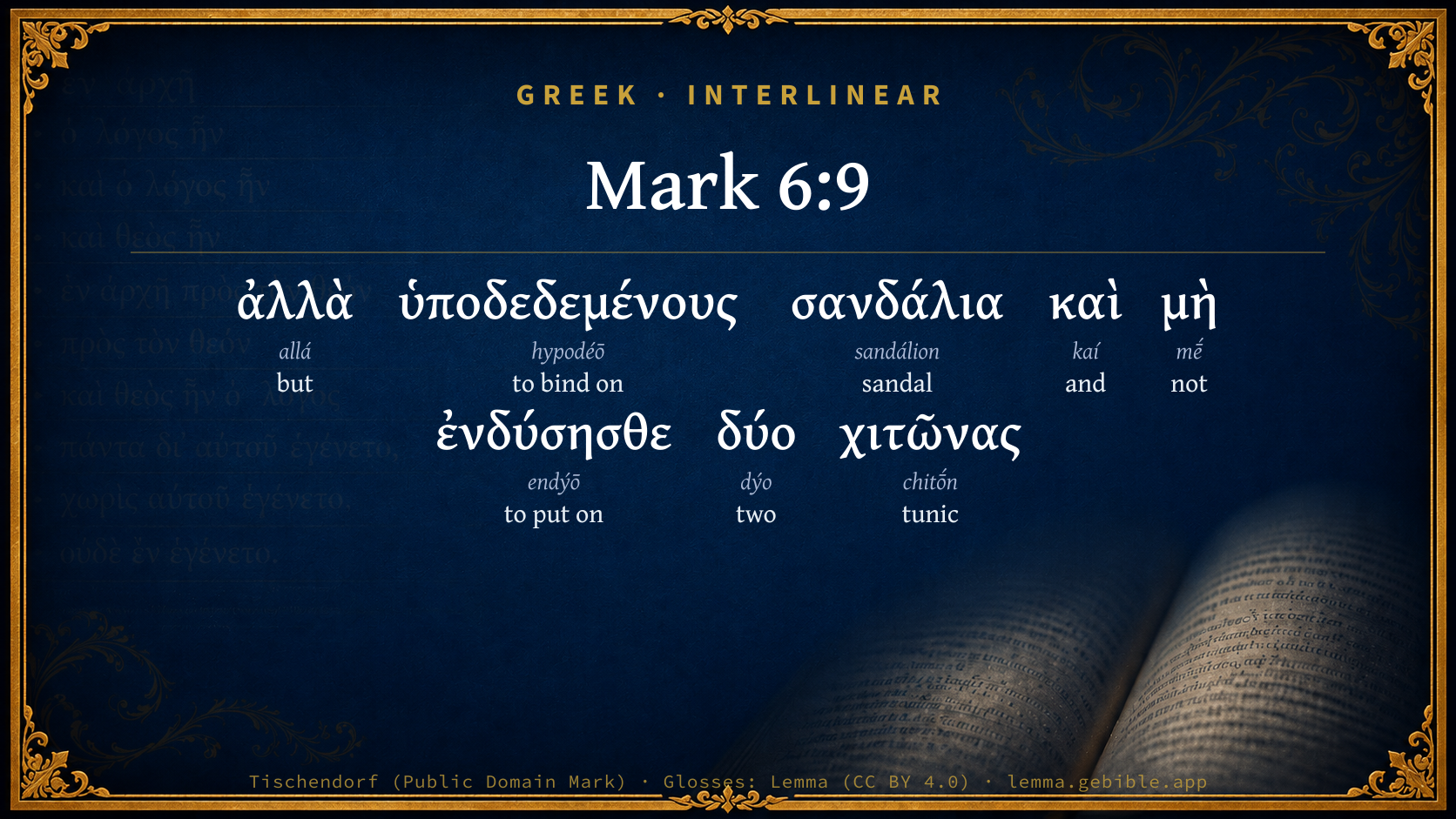
Greek (Tischendorf 8th ed.) Mark 6:9 appears in the Greek New Testament. The text above is from the Tischendorf 8th edition. Each word links to its Strong’s number and a concise gloss. Click any word for its full Thayer’s Greek Lexicon entry.
Download image
Cite this verse

Mark 6:9 (World English Bible). Public Domain. Lemma interlinear Bible study tool, https://lemma.gebible.app/v/mark/6/9.

Show BibTeX & RIS
BibTeX
RIS
English Translation
but to wear sandals, and not put on two tunics.
World English Bible · Public Domain
Highlights
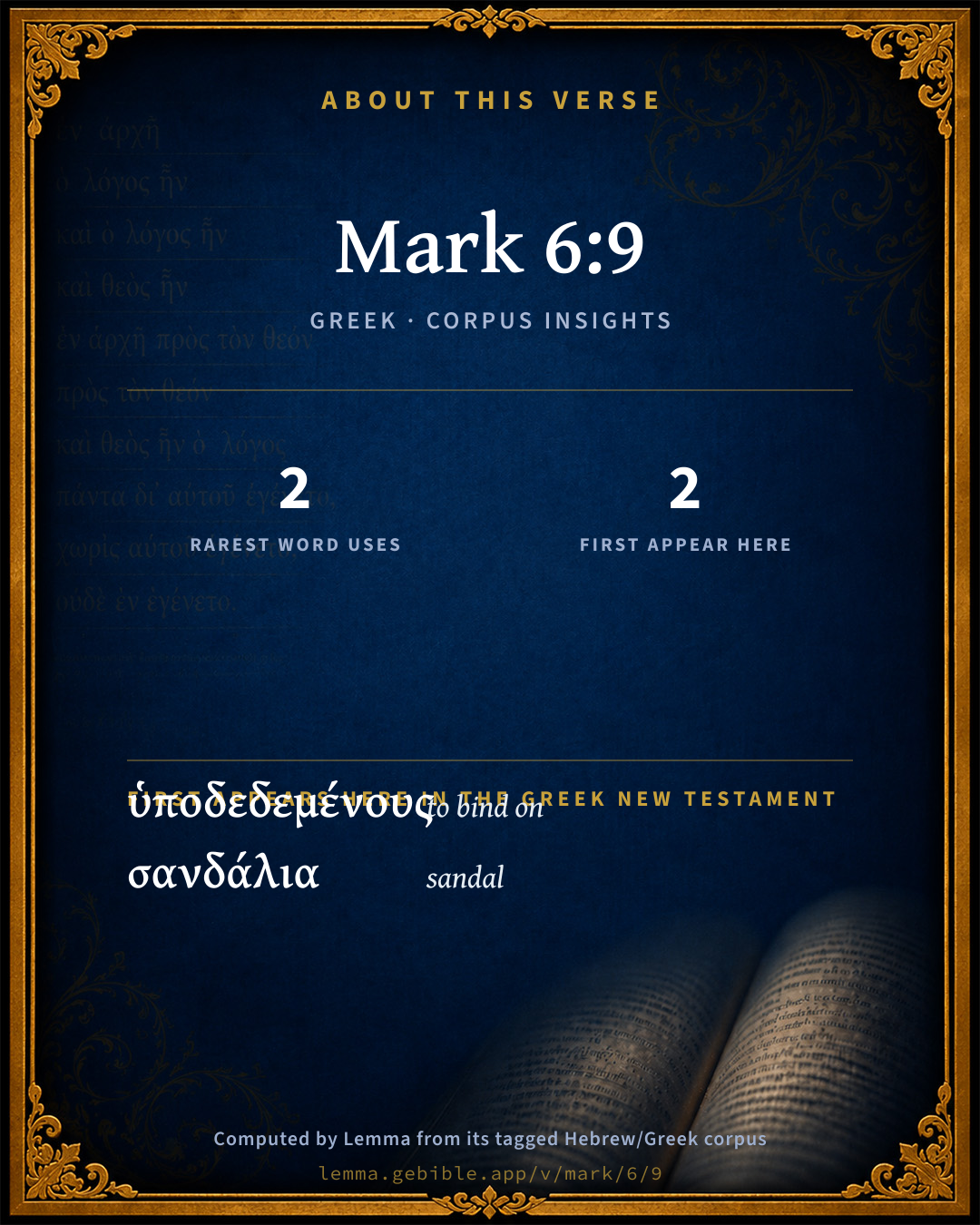
  • 2 first appearances in the Greek New Testament
Full analysis ↓
Download a study sheet

One document with this verse’s original text, its word-by-word gloss line, the meaning frame, cross-references with their text, attributed commentary, and full source and license credits — printable, and it pastes into notes with its structure intact.

This verse Autodidact and up

Study sheet (.html) Plain text (.txt)

A passage Seminary Student

Up to 50 verses in one chapter. A passage sheet keeps up to 6 commentary sources and 12 cross-references per verse, in the order this page ranks them, and says so on the sheet whenever that leaves anything out. Ask for a single verse and you get the Autodidact verse sheet above.

Everything on this page stays free to read, with no account — the sheet is a download of what is already on screen, not access to it.

Want to remove ads? Support Godless Engineer
Compare translations 3

The same verse in 3 English versions, stacked beneath the original-language interlinear above. Click any original word for its lexicon entry.

Each is an independent rendering of the whole verse — the interlinear is not word-aligned to these translations.

Highlighted words mark where these versions differ — a whole-verse word diff, not a word-by-word alignment.

  • World English Bible Public Domain
    but to wear sandals, and not put on two tunics.
  • King James Version Public Domain
    But be shod with sandals; and not put on two coats.
  • unfoldingWord Literal Text CC BY-SA 4.0
    but having put on sandals, and, “You may not wear two tunics.”

unfoldingWord Literal Text — © unfoldingWord, licensed CC BY-SA 4.0. Word-aligned USFM3 via Door43 (git.door43.org/unfoldingWord/en_ult).

Versions to compare (up to 4)

3 of 4 selected

Show all 19 translations

Every available English version of this verse, each an independent rendering of the whole verse.

  • World English Bible Public Domain
    but to wear sandals, and not put on two tunics.
  • Berean Standard Bible Public Domain
    and to wear sandals, but not a second tunic.
  • Majority Standard Bible Public Domain
    and to wear sandals, but not a second tunic.
  • King James Version Public Domain
    But be shod with sandals; and not put on two coats.
  • American Standard Version (1901) Public Domain
    but `to go' shod with sandals: and, `said he', put not on two coats.
  • Revised Version (1885) Public Domain
    but to go shod with sandals: and, said he, put not on two coats.
  • Geneva Bible (1599) Public Domain
    But that they should be shod with sandals, and that they should not put on two coates.
  • Douay-Rheims (1899) Public Domain
    But to be shod with sandals, and that they should not put on two coats.
  • Young's Literal Translation Public Domain
    but having been shod with sandals, and ye may not put on two coats.
  • Literal Standard Version CC BY-SA 4.0
    but having been shod with sandals, and you may not put on two coats.
  • Unlocked Literal Bible CC BY-SA 4.0
    but to wear sandals, and not to wear two tunics.
  • unfoldingWord Literal Text CC BY-SA 4.0
    but having put on sandals, and, “You may not wear two tunics.”
  • Darby Bible Public Domain
    but be shod with sandals, and put not on two body-coats.
  • World Messianic Bible Public Domain
    but to wear sandals, and not put on two tunics.
  • Webster's Bible Public Domain
    But be shod with sandals; and not put on two coats.
  • Free Bible Version CC BY-SA 4.0
    They could wear sandals, but they were not to take an extra shirt.
  • Bible in Basic English Public Domain
    They were to go with common shoes on their feet, and not to take two coats.
  • Text-Critical English NT CC BY 4.0
    He told them to wear sandals but not an extra tunic.
  • Tyndale New Testament (1534) Public Domain
    but shuld be shood with sandals. And that they shuld not put on two coottes.

Literal Standard Version (2020), Covenant Press — licensed CC BY-SA 4.0. Text via the HelloAO Bible API (eBible.org). Unlocked Literal Bible (unfoldingWord) — licensed CC BY-SA 4.0. Text via the HelloAO Bible API (eBible.org). unfoldingWord Literal Text — © unfoldingWord, licensed CC BY-SA 4.0. Word-aligned USFM3 via Door43 (git.door43.org/unfoldingWord/en_ult). Free Bible Version, Dr. Jonathan Gallagher — licensed CC BY-SA 4.0. Text via the HelloAO Bible API (eBible.org).

Word by word

More ways to search: Search by grammar → Find every occurrence → Compare this word →

Practice this passage: Drill this verse → Learn its vocabulary →

About this verse

These counts appear in no published source. They are computed here, from the morphology-tagged text and Lemma’s own curated glosses. What Lemma adds →

8
words
8
distinct lemmas
Gospels
section

Notable vocabulary

The rarest word here is σανδάλια sandal G4547 — appearing just 2 times in the whole Greek New Testament.

First appearance in Scripture

These words make their first canonical appearance in the Greek New Testament here:

  • ὑποδεδεμένους to bind on G5265
  • σανδάλια sandal G4547

Shared distinctive vocabulary

σανδάλια sandal G4547 occurs in 2 verses of the Greek New Testament. Also found in:
Cross-references

2

Topical passages linked to Mark 6:9 in the Treasury of Scripture Knowledge — connected by theme and wording, ordered by reader-vote popularity; previews shown in the World English Bible.

  • Acts 12:8 The angel said to him, "Get dressed and put on your sandals." He did so. He said to him, "Put on your cloak, and follow me."
  • Ephesians 6:15 and having fitted your feet with the preparation of the Gospel of peace;

Cross-references courtesy of OpenBible.info (CC BY 4.0).

Commentary

Notes on Mark 6:9 from classic Christian and Jewish commentators (each source and its license shown beneath its notes). The classic Christian expositions comment on the surrounding passage and are grouped to its opening verse, so a note may address several verses; the Jewish commentaries on the Tanakh (Rashi and others) are per-verse, so they appear only where the commentator wrote on this verse.

Lemma curates 59 commentaries, every one of them public domain or Creative Commons licensed, each selected and text-cleaned for this edition rather than reprinted as found. About our sources →

Expositor's Greek Testament

ed. W. Robertson Nicoll

Mar 6:9 . ἀλλὰ … σανδάλια , but shod with sandals. μηδὲ ὑποδήματα , says Matthew, reconcilable either by distinguishing between sandals and shoes ( vide on Matthew), or by understanding μηδὲ before ὑποδεδεμένους (Victor Ant.). δύο χιτῶνας : In Mark the prohibition is not to wear ( ἐνδύσησθε ) two tunics, in Matthew and Luke not to possess a spare one. The sentence in Mar 6:8-9 presents a curious instance of varying construction: first ἵνα with the subjunctive after παρήγγειλεν (Mar 6:8 ), then ὑποδεδεμένους , implying an infinitive with accusative ( πορεύεσθαι understood), then finally there is a transition from indirect to direct narration in μὴ ἐνδύσησθε .

The Expositor's Greek Testament, edited by W. Robertson Nicoll (1897–1910) — public domain. Text from a community e-Sword module.

Geneva Bible (1599)

Geneva Bible translators

That is, they should take no change of garments with them, that they might be lighter for this journey, and make more speed.

The word signifieth properly women’s shoes.

Geneva Bible (1599) marginal notes — public domain. Text via Bolls.life.

Adam Clarke's Commentary

Verse 9. Shod with sandals] The sandal seems to have been similar to the Roman solea, which covered only the sole of the foot, and was fastened about the foot and ankle with straps. The sandal was originally a part of the woman's dress; ancient authors represent them as worn only by women. In Mt 10:10, the disciples are commanded to take no shoes, υποδηματα, which word is nearly of the same import with σανδαλια, sandals; but, as our Lord intimates to them that they should be free from all useless incumbrances, that they might fulfil his orders with the utmost diligence and despatch, so we may suppose that the sandal was a lighter kind of wear than the shoe: and indeed the word sandal, which is mere Chaldee, סנדל might be properly translated a light shoe; as it is compounded of סין sin, a shoe, (see Targum, Deu 25:9-10,) and דל dal, thin, slender, or mean, as being made, not only lighter than the hypodema or shoe, but (probably) also of meaner materials. See many excellent observations on this subject in Martinius's Etymolog. Lexicon, under the word Sandalium.

Adam Clarke's Commentary on the Bible (1810–1826) — public domain. Text from a community e-Sword/MySword module.

Ellicott's Commentary for English Readers

(9) Be shod with sandals.—The word occurs again in Act_12:8. It describes obviously the shoes worn by the poor as distinguished from those of the more wealthy class, the sole of leather or wood fastened over the instep by strong leather thongs.

A Bible Commentary for English Readers, edited by Charles John Ellicott (1878–1897) — public domain. Text from a community e-Sword module.

The Cambridge Bible for Schools and Colleges

gen. ed. J. J. S. Perowne

9. be shod with sandals] That is, they were to take no other shoes with them for travelling “than their ordinary sandals of palm-bark.” So now “the Galilean peasants wear a coarse shoe, answering to the sandal of the ancients, but never take two pair with them.”

two coats] That is, they were not to take with them a change of raiment.

The Cambridge Bible for Schools and Colleges (gen. ed. J. J. S. Perowne; Cambridge University Press, 1878–1918) — public domain. Text from a community e-Sword module.

John Gill's Exposition

But be shod with sandals,.... Which were different from shoes, and more fit to travel with, and therefore allowed when shoes were forbidden; See Gill on Mat 10:10, though some think there was no difference between shoes and sandals, and that Christ, in Mat 10:10, does not forbid the taking of shoes, but two pair of shoes; as not two coats, nor two staves, but one of a sort only. And

not put on two coats; that is, at a time; an inner and an outward one, or one at one time, and another at another: they were forbid change of raiment; the reasons for it See Gill on Mat 10:10. From all which it appears, that as a minister of the Gospel ought not to be a worldly minded man, that minds earth and earthly things, and seeks to amass wealth and riches to himself, and preaches for filthy lucre's sake; nor to be a sensual and voluptuous man, serving his own belly, and not the Lord Jesus Christ, feeding himself, and not the flock; so neither should he be filled with worldly cares, overwhelmed in worldly business, and entangled with the affairs of this life: he ought to have his mind free from all solicitude and anxious concern, about a subsistence for himself and his, that so he may with greater and more close application attend to his ministry, to preparations for it, and the performance of it; and give up himself entirely to the word and prayer, and not have his mind distracted with other things: upon which account it is highly necessary, that the people to whom he ministers should take care, that a sufficient provision be made for him; that he may live without any anxious care and thought about such things, and his mind be more intent about the work he is called unto: and which is what our Lord chiefly designs by all this, who has ordained that they that preach the Gospel, should be comfortably provided for, and live of it; and which, as it makes for the peace of their minds that minister, it issues in the advantage of those who are ministered to.

John Gill's Exposition of the Whole Bible (1746–1763) — public domain (CC PDM 1.0). Text via the HelloAO Bible API.

Trapp's Complete Commentary

John Trapp

9 But be shod with sandals; and not put on two coats.

Ver. 9. {See Trapp on "Mat 10:9"} {See Trapp on "Mat 10:10"}

John Trapp, A Commentary or Exposition upon All the Books of the Old and New Testament (1647–1656) — public domain. Text from a community e-Sword module.

Matthew Poole's English Annotations

Go in your ordinary habits, making no provision for yourselves, as travellers, who think they may need something before their return.

Matthew Poole's English Annotations on the Holy Bible (1683–1685) — public domain. Text from a community e-Sword/MySword module.

Whedon's Commentary on the Bible

Daniel D. Whedon

9. Be shod with sandals — They were to take no shoes, as being a special and more costly provision, but wear their ordinary sandals.

Daniel D. Whedon (gen. ed.), Commentary on the Old and New Testaments (1874–1909) — public domain. Text from a community e-Sword module.

The Pulpit Commentary

But be shod with sandals. This is quite consistent with what St. Matthew says, (Mat_10:9) that they were not to provide themselves with shoes (mhde upodhmata). According to St. Matthew, shoes are forbidden directly; according to St. Mark, they are forbidden by implication, where he says that they were to be shod with sandals. Shoes are here forbidden which cover the whole foot, not sandals which only protect the soles of the feet lest they should be injured by the rocky ground. The soil of Judaea was rocky and rough, and the climate hot. The sandals therefore protected the soles of the feet, and yet, being open above, kept the feet more cool, and therefore fit for the journey. It is worthy of our notice that, after our Lord"s ascension, we find St. Peter using sandals when the angel, who delivered him out of prison, said to him, (Act_12:8) "Gird thyself, and bind on thy sandals."

The Pulpit Commentary (1880–1919), ed. H.D.M. Spence-Jones & Joseph S. Exell — public domain. Text from a community e-Sword module.

John Wesley's Explanatory Notes

Be shod with sandals - As you usually are. Sandals were pieces of strong leather or wood, tied under the sole of the foot by thongs, something resembling modern clogs. The shoes which they are in St. Matthew forbidden to take, were a kind of short boots, reaching a little above the mid-leg, which were then commonly used in journeys. Our Lord intended by this mission to initiate them into their apostolic work. And it was doubtless an encouragement to them all their life after, to recollect the care which God took of them, when they had left all they had, and went out quite unfurnished for such an expedition. In this view our Lord himself leads them to consider it, Luke xxii, xxxv, When I sent you forth without purse or scrip, lacked ye any thing?

John Wesley, Explanatory Notes Upon the Whole Bible (1754–1765) — public domain. Text via the GEBible commentary corpus.

The People's New Testament

B. W. Johnson

9. Be shod with sandals. Matthew forbids shoes, instead of which they were to wear sandals. The ancient shoe resembled the modern; the sandal was a sole tied on the foot. The latter was usually worn by the common people and they were to dress like them.

B. W. Johnson's The People's New Testament with Notes (1889–1891) — public domain. Electronic text from the Christian Classics Ethereal Library (CCEL) ThML edition.

Cambridge Greek Testament for Schools and Colleges

9. It is difficult to decide between ἐνδύσασθε ([1136][1137] ἐνδύσασθαι ([1138]2[1139][1140]), and ἐνδύσησθε ([1141][1142][1143][1144][1145]). Perhaps the first would most easily have produced the other readings.

[1136] Codex Vaticanus. 4th cent., but perhaps a little later than א. In the Vatican Library almost since its foundation by Pope Nicolas V., and one of its greatest treasures. The whole Gospel, ending at Mar 16:8. Photographic facsimile, 1889.

[1137] asterisk denotes that the word is not found elsewhere in N.T., and such words are included in the index, even if there is no note on them in the commentary.

[1138] Codex Vaticanus. 4th cent., but perhaps a little later than א. In the Vatican Library almost since its foundation by Pope Nicolas V., and one of its greatest treasures. The whole Gospel, ending at Mar 16:8. Photographic facsimile, 1889.

[1139] Codex Vaticanus. 10th cent. Dated A.D. 949.

[1140] Codex Petropolitanus. 9th cent. Gospels almost complete. Mar 16:18-20 is in a later hand.

[1141] Codex Sinaiticus. 4th cent. Discovered by Tischendorf in 1859 at the Monastery of St Katharine on Mount Sinai. Now at St Petersburg. The whole Gospel, ending at Mar 16:8. Photographic facsimile, 1911.

[1142] Codex Alexandrinus. 5th cent. Brought by Cyril Lucar, Patriarch of Constantinople, from Alexandria, and afterwards presented by him to King Charles I. in 1628. In the British Museum. The whole Gospel. Photographic facsimile, 1879.

[1143] Codex Ephraemi. 5th cent. A palimpsest: the original writing has been partially rubbed out, and the works of Ephraem the Syrian have been written over it; but a great deal of the original writing has been recovered; of Mark we have Mar 1:17 to Mar 6:31, Mar 8:5 to Mar 12:29, Mar 13:19 to Mar 16:20. In the National Library at Paris.

[1144] Codex Bezae. 6th cent. Has a Latin translation (d) side by side with the Greek text, and the two do not quite always agree. Presented by Beza to the University Library of Cambridge in 1581. Remarkable for its frequent divergences from other texts. Contains Mark, except Mar 16:15-20, which has been added by a later hand. Photographic facsimile, 1899.

[1145] Codex Sangallensis. 9th or 10th cent. Contains the Gospels nearly complete, with an interlinear Latin translation. The text of Mark is specially good, agreeing often with CL. At St Gall.

9. ἀλλὰ ὑποδεδεμένους σανδάλια. A violent anacoluthon, illustrating Mk’s want of literary skill, and showing how completely ἵνα after verbs of exhorting has become equivalent to the acc. c. infin. Mk goes on here as if he had used the acc. c. infin., for εἶναι or πορεύεσθαι is understood here. The identity of σανδάλια (Act 12:8) and ὑποδήματα (Mar 1:7; Mat 10:10; etc.) is clear, for both are used to translate the same Hebrew, naal (Jos 9:5; Isa 20:2 and Exo 3:5; Exo 12:11). Here and in Acts, σανδάλια may have been preferred in order to avoid the unpleasing repetition, ὑποδέομαι ὑποδήματα.

Μὴ ἐνδύσασθε. If this is the right reading, we have a change from or. obliqua to or. recta, as in Luk 5:14; Act 23:22. Mar 11:32 is different. There is a similar change if we read ἐνδύσησθε (R.V.). We may take ἐνδύσασθαι as coordinate with the infin. understood with ὑποδεδεμένους, or as an infin. imperat. It is strange criticism to see in these broken constructions signs of clumsy copying from a document. They are signs of Mk writing just as he would talk. In Mt. the Twelve are forbidden to get two chitons, in Lk. to have two, in Mk to put on two. The χιτών was the less necessary garment, worn under the almost indispensable ἱμάτιον (Mat 5:40; Joh 19:23); therefore a “shirt” rather than a “coat.” The Baptist told those who had two chitons to “give a share,” i.e. one of the two, to some one who had none (Luk 3:11). The high-priest rends “his chitons” (Mar 14:63), and two were sometimes worn in travelling (Joseph. Ant. XVII. Mar 6:7). We learn from Luk 22:35 that the Twelve found this very small outfit sufficient. Origen thinks that these regulations were not intended to be taken literally, and Bede interprets the prohibition of two chitons as an admonition non dupliciter sed simpliciter ambulare.

Cambridge Greek Testament for Schools and Colleges (Cambridge University Press, 1896; 21 vols, various authors incl. Carr, Maclear, Plummer, Farrar, Lumby, Moule, M. R. James, Simcox) — public domain. Text from a community e-Sword module.

Alford’s Greek Testament

Henry Alford

9. ὑποδεδεμένους] Scil. πορεύεσθαι, or some equivalent infinitive. We have another change of construction in ἐνδύσησθε. These breaks serve to give the narrative a more lively form.

Henry Alford, The Greek Testament (1849–1861) — public domain. Text from a community e-Sword module.

International Critical Commentary

9. ὑποδεδεμένους—The participle is put in the acc. as if to agree with a preceding acc. with an inf. The command to wear sandals seems superfluous, but it is really a part of the injunction against any luxury in their outfit, being contrasted with shoes protecting the upper part of the feet as well as the soles. There is no contradiction between this and the command not to buy sandals for the journey, Mat 10:9, the latter being directed against the purchase of extra sandals over and above what they were wearing. But, while there is no contradiction, there is a difference; they are two orders about this same matter of sandals. All that we can gather about it is, that Jesus gave some direction about sandals in connection with the general direction for simplicity of equipment, of which the several Gospels have preserved different accounts. μὴ ἐνδύσησθε δύο χιτῶνας—do not wear two tunics.1 Mt. and Lk. say that they were not to have or provide two tunics. But this forbids their wearing two, referring to a custom of dress belonging to persons of distinction, who wore two χιτῶνας, an inner and an outer. See Bib. Dic., article Dress, and Dic. of Antiq., article Tunica. In general, these directions are against luxury in their equipment, and also against their providing themselves with what they could procure from the hospitality of others. Evidently, if they took no food and no money, this dependence on others would be their only resort. See Mat 10:10.

Treg. marg. WH. read ἐνδύσασθαι, which is also the reading of Beza and Elzevir, with B2 S Π*. L and some others read ἐνδεδύσθαι. Improbable and unsupported.

International Critical Commentary — older volumes (1896–1929), various authors — public domain. Text from a community e-Sword module.

Lesson kit

Teaching starters — assembled from the data on this page, not authored interpretation. Every prompt links to the verse data it draws on. Edit before teaching.

Mark, in the Gospels, opens this verse with 8 words (8 distinct Greek lemmas). Its most distinctive word is sandálion (“sandal”). A historical commentator’s framing appears above. Read the whole chapter for the surrounding context.

Discussion questions

  1. What does “sandal” (sandálion) contribute to the verse as a whole?
  2. 2 words here appear for the first time in Scripture. What is being introduced at this debut?
  3. Acts 12:8 shares the word «sandal» with this verse. How do the two illuminate each other?
  4. The translations on this page render this verse differently — a whole-verse word diff, not a word-by-word alignment. What might account for the different wordings?
  5. Reading how Expositor's Greek Testament and Geneva Bible (1599) read this verse, where do the two commentators agree and where do they part?

Things to notice

  • 2 words make their first canonical appearance in Scripture here.
  • These translations choose different wording for 7 words in this verse.
  • 8 distinct Greek lemmas span 8 words in this verse.

Reading settings

Reading text

Shown beneath each verse's original-language words.

Old Testament
Old Testament edition

Read the OT as the Masoretic Hebrew (MT) or the Greek Septuagint (LXX).

English shown for the Greek Septuagint (in the Hebrew ↔ Greek comparison).

Comparing translations? Open the Compare panel on any verse page to stack up to four side by side.