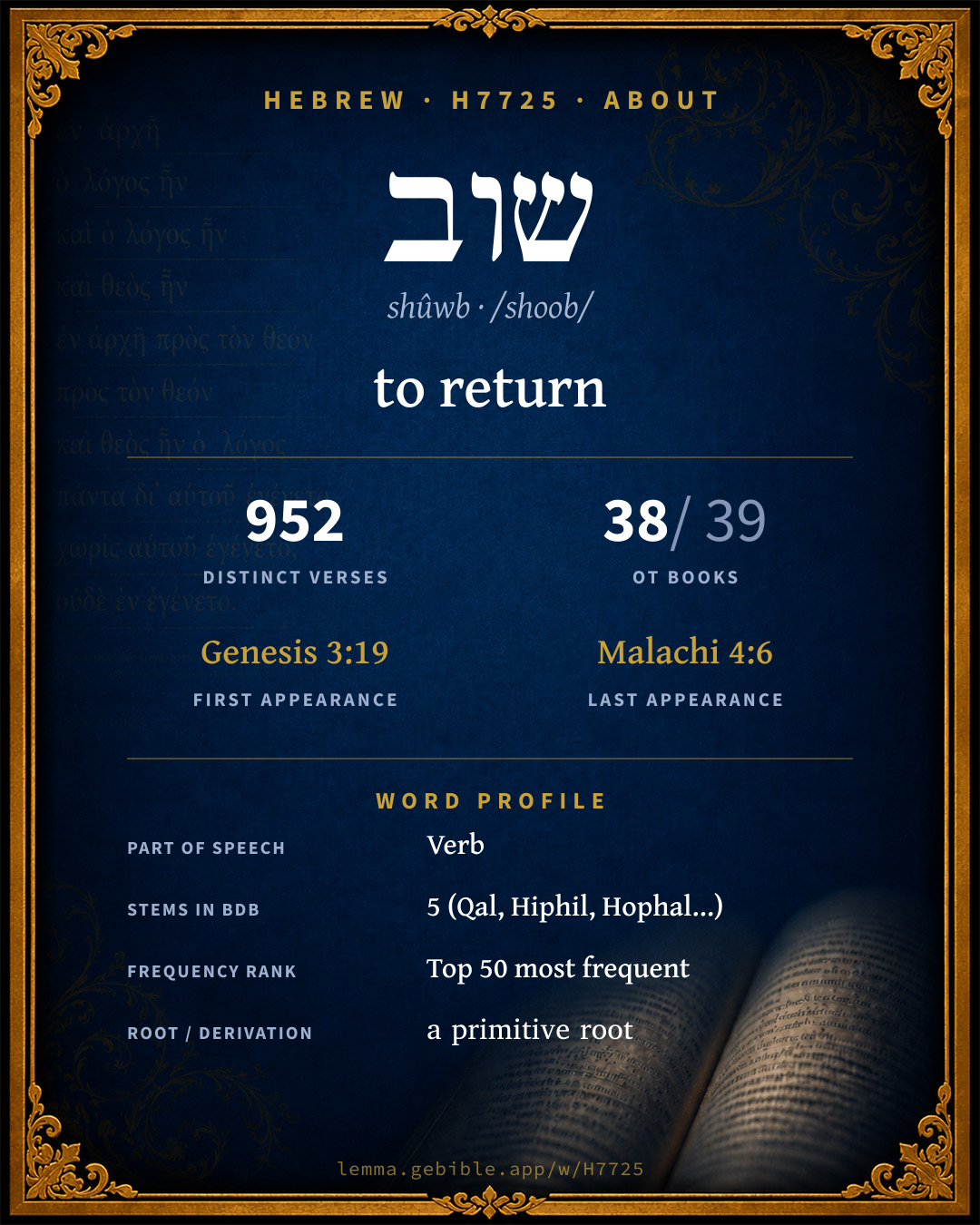
שׁוּב
to return
‘to return’ is one of 5 main senses fuller range ↓
Full lexicon entry — Brown-Driver-Briggs (BDB)
From Brown-Driver-Briggs (BDB)
Where this word appears
See every Qal verb in the Hebrew Bible →
Grammar key — what these labels mean
Part of speech
- Verb
- An action or state-of-being word.
Stem
- Qal
- The basic, simple active stem — the plain form of the verb (“he wrote”). Here: ‘turn back’
- Hiphil
- The causative active stem (“he caused / brought about”). Here: ‘bring back’
- Polel
- A stem of hollow/geminate roots functioning like the Piel — intensive active.
- Hophal
- The passive counterpart of the Hiphil (“he was caused to…”).
Form
- Sequential Imperfect
- An imperfect with prefixed waw — the standard past-narrative form (waw-consecutive imperfect).
- Imperfect
- An incomplete, ongoing, or future action (“he will / would write”).
- Infinitive Construct
- A bound verbal noun, frequently with prepositions (“to write / in writing”).
- Perfect
- A completed action or state — Hebrew marks aspect (completeness) more than strict tense (“he wrote”).
- Imperative
- A direct command (“write!”).
- Sequential Perfect
- A perfect with prefixed waw continuing a preceding imperfect or command (waw-consecutive perfect).
- Participle Active
- A verbal adjective expressing ongoing or characteristic action (“writing / one who writes”).
- Jussive
- A third- or second-person volitional form expressing wish or command (“let him write”).
- Infinitive Absolute
- An unbound verbal noun, often intensifying or standing in for a finite verb.
- Cohortative
- A first-person volitional form expressing wish or resolve (“let me / let us write”).
- Participle Passive
- A verbal adjective expressing action received (“written”).
State
- Absolute
- The independent form of a noun, not bound to a following word.
- Construct
- A noun bound to a following noun in a possessive / “of” relationship (the construct chain).
Person
- 3rd Person
- The one spoken about (“he / she / it / they”).
- 2nd Person
- The one addressed (“you”).
- 1st Person
- The speaker (“I / we”).
Gender
- Masculine
- Grammatically masculine.
- Common
- Either gender — not distinguished for this form.
- Feminine
- Grammatically feminine.
Number
- Singular
- One.
- Plural
- More than one (in Hebrew, generally three or more).
Grammatical forms 97 distinct
- Verb, Qal, Sequential Imperfect, 3rd Person, Masculine, Singular 84 times (8%)
- Verb, Qal, Imperfect, 3rd Person, Masculine, Singular 65 times (6%)
- Verb, Qal, Infinitive Construct 64 times (6%)
- Verb, Qal, Sequential Imperfect, 3rd Person, Masculine, Plural 52 times (5%)
- Verb, Hiphil, Infinitive Construct 44 times (4%)
- Verb, Hiphil, Imperfect, 1st Person, Common, Singular 42 times (4%)
- Verb, Qal, Perfect, 3rd Person, Masculine, Singular 40 times (4%)
- Verb, Qal, Imperfect, 3rd Person, Masculine, Plural 39 times (4%)
+89 more forms (643 occurrences)
Parsed forms decoded from the imported morphology (morphhb / Westminster Leningrad Codex — WLC text public domain, morphhb tagging CC BY 4.0), counted across 1,073 parsed occurrences — not distinct verses.
Page 5 of 5 — showing verses 801–952 of 952 distinct verses where H7725 appears, across 38 books. Click any verse to open its interlinear word-by-word view. Verse text shown in the World English Bible for context — . Each verse’s Hebrew form is shown with its reference; the English is not keyword-highlighted, since the data carries no word-level English alignment. Use “Compare translations” on any verse to read it across multiple English versions. This concordance covers the Hebrew Bible; Septuagint (Greek Old Testament) occurrences are not indexed here.
Lamentations 13 verses
- Lamentations 1:13 הֱשִׁיבַ֣/נִי Hiphil pf 3ms + sfx pers 1cs From on high has he sent fire into my bones, and it prevails against them; He has spread a net for my feet, he has turned me back: He has made me desolate and faint all the day.
- Lamentations 1:16 מֵשִׁ֣יב Hiphil ptcp.act ms For these things I weep; my eye, my eye runs down with water; Because the comforter who should refresh my soul is far from me: My children are desolate, because the enemy has prevailed.
- Lamentations 1:19 וְ/יָשִׁ֖יבוּ conj + Hiphil juss 3mp I called for my lovers, [but] they deceived me: My priests and my elders gave up the spirit in the city, While they sought them food to refresh their souls.
- Lamentations 2:3 הֵשִׁ֥יב Hiphil pf 3ms He has cut off in fierce anger all the horn of Israel; He has drawn back his right hand from before the enemy: He has burned up Jacob like a flaming fire, which devours round about.
- Lamentations 2:8 הֵשִׁ֥יב Hiphil pf 3ms Yahweh has purposed to destroy the wall of the daughter of Zion; He has stretched out the line, he has not withdrawn his hand from destroying; He has made the rampart and wall to lament; they languish together.
- Lamentations 2:14 לְ/הָשִׁ֣יב prep + Hiphil inf.cs Your prophets have seen for you false and foolish visions; They have not uncovered your iniquity, to bring back your captivity, But have seen for you false oracles and causes of banishment.
- Lamentations 3:3 יָשֻׁ֛ב Qal impf 3ms Surely against me he turns his hand again and again all the day.
- Lamentations 3:21 אָשִׁ֥יב Hiphil impf 1cs This I recall to my mind; therefore have I hope.
- Lamentations 3:40 וְ/נָשׁ֖וּבָה conj + Qal coh 1cp Let us search and try our ways, and turn again to Yahweh.
- Lamentations 3:64 תָּשִׁ֨יב Hiphil impf 2ms You will render to them a recompense, Yahweh, according to the work of their hands.
- Lamentations 5:21 הֲשִׁיבֵ֨/נוּ ו/נשוב וְֽ/נָשׁ֔וּבָה Hiphil impv 2ms + sfx pers 1cp conj + Qal impf 1cp conj + Qal coh 1cp Turn you us to you, Yahweh, and we shall be turned; Renew our days as of old.
Ezekiel 53 verses
- Ezekiel 1:14 וָ/שׁ֑וֹב conj + Qal inf.abs The living creatures ran and returned as the appearance of a flash of lightning.
- Ezekiel 3:19 שָׁב֙ Qal pf 3ms Yet if you warn the wicked, and he doesn't turn from his wickedness, nor from his wicked way, he shall die in his iniquity; but you have delivered your soul.
- Ezekiel 3:20 וּ/בְ/שׁ֨וּב conj + prep + Qal inf.cs Again, when a righteous man does turn from his righteousness, and commit iniquity, and I lay a stumbling block before him, he shall die: because you have not given him warning, he shall die in his sin, and his righteous deeds which he has done shall not be remembered; but his blood will I require at your hand.
- Ezekiel 7:13 יָשׁ֔וּב יָשׁ֔וּב Qal impf 3ms Qal impf 3ms For the seller shall not return to that which is sold, although they be yet alive: for the vision is touching the whole multitude of it, none shall return; neither shall any strengthen himself in the iniquity of his life.
- Ezekiel 8:6 תָּשׁ֣וּב Qal impf 2ms He said to me, Son of man, see you what they do? even the great abominations that the house of Israel do commit here, that I should go far off from my sanctuary? but you shall again see yet other great abominations.
- Ezekiel 8:13 תָּשׁ֥וּב Qal impf 2ms He said also to me, You shall again see yet other great abominations which they do.
- Ezekiel 8:15 תָּשׁ֥וּב Qal impf 2ms Then said he to me, Have you seen [this], son of man? you shall again see yet greater abominations than these.
- Ezekiel 8:17 וַ/יָּשֻׁ֨בוּ֙ conj + Qal wimpf 3mp Then he said to me, Have you seen [this], son of man? Is it a light thing to the house of Judah that they commit the abominations which they commit here? for they have filled the land with violence, and have turned again to provoke me to anger: and, behold, they put the branch to their nose.
- Ezekiel 9:11 מֵשִׁ֥יב Hiphil ptcp.act ms Behold, the man clothed in linen, who had the inkhorn by his side, reported the matter, saying, I have done as you have commanded me.
- Ezekiel 13:22 שׁ֛וּב Qal inf.cs Because with lies you have grieved the heart of the righteous, whom I have not made sad; and strengthened the hands of the wicked, that he should not return from his wicked way, and be saved alive:
- Ezekiel 14:6 שׁ֣וּבוּ וְ/הָשִׁ֔יבוּ הָשִׁ֥יבוּ Qal impv 2mp conj + Hiphil impv 2mp Hiphil impv 2mp Therefore tell the house of Israel, Thus says the Lord Yahweh: Return you, and turn yourselves from your idols; and turn away your faces from all your abominations.
- Ezekiel 16:53 וְ/שַׁבְתִּי֙ conj + Qal wpf 1cs I will turn again their captivity, the captivity of Sodom and her daughters, and the captivity of Samaria and her daughters, and the captivity of your captives in the midst of them;
- Ezekiel 16:55 תָּשֹׁ֣בְןָ תָּשֹׁ֖בְןָ תְּשֻׁבֶ֖ינָה Qal impf 3fp Qal impf 3fp Qal impf 2fp Your sisters, Sodom and her daughters, shall return to their former estate; and Samaria and her daughters shall return to their former estate; and you and your daughters shall return to your former estate.
- Ezekiel 18:7 יָשִׁ֔יב Hiphil impf 3ms and has not wronged any, but has restored to the debtor his pledge, has taken nothing by robbery, has given his bread to the hungry, and has covered the naked with a garment;
- Ezekiel 18:8 יָשִׁ֣יב Hiphil impf 3ms he who has not given forth on interest, neither has taken any increase, who has withdrawn his hand from iniquity, has executed true justice between man and man,
- Ezekiel 18:12 יָשִׁ֑יב Hiphil impf 3ms has wronged the poor and needy, has taken by robbery, has not restored the pledge, and has lifted up his eyes to the idols, has committed abomination,
- Ezekiel 18:17 הֵשִׁ֣יב Hiphil pf 3ms who has withdrawn his hand from the poor, who has not received interest nor increase, has executed my ordinances, has walked in my statutes; he shall not die for the iniquity of his father, he shall surely live.
- Ezekiel 18:21 יָשׁוּב֙ Qal impf 3ms But if the wicked turn from all his sins that he has committed, and keep all my statutes, and do that which is lawful and right, he shall surely live, he shall not die.
- Ezekiel 18:23 בְּ/שׁוּב֥/וֹ prep + Qal inf.cs + sfx pers 3ms Have I any pleasure in the death of the wicked? says the Lord Yahweh; and not rather that he should return from his way, and live?
- Ezekiel 18:24 וּ/בְ/שׁ֨וּב conj + prep + Qal inf.cs But when the righteous turns away from his righteousness, and commits iniquity, and does according to all the abominations that the wicked man does, shall he live? None of his righteous deeds that he has done shall be remembered: in his trespass that he has trespassed, and in his sin that he has sinned, in them shall he die.
- Ezekiel 18:26 בְּ/שׁוּב prep + Qal inf.cs When the righteous man turns away from his righteousness, and commits iniquity, and dies therein; in his iniquity that he has done shall he die.
- Ezekiel 18:27 וּ/בְ/שׁ֣וּב conj + prep + Qal inf.cs Again, when the wicked man turns away from his wickedness that he has committed, and does that which is lawful and right, he shall save his soul alive.
- Ezekiel 18:28 ו/ישוב וַ/יָּ֔שָׁב conj + Qal wimpf 3ms conj + Qal wimpf 3ms Because he considers, and turns away from all his transgressions that he has committed, he shall surely live, he shall not die.
- Ezekiel 18:30 שׁ֤וּבוּ וְ/הָשִׁ֨יבוּ֙ Qal impv 2mp conj + Hiphil impv 2mp Therefore I will judge you, house of Israel, everyone according to his ways, says the Lord Yahweh. Return you, and turn yourselves from all your transgressions; so iniquity shall not be your ruin.
- Ezekiel 18:32 וְ/הָשִׁ֖יבוּ conj + Hiphil impv 2mp For I have no pleasure in the death of him who dies, says the Lord Yahweh: therefore turn yourselves, and live.
- Ezekiel 20:22 וַ/הֲשִׁבֹ֨תִי֙ conj + Hiphil pf 1cs Nevertheless I withdrew my hand, and worked for my name's sake, that it should not be profaned in the sight of the nations, in whose sight I brought them forth.
- Ezekiel 21:5 תָשׁ֖וּב Qal impf 3fs and all flesh shall know that I, Yahweh, have drawn forth my sword out of its sheath; it shall not return any more.
- Ezekiel 21:30 הָשַׁ֖ב Hiphil impv 2ms Cause it to return into its sheath. In the place where you were created, in the land of your birth, will I judge you.
- Ezekiel 27:15 הֵשִׁ֖יבוּ Hiphil pf 3cp The men of Dedan were your traffickers; many isles were the market of your hand: they brought you in exchange horns of ivory and ebony.
- Ezekiel 29:14 וְ/שַׁבְתִּי֙ וַ/הֲשִׁבֹתִ֤י conj + Qal pf 1cs conj + Hiphil wpf 1cs and I will bring back the captivity of Egypt, and will cause them to return into the land of Pathros, into the land of their birth; and they shall be there a base kingdom.
- Ezekiel 33:9 לָ/שׁ֣וּב שָׁ֖ב prep + Qal inf.cs Qal pf 3ms Nevertheless, if you warn the wicked of his way to turn from it, and he doesn't turn from his way; he shall die in his iniquity, but you have delivered your soul.
- Ezekiel 33:11 בְּ/שׁ֥וּב שׁ֣וּבוּ שׁ֜וּבוּ prep + Qal inf.cs Qal impv 2mp Qal impv 2mp Tell them, As I live, says the Lord Yahweh, I have no pleasure in the death of the wicked; but that the wicked turn from his way and live: turn you, turn you from your evil ways; for why will you die, house of Israel?
- Ezekiel 33:12 שׁוּב֣/וֹ Qal inf.cs + sfx pers 3ms You, son of man, tell the children of your people, The righteousness of the righteous shall not deliver him in the day of his disobedience; and as for the wickedness of the wicked, he shall not fall thereby in the day that he turns from his wickedness; neither shall he who is righteous be able to live thereby in the day that he sins.
- Ezekiel 33:14 וְ/שָׁב֙ conj + Qal wpf 3ms Again, when I say to the wicked, You shall surely die; if he turn from his sin, and do that which is lawful and right;
- Ezekiel 33:15 יָשִׁ֤יב Hiphil impf 3ms if the wicked restore the pledge, give again that which he had taken by robbery, walk in the statutes of life, committing no iniquity; he shall surely live, he shall not die.
- Ezekiel 33:18 בְּ/שׁוּב prep + Qal inf.cs When the righteous turns from his righteousness, and commits iniquity, he shall even die therein.
- Ezekiel 33:19 וּ/בְ/שׁ֤וּב conj + prep + Qal inf.cs When the wicked turns from his wickedness, and does that which is lawful and right, he shall live thereby.
- Ezekiel 34:4 הֲשֵׁבֹתֶ֔ם Hiphil pf 2mp You haven't strengthened the diseased, neither have you healed that which was sick, neither have you bound up that which was broken, neither have you brought back that which was driven away, neither have you sought that which was lost; but with force and with rigor have you ruled over them.
- Ezekiel 34:16 אָשִׁ֔יב Hiphil impf 1cs I will seek that which was lost, and will bring back that which was driven away, and will bind up that which was broken, and will strengthen that which was sick: but the fat and the strong I will destroy; I will feed them in justice.
- Ezekiel 35:7 וָ/שָֽׁב conj + Qal ptcp.act ms Thus will I make Mount Seir an astonishment and a desolation; and I will cut off from it him who passes through and him who returns.
- Ezekiel 35:9 תָשֹׁ֑בְנָה Qal impf 3fp I will make you a perpetual desolation, and your cities shall not be inhabited; and you shall know that I am Yahweh.
- Ezekiel 38:4 וְ/שׁ֣וֹבַבְתִּ֔י/ךָ conj + Polel wpf 1cs + sfx pers 2ms and I will turn you about, and put hooks into your jaws, and I will bring you forth, and all your army, horses and horsemen, all of them clothed in full armor, a great company with buckler and shield, all of them handling swords;
- Ezekiel 38:8 מְשׁוֹבֶ֣בֶת Polel ptcp.pass fs After many days you shall be visited: in the latter years you shall come into the land that is brought back from the sword, that is gathered out of many peoples, on the mountains of Israel, which have been a continual waste; but it is brought forth out of the peoples, and they shall dwell securely, all of them.
- Ezekiel 38:12 לְ/הָשִׁ֨יב prep + Hiphil inf.cs to take the spoil and to take the prey; to turn your hand against the waste places that are [now] inhabited, and against the people who are gathered out of the nations, who have gotten cattle and goods, who dwell in the middle of the earth.
- Ezekiel 39:2 וְ/שֹׁבַבְתִּ֨י/ךָ֙ conj + Polel wpf 1cs + sfx pers 2ms and I will turn you about, and will lead you on, and will cause you to come up from the uttermost parts of the north; and I will bring you on the mountains of Israel;
- Ezekiel 39:25 אָשִׁיב֙ Hiphil impf 1cs Therefore thus says the Lord Yahweh: Now will I bring back the captivity of Jacob, and have mercy on the whole house of Israel; and I will be jealous for my holy name.
- Ezekiel 39:27 בְּ/שׁוֹבְבִ֤/י prep + Polel inf.cs + sfx pers 1cs when I have brought them back from the peoples, and gathered them out of their enemies' lands, and am sanctified in them in the sight of many nations.
- Ezekiel 44:1 וַ/יָּ֣שֶׁב conj + Hiphil wimpf 3ms Then he brought me back by the way of the outer gate of the sanctuary, which looks toward the east; and it was shut.
- Ezekiel 46:9 יָשׁ֗וּב Qal impf 3ms But when the people of the land shall come before Yahweh in the appointed feasts, he who enters by the way of the north gate to worship shall go forth by the way of the south gate; and he who enters by the way of the south gate shall go forth by the way of the north gate: he shall not return by the way of the gate by which he came in, but shall go forth straight before him.
- Ezekiel 46:17 וְ/שָׁבַ֖ת conj + Qal wpf 3fs But if he give of his inheritance a gift to one of his servants, it shall be his to the year of liberty; then it shall return to the prince; but as for his inheritance, it shall be for his sons.
- Ezekiel 47:1 וַ/יְשִׁבֵ/נִי֮ conj + Hiphil wimpf 3ms + sfx pers 1cs He brought me back to the door of the house; and, behold, waters issued out from under the threshold of the house eastward; (for the forefront of the house was toward the east;) and the waters came down from under, from the right side of the house, on the south of the altar.
- Ezekiel 47:6 וַ/יְשִׁבֵ֖/נִי conj + Hiphil wimpf 3ms + sfx pers 1cs He said to me, Son of man, have you seen [this]? Then he brought me, and caused me to return to the bank of the river.
- Ezekiel 47:7 בְּ/שׁוּבֵ֕/נִי prep + Qal inf.cs + sfx pers 1cs Now when I had returned, behold, on the bank of the river were very many trees on the one side and on the other.
Daniel 12 verses
- Daniel 9:13 לָ/שׁוּב֙ prep + Qal inf.cs As it is written in the law of Moses, all this evil is come on us: yet have we not entreated the favor of Yahweh our God, that we should turn from our iniquities, and have discernment in your truth.
- Daniel 9:16 יָֽשָׁב Qal juss 3ms Lord, according to all your righteousness, let your anger and please let your wrath be turned away from your city Jerusalem, your holy mountain; because for our sins, and for the iniquities of our fathers, Jerusalem and your people are become a reproach to all who are round about us.
- Daniel 9:25 לְ/הָשִׁיב֙ תָּשׁוּב֙ prep + Hiphil inf.cs Qal impf 3fs Know therefore and discern, that from the going forth of the commandment to restore and to build Jerusalem to the Anointed One, the prince, shall be seven weeks, and sixty-two weeks: it shall be built again, with street and moat, even in troubled times.
- Daniel 10:20 אָשׁ֔וּב Qal impf 1cs Then he said, "Do you know why I have come to you? Now I will return to fight with the prince of Persia. When I go forth, behold, the prince of Greece shall come.
- Daniel 11:9 וְ/שָׁ֖ב conj + Qal wpf 3ms He shall come into the realm of the king of the south, but he shall return into his own land.
- Daniel 11:10 וְ/יָשֹׁ֥ב conj + Qal juss 3ms His sons shall war, and shall assemble a multitude of great forces, which shall come on, and overflow, and pass through; and they shall return and war, even to his fortress.
- Daniel 11:13 וְ/שָׁב֙ conj + Qal wpf 3ms The king of the north shall return, and shall set forth a multitude greater than the former; and he shall come on at the end of the times, [even of] years, with a great army and with much substance.
- Daniel 11:18 ו/ישב יָשִׁ֥יב conj + Hiphil impf 3ms Hiphil impf 3ms After this shall he turn his face to the isles, and shall take many: but a prince shall cause the reproach offered by him to cease; yes, moreover, he shall cause his reproach to turn on him.
- Daniel 11:19 וְ/יָשֵׁ֣ב conj + Hiphil juss 3ms Then he shall turn his face toward the fortresses of his own land; but he shall stumble and fall, and shall not be found.
- Daniel 11:28 וְ/יָשֹׁ֤ב וְ/שָׁ֥ב conj + Qal juss 3ms conj + Qal wpf 3ms Then shall he return into his land with great substance; and his heart [shall be] against the holy covenant; and he shall do [his pleasure], and return to his own land.
- Daniel 11:29 יָשׁ֖וּב Qal impf 3ms At the time appointed he shall return, and come into the south; but it shall not be in the latter time as it was in the former.
- Daniel 11:30 וְ/שָׁ֛ב וְ/שָׁ֣ב conj + Qal wpf 3ms conj + Qal wpf 3ms For ships of Kittim shall come against him; therefore he shall be grieved, and shall return, and have indignation against the holy covenant, and shall do [his pleasure]: he shall even return, and have regard to those who forsake the holy covenant.
Hosea 21 verses
- Hosea 2:7 וְ/אָשׁ֨וּבָה֙ conj + Qal impf 1cs She will follow after her lovers, But she won't overtake them; And she will seek them, But won't find them. Then she will say, 'I will go and return to my first husband; For then was it better with me than now.'
- Hosea 2:9 אָשׁ֔וּב Qal impf 1cs Therefore I will take back my grain in its time, And my new wine in its season, And will pluck away my wool and my flax which should have covered her nakedness.
- Hosea 3:5 יָשֻׁ֨בוּ֙ Qal impf 3mp Afterward the children of Israel shall return, and seek Yahweh their God, and David their king, and shall come with trembling to Yahweh and to his blessings in the last days.
- Hosea 4:9 אָשִׁ֥יב Hiphil impf 1cs It will be, like people, like priest; And I will punish them for their ways, And will repay them for their deeds.
- Hosea 5:4 לָ/שׁ֖וּב prep + Qal inf.cs Their deeds won't allow them to turn to their God; For the spirit of prostitution is within them, And they don't know Yahweh.
- Hosea 5:15 אָשׁ֨וּבָה֙ Qal impf 1cs I will go and return to my place, until they acknowledge their offense, And seek my face. In their affliction they will seek me earnestly."
- Hosea 6:1 וְ/נָשׁ֣וּבָה conj + Qal coh 1cp "Come, and let us return to Yahweh; For he has torn us to pieces, And he will heal us; He has injured us, And he will bind up our wounds.
- Hosea 6:11 בְּ/שׁוּבִ֖/י prep + Qal inf.cs + sfx pers 1cs "Also, Judah, there is a harvest appointed for you, When I restore the fortunes of my people.
- Hosea 7:10 שָׁ֨בוּ֙ Qal pf 3cp The pride of Israel testifies to his face; Yet they haven't returned to Yahweh their God, Nor sought him, for all this.
- Hosea 7:16 יָשׁ֣וּבוּ Qal impf 3mp They return, but not to the Most High. They are like a faulty bow. Their princes will fall by the sword for the rage of their tongue. This will be their derision in the land of Egypt.
- Hosea 8:13 יָשֽׁוּבוּ Qal impf 3mp As for the sacrifices of my offerings, they sacrifice flesh and eat it; But Yahweh doesn't accept them. Now he will remember their iniquity, And punish their sins. They will return to Egypt.
- Hosea 9:3 וְ/שָׁ֤ב conj + Qal wpf 3ms They won't dwell in Yahweh's land; But Ephraim will return to Egypt, And they will eat unclean food in Assyria.
- Hosea 11:5 יָשׁוּב֙ לָ/שֽׁוּב Qal impf 3ms prep + Qal inf.cs "They won't return into the land of Egypt; But the Assyrian will be their king, Because they refused to repent.
- Hosea 11:9 אָשׁ֖וּב Qal impf 1cs I will not execute the fierceness of my anger. I will not return to destroy Ephraim: For I am God, and not man; the Holy One in the midst of you; And I will not come in wrath.
- Hosea 12:2 יָשִׁ֥יב Hiphil impf 3ms Yahweh also has a controversy with Judah, And will punish Jacob according to his ways; According to his deeds he will repay him.
- Hosea 12:6 תָשׁ֑וּב Qal impf 2ms Therefore turn to your God. Keep kindness and justice, And wait for your God continually.
- Hosea 12:14 יָשִׁ֥יב Hiphil impf 3ms Ephraim has provoked to anger most bitterly. Therefore his blood will be left on him, And his his Lord will repay his contempt.
- Hosea 14:1 שׁ֚וּבָ/ה Qal impv 2ms + sfx h Israel, return to Yahweh your God; For you have fallen because of your sin.
- Hosea 14:2 וְ/שׁ֖וּבוּ conj + Qal impv 2mp Take words with you, and return to Yahweh. Tell him, "Forgive all our sins, And accept that which is good: So we offer like bulls our lips.
- Hosea 14:4 שָׁ֥ב Qal pf 3ms "I will heal their waywardness. I will love them freely; For my anger is turned away from him.
- Hosea 14:7 יָשֻׁ֨בוּ֙ Qal impf 3mp Men will dwell in his shade. They will revive like the grain, And blossom like the vine. Their fragrance will be like the wine of Lebanon.
Joel 6 verses
- Joel 2:12 שֻׁ֥בוּ Qal impv 2mp "Yet even now," says Yahweh, "turn to me with all your heart, And with fasting, and with weeping, and with mourning."
- Joel 2:13 וְ/שׁ֖וּבוּ conj + Qal impv 2mp Tear your heart, and not your garments, And turn to Yahweh, your God; For he is gracious and merciful, Slow to anger, and abundant in loving kindness, And relents from sending calamity.
- Joel 2:14 יָשׁ֣וּב Qal impf 3ms Who knows? He may turn and relent, And leave a blessing behind him, Even a meal offering and a drink offering to Yahweh, your God.
- Joel 3:1 אשוב אָשִׁ֛יב Qal impf 1cs Hiphil impf 1cs "For, behold, in those days, And in that time, When I restore the fortunes of Judah and Jerusalem,
- Joel 3:4 אָשִׁ֥יב Hiphil impf 1cs "Yes, and what are you to me, Tyre, and Sidon, And all the regions of Philistia? Will you repay me? And if you repay me, I will swiftly and speedily return your repayment on your own head.
- Joel 3:7 וַ/הֲשִׁבֹתִ֥י conj + Hiphil wpf 1cs Behold, I will stir them up out of the place where you have sold them, And will return your repayment on your own head;
Amos 15 verses
- Amos 1:3 אֲשִׁיבֶ֑/נּוּ Hiphil impf 1cs + sfx pers 3ms Thus says Yahweh: "For three transgressions of Damascus, yes, for four, I will not turn away its punishment; Because they have threshed Gilead with threshing instruments of iron;
- Amos 1:6 אֲשִׁיבֶ֑/נּוּ Hiphil impf 1cs + sfx pers 3ms Thus says Yahweh: "For three transgressions of Gaza, yes, for four, I will not turn away its punishment; Because they carried away captive the whole community, To deliver them up to Edom;
- Amos 1:8 וַ/הֲשִׁיב֨וֹתִי conj + Hiphil wpf 1cs I will cut off the inhabitant from Ashdod, And him who holds the scepter from Ashkelon; And I will turn my hand against Ekron; And the remnant of the Philistines will perish," says the Lord Yahweh.
- Amos 1:9 אֲשִׁיבֶ֑/נּוּ Hiphil impf 1cs + sfx pers 3ms Thus says Yahweh: "For three transgressions of Tyre, yes, for four, I will not turn away its punishment; Because they delivered up the whole community to Edom, And didn't remember the brotherly covenant;
- Amos 1:11 אֲשִׁיבֶ֑/נּוּ Hiphil impf 1cs + sfx pers 3ms Thus says Yahweh: "For three transgressions of Edom, yes, for four, I will not turn away its punishment; Because he pursued his brother with the sword, And cast off all pity, And his anger raged continually, And he kept his wrath forever;
- Amos 1:13 אֲשִׁיבֶ֑/נּוּ Hiphil impf 1cs + sfx pers 3ms Thus says Yahweh: "For three transgressions of the children of Ammon, yes, for four, I will not turn away its punishment; Because they have ripped open the pregnant women of Gilead, That they may enlarge their border.
- Amos 2:1 אֲשִׁיבֶ֑/נּוּ Hiphil impf 1cs + sfx pers 3ms Thus says Yahweh: "For three transgressions of Moab, yes, for four, I will not turn away its punishment; Because he burned the bones of the king of Edom into lime;
- Amos 2:4 אֲשִׁיבֶ֑/נּוּ Hiphil impf 1cs + sfx pers 3ms Thus says Yahweh: "For three transgressions of Judah, yes, for four, I will not turn away its punishment; Because they have rejected Yahweh's law, And have not kept his statutes, And their lies have led them astray, After which their fathers walked;
- Amos 2:6 אֲשִׁיבֶ֑/נּוּ Hiphil impf 1cs + sfx pers 3ms Thus says Yahweh: "For three transgressions of Israel, yes, for four, I will not turn away its punishment; Because they have sold the righteous for silver, And the needy for a pair of shoes;
- Amos 4:6 שַׁבְתֶּ֥ם Qal pf 2mp "I also have given you cleanness of teeth in all your cities, And lack of bread in every town; Yet you haven't returned to me," says Yahweh.
- Amos 4:8 שַׁבְתֶּ֥ם Qal pf 2mp So two or three cities staggered to one city to drink water, And were not satisfied: Yet you haven't returned to me," says Yahweh.
- Amos 4:9 שַׁבְתֶּ֥ם Qal pf 2mp I struck you with blight and mildew many times in your gardens and your vineyards; And your fig trees and your olive trees have the swarming locust devoured: Yet you haven't returned to me," says Yahweh.
- Amos 4:10 שַׁבְתֶּ֥ם Qal pf 2mp I sent plagues among you like I did Egypt. I have slain your young men with the sword, And have carried away your horses; And I filled your nostrils with the stench of your camp Yet you haven't returned to me," says Yahweh.
- Amos 4:11 שַׁבְתֶּ֥ם Qal pf 2mp "I have overthrown some of you, As when God overthrew Sodom and Gomorrah, And you were like a burning stick plucked out of the fire; Yet you haven't returned to me," says Yahweh.
- Amos 9:14 וְ/שַׁבְתִּי֮ conj + Qal wpf 1cs I will bring back the captivity of my people Israel, And they will rebuild the ruined cities, and inhabit them; and they will plant vineyards, and drink wine from them. They shall also make gardens, And eat the fruit of them.
Obadiah 1 verse
Jonah 4 verses
- Jonah 1:13 לְ/הָשִׁ֛יב prep + Hiphil inf.cs Nevertheless the men rowed hard to get them back to the land; but they could not, for the sea grew more and more tempestuous against them.
- Jonah 3:8 וְ/יָשֻׁ֗בוּ conj + Qal impf 3mp but let them be covered with sackcloth, both man and animal, and let them cry mightily to God. Yes, let them turn everyone from his evil way, and from the violence that is in his hands.
- Jonah 3:9 יָשׁ֔וּב וְ/שָׁ֛ב Qal impf 3ms conj + Qal wpf 3ms Who knows whether God will not turn and repent, and turn away from his fierce anger, so that we might not perish?"
- Jonah 3:10 שָׁ֖בוּ Qal pf 3cp God saw their works, that they turned from their evil way. God repented of the evil which he said he would do to them, and he didn't do it.
Micah 4 verses
- Micah 1:7 יָשֽׁוּבוּ Qal impf 3mp All her idols will be beaten to pieces, And all her temple gifts will be burned with fire, And all her images I will destroy; For of the hire of a prostitute has she gathered them, And to the hire of a prostitute shall they return."
- Micah 2:8 שׁוּבֵ֖י Qal ptcp.pass mp cs But lately my people have risen up as an enemy. You strip the robe and clothing from those who pass by without a care, returning from battle.
- Micah 5:3 יְשׁוּב֖וּ/ן Qal impf 3mp + sfx n Therefore he will abandon them until the time that she who is in labor gives birth. Then the rest of his brothers will return to the children of Israel.
- Micah 7:19 יָשׁ֣וּב Qal impf 3ms He will again have compassion on us. He will tread our iniquities under foot; And you will cast all their sins into the depths of the sea.
Nahum 1 verse
Habakkuk 1 verse
Zephaniah 2 verses
- Zephaniah 2:7 וְ/שָׁ֥ב conj + Qal wpf 3ms The coast will be for the remnant of the house of Judah. They will find pasture. In the houses of Ashkelon, they will lie down in the evening, for Yahweh, their God, will visit them, and restore them.
- Zephaniah 3:20 בְּ/שׁוּבִ֧/י prep + Qal inf.cs + sfx pers 1cs At that time will I bring you in, and at that time will I gather you; for I will give you honor and praise among all the peoples of the earth, when I bring back your captivity before your eyes, says Yahweh.
Zechariah 16 verses
- Zechariah 1:3 שׁ֣וּבוּ וְ/אָשׁ֣וּב Qal impv 2mp conj + Qal impf 1cs Therefore tell them: Thus says Yahweh of Hosts: 'Return to me,' says Yahweh of Hosts, 'and I will return to you,' says Yahweh of Hosts.
- Zechariah 1:4 שׁ֤וּבוּ Qal impv 2mp Don't you be like your fathers, to whom the former prophets proclaimed, saying: Thus says Yahweh of hosts, 'Return now from your evil ways, and from your evil doings;' but they did not hear, nor listen to me, says Yahweh.
- Zechariah 1:6 וַ/יָּשׁ֣וּבוּ conj + Qal wimpf 3mp But my words and my decrees, which I commanded my servants the prophets, didn't they overtake your fathers? "Then they repented and said, 'Just as Yahweh of Hosts determined to do to us, according to our ways, and according to our practices, so he has dealt with us.'"
- Zechariah 1:16 שַׁ֤בְתִּי Qal pf 1cs Therefore thus says Yahweh: "I have returned to Jerusalem with mercy. My house shall be built in it," says Yahweh of Hosts, "and a line shall be stretched forth over Jerusalem."'
- Zechariah 4:1 וַ/יָּ֕שָׁב conj + Qal wimpf 3ms The angel who talked with me came again, and wakened me, as a man who is wakened out of his sleep.
- Zechariah 5:1 וָ/אָשׁ֕וּב conj + Qal wimpf 1cs Then again I lifted up my eyes, and saw, and, behold, a flying scroll.
- Zechariah 6:1 וָ/אָשֻׁ֗ב conj + Qal wimpf 1cs Again I lifted up my eyes, and saw, and, behold, four chariots came out from between two mountains; and the mountains were mountains of brass.
- Zechariah 7:14 וּ/מִ/שָּׁ֑ב conj + prep + Qal ptcp.act ms "but I will scatter them with a whirlwind among all the nations which they have not known. Thus the land was desolate after them, so that no man passed through nor returned: for they made the pleasant land desolate."
- Zechariah 8:3 שַׁ֚בְתִּי Qal pf 1cs Thus says Yahweh: "I have returned to Zion, and will dwell in the midst of Jerusalem. Jerusalem shall be called 'The City of Truth;' and the mountain of Yahweh of Hosts, 'The Holy Mountain.'"
- Zechariah 8:15 שַׁ֤בְתִּי Qal pf 1cs so again have I thought in these days to do good to Jerusalem and to the house of Judah. Don't be afraid.
- Zechariah 9:8 וּ/מִ/שָּׁ֔ב conj + prep + Qal ptcp.act ms I will encamp around my house against the army, That none pass through or return; And no oppressor will pass through them any more: For now I have seen with my eyes.
- Zechariah 9:12 שׁ֚וּבוּ אָשִׁ֥יב Qal impv 2mp Hiphil impf 1cs Turn to the stronghold, you prisoners of hope! Even today I declare that I will restore double to you.
- Zechariah 10:6 וְ/הֽוֹשְׁבוֹתִי/ם֙ conj + Hiphil pf 1cs + sfx pers 3mp "I will strengthen the house of Judah, And I will save the house of Joseph, And I will bring them back; For I have mercy on them; And they will be as though I had not cast them off: For I am Yahweh their God, and I will hear them.
- Zechariah 10:9 וָ/שָֽׁבוּ conj + Qal pf 3cp I will sow them among the peoples; And they will remember me in far countries; And they will live with their children, and will return.
- Zechariah 10:10 וַ/הֲשִֽׁיבוֹתִי/ם֙ conj + Hiphil pf 1cs + sfx pers 3mp I will bring them again also out of the land of Egypt, And gather them out of Assyria; And I will bring them into the land of Gilead and Lebanon; And there won't be room enough for them.
- Zechariah 13:7 וַ/הֲשִׁבֹתִ֥י conj + Hiphil wpf 1cs "Awake, sword, against my shepherd, And against the man who is close to me," says Yahweh of Hosts. Strike the shepherd, and the sheep will be scattered; And I will turn my hand against the little ones.
Malachi 5 verses
- Malachi 1:4 וְ/נָשׁוּב֙ conj + Qal impf 1cp Whereas Edom says, "We are beaten down, but we will return and build the waste places;" thus says Yahweh of Hosts, "They shall build, but I will throw down; and men will call them 'The Wicked Land,' even the people against whom Yahweh shows wrath forever."
- Malachi 2:6 הֵשִׁ֥יב Hiphil pf 3ms The law of truth was in his mouth, and unrighteousness was not found in his lips. He walked with me in peace and uprightness, and turned many away from iniquity.
- Malachi 3:7 שׁ֤וּבוּ וְ/אָשׁ֣וּבָה נָשֽׁוּב Qal impv 2mp conj + Qal coh 1cs Qal impf 1cp From the days of your fathers you have turned aside from my ordinances, and have not kept them. Return to me, and I will return to you," says Yahweh of Hosts. "But you say, 'How shall we return?'
- Malachi 3:18 וְ/שַׁבְתֶּם֙ conj + Qal wpf 2mp Then you shall return and discern between the righteous and the wicked, between him who serves God and him who doesn't serve him.
- Malachi 4:6 וְ/הֵשִׁ֤יב conj + Hiphil wpf 3ms He will turn the hearts of the fathers to the children, and the hearts of the children to their fathers, lest I come and strike the earth with a curse."
About this entry
At a glance — auto-summarized from this page’s data, not written by a person. Every figure links to its source below. This summary describes the numbers; it doesn’t interpret them.
The Hebrew verb שוב centers on the idea of “to return.” As a verb its force shifts by stem, across 5 stems (Qal, Hiphil, and more). Spanning 952 verses in 38 books, it ranks among the most common words of the Hebrew Bible. Its earliest occurrence is Genesis 3:19. Related forms include משובה, שובב and שובב. Dig into 952-verse concordance and the renderings breakdown below.
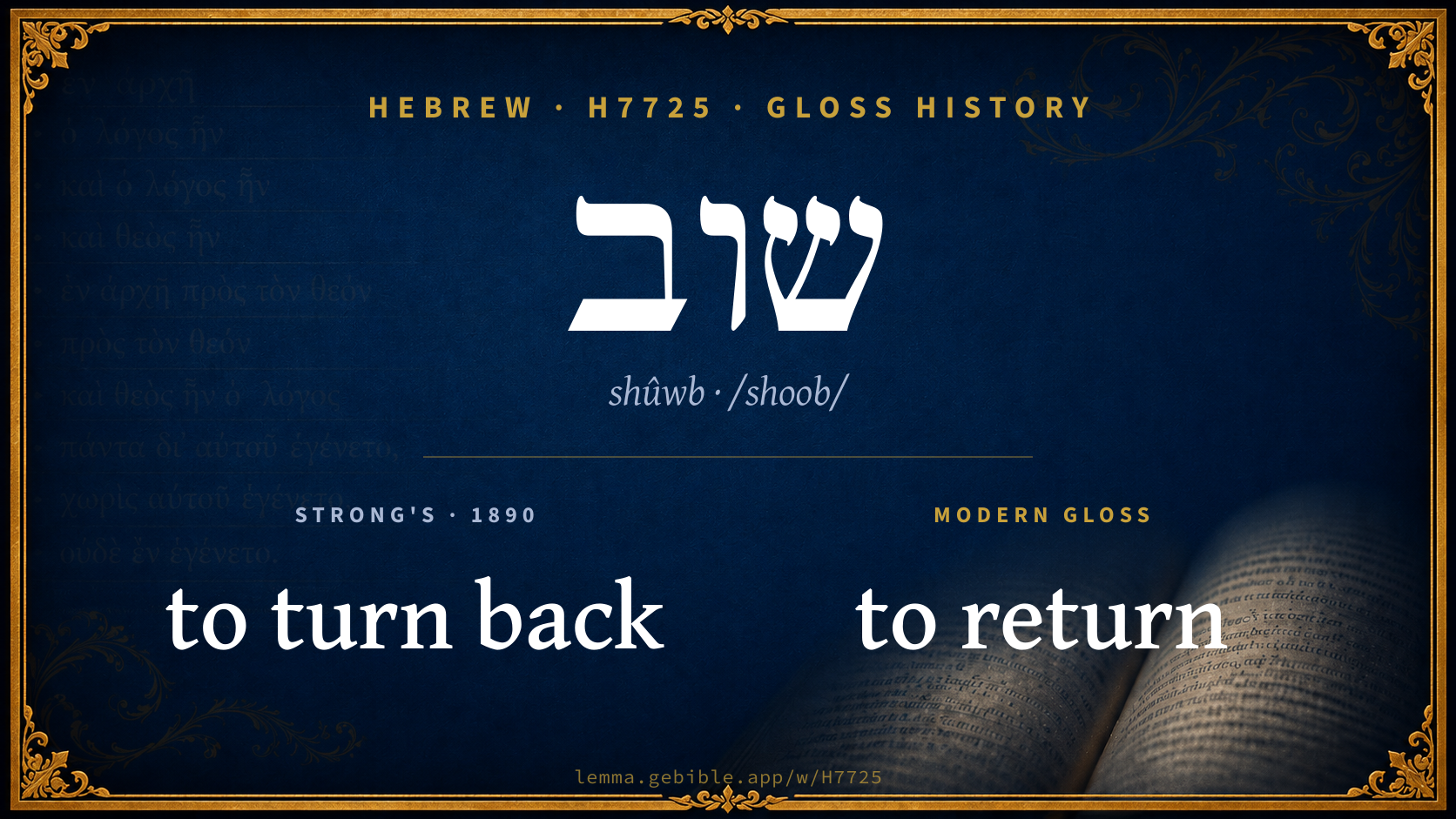
Gloss history
Strong's 1890 vs modern scholarship
About this word
Strong's H7725 catalogs a Hebrew word from the Hebrew Old Testament.
These counts are not copied from any lexicon or concordance. They are computed here, from the morphology-tagged Hebrew Old Testament. What Lemma adds →
- 952
- distinct verses
- The word appears in 952 distinct verses.
- 38 / 39
- OT books
- The word appears in 38 of 39 Old Testament books.
- #38
- by frequency
- Top 50 most frequent Hebrew words (rank 38 of 8,640 Hebrew words by occurrence).
View all 952 occurrences in the concordance →
By section of the Old Testament
By traditional corpus
Conventional, traditional groupings — biblical authorship is debated, so this is a traditional corpus grouping, not an authorship claim. Each share is this word’s portion of its verses in that division of the Hebrew canon. Each figure is a share of the word’s 952 distinct verses.
- Prophets (Nevi'im) 528 verses · 55%
- Writings (Ketuvim) 265 verses · 28%
- Torah (Pentateuch) 159 verses · 17%
How translations render this word
Counts come from each version’s own published word-to-Strong’s tagging or interlinear alignment — an approximate guide to how each version renders this word, not a word-level alignment the data otherwise carries. Because each total is that version’s own tagged count, the per-version totals vary from one another and need not match the appearance or distinct-verse counts above. These counts may also differ from a printed concordance because Lemma counts each distinctly tagged rendering and does not collapse phrase taggings into a single head-word total. This is a fixed set of word-tagged versions (KJV, ASV, BSB, ULT) and does not change with the reading translation you choose elsewhere. Each version’s license is shown beside its name below (and on Sources).
- King James Version: Return 84×, Returned 80×, Again 66×
- American Standard Version: Returned 75×, Return 69×, Again 60×
- Berean Standard Bible: Return 102×, Returned 62×, Turn 29×
- unfoldingWord Literal Text: Return 164×, Returned 95×, And 80×
King James Version Public Domain
Renders H7725 across 1,106 tagged occurrences — most commonly:
Plus other, less common renderings. Plus 386 renderings that appear only once — usually multi-word phrases or single function words the recovered tagging swept in, not distinct renderings. Not rendered by a distinct English word in 11 further occurrences.
American Standard Version Public Domain
Renders H7725 across 1,102 tagged occurrences — most commonly:
Plus other, less common renderings. Plus 386 renderings that appear only once — usually multi-word phrases or single function words the recovered tagging swept in, not distinct renderings.
Berean Standard Bible Public Domain
Renders H7725 across 1,007 tagged occurrences — most commonly:
Plus other, less common renderings. Plus 306 renderings that appear only once — usually multi-word phrases or single function words the recovered tagging swept in, not distinct renderings. Not rendered by a distinct English word in 48 further occurrences.
unfoldingWord Literal Text CC BY-SA 4.0
Renders H7725 across 1,254 tagged occurrences — most commonly:
Plus other, less common renderings. Plus 223 renderings that appear only once — usually multi-word phrases or single function words the recovered tagging swept in, not distinct renderings.
64 senses and sub-senses in the full BDB
Hebrew verbs can shift meaning by stem (binyan): Qal is the basic action, Niphal is often passive or reflexive, Piel often intensifies or makes it factitive, and Hiphil is typically causative. The senses below are grouped under the stem BDB assigns to each. This entry also uses Hophal (the passive of Hiphil) and one or more reduplicated stems (the Pōlēl/Pilpēl type), which for hollow or geminate roots behave much like Piel — often intensive or iterative.
What do BDB’s symbols mean?
BDB uses these scholarly abbreviations:
| Symbol | Meaning |
|---|---|
| 𝔊 | the Septuagint (the ancient Greek translation, LXX) |
| 𝔙 | the Vulgate (the Latin translation) |
| 𝔖 | the Syriac version (the Peshitta) |
| 𝔗 | the Targum (the Aramaic translation) |
| ψ | the Psalms |
| √ | root (the underlying root or stem) |
| ‖ | parallel passage (a synonymous or contrasted parallel) |
| † | the dagger: every passage where the word occurs is cited |
The 64 senses and sub-senses the full Brown-Driver-Briggs lexicon distinguishes for this word, in lexicon order (not ranked by frequency), with BDB’s own verbatim wording and sub-sense lettering. Shown in Hebrew script with BDB’s own scholarly abbreviations. The condensed entry is in the Lexicon Entry tab. See also the Forms in the corpus table below.
Qal
- Pf. 3 ms. שָׁב Gn 18:33 +, 3 fs. שָׁ֫בָה Ru 1:15 +, וְשָׁבַת consec. †Ez 46:17 (Ges§ 72 o, but Co Toy Krae וְשָׁבָה), 2 ms. שַׁבְתָּ ψ 85:2, etc.; Impf. 3 ms. יָשׁוּב Ho 11:5 + often, יָשֻׁב ψ 146:4; La 3:3, juss. יָשֹׁב Ju 7:3 +, וַיָּ֫שָׁב Gn 26:18 +; 3 fpl. תָּשֹׁבְןָ Ez 16:55(×2), תְּשֻׁבֶינָה v 55, etc.; Imv. ms. שׁוּב Gn 31:3 +, שֻׁב Ex 4:19; 1 K 18:43, שׁוּ֫בָה Ho 14:2 +, fpl. שֹׁבְנָה Ru 1:8, 11, 12, etc.; Inf. abs. שׁוֹב Gn 8:3 +, cstr. שׁוּב Ex 4:21 +, שֹׁב Jos 2:16 (Ges§ 72 q), etc.; Pt. שָׁב Gn 43:18 +, fs. שָׁבָ֫ה Ru 1:22 +, etc.; pass. cstr. שׁוּבֵי Mi 2:8;—turn back, return: e.g. Genesis 18:33
- 1. turn back, c. מִן loc. Ju 3:19; 8:13, cf. 7:3, c. מֵאַחֲרֵי pers., i.e. from following 2 S 11:15; 1 K 19:21; Ru 1:16, from pursuing 2 S 2:26, 30; 1 K 22:33 = 2 Ch 18:32; c. מִן of pursuit 1 S 17:53; 23:28, cf. 2 Ch 11:4; c. אַחֲרֵי pers., i.e. so as to follow 1 S 15:31 2 S 23:10; turn back in fear, מִן rei Jb 39:22 (of horse), מִפְנֵי כֹל Pr 30:30 (of lion), so abs. (of foes) ψ 6:11; 56:10; 70:4, in shame La 1:8; turn back and do so and so: Gn 14:7; Ex 14:2, cf. Nu 33:7 (עַל loc., both P), Jos 8:21 (E), 11:10 (J), 1 Ch 21:20, sq. inf. 2 Ch 20:27; abs. turn back (face about) Ct 7:1(×4) (+ vb.); = be repulsed, defeated ψ 9:4 (+ אָחוֹר), 74:21; fig. turn back, viz. from promise or vow Ju 11:35; c. מִן of service Nu 8:25 (P), i.e. be exempt. e.g. Judges 3:19
- 2. return, come or go back, c. מֵעַל pers. 1 S 17:15 (opp. הלך), 2 S 10:14; 2 K 18:14, מִן pers. Jos 10:31 (+ בְּשָׁלוֹם), מִן loc., especially from foreign land 2 K 8:3; 2 Ch 10:2; Ru 1:6, 22; 2:6; 4:3; Je 31:16; 40:12; 43:5; 44:28; Ezr 6:21; Ne 8:17, מֵהַכּוֹת Gn 14:17 (JE?), 1 S 17:57; 18:6; 2 S 1:1; 8:13, מֵאַחֲרֵי i.e. from pursuing 1 S 24:2 (Gi v 1); fig., לֹא שׁ׳ מִנִּי חֹשֶׁךְ Jb 15:22 (v. חֹשֶׁךְ 3 a); עִבְרוּ וָשׁוּבוּ מִשַּׁעַר לָשַׁעַר Ex 32:27 (J), i.e. go back and forth from gate to gate, cf. (abs.) pt. as subst. עֹבֵר וָשָׁב Zc 7:14; 9:8 and (= all persons) Ez 35:7; also וַיֵּצֵא יָצוֹא וָשׁוֹב Gn 8:7 (J), רָצוֹא וָשׁוֹב Ez 1:14 (del. Hi Co Toy al.; yet v. Krae); Gn 8:3 (J) v. הלך 4 c (4). e.g. 1 Samuel 17:15
- 3. especially return unto:
- a. go back, אֶל pers. Nu 23:5, 16 (JE), 2 K 1:6 (‖ הָלַךְ, as often), Ex 5:22 (J; אֶל־י׳, 32:31 (E; id.), Nu 17:15 (P), 2 S 20:22 (+ acc. loc.), Je 46:16 (both + אֶל loc.), + 17 times; אֶל loc. also Gn 21:32; 28:21 (both E), 2 S 11:4; Ho 5:15 (of י׳), 2 Ch 19:1 (+ בְּשָׁלוֹם, + ל pers.), Est 2:14 (opp. בּוֹא), 7:8 (+ מִן loc.), + 27 times; of a dog שׁ׳ עַל־קֵאוֹ Pr 26:11; ל loc. Gn 18:33 (J), 1 S 26:25; 29:4; 1 K 19:15 (+ -ה loc.), Gn 33:16 (J; לְדַרְכּוֹ, + id.), ψ 7:8 (of י׳), + 25 times; ל pers. †Ru 1:10 (לְעַמֵּךְ); -ה loc. also Gn 44:13 (J), Ex 4:20, 21 (R), 13:17 (E), + 5 times; שָׁם (= שָׁ֫מָּה) Je 22:27; acc. loc. also Ho 8:13; 9:3; 1 S 18:2; 2 S 3:27; 15:27 (+ בְּשָׁלוֹם), 2 K 2:25 (+ מִן loc.), + 15 times; acc. דֶּרֶךָ Ez 46:9; acc. pers. †Nu 10:36; אַחֲרֵי pers. Ru 1:15; abs. 2 S 3:16; 19:16 (+ בּוֹא), 1 K 18:43; Je 40:5 (Ez 7:13b (del. 𝔊 Co Krae al.) +; sq. vb., go back and do so and so, Gn 43:2; 1 S 1:19; 29:7 (שׁוּב וְלֵךְ בְּשָׁלוֹם), 1 K 13:22; 2 Ch 18:16 (+ בְּשָׁלוֹם) +, (Je 42:10 read יָשׁוֹב Vrss and mod.); sq. inf. purpose Ju 14:8; 2 S 6:20 + 10 times e.g. Numbers 23:5
- b. come back, אֶל pers. Gn 8:9 (J; + אֶל loc.), Ex 24:14 (J), 1 S 23:23 + 2 S 17:3 (𝔊 Ew Th We Dr HPS Bu), 1 K 12:15 (opp. הָלַךְ) + 9 times + (in hostility) Ju 20:48; אֶל loc. also Zc 8:3 (subj. י׳); Jos 22:32 (P) has מֵאֵת pers. + מִן loc. + אֶל loc. + אֶל pers.; אֶל rei Ez 7:13; עַל pers. †Ne 4:6 Mi 5:2 (be reunited to); עַל loc. †1 K 17:21, 22; ל loc. Jos 1:15 (R), Zc 1:16 (subj. י׳), 2 Ch 30:9 + (from exile) 5 times; ל animal., Jb 39:4; -ה loc. †Gn 15:16 (E), 50:14 (J); acc. loc. †2 Ch 19:8; שָׁם Je 22:11 (opp. יָצָא), שָׁ֫מָּה v 27, הֵ֫נָּה 31:8; abs. Gn 43:10 (J), 2 S 10:5; 2 K 1:5; Is 21:12 (‖ אָתָה), Jb 39:12 (Kt, so Bu Du; of wild ox), + often; + בְּשָׁלוֹם Ju 8:9; 1 K 22:28 (שׁוֹב תָּשׁוּב) = 2 Ch 18:27; 2 Ch 18:26; + vb., come back and do so and so, †Dt 1:45; 30:8; Je 37:8; 1 K 19:7; 20:5; 2 K 9:36 ψ 60:2 (title), cf. Zc 4:1; Dn 11:10, שׁ׳ לָשֶׁבֶת Nu 35:32 (P), שׁ׳ לָלֶכֶת Ec 5:14. e.g. Genesis 8:9
- 4.
- a. of dying, שׁ׳ אֶל־(הֶ)עָפָר Gn 3:19(×2) (J), ψ 104:29; Ec 3:20, עַל־עָפָר Jb 34:15; שׁ׳ לְאַדְמָתוֹ ψ 146:4, cf. אָשׁוּב שָׁ֫מָּה (i.e. בֶּטֶן אִמּוֹ) Jb 1:21 (v. Di Bu, also Ec 5:14); שׁ׳ לִשְׁא֑וֹלָה ψ 9:18; so prob. abs. ψ 90:3 (> come back to life); of (human) dust, שׁ׳ עַל־הָאָרֶץ Ec 12:7; breath, שׁ׳ אֶל־הָאֱלֹהִים v 7. e.g. Genesis 3:19
- b. of revival from death, שׁ׳ לְבֵיתוֹ Jb 7:10, abs. 10:21 (opp. הָלַךְ), 16:22 (id.), Pr 2:19; also c. אֶל pers. 2 S 12:23. e.g. Job 7:10
- 5. fig. of human relations:
- a. return to leader, king, אֶל pers., Ju 11:8; 1 K 12:27(×2); to divorced wife Je 3:1 (opp. הלך). e.g. Judges 11:8
- b. = change so as to approach (in purpose, desire), אֶל־ pers. Je 15:19(×2). e.g. Jeremiah 15:19
- c. turn, i.e. resort to, ל pers. ψ 119:79. e.g. Psalms 119:79
- d. return to a physical condition Jb 33:25 (ל rei); to a state or course of life, ל rei Is 23:17; Ez 16:55(×3); Ne 9:17 ψ 85:9 עַל rei Je 11:10, הֲלוֹם ψ 73:10 (but crpt.); ב Je 8:6 (Du reads שָׁט for שָׁב). e.g. Job 33:25
- e. abs. = change course of action; from good to bad, וַיָּשָׁב וַיִּמְרָד־בּוֹ 2 K 24:1; Je 34:11, 16; bad to good v 15; so שׁ׳ alone Jb 6:29(×2) (prob.; read וְשׁוּבוּ, so Di Da Bu al.; other interpr. De Du al.). e.g. 2 Kings 24:1
- f. pt. pass. = averse, שׁוּבֵי מִלְחָמָה Mi 2:8 (> We Now שׁבִי spoil of war). e.g. Micah 2:8
- 6. fig., specif. of spiritual relations:
- a. turn back from God, = apostatize, מֵאַחֲרֵי י׳ Nu 14:43 (J), 1 S 15:11; 1 K 9:6 (שׁוֹב תְּשֻׁב֫וּן), Je 3:19; Nu 32:15; Jos 22:16, 18, 23, 29 (all P); abs. (usually + vb.) Ju 2:19; 8:33; Jos 23:12 (RD), Je 8:4 ψ 78:41; 2 Ch 7:19. e.g. Numbers 14:43
- b. of י׳, turn away, מֵאַחֲרֵי pers. Dt 23:15. e.g. Deuteronomy 23:15
- c. turn back to God (= seek penitently), אֶל־י׳ Ho 6:1; 7:10; 14:3; Je 3:7; 1 K 8:33, 48 (בְּכָל־לֵבָב), + 18 times; אֶל־אֱלֹהִים †Ho 5:4 ψ 51:15, cf. Is 10:21; עַל־י׳ †2 Ch 15:4; 30:9; עַד־י׳ Am 4:6, 8, 9, 10, 11; Ho 14:2; Is 9:12 + 5 times; עַד־שַׁדַּי †Jb 22:23; לי׳ Is 31:6, שׁ׳ נַפְשִׁי לִמְנוּחָ֑יְכִי ψ 116:7; cf. לַבַּעַל Ho 7:16 (for לֹא עַל, Now, cf. Marti); לְתוֹכַחְתִּי Pr 1:23 (prob. del., v. Toy). e.g. Hosea 6:1
- d. abs. repent, Ho 3:5; 11:5; Is 6:10; 10:22; Je 3:7, 12, 14, 22; 4:1; 5:3 + 14 times, + pt. as subst. Is 1:27. e.g. Hosea 3:5
- e. turn back from evil, c. מִן (especially Je Ez) 1 K 8:35; 13:33; Je 15:7; 18:8 + 8 times Je, Ez 3:19; 13:22 + 12 times Ez, + 9 times; cf. שָׁבֵי פֶשַׁע Is 59:20; שׁוּבוּ וְהָשִׁיבוּ מִן Ez 18:30, so c. מֵעַל 14:6; from good, c. מִן, †Ez 3:20; 18:24, 26; 33:18. e.g. 1 Kings 8:35
- f. of י׳, שׁ׳ מֵחֲרוֹן אַפּוֹ Ex 32:12 (JE), Dt 13:18; Jos 7:26 (J), 2 K 23:26; Jon 3:9; שׁ׳ מִמֶּנּוּ אַף־י׳ Ho 14:5; Je 2:35; 4:8; Nu 25:4 (P), 2 Ch 12:12; 29:10; 30:8, so (man’s anger) Gn 27:45 (J) and (abs.) v 44 (E); abs. of אַף־י׳ Is 5:25; 9:11, 16, 20; 10:4; 12:1; Je 23:20 (opp. יָצָא v 19), 30:24 Jb 14:13; Dn 9:16. e.g. Exodus 32:12
- g. of י׳, return (to shew favour), אֶל pers. †Gn 18:10 (+ inf. abs.), v 14 Zc 1:3; Mal 3:7; 2 Ch 30:6, abs. Is 63:17 ψ 80:15 (‖ הִבִּיט, פָּקַד), 90:13, + vb. Je 12:15 ψ 6:5 Jo 2:14 Jon 3:9; also in hostility, + vb. Jos 24:20 (E), c. inf. purpose Ho 11:9. e.g. Genesis 18:10
- h. of י׳, turn back from (מִן) judgment Je 4:28, אֱמֶת ψ 132:11; מֵאַחֲרֵי pers., i.e. cease to bless, Je 32:40. e.g. Jeremiah 4:28
- 7. of inanimate things (sometimes personified, or treated as things of life):
- a. as perceptibly moving, water Gn 8:3 (J; מֵעַל loc.), Jos 4:18 (J; ל loc.), Ex 14:26 (P; עַל pers.), v 28 (P; + vb.), ψ 104:9 (ל inf.), sea Ex 14:27 (J; לְאֵיתָנוֹ); wind ψ 78:39 (opp. הלך), Ec 1:6 (עַל loc.); shadow 2 K 20:9, 10 (+ אֲחֹרַנִּית), ‖ Is 38:8 (sun on dial), of breath (= revive) Ju 15:19; 1 S 30:12 (אֶל pers.); clouds Ec 12:2 (מִן temp.); rain and snow Is 55:10 (ה loc.); rolling stone Pr 26:27; sword 2 S 1:22 (מִן rei), Ez 21:10, arrow Je 50:9; of plague-spot = re-appear, Lv 14:43 (P). e.g. Genesis 8:3
- b. = be brought back, Gn 43:18 (J), 1 S 5:11 (ל loc.), hence be restored, ל pers. Ez 46:17, so of kingdom 1 K 12:26, city 1 S 7:14 (Ez 35:9 v. ישׁב 4), field Lv 27:24 (P); of animal Dt 28:31. e.g. Genesis 43:18
- c. = be turned into, ל rei, Is 29:17; = be turned back into, עַד rei, Mi 1:7. e.g. Isaiah 29:17
- d. return, fig. of word, (1) Is 45:23, c. אֶל pers. 55:11 (both opp. יָצָא); (2) ψ 35:13 my prayer turned upon (עַל) my bosom (was uttered with bowed head, De Bae Du). e.g. Isaiah 45:23
- e. turn away, depart, of infamy Pr 25:10. e.g. Proverbs 25:10
- f. return (in recompense), of crime, evil, etc., c. בְּרֹאשׁ 1 K 2:33; Ob 15 ψ 7:17, עַל־רֹאשׁ Est 9:25, ל pers. ψ 54:7 (Kt; > Qr Hiph.), Pr 12:14. e.g. 1 Kings 2:33
- g. ψ 94:15 judgment (-giving) shall return to (עַד) righteousness (be in accord therewith). e.g. Psalms 94:15
- h. of boundary, = change (sometimes reverse) direction (P), -ה loc. Jos 19:12 (+ מִן loc.), v 34 (+ acc. loc.), acc. loc. also v 27, 29 (+ עַד loc.), v 29. e.g. Joshua 19:12
- i. be restored to healthy condition, of withered hand 1 K 13:6(×2) (אֶל pers.), leprous hand Ex 4:7 (J; c. כ comp.), flesh 2 K 5:10 (ל pers.), v 14; Lv 13:16 (‖ נֶהְפַּךְ לְלָבָן). e.g. 1 Kings 13:6
- 8. denoting repetition, etc. (Ges§ 120 d g): + vb., return (and) do = do again, Gn 26:18; 30:31; Nu 11:4 (all J), Ju 19:7; 1 S 3:5, 6; 1 K 13:33; 19:6; 2 K 1:11, 13; 19:9; 21:3 = 2 Ch 33:3; Je 18:4; 36:28; Zc 5:1; 6:1; Mal 1:4; Jb 10:16; 17:10 ψ 7:13; Dn 9:25, perhaps also 2 Ch 19:4; cf. Is 6:13 = it, in turn, shall be destroyed (destruction shall be repeated in its case), La 3:3 appar. = do repeatedly; שׁ׳ + Inf. abs. Ec 4:1, 7; 9:11; in compar. עוֹד תָּשׁוּב תִּרְאֶה Ez 8:6 thou shalt see yet greater abominations, so v 13 and (מִן comp.) v 15; שׁ׳ + Inf. cstr. Dt 24:4; 30:9; Jos 5:2 (RD), Je 36:28; Ez 8:17; Ezr 9:14; Ne 9:28; Jb 7:7; Ec 1:7: = reverse one’s action, + vb. Jos 2:23 (E), Ho 2:11; 2 K 13:25; Dt 30:3; Mi 7:19; Zc 8:15 ψ 71:20(×2); 85:7; = restore to original condition by doing, + vb. Dt 23:14. e.g. Genesis 26:18
- 9. trans., peculiarly, in phr. שׁ׳ שְׁבוּת restore captivity of, etc., c. 21 times (v. שְׁבוּת sub שָׁבָה); שׁ׳ י׳ צִיּוֹן Is 52:8, שׁ׳ c. sf. pers. ψ 85:5; elsewhere only וְשָׁב י׳ אֶת־גְּאוֹן יַעֲקֹב וגו׳ Na 2:3, cf. Hiph. 9. e.g. Isaiah 52:8
Pōʿl
- 1. bring back, Pf. 1 s. וְשֹׁבַבְתִּ֫י, c. acc. pers. + אֶל loc. Je 50:19 (י׳ subj.), Inf. cstr. sf. בְּשׁוֹבְבִי, c. מִן loc. Ez 39:27 and (fig.) לְשׁוֹבֵב, c. אֶל pers. Is 49:5; Impf. 2 ms. תְּשׁוֹבֵב לָנוּ ψ 60:3 = take us back into power. e.g. Jeremiah 50:19
- 2.
- a. fig. restore, refresh, 3 ms. נַפְשִׁי יְשׁוֹבֵב ψ 23:3 (י׳ subj.); cf. Hiph. 2 b. e.g. Psalms 23:3
- b. restore, repair, Pt. מְשׁוֹבֵב נְתִיבוֹח לָשָׁ֑בֶת Is 58:12. e.g. Isaiah 58:12
- 3. lead away (enticingly), Pf. 1 s. sf. (of Gog), י׳ subj., וְשׁוֹבַבְתִּיךָ Ez 38:4 (del. Co), וְשֹׁ׳ 39:2; so fig. 3 fs. sf. וְדַעְתֵּךְ הִיא שׁוֹבְבָ֑תֶךְ Is 47:10 (of Bab.);—Je 50:6 v. Qal. e.g. Ezekiel 38:4
- 4. shew turning = apostatize (cf. Hiph. 8), Pf. 3 fs. שׁוֹבְבָה Je 8:5 (read שׁוֹבֵב, and del. ירושׁלם, c. 𝔊).—Vid. also שׁוֹבֵב infra. e.g. Jeremiah 8:5
Puʿl
- Pt. f. מְשׁוֹבֶ֫בֶת Ez 38:8 a land restored + מִן rei.—Vid. also שׁוֹבָב infra. e.g. Ezekiel 38:8
Hiphil
- Pf. 3 ms. Gn 41:13 +; sf. וַהֲשִׁיבְךָ 40:13, וֶהֱשִׁיבְךָ Dt 28:68; 2 ms. הֱשִׁיבוֹתָ ψ 85:4, וַהֲשֵׁבֹתָ֫ Dt 4:39; 30:1, sf. וַהֲשֵׁיבוֹתָם 2 Ch 6:25; 1 s. consec. וַהֲשִׁיב֫וֹתִי Am 1:8, וַהֲשִׁבֹתִ֫י Nu 22:8 +, sf. וְהוֹשְׁבוֹתִים Zc 10:6 (but read וַהֲשִׁבוֹתִים, v. ישׁב Hiph.), etc.; Impf. 3 ms. יָשִׁיב Ex 21:34 +, (read יָשִׁב Dn 11:18, 19 > Qr v 18 יָשֵׂם), וַיָּ֫שֶׁב Gn 20:14 +; sf. יְשִׁבֵנִי 2 S 15:8 +, וַיְשִׁיבֵם 2 Ch 19:4 + 1 S 12:8 Vrss We Dr al.; 3 fpl. תָּשֵׁבְנָה Jb 20:10, etc.; Imv. ms. הָשֵׁב Gn 20:7 +, הָשֵׁיב 2 K 8:6, הָשַׁ֑ב Is 42:22, so הָשַׁ֖ב Ez 21:35 (v. Ke and still Toy; Ew Sm Krae Inf. abs. הָשֵׁב), הָשִׁיבָה Ju 11:13 +, etc.; Inf. abs. הָשֵׁב Ex 23:4 +; cstr. הָשִׁיב Gn 42:35 +, etc.; Pt. מֵשִׁיב 20:7 +, etc.;—cause to return, bring back: e.g. Genesis 41:13
- 1.
- a. c. acc. pers. + אֶל loc. Gn 24:5 (J; הֶהָשֵׁב אָשִׁיב), 28:15 (J), 42:37 (E), 48:21 (E), +; especially from exile 1 K 8:34 = 2 Ch 6:25; Je 27:22 + 5 times Je; + אֶל pers. 1 K 22:26 = 2 Ch 18:25; + עַל loc. Je 16:15; 23:3; 24:6; + ל loc. 12:15; + acc. loc. 2 S 15:8 (read הָשֵׁב יְשִׁבֵנִי Vrss Th We Dr al.), Dt 28:68; Ez 29:14; 47:6; 2 Ch 33:13, etc.; + מִן loc. Je 41:16; Zc 10:10, מֵאֵת pers. Je 41:16, מִן inf. 2 Ch 25:13; acc. pers. only Ju 19:3; 1 K 13:20, 23 +; bring back into bondage, etc., Je 34:11, 16; = allow to return 15:19; acc. pers. + rei (= recover, recapture), 28:6 (+ אֶל loc., מִן loc.); = recover, rescue, Gn 14:16 (acc. pers. + rei), ψ 35:17 (acc. נַפְשִׁי, מִן rei); acc. rei + אֶל pers. Gn 44:8 (J), + עַל pers. Ex 15:9 (song), Pr 20:26; + אֶל loc. 1 K 14:28 = 2 Ch 12:11; Je 28:3; 2 Ch 24:11; acc. of hand, אֶל־פֶּה 1 S 14:27; Pr 19:24 26:15; especially of י׳’s hand, in judgment, sq. עַל Am 1:8; Is 1:25; Zc 13:7 ψ 81:15, also of man’s hand Je 6:9; Ez 38:12; + acc. loc. 2 S 15:25, 29; + שָׁם Ne 13:9; acc. rei alone Gn 43:12, 21 (both בְּיֶדְכֶם), 14:16 (= recapture), 1 S 6:21; 30:19; 1 K 13:29 (corpse), Lv 26:26 (H); c. acc. animal. 1 S 6:7 (מֵאַחֲרֵי), Ez 34:4, 16 (fig.); shadow on dial 2 K 20:11 = Is 38:8.—Jb 39:12 v. Qal 3 b. e.g. Genesis 24:5
- b. put back: acc. rei, stone, עַל־פִּי הַבְּאֵר Gn 29:3 (J), veil עַל־פָּנָיו Ex 34:35 (P), Dagon לִמְקוֹמוֹ 1 S 5:3, rod לִפְנֵי הָעֵדוּת Nu 17:25 (P), sword, + אֶל of sheath, 1 Ch 21:27; Ez 21:35 (acc. om.); hand אֶל־חֵיק Ex 4:7(×2) (J; opp. הוֹצִיא). e.g. Genesis 29:3
- c. = draw back, hand Gn 38:29 (J), 1 K 13:4 (opp. שָׁלַח; + אֶל reflex.), Jos 8:26 (E; opp. נטה), so fig., י׳ subj. La 2:3 (מִפְּנֵי, אָחוֹר), ψ 74:11; c. מִן = refrain from La 2:8; Ex 18:8, 17 (i.e. from oppressing), 20:22 (מִן om.); foot, c. מִן Is 58:13 (fig.); draw in breath Jb 9:18. e.g. Genesis 38:29
- d. = give back, restore, acc. pers. vel rei: + ל pers. Gn 20:14 (E), v 7 (E; acc. om.), Ex 23:4 (E; הָשֵׁב תָּשִׁיב), Dt 22:1 (id.; both acc. animal.), 24:13 (id.), Ex 22:25 (E), Ju 17:3(×2), 4; 1 S 12:3; 2 S 9:7; Dt 22:2 (P), Ne 5:11, so 2 S 16:3; 1 K 12:21 = 2 Ch 11:1 (all acc. of kingdom), c. acc. צְדָקָה Jb 33:26; + אֶל pers. Gn 37:22 (E; acc. pers.); + אֶל loc. 42:25 (E); acc. rei only, 2 K 8:6; Ez 18:7 (read Inf. abs. שׁוֹב for חוֹב, Co Toy Krae), 18:12; 33:15; Lv 5:23 (P), Nu 5:7 (P; + בְּרֹאשׁוֹ = in full), ψ 69:5 (opp. גָּזַל), so of land (or city) Ju 11:13; 1 K 20:34; Ne 5:12, cf. 2 K 14:28 (+ בְּיִשְׂרָאֵל), 16:6 (+ לַאֲרָם); = win back 2 K 13:25; 14:22 (+ ל terr.) = 2 Ch 26:2, boundary (i.e. re-establish it) 2 K 14:25; restore ruined city Dn 9:25 (+ לִבְנוֹת), conquered nation ψ 80:4, 8, 20; joy, acc. + ל pers. ψ 51:14.—2 S 8:3 v. יָד 2.—Acc. pers. only, Gn 20:7 (E), Is 42:22; restore to office, acc. pers. + עַל Gn 40:13, 21 (E), אֶל loc. 2 S 19:12, acc. pers. only, 2 S 19:11, 13, 44, cf. Is 1:26; = pay back money, Lv 25:27 (ל pers.), v 51, 52. e.g. Genesis 20:14
- e. = relinquish, c. acc. rei, Jb 20:10. e.g. Job 20:10
- f. = give in payment, requital, c. acc. rei + appos. 1 S 6:8 (ל pers.), v 17 (id.; cf. טְחוֹר); also pay as tribute (in answer to demand), acc. rei 2 K 17:3 ψ 72:10, + ל pers. 2 K 3:4; 2 Ch 27:5; give in exchange Ez 27:15. e.g. 1 Samuel 6:8
- g. bring one back (from dead) 2 S 12:23, so c. מִנִּי Jb 33:30; on other hand, אֶל־עָפָר Jb 10:9 = מָוֶת (acc.) 30:23, cf. עַד־דַּכָּא ψ 90:3. e.g. 2 Samuel 12:23
- 2.
- a. bring back heart, לֵב, עַל pers. Mal 3:24; הֲשִׁיבֵנוּ י׳ אֵלֶיךָ La 5:21 (restore, del. אליך); הֵשִׁיב אֶל־י׳ Ne 9:26 (cf. v 29), 2 Ch 19:4; 24:19, also (מִן of evil) Je 23:22, abs. 31:18. e.g. Malachi 3:24
- b. acc. נֶפֶשׁ = refresh La 1:11, 16, 19 ψ 19:8 Pr 25:13; Ru 4:15. e.g. Lamentations 1:11
- 3. bring back words of people, אֶל־י׳ Ex 19:8 (E); then, in gen., bring back word, דָּבָר, report to, + acc. pers. Gn 37:14; Nu 13:26; 22:8 (all E), Dt 1:22, 25; Jos 14:7 (RD), 22:32 (P), + 8 times; = answer 1 S 17:30; 2 S 3:11; 1 K 12:6 = 2 Ch 10:6 + 6 times, + (acc. מִלִּין) Jb 35:4; also (דָּבָר om.) Jb 13:22; 20:2; 33:5, 32; 2 Ch 10:16; Ne 6:4 (כַּדָּבָר הַזֶּה); acc. אֲמָרִים + ל pers. Ju 5:29; Pr 22:21; later c. ל pers. alone 1 S 12:3; c. cl. orat. recta, אֶל pers. Est 4:13, 15; similar phrases, Ez 9:11; Pr 18:13; 24:26; 26:16; Hb 2:1; Jb 31:14; 32:14 (Gi v 15), 40:4. e.g. Exodus 19:8
- 4.
- a. bring back (in retribution), cf. Qal 7 f) upon, subj. often י׳, acc. of evil, Ju 9:56, בְּרֹאשׁ Ju 9:57; 1 S 25:39; 1 K 2:44; Jo 4:4, 7, עַל־רֹאשׁ 1 K 2:32, אֶל־רֹאשׁ Ne 3:36; ל pers. Gn 50:15 (E), 1 S 6:3 (הָשֵׁב תָּשִׁיבוּ), v 4 25:21 (return evil for good), +, etc.; abs. = make requital, ל pers. 2 Ch 6:23 + (כ comp.) Ho 12:3; Pr 24:12, 29; †c. acc. of good, ל pers. 1 S 26:23; 2 S 16:12; Zc 9:12; c. כ comp. + ל pers. ψ 18:21, 25 = 2 S 22:21, 25, and (כ comp. only) 2 Ch 32:25; requite י׳’s benefits, acc. rei + לי׳ ψ 116:12, cf. Nu 18:9 (P). e.g. Judges 9:56
- b. pay as recompense, כֶּסֶף יָשׁ׳ לִבְעָלָיו Ex 21:34 (E); so (fig.) of י׳, הֵשׁ׳ נָקָם לְ Dt 32:41, 43, לְהָשׁ׳ בְּחֵמָה אַפּוֹ Is 66:15. e.g. Exodus 21:34
- 5. turn back, backward = repel, defeat, c. אֶת־פְּנֵי 2 K 18:24 = Is 36:9, acc. מִלְחָמָה Is 28:6, acc. of sword ψ 89:44, acc. pers. + אָחוֹר ψ 44:11 (+ מִנִּי pers.), Is 44:25 (fig., = refute, confute), fig. of calamity La 1:13; = repulse, hinder Je 2:24, especially acc. Is 14:27 (יַד־י׳), cf. 43:13, Jb 9:12; 11:10; 23:13; = reject, refuse, (אֶת־)פְּנֵי פ׳ 1 K 2:16, 17, 20(×2) 2 Ch 6:42 ψ 132:10. e.g. 2 Kings 18:24
- 6.
- a. turn away face, fig., + מֵעַל rei Ez 14:6; acc. pers. + מִן rei Mal 2:6; anger of י׳ (acc.) + מֵעַל pers. Nu 25:11 (P), Pr 24:18, מִן pers. Je 18:20 Ezr 10:14; acc. only, Jb 9:13 ψ 78:38; 106:23; acc. of human anger Pr 15:1; 29:8. e.g. Ezekiel 14:6
- b. late, turn toward, acc. face, ל loc. Dn 11:18, 19, acc. foot, אֶל rei ψ 119:59 (fig.). e.g. Daniel 11:18
- 7. turn against, אֶל־אֵל, c. acc. רוּחֶ֑ךָ Jb 15:13. e.g. Job 15:13
- 8. לֵב, הֵשׁ׳ אֶל־לֵבָב bring back to mind, take into consideration, c. acc. La 3:21, sq. cl. with כִּ׳ Dt 4:39 (cf. Dr), obj. om. 30:1; 1 K 8:47 = 2 Ch 6:37, Is 44:19, + (עַל) 46:8. e.g. Lamentations 3:21
- 9. הֵשִׁיב אֶת־שְׁבוּת פ׳ Je 32:44; 33:7, 11; 49:6; La 2:14; Ez 39:25 + (Qr Hiph., Kt Qal) Je 33:26; 49:39; Jo 4:1 (v. Qal 9). e.g. Jeremiah 32:44
- 10. Hiph. declar., הָשׁ׳ מֵעַל Ez 14:6 = shew a turning away from your idols (i.e. turn away), cf. (מִן) 18:30, abs. הָשׁ׳ וִחְיוּ v 32; of י׳, השׁ׳ מֵחֲרוֹן אַפֶּ֑ךָ ψ 85:4 (but read prob. הֲשִׁיבוֹתָה חֲרוֹן א׳ [6 a supra]); perhaps in physical sense Jon 1:13 (אֶל loc.; We Now sc. אֳנִיָּה, etc.). e.g. Ezekiel 14:6
- 11. reverse, revoke, acc. (sf.) rei, i.e. judgment, Am 1:3, 6, 9, 11, 13; 2:1, 4, 6; blessing Nu 23:20 (poem in E), edict Est 8:5, 8. e.g. Amos 1:3
Hophal
- Pf. 3 ms. הוּשֵׁב Gn 42:28 my money has been returned! cf. Pt. הַכֶּסֶף הַמּוּשָׁב 43:12 (both J); הַמּ׳ לי׳ Nu 5:8 (P) the אָשָׁם which is restored to י׳; pl. מוּשָׁבִים Je 27:16 the vessels are about to be brought back, c. מִן loc.; Impf. 3 ms. וַיּוּשַׁב אֶת־מֹשֶׁה Ex 10:8 (J; cf. Ges§ 121 a, b) Moses was brought back, c. אֶל pers. e.g. Genesis 42:28
Senses from the full Brown-Driver-Briggs lexicon (Brown, Driver, Briggs; Oxford 1906 — public domain), digitized via Sefaria, supplemented by the OpenScriptures HebrewLexicon (CC BY 4.0). Full attribution on Sources.
Word origin
vb. turn back, return (NH id.; Hiph. in MI 8 f. 12; Sab. תֿוב, התֿב, especially requite Os ZMG xix (1865), 198 SabDenkm No. 20, l. 1 HomChrest. 122 CIS iv. 81, 1. 9, etc.; Arabic ثَابَ return, so Aramaic תּוּב, ܬܒ );—
— Brown-Driver-Briggs (Oxford 1906, public domain), digitized via Sefaria, supplemented by the OpenScriptures HebrewLexicon (CC BY 4.0). See Sources.
Origin: a primitive root
Jastrow Dictionary
A second Hebrew/Aramaic lexicon for comparison, covering Aramaic and post-biblical (Talmudic, Targumic, Midrashic) usage that the biblical-Hebrew BDB does not. Matched by lemma rather than by Strong’s number, so a lemma may carry more than one Jastrow headword (shown separately below), and the entries cover usage well beyond the Bible.
שׁוּב I
- (b. h.) to go back, come back. Sot. 10ᵇ כל עובר ושָׁב every passer-by (in going or coming back). Gen. R. s. 48, a. fr. העוברים והשָׁבִים the travellers. Lev. R. s. 23 ושָׁבַת נפשו עליו (not עליה) and his soul came back (was restored) to him, i.e. he was reconciled; a. fr.—Esp. to return (to God); to repent. B. Bath. 110ᵃ (play on ש̇ב̇א̇ל̇ I Chr. XXVI, 24) שש̇ב̇ לא̇ל̇ בכל לבו he returned to God with all his heart. Hor. 2ᵃ (ref. to Lev. IV, 22, sq.) השב … לא שב וכ׳ he who repents when he finds out (his wrong) brings a sacrifice for his error; if he does not repent, he is not permitted to sacrifice. Ab. II, 10 ושׁוּב יום וכ׳ repent one day before thy death. Ex. R. s. 42 לעולם מקבלים השבים repentant sinners are accepted at all times; a. fr. e.g. 1 Chronicles 26:24
- 1. to bring back, return, restore. Y. Yoma VIII, 45ᵃ bot. החומץ מֵשִׁיב את הנפש vinegar restores life, is a refreshing drink. Gitt. 51ᵇ, a. e. אינו אלא כמשיב … ופטור he is in that case like one who restores a lost object, and therefore is not bound to make oath. Ib. לית ליה משיב … פטור he is not of the opinion that he who restores a lost object is exempt from making oath; a. fr.
- 2. to reply; to refute. Ab. II, 14 ורע מה שתָּשִׁיב וכ׳ that you may know how to answer the sceptic. Y. Gitt. IX, beg. 50ᵃ נכנסו … להָשִׁיב על דבריו וכ׳ four elders met to refute R. Eliezer’s words; Bab. Gitt. 83ᵃ; Tosef. ib. IX (VII), 1. Y. l. c. אין אתם מְשִׁיבִים את הארי וכ׳ are you not going to refute the lion after he is dead?; Bab. ib. l. c. אין מְשִׁיבִין וכ׳ you dare not refute &c. Y. l. c. ה׳ ר׳ טרפון R. T. argued &c. (Bab. l. c. נענה; Tosef. l. c. אמר). Sabb. 88ᵇ שומעין … משיבין, v. חֶרְפָּה. B. Kam. 63ᵇ, a. e. אין משיבין על הקישא you must not argue against a conclusion from analogy. Ab. Zar. III, 4 אין משיבין במרחץ we must not answer (a religious question) in the bath-house. M. Kat. 21ᵇ מֵשִׁיב ואינו שואל the mourner may answer (a salutation), but must not salute; שואל ומשיב כדרכו he may salute and answer as usual; a. fr.—[Y. Gitt. VIII, 49ᶜ top, in Chald. dict. משיב, v. תּוּב I.]
- 3. to go back with a message. Meg. 15ᵃ; Ab. Zar. 10ᵇ אין משיבין על הקלקלה you need not go back (to him that sent you) to bring bad news.
- to be replied; to refer. Y. B. Kam. II, 3ᵃ top על הראשונה הוּשָׁבָה the modification in the Mishnah (במה דברים אמורים) refers to the first clause only; על כולה הושבה it refers to the whole paragraph. Y. Bicc. II, 65ᵃ top; a. e.
שׁוּב II
- adv. again, furthermore. Nidd. V, 7 ש׳ אין וכ׳ her father has no longer control over her. Sabb. 88ᵇ, sq. ש׳ מה כתיב furthermore, what is written in it?; a. fr.
A Dictionary of the Targumim, the Talmud Babli and Yerushalmi, and the Midrashic Literature (Marcus Jastrow; London, Luzac, 1903) — Public Domain. Digitized via Sefaria. Digitized via Sefaria. Full attribution on Sources.
Forms in the corpus
The 599 distinct written forms H7725 takes in the Hebrew Bible, most frequent first — each parse links to that stem’s occurrences in the concordance. Hebrew forms include their vowel points and cantillation, so a single lemma takes many written forms.
The 60 most common forms are shown; 539 rarer forms follow in the full concordance.
Same root — word family
Other BDB entries built from the same root as H7725, grouped by Strong’s listed origin. These share a root / origin per the lexicon — not necessarily a shared meaning. Each links to that word’s own entry.
Derived from this word
- משובה mᵉshûwbâh H4878 apostasy
- שובב shôwbâb H7726 backsliding
- שובב shôwbêb H7728 backsliding
- שובה shûwbâh H7729 withdrawal
- שיבה shîybâh H7870 restoration
- תוב tûwb H8421 to return
- תשובה tᵉshûwbâh H8666 answer
Proper names from this root
People and places named from this root — a name, not an additional meaning of the word.
- יושב חסד Yûwshab Cheçed H3142 Jushab-hesed
- ישבי לחם Yâshubîy Lechem H3433 Jashubi-lehem
- ישבעם Yâshobʻâm H3434 Jashobeam
- ישוב Yâshûwb H3437 Jashub
- משובב Mᵉshôwbâb H4877 Meshobab
Compare all same-root words → Showing 4 of 13 — not the complete family. 5 of the same-root words are proper names (people or places). They share a root, not necessarily a meaning.
Septuagint verse parallels
This word appears in 880 verses that also exist in the Greek Old Testament (Septuagint), out of the 952 Hebrew verses it occurs in. You can read those verses in Greek by switching the Old Testament edition to the Septuagint.
Read these verses in the Septuagint
- Genesis 3:19
- Exodus 4:7
- Leviticus 6:4
- Numbers 5:7
- Deuteronomy 1:22
- Joshua 1:15
- Judges 2:19
- Ruth 1:6
- 1 Samuel 1:19
- 2 Samuel 1:1
- 1 Kings 2:16
- 2 Kings 1:5
This is a verse-level parallel only — the same verses exist in both the Hebrew and Greek Old Testaments. No word-level Hebrew↔Greek correspondence is claimed: the data carries no such alignment, so no Greek word is shown as this Hebrew word’s translation. Coverage is not total — the Septuagint omits the deuterocanon and renumbers the Psalms, so some Hebrew verses have no direct Greek parallel.