

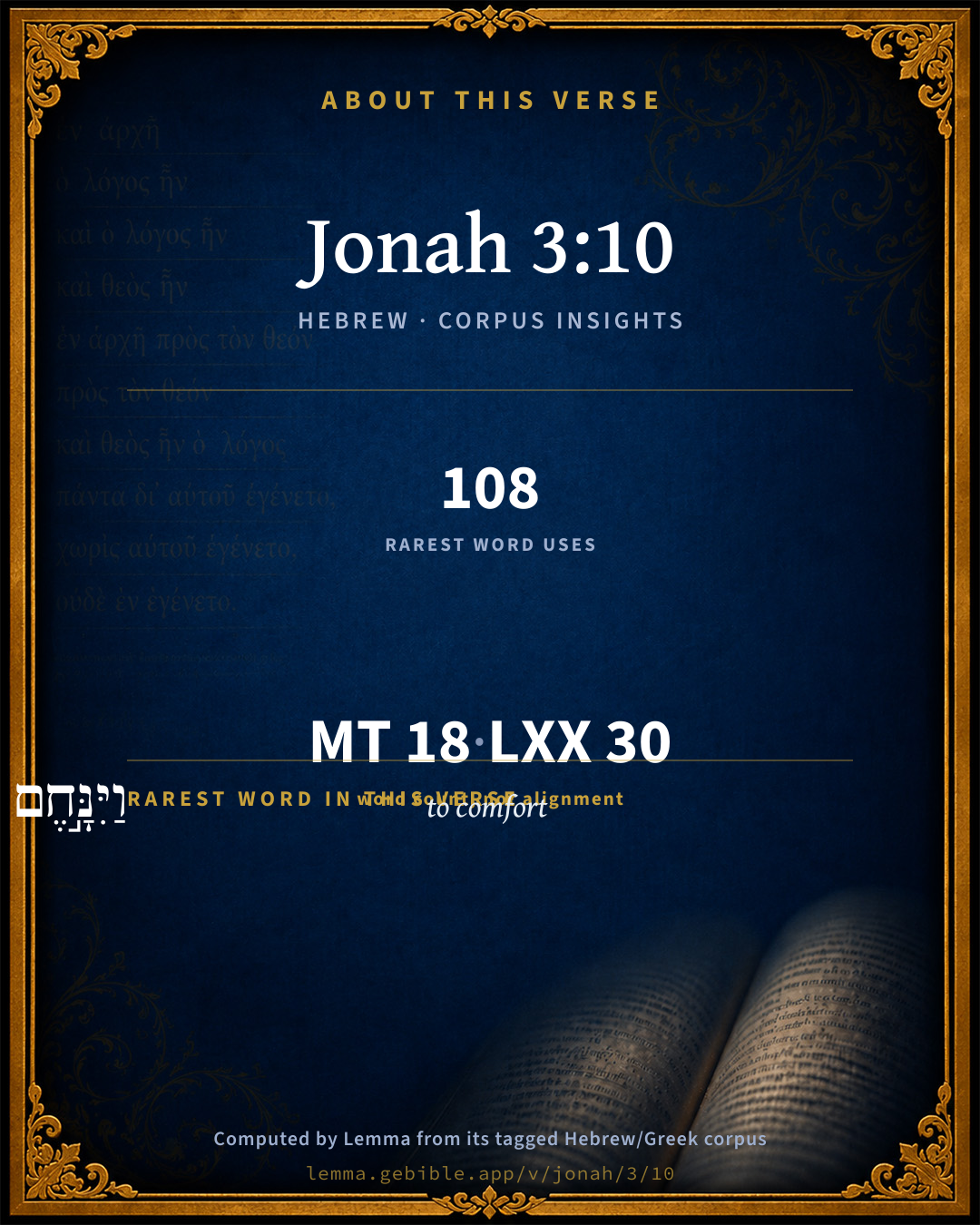
Jonah 3:10

Hebrew (Westminster Leningrad Codex) Jonah 3:10 appears in the Hebrew Old Testament. The text above is from the Westminster Leningrad Codex. Each word links to its Strong’s number, a concise gloss, and parsing drawn from the Open Scriptures Hebrew Bible morphology. Click any word for its full Brown-Driver-Briggs (BDB) entry.
Download image
Cite this verse

Jonah 3:10 (World English Bible). Public Domain. Lemma interlinear Bible study tool, https://lemma.gebible.app/v/jonah/3/10.

Show BibTeX & RIS
BibTeX
RIS
English Translation
God saw their works, that they turned from their evil way. God repented of the evil which he said he would do to them, and he didn't do it.
World English Bible · Public Domain
Download a study sheet

One document with this verse’s original text, its word-by-word gloss line, the meaning frame, cross-references with their text, attributed commentary, and full source and license credits — printable, and it pastes into notes with its structure intact.

This verse Autodidact and up

Study sheet (.html) Plain text (.txt)

A passage Seminary Student

Up to 50 verses in one chapter. A passage sheet keeps up to 6 commentary sources and 12 cross-references per verse, in the order this page ranks them, and says so on the sheet whenever that leaves anything out. Ask for a single verse and you get the Autodidact verse sheet above.

Everything on this page stays free to read, with no account — the sheet is a download of what is already on screen, not access to it.

Want to remove ads? Support Godless Engineer
Compare translations 3

The same verse in 3 English versions, stacked beneath the original-language interlinear above. Click any original word for its lexicon entry.

Each is an independent rendering of the whole verse — the interlinear is not word-aligned to these translations.

Highlighted words mark where these versions differ — a whole-verse word diff, not a word-by-word alignment.

  • World English Bible Public Domain
    God saw their works, that they turned from their evil way. God repented of the evil which he said he would do to them, and he didn't do it.
  • King James Version Public Domain
    And God saw their works, that they turned from their evil way; and God repented of the evil, that he had said that he would do unto them; and he did it not.
  • unfoldingWord Literal Text CC BY-SA 4.0
    And God saw their deeds, that they turned away from their evil ways. And God relented in regard to the evil that he had said he would do to them, and he did not do. ts\*

unfoldingWord Literal Text — © unfoldingWord, licensed CC BY-SA 4.0. Word-aligned USFM3 via Door43 (git.door43.org/unfoldingWord/en_ult).

Versions to compare (up to 4)

3 of 4 selected

Show all 18 translations

Every available English version of this verse, each an independent rendering of the whole verse.

  • World English Bible Public Domain
    God saw their works, that they turned from their evil way. God repented of the evil which he said he would do to them, and he didn't do it.
  • Berean Standard Bible Public Domain
    When God saw their actions—that they had turned from their evil ways—He relented from the disaster He had threatened to bring upon them.
  • Majority Standard Bible Public Domain
    When God saw their actions—that they had turned from their evil ways—He relented from the disaster He had threatened to bring upon them.
  • King James Version Public Domain
    And God saw their works, that they turned from their evil way; and God repented of the evil, that he had said that he would do unto them; and he did it not.
  • American Standard Version (1901) Public Domain
    And God saw their works, that they turned from their evil way; and God repented of the evil which he said he would do unto them; and he did it not.
  • Revised Version (1885) Public Domain
    And God saw their works, that they turned from their evil way; and God repented of the evil, which he said he would do unto them; and he did it not.
  • Geneva Bible (1599) Public Domain
    And God sawe their workes that they turned from their euill wayes: and God repented of the euill that he had said that he woulde doe vnto them, and he did it not.
  • Douay-Rheims (1899) Public Domain
    And God saw their works, that they were turned from their evil way: and God had mercy with regard to the evil which he had said that he would do to them, and he did it not.
  • Young's Literal Translation Public Domain
    And God seeth their works, that they have turned back from their evil way, and God repenteth of the evil that He spake of doing to them, and he hath not done `it'.
  • Literal Standard Version CC BY-SA 4.0
    And God sees their works, that they have turned back from their evil way, and God relents of the evil that He spoke of doing to them, and He has not done [it].
  • Unlocked Literal Bible CC BY-SA 4.0
    God saw what they did, that they turned from their evil ways. So then God changed his mind about the punishment that he had said he would do to them, and he did not do it.
  • unfoldingWord Literal Text CC BY-SA 4.0
    And God saw their deeds, that they turned away from their evil ways. And God relented in regard to the evil that he had said he would do to them, and he did not do. ts\*
  • Darby Bible Public Domain
    And God saw their works, that they turned from their evil way; and God repented of the evil that he had said he would do unto them, and he did [it] not.
  • World Messianic Bible Public Domain
    God saw their works, that they turned from their evil way. God relented of the disaster which he said he would do to them, and he didn’t do it.
  • Webster's Bible Public Domain
    And God saw their works, that they turned from their evil way; and God repented of the evil, that he had said that he would do to them; and he did it not.
  • Free Bible Version CC BY-SA 4.0
    God saw what they had done—that they had given up their evil ways—so he changed his mind and did not carry out the destruction he had threatened.
  • Bible in Basic English Public Domain
    And God saw what they did, how they were turned from their evil way; and God's purpose was changed as to the evil which he said he would do to them, and he did it not.
  • JPS Tanakh (1917) Public Domain
    And God saw their works, that they turned from their evil way; and God repented of the evil, which He said He would do unto them; and He did it not.

Literal Standard Version (2020), Covenant Press — licensed CC BY-SA 4.0. Text via the HelloAO Bible API (eBible.org). Unlocked Literal Bible (unfoldingWord) — licensed CC BY-SA 4.0. Text via the HelloAO Bible API (eBible.org). unfoldingWord Literal Text — © unfoldingWord, licensed CC BY-SA 4.0. Word-aligned USFM3 via Door43 (git.door43.org/unfoldingWord/en_ult). Free Bible Version, Dr. Jonathan Gallagher — licensed CC BY-SA 4.0. Text via the HelloAO Bible API (eBible.org).

Word by word

More ways to search: Search by grammar → Find every occurrence → Compare this word →

Practice this passage: Drill this verse → Learn its vocabulary →

וַיִּנָּ֣חֶם
nâcham
H5162
“and · to comfort”
Conjunction + Verb, Niphal, Sequential Imperfect, 3rd Person, Masculine, Singular
Part of Speech
Conjunction + Verb
Stem
Niphal
Form
Sequential Imperfect
Person
3rd Person
Gender
Masculine
Number
Singular
Full BDB Definition

Origin: a primitive root

TWOT: 1344

to be sorry, console oneself, repent, regret, comfort, be comforted - (Niphal) - to be sorry, be moved to pity, have compassion - to be sorry, rue, suffer grief, repent - to comfort oneself, be comforted - to comfort oneself, ease oneself - (Piel) to comfort, console - (Pual) to be comforted, be consoled - (Hithpael) - to be sorry, have compassion - to rue, repent of - to comfort oneself, be comforted - to ease oneself
  1. וַיַּ֤רְא râʼâh H7200 “and · to see” Conjunction + Verb, Qal, Sequential Imperfect, 3rd Person, Masculine, Singular
  2. הָֽאֱלֹהִים֙ ʼĕlôhîym H430 “the · God(s)” Particle, Definite Article + Noun, Common, Masculine, Plural, Absolute
  3. אֶֽת ʼêth H853 “-” Particle, Direct Object
  4. מַ֣עֲשֵׂיהֶ֔ם maʻăseh H4639 “works · their” Noun, Common, Masculine, Plural, Construct + Suffix, Personal, 3rd Person, Masculine, Plural
  5. כִּי kîy H3588 “that” Conjunction
  6. שָׁ֖בוּ shûwb H7725 “to return” Verb, Qal, Perfect, 3rd Person, Common, Plural
  7. מִדַּרְכָּ֣ם derek H1870 “from · way · their” Preposition + Noun, Common, Both, Singular, Construct + Suffix, Personal, 3rd Person, Masculine, Plural
  8. הָרָעָ֑ה raʻ H7451 “the · evil” Particle, Definite Article + Adjective, Adjective, Feminine, Singular, Absolute
  9. הָאֱלֹהִ֗ים ʼĕlôhîym H430 “the · God(s)” Particle, Definite Article + Noun, Common, Masculine, Plural, Absolute
  10. עַל ʻal H5921 “upon” Preposition
  11. הָרָעָ֛ה raʻ H7451 “the · evil” Particle, Definite Article + Noun, Common, Feminine, Singular, Absolute
  12. אֲשֶׁר ʼăsher H834 “which” Particle, Relative
  13. דִּבֶּ֥ר dâbar H1696 “to speak” Verb, Piel, Perfect, 3rd Person, Masculine, Singular
  14. לַעֲשׂוֹת ʻâsâh H6213 “to do” Preposition + Verb, Qal, Infinitive Construct
  15. וְלֹ֥א lôʼ H3808 “and · not” Conjunction + Particle, Negative
  16. עָשָֽׂה ʻâsâh H6213 “to do” Verb, Qal, Perfect, 3rd Person, Masculine, Singular

About this verse

These counts appear in no published source. They are computed here, from the morphology-tagged text and Lemma’s own curated glosses. What Lemma adds →

18
words
14
distinct lemmas
Prophets
section

Grammatical profile

  • 6 verbs
  • 5 nouns
  • 1 adjective
  • 2 prepositions
  • 1 conjunction
  • 3 particles

Verb forms

  • וַיַּ֤רְא Qal · Sequential Imperfect
  • שָׁ֖בוּ Qal · Perfect
  • וַיִּנָּ֣חֶם Niphal · Sequential Imperfect
  • דִּבֶּ֥ר Piel · Perfect
  • לַעֲשׂוֹת Qal · Infinitive Construct
  • עָשָֽׂה Qal · Perfect

Repetition

Words recur within this verse — often emphatic in Hebrew:

  • הָֽאֱלֹהִים֙ God H430 ×2
  • הָרָעָ֑ה evil H7451 ×2
  • לַעֲשׂוֹת to do H6213 ×2

Hebrew & Septuagint length

In English translation the verse runs 29 words from the Hebrew and 32 from the Septuagint (LXX English) — closely comparable.

A rough comparison of the two English renderings, which tokenize alike — not a word-level alignment.

Word counts can differ between the Hebrew and the Greek without any difference in meaning — e.g. the Hebrew direct-object marker אֵת has no separate Greek word, and Greek often adds the article ὁ.

In the original languages it is 18 Hebrew tokens and 30 Greek tokens — but the two are counted differently (Hebrew bundles its prefixes and suffixes into one token; the Greek is in lemma form), so that isn’t a like-for-like length.

Cross-references

11

Topical passages linked to Jonah 3:10 in the Treasury of Scripture Knowledge — connected by theme and wording, ordered by reader-vote popularity; previews shown in the World English Bible.

  • Jeremiah 18:8 if that nation, concerning which I have spoken, turn from their evil, I will repent of the evil that I thought to do to them.
  • 1 Kings 21:27–29 It happened, when Ahab heard those words, that he tore his clothes, and put sackcloth on his flesh, and fasted, and lay in sackcloth, and went softly.
  • Exodus 32:14 Yahweh repented of the evil which he said he would do to his people.
  • Amos 7:6 Yahweh relented concerning this. "This also shall not be," says the Lord Yahweh.
  • Luke 11:32 The men of Nineveh will stand up in the judgment with this generation, and will condemn it: for they repented at the preaching of Jonah, and behold, one greater than Jonah is here.
  • Luke 15:20 "He arose, and came to his father. But while he was still far off, his father saw him, and was moved with compassion, and ran, and fell on his neck, and kissed him.
  • Amos 7:3 Yahweh relented concerning this. "It shall not be," says Yahweh.
  • Jeremiah 31:18–20 I have surely heard Ephraim bemoaning himself [thus], You have chastised me, and I was chastised, as a calf unaccustomed [to the yoke]: turn you me, and I shall be turned; for you are Yahweh my God.
  • Joel 2:13 Tear your heart, and not your garments, And turn to Yahweh, your God; For he is gracious and merciful, Slow to anger, and abundant in loving kindness, And relents from sending calamity.
  • Job 33:27–28 He sings before men, and says, 'I have sinned, and perverted that which was right, And it didn't profit me.
  • Jonah 4:2 He prayed to Yahweh, and said, "Please, Yahweh, wasn't this what I said when I was still in my own country? Therefore I hurried to flee to Tarshish, for I knew that you are a gracious God, and merciful, slow to anger, and abundant in loving kindness, and you repent of the evil.

Cross-references courtesy of OpenBible.info (CC BY 4.0).

Hebrew and Greek witnesses Masoretic Hebrew ↔ Greek Septuagint

The same verse in the two great witnesses to the Old Testament, shown verse-for-verse.

These are two independent witnesses, not word-aligned to each other, and the Septuagint is shown in lemma (dictionary) form.

Hebrew Jonah 3:10 Masoretic · Westminster Leningrad Codex

וַיַּ֤רְא הָֽאֱלֹהִים֙ אֶֽת מַ֣עֲשֵׂיהֶ֔ם כִּי שָׁ֖בוּ מִדַּרְכָּ֣ם הָרָעָ֑ה וַיִּנָּ֣חֶם הָאֱלֹהִ֗ים עַל הָרָעָ֛ה אֲשֶׁר דִּבֶּ֥ר לַעֲשׂוֹת לָהֶ֖ם וְלֹ֥א עָשָֽׂה

God saw their works, that they turned from their evil way. God repented of the evil which he said he would do to them, and he didn't do it.

World English Bible · Public Domain

Greek LXX Jonah 3:10 Septuagint · lemma form

καί ὁράω ὁ θεός ὁ ἔργον αὐτός ὅτι ἀποστρέφω ἀπό ὁ ὁδός αὐτός ὁ πονηρός καί μετανοέω ὁ θεός ἐπί ὁ κακία ὅς λαλέω ὁ ποιέω αὐτός καί οὐ ποιέω

And God saw their works, that they turned from their evil ways; and God repented of the evil which he had said he would do to them; and he did it not.

LXX2012 (modern English Septuagint) · Public Domain

On this verse, Haydock's Catholic Bible Commentary discusses the Septuagint’s reading. Read the note in Commentary ↓

Hebrew: Westminster Leningrad Codex (CC BY 4.0). Greek: Septuagint (public domain); English from LXX2012 (modern English Septuagint) (Public Domain). How the Septuagint differs from the Hebrew →

Targum (Aramaic paraphrase)

1

The Targum is the ancient Jewish Aramaic paraphrase of the Hebrew Scriptures — an interpretive translation, not the Hebrew text itself. Onkelos (literal) and Pseudo-Jonathan (expansive) render the Torah, and Jonathan the Prophets. Coverage is partial: where no permissively-licensed English translation exists for a verse, only the Aramaic is shown. This is verse-level text, not a word-by-word alignment to the Hebrew.

  1. Targum Jonathan Prophets (Joshua–Malachi)
    וּגְלַן קֳדָם יְיָ עוֹבָדֵיהוֹן אֲרֵי תָבוּ מֵאוֹרְחַתְהוֹן בִּישְׁתָא וְתָב יְיָ מִן בִּישְׁתָא דִי מַלֵיל לְמֶעְבַּד לְהוֹן וְלָא עֲבָד:

    And their acts were revealed before God, that they had turned from their evil ways, and God turned the evil that He had said he would do away from them and did not do it.

    Targum Jonathan — Aramaic: “Mikraot Gedolot” (public domain). English: “Sefaria Community Translation” (CC0 1.0 (public-domain dedication)); “London "Chaldee Paraphrase," 1871” (public domain). Text via Sefaria.

Commentary

Notes on Jonah 3:10 from classic Christian and Jewish commentators (each source and its license shown beneath its notes). The classic Christian expositions comment on the surrounding passage and are grouped to its opening verse, so a note may address several verses; the Jewish commentaries on the Tanakh (Rashi and others) are per-verse, so they appear only where the commentator wrote on this verse.

Lemma curates 59 commentaries, every one of them public domain or Creative Commons licensed, each selected and text-cleaned for this edition rather than reprinted as found. About our sources →

Trapp's Complete Commentary

John Trapp

Jon 3:10 And God saw their works, that they turned from their evil way; and God repented of the evil, that he had said that he would do unto them; and he did [it] not.

Ver. 10. And God saw their works] i.e. He noted and noticed them to others; or, he saw them, that is, he approved of them. Videre Dei, est approbare. Let God but see repentance as a rainbow appearing in our hearts and lives, and he will never drown us in destruction. But unless God sees turning, he sees no work in a fast, saith one upon this very text. God may say to impenitent fasters, saith another, as Isaac did to his father, "Behold the fire and wood, but where is the lamb?" Or as Jacob did concerning Joseph, "Here is the coat, but where is the child? Get thee behind me," saith Jehu to the messengers, "what hast thou to do with peace?" Confessions and humiliations are our messengers; but if the heart be not broken, if the life be not amended, what peace? The Talmudists note here, that God is not said to have seen their sackcloth and ashes, but their repentance and works, those fruits of their faith, truth in the inward parts, which God eyeth with singular delight, Jer 5:3; as the work of his own Spirit, Eph 2:10. Certum est nos facere quod facimus; sed ille facit ut faciamus (August.); and he is pleased to call his grace in us our works, for our encouragement in well doing, and freely to crown it in us, without any merit on our part.

That they turned from their evil way] To which they were by nature and ill custom so wedded and wedged, that they could never have been loosened but by an extraordinary touch from the hand of Heaven. The conversion of a sinner from the evil of his way is God’s own handywork, Jer 31:18 2Ti 2:25 Eze 6:9. Plato went three times into Sicily to convert Dionysius, the tyrant, and could do no good on him. Polemo, of a drunkard, by hearing Xenocrates, is said to have become a philosopher. But what saith Ambrose to him? Si resipuit a vino, &c. If he repented of his drunkenness yet he continued an infidel; he was still temulentus sacrilegio, drunk with superstition. He recovered of one disease, and died of another, as Benhadad did; he gave but the half turn, and therefore turned at length, and nevertheless into hell, Psa 9:17. We conceive better of these Ninevites, though some are of the opinion that their repentance was but feigned and forced, as was that of Pharaoh and Ahab, as appears (say they) by the sequent history, by their dealing against the Jews, and by Nahum.

And God repented] This was mutatio rei non Dei, change of intention not of God himself, as is above noted.

John Trapp, A Commentary or Exposition upon All the Books of the Old and New Testament (1647–1656) — public domain. Text from a community e-Sword module.

The Biblical Illustrator

Joseph S. Exell

Jon_3:10

And God repented of the evil that He had said that He would do unto them,

God repenting

There are certain passages of holy Scripture which assert in the strongest way that God cannot repent, and that He never does.

There are certain other passages which assert, just as strongly, and with as little qualification, that He can repent, and that, in fact, He has often done so. Here is an apparent contradiction. The ordinary method of interpretation applied to such texts is, to my mind, eminently unsatisfactory, and in fact involves erroneous and pernicious views of the Divine nature. We are told that the passages which speak of Gods repentance are simply forms of speech to indicate a change of outward procedure, but do not imply any change whatever of interior feeling. This theory, in order to exempt God frown those imperfections which are connected with the exercise of the affections and passions among men, virtually denies to Him the possession of any affections at all. It makes Him simply a Being of pure thought and unrelenting will. What a stupendous inroad is thus made on the fulness and beauty of the glorious Gospel of the blessed God! I take the words to mean what we naturally understand by them--that God did really repent--i.e., changed His mind, which is the meaning of repentance. When He sent the prophet He meant destruction. When the city was humbled, He changed His mind, and waved the destroying angel home. There was a condition involved in the threat, and understood. God knew that the city would repent. Yes, but He also knew that the city would repent under commination. Why should it be incredible that God repents or changes? Would it not be more incredible if it were asserted that He never does? Are we to suppose that what constitutes a special perfection in the moral character of a man is an imperfection in God? God morally regards us at any one moment just as we are. (A. Raleigh, D. D.)

Repentance applied to God

As to what Jonah adds, that God was led to repent, it is a mode of speaking that ought to be sufficiently known to us. Strictly speaking, no repentance can belong to God; and it ought not to be ascribed to His secret and hidden counsel. God, then, is in Himself ever the same, and consistent with Himself, but He is said to repent when a regard is had to the comprehension of men; for as we conceive God to be angry whenever He summons us to His tribunal, and shows us our sins, so also we conceive Him to be placable when He offers the hope of pardon. But it is according to our perceptions that there is any change when God forgets His wrath, as though He had put on a new character. As then we cannot otherwise be terrified, that we may be humbled before God and repent, except He sets forth before us His wrath, the Scripture accommodates itself to the grossness of our understanding. But, on the other hand, we cannot call confidently on God unless we feel assured that He is placable. We hence see that some kind of change appears to us, whenever God either threatens or gives hopes of pardon and reconciliation; and to this must be referred this mode of speaking which Jonah adopts when he says that God repented. There is a twofold view of God--as He sets Himself forth in His word, and as He is in His hidden counsel. With regard to His secret counsel, God is always like Himself, and is subject to none of our feelings; but with regard to the teaching of His Word, He is accommodated to our capacities. God is now angry with us, and then, as though He were pacified, He offers pardon, and is propitious to us. Such is the repentance of God. Let us remember, then, that it proceeds from His Word that God is said to repent. (John Calvin.)

Repentance, human and Divine

Jonahs prediction, we say, was not fulfilled. But was it not, in a very true sense? The city was not overthrown in one sense, but it was in another. A moral revolution took place, but it was a revolution. Nineveh was overthrown by the preaching of Jonah, as long afterwards the world was said to be turned upside down by that of the apostles. This, of course, was not what Jonah had in mind. It was not that the city was destroyed, in Jonahs sense. The inhabitants repented, and by so doing occasioned God Himself to repent of His purpose in relation to them. There is, then, such a thing as repentance, not only on the part of human beings, but also on that of the Divine Being.

I. The repentance of the Ninevites.

1. It was a sincere repentance. God saw their works, that they turned from their evil way. This settles the matter. It was impossible for them to deceive God. There is in our fallen nature a tendency to the hateful sin of hypocrisy, and there are two kinds of hypocrisy--the hypocrisy which affects holiness; and the hypocrisy which affects penitence. The latter is the more artful, as it is the more heinous.

2. It was occasioned by their faith ill God. The people of Nineveh believed in God. Faith in God is certain to produce repentance. A man cannot repent without repenting of his unbelief in God, and in Gods Son.

3. It was universal. They seem to have turned every one from his evil way. It is probable that the case of Nineveh is unique in this respect. It was an earnest of the universal repentance of mankind.

4. It was exceedingly prompt. There was a necessity for promptitude, seeing that a time-limit had been fixed. Delay in such a case meant destruction.

5. It originated at the summit of society, and spread downwards to its base. But the repentance of the Ninevites, sincere and effectual as it was, did not prevent their descendants from doing all manner of evil, and incurring the destruction of their city.

II. Repentance as ascribed to God. There is a doctrinal difficulty here. Some passages of Scripture attribute repentance to the Most High, and some other passages deny that He ever does repent. Truth may sometimes be formulated most conveniently by a paradox. God may be said to be, unchangeably changeable. Illustrate from the thermometer or from the tides. As often as a change bakes place in a human being from loyalty to disloyalty, or vice versa, a corresponding change in God occurs in relation to that person. This change takes place in the Most High, not because He is changeable, but because He is unchangeable. See Jer_18:7-10. That gives the changeless principle of Gods government, and it explains all the changes in His attitude towards nations and persons. God has Often changed in the manner thus described, and that for the simple and sufficient reason that He is unchangeable. If there is one who knows only too well that he is regarded by the Supreme Being with deserved displeasure, let such an one know that a change on his part towards God will result in a corresponding change on Gods part towards himself. (Samuel Clift Burn.)

Gods mercy vindicated

The dealings of God with men have ever been characterised by judgment and mercy. God always deals with man according to his works; but the moral character of those works is determined by the state of the heart, and by the motives from which they spring. God deals with man according to his works. To the penitent God shows mercy; to the obedient, favour; to the rebellious and impenitent, judgment. The conduct of God towards the repentant Ninevites was in accordance with these general principles of His moral government.

I. Gods repentance. Repentance in man is change of mind and purpose, issuing in change of conduct; but repentance in God is only change of operation or administration, according as mans conduct agrees with, or violates, the requirements of the Divine law. With the Ninevites God was justly angry. Their aggravated sins cried aloud for vengeance, and He determined to destroy them; but when they turned away from their sins He graciously withheld His avenging hand. This change in Gods dealings, or threatened dealings, with the Ninevites, was not a change of principle or a change of mind, but simply a change of dispensation, arising out of their altered circumstances. Repentance in man always produces a corresponding change in Gods administrations towards him. (Jer_18:7-10.) This gives to the denunciations of God a conditional character. Some times the condition is expressed in the terms of the threatening, and sometimes it is understood. It is as much a principle of Gods gracious government to suspend the execution of a threatened punishment on mans sincere repentance as it is to execute it in the case of obstinate and continued sin. Erroneous notions have been adopted with respect to the immutability of God. God is unchangeable in His being, perfections, and principles of moral government. But in His actual dispensations with man He deals with him according to the state of his heart and life.

II. The effects of Gods repentance on Jonah. Such an act of grace and forbearance On the part of God ought to have excited the devout thankfulness of the prophet. But Jonah heard of the reprieve and pardon not only without joy, but with angry displeasure. The reason of his inhuman displeasure was a fear for his own fame. Jonahs unreasonable anger will account for his unseemly and censurable prayer.

III. Gods reproof of Jonah, and vindication of Himself. Gods dealings with Jonah place His own character in the most gracious and amiable light, and in the most affecting contrast with that of the prophet. Jonah appears to have been a man of strong passions, and easily excited. Means had been found, in connection with the booth, the gourd, and the worm, to arouse conviction in Jonahs mind, and now God proceeds to make more direct application. He approaches Jonah with mild and dispassionate language--Doest thou well to be angry for the gourd? How great the patience that bore with Jonahs petulance! Thou hast had pity on the gourd; and should not I spare Nineveh? Whether this appeal of God had any salutary effect on Jonahs mind, and led to any improvement in his conduct or not, is wholly unknown. We lose sight of Jonah under circumstances extremely disadvantageous to him. He drops out of history in a bad temper; and we have little to recall him to our remembrance but his sin, his punishment, and his petulance. (Thomas Harding.)

The Biblical Illustrator, edited by Joseph S. Exell (c. 1880s–1900s) — public domain. Text from a community e-Sword module.

Joseph Benson's Commentary

Jon 3:10. And God saw their works — He not only heard their good words, by which they professed repentance, but saw their good works, by which they brought forth fruits meet for repentance. He saw that they turned from their evil way — And that was what he looked for and required. If he had not seen that, their fasting and sackcloth would have been as nothing in his account. Observe, reader, God takes notice of every instance of the reformation of sinners, even of those instances which fall not under the observation of the world. He sees who turn from their evil ways and who do not; and meets those with favour that meet him in a sincere conversion. When men repent of the evil of sin committed by them, he repents of the evil of judgment pronounced against them. Thus he spared Nineveh, and did not the evil which he said he would do against it. Here were no sacrifices offered to God, that we read of, to make atonement for sin; but the sacrifice of God is a broken spirit; a broken and a contrite heart, such as the Ninevites now had, is what he will not despise: on the contrary, it is what he will give encouragement to, and put honour upon.

Joseph Benson's Commentary on the Old and New Testaments (1811–1818) — public domain. Text from a community e-Sword module.

Keil & Delitzsch

C. F. Keil & F. Delitzsch

But however deep the penitential mourning of Nineveh might be, and however sincere the repentance of the people, when they acted according to the king's command; the repentance was not a lasting one, or permanent in its effects. Nor did it evince a thorough conversion to God, but was merely a powerful incitement to conversion, a waking up out of the careless security of their life of sin, an endeavour to forsake their evil ways which did not last very long. The statement in Jon 3:10, that "God saw their doing, that they turned from their evil ways; and He repented of the evil that He had said that He would do to them, and did it not" (cf. Exo 32:14), can be reconciled with this without difficulty. The repentance of the Ninevites, even if it did not last, showed, at any rate, a susceptibility on the part of the heathen for the word of God, and their willingness to turn and forsake their evil and ungodly ways; so that God, according to His compassion, could extend His grace to them in consequence. God always acts in this way. He not only forgives the converted man, who lays aside his sin, and walks in newness of life; but He has mercy also upon the penitent who confesses and mourns over his sin, and is willing to amend. The Lord also directed Jonah to preach repentance to Nineveh; not that this capital of the heathen world might be converted at once to faith in the living God, and its inhabitants be received into the covenant of grace which He had made with Israel, but simply to give His people Israel a practical proof that He was the God of the heathen also, and could prepare for Himself even among them a people of His possession. Moreover, the readiness, with which the Ninevites hearkened to the word of God that was proclaimed to them and repented, showed that with all the depth to which they were sunken in idolatry and vice they were at that time not yet ripe for the judgment of extermination. The punishment was therefore deferred by the long-suffering of God, until this great heathen city, in its further development into a God-opposing imperial power, seeking to subjugate all nations, and make itself the mistress of the earth, had filled up the measure of its sins, and had become ripe for that destruction which the prophet Nahum predicted, and the Median king Cyaxares inflicted upon it in alliance with Nabopolassar of Babylonia.

Keil & Delitzsch — Biblical Commentary on the Old Testament (1861–1891) — public domain (CC PDM 1.0). Text via the HelloAO Bible API. (Old Testament only.)

Tyndale Open Study Notes

Tyndale Open Resources

3:10 he changed his mind: Had the people of Nineveh not repented, God would have destroyed them (3:4). But God was ready to meet their repentance with mercy (see 4:2, 11). In God’s mind, the change did not reverse his original intention, because his disposition always included the possibility of mercy. Nor does this change in God’s mind say anything about God’s foreknowledge. Historically, the church has believed that God knows the future fully (see Ps 139:4; Isa 46:10; Dan 2:28-29; Matt 24:36). Nothing in this account contradicts that belief.

Tyndale Open Study Notes — © Tyndale Open Resources, licensed CC BY-SA 4.0. Text via the HelloAO Bible API.

Geneva Bible (1599)

Geneva Bible translators

Read Jer. 18:8.

That is, the fruits of their repentance, which did proceed of faith, which God had planted by the ministry of his Prophet.

Geneva Bible (1599) marginal notes — public domain. Text via Bolls.life.

Jamieson, Fausset & Brown

Robert Jamieson, A. R. Fausset & David Brown

God repented of the evil--When the message was sent to them, they were so ripe for judgment that a purpose of destruction to take effect in forty days was the only word God's righteous abhorrence of sin admitted of as to them. But when they repented, the position in which they stood towards God's righteousness was altered. So God's mode of dealing with them must alter accordingly, if God is not to be inconsistent with His own immutable character of dealing with men according to their works and state of heart, taking vengeance at last on the hardened impenitent, and delighting to show mercy on the penitent. Compare Abraham's reasoning, ; ; . What was really a change in them and in God's corresponding dealings is, in condescension to human conceptions, represented as a change in God (compare ), who, in His essential righteousness and mercy, changeth not (; ; ; ). The reason why the announcement of destruction was made absolute, and not dependent on Nineveh's continued impenitence, was that this form was the only one calculated to rouse them; and at the same time it was a truthful representation of God's purpose towards Nineveh under its existing state, and of Nineveh's due. When that state ceased, a new relation of Nineveh to God, not contemplated in the message, came in, and room was made for the word to take effect, "the curse causeless shall not come" [FAIRBAIRN]. Prophecy is not merely for the sake of proving God's omniscience by the verification of predictions of the future, but is mainly designed to vindicate God's justice and mercy in dealing with the impenitent and penitent respectively (). The Bible ever assigns the first place to the eternal principles of righteousness, rooted in the character of God, subordinating to them all divine arrangements. God's sparing Nineveh, when in the jaws of destruction, on the first dawn of repentance encourages the timid penitent, and shows beforehand that Israel's doom, soon after accomplished, is to be ascribed, not to unwillingness to forgive on God's part, but to their own obstinate impenitence.

Next: Jonah Chapter 4

Jamieson, Fausset & Brown — Commentary Critical and Explanatory on the Whole Bible (1871) — public domain (CC PDM 1.0). Text via the HelloAO Bible API.

Adam Clarke's Commentary

Verse 10. And God saw their works] They repented, and brought forth fruits meet for repentance; works which showed that they did most earnestly repent. He therefore changed his purpose, and the city was saved. The purpose was: If the Ninevites do not return from their evil ways, and the violence that is in their hands, within forty days, I will destroy the city. The Ninevites did return, &c., and therefore escaped the threatened judgment. Thus we see that the threatening was conditional.

Adam Clarke's Commentary on the Bible (1810–1826) — public domain. Text from a community e-Sword/MySword module.

John Calvin's Commentaries

Jonah now says, that the Ninevites obtained pardon through their repentance: and this is an example worthy of being observed; for we hence learn for what purpose God daily urges us to repentance, and that is, because he desires to be reconciled to us, and that we should be reconciled to him. The reason then why so many reproofs and threatening resound in our ears, whenever we come to hear the word of God, is this, — that as God seeks to recover us from destruction he speaks sharply to us: in short, whatever the Scripture contains on repentance and the judgment of God ought to be wholly applied for this purpose — to induce us to return into favor with him; for he is ready to be reconciled, and is ever prepared to embrace those who without dissimulation turn to him. We then understand by this example that God has no other object in view, whenever he sharply constrains us, than that he may be reconciled to us, provided only we be our own judges, and thus anticipate his wrath by genuine sorrow of heart, provided we solicit the pardon of our guilt and sin, and loathe ourselves, and confess that we are worthy of perdition.

But Jonah seems to ascribe their deliverance to their repentance, and also to their works: for he says that the Ninevites obtained pardon, because God looked on their works.

We must first see what works he means, that no one may snatch at a single word, as hypocrites are wont to do; and this, as we have said, is very commonly the case under the Papacy. God had respect to their works — what works? not sackcloth, not ashes, not fasting; for Jonah does not now mention these; but he had respect to their works — because they turned from their evil way. We hence see that God was not pacified by outward rites only, by the external profession of repentance, but that he rather looked on the true and important change which had taken place in the Ninevites, for they had become renewed. These then were their works, even the fruits of repentance. And such a change of life could not have taken place, had not the Ninevites been really moved by a sense of God’s wrath. The fear of God then had preceded; and this fear could not have been without faith. We hence see that he chiefly speaks here not of external works, but of the renovation of men.

But if any one objects and says that still this view does not prevent us from thinking that good works reconcile us to God, and that they thus procure our salvation: to this I answer — that the question here is not about the procuring cause of forgiveness. It is certain that God was freely pacified towards the Ninevites, as he freely restores his favor daily to us. Jonah then did not mean that satisfactions availed before God, as though the Ninevites made compensations for their former sins. The words mean no such thing; but he shows it as a fact which followed, that God was pacified, because the Ninevites repented. But we are to learn from other parts of Scripture how God becomes gracious to us, and how we obtain pardon with him, and whether this comes to us for our merits and repentance or whether God himself forgives us freely. Since the whole Scripture testifies that pardon is gratuitously given us, and that God cannot be otherwise propitious to us than by not imputing sins, there is no need, with regard to the present passage, anxiously to inquire why God looked on the works of the Ninevites, so as not to destroy them: for this is said merely as a consequence. Jonah then does not here point out the cause, but only declares that God was pacified towards the Ninevites, as soon as they repented. But we shall speak more on this subject.

John Calvin's Commentaries (1540-1563) — public domain. Text from the Calvin Translation Society English edition (1840s-50s) via the Christian Classics Ethereal Library (ccel.org). Calvin's coverage is partial (roughly two-thirds of the Bible); uncommented books and verses are honest gaps, never fabricated. The 19th-century editor's footnotes and remarks are omitted so the notes are faithfully Calvin's own voice.

Ellicott's Commentary for English Readers

(10) And God repented.—See Note, Gen_6:6.

And he did it not.—As we are entirely ignorant of the nature of the threatened destruction, so are we also of the mode in which it was averted. Possibly some inscription throwing light on the book of Jonah may yet be discovered.

A Bible Commentary for English Readers, edited by Charles John Ellicott (1878–1897) — public domain. Text from a community e-Sword module.

The Cambridge Bible for Schools and Colleges

gen. ed. J. J. S. Perowne

10. that they turned from their evil way] “See what removed that inevitable wrath. Did fasting and sackcloth alone? No, but the change of the whole life. How does this appear? From the prophet’s word itself. For he who spake of the wrath of God and of their fast, himself mentions the reconciliation and its cause. And God saw their works. What works? that they fasted? that they put on sackcloth? He passes by these and says, that everyone turned from his evil ways; and God repented of the evil which He had said that He would do unto them. Seest thou that not the fast plucked them from the peril, but the change of life made God propitious to these heathen? I say this, not that we should dishonour, but that we may honour fasting. For the honour of a fast is not in abstinence from food, but in avoidance of sin. So that he who limiteth fasting to the abstinence from food only, he it is who above all dishonoureth it. Fastest thou? Show it me by thy works.” St Chrysostom, On the Statues, Hom. iii. 4, quoted by Pusey.

God repented] When we regard the relations of Almighty God to men and His dealings with them from the divine side, so far as it is revealed to us and we are able to comprehend it, then they are all foreseen and planned and executed in accordance with His perfect foreknowledge. Then there is no place for repentance, no room for change. “Known unto God are all His works from the beginning of the world.” But when we alter our stand-point, and regard them from the human side, when from the pure heights of contemplation we come down to the busy field of action, free scope is given in the aspect in which God then presents Himself to us for human effort and prayer and feeling, then His purpose waits upon our will. Both of these sides are freely and fearlessly set forth in Holy Scripture. On the one side, “God is not a man that He should lie, neither the son of man that He should repent” (Num_23:19). With Him “is no variableness, neither shadow of turning” (Jas_1:17). On the other side we read, “It repented the Lord that He had made man on the earth, and it grieved Him at His heart” (Gen_6:6); “God repented of the evil that He had said that He would do unto them, and He did it not.” Both views are equally true, and they are in perfect harmony with each other, but Holy Scripture never attempts to harmonise them, nor is it wise for us to attempt to do so; we cannot look upon both sides of the shield at once.

he did it not] It is obvious that this statement, and indeed the whole account of the repentance of the Ninevites, is to be taken within the limits which the history itself prescribes. There is nothing here to contradict the subsequent relapse of the Ninevites into sin, their filling up the measures of their iniquities, and the consequent overthrow of their city and extinction of their national life. But none of these things are here in view, the present fills the whole picture, and fills it grandly. They are sinners. They are threatened. They repent. They are saved.

The fact that no reference has been discovered amongst extant Assyrian monuments to the mission of Jonah and its results may be reasonably accounted for. The Assyrian records of this particular period are singularly meagre in comparison of those of the immediately preceding and succeeding reigns. The subject-matter of this event in the national history is not such as the monuments are wont to record. Wars and victories and material works chiefly occupy them. Moral reformation is foreign to their theme. The marvellous manner in which recent discoveries have come in confirmation of the statements of Holy Scripture leave it open to us, however, to believe that some such confirmation of the history of Jonah may yet reach us from secular sources.

The Cambridge Bible for Schools and Colleges (gen. ed. J. J. S. Perowne; Cambridge University Press, 1878–1918) — public domain. Text from a community e-Sword module.

John Gill's Exposition

And God saw their words, that they turned from their evil way,.... Not their outward works, in putting on sackcloth and ashes, and fasting; but their inward works, their faith in him, and repentance towards him; and which were attended with fruits and works meet for repentance, in that they forsook their former course of life, and refrained from it; and these he saw not barely with his eye of omniscience, as he sees all persons and things, good and bad, but so as to like them, approve of them, and accept them, in which sense the word is used, Gen 1:4; and so the repentance of these men is spoken of with commendation by Christ, and as what would rise up in judgment, and condemn the men of that generation, Mat 12:41;

and God repented of the evil that he had said that he would do unto them, and he did it not; this is spoken after the manner of men, as Aben Ezra observes; and is to be understood, not of any such affection in God as repentance; but of an effect done by him, which carries in it a show of repentance, or resembles what is done by men when they repent; then they change their course and conduct; so, the Lord, though he never changes his will, nor repents of or revokes his decrees, or alters his purposes; yet he sometimes wills a change, and makes an alteration in the dispensations of his providence, according to his unchangeable will. God, in this case, did not repent of his decrees concerning the Ninevites, but of what he had said or threatened respecting the overthrow of Nineveh, in case of their impenitence; it was his will that they should be told of their sin and danger, and by this means be brought to repentance, and the wrath threatened them be averted; so that here was a change, not of his mind and will concerning them, but of his outward dispensations towards them; see Jer 18:7.

Next: Jonah Chapter 4

John Gill's Exposition of the Whole Bible (1746–1763) — public domain (CC PDM 1.0). Text via the HelloAO Bible API.

Albert Barnes' Notes on the Bible

And God saw their works - o “He did not then first see them; He did not then first see their sackcloth when they covered themselves with it. He had seen them long before He sent the prophet there, while Israel was slaying the prophets who announced to them the captivity which hung over them. He knew certainly, that if He were to send the prophets far off to the Gentiles with such an announcement, they would hear and repent.” God saw them, looked upon them, approved them, accepted the Ninevites not for time only, but, as many as persevered, for eternity. It was no common repentance. It was the penitence, which our Lord sets forth as the pattern of true repentance before His coming Mat 12:41. “The men of Nineveh shall rise in judgment with this generation and shall condemn it, because they repented at the preaching of Jonah, and behold a greater than Jonah is here.”

They believed in the one God, before unknown to them; they humbled themselves; they were not ashamed to repent publicly; they used great strictness with themselves; but, what Scripture chiefly dwells upon, their repentance was not only in profession, in belief, in outward act, but in the fruit of genuine works of repentance, a changed life out of a changed heart. “God saw their works, that they turned from their evil way.” Their whole way and course of life was evil; they broke off, not the one or other sin only, but all “their” whole “evil way” . “The Ninevites, when about to perish, appoint them a first; in their bodies they chasten their souls with the scourge of humility; they put on hair-cloth for raiment, for ointment they sprinkle themselves with ashes; and, prostrate on the ground, they lick the dust. They publish their guilt with groans and lay open their secret misdeeds. Every age and sex alike applies itself to offices of mourning; all ornament was laid aside; food was refused to the suckling, and the age, as yet unstained by sins of its own, bare the weight of those of others; the mute animals lacked their own food. One cry of unlike natures was heard along the city walls; along all the houses echoed the piteous lament of the mourners; the earth bore the groans of the penitents; heaven itself echoed with their voice. That was fulfilled (Ecclesiasticus 35:17); The prayer of the humble pierceth the clouds.” “The Ninevites were converted to the fear of God, and laying aside the evil of their former life, betook themselves through repentance to virtue and righteousness, with a course of penitence so faithful, that they changed the sentence already pronounced on them by God.” “As soon as prayer took possession of them, it both made them righteous, and immediately corrected the city which had been habituated to live with profligacy and wickedness and lawlessness. More powerful was prayer than the long usage of sin. It filled that city with heavenly laws, and brought along with it temperance, lovingkindness, gentleness and care of the poor. For without these it cannot abide to dwell in the soul. Had any then entered Nineveh, who knew it well before, he would not have known the city; so suddenly had it sprung back from life most foul to godliness.”

And God repented of the evil - This was no real change in God; rather, the object of His threatening was, that He might not do what He threatened. God’s threatenings are conditional, “unless they repent,” as are His promises, “if they endure to the end” Mat 10:22. God said afterward by Jeremiah, Jer 18:7-8. At what “instant I shall speak concerning a nation and concern ing a kingdom, to pluck up and to pull down and to destroy it, if that nation, against whom I had pronounced, turn from their evil, I will repent of the evil that I thought to do unto them.”

“As God is unchangeable in nature, so is He unchangeable in will. For no one can turn back His thoughts. For though some seem to have turned back His thoughts by their deprecations, yet this was His inward thought, that they should be able by their deprecations to turn back His sentence, and that they should receive from Him whereby to avail with Him. When then outwardly His sentence seemeth to be changed, inwardly His counsel is unchanged, because He inwardly ordereth each thing unchangeably, whatsoever is done outwardly with change.” “It is said that He repented, because He changed that which He seemed about to do, to destroy them. In God all things are disposed and fixed, nor doth He anything out of any sudden counsel, which He knew not in all eternity that He should do; but, amid the movements of His creature in time, which He governeth marvelously, He, not moved in time, as by a sudden will, is said to do what He disposed by well-ordered causes in the immutability of His most secret counsel whereby things which come to knowledge, each in its time, He both doth when they are present, and already did when they were future.” “God is subject to no dolor of repentance, nor is He deceived in anything, so as to wish to correct wherein He erred. But as man, when he repenteth willeth to change what he has done, so when thou hearest that God repenteth, look for the change. God, although He calleth it ‘repenting,’ doth it otherwise than thou. Thou doest it, because thou hast erred; He, because He avengeth or freeth. He changed the kingdom of Saul when He “repented.”

And in the very place, where Scripture saith, “He repenteth,” it is said a little after, “He is not a man that He should repent.” When then He changes His works through His unchangeable counsels, He is said to repent, on account of the change, not of the counsel, but of the act.” Augustine thinks that God, by using this language of Himself, which all would feel to be inadequate to His Majesty, meant to teach us that all language is inadequate to His Excellences. “We say these things of God, because we do not find anything better to say. I say, ‘God is just,’ because in man’s words I find nothing’ better, for He is beyond justice. It is said in Scripture, “God is just and loveth justice.” But in Scripture it is said, that “God repenteth,” ‘God is ignorant.’ Who would not start back at this? Yet to that end Scripture condescendeth healthfully to those words from which thou shrinkest, that thou shouldest not think that what thou deemest great is said worthily of Him. If thou ask, ‘what then is said worthily of God? one may perhaps answer, that ‘He is just.’ Another more gifted would say, that this word too is surpassed by His Excellence, and that this too is said, not worthily of Him, although suitably according to man’s capacity: so that, when he would prove out of Scripture that it is written, “God is just,” he may be answered rightly, that the same Scriptures say that “God repenteth;” so, that, as he does not take that in its ordinary meaning, as men are accustomed to repent, so also when He is said to be just, this does not correspond to His supereminence, although Scripture said this also well, that, through these words such as they are, we may be brought to that which is unutterable.” “Why predictest Thou,” asks Chrysostom, “the terrible things which Thou art about to do? That I may not do what I predict. Wherefore also He threatened hell, that He may not bring to hell. Let words terrify you that ye may be freed from the auguish of deeds.” “Men threaten punishment and inflict it. Not so God; but contrariwise, He both predicts and delays, and terrifies with words, and leaves nothing undone, that He may not bring what He threatens. So He did with the Ninevites. He bends His bow, and brandishes His sword, and prepares His spear, and inflicts not the blow. Were not the prophet’s words bow and spear and sharp sword, when he said, “yet forty days and Nineveh shall be destroyed?” But He discharged not the shaft, for it was prepared, not to be shot, but to be laid up.”

“When we read in the Scriptures or hear in Churches the word of God, what do we hear but Christ? “And behold a greater than Jonas is here.” If they repented at the cry of one unknown servant, of what punishment shall not we be worthy, if, when the Lord preacheth, whom we have known through so many benefits heaped upon us, we repent not? To them one day sufficed; to us shall so many months and years not suffice? To them the overthrow of the city was preached, and 40 days were granted for repentance: to us eternal torments are threatened, and we have not half an hour’s life certain.”

And He did it not - God willed rather that His prophecy should seem to fail, than that repentance should fail of its fruit. But it did not indeed fail, for the condition lay expressed in the threat. “Prophecy,” says Aquinas in reference to these cases, “cannot contain anything untrue.” For “prophecy is a certain knowledge impressed on the understanding of the prophets by revelation of God, by means of certain teaching. But truth of knowledge is the same in the Teacher and the taught, because the knowledge of the learner is a likeness of the knowledge of the Teacher. And in this way, Jerome saith that ‘prophecy is a sort of sign of divine foreknowledge.’ The truth then of the prophetic knowledge and utterance must be the same as that of the divine knowledge, in which there can be no error. But although in the Divine Intellect, the two-fold knowledge (of things as they are in themselves, and as they are in their causes,) is always united, it is not always united in the prophetic revelation, because the impression made by the Agent is not always adequate to His power. Whence, sometimes, the prophetic revelation is a sort of impressed likeness of the Divine Foreknowledge, as it beholds the future contingent things in themselves, and these always take place as they are prophesied: as, “Behold, a virgin shall conceive.”

But sometimes the prophetic revelation is an impressed likeness of Divine Foreknowledge, as it knows the order of causes to effects; and then at times the event is other than is foretold, and yet there is nothing untrue in the prophecy. For the meaning of the prophecy is, that the disposition of the inferior causes, whether in nature or in human acts, is such, that such an effect would follow” (as in regard to Hezekiah and Nineveh), “which order of the cause to the effect is sometimes hindered by other things supervening. “The will of God,” he says again, “being the first, universal Cause, does not exclude intermediate causes, by virtue of which certain effects are produced. And since all intermediate causes are not adequate to the power of the First Cause, there are many things in the power, knowledge, and will of God, which are not contained in the order of the inferior causes, as the resurrection of Lazarus. Whence one, looking to the inferior causes, might say, ‘Lazarus will not rise again:’ whereas, looking to the First Divine Cause, he could say, ‘Lazarus will rise again.’ And each of these God willeth, namely, that a thing should take place according to the inferior cause: which shall not take place, according to the superior cause, and conversely. So that God sometimes pronounces that a thing shall be, as far as it is contained in the order of inferior causes (as according to the disposition of nature or deserts), which yet doth not take place, because it is otherwise in the superior Divine Cause. As when He foretold Hezekiah Isa 38:1, “Set thy house in order, for thou, shalt die and not live;” which yet did not take place, because from eternity it was otherwise in the knowledge and will of God which is unchangeable. Whence Gregory saith , ‘though God changeth the thing, His counsel He doth not change.’ When then He saith, “I will repent,” Jer 18:8. it is understood as said metaphorically, for men, when they fulfill not what they threatened, seem to repent.”

Albert Barnes' Notes on the Bible (1834–1885) — public domain. Text from a community e-Sword/MySword module.

Haydock's Catholic Bible Commentary

Mercy. Hebrew, "repented," as some copies of the Septuagint read, while others have, "was comforted." (Haydock) --- God suspended the stroke. But as the people soon relapsed, Sardanapalus burnt himself to death, and the city was taken, (St. Jerome) thirty-seven years after Jeroboam. (In the year of the world 3257, Usher) --- Yet this was only a prelude to its future ruin, foretold by Tobias, (xiv. 5. in Greek) and effected by Nabopolassar and Astyages. (Calmet) (In the year 3378, Usher) --- The vestiges did not appear in the days of Lucian, (Charon.; Calmet) soon after Christ. (Haydock)

George Leo Haydock (1774–1849), Haydock's Catholic Family Bible and Commentary, 1859 edition — public domain. Excludes Psalms (Douay-Rheims chapter numbering differs from Protestant) and Deuterocanonical books (Catholic canon only).

Matthew Poole's English Annotations

God saw; not only with naked and single intuition, hut he saw and approved, was singularly well pleased with that he saw.

Their works: works, not words, are sure signs of what men are humbling themselves to the dust, extraordinary fasting, and crying unto God, these were some of their works; but God saw more than these external, professing works.

They turned from their evil way: see Jon 3:8; they did heartily, presently, and universally turn from the ways of impiety against God, of injustice against man, from the ways of luxury and pride, from all their violence against man; without this all the rest had been not worth the observing, nor would God have regarded it. God repented: this is spoken as before, Jon 3:9, (and as his seeing is attributed to him,) after the manner of man, and must be applied unto our unchangeable God so as may not reflect any blemish upon his truth, constancy, or immutability. Though he is said to repent, it is not as man doth, who may, through frailty of his nature, lie; but our God is not a man, or as the son of man, that he should change or lie.

Of the evil of punishment,

that he had said, threatened by Jonah’s mouth,

that he would do unto them; to sinning Ninevites, who did rightly conjecture that it was possible this dreadful message might be a minatory warning and might be big of a merciful condition of pardon if they repented, and there was no other way to make the discovery of this but that they took. For he will not deal with penitent sinners as with impenitent; though his justice would not have spared unrepenting citizens, his mercy is so great he will not destroy repenting sinners.

Matthew Poole's English Annotations on the Holy Bible (1683–1685) — public domain. Text from a community e-Sword/MySword module.

Whedon's Commentary on the Bible

Daniel D. Whedon

10. When God beheld their sincere repentance he stayed the judgment (see on Jon_3:4, and Amo_9:15).

God repented — See on Joe_2:13 (compare Amo_7:3).

Daniel D. Whedon (gen. ed.), Commentary on the Old and New Testaments (1874–1909) — public domain. Text from a community e-Sword module.

The Pulpit Commentary

God accepts this repentance, and the threatened destruction is averted. God saw their works. There is no notice in the inscriptions of this "repentance," or of any change in the polytheistic worship of the Ninevites. But the existing records of this period are singularly meagre, and show a state of calamity and depression, of internal commotions and famine. Nor is it usual in the monumental history to find mention of any events but wars and the execution of material works; moral reformations are not recorded. God repented of the evil. (Exo_32:14) This is an anthropopathical mode of speaking; God acted as if, taking man"s view of the transaction, he repented. The sentence was conditional, as Jonah well knew, (Jon_4:2) in accordance with the great principle laid down in Jer_18:7, etc., viz. that if a nation against which sentence is pronounced turn from its evil way, the sentence shall not be executed. God does not change, but he threatens that man may change. (see note on Amo_7:3; and observe the same principle applied to individuals, Eze_33:8, Eze_33:13-16) He did it not. The evil day was postponed. This partial repentance, though it was not permanent and made little lasting impression on the national life, showed that there was some element of good in these Assyrians, and that they were not yet ripe for destruction. It has been considered to be a proof of the unhistorical character of the Book of Jonah that no mention of any of the incidents is made in the Books of Kings and Chronicles; but there is nothing strange in this. Those records never touch external politics except as closely connected with Israel"s fortunes; and, derived as they were from national annals, it would have been unnatural for them to have narrated events happening so far away, and not likely to be introduced in the documents on which their history was founded.

Man"s repentance and God"s.

The simplicity with which this great fact is recorded is quite in accordance with the usual style in which the Old Testament is written. Inspired men wrote of God as they would have written of a great king. Thus only, indeed, can we receive or communicate intelligible ideas regarding the Supreme. It is easy to criticize such statements as that of this text by nailing them "anthropopathic;" but the fact is that it is not degrading but exalting the conception of God to attribute to him, not merely reason and will, but the capacity of the highest, purest, and tenderest emotions.

I HUMAN REPENTANCE THE CONDITION OF THE DIVINE.

1. Repentance involves the turning with loathing from the paths of sin. Yetthis is very difficult to account for. How, why, should those who have addicted themselves to sin, because of its pleasantness or its profitableness, regard it in a quite different, a contrary light?

2. Repentance involves an apprehension of the majesty and justice of themoral law. Whilst men look earthward they will never repent, i.e. of sin itself; but when they direct their gaze heavenward, and perceive the splendour and beauty of an eternal, an inflexible law of right, thou, by comparison with that, their own sin seems odious and degrading.

II DIVINE REPENTANCE IS THE RESPONSE TO THE HUMAN.

1. The repentance attributed to God does not involve any real change inthe character or the purposes of God. He ever hates the sin, and pities and loves the sinner; this is so both before and after the sinner"s repentance.

2. Divine repentance is therefore the same principle acting differently inaltered circumstances. If the prospect of punishment answers the same purpose as that intended by the punishment itself; there is no inconsistency in its remission; for punishment is not an end, it is only a means to goodness, to the reign of the law of righteousness.

3. Divine repentance is apparent in the forgiveness and acceptance of thecontrite sinner.

4. And also in the moral influence which it exercises over the hearts ofthose who are reconciled. Gratitude is excited, love is awakened, consecration is elicited, obedience is confirmed.

APPLICATION. It is to be observed that these great principles of the Divine government are exhibited in all their power in the gospel of our Lord Jesus Christ. In the cross God summons mankind to repentance; in the cross God shows how he himself can repent.

God repenting.

"And God saw their works, that they turned from their evil way; and God repented of the evil, that be had said that he would do unto them; and he did it not." Merciful character of God vindicated. "He retaineth not anger forever, because he delighteth in mercy;" "I said, I will confess my transgression unto the Lord; and thou forgavest the iniquity of my sin;" "If we confess our sins, he is faithful and just to forgive us our sins, and to cleanse us from all unrighteousness.

I THE CAUSE OF THE CHANGE. "God saw their works, that they turned from their evil way." He not only heard their professions, but saw from their acts that these were real; they believed God believed that on account of their sins his "fierce anger" rested on them, and they showed their faith by their works; and the particular kind of works was their turning from their evil way not resorting to matters of will worship, such as self-mutilation or making children pass through the fire, not stretching forth hands or making many prayers, but abandoning the sin that had offended God; not giving money to build or ornament temples or buy God"s favour, but tearing the idol from their hearts turning from their evil way. The real test of repentance is giving up sin favourite sin, pleasant sin sins of sensuality and indulgence and display; giving them up as acts, and trying to give them up as objects of desire; seeking to have the heart cleansed as well as the hands; to have the natural love of them subdued by the thought that they excite against us the fierce wrath of God; and in our case, under the light of the gospel, by all the considerations derived from the cross of Christ, and God"s display of love and grace in him. Was the repentance of Nineveh complete, inward, spiritual? This is not said, nor is it necessary to believe it was. Probably it did not last long. It was repentance, however, according to their light and circumstances the expression of deep national concern for sins that had come up before God, and against which God had sent his prophet to testify. It was an acknowledgment of the God of Jonah as the God of the whole earth a submission of themselves to him such submission as would have saved Egypt and Pharaoh, had it been made, in Moses" time, with accompanying tokens of sorrow and sincerity. Higher quality of repentance is demanded from an individual than from a nation; fellowship of reconciled God with the individual is much more intimate and spiritual than with the nation; such fellowship is impossible, save in case of regenerate hearts; in "repentance unto life" there must be genuine hating of what God hates, and loving what he loves.

II THE CHANGE ON THE PART OF GOD. "God repented of the evil, that he had said he would do unto them; and he did it not." It is frequently objected that this implies fickleness on the part of God, as if he were mutable as if he were a son of man that he should repent. But fickleness or mutability implies change of action while circumstances remain the same; immutability demands change of action when circumstances change. Immutability is tested by principles on which one acts rather than on the outward actions one performs; hence there is no fickleness on part of God in opposite actions, as when he placed man in Paradise and afterwards drove him forth. When God said by Jonah, "Yet forty days, and Nineveh shall be destroyed," he meant that Nineveh Nineveh if it continued the same, black with guilt, impenitent, unreformed. He did not mean that another Nineveh would be destroyed Nineveh fasting, penitent, transformed. At the end of forty days old Nineveh did not exist; the corruption that would have drawn down the Divine judgment was removed in a sense that old Nineveh was destroyed it had passed away. Consequently, the denunciation ceased to be applicable; the doom threatened was not inflicted. This was the whole amount of the change on the part of God. The phrase, "God repented," is an anthropomorphism; God acted as man would have done if he had repented regarded it no longer as a case for infliction of judgment. God"s denunciations of judgment are directed rather against states of mind and conduct than particular places or communities implying, usually, a chance of repentance, In some cases the time for repentance had passed, and denunciation of doom became absolute as in the case of our Lord weeping over Jerusalem. In rejecting him they had filled up the measure of their iniquities. Their house was left desolate. "We are ever to guard against assigning human imperfection to God. But we are equally to guard against assigning to him such a character or nature as would render living, intelligible, friendly intercourse between him and his people impossible. But impossible utterly all such intercourse may be, if I may not speak to God in the same forms and phrases and feelings in which I would offer a request, or state my case to a fellow man, though of course retaining unreserved submission and unlimited adoration of the Mighty One of Israel. My adoration unbounded; my surrender of myself to God unreservedly; these are tributes to the searchless glory of his Godhead which I may not withhold, and yet profess to worship him. Nevertheless, with these I must be allowed, in condescension to my weakness, to ask God to be "attentive to the voice of my supplications;" to "behold and visit me;" to "stretch out his hand" for my help; to "shine upon me with the light of his countenance;" to "awake;" to "arise;" to "draw near; "to" come and dwell with me." All these expressions and requests are after the manner of men. I must be allowed to spread out my sorrow and my trial before him, precisely as if my design and expectation were to work on his feelings, and move and induce him in his pity to deliver me" (Martin).

III NINEVAH IS SPARED. Picture the city as the fortieth day approached; when it dawned; afterwards, when it passed away and Nineveh remained. Picture universal relief and joy old and young congratulations life appearing before them with a new brightness the day breaks, and the shadows flee away. Symbol of what may be realized when the anger of God due to sin is averted: "In that day thou shalt say, O Lord, I will praise thee: though thou wast angry with me, throe anger is turned away, and thou comfortest me". (Isa_12:1) "What, then, must we expect will be the sweet surprise and transport of the departed soul on his first entrance into glory; when translated of a sudden from this material world to the world of spirits; from among men into the immediate presence of God? What must be his sensations, delight, and astonishment, when first conducted into the presence of the Saviour reigning on the throne of heaven? What will be his feelings when he sees around the throne a company which no man can number, all arrayed in white robes, and wearing brilliant crowns that never fade; all in transport of joy, singing of redeeming love, and celebrating the praises of the Lamb that was slain, and their voices like the sound of many waters? When the soul first joins this company, and reviews the dangers it has escaped in the world below, its love will kindle into a burning flame, and its song will be eternal. W.G.B.

Missions to the heathen.

1. The heathen are capable of salvation.

2. God purposes their salvation.

3. The Jews were the divinely appointed first preachers of salvationto the Gentile heathens.

Jewish Jonah, the first of the prophets, was sent to heathen Nineveh. A real example thin of the genius of the gospel." And the Jewish apostles were sent to preach Jesus Christ to "every creature? He died for all ! G.T.C.

God repenting.

It is another people in Nineveh that God now looks down upon. These have "ceased to do evil." God saw their works, that they turned from their evil way." Then is the threatened doom to come? No; "God repented of the evil, that he had said that he would do unto them; and he did it not." And yet in other Scriptures God is said not to repent. Words can only faintly portray a human friend. How feeble, then, are all words to declare God! Words that seem to us to contradict each other are necessary to convey to us a fuller, clearer view of him. If in one Scripture God is said not to repent, or "change his mind" (as the word means), that is true. If in another he is said to do so, that is also true. The Scripture fearlessly declares both.]t makes no attempt to harmonize them. We may be unable to do so. And yet we may believe both; confident that they are in harmony if we cannot harmonize them. Men repent, or change their mind, in reference to sin. God repents, or changes his mind, in reference to the sinner.

I IN HIS OWN NATURE GOD IS CHANGELESS. What changes there are in earth and sky, the seasons, human life and experience! Man continueth not in one stay." With God" is no variableness, neither shadow of turning." He never ceases to be almighty, omniscient, "the only wise God." He says, "I am the Lord, I change not". (Mal_3:6) This was the Divine message by Balaam to Balak: "God is not a man, that he should lie; neither the son of man, that he should repent; hath he said, and shall he not do it?" etc. (Num_23:19, Num_23:20) In other words, no enchantment, no divination, could avail against Israel. What were Balak"s bribes to God? He could fulfil his promises to Israel for he was almighty; he would, for he was faithful. Further, in various Scriptures (Gen_6:3 Jer_18:7; as well as here) we are taught

II THAT GOD REPENTS, OR CHANGES HIS MIND. Some would limit this to God"s altered dealings with men; to his acts, never to his feelings. They hold that in his feelings he is ever the same to men; that none of the affections found in us have any counterpart in him; that he looks down upon all human changes sorrows, joys, conflicts, defeats, triumphs cold, calm, unmoved, immovable! What! a God only thought, only will? No mercy, no pity, no sympathy, no love? Unlovely creed! "God is love." Then he has the feelings of love, without, indeed, the imperfections that may mingle with ours. He is "the Father of our spirits." Our emotions are the image of his; in him "without spot," or defect," or any such thing." It is no mere figure of meaningless speech that speaks of him as "angry with the wicked" as "pitying them that fear him," as rejoicing over his penitent creatures; as repenting concerning Nineveh. With no idle threatening was Jonah sent to the Ninevites. God then meant destruction. And had the people not repented, it would have come. But the very threatening was blessed to them. They saw the greatness of their sin in the greatness of the imminent punishment. And when their state of rebellion and defiance ceased, their city came into a new relation to God, "and room was made for the word to take effect; "the curse causeless shall not come. God knew that the city would be spared. Yes. But he also knew that, when spared, it would be another city a city not of violent rebels against him, but of penitent subjects. God is righteous in all his ways. He rewards every man according to his works. It was in accordance, then, with his nature, that when the Ninevites turned from their evil courses with true heart sorrow, he should turn from the fierceness of his anger. There is warning here. God"s threatenings are not to be trifled with. Remember the destroyed sinners "in the days of Noah;" ultimately these very Ninevites; and the Jew, "tribe of the wandering foot and weary breast," is witness today through all lands to the tact that when a warned nation repents not, God is faithful to his warning. And so with the individual. Let the warned sinner "flee from the wrath to come." What consolation, too, in this narrative! God is "not willing that any should perish; but that all should come to repentance." How willing how revealed in Christ, who came to "call sinners to repentance"! Turn from sin. God will turn to you. From afar he will see you. He will run to meet you. He will kiss into forgetfulness all your sins. He waits to be gracious. "He delighteth in mercy. G.T.C.

The Pulpit Commentary (1880–1919), ed. H.D.M. Spence-Jones & Joseph S. Exell — public domain. Text from a community e-Sword module.

Fairbairn on Ezekiel, Jonah & the Pastoral Epistles

Patrick Fairbairn

CHAPTER VII. GOD’S CHANGE OF PURPOSE AT THE REPENTANCE OF NINEVEH, AND THE LIGHT THEREBY FURNISHED FOR THE INTERPRETATION OF HIS WORD AND WAYS

THE intimation given in the book of Jonah regarding the procedure of God toward Nineveh in the new circumstances in which it now stood, is delivered with great simplicity, and as if no feeling of surprise should have been occasioned by it: “And God saw their works, that they turned from their evil way; and God repented of the evil, that he had said that he would do unto them; and he did it not.” Important principles, however, are embodied in this statement, and it will require to be viewed in more than one aspect.

1. It may be viewed, first of all, as the record simply of a fact in providence; in which respect the most direct lesson it furnishes is one of ample encouragement to the sincere penitent. When God sent his messenger to Nineveh, the people were so ripe for judgment, that a purpose of destruction, to take effect in forty days, was the only word he could publish in their hearing. But no sooner does he see the message laid seriously to heart, and the people with one consent returning from sin to God, than the purpose of destruction is recalled, the threatened doom is suspended, and Nineveh is still spared. Nothing could more strikingly show the unwillingness of God to execute vengeance, and the certainty with which every true penitent may count upon finding an interest in his pardoning mercy. He will rather expose his proceedings to the hazard of being misunderstood by shallow and superficial men, than allow the penalty due to unforgiven sin to fall upon such as have turned in earnest from its ruinous courses. What an assurance did the world then receive that God is rich in mercy and plenteous in redemption! He came down, in a manner, to its most public theatre, and in deeds more expressive than words, proclaimed, “Look unto me, all the ends of the earth, and be ye saved.” “Let the wicked forsake his way, and the unrighteous man his thoughts, and let him return unto the Lord, and he will have mercy upon him; and to our God, for he will abundantly pardon.”

At the same time, it is not to be overlooked, that along with this direct lesson, and in close connection with it, there was furnished through the Lord’s dealing with Nineveh an indirect warning and instruction to those who persist in impenitence and sin. Viewed, for example, in relation to Israel, the prophet’s own people, the sparing of Nineveh on account of its repentance was an anticipatory vindication of God in regard to the severe course he was purposing to adopt in respect to those children of the covenant; it was like the laying down of a solemn pledge before the world, that the desolating judgment, when it should alight on them, must be ascribed, not to any harshness in his character, but solely to their own incorrigible and hardened impenitence. They had claims on his compassion which Nineveh had not; and their destruction in spite of these, viewed in connection with the sparing of that heathen city, was an unanswerable proof of their inexcusable folly and perverseness. They were thus seen to be emphatically the authors of their own ruin. And the same end substantially is still served by the preservation of the repenting Ninevites; it stands as a perpetual witness against the lost, throwing the blame of their perdition entirely upon their own heads; so that God shall be justified when he speaks concerning them, and clear when he is judged.

2. But the sparing of Nineveh on its repentance may be viewed, secondly, in connection with the word spoken to it by Jonah in the name of the Lord—the word announcing its coming doom, in which respect it serves to throw light on the threatenings of God generally. The sharp contrast between what God had spoken and what he actually did—his declaring without reserve a purpose of evil, and still abstaining from the execution of the purpose, was wont to be explained by drawing a distinction between God’s secret and his revealed will—between his real intention or decree, which remains, like himself, fixed and immutable, and his declared intention, which may vary with the changeful conditions of those to whom it refers. But such a mode of representation, however it may accord with the essential truth of things, wears an unhappy aspect; and even when most carefully guarded and denned, can scarcely be separated from an appearance of insincerity on the part of God, as if he could speak otherwise than he really thinks in his heart. It is far more conformable to our natural feelings, and consistent with just notions of the divine character and glory, to consider such parts of God’s procedure as belonging to that human mode of representing his mind and will which is adopted throughout Scripture, and adopted from the absolute impossibility of conveying to us otherwise clear and adequate ideas of God. He who is simply spirit, and a spirit in all the essential attributes of being, free from the bounds and limits of a creature—infinite, eternal, unchangeable—can only be made known to us through his image man, and must be represented as thinking and acting in a human manner. In no other way is it possible for us to obtain a realizing sense of his existence, and so to apprehend his manifestations in providence, as to have our affections interested and our wills determined. “Without these anthropomorphisms,” or corporeal and human representations of God, to use the words of Hengstenberg, “we never can speak positively of God. He who would disentangle himself from them, as the Deists attempt to do, entirely loses sight of God; while seeking to purify and sublimate the representation of him in the highest possible degree, he is carried, through the illusion of excessive respect, out of all respect. In his anxiety to get rid of human forms, he sinks into nonentities. His relation to God becomes of all others the most untrue, the most unworthy; the nearest is practically to him the farthest, the absolute and essential Being changes for him into a shadow.” (Authentie, ii. p. 448.) And in regard to the expressions in Gen 6:6, in which God is declared to have repented that he had made man upon the earth—the strongest, perhaps, in all scripture of the class to which, the passage before us belongs—the same author further remarks: “Respect is not had here to the circumstance that God is still glorified upon men, though not in them, but merely to the destination of man to glorify God with a free and willing mind. Were this man’s only, as it certainly is his original destination, God must have repented that he had made the degenerate race of mankind. What God would have done had this one point only come into consideration, he is here represented as having actually done, in order to impress upon the hearts of men how great their corruption was, and how deep was God’s abhorrence of their sin.” (Do., p. 453.)

In like manner, that God should have issued a proclamation dooming Nineveh to destruction, and, in consideration of the people’s repentance, should have recalled the sentence, and repented of the evil he had said he would do to it, this was evidently with the design of begetting right impressions concerning God’s views of sin upon the one hand, and of sincere repentance on the other. Such is his holy indignation against sin, that nothing less than overwhelming and immediate destruction is to be regarded as due to transgressors. And yet, severe as this is, such also is his compassion for the perishing, such his yearning desire to save them from destruction, if he only can do it in consistence with his holiness, that whenever he sees them turning in earnest from their sinful ways, and seeking to him for pardon and acceptance, he cancels the doom, and receives them again to blessing. But this, so far from bespeaking God capricious in his ways, and changeable in the principles of his government, rather manifests him to be, in what alone is of essential moment, unalterably the same. Conducting his administration in righteousness, he must change his procedure toward men when their relation toward him becomes changed; as Abraham already perceived when he said, “That be far from thee to slay the righteous with the wicked, and that the righteous should be as the wicked; shall not the Judge of all the earth do right?” Hence also the word of Ezekiel on this precise point to the captious complainers of his day, who thought that the procedure of God should be the same, whatever might be the conduct of the people: “Hear now, O Israel! Is not my way equal? are not your ways unequal? When a righteous man turneth away from his righteousness, and committeth iniquities and dieth in them; for his iniquity that he hath done shall he die. Again, when the wicked man turneth away from his wickedness that he hath committed, and doeth that which is lawful and right, he shall save his soul alive.” And so, when Nineveh had passed from being a theatre of wickedness into a place where God’s name was feared and his authority obeyed, the measures of his government fitly partook of a corresponding change; and to have dealt with repenting, as he purposed to have done with corrupt and profligate Nineveh, would have betokened an indifference to the essential distinctions between right and wrong—would have betrayed a disposition to deal with the righteous as with the wicked.

It is simply in regard to these eternal principles of righteousness, that the declarations in scripture are made, which affirm the impossibility of change in God: Such, for example, as the word of Balaam, “God is not a man that he should lie, neither the son of man, that he should repent; hath he said, and shall he not do it? or hath he spoken, and shall he not make it good?” Or the corresponding word of Samuel, which, indeed, is but a re-assertion and new application of the same: “The strength of Israel will not repent; for he is not a man that he should repent.” Testimonies of this description have respect to those declarations of God which are so inseparably connected with his inherent and immutable righteousness, as to admit of no room for change in regard even to his external administration. Such was the determination of God to bless Israel in the time of Balaam, and in the manner represented by him; for Israel not only possessed the covenant of God, but stood then within the bonds of the covenant; and the faithfulness of God secured them from harm against the power of any adversary or the enchantment of any diviner—although, when they fell away from the obligations of the covenant, as thousands of them did presently after, and in later times the great mass of the people, the course of the divine procedure was changed—the curse, and not the blessing, became their portion. Such, again, was the purpose of God to rend the kingdom from Saul in the time of Samuel; for that proud monarch had departed from the condition on which alone God could permit a king to reign in his stead over the chosen people; he wanted the heart which God indispensably required, and so the determination to remove him, which was but the expression of God’s righteous will, was irrevocably fixed. But such representations of God’s character argue nothing against the possibility, or even the moral necessity, of a change of administration in a case like that of Nineveh, where, the spiritual relations of the people having become entirely altered, the procedure originally indicated by God of necessity fell to the ground; it could no longer have been enforced in accordance with the essential principles of the government of One who ever delights to manifest himself as at once “a just God and a Saviour.”

But this being the case, why, some may be disposed to ask, should the announcement through Jonah have been made to take so absolute a form? Why declare so expressly, that in forty days Nineveh should be destroyed, and not rather, that if the people repented not, such a calamity would certainly overtake them? But what if God knew, as doubtless he did know, that the shape actually given to the message was the best fitted, perhaps the only one fitted to awaken the feelings suited to the occasion, and effect the desired result? No doubt, if the thing done had involved any breach of righteous principle,—if the throwing of the message into such a form had been a mere stroke of policy, in itself not conformable to the truth of things, then, however adapted to the end in view, it could not have been employed with the approval and sanction of God. But this was by no means the case. As actually delivered, the message was a real utterance of God’s mind and purpose toward Nineveh—considered simply as the place where sin had been rearing its head so offensively against heaven; it was, therefore, in its direct and proper aspect a burden from the Lord on account of sin; and as soon as sin was repented of and abandoned, another state of things, not contemplated in the message, came into being—the cause of the impending evil was gone—and there was room for the word to take effect which says, “the curse causeless shall not come.” In all such cases the principle announced by the prophet Jeremiah, whether expressly mentioned or not, is to be understood as lying at the foundation of the divine procedure and directing it, “At what instant I shall speak concerning a kingdom, to pluck up, and to pull down, and to destroy; if that nation against whom I have pronounced, turn from their evil, I will repent of the evil that I thought to do unto them.” (Jer 18:7)

In this passage the principle is distinctly and formally brought out which was exemplified in the Lord’s dealing with Nineveh; and applied to that portion generally of the prophetic word, which contains denunciations of coming judgment, it plainly instructs us to regard these denunciations as primarily intimations of God’s displeasure on account of sin, and only indirectly and remotely as predictions of events actually to happen in providence. They did not necessarily become events at all; their doing so was a contingency depending on the spiritual condition of the parties respecting whom they were uttered; and to take the burdens of prophecy, as is usually done, in the sense of absolute and determinate judgments that must be executed, may lead us in several instances to miss their proper design, and even to place them in opposition to the facts of history. The tide of evil which they poured forth on guilty persons or communities, may have been again checked by a timely reformation from the evil, and what the messenger of God suspended over them simply as a curse, perhaps in process of time passed into a blessing. (Look, for example, to the words of Jacob on Simeon an Levi, which were the utterance of a comparative curse (only indeed comparative, for as children of the covenant they still had a share in the blessing, and hence are said to have been blessed, as well as the rest, by their father): “Cursed be their anger, for it was fierce, and their wrath, for it was cruel; I will divide them in Jacob, and scatter them in Israel.” This sentence on the two brethren, dooming them to future separation and dispersion, was evidently pronounced upon them as a judgment for their past misconduct, and was to take effect on the supposition of the spiritual state of the parents continuing, and even perpetuating itself in their descendants. In the case of Simeon, such appears to have been actually the case; of all the tribes, it suffered most from God’s judgments on the way to Canaan, and entered the land in so enfeebled a condition, that certain cities within the inheritance of the tribe of Judah were appointed for its lot (Jos 19:1), whence it appears to have become ultimately merged in Judah, and its people are doubtless “the children of Israel that dwelt in the cities of Judah,” referred to in 1Ki 12:17, as adhering to Rehoboam. (The two tribes forming the kingdom of Judah were thus necessarily Simeon and Judah, with a portion, but only apparently a very small portion, those in and around Jerusalem, of the tribe of Benjamin.—See Hengstenberg on Psalms 80 Introd). Levi, however, from some cause, probably from nothing more than a consideration of the solemn words of the dying patriarch, became pre-eminent among the tribes for piety and zeal; and though the dispersion threatened might in one sense be said to be carried into effect, yet not properly as threatened; it changed its character when it became the method appointed by God for enabling them to do more efficiently the work of spiritual judges and teachers to their brethren. So far from being necessarily weakened by such a dispersion, it empowered them, so long as they were faithful to their charge, to hold the highest place of influence; it was only when they proved unfaithful, that their scattering became the source of weakness.)

Or, look again, as another example, to the prophecies of Ezekiel respecting Egypt (Ezekiel 29-30) which declare against it destruction of power, a scattering among the nations, baseness and contempt, and even utter desolation. (compare also Joe 3:19) It is clear, that what the prophet speaks is a denunciation of judgment on account of sin, the sin especially of pride of heart and professing to do for God’s people what God alone could perform—and therefore, though the evils threatened did so far alight upon them, yet we have no reason to think that they would be continued beyond the time that the Egyptians were chargeable with the sins in question. There are other prophecies which speak of Egypt as peculiarly the object of divine mercy, (in particular, Isa 19:18-25) which began to be fulfilled whenever Egypt received the knowledge of God, as it did to a very considerable extent in the first ages of Christianity. And it would be no violation of Ezekiel’s word rightly understood, if Egypt even now were rising to an influential position as a nation.

3. It is clear, however, from the very nature of the principle now under consideration, that it cannot be confined to one side only of the divine administration, but must be equally valid in regard to the other. If a change in man’s spiritual relation to him from bad to good necessitates a corresponding change in the manifestations he gives of himself to them, an alteration in the reverse order, from good to bad, must draw along with it a partial, and, if persevered in, a total suspension of God’s purpose to do them good. And if the threatenings of the prophetic word, then of necessity also its promises, are not to be regarded as primarily and infallibly predictions of coming events, but rather as exhibitions of the Lord’s goodness, free outgoings of his desire, and solemn pledges of his readiness to bless, yet capable of being hindered or restrained by the exercise of a perverse or rebellious spirit on the part of men.

The word of Jeremiah, which most explicitly announces the principle, and applies it particularly to nations, is equally express on this side as on the other: “And at what instant I shall speak concerning a nation, and concerning a kingdom, to build and to plant it; if it do evil in my sight, that it obey not my voice, then I will repent of the good wherewith I said I would benefit them. Now therefore go to, speak to the men of Judah, and to the inhabitants of Jerusalem, saying, Thus saith the Lord; Behold, I frame evil against you, and devise a device against you: return ye now every one from his evil way, and make your ways and your doings good.”— (Jer 18:9-11) Nor is the prophet Ezekiel less express in his announcement of the principle, and its application to individuals: “But when the righteous turneth away from his righteousness, and committeth iniquity, and doeth according to all the abominations that the wicked man doeth, shall he live? All his righteousness that he hath done shall not be mentioned; in his trespass that he hath trespassed, and in his sin that he hath sinned, in them shall he die.”— (Eze 18:24) In like manner also the apostle Paul, extending the principle to all the promised manifestations of the Lord’s goodness: “Behold therefore the goodness and severity of God: on them which fell, severity; but toward thee, goodness, if thou continue in his goodness: otherwise thou also shalt be cut off.”— (Rom 11:22) That is, the word of promise which certifies us of God’s goodness is to be understood as valid only so long as the spiritual relation contemplated in it continues; when that ceases, a new and different state of things is introduced, for which the promise was not intended, and to which it cannot justly be applied.

Very striking examples of this also have been given in the course of God’s providence, as connected with the history of his ancient people. How express, for instance, was the word brought by Moses to the children of Israel in Egypt, that the Lord had heard their groanings, that he was now come to deliver them, and would bring them into the land promised to their fathers! Yet that word, as we might indeed have inferred from the character of God himself, and as subsequent events showed, went entirely on the supposition that they would hearken and be obedient to the voice of God. This, however, the greater portion of them failed so often and to such an extent to do, that the fulfilment of the word in their experience became morally impossible. The prophecies, in like manner, which were given before respecting their future condition in Canaan, that it would be to them a land flowing with milk and honey, that the people should be there replenished with blessings of the heavens above, and blessings of the earth beneath, that they should dwell alone among the nations, satisfied with the favour of God, and should possess it as an everlasting inheritance—such prophecies as these, which were, in other words, promises of mercy and loving-kindness, could not be more than partially verified, because the people obstinately refused to maintain the relation of filial reverence and love to God, which was pre-supposed as the common ground of all blessing. And of course, as all promises are prospective, and partake to some extent of the character of prophecies, what has been now said of the kind of prophecies referred to, may certainly he extended to the promises of Messing generally scattered throughout Scripture, and addressed to men at large. The good offered and secured in the promise must always he understood in connexion with the principles of holiness; and the grace which reigns in the experience of Christ’s people, as well as in the work of Christ himself, can only reign through righteousness unto eternal life.

But to speak only of what is more strictly understood by the prophetic word, it is clear from what has been advanced, that if we would give a sound and consistent interpretation to its utterances, we must distinguish between one portion and another, and not throw the whole into one mass, as if, from having all proceeded from a prophet’s lips, it were all to be brought under one and the same rule. There are portions of it which may justly be regarded as in the strictest sense absolute, because depending for their fulfilment on nothing but the faithfulness and power of God. Such, for example, are the visions of Daniel respecting the successive monarchies of the world; such also the announcements made respecting the appearance of Christ in the flesh, the line from which he was to spring, the place where he was to be born, the work he was to accomplish, and the nature and progress of his kingdom; such, again, the prediction of an apostasy within the Christian Church, and the purely prophetic delineation of things to come in Daniel’s “scripture of truth,” and the apocalypse of St John. In regard to these predictions and others of a similar description, we have simply to do with the omniscience of God in foreseeing, his veracity in declaring, and his overruling providence in directing what should come to pass. But when, on the other hand, the word of prophecy takes the shape, as it so often does, of threatenings of judgment, or promises of good things to come, the prophetic element is not the first and the determinate thing, which must at all events develop itself, but rather that which is secondary and dependent. It always takes for granted a certain frame of mind and course of behaviour on the part of those interested in its declarations; and before we inquire whether the things occurring in experience precisely correspond with those previously announced in the prophecy, there is a primary question to be settled, How does the spiritual condition of the persons interested agree with what is implied or expressed in the prophetic word?

That this word, in so far as it utters what directly bears on the wellbeing of men, should thus be bound up, for the measure of fulfilment it is to receive, with their spiritual condition, is no expedient devised to meet a difficulty in interpretation. On the contrary, it rests on a principle which is essentially connected with the nature of God, and is inwoven, we may say, as a ground-element in all the manifestations he has given of himself in Scripture. There, from first to last, all is predominantly of a spiritual or moral, not simply of a natural character; and, in nothing more does the religion of the Bible in its entire course differ from the religions of the world, than in the place it assigns to the principles of righteousness, ever putting these first, and subordinating to them all divine arrangements and purposes. The evil and the good here are no mere nature-processes, but results growing out of the eternal distinctions, which are rooted in the character of God, between sin and holiness. It was the grand error of the Jews in ancient times to forget this. Surrounded on every hand by the foul atmosphere of heathenism, which was just the deification of nature, they were too prone to feel as if they held their portion of good on merely natural grounds; they thought their lineal descent from Abraham alone secured them in what was promised, and thus came practically to disregard God’s threatenings on account of sin, and to convert his promises into absolute and unconditional titles to blessing. For them a most pernicious and fatal mistake in experience, as it must also be for us in interpretation, if we should fall in any degree into their error! We want the key to a right interpretation at once of God’s threatenings and of his promises, unless we see them in the mirror of his own pure righteousness; and we shall unquestionably misunderstand both him and them, if we suppose that even when he most severely threatens, he can smite the truly repentant sinner or people, or that he can continue to bless the children of promise when they harden their heart against reproof, however expressly and copiously he may have promised to bless. (See a fuller development of the principle of interpretation brought out in this chapter in the Supplementary Remarks.)

Patrick Fairbairn — An Exposition of Ezekiel (1851), Jonah (1849), and The Pastoral Epistles (1874) — public domain. Text from a community e-Sword module.

Scofield Reference Notes

C. I. Scofield

repented

(See Scofield "Zec 8:14")

The Scofield Reference Bible (1917 edition), notes by C. I. Scofield — public domain. Text from a community e-Sword module.

unfoldingWord translationNotes

Door43 World Missions Community

God saw what they did

"God understood that they stopped doing evil actions"

they turned from their evil ways

The author speaks of the people stop sinning as if they turned their back to an object. (See: Metaphor)

God changed his mind about the punishment that he had said he would do to them

Here God deciding not to do the punishment he had planned is spoken of is if he changed his mind. AT: "God changed his thinking about the punishment that he had said he would do to them" or "God decided not to punish them as he had said he would" (See: Metaphor)

he did not do it

What God was to do can be made explicit. AT: "he did not punish them" or "he did not destroy them" (See: Assumed Knowledge and Implicit Information)

translationWords

God

evil

punish

unfoldingWord translationNotes — © Distant Shores Media and the Door43 World Missions Community, licensed CC BY-SA 4.0. Source: git.door43.org/Door43/en_tn.

Rashi

Rabbi Shlomo Yitzchaki (Rashi)

and God will relent—He will think about the evil to repent of it.

Rashi on the Tanakh — English translations: “The Judaica Press complete Tanach with Rashi, translated by A. J. Rosenberg” (CC BY 4.0); “Pentateuch with Rashi's commentary by M. Rosenbaum and A.M. Silbermann, 1929-1934” (public domain); “The Metsudah Tanach series, Lakewood, N.J” (CC BY 4.0); and “The Book of Joshua, Metsudah Publications, 1997” (CC BY 4.0). Text via Sefaria.

Radak

Rabbi David Kimhi (Radak)

"And he saw...from their evil way"- [This phrase] includes all the evils [they were doing]. "And from the treachery" [means] they repented a complete repentance, like our Rabbis of blessed memory said: "One who steal a beam and builds it into a large pit must destroy the whole pit in its entirety and return the beam to its owner."

"And God will relent"- Because all his words which he said to cause harm to people are with a condition: "if they do not repent [they will be destroyed]," but if they do repent, He will forgive, and this trait comes from His traits, Blessed is He, like it says in the Torah, and so said Yirmiyahu [as well]: "For a moment I speak of a nation [to be destroyed]..." (Jeremiah 18:7); And so said Yekhezkel: "And when a evil person returns from his wickedness..."(Ezekiel 18:27).

Radak on the Tanakh — English translations: “Sefaria Community Translation” (CC0 1.0 (public-domain dedication)); “Eliyahu Munk, HaChut Hameshulash” (CC BY 4.0); “Rabbi Mike Feuer, Jerusalem Anthology” (CC BY 4.0); and “R. David Kimhi on the first book of Psalms, Translated by R.G. Finch, London, 1919” (public domain). Text via Sefaria.

Ibn Ezra

Rabbi Abraham ibn Ezra

"And God saw" - that they believed in him. And it [the people's belief] is like this [episode] in [Parshat] Yitro: "before God." (Shemot 18:12).

"And he relented"- [In describing God with human attributes, the Torah here employs the principle] "The torah spoke like the language of human beings."

Ibn Ezra on the Tanakh — English translations: “Sefaria Community Translation” (CC0 1.0 (public-domain dedication)); “Yalkut, Sifsei Chachomim Chumash, Metsudah Publications, 2009” (CC BY 4.0); and “Commentary of Ibn Ezra on Isaiah - trans. by M. Friedlander, 1873” (public domain). Text via Sefaria.

Lesson kit

Teaching starters — assembled from the data on this page, not authored interpretation. Every prompt links to the verse data it draws on. Edit before teaching.

Jonah, in the Prophets, opens this verse with 18 words (14 distinct Hebrew lemmas). Its most distinctive word is nâcham (“to comfort”). A historical commentator’s framing appears above. Read the whole chapter for the surrounding context.

Discussion questions

  1. How does “to comfort” (nâcham) shape what this verse is saying?
  2. Jeremiah 18:8 shares this passage’s theme. How do the two illuminate each other?
  3. “God” occurs 2× in this one verse. What is the effect of the repetition?
  4. These translations render this verse differently; the difference is in the English rendering, not the original. What questions does that raise?
  5. The verb «וַיַּ֤רְא» is Qal Sequential Imperfect. How does its form color the action?
  6. Reading how Trapp's Complete Commentary and The Biblical Illustrator read this verse, where do the two commentators agree and where do they part?

Things to notice

Reading settings

Reading text

Shown beneath each verse's original-language words.

Old Testament
Old Testament edition

Read the OT as the Masoretic Hebrew (MT) or the Greek Septuagint (LXX).

English shown for the Greek Septuagint (in the Hebrew ↔ Greek comparison).

Comparing translations? Open the Compare panel on any verse page to stack up to four side by side.