
Jeremiah 34:11

Hebrew (Westminster Leningrad Codex) Jeremiah 34:11 appears in the Hebrew Old Testament. The text above is from the Westminster Leningrad Codex. Each word links to its Strong’s number, a concise gloss, and parsing drawn from the Open Scriptures Hebrew Bible morphology. Click any word for its full Brown-Driver-Briggs (BDB) entry.
Download image
Cite this verse

Jeremiah 34:11 (World English Bible). Public Domain. Lemma interlinear Bible study tool, https://lemma.gebible.app/v/jeremiah/34/11.

Show BibTeX & RIS
BibTeX
RIS
English Translation
but afterwards they turned, and caused the servants and the handmaids, whom they had let go free, to return, and brought them into subjection for servants and for handmaids.
World English Bible · Public Domain
Download a study sheet

One document with this verse’s original text, its word-by-word gloss line, the meaning frame, cross-references with their text, attributed commentary, and full source and license credits — printable, and it pastes into notes with its structure intact.

This verse Autodidact and up

Study sheet (.html) Plain text (.txt)

A passage Seminary Student

Up to 50 verses in one chapter. A passage sheet keeps up to 6 commentary sources and 12 cross-references per verse, in the order this page ranks them, and says so on the sheet whenever that leaves anything out. Ask for a single verse and you get the Autodidact verse sheet above.

Everything on this page stays free to read, with no account — the sheet is a download of what is already on screen, not access to it.

Want to remove ads? Support Godless Engineer
Compare translations 3

The same verse in 3 English versions, stacked beneath the original-language interlinear above. Click any original word for its lexicon entry.

Each is an independent rendering of the whole verse — the interlinear is not word-aligned to these translations.

Highlighted words mark where these versions differ — a whole-verse word diff, not a word-by-word alignment.

  • World English Bible Public Domain
    but afterwards they turned, and caused the servants and the handmaids, whom they had let go free, to return, and brought them into subjection for servants and for handmaids.
  • King James Version Public Domain
    But afterward they turned, and caused the servants and the handmaids, whom they had let go free, to return, and brought them into subjection for servants and for handmaids.
  • unfoldingWord Literal Text CC BY-SA 4.0
    But after this they changed their minds. They brought back the slaves whom they had freed. They forced them to become slaves again.

unfoldingWord Literal Text — © unfoldingWord, licensed CC BY-SA 4.0. Word-aligned USFM3 via Door43 (git.door43.org/unfoldingWord/en_ult).

Versions to compare (up to 4)

3 of 4 selected

Show all 18 translations

Every available English version of this verse, each an independent rendering of the whole verse.

  • World English Bible Public Domain
    but afterwards they turned, and caused the servants and the handmaids, whom they had let go free, to return, and brought them into subjection for servants and for handmaids.
  • Berean Standard Bible Public Domain
    but later they changed their minds and took back the menservants and maidservants they had freed, and they forced them to become slaves again.
  • Majority Standard Bible Public Domain
    but later they changed their minds and took back the menservants and maidservants they had freed, and they forced them to become slaves again.
  • King James Version Public Domain
    But afterward they turned, and caused the servants and the handmaids, whom they had let go free, to return, and brought them into subjection for servants and for handmaids.
  • American Standard Version (1901) Public Domain
    but afterwards they turned, and caused the servants and the handmaids, whom they had let go free, to return, and brought them into subjection for servants and for handmaids.
  • Revised Version (1885) Public Domain
    but afterwards they turned, and caused the servants and the handmaids, whom they had let go free, to return, and brought them into subjection for servants and for handmaids:
  • Geneva Bible (1599) Public Domain
    But afterwarde they repented and caused the seruants and the handmayds, whom they had let go free, to returne, and helde them in subiection as seruants and handmayds.
  • Douay-Rheims (1899) Public Domain
    But afterwards they turned: and brought back again their servants and their handmaids, whom they had let go free, and brought them into subjection as menservants and maidservants.
  • Young's Literal Translation Public Domain
    and they turn afterwards, and cause the men-servants and the maid-servants to return, whom they had sent forth free, and they subdue them for men-servants and for maid-servants.
  • Literal Standard Version CC BY-SA 4.0
    and they turn afterward, and cause the menservants and the maidservants to return, whom they had sent forth free, and they subdue them for menservants and for maidservants.
  • Unlocked Literal Bible CC BY-SA 4.0
    But after this they changed their minds. They brought back the slaves whom they had freed. They forced them to become slaves again.
  • unfoldingWord Literal Text CC BY-SA 4.0
    But after this they changed their minds. They brought back the slaves whom they had freed. They forced them to become slaves again.
  • Darby Bible Public Domain
    But afterwards they turned, and caused the bondmen and the bondmaids whom they had let go free, to return, and brought them into subjection for bondmen and for bondmaids.
  • World Messianic Bible Public Domain
    but afterwards they turned, and caused the servants and the handmaids whom they had let go free to return, and brought them into subjection for servants and for handmaids.
  • Webster's Bible Public Domain
    But afterwards they turned, and caused the servants and the handmaids, whom they had liberated, to return, and brought them into subjection for servants and for handmaids.
  • Free Bible Version CC BY-SA 4.0
    However, later on they changed their minds and took back the male and female slaves they'd freed, forcing them back into slavery.
  • Bible in Basic English Public Domain
    But later, they took back again the servants and the servant-girls whom they had let go free, and put them again under the yoke as servants and servant-girls.
  • JPS Tanakh (1917) Public Domain
    but afterwards they turned, and caused the servants and the handmaids, whom they had let go free, to return, and brought them into subjection for servants and for handmaids;

Literal Standard Version (2020), Covenant Press — licensed CC BY-SA 4.0. Text via the HelloAO Bible API (eBible.org). Unlocked Literal Bible (unfoldingWord) — licensed CC BY-SA 4.0. Text via the HelloAO Bible API (eBible.org). unfoldingWord Literal Text — © unfoldingWord, licensed CC BY-SA 4.0. Word-aligned USFM3 via Door43 (git.door43.org/unfoldingWord/en_ult). Free Bible Version, Dr. Jonathan Gallagher — licensed CC BY-SA 4.0. Text via the HelloAO Bible API (eBible.org).

Word by word

More ways to search: Search by grammar → Find every occurrence → Compare this word →

Practice this passage: Drill this verse → Learn its vocabulary →

ויכבישום
kâbash
H3533
“and · to subdue · them”
Conjunction + Verb, Hiphil, Sequential Imperfect, 3rd Person, Masculine, Plural + Suffix, Personal, 3rd Person, Masculine, Plural
Part of Speech
Conjunction + Verb
Stem
Hiphil
Form
Sequential Imperfect
Person
3rd Person
Gender
Masculine
Number
Plural
Full BDB Definition

Origin: a primitive root

TWOT: 951

to subject, subdue, force, keep under, bring into bondage - (Qal) - to bring into bondage, make subservient - to subdue, force, violate - to subdue, dominate, tread down - (Niphal) to be subdued - (Piel) to subdue - (Hiphil) to bring into bondage
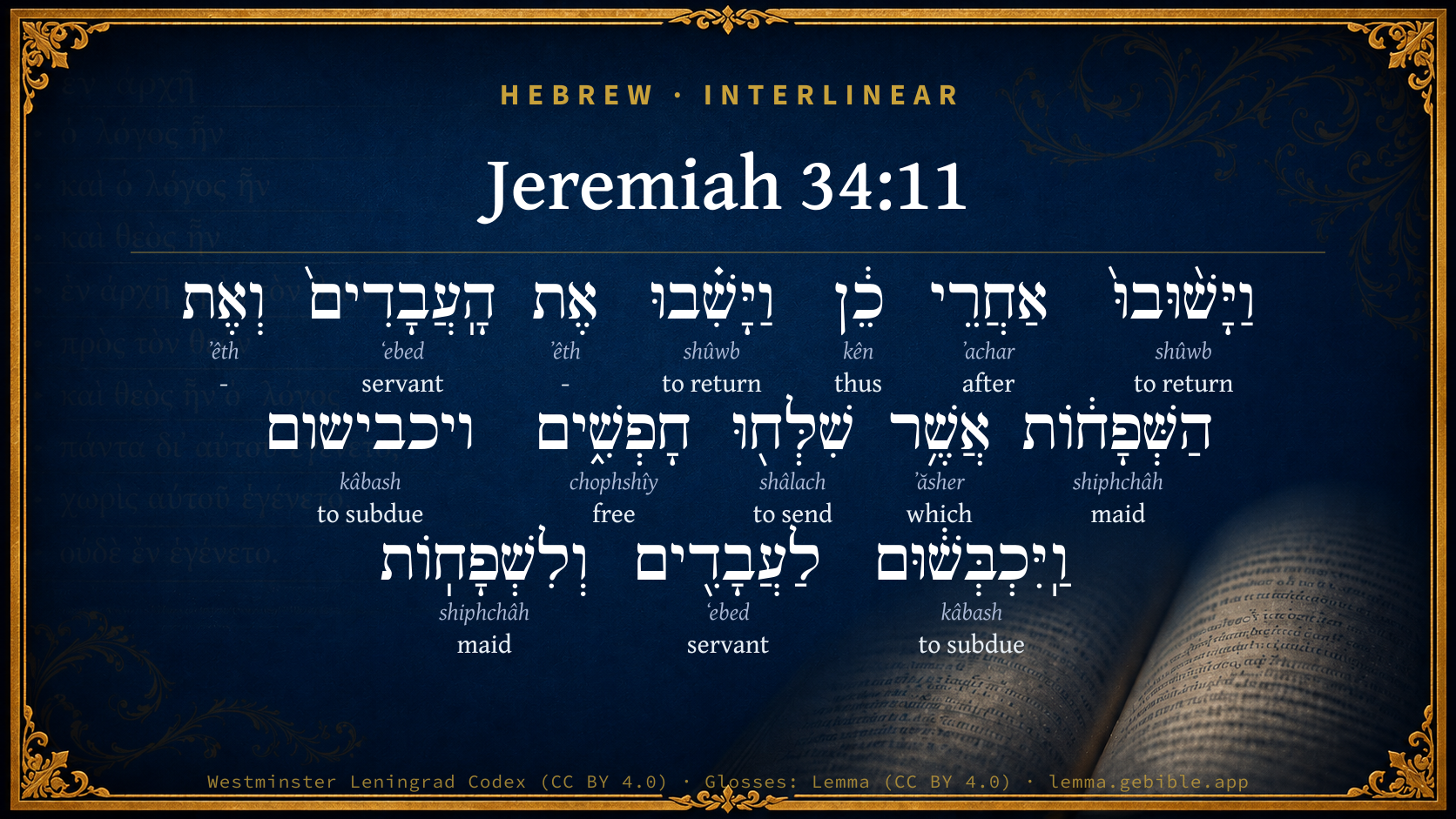
  1. וַיָּשׁ֨וּבוּ֙ shûwb H7725 “and · to return” Conjunction + Verb, Qal, Sequential Imperfect, 3rd Person, Masculine, Plural
  2. אַחֲרֵי ʼachar H310 “after” Preposition
  3. כֵ֔ן kên H3651 “thus” Adverb
  4. וַיָּשִׁ֗בוּ shûwb H7725 “and · to return” Conjunction + Verb, Hiphil, Sequential Imperfect, 3rd Person, Masculine, Plural
  5. אֶת ʼêth H853 “-” Particle, Direct Object
  6. הָֽעֲבָדִים֙ ʻebed H5650 “the · servants” Particle, Definite Article + Noun, Common, Masculine, Plural, Absolute
  7. וְאֶת ʼêth H853 “and · -” Conjunction + Particle, Direct Object
  8. הַשְּׁפָח֔וֹת shiphchâh H8198 “the · maids” Particle, Definite Article + Noun, Common, Feminine, Plural, Absolute
  9. אֲשֶׁ֥ר ʼăsher H834 “which” Particle, Relative
  10. שִׁלְּח֖וּ shâlach H7971 “to send” Verb, Piel, Perfect, 3rd Person, Common, Plural
  11. חָפְשִׁ֑ים chophshîy H2670 “free” Adjective, Adjective, Masculine, Plural, Absolute
  12. וַֽיִּכְבְּשׁ֔וּם kâbash H3533 “and · to subdue · them” Conjunction + Verb, Qal, Sequential Imperfect, 3rd Person, Masculine, Plural + Suffix, Personal, 3rd Person, Masculine, Plural
  13. לַעֲבָדִ֖ים ʻebed H5650 “to/for · servants” Preposition + Noun, Common, Masculine, Plural, Absolute
  14. וְלִשְׁפָחֽוֹת shiphchâh H8198 “and · to/for · maids” Conjunction + Preposition + Noun, Common, Feminine, Plural, Absolute

About this verse

These counts appear in no published source. They are computed here, from the morphology-tagged text and Lemma’s own curated glosses. What Lemma adds →

15
words
10
distinct lemmas
Prophets
section

Notable vocabulary

The rarest word here is ויכבישום to subdue H3533 — appearing just 15 times in the whole Hebrew Bible.

Shared distinctive vocabulary

ויכבישום to subdue H3533 occurs in 13 verses of the Hebrew Bible. Also found in:

Grammatical profile

  • 5 verbs
  • 4 nouns
  • 1 adjective
  • 1 preposition
  • 1 adverb
  • 3 particles

Verb forms

  • וַיָּשׁ֨וּבוּ֙ Qal · Sequential Imperfect
  • וַיָּשִׁ֗בוּ Hiphil · Sequential Imperfect
  • שִׁלְּח֖וּ Piel · Perfect
  • ויכבישום Hiphil · Sequential Imperfect
  • וַֽיִּכְבְּשׁ֔וּם Qal · Sequential Imperfect

Repetition

Words recur within this verse — often emphatic in Hebrew:

  • וַיָּשׁ֨וּבוּ֙ to return H7725 ×2
  • הָֽעֲבָדִים֙ servant H5650 ×2
  • הַשְּׁפָח֔וֹת maid H8198 ×2
  • ויכבישום to subdue H3533 ×2

Cross-references

22

Topical passages linked to Jeremiah 34:11 in the Treasury of Scripture Knowledge — connected by theme and wording, ordered by reader-vote popularity; previews shown in the World English Bible.

  • 2 Peter 2:20–22 For if, after they have escaped the defilement of the world through the knowledge of the Lord and Savior Jesus Christ, they are again entangled therein and overcome, the last state has become worse with them than the first.
  • Proverbs 26:11 As a dog that returns to his vomit, So is a fool who repeats his folly.
  • Ecclesiastes 8:11 Because sentence against an evil work is not executed speedily, therefore the heart of the sons of men is fully set in them to do evil.
  • Matthew 12:43–45 But the unclean spirit, when he is gone out of the man, passes through waterless places, seeking rest, and doesn't find it.
  • Exodus 8:8 Then Pharaoh called for Moses and Aaron, and said, "Entreat Yahweh, that he take away the frogs from me, and from my people; and I will let the people go, that they may sacrifice to Yahweh."
  • Exodus 8:15 But when Pharaoh saw that there was a respite, he hardened his heart, and didn't listen to them, as Yahweh had spoken.
  • Exodus 9:28 Pray to Yahweh; for there has been enough of mighty thunderings and hail. I will let you go, and you shall stay no longer."
  • Exodus 9:34–35 When Pharaoh saw that the rain and the hail and the thunders were ceased, he sinned yet more, and hardened his heart, he and his servants.
  • Exodus 10:17–20 Now therefore please forgive my sin again, and pray to Yahweh your God, that he may also take away from me this death."
  • Exodus 14:3–9 Pharaoh will say of the children of Israel, 'They are entangled in the land. The wilderness has shut them in.'
  • 1 Samuel 19:6–11 Saul listened to the voice of Jonathan: and Saul swore, As Yahweh lives, he shall not be put to death.
  • 1 Samuel 24:19 For if a man finds his enemy, will he let him go away unharmed? Therefore may Yahweh reward you good for that which you have done to me this day.
  • 1 Samuel 26:21 Then said Saul, I have sinned: return, my son David; for I will no more do you harm, because my life was precious in your eyes this day: behold, I have played the fool, and have erred exceedingly.
  • Psalms 36:3 The words of his mouth are iniquity and deceit. He has ceased to be wise and to do good.
  • Psalms 78:34–36 When he killed them, then they inquired after him. They returned and sought God earnestly.
  • Psalms 125:5 But as for those who turn aside to their crooked ways, Yahweh will lead them away with the workers of iniquity. Peace be on Israel.
  • Jeremiah 34:21 Zedekiah king of Judah and his princes will I give into the hand of their enemies, and into the hand of those who seek their life, and into the hand of the king of Babylon's army, who have gone away from you.
  • Jeremiah 37:5 Pharaoh's army was come forth out of Egypt; and when the Chaldeans who were besieging Jerusalem heard news of them, they broke up from Jerusalem.
  • Hosea 6:4 "Ephraim, what shall I do to you? Judah, what shall I do to you? For your love is like a morning cloud, And like the dew that disappears early.
  • Hosea 7:16 They return, but not to the Most High. They are like a faulty bow. Their princes will fall by the sword for the rage of their tongue. This will be their derision in the land of Egypt.
  • Zephaniah 1:6 those who have turned back from following Yahweh, and those who haven't sought Yahweh nor inquired after him.
  • Romans 2:4–5 Or do you despise the riches of his goodness, forbearance, and patience, not knowing that the goodness of God leads you to repentance?

Cross-references courtesy of OpenBible.info (CC BY 4.0).

Hebrew and Greek witnesses Masoretic Hebrew ↔ Greek Septuagint

The same verse in the two great witnesses to the Old Testament, shown verse-for-verse.

These are two independent witnesses, not word-aligned to each other, and the Septuagint is shown in lemma (dictionary) form.

Hebrew Jeremiah 34:11 Masoretic · Westminster Leningrad Codex

וַיָּשׁ֨וּבוּ֙ אַחֲרֵי כֵ֔ן וַיָּשִׁ֗בוּ אֶת הָֽעֲבָדִים֙ וְאֶת הַשְּׁפָח֔וֹת אֲשֶׁ֥ר שִׁלְּח֖וּ חָפְשִׁ֑ים ויכבישום וַֽיִּכְבְּשׁ֔וּם לַעֲבָדִ֖ים וְלִשְׁפָחֽוֹת

but afterwards they turned, and caused the servants and the handmaids, whom they had let go free, to return, and brought them into subjection for servants and for handmaids.

World English Bible · Public Domain

Greek LXX Structure differs

In the Septuagint, Jeremiah is about an eighth shorter than the Hebrew and arranges its material differently — the Oracles Against the Nations (Hebrew chapters 46–51) appear in the middle of the Greek book, after 25:13. Because the chapter and verse boundaries do not line up, a verse-for-verse comparison with the Hebrew is not shown.

A verse-for-verse comparison isn’t shown here because the chapters and verses don’t line up. Switch to the LXX edition with the MT / LXX toggle above to read the Greek directly.

Hebrew: Westminster Leningrad Codex (CC BY 4.0). Greek: Septuagint (public domain); English from a public-domain English Septuagint. How the Septuagint differs from the Hebrew →

Targum (Aramaic paraphrase)

1

The Targum is the ancient Jewish Aramaic paraphrase of the Hebrew Scriptures — an interpretive translation, not the Hebrew text itself. Onkelos (literal) and Pseudo-Jonathan (expansive) render the Torah, and Jonathan the Prophets. Coverage is partial: where no permissively-licensed English translation exists for a verse, only the Aramaic is shown. This is verse-level text, not a word-by-word alignment to the Hebrew.

  1. Targum Jonathan Prophets (Joshua–Malachi)
    וְתָבוּ בָּתַר כֵּן וְאָתִיבוּ יַת עַבְדִין וְיַת אַמְהָתָא דִפְטָרוּ בְּנֵי חוֹרִין וּכְבִישׁוּנוּן לְעַבְדִין וּלְאַמְהָן:

    (no public-domain English translation for this verse)

    Targum Jonathan — Aramaic: “Mikraot Gedolot” (public domain). English: “Sefaria Community Translation” (CC0 1.0 (public-domain dedication)); “London "Chaldee Paraphrase," 1871” (public domain). Text via Sefaria.

Commentary

Notes on Jeremiah 34:11 from classic Christian and Jewish commentators (each source and its license shown beneath its notes). The classic Christian expositions comment on the surrounding passage and are grouped to its opening verse, so a note may address several verses; the Jewish commentaries on the Tanakh (Rashi and others) are per-verse, so they appear only where the commentator wrote on this verse.

Lemma curates 59 commentaries, every one of them public domain or Creative Commons licensed, each selected and text-cleaned for this edition rather than reprinted as found. About our sources →

Trapp's Complete Commentary

John Trapp

Jer 34:11 But afterward they turned, and caused the servants and the handmaids, whom they had let go free, to return, and brought them into subjection for servants and for handmaids.

Ver. 11. But afterwards they turned, and caused their servants.] Stimulante avaritia. Covetousness prompting and pricking them on thereunto for that is the root of all evil. {1Ti 6:10} The Chaldeans had drawn off, to go, belike, to fight with the relief that was coming out of Egypt; {Jer 37:7; Jer 37:11} and now these silly Jews thought themselves out of the reach of God’s rod perfidiously repealed their vows, re-embondaged their servants, and are therefore worthily threatened with a more cruel servitude to the Chaldeans for this their relapse and breach of covenant with God.

John Trapp, A Commentary or Exposition upon All the Books of the Old and New Testament (1647–1656) — public domain. Text from a community e-Sword module.

Geneva Bible (1599)

Geneva Bible translators

Hebrew, returneth.

Geneva Bible (1599) marginal notes — public domain. Text via Bolls.life.

Jamieson, Fausset & Brown

Robert Jamieson, A. R. Fausset & David Brown

During the interruption of the siege by Pharaoh-hophra (compare Jer 34:21-22, with Jer 37:5-10), the Jews reduced their servants to bondage again.

Jamieson, Fausset & Brown — Commentary Critical and Explanatory on the Whole Bible (1871) — public domain (CC PDM 1.0). Text via the HelloAO Bible API.

Adam Clarke's Commentary

Verse 11. But afterward they turned] They had agreed to manumit them at the end of the seventh year; but when the seventh year was ended, they recalled their engagement, and detained their servants. This, I believe, is what is here meant.

Adam Clarke's Commentary on the Bible (1810–1826) — public domain. Text from a community e-Sword/MySword module.

John Calvin's Commentaries

He then adds, And they afterwards turned, that is, after they had heard and obeyed. The turning refers to a change of purpose, for they immediately repented of what they had done. They had felt some fear of God, and then equity and kindness prevailed; but they soon turned or changed. The word is taken sometimes in a good, and sometimes in a bad sense. He says that they turned, or returned, because they receded or turned back after having commenced a right course. And they remanded; there is a correspondence between the verbs ישובו ishibu, they turned, and ישיבו ishibu, they remanded, or made to return the servants and maids whom they let go free, and brought them under as servants and maids There is no doubt but that the Jews alleged some excuse when they thus remanded their servants, and robbed them of the privilege of freedom: but God designed that they should act in sincerity and without disguise. Whatever, then, subtle men may contrive as an excuse for oppressing the miserable, and however they may disguise things before men, yet God, who requires integrity, does not allow such disguises, for he would have us to deal honestly with our neighbors, for all craftiness is condemned by him.

John Calvin's Commentaries (1540-1563) — public domain. Text from the Calvin Translation Society English edition (1840s-50s) via the Christian Classics Ethereal Library (ccel.org). Calvin's coverage is partial (roughly two-thirds of the Bible); uncommented books and verses are honest gaps, never fabricated. The 19th-century editor's footnotes and remarks are omitted so the notes are faithfully Calvin's own voice.

John Gill's Exposition

But afterwards they turned,.... From the law of God, and their own agreement, and returned to their former usage of their servants; they changed their minds and measures. This seems to be done, when the king of Babylon, hearing the king of Egypt was coming to break up the siege of Jerusalem, quitted it, and went forth to meet him, as appears from Jer 34:21; the Jews now finding themselves at liberty, and out of danger as they imagined, wickedly rebelled against the law of God; perfidiously broke their own covenant, repenting of what they had done, and returned to their former ways of oppression and cruelty; which shows they were not hearty and sincere in their covenant:

and caused the servants and the handmaids, whom they had let go free,

to return, and brought them into subjection for servants and for handmaids; which was done by force, contrary to the will of their servants and handmaids, and in violation of the law of God, and their own solemn oath and covenant.

John Gill's Exposition of the Whole Bible (1746–1763) — public domain (CC PDM 1.0). Text via the HelloAO Bible API.

Matthew Poole's English Annotations

Like a company of wretched hypocrites, they reformed this abuse only to serve a turn, which when it was served they returned again to their old oppression; and in this thing not the people alone, but the government, was to be blamed, for their judges in the courts of justice ought to have executed the law of the Lord, and to have restrained the covetous and oppressive humour of the people. The learned author of the English Annotations thinketh that that which altered their minds was a little alteration of their state, during the siege; for, Jer 37:5, we read that the Babylonians and Chaldeans hearing of an army coming out of Egypt, to relieve the city, left the siege for a time, and that the prophet, Jer 34:22 of this chapter, relates to that, when he prophesied that the king of Babylon’s army should return. But these wretched men, seeing the Babylonian army raised from the siege, concluded they were now out of God’s hands, and repented of their repentance in this particular, and would make all their servants return into their former servitude.

Matthew Poole's English Annotations on the Holy Bible (1683–1685) — public domain. Text from a community e-Sword/MySword module.

Whedon's Commentary on the Bible

Daniel D. Whedon

11. But afterwards, etc. — This reformation in the presence of impending danger, was no more genuine than deathbed repentances frequently are. So soon as the danger seemed over-past the wrong was resumed. The idiom in this verse is mistaken in the Authorized Version. Instead of turned, and caused… to return, the true translation should be, they again caused them to return.

Daniel D. Whedon (gen. ed.), Commentary on the Old and New Testaments (1874–1909) — public domain. Text from a community e-Sword module.

Lesson kit

Teaching starters — assembled from the data on this page, not authored interpretation. Every prompt links to the verse data it draws on. Edit before teaching.

Jeremiah, in the Prophets, opens this verse with 15 words (10 distinct Hebrew lemmas). Its most distinctive word is kâbash (“to subdue”). A historical commentator’s framing appears above. Read the whole chapter for the surrounding context.

Discussion questions

  1. The word kâbash carries the sense “to subdue.” How does it shape the verse?
  2. Genesis 1:28 shares the word «to subdue» with this verse. How do the two illuminate each other?
  3. “to return” occurs 2× in this one verse. What is the effect of the repetition?
  4. These translations render this verse differently; the difference is in the English rendering, not the original. What questions does that raise?
  5. The verb «וַיָּשׁ֨וּבוּ֙» is Qal Sequential Imperfect. How does its form color the action?
  6. Reading how Trapp's Complete Commentary and Geneva Bible (1599) read this verse, where do the two commentators agree and where do they part?

Things to notice

Reading settings

Reading text

Shown beneath each verse's original-language words.

Old Testament
Old Testament edition

Read the OT as the Masoretic Hebrew (MT) or the Greek Septuagint (LXX).

English shown for the Greek Septuagint (in the Hebrew ↔ Greek comparison).

Comparing translations? Open the Compare panel on any verse page to stack up to four side by side.