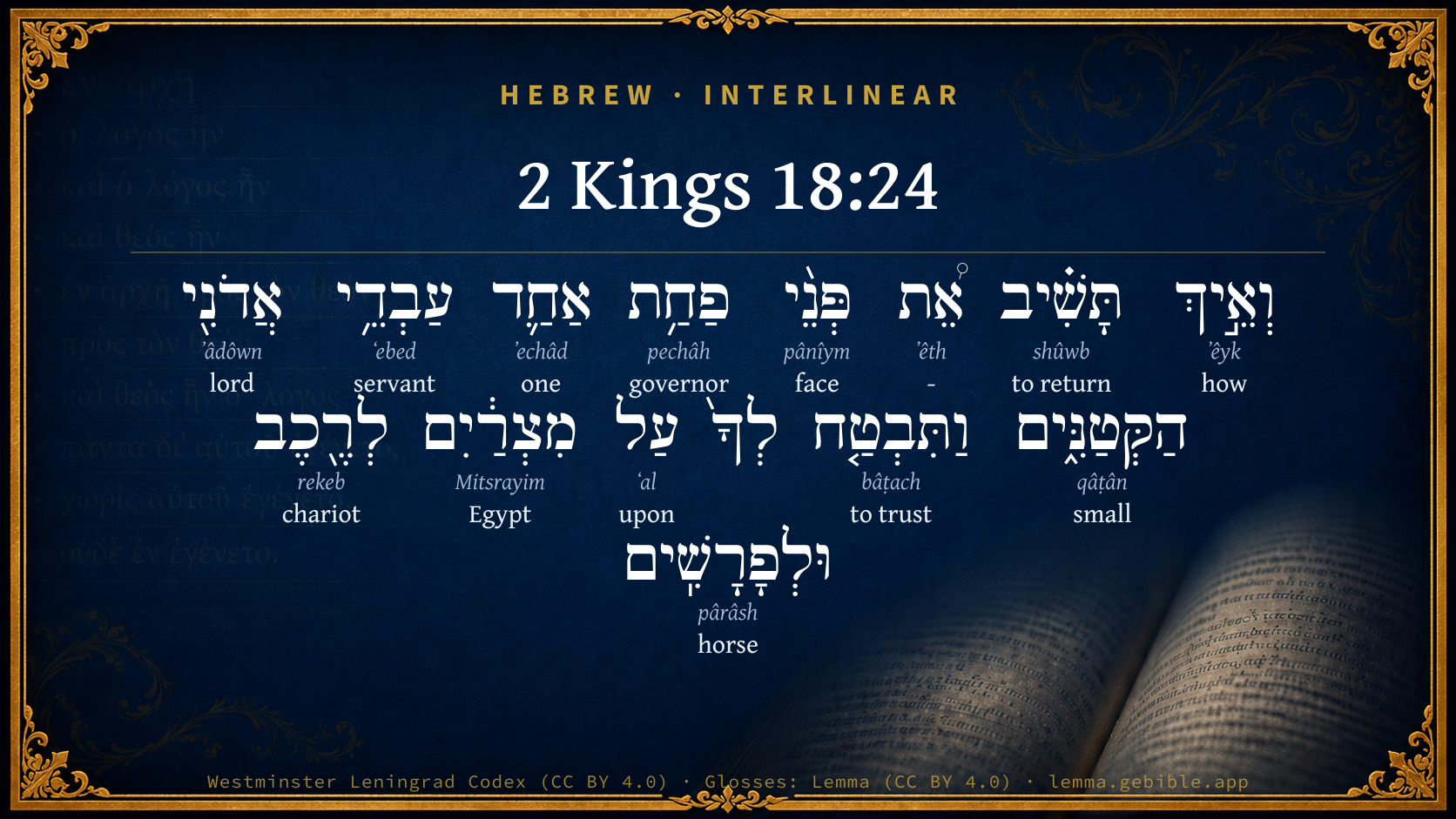
2 Kings 18:24

Hebrew (Westminster Leningrad Codex) 2 Kings 18:24 appears in the Hebrew Old Testament. The text above is from the Westminster Leningrad Codex. Each word links to its Strong’s number, a concise gloss, and parsing drawn from the Open Scriptures Hebrew Bible morphology. Click any word for its full Brown-Driver-Briggs (BDB) entry.
Download image
Cite this verse

2 Kings 18:24 (World English Bible). Public Domain. Lemma interlinear Bible study tool, https://lemma.gebible.app/v/2-kings/18/24.

Show BibTeX & RIS
BibTeX
RIS
English Translation
How then can you turn away the face of one captain of the least of my master's servants, and put your trust on Egypt for chariots and for horsemen?
World English Bible · Public Domain
Download a study sheet

One document with this verse’s original text, its word-by-word gloss line, the meaning frame, cross-references with their text, attributed commentary, and full source and license credits — printable, and it pastes into notes with its structure intact.

This verse Autodidact and up

Study sheet (.html) Plain text (.txt)

A passage Seminary Student

Up to 50 verses in one chapter. A passage sheet keeps up to 6 commentary sources and 12 cross-references per verse, in the order this page ranks them, and says so on the sheet whenever that leaves anything out. Ask for a single verse and you get the Autodidact verse sheet above.

Everything on this page stays free to read, with no account — the sheet is a download of what is already on screen, not access to it.

Want to remove ads? Support Godless Engineer
Compare translations 3

The same verse in 3 English versions, stacked beneath the original-language interlinear above. Click any original word for its lexicon entry.

Each is an independent rendering of the whole verse — the interlinear is not word-aligned to these translations.

Highlighted words mark where these versions differ — a whole-verse word diff, not a word-by-word alignment.

  • World English Bible Public Domain
    How then can you turn away the face of one captain of the least of my master's servants, and put your trust on Egypt for chariots and for horsemen?
  • King James Version Public Domain
    How then wilt thou turn away the face of one captain of the least of my master's servants, and put thy trust on Egypt for chariots and for horsemen?
  • unfoldingWord Literal Text CC BY-SA 4.0
    But how would you turn back the face of a captain of one of the least servants of my master? So you trust for yourself in Egypt for chariots and for horsemen.’

unfoldingWord Literal Text — © unfoldingWord, licensed CC BY-SA 4.0. Word-aligned USFM3 via Door43 (git.door43.org/unfoldingWord/en_ult).

Versions to compare (up to 4)

3 of 4 selected

Show all 18 translations

Every available English version of this verse, each an independent rendering of the whole verse.

  • World English Bible Public Domain
    How then can you turn away the face of one captain of the least of my master's servants, and put your trust on Egypt for chariots and for horsemen?
  • Berean Standard Bible Public Domain
    For how can you repel a single officer among the least of my master’s servants when you depend on Egypt for chariots and horsemen?
  • Majority Standard Bible Public Domain
    For how can you repel a single officer among the least of my master’s servants when you depend on Egypt for chariots and horsemen?
  • King James Version Public Domain
    How then wilt thou turn away the face of one captain of the least of my master's servants, and put thy trust on Egypt for chariots and for horsemen?
  • American Standard Version (1901) Public Domain
    How then canst thou turn away the face of one captain of the least of my master's servants, and put thy trust on Egypt for chariots and for horsemen?
  • Revised Version (1885) Public Domain
    How then canst thou turn away the face of one captain of the least of my master’s servants, and put thy trust on Egypt for chariots and for horsemen?
  • Geneva Bible (1599) Public Domain
    For how canst thou despise any captaine of the least of my masters seruants, and put thy trust on Egypt for charets and horsemen?
  • Douay-Rheims (1899) Public Domain
    And how can you stand against one lord of the least of my master's servants? Dost thou trust in Egypt for chariots and for horsemen?
  • Young's Literal Translation Public Domain
    And how dost thou turn back the face of one captain of the least of the servants of my lord, that thou dost trust for thee on Egypt for chariot, and for horsemen?
  • Literal Standard Version CC BY-SA 4.0
    And how do you turn back the face of one captain of the least of the servants of my lord, that you trust for yourself on Egypt for chariot and for horsemen?
  • Unlocked Literal Bible CC BY-SA 4.0
    How could you resist even one captain of the least of my master's servants? You have put your trust in Egypt for chariots and horsemen!
  • unfoldingWord Literal Text CC BY-SA 4.0
    But how would you turn back the face of a captain of one of the least servants of my master? So you trust for yourself in Egypt for chariots and for horsemen.’
  • Darby Bible Public Domain
    How then wilt thou turn away the face of one captain of the least of my master's servants? And thou reliest upon Egypt for chariots and for horsemen!
  • World Messianic Bible Public Domain
    How then can you turn away the face of one captain of the least of my master’s servants, and put your trust on Egypt for chariots and for horsemen?
  • Webster's Bible Public Domain
    How then wilt thou turn away the face of one captain of the least of my master's servants, and put thy trust on Egypt for chariots and for horsemen?
  • Free Bible Version CC BY-SA 4.0
    How could you defeat even a single officer in charge of the weakest of my master's men when you're trusting in Egypt for chariots and horsemen?
  • Bible in Basic English Public Domain
    How then may you put to shame the least of my master's servants? and you have put your hope in Egypt for war-carriages and horsemen:
  • JPS Tanakh (1917) Public Domain
    How then canst thou turn away the face of one captain, even of the least of my masters servants? and yet thou puttest thy trust on Egypt for chariots and for horsemen!

Literal Standard Version (2020), Covenant Press — licensed CC BY-SA 4.0. Text via the HelloAO Bible API (eBible.org). Unlocked Literal Bible (unfoldingWord) — licensed CC BY-SA 4.0. Text via the HelloAO Bible API (eBible.org). unfoldingWord Literal Text — © unfoldingWord, licensed CC BY-SA 4.0. Word-aligned USFM3 via Door43 (git.door43.org/unfoldingWord/en_ult). Free Bible Version, Dr. Jonathan Gallagher — licensed CC BY-SA 4.0. Text via the HelloAO Bible API (eBible.org).

Word by word

More ways to search: Search by grammar → Find every occurrence → Compare this word →

Practice this passage: Drill this verse → Learn its vocabulary →

פַחַ֥ת
pechâh
H6346
“governor of”
Noun, Common, Masculine, Singular, Construct
Part of Speech
Noun
Type
Common
Gender
Masculine
Number
Singular
State
Construct
Full BDB Definition

Origin: of foreign origin

TWOT: 1757

governor
  1. וְאֵ֣יךְ ʼêyk H349 “and · how” Conjunction + Particle, Interrogative
  2. תָּשִׁ֗יב shûwb H7725 “to return” Verb, Hiphil, Imperfect, 2nd Person, Masculine, Singular
  3. אֵ֠ת ʼêth H853 “-” Particle, Direct Object
  4. פְּנֵ֨י pânîym H6440 “face(s) of” Noun, Common, Both, Plural, Construct
  5. אַחַ֛ד ʼechâd H259 “one” Adjective, Cardinal number, Masculine, Singular, Absolute
  6. עַבְדֵ֥י ʻebed H5650 “servants of” Noun, Common, Masculine, Plural, Construct
  7. אֲדֹנִ֖י ʼâdôwn H113 “lord · my” Noun, Common, Masculine, Singular, Construct + Suffix, Personal, 1st Person, Common, Singular
  8. הַקְּטַנִּ֑ים qâṭân H6996 “the · small” Particle, Definite Article + Adjective, Adjective, Masculine, Plural, Absolute
  9. וַתִּבְטַ֤ח bâṭach H982 “and · to trust” Conjunction + Verb, Qal, Sequential Imperfect, 2nd Person, Masculine, Singular
  10. עַל ʻal H5921 “upon” Preposition
  11. מִצְרַ֔יִם Mitsrayim H4714 “Egypt” Noun, Proper
  12. לְרֶ֖כֶב rekeb H7393 “to/for · chariot” Preposition + Noun, Common, Masculine, Singular, Absolute
  13. וּלְפָרָשִֽׁים pârâsh H6571 “and · to/for · horses” Conjunction + Preposition + Noun, Common, Masculine, Plural, Absolute

About this verse

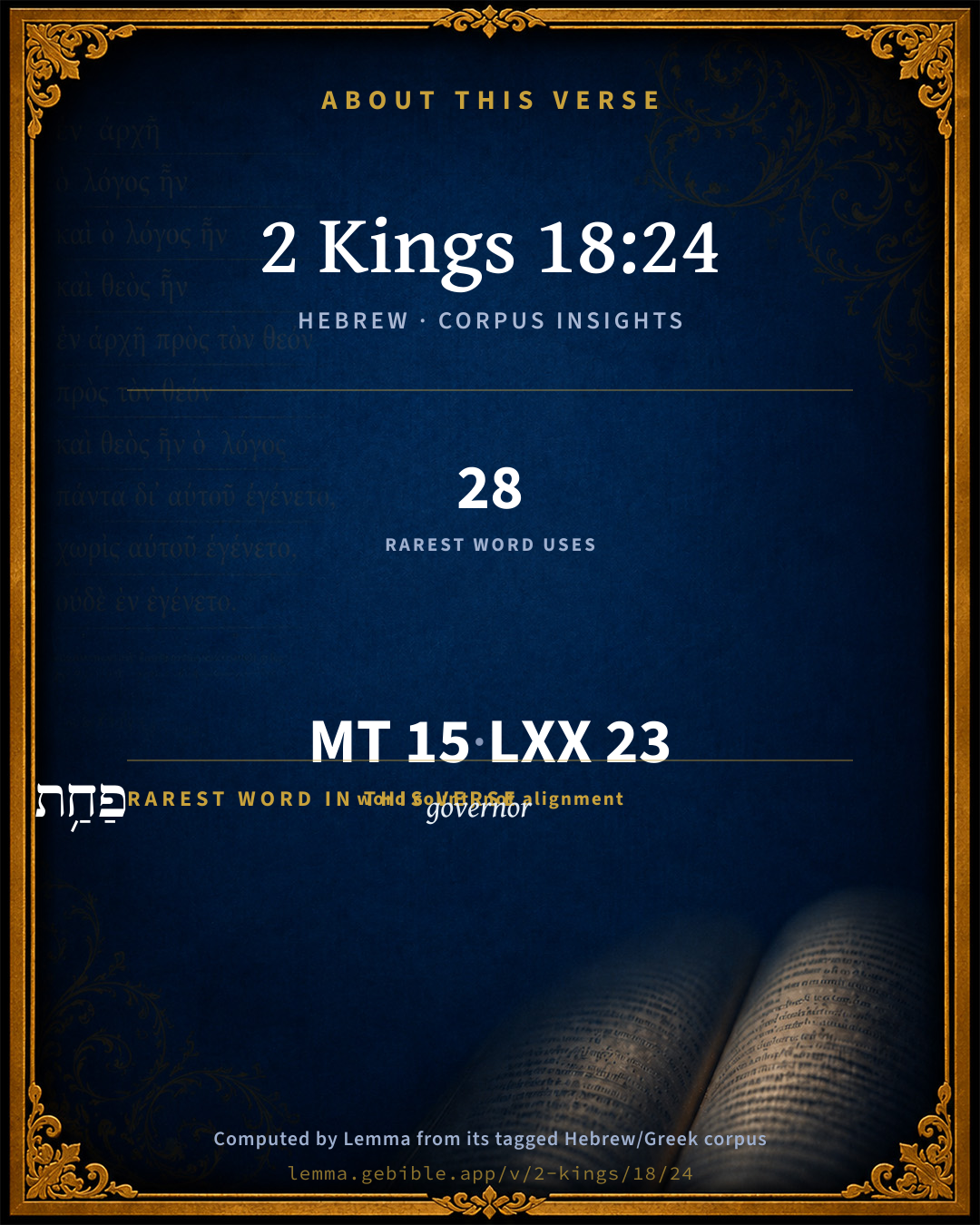
These counts appear in no published source. They are computed here, from the morphology-tagged text and Lemma’s own curated glosses. What Lemma adds →

15
words
14
distinct lemmas
Historical
section

Shared distinctive vocabulary

פַחַ֥ת governor H6346 occurs in 27 verses of the Hebrew Bible. Also found in:

Grammatical profile

  • 2 verbs
  • 7 nouns
  • 2 adjectives
  • 2 prepositions
  • 2 particles

Verb forms

  • תָּשִׁ֗יב Hiphil · Imperfect
  • וַתִּבְטַ֤ח Qal · Sequential Imperfect

Hebrew & Septuagint length

In English translation the verse runs 29 words from the Hebrew and 31 from the Septuagint (LXX English) — closely comparable.

A rough comparison of the two English renderings, which tokenize alike — not a word-level alignment.

Word counts can differ between the Hebrew and the Greek without any difference in meaning — e.g. the Hebrew direct-object marker אֵת has no separate Greek word, and Greek often adds the article ὁ.

In the original languages it is 15 Hebrew tokens and 23 Greek tokens — but the two are counted differently (Hebrew bundles its prefixes and suffixes into one token; the Greek is in lemma form), so that isn’t a like-for-like length.

Cross-references

15

Topical passages linked to 2 Kings 18:24 in the Treasury of Scripture Knowledge — connected by theme and wording, ordered by reader-vote popularity; previews shown in the World English Bible.

  • Isaiah 10:8 For he says, Aren't my princes all of them kings?
  • Deuteronomy 17:16 Only he shall not multiply horses to himself, nor cause the people to return to Egypt, to the end that he may multiply horses; because Yahweh has said to you, You shall henceforth return no more that way.
  • 2 Kings 18:21 Now, behold, you trust on the staff of this bruised reed, even on Egypt; whereon if a man lean, it will go into his hand, and pierce it: so is Pharaoh king of Egypt to all who trust on him.
  • Psalms 20:7–8 Some trust in chariots, and some in horses, But we trust the name of Yahweh our God.
  • Isaiah 31:1 Woe to those who go down to Egypt for help, and rely on horses, and trust in chariots because they are many, and in horsemen because they are very strong, but they don't look to the Holy One of Israel, neither seek Yahweh!
  • Isaiah 31:3 Now the Egyptians are men, and not God; and their horses flesh, and not spirit: and when Yahweh shall stretch out his hand, both he who helps shall stumble, and he who is helped shall fall, and they all shall be consumed together.
  • Isaiah 36:6 Behold, you trust on the staff of this bruised reed, even on Egypt, whereon if a man lean, it will go into his hand, and pierce it: so is Pharaoh king of Egypt to all who trust on him.
  • Isaiah 36:9 How then can you turn away the face of one captain of the least of my master's servants, and put your trust on Egypt for chariots and for horsemen?
  • Jeremiah 37:7 Thus says Yahweh, the God of Israel, Thus shall you tell the king of Judah, who sent you to me to inquire of me: Behold, Pharaoh's army, which is come forth to help you, shall return to Egypt into their own land.
  • Jeremiah 42:14–18 saying, No; but we will go into the land of Egypt, where we shall see no war, nor hear the sound of the trumpet, nor have hunger of bread; and there will we dwell:
  • Ezekiel 17:15 But he rebelled against him in sending his ambassadors into Egypt, that they might give him horses and much people. Shall he prosper? shall he escape who does such things? shall he break the covenant, and yet escape?
  • Ezekiel 17:17 Neither shall Pharaoh with his mighty army and great company help him in the war, when they cast up mounds and build forts, to cut off many persons.
  • Daniel 2:37–38 You, O king, are king of kings, to whom the God of heaven has given the kingdom, the power, and the strength, and the glory;
  • Daniel 4:22 it is you, O king, that are grown and become strong; for your greatness is grown, and reaches to the sky, and your dominion to the end of the earth.
  • Daniel 4:37 Now I, Nebuchadnezzar, praise and extol and honor the King of heaven; for all his works are truth, and his ways justice; and those who walk in pride he is able to abase.

Cross-references courtesy of OpenBible.info (CC BY 4.0).

Hebrew and Greek witnesses Masoretic Hebrew ↔ Greek Septuagint

The same verse in the two great witnesses to the Old Testament, shown verse-for-verse.

These are two independent witnesses, not word-aligned to each other, and the Septuagint is shown in lemma (dictionary) form.

Hebrew 2 Kings 18:24 Masoretic · Westminster Leningrad Codex

וְאֵ֣יךְ תָּשִׁ֗יב אֵ֠ת פְּנֵ֨י פַחַ֥ת אַחַ֛ד עַבְדֵ֥י אֲדֹנִ֖י הַקְּטַנִּ֑ים וַתִּבְטַ֤ח לְךָ֙ עַל מִצְרַ֔יִם לְרֶ֖כֶב וּלְפָרָשִֽׁים

How then can you turn away the face of one captain of the least of my master's servants, and put your trust on Egypt for chariots and for horsemen?

World English Bible · Public Domain

Greek LXX 2 Kings 18:24 Septuagint · lemma form

καί πῶς ἀποστρέφω ὁ πρόσωπον τοπαρχής εἷς ὁ δοῦλος ὁ κύριος ἐγώ ὁ ἐλαχύς καί ἐλπίζω σεαυτοῦ ἐπί αἴγυπτος εἰς ἅρμα καί ἱππεύς

How then will you turn away the face of one petty governor, from among the least of my lord's servants? whereas you trust for yourself on Egypt for chariots and horsemen.

LXX2012 (modern English Septuagint) · Public Domain

Hebrew: Westminster Leningrad Codex (CC BY 4.0). Greek: Septuagint (public domain); English from LXX2012 (modern English Septuagint) (Public Domain). How the Septuagint differs from the Hebrew →

Targum (Aramaic paraphrase)

1

The Targum is the ancient Jewish Aramaic paraphrase of the Hebrew Scriptures — an interpretive translation, not the Hebrew text itself. Onkelos (literal) and Pseudo-Jonathan (expansive) render the Torah, and Jonathan the Prophets. Coverage is partial: where no permissively-licensed English translation exists for a verse, only the Aramaic is shown. This is verse-level text, not a word-by-word alignment to the Hebrew.

  1. Targum Jonathan Prophets (Joshua–Malachi)
    וְאֵיכְדֵין אַתְּ מְדַמֵי לַאֲתָבָא יַת אַפֵּי חַד מִשִׁלְטוֹנֵי עַבְדֵי רִבּוֹנִי זְעֵירַיָא וְאִתְרְחִיצַת לָךְ עַל מִצְרָאֵי לִרְתִיכִין וּלְפָרָשִׁין:

    (no public-domain English translation for this verse)

    Targum Jonathan — Aramaic: “Mikraot Gedolot” (public domain). English: “Sefaria Community Translation” (CC0 1.0 (public-domain dedication)); “London "Chaldee Paraphrase," 1871” (public domain). Text via Sefaria.

Commentary

Notes on 2 Kings 18:24 from classic Christian and Jewish commentators (each source and its license shown beneath its notes). The classic Christian expositions comment on the surrounding passage and are grouped to its opening verse, so a note may address several verses; the Jewish commentaries on the Tanakh (Rashi and others) are per-verse, so they appear only where the commentator wrote on this verse.

Lemma curates 59 commentaries, every one of them public domain or Creative Commons licensed, each selected and text-cleaned for this edition rather than reprinted as found. About our sources →

Trapp's Complete Commentary

John Trapp

2Ki 18:24 How then wilt thou turn away the face of one captain of the least of my master’s servants, and put thy trust on Egypt for chariots and for horsemen?

Ver. 24. And put thy trust in Egypt.] See on 2Ki 18:21.

John Trapp, A Commentary or Exposition upon All the Books of the Old and New Testament (1647–1656) — public domain. Text from a community e-Sword module.

Ellicott's Commentary for English Readers

(24) How then.—Literally, And how. The connection of thought is: (But thou canst not); and how . . .

Turn away the face of . . .—i.e., repulse, reject the demand of . . . (1Ki_2:16.)

One captain of the least of my master’s servants.—Rather, a pasha who is one of the smallest of my lord’s servants. He means himself. The word we render “pasha” is, in the Hebrew, pa’hath, a word which used to be derived from the Persian, but which is now known to be Semitic, from the corresponding Assyrian words pahat, “prefect,” “provincial governor,” and pihat, “prefecture.”

And put thy trust.—Rather, but thou hast put thy trust; assigning a ground for Hezekiah’s folly. There should be a stop at “servants.” (Comp. Isa_31:1 : “Woe to them that go down to Egypt for help; and stay on horses, and trust in chariots.”)

A Bible Commentary for English Readers, edited by Charles John Ellicott (1878–1897) — public domain. Text from a community e-Sword module.

The Cambridge Bible for Schools and Colleges

gen. ed. J. J. S. Perowne

24. How then wilt thou, &c.] Rab-shakeh impudently takes for granted that Hezekiah’s only answer would be ‘I have not the men’. So he proceeds with his insults, and points out what he deems the folly of resistance. ‘We, three of the principal officers of our master, are come to treat with you. As your power is so feeble, you ought not to think of opposition, but to listen to the Assyrian proposals if they were brought even by some inferior person.’ The word which in this verse is rendered ‘captains’ is that which is constantly used in Ezra, Nehemiah and Esther of the ‘governors’ of provinces belonging to the great king. Any one of these, Rab-shakeh intimates, would be a power by himself which Hezekiah ought not to despise, as he possesses no men, even if the horses were made a present to him, out of which to form a body of cavalry. When Assyria can be so liberal in offers of horses, and when even her smallest governors are so well equipped with troops, is it not folly to go to Egypt for chariots and horses? He knows, and intimates that the same kind of vassalage would be required by the king of Egypt, as the king of Assyria demands.

Some have taken the verb ‘wilt thou turn away’ as equivalent to ‘wilt thou defeat and put to flight’. But this seems to suit very badly with the concluding clause of the sentence. ‘To put trust in Egypt’ is a good antithesis to the rejection of a proposal from the side of Assyria, but not to the defeat of the Assyrian troops.

The Cambridge Bible for Schools and Colleges (gen. ed. J. J. S. Perowne; Cambridge University Press, 1878–1918) — public domain. Text from a community e-Sword module.

Matthew Poole's English Annotations

How wilt thou force him to turn his back to thee, and flee away from thee?

Matthew Poole's English Annotations on the Holy Bible (1683–1685) — public domain. Text from a community e-Sword/MySword module.

Whedon's Commentary on the Bible

Daniel D. Whedon

24. Turn away the face — Or, cause to face about, that is, put to flight.

One captain of the least — That is, how canst thou repulse even one of the less valiant officers who commands one of the smallest divisions of the army? The word פחת, here rendered captain, means properly a governor or satrap. It is “first used of Assyrian subordinate stadtholders and generals; (Isa_36:9;) afterwards transferred to the governors and prefects of the Babylonian, (Jer_51:57; Eze_23:6; Eze_23:23,) Median, (Jer_51:28,) and Persian empires, (Est_8:9; Est_9:3;) applied especially to the Persian governors on this side of the Euphrates and in Judea, (Neh_2:7; Neh_2:9; Neh_3:7; Ezr_8:36; Hag_1:1; Hag_1:14,) Nehemiah and Zerubbabel being such. The word was transplanted into Hebrew by early Assyrian influence.” — Furst.

Daniel D. Whedon (gen. ed.), Commentary on the Old and New Testaments (1874–1909) — public domain. Text from a community e-Sword module.

The Pulpit Commentary

How then wilt thou turn away the face ofi.e. "repulse, "cause to retreatone captain of the least of my master"s servants; literally, one governor the word used is that which in modern times takes the form of "pasha," or "pacha." It properly applies to the rulers of provinces; but as these were expected to collect and command, upon occasions, the troops of their province, it has a secondary sense of "commander" or "captain." And put thy trust; rather, and thou puttest thy trust in this extremity of weakness, so far as thine own forces are concerned, thou art so foolish as to put thy trust in Egypt, and to expect that her strength will make up for thine own impotence. Vain hope! (see ver. 21). On Egypt for chariots and for horsemen? or, chariots and chariot-men.

The Pulpit Commentary (1880–1919), ed. H.D.M. Spence-Jones & Joseph S. Exell — public domain. Text from a community e-Sword module.

unfoldingWord translationNotes

Door43 World Missions Community

General Information:

Rabshakeh continues telling the message from the king of Assyria to King Hezekiah's men.

How could you resist even one captain of the least of my master's servants?

He asks this question to emphasize that the army of Hezekiah does not have the resources to fight. He also uses exaggeration to mock Hezekiah's army. AT: Possible meanings are 1) "You could not defeat even one of the least of the king's soldiers." or 2) "You could not defeat a group of the king's soldiers commanded by his least important officer." (See: Rhetorical Question and Hyperbole and Generalization)

Have I traveled up here without Yahweh to fight against this place and destroy it?

He asks this question to emphasize that Yahweh is behind his success to obey the command to destroy Israel. AT: "Yahweh himself told us to come here and destroy this land!" (See: Rhetorical Question)

translationWords

servant

chariot

horseman

unfoldingWord translationNotes — © Distant Shores Media and the Door43 World Missions Community, licensed CC BY-SA 4.0. Source: git.door43.org/Door43/en_tn.

Rashi

Rabbi Shlomo Yitzchaki (Rashi)

How can you turn away one captain of my master's servants. For the smallest of them is captain over two thousand men, and you cannot obtain two thousand men. We deduce from here concerning the heads of the armies, who totaled one hundred and eighty-five thousand and fell with Sancheiriv, that the smallest of them was captain over two thousand men who were with him.

Rashi on the Tanakh — English translations: “The Judaica Press complete Tanach with Rashi, translated by A. J. Rosenberg” (CC BY 4.0); “Pentateuch with Rashi's commentary by M. Rosenbaum and A.M. Silbermann, 1929-1934” (public domain); “The Metsudah Tanach series, Lakewood, N.J” (CC BY 4.0); and “The Book of Joshua, Metsudah Publications, 1997” (CC BY 4.0). Text via Sefaria.

Lesson kit

Teaching starters — assembled from the data on this page, not authored interpretation. Every prompt links to the verse data it draws on. Edit before teaching.

2 Kings, in the Historical, opens this verse with 15 words (14 distinct Hebrew lemmas). Its most distinctive word is pechâh (“governor”). A historical commentator’s framing appears above. Read the whole chapter for the surrounding context.

Discussion questions

  1. The word pechâh carries the sense “governor.” How does it shape the verse?
  2. How does 1 Kings 10:15, which shares the word «governor», read alongside this verse?
  3. These translations render this verse differently. What is at stake in choosing one wording over another?
  4. «תָּשִׁ֗יב» is a Hiphil Imperfect verb. How does that grammatical form shape the action described?
  5. Compare how Trapp's Complete Commentary and Ellicott's Commentary for English Readers read this verse. Where do they agree or differ?

Things to notice

Reading settings

Reading text

Shown beneath each verse's original-language words.

Old Testament
Old Testament edition

Read the OT as the Masoretic Hebrew (MT) or the Greek Septuagint (LXX).

English shown for the Greek Septuagint (in the Hebrew ↔ Greek comparison).

Comparing translations? Open the Compare panel on any verse page to stack up to four side by side.