
Lamentations 1:16

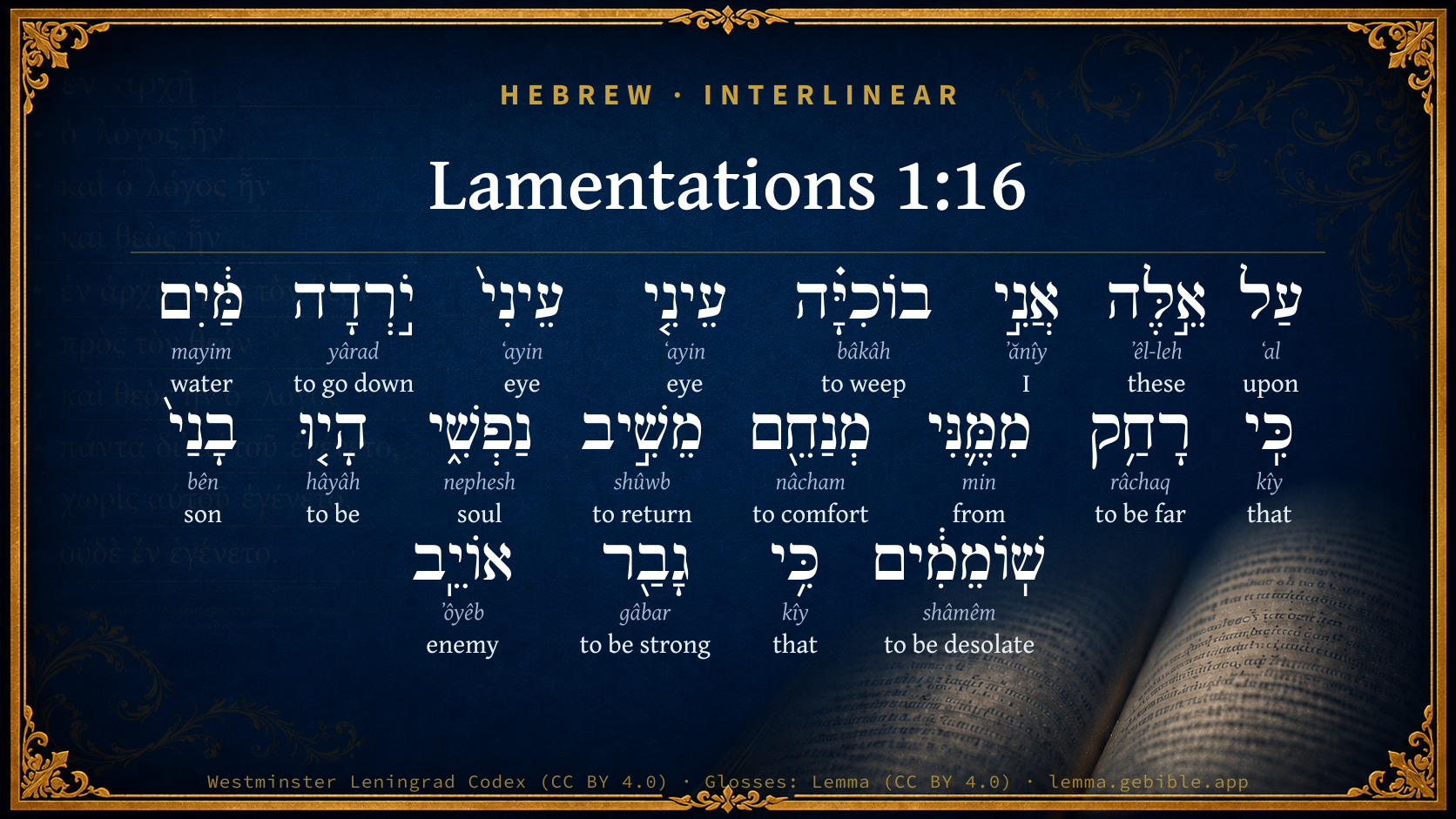
Hebrew (Westminster Leningrad Codex) Lamentations 1:16 appears in the Hebrew Old Testament. The text above is from the Westminster Leningrad Codex. Each word links to its Strong’s number, a concise gloss, and parsing drawn from the Open Scriptures Hebrew Bible morphology. Click any word for its full Brown-Driver-Briggs (BDB) entry.
Download image
Cite this verse

Lamentations 1:16 (World English Bible). Public Domain. Lemma interlinear Bible study tool, https://lemma.gebible.app/v/lamentations/1/16.

Show BibTeX & RIS
BibTeX
RIS
English Translation
For these things I weep; my eye, my eye runs down with water; Because the comforter who should refresh my soul is far from me: My children are desolate, because the enemy has prevailed.
World English Bible · Public Domain
Download a study sheet

One document with this verse’s original text, its word-by-word gloss line, the meaning frame, cross-references with their text, attributed commentary, and full source and license credits — printable, and it pastes into notes with its structure intact.

This verse Autodidact and up

Study sheet (.html) Plain text (.txt)

A passage Seminary Student

Up to 50 verses in one chapter. A passage sheet keeps up to 6 commentary sources and 12 cross-references per verse, in the order this page ranks them, and says so on the sheet whenever that leaves anything out. Ask for a single verse and you get the Autodidact verse sheet above.

Everything on this page stays free to read, with no account — the sheet is a download of what is already on screen, not access to it.

Want to remove ads? Support Godless Engineer
Compare translations 3

The same verse in 3 English versions, stacked beneath the original-language interlinear above. Click any original word for its lexicon entry.

Each is an independent rendering of the whole verse — the interlinear is not word-aligned to these translations.

Highlighted words mark where these versions differ — a whole-verse word diff, not a word-by-word alignment.

  • World English Bible Public Domain
    For these things I weep; my eye, my eye runs down with water; Because the comforter who should refresh my soul is far from me: My children are desolate, because the enemy has prevailed.
  • King James Version Public Domain
    For these things I weep; mine eye, mine eye runneth down with water, because the comforter that should relieve my soul is far from me: my children are desolate, because the enemy prevailed.
  • unfoldingWord Literal Text CC BY-SA 4.0
    Over these things I, I am weeping; my eye, my eye is running down with water, for a comforter who restores my life is far from me. My sons are desolate because the enemy has prevailed.” PE

unfoldingWord Literal Text — © unfoldingWord, licensed CC BY-SA 4.0. Word-aligned USFM3 via Door43 (git.door43.org/unfoldingWord/en_ult).

Versions to compare (up to 4)

3 of 4 selected

Show all 18 translations

Every available English version of this verse, each an independent rendering of the whole verse.

  • World English Bible Public Domain
    For these things I weep; my eye, my eye runs down with water; Because the comforter who should refresh my soul is far from me: My children are desolate, because the enemy has prevailed.
  • Berean Standard Bible Public Domain
    For these things I weep; my eyes flow with tears. For there is no one nearby to comfort me, no one to revive my soul. My children are destitute because the enemy has prevailed.
  • Majority Standard Bible Public Domain
    For these things I weep; my eyes flow with tears. For there is no one nearby to comfort me, no one to revive my soul. My children are destitute because the enemy has prevailed.
  • King James Version Public Domain
    For these things I weep; mine eye, mine eye runneth down with water, because the comforter that should relieve my soul is far from me: my children are desolate, because the enemy prevailed.
  • American Standard Version (1901) Public Domain
    For these things I weep; mine eye, mine eye runneth down with water; Because the comforter that should refresh my soul is far from me: My children are desolate, because the enemy hath prevailed.
  • Revised Version (1885) Public Domain
    For these things I weep; mine eye, mine eye runneth down with water; because the comforter that should refresh my soul is far from me: my children are desolate, because the enemy hath prevailed.
  • Geneva Bible (1599) Public Domain
    For these things I weepe: mine eye, euen mine eye casteth out water, because the comforter that should refresh my soule, is farre from me: my children are desolate, because the enemie preuailed.
  • Douay-Rheims (1899) Public Domain
    Ain. Therefore do I weep, and my eyes run down with water: because the comforter, the relief of my soul, is far from me: my children are desolate because the enemy hath prevailed.
  • Young's Literal Translation Public Domain
    For these I am weeping, My eye, my eye, is running down with waters, For, far from me hath been a comforter, Refreshing my soul, My sons have been desolate, For mighty hath been an enemy.
  • Literal Standard Version CC BY-SA 4.0
    For these I am weeping, || My eye, my eye, is running down with waters, || For a comforter has been far from me, || Refreshing my soul, || My sons have been desolate, || For mighty has been an enemy.
  • Unlocked Literal Bible CC BY-SA 4.0
    For these things I weep, my eyes overflow with tears; for a comforter is far from me, one who restores my life. My children are desolate because the enemy has conquered me.
  • unfoldingWord Literal Text CC BY-SA 4.0
    Over these things I, I am weeping; my eye, my eye is running down with water, for a comforter who restores my life is far from me. My sons are desolate because the enemy has prevailed.” PE
  • Darby Bible Public Domain
    For these things I weep; mine eye, mine eye runneth down with water: for the comforter that should revive my soul is far from me; my children are desolate, for the enemy hath prevailed.
  • World Messianic Bible Public Domain
    “For these things I weep. My eye, my eye runs down with water, because the comforter who should refresh my soul is far from me. My children are desolate, because the enemy has prevailed.”
  • Webster's Bible Public Domain
    For these things I weep; my eye, my eye runneth down with water, because the comforter that should relieve my soul is far from me: my children are desolate, because the enemy prevailed.
  • Free Bible Version CC BY-SA 4.0
    This is why I'm weeping, tears flowing from my eyes, because there's is no one here to comfort me, no one to make me feel better. There's nothing left for my children because the enemy has conquered us.”
  • Bible in Basic English Public Domain
    For these things I am weeping; my eye is streaming with water; because the comforter who might give me new life is far from me: my children are made waste, because the hater is strong.
  • JPS Tanakh (1917) Public Domain
    'For these things I weep; mine eye, mine eye runneth down with water; because the comforter is far from me, even he that should refresh my soul; my children are desolate, because the enemy hath prevailed.'

Literal Standard Version (2020), Covenant Press — licensed CC BY-SA 4.0. Text via the HelloAO Bible API (eBible.org). Unlocked Literal Bible (unfoldingWord) — licensed CC BY-SA 4.0. Text via the HelloAO Bible API (eBible.org). unfoldingWord Literal Text — © unfoldingWord, licensed CC BY-SA 4.0. Word-aligned USFM3 via Door43 (git.door43.org/unfoldingWord/en_ult). Free Bible Version, Dr. Jonathan Gallagher — licensed CC BY-SA 4.0. Text via the HelloAO Bible API (eBible.org).

Word by word

More ways to search: Search by grammar → Find every occurrence → Compare this word →

Practice this passage: Drill this verse → Learn its vocabulary →

גָבַ֖ר
gâbar
H1396
“to be strong”
Verb, Qal, Perfect, 3rd Person, Masculine, Singular
Part of Speech
Verb
Stem
Qal
Form
Perfect
Person
3rd Person
Gender
Masculine
Number
Singular
Full BDB Definition

Origin: a primitive root

TWOT: 310

to prevail, have strength, be strong, be powerful, be mighty, be great - (Qal) - to be strong, mighty - to prevail - (Piel) to make strong, strengthen - (Hiphil) - to confirm, give strength - to confirm (a covenant) - (Hithpael) - to show oneself mighty - to act proudly (toward God)
  1. עַל ʻal H5921 “upon” Preposition
  2. אֵ֣לֶּה ʼêl-leh H428 “these” Pronoun, Demonstrative, Common, Plural
  3. אֲנִ֣י ʼănîy H589 “I” Pronoun, Personal, 1st Person, Common, Singular
  4. בוֹכִיָּ֗ה bâkâh H1058 “weeping” Verb, Qal, Participle Active, Feminine, Singular, Absolute
  5. עֵינִ֤י ʻayin H5869 “eye · my” Noun, Common, Both, Singular, Construct + Suffix, Personal, 1st Person, Common, Singular
  6. עֵינִי֙ ʻayin H5869 “eye · my” Noun, Common, Both, Singular, Construct + Suffix, Personal, 1st Person, Common, Singular
  7. יֹ֣רְדָה yârad H3381 “going down” Verb, Qal, Participle Active, Feminine, Singular, Absolute
  8. מַּ֔יִם mayim H4325 “water(s)” Noun, Common, Masculine, Plural, Absolute
  9. כִּֽי kîy H3588 “that” Conjunction
  10. רָחַ֥ק râchaq H7368 “to be far” Verb, Qal, Perfect, 3rd Person, Masculine, Singular
  11. מִמֶּ֛נִּי min H4480 “from · me” Preposition + Suffix, Personal, 1st Person, Common, Singular
  12. מְנַחֵ֖ם nâcham H5162 “comforting” Verb, Piel, Participle Active, Masculine, Singular, Absolute
  13. מֵשִׁ֣יב shûwb H7725 “returning” Verb, Hiphil, Participle Active, Masculine, Singular, Absolute
  14. נַפְשִׁ֑י nephesh H5315 “soul · my” Noun, Common, Both, Singular, Construct + Suffix, Personal, 1st Person, Common, Singular
  15. הָי֤וּ hâyâh H1961 “to be” Verb, Qal, Perfect, 3rd Person, Common, Plural
  16. בָנַי֙ bên H1121 “sons · my” Noun, Common, Masculine, Plural, Construct + Suffix, Personal, 1st Person, Common, Singular
  17. שֽׁוֹמֵמִ֔ים shâmêm H8074 “being desolate” Verb, Qal, Participle Active, Masculine, Plural, Absolute
  18. כִּ֥י kîy H3588 “that” Conjunction
  19. אוֹיֵֽב ʼôyêb H341 “enemy” Verb, Qal, Participle Active, Masculine, Singular, Absolute

About this verse

These counts appear in no published source. They are computed here, from the morphology-tagged text and Lemma’s own curated glosses. What Lemma adds →

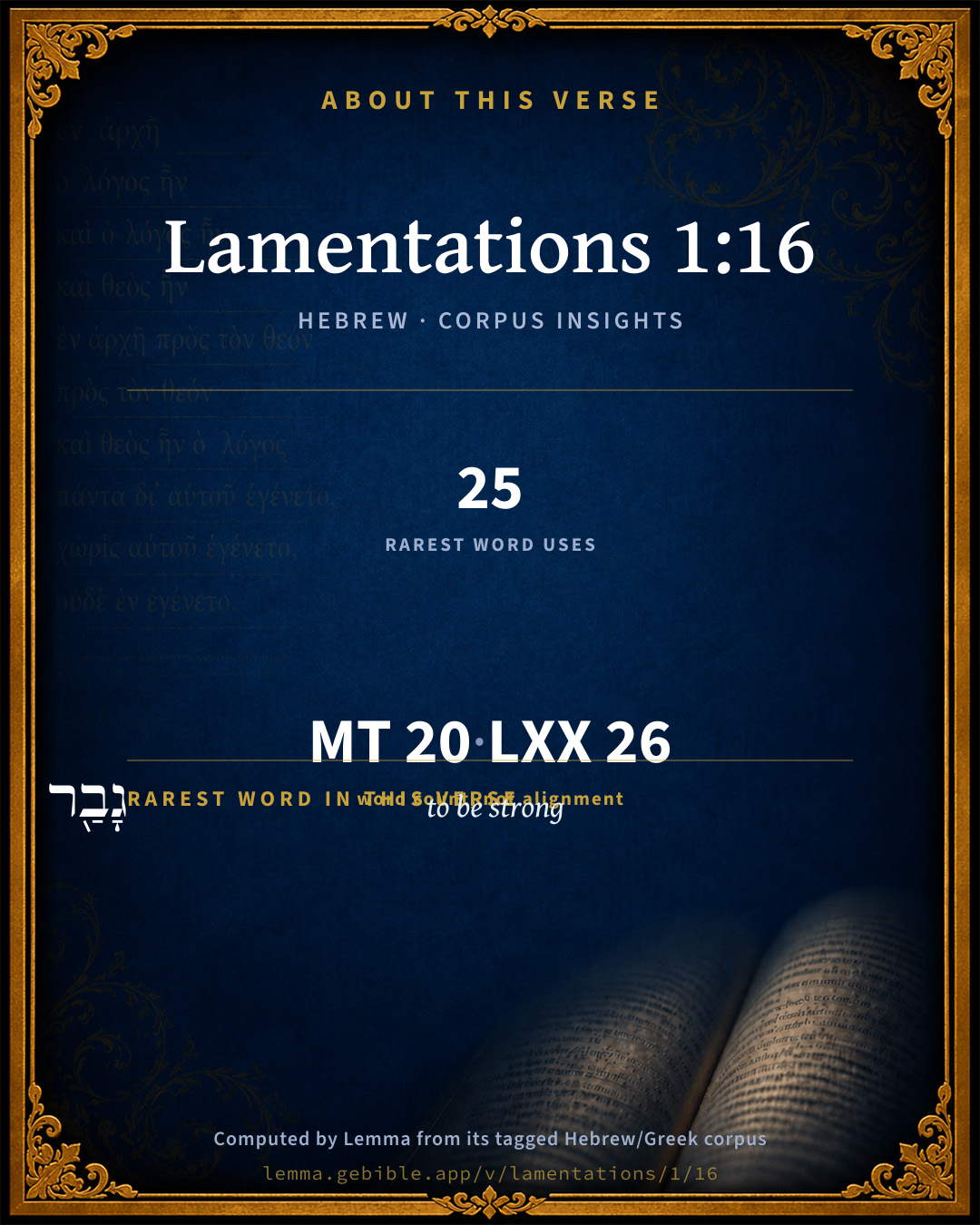
20
words
18
distinct lemmas
Prophets
section

Notable vocabulary

The rarest word here is גָבַ֖ר to be strong H1396 — appearing just 25 times in the whole Hebrew Bible.

Shared distinctive vocabulary

גָבַ֖ר to be strong H1396 occurs in 24 verses of the Hebrew Bible. Also found in:

Grammatical profile

  • 9 verbs
  • 5 nouns
  • 2 pronouns
  • 2 prepositions
  • 2 conjunctions

Verb forms

  • בוֹכִיָּ֗ה Qal · Participle Active
  • יֹ֣רְדָה Qal · Participle Active
  • רָחַ֥ק Qal · Perfect
  • מְנַחֵ֖ם Piel · Participle Active
  • מֵשִׁ֣יב Hiphil · Participle Active
  • הָי֤וּ Qal · Perfect
  • שֽׁוֹמֵמִ֔ים Qal · Participle Active
  • גָבַ֖ר Qal · Perfect
  • אוֹיֵֽב Qal · Participle Active

Repetition

Words recur within this verse — often emphatic in Hebrew:

  • עֵינִ֤י eye H5869 ×2
  • כִּֽי that H3588 ×2

Hebrew & Septuagint length

In English translation the verse runs 34 words from the Hebrew and 34 from the Septuagint (LXX English) — the same length.

A rough comparison of the two English renderings, which tokenize alike — not a word-level alignment.

Word counts can differ between the Hebrew and the Greek without any difference in meaning — e.g. the Hebrew direct-object marker אֵת has no separate Greek word, and Greek often adds the article ὁ.

In the original languages it is 20 Hebrew tokens and 26 Greek tokens — but the two are counted differently (Hebrew bundles its prefixes and suffixes into one token; the Greek is in lemma form), so that isn’t a like-for-like length.

Cross-references

19

Topical passages linked to Lamentations 1:16 in the Treasury of Scripture Knowledge — connected by theme and wording, ordered by reader-vote popularity; previews shown in the World English Bible.

  • Psalms 119:136 Streams of tears run down my eyes, Because they don't observe your law.
  • Lamentations 1:2 She weeps sore in the night, and her tears are on her cheeks; Among all her lovers she has none to comfort her: All her friends have dealt treacherously with her; they are become her enemies.
  • Jeremiah 13:17 But if you will not hear it, my soul shall weep in secret for [your] pride; and my eye shall weep sore, and run down with tears, because Yahweh's flock is taken captive.
  • Jeremiah 14:17 You shall say this word to them, Let my eyes run down with tears night and day, and let them not cease; for the virgin daughter of my people is broken with a great breach, with a very grievous wound.
  • Lamentations 2:11 My eyes do fail with tears, my heart is troubled; My liver is poured on the earth, because of the destruction of the daughter of my people, Because the young children and the infants swoon in the streets of the city.
  • Lamentations 2:18 Their heart cried to the Lord: wall of the daughter of Zion, let tears run down like a river day and night; Give yourself no respite; don't let the apple of your eye cease.
  • Lamentations 3:48–49 My eye runs down with streams of water, for the destruction of the daughter of my people.
  • Psalms 69:20 Reproach has broken my heart, and I am full of heaviness. I looked for some to take pity, but there was none; For comforters, but I found none.
  • Ecclesiastes 4:1 Then I returned and saw all the oppressions that are done under the sun: and, behold, the tears of those who were oppressed, and they had no comforter; and on the side of their oppressors there was power; but they had no comforter.
  • Jeremiah 9:1 Oh that my head were waters, and my eyes a spring of tears, that I might weep day and night for the slain of the daughter of my people!
  • Jeremiah 9:10 For the mountains will I take up a weeping and wailing, and for the pastures of the wilderness a lamentation, because they are burned up, so that none passes through; neither can men hear the voice of the cattle; both the birds of the sky and the animals are fled, they are gone.
  • Jeremiah 9:21 For death is come up into our windows, it is entered into our palaces; to cut off the children from outside, [and] the young men from the streets.
  • Lamentations 1:5–6 Her adversaries are become the head, her enemies prosper; For Yahweh has afflicted her for the multitude of her transgressions: Her young children are gone into captivity before the adversary.
  • Lamentations 1:9 Her filthiness was in her skirts; she didn't remember her latter end; Therefore is she come down wonderfully; she has no comforter: See, Yahweh, my affliction; for the enemy has magnified himself.
  • Lamentations 2:20–22 Look, Yahweh, and see to whom you have done thus! Shall the women eat their fruit, the children that are dandled in the hands? Shall the priest and the prophet be killed in the sanctuary of the Lord?
  • Lamentations 4:2–10 The precious sons of Zion, comparable to fine gold, How are they esteemed as earthen pitchers, the work of the hands of the potter!
  • Hosea 9:12 Though they bring up their children, Yet I will bereave them, so that not a man shall be left. Indeed, woe also to them when I depart from them!
  • Luke 19:41–44 When he drew near, he saw the city and wept over it,
  • Romans 9:1–3 I tell the truth in Christ. I am not lying, my conscience testifying with me in the Holy Spirit,

Cross-references courtesy of OpenBible.info (CC BY 4.0).

Hebrew and Greek witnesses Masoretic Hebrew ↔ Greek Septuagint

The same verse in the two great witnesses to the Old Testament, shown verse-for-verse.

These are two independent witnesses, not word-aligned to each other, and the Septuagint is shown in lemma (dictionary) form.

Hebrew Lamentations 1:16 Masoretic · Westminster Leningrad Codex

עַל אֵ֣לֶּה אֲנִ֣י בוֹכִיָּ֗ה עֵינִ֤י עֵינִי֙ יֹ֣רְדָה מַּ֔יִם כִּֽי רָחַ֥ק מִמֶּ֛נִּי מְנַחֵ֖ם מֵשִׁ֣יב נַפְשִׁ֑י הָי֤וּ בָנַי֙ שֽׁוֹמֵמִ֔ים כִּ֥י גָבַ֖ר אוֹיֵֽב

For these things I weep; my eye, my eye runs down with water; Because the comforter who should refresh my soul is far from me: My children are desolate, because the enemy has prevailed.

World English Bible · Public Domain

Greek LXX Lamentations 1:16 Septuagint · lemma form

ὁ ὀφθαλμός ἐγώ καταἄγω ὕδωρ ὅτι μακρύνω ἀπό ἐγώ ὁ παρακαλέω ἐγώ ὁ ἐπιστρέφω ψυχή ἐγώ γίγνομαι ὁ υἱός ἐγώ ἀπο ἀναἵζω ὅτι κραταιόω ὁ ἐχθρός

AIN. My eye has poured out water, because he that should comfort me, that should restore my soul, has been removed far from me: my sons have been destroyed, because the enemy has prevailed.

LXX2012 (modern English Septuagint) · Public Domain

On this verse, The Pulpit Commentary discusses the Septuagint’s reading. Read the note in Commentary ↓

Hebrew: Westminster Leningrad Codex (CC BY 4.0). Greek: Septuagint (public domain); English from LXX2012 (modern English Septuagint) (Public Domain). How the Septuagint differs from the Hebrew →

Commentary

Notes on Lamentations 1:16 from classic Christian and Jewish commentators (each source and its license shown beneath its notes). The classic Christian expositions comment on the surrounding passage and are grouped to its opening verse, so a note may address several verses; the Jewish commentaries on the Tanakh (Rashi and others) are per-verse, so they appear only where the commentator wrote on this verse.

Lemma curates 59 commentaries, every one of them public domain or Creative Commons licensed, each selected and text-cleaned for this edition rather than reprinted as found. About our sources →

Trapp's Complete Commentary

John Trapp

Lam 1:16 For these [things] I weep; mine eye, mine eye runneth down with water, because the comforter that should relieve my soul is far from me: my children are desolate, because the enemy prevailed.

Ver. 16. For these things I weep.] I, Jerusalem; {as Lam 1:2} or, I, Jeremiah.

“ Nam faciles motus mens generosa capit. ” - Ovid.

Mine eye, mine eye runneth down with water.] Continuitatem significat: imo emphasin dicit. Niobe like, I weep excessively and without intermission. God would not have the wounds of a godly sorrow to be ever so healed up but that they may bleed afresh again upon all good occasion. As for worldly sorrow, there must be a stop put to it, lest what we have overly wept, we be forced to unweep again.

Because the comforter that should relieve my soul is far from me.] This was very sad, and made both eyes run down with water. God stood aloof off; men were slack to shore up a poor sinking soul. This was a condition and complaint not unlike that of Saul, "I am sore distressed; for the Philistines are upon me, and God is departed from me." {1Sa 28:15}

John Trapp, A Commentary or Exposition upon All the Books of the Old and New Testament (1647–1656) — public domain. Text from a community e-Sword module.

Jamieson, Fausset & Brown

Robert Jamieson, A. R. Fausset & David Brown

(Jer 13:17; Jer 14:17). Jerusalem is the speaker.

mine eye, mine eye--so Lam 4:18, "our end . . . our end"; repetition for emphasis.

Jamieson, Fausset & Brown — Commentary Critical and Explanatory on the Whole Bible (1871) — public domain (CC PDM 1.0). Text via the HelloAO Bible API.

John Calvin's Commentaries

He describes at large the calamities of Jerusalem. But it is no wonder that the Prophet, thus lengthened his discourse; for we know that those who are heavily oppressed never satisfy themselves with mourning and lamentations. If, indeed, we duly consider how great the evils were, the Prophet will not appear to us wordy, nor will his prolixity be wearisome to us. For when any one compares the flourishing state of Jerusalem with that desolate ruin which the Prophet laments, it will surely appear to him that no words, however many, can fully express what it really was; nay, though the expressions may seem hyperbolical, yet they do not exceed the greatness of that calamity. This point is briefly adverted to, lest any one should be wearied with those various modes of expression which the Prophet employs, when yet he might have at once said that Jerusalem was destroyed.

He says, For this will I weep. He throughout sustains the person of a woman; for Jerusalem herself speaks, and not Jeremiah. I, she says, for this will weep; mine eye mine eye! it shall descend into waters. Others read, “Waters will descend from mine eyes;” but such a rendering is too loose. I do not, then, doubt but that Jerusalem says that her eyes would be like fountains of waters. She indeed speaks in the singular number, and repeats the words, mine eye! mine eye! it shall descend, or flow as waters, that is, as though they were two fountains, because alienated from me, or far from me, is a comforter, to revive my soul By these words she intimates that she was fainting, and as it were dying and that there was no one present to administer comfort, so that her soul might be revived. As it appeared before, that it is deemed an extreme evil when there is no friend to do the duty of humanity by alleviating sorrow; so now again Jerusalem repeats the same complaint, and says that all her sons were destroyed, because the enemy had prevailed. It follows, —

John Calvin's Commentaries (1540-1563) — public domain. Text from the Calvin Translation Society English edition (1840s-50s) via the Christian Classics Ethereal Library (ccel.org). Calvin's coverage is partial (roughly two-thirds of the Bible); uncommented books and verses are honest gaps, never fabricated. The 19th-century editor's footnotes and remarks are omitted so the notes are faithfully Calvin's own voice.

Ellicott's Commentary for English Readers

(16) For these things . . .—The unparalleled misery finds vent in a flood of bitterest tears. We note the emphasis of iteration in “mine eye, mine eye.” On “relieve,” see Note on Lam_1:11; and on “desolate,” see Note on Lam_1:13.

A Bible Commentary for English Readers, edited by Charles John Ellicott (1878–1897) — public domain. Text from a community e-Sword module.

The Cambridge Bible for Schools and Colleges

gen. ed. J. J. S. Perowne

16. For these things] The particulars rehearsed in the last three vv. open again the floodgates of tears.

mine eye, mine eye] This repetition spoils the metre, and arises in all probability from a copyist’s error.

mine eye runneth down with water] See Lam_3:48, and cp. the phrase “to weep one’s eyes out.”

The Cambridge Bible for Schools and Colleges (gen. ed. J. J. S. Perowne; Cambridge University Press, 1878–1918) — public domain. Text from a community e-Sword module.

John Gill's Exposition

For these things I weep,.... The congregation of Judah, the godly among them, particularly Jeremiah, who represented them, wept for the sins the people had been guilty of, and for the punishment inflicted on them, or the sore calamities that were brought upon them. The Targum goes into particulars, and paraphrases it thus,

"for the little ones that are dashed in pieces, and for the women big with child, whose bellies are ripped up, the congregation of Israel saith, I weep:''

mine eye, mine eye runneth down with water: which doubling of the words seems to express the vehemency of her passion; the greatness of the grief she was overwhelmed with. The Targum is,

"my both eyes flow with tears as a fountain of water:''

because the comforter that should relieve my soul is far from me; meaning God himself, who is the principal comforter of his people: saints may be comforters of one another, by relating to each other their gracious experiences; praying with one another, and building up each other in their most holy faith; by behaving in a kind, tender, and loving manner to each other; forgiving mutual offences; and conversing together about the glories of heaven, and being for ever with the Lord; but these sometimes are at a distance; or, like Job's friends, are miserable comforters. Ministers of the Gospel are by their character and office "Barnabases", "sons of consolation"; are trained up, appointed, and sent by the Lord to comfort his people; which they do by preaching the Gospel to them purely; by opening the Scriptures of truth clearly; by administering ordinances faithfully, and in all directing to Christ: but these sometimes are removed afar off by persecution or death; or those who bear this name do not perform their work aright. God is the chief comforter of his people; God, Father, Son, and Spirit: the Father comforts with his gracious presence; with views of covenant interest, and of the firmness and stability of it; with the precious promises of the word; with his everlasting and unchangeable love; and with discoveries of his pardoning grace and mercy. The Son is a comforter; one of the names of the Messiah with the Jews (c) is "Menachem", "the Comforter"; and who they say is here meant; and he is called the Consolation of Israel, Luk 2:25; who comforts by bringing near his righteousness and salvation; by his peace speaking blood, and atoning sacrifice; by directing to his fulness, and favouring with his presence. And the Holy Spirit is another comforter; who comforts by taking of the things of God, Christ, and the Gospel, and showing them to the saints; by opening and applying the promises to his people; by being the spirit of adoption, and the seal, earnest, and pledge of eternal glory: and thus, by being a comforter, the Lord "relieves the souls" of his people, under the weight of sin, the temptations of Satan, and the various afflictions of life; and prevents their fainting, and returns their souls, as the word (d) signifies; or fetches them back, when fainting and swooning away: but sometimes he withdraws himself, and stands at a distance, at least in their apprehensions; and this is matter of great grief and sorrow to them; which was the case of the church at this time:

my children are desolate: those which should help and relieve her, and be a comfort to her, were destitute themselves: or, were "destroyed" (e), and were not; and which was the cause of her disconsolate state, as was Rachel's, Jer 31:15;

because the enemy prevailed; that is, over them, as the Targum adds; over her children; and either put them to death or carried them captive.

(c) T. Bab. Sanhedrin, fol. 98. 2. Echa Rabbati, fol. 50. 1. (d) "reducens animam meam", V. L. Montanus; "qui restituat", Tigurine version. (e) "perditi", V. L.

John Gill's Exposition of the Whole Bible (1746–1763) — public domain (CC PDM 1.0). Text via the HelloAO Bible API.

Matthew Poole's English Annotations

For these sore afflictions, and for my sins that have caused them, and for these impressions of Divine wrath which I discern in them, Lord! I that am thy prophet, and we that are Israelites indeed, weep, and that plentifully; having neither thee present with us as formerly to be our hope or comfort, nor any friend that will deal by us as friends sometimes do by others in swooning fits to fetch back their souls.

My children are desolate, because the enemy prevailed; either the other cities of Judah, (Jerusalem was the mother city,) or my people, my inhabitants, are wasted, destroyed, and made desolate, because the enemy hath prevailed.

Matthew Poole's English Annotations on the Holy Bible (1683–1685) — public domain. Text from a community e-Sword/MySword module.

The Pulpit Commentary

For these things, etc. After the reflections of vers. 13-15, the poet gives vent anew to his hitter grief. Mine eye, mine eye. A repetition quite in Jeremiah"s manner; comp. Jer_4:19 Jer_6:14 Jer_8:11 Jer_22:29 Jer_23:25. The Septuagint and Vulgate, however, have "mine eye" only once. Relieve my soul (see on ver. 11).

The Pulpit Commentary (1880–1919), ed. H.D.M. Spence-Jones & Joseph S. Exell — public domain. Text from a community e-Sword module.

John Wesley's Explanatory Notes

The comforter - God.

John Wesley, Explanatory Notes Upon the Whole Bible (1754–1765) — public domain. Text via the GEBible commentary corpus.

unfoldingWord translationNotes

Door43 World Missions Community

General Information:

In this section Jerusalem is portrayed as a woman speaking about herself. In Lamentations, Zion and Jerusalem are names used to refer to the same city. (See: Personification)

for a comforter is far from me, one who restores my life

This speaks of Jerusalem having no one to comfort her as if she did have a comforter, but that he was far away. The word "comforter" can be expressed as a verb. AT: "for there is no one to comfort me and restore my life" (See: Metaphor)

restores my life

"revives me"

Zion has spread her hands wide

Here Jerusalem no longer speaks about herself; instead the author describes Jerusalem. He speaks of Zion as if it were a woman that lifts up her hands to ask for help. AT: "Zion has reached out for help" (See: Personification and Symbolic Action)

those around Jacob

"the people around Jacob" or "the nations surrounding Jacob"

around Jacob should be his adversaries

Here "Jacob" refers to his descendants, that is Israel. AT: "around Jacob's descendants should be their adversaries" (See: Metonymy)

unclean

A person who God considers spiritually unacceptable or defiled is spoken of as if the person were physically unclean. (See: Metaphor)

translationWords

comfort

restore

life

children

desolate

adversary

Zion

Yahweh

command

Jacob

Jerusalem

unfoldingWord translationNotes — © Distant Shores Media and the Door43 World Missions Community, licensed CC BY-SA 4.0. Source: git.door43.org/Door43/en_tn.

Rashi

Rabbi Shlomo Yitzchaki (Rashi)

my eye, yea, my eye i.e., my eye constantly sheds tears. The double expression indicates that there was no letup.

Rashi on the Tanakh — English translations: “The Judaica Press complete Tanach with Rashi, translated by A. J. Rosenberg” (CC BY 4.0); “Pentateuch with Rashi's commentary by M. Rosenbaum and A.M. Silbermann, 1929-1934” (public domain); “The Metsudah Tanach series, Lakewood, N.J” (CC BY 4.0); and “The Book of Joshua, Metsudah Publications, 1997” (CC BY 4.0). Text via Sefaria.

Lesson kit

Teaching starters — assembled from the data on this page, not authored interpretation. Every prompt links to the verse data it draws on. Edit before teaching.

Lamentations, in the Prophets, opens this verse with 20 words (18 distinct Hebrew lemmas). Its most distinctive word is gâbar (“to be strong”). A historical commentator’s framing appears above. Read the whole chapter for the surrounding context.

Discussion questions

  1. How does “to be strong” (gâbar) shape what this verse is saying?
  2. How does Genesis 7:18, which shares the word «to be strong», read alongside this verse?
  3. What does the repetition of “eye” (2× in this one verse) do in this verse?
  4. The translations on this page render this verse differently — a whole-verse word diff, not a word-by-word alignment. What might account for the different wordings?
  5. «בוֹכִיָּ֗ה» is a Qal Participle Active verb. How does that grammatical form shape the action described?
  6. Compare how Trapp's Complete Commentary and Jamieson, Fausset & Brown read this verse. Where do they agree or differ?

Things to notice

Reading settings

Reading text

Shown beneath each verse's original-language words.

Old Testament
Old Testament edition

Read the OT as the Masoretic Hebrew (MT) or the Greek Septuagint (LXX).

English shown for the Greek Septuagint (in the Hebrew ↔ Greek comparison).

Comparing translations? Open the Compare panel on any verse page to stack up to four side by side.