Obadiah 1:15

Hebrew (Westminster Leningrad Codex) Obadiah 1:15 appears in the Hebrew Old Testament. The text above is from the Westminster Leningrad Codex. Each word links to its Strong’s number, a concise gloss, and parsing drawn from the Open Scriptures Hebrew Bible morphology. Click any word for its full Brown-Driver-Briggs (BDB) entry.
Download image
Cite this verse

Obadiah 1:15 (World English Bible). Public Domain. Lemma interlinear Bible study tool, https://lemma.gebible.app/v/obadiah/1/15.

Show BibTeX & RIS
BibTeX
RIS
English Translation
For the day of Yahweh is near all the nations! As you have done, it will be done to you. Your deeds will return upon your own head.
World English Bible · Public Domain
Download a study sheet

One document with this verse’s original text, its word-by-word gloss line, the meaning frame, cross-references with their text, attributed commentary, and full source and license credits — printable, and it pastes into notes with its structure intact.

This verse Autodidact and up

Study sheet (.html) Plain text (.txt)

A passage Seminary Student

Up to 50 verses in one chapter. A passage sheet keeps up to 6 commentary sources and 12 cross-references per verse, in the order this page ranks them, and says so on the sheet whenever that leaves anything out. Ask for a single verse and you get the Autodidact verse sheet above.

Everything on this page stays free to read, with no account — the sheet is a download of what is already on screen, not access to it.

Want to remove ads? Support Godless Engineer
Compare translations 3

The same verse in 3 English versions, stacked beneath the original-language interlinear above. Click any original word for its lexicon entry.

Each is an independent rendering of the whole verse — the interlinear is not word-aligned to these translations.

Highlighted words mark where these versions differ — a whole-verse word diff, not a word-by-word alignment.

  • World English Bible Public Domain
    For the day of Yahweh is near all the nations! As you have done, it will be done to you. Your deeds will return upon your own head.
  • King James Version Public Domain
    For the day of the LORD is near upon all the heathen: as thou hast done, it shall be done unto thee: thy reward shall return upon thine own head.
  • unfoldingWord Literal Text CC BY-SA 4.0
    For the day of Yahweh is near upon all the nations. According to what you have done, it will be done to you; your recompense will return on your own head.

unfoldingWord Literal Text — © unfoldingWord, licensed CC BY-SA 4.0. Word-aligned USFM3 via Door43 (git.door43.org/unfoldingWord/en_ult).

Versions to compare (up to 4)

3 of 4 selected

Show all 18 translations

Every available English version of this verse, each an independent rendering of the whole verse.

  • World English Bible Public Domain
    For the day of Yahweh is near all the nations! As you have done, it will be done to you. Your deeds will return upon your own head.
  • Berean Standard Bible Public Domain
    For the Day of the LORD is near for all the nations. As you have done, it will be done to you; your recompense will return upon your own head.
  • Majority Standard Bible Public Domain
    For the Day of the LORD is near for all the nations. As you have done, it will be done to you; your recompense will return upon your own head.
  • King James Version Public Domain
    For the day of the LORD is near upon all the heathen: as thou hast done, it shall be done unto thee: thy reward shall return upon thine own head.
  • American Standard Version (1901) Public Domain
    For the day of Jehovah is near upon all the nations: as thou hast done, it shall be done unto thee; thy dealing shall return upon thine own head.
  • Revised Version (1885) Public Domain
    For the day of the LORD is near upon all the nations: as thou hast done, it shall be done unto thee; thy dealing shall return upon thine own head.
  • Geneva Bible (1599) Public Domain
    For the day of the Lord is neere, vpon all the heathen: as thou hast done, it shall bee done to thee: thy reward shall returne vpon thine head.
  • Douay-Rheims (1899) Public Domain
    For the day of the Lord is at hand upon all nations: as thou hast done, so shall it be done to thee: he will turn thy reward upon thy own head.
  • Young's Literal Translation Public Domain
    For near `is' the day of Jehovah, on all the nations, As thou hast done, it is done to thee, Thy deed doth turn back on thine own head.
  • Literal Standard Version CC BY-SA 4.0
    For near [is] the Day of YHWH, on all the nations, || As you have done, it is done to you, || Your deed turns back on your own head.
  • Unlocked Literal Bible CC BY-SA 4.0
    For the day of Yahweh is near upon all the nations. As you have done, it will be done to you; your deeds will return on your own head.
  • unfoldingWord Literal Text CC BY-SA 4.0
    For the day of Yahweh is near upon all the nations. According to what you have done, it will be done to you; your recompense will return on your own head.
  • Darby Bible Public Domain
    For the day of Jehovah is near upon all the nations: as thou hast done, it shall be done unto thee: thy recompence shall return upon thine own head.
  • World Messianic Bible Public Domain
    For the day of the LORD is near all the nations! As you have done, it will be done to you. Your deeds will return upon your own head.
  • Webster's Bible Public Domain
    For the day of the LORD is near upon all the heathen: as thou hast done, it shall be done to thee: thy reward shall return upon thy own head.
  • Free Bible Version CC BY-SA 4.0
    For the day of the Lord is near for all nations. What you have done will be done to you; your actions will fall back on your own heads.
  • Bible in Basic English Public Domain
    For the day of the Lord is coming quickly on all nations: as you have done it will be done to you; the reward of your acts will come on your head.
  • JPS Tanakh (1917) Public Domain
    For the day of the LORD is near upon all the nations; as thou hast done, it shall be done unto thee; thy dealing shall return upon thine own head.

Literal Standard Version (2020), Covenant Press — licensed CC BY-SA 4.0. Text via the HelloAO Bible API (eBible.org). Unlocked Literal Bible (unfoldingWord) — licensed CC BY-SA 4.0. Text via the HelloAO Bible API (eBible.org). unfoldingWord Literal Text — © unfoldingWord, licensed CC BY-SA 4.0. Word-aligned USFM3 via Door43 (git.door43.org/unfoldingWord/en_ult). Free Bible Version, Dr. Jonathan Gallagher — licensed CC BY-SA 4.0. Text via the HelloAO Bible API (eBible.org).

Word by word

More ways to search: Search by grammar → Find every occurrence → Compare this word →

Practice this passage: Drill this verse → Learn its vocabulary →

גְּמֻלְךָ֖
gᵉmûwl
H1576
“recompense · your”
Noun, Common, Masculine, Singular, Construct + Suffix, Personal, 2nd Person, Masculine, Singular
Part of Speech
Noun
Type
Common
Gender
Masculine
Number
Singular
State
Construct
Full BDB Definition

Origin: from H1580

TWOT: 360a

dealing, recompense, benefit - dealing (of one's hand) - recompense - benefit
  1. כִּֽי kîy H3588 “that” Conjunction
  2. קָר֥וֹב qârôwb H7138 “near” Adjective, Adjective, Masculine, Singular, Absolute
  3. יוֹם yôwm H3117 “day of” Noun, Common, Masculine, Singular, Construct
  4. יְהוָ֖ה Yᵉhôvâh H3068 “LORD” Noun, Proper
  5. עַל ʻal H5921 “upon” Preposition
  6. כָּל kôl H3605 “all of” Noun, Common, Masculine, Singular, Construct
  7. הַגּוֹיִ֑ם gôwy H1471 “the · nations” Particle, Definite Article + Noun, Common, Masculine, Plural, Absolute
  8. כַּאֲשֶׁ֤ר ʼăsher H834 “like/as · which” Preposition + Particle, Relative
  9. עָשִׂ֨יתָ֙ ʻâsâh H6213 “to do” Verb, Qal, Perfect, 2nd Person, Masculine, Singular
  10. יֵעָ֣שֶׂה ʻâsâh H6213 “to do” Verb, Niphal, Imperfect, 3rd Person, Masculine, Singular
  11. יָשׁ֥וּב shûwb H7725 “to return” Verb, Qal, Imperfect, 3rd Person, Masculine, Singular
  12. בְּרֹאשֶֽׁךָ rôʼsh H7218 “in/at · head · your” Preposition + Noun, Common, Masculine, Singular, Construct + Suffix, Personal, 2nd Person, Masculine, Singular

About this verse

These counts appear in no published source. They are computed here, from the morphology-tagged text and Lemma’s own curated glosses. What Lemma adds →

14
words
12
distinct lemmas
Prophets
section

Notable vocabulary

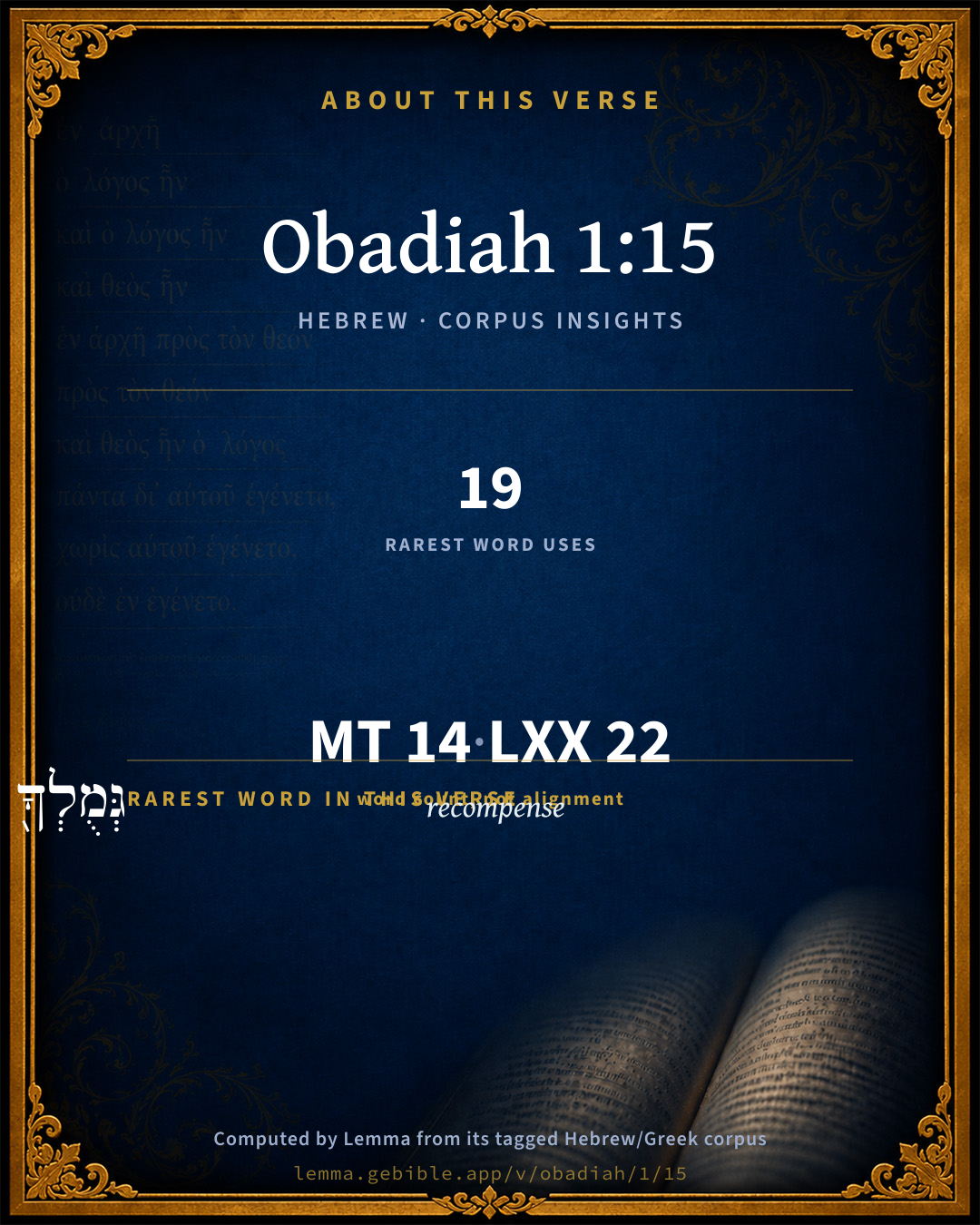
The rarest word here is גְּמֻלְךָ֖ recompense H1576 — appearing just 19 times in the whole Hebrew Bible.

Shared distinctive vocabulary

גְּמֻלְךָ֖ recompense H1576 occurs in 17 verses of the Hebrew Bible. Also found in:

Grammatical profile

  • 3 verbs
  • 6 nouns
  • 1 adjective
  • 2 prepositions
  • 1 conjunction
  • 1 particle

Verb forms

  • עָשִׂ֨יתָ֙ Qal · Perfect
  • יֵעָ֣שֶׂה Niphal · Imperfect
  • יָשׁ֥וּב Qal · Imperfect

Repetition

A word recurs within this verse — often emphatic in Hebrew:

  • עָשִׂ֨יתָ֙ to do H6213 ×2

Hebrew & Septuagint length

In English translation the verse runs 28 words from the Hebrew and 32 from the Septuagint (LXX English) — closely comparable.

A rough comparison of the two English renderings, which tokenize alike — not a word-level alignment.

Word counts can differ between the Hebrew and the Greek without any difference in meaning — e.g. the Hebrew direct-object marker אֵת has no separate Greek word, and Greek often adds the article ὁ.

In the original languages it is 14 Hebrew tokens and 22 Greek tokens — but the two are counted differently (Hebrew bundles its prefixes and suffixes into one token; the Greek is in lemma form), so that isn’t a like-for-like length.

Cross-references

18

Topical passages linked to Obadiah 1:15 in the Treasury of Scripture Knowledge — connected by theme and wording, ordered by reader-vote popularity; previews shown in the World English Bible.

  • James 2:13 For judgment is without mercy to him who has shown no mercy. Mercy triumphs over judgment.
  • Habakkuk 2:8 Because you have plundered many nations, all the remnant of the peoples will plunder you, because of men's blood, and for the violence done to the land, to the city and to all who dwell in it.
  • Ezekiel 30:3 For the day is near, even the day of Yahweh is near; it shall be a day of clouds, a time of the nations.
  • Matthew 7:2 For with whatever judgment you judge, you will be judged; and with whatever measure you measure, it will be measured to you.
  • Micah 5:15 I will execute vengeance in anger, And wrath on the nations that didn't listen."
  • Psalms 137:8 Daughter of Babylon, doomed to destruction, He will be happy who rewards you, As you have served us.
  • Jeremiah 50:29 Call together the archers against Babylon, all those who bend the bow; encamp against her round about; let none of it escape: recompense her according to her work; according to all that she has done, do to her; for she has been proud against Yahweh, against the Holy One of Israel.
  • Joel 3:11–14 Hurry and come, all you surrounding nations, And gather yourselves together." Cause your mighty ones to come down there, Yahweh.
  • Judges 1:7 Adoni-bezek said, "Seventy kings, having their thumbs and their great toes cut off, gathered [their food] under my table: as I have done, so God has requited me." They brought him to Jerusalem, and he died there.
  • Jeremiah 49:12 For thus says Yahweh: Behold, they to whom it didn't pertain to drink of the cup shall assuredly drink; and are you he who shall altogether go unpunished? you shall not go unpunished, but you shall surely drink.
  • Ezekiel 35:15 As you did rejoice over the inheritance of the house of Israel, because it was desolate, so will I do to you: you shall be desolate, Mount Seir, and all Edom, even all of it; and they shall know that I am Yahweh.
  • Joel 1:15 Alas for the day! For the day of Yahweh is at hand, And it will come as destruction from the Almighty.
  • Joel 3:7–8 Behold, I will stir them up out of the place where you have sold them, And will return your repayment on your own head;
  • Psalms 110:5–6 The Lord is at your right hand. He will crush kings in the day of his wrath.
  • Jeremiah 9:25–26 Behold, the days come, says Yahweh, that I will punish all those who are circumcised in [their] uncircumcision:
  • Jeremiah 25:15–29 For thus says Yahweh, the God of Israel, to me: take this cup of the wine of wrath at my hand, and cause all the nations, to whom I send you, to drink it.
  • Lamentations 4:21–22 Rejoice and be glad, daughter of Edom, that dwell in the land of Uz: The cup shall pass through to you also; you shall be drunken, and shall make yourself naked.
  • Zechariah 14:14–18 Judah also will fight at Jerusalem; and the wealth of all the surrounding nations will be gathered together: gold, and silver, and clothing, in great abundance.

Cross-references courtesy of OpenBible.info (CC BY 4.0).

Hebrew and Greek witnesses Masoretic Hebrew ↔ Greek Septuagint

The same verse in the two great witnesses to the Old Testament, shown verse-for-verse.

These are two independent witnesses, not word-aligned to each other, and the Septuagint is shown in lemma (dictionary) form.

Hebrew Obadiah 1:15 Masoretic · Westminster Leningrad Codex

כִּֽי קָר֥וֹב יוֹם יְהוָ֖ה עַל כָּל הַגּוֹיִ֑ם כַּאֲשֶׁ֤ר עָשִׂ֨יתָ֙ יֵעָ֣שֶׂה לָּ֔ךְ גְּמֻלְךָ֖ יָשׁ֥וּב בְּרֹאשֶֽׁךָ

For the day of Yahweh is near all the nations! As you have done, it will be done to you. Your deeds will return upon your own head.

World English Bible · Public Domain

Greek LXX Obadiah 1:15 Septuagint · lemma form

διότι ἐγγύς ἡμέρα κύριος ἐπί πᾶς ὁ ἔθνος ὅς τρόπος ποιέω οὕτως εἰμί σύ ὁ ἀνταπόδομα σύ ἀντι ἀποδίδωμι εἰς κεφαλή σύ

For the day of the Lord is near upon all the Gentiles: as you have done, so shall it be done to you: your recompense shall be returned on your own head.

LXX2012 (modern English Septuagint) · Public Domain

Hebrew: Westminster Leningrad Codex (CC BY 4.0). Greek: Septuagint (public domain); English from LXX2012 (modern English Septuagint) (Public Domain). How the Septuagint differs from the Hebrew →

Targum (Aramaic paraphrase)

1

The Targum is the ancient Jewish Aramaic paraphrase of the Hebrew Scriptures — an interpretive translation, not the Hebrew text itself. Onkelos (literal) and Pseudo-Jonathan (expansive) render the Torah, and Jonathan the Prophets. Coverage is partial: where no permissively-licensed English translation exists for a verse, only the Aramaic is shown. This is verse-level text, not a word-by-word alignment to the Hebrew.

  1. Targum Jonathan Prophets (Joshua–Malachi)
    אֲרֵי קָרִיב יוֹמָא דְעָתִיד לְמֵיתֵי מִן קֳדָם יְיָ עַל כָּל עַמְמַיָא כְּמָא דַעֲבָדַת יִתְעֲבֵיד לָךְ גַמְלָךְ יִתְּתָב בְּרֵישָׁךְ:

    (no public-domain English translation for this verse)

    Targum Jonathan — Aramaic: “Mikraot Gedolot” (public domain). English: “Sefaria Community Translation” (CC0 1.0 (public-domain dedication)); “London "Chaldee Paraphrase," 1871” (public domain). Text via Sefaria.

Commentary

Notes on Obadiah 1:15 from classic Christian and Jewish commentators (each source and its license shown beneath its notes). The classic Christian expositions comment on the surrounding passage and are grouped to its opening verse, so a note may address several verses; the Jewish commentaries on the Tanakh (Rashi and others) are per-verse, so they appear only where the commentator wrote on this verse.

Lemma curates 59 commentaries, every one of them public domain or Creative Commons licensed, each selected and text-cleaned for this edition rather than reprinted as found. About our sources →

The Cambridge Bible for Schools and Colleges

gen. ed. J. J. S. Perowne

15. The day of the Lord] The order of the words, “for near is the day of the Lord,” accords with the fact that the day of the Lord is here spoken of as something already known and familiar. It was first revealed to the prophet Joel (Joe_1:15; Joe_2:1; Joe_2:31 [Heb, 3:4]). There as here it had reference first to some nearer typical visitation and judgment, but included the great final day into which the prophet’s view here expands.

as thou hast done] comp. Eze_35:15 and Psa_137:8.

thy reward] rather, thy work; dealing, R.V. Comp. Joe_3:7 [Heb., 4:7].

As ye have drunk] This is commonly interpreted to mean, “As ye Edomites have drunk in triumphant revelry and carousal on my holy mountain, rejoicing with unhallowed joy over its destruction, so shall (ye and) all the nations drink continually the wine of God’s wrath and indignation.” But it is better to understand the first clause as referring to the Jews: “As ye have drunk (who are) upon my holy mountain; as even you, who are my chosen people and inhabit the mountain consecrated by my presence, have not escaped the cup of my wrath, so all the nations shall drink of that same cup, not with a passing salutary draught as you have done, but with a continuous swallowing down, till they have wrung out the dregs thereof and been brought to nothing by their consuming power.” The “drinking” is thus the same in both clauses and not as in the other interpretation, literal in the first clause, and figurative in the second. Thus too the word “continually” has its proper force, by virtue of the contrast which it suggests between the Jews, for whom the bitter draught was only temporary, for amendment and not for destruction, and the heathen who were to drink on till they perished. And this view of the words is strikingly confirmed by the parallel passages in Jeremiah. To that prophet the commission is given by God, “Take the wine cup of this fury at mine hand, and cause all the nations to whom I send thee to drink it.” Beginning with “Jerusalem and the cities of Judah” the prophet passes the cup in turn to Edom. And if the nations refuse to take the cup, he is to answer them by Obadiah’s argument that even God’s holy mountain has not escaped: “ye shall certainly drink. For do I begin to bring evil on the city which is called by my name and should ye be utterly unpunished?” (Jer_25:15-29). Again in the chapter in which, as we have seen, Jeremiah has much in common with Obadiah, he uses the figure of the cup of judgment with reference both to Jews and Edomites as though he had so understood it here. “Behold,” he says, “they whose judgment was not to drink of the cup have assuredly drunken, and art thou he that shall altogether go unpunished?” Jer_49:12. And once more in the book of Lamentations he prophesies, “the cup also (of which we have drunk) shall pass through unto thee,” and then draws, in the following verse, the same contrast in plain language between the punishment of Israel and of Edom, which is here drawn by Obadiah by the figure of the single and the continuous draught. “The punishment of thine iniquity is accomplished, O daughter of Zion; he will no more carry thee away into captivity. He will visit thine iniquity, O daughter of Edom; he will discover thy sins” (Jer_4:21-22).

15, 16. After the description in Oba_1:11-14, of the fault for which Edom was to be punished, the prophet returns in these two verses to the subject of Oba_1:2-9, and completes the description of the punishment that should be inflicted on him. He connects them by the word “for,” at once with the prediction of Oba_1:10, “thou shalt be cut off for ever,” and with the earnest dissuasions of the verses that have followed.

The Cambridge Bible for Schools and Colleges (gen. ed. J. J. S. Perowne; Cambridge University Press, 1878–1918) — public domain. Text from a community e-Sword module.

Trapp's Complete Commentary

John Trapp

Oba 1:15 For the day of the LORD [is] near upon all the heathen: as thou hast done, it shall be done unto thee: thy reward shall return upon thine own head.

Ver. 15. For the day of the Lord is near, &c.] "The wicked plotteth against the just, and gnasheth upon him with his teeth. The Lord shall laugh at him: for he seeth that his day is coming," Psa 37:12-13, the particular day of his sore punishment, a type and pledge of the general judgment, that great day of the Lord, as it is called, Rev 6:17; Rev 16:14, because the great God will on that day do great works, and determine great matters, Jdg 1:19. But as some men’s sins go before to judgment (as it were, by a special sessions preceding and anteverting the great Assizes), so should Edom and his neighbouring nations taste also of Nebuchadnezzar’s cup and whip, Jer 25:17, and this day is said to be near upon them, though it came not of above a hundred years after; so is the coming of Christ to judgment near, though we presume not to set the time, as some have done, deceiving and being deceived.

As thou hast done, it shall be done to thee] God loves to retaliate, and to oppose frowardness to frowardness, Psa 18:26, contrariety to contrariety, Lev 26:18; Lev 26:21, severity to cruelty, as he did to Adonibezek, Agag, Zebah, and Zalmunna, Jdg 8:19, and Edom here, and Eze 35:1-15. And the heathens held this but meet, as appeareth by their fables and stories of Phineus (Ovid).

“ Quid fodis immeritis natis sua lumina, Phineu?

- Poena reversura est in caput ipsa tuum. ”

So of Diomedes, King of Thrace, cast by Hercules to be devoured by his own dogs, which he had so often fed with man’s flesh. The like might be said of Perillus and his brazen bull, whereof himself had the lucky omen. Iustum est, ait Rhadamanthus, quod quis iniuste aliis intulit idem subeat et patiatur (Arist. Ethic.). Herein they said no other thing than what God had in the old law decreed, Lev 24:19, and Christ in the new hath confirmed, Mat 7:2, for a terror to evildoers, who shall have like for like returned unto them, and be filled with their own ways, Pro 14:14. See Lam 4:21. The Rabbis conceive all this to be spoken of the Romans (whom they call Edomites); sure we are God will be even with that Romish antichrist, and render him his own in kind, when he once takes him in hand, as Rev 13:10; Rev 18:6.

John Trapp, A Commentary or Exposition upon All the Books of the Old and New Testament (1647–1656) — public domain. Text from a community e-Sword module.

Albert Barnes' Notes on the Bible

For the day of the Lord is near upon all the pagan - The prophet once more enforces his warning by preaching judgment to come. “The day of the Lord” was already known Joe 1:15; Joe 2:1, Joe 2:31, as a day of judgment upon “all nations,” in which God would “judge all the pagan,” especially for their outrages against His people. Edom might hope to escape, were it alone threatened. The prophet announces one great law of God’s retribution, one rule of His righteous judgment. “As thou hast done, it shall be done unto thee.” Pagan justice owned this to be just, and placed it in the mouth of their ideal of justice. “Blessed he,” says the Psalmist Psa 137:8, “that recompenses unto thee the deed which thou didst to us.” “Blessed,” because he was the instrument of God. Having laid down the rule of God’s’ judgment, he resumes his sentence to Edom, and speaks to all in him. In the day of Judahs calamity Edom made itself as “one of them.” It, Jacob’s brother, had ranked itself among the enemies of God’s people. It then too should be swept away in one universal destruction. It takes its place with them, undistinguished in its doom as in its guilt, or it stands out as their representa tive, having the greater guilt, because it had the greater light. Obadiah, in adopting Joel’s words Joe 3:7, “thy reward shall return upon thine own head,” pronounces therewith on Edom all those terrible judgments contained in the sentence of retribution as they had been expanded by Joel.

Albert Barnes' Notes on the Bible (1834–1885) — public domain. Text from a community e-Sword/MySword module.

Joseph Benson's Commentary

Oba 1:15-16. For the day of the Lord is near upon all the heathen — The sacred writers call that the day of any persons, in which they do or suffer any thing very remarkable. Thus, Oba 1:13, the day of thy brother, signifies that time in which he was remarkably afflicted. So the day of the Lord signifies that time in which he does something extraordinary; and here it means the time in which God would inflict a remarkable vengeance upon the enemies of Judah. By all the heathen, is meant all those nations who, together with the Idumeans, insulted over the calamities of the Jews, or had waged war against them without any just cause. As thou hast done, it shall be done unto thee — As thou hast rejoiced at the calamities of others, so shall others rejoice at thine: and as thou hast spoiled and plundered thy neighbours, so shalt thou be served thyself: see the margin. For as ye have drunk upon my holy mountain, &c. — Here is a sudden apostrophe to the Jewish people, who are here addressed. The sense is, As ye, who dwell on the mount which is sacred to me, have drunk of the cup of my indignation, or have suffered grievous calamities from my just displeasure, so also shall the nations among whom I am not known. They shall drink and swallow down — Or, they shall drink large draughts of it, even to the very dregs. By this is expressed their suffering calamities in an extraordinary degree. They shall be as though they had not been — They shall be utterly destroyed, so that there shall be no remains of them.

Joseph Benson's Commentary on the Old and New Testaments (1811–1818) — public domain. Text from a community e-Sword module.

Whedon's Commentary on the Bible

Daniel D. Whedon

The terrors of the day of Jehovah, Oba_1:15-16.

In Oba_1:10 the prophet announces judgment upon the Edomites for their ill treatment of Judah; in Oba_1:11 he describes in greater detail their wrongdoings; in 12-14 he warns them to abstain from further violence. These warnings he backs up in Oba_1:15-16 by calling attention to the day of Jehovah, when Edom and all other enemies of Jehovah will receive their just dues.

For — Connects with Oba_1:14 more directly than with Oba_1:9.

The day of Jehovah is near upon all the heathen — R.V., “all the nations.” Edom is joined here with the other enemies of Jehovah; but 15b sets her apart again from the rest. Though the transition from 15a to 15b is abrupt there is insufficient reason for rejecting the latter as out of harmony with the former. The seeming difficulty may be removed by regarding 15b as an attempt on the part of the prophet to emphasize the special guilt of the Edomites, which might possibly be overlooked, were they not singled out for condemnation. In a sense, therefore, 15b is a parenthetical clause.

Day of Jehovah — See on Joe_1:15.

As thou hast done — The latter part of Oba_1:15 lays down the basis of recompense, the lex talionis (compare Eze_35:15; Psa_137:8; see on Joe_3:7). This idea is continued, in somewhat different form, in Oba_1:16. “With what measure ye mete, it shall be measured unto you.”

The interpretation of Oba_1:16 depends upon the determination as to who are the persons addressed with you. 1. Are they Edomites? “As ye Edomites have drunk in triumphant revelry and carousal on my holy mountain, rejoicing with unhallowed joy over its destruction, so shall (ye and) all the nations drink continually the wine of God’s wrath and indignation.” 2. Are they the Jews? “As ye have drunk (who are) upon my holy mountain; as even you who are my chosen people, and inhabit the mountain consecrated by my presence, have not escaped the cup of my wrath, so all the nations shall drink of that same cup, not with a passing salutary draught as you have done, but with a continuous swallowing down, till they have wrung out the dregs thereof and been brought to nothing by their consuming power.” Against the first and in support of the second interpretation it is urged: (1) The former would necessitate a change of meaning in drink; in the first sentence it would have to be understood literally, in the second figuratively. (2) In other parts of the book Edom is addressed in the singular, here in the plural. (3) The Edomites are a part of “all the nations” (15a); it would be peculiar to have them separated in Oba_1:16 (15b is of a different nature). (4) “The contrast between the Edomites reveling upon Mount Zion and the nations drinking the cup of Jehovah’s wrath gives no sense.” (5) It is also urged that the second interpretation alone does justice to continually “by virtue of the contrast which it suggests between the Jews for whom the bitter draught was only temporary, for amendment and not for destruction, and the heathen who were to drink on until they perished.” (6) The parallel passage (see, however, p. 291) in Jer_49:12 (compare Jer_25:15-29; Lam_4:21-22) is also quoted in support. But the second interpretation is by no means free from difficulties: (1) The rendering, “As ye have drunk who are upon my holy mountain,” is grammatically impossible; “upon my holy mountain” belongs to “as ye have drunk.” This objection, however, is valid only against the above-mentioned translation of the passage; a proper translation might remove the difficulty. (2) Throughout the whole prophecy Edom seems to be addressed, never the people of Judah directly. (3) The parallelism with “even as thou hast done,” referring to Edom (Oba_1:15), favors the first view. (4) The meaning which Jeremiah gives to the passage cannot determine the meaning of Obadiah. If the two passages are dependent the one on the other, which is by no means certain (p. 291), the borrower evidently took considerable liberty with the passage borrowed, and he may have gone so far as to alter the original meaning. On the whole, the first interpretation seems to be the more natural. It is in more perfect accord with the context, and it gives to the expression “drunk upon my holy mountain” its natural meaning. The use of drink in a twofold sense is not a serious objection; on the contrary, such change would be striking, and thus would add force to the prophetic message. The word continually would not lose its significance. Abrupt transitions from singular to plural, or plural to singular, are not uncommon in prophetic literature; and in this case the change may easily be accounted for by assuming that the prophet desired to include, in thought at least, all the nations. This assumption is supported by the fact that in Oba_1:15-16 the Edomites and the other nations are thought of as intimately associated, both in oppressing Judah and in enduring the judgment. For these reasons we may consider the words addressed to the Edomites, and by implication to all the nations.

As ye have drunk — There is nothing improbable in the thought that the Edomites joined the destroyers in carousals and revelry to celebrate the downfall of the Jewish nation and the capture of the city, and that they did this on the temple mountain.

My holy mountain — See on Joe_2:1.

So shall all the heathen [“nations”] drink — All who have manifested hostility toward the chosen people of God must drink the cup of the divine wrath.

Continually — “So that the turn to drink never passes from the nations to Judah” (Isa_51:22-23).

Swallow down — R.V. margin, “talk foolishly.” Of these the former is to be preferred. They will be compelled to empty the cup to the bottom.

A figurative description of the severity and completeness of the judgment. The result will be utter destruction for the nations that have been the enemies of Jehovah and of his people.

Daniel D. Whedon (gen. ed.), Commentary on the Old and New Testaments (1874–1909) — public domain. Text from a community e-Sword module.

The Pulpit Commentary

Vers. 15, 16. . The warning given in the first section (vers, 1-9) is supplemented by the announcement that in the day of the Lord, Edom and all the enemies of Israel shall be remembered, and shall suffer just retribution, meeting with the fate which they had inflicted on others.

The day of the Lord. This is not primarily the final day of judgment, but the time when "Jehovah reveals his majesty and omnipotence in a glorious manner, to overthrow all ungodly powers, and to complete his kingdom" (Keil). It is announced by Joe_1:15 Joe_2:1, 31 Zep_1:14; but the notion of a judgment to fall on Gentile nations, and to issue in the establishment of the kingdom of God, was familiar long before. Balaam had seen it in dim vision; (Num_24:17-24) Hannah had anticipated the destruction that would accompany it; (1Sa_2:9, 1Sa_2:10) so had (2Sa_23:5-7) in his last words; it is clearly predicted in the Psalms (see Psalm 2 and Ps 110) (Knabenbauer). Is near. Because every such judgment upon individual nations is typical of the great day and preparative of it. As thou hast done, it shall be done unto thee. (comp. Jud_1:7 Psa_137:8 Jer_50:15) This law of retribution was the ideal of heathen justice, according to the Rhadamanthian rule, "If a man should suffer what he hath done, then there would be strict justice" (Aristotle, "Eth. Nic." 5:5. 3). Thy reward; (Joe_3:7) better, that which thou hast performed thy work or dealing, Upon thine own head. Like a stone cast towards heaven. (comp. Psa_7:16 Est_9:25)

Vers. 15, 16. The "lex talionis.

The principle of government or of retribution known as the lex talionis was known to the Hebrews as well as to other nations. "It was said by them of old time, An eye for an eye, a tooth for a tooth." Passages in Ezekiel contain threatenings of a retribution similar to that which in this passage is denounced upon Edom.

I THE AUTHOR AND THE OCCASION OF THIS RETRIBUTION. "The day of the Lord" is an expression frequently occurring in the prophetic writings, and always denoting a season of retribution appointed by a righteous God. The day when iniquity is rampant, when injustice is perpetrated and is apparently unnoticed, is the day of man. But as surely as the universe is governed by a Being of rectitude, so surely shall the cause of equity and truth be vindicated; and the time of such vindication, come when it may, is the day of the Lord.

II THE METHOD AND MEASURE OF RETRIBUTION. "As thou hast done, it shall be done unto thee." Edom had deserted her friends; she should be deserted. Edom had spoiled her neighbours; she should be spoiled. And this doom was threatened, not upon Edom only, but upon "all the heathen," i.e. upon all who shared Edom"s guilt. Whether this was to happen by the working out of what we call a natural law, or by a special interposition of Providence, we are not told, and this is immaterial. History records very many instances in which this principle has operated, in which this doom has been inflicted.

III THE HIGHER DIVINE PRINCIPLE WHICH TEMPERS THIS OF RETRIBUTION. Our Lord Jesus has taught us that the lex talionis is not an adequate principle of human conduct. Much less can it be deemed the perfect and final law of the Divine government. Mercy triumphs over wrath. Where there is true repentance on man"s part, there is ready forgiveness on God"s part. If this were not so, the human race would long ago have perished; if this were not so, we should not now be rejoicing in the Saviour of our souls, the Saviour of mankind.

Recompense is sure.

"As thou hast done, it shall be done unto thee." Herein we have an immensely important principle laid down. Sowing and reaping always correspond. "Whatsoever a man soweth, that shall he also reap." All actions are seeds, many of which bear fruit in this world, and many in the next. "As thou hast done, it shall be done unto thee." Edom had been merciless and cruel, and the prophet says, "Thy reward shall return upon thine own head." In like manner we find mystic Babylon denounced in Rev_18:6 (I give the new version as more exact and expressive): "Render unto her even as she rendered, and double unto her the double according to her works: in the cup which she mingled, mingle unto her double." Here you see the principle in force rendering to Babylon as she rendered; doubling to her as she doubled; mingling for her as she mingled. We cannot overestimate the immense importance of this principle. In this life nations and individuals are constantly exemplifying the solemn truth which it involves. We should therefore all carefully remember that we are seed sowing, and sooner or later must come the harvest. (God told Edom, "Thy reward shall be upon thine own head. For as ye have drunk upon my holy mountain, so shall all the heathen drink continually." So Edom drank the cup at the hands of Babylon; Babylon drank it at the hands of the Modes; the Modes and Persians drank it at the hands of the Macedonians; the Macedonians drank it at the hands of the Romans; the Romans, in their turn, drank it at the hands of the barbarians (Dr. Pusey). Thus as they had done, it was done to them. Their reward returned upon their own heed. In Eze_35:15 we have a similar denunciation of Edom: "As thou didst rejoice at the inheritance of the house of Israel, because it was desolate, so will I do unto thee: and thou shaft be desolate, O Mount Seir, and all Idumea, even all of it." It is, you will notice, exactly the same kind of denunciation. In Pro_26:27 God says, "Whoso diggeth a pit shall fall therein: and he that rolleth a stone, it will return upon him." And in Psa_9:15 we are told, "The heathen are sunk down in the pit that they made: in the net which they hid is their own foot taken." In Numbers we find Moab plotting to curse Israel, and the curse came upon himself. In Judges we read of Adoni-bezek taken in battle, and maimed in his hands and feet. Adoni-bezek acknowledged that he had himself maimed three score and ten petty princes. His words are not dissimilar to our text, "As I have done, so God hath requited me." He confessed that the law of Nemesis had reached him. The end of Haman will occur to us. Haman dug a pit, and fell therein himself. He set a stone rolling, and it returned upon him. He perished upon the gallows which he prepared for Mordecai. In Psalm 18 David says, "With the froward thou wilt show thyself froward." He clearly means that Jehovah will be sternly opposed to the sinner"s frowardness. A similar passage is in Le 26, "If ye walk contrary unto me, then will I walk contrary unto you." The stubborn will gain nothing by their obstinacy. God will render to nations and individuals according to their ways. They shall be filled with the fruit of their own doings. The enemies of Daniel, were devoured by the lions which they intended for his destruction. The accusers of the three Hebrews were consumed by the fiery furnace which they kindled for them, The plotters of mischief were taken in their own wickedness and filled with their own ways. "As thou hast done, it shall be done unto thee." In the case of Jezebel we have a terrible example of this kind. In the place where Jezebel caused the dogs to lick the blood of Naboth, the dogs licked her blood. Well said Eliphaz, "I have seen that they who plough iniquity, and sow wickedness, reap the same. " The Jews, who were made to serve "strange" masters, were told that it was for serving "strange" gods. And our Lord himself has said, "With the same measure that ye mete it shall be measured to you again." Society has been likened to the echoing hills. It gives the speaker his words back again, doleful groan for groan, and joyous song for song. Thus "with the same measure that ye mete it shall be measured to you again." Jacob, who deceived his father, was in turn, and similarly, deceived by his sons. The Egyptians killed the Hebrew children; the God of the Hebrews slew the firstborn of Egypt. "As thou hast done, it shall be done unto thee." The words, we know, were addressed to Esau, and we have had abundant proof of the truth of the principle which they involve. But let us briefly notice the converse. "Whatsoever a man soweth, that shall he also reap." If the ungodly cannot sow hemlock, nightshade, and darnel, without reaping the same, so God"s servants cannot sow seeds of kindness, seeds of truth, seeds of light, seeds of heavenly blessing, without reaping in duo season. The great harvest of well doing, like that of evil doing, is indeed hereafter, but it has its tokens and firstfruits even now. Lot us notice, for example, our adorable Redeemer"s beatitude, "Blessed are the merciful: for they shall obtain mercy." We know that the merciful are those who upon gospel principles are sympathetic, helpful, loving, and kind. We know also that hereafter Christ will say to those on his right hand, "Come, ye blessed,... inherit the kingdom... I was a hungered, and ye gave me meat: I was thirsty, and ye gave me drink: I was a stranger, and ye took me in: naked, and ye clothed me: I was sick, and ye visited me: I was in prison, and ye came unto me.... Verily I say unto you, Inasmuch as ye did it unto one of these my brethren, even these least, ye did it unto me." Hereafter, it is clear, the merciful will obtain mercy. But at present the like principle is at work. "As thou hast done, it shall be done unto thee" The kind and merciful now enjoy much blessedness; the unmerciful are now unblest. A man whose sympathies are all dried up lives in a region of wintry blight. He walks in no glorious sunshine and in no joyous liberty. He knows nothing of the bliss that comes from open-hearted sympathy. There is darkness within. Darkness covers the face of the deep, and the Spirit of God does not move on the lace of the waters. But the merciful man, the man who is kind and sympathizing, the man who is forgiving and for bearing, the man who has a kind excuse for others, the man who looks on the charitable side of a case, the man who thinketh no evil, that man will reap here as well as here after. In his straits and afflictions he will find, as a general rule, the stream of kindness flow back again. The world will learn mercy by his mercy, and show some feeling for one whose wont was to sympathize with adversity. "The merciful man doeth good to his own soul". (Pro_11:17) The widow of Sarepta and the woman of Shunem, for kindness to the Lord"s prophets, received a prophet"s reward. The alms of Cornelius brought good to his own soul. God is not unrighteous to forget your work and labour of love. "As thou hast done, it shall be done unto thee." Now this is one of the original principles of the creation of God. God said, "Let the earth bring forth grass, the herb yielding seed, and the fruit tree yielding fruit, after his kind. " The vine yielded grapes; the fig tree, figs; the olive tree, olives. The principle was universal. So it is in the moral world. "What a man soweth, that shall he also reap." There is no altering the law naturally, morally, or spiritually. If a mother spoils a child, we know what the harvest will be. If a man takes to intemperate habits, we know what the harvest will be. And we all expect an idle, indolent man to come to disgrace and shame. Let no one be deceived. "God is not mocked... whatsoever a man soweth, that shall he also reap." Often and often souls have been deceived. Eve was deceived, Jacob was deceived, Ahab was deceived, David was deceived; but as they sowed, they reaped. God was not mocked. And so with us. Our words, our actions, our habits, are seeds seeds that will spring up. Oh, what will the harvest be? In this life there is, as I have shown, no little reaping ever going on. Nations and individuals are constantly learning the meaning of God"s words to Edom, "As thou hast done, it shall be done unto thee." But the great harvest is at the end of the world. The Lord of the harvest is at hand. My text, which I have said, has a present fulfilment, especially amongst nations, will have its complete accomplishment with regard to individuals when Christ"s judgment throne is set up. Then shall every man receive the things done in the body, Everyone shall receive that it, carry away with him the things done in the body, according to that he hath done, whether it be good or bad. The bad the sins must each be as a scorpion sting throughout eternity. Every sinner will be his own hell. The memory of his sins will be perpetual torment. In days when men argue against a future hell, it may be asked Who will argue that justice must extinguish the memory and take away the remorse of the sinner"s wilful transgressions? The recollection of the unpardoned sins of a lifetime will in itself be terrible. Let us, in this day of grace, when Jesus of Nazareth passeth by, offering salvation and everlasting life, let us every one come to him without delay. Let us accept his forgiving mercy, that our sins may be blotted out. Let us yield to the guidance of his Holy Spirit. And let us put on the Lord Jesus Christ, that we may be able to stand in the judgment. Henceforth may this be our language"Jesus, thy blood and righteousness My beauty are, my glorious dress; "Midst flaming worlds in these arrayed, With joy shall I lift up my head"! A.C.T.

Social retribution.

"For the day of the Lord is near upon all the heathen: as thou hast done, it shall be done unto thee: thy reward shall return upon thine own head." We have above furnished outlines of three homilies on the first sixteen verses of this chapter. Social cruelty we considered as the grand subject of the whole. This was presented:

1. As a sin against the Creator. And this was proved by the constitution of the human soul; the common relation of the race to God; the common interest of Christ in the race; and the universal teaching of the Bible.

2. As when perpetrated against a brother, specially offensive to God. And three reasons were mentioned for this the obligation to love a brother is stronger; the chief human institution is outraged; and the tenderest human loves are wounded.

3. As working in various forms from generation to generation. In this view it was shown that cruelty has various forms of working; that Omniscience observes it in all its workings; and that a terrible retribution awaits it in all its forms. Now social retribution is the subject before us, and this subject we have touched on already.

There are two great popular errors concerning the subject of retribution.

1. That retribution is reserved entirely for the future state. That the future state will be a state of retribution a state in which every man shall be rewarded according to his works must be admitted by every thoughtful student of the Bible. But retribution is not only future; it is here; retribution is an eternal principle of the Divine government; it follows sin at all times and forever. The men and nations whose acts are registered in the Bible proclaim the grand truth, "Behold, the righteous shall be recompensed in the earth: much more the wicked and the sinner". (Pro_11:31) "Bishop Butler, in accordance with the same doctrine, lays it down as an axiom that this life is the allotted and appointed period of retributive justice. Having assumed this as an undoubted fact, he proceeds to infer therefrom the certainty of the future judgment. How many masters in Israel arrive at the same wholesome conclusion on quite opposite premises the entire absence of systematic retributive justice during this life! "We find." he says, "that the true notion of the Author of our nature is that of a Master or Governor, prior to the consideration of his moral attributes. The fact of our case, which we find by experience, is that he actually exercises dominion or government over us at present, by rewarding and punishing us for our actions in as strict and proper a sense of these words, and even in the same sense, as children, servants, subjects, are rewarded and punished by those who govern them. Did not retributive justice strike our first parents and Cain at once? Did it not strike the antediluvian world, Sodom and Gomorrah, etc.? Another popular error concerning retribution is:

2. That it is a special infliction of God. We do not say that God may not break through the established order of things to inflict punishment, nor that he has not done so; for the Bible furnishes us with instances to the contrary. All we say is this is not the general rule. Divine punishments are natural events. Divine justice works as naturally as Divine goodness. Sin and punishment are indissolubly linked as cause and effect. The text suggests two thoughts in relation to social retribution.

I THAT IT IS OFTENTIMES A RETURN TO THE OFFENDER OF THE SAME KIND OF SUFFERING AS HE INFLICTED ON HIS VICTIM. "As thou hast done, it shall be done unto thee: thy reward shall return upon thine own head." The bitter cup thou hast given to thine enemy shall come round to thee, and of its dregs thou shalt drink. This principle is stated by Christ. "With what measure ye mete, it shall be measured to you again." The Bible is full of examples of this principle. Isaac told a lie, affirming that his wife was his sister; and he is told a lie by his son Jacob, who declared himself to be Esau. Jacob had deceived his aged parent in relation to Esau; his sons deceive him with regard to Joseph. He had embittered the declining years of his aged sire; his children embittered his. Again, Joseph was sold by his brethren as a bond servant into Egypt; in Egypt his brethren are compelled to resign themselves as bond servants to him. All history is full of examples, and everywhere in modern society illustrative cases may be selected. The deceiver himself is deceived, the fraudulent is himself cheated, the hater is himself hated, the cruel is often ruthlessly treated. Thus "as thou hast done, it shall be done unto thee." "Hear the just law, the judgment of the skies; He that hates truth shall be the dupe of lies (Cowper.)

II THAT IT OFTEN APPEARS TO COME AS A SPECIAL VISITATION OF ALMIGHTY GOD. "The day of the Lord is near upon all the heathen." All days are his days. But it is not until the guilty conscience is smitten with a sense of Sin that it sees him and feels that the day is full of God. Electricity pervades the universe, is ubiquitous; but men become conscious of it and talk of it only when it flashes in lightning and sounds in thunder. So with God"s justice. It is everywhere; but when the guilty conscience feels its punitive touch it calls it the day of judgment. The righteous are now going into life eternal, every righteous deed is a step onward; the wicked are now going into everlasting punishment, with every sin they tramp downward.

CONCLUSION. Learn that no soul can sin with impunity; that every sin carries with it punishment. "The gods are just, and of our pleasant vices make whips to scourge us." It may be, indeed, through the deadness of your conscience and the superabundant mercies of this life, that you feel not the retributive lash as you will feel it at some future time; but retribution is working here. "We still have judgment here that we but teach Bloody instructions, which, being taught, return To plague the inventor. This even-handed justice Commends the ingredients of our poisoned chalice To our own lips. (Shakespeare.) D.T.

The Pulpit Commentary (1880–1919), ed. H.D.M. Spence-Jones & Joseph S. Exell — public domain. Text from a community e-Sword module.

The Preacher's Complete Homiletical Commentary

Joseph S. Exell (gen. ed.)

CRITICAL NOTES.]

Oba_1:15. For] Resumptive from Oba_1:10. Righteous retribution in kind.

Oba_1:16.] The greatest crime the desecration of the holy mountain by drinking carousals, for which all nations are to drink of God’s wrath till utterly destroyed. Not been] (Job_10:19); not a trace of national existence left (Psa_37:36; Eze_26:21).

HOMILETICS

THE DAY OF RETRIBUTION.—Oba_1:15-16

Another warning of judgment to come. All men are amenable to law. God notices violations of law and duty. He is present in the affairs and will administer justice on the sins of men. “For the day of the Lord is near.”

I. God governs men by a law of requital. Human life appears confused, but God has plan and design. The wicked may triumph and the righteous suffer, but God will rectify matters. Men may disregard and deny the day of retribution, but cannot escape it. They often suffer here in loss of property, thwarted plans, and bad repute. Look not then upon the wrath of man, but the judgment of God.

1. This retribution may be near. “The day of the Lord is near.”

2. It is fixed in time. “The day of the Lord.”

3. It is certain. “They shall drink.” “Vengeance is mine: I will repay, saith the Lord.”

II. This law of retribution will be in equity. “As thou hast done it shall be done unto thee.” It is the lex talionis. God renders exactly to nations and individuals according to their works. Adonibezek confessed, “As I have done so God hath requited me” (Jud_1:7). With the froward God is froward (Psa_18:26); with the cruel he is strict, as with Agag and Edom. Men are filled with their own ways (Pro_14:14), and reap exactly what they sow in quality and quantity. “With what measure ye mete, it shall be measured to you again.”

1. In personal experience. “Thy reward shall be upon thine own head.”

2. In bitter degree. “They shall drink and swallow down.”

3. In long duration. “Drink continually.” “His mischief shall return upon his own head, and his violent dealings shall come down upon his own pate.”

“Heaven is above all, yet there sits a Judge

That no king can corrupt” [Shakespeare].

HOMILETIC HINTS AND OUTLINES

Oba_1:15. Thy reward, &c.

1. Then take not the law in your own hands.

2. Be encouraged in a good cause.

3. Fear in a bad cause.

Oba_1:16. As ye have drunk. A metaphor found in Scripture and heathen writers, in allusion to the cup of poison given to criminals, or to feasts where the governor gave to each guest (Joh_2:9). As God’s people had drunk the cup of affliction, so must the heathen drink of it. The cup of sorrow.

1. To God’s people—(a) mixed with sweetness; (b) it will soon be over.

2. To the wicked—(a) full of wrath; (b) will last for ever. “When God’s people have drunk the red wine in the cup, the wicked must drink the dregs; the cup passeth from place to place till all be drank off.”

All nations are, in the first instance, all who had been leagued against God’s people; but the wide term comprehends all who, in time, become like them. It is a rule of God’s justice for all times. Each in turn drank continuously, until it became as though it had never been. To swallow up, and be swallowed up in turn, is the world’s history [Pusey].

1. The Hill of Zion God’s holy mount.

2. This mount polluted by the carousals of men.

3. This mount vindicated and purified by God. The Church may be laid waste and made desolate, but God will purify it and revenge its enemies; will make a difference between holy and unholy; punish the spoiler and defend the worshipper. “Here will I dwell, for I have a delight therein.”

ILLUSTRATIONS TO THE CHAPTER

Oba_1:15-16. Retribution. To the revengeful God will be robed in vengeance, and to the merciful he will be a God of love. Thus our own characters, whether good or bad, will be thrown back upon ourselves, with the conscious force of Divinity. What is hell but sin’s reflections of the Divine character—the rays of the Eternal falling upon the soul through the combustible medium of the moral corruption, and thus setting all on fire? Let us remember, then, that there is to be a Divine reflection of ourselves, and that exactly with what measure we mete, it will be measured to us again [Dr Thomas].

The Preacher's Complete Homiletical Commentary (gen. ed. Joseph S. Exell; Funk & Wagnalls, c. 1892) — public domain (pre-1929). A full-Bible homiletical/sermon-outline anthology covering 65 of 66 books (2 John is absent from the source module). Text from a community e-Sword module.

Keil & Delitzsch

C. F. Keil & F. Delitzsch

This warning is supported in Oba 1:15 by an announcement of the day of the Lord, in which Edom and all the enemies of Israel will receive just retribution for their sins against Israel. Oba 1:15. "For the day of Jehovah is near upon all nations. As thou hast done, it will be done to thee; what thou hast performed returns upon thy head. Oba 1:16. For as ye have drunken upon my holy mountain, all nations will drink continually, and drink and swallow, and will be as those that were not." כּי (for) connects what follows with the warnings in Oba 1:12-14, but not also, or exclusively, with Oba 1:10, Oba 1:11, as Rosenmller and others suppose, for Oba 1:2-14 are not inserted parenthetically. "The day of Jehovah" has been explained at Joe 1:15. The expression was first formed by Obadiah, not by Joel; and Joel, Isaiah, and the prophets that follow, adopted it from Obadiah. The primary meaning is not the day of judgment, but the day on which Jehovah reveals His majesty and omnipotence in a glorious manner, to overthrow all ungodly powers, and to complete His kingdom. It was this which gave rise to the idea of the day of judgment and retribution which predominates in the prophetic announcements, but which simply forms one side of the revelation of the glory of God, as our passage at once shows; inasmuch as it describes Jehovah as not only judging all nations and regarding them according to their deeds (cf. Oba 1:15, and Oba 1:16), but as providing deliverance upon Zion (Oba 1:17), and setting up His kingdom (Oba 1:21). The retribution will correspond to the actions of Edom and of the nations. For גּמלך וגו, compare Joe 3:4, Joe 3:7, where (Joe 3:2-7) the evil deeds of the nations, what they have done against the people of God, are described. In Oba 1:16 Obadiah simply mentions as the greatest crime the desecration of the holy mountain by drinking carousals, for which all nations are to drink the intoxicating cup of the wrath of God till they are utterly destroyed. In shethı̄them (ye have drunk) it is not the Judaeans who are addressed, as many commentators, from Ab. Ezra to Ewald and Meier, suppose, but the Edomites. This is required not only by the parallelism of כּאשׁר שׁתיתם (as ye have drunk) and בּאשׁר שׁתיתם על הת (as thou hast done), but also by the actual wording and context. בּאשׁר שׁתיתם על הר cannot mean "as ye who are upon my holy mountain have drunk;" and in the announcement of the retribution which all nations will receive for the evil they have done to Judah, it is impossible that either the Judaeans should be addressed, or a parallel drawn between their conduct and that of the nations. Moreover, throughout the whole of the prophecy Edom only is addressed, and never Judah. Mount Zion is called "my holy mountain," because Jehovah was there enthroned in His sanctuary. The verb shâthâh is used in the two clauses in different senses: viz., shethı̄them, of the drinking carousals which the Edomites held upon Zion, like yishtū in Joe 3:3; and shâthū, in the apodosis, of the drinking of the intoxicating goblet (cf. Isa 51:17; Jer 25:15; Jer 49:12, etc.), as the expression "they shall be as though they had not been" clearly shows. At the same time, we cannot infer from the words "all nations will drink," that all nations would succeed in taking Zion and abusing it, but that they would have to taste all the bitterness of their crime; for it is not stated that they are to drink upon Mount Zion. The fact that the antithesis to שׁתיתם is not תּשׁתּוּ ("ye will drink") but ישׁתּוּ כּל־הגּוים, does not compel us to generalize shethı̄them, and regard all nations as addressed implicite in the Edomites. The difficulty arising from this antithesis cannot be satisfactorily removed by the remark of Caspari, that in consequence of the allusion to the day of the Lord upon all nations in Oba 1:15, the judgment upon all nations and that upon the Edomites were thought of as inseparably connected, or that this induced Obadiah to place opposite to the sins of the Edomites, not their own punishment, but the punishment of all nations, more especially as, according to Oba 1:11, it must necessarily be assumed that the foreign nations participated in the sin of Edom. For this leaves the question unanswered, how Obadiah came to speak at all (Oba 1:15) of the day of the Lord upon all nations. The circumstance that, according to Oba 1:11, heathen nations had plundered Jerusalem, and committed crimes like those for which Edom is condemned in Oba 1:12-14, does not lead directly to the day of judgment upon all nations, but simply to a judgment upon Edom and the nations which had committed like sins. The difficulty is only removed by the assumption that Obadiah regarded Edom as a type of the nations that had risen up in hostility to the Lord and His people, and were judged by the Lord in consequence, so that what he says of Edom applies to all nations which assume the same or a similar attitude towards the people of God. From this point of view he could, without reserve, extend to all nations the retribution which would fall upon Edom for its sins. They should drink tâmı̄d, i.e., not at once, as Ewald has rendered it in opposition to the usage of the language, but "continually." This does not mean, however, that "there will be no time in which there will not be one of the nations drinking the intoxicating cup, and being destroyed by drinking thereof; or that the nations will come in turn, and therefore in a long immeasurable series, one after the other, to drink the cup of intoxication," as Caspari supposes, but "continually, so that the turn never passes from the heathen to Judah, Isa 51:22-23" (Hitzig). This drinking is more precisely defined as drinking and swallowing (לוּע, in Syriac, to devour or swallow, hence לע, a throat, so called from the act of swallowing, Pro 23:2), i.e., drinking in full draughts; and the effect, "they will be like such as have not been, have never existed" (cf. Job 10:19), i.e., they will be utterly destroyed as nations.

Keil & Delitzsch — Biblical Commentary on the Old Testament (1861–1891) — public domain (CC PDM 1.0). Text via the HelloAO Bible API. (Old Testament only.)

Tyndale Open Study Notes

Tyndale Open Resources

1:15-18 The law of retribution (lex talionis) is that we harvest what we plant. Edom’s treachery, compounded by her pride, would be more than returned when the cup of vengeance came around to her lips. Justice would bring deliverance for Israel and punishment for Edom (see also Jer 49:7-22; Ezek 32:29; Mal 1:2-5).

1:15 The day is near when I, the Lord, will judge (literally the day of the Lord is near): Although the day of the Lord was sometimes a temporal event (e.g., the forthcoming destruction of Edom; Joel’s locust plague, Joel 1:15), in its final form that day encompasses God’s final retribution on all godless nations. • As you have done: For those who experience judgment, their evil deeds shape their punishment.

Tyndale Open Study Notes — © Tyndale Open Resources, licensed CC BY-SA 4.0. Text via the HelloAO Bible API.

Geneva Bible (1599)

Geneva Bible translators

When he will summon all the heathen, and send them to destroy thee.

Geneva Bible (1599) marginal notes — public domain. Text via Bolls.life.

Jamieson, Fausset & Brown

Robert Jamieson, A. R. Fausset & David Brown

For--resumptive in connection with , wherein Edom was threatened with cutting off for ever.

the day of the Lord--the day in which He will manifest Himself as the Righteous Punisher of the ungodly peoples (). The "all" shows that the fulfilment is not exhausted in the punishment inflicted on the surrounding nations by the instrumentality of Nebuchadnezzar; but, as in , and , that the last judgment to come on the nations confederate against Jerusalem is referred to.

as thou hast done, it shall be done unto thee--the righteous principle of retribution in kind (; ; compare ; ; ).

thy reward--the reward of thy deed (compare ).

Jamieson, Fausset & Brown — Commentary Critical and Explanatory on the Whole Bible (1871) — public domain (CC PDM 1.0). Text via the HelloAO Bible API.

Adam Clarke's Commentary

Verse 15. The day of the Lord is near] God will not associate thee with him in the judgments which he inflicts. Thou also art guilty, and shalt have thy punishment in due course with the other sinful nations.

Adam Clarke's Commentary on the Bible (1810–1826) — public domain. Text from a community e-Sword/MySword module.

John Calvin's Commentaries

By saying that the day of Jehovah was nigh upon all nations, the Prophet may be regarded as reasoning from the greater to the less: “If God will not spare other nations, how canst thou escape his hand?” In a like manner does Jeremiah speak in chapter 49, (Jeremiah 49:12) he addresses the Idumeans in these words, ‘Behold, they shall drink of the cup, who have not been by judgment condemned to drink; and shalt thou not taste? by drinking thou shalt drink to the very dregs. He shows then that the Idumeans deserved a double vengeance; for if indeed they were compared with the Assyrians and Chaldeans, the fault of the latter would appear small: the Chaldeans might pretend some causes for the war, they were aliens, they were, in short, professed enemies; but the Idumeans were neighbors and kindred. The same thing might be also said of other nations. But the words may be explained in a simpler manner; and that is, that God would not only take vengeance on one or two nations, but on all. “See,” he says, “a change will take place not only in one corner, but in the whole world. The Lord will thus show that he is the judge of the whole earth. Hence it follows, that the Idumeans also must render an account, for God has resolved to execute judgment on all nations; no one whatever shall be passed by.”

Behold, then, nigh is the day of Jehovah. We have said that the time in which Obadiah prophesied is unknown to us. But it is no matter of wonder that he declares that nigh is the day of Jehovah; for the Lord hastens not after the manner of men; but, at the same time, he knows his own seasons; and this is ever accomplished, that when the ungodly think themselves to be at rest, then sudden destruction overtakes them.

He draws this conclusion, As thou hast done, so shall it be done to thee. There seems, however, to be here an implied comparison between the chastisement of the chosen people and the punishment which shall be inflicted on other nations. When the Idumeans saw that the kingdom of Israel and of Judah was trodden under foot, they thought that the children of Abraham were thus punished because they had despised their own Prophets, because they had become immoral and perverse in the extreme. Thus they exempted themselves and others from punishment. Now the Prophet declares that God had been the judge of his people, but that he is also the judge of the whole world, and that this would quickly be made evident. When, therefore, he says, that nigh was the day of Jehovah, he had, I have no doubt, a regard, as I have already said, to the chastisement of the Church; as though he said, “As God has proved himself to be one who justly punishes sins with respect to Israel and Judah; so also at length he will ascend his tribunal to judge all the nations; no one, therefore, shall escape punishment. All then in their different conditions shall be constrained to give an account of their actions, for the Lord will spare none: and though he has begun with his Church and his own house, yet there will come afterwards the suitable time to take vengeance, when he will extend his hand to punish all heathen nations.” This, seems to me to be the real meaning.

Rightly then does he conclude, As then thou hast done, it shall be done to thee: “Think not that thou shalt be unpunished for having gone against thy brother. It was God’s purpose to exhibit an example of his severity towards others, while he spared thee; but thou hast abused his forbearance; for thou mightest have remained quiet at home: the Lord will then repay thee.” And then he subjoins, Thy reward shall recoil, or return, on thine own head Here the Prophet announces what Christ also says

‘With what measure any one measures, it shall be repaid to him,’ (Matthew 7:2.)

This sentence is worthy of being noticed: for when God leaves the innocent to the will of the ungodly, they think that they may do whatever they please with impunity, as though they were the executioners of God. As then they become thus insolent when the Lord spares them, let us take notice of what the Prophet says here, — that a reward is prepared for every one, and that whatever cruelty the ungodly may exercise, it shall be returned on their own heads. It follows —

John Calvin's Commentaries (1540-1563) — public domain. Text from the Calvin Translation Society English edition (1840s-50s) via the Christian Classics Ethereal Library (ccel.org). Calvin's coverage is partial (roughly two-thirds of the Bible); uncommented books and verses are honest gaps, never fabricated. The 19th-century editor's footnotes and remarks are omitted so the notes are faithfully Calvin's own voice.

John Gill's Exposition

For the day of the Lord is near upon all the Heathen,.... That is, the time was at hand, fixed and determined by the Lord, and he had spoken of by his prophets, when he would punish all the Heathens round about for their sins; as the Egyptians, Philistines, Tyrians, Ammonites, Moabites, and others; and so the Edomites among the rest; for this is mentioned for their sakes, and to show that their punishment was inevitable, and that they could not expect to escape in the general ruin; see Jer 25:17. This destruction of Edom here prophesied of, and of all the Heathen, was accomplished about five years after the destruction of Jerusalem, so that it might be truly said to be near; and some time within this space Obadiah seems to have prophesied; and the day of the Lord is not far off upon the Pagans, Mahometans, and all the "antichristian" states, When mystical Edom or Rome will be destroyed; see Rev 16:19;

as thou hast done, it shall be done unto thee; thy reward shall return upon thine own head; this is particularly directed to Edom, upon whom the day of the Lord's vengeance shall come; when he punished the Heathens, then the Edomites should be retaliated in their own way; and as they had rejoiced at the destruction of the Jews, and had insulted them in their calamities, and barbarously used them, they should be treated in like manner; see Eze 35:15; and thus will mystical Babylon, or the mystical Edomites, be dealt with, even after the same manner as they have dealt with the truly godly, the faithful professors of Christ, Rev 18:6.

John Gill's Exposition of the Whole Bible (1746–1763) — public domain (CC PDM 1.0). Text via the HelloAO Bible API.

Haydock's Catholic Bible Commentary

Nations around. (Haydock) --- Josephus ([Antiquities?] x. 11.) does not specify Edom. But the prophets had announced their destruction, effected by Nabuchodonosor, while the main part of his army besieged Tyre. (Calmet)

George Leo Haydock (1774–1849), Haydock's Catholic Family Bible and Commentary, 1859 edition — public domain. Excludes Psalms (Douay-Rheims chapter numbering differs from Protestant) and Deuterocanonical books (Catholic canon only).

Matthew Poole's English Annotations

For the day of the Lord, of just revenge from the Lord upon this cruelty of Edom, the time which the Lord hath appointed for the punishing of this and other nations, is near upon all the heathen; which God had given to Nebuchadnezzar, and which by this man’s arms God would punish, as Jer 27:2-7; and that day may justly be accounted near, which shall come within the compass of one man’s life, and that well advanced in years, as Nebuchadnezzar now was.

As thou hast done, perfidiously, cruelly, and ravenously against Jacob, with a hostile, revengeful mind, it shall be done by thine enemies

to thee, as Oba 1:7; and this came to pass on Edom within five years after Jerusalem was sacked and ruined; within which space of time Obadiah prophesied, reproving Edom, and threatening him for what he had done against Jerusalem and its inhabitants.

Thy reward, the punishment or retribution of evil for the evil thou hast done to Jacob,

shall return; by God’s just hand, and by thy enemy’s cruel hand, shall be poured out upon thee.

Upon thine own head: thy chief men, chief in the cruelty, shall be chief in suffering, for the measure thou hast measured shall be measured to thee, as Psa 137:8; Eze 35:15; Joe 3:7,8.

Matthew Poole's English Annotations on the Holy Bible (1683–1685) — public domain. Text from a community e-Sword/MySword module.

John Wesley's Explanatory Notes

The day - The time which the Lord hath appointed for the punishing of this, and other nations. As thou hast done - Perfidiously, cruelly, and ravenously, against Jacob.

John Wesley, Explanatory Notes Upon the Whole Bible (1754–1765) — public domain. Text via the GEBible commentary corpus.

unfoldingWord translationNotes

Door43 World Missions Community

General Information:

Yahweh concludes his message to Edom in verse 15. In verses 16-21, Yahweh speaks through Obadiah to tell the people of Judah that they will possess the land of Edom.

For the day of Yahweh is near ... will return on your own head

Bible experts are not certain whether verse 15 goes with verse 14 as the end of the previous section, or goes with verse 16 as the beginning of the new section.

For the day of Yahweh is near upon all the nations

"Soon the time will come when Yahweh will show all the nations that he is Lord"

As you have done, it will be done to you

This can be stated in active form. AT: "I will do to you the same things that you did to others" (See: Active or Passive)

your deeds will return on your own head

Here "return on your own head" means they will be punished for those things. AT: "you will suffer the consequences for the things you have done" (See: Idiom)

For as you

The word "you" is plural and probably refers to the people of Judah.

as you have drunk

The punishment that Judah received from the enemy nations is spoken of as if a bitter liquid that they drank. AT: "as you have drunk suffering" or "as I have punished you" (See: Metaphor)

my holy mountain

This was a way of referring to Jerusalem.

so will all the nations drink continually

Yahweh's punishment of the other nations is spoken of as if it was a bitter liquid that he will cause them to drink continually. AT: "so all the nations will drink in suffering continually" or "so I will punish all of the nations without stopping" (See: Metaphor)

They will drink and swallow and it will be as though they had never existed

Yahweh continues the metaphor of drinking punishment. Here "swallow" expresses that they will fully experience the punishment, with the result that it will destroy them completely. AT: "They will drink in my punishment fully until they cease to exist" or "I will continue to punish them fully until I completely destroy them" (See: Metaphor and Assumed Knowledge and Implicit Information)

translationWords

day of the Lord

nation

works

head

holy

unfoldingWord translationNotes — © Distant Shores Media and the Door43 World Missions Community, licensed CC BY-SA 4.0. Source: git.door43.org/Door43/en_tn.

Lesson kit

Teaching starters — assembled from the data on this page, not authored interpretation. Every prompt links to the verse data it draws on. Edit before teaching.

Obadiah, in the Prophets, opens this verse with 14 words (12 distinct Hebrew lemmas). Its most distinctive word is gᵉmûwl (“recompense”). A historical commentator’s framing appears above. Read the whole chapter for the surrounding context.

Discussion questions

  1. What does “recompense” (gᵉmûwl) contribute to the verse as a whole?
  2. How does Judges 9:16, which shares the word «recompense», read alongside this verse?
  3. What does the repetition of “to do” (2× in this one verse) do in this verse?
  4. The translations on this page render this verse differently — a whole-verse word diff, not a word-by-word alignment. What might account for the different wordings?
  5. «עָשִׂ֨יתָ֙» is a Qal Perfect verb. How does that grammatical form shape the action described?
  6. Compare how The Cambridge Bible for Schools and Colleges and Trapp's Complete Commentary read this verse. Where do they agree or differ?

Things to notice

Reading settings

Reading text

Shown beneath each verse's original-language words.

Old Testament
Old Testament edition

Read the OT as the Masoretic Hebrew (MT) or the Greek Septuagint (LXX).

English shown for the Greek Septuagint (in the Hebrew ↔ Greek comparison).

Comparing translations? Open the Compare panel on any verse page to stack up to four side by side.