Ezekiel 47:6

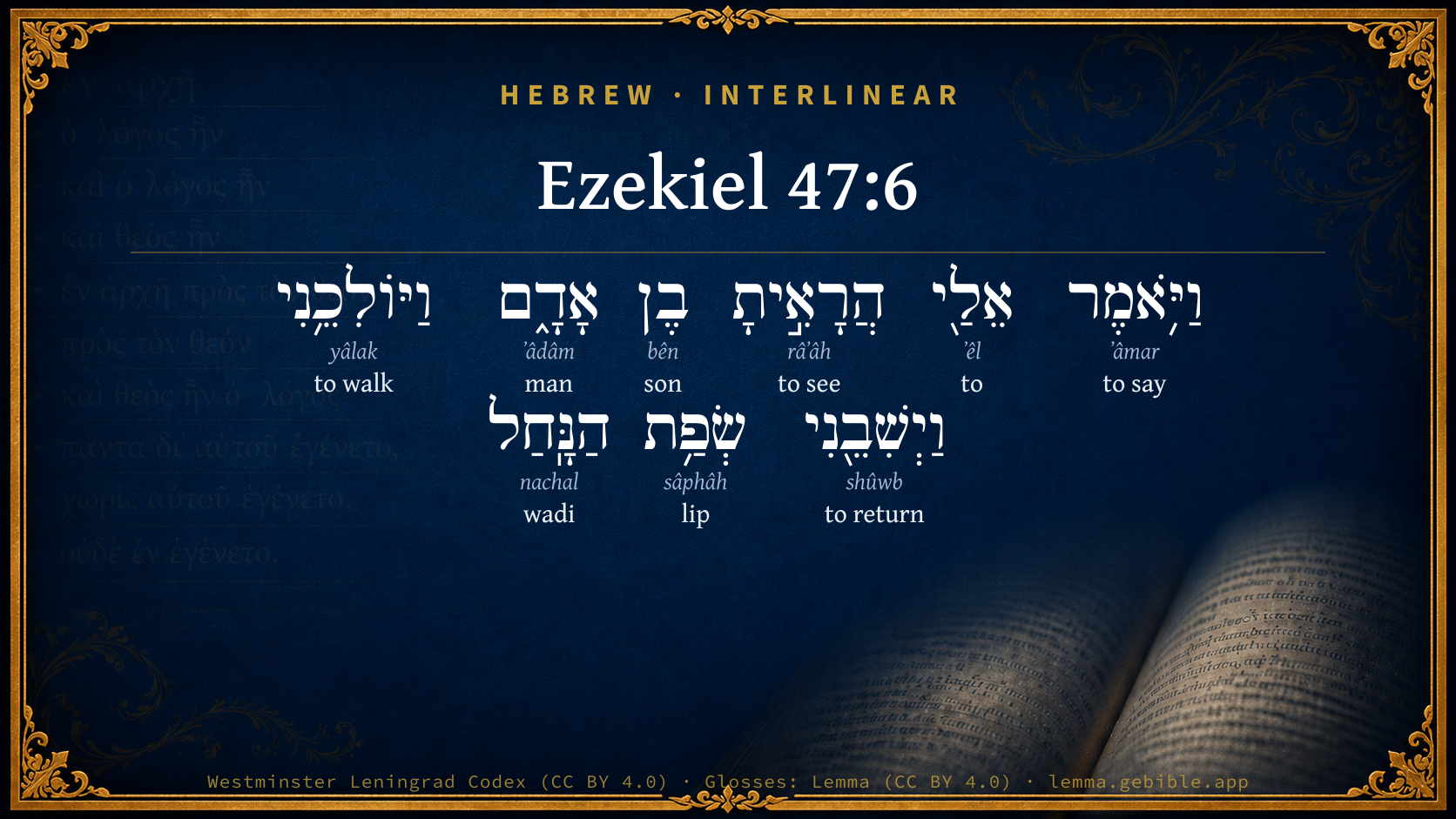
Hebrew (Westminster Leningrad Codex) Ezekiel 47:6 appears in the Hebrew Old Testament. The text above is from the Westminster Leningrad Codex. Each word links to its Strong’s number, a concise gloss, and parsing drawn from the Open Scriptures Hebrew Bible morphology. Click any word for its full Brown-Driver-Briggs (BDB) entry.
Download image
Cite this verse

Ezekiel 47:6 (World English Bible). Public Domain. Lemma interlinear Bible study tool, https://lemma.gebible.app/v/ezekiel/47/6.

Show BibTeX & RIS
BibTeX
RIS
English Translation
He said to me, Son of man, have you seen [this]? Then he brought me, and caused me to return to the bank of the river.
World English Bible · Public Domain
Download a study sheet

One document with this verse’s original text, its word-by-word gloss line, the meaning frame, cross-references with their text, attributed commentary, and full source and license credits — printable, and it pastes into notes with its structure intact.

This verse Autodidact and up

Study sheet (.html) Plain text (.txt)

A passage Seminary Student

Up to 50 verses in one chapter. A passage sheet keeps up to 6 commentary sources and 12 cross-references per verse, in the order this page ranks them, and says so on the sheet whenever that leaves anything out. Ask for a single verse and you get the Autodidact verse sheet above.

Everything on this page stays free to read, with no account — the sheet is a download of what is already on screen, not access to it.

Want to remove ads? Support Godless Engineer
Compare translations 3

The same verse in 3 English versions, stacked beneath the original-language interlinear above. Click any original word for its lexicon entry.

Each is an independent rendering of the whole verse — the interlinear is not word-aligned to these translations.

Highlighted words mark where these versions differ — a whole-verse word diff, not a word-by-word alignment.

  • World English Bible Public Domain
    He said to me, Son of man, have you seen [this]? Then he brought me, and caused me to return to the bank of the river.
  • King James Version Public Domain
    And he said unto me, Son of man, hast thou seen this? Then he brought me, and caused me to return to the brink of the river.
  • unfoldingWord Literal Text CC BY-SA 4.0
    The man said to me, “Son of man, do you see this?” and he brought me out and had me walk back along the riverbank.

unfoldingWord Literal Text — © unfoldingWord, licensed CC BY-SA 4.0. Word-aligned USFM3 via Door43 (git.door43.org/unfoldingWord/en_ult).

Versions to compare (up to 4)

3 of 4 selected

Show all 18 translations

Every available English version of this verse, each an independent rendering of the whole verse.

  • World English Bible Public Domain
    He said to me, Son of man, have you seen [this]? Then he brought me, and caused me to return to the bank of the river.
  • Berean Standard Bible Public Domain
    “Son of man, do you see this?” he asked. Then he led me back to the bank of the river.
  • Majority Standard Bible Public Domain
    “Son of man, do you see this?” he asked. Then he led me back to the bank of the river.
  • King James Version Public Domain
    And he said unto me, Son of man, hast thou seen this? Then he brought me, and caused me to return to the brink of the river.
  • American Standard Version (1901) Public Domain
    And he said unto me, Son of man, hast thou seen `this'? Then he brought me, and caused me to return to the bank of the river.
  • Revised Version (1885) Public Domain
    And he said unto me, Son of man, hast thou seen this? Then he brought me, and caused me to return to the bank of the river.
  • Geneva Bible (1599) Public Domain
    And he said vnto me, Sonne of man, hast thou seene this? Then he brought me, and caused me to returne to the brinke of the riuer.
  • Douay-Rheims (1899) Public Domain
    And he said to me: Surely thou hast seen, O son of man. And he brought me out, and he caused me to turn to the bank of the torrent.
  • Young's Literal Translation Public Domain
    And he saith unto me, `Hast thou seen, son of man?' and he leadeth me, and bringeth me back unto the edge of the stream.
  • Literal Standard Version CC BY-SA 4.0
    And he says to me, “Have you seen, son of man?” And he leads me, and brings me back to the edge of the stream.
  • Unlocked Literal Bible CC BY-SA 4.0
    The man said to me, “Son of man, do you see this?” and he brought me out and had me walk back along the riverbank.
  • unfoldingWord Literal Text CC BY-SA 4.0
    The man said to me, “Son of man, do you see this?” and he brought me out and had me walk back along the riverbank.
  • Darby Bible Public Domain
    And he said unto me, Son of man, hast thou seen [this]? And he led me, and brought me back to the bank of the river.
  • World Messianic Bible Public Domain
    He said to me, “Son of man, have you seen this?” Then he brought me and caused me to return to the bank of the river.
  • Webster's Bible Public Domain
    And he said to me, Son of man, hast thou seen this? Then he brought me, and caused me to return to the brink of the river.
  • Free Bible Version CC BY-SA 4.0
    “Son of man, have you observed all this?” he asked. Then he took me back to the riverbank.
  • Bible in Basic English Public Domain
    And he said to me, Son of man, have you seen this? Then he took me to the river's edge.
  • JPS Tanakh (1917) Public Domain
    And he said unto me: 'Hast thou seen this, O son of man?' Then he led me, and caused me to return to the bank of the river.

Literal Standard Version (2020), Covenant Press — licensed CC BY-SA 4.0. Text via the HelloAO Bible API (eBible.org). Unlocked Literal Bible (unfoldingWord) — licensed CC BY-SA 4.0. Text via the HelloAO Bible API (eBible.org). unfoldingWord Literal Text — © unfoldingWord, licensed CC BY-SA 4.0. Word-aligned USFM3 via Door43 (git.door43.org/unfoldingWord/en_ult). Free Bible Version, Dr. Jonathan Gallagher — licensed CC BY-SA 4.0. Text via the HelloAO Bible API (eBible.org).

Word by word

More ways to search: Search by grammar → Find every occurrence → Compare this word →

Practice this passage: Drill this verse → Learn its vocabulary →

הַנָּֽחַל
nachal
H5158
“the · wadi”
Particle, Definite Article + Noun, Common, Masculine, Singular, Absolute
Part of Speech
Particle + Noun
Type
Common
Gender
Masculine
Number
Singular
State
Absolute
Full BDB Definition

Origin: from H5157 in its original sense

TWOT: 1343a , 1343b

torrent, valley, wadi, torrent-valley - torrent - torrent-valley, wadi (as stream bed) - shaft (of mine) - palm-tree - meaning dubious
  1. וַיֹּ֥אמֶר ʼâmar H559 “and · to say” Conjunction + Verb, Qal, Sequential Imperfect, 3rd Person, Masculine, Singular
  2. אֵלַ֖י ʼêl H413 “to · me” Preposition + Suffix, Personal, 1st Person, Common, Singular
  3. הֲרָאִ֣יתָ râʼâh H7200 “to see” Particle, Interrogative + Verb, Qal, Perfect, 2nd Person, Masculine, Singular
  4. בֶן bên H1121 “son of” Noun, Common, Masculine, Singular, Construct
  5. אָדָ֑ם ʼâdâm H120 “man” Noun, Common, Masculine, Singular, Absolute
  6. וַיּוֹלִכֵ֥נִי yâlak H3212 “and · to walk · me” Conjunction + Verb, Hiphil, Sequential Imperfect, 3rd Person, Masculine, Singular + Suffix, Personal, 1st Person, Common, Singular
  7. וַיְשִׁבֵ֖נִי shûwb H7725 “and · to return · me” Conjunction + Verb, Hiphil, Sequential Imperfect, 3rd Person, Masculine, Singular + Suffix, Personal, 1st Person, Common, Singular
  8. שְׂפַ֥ת sâphâh H8193 “lip of” Noun, Common, Feminine, Singular, Construct

About this verse

These counts appear in no published source. They are computed here, from the morphology-tagged text and Lemma’s own curated glosses. What Lemma adds →

9
words
9
distinct lemmas
Prophets
section

Grammatical profile

  • 4 verbs
  • 4 nouns
  • 1 preposition

Verb forms

  • וַיֹּ֥אמֶר Qal · Sequential Imperfect
  • הֲרָאִ֣יתָ Qal · Perfect
  • וַיּוֹלִכֵ֥נִי Hiphil · Sequential Imperfect
  • וַיְשִׁבֵ֖נִי Hiphil · Sequential Imperfect

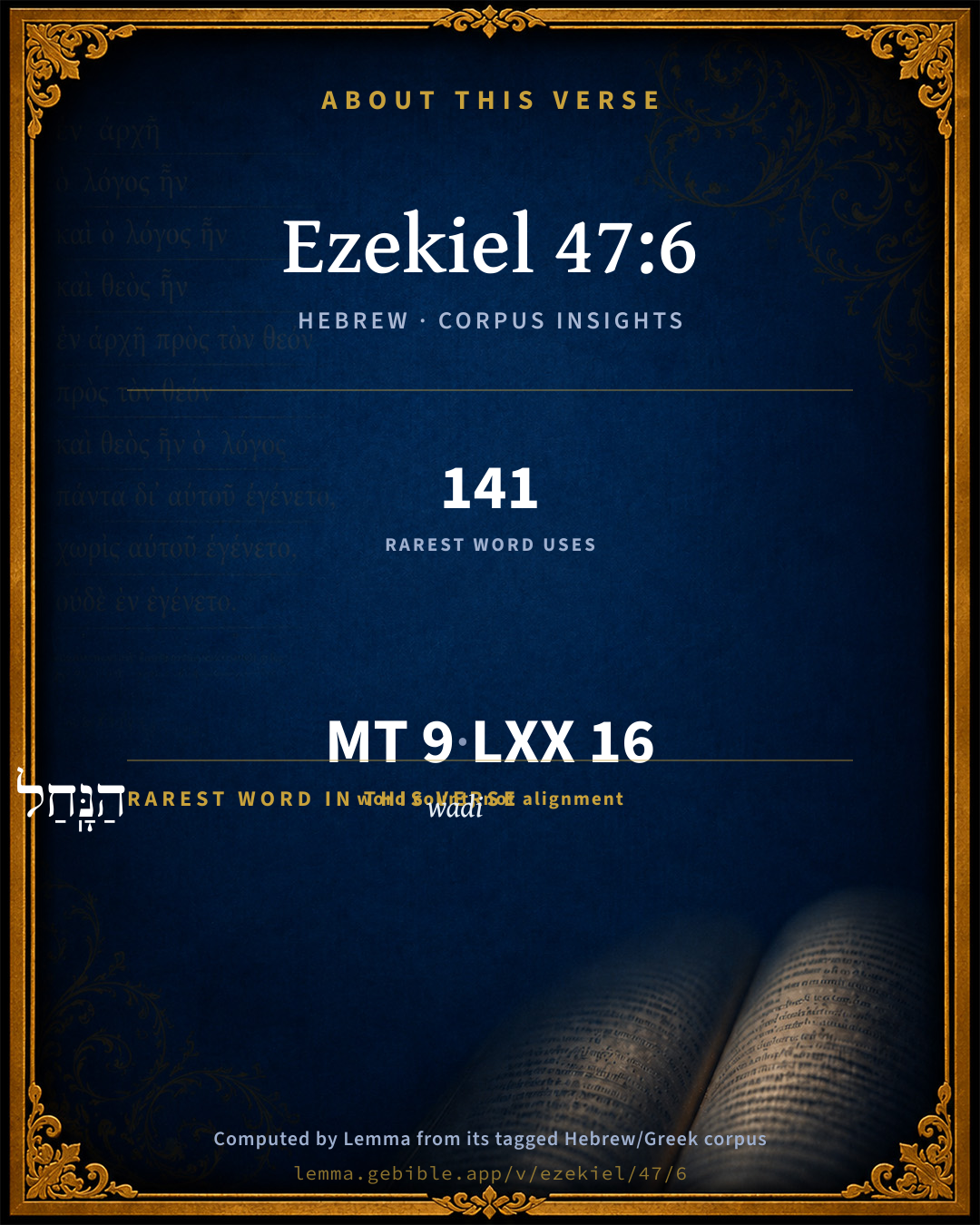
Hebrew & Septuagint length

In English translation the verse runs 26 words from the Hebrew and 26 from the Septuagint (LXX English) — the same length.

A rough comparison of the two English renderings, which tokenize alike — not a word-level alignment.

Word counts can differ between the Hebrew and the Greek without any difference in meaning — e.g. the Hebrew direct-object marker אֵת has no separate Greek word, and Greek often adds the article ὁ.

In the original languages it is 9 Hebrew tokens and 16 Greek tokens — but the two are counted differently (Hebrew bundles its prefixes and suffixes into one token; the Greek is in lemma form), so that isn’t a like-for-like length.

Cross-references

8

Topical passages linked to Ezekiel 47:6 in the Treasury of Scripture Knowledge — connected by theme and wording, ordered by reader-vote popularity; previews shown in the World English Bible.

  • Ezekiel 40:4 The man said to me, Son of man, see with your eyes, and hear with your ears, and set your heart on all that I shall show you; for, to the intent that I may show them to you, are you brought here: declare all that you see to the house of Israel.
  • Ezekiel 44:5 Yahweh said to me, Son of man, mark well, and see with your eyes, and hear with your ears all that I tell you concerning all the ordinances of the house of Yahweh, and all the laws of it; and mark well the entrance of the house, with every exit of the sanctuary.
  • Jeremiah 1:11–13 Moreover the word of Yahweh came to me, saying, Jeremiah, what see you? I said, I see a rod of an almond tree.
  • Ezekiel 8:6 He said to me, Son of man, see you what they do? even the great abominations that the house of Israel do commit here, that I should go far off from my sanctuary? but you shall again see yet other great abominations.
  • Ezekiel 8:17 Then he said to me, Have you seen [this], son of man? Is it a light thing to the house of Judah that they commit the abominations which they commit here? for they have filled the land with violence, and have turned again to provoke me to anger: and, behold, they put the branch to their nose.
  • Zechariah 4:2 He said to me, "What do you see?" I said, "I have seen, and, behold, a lampstand all of gold, with its bowl on the top of it, and its seven lamps thereon; there are seven pipes to each of the lamps, which are on the top of it;
  • Zechariah 5:2 He said to me, "What do you see?" I answered, "I see a flying scroll; its length is twenty cubits, and its breadth ten cubits."
  • Matthew 13:51 Jesus said to them, "Have you understood all these things?" They answered him, "Yes, Lord."

Cross-references courtesy of OpenBible.info (CC BY 4.0).

Hebrew and Greek witnesses Masoretic Hebrew ↔ Greek Septuagint

The same verse in the two great witnesses to the Old Testament, shown verse-for-verse.

These are two independent witnesses, not word-aligned to each other, and the Septuagint is shown in lemma (dictionary) form.

Hebrew Ezekiel 47:6 Masoretic · Westminster Leningrad Codex

וַיֹּ֥אמֶר אֵלַ֖י הֲרָאִ֣יתָ בֶן אָדָ֑ם וַיּוֹלִכֵ֥נִי וַיְשִׁבֵ֖נִי שְׂפַ֥ת הַנָּֽחַל

He said to me, Son of man, have you seen [this]? Then he brought me, and caused me to return to the bank of the river.

World English Bible · Public Domain

Greek LXX Ezekiel 47:6 Septuagint · lemma form

καί εἶπον πρός ἐγώ εἰ ὁράω υἱός ἄνθρωπος καί ἄγω ἐγώ ἐπί ὁ χεῖλος ὁ ποταμός

And he said to me, Have you seen this, son of man? Then he brought me, and led me back to the brink of the river

LXX2012 (modern English Septuagint) · Public Domain

Hebrew: Westminster Leningrad Codex (CC BY 4.0). Greek: Septuagint (public domain); English from LXX2012 (modern English Septuagint) (Public Domain). How the Septuagint differs from the Hebrew →

Targum (Aramaic paraphrase)

1

The Targum is the ancient Jewish Aramaic paraphrase of the Hebrew Scriptures — an interpretive translation, not the Hebrew text itself. Onkelos (literal) and Pseudo-Jonathan (expansive) render the Torah, and Jonathan the Prophets. Coverage is partial: where no permissively-licensed English translation exists for a verse, only the Aramaic is shown. This is verse-level text, not a word-by-word alignment to the Hebrew.

  1. Targum Jonathan Prophets (Joshua–Malachi)
    וַאֲמַר לִי הַחֲזֵיתָא בַּר אָדָם וְאוֹבִלַנִי וַאֲתִיבַנִי עַל כֵּיף נַחֲלָא:

    (no public-domain English translation for this verse)

    Targum Jonathan — Aramaic: “Mikraot Gedolot” (public domain). English: “Sefaria Community Translation” (CC0 1.0 (public-domain dedication)); “London "Chaldee Paraphrase," 1871” (public domain). Text via Sefaria.

Commentary

Notes on Ezekiel 47:6 from classic Christian and Jewish commentators (each source and its license shown beneath its notes). The classic Christian expositions comment on the surrounding passage and are grouped to its opening verse, so a note may address several verses; the Jewish commentaries on the Tanakh (Rashi and others) are per-verse, so they appear only where the commentator wrote on this verse.

Lemma curates 59 commentaries, every one of them public domain or Creative Commons licensed, each selected and text-cleaned for this edition rather than reprinted as found. About our sources →

Trapp's Complete Commentary

John Trapp

Eze 47:6 And he said unto me, Son of man, hast thou seen [this]? Then he brought me, and caused me to return to the brink of the river.

Ver. 6. Son of man, hast thou seen this?] And art thou soundly sensible thereof? It is very fit thou shouldst, that God may have the glory of his great goodness and power in propagating the gospel, and bringing forward the work of his grace in the hearts of his people, maugre the malice of earth and of hell. The Reformation wrought in Germany, from how small beginnings grew it! The establishing of that among us, how imperfect soever, to be done by so weak and simple means, yea, by casual and cross means, against the force of so potent and political an adversary, this is to be looked upon as a just miracle.

To the brink of the river.] Where my work was to stand and cry, Oh the depth! Oh how great things hath God prepared for those that fear him! Oh the joy, the joy! Eye hath not seen, nor ear heard, &c.

John Trapp, A Commentary or Exposition upon All the Books of the Old and New Testament (1647–1656) — public domain. Text from a community e-Sword module.

Joseph Benson's Commentary

Eze 47:6-7. And he said, Son of man, hast thou seen this? — Hast thou considered, or taken notice of, this vision now showed unto thee? To see, often signifies to take notice of what we see: on the contrary, they are said to have eyes and see not, who do not observe what is placed before their eyes. This is an intimation to us, that it is our indispensable duty to consider well what is signified by these waters, and by their increase and effects: namely, to mark well the progress of the gospel in the world, and the process of the work of grace in the heart; to follow and carefully observe these waters, as Ezekiel here did; to attend to the motions and drawings of the blessed Spirit, and walk after them under a divine conduct. It is good to be often searching into the things of God, and trying to discover the depth of them; not only to look on the surface of the waters, but to go as far as we can toward the bottom of them; to be often digging, often diving into the mysteries of the kingdom of heaven, as those who covet to be intimately acquainted with them. If we carefully consider the things of God, we shall find some of them very plain, and easy to be understood, like the waters that came only up to the ankles; others more difficult, and which require a deeper search, as the waters which rose to the knees, or the loins; and some quite beyond our reach, which we can neither fathom nor penetrate into, but, despairing to find their bottom, or measure their depth must be content, with St. Paul, to sit down on the brink, and adore it, crying out with him, O the depth of the riches, both of the wisdom and knowledge of God! How unsearchable are his judgments, and his ways past finding out! Rom 11:33.

Then he caused me to return by the brink of the river — He made me go along by the river side. Behold, on the bank of the river were very many trees — The words allude to the trees planted in paradise, and designed for man’s food in the state of innocence; and especially to the tree of life which grew there. The reader will observe, that many of the ideas in this chapter are taken from the terrestrial paradise; see Eze 47:12, and compare Rev 22:1-2, where the same ideas are carried to the celestial paradise by St. John.

Joseph Benson's Commentary on the Old and New Testaments (1811–1818) — public domain. Text from a community e-Sword module.

Tyndale Open Study Notes

Tyndale Open Resources

47:6-9 The river grew as it went, bringing life to everything it touched, even the salty waters of the Dead Sea.

Tyndale Open Study Notes — © Tyndale Open Resources, licensed CC BY-SA 4.0. Text via the HelloAO Bible API.

Ellicott's Commentary for English Readers

(6) To return to the brink.—The angel, having called the prophet’s attention to this marvellous increase, now causes him to return along the bank to observe other things. The word brink in this verse and bank in the next are the same in the original. The prophet does not return to the brink, for he had not left it, but is told to pass along it.

A Bible Commentary for English Readers, edited by Charles John Ellicott (1878–1897) — public domain. Text from a community e-Sword module.

The Cambridge Bible for Schools and Colleges

gen. ed. J. J. S. Perowne

6. to the brink] Perhaps: along the brink. River is brook or wady as Eze_47:5.

The Cambridge Bible for Schools and Colleges (gen. ed. J. J. S. Perowne; Cambridge University Press, 1878–1918) — public domain. Text from a community e-Sword module.

John Gill's Exposition

And he said unto me, son of man, hast thou seen this? &c. That is, the man that measured the waters said to the prophet, hast thou carefully observed all this from whence the waters flowed? from what small beginnings they rose, and gradually increased? how they first issued forth, as out of a vial; and now, in the space of about two or three miles, are become a deep river, and impassable? it is right and profitable to observe the rise and progress of the Gospel; what a spread it has had in the world, and what it will have:

then he brought me, and caused me to return to the brink of the river; there to stand and observe the nature of the waters, and the course of them; the multitude of fish in them; and the trees which grew upon the banks of them; of all which some account is given in the following verses.

John Gill's Exposition of the Whole Bible (1746–1763) — public domain (CC PDM 1.0). Text via the HelloAO Bible API.

Matthew Poole's English Annotations

He said, i.e. the man with measuring line in hand.

Seen this; observed and considered this; hast thou well seen this?

Caused me to return: it is not said whether he was gone from the bank, though it be said he returned to the brink, or perhaps it is, he caused me to return along by the brink of the river.

Matthew Poole's English Annotations on the Holy Bible (1683–1685) — public domain. Text from a community e-Sword/MySword module.

The Pulpit Commentary

Then he... caused me to return to the brink of the river. The difficulty lying in the word "return" has given rise to a variety of conjectures. Hengstenberg supposes the prophet had made trial of the river"s depth by wading in (perhaps up to the neck), and that the angel caused him to return from the stream to the bank According to Hitzig, the measuring had taken place at some distance from the stream, and the prophet, having come up to his guide from the bank after making trial of the water"s depth, was Once more conducted back to the river"s brink. Havernick conceives the sense to be that the prophet, having accompanied the angel to the point where the stream debouched into the Dead Sea was led back to the riverbank. All difficulty, however, vanishes if, either with Schroder we refer ynibeviyw to a mental returning, as if the import were that the angel, having ascertained that the prophet had "seen" the river"s course, now told him to direct his attention to the bank, or, with Keil and Kliefoth, translate l by "along" or "on" rather than "to." As the prophet had been led along or on the river"s bank to see the increasing breadth and depth of the water, so was he now "caused to return" along or on the same bank to note the abundance of the foliage with which it was adorned.

The Pulpit Commentary (1880–1919), ed. H.D.M. Spence-Jones & Joseph S. Exell — public domain. Text from a community e-Sword module.

unfoldingWord translationNotes

Door43 World Missions Community

Son of man

"Son of a human being" or "Son of humanity." God calls Ezekiel this to emphasize that Ezekiel is only a human being. God is eternal and powerful, but humans are not. See how you translated this in Ezekiel 2:1. AT: "Mortal person" or "Human"

do you see this?

Yahweh is commanding Ezekiel to think about what he has just seen. See how you translated this in Ezekiel 8:15. AT: "think about this." (See: Rhetorical Question)

translationWords

Son of Man

Arabah

Salt Sea

unfoldingWord translationNotes — © Distant Shores Media and the Door43 World Missions Community, licensed CC BY-SA 4.0. Source: git.door43.org/Door43/en_tn.

Rashi

Rabbi Shlomo Yitzchaki (Rashi)

Have you seen, Son of man how much this stream has swelled?

Rashi on the Tanakh — English translations: “The Judaica Press complete Tanach with Rashi, translated by A. J. Rosenberg” (CC BY 4.0); “Pentateuch with Rashi's commentary by M. Rosenbaum and A.M. Silbermann, 1929-1934” (public domain); “The Metsudah Tanach series, Lakewood, N.J” (CC BY 4.0); and “The Book of Joshua, Metsudah Publications, 1997” (CC BY 4.0). Text via Sefaria.

Lesson kit

Teaching starters — assembled from the data on this page, not authored interpretation. Every prompt links to the verse data it draws on. Edit before teaching.

Ezekiel, in the Prophets, opens this verse with 9 words (9 distinct Hebrew lemmas). Its most distinctive word is nachal (“wadi”). A historical commentator’s framing appears above. Read the whole chapter for the surrounding context.

Discussion questions

  1. What does “wadi” (nachal) contribute to the verse as a whole?
  2. Ezekiel 40:4 shares this passage’s theme. How do the two illuminate each other?
  3. The translations on this page render this verse differently — a whole-verse word diff, not a word-by-word alignment. What might account for the different wordings?
  4. The verb «וַיֹּ֥אמֶר» is Qal Sequential Imperfect. How does its form color the action?
  5. Reading how Trapp's Complete Commentary and Joseph Benson's Commentary read this verse, where do the two commentators agree and where do they part?

Things to notice

Reading settings

Reading text

Shown beneath each verse's original-language words.

Old Testament
Old Testament edition

Read the OT as the Masoretic Hebrew (MT) or the Greek Septuagint (LXX).

English shown for the Greek Septuagint (in the Hebrew ↔ Greek comparison).

Comparing translations? Open the Compare panel on any verse page to stack up to four side by side.