
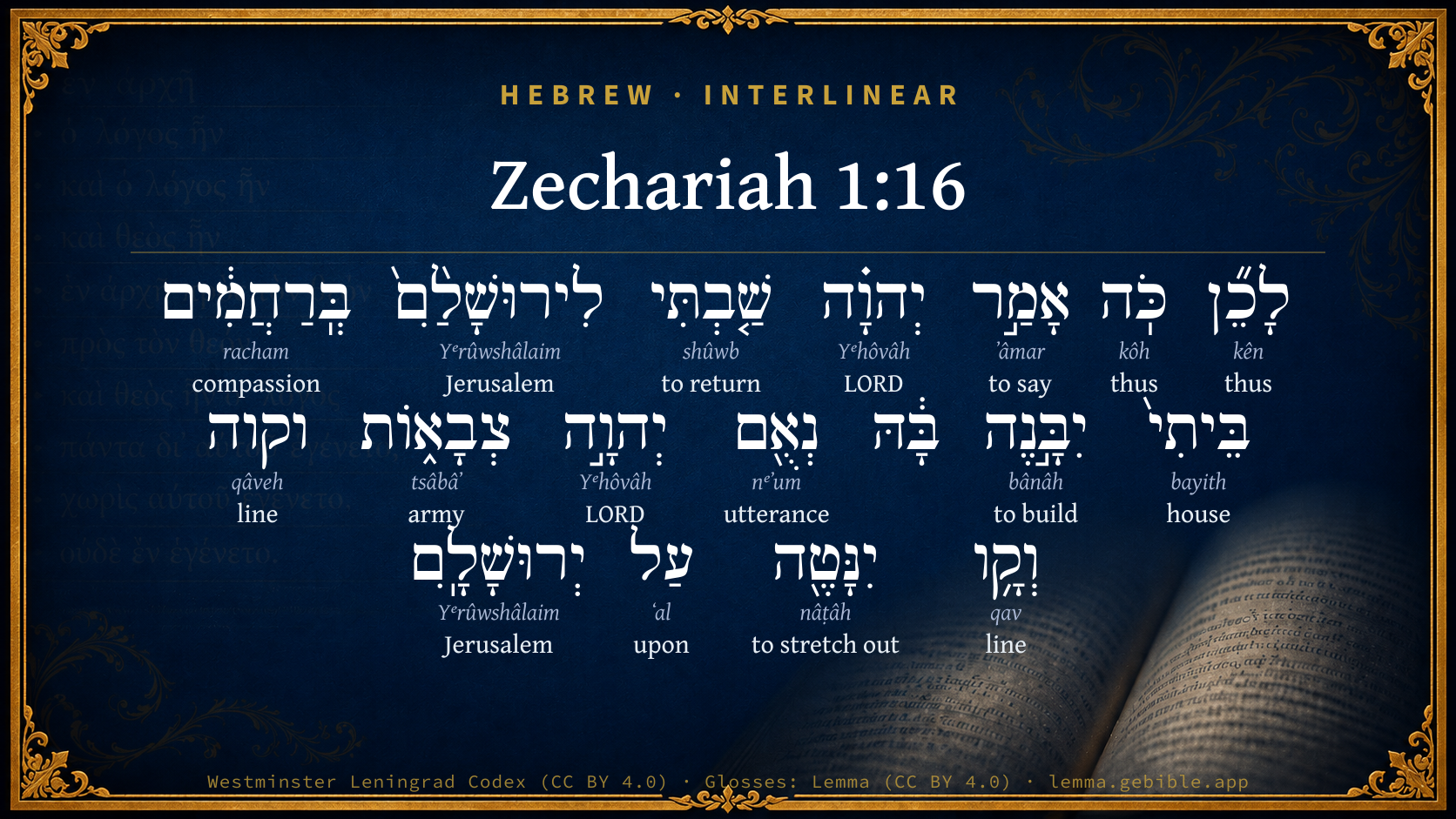

Zechariah 1:16

Hebrew (Westminster Leningrad Codex) Zechariah 1:16 appears in the Hebrew Old Testament. The text above is from the Westminster Leningrad Codex. Each word links to its Strong’s number, a concise gloss, and parsing drawn from the Open Scriptures Hebrew Bible morphology. Click any word for its full Brown-Driver-Briggs (BDB) entry.
Download image
Cite this verse

Zechariah 1:16 (World English Bible). Public Domain. Lemma interlinear Bible study tool, https://lemma.gebible.app/v/zechariah/1/16.

Show BibTeX & RIS
BibTeX
RIS
English Translation
Therefore thus says Yahweh: "I have returned to Jerusalem with mercy. My house shall be built in it," says Yahweh of Hosts, "and a line shall be stretched forth over Jerusalem."'
World English Bible · Public Domain
Download a study sheet

One document with this verse’s original text, its word-by-word gloss line, the meaning frame, cross-references with their text, attributed commentary, and full source and license credits — printable, and it pastes into notes with its structure intact.

This verse Autodidact and up

Study sheet (.html) Plain text (.txt)

A passage Seminary Student

Up to 50 verses in one chapter. A passage sheet keeps up to 6 commentary sources and 12 cross-references per verse, in the order this page ranks them, and says so on the sheet whenever that leaves anything out. Ask for a single verse and you get the Autodidact verse sheet above.

Everything on this page stays free to read, with no account — the sheet is a download of what is already on screen, not access to it.

Want to remove ads? Support Godless Engineer
Compare translations 3

The same verse in 3 English versions, stacked beneath the original-language interlinear above. Click any original word for its lexicon entry.

Each is an independent rendering of the whole verse — the interlinear is not word-aligned to these translations.

Highlighted words mark where these versions differ — a whole-verse word diff, not a word-by-word alignment.

  • World English Bible Public Domain
    Therefore thus says Yahweh: "I have returned to Jerusalem with mercy. My house shall be built in it," says Yahweh of Hosts, "and a line shall be stretched forth over Jerusalem."'
  • King James Version Public Domain
    Therefore thus saith the LORD; I am returned to Jerusalem with mercies: my house shall be built in it, saith the LORD of hosts, and a line shall be stretched forth upon Jerusalem.
  • unfoldingWord Literal Text CC BY-SA 4.0
    Therefore, thus says Yahweh: I have returned to Jerusalem with compassions. My house will be built in her—the declaration of Yahweh of Armies—and a measuring line will be stretched out over Jerusalem.’

unfoldingWord Literal Text — © unfoldingWord, licensed CC BY-SA 4.0. Word-aligned USFM3 via Door43 (git.door43.org/unfoldingWord/en_ult).

Versions to compare (up to 4)

3 of 4 selected

Show all 18 translations

Every available English version of this verse, each an independent rendering of the whole verse.

  • World English Bible Public Domain
    Therefore thus says Yahweh: "I have returned to Jerusalem with mercy. My house shall be built in it," says Yahweh of Hosts, "and a line shall be stretched forth over Jerusalem."'
  • Berean Standard Bible Public Domain
    Therefore this is what the LORD says: ‘I will return to Jerusalem with mercy, and there My house will be rebuilt, declares the LORD of Hosts, and a measuring line will be stretched out over Jerusalem.’
  • Majority Standard Bible Public Domain
    Therefore this is what the LORD says: ‘I will return to Jerusalem with mercy, and there My house will be rebuilt, declares the LORD of Hosts, and a measuring line will be stretched out over Jerusalem.’
  • King James Version Public Domain
    Therefore thus saith the LORD; I am returned to Jerusalem with mercies: my house shall be built in it, saith the LORD of hosts, and a line shall be stretched forth upon Jerusalem.
  • American Standard Version (1901) Public Domain
    Therefore thus saith Jehovah: I am returned to Jerusalem with mercies; my house shall be built in it, saith Jehovah of hosts, and a line shall be stretched forth over Jerusalem.
  • Revised Version (1885) Public Domain
    Therefore thus saith the LORD: I am returned to Jerusalem with mercies; my house shall be built in it, saith the LORD of hosts, and a line shall be stretched forth over Jerusalem.
  • Geneva Bible (1599) Public Domain
    Therefore thus saith the Lord, I wil returne vnto Ierusalem with tender mercie: mine house shall be builded in it, saith the Lord of hostes, and a line shall be stretched vpon Ierusalem.
  • Douay-Rheims (1899) Public Domain
    Therefore thus saith the Lord: I will return to Jerusalem in mercies: my house shall be built in it, saith the Lord of hosts: and the building line shall be stretched forth upon Jerusalem.
  • Young's Literal Translation Public Domain
    Therefore, thus said Jehovah: I have turned to Jerusalem with mercies, My house is built in it, An affirmation of Jehovah of Hosts, And a line is stretched over Jerusalem.
  • Literal Standard Version CC BY-SA 4.0
    Therefore, thus said YHWH: I have turned to Jerusalem with mercies, || My house is built in it, || A declaration of YHWH of Hosts, || And a line is stretched over Jerusalem.
  • Unlocked Literal Bible CC BY-SA 4.0
    Therefore Yahweh of hosts says this: I have returned to Jerusalem with mercies. My house will be built within her —this is the declaration of Yahweh of hosts—and the measuring line will be stretched out over Jerusalem!'
  • unfoldingWord Literal Text CC BY-SA 4.0
    Therefore, thus says Yahweh: I have returned to Jerusalem with compassions. My house will be built in her—the declaration of Yahweh of Armies—and a measuring line will be stretched out over Jerusalem.’
  • Darby Bible Public Domain
    Therefore thus saith Jehovah: I am returned to Jerusalem with mercies: my house shall be built in it, saith Jehovah of hosts, and the line shall be stretched forth upon Jerusalem.
  • World Messianic Bible Public Domain
    Therefore the LORD says: “I have returned to Jerusalem with mercy. My house shall be built in it,” says the LORD of Hosts, “and a line shall be stretched out over Jerusalem.”’
  • Webster's Bible Public Domain
    Therefore thus saith the LORD; I have returned to Jerusalem with mercies: my house shall be built in it, saith the LORD of hosts, and a line shall be stretched forth upon Jerusalem.
  • Free Bible Version CC BY-SA 4.0
    Therefore this is what the Lord says: I have returned to be merciful to Jerusalem. My Temple shall be rebuilt there, as well as the city, declares the Lord Almighty.
  • Bible in Basic English Public Domain
    So this is what the Lord has said: I have come back to Jerusalem with mercies; my house is to be put up in her, says the Lord of armies, and a line is to be stretched out over Jerusalem.
  • JPS Tanakh (1917) Public Domain
    Therefore thus saith the LORD: I return to Jerusalem with compassions: My house shall be built in it, saith the LORD of hosts, and a line shall be stretched forth over Jerusalem.

Literal Standard Version (2020), Covenant Press — licensed CC BY-SA 4.0. Text via the HelloAO Bible API (eBible.org). Unlocked Literal Bible (unfoldingWord) — licensed CC BY-SA 4.0. Text via the HelloAO Bible API (eBible.org). unfoldingWord Literal Text — © unfoldingWord, licensed CC BY-SA 4.0. Word-aligned USFM3 via Door43 (git.door43.org/unfoldingWord/en_ult). Free Bible Version, Dr. Jonathan Gallagher — licensed CC BY-SA 4.0. Text via the HelloAO Bible API (eBible.org).

Word by word

More ways to search: Search by grammar → Find every occurrence → Compare this word →

Practice this passage: Drill this verse → Learn its vocabulary →

וקוה
qâveh
H6961
“and · line”
Conjunction + Noun, Common, Masculine, Singular, Absolute
Part of Speech
Conjunction + Noun
Type
Common
Gender
Masculine
Number
Singular
State
Absolute
Full BDB Definition

Origin: from H6960

TWOT: 1994a

line
  1. לָכֵ֞ן kên H3651 “to/for · thus” Preposition + Adverb
  2. כֹּֽה kôh H3541 “thus” Adverb
  3. אָמַ֣ר ʼâmar H559 “to say” Verb, Qal, Perfect, 3rd Person, Masculine, Singular
  4. יְהוָ֗ה Yᵉhôvâh H3068 “LORD” Noun, Proper
  5. שַׁ֤בְתִּי shûwb H7725 “to return” Verb, Qal, Perfect, 1st Person, Common, Singular
  6. לִירוּשָׁלִַ֨ם֙ Yᵉrûwshâlaim H3389 “to/for · Jerusalem” Preposition + Noun, Proper
  7. בְּֽרַחֲמִ֔ים racham H7356 “in/at · compassion” Preposition + Noun, Common, Masculine, Plural, Absolute
  8. בֵּיתִי֙ bayith H1004 “house · my” Noun, Common, Masculine, Singular, Construct + Suffix, Personal, 1st Person, Common, Singular
  9. יִבָּ֣נֶה bânâh H1129 “to build” Verb, Niphal, Imperfect, 3rd Person, Masculine, Singular
  10. נְאֻ֖ם nᵉʼum H5002 “utterance of” Noun, Common, Masculine, Singular, Construct
  11. יְהוָ֣ה Yᵉhôvâh H3068 “LORD” Noun, Proper
  12. צְבָא֑וֹת tsâbâʼ H6635 “armies” Noun, Common, Both, Plural, Absolute
  13. וְקָ֥ו qav H6957 “and · line” Conjunction + Noun, Common, Masculine, Singular, Absolute
  14. יִנָּטֶ֖ה nâṭâh H5186 “to stretch out” Verb, Niphal, Imperfect, 3rd Person, Masculine, Singular
  15. עַל ʻal H5921 “upon” Preposition
  16. יְרוּשָׁלִָֽם Yᵉrûwshâlaim H3389 “Jerusalem” Noun, Proper

About this verse

These counts appear in no published source. They are computed here, from the morphology-tagged text and Lemma’s own curated glosses. What Lemma adds →

18
words
15
distinct lemmas
Prophets
section

Notable vocabulary

The rarest word here is וקוה line H6961 — appearing just 4 times in the whole Hebrew Bible.

Shared distinctive vocabulary

וקוה line H6961 occurs in 3 verses of the Hebrew Bible. Also found in:

Grammatical profile

  • 4 verbs
  • 10 nouns
  • 2 prepositions
  • 2 adverbs

Verb forms

  • אָמַ֣ר Qal · Perfect
  • שַׁ֤בְתִּי Qal · Perfect
  • יִבָּ֣נֶה Niphal · Imperfect
  • יִנָּטֶ֖ה Niphal · Imperfect

Repetition

Words recur within this verse — often emphatic in Hebrew:

  • יְהוָ֗ה LORD H3068 ×2
  • לִירוּשָׁלִַ֨ם֙ Jerusalem H3389 ×2

Hebrew & Septuagint length

In English translation the verse runs 31 words from the Hebrew and 35 from the Septuagint (LXX English) — closely comparable.

A rough comparison of the two English renderings, which tokenize alike — not a word-level alignment.

Word counts can differ between the Hebrew and the Greek without any difference in meaning — e.g. the Hebrew direct-object marker אֵת has no separate Greek word, and Greek often adds the article ὁ.

In the original languages it is 18 Hebrew tokens and 26 Greek tokens — but the two are counted differently (Hebrew bundles its prefixes and suffixes into one token; the Greek is in lemma form), so that isn’t a like-for-like length.

Cross-references

19

Topical passages linked to Zechariah 1:16 in the Treasury of Scripture Knowledge — connected by theme and wording, ordered by reader-vote popularity; previews shown in the World English Bible.

  • Zechariah 8:3 Thus says Yahweh: "I have returned to Zion, and will dwell in the midst of Jerusalem. Jerusalem shall be called 'The City of Truth;' and the mountain of Yahweh of Hosts, 'The Holy Mountain.'"
  • Ezra 6:14–15 The elders of the Jews built and prospered, through the prophesying of Haggai the prophet and Zechariah the son of Iddo. They built and finished it, according to the commandment of the God of Israel, and according to the decree of Cyrus, and Darius, and Artaxerxes king of Persia.
  • Ezekiel 37:24–28 My servant David shall be king over them; and they all shall have one shepherd: they shall also walk in my ordinances, and observe my statutes, and do them.
  • Zechariah 2:10–11 Sing and rejoice, daughter of Zion; for, behold, I come, and I will dwell in the midst of you,' says Yahweh.
  • Job 38:5 Who determined the measures of it, if you know? Or who stretched the line on it?
  • Isaiah 54:8–10 In overflowing wrath I hid my face from you for a moment; but with everlasting loving kindness will I have mercy on you, says Yahweh your Redeemer.
  • Zechariah 4:9 "The hands of Zerubbabel have laid the foundation of this house. His hands shall also finish it; and you will know that Yahweh of Hosts has sent me to you.
  • Ezekiel 39:25–29 Therefore thus says the Lord Yahweh: Now will I bring back the captivity of Jacob, and have mercy on the whole house of Israel; and I will be jealous for my holy name.
  • Ezekiel 40:3 He brought me there; and, behold, there was a man, whose appearance was like the appearance of brass, with a line of flax in his hand, and a measuring reed; and he stood in the gate.
  • Ezekiel 47:3 When the man went forth eastward with the line in his hand, he measured one thousand cubits, and he caused me to pass through the waters, waters that were to the ankles.
  • Zechariah 2:1–2 I lifted up my eyes, and saw, and, behold, a man with a measuring line in his hand.
  • Isaiah 12:1 In that day you will say, "I will give thanks to you, Yahweh; for though you were angry with me, your anger has turned away and you comfort me.
  • Isaiah 34:11 But the pelican and the porcupine shall possess it; and the owl and the raven shall dwell therein: and he will stretch over it the line of confusion, and the plummet of emptiness.
  • Isaiah 44:26–28 who confirms the word of his servant, and performs the counsel of his messengers; who says of Jerusalem, She shall be inhabited; and of the cities of Judah, They shall be built, and I will raise up the waste places of it;
  • Jeremiah 31:22–25 How long will you go here and there, you backsliding daughter? for Yahweh has created a new thing in the earth: a woman shall encompass a man.
  • Jeremiah 31:39–40 The measuring line shall go out further straight onward to the hill Gareb, and shall turn about to Goah.
  • Jeremiah 33:10–12 Thus says Yahweh: Yet again there shall be heard in this place, about which you say, It is waste, without man and without animal, even in the cities of Judah, and in the streets of Jerusalem, that are desolate, without man and without inhabitant and without animal,
  • Ezekiel 48:35 It shall be eighteen thousand [reeds] round about: and the name of the city from that day shall be, Yahweh is there.
  • Haggai 1:14 Yahweh stirred up the spirit of Zerubbabel, the son of Shealtiel, governor of Judah, and the spirit of Joshua, the son of Jehozadak, the high priest, and the spirit of all the remnant of the people; and they came and worked on the house of Yahweh of Hosts, their God,

Cross-references courtesy of OpenBible.info (CC BY 4.0).

Hebrew and Greek witnesses Masoretic Hebrew ↔ Greek Septuagint

The same verse in the two great witnesses to the Old Testament, shown verse-for-verse.

These are two independent witnesses, not word-aligned to each other, and the Septuagint is shown in lemma (dictionary) form.

Hebrew Zechariah 1:16 Masoretic · Westminster Leningrad Codex

לָכֵ֞ן כֹּֽה אָמַ֣ר יְהוָ֗ה שַׁ֤בְתִּי לִירוּשָׁלִַ֨ם֙ בְּֽרַחֲמִ֔ים בֵּיתִי֙ יִבָּ֣נֶה בָּ֔הּ נְאֻ֖ם יְהוָ֣ה צְבָא֑וֹת וקוה וְקָ֥ו יִנָּטֶ֖ה עַל יְרוּשָׁלִָֽם

Therefore thus says Yahweh: "I have returned to Jerusalem with mercy. My house shall be built in it," says Yahweh of Hosts, "and a line shall be stretched forth over Jerusalem."'

World English Bible · Public Domain

Greek LXX Zechariah 1:16 Septuagint · lemma form

διά οὗτος ὅδε λέγω κύριος ἐπιστρέφω ἐπί ἰερουσαλήμ ἐν οἰκτιρμός καί ὁ οἶκος ἐγώ ἀναοἰκοδομέω ἐν αὐτός λέγω κύριος παντοκράτωρ καί μέτρον ἐκτείνω ἐπί ἰερουσαλήμ ἔτι

Therefore thus says the Lord: I will return to Jerusalem with compassion; and my house shall be rebuilt in her, says the Lord Almighty, and a measuring line shall yet be stretched out over Jerusalem.

LXX2012 (modern English Septuagint) · Public Domain

On this verse, Whedon's Commentary on the Bible discusses the Septuagint’s reading. Read the note in Commentary ↓

Hebrew: Westminster Leningrad Codex (CC BY 4.0). Greek: Septuagint (public domain); English from LXX2012 (modern English Septuagint) (Public Domain). How the Septuagint differs from the Hebrew →

Targum (Aramaic paraphrase)

1

The Targum is the ancient Jewish Aramaic paraphrase of the Hebrew Scriptures — an interpretive translation, not the Hebrew text itself. Onkelos (literal) and Pseudo-Jonathan (expansive) render the Torah, and Jonathan the Prophets. Coverage is partial: where no permissively-licensed English translation exists for a verse, only the Aramaic is shown. This is verse-level text, not a word-by-word alignment to the Hebrew.

  1. Targum Jonathan Prophets (Joshua–Malachi)
    בְּכֵן כִּדְנַן אֲמַר יְיָ אֱתוּב לִירוּשְׁלֵם בְּרַחֲמִין בֵּית מַקְדְשִׁי יִתְבְּנִי בָהּ אֲמַר יְיָ צְבָאוֹת וְחוּט דִמְשַׁחְתָּא יִתְנְגֵד עַל בִּנְיָן כָתְלֵי יְרוּשְׁלֵם:

    (no public-domain English translation for this verse)

    Targum Jonathan — Aramaic: “Mikraot Gedolot” (public domain). English: “Sefaria Community Translation” (CC0 1.0 (public-domain dedication)); “London "Chaldee Paraphrase," 1871” (public domain). Text via Sefaria.

Commentary

Notes on Zechariah 1:16 from classic Christian and Jewish commentators (each source and its license shown beneath its notes). The classic Christian expositions comment on the surrounding passage and are grouped to its opening verse, so a note may address several verses; the Jewish commentaries on the Tanakh (Rashi and others) are per-verse, so they appear only where the commentator wrote on this verse.

Lemma curates 59 commentaries, every one of them public domain or Creative Commons licensed, each selected and text-cleaned for this edition rather than reprinted as found. About our sources →

Trapp's Complete Commentary

John Trapp

Zec 1:16 Therefore thus saith the LORD; I am returned to Jerusalem with mercies: my house shall be built in it, saith the LORD of hosts, and a line shall be stretched forth upon Jerusalem.

Ver. 16. Therefore thus saith the Lord] Thus, one deep calleth another, Psa 42:7; the lower deep of our misery, the higher deep of God’s mercy. As Croesus’ dumb son burst out into, Kill not King Croesus; so, when enemies are ready to devour the Church, God’s bowels work; he can hold no longer, but cries, Save my child, handle the young man gently for my sake: see Jer 31:20 Isa 57:16 "I will not contend for ever, neither will I be always wroth; for the spirit should fail before me," &c.; when the child swoons in the whipping God lets fall the rod, and falls a kissing it, to fetch life into it again. A physician, in some cases, purgeth his patient till nothing be left almost but skin and bone; or bloodeth him, ad deliquium animae, till he faint and sink, but yet his care is still to maintain nature; so this heavenly Father and Physician is careful to keep up the spirits of his suffering saints by comforts and cordials, as here:

I am returned to Jerusalem with mercies] Miserationibus visceralibus, with multitudes of tender mercies that flow from the inwards, from the bowels, from the bosom and bottom of the heart; and that of a parent, nay, of a mother toward her child in an extremity, as 1Ki 3:26. And here observe how fully and sweetly the angel’s prayer {Zec 1:12} is answered, even ad cardinem desiderii. God not only grants him according to his own heart, but fulfils all his counsel, as it is, Psa 20:4. Let it be to him even as he will, nay, gives him an enlarged answer, presseth upon him, as Naaman did upon Gehazi two talents when he desired but one. How long wilt thou not be merciful to Jerusalem? saith he.

Behold, I am returned to Jerusalem with many mercies, saith God] I went away and hid me from it in my anger, Hos 5:15, but am come again with many comforts to relieve it. As all light is from the sun, and all waters from the sea; so is all comfort from God. In thy light shall we see light; but "thou didst hide thy face, and I was troubled," Psa 30:7 : as when the sun is eclipsed all creatures here flag and hang the head, there is a drooping in the whole frame of nature; and when the extracting force of the sun leaves the vapours that are drawn up, they fall down again to the earth; so fares it with the Church: if God withdraw she lies all amort, yea, she lieth open to all sorts of evils and enemies; for her shadow is departed from her. But he cannot be long absent, such is his love; he will repent for his people when he seeth their power is gone, Deu 32:36, when there is a dignus vindice nodus, an extremity fit for Divine power to interpose; when misery weighs down, and nothing but mercy turns the scale, then at furthest in the very turning and critical point. He will return to Jerusalem with mercies. He will return to her, not as the winter sun, that casts a goodly countenance when it shines, but gives little comfort and heat; but with a cornucopia of all manner of blessings will he come.

My house shall be built in it, saith the Lord of hosts, and a line shall be stretched forth upon Jerusalem] That is, both Church and State shall flourish. God will both do good in his good pleasure unto Zion; he will also build the walls of Jerusalem, Psa 51:18; but mark that he saith in his good pleasure, as here in tender mercies; to teach us that all the good we enjoy is merely of mercy, it is all of free grace; for otherwise there should not be so much as any face of Church or commonwealth, as we see in the Jews at this day; a miserable dejected people, because Loruhamah, such as have not obtained mercy, Hos 1:8. Their ancestors acknowledged, with all thankfulness for so undeserved a favour, that except the Lord of hosts had left unto them a very small remnant, they should have been as Sodom, and like unto Gomorrah, Isa 1:9. Had not the angels laid hold upon Lot’s hand and the good Lord been merciful unto him, Gen 19:16, he also had perished among those sinners against their own souls. Joshua was "a brand plucked out of the fire," Zec 3:2. And when one said to Mr Bradford the martyr, God hath done much for you since I first knew you, and hath wrought wondrously in you to his glory; he thus answered, Truth it is, for he hath dealt favourably with me, in that he hath not punished me according to my sins, but hath suffered me to live that I might seek repentance (Acts and Mon. 1473). "Thou hast punished us less than our iniquities deserve," saith Ezra, Ezr 9:13. And "it is of the Lord’s mercies that we are not consumed," saith the Church, "because his compassions fail not," Lam 3:22.

John Trapp, A Commentary or Exposition upon All the Books of the Old and New Testament (1647–1656) — public domain. Text from a community e-Sword module.

The Biblical Illustrator

Joseph S. Exell

Zec_1:16

I am returned to Jerusalem with mercies

Returning mercies

Jerusalem and Zion are laid waste, it is true, but not in anger, so much as in chastising love.

God still loves them, and is jealous of any estrangement of their affections from Him, and when estranged He chastises them to bring them back. This was His object in using the heathen as instruments of chastisement, but the spirit in which they executed this office provoked His wrath. He designed only to inflict a slight chastisement, but they rioted in the sufferings of His people with wanton cruelty. They mocked their sorrows and taunted them with their abandonment. Hence God will punish these heathen, and will bestow mercy on His people, cause the temple to be built, the city to be enlarged, and prosperity to return to the land. (T. V. Moore, D. D.)

The Divine absence and return

1. God seems to absent Himself sometimes from those for whom He hath great blessings in store. By absenting Himself is meant only the withdrawing His countenance, or sunshine of His favour, when the clouds of adversity or trouble, either spiritual or temporal, sit uneasy on His chosen servants. At such times He seems to hide His face from them. Afflictions in this life are like eclipses of celestial bodies, the noblest planet never suffers any, for when we say the sun is eclipsed, it is we are more properly so, we want his cheerful light and influences, whilst he himself is not diminished one ray. The moon is sometimes really eclipsed, and labours under the want of a borrowed light. Thus Divinest constitutions never suffer. The lunar populace are more really affected by that obscurity which can never hurt a being, placed so near Divinity. But if such an one hath been obscured, then this proposition must be granted, that God Almighty doth sometimes seem to absent Himself from those whom He best loves. Joseph, David, and even the Son of God Himself, had more than an ordinary share of this worlds frowns. The reason for such experiences may respect--

(1) God Himself. He may permit this for His own Divine sake, that He may be glorified by all that happens to the children of men; that the wise man may see that he hath no reason to glory in his wisdom, nor the mighty man in his strength, but that all things by Gods providence come alike sometimes to all.

(2) In respect of those whom He loves, God may sometimes afflict them either by way of admonition or trial. God is that wise and tender physician who never administers any uneasy medicine but when He sees there is an occasion for it. All the dispensations of His providence are the results of Divine wisdom and unchangeable love; therefore they ought most to suspect themselves who have the least share of severe favours. God may design to make trial of the patience, virtue, faith, hope, or charity of any one of His servants.

(3) The like reason not only regards the sufferer, but all others who are witnesses and spectators of their sufferings. That they may see the advantages of religion above all other supports and consolations, how useful and effectual it is.

2. Such absenting of Himself is but for a while, as seems best to His goodness and wisdom I am returned denotes the speediness and certainty of Gods returning with mercies. The fountain of honour can never be impoverished or impaired by making the first overtures of tenderness and reconciliation. He is in great haste for an accommodation; He condescends much to our infirmities. It is His nature and property to have mercy and forgive.

3. When He doth return it is with all the tenders of love and compassion. Not with forgiveness only, or any one species, but with all the instances of mercy. Nor doth it at all interfere with His constancy and justice, because it always supposes conditions performed; at least in His foreknowledge, that His mercy will move us to repentance. Upon winch account His mercy is sometimes termed His justice. His mercy never obstructs His justice, but all His attributes are one simple essence, and proceed in an eternal and unchangeable method. Learn that if the mercies of God toward us are so great, we ought to be tender and compassionate one towards another. (Samuel Prat, D. D.)

The Biblical Illustrator, edited by Joseph S. Exell (c. 1880s–1900s) — public domain. Text from a community e-Sword module.

Geneva Bible (1599)

Geneva Bible translators

To measure out the buildings.

Geneva Bible (1599) marginal notes — public domain. Text via Bolls.life.

Jamieson, Fausset & Brown

Robert Jamieson, A. R. Fausset & David Brown

I am returned--whereas in anger I had before withdrawn from her (Hos 5:15).

with mercies--not merely of one kind, nor once only, but repeated mercies.

my house shall be built--which at this time (the second year of Darius, Zac 1:1) had only its foundations laid (Hag 2:18). It was not completed till the sixth year of Darius (Ezr 6:15).

line-- (Job 38:5). The measuring-line for building, not hastily, but with measured regularity. Not only the temple, but Jerusalem also was to be rebuilt (Neh 2:3, &c.; compare Zac 2:1-2). Also, as to the future temple and city, Eze 41:3; Eze. 42:1-44:31; Eze 45:6.

Jamieson, Fausset & Brown — Commentary Critical and Explanatory on the Whole Bible (1871) — public domain (CC PDM 1.0). Text via the HelloAO Bible API.

Adam Clarke's Commentary

Verse 16. I am returned to Jerusalem with mercies] Before, he came to them in judgments; and the principal mercy is, the house of the Lord shall be rebuilt, and the ordinances of' the Lord re-established.

And a line shall be stretched forth] The circuit shall be determined, and the city built according to the line marked out.

Adam Clarke's Commentary on the Bible (1810–1826) — public domain. Text from a community e-Sword/MySword module.

John Calvin's Commentaries

This is a confirmation of the last prophecy, — that God purposed to put an end to his chastisement, as it is said by Isaiah, “They have received at Jehovah’s hand double for all their sins.” For in these words God reminds us that he was satisfied with the punishment he had inflicted on his people, like a father, who thinks that he had been sufficiently severe and rigid in punishing his son. So now, Thus saith Jehovah, I have returned to Jerusalem in mercies: for it was necessary to give the people the hope of pardon and reconciliation, that they might look forward with confidence. Hypocrites very quickly raise up their crests as soon as a kind word is addressed to them; but the faithful, being conscious of what is wrong, and having their sins before their eyes, do not so easily take courage; nor can they do so, until they are convinced that their sins are buried, and that they themselves are freed from guilt. Hence the Prophet says, that God had turned to Jerusalem, that the Jews might know that the punishment with which God had visited them was to be only for a time.

But in the meantime he exhorts them to humility: for the people could not from this prophecy entertain any hope, except they duly considered that they had suffered justly, because they had provoked God’s wrath. Hence the Prophet reminds them that what they had hitherto endured was to be imputed to their sins; but that God yet intended to treat them in a paternal manner; for, as I have already stated, he had promised that his mercy towards his elect and faithful would be perpetual. Hence he says, that he had returned in mercies to Jerusalem

He then adds, My house shall be built in it; and over Jerusalem shall a line be stretched forth. Line, קוה, kue, is to be taken for a perpendicular line, as in Isaiah 28:17, and in other places. There is here an addition of ה, he, for as it has been elsewhere said, the language had become somewhat degenerated. The import of the whole is, that there was a hope of the temple and of the city being built, because God had returned into favor with the people. There are then two things to be noticed, — that God was now pacified towards Jerusalem, — and that the fruit of reconciliation would be the building of the temple, the establishment of divine worship and of the dignity of the kingdom. The Prophet teaches us at the same time, that the building of the temple was not to be expected but as an instance of God’s gratuitous favor, so that the Jews might know that every hope would have been cut off, had not God been pleased to abolish their guilt.

This doctrine ought also to be extended to the state of the Church at all times: for whence comes it that the Church remains safe in the world? Nay, how is it that it sometimes increases, except that God indulges us according to his infinite goodness? For we cease not daily to provoke him, and deserve to be wholly exterminated from the world. There would then be no Church, were not God to preserve it in a wonderful manner through his goodness and mercies, and also to restore it when it seems to have wholly fallen. He at length adds —

John Calvin's Commentaries (1540-1563) — public domain. Text from the Calvin Translation Society English edition (1840s-50s) via the Christian Classics Ethereal Library (ccel.org). Calvin's coverage is partial (roughly two-thirds of the Bible); uncommented books and verses are honest gaps, never fabricated. The 19th-century editor's footnotes and remarks are omitted so the notes are faithfully Calvin's own voice.

Ellicott's Commentary for English Readers

(16) A line.—To measure, and mark out its confines. (Comp. Zec_2:1-2.)

A Bible Commentary for English Readers, edited by Charles John Ellicott (1878–1897) — public domain. Text from a community e-Sword module.

The Cambridge Bible for Schools and Colleges

gen. ed. J. J. S. Perowne

16. Therefore] because I am thus jealous for my people and angry with their enemies.

a line] i.e. a measuring line, to mark out the city with a view to its being rebuilt. Comp. Job_38:5. It had been measured before for destruction, 2Ki_21:13; Lam_2:8.

The Cambridge Bible for Schools and Colleges (gen. ed. J. J. S. Perowne; Cambridge University Press, 1878–1918) — public domain. Text from a community e-Sword module.

John Gill's Exposition

Therefore thus saith the Lord, I am returned to Jerusalem with mercies,.... Having returned the people of the Jews from their captivity to Jerusalem, in which he had shown abundant mercy to them:

my house shall be built in it, saith the Lord of hosts; meaning the temple where he dwelt and was worshipped; the foundation of which had been laid two months before this prophecy was delivered, Hag 2:18 and which should be raised up and finished, notwithstanding all the opposition of the enemy, and the discouragements of the people:

and a line shall be stretched forth upon Jerusalem; to measure with it, and build by it, the wall, streets, and houses of Jerusalem. The meaning is, that not only the temple should be built, but the city likewise, and that in great order, and with great exactness and symmetry; see Zac 2:1. The Targum paraphrases it, "upon the building of the walls of Jerusalem".

John Gill's Exposition of the Whole Bible (1746–1763) — public domain (CC PDM 1.0). Text via the HelloAO Bible API.

Albert Barnes' Notes on the Bible

Therefore - This being so, since God was so jealous for His people, so displeased with their persecutors, “thus saith the Lord,” Dionysius, “I who “in wrath remember mercy, am returned” Hab 3:2, not by change of place, who am uncircumscribed, not existing in place, to the people of Judah and Jerusalem in mercies, manifoldly benefiting them by various effects of My love.” The single benefits, the rebuilding of His House, and so the restoration of His public worship, and the rebuilding of Jerusalem, are but instances of that all-containing mercy, His restored presence in tender mercies. “I am returned,” God says, although the effects of His return were yet to come.

A line shall be stretched forth over Jerusalem - Before, when it stood, this had been done to destroy 2Ki 21:13; Isa 34:11; now, when destroyed, to rebuild .

Osorius: “The temple was built then, when the foundations of the walls were not yet laid. In man’s sight it would have seemed more provident that the walls should be first builded, that then the temple might be builded more securely. To God, in whom alone is the most firm stay of our life and salvation, it seemed otherwise. For it cannot be that he, to whom nothing is dearer fhan zeal for the most holy religion, should be forsaken of His help.”

Albert Barnes' Notes on the Bible (1834–1885) — public domain. Text from a community e-Sword/MySword module.

Haydock's Catholic Bible Commentary

Line. Soon after Nehemias came to rebuild the city. (Calmet)

George Leo Haydock (1774–1849), Haydock's Catholic Family Bible and Commentary, 1859 edition — public domain. Excludes Psalms (Douay-Rheims chapter numbering differs from Protestant) and Deuterocanonical books (Catholic canon only).

Matthew Poole's English Annotations

Therefore; because the enemy hath so barbarously and inhumanly added affliction to the afflicted, it is time to save and relieve.

I am returned: when I was departed, and had withdrawn my presence, thus cruelly were my people handled; but now I will return, I will be with them, my presence shall restrain the violent and protect the innocent.

With mercies; with tender, abundant, and promised mercies now they shall be comforted indeed.

My house; the temple of God, the excellency of Jacob.

Shall be built in it; shall be finished, the impediments shall be removed, what glory I have promised by Hag 2:9, I will put upon this house of mine in Jerusalem.

Saith the Lord of hosts: this confirms the promise, and establisheth our faith, if we know the import hereof.

A line, the builder’s measuring line, shall be stretched out, to mark out walls, gates, palaces, streets, and houses in Jerusalem, that they may be built again in beauty and strength, with skill and art; and shall be once more the glory of the earth, and joy of Israel.

Matthew Poole's English Annotations on the Holy Bible (1683–1685) — public domain. Text from a community e-Sword/MySword module.

Whedon's Commentary on the Bible

Daniel D. Whedon

16. Therefore — Because Jehovah is jealous for Jerusalem and angry with the nations.

I am returned to Jerusalem — The tense is to be understood as a perfect of prophetic certainty. The return is not yet accomplished.

With mercies — Or, compassion. Not with judgments or wrath as in the past.

16b and 17 describe the consequences of the divine return.

My house shall be built — So long as the temple remains uncompleted Jehovah can have no permanent abiding place in the city. It was completed and dedicated in 516.

A line shall be stretched forth upon Jerusalem — Not only the temple but the city also will be rebuilt. The line is the measuring line which is used to mark off the space on which the city is to stand, and the plan according to which it is to be built (Zec_2:2; Jer_31:39). But the blessing will not stop with the rebuilding of the city; the whole land will feel the benefits of Jehovah’s return to Zion.

Cry yet — R.V. adds “again.” A new phase of the divine blessing is to be announced.

My cities — The cities scattered throughout the land of Jehovah, that is, through Judah.

Through prosperity shall yet be spread abroad — P.V., “shall yet overflow with prosperity.” The latter is to be preferred. The verb occurs with the same meaning in Pro_5:16 (not so in Zec_13:7). At present there is distress everywhere; but when Jehovah returns to his own all will be prosperity (Jer_33:12-13). 17b returns to Jerusalem; it will be the center of the divine government in the period of restoration. There is no ground for despair; Jehovah will yet comfort Zion (see on Zec_1:13); LXX. seems to have read a different verb, “will have mercy.”

Choose — As his royal residence (compare Zec_2:12; Zec_3:2).

Daniel D. Whedon (gen. ed.), Commentary on the Old and New Testaments (1874–1909) — public domain. Text from a community e-Sword module.

The Pulpit Commentary

Therefore. Because God loved his people and was incensed with the heathen. I am returned; I return. According to the promise in ver. 3. (see note on Zec_8:3) A line shall be stretched forth. A measuring line shall now be used to mark out the city for rebuilding. (Job_38:5) The first proof of God"s renewed mercy would be seen in the restoration of the temple, the symbol of the theocracy, and in the revival of the city, the type of national life. The "line" had been used for purposes of destruction. (2Ki_21:13 Isa_34:11 Lam_2:8)

The Pulpit Commentary (1880–1919), ed. H.D.M. Spence-Jones & Joseph S. Exell — public domain. Text from a community e-Sword module.

John Wesley's Explanatory Notes

A line - The builder's measuring line shall be stretched out, to mark out the walls, gates, streets, and houses in Jerusalem.

John Wesley, Explanatory Notes Upon the Whole Bible (1754–1765) — public domain. Text via the GEBible commentary corpus.

unfoldingWord translationNotes

Door43 World Missions Community

I have returned to Jerusalem with mercies

Possible meanings are 1) although Yahweh had left Jerusalem when the people had gone into exile, he will now return to Jerusalem when they have come back from exile or 2) Yahweh speaks of having a change of attitude towards the people of Jerusalem and again blessing them and helping them as if he were returning to the city. AT: "I will once again show mercy towards Jerusalem" (See: Metaphor)

My house will be built within her

The word "her" refers to Jerusalem, and the word "house" is a metonym for the temple. This can be stated in active form. AT: "The people will build my temple in Jerusalem" (See: Metonymy and Active or Passive)

this is the declaration of Yahweh of hosts

Yahweh speaks of himself by name to express the certainty of what he is declaring. See how you translated this in Zechariah 1:3. AT: "this is what Yahweh of hosts has declared" or "this is what I, Yahweh of hosts, have declared" (See: First, Second, or Third Person)

the measuring line will be stretched out over Jerusalem

This refers to builders using their instruments to rebuild the city. This can be stated in active form. AT: "builders will stretch out their measuring lines over Jerusalem" or "the people will rebuild Jerusalem" (See: Assumed Knowledge and Implicit Information and Active or Passive)

Again call out, saying

The angel who was speaking to Zechariah says these words.

My cities will once again overflow with goodness

The phrase "my cities" refers to the cities of Judah and represents the people who live in those cities. Yahweh speaks of the inhabitants of those cities again being prosperous as if goodness were a liquid that overflowed the cities, which are its containers. AT: "My cities will once again be prosperous" or "The people in the cities of Judah will once again be prosperous" (See: Metonymy and Metaphor)

Yahweh will again comfort Zion

Here the word "Zion" refers to the people who live in the city. AT: "Yahweh will again comfort the people in Zion" (See: Metonymy)

translationWords

Yahweh of hosts

Jerusalem

mercy

house

declare

Zion

unfoldingWord translationNotes — © Distant Shores Media and the Door43 World Missions Community, licensed CC BY-SA 4.0. Source: git.door43.org/Door43/en_tn.

Rashi

Rabbi Shlomo Yitzchaki (Rashi)

and a plumb line shall be stretched out to measure its wall, its length and breadth.

Rashi on the Tanakh — English translations: “The Judaica Press complete Tanach with Rashi, translated by A. J. Rosenberg” (CC BY 4.0); “Pentateuch with Rashi's commentary by M. Rosenbaum and A.M. Silbermann, 1929-1934” (public domain); “The Metsudah Tanach series, Lakewood, N.J” (CC BY 4.0); and “The Book of Joshua, Metsudah Publications, 1997” (CC BY 4.0). Text via Sefaria.

Lesson kit

Teaching starters — assembled from the data on this page, not authored interpretation. Every prompt links to the verse data it draws on. Edit before teaching.

Zechariah, in the Prophets, opens this verse with 18 words (15 distinct Hebrew lemmas). Its most distinctive word is qâveh (“line”). A historical commentator’s framing appears above. Read the whole chapter for the surrounding context.

Discussion questions

  1. What does “line” (qâveh) contribute to the verse as a whole?
  2. How does 1 Kings 7:23, which shares the word «line», read alongside this verse?
  3. What does the repetition of “LORD” (2× in this one verse) do in this verse?
  4. These translations render this verse differently. What is at stake in choosing one wording over another?
  5. «אָמַ֣ר» is a Qal Perfect verb. How does that grammatical form shape the action described?
  6. Compare how Trapp's Complete Commentary and The Biblical Illustrator read this verse. Where do they agree or differ?

Things to notice

Reading settings

Reading text

Shown beneath each verse's original-language words.

Old Testament
Old Testament edition

Read the OT as the Masoretic Hebrew (MT) or the Greek Septuagint (LXX).

English shown for the Greek Septuagint (in the Hebrew ↔ Greek comparison).

Comparing translations? Open the Compare panel on any verse page to stack up to four side by side.