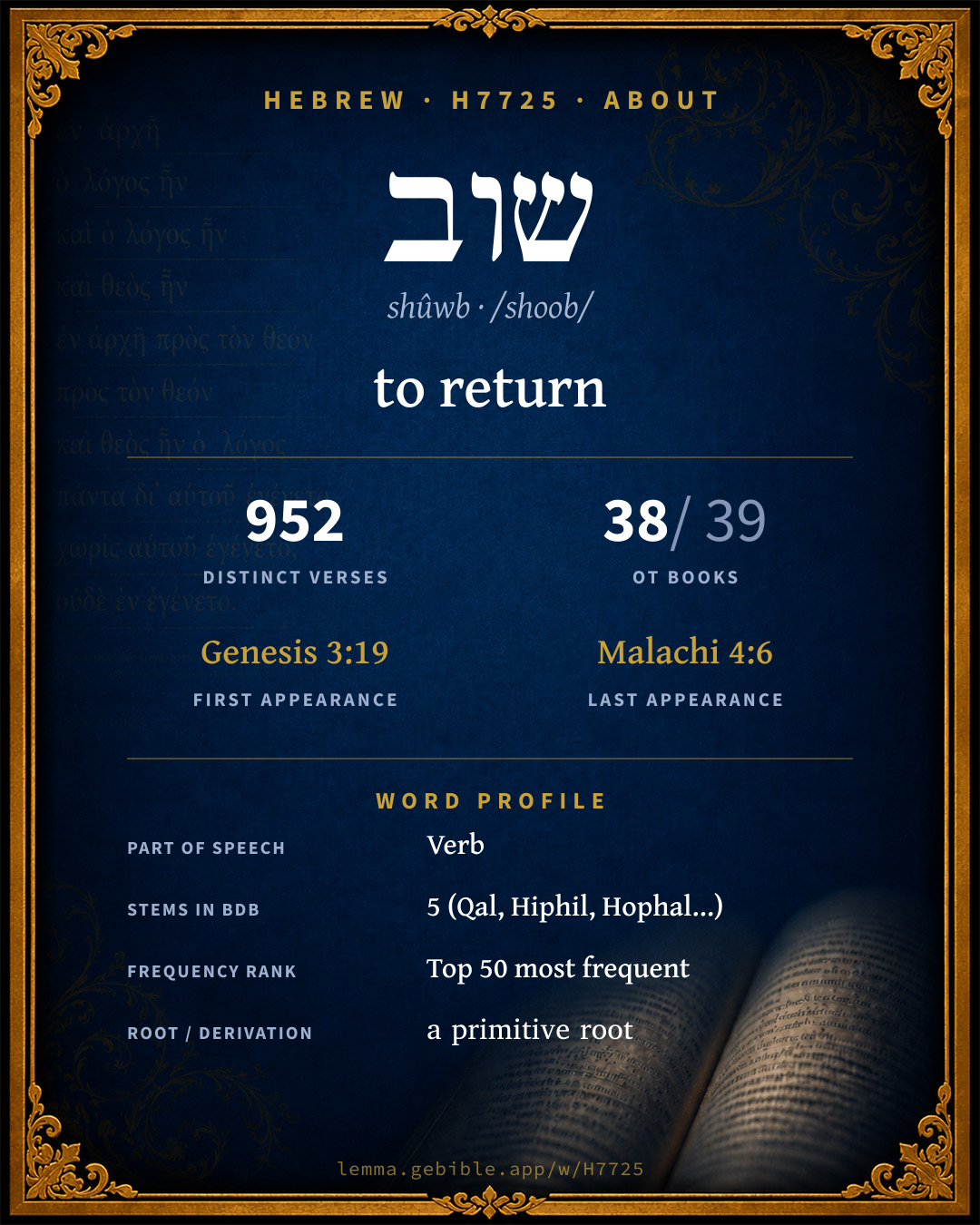
שׁוּב
to return
‘to return’ is one of 5 main senses fuller range ↓
Full lexicon entry — Brown-Driver-Briggs (BDB)
From Brown-Driver-Briggs (BDB)
Where this word appears
See every Qal verb in the Hebrew Bible →
Grammar key — what these labels mean
Part of speech
- Verb
- An action or state-of-being word.
Stem
- Qal
- The basic, simple active stem — the plain form of the verb (“he wrote”). Here: ‘turn back’
- Hiphil
- The causative active stem (“he caused / brought about”). Here: ‘bring back’
- Polel
- A stem of hollow/geminate roots functioning like the Piel — intensive active.
- Hophal
- The passive counterpart of the Hiphil (“he was caused to…”).
Form
- Sequential Imperfect
- An imperfect with prefixed waw — the standard past-narrative form (waw-consecutive imperfect).
- Imperfect
- An incomplete, ongoing, or future action (“he will / would write”).
- Infinitive Construct
- A bound verbal noun, frequently with prepositions (“to write / in writing”).
- Perfect
- A completed action or state — Hebrew marks aspect (completeness) more than strict tense (“he wrote”).
- Imperative
- A direct command (“write!”).
- Sequential Perfect
- A perfect with prefixed waw continuing a preceding imperfect or command (waw-consecutive perfect).
- Participle Active
- A verbal adjective expressing ongoing or characteristic action (“writing / one who writes”).
- Jussive
- A third- or second-person volitional form expressing wish or command (“let him write”).
- Infinitive Absolute
- An unbound verbal noun, often intensifying or standing in for a finite verb.
- Cohortative
- A first-person volitional form expressing wish or resolve (“let me / let us write”).
- Participle Passive
- A verbal adjective expressing action received (“written”).
State
- Absolute
- The independent form of a noun, not bound to a following word.
- Construct
- A noun bound to a following noun in a possessive / “of” relationship (the construct chain).
Person
- 3rd Person
- The one spoken about (“he / she / it / they”).
- 2nd Person
- The one addressed (“you”).
- 1st Person
- The speaker (“I / we”).
Gender
- Masculine
- Grammatically masculine.
- Common
- Either gender — not distinguished for this form.
- Feminine
- Grammatically feminine.
Number
- Singular
- One.
- Plural
- More than one (in Hebrew, generally three or more).
Every verse where H7725 appears in the Book of 2 Chronicles — 54 distinct verses. Click any verse to open its interlinear word-by-word view. Verse text shown in the World English Bible for context — . Each verse’s Hebrew form is shown with its reference; the English is not keyword-highlighted, since the data carries no word-level English alignment. Use “Compare translations” on any verse to read it across multiple English versions. This concordance covers the Hebrew Bible; Septuagint (Greek Old Testament) occurrences are not indexed here.
2 Chronicles
- 2 Chronicles 6:23 לְ/הָשִׁ֣יב prep + Hiphil inf.cs then hear from heaven, and do, and judge your servants, requiting the wicked, to bring his way on his own head; and justifying the righteous, to give him according to his righteousness.
- 2 Chronicles 6:24 וְ/שָׁ֨בוּ֙ conj + Qal wpf 3cp If your people Israel be struck down before the enemy, because they have sinned against you, and shall turn again and confess your name, and pray and make supplication before you in this house;
- 2 Chronicles 6:25 וַ/הֲשֵׁיבוֹתָ/ם֙ conj + Hiphil wpf 2ms + sfx pers 3mp then hear from heaven, and forgive the sin of your people Israel, and bring them again to the land which you gave to them and to their fathers.
- 2 Chronicles 6:26 יְשׁוּב֖וּ/ן Qal impf 3mp + sfx n When the sky is shut up, and there is no rain, because they have sinned against you; if they pray toward this place, and confess your name, and turn from their sin, when you do afflict them:
- 2 Chronicles 6:37 וְ/הֵשִׁ֨יבוּ֙ וְ/שָׁ֣בוּ conj + Hiphil wpf 3cp conj + Qal wpf 3cp yet if they shall repent themselves in the land where they are carried captive, and turn again, and make supplication to you in the land of their captivity, saying, We have sinned, we have done perversely, and have dealt wickedly;
- 2 Chronicles 6:38 וְ/שָׁ֣בוּ conj + Qal wpf 3cp if they return to you with all their heart and with all their soul in the land of their captivity, where they have carried them captive, and pray toward their land, which you gave to their fathers, and the city which you have chosen, and toward the house which I have built for your name:
- 2 Chronicles 6:42 תָּשֵׁ֖ב Hiphil juss 2ms Yahweh God, don't turn away the face of your anointed: remember [your] loving kindnesses to David your servant.
- 2 Chronicles 7:14 וְ/יָשֻׁ֖בוּ conj + Qal impf 3mp if my people, who are called by my name, shall humble themselves, and pray, and seek my face, and turn from their wicked ways; then will I hear from heaven, and will forgive their sin, and will heal their land.
- 2 Chronicles 7:19 תְּשׁוּב֣וּ/ן Qal impf 2mp + sfx n But if you turn away, and forsake my statutes and my commandments which I have set before you, and shall go and serve other gods, and worship them;
- 2 Chronicles 10:2 וַ/יָּ֥שָׁב conj + Qal wimpf 3ms It happened, when Jeroboam the son of Nebat heard of it, (for he was in Egypt, where he had fled from the presence of king Solomon), that Jeroboam returned out of Egypt.
- 2 Chronicles 10:5 וְ/שׁ֣וּבוּ conj + Qal impv 2mp He said to them, Come again to me after three days. The people departed.
- 2 Chronicles 10:6 לְ/הָשִׁ֥יב prep + Hiphil inf.cs King Rehoboam took counsel with the old men, who had stood before Solomon his father while he yet lived, saying, What counsel give you me to return answer to this people?
- 2 Chronicles 10:9 וְ/נָשִׁ֥יב conj + Hiphil impf 1cp He said to them, What counsel give you, that we may return answer to this people, who have spoken to me, saying, Make the yoke that your father did put on us lighter?
- 2 Chronicles 10:12 שׁ֥וּבוּ Qal impv 2mp So Jeroboam and all the people came to Rehoboam the third day, as the king bade, saying, Come to me again the third day.
- 2 Chronicles 10:16 וַ/יָּשִׁ֣יבוּ conj + Hiphil wimpf 3mp When all Israel saw that the king didn't listen to them, the people answered the king, saying, What portion have we in David? neither have we inheritance in the son of Jesse: every man to your tents, Israel: now see to your own house, David. So all Israel departed to their tents.
- 2 Chronicles 11:1 לְ/הָשִׁ֥יב prep + Hiphil inf.cs When Rehoboam was come to Jerusalem, he assembled the house of Judah and Benjamin, one hundred eighty thousand chosen men, who were warriors, to fight against Israel, to bring the kingdom again to Rehoboam.
- 2 Chronicles 11:4 שׁ֚וּבוּ וַ/יָּשֻׁ֖בוּ Qal impv 2mp conj + Qal wimpf 3mp Thus says Yahweh, You shall not go up, nor fight against your brothers: return every man to his house; for this thing is of me. So they listened to the words of Yahweh, and returned from going against Jeroboam.
- 2 Chronicles 12:11 וֶ/הֱשִׁב֖וּ/ם conj + Hiphil wpf 3cp + sfx pers 3mp It was so, that as often as the king entered into the house of Yahweh, the guard came and bore them, and brought them back into the guard-chamber.
- 2 Chronicles 12:12 שָׁ֤ב Qal pf 3ms When he humbled himself, the wrath of Yahweh turned from him, so as not to destroy him altogether: and moreover in Judah there were good things [found].
- 2 Chronicles 14:15 וַ/יָּשֻׁ֖בוּ conj + Qal wimpf 3mp They struck also the tents of cattle, and carried away sheep in abundance, and camels, and returned to Jerusalem.
- 2 Chronicles 15:4 וַ/יָּ֨שָׁב֙ conj + Qal wimpf 3ms But when in their distress they turned to Yahweh, the God of Israel, and sought him, he was found of them.
- 2 Chronicles 18:16 יָשׁ֥וּבוּ Qal impf 3mp He said, I saw all Israel scattered on the mountains, as sheep that have no shepherd: and Yahweh said, These have no master; let them return every man to his house in peace.
- 2 Chronicles 18:25 וַ/הֲשִׁיבֻ֖/הוּ conj + Hiphil impv 2mp + sfx pers 3ms The king of Israel said, Take Micaiah, and carry him back to Amon the governor of the city, and to Joash the king's son;
- 2 Chronicles 18:26 שׁוּבִ֥/י Qal inf.cs + sfx pers 1cs and say, Thus says the king, Put this fellow in the prison, and feed him with bread of affliction and with water of affliction, until I return in peace.
- 2 Chronicles 18:27 שׁ֤וֹב תָּשׁוּב֙ Qal inf.abs Qal impf 2ms Micaiah said, If you return at all in peace, Yahweh has not spoken by me. He said, Hear, you peoples, all of you.
- 2 Chronicles 18:32 וַ/יָּשֻׁ֖בוּ conj + Qal wimpf 3mp It happened, when the captains of the chariots saw that it was not the king of Israel, that they turned back from pursuing him.
- 2 Chronicles 19:1 וַ֠/יָּשָׁב conj + Qal wimpf 3ms Jehoshaphat the king of Judah returned to his house in peace to Jerusalem.
- 2 Chronicles 19:4 וַ/יָּ֜שָׁב וַ/יְשִׁיבֵ֕/ם conj + Qal wimpf 3ms conj + Hiphil wimpf 3ms + sfx pers 3mp Jehoshaphat lived at Jerusalem: and he went out again among the people from Beersheba to the hill-country of Ephraim, and brought them back to Yahweh, the God of their fathers.
- 2 Chronicles 19:8 וַ/יָּשֻׁ֖בוּ conj + Qal wimpf 3mp Moreover in Jerusalem did Jehoshaphat set of the Levites and the priests, and of the heads of the fathers' [houses] of Israel, for the judgment of Yahweh, and for controversies. They returned to Jerusalem.
- 2 Chronicles 20:27 וַ֠/יָּשֻׁבוּ לָ/שׁ֥וּב conj + Qal wimpf 3mp prep + Qal inf.cs Then they returned, every man of Judah and Jerusalem, and Jehoshaphat in the forefront of them, to go again to Jerusalem with joy; for Yahweh had made them to rejoice over their enemies.
- 2 Chronicles 22:6 וַ/יָּ֜שָׁב conj + Qal wimpf 3ms He returned to be healed in Jezreel of the wounds which they had given him at Ramah, when he fought against Hazael king of Syria. Azariah the son of Jehoram king of Judah went down to see Jehoram the son of Ahab in Jezreel, because he was sick.
- 2 Chronicles 24:11 וִֽ/ישִׁיבֻ֣/הוּ conj + Hiphil impf 3mp + sfx pers 3ms It was so, that whenever the chest was brought to the king's officers by the hand of the Levites, and when they saw that there was much money, the king's scribe and the chief priest's officer came and emptied the chest, and took it, and carried it to its place again. Thus they did day by day, and gathered money in abundance.
- 2 Chronicles 24:19 לַ/הֲשִׁיבָ֖/ם prep + Hiphil inf.cs + sfx pers 3mp Yet he sent prophets to them, to bring them again to Yahweh; and they testified against them: but they would not give ear.
- 2 Chronicles 25:10 וַ/יָּשׁ֥וּבוּ conj + Qal wimpf 3mp Then Amaziah separated them, [to wit], the army that had come to him out of Ephraim, to go home again: therefore their anger was greatly kindled against Judah, and they returned home in fierce anger.
- 2 Chronicles 25:13 הֵשִׁ֤יב Hiphil pf 3ms But the men of the army whom Amaziah sent back, that they should not go with him to battle, fell on the cities of Judah, from Samaria even to Beth Horon, and struck of them three thousand, and took much spoil.
- 2 Chronicles 25:24 וַ/יָּ֖שָׁב conj + Qal wimpf 3ms [He took] all the gold and silver, and all the vessels that were found in the house of God with Obed-edom, and the treasures of the king's house, the hostages also, and returned to Samaria.
- 2 Chronicles 26:2 וַ/יְשִׁיבֶ֖/הָ conj + Hiphil wimpf 3ms + sfx pers 3fs He built Eloth, and restored it to Judah, after that the king slept with his fathers.
- 2 Chronicles 27:5 הֵשִׁ֤יבוּ Hiphil pf 3cp He fought also with the king of the children of Ammon, and prevailed against them. The children of Ammon gave him the same year one hundred talents of silver, and ten thousand measures of wheat, and ten thousand of barley. So much did the children of Ammon render to him, in the second year also, and in the third.
- 2 Chronicles 28:11 וְ/הָשִׁ֨יבוּ֙ conj + Hiphil impv 2mp Now hear me therefore, and send back the captives, that you have taken captive of your brothers; for the fierce wrath of Yahweh is on you.
- 2 Chronicles 28:15 וַ/יָּשׁ֖וּבוּ conj + Qal wimpf 3mp The men who have been mentioned by name rose up, and took the captives, and with the spoil clothed all who were naked among them, and arrayed them, and shod them, and gave them to eat and to drink, and anointed them, and carried all the feeble of them on donkeys, and brought them to Jericho, the city of palm trees, to their brothers: then they returned to Samaria.
- 2 Chronicles 29:10 וְ/יָשֹׁ֥ב conj + Qal juss 3ms Now it is in my heart to make a covenant with Yahweh, the God of Israel, that his fierce anger may turn away from us.
- 2 Chronicles 30:6 שׁ֚וּבוּ וְ/יָשֹׁב֙ Qal impv 2mp conj + Qal juss 3ms So the posts went with the letters from the king and his princes throughout all Israel and Judah, and according to the commandment of the king, saying, You children of Israel, turn again to Yahweh, the God of Abraham, Isaac, and Israel, that he may return to the remnant that have escaped of you out of the hand of the kings of Assyria.
- 2 Chronicles 30:8 וְ/יָשֹׁ֥ב conj + Qal juss 3ms Now don't you be stiff-necked, as your fathers were; but yield yourselves to Yahweh, and enter into his sanctuary, which he has sanctified forever, and serve Yahweh your God, that his fierce anger may turn away from you.
- 2 Chronicles 30:9 בְ/שׁוּבְ/כֶ֞ם וְ/לָ/שׁ֖וּב תָּשׁ֖וּבוּ prep + Qal inf.cs + sfx pers 2mp conj + prep + Qal inf.cs Qal impf 2mp For if you turn again to Yahweh, your brothers and your children shall find compassion before those who led them captive, and shall come again into this land: for Yahweh your God is gracious and merciful, and will not turn away his face from you, if you return to him.
- 2 Chronicles 31:1 וַ/יָּשׁ֜וּבוּ conj + Qal wimpf 3mp Now when all this was finished, all Israel who were present went out to the cities of Judah, and broke in pieces the pillars, and hewed down the Asherim, and broke down the high places and the altars out of all Judah and Benjamin, in Ephraim also and Manasseh, until they had destroyed them all. Then all the children of Israel returned, every man to his possession, into their own cities.
- 2 Chronicles 32:21 וַ/יָּשָׁב֩ conj + Qal wimpf 3ms Yahweh sent an angel, who cut off all the mighty men of valor, and the leaders and captains, in the camp of the king of Assyria. So he returned with shame of face to his own land. When he was come into the house of his god, those who came forth from his own bowels killed him there with the sword.
- 2 Chronicles 32:25 הֵשִׁ֣יב Hiphil pf 3ms But Hezekiah didn't render again according to the benefit done to him; for his heart was lifted up: therefore there was wrath on him, and on Judah and Jerusalem.
- 2 Chronicles 33:3 וַ/יָּ֗שָׁב conj + Qal wimpf 3ms For he built again the high places which Hezekiah his father had broken down; and he reared up altars for the Baals, and made Asheroth, and worshiped all the host of the sky, and served them.
- 2 Chronicles 33:13 וַ/יְשִׁיבֵ֥/הוּ conj + Hiphil wimpf 3ms + sfx pers 3ms He prayed to him; and he was entreated of him, and heard his supplication, and brought him again to Jerusalem into his kingdom. Then Manasseh knew that Yahweh he was God.
- 2 Chronicles 34:7 וַ/יָּ֖שָׁב conj + Qal wimpf 3ms He broke down the altars, and beat the Asherim and the engraved images into powder, and hewed down all the sun-images throughout all the land of Israel, and returned to Jerusalem.
- 2 Chronicles 34:9 וַ/יָּשֻׁ֖בוּ conj + Qal wimpf 3mp They came to Hilkiah the high priest, and delivered the money that was brought into the house of God, which the Levites, the keepers of the threshold, had gathered of the hand of Manasseh and Ephraim, and of all the remnant of Israel, and of all Judah and Benjamin, and of the inhabitants of Jerusalem.
- 2 Chronicles 34:16 וַ/יָּ֨שֶׁב conj + Hiphil wimpf 3ms Shaphan carried the book to the king, and moreover brought back word to the king, saying, All that was committed to your servants, they are doing.
- 2 Chronicles 34:28 וַ/יָּשִׁ֥יבוּ conj + Hiphil wimpf 3mp Behold, I will gather you to your fathers, and you shall be gathered to your grave in peace, neither shall your eyes see all the evil that I will bring on this place, and on the inhabitants of it. They brought back word to the king.
- 2 Chronicles 36:13 מִ/שּׁ֕וּב prep + Qal inf.cs He also rebelled against king Nebuchadnezzar, who had made him swear by God: but he stiffened his neck, and hardened his heart against turning to Yahweh, the God of Israel.
About this entry
At a glance — auto-summarized from this page’s data, not written by a person. Every figure links to its source below. This summary describes the numbers; it doesn’t interpret them.
The Hebrew verb שוב centers on the idea of “to return.” As a verb its force shifts by stem, across 5 stems (Qal, Hiphil, and more). Spanning 952 verses in 38 books, it ranks among the most common words of the Hebrew Bible. Its earliest occurrence is Genesis 3:19. Related forms include משובה, שובב and שובב. Dig into 952-verse concordance and the renderings breakdown below.
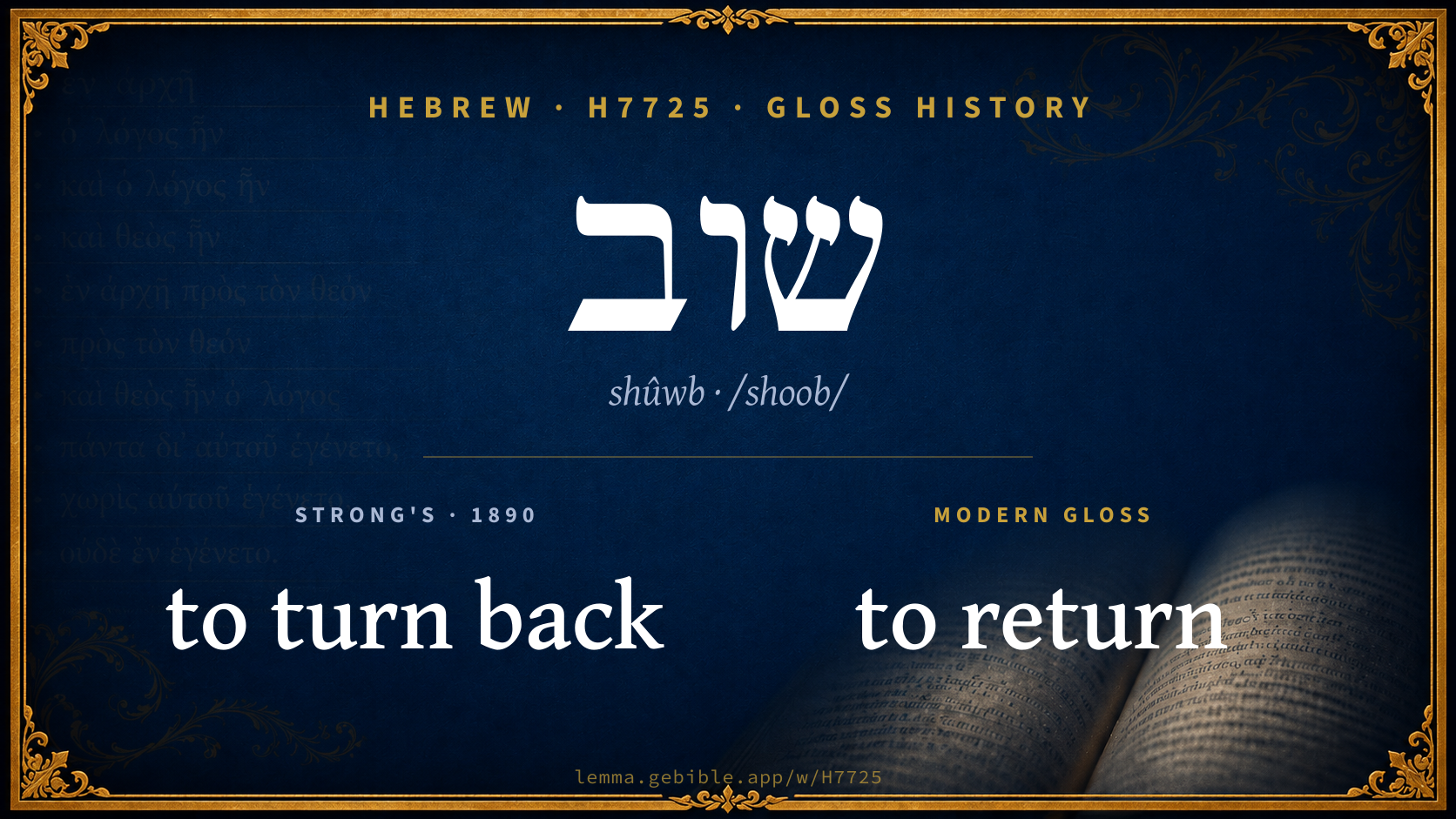
Gloss history
Strong's 1890 vs modern scholarship
About this word
Strong's H7725 catalogs a Hebrew word from the Hebrew Old Testament.
These counts are not copied from any lexicon or concordance. They are computed here, from the morphology-tagged Hebrew Old Testament. What Lemma adds →
- 952
- distinct verses
- The word appears in 952 distinct verses.
- 38 / 39
- OT books
- The word appears in 38 of 39 Old Testament books.
- #38
- by frequency
- Top 50 most frequent Hebrew words (rank 38 of 8,640 Hebrew words by occurrence).
View all 952 occurrences in the concordance →
By section of the Old Testament
By traditional corpus
Conventional, traditional groupings — biblical authorship is debated, so this is a traditional corpus grouping, not an authorship claim. Each share is this word’s portion of its verses in that division of the Hebrew canon. Each figure is a share of the word’s 952 distinct verses.
- Prophets (Nevi'im) 528 verses · 55%
- Writings (Ketuvim) 265 verses · 28%
- Torah (Pentateuch) 159 verses · 17%
How translations render this word
Counts come from each version’s own published word-to-Strong’s tagging or interlinear alignment — an approximate guide to how each version renders this word, not a word-level alignment the data otherwise carries. Because each total is that version’s own tagged count, the per-version totals vary from one another and need not match the appearance or distinct-verse counts above. These counts may also differ from a printed concordance because Lemma counts each distinctly tagged rendering and does not collapse phrase taggings into a single head-word total. This is a fixed set of word-tagged versions (KJV, ASV, BSB, ULT) and does not change with the reading translation you choose elsewhere. Each version’s license is shown beside its name below (and on Sources).
- King James Version: Return 84×, Returned 80×, Again 66×
- American Standard Version: Returned 75×, Return 69×, Again 60×
- Berean Standard Bible: Return 102×, Returned 62×, Turn 29×
- unfoldingWord Literal Text: Return 164×, Returned 95×, And 80×
King James Version Public Domain
Renders H7725 across 1,106 tagged occurrences — most commonly:
Plus other, less common renderings. Plus 386 renderings that appear only once — usually multi-word phrases or single function words the recovered tagging swept in, not distinct renderings. Not rendered by a distinct English word in 11 further occurrences.
American Standard Version Public Domain
Renders H7725 across 1,102 tagged occurrences — most commonly:
Plus other, less common renderings. Plus 386 renderings that appear only once — usually multi-word phrases or single function words the recovered tagging swept in, not distinct renderings.
Berean Standard Bible Public Domain
Renders H7725 across 1,007 tagged occurrences — most commonly:
Plus other, less common renderings. Plus 306 renderings that appear only once — usually multi-word phrases or single function words the recovered tagging swept in, not distinct renderings. Not rendered by a distinct English word in 48 further occurrences.
unfoldingWord Literal Text CC BY-SA 4.0
Renders H7725 across 1,254 tagged occurrences — most commonly:
Plus other, less common renderings. Plus 223 renderings that appear only once — usually multi-word phrases or single function words the recovered tagging swept in, not distinct renderings.
64 senses and sub-senses in the full BDB
Hebrew verbs can shift meaning by stem (binyan): Qal is the basic action, Niphal is often passive or reflexive, Piel often intensifies or makes it factitive, and Hiphil is typically causative. The senses below are grouped under the stem BDB assigns to each. This entry also uses Hophal (the passive of Hiphil) and one or more reduplicated stems (the Pōlēl/Pilpēl type), which for hollow or geminate roots behave much like Piel — often intensive or iterative.
What do BDB’s symbols mean?
BDB uses these scholarly abbreviations:
| Symbol | Meaning |
|---|---|
| 𝔊 | the Septuagint (the ancient Greek translation, LXX) |
| 𝔙 | the Vulgate (the Latin translation) |
| 𝔖 | the Syriac version (the Peshitta) |
| 𝔗 | the Targum (the Aramaic translation) |
| ψ | the Psalms |
| √ | root (the underlying root or stem) |
| ‖ | parallel passage (a synonymous or contrasted parallel) |
| † | the dagger: every passage where the word occurs is cited |
The 64 senses and sub-senses the full Brown-Driver-Briggs lexicon distinguishes for this word, in lexicon order (not ranked by frequency), with BDB’s own verbatim wording and sub-sense lettering. Shown in Hebrew script with BDB’s own scholarly abbreviations. The condensed entry is in the Lexicon Entry tab. See also the Forms in the corpus table below.
Qal
- Pf. 3 ms. שָׁב Gn 18:33 +, 3 fs. שָׁ֫בָה Ru 1:15 +, וְשָׁבַת consec. †Ez 46:17 (Ges§ 72 o, but Co Toy Krae וְשָׁבָה), 2 ms. שַׁבְתָּ ψ 85:2, etc.; Impf. 3 ms. יָשׁוּב Ho 11:5 + often, יָשֻׁב ψ 146:4; La 3:3, juss. יָשֹׁב Ju 7:3 +, וַיָּ֫שָׁב Gn 26:18 +; 3 fpl. תָּשֹׁבְןָ Ez 16:55(×2), תְּשֻׁבֶינָה v 55, etc.; Imv. ms. שׁוּב Gn 31:3 +, שֻׁב Ex 4:19; 1 K 18:43, שׁוּ֫בָה Ho 14:2 +, fpl. שֹׁבְנָה Ru 1:8, 11, 12, etc.; Inf. abs. שׁוֹב Gn 8:3 +, cstr. שׁוּב Ex 4:21 +, שֹׁב Jos 2:16 (Ges§ 72 q), etc.; Pt. שָׁב Gn 43:18 +, fs. שָׁבָ֫ה Ru 1:22 +, etc.; pass. cstr. שׁוּבֵי Mi 2:8;—turn back, return: e.g. Genesis 18:33
- 1. turn back, c. מִן loc. Ju 3:19; 8:13, cf. 7:3, c. מֵאַחֲרֵי pers., i.e. from following 2 S 11:15; 1 K 19:21; Ru 1:16, from pursuing 2 S 2:26, 30; 1 K 22:33 = 2 Ch 18:32; c. מִן of pursuit 1 S 17:53; 23:28, cf. 2 Ch 11:4; c. אַחֲרֵי pers., i.e. so as to follow 1 S 15:31 2 S 23:10; turn back in fear, מִן rei Jb 39:22 (of horse), מִפְנֵי כֹל Pr 30:30 (of lion), so abs. (of foes) ψ 6:11; 56:10; 70:4, in shame La 1:8; turn back and do so and so: Gn 14:7; Ex 14:2, cf. Nu 33:7 (עַל loc., both P), Jos 8:21 (E), 11:10 (J), 1 Ch 21:20, sq. inf. 2 Ch 20:27; abs. turn back (face about) Ct 7:1(×4) (+ vb.); = be repulsed, defeated ψ 9:4 (+ אָחוֹר), 74:21; fig. turn back, viz. from promise or vow Ju 11:35; c. מִן of service Nu 8:25 (P), i.e. be exempt. e.g. Judges 3:19
- 2. return, come or go back, c. מֵעַל pers. 1 S 17:15 (opp. הלך), 2 S 10:14; 2 K 18:14, מִן pers. Jos 10:31 (+ בְּשָׁלוֹם), מִן loc., especially from foreign land 2 K 8:3; 2 Ch 10:2; Ru 1:6, 22; 2:6; 4:3; Je 31:16; 40:12; 43:5; 44:28; Ezr 6:21; Ne 8:17, מֵהַכּוֹת Gn 14:17 (JE?), 1 S 17:57; 18:6; 2 S 1:1; 8:13, מֵאַחֲרֵי i.e. from pursuing 1 S 24:2 (Gi v 1); fig., לֹא שׁ׳ מִנִּי חֹשֶׁךְ Jb 15:22 (v. חֹשֶׁךְ 3 a); עִבְרוּ וָשׁוּבוּ מִשַּׁעַר לָשַׁעַר Ex 32:27 (J), i.e. go back and forth from gate to gate, cf. (abs.) pt. as subst. עֹבֵר וָשָׁב Zc 7:14; 9:8 and (= all persons) Ez 35:7; also וַיֵּצֵא יָצוֹא וָשׁוֹב Gn 8:7 (J), רָצוֹא וָשׁוֹב Ez 1:14 (del. Hi Co Toy al.; yet v. Krae); Gn 8:3 (J) v. הלך 4 c (4). e.g. 1 Samuel 17:15
- 3. especially return unto:
- a. go back, אֶל pers. Nu 23:5, 16 (JE), 2 K 1:6 (‖ הָלַךְ, as often), Ex 5:22 (J; אֶל־י׳, 32:31 (E; id.), Nu 17:15 (P), 2 S 20:22 (+ acc. loc.), Je 46:16 (both + אֶל loc.), + 17 times; אֶל loc. also Gn 21:32; 28:21 (both E), 2 S 11:4; Ho 5:15 (of י׳), 2 Ch 19:1 (+ בְּשָׁלוֹם, + ל pers.), Est 2:14 (opp. בּוֹא), 7:8 (+ מִן loc.), + 27 times; of a dog שׁ׳ עַל־קֵאוֹ Pr 26:11; ל loc. Gn 18:33 (J), 1 S 26:25; 29:4; 1 K 19:15 (+ -ה loc.), Gn 33:16 (J; לְדַרְכּוֹ, + id.), ψ 7:8 (of י׳), + 25 times; ל pers. †Ru 1:10 (לְעַמֵּךְ); -ה loc. also Gn 44:13 (J), Ex 4:20, 21 (R), 13:17 (E), + 5 times; שָׁם (= שָׁ֫מָּה) Je 22:27; acc. loc. also Ho 8:13; 9:3; 1 S 18:2; 2 S 3:27; 15:27 (+ בְּשָׁלוֹם), 2 K 2:25 (+ מִן loc.), + 15 times; acc. דֶּרֶךָ Ez 46:9; acc. pers. †Nu 10:36; אַחֲרֵי pers. Ru 1:15; abs. 2 S 3:16; 19:16 (+ בּוֹא), 1 K 18:43; Je 40:5 (Ez 7:13b (del. 𝔊 Co Krae al.) +; sq. vb., go back and do so and so, Gn 43:2; 1 S 1:19; 29:7 (שׁוּב וְלֵךְ בְּשָׁלוֹם), 1 K 13:22; 2 Ch 18:16 (+ בְּשָׁלוֹם) +, (Je 42:10 read יָשׁוֹב Vrss and mod.); sq. inf. purpose Ju 14:8; 2 S 6:20 + 10 times e.g. Numbers 23:5
- b. come back, אֶל pers. Gn 8:9 (J; + אֶל loc.), Ex 24:14 (J), 1 S 23:23 + 2 S 17:3 (𝔊 Ew Th We Dr HPS Bu), 1 K 12:15 (opp. הָלַךְ) + 9 times + (in hostility) Ju 20:48; אֶל loc. also Zc 8:3 (subj. י׳); Jos 22:32 (P) has מֵאֵת pers. + מִן loc. + אֶל loc. + אֶל pers.; אֶל rei Ez 7:13; עַל pers. †Ne 4:6 Mi 5:2 (be reunited to); עַל loc. †1 K 17:21, 22; ל loc. Jos 1:15 (R), Zc 1:16 (subj. י׳), 2 Ch 30:9 + (from exile) 5 times; ל animal., Jb 39:4; -ה loc. †Gn 15:16 (E), 50:14 (J); acc. loc. †2 Ch 19:8; שָׁם Je 22:11 (opp. יָצָא), שָׁ֫מָּה v 27, הֵ֫נָּה 31:8; abs. Gn 43:10 (J), 2 S 10:5; 2 K 1:5; Is 21:12 (‖ אָתָה), Jb 39:12 (Kt, so Bu Du; of wild ox), + often; + בְּשָׁלוֹם Ju 8:9; 1 K 22:28 (שׁוֹב תָּשׁוּב) = 2 Ch 18:27; 2 Ch 18:26; + vb., come back and do so and so, †Dt 1:45; 30:8; Je 37:8; 1 K 19:7; 20:5; 2 K 9:36 ψ 60:2 (title), cf. Zc 4:1; Dn 11:10, שׁ׳ לָשֶׁבֶת Nu 35:32 (P), שׁ׳ לָלֶכֶת Ec 5:14. e.g. Genesis 8:9
- 4.
- a. of dying, שׁ׳ אֶל־(הֶ)עָפָר Gn 3:19(×2) (J), ψ 104:29; Ec 3:20, עַל־עָפָר Jb 34:15; שׁ׳ לְאַדְמָתוֹ ψ 146:4, cf. אָשׁוּב שָׁ֫מָּה (i.e. בֶּטֶן אִמּוֹ) Jb 1:21 (v. Di Bu, also Ec 5:14); שׁ׳ לִשְׁא֑וֹלָה ψ 9:18; so prob. abs. ψ 90:3 (> come back to life); of (human) dust, שׁ׳ עַל־הָאָרֶץ Ec 12:7; breath, שׁ׳ אֶל־הָאֱלֹהִים v 7. e.g. Genesis 3:19
- b. of revival from death, שׁ׳ לְבֵיתוֹ Jb 7:10, abs. 10:21 (opp. הָלַךְ), 16:22 (id.), Pr 2:19; also c. אֶל pers. 2 S 12:23. e.g. Job 7:10
- 5. fig. of human relations:
- a. return to leader, king, אֶל pers., Ju 11:8; 1 K 12:27(×2); to divorced wife Je 3:1 (opp. הלך). e.g. Judges 11:8
- b. = change so as to approach (in purpose, desire), אֶל־ pers. Je 15:19(×2). e.g. Jeremiah 15:19
- c. turn, i.e. resort to, ל pers. ψ 119:79. e.g. Psalms 119:79
- d. return to a physical condition Jb 33:25 (ל rei); to a state or course of life, ל rei Is 23:17; Ez 16:55(×3); Ne 9:17 ψ 85:9 עַל rei Je 11:10, הֲלוֹם ψ 73:10 (but crpt.); ב Je 8:6 (Du reads שָׁט for שָׁב). e.g. Job 33:25
- e. abs. = change course of action; from good to bad, וַיָּשָׁב וַיִּמְרָד־בּוֹ 2 K 24:1; Je 34:11, 16; bad to good v 15; so שׁ׳ alone Jb 6:29(×2) (prob.; read וְשׁוּבוּ, so Di Da Bu al.; other interpr. De Du al.). e.g. 2 Kings 24:1
- f. pt. pass. = averse, שׁוּבֵי מִלְחָמָה Mi 2:8 (> We Now שׁבִי spoil of war). e.g. Micah 2:8
- 6. fig., specif. of spiritual relations:
- a. turn back from God, = apostatize, מֵאַחֲרֵי י׳ Nu 14:43 (J), 1 S 15:11; 1 K 9:6 (שׁוֹב תְּשֻׁב֫וּן), Je 3:19; Nu 32:15; Jos 22:16, 18, 23, 29 (all P); abs. (usually + vb.) Ju 2:19; 8:33; Jos 23:12 (RD), Je 8:4 ψ 78:41; 2 Ch 7:19. e.g. Numbers 14:43
- b. of י׳, turn away, מֵאַחֲרֵי pers. Dt 23:15. e.g. Deuteronomy 23:15
- c. turn back to God (= seek penitently), אֶל־י׳ Ho 6:1; 7:10; 14:3; Je 3:7; 1 K 8:33, 48 (בְּכָל־לֵבָב), + 18 times; אֶל־אֱלֹהִים †Ho 5:4 ψ 51:15, cf. Is 10:21; עַל־י׳ †2 Ch 15:4; 30:9; עַד־י׳ Am 4:6, 8, 9, 10, 11; Ho 14:2; Is 9:12 + 5 times; עַד־שַׁדַּי †Jb 22:23; לי׳ Is 31:6, שׁ׳ נַפְשִׁי לִמְנוּחָ֑יְכִי ψ 116:7; cf. לַבַּעַל Ho 7:16 (for לֹא עַל, Now, cf. Marti); לְתוֹכַחְתִּי Pr 1:23 (prob. del., v. Toy). e.g. Hosea 6:1
- d. abs. repent, Ho 3:5; 11:5; Is 6:10; 10:22; Je 3:7, 12, 14, 22; 4:1; 5:3 + 14 times, + pt. as subst. Is 1:27. e.g. Hosea 3:5
- e. turn back from evil, c. מִן (especially Je Ez) 1 K 8:35; 13:33; Je 15:7; 18:8 + 8 times Je, Ez 3:19; 13:22 + 12 times Ez, + 9 times; cf. שָׁבֵי פֶשַׁע Is 59:20; שׁוּבוּ וְהָשִׁיבוּ מִן Ez 18:30, so c. מֵעַל 14:6; from good, c. מִן, †Ez 3:20; 18:24, 26; 33:18. e.g. 1 Kings 8:35
- f. of י׳, שׁ׳ מֵחֲרוֹן אַפּוֹ Ex 32:12 (JE), Dt 13:18; Jos 7:26 (J), 2 K 23:26; Jon 3:9; שׁ׳ מִמֶּנּוּ אַף־י׳ Ho 14:5; Je 2:35; 4:8; Nu 25:4 (P), 2 Ch 12:12; 29:10; 30:8, so (man’s anger) Gn 27:45 (J) and (abs.) v 44 (E); abs. of אַף־י׳ Is 5:25; 9:11, 16, 20; 10:4; 12:1; Je 23:20 (opp. יָצָא v 19), 30:24 Jb 14:13; Dn 9:16. e.g. Exodus 32:12
- g. of י׳, return (to shew favour), אֶל pers. †Gn 18:10 (+ inf. abs.), v 14 Zc 1:3; Mal 3:7; 2 Ch 30:6, abs. Is 63:17 ψ 80:15 (‖ הִבִּיט, פָּקַד), 90:13, + vb. Je 12:15 ψ 6:5 Jo 2:14 Jon 3:9; also in hostility, + vb. Jos 24:20 (E), c. inf. purpose Ho 11:9. e.g. Genesis 18:10
- h. of י׳, turn back from (מִן) judgment Je 4:28, אֱמֶת ψ 132:11; מֵאַחֲרֵי pers., i.e. cease to bless, Je 32:40. e.g. Jeremiah 4:28
- 7. of inanimate things (sometimes personified, or treated as things of life):
- a. as perceptibly moving, water Gn 8:3 (J; מֵעַל loc.), Jos 4:18 (J; ל loc.), Ex 14:26 (P; עַל pers.), v 28 (P; + vb.), ψ 104:9 (ל inf.), sea Ex 14:27 (J; לְאֵיתָנוֹ); wind ψ 78:39 (opp. הלך), Ec 1:6 (עַל loc.); shadow 2 K 20:9, 10 (+ אֲחֹרַנִּית), ‖ Is 38:8 (sun on dial), of breath (= revive) Ju 15:19; 1 S 30:12 (אֶל pers.); clouds Ec 12:2 (מִן temp.); rain and snow Is 55:10 (ה loc.); rolling stone Pr 26:27; sword 2 S 1:22 (מִן rei), Ez 21:10, arrow Je 50:9; of plague-spot = re-appear, Lv 14:43 (P). e.g. Genesis 8:3
- b. = be brought back, Gn 43:18 (J), 1 S 5:11 (ל loc.), hence be restored, ל pers. Ez 46:17, so of kingdom 1 K 12:26, city 1 S 7:14 (Ez 35:9 v. ישׁב 4), field Lv 27:24 (P); of animal Dt 28:31. e.g. Genesis 43:18
- c. = be turned into, ל rei, Is 29:17; = be turned back into, עַד rei, Mi 1:7. e.g. Isaiah 29:17
- d. return, fig. of word, (1) Is 45:23, c. אֶל pers. 55:11 (both opp. יָצָא); (2) ψ 35:13 my prayer turned upon (עַל) my bosom (was uttered with bowed head, De Bae Du). e.g. Isaiah 45:23
- e. turn away, depart, of infamy Pr 25:10. e.g. Proverbs 25:10
- f. return (in recompense), of crime, evil, etc., c. בְּרֹאשׁ 1 K 2:33; Ob 15 ψ 7:17, עַל־רֹאשׁ Est 9:25, ל pers. ψ 54:7 (Kt; > Qr Hiph.), Pr 12:14. e.g. 1 Kings 2:33
- g. ψ 94:15 judgment (-giving) shall return to (עַד) righteousness (be in accord therewith). e.g. Psalms 94:15
- h. of boundary, = change (sometimes reverse) direction (P), -ה loc. Jos 19:12 (+ מִן loc.), v 34 (+ acc. loc.), acc. loc. also v 27, 29 (+ עַד loc.), v 29. e.g. Joshua 19:12
- i. be restored to healthy condition, of withered hand 1 K 13:6(×2) (אֶל pers.), leprous hand Ex 4:7 (J; c. כ comp.), flesh 2 K 5:10 (ל pers.), v 14; Lv 13:16 (‖ נֶהְפַּךְ לְלָבָן). e.g. 1 Kings 13:6
- 8. denoting repetition, etc. (Ges§ 120 d g): + vb., return (and) do = do again, Gn 26:18; 30:31; Nu 11:4 (all J), Ju 19:7; 1 S 3:5, 6; 1 K 13:33; 19:6; 2 K 1:11, 13; 19:9; 21:3 = 2 Ch 33:3; Je 18:4; 36:28; Zc 5:1; 6:1; Mal 1:4; Jb 10:16; 17:10 ψ 7:13; Dn 9:25, perhaps also 2 Ch 19:4; cf. Is 6:13 = it, in turn, shall be destroyed (destruction shall be repeated in its case), La 3:3 appar. = do repeatedly; שׁ׳ + Inf. abs. Ec 4:1, 7; 9:11; in compar. עוֹד תָּשׁוּב תִּרְאֶה Ez 8:6 thou shalt see yet greater abominations, so v 13 and (מִן comp.) v 15; שׁ׳ + Inf. cstr. Dt 24:4; 30:9; Jos 5:2 (RD), Je 36:28; Ez 8:17; Ezr 9:14; Ne 9:28; Jb 7:7; Ec 1:7: = reverse one’s action, + vb. Jos 2:23 (E), Ho 2:11; 2 K 13:25; Dt 30:3; Mi 7:19; Zc 8:15 ψ 71:20(×2); 85:7; = restore to original condition by doing, + vb. Dt 23:14. e.g. Genesis 26:18
- 9. trans., peculiarly, in phr. שׁ׳ שְׁבוּת restore captivity of, etc., c. 21 times (v. שְׁבוּת sub שָׁבָה); שׁ׳ י׳ צִיּוֹן Is 52:8, שׁ׳ c. sf. pers. ψ 85:5; elsewhere only וְשָׁב י׳ אֶת־גְּאוֹן יַעֲקֹב וגו׳ Na 2:3, cf. Hiph. 9. e.g. Isaiah 52:8
Pōʿl
- 1. bring back, Pf. 1 s. וְשֹׁבַבְתִּ֫י, c. acc. pers. + אֶל loc. Je 50:19 (י׳ subj.), Inf. cstr. sf. בְּשׁוֹבְבִי, c. מִן loc. Ez 39:27 and (fig.) לְשׁוֹבֵב, c. אֶל pers. Is 49:5; Impf. 2 ms. תְּשׁוֹבֵב לָנוּ ψ 60:3 = take us back into power. e.g. Jeremiah 50:19
- 2.
- a. fig. restore, refresh, 3 ms. נַפְשִׁי יְשׁוֹבֵב ψ 23:3 (י׳ subj.); cf. Hiph. 2 b. e.g. Psalms 23:3
- b. restore, repair, Pt. מְשׁוֹבֵב נְתִיבוֹח לָשָׁ֑בֶת Is 58:12. e.g. Isaiah 58:12
- 3. lead away (enticingly), Pf. 1 s. sf. (of Gog), י׳ subj., וְשׁוֹבַבְתִּיךָ Ez 38:4 (del. Co), וְשֹׁ׳ 39:2; so fig. 3 fs. sf. וְדַעְתֵּךְ הִיא שׁוֹבְבָ֑תֶךְ Is 47:10 (of Bab.);—Je 50:6 v. Qal. e.g. Ezekiel 38:4
- 4. shew turning = apostatize (cf. Hiph. 8), Pf. 3 fs. שׁוֹבְבָה Je 8:5 (read שׁוֹבֵב, and del. ירושׁלם, c. 𝔊).—Vid. also שׁוֹבֵב infra. e.g. Jeremiah 8:5
Puʿl
- Pt. f. מְשׁוֹבֶ֫בֶת Ez 38:8 a land restored + מִן rei.—Vid. also שׁוֹבָב infra. e.g. Ezekiel 38:8
Hiphil
- Pf. 3 ms. Gn 41:13 +; sf. וַהֲשִׁיבְךָ 40:13, וֶהֱשִׁיבְךָ Dt 28:68; 2 ms. הֱשִׁיבוֹתָ ψ 85:4, וַהֲשֵׁבֹתָ֫ Dt 4:39; 30:1, sf. וַהֲשֵׁיבוֹתָם 2 Ch 6:25; 1 s. consec. וַהֲשִׁיב֫וֹתִי Am 1:8, וַהֲשִׁבֹתִ֫י Nu 22:8 +, sf. וְהוֹשְׁבוֹתִים Zc 10:6 (but read וַהֲשִׁבוֹתִים, v. ישׁב Hiph.), etc.; Impf. 3 ms. יָשִׁיב Ex 21:34 +, (read יָשִׁב Dn 11:18, 19 > Qr v 18 יָשֵׂם), וַיָּ֫שֶׁב Gn 20:14 +; sf. יְשִׁבֵנִי 2 S 15:8 +, וַיְשִׁיבֵם 2 Ch 19:4 + 1 S 12:8 Vrss We Dr al.; 3 fpl. תָּשֵׁבְנָה Jb 20:10, etc.; Imv. ms. הָשֵׁב Gn 20:7 +, הָשֵׁיב 2 K 8:6, הָשַׁ֑ב Is 42:22, so הָשַׁ֖ב Ez 21:35 (v. Ke and still Toy; Ew Sm Krae Inf. abs. הָשֵׁב), הָשִׁיבָה Ju 11:13 +, etc.; Inf. abs. הָשֵׁב Ex 23:4 +; cstr. הָשִׁיב Gn 42:35 +, etc.; Pt. מֵשִׁיב 20:7 +, etc.;—cause to return, bring back: e.g. Genesis 41:13
- 1.
- a. c. acc. pers. + אֶל loc. Gn 24:5 (J; הֶהָשֵׁב אָשִׁיב), 28:15 (J), 42:37 (E), 48:21 (E), +; especially from exile 1 K 8:34 = 2 Ch 6:25; Je 27:22 + 5 times Je; + אֶל pers. 1 K 22:26 = 2 Ch 18:25; + עַל loc. Je 16:15; 23:3; 24:6; + ל loc. 12:15; + acc. loc. 2 S 15:8 (read הָשֵׁב יְשִׁבֵנִי Vrss Th We Dr al.), Dt 28:68; Ez 29:14; 47:6; 2 Ch 33:13, etc.; + מִן loc. Je 41:16; Zc 10:10, מֵאֵת pers. Je 41:16, מִן inf. 2 Ch 25:13; acc. pers. only Ju 19:3; 1 K 13:20, 23 +; bring back into bondage, etc., Je 34:11, 16; = allow to return 15:19; acc. pers. + rei (= recover, recapture), 28:6 (+ אֶל loc., מִן loc.); = recover, rescue, Gn 14:16 (acc. pers. + rei), ψ 35:17 (acc. נַפְשִׁי, מִן rei); acc. rei + אֶל pers. Gn 44:8 (J), + עַל pers. Ex 15:9 (song), Pr 20:26; + אֶל loc. 1 K 14:28 = 2 Ch 12:11; Je 28:3; 2 Ch 24:11; acc. of hand, אֶל־פֶּה 1 S 14:27; Pr 19:24 26:15; especially of י׳’s hand, in judgment, sq. עַל Am 1:8; Is 1:25; Zc 13:7 ψ 81:15, also of man’s hand Je 6:9; Ez 38:12; + acc. loc. 2 S 15:25, 29; + שָׁם Ne 13:9; acc. rei alone Gn 43:12, 21 (both בְּיֶדְכֶם), 14:16 (= recapture), 1 S 6:21; 30:19; 1 K 13:29 (corpse), Lv 26:26 (H); c. acc. animal. 1 S 6:7 (מֵאַחֲרֵי), Ez 34:4, 16 (fig.); shadow on dial 2 K 20:11 = Is 38:8.—Jb 39:12 v. Qal 3 b. e.g. Genesis 24:5
- b. put back: acc. rei, stone, עַל־פִּי הַבְּאֵר Gn 29:3 (J), veil עַל־פָּנָיו Ex 34:35 (P), Dagon לִמְקוֹמוֹ 1 S 5:3, rod לִפְנֵי הָעֵדוּת Nu 17:25 (P), sword, + אֶל of sheath, 1 Ch 21:27; Ez 21:35 (acc. om.); hand אֶל־חֵיק Ex 4:7(×2) (J; opp. הוֹצִיא). e.g. Genesis 29:3
- c. = draw back, hand Gn 38:29 (J), 1 K 13:4 (opp. שָׁלַח; + אֶל reflex.), Jos 8:26 (E; opp. נטה), so fig., י׳ subj. La 2:3 (מִפְּנֵי, אָחוֹר), ψ 74:11; c. מִן = refrain from La 2:8; Ex 18:8, 17 (i.e. from oppressing), 20:22 (מִן om.); foot, c. מִן Is 58:13 (fig.); draw in breath Jb 9:18. e.g. Genesis 38:29
- d. = give back, restore, acc. pers. vel rei: + ל pers. Gn 20:14 (E), v 7 (E; acc. om.), Ex 23:4 (E; הָשֵׁב תָּשִׁיב), Dt 22:1 (id.; both acc. animal.), 24:13 (id.), Ex 22:25 (E), Ju 17:3(×2), 4; 1 S 12:3; 2 S 9:7; Dt 22:2 (P), Ne 5:11, so 2 S 16:3; 1 K 12:21 = 2 Ch 11:1 (all acc. of kingdom), c. acc. צְדָקָה Jb 33:26; + אֶל pers. Gn 37:22 (E; acc. pers.); + אֶל loc. 42:25 (E); acc. rei only, 2 K 8:6; Ez 18:7 (read Inf. abs. שׁוֹב for חוֹב, Co Toy Krae), 18:12; 33:15; Lv 5:23 (P), Nu 5:7 (P; + בְּרֹאשׁוֹ = in full), ψ 69:5 (opp. גָּזַל), so of land (or city) Ju 11:13; 1 K 20:34; Ne 5:12, cf. 2 K 14:28 (+ בְּיִשְׂרָאֵל), 16:6 (+ לַאֲרָם); = win back 2 K 13:25; 14:22 (+ ל terr.) = 2 Ch 26:2, boundary (i.e. re-establish it) 2 K 14:25; restore ruined city Dn 9:25 (+ לִבְנוֹת), conquered nation ψ 80:4, 8, 20; joy, acc. + ל pers. ψ 51:14.—2 S 8:3 v. יָד 2.—Acc. pers. only, Gn 20:7 (E), Is 42:22; restore to office, acc. pers. + עַל Gn 40:13, 21 (E), אֶל loc. 2 S 19:12, acc. pers. only, 2 S 19:11, 13, 44, cf. Is 1:26; = pay back money, Lv 25:27 (ל pers.), v 51, 52. e.g. Genesis 20:14
- e. = relinquish, c. acc. rei, Jb 20:10. e.g. Job 20:10
- f. = give in payment, requital, c. acc. rei + appos. 1 S 6:8 (ל pers.), v 17 (id.; cf. טְחוֹר); also pay as tribute (in answer to demand), acc. rei 2 K 17:3 ψ 72:10, + ל pers. 2 K 3:4; 2 Ch 27:5; give in exchange Ez 27:15. e.g. 1 Samuel 6:8
- g. bring one back (from dead) 2 S 12:23, so c. מִנִּי Jb 33:30; on other hand, אֶל־עָפָר Jb 10:9 = מָוֶת (acc.) 30:23, cf. עַד־דַּכָּא ψ 90:3. e.g. 2 Samuel 12:23
- 2.
- a. bring back heart, לֵב, עַל pers. Mal 3:24; הֲשִׁיבֵנוּ י׳ אֵלֶיךָ La 5:21 (restore, del. אליך); הֵשִׁיב אֶל־י׳ Ne 9:26 (cf. v 29), 2 Ch 19:4; 24:19, also (מִן of evil) Je 23:22, abs. 31:18. e.g. Malachi 3:24
- b. acc. נֶפֶשׁ = refresh La 1:11, 16, 19 ψ 19:8 Pr 25:13; Ru 4:15. e.g. Lamentations 1:11
- 3. bring back words of people, אֶל־י׳ Ex 19:8 (E); then, in gen., bring back word, דָּבָר, report to, + acc. pers. Gn 37:14; Nu 13:26; 22:8 (all E), Dt 1:22, 25; Jos 14:7 (RD), 22:32 (P), + 8 times; = answer 1 S 17:30; 2 S 3:11; 1 K 12:6 = 2 Ch 10:6 + 6 times, + (acc. מִלִּין) Jb 35:4; also (דָּבָר om.) Jb 13:22; 20:2; 33:5, 32; 2 Ch 10:16; Ne 6:4 (כַּדָּבָר הַזֶּה); acc. אֲמָרִים + ל pers. Ju 5:29; Pr 22:21; later c. ל pers. alone 1 S 12:3; c. cl. orat. recta, אֶל pers. Est 4:13, 15; similar phrases, Ez 9:11; Pr 18:13; 24:26; 26:16; Hb 2:1; Jb 31:14; 32:14 (Gi v 15), 40:4. e.g. Exodus 19:8
- 4.
- a. bring back (in retribution), cf. Qal 7 f) upon, subj. often י׳, acc. of evil, Ju 9:56, בְּרֹאשׁ Ju 9:57; 1 S 25:39; 1 K 2:44; Jo 4:4, 7, עַל־רֹאשׁ 1 K 2:32, אֶל־רֹאשׁ Ne 3:36; ל pers. Gn 50:15 (E), 1 S 6:3 (הָשֵׁב תָּשִׁיבוּ), v 4 25:21 (return evil for good), +, etc.; abs. = make requital, ל pers. 2 Ch 6:23 + (כ comp.) Ho 12:3; Pr 24:12, 29; †c. acc. of good, ל pers. 1 S 26:23; 2 S 16:12; Zc 9:12; c. כ comp. + ל pers. ψ 18:21, 25 = 2 S 22:21, 25, and (כ comp. only) 2 Ch 32:25; requite י׳’s benefits, acc. rei + לי׳ ψ 116:12, cf. Nu 18:9 (P). e.g. Judges 9:56
- b. pay as recompense, כֶּסֶף יָשׁ׳ לִבְעָלָיו Ex 21:34 (E); so (fig.) of י׳, הֵשׁ׳ נָקָם לְ Dt 32:41, 43, לְהָשׁ׳ בְּחֵמָה אַפּוֹ Is 66:15. e.g. Exodus 21:34
- 5. turn back, backward = repel, defeat, c. אֶת־פְּנֵי 2 K 18:24 = Is 36:9, acc. מִלְחָמָה Is 28:6, acc. of sword ψ 89:44, acc. pers. + אָחוֹר ψ 44:11 (+ מִנִּי pers.), Is 44:25 (fig., = refute, confute), fig. of calamity La 1:13; = repulse, hinder Je 2:24, especially acc. Is 14:27 (יַד־י׳), cf. 43:13, Jb 9:12; 11:10; 23:13; = reject, refuse, (אֶת־)פְּנֵי פ׳ 1 K 2:16, 17, 20(×2) 2 Ch 6:42 ψ 132:10. e.g. 2 Kings 18:24
- 6.
- a. turn away face, fig., + מֵעַל rei Ez 14:6; acc. pers. + מִן rei Mal 2:6; anger of י׳ (acc.) + מֵעַל pers. Nu 25:11 (P), Pr 24:18, מִן pers. Je 18:20 Ezr 10:14; acc. only, Jb 9:13 ψ 78:38; 106:23; acc. of human anger Pr 15:1; 29:8. e.g. Ezekiel 14:6
- b. late, turn toward, acc. face, ל loc. Dn 11:18, 19, acc. foot, אֶל rei ψ 119:59 (fig.). e.g. Daniel 11:18
- 7. turn against, אֶל־אֵל, c. acc. רוּחֶ֑ךָ Jb 15:13. e.g. Job 15:13
- 8. לֵב, הֵשׁ׳ אֶל־לֵבָב bring back to mind, take into consideration, c. acc. La 3:21, sq. cl. with כִּ׳ Dt 4:39 (cf. Dr), obj. om. 30:1; 1 K 8:47 = 2 Ch 6:37, Is 44:19, + (עַל) 46:8. e.g. Lamentations 3:21
- 9. הֵשִׁיב אֶת־שְׁבוּת פ׳ Je 32:44; 33:7, 11; 49:6; La 2:14; Ez 39:25 + (Qr Hiph., Kt Qal) Je 33:26; 49:39; Jo 4:1 (v. Qal 9). e.g. Jeremiah 32:44
- 10. Hiph. declar., הָשׁ׳ מֵעַל Ez 14:6 = shew a turning away from your idols (i.e. turn away), cf. (מִן) 18:30, abs. הָשׁ׳ וִחְיוּ v 32; of י׳, השׁ׳ מֵחֲרוֹן אַפֶּ֑ךָ ψ 85:4 (but read prob. הֲשִׁיבוֹתָה חֲרוֹן א׳ [6 a supra]); perhaps in physical sense Jon 1:13 (אֶל loc.; We Now sc. אֳנִיָּה, etc.). e.g. Ezekiel 14:6
- 11. reverse, revoke, acc. (sf.) rei, i.e. judgment, Am 1:3, 6, 9, 11, 13; 2:1, 4, 6; blessing Nu 23:20 (poem in E), edict Est 8:5, 8. e.g. Amos 1:3
Hophal
- Pf. 3 ms. הוּשֵׁב Gn 42:28 my money has been returned! cf. Pt. הַכֶּסֶף הַמּוּשָׁב 43:12 (both J); הַמּ׳ לי׳ Nu 5:8 (P) the אָשָׁם which is restored to י׳; pl. מוּשָׁבִים Je 27:16 the vessels are about to be brought back, c. מִן loc.; Impf. 3 ms. וַיּוּשַׁב אֶת־מֹשֶׁה Ex 10:8 (J; cf. Ges§ 121 a, b) Moses was brought back, c. אֶל pers. e.g. Genesis 42:28
Senses from the full Brown-Driver-Briggs lexicon (Brown, Driver, Briggs; Oxford 1906 — public domain), digitized via Sefaria, supplemented by the OpenScriptures HebrewLexicon (CC BY 4.0). Full attribution on Sources.
Word origin
vb. turn back, return (NH id.; Hiph. in MI 8 f. 12; Sab. תֿוב, התֿב, especially requite Os ZMG xix (1865), 198 SabDenkm No. 20, l. 1 HomChrest. 122 CIS iv. 81, 1. 9, etc.; Arabic ثَابَ return, so Aramaic תּוּב, ܬܒ );—
— Brown-Driver-Briggs (Oxford 1906, public domain), digitized via Sefaria, supplemented by the OpenScriptures HebrewLexicon (CC BY 4.0). See Sources.
Origin: a primitive root
Jastrow Dictionary
A second Hebrew/Aramaic lexicon for comparison, covering Aramaic and post-biblical (Talmudic, Targumic, Midrashic) usage that the biblical-Hebrew BDB does not. Matched by lemma rather than by Strong’s number, so a lemma may carry more than one Jastrow headword (shown separately below), and the entries cover usage well beyond the Bible.
שׁוּב I
- (b. h.) to go back, come back. Sot. 10ᵇ כל עובר ושָׁב every passer-by (in going or coming back). Gen. R. s. 48, a. fr. העוברים והשָׁבִים the travellers. Lev. R. s. 23 ושָׁבַת נפשו עליו (not עליה) and his soul came back (was restored) to him, i.e. he was reconciled; a. fr.—Esp. to return (to God); to repent. B. Bath. 110ᵃ (play on ש̇ב̇א̇ל̇ I Chr. XXVI, 24) שש̇ב̇ לא̇ל̇ בכל לבו he returned to God with all his heart. Hor. 2ᵃ (ref. to Lev. IV, 22, sq.) השב … לא שב וכ׳ he who repents when he finds out (his wrong) brings a sacrifice for his error; if he does not repent, he is not permitted to sacrifice. Ab. II, 10 ושׁוּב יום וכ׳ repent one day before thy death. Ex. R. s. 42 לעולם מקבלים השבים repentant sinners are accepted at all times; a. fr. e.g. 1 Chronicles 26:24
- 1. to bring back, return, restore. Y. Yoma VIII, 45ᵃ bot. החומץ מֵשִׁיב את הנפש vinegar restores life, is a refreshing drink. Gitt. 51ᵇ, a. e. אינו אלא כמשיב … ופטור he is in that case like one who restores a lost object, and therefore is not bound to make oath. Ib. לית ליה משיב … פטור he is not of the opinion that he who restores a lost object is exempt from making oath; a. fr.
- 2. to reply; to refute. Ab. II, 14 ורע מה שתָּשִׁיב וכ׳ that you may know how to answer the sceptic. Y. Gitt. IX, beg. 50ᵃ נכנסו … להָשִׁיב על דבריו וכ׳ four elders met to refute R. Eliezer’s words; Bab. Gitt. 83ᵃ; Tosef. ib. IX (VII), 1. Y. l. c. אין אתם מְשִׁיבִים את הארי וכ׳ are you not going to refute the lion after he is dead?; Bab. ib. l. c. אין מְשִׁיבִין וכ׳ you dare not refute &c. Y. l. c. ה׳ ר׳ טרפון R. T. argued &c. (Bab. l. c. נענה; Tosef. l. c. אמר). Sabb. 88ᵇ שומעין … משיבין, v. חֶרְפָּה. B. Kam. 63ᵇ, a. e. אין משיבין על הקישא you must not argue against a conclusion from analogy. Ab. Zar. III, 4 אין משיבין במרחץ we must not answer (a religious question) in the bath-house. M. Kat. 21ᵇ מֵשִׁיב ואינו שואל the mourner may answer (a salutation), but must not salute; שואל ומשיב כדרכו he may salute and answer as usual; a. fr.—[Y. Gitt. VIII, 49ᶜ top, in Chald. dict. משיב, v. תּוּב I.]
- 3. to go back with a message. Meg. 15ᵃ; Ab. Zar. 10ᵇ אין משיבין על הקלקלה you need not go back (to him that sent you) to bring bad news.
- to be replied; to refer. Y. B. Kam. II, 3ᵃ top על הראשונה הוּשָׁבָה the modification in the Mishnah (במה דברים אמורים) refers to the first clause only; על כולה הושבה it refers to the whole paragraph. Y. Bicc. II, 65ᵃ top; a. e.
שׁוּב II
- adv. again, furthermore. Nidd. V, 7 ש׳ אין וכ׳ her father has no longer control over her. Sabb. 88ᵇ, sq. ש׳ מה כתיב furthermore, what is written in it?; a. fr.
A Dictionary of the Targumim, the Talmud Babli and Yerushalmi, and the Midrashic Literature (Marcus Jastrow; London, Luzac, 1903) — Public Domain. Digitized via Sefaria. Digitized via Sefaria. Full attribution on Sources.
Forms in the corpus
The 599 distinct written forms H7725 takes in the Hebrew Bible, most frequent first — each parse links to that stem’s occurrences in the concordance. Hebrew forms include their vowel points and cantillation, so a single lemma takes many written forms.
The 60 most common forms are shown; 539 rarer forms follow in the full concordance.
Same root — word family
Other BDB entries built from the same root as H7725, grouped by Strong’s listed origin. These share a root / origin per the lexicon — not necessarily a shared meaning. Each links to that word’s own entry.
Derived from this word
- משובה mᵉshûwbâh H4878 apostasy
- שובב shôwbâb H7726 backsliding
- שובב shôwbêb H7728 backsliding
- שובה shûwbâh H7729 withdrawal
- שיבה shîybâh H7870 restoration
- תוב tûwb H8421 to return
- תשובה tᵉshûwbâh H8666 answer
Proper names from this root
People and places named from this root — a name, not an additional meaning of the word.
- יושב חסד Yûwshab Cheçed H3142 Jushab-hesed
- ישבי לחם Yâshubîy Lechem H3433 Jashubi-lehem
- ישבעם Yâshobʻâm H3434 Jashobeam
- ישוב Yâshûwb H3437 Jashub
- משובב Mᵉshôwbâb H4877 Meshobab
Compare all same-root words → Showing 4 of 13 — not the complete family. 5 of the same-root words are proper names (people or places). They share a root, not necessarily a meaning.
Septuagint verse parallels
This word appears in 880 verses that also exist in the Greek Old Testament (Septuagint), out of the 952 Hebrew verses it occurs in. You can read those verses in Greek by switching the Old Testament edition to the Septuagint.
Read these verses in the Septuagint
- Genesis 3:19
- Exodus 4:7
- Leviticus 6:4
- Numbers 5:7
- Deuteronomy 1:22
- Joshua 1:15
- Judges 2:19
- Ruth 1:6
- 1 Samuel 1:19
- 2 Samuel 1:1
- 1 Kings 2:16
- 2 Kings 1:5
This is a verse-level parallel only — the same verses exist in both the Hebrew and Greek Old Testaments. No word-level Hebrew↔Greek correspondence is claimed: the data carries no such alignment, so no Greek word is shown as this Hebrew word’s translation. Coverage is not total — the Septuagint omits the deuterocanon and renumbers the Psalms, so some Hebrew verses have no direct Greek parallel.