
Genesis 18:10

Hebrew (Westminster Leningrad Codex) Genesis 18:10 appears in the Hebrew Old Testament. The text above is from the Westminster Leningrad Codex. Each word links to its Strong’s number, a concise gloss, and parsing drawn from the Open Scriptures Hebrew Bible morphology. Click any word for its full Brown-Driver-Briggs (BDB) entry.
Download image
Cite this verse

Genesis 18:10 (World English Bible). Public Domain. Lemma interlinear Bible study tool, https://lemma.gebible.app/v/genesis/18/10.

Show BibTeX & RIS
BibTeX
RIS
English Translation
He said, "I will certainly return to you when the season comes round. Behold, Sarah your wife will have a son." Sarah heard in the tent door, which was behind him.
World English Bible · Public Domain
Download a study sheet

One document with this verse’s original text, its word-by-word gloss line, the meaning frame, cross-references with their text, attributed commentary, and full source and license credits — printable, and it pastes into notes with its structure intact.

This verse Autodidact and up

Study sheet (.html) Plain text (.txt)

A passage Seminary Student

Up to 50 verses in one chapter. A passage sheet keeps up to 6 commentary sources and 12 cross-references per verse, in the order this page ranks them, and says so on the sheet whenever that leaves anything out. Ask for a single verse and you get the Autodidact verse sheet above.

Everything on this page stays free to read, with no account — the sheet is a download of what is already on screen, not access to it.

Want to remove ads? Support Godless Engineer
Compare translations 3

The same verse in 3 English versions, stacked beneath the original-language interlinear above. Click any original word for its lexicon entry.

Each is an independent rendering of the whole verse — the interlinear is not word-aligned to these translations.

Highlighted words mark where these versions differ — a whole-verse word diff, not a word-by-word alignment.

  • World English Bible Public Domain
    He said, "I will certainly return to you when the season comes round. Behold, Sarah your wife will have a son." Sarah heard in the tent door, which was behind him.
  • King James Version Public Domain
    And he said, I will certainly return unto thee according to the time of life; and, lo, Sarah thy wife shall have a son. And Sarah heard it in the tent door, which was behind him.
  • unfoldingWord Literal Text CC BY-SA 4.0
    Then he said, “I will surely return to you at the time of life, and behold, Sarah your wife will have a son.” And Sarah was listening the opening of the tent, and it behind him.

unfoldingWord Literal Text — © unfoldingWord, licensed CC BY-SA 4.0. Word-aligned USFM3 via Door43 (git.door43.org/unfoldingWord/en_ult).

Versions to compare (up to 4)

3 of 4 selected

Show all 18 translations

Every available English version of this verse, each an independent rendering of the whole verse.

  • World English Bible Public Domain
    He said, "I will certainly return to you when the season comes round. Behold, Sarah your wife will have a son." Sarah heard in the tent door, which was behind him.
  • Berean Standard Bible Public Domain
    Then the LORD said, “I will surely return to you at this time next year, and your wife Sarah will have a son!” Now Sarah was behind him, listening at the entrance to the tent.
  • Majority Standard Bible Public Domain
    Then the LORD said, “I will surely return to you at this time next year, and your wife Sarah will have a son!” Now Sarah was behind him, listening at the entrance to the tent.
  • King James Version Public Domain
    And he said, I will certainly return unto thee according to the time of life; and, lo, Sarah thy wife shall have a son. And Sarah heard it in the tent door, which was behind him.
  • American Standard Version (1901) Public Domain
    And he said, I will certainly return unto thee when the season cometh round; and, lo, Sarah thy wife shall have a son. And Sarah heard in the tent door, which was behind him.
  • Revised Version (1885) Public Domain
    And he said, I will certainly return unto thee when the season cometh round; and, lo, Sarah thy wife shall have a son. And Sarah heard in the tent door, which was behind him.
  • Geneva Bible (1599) Public Domain
    And he saide, I will certainely come againe vnto thee according to ye time of life: and loe, Sarah thy wife shall haue a sonne. and Sarah heard in the tent doore, which was behinde him.
  • Douay-Rheims (1899) Public Domain
    And when they had eaten, they said to him: Where is Sara thy wife? He answered: Lo, she is in the tent.
  • Young's Literal Translation Public Domain
    and he saith, `returning I return unto thee, about the time of life, and lo, to Sarah thy wife a son.'
  • Literal Standard Version CC BY-SA 4.0
    and He says, “Returning I return to you, about the time of life, and behold, to Sarah your wife a son.” And Sarah is listening at the opening of the tent, which is behind him;
  • Unlocked Literal Bible CC BY-SA 4.0
    He said, “I will certainly return to you in the springtime, and see, Sarah your wife will have a son.” Sarah was listening in the tent doorway, which was behind him.
  • unfoldingWord Literal Text CC BY-SA 4.0
    Then he said, “I will surely return to you at the time of life, and behold, Sarah your wife will have a son.” And Sarah was listening the opening of the tent, and it behind him.
  • Darby Bible Public Domain
    And he said, I will certainly return to thee at [this] time of the year, and behold, Sarah thy wife shall have a son. And Sarah was listening at the tent-door, which was behind him.
  • World Messianic Bible Public Domain
    He said, “I will certainly return to you at about this time next year; and behold, Sarah your wife will have a son.” Sarah heard in the tent door, which was behind him.
  • Webster's Bible Public Domain
    And he said, I will certainly return to thee according to the time of life; and lo, Sarah thy wife shall have a son. And Sarah heard it in the tent door, which was behind him.
  • Free Bible Version CC BY-SA 4.0
    Then one said, “I promise you that I will come back to visit you about this time next year, and your wife Sarah will have a son.” Sarah was listening, hiding just inside the entrance to the tent behind him.
  • Bible in Basic English Public Domain
    And he said, I will certainly come back to you in the spring, and Sarah your wife will have a son. And his words came to the ears of Sarah who was at the back of the tent-door.
  • JPS Tanakh (1917) Public Domain
    And He said: 'I will certainly return unto thee when the season cometh round; and, lo, Sarah thy wife shall have a son.' And Sarah heard in the tent door, which was behind him. —

Literal Standard Version (2020), Covenant Press — licensed CC BY-SA 4.0. Text via the HelloAO Bible API (eBible.org). Unlocked Literal Bible (unfoldingWord) — licensed CC BY-SA 4.0. Text via the HelloAO Bible API (eBible.org). unfoldingWord Literal Text — © unfoldingWord, licensed CC BY-SA 4.0. Word-aligned USFM3 via Door43 (git.door43.org/unfoldingWord/en_ult). Free Bible Version, Dr. Jonathan Gallagher — licensed CC BY-SA 4.0. Text via the HelloAO Bible API (eBible.org).

Word by word

More ways to search: Search by grammar → Find every occurrence → Compare this word →

Practice this passage: Drill this verse → Learn its vocabulary →

לְשָׂרָ֣ה
Sârâh
H8283
“to/for · Sarah”
Preposition + Noun, Proper
Part of Speech
Preposition + Noun
Type
Proper
Full BDB Definition

Origin: the same as H8282

TWOT: None

Sarah = "noblewoman" - wife of Abraham and mother of Isaac
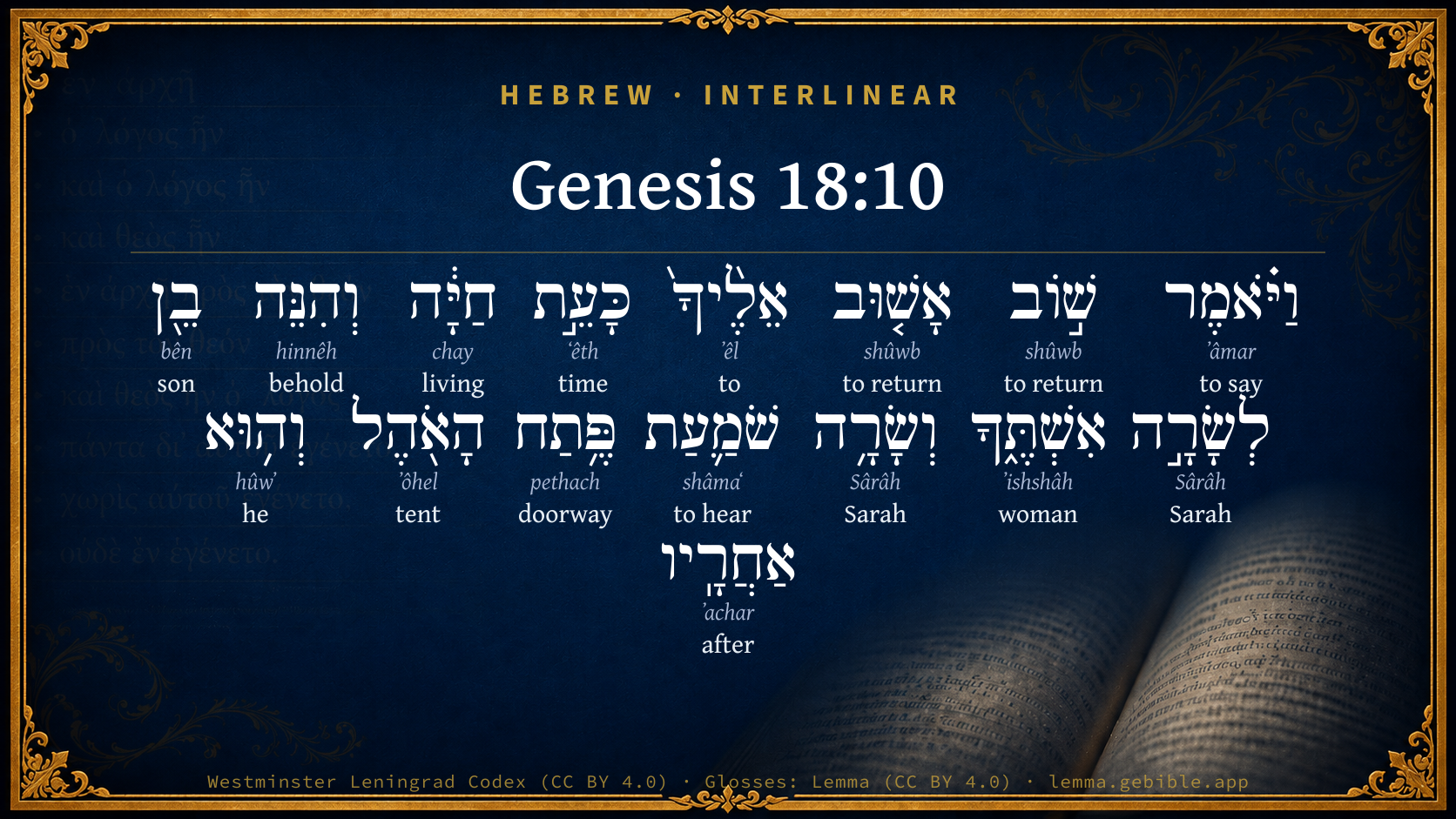
  1. וַיֹּ֗אמֶר ʼâmar H559 “and · to say” Conjunction + Verb, Qal, Sequential Imperfect, 3rd Person, Masculine, Singular
  2. שׁ֣וֹב shûwb H7725 “to return” Verb, Qal, Infinitive Absolute
  3. אָשׁ֤וּב shûwb H7725 “to return” Verb, Qal, Imperfect, 1st Person, Common, Singular
  4. אֵלֶ֨יךָ֙ ʼêl H413 “to · you” Preposition + Suffix, Personal, 2nd Person, Masculine, Singular
  5. כָּעֵ֣ת ʻêth H6256 “like/as the · time” Preposition, Determined + Noun, Common, Both, Singular, Absolute
  6. חַיָּ֔ה chay H2416 “living” Adjective, Adjective, Feminine, Singular, Absolute
  7. וְהִנֵּה hinnêh H2009 “and · behold” Conjunction + Particle, Demonstrative
  8. בֵ֖ן bên H1121 “son” Noun, Common, Masculine, Singular, Absolute
  9. אִשְׁתֶּ֑ךָ ʼishshâh H802 “woman · your” Noun, Common, Feminine, Singular, Construct + Suffix, Personal, 2nd Person, Masculine, Singular
  10. וְשָׂרָ֥ה Sârâh H8283 “and · Sarah” Conjunction + Noun, Proper
  11. שֹׁמַ֛עַת shâmaʻ H8085 “hearing” Verb, Qal, Participle Active, Feminine, Singular, Absolute
  12. פֶּ֥תַח pethach H6607 “doorway of” Noun, Common, Masculine, Singular, Construct
  13. הָאֹ֖הֶל ʼôhel H168 “the · tent” Particle, Definite Article + Noun, Common, Masculine, Singular, Absolute
  14. וְה֥וּא hûwʼ H1931 “and · he” Conjunction + Pronoun, Personal, 3rd Person, Masculine, Singular
  15. אַחֲרָֽיו ʼachar H310 “after · him” Preposition + Suffix, Personal, 3rd Person, Masculine, Singular

About this verse

These counts appear in no published source. They are computed here, from the morphology-tagged text and Lemma’s own curated glosses. What Lemma adds →

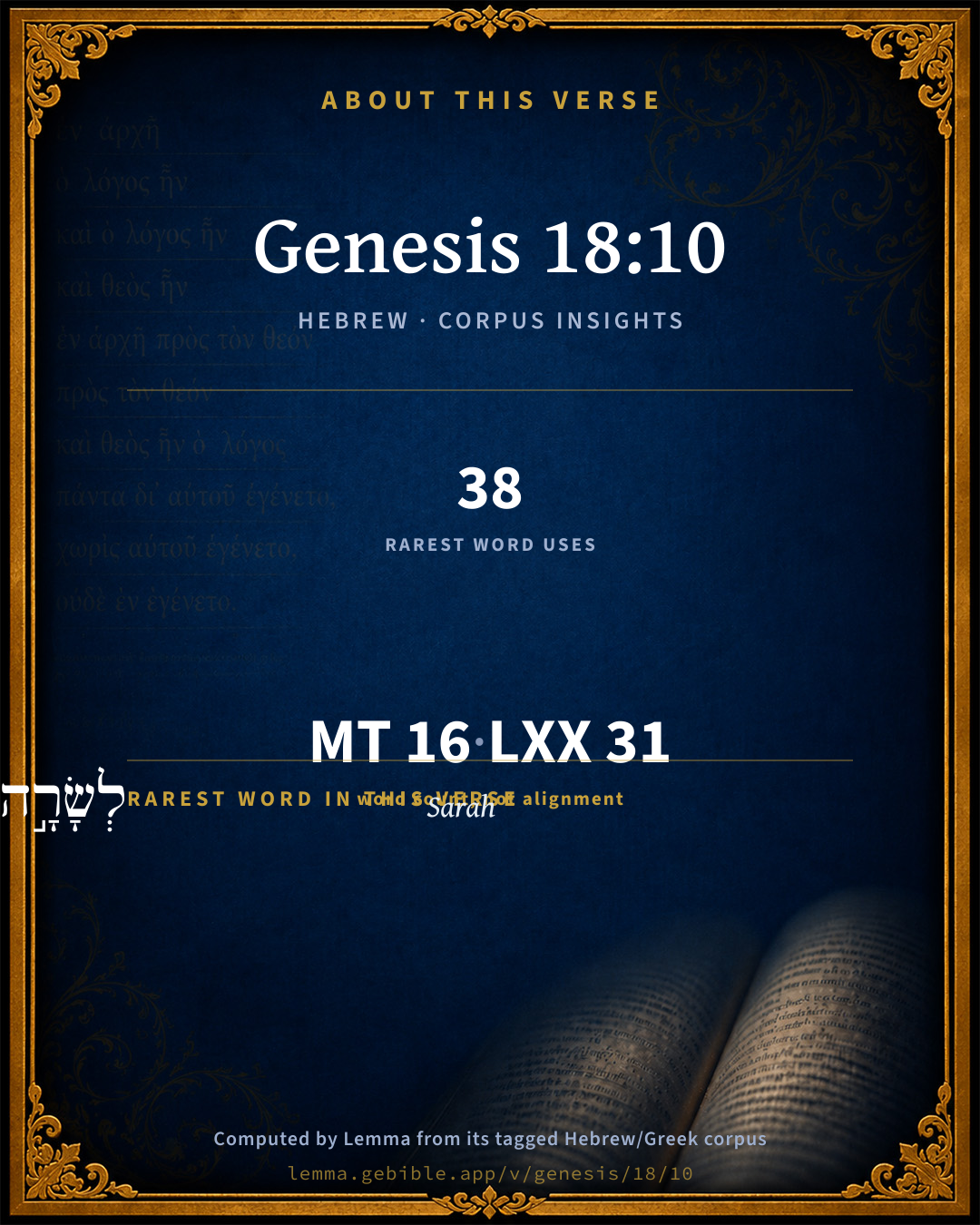
16
words
14
distinct lemmas
Pentateuch
section

Shared distinctive vocabulary

לְשָׂרָ֣ה Sarah H8283 occurs in 32 verses of the Hebrew Bible. Also found in:

Grammatical profile

  • 4 verbs
  • 7 nouns
  • 1 adjective
  • 1 pronoun
  • 2 prepositions
  • 1 particle

Verb forms

  • וַיֹּ֗אמֶר Qal · Sequential Imperfect
  • שׁ֣וֹב Qal · Infinitive Absolute
  • אָשׁ֤וּב Qal · Imperfect
  • שֹׁמַ֛עַת Qal · Participle Active

Repetition

Words recur within this verse — often emphatic in Hebrew:

  • שׁ֣וֹב to return H7725 ×2
  • לְשָׂרָ֣ה Sarah H8283 ×2

Hebrew & Septuagint length

In English translation the verse runs 31 words from the Hebrew and 35 from the Septuagint (LXX English) — closely comparable.

A rough comparison of the two English renderings, which tokenize alike — not a word-level alignment.

Word counts can differ between the Hebrew and the Greek without any difference in meaning — e.g. the Hebrew direct-object marker אֵת has no separate Greek word, and Greek often adds the article ὁ.

In the original languages it is 16 Hebrew tokens and 31 Greek tokens — but the two are counted differently (Hebrew bundles its prefixes and suffixes into one token; the Greek is in lemma form), so that isn’t a like-for-like length.

Cross-references

13

Topical passages linked to Genesis 18:10 in the Treasury of Scripture Knowledge — connected by theme and wording, ordered by reader-vote popularity; previews shown in the World English Bible.

  • Genesis 21:2 Sarah conceived, and bore Abraham a son in his old age, at the set time of which God had spoken to him.
  • Genesis 17:21 But my covenant I establish with Isaac, whom Sarah will bear to you at this set time in the next year."
  • Romans 9:8–9 That is, it is not the children of the flesh who are children of God, but the children of the promise are counted as a seed.
  • Genesis 17:16 I will bless her, and moreover I will give you a son by her. Yes, I will bless her, and she will be a mother of nations. Kings of peoples will come from her."
  • Genesis 17:19 God said, "No, but Sarah, your wife, will bear you a son. You shall call his name Isaac. I will establish my covenant with him for an everlasting covenant for his seed after him.
  • 2 Kings 4:16–17 He said, At this season, when the time comes round, you shall embrace a son. She said, No, my lord, you man of God, do not lie to your handmaid.
  • Genesis 16:10 The angel of Yahweh said to her, "I will greatly multiply your seed, that they will not be numbered for multitude."
  • Genesis 18:13–14 Yahweh said to Abraham, "Why did Sarah laugh, saying, 'Will I really bear a child, yet I am old?'
  • Genesis 22:15–16 The angel of Yahweh called to Abraham a second time out of the sky,
  • Luke 1:13 But the angel said to him, "Don't be afraid, Zacharias, because your request has been heard, and your wife, Elizabeth, will bear you a son, and you shall call his name John.
  • Galatians 4:23 However, the son by the handmaid was born according to the flesh, but the son by the free woman was born through promise.
  • Galatians 4:28 Now we, brothers, as Isaac was, are children of promise.
  • Judges 13:3–5 The angel of Yahweh appeared to the woman, and said to her, See now, you are barren, and don't bear; but you shall conceive, and bear a son.

Cross-references courtesy of OpenBible.info (CC BY 4.0).

Hebrew and Greek witnesses Masoretic Hebrew ↔ Greek Septuagint

The same verse in the two great witnesses to the Old Testament, shown verse-for-verse.

These are two independent witnesses, not word-aligned to each other, and the Septuagint is shown in lemma (dictionary) form.

Hebrew Genesis 18:10 Masoretic · Westminster Leningrad Codex

וַיֹּ֗אמֶר שׁ֣וֹב אָשׁ֤וּב אֵלֶ֨יךָ֙ כָּעֵ֣ת חַיָּ֔ה וְהִנֵּה בֵ֖ן לְשָׂרָ֣ה אִשְׁתֶּ֑ךָ וְשָׂרָ֥ה שֹׁמַ֛עַת פֶּ֥תַח הָאֹ֖הֶל וְה֥וּא אַחֲרָֽיו

He said, "I will certainly return to you when the season comes round. Behold, Sarah your wife will have a son." Sarah heard in the tent door, which was behind him.

World English Bible · Public Domain

Greek LXX Genesis 18:10 Septuagint · lemma form

εἶπον δέ ἐπι ἀναστρέφω ἥκω πρός σύ κατά ὁ καιρός οὗτος εἰς ὥρα καί ἔχω υἱός σαρρα ὁ γυνή σύ σαρρα δέ ἀκούω πρός ὁ θύρα ὁ σκηνή εἰμί ὄπισθε αὐτός

And he said, I will return and come to you according to this period seasonably, and Sarrha your wife shall have a son; and Sarrha heard at the door of the tent, being behind him.

LXX2012 (modern English Septuagint) · Public Domain

On this verse, Ellicott's Commentary for English Readers discusses the Septuagint’s reading. Read the note in Commentary ↓

Hebrew: Westminster Leningrad Codex (CC BY 4.0). Greek: Septuagint (public domain); English from LXX2012 (modern English Septuagint) (Public Domain). How the Septuagint differs from the Hebrew →

Targum (Aramaic paraphrase)

2

The Targum is the ancient Jewish Aramaic paraphrase of the Hebrew Scriptures — an interpretive translation, not the Hebrew text itself. Onkelos (literal) and Pseudo-Jonathan (expansive) render the Torah, and Jonathan the Prophets. Coverage is partial: where no permissively-licensed English translation exists for a verse, only the Aramaic is shown. This is verse-level text, not a word-by-word alignment to the Hebrew.

  1. Targum Onkelos Torah (Genesis–Deuteronomy)
    וַאֲמַר מִתַּב אִתּוּב לְוָתָךְ כְּעִדָּן דְּאַתּוּן קַיָּמִין וְהָא בַר לְשָׂרָה אִתְּתָךְ וְשָׂרָה שְמַעַת בִּתְרַע מַשְׁכְנָא וְהוּא אֲחוֹרוֹהִי

    (no public-domain English translation for this verse)

    Targum Onkelos — Aramaic: “Onkelos Genesis” (public domain); “Onkelos Exodus” (public domain); “Onkelos Leviticus” (public domain); “Onkelos Numbers” (public domain); “Onkelos Deuteronomy” (public domain). English: “Sefaria Community Translation” (CC0 1.0 (public-domain dedication)); “J.W. Etheridge. The Targums of Onkelos and Jonathan Ben Uzziel on the Pentateuch. London: Longmans, Green, 1862” (public domain). Text via Sefaria.

  2. Targum Pseudo-Jonathan Torah (Genesis–Deuteronomy)
    וַאֲמַר חַד מִנְהוֹן מֵיתַב אִתוּב לְוָתָךְ לְשַׁתָּא דְאַתְיָא וְאַתּוּן קַיָימִין וְהָא בַּר לְשָרָה אִנְתְּתָךְ וְשָרָה הֲוַת שָׁמְעָא בִּתְרַע מַשְׁכְּנָא וְיִשְׁמָעֵאל קָאִי בַּתְרֵיהּ וְצָיִית מַה דְאָמַר מַלְאָכָא

    And one of them said, Returning I will return to thee in the coming year; and you shall be revived, and, behold, Sarah thy wife shall have a son. And Sarah was hearkening at the door of the tent, and Ishmael stood behind her, and marked what the Angel said.

    Targum Pseudo-Jonathan — Aramaic: “Targum Jonathan on Genesis” (public domain); “Targum Jonathan on Exodus” (public domain); “Targum Jonathan on Leviticus” (public domain); “Targum Jonathan on Numbers” (public domain); “Targum Jonathan on Deuteronomy” (public domain). English: “The Targum of Jonathan ben Uzziel, trans. J. W. Etheridge, London, 1862” (public domain). Text via Sefaria.

Commentary

Notes on Genesis 18:10 from classic Christian and Jewish commentators (each source and its license shown beneath its notes). The classic Christian expositions comment on the surrounding passage and are grouped to its opening verse, so a note may address several verses; the Jewish commentaries on the Tanakh (Rashi and others) are per-verse, so they appear only where the commentator wrote on this verse.

Lemma curates 59 commentaries, every one of them public domain or Creative Commons licensed, each selected and text-cleaned for this edition rather than reprinted as found. About our sources →

Trapp's Complete Commentary

John Trapp

Gen 18:10 And he said, I will certainly return unto thee according to the time of life; and, lo, Sarah thy wife shall have a son. And Sarah heard [it] in the tent door, which [was] behind him.

Ver. 10. According to the time af life.] That is, when this time shall return again; this time twelve month. {See Trapp on "Gen 18:14"}

Sarah heard it in the tent-door.] She was listening out of womanish curiosity. Yet some think, the angel asked for her on purpose, that she hearing her name mentioned might listen.

John Trapp, A Commentary or Exposition upon All the Books of the Old and New Testament (1647–1656) — public domain. Text from a community e-Sword module.

Joseph Benson's Commentary

Gen 18:10. I will certainly return unto thee, and visit thee according to the time of life — That is, nine months hence, and, in fulfilment of my promise, Sarah shall have a son. God will return to those that bid him welcome.

Joseph Benson's Commentary on the Old and New Testaments (1811–1818) — public domain. Text from a community e-Sword module.

Tyndale Open Study Notes

Tyndale Open Resources

18:10 I will return: The Hebrew verb means “to intervene in someone’s life to change their destiny.” The statement announced a coming dramatic change.

Tyndale Open Study Notes — © Tyndale Open Resources, licensed CC BY-SA 4.0. Text via the HelloAO Bible API.

Geneva Bible (1599)

Geneva Bible translators

That is, about this time when she shall be alive, or when the child shall come into this life.

Geneva Bible (1599) marginal notes — public domain. Text via Bolls.life.

Jamieson, Fausset & Brown

Robert Jamieson, A. R. Fausset & David Brown

REPROOF OF SARAH. An inquiry about his wife, so surprising in strangers, the subject of conversation, and the fulfilment of the fondly cherished promise within a specified time, showed Abraham that he had been entertaining more than ordinary travellers (Heb 13:2). (Gen 18:9-15)

Sarah heard it in the tent door, which was behind him--The women's apartment is in the back of the tent, divided by a thin partition from the men's.

Jamieson, Fausset & Brown — Commentary Critical and Explanatory on the Whole Bible (1871) — public domain (CC PDM 1.0). Text via the HelloAO Bible API.

Adam Clarke's Commentary

Verse 10. I will certainly return] Abraham was now ninety-nine years of age, and this promise was fulfilled when he was a hundred; so that the phrase according to the time of life must mean either a complete year, or nine months from the present time, the ordinary time of pregnancy. Taken in this latter sense, Abraham was now in the ninety-ninth year of his age, and Isaac was born when he was in his hundredth year.

Adam Clarke's Commentary on the Bible (1810–1826) — public domain. Text from a community e-Sword/MySword module.

John Calvin's Commentaries

10. I will certainly return unto thee Jerome translates its ‘I will return, life attending me:’ as if God, speaking in the manner of men, had said, ‘I will return if I live.’ But it would be absurd, that God, who here so magnificently proclaims his power, should borrow from man a form of speech which would suppose him to be mortal. What majesty, I pray, would this remarkable oracle possess, which treats of the eternal salvation of the world? That interpretation, therefore, can by no means be approved, which entirely enervates the force and authority of the promise. Literally it is, according to the time of life. Which some expound of Sarah; as if the angel had said, Sarah shall survive to that period. But it is more properly explained of the child; for God promises that He will come, at the just and proper time of bringing forth, that Sarah might become the mother of a living child.

John Calvin's Commentaries (1540-1563) — public domain. Text from the Calvin Translation Society English edition (1840s-50s) via the Christian Classics Ethereal Library (ccel.org). Calvin's coverage is partial (roughly two-thirds of the Bible); uncommented books and verses are honest gaps, never fabricated. The 19th-century editor's footnotes and remarks are omitted so the notes are faithfully Calvin's own voice.

Ellicott's Commentary for English Readers

(10) According to the time of life.—Heb., according to the living time. It is evident from Gen_18:14, and 2Ki_4:16-17, that these words denote some fixed period, but the exact rendering is in dispute. “When the season revives” = next spring, is entirely remote from Oriental thought, and the rendering of Zunz “at the living time” is poetical, but meaningless. The true rendering is probably “a year hence,” as when the year is over it dies, and a new year lives in its place. Jewish tradition is strongly in favour of this view, translating “according to this time next year,” and adding that the season was the Passover. The only other tenable rendering is “in course of time.”

Which was behind him.—The LXX. has a preferable reading, and she was behind it. The door, as we have seen, was an opening made by looping back the curtain, which would effectually conceal Sarah’s person.

A Bible Commentary for English Readers, edited by Charles John Ellicott (1878–1897) — public domain. Text from a community e-Sword module.

The Cambridge Bible for Schools and Colleges

gen. ed. J. J. S. Perowne

10. I will certainly] A first hint of Divine knowledge of the parents’ grief over their childlessness.

when the season cometh round] R. V. marg. Heb. liveth, or, reviveth. A strange phrase, probably meaning “at this time a year hence,” as in Gen_17:21. Cf. 2Ki_4:16-17, LXX κατὰ τὸν καιρὸν τοῦτον εἰς ὥρας, Lat. tempore isto, vita comite. Skinner conjectures, with a slight alteration of the vowel points, “according to the time of a pregnant woman,” on the ground that the Heb. word for “liveth” means in modern Heb. “a woman in child-birth.”

Sarah … in the tent door] Sarah was not visible, but the conversation of the men under the tree was easily audible to her at the tent opening.

heard] Better, “was listening,” which reproduces the Heb. participle.

which was behind him] Probably the LXX preserves the right reading, “and she was behind it,” i.e. the door.

The Cambridge Bible for Schools and Colleges (gen. ed. J. J. S. Perowne; Cambridge University Press, 1878–1918) — public domain. Text from a community e-Sword module.

John Gill's Exposition

And he said,.... The same that put the question, Jehovah himself, as appears by what follows:

I will certainly return unto thee according to the time of life; not by a personal appearance as now, but by the fulfilment of his promise which he had before given to Abraham, that he should have a son by Sarah, and now renews it; and this would be about the same time in the next year, perhaps at the spring of the year, which may be called "a time of life", when all things revive, which in the winter season seem to be dead; a fit emblem this of the case and condition of Abraham and Sarah, both as they now were, and afterwards would be; for, though their bodies were as it were dead and unfit for generation, yet nature would revive in them again: unless it be understood of the whole time of the conception, quickening, and birth of an infant, at the usual time a woman goes with child, which is nine months, when the infant is a perfect living child. All the Targums paraphrase it,"in which ye shall be alive,''safe and well, and so most of the Jewish commentators; as if it was a promise to Abraham and Sarah, that they should live to see the promise made good next given; but this seems not so agreeable as either of the former, see Kg2 4:16,

and, lo, Sarah thy wife shall have a son; it was by degrees that this was made known to Abraham; first he was told he should have a son, but it was not said by whom he should have it; some years after that he is informed he should have a son by Sarah, but not when; but now it is revealed to him, that he should have one by her the next year:

and Sarah heard it in the tent door, which was behind him; or, "and it was behind him" (u); that is, the tent door was at the back of the person speaking; Sarah, hearing her name mentioned, got to the tent door to listen to what might be further said; and the place where she was, was behind the speaker, who stood between her and Abraham, with whom he was conversing; Abraham was before high, and Sarah behind him, so that he could not see her when she laughed, and yet he knew she did; and for the sake of that, this circumstance is remarked: both the Targums of Jonathan and Jerusalem paraphrase the clause,"and Ishmael stood behind it,''the tent door; and the former adds, and hearkened to what the angel said.

(u) "et ipsum post eum", Montanus.

John Gill's Exposition of the Whole Bible (1746–1763) — public domain (CC PDM 1.0). Text via the HelloAO Bible API.

Haydock's Catholic Bible Commentary

Time, or season of the year ensuing, if I be alive; which he says after the manner of men, as he had assumed also the human form. (Haydock)

George Leo Haydock (1774–1849), Haydock's Catholic Family Bible and Commentary, 1859 edition — public domain. Excludes Psalms (Douay-Rheims chapter numbering differs from Protestant) and Deuterocanonical books (Catholic canon only).

Matthew Poole's English Annotations

I will certainly return unto thee, not in a visible shape, but with my powerful and effectual presence, to fulfil my promise.

According to the time of life: this time may respect, either,

1. Abraham and Sarah, in the time of life, i.e. when you shall be both alive and in health. But if it belonged to them, it might seem better to understand it thus; in the time when God shall restore life, i.e. vigour and activity to you; for till then both Abraham’s body and Sarah’s womb are expressly said to be dead, Rom 4:19, to which deadness this life may be opposite; and the time of restoring this lost power of generation may well be called a time of life, it being a kind of life from the dead, and an empowering of him for a vital action from which he was before disenabled, and for the conveying of life to a child, and perpetuating his own life in him. Or,

2. To the child, according to the time of life, i.e. in the time which is usual for the conception, quickening, and bringing forth of a living child. Which interpretation receiveth some countenance from 2Ki 4:16, where we have the same phrase. Or,

3. To the year, according to the time, or this time of life, or living time, i.e. when this time or season of the year shall revive, i.e. return or be restored; as cities and buildings are said to be revived, when they are repaired or rebuilt, as 1Ch 11:8; Neh 4:2. And this season might more properly be said to revive, and be called the time of life, because it may be gathered from the heat, Gen 18:1, and their refreshing themselves under the shadow of a tree, that it was the spring time, when herbs and plants and trees, which seem to be dead in the winter, recover and show forth their life and vigour: and so the sense may be this, according to this time, which is a time of life, or reviving, wherein as the beauty and fruits of the earth will be renewed and revived, so thou and Sarah shall be revived, or receive, as it were, a new life in the son that shall be born to you. This sense seems more probable than either of the former, because he speaks of a certain set or appointed time, Gen 18:14; Rom 9:9; Gen 21:2, and that time was about a year after this, as may appear by comparing Gen 17:24, and Gen 21:5.

In the tent door which was behind him, i.e. at the back of the angel that spoke with him; which is here added, to show that he knew her laughter, not by the sight of his eyes, but by his all-seeing knowledge.

Matthew Poole's English Annotations on the Holy Bible (1683–1685) — public domain. Text from a community e-Sword/MySword module.

Whedon's Commentary on the Bible

Daniel D. Whedon

10. He said — The question of Gen_18:9 was common to the three — “they said.” Now HE, the prominent One, whom Abraham, in Gen_18:3, called “My Lord,” speaks in the person of the Almighty, assuming power to accomplish what he promises.

I will certainly return — He speaks as if about departing. Like a passing traveller, he will now depart, but he will return again.

According to the time of life — Reference to what he had previously promised, in a very recent revelation, “at this set time next year.” Gen_17:21.

Daniel D. Whedon (gen. ed.), Commentary on the Old and New Testaments (1874–1909) — public domain. Text from a community e-Sword module.

The Pulpit Commentary

And he said (the Principal Guest, as above, who, by the very nature and terms of his announcement, identifies himself with Jehovah), I will certainly return unto thee according to the time of life. Literally, at the time reviving; i.e. when the year shall have been renewed, in the next year, or rather spring (vide Ewald, "Hebrews Synt.," Rosenm Drusius, Keil, Kalisch, Lange, Ainsworth, "Speaker"s Commentary"); though other interpretations of the phrase have been suggested, as, e.g., "according to the time of that which is born," i.e. at the end of nine months (Willet, Calvin, Bush, Murphy). And, lo, Sarah thy wife shall have a son. Ie. at the time specified. And Sarah heard it in the tent door, which was behind him.

The Pulpit Commentary (1880–1919), ed. H.D.M. Spence-Jones & Joseph S. Exell — public domain. Text from a community e-Sword module.

John Wesley's Explanatory Notes

I will certainly return unto thee - And visit thee. God will return to those that bid him welcome.

John Wesley, Explanatory Notes Upon the Whole Bible (1754–1765) — public domain. Text via the GEBible commentary corpus.

Rashi

Rabbi Shlomo Yitzchaki (Rashi)

שוב אשוב I WILL CERTAINLY RETURN — The angel was not announcing that he would return to him, but he was speaking to him as God’s agent (meaning that God would return). Similar is, (16:10) “And the angel of the Lord said to her, I will greatly multiply thy seed, but he had no power to multiply, and was speaking only as God’s agent. So also here, he spoke thus as God’s agent. Elisha said to the Shunamite (2 Kings 4:16), “At this season when the time cometh round thou shalt embrace a son”, and she said, “Nay, my lord, thou man of God, do not lie unto thy handmaid; see, those angels who made the announcement to Sarah said “at the appointed time I will return”! Elisha in effect said to her, “Those angels who live and endure for ever could indeed promise “at the appointed time I will return”, but I am only flesh and blood (human), alive today and dead tomorrow — but whether I live or die, “at this season [thou shalt embrace a son]” (Genesis Rabbah 53:2).

כעת חיה means at this time next year — it was the Passover, and on the next Passover Isaac was born — since we do not read כְּעֵת (at “a” time) but כָּעֵת (at this time).

The words כעת חיה signify: at this time when there will be life to you — when you will all be healthy and alive.

והוא אחריו AND IT (literally, HE) WAS BEHIND HIM — The door was behind the angel.

Rashi on the Tanakh — English translations: “The Judaica Press complete Tanach with Rashi, translated by A. J. Rosenberg” (CC BY 4.0); “Pentateuch with Rashi's commentary by M. Rosenbaum and A.M. Silbermann, 1929-1934” (public domain); “The Metsudah Tanach series, Lakewood, N.J” (CC BY 4.0); and “The Book of Joshua, Metsudah Publications, 1997” (CC BY 4.0). Text via Sefaria.

Ramban (Nachmanides)

Rabbi Moshe ben Nachman (Ramban / Nachmanides)

I WILL CERTAINLY RETURN UNTO THEE WHEN THE SEASON COMETH AROUND. Rashi comments, “The angel was not announcing that he would return to him, but he was speaking to him as G-d’s agent, [meaning that G-d would return]. This is similar to the verse: And the angel of the Eternal said to her [Hagar], I will multiply thy seed exceedingly., 16:10. But he [the angel] has no power to multiply, and he was therefore speaking as G-d’s agent. So also here, he spoke as G-d’s agent.”Now the Rabbi, Note 139. found it necessary to say so because the Holy One, blessed be He, told Abraham here, At the set time I will return unto thee.. However, whether it be a reference to the angel or to the Holy One, blessed be He, we do not find it recorded that at the set time He returned. Perhaps a reference to this return is included in the expression, And the Eternal remember-ed Sarah, as He had said, and the Eternal did unto Sarah as He had spoken. Rabbi Abraham ibn Ezra said that the verse beginning, And the Eternal said to Abraham,. means that the angel said it in the name of Him Who sent him, and he did return at the set time which he had told him, even though it is not written in Scripture.The correct interpretation appears to me to be that [the expression, shov ashuv (I will certainly return)], is akin to the phrase, liteshuvath hashanah (at the return of the year). The verse is thus stating: “I will surely bring back to thee a time as this time, that you will be alive and Sarah your wife will have a son.” This is similar to what was said to Abraham, At this set time in the next year. The word ashuv will then be like, ‘Veshav’ (And) the Eternal your G-d (will bring back) thy captivity and have compassion upon thee and will return and gather thee. there means “and He will bring back.” Here too the word ashuv means “I will bring back a time, like the present, in which you will be alive, and in which time, in addition to your being alive, Sarah will have a son.”

Ramban (Nachmanides) on the Tanakh — English translation: “Commentary on the Torah by Ramban (Nachmanides). Translated and annotated by Charles B. Chavel. New York, Shilo Pub. House, 1971-1976” (CC BY 4.0). Text via Sefaria.

Radak

Rabbi David Kimhi (Radak)

ויאמר, the senior angel, the one whom Avraham had addressed in verse 3 with the words אם נא מצאתי חן בעיניך. שוב אשוב אליך, this was the one whose task it was to tell Sarah that she would bear a son. He spoke of his return visit a year from the present time. The other two were to destroy Sodom and to rescue Lot respectively. Three angels were required as no angel is charged with more than one mission at a time. (Bereshit Rabbah 50,2)

כעת חיה, at about this time of year next year Sarah will be giving birth. We find the term חיה used to describe giving birth in Yuma 73. On the other hand, the word may also refer to a time frame, i.e. at this time next year, seeing that you will both be alive, Sarah will bear a son. G’d had spoken of למועד הזה בשנה האחרת (compare Genesis 17,21) whereas the angel expressed the same thought in the words כעת חיה. The angel did not spell out to Avraham precisely when this birth would take place, as had G’d in the previous chapter.

ושרה שומעת פתח האהל, she had been inside her tent; when she heard the voices of the angel and Avraham. She went to the entrance of her tent to overhear what was being said. Neither the angel nor Avraham saw her at the time. seeing both their backs were turned towards the entrance. This is the meaning of the words והוא אחריו, i.e. Sarah’s tent was behind the angel who was doing the talking.

Radak on the Tanakh — English translations: “Sefaria Community Translation” (CC0 1.0 (public-domain dedication)); “Eliyahu Munk, HaChut Hameshulash” (CC BY 4.0); “Rabbi Mike Feuer, Jerusalem Anthology” (CC BY 4.0); and “R. David Kimhi on the first book of Psalms, Translated by R.G. Finch, London, 1919” (public domain). Text via Sefaria.

Lesson kit

Teaching starters — assembled from the data on this page, not authored interpretation. Every prompt links to the verse data it draws on. Edit before teaching.

Genesis, in the Pentateuch, opens this verse with 16 words (14 distinct Hebrew lemmas). Its most distinctive word is Sârâh (“Sarah”). A historical commentator’s framing appears above. Read the whole chapter for the surrounding context.

Discussion questions

  1. The word Sârâh carries the sense “Sarah.” How does it shape the verse?
  2. Genesis 17:15 shares the word «Sarah» with this verse. How do the two illuminate each other?
  3. “to return” occurs 2× in this one verse. What is the effect of the repetition?
  4. The translations on this page render this verse differently — a whole-verse word diff, not a word-by-word alignment. What might account for the different wordings?
  5. The verb «וַיֹּ֗אמֶר» is Qal Sequential Imperfect. How does its form color the action?
  6. Reading how Trapp's Complete Commentary and Joseph Benson's Commentary read this verse, where do the two commentators agree and where do they part?

Things to notice

Reading settings

Reading text

Shown beneath each verse's original-language words.

Old Testament
Old Testament edition

Read the OT as the Masoretic Hebrew (MT) or the Greek Septuagint (LXX).

English shown for the Greek Septuagint (in the Hebrew ↔ Greek comparison).

Comparing translations? Open the Compare panel on any verse page to stack up to four side by side.