Jeremiah 8:5

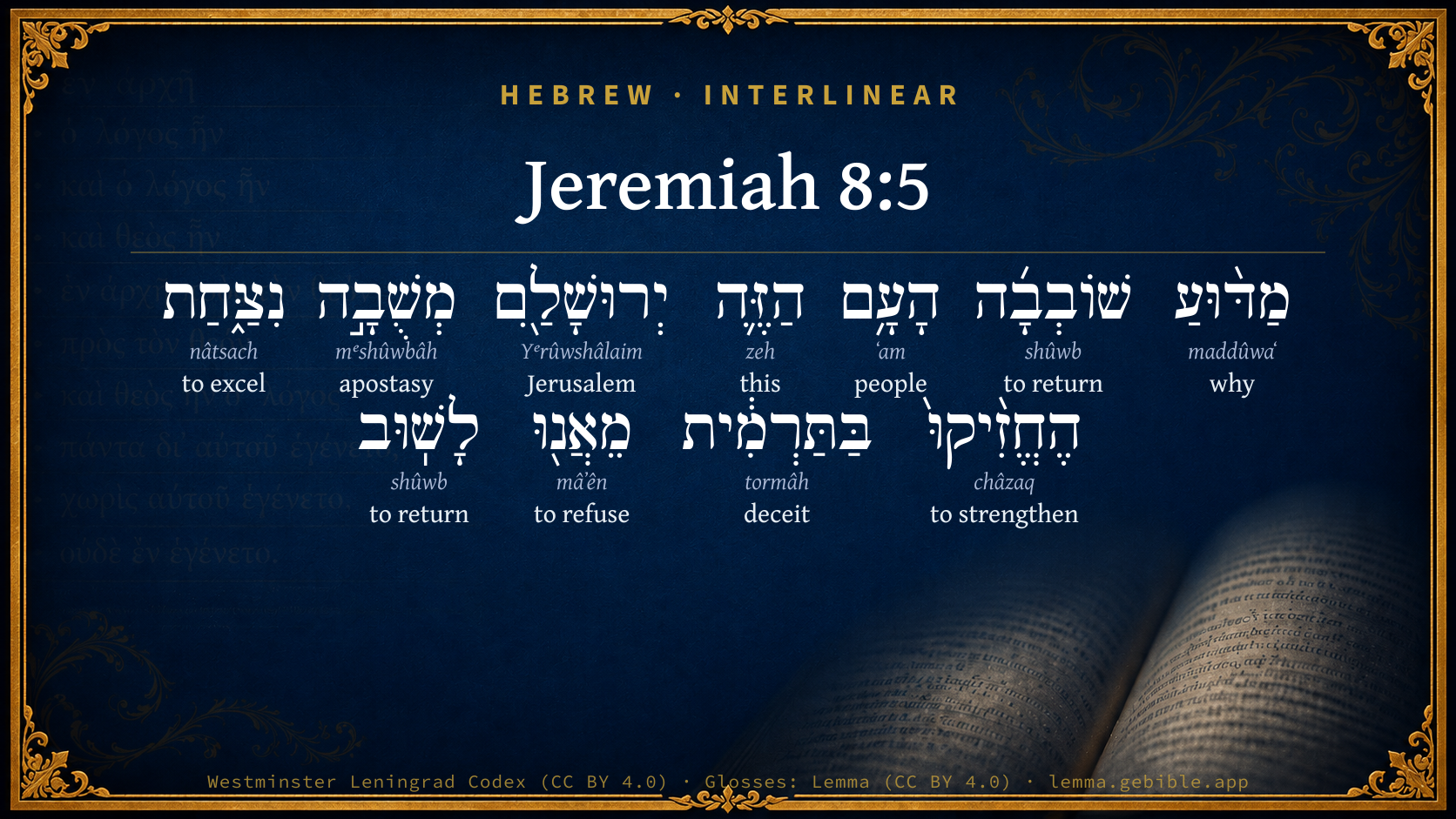
Hebrew (Westminster Leningrad Codex) Jeremiah 8:5 appears in the Hebrew Old Testament. The text above is from the Westminster Leningrad Codex. Each word links to its Strong’s number, a concise gloss, and parsing drawn from the Open Scriptures Hebrew Bible morphology. Click any word for its full Brown-Driver-Briggs (BDB) entry.
Download image
Cite this verse

Jeremiah 8:5 (World English Bible). Public Domain. Lemma interlinear Bible study tool, https://lemma.gebible.app/v/jeremiah/8/5.

Show BibTeX & RIS
BibTeX
RIS
English Translation
Why then is this people of Jerusalem slidden back by a perpetual backsliding? they hold fast deceit, they refuse to return.
World English Bible · Public Domain
Download a study sheet

One document with this verse’s original text, its word-by-word gloss line, the meaning frame, cross-references with their text, attributed commentary, and full source and license credits — printable, and it pastes into notes with its structure intact.

This verse Autodidact and up

Study sheet (.html) Plain text (.txt)

A passage Seminary Student

Up to 50 verses in one chapter. A passage sheet keeps up to 6 commentary sources and 12 cross-references per verse, in the order this page ranks them, and says so on the sheet whenever that leaves anything out. Ask for a single verse and you get the Autodidact verse sheet above.

Everything on this page stays free to read, with no account — the sheet is a download of what is already on screen, not access to it.

Want to remove ads? Support Godless Engineer
Compare translations 3

The same verse in 3 English versions, stacked beneath the original-language interlinear above. Click any original word for its lexicon entry.

Each is an independent rendering of the whole verse — the interlinear is not word-aligned to these translations.

Highlighted words mark where these versions differ — a whole-verse word diff, not a word-by-word alignment.

  • World English Bible Public Domain
    Why then is this people of Jerusalem slidden back by a perpetual backsliding? they hold fast deceit, they refuse to return.
  • King James Version Public Domain
    Why then is this people of Jerusalem slidden back by a perpetual backsliding? they hold fast deceit, they refuse to return.
  • unfoldingWord Literal Text CC BY-SA 4.0
    Why this people, Jerusalem, turned away, a continous apostasy? They grasp upon deceit and refuse to turn.

unfoldingWord Literal Text — © unfoldingWord, licensed CC BY-SA 4.0. Word-aligned USFM3 via Door43 (git.door43.org/unfoldingWord/en_ult).

Versions to compare (up to 4)

3 of 4 selected

Show all 18 translations

Every available English version of this verse, each an independent rendering of the whole verse.

  • World English Bible Public Domain
    Why then is this people of Jerusalem slidden back by a perpetual backsliding? they hold fast deceit, they refuse to return.
  • Berean Standard Bible Public Domain
    Why then have these people turned away? Why does Jerusalem always turn away? They cling to deceit; they refuse to return.
  • Majority Standard Bible Public Domain
    Why then have these people turned away? Why does Jerusalem always turn away? They cling to deceit; they refuse to return.
  • King James Version Public Domain
    Why then is this people of Jerusalem slidden back by a perpetual backsliding? they hold fast deceit, they refuse to return.
  • American Standard Version (1901) Public Domain
    Why then is this people of Jerusalem slidden back by a perpetual backsliding? they hold fast deceit, they refuse to return.
  • Revised Version (1885) Public Domain
    Why then is this people of Jerusalem slidden back by a perpetual backsliding? they hold fast deceit, they refuse to return.
  • Geneva Bible (1599) Public Domain
    Wherefore is this people of Ierusalem turned backe by a perpetuall rebellion? they gaue themselues to deceit, and would not returne.
  • Douay-Rheims (1899) Public Domain
    Why then is this people in Jerusalem turned away with a stubborn revolting? they have laid hold on lying, and have refused to return.
  • Young's Literal Translation Public Domain
    Wherefore hath this people of Jerusalem Turned back -- a perpetual backsliding? They have kept hold on deceit, They have refused to turn back.
  • Literal Standard Version CC BY-SA 4.0
    Why has this people of Jerusalem || Turned back—a continuous backsliding? They have kept hold on deceit, || They have refused to turn back.
  • Unlocked Literal Bible CC BY-SA 4.0
    Why has this people, Jerusalem, turned away in permanent faithlessness? They hold on to treachery and refuse to repent.
  • unfoldingWord Literal Text CC BY-SA 4.0
    Why this people, Jerusalem, turned away, a continous apostasy? They grasp upon deceit and refuse to turn.
  • Darby Bible Public Domain
    Why hath this people of Jerusalem slidden back with a perpetual backsliding? They hold fast deceit, they refuse to return.
  • World Messianic Bible Public Domain
    Why then have the people of Jerusalem fallen back by a perpetual backsliding? They cling to deceit. They refuse to return.
  • Webster's Bible Public Domain
    Why then hath this people of Jerusalem slidden back by a perpetual backsliding? they hold fast deceit, they refuse to return.
  • Free Bible Version CC BY-SA 4.0
    So why have these people of Jerusalem gone the wrong way? Why do they refuse to turn around from their repeated betrayals, holding on to all their lies?
  • Bible in Basic English Public Domain
    Why do these people of Jerusalem go back, for ever turning away? they will not give up their deceit, they will not come back.
  • JPS Tanakh (1917) Public Domain
    Why then is this people of Jerusalem slidden back by a perpetual backsliding? They hold fast deceit, they refuse to return.

Literal Standard Version (2020), Covenant Press — licensed CC BY-SA 4.0. Text via the HelloAO Bible API (eBible.org). Unlocked Literal Bible (unfoldingWord) — licensed CC BY-SA 4.0. Text via the HelloAO Bible API (eBible.org). unfoldingWord Literal Text — © unfoldingWord, licensed CC BY-SA 4.0. Word-aligned USFM3 via Door43 (git.door43.org/unfoldingWord/en_ult). Free Bible Version, Dr. Jonathan Gallagher — licensed CC BY-SA 4.0. Text via the HelloAO Bible API (eBible.org).

Word by word

More ways to search: Search by grammar → Find every occurrence → Compare this word →

Practice this passage: Drill this verse → Learn its vocabulary →

בַּתַּרְמִ֔ית
tormâh
H8649
“in/at the · deceit”
Preposition, Determined + Noun, Common, Feminine, Singular, Absolute
Part of Speech
Preposition + Noun
Type
Common
Gender
Feminine
Number
Singular
State
Absolute
Full BDB Definition

Origin: from H7411

TWOT: 2169c

treachery, fraud, deceit, deceitfulness
  1. מַדּ֨וּעַ maddûwaʻ H4069 “why” Particle, Interrogative
  2. שׁוֹבְבָ֜ה shûwb H7725 “to return” Verb, Polel, Perfect, 3rd Person, Feminine, Singular
  3. הָעָ֥ם ʻam H5971 “the · people” Particle, Definite Article + Noun, Common, Masculine, Singular, Absolute
  4. הַזֶּ֛ה zeh H2088 “the · this” Particle, Definite Article + Pronoun, Demonstrative, Masculine, Singular
  5. יְרוּשָׁלִַ֖ם Yᵉrûwshâlaim H3389 “Jerusalem” Noun, Proper
  6. מְשֻׁבָ֣ה mᵉshûwbâh H4878 “apostasy” Noun, Common, Feminine, Singular, Absolute
  7. נִצַּ֑חַת nâtsach H5329 “excelled” Verb, Niphal, Participle Passive, Feminine, Singular, Absolute
  8. הֶחֱזִ֨יקוּ֙ châzaq H2388 “to strengthen” Verb, Hiphil, Perfect, 3rd Person, Common, Plural
  9. מֵאֲנ֖וּ mâʼên H3985 “to refuse” Verb, Piel, Perfect, 3rd Person, Common, Plural
  10. לָשֽׁוּב shûwb H7725 “to return” Preposition + Verb, Qal, Infinitive Construct

About this verse

These counts appear in no published source. They are computed here, from the morphology-tagged text and Lemma’s own curated glosses. What Lemma adds →

11
words
10
distinct lemmas
Prophets
section

Notable vocabulary

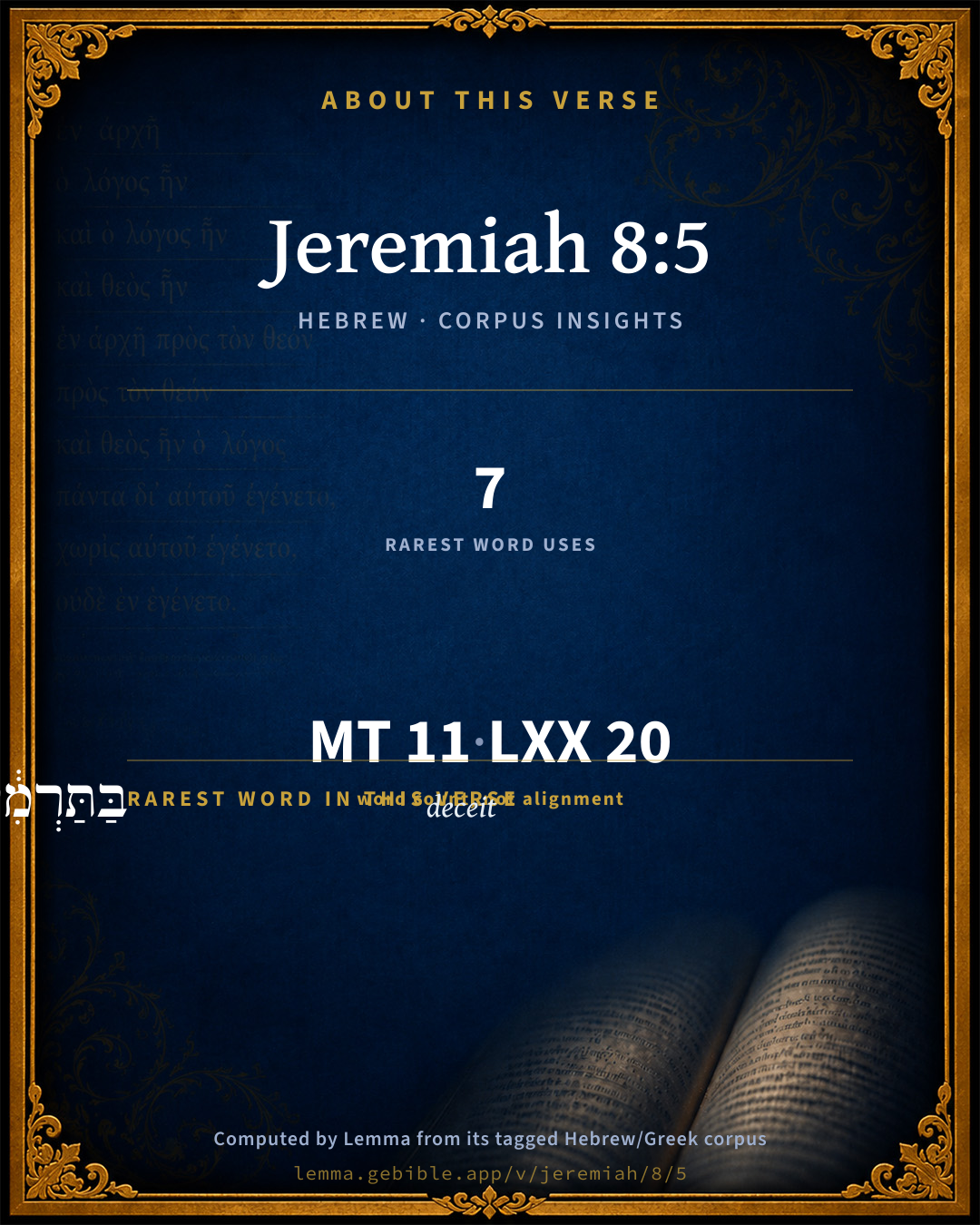
The rarest word here is בַּתַּרְמִ֔ית deceit H8649 — appearing just 7 times in the whole Hebrew Bible.

Shared distinctive vocabulary

בַּתַּרְמִ֔ית deceit H8649 occurs in 6 verses of the Hebrew Bible. Also found in:

Grammatical profile

  • 5 verbs
  • 4 nouns
  • 1 pronoun
  • 1 particle

Verb forms

  • שׁוֹבְבָ֜ה Polel · Perfect
  • נִצַּ֑חַת Niphal · Participle Passive
  • הֶחֱזִ֨יקוּ֙ Hiphil · Perfect
  • מֵאֲנ֖וּ Piel · Perfect
  • לָשֽׁוּב Qal · Infinitive Construct

Repetition

A word recurs within this verse — often emphatic in Hebrew:

  • שׁוֹבְבָ֜ה to return H7725 ×2

Hebrew & Septuagint length

In the original languages it is 11 Hebrew tokens and 20 Greek tokens — but the two are counted differently (Hebrew bundles its prefixes and suffixes into one token; the Greek is in lemma form), so that isn’t a like-for-like length.

Cross-references

18

Topical passages linked to Jeremiah 8:5 in the Treasury of Scripture Knowledge — connected by theme and wording, ordered by reader-vote popularity; previews shown in the World English Bible.

  • Jeremiah 9:6 Your habitation is in the midst of deceit; through deceit they refuse to know me, says Yahweh.
  • Jeremiah 5:3 O Yahweh, don't your eyes look on truth? you have stricken them, but they were not grieved; you have consumed them, but they have refused to receive correction: they have made their faces harder than a rock; they have refused to return.
  • Zechariah 7:11 But they refused to listen, and turned their backs, and stopped their ears, that they might not hear.
  • Hosea 11:7 My people are determined to turn from me. Though they call to the Most High, He certainly won't exalt them.
  • John 5:40 Yet you will not come to me, that you may have life.
  • Hebrews 12:25 See that you don't refuse him who speaks. For if they didn't escape when they refused him who warned on the Earth, how much more will we not escape who turn away from him who warns from heaven,
  • Isaiah 30:10 who tell the seers, "Don't see;" and to the prophets, "Don't prophesy to us right things, speak to us smooth things, prophesy deceits,
  • Isaiah 44:20 He feeds on ashes; a deceived heart has turned him aside; and he can't deliver his soul, nor say, Is there not a lie in my right hand?
  • Jeremiah 5:27 As a cage is full of birds, so are their houses full of deceit: therefore they are become great, and grew rich.
  • 2 Thessalonians 2:9–12 even he whose coming is according to the working of Satan with all power and signs and lying wonders,
  • Hosea 4:16 For Israel has behaved extremely stubbornly, like a stubborn heifer. Then how will Yahweh feed them like a lamb in a meadow.
  • 1 Thessalonians 5:21 Test all things, and hold firmly that which is good.
  • Revelation 2:25 Nevertheless, hold firmly that which you have, until I come.
  • Proverbs 4:13 Take firm hold of instruction. Don't let her go. Keep her, for she is your life.
  • Isaiah 1:20 But if you refuse and rebel, you shall be devoured with the sword; For the mouth of Yahweh has spoken it."
  • Jeremiah 2:32 Can a virgin forget her ornaments, or a bride her attire? yet my people have forgotten me days without number.
  • Jeremiah 3:11–14 Yahweh said to me, Backsliding Israel has shown herself more righteous than treacherous Judah.
  • Jeremiah 7:24–26 But they didn't listen nor turn their ear, but walked in [their own] counsels [and] in the stubbornness of their evil heart, and went backward, and not forward.

Cross-references courtesy of OpenBible.info (CC BY 4.0).

Hebrew and Greek witnesses Masoretic Hebrew ↔ Greek Septuagint

The same verse in the two great witnesses to the Old Testament, shown verse-for-verse.

These are two independent witnesses, not word-aligned to each other, and the Septuagint is shown in lemma (dictionary) form.

Hebrew Jeremiah 8:5 Masoretic · Westminster Leningrad Codex

מַדּ֨וּעַ שׁוֹבְבָ֜ה הָעָ֥ם הַזֶּ֛ה יְרוּשָׁלִַ֖ם מְשֻׁבָ֣ה נִצַּ֑חַת הֶחֱזִ֨יקוּ֙ בַּתַּרְמִ֔ית מֵאֲנ֖וּ לָשֽׁוּב

Why then is this people of Jerusalem slidden back by a perpetual backsliding? they hold fast deceit, they refuse to return.

World English Bible · Public Domain

Greek LXX Structure differs

In the Septuagint, Jeremiah is about an eighth shorter than the Hebrew and arranges its material differently — the Oracles Against the Nations (Hebrew chapters 46–51) appear in the middle of the Greek book, after 25:13. Because the chapter and verse boundaries do not line up, a verse-for-verse comparison with the Hebrew is not shown.

A verse-for-verse comparison isn’t shown here because the chapters and verses don’t line up. Switch to the LXX edition with the MT / LXX toggle above to read the Greek directly.

Hebrew: Westminster Leningrad Codex (CC BY 4.0). Greek: Septuagint (public domain); English from a public-domain English Septuagint. How the Septuagint differs from the Hebrew →

Targum (Aramaic paraphrase)

1

The Targum is the ancient Jewish Aramaic paraphrase of the Hebrew Scriptures — an interpretive translation, not the Hebrew text itself. Onkelos (literal) and Pseudo-Jonathan (expansive) render the Torah, and Jonathan the Prophets. Coverage is partial: where no permissively-licensed English translation exists for a verse, only the Aramaic is shown. This is verse-level text, not a word-by-word alignment to the Hebrew.

  1. Targum Jonathan Prophets (Joshua–Malachi)
    מַה דֵין מִתְחַסְנִין לְמֵיתָב לְפוּלְחָנִי עַמָא הָדֵין יַתְבֵי יְרוּשְׁלֵם תָּבוּ לִמְרַד מִן אוֹרַיְתָא וְלָא צָבָן לְמֵיתַב אַתְקִיפוּ בְּנִכְלִין מְסָרְבִין לְמֵיתַב:

    (no public-domain English translation for this verse)

    Targum Jonathan — Aramaic: “Mikraot Gedolot” (public domain). English: “Sefaria Community Translation” (CC0 1.0 (public-domain dedication)); “London "Chaldee Paraphrase," 1871” (public domain). Text via Sefaria.

Commentary

Notes on Jeremiah 8:5 from classic Christian and Jewish commentators (each source and its license shown beneath its notes). The classic Christian expositions comment on the surrounding passage and are grouped to its opening verse, so a note may address several verses; the Jewish commentaries on the Tanakh (Rashi and others) are per-verse, so they appear only where the commentator wrote on this verse.

Lemma curates 59 commentaries, every one of them public domain or Creative Commons licensed, each selected and text-cleaned for this edition rather than reprinted as found. About our sources →

Trapp's Complete Commentary

John Trapp

Jer 8:5 Why [then] is this people of Jerusalem slidden back by a perpetual backsliding? they hold fast deceit, they refuse to return.

Ver. 5. Why then is this people of Jerusalem? &c.] Why else but because they are void of all true reason, and quite beside themselves in point of salvation? Their pertinace, or rather pervicacy, in sinning is altogether insuperable. Monoceros interimi potest, capri non potest. The unicorn is able to be killed, the billy goat can not.

They hold fast deceit.] They hold close to their false prophets, or rather a false heart of their own hath deceived them. {as Jer 8:11} A deceived heart hath turned them aside. {as Isa 44:20; see there}

John Trapp, A Commentary or Exposition upon All the Books of the Old and New Testament (1647–1656) — public domain. Text from a community e-Sword module.

The Biblical Illustrator

Joseph S. Exell

Jer_8:5

They hold fast deceit.

On the deceitfulness of the heart in stifling convictions

These words, as immediately referring to the people of Judah, might denote their preposterous confidence in the assistance of neighbouring nations, or in the testimony of their false prophets, who assured them of peace and prosperity, notwithstanding all Gods declarations to the contrary; and their refusal to return to Him in that way which He had enjoined, by faith in His pardoning mercy through the blood of the covenant, and genuine repentance. In general, they express the conduct of sinners under the power of deceit, who reject all the calls, invitations, and expostulations of God, turn a deaf ear to all the warnings of conscience, and resist all the common operations of the Spirit.

I. Some of the proofs that the heart affords of its deceitfulness, in the methods which it takes for stifling convictions of sin.

1. Many drown their convictions in the mire of their lusts. When conscience is, in some measure, awakened because of former sins, they endeavour to overpower it, by making its load the heavier, that, if possible, it may sink under it altogether, and trouble them no more.

2. Many extinguish convictions by flying to the world, multitudes are in this manner ruined for eternity. Even the innocent enioyments of life prove the destruction of myriads.

3. The hearers of the Gospel often quench their convictions by doubting the truth of the doctrine. In this way did sin make its entrance into the world; and all along, it has proved a great support of it. The unbelief of the heart comes in to the assistance of the love of sin.

4. Many stifle their convictions by turning them into ridicule. They try to laugh themselves out of convictions just as a coward endeavours to get rid of his fear, by inward ridicule: not that they really disbelieve the things that give them trouble, but they wish to do so. And by habituating themselves to laugh at the shaking of the spear, like the coward at heart, they may acquire a fictitious courage, and really get the mastery over them.

5. Men overpower their convictions by extenuating sin, or apprehending that they are not guilty in the eye of the law, because free of grosser immoralities. But this is as great folly, in a spiritual sense, as it would be for a thief or robber to imagine that he was in no danger of the sentence of the law of his country, because he had not yet committed murder; or, for a man indulging himself in strong drink, to apprehend that he run no risk of intoxication, because he could still hold the cup to his head.

6. The heart often stifles convictions by representing eternal concerns as of little importance. By far the greatest part of men, although they see a dying world around them, live as if themselves alone were to be immortal. Or, one might be apt to imagine from their conduct, that they altogether denied the immortality of their souls, and believed that they would perish with their bodies.

7. Many endeavour to fly from a wounded conscience, and so hold fast deceit by flying from the means of grace. The only condition on which such persons will submit to the sound of the Gospel, is that they have nothing but smooth things prophesied to them.

8. Others extinguish convictions by magnifying the difficulties of religion. It seems to them a great hardship to perform so many duties, to be instant in season and out of season. They reckon Gods commandments grievous, and the reward scarcely an equivalent for the labour.

9. Convictions are often stifled by the hope of abundance of time, and the promise of a future consideration. Thousands and ten thousands fall the miserable victims of a false hope. When the concerns of their precious souls intrude themselves on their thoughts, they endeavour to banish them, from the expectation of length of days, and of a continued enjoyment of a merciful dispensation.

II. The great danger of stifling convictions.

1. This conduct is of the most hardening nature. All sin is so. He who sins today makes the commission of sin easier to conscience tomorrow. There is a progress in sin as well as in holiness. And there is no sin of a more heart-hardening nature than this of quenching convictions. When men make their neck an iron sinew, the brow becomes brass. Obduracy in resisting God is always succeeded by effrontery in sin.

2. He who stifles convictions willingly continues under the sentence of condemnation, consents to it, and seals himself up under it. Convictions are the messengers of incensed justice, sent forth against the transgressor, warning him of the necessity of fleeing into the city or refuge. He who refuses to listen, scorns the refuge provided, and runs his risk of meeting with the avenger.

3. The expected time of consideration may never arrive. Cain went out from the presence of the Lord, and we have not the least reason to think that he ever returned.

4. God may justly deny heartmollifying grace. They rebelled and vexed His holy Spirit, and He was turned to be their enemy.

5. He may cease to be a reprover. This is often the case. When the sinner continues to stifle convictions, God takes away His messengers. Or, the means may be continued, and yet be altogether blasted to them. The Bible becomes a book that is sealed. The Word is a dead letter. The most awakening sermons leave them as fast asleep in sin as they found them. For the Lord hath said, My Spirit will not always strive with man.

6. He may contend with them in the course of His providence. He hath long fought against them, as He threatens the Church of Sardis, with the sword of His mouth. Now He will fight against them with the sword of His hand.

7. God gives them up to their own lusts. A man needs no other devil to possess him than these. The name of such a possession is legion. Thus he becomes exceeding fierce in sin, and hurries on headlong to destruction, as if it advanced of itself, with too slow a pace.

8. In judgment He may lay occasions of sin in their way. God can tempt no man. He forces no man to sin, because He infinitely hates it. But when He sees sinners determined on iniquity, He sometimes chooses their delusions, as He threatens in His Word: I also will choose their delusions, and will bring their fears upon them.

9. God may judicially harden their hearts. It is one of the inconceivable mysteries of Divine operation, that God should in righteous judgment give up a sinner to obduracy, and yet be at an infinite distance from the sin. But so it is.

10. God may refuse to hear, although they should call. He laughs at the sinner when trying to break His bands. But His holy scorn will be far more awful in the end. (J. J. Jameson, M. A.)

The Biblical Illustrator, edited by Joseph S. Exell (c. 1880s–1900s) — public domain. Text from a community e-Sword module.

Jamieson, Fausset & Brown

Robert Jamieson, A. R. Fausset & David Brown

slidden . . . backsliding--rather, as the Hebrew is the same as in Jer 8:4, to which this verse refers, "turned away with a perpetual turning away."

perpetual--in contrast to the "arise" ("rise again," Jer 8:4).

refuse to return--in contrast to, "shall he . . . not return" (Jer 8:4; Jer 5:3).

Jamieson, Fausset & Brown — Commentary Critical and Explanatory on the Whole Bible (1871) — public domain (CC PDM 1.0). Text via the HelloAO Bible API.

John Calvin's Commentaries

Whoever will impartially consider the discourse of the Prophet must see that this is the real meaning; for, in the second of these verses, he says, Why is this people of Jerusalem, etc.; he now first speaks, as it clearly appears, of the people. It then follows that the former verse ought not to be applied to the people; but it contains only a general statement. In short, Jeremiah condemns here the madness of the people, because they followed not the example of those who have either fallen or deviated from the way by mistake. For it is what is naturally implanted in all, that they do not willingly perish in their misfortunes. He then who falls immediately strives to rise again; and he who leaves the right way, tries if possible to return to it again. This then is what the most foolish will do; why then, says Jeremiah, do not this people imitate such an example? He therefore shews by this comparison, that their conduct was monstrous; for they obstinately adhered to their vices, and never thought that there was a hope of reconciliation if they from the heart returned unto God. And he emphatically mentions Jerusalem; for had such obstinacy prevailed among the Chaldeans or the Egyptians, it would indeed have been inexcusable; but not so strange as among a people to whom the law had been given, and to whom God had plainly revealed the way of salvation. When, therefore, this people so hardened themselves as to reject all warnings, was it not monstrous?

Then he says, that they were rebellious with a pertinacious rebellion; that is, that they forsook God not only through levity or want of thought, or some sudden impulse, but so pertinaciously, that the prophets spent their labor in vain in teaching and exhorting them. Hence he calls it a strong rebellion, though the word may be taken here as in other places in the sense of perpetual And he assigns the cause, because they laid hold on deception, that is, they adhered fast to deception. But the Prophet means by deception, not that by which a neighbor is deceived or circumvented, but hypocrisy, by which men so blind themselves, that they are unwilling either to attend to God’s word, or to open their eyes to see the light. When, therefore, men through willful obstinacy bury themselves in darkness, they may be said to lay fast hold on deception

David says, in Psalm 32:2, that the man is blessed in whose spirit there is no guile: he entertains no guile, as we commonly do. Now, to entertain guile is to possess a deceitful heart. He had before said that they are blessed whose sins are forgiven and to whom iniquity is not imputed: he adds by way of explanation, provided there be no guile in the spirit; and why? Because wicked men seem to themselves to be blessed, for they perceive not their own misery, because they are enveloped in their own coverings: and this is the guile of which David speaks. According to the same meaning, our Prophet says, that those laid fast hold on deception, who were so involved in darkness or so blinded by their lusts, as to seek to deceive God; but they deceive themselves. This then is the cause why those whom God corrects and chastises feel no penitence; for they are willfully blind, they close their eyes and deafen their ears, and seek to be deceived by the devil; they attend not to the holy warnings given them for their salvation. If then, we wish to be healed of our vices, let us ever begin in this way, — let us carefully examine our thoughts and our motives, and not please ourselves nor deceive ourselves by empty flatteries, but strive to shake off whatever is reprehensible and vicious. The very beginning of true repentance is to renounce all deceptions and fallacies and to seek the light, which can alone discover to us our evils. It afterwards follows —

John Calvin's Commentaries (1540-1563) — public domain. Text from the Calvin Translation Society English edition (1840s-50s) via the Christian Classics Ethereal Library (ccel.org). Calvin's coverage is partial (roughly two-thirds of the Bible); uncommented books and verses are honest gaps, never fabricated. The 19th-century editor's footnotes and remarks are omitted so the notes are faithfully Calvin's own voice.

Ellicott's Commentary for English Readers

(5) Slidden back . . . backsliding.—The English fails to give the full emphasis of the re-iteration of the same word as in the previous verse. Why doth this people of Jerusalem turn away with a perpetual turning? Here, so far, there was no retracing the evil path which they had chosen.

I hearkened and heard.—Jehovah himself is introduced here, as probably in the question of the previous verse, as speaking, listening for cries of penitence, and hearing only the words of the evildoers.

Rusheth.—The word is primarily used of the rushing of a torrent (Isa_8:8; Isa_10:22; Isa_28:17), and is applied to the frantic impetuosity with which Israel was rushing into evil, and therefore into the misery that followed it.

A Bible Commentary for English Readers, edited by Charles John Ellicott (1878–1897) — public domain. Text from a community e-Sword module.

The Cambridge Bible for Schools and Colleges

gen. ed. J. J. S. Perowne

5. slidden back … backsliding … return] All three expressions are from the same root; “turn back … backturning … to return.”

The Cambridge Bible for Schools and Colleges (gen. ed. J. J. S. Perowne; Cambridge University Press, 1878–1918) — public domain. Text from a community e-Sword module.

John Gill's Exposition

Why then is this people of Jerusalem slidden back by a perpetual backsliding?.... These people fill into sin, and rise not again by repentance; they turn out of the good ways of God and religion, and return not again; they backslide and revolt from the Lord, and they continue in their revolt and rebellion; their backsliding is an everlasting one; there is no hope of their repentance and recovery: it is a vehement and passionate expostulation about the people of the Jews, founded upon the former general observation, showing them to be the worst of all people: it is a common saying, "it is a long lane that has no turning"; but these people, having departed from the Lord, return no more. A very learned man renders the words, "why does Jerusalem turn away this people with an obstinate aversion?" (b) that is, the rulers and governors of Jerusalem, as in Mat 23:37 or rather thus, "why does a stubborn aversion turn away this people, O Jerusalem?" and so they are an address to the magistrates and inhabitants of Jerusalem.

They hold fast deceit; practise it, and continue in the practice of it, both with God and man:

they refuse to return: to the Lord, to his worship, and to the right ways of holiness and truth, from whence they had erred; see Jer 5:3.

(b) "quare avertit hunc populum Hierosolyma aversione pertinaci? vel quare avertit populum hunc", O Jerusalem, "aversio pertinax?" De Dieu.

John Gill's Exposition of the Whole Bible (1746–1763) — public domain (CC PDM 1.0). Text via the HelloAO Bible API.

Albert Barnes' Notes on the Bible

When men act as in Jer 8:4, why is God’s own people alone an exception?

Slidden back ... backsliding - The same words as “turn” and “return” in Jer 8:4. They should be rendered, “Why doth this people of Jerusalem turn away with a perpetual turning?”

Deceit - i. e., idolatry; because men worship in it that which is false, and it is false to the worshippers.

Refuse - From a feeling of dislike.

Albert Barnes' Notes on the Bible (1834–1885) — public domain. Text from a community e-Sword/MySword module.

Matthew Poole's English Annotations

By a perpetual backsliding: either a universal backsliding; or rather, obstinately resolved to hold on, though they see they are out of the way; not out of levity or inconsiderateness. The Hebrew word signifies strength, the same used Psa 13:1, and translated for ever, implying a strong, stiff, stout refusal. See Isa 57:17; Jer 5:3. Deceit: either their injustice and cozenages in circumventing one another, which was so frequent among them, Jer 9:4-6; Mic 7:3,4; or their hypocrisy, whereby they thought to deceive God, but they did indeed deceive themselves; the great impediment of their repentance, Isa 44:20; or rather, their sticking close to their false prophets, who did deceive them, thence encouraging themselves in their wickedness, and pleasing themselves that their miseries should not come upon them. See Poole "Isa 30:10"; See Poole "Jer 5:31"; See Poole "Jer 14:13-14", &c.

Matthew Poole's English Annotations on the Holy Bible (1683–1685) — public domain. Text from a community e-Sword/MySword module.

Whedon's Commentary on the Bible

Daniel D. Whedon

5. Why then, etc. — And so constitute such a sad anomaly.

Daniel D. Whedon (gen. ed.), Commentary on the Old and New Testaments (1874–1909) — public domain. Text from a community e-Sword module.

The Pulpit Commentary

Slidden back... backsliding. The verb is the same verb (in another conjugation) as in Ver. 4, and the noun is a derivative from it. The Authorized Version, therefore, has slightly weakened the force of the argument. They hold fast deceit. They cling to a false view of their relation to their God. (comp. Jer_4:2 Jer_5:2)

The Pulpit Commentary (1880–1919), ed. H.D.M. Spence-Jones & Joseph S. Exell — public domain. Text from a community e-Sword module.

John Wesley's Explanatory Notes

Deceit - Their false prophets, encouraging themselves in their wickedness, and pleasing themselves, that their miseries should not come upon them.

John Wesley, Explanatory Notes Upon the Whole Bible (1754–1765) — public domain. Text via the GEBible commentary corpus.

Rashi

Rabbi Shlomo Yitzchaki (Rashi)

a perpetual backsliding Heb. משבה נצחת, a perpetual backsliding, like נצח, perpetual.

They have held Heb. החזיקו.

to deceit Heb. בתרמית.

Rashi on the Tanakh — English translations: “The Judaica Press complete Tanach with Rashi, translated by A. J. Rosenberg” (CC BY 4.0); “Pentateuch with Rashi's commentary by M. Rosenbaum and A.M. Silbermann, 1929-1934” (public domain); “The Metsudah Tanach series, Lakewood, N.J” (CC BY 4.0); and “The Book of Joshua, Metsudah Publications, 1997” (CC BY 4.0). Text via Sefaria.

Lesson kit

Teaching starters — assembled from the data on this page, not authored interpretation. Every prompt links to the verse data it draws on. Edit before teaching.

Jeremiah, in the Prophets, opens this verse with 11 words (10 distinct Hebrew lemmas). Its most distinctive word is tormâh (“deceit”). A historical commentator’s framing appears above. Read the whole chapter for the surrounding context.

Discussion questions

  1. How does “deceit” (tormâh) shape what this verse is saying?
  2. Judges 9:31 shares the word «deceit» with this verse. How do the two illuminate each other?
  3. “to return” occurs 2× in this one verse. What is the effect of the repetition?
  4. These translations render this verse differently; the difference is in the English rendering, not the original. What questions does that raise?
  5. The verb «שׁוֹבְבָ֜ה» is Polel Perfect. How does its form color the action?
  6. Reading how Trapp's Complete Commentary and The Biblical Illustrator read this verse, where do the two commentators agree and where do they part?

Things to notice

Reading settings

Reading text

Shown beneath each verse's original-language words.

Old Testament
Old Testament edition

Read the OT as the Masoretic Hebrew (MT) or the Greek Septuagint (LXX).

English shown for the Greek Septuagint (in the Hebrew ↔ Greek comparison).

Comparing translations? Open the Compare panel on any verse page to stack up to four side by side.