Joel 3:7

Hebrew (Westminster Leningrad Codex) Joel 3:7 appears in the Hebrew Old Testament. The text above is from the Westminster Leningrad Codex. Each word links to its Strong’s number, a concise gloss, and parsing drawn from the Open Scriptures Hebrew Bible morphology. Click any word for its full Brown-Driver-Briggs (BDB) entry.
Download image
Cite this verse

Joel 3:7 (World English Bible). Public Domain. Lemma interlinear Bible study tool, https://lemma.gebible.app/v/joel/3/7.

Show BibTeX & RIS
BibTeX
RIS
English Translation
Behold, I will stir them up out of the place where you have sold them, And will return your repayment on your own head;
World English Bible · Public Domain
Download a study sheet

One document with this verse’s original text, its word-by-word gloss line, the meaning frame, cross-references with their text, attributed commentary, and full source and license credits — printable, and it pastes into notes with its structure intact.

This verse Autodidact and up

Study sheet (.html) Plain text (.txt)

A passage Seminary Student

Up to 50 verses in one chapter. A passage sheet keeps up to 6 commentary sources and 12 cross-references per verse, in the order this page ranks them, and says so on the sheet whenever that leaves anything out. Ask for a single verse and you get the Autodidact verse sheet above.

Everything on this page stays free to read, with no account — the sheet is a download of what is already on screen, not access to it.

Want to remove ads? Support Godless Engineer
Compare translations 3

The same verse in 3 English versions, stacked beneath the original-language interlinear above. Click any original word for its lexicon entry.

Each is an independent rendering of the whole verse — the interlinear is not word-aligned to these translations.

Highlighted words mark where these versions differ — a whole-verse word diff, not a word-by-word alignment.

  • World English Bible Public Domain
    Behold, I will stir them up out of the place where you have sold them, And will return your repayment on your own head;
  • King James Version Public Domain
    Behold, I will raise them out of the place whither ye have sold them, and will return your recompence upon your own head:
  • unfoldingWord Literal Text CC BY-SA 4.0
    Behold me rousing them from the place where you sold them there, and I will return your recompense onto your head.

unfoldingWord Literal Text — © unfoldingWord, licensed CC BY-SA 4.0. Word-aligned USFM3 via Door43 (git.door43.org/unfoldingWord/en_ult).

Versions to compare (up to 4)

3 of 4 selected

Show all 18 translations

Every available English version of this verse, each an independent rendering of the whole verse.

  • World English Bible Public Domain
    Behold, I will stir them up out of the place where you have sold them, And will return your repayment on your own head;
  • Berean Standard Bible Public Domain
    Behold, I will rouse them from the places to which you sold them; I will return your recompense upon your heads.
  • Majority Standard Bible Public Domain
    Behold, I will rouse them from the places to which you sold them; I will return your recompense upon your heads.
  • King James Version Public Domain
    Behold, I will raise them out of the place whither ye have sold them, and will return your recompence upon your own head:
  • American Standard Version (1901) Public Domain
    behold, I will stir them up out of the place whither ye have sold them, and will return your recompense upon your own head;
  • Revised Version (1885) Public Domain
    behold, I will stir them up out of the place whither ye have sold them, and will return your recompence upon your own head;
  • Geneva Bible (1599) Public Domain
    Beholde, I will rayse them out of the place where ye haue sold them, and will render your reward vpon your owne head,
  • Douay-Rheims (1899) Public Domain
    Behold, I will raise them up out of the place wherein you have sold them: and I will return your recompense upon your own heads.
  • Young's Literal Translation Public Domain
    Lo, I am stirring them up out of the place Whither ye have sold them, And I have turned back your recompence on your head,
  • Literal Standard Version CC BY-SA 4.0
    Behold, I am stirring them up out of the place || To where you have sold them, || And I have turned back your repayment on your head,
  • Unlocked Literal Bible CC BY-SA 4.0
    Look, I am about to stir them up, out of the place where you sold them, and will return payment on your own head.
  • unfoldingWord Literal Text CC BY-SA 4.0
    Behold me rousing them from the place where you sold them there, and I will return your recompense onto your head.
  • Darby Bible Public Domain
    Behold, I will raise them up out of the place whither ye have sold them, and will bring your recompence upon your own head.
  • World Messianic Bible Public Domain
    Behold, I will stir them up out of the place where you have sold them, and will return your repayment on your own head;
  • Webster's Bible Public Domain
    \\3:2\\I will also gather all nations, and will bring them down into the valley of Jehoshaphat, and will plead with them there for my people and for my heritage Israel, whom they have scattered among the nations, and divided my land.
  • Free Bible Version CC BY-SA 4.0
    But watch out! I will get them moving from the places you sold them to, and bring them back, and I will pay you back what you deserve for what you've done.
  • Bible in Basic English Public Domain
    I will get together all the nations, and make them come down into the valley of Jehoshaphat; and there I will take up with them the cause of my people and of my heritage Israel, whom they have sent wandering among the nations, and of my land which has been parted by them.
  • JPS Tanakh (1917) Public Domain
    (4-7) behold, I will stir them up out of the place whither ye have sold them, and will return your retribution upon your own head;

Literal Standard Version (2020), Covenant Press — licensed CC BY-SA 4.0. Text via the HelloAO Bible API (eBible.org). Unlocked Literal Bible (unfoldingWord) — licensed CC BY-SA 4.0. Text via the HelloAO Bible API (eBible.org). unfoldingWord Literal Text — © unfoldingWord, licensed CC BY-SA 4.0. Word-aligned USFM3 via Door43 (git.door43.org/unfoldingWord/en_ult). Free Bible Version, Dr. Jonathan Gallagher — licensed CC BY-SA 4.0. Text via the HelloAO Bible API (eBible.org).

Word by word

More ways to search: Search by grammar → Find every occurrence → Compare this word →

Practice this passage: Drill this verse → Learn its vocabulary →

גְמֻלְכֶ֖ם
gᵉmûwl
H1576
“recompense · your”
Noun, Common, Masculine, Singular, Construct + Suffix, Personal, 2nd Person, Masculine, Plural
Part of Speech
Noun
Type
Common
Gender
Masculine
Number
Singular
State
Construct
Full BDB Definition

Origin: from H1580

TWOT: 360a

dealing, recompense, benefit - dealing (of one's hand) - recompense - benefit
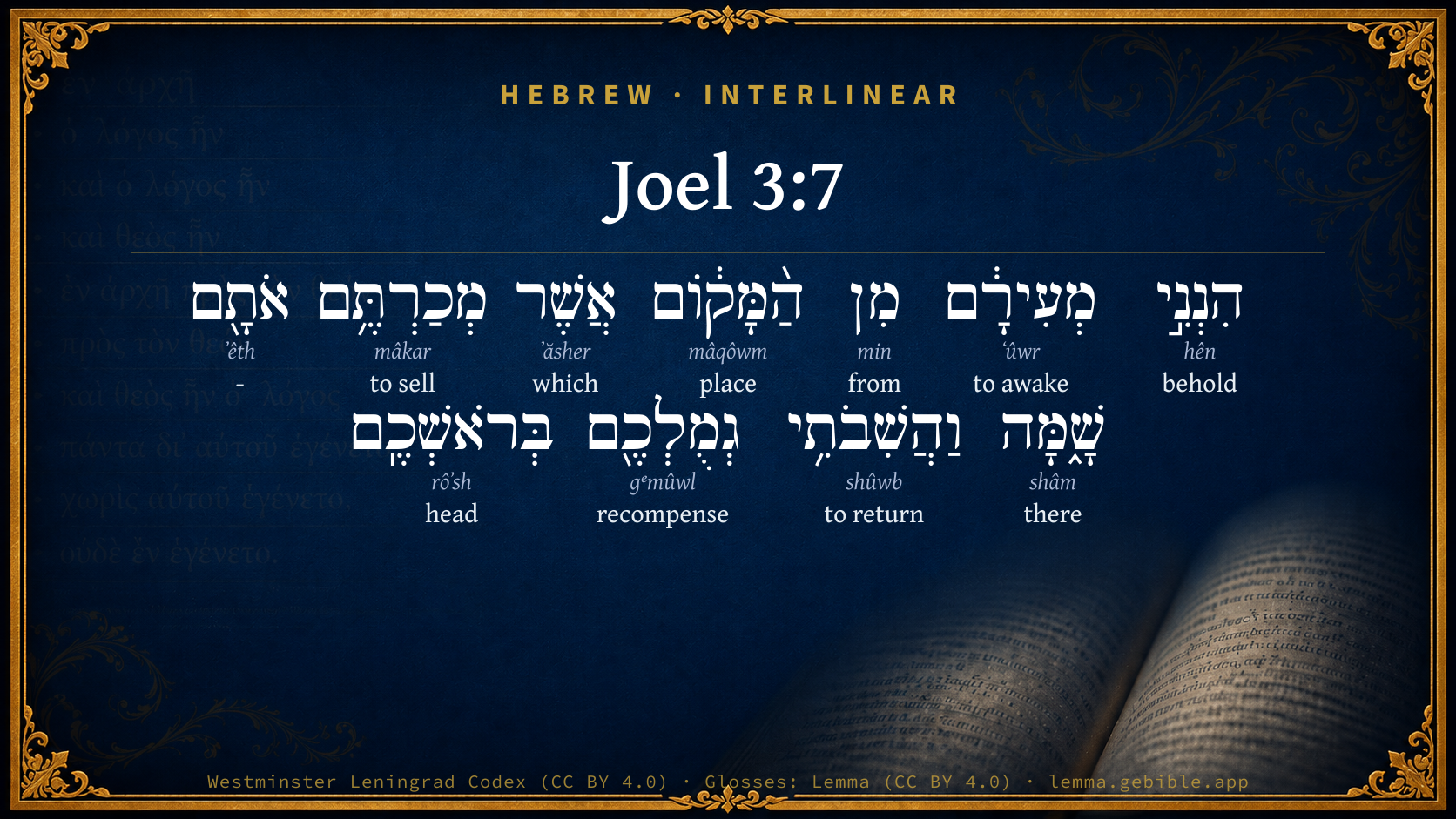
  1. הִנְנִ֣י hên H2005 “behold · me” Particle, Demonstrative + Suffix, Personal, 1st Person, Common, Singular
  2. מְעִירָ֔ם ʻûwr H5782 “awaking · them” Verb, Hiphil, Participle Active, Masculine, Singular, Construct + Suffix, Personal, 3rd Person, Masculine, Plural
  3. מִן min H4480 “from” Preposition
  4. הַ֨מָּק֔וֹם mâqôwm H4725 “the · place” Particle, Definite Article + Noun, Common, Masculine, Singular, Absolute
  5. אֲשֶׁר ʼăsher H834 “which” Particle, Relative
  6. מְכַרְתֶּ֥ם mâkar H4376 “to sell” Verb, Qal, Perfect, 2nd Person, Masculine, Plural
  7. אֹתָ֖ם ʼêth H853 “- · them” Particle, Direct Object + Suffix, Personal, 3rd Person, Masculine, Plural
  8. שָׁ֑מָּה shâm H8033 “there · toward” Adverb + Suffix, Demonstrative
  9. וַהֲשִׁבֹתִ֥י shûwb H7725 “and · to return” Conjunction + Verb, Hiphil, Sequential Perfect, 1st Person, Common, Singular
  10. בְּרֹאשְׁכֶֽם rôʼsh H7218 “in/at · head · your” Preposition + Noun, Common, Masculine, Singular, Construct + Suffix, Personal, 2nd Person, Masculine, Plural

About this verse

These counts appear in no published source. They are computed here, from the morphology-tagged text and Lemma’s own curated glosses. What Lemma adds →

11
words
11
distinct lemmas
Prophets
section

Notable vocabulary

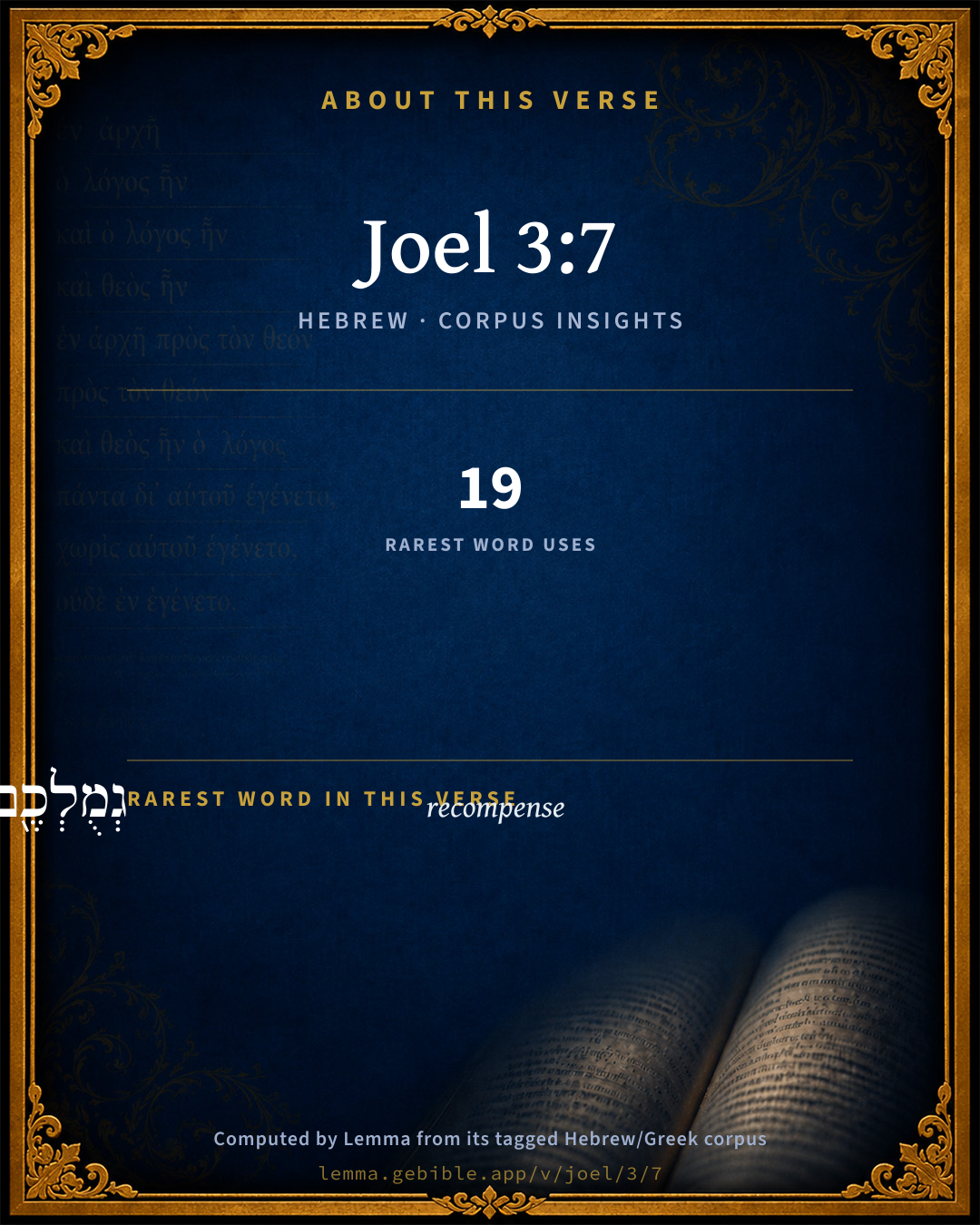
The rarest word here is גְמֻלְכֶ֖ם recompense H1576 — appearing just 19 times in the whole Hebrew Bible.

Shared distinctive vocabulary

גְמֻלְכֶ֖ם recompense H1576 occurs in 17 verses of the Hebrew Bible. Also found in:

Grammatical profile

  • 3 verbs
  • 3 nouns
  • 1 preposition
  • 1 adverb
  • 3 particles

Verb forms

  • מְעִירָ֔ם Hiphil · Participle Active
  • מְכַרְתֶּ֥ם Qal · Perfect
  • וַהֲשִׁבֹתִ֥י Hiphil · Sequential Perfect

Hebrew & Septuagint length

In English translation the verse runs 24 words from the Hebrew and 26 from the Septuagint (LXX English) — closely comparable.

A rough comparison of the two English renderings, which tokenize alike — not a word-level alignment.

Word counts can differ between the Hebrew and the Greek without any difference in meaning — e.g. the Hebrew direct-object marker אֵת has no separate Greek word, and Greek often adds the article ὁ.

Cross-references

22

Topical passages linked to Joel 3:7 in the Treasury of Scripture Knowledge — connected by theme and wording, ordered by reader-vote popularity; previews shown in the World English Bible.

  • Isaiah 43:5–6 Don't be afraid; for I am with you: I will bring your seed from the east, and gather you from the west;
  • Jeremiah 23:8 but, As Yahweh lives, who brought up and who led the seed of the house of Israel out of the north country, and from all the countries where I had driven them. They shall dwell in their own land.
  • Jeremiah 30:16 Therefore all those who devour you shall be devoured; and all your adversaries, everyone of them, shall go into captivity; and those who despoil you shall be a spoil, and all who prey on you will I give for a prey.
  • 2 Thessalonians 1:6 Since it is a righteous thing with God to repay affliction to those who afflict you,
  • Jeremiah 30:10 Therefore don't you be afraid, O Jacob my servant, says Yahweh; neither be dismayed, Israel: for, behold, I will save you from afar, and your seed from the land of their captivity; and Jacob shall return, and shall be quiet and at ease, and none shall make him afraid.
  • Zechariah 10:6–10 "I will strengthen the house of Judah, And I will save the house of Joseph, And I will bring them back; For I have mercy on them; And they will be as though I had not cast them off: For I am Yahweh their God, and I will hear them.
  • Judges 1:7 Adoni-bezek said, "Seventy kings, having their thumbs and their great toes cut off, gathered [their food] under my table: as I have done, so God has requited me." They brought him to Jerusalem, and he died there.
  • 1 Samuel 15:33 Samuel said, As your sword has made women childless, so shall your mother be childless among women. Samuel hewed Agag in pieces before Yahweh in Gilgal.
  • Esther 7:10 So they hanged Haman on the gallows that he had prepared for Mordecai. Then was the king's wrath pacified.
  • Isaiah 11:12 He will set up an ensign for the nations, and will assemble the outcasts of Israel, and gather together the dispersed of Judah from the four corners of the earth.
  • Isaiah 49:12 Behold, these shall come from far; and, behold, these from the north and from the west; and these from the land of Sinim.
  • Jeremiah 31:8 Behold, I will bring them from the north country, and gather them from the uttermost parts of the earth, [and] with them the blind and the lame, the woman with child and her who travails with child together: a great company shall they return here.
  • Jeremiah 32:37 Behold, I will gather them out of all the countries, where I have driven them in my anger, and in my wrath, and in great indignation; and I will bring them again to this place, and I will cause them to dwell safely:
  • Ezekiel 36:24 For I will take you from among the nations, and gather you out of all the countries, and will bring you into your own land.
  • Ezekiel 38:8 After many days you shall be visited: in the latter years you shall come into the land that is brought back from the sword, that is gathered out of many peoples, on the mountains of Israel, which have been a continual waste; but it is brought forth out of the peoples, and they shall dwell securely, all of them.
  • Joel 3:4 "Yes, and what are you to me, Tyre, and Sidon, And all the regions of Philistia? Will you repay me? And if you repay me, I will swiftly and speedily return your repayment on your own head.
  • Matthew 7:2 For with whatever judgment you judge, you will be judged; and with whatever measure you measure, it will be measured to you.
  • James 2:13 For judgment is without mercy to him who has shown no mercy. Mercy triumphs over judgment.
  • Revelation 13:10 If anyone has captivity, he will go. If anyone is with the sword, he must be killed. Here is the endurance and the faith of the saints.
  • Revelation 16:6 For they poured out the blood of the saints and the prophets, and you have given them blood to drink. They deserve this."
  • Revelation 19:2 for true and righteous are his judgments. For he has judged the great prostitute, who corrupted the earth with her sexual immorality, and he has avenged the blood of his servants at her hand."
  • Ezekiel 34:12–13 As a shepherd seeks out his flock in the day that he is among his sheep that are scattered abroad, so will I seek out my sheep; and I will deliver them out of all places where they have been scattered in the cloudy and dark day.

Cross-references courtesy of OpenBible.info (CC BY 4.0).

Hebrew and Greek witnesses Masoretic Hebrew ↔ Greek Septuagint

The same verse in the two great witnesses to the Old Testament, shown verse-for-verse.

These are two independent witnesses, not word-aligned to each other, and the Septuagint is shown in lemma (dictionary) form.

Hebrew Joel 3:7 Masoretic · Westminster Leningrad Codex

הִנְנִ֣י מְעִירָ֔ם מִן הַ֨מָּק֔וֹם אֲשֶׁר מְכַרְתֶּ֥ם אֹתָ֖ם שָׁ֑מָּה וַהֲשִׁבֹתִ֥י גְמֻלְכֶ֖ם בְּרֹאשְׁכֶֽם

Behold, I will stir them up out of the place where you have sold them, And will return your repayment on your own head;

World English Bible · Public Domain

Greek LXX Joel 3:7 Septuagint · lemma form
Therefore, behold, I will raise them up out of the place whither you⌃ have sold them, and I will return your recompense on your own heads.

LXX2012 (modern English Septuagint) · Public Domain

On this verse, Whedon's Commentary on the Bible discusses the Septuagint’s reading. Read the note in Commentary ↓

Hebrew: Westminster Leningrad Codex (CC BY 4.0). Greek: Septuagint (public domain); English from LXX2012 (modern English Septuagint) (Public Domain). How the Septuagint differs from the Hebrew →

Commentary

Notes on Joel 3:7 from classic Christian and Jewish commentators (each source and its license shown beneath its notes). The classic Christian expositions comment on the surrounding passage and are grouped to its opening verse, so a note may address several verses; the Jewish commentaries on the Tanakh (Rashi and others) are per-verse, so they appear only where the commentator wrote on this verse.

Lemma curates 59 commentaries, every one of them public domain or Creative Commons licensed, each selected and text-cleaned for this edition rather than reprinted as found. About our sources →

Trapp's Complete Commentary

John Trapp

Joe 3:7 Behold, I will raise them out of the place whither ye have sold them, and will return your recompence upon your own head:

Ver. 7. Behold, I will raise them out of the place, &c.] Seem it never so improbable or impossible, I will do it, saith God, and you shall see it. Behold, I will fetch home my banished, though they may seem to be as water spilt on the ground. I will make those dead bones live; and raise myself a name, and a praise, by outbidding their hopes, and marring your design of utter extermination. Ribera understands the words concerning the resurrection of the dead at the last day, because the Hebrew word properly signifieth, to raise one out of sleep. Some think it is meant of the apostles and martyrs, fetched out of banishment; as was John out of Patmos, Athanasius, Chrysostom, who yet in his last banishment, by reason of the barbarous usage of the soldiers that led him along, hired for that purpose, sweetly and blessedly breathed out his last, (Erasm. in Vita Chrysost.), the English exiles in Queen Mary’s time, whereof many returned and did excellent service here. But I doubt not, saith judicious Calvin (in loc.), but God intends here a spiritual gathering together of his people into one body, by the bond of faith; and this was principally fulfilled after the death of Christ, who died for that nation, "And not for that nation only, but that also he should gather together into one the children of God that were scattered abroad," Joh 11:52; so that those whom God hath gathered together and caused to return ( non pedibus vel navigio, for that needs not, to Jerusalem, which is above, which is the mother of us all), from the lands of the east, of the west, of the north, and of the south, shall praise the Lord together, as the psalmist hath it, Psa 107:2-3.

And will return your recompence upon your own head] God delights to retaliate, to bloody and deceitful men especially; as were easy to instance in the Egyptians, Adonibezek, Agag, Attilius Regulus, the Roman general, who dealt most cruelly with the Carthaginians, and was shortly after as cruelly dealt with by them, when fallen into their hands (Polybius). Here at home, in King Edward VI’s time, the remembrance of Somerset much moved the people to fall from Northumberland (who had wrought his death) in his greatest attempts, and to leave him to his fatal fall; whereas also they openly rejoiced, and presented to him handkerchiefs dipped in the blood of Somerset, for whom they thought he suffered rather late than undeserved punishment. So certain it is (saith the historian), that the debts both of cruelty and mercy go never unpaid.

John Trapp, A Commentary or Exposition upon All the Books of the Old and New Testament (1647–1656) — public domain. Text from a community e-Sword module.

Joseph Benson's Commentary

Joe 3:7-8. Behold, I will raise them, &c. — I will restore them, or their posterity, out of their several captivities whither their enemies have dispersed them. Grotius on this place mentions, that Alexander and his successors set at liberty many Jews, who were slaves in Greece. Many also, on occasion of Cyrus’s decree, might return to their country, from such parts of Asia Minor and the Ionian islands as were subject to that monarch. And will return your recompense upon your own head — Will inflict upon you the punishments mentioned in the following verse. I will sell your sons, &c. — This was fulfilled when Alexander took Gaza, Zidon, and Tyre, and made a great multitude of captives, of whom he is said to have sold thirty thousand for slaves. These captives the Jews, who were in favour with him, had the liberty of buying, and probably afterward sold many of them, by way of traffic, to the Arabians, here meant by the Sabeans.

Joseph Benson's Commentary on the Old and New Testaments (1811–1818) — public domain. Text from a community e-Sword module.

Tyndale Open Study Notes

Tyndale Open Resources

3:7-8 The people of Tyre, Sidon, and Philistia had enslaved Israelites, so the Lord would punish them by selling their sons and daughters into slavery.

Tyndale Open Study Notes — © Tyndale Open Resources, licensed CC BY-SA 4.0. Text via the HelloAO Bible API.

Jamieson, Fausset & Brown

Robert Jamieson, A. R. Fausset & David Brown

raise them--that is, I will rouse them. Neither sea nor distance will prevent My bringing them back. Alexander, and his successors, restored to liberty many Jews in bondage in Greece [JOSEPHUS, Antiquities, 13.5; Wars of the Jews, 9,2].

Jamieson, Fausset & Brown — Commentary Critical and Explanatory on the Whole Bible (1871) — public domain (CC PDM 1.0). Text via the HelloAO Bible API.

Adam Clarke's Commentary

Verse 7. I will raise them] I shall find means to bring them back from the place whither ye have sold them, and they shall retaliate upon you the injuries they have sustained. It is said that Alexander and his successors set at liberty many Jews that had been sold into Greece. And it is likely that many returned from different lands, on the publication of the edict of Cyrus. - Newcome.

Adam Clarke's Commentary on the Bible (1810–1826) — public domain. Text from a community e-Sword/MySword module.

John Calvin's Commentaries

The Prophet declares here more fully and expressly, that God had not so deserted the Jews, but that he intended, in course of time, to stretch forth his hand to them again. It was indeed a temporary desertion: but it behaved the faithful in the meantime to rely on this assurance, — that God purposed again to restore his people: and of this the Prophet now speaks, Behold, he says, I will raise them from the place unto which ye have sold them; as though he said “Neither distance of place, nor the intervening sea, will hinder me from restoring my people.” As then the Syrians and Sidonians thought that the Jews were precluded a return to their country, because they were taken away into distant parts of the world, God says that this would be no obstacle in his way to collect again his Church.

But it may he asked, When has this prediction been fulfilled? as we indeed know that the Jews have never returned to their own country: for shortly after their return from exile, they were in various ways diminished; and at length the most grievous calamities followed, which consumed the greatest part of the people. Since this then has been the condition of that nation, we ought to inquire whether Christ has collected the Jews, who had been far dispersed. We indeed know that they were then especially scattered; for the land of Judea never ceased to be distressed by continual wars until Jerusalem was destroyed, and the people were almost wholly consumed. Since then it has been so, when can we say that this prediction has been fulfilled? Many explain the words allegorically, and say, that the Prophet speaks of apostles and martyrs, who, through various persecutions, were driven into different parts; but this is a strained view. I therefore do not doubt, but that here he refers to a spiritual gathering: and it is certain that God, since the appearance of Christ, has joined together his Church by the bond of faith; for not only that people have united together in one, but also the Gentiles, who were before alienated from the Church, and had no intercourse with it, have been collected into one body. We hence see, that what the Prophet says has been spiritually fulfilled; even the children of Judah and the children of Jerusalem have been redeemed by the Lord, and restored again, not on foot or by sea; for Jerusalem has been built everywhere as it is said in Zechariah.

I will therefore gather them, he says; and he adds, I will return recompense on your head He again confirms what he said before, — that though the ungodly should exult, while ruling over the children of God, their cruelty would not be unpunished; for they shall find that the Church is never neglected by God; though he may subject it to various troubles, and exercise its patience, and even chastise it, he will yet be ever its defender. It follows —

John Calvin's Commentaries (1540-1563) — public domain. Text from the Calvin Translation Society English edition (1840s-50s) via the Christian Classics Ethereal Library (ccel.org). Calvin's coverage is partial (roughly two-thirds of the Bible); uncommented books and verses are honest gaps, never fabricated. The 19th-century editor's footnotes and remarks are omitted so the notes are faithfully Calvin's own voice.

The Cambridge Bible for Schools and Colleges

gen. ed. J. J. S. Perowne

7. Behold, I am stirring them up] i.e. arousing them into activity (Isa_13:17; Jer_50:9, R.V.: Isa_41:2; Isa_41:25; Isa_45:13, A.V., R.V. render badly raise up), and enabling them to leave the land of their servitude.

and will return your deed upon your own head] repeated from Joe_3:4 b.

7–8. The punishment, awarded according to the Lex talionis.

The Cambridge Bible for Schools and Colleges (gen. ed. J. J. S. Perowne; Cambridge University Press, 1878–1918) — public domain. Text from a community e-Sword module.

John Gill's Exposition

Behold, I will raise them out of the place whither ye have sold them,.... That is, bring them back to their own land, from their places whither they have been carried captive, and where they have dwelt in obscurity, and as if theft had been buried in graves, but now should be raised up and restored; and this their restoration will be as life from the dead. So the Targum,

"behold, I will bring them publicly from the place whither ye have sold them;''

this is to be understood, not of the same persons, but of their posterity, they being the same natural body. Kimchi interprets it of them and their children; them at the resurrection of the dead, their children at the time of salvation. Some think this had its accomplishment in Alexander and his successors, by whom the Jews, who had been detained captives in other countries, were set free; particularly by Demetrius, as Josephus (f) relates: though it may be applied to the future restoration of the Jews, out of all countries, unto their own land; or rather to the gathering together the spiritual Israel, or people of God, who have been persecuted from place to place by their antichristian enemies;

and will return your recompence upon your own head; do to them as they have done to others; pay them in their own coin; retaliate the wrongs done to his people; see Rev 13:10.

(f) Antiqu. l. 13. c. 5.

John Gill's Exposition of the Whole Bible (1746–1763) — public domain (CC PDM 1.0). Text via the HelloAO Bible API.

Albert Barnes' Notes on the Bible

Behold I will raise them - If this promise relates to the same individuals who had been sold, it must have been fulfilled silently; as indeed the return of captives to their own land, unless brought about by some historical event, belongs not to history, but to private life. The prophet, however, is probably predicting God’s dealings with the nations, not with those individuals. The enslaving of these Hebrews in the time of Joram was but one instance out of a whole system of covetous misdeeds. The Philistines carried away captives from them again in the time of Ahaz 2Ch 28:18, and yet again subsequently Eze 16:27, Eze 16:57; and still more at the capture of Jerusalem Eze 25:15.

Albert Barnes' Notes on the Bible (1834–1885) — public domain. Text from a community e-Sword/MySword module.

Haydock's Catholic Bible Commentary

Them, particularly under Hystaspes and Artaxerxes.

George Leo Haydock (1774–1849), Haydock's Catholic Family Bible and Commentary, 1859 edition — public domain. Excludes Psalms (Douay-Rheims chapter numbering differs from Protestant) and Deuterocanonical books (Catholic canon only).

Matthew Poole's English Annotations

Behold; observe it well, for as it will be strange when done, so it shall certainly be done, to your joy, O my people, and to the astonishment of your enemies.

I will raise them; awaken and raise them; though they lay sleeping, or as dead men, I will stir up some who shall befriend them. Out of the place whither ye have sold them; fulfilled when Alexander the Great and his successors, as Josephus, lib. 13. cap. 5, reports, dismissed all Jews that were slaves in Greece, and gave them leave to return to their own country.

And will return your recompence upon your own head; and more than this, I will pay you in your own coin, you shall read and know your sin in your punishment.

Matthew Poole's English Annotations on the Holy Bible (1683–1685) — public domain. Text from a community e-Sword/MySword module.

Whedon's Commentary on the Bible

Daniel D. Whedon

7, 8. Indeed, these enemies deserve punishment; and “with what measure ye mete it shall be measured unto you.” All they have done will be recompensed to them according to the lex talionis. Behold, I will raise them [“stir them up”] — Better, I am about to stir up. The event is imminent (compare Joe_2:19).

Them — The children of Judah and Jerusalem; they will be roused into activity in their place of exile, and will be brought home (Joe_3:1); there under the blessing of Jehovah the Jews will become strong and powerful, and by means of them Jehovah will do unto the Tyrians, Sidonians, and Philistines as they have done unto Judah and Jerusalem — sell them into slavery.

Sons and daughters — Not children, but citizens of the countries (Hos_2:2). Sabeans [“men of Sheba”] — A celebrated commercial nation in southwest Arabia; well known from the descriptions of ancient geographers, and more recently from the inscriptions found in the district itself. They traded not only in the products of their own land, but also in those of India and Ethiopia (Gen_10:7; Gen_10:28; Gen_25:3; 1Ki_10:2; 1Ki_10:10).

A people [“nation”] far off — The Jews had been sold into the far west (Joe_3:6); their enemies are to be sold to the far southeast. LXX. reads, “into exile”; which presupposes only a slight change in the Hebrew text and is favored by some as the original reading. The prophet assures the nations that the prediction will surely be fulfilled.

For Jehovah hath spoken it — A common formula of asseveration in the Old Testament (Isa_1:20; Isa_22:25; Oba_1:18).

Daniel D. Whedon (gen. ed.), Commentary on the Old and New Testaments (1874–1909) — public domain. Text from a community e-Sword module.

The Pulpit Commentary

Vers. 7, 8. In these verses we have the recompense of reward so deservedly dealt out to the enemies of Israel.

Behold, I will raise them out of the place whither ye have sold them. Instead of "raise," some prefer "waken," "rouse," or "stir up.

The Judaeans would be roused out of the countries into which they had been sold, and restored to their own land, and the measure which had been meted to them meted in turn to their enemies. The deliverance mentioned here may be exemplified, if not realized in part, in the time of Alexander the Great and his successors, when Jewish captives in many lands were set at liberty. Thus Demetrius, in his letter to Jonathan, writes, "I also make free all those Jews who have been made captives and slaves in my kingdom." And will return your recompense upon your own head; better rendered, and will turn back your doing upon your head. A righteous retaliation awaited Philistines and Phoenicians. They in turn would fall into the hands of the Judaeans, and be made prisoners of war, and, as they had done, so should it be done to them.

The Pulpit Commentary (1880–1919), ed. H.D.M. Spence-Jones & Joseph S. Exell — public domain. Text from a community e-Sword module.

John Wesley's Explanatory Notes

I will raise them - This was fulfilled when Alexander, and his successors dismissed all the Jews that were slaves in Greece, and gave them leave to return to their own country.

John Wesley, Explanatory Notes Upon the Whole Bible (1754–1765) — public domain. Text via the GEBible commentary corpus.

unfoldingWord translationNotes

Door43 World Missions Community

General Information:

Yahweh continues the speech he began in Joel 2:25, promising good things for the people of Israel.

Look

"Pay attention" or "Listen"

out of the place where you sold them

The people of Israel will leave the places where they were slaves and come back to the land of Israel. (See: Assumed Knowledge and Implicit Information)

return payment

"give back what you deserve"

I will sell your sons and your daughters, by the hand of the people of Judah

The hand can be a metonym for the power the hand exercises or a synecdoche for the person. AT: "I will have the people of Judah sell your sons and your daughters" (See: Metonymy and Synecdoche)

Sabeans

the people of the land of Sabea (See: How to Translate Names)

translationWords

hand

Judah

nation

Yahweh

unfoldingWord translationNotes — © Distant Shores Media and the Door43 World Missions Community, licensed CC BY-SA 4.0. Source: git.door43.org/Door43/en_tn.

Lesson kit

Teaching starters — assembled from the data on this page, not authored interpretation. Every prompt links to the verse data it draws on. Edit before teaching.

Joel, in the Prophets, opens this verse with 11 words (11 distinct Hebrew lemmas). Its most distinctive word is gᵉmûwl (“recompense”). A historical commentator’s framing appears above. Read the whole chapter for the surrounding context.

Discussion questions

  1. The word gᵉmûwl carries the sense “recompense.” How does it shape the verse?
  2. Judges 9:16 shares the word «recompense» with this verse. How do the two illuminate each other?
  3. These translations render this verse differently; the difference is in the English rendering, not the original. What questions does that raise?
  4. The verb «מְעִירָ֔ם» is Hiphil Participle Active. How does its form color the action?
  5. Reading how Trapp's Complete Commentary and Joseph Benson's Commentary read this verse, where do the two commentators agree and where do they part?

Things to notice

Reading settings

Reading text

Shown beneath each verse's original-language words.

Old Testament
Old Testament edition

Read the OT as the Masoretic Hebrew (MT) or the Greek Septuagint (LXX).

English shown for the Greek Septuagint (in the Hebrew ↔ Greek comparison).

Comparing translations? Open the Compare panel on any verse page to stack up to four side by side.