
Numbers 5:7

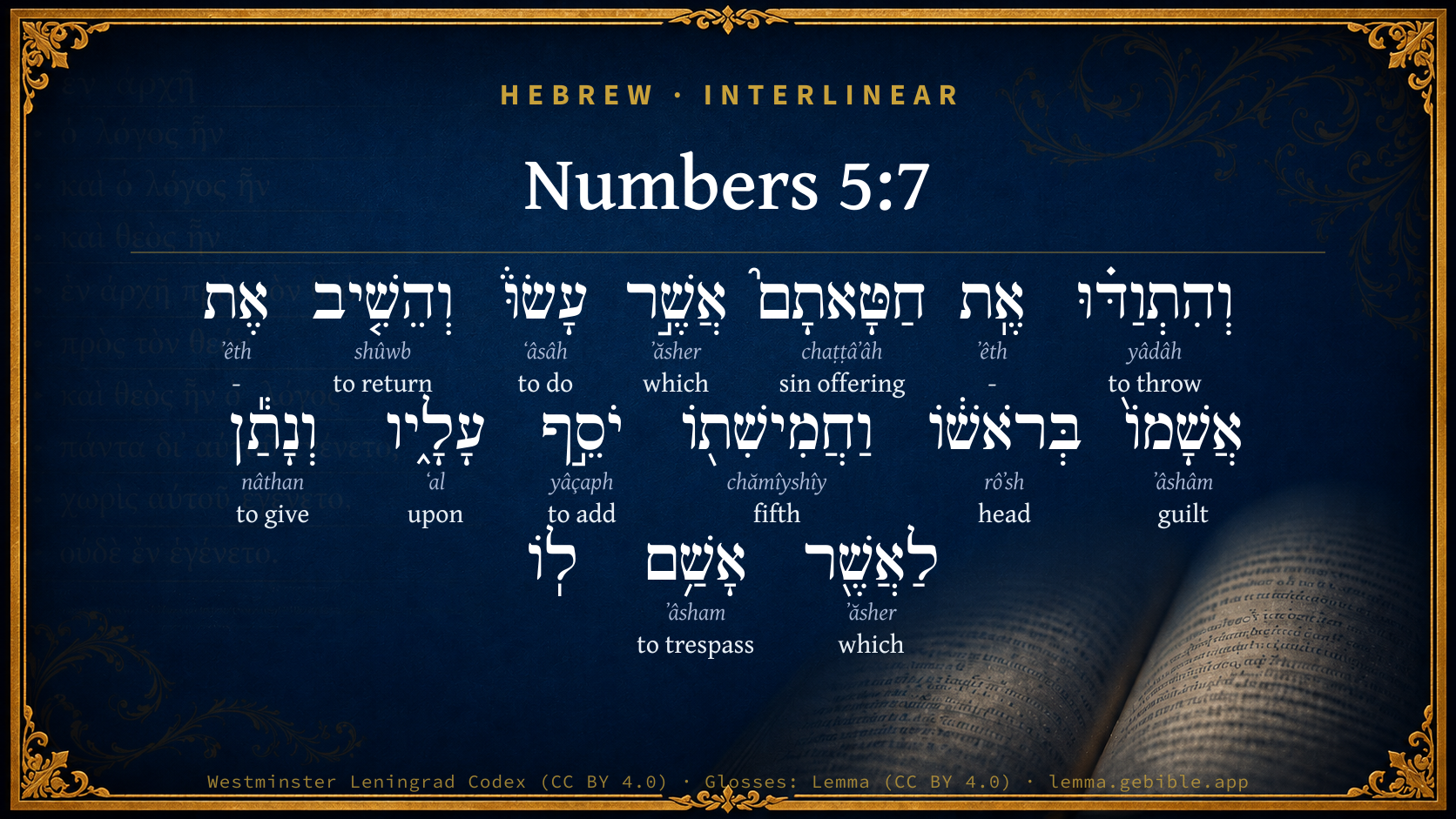
Hebrew (Westminster Leningrad Codex) Numbers 5:7 appears in the Hebrew Old Testament. The text above is from the Westminster Leningrad Codex. Each word links to its Strong’s number, a concise gloss, and parsing drawn from the Open Scriptures Hebrew Bible morphology. Click any word for its full Brown-Driver-Briggs (BDB) entry.
Download image
Cite this verse

Numbers 5:7 (World English Bible). Public Domain. Lemma interlinear Bible study tool, https://lemma.gebible.app/v/numbers/5/7.

Show BibTeX & RIS
BibTeX
RIS
English Translation
then he shall confess his sin which he has done, and he shall make restitution for his guilt in full, and add to it the fifth part of it, and give it to him in respect of whom he has been guilty.
World English Bible · Public Domain
Download a study sheet

One document with this verse’s original text, its word-by-word gloss line, the meaning frame, cross-references with their text, attributed commentary, and full source and license credits — printable, and it pastes into notes with its structure intact.

This verse Autodidact and up

Study sheet (.html) Plain text (.txt)

A passage Seminary Student

Up to 50 verses in one chapter. A passage sheet keeps up to 6 commentary sources and 12 cross-references per verse, in the order this page ranks them, and says so on the sheet whenever that leaves anything out. Ask for a single verse and you get the Autodidact verse sheet above.

Everything on this page stays free to read, with no account — the sheet is a download of what is already on screen, not access to it.

Want to remove ads? Support Godless Engineer
Compare translations 3

The same verse in 3 English versions, stacked beneath the original-language interlinear above. Click any original word for its lexicon entry.

Each is an independent rendering of the whole verse — the interlinear is not word-aligned to these translations.

Highlighted words mark where these versions differ — a whole-verse word diff, not a word-by-word alignment.

  • World English Bible Public Domain
    then he shall confess his sin which he has done, and he shall make restitution for his guilt in full, and add to it the fifth part of it, and give it to him in respect of whom he has been guilty.
  • King James Version Public Domain
    Then they shall confess their sin which they have done: and he shall recompense his trespass with the principal thereof, and add unto it the fifth part thereof, and give it unto him against whom he hath trespassed.
  • unfoldingWord Literal Text CC BY-SA 4.0
    And they shall confess their sin that they did, and he shall return his guilt in its head and he shall add its fifth upon it, and he shall give to him to whom he is guilty.

unfoldingWord Literal Text — © unfoldingWord, licensed CC BY-SA 4.0. Word-aligned USFM3 via Door43 (git.door43.org/unfoldingWord/en_ult).

Versions to compare (up to 4)

3 of 4 selected

Show all 18 translations

Every available English version of this verse, each an independent rendering of the whole verse.

  • World English Bible Public Domain
    then he shall confess his sin which he has done, and he shall make restitution for his guilt in full, and add to it the fifth part of it, and give it to him in respect of whom he has been guilty.
  • Berean Standard Bible Public Domain
    and must confess the sin he has committed. He must make full restitution, add a fifth to its value, and give all this to the one he has wronged.
  • Majority Standard Bible Public Domain
    and must confess the sin he has committed. He must make full restitution, add a fifth to its value, and give all this to the one he has wronged.
  • King James Version Public Domain
    Then they shall confess their sin which they have done: and he shall recompense his trespass with the principal thereof, and add unto it the fifth part thereof, and give it unto him against whom he hath trespassed.
  • American Standard Version (1901) Public Domain
    then he shall confess his sin which he hath done: and he shall make restitution for his guilt in full, and add unto it the fifth part thereof, and give it unto him in respect of whom he hath been guilty.
  • Revised Version (1885) Public Domain
    then they shall confess their sin which they have done: and he shall make restitution for his guilt in full, and add unto it the fifth part thereof, and give it unto him in respect of whom he hath been guilty.
  • Geneva Bible (1599) Public Domain
    Then they shall confesse their sinne which they haue done, and shall restore the domage thereof with his principall, and put the fift part of it more thereto, and shall giue it vnto him, against whom he hath trespassed.
  • Douay-Rheims (1899) Public Domain
    They shall confess their sin, and restore the principal itself, and the fifth part over and above, to him against whom they have sinned.
  • Young's Literal Translation Public Domain
    and they have confessed their sin which they have done, then he hath restored his guilt in its principal, and its fifth is adding to it, and hath given `it' to him in reference to whom he hath been guilty.
  • Literal Standard Version CC BY-SA 4.0
    and they have confessed their sin which they have done, then he has restored his guilt in its principal, and is adding its fifth to it, and has given [it] to him in reference to whom he has been guilty.
  • Unlocked Literal Bible CC BY-SA 4.0
    Then he must confess the sin that he has done. He must completely pay back the price of his guilt and add to the price one-fifth more. He must give this to the one he has wronged.
  • unfoldingWord Literal Text CC BY-SA 4.0
    And they shall confess their sin that they did, and he shall return his guilt in its head and he shall add its fifth upon it, and he shall give to him to whom he is guilty.
  • Darby Bible Public Domain
    then they shall confess their sin which they have done; and he shall recompense his trespass according to the principal thereof, and shall add unto it the fifth part thereof, and give it unto him against whom he hath trespassed.
  • World Messianic Bible Public Domain
    then he shall confess his sin which he has done; and he shall make restitution for his guilt in full, add to it the fifth part of it, and give it to him in respect of whom he has been guilty.
  • Webster's Bible Public Domain
    Then they shall confess their sin which they have done: and he shall recompense his trespass with the principal of it, and add to it the fifth part of it, and give it to him against whom he hath trespassed.
  • Free Bible Version CC BY-SA 4.0
    and must confess their sin. They have to pay the full amount of compensation plus one-fifth of its value, and give this to the person they have wronged.
  • Bible in Basic English Public Domain
    Let them say openly what they have done; and make payment for the wrong done, with the addition of a fifth part, and give it to him to whom the wrong was done.
  • JPS Tanakh (1917) Public Domain
    then they shall confess their sin which they have done; and he shall make restitution for his guilt in full, and add unto it the fifth part thereof, and give it unto him in respect of whom he hath been guilty.

Literal Standard Version (2020), Covenant Press — licensed CC BY-SA 4.0. Text via the HelloAO Bible API (eBible.org). Unlocked Literal Bible (unfoldingWord) — licensed CC BY-SA 4.0. Text via the HelloAO Bible API (eBible.org). unfoldingWord Literal Text — © unfoldingWord, licensed CC BY-SA 4.0. Word-aligned USFM3 via Door43 (git.door43.org/unfoldingWord/en_ult). Free Bible Version, Dr. Jonathan Gallagher — licensed CC BY-SA 4.0. Text via the HelloAO Bible API (eBible.org).

Word by word

More ways to search: Search by grammar → Find every occurrence → Compare this word →

Practice this passage: Drill this verse → Learn its vocabulary →

אָשַׁ֥ם
ʼâsham
H816
“to trespass”
Verb, Qal, Perfect, 3rd Person, Masculine, Singular
Part of Speech
Verb
Stem
Qal
Form
Perfect
Person
3rd Person
Gender
Masculine
Number
Singular
Full BDB Definition

Origin: a primitive root

TWOT: 180

to offend, be guilty, trespass - (Qal) - to do wrong, offend, trespass, commit an offense, do injury - to be or become guilty - to be held guilty - to be incriminated - (Niphal) to suffer punishment - (Hiphil) to declare guilty - (TWOT) to be desolate, acknowledge offense
  1. וְהִתְוַדּ֗וּ yâdâh H3034 “and · to throw” Conjunction + Verb, Hithpael, Sequential Perfect, 3rd Person, Common, Plural
  2. אֶֽת ʼêth H853 “-” Particle, Direct Object
  3. חַטָּאתָם֮ chaṭṭâʼâh H2403 “sin offering · their” Noun, Common, Feminine, Singular, Construct + Suffix, Personal, 3rd Person, Masculine, Plural
  4. אֲשֶׁ֣ר ʼăsher H834 “which” Particle, Relative
  5. עָשׂוּ֒ ʻâsâh H6213 “to do” Verb, Qal, Perfect, 3rd Person, Common, Plural
  6. וְהֵשִׁ֤יב shûwb H7725 “and · to return” Conjunction + Verb, Hiphil, Sequential Perfect, 3rd Person, Masculine, Singular
  7. אֶת ʼêth H853 “-” Particle, Direct Object
  8. אֲשָׁמוֹ֙ ʼâshâm H817 “guilt · his” Noun, Common, Masculine, Singular, Construct + Suffix, Personal, 3rd Person, Masculine, Singular
  9. בְּרֹאשׁ֔וֹ rôʼsh H7218 “in/at · head · his” Preposition + Noun, Common, Masculine, Singular, Construct + Suffix, Personal, 3rd Person, Masculine, Singular
  10. וַחֲמִישִׁת֖וֹ chămîyshîy H2549 “and · fifth · his” Conjunction + Noun, Common, Feminine, Singular, Construct + Suffix, Personal, 3rd Person, Masculine, Singular
  11. יֹסֵ֣ף yâçaph H3254 “to add” Verb, Hiphil, Imperfect, 3rd Person, Masculine, Singular
  12. עָלָ֑יו ʻal H5921 “upon · him” Preposition + Suffix, Personal, 3rd Person, Masculine, Singular
  13. וְנָתַ֕ן nâthan H5414 “and · to give” Conjunction + Verb, Qal, Sequential Perfect, 3rd Person, Masculine, Singular
  14. לַאֲשֶׁ֖ר ʼăsher H834 “to/for · which” Preposition + Particle, Relative

About this verse

These counts appear in no published source. They are computed here, from the morphology-tagged text and Lemma’s own curated glosses. What Lemma adds →

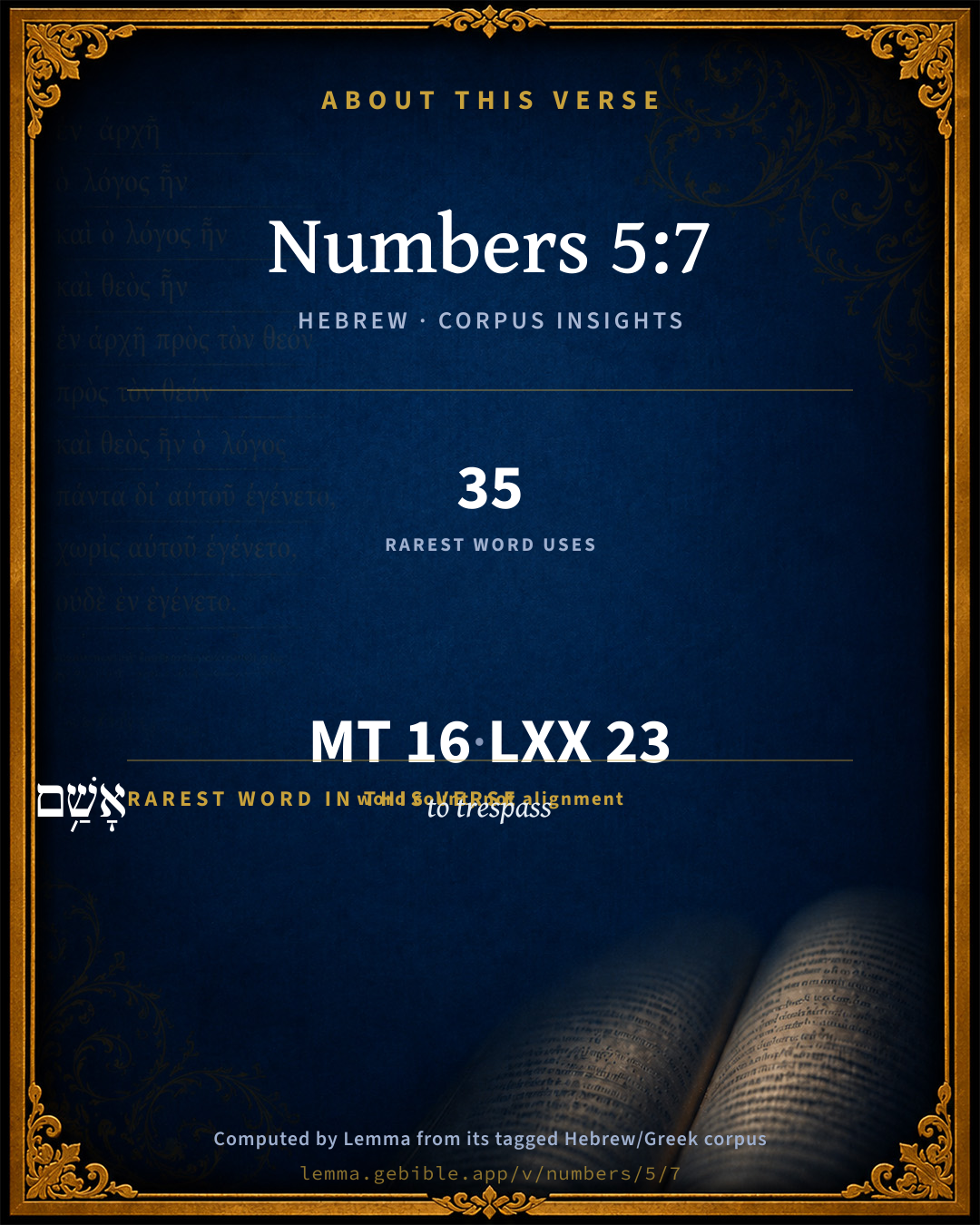
16
words
13
distinct lemmas
Pentateuch
section

Shared distinctive vocabulary

אָשַׁ֥ם to trespass H816 occurs in 32 verses of the Hebrew Bible. Also found in:

Grammatical profile

  • 6 verbs
  • 4 nouns
  • 2 prepositions
  • 4 particles

Verb forms

  • וְהִתְוַדּ֗וּ Hithpael · Sequential Perfect
  • עָשׂוּ֒ Qal · Perfect
  • וְהֵשִׁ֤יב Hiphil · Sequential Perfect
  • יֹסֵ֣ף Hiphil · Imperfect
  • וְנָתַ֕ן Qal · Sequential Perfect
  • אָשַׁ֥ם Qal · Perfect

Repetition

A word recurs within this verse — often emphatic in Hebrew:

  • אֲשֶׁ֣ר which H834 ×2

Hebrew & Septuagint length

In English translation the verse runs 42 words from the Hebrew and 41 from the Septuagint (LXX English) — closely comparable.

A rough comparison of the two English renderings, which tokenize alike — not a word-level alignment.

Word counts can differ between the Hebrew and the Greek without any difference in meaning — e.g. the Hebrew direct-object marker אֵת has no separate Greek word, and Greek often adds the article ὁ.

In the original languages it is 16 Hebrew tokens and 23 Greek tokens — but the two are counted differently (Hebrew bundles its prefixes and suffixes into one token; the Greek is in lemma form), so that isn’t a like-for-like length.

Cross-references

11

Topical passages linked to Numbers 5:7 in the Treasury of Scripture Knowledge — connected by theme and wording, ordered by reader-vote popularity; previews shown in the World English Bible.

  • Leviticus 5:5 It shall be, when he is guilty of one of these, he shall confess that in which he has sinned:
  • Leviticus 26:40 "'If they confess their iniquity, and the iniquity of their fathers, in their trespass which they trespassed against me, and also that, because they walked contrary to me,
  • Joshua 7:19 Joshua said to Achan, My son, please give glory to Yahweh, the God of Israel, and make confession to him; and tell me now what you have done; don't hide it from me.
  • Proverbs 28:13 He who conceals his sins doesn't prosper, But whoever confesses and renounces them finds mercy.
  • Luke 19:8 Zacchaeus stood and said to the Lord, "Behold, Lord, half of my goods I give to the poor. If I have wrongfully exacted anything of anyone, I restore four times as much."
  • Leviticus 5:15 "If anyone commits a trespass, and sins unwittingly, in the holy things of Yahweh; then he shall bring his trespass offering to Yahweh, a ram without blemish from the flock, according to your estimation in silver by shekels, after the shekel of the sanctuary, for a trespass offering.
  • Leviticus 6:4–7 then it shall be, if he has sinned, and is guilty, he shall restore that which he took by robbery, or the thing which he has gotten by oppression, or the deposit which was committed to him, or the lost thing which he found,
  • Leviticus 7:7 "'As is the sin offering, so is the trespass offering; there is one law for them. The priest who makes atonement with them shall have it.
  • Job 33:27–28 He sings before men, and says, 'I have sinned, and perverted that which was right, And it didn't profit me.
  • Psalms 32:5 I acknowledged my sin to you. I didn't hide my iniquity. I said, I will confess my transgressions to Yahweh, And you forgave the iniquity of my sin. Selah.
  • 1 John 1:8–10 If we say that we have no sin, we deceive ourselves, and the truth is not in us.

Cross-references courtesy of OpenBible.info (CC BY 4.0).

Hebrew and Greek witnesses Masoretic Hebrew ↔ Greek Septuagint

The same verse in the two great witnesses to the Old Testament, shown verse-for-verse.

These are two independent witnesses, not word-aligned to each other, and the Septuagint is shown in lemma (dictionary) form.

Hebrew Numbers 5:7 Masoretic · Westminster Leningrad Codex

וְהִתְוַדּ֗וּ אֶֽת חַטָּאתָם֮ אֲשֶׁ֣ר עָשׂוּ֒ וְהֵשִׁ֤יב אֶת אֲשָׁמוֹ֙ בְּרֹאשׁ֔וֹ וַחֲמִישִׁת֖וֹ יֹסֵ֣ף עָלָ֑יו וְנָתַ֕ן לַאֲשֶׁ֖ר אָשַׁ֥ם לֽוֹ

then he shall confess his sin which he has done, and he shall make restitution for his guilt in full, and add to it the fifth part of it, and give it to him in respect of whom he has been guilty.

World English Bible · Public Domain

Greek LXX Numbers 5:7 Septuagint · lemma form

ἐκἀγορεύω ὁ ἁμαρτία ὅς ποιέω καί ἀποδίδωμι ὁ πλημμέλεια ὁ κεφάλαιον καί ὁ ἐπίπεμπτος αὐτός προςτίθημι ἐπί αὐτός καί ἀποδίδωμι τίς πλημμελέω αὐτός

that person shall confess the sin which he has committed, and shall make satisfaction for his trespass: he shall pay the principal, and shall add to it the fifth part, and shall make restoration to him against whom he has trespassed.

LXX2012 (modern English Septuagint) · Public Domain

Hebrew: Westminster Leningrad Codex (CC BY 4.0). Greek: Septuagint (public domain); English from LXX2012 (modern English Septuagint) (Public Domain). How the Septuagint differs from the Hebrew →

Targum (Aramaic paraphrase)

2

The Targum is the ancient Jewish Aramaic paraphrase of the Hebrew Scriptures — an interpretive translation, not the Hebrew text itself. Onkelos (literal) and Pseudo-Jonathan (expansive) render the Torah, and Jonathan the Prophets. Coverage is partial: where no permissively-licensed English translation exists for a verse, only the Aramaic is shown. This is verse-level text, not a word-by-word alignment to the Hebrew.

  1. Targum Onkelos Torah (Genesis–Deuteronomy)
    וִיוַדוּן יָת חוֹבֵיהוֹן דִי עֲבָדוּ וְיָתֵב יָת חוֹבְתֵהּ בְּרֵישֵׁהּ וְחֻמְשֵׁהּ יוֹסֵף עֲלוֹהִי וְיִתֵּן לִדְחָב לֵהּ

    (no public-domain English translation for this verse)

    Targum Onkelos — Aramaic: “Onkelos Genesis” (public domain); “Onkelos Exodus” (public domain); “Onkelos Leviticus” (public domain); “Onkelos Numbers” (public domain); “Onkelos Deuteronomy” (public domain). English: “Sefaria Community Translation” (CC0 1.0 (public-domain dedication)); “J.W. Etheridge. The Targums of Onkelos and Jonathan Ben Uzziel on the Pentateuch. London: Longmans, Green, 1862” (public domain). Text via Sefaria.

  2. Targum Pseudo-Jonathan Torah (Genesis–Deuteronomy)
    וְיוֹדוּן יַת חוֹבֵיהוֹן דְעָבָדוּ אִין מָמוֹנָא אֲנַס לְחַבְרֵיהּ וְיָתוּב יַת חוֹבְתֵיהּ בְּרֵישֵׁיהּ וְחוֹמֶשׁ דְמוֹי יוֹסֵף עֲלוֹי וְיִתֵּן קַרְנָא וְחוּמְשָׁא לְמַאן דְאִתְחַיֵיב לֵיהּ

    they shall make confession of their sins which they have committed. If he hath extorted money from his neighbour, he shall restore (the amount of) his sin in the principal thereof, and add to it a fifth of its value, and give (both) principal and fifth to him against whom he hath sinned.

    Targum Pseudo-Jonathan — Aramaic: “Targum Jonathan on Genesis” (public domain); “Targum Jonathan on Exodus” (public domain); “Targum Jonathan on Leviticus” (public domain); “Targum Jonathan on Numbers” (public domain); “Targum Jonathan on Deuteronomy” (public domain). English: “The Targum of Jonathan ben Uzziel, trans. J. W. Etheridge, London, 1862” (public domain). Text via Sefaria.

Commentary

Notes on Numbers 5:7 from classic Christian and Jewish commentators (each source and its license shown beneath its notes). The classic Christian expositions comment on the surrounding passage and are grouped to its opening verse, so a note may address several verses; the Jewish commentaries on the Tanakh (Rashi and others) are per-verse, so they appear only where the commentator wrote on this verse.

Lemma curates 59 commentaries, every one of them public domain or Creative Commons licensed, each selected and text-cleaned for this edition rather than reprinted as found. About our sources →

Trapp's Complete Commentary

John Trapp

Num 5:7 Then they shall confess their sin which they have done: and he shall recompense his trespass with the principal thereof, and add unto it the fifth [part] thereof, and give [it] unto [him] against whom he hath trespassed.

Ver. 7. Then they shall confess their sin.] So they were bound to do, all their sins. {Pro 28:13 Job 33:27-28} Confessio peccati est medicina peccati, saith Nazianzen; a sin acknowledged is half amended.

And he shall recompense his trespass.] Restitution must be made of goods unjustly detained, or else you shall cough in hell, said Mr Latimer. Our King Henry VII, in his last will and testament, after the disposing of his soul and body, he devised and willed restitution should be made, of all such moneys as had unjustly been levied by his officers. {a} So did Selymus the great Turk give orders at his death for the restoring and recompensing of the great treasure he had taken from the Persian merchants. {b}

{a} Speed’s Hist., fol. 995.

{b} Turk. Hist., fol. 767.

John Trapp, A Commentary or Exposition upon All the Books of the Old and New Testament (1647–1656) — public domain. Text from a community e-Sword module.

Joseph Benson's Commentary

Num 5:7. They shall confess their sin — They shall not continue in the denial of the fact, but give glory to God, and take shame to themselves by acknowledging it. The principal — That is, the thing he took away, or what is equivalent to it. And add — Both as a compensation to the injured person for want of his goods so long, and as a penalty upon the injurious dealer, to discourage others from such attempts.

Joseph Benson's Commentary on the Old and New Testaments (1811–1818) — public domain. Text from a community e-Sword module.

Tyndale Open Study Notes

Tyndale Open Resources

5:7 This restitution and the guilt offering (see Lev 6–7) associated with the sin was intended to inculcate a heightened sense of individual responsibility to God’s holiness.

Tyndale Open Study Notes — © Tyndale Open Resources, licensed CC BY-SA 4.0. Text via the HelloAO Bible API.

Adam Clarke's Commentary

Verse 7. Shall confess their sin] Without confession or acknowledgment of sin, there was no hope of mercy held out.

He shall recompense] For without restitution, in every possible case, God will not for give the iniquity of a man's sin. How can any person in a case of defraud, with his neighbour's property in his possession, expect to receive mercy from the hand of a just and holy God?

See this subject considered in Clarke's notes on "Ge 42:38".

Adam Clarke's Commentary on the Bible (1810–1826) — public domain. Text from a community e-Sword/MySword module.

The Cambridge Bible for Schools and Colleges

gen. ed. J. J. S. Perowne

7. make restitution for his guilt] lit. ‘restore his guilt,’ abstract for concrete; he shall restore that which he guiltily holds in possession; and similarly in Num_5:8.

the fifth part] The same compensation is enjoined in other cases—the eating of sacred food unwittingly (Lev_22:14), the redemption of an unclean animal that has been vowed (Lev_27:11-13), or that is a firstling (id. 27), and the redemption of tithe (id. 31).

The Cambridge Bible for Schools and Colleges (gen. ed. J. J. S. Perowne; Cambridge University Press, 1878–1918) — public domain. Text from a community e-Sword module.

John Gill's Exposition

Then they shall confess their sin which they have done,.... The form of which confession, according to Fagius, was, O Lord, I am guilty of death, I have deserved to be stoned for this sin, or to be strangled for this trespass, or to be burnt for this crime, &c.

and he shall recompense his trespass with the principal thereof, and add unto it the fifth part thereof; paying the whole of whatsoever he had in any manner defrauded his neighbour of, to which he was to add a fifth part of that; that is, as Aben Ezra interprets it, it he confesses of himself, but if there are witnesses of it he must add two fifths, and some say a fifth of a fifth:

and give it unto him against whom he hath trespassed; as a satisfaction for the injury done him.

John Gill's Exposition of the Whole Bible (1746–1763) — public domain (CC PDM 1.0). Text via the HelloAO Bible API.

Haydock's Catholic Bible Commentary

Shall confess. This confession and satisfaction, ordained in the old law, was a figure of the sacrament of penance. (Challoner) --- A special confession of their sin, with satisfaction, and a sacrifice, are required. So Christ orders us to lay open our consciences to his priests, St. John. xx., &c. (Worthington)

George Leo Haydock (1774–1849), Haydock's Catholic Family Bible and Commentary, 1859 edition — public domain. Excludes Psalms (Douay-Rheims chapter numbering differs from Protestant) and Deuterocanonical books (Catholic canon only).

Matthew Poole's English Annotations

They shall not continue in the denial of the fact, as such persons oft do, but shall give glory to God, and take shame to themselves, by acknowledging their sin with grief and remorse. See Lev 5:5; 6:4.

With the principal thereof; i.e. the thing he took away, or what is equivalent to it.

The fifth part thereof is added both as a compensation to the injured person for the want of his goods so long, and for his trouble for the supposed utter loss of them, and as a penalty upon the injurious dealer to discourage others from such attempts.

Quest. How doth this agree with that law, Exo 22:1?

Answer. That law was made against notorious and obstinate thieves, who were legally convicted of their crime, and this against more modest thieves, whose necessities might induce them to steal, and whose consciences are affected with their sin.

Matthew Poole's English Annotations on the Holy Bible (1683–1685) — public domain. Text from a community e-Sword/MySword module.

Whedon's Commentary on the Bible

Daniel D. Whedon

7. They shall confess their sin — This was not a forced acknowledgment of a person detected in dishonesty which he is trying to hide, but a voluntary confession of a truly penitent heart conscious of guilt. Confession is the ordained manifestation of sincere sorrow for sin.

The principal… and fifth part — Restitution, if possible, must always accompany true repentance. To confess and still clutch the “guilty prize” is a mockery of God and man. The fifth part of the value was to be added to compensate the injured person, If the crime had not been voluntarily confessed, but had been lawfully proven, the convicted thief would have been liable to a fine of fourfold if the thing had been sold or the animal slain, and there was no possibility of voluntary restitution. Exo_22:1. The difference is, that the one is directed against flagrant and wilful thieves, and the other against those who have committed fraud through extreme want and strong temptation, and against the light of conscience which is now giving them no rest, but is prompting them to confession.

Daniel D. Whedon (gen. ed.), Commentary on the Old and New Testaments (1874–1909) — public domain. Text from a community e-Sword module.

John Wesley's Explanatory Notes

They shall confess their sin - They shall not continue in the denial of the fact, but give glory to God, and take shame to themselves by acknowledging it. The principal - That is, the thing he took away, or what is equivalent to it. And add - Both as a compensation to the injured person for the want of his goods so long, and as a penalty upon the injurious dealer, to discourage others from such attempts.

John Wesley, Explanatory Notes Upon the Whole Bible (1754–1765) — public domain. Text via the GEBible commentary corpus.

Rashi

Rabbi Shlomo Yitzchaki (Rashi)

את אשמו בראשו [HE SHALL RESTORE] THAT WHEREIN HE IS GUILTY, AS BEING THE CHIEF SUM — This means, he shall restore the principal about which he has sworn falsely (Bava Kamma 110a).

לאשר אשם לו [AND HE SHALL RESTORE THE PRINCIPAL … AND GIVE UNTO HIM] TO WHOM HE IS GUILTY — i.e. unto him to whom he (the claimant) owes money (Ketubot 19a).

Rashi on the Tanakh — English translations: “The Judaica Press complete Tanach with Rashi, translated by A. J. Rosenberg” (CC BY 4.0); “Pentateuch with Rashi's commentary by M. Rosenbaum and A.M. Silbermann, 1929-1934” (public domain); “The Metsudah Tanach series, Lakewood, N.J” (CC BY 4.0); and “The Book of Joshua, Metsudah Publications, 1997” (CC BY 4.0). Text via Sefaria.

Ibn Ezra

Rabbi Abraham ibn Ezra

They shall confess. Whether it was a man or a woman.

The principal amount. As it is and no less.

And add one fifth to that amount. If he confesses on his own. If there are witnesses, he must add two fifths (Vayikro 5:24: “And an additional fifth”). Our Sages said, though, he must bring an additional fifth of that fifth, or a twenty-fifth.

Ibn Ezra on the Tanakh — English translations: “Sefaria Community Translation” (CC0 1.0 (public-domain dedication)); “Yalkut, Sifsei Chachomim Chumash, Metsudah Publications, 2009” (CC BY 4.0); and “Commentary of Ibn Ezra on Isaiah - trans. by M. Friedlander, 1873” (public domain). Text via Sefaria.

Lesson kit

Teaching starters — assembled from the data on this page, not authored interpretation. Every prompt links to the verse data it draws on. Edit before teaching.

Numbers, in the Pentateuch, opens this verse with 16 words (13 distinct Hebrew lemmas). Its most distinctive word is ʼâsham (“to trespass”). A historical commentator’s framing appears above. Read the whole chapter for the surrounding context.

Discussion questions

  1. How does “to trespass” (ʼâsham) shape what this verse is saying?
  2. Leviticus 4:13 shares the word «to trespass» with this verse. How do the two illuminate each other?
  3. “which” occurs 2× in this one verse. What is the effect of the repetition?
  4. These translations render this verse differently; the difference is in the English rendering, not the original. What questions does that raise?
  5. The verb «וְהִתְוַדּ֗וּ» is Hithpael Sequential Perfect. How does its form color the action?
  6. Reading how Trapp's Complete Commentary and Joseph Benson's Commentary read this verse, where do the two commentators agree and where do they part?

Things to notice

Reading settings

Reading text

Shown beneath each verse's original-language words.

Old Testament
Old Testament edition

Read the OT as the Masoretic Hebrew (MT) or the Greek Septuagint (LXX).

English shown for the Greek Septuagint (in the Hebrew ↔ Greek comparison).

Comparing translations? Open the Compare panel on any verse page to stack up to four side by side.