
Lamentations 1:13

Hebrew (Westminster Leningrad Codex) Lamentations 1:13 appears in the Hebrew Old Testament. The text above is from the Westminster Leningrad Codex. Each word links to its Strong’s number, a concise gloss, and parsing drawn from the Open Scriptures Hebrew Bible morphology. Click any word for its full Brown-Driver-Briggs (BDB) entry.
Download image
Cite this verse

Lamentations 1:13 (World English Bible). Public Domain. Lemma interlinear Bible study tool, https://lemma.gebible.app/v/lamentations/1/13.

Show BibTeX & RIS
BibTeX
RIS
English Translation
From on high has he sent fire into my bones, and it prevails against them; He has spread a net for my feet, he has turned me back: He has made me desolate and faint all the day.
World English Bible · Public Domain
Download a study sheet

One document with this verse’s original text, its word-by-word gloss line, the meaning frame, cross-references with their text, attributed commentary, and full source and license credits — printable, and it pastes into notes with its structure intact.

This verse Autodidact and up

Study sheet (.html) Plain text (.txt)

A passage Seminary Student

Up to 50 verses in one chapter. A passage sheet keeps up to 6 commentary sources and 12 cross-references per verse, in the order this page ranks them, and says so on the sheet whenever that leaves anything out. Ask for a single verse and you get the Autodidact verse sheet above.

Everything on this page stays free to read, with no account — the sheet is a download of what is already on screen, not access to it.

Want to remove ads? Support Godless Engineer
Compare translations 3

The same verse in 3 English versions, stacked beneath the original-language interlinear above. Click any original word for its lexicon entry.

Each is an independent rendering of the whole verse — the interlinear is not word-aligned to these translations.

Highlighted words mark where these versions differ — a whole-verse word diff, not a word-by-word alignment.

  • World English Bible Public Domain
    From on high has he sent fire into my bones, and it prevails against them; He has spread a net for my feet, he has turned me back: He has made me desolate and faint all the day.
  • King James Version Public Domain
    From above hath he sent fire into my bones, and it prevaileth against them: he hath spread a net for my feet, he hath turned me back: he hath made me desolate and faint all the day.
  • unfoldingWord Literal Text CC BY-SA 4.0
    From on high he sent fire into my bones, and it ruled over them. He spread a net for my feet; he turned me back. He made me desolate, faint all the day. NUN

unfoldingWord Literal Text — © unfoldingWord, licensed CC BY-SA 4.0. Word-aligned USFM3 via Door43 (git.door43.org/unfoldingWord/en_ult).

Versions to compare (up to 4)

3 of 4 selected

Show all 18 translations

Every available English version of this verse, each an independent rendering of the whole verse.

  • World English Bible Public Domain
    From on high has he sent fire into my bones, and it prevails against them; He has spread a net for my feet, he has turned me back: He has made me desolate and faint all the day.
  • Berean Standard Bible Public Domain
    He sent fire from on high, and it overpowered my bones. He spread a net for my feet and turned me back. He made me desolate, faint all the day long.
  • Majority Standard Bible Public Domain
    He sent fire from on high, and it overpowered my bones. He spread a net for my feet and turned me back. He made me desolate, faint all the day long.
  • King James Version Public Domain
    From above hath he sent fire into my bones, and it prevaileth against them: he hath spread a net for my feet, he hath turned me back: he hath made me desolate and faint all the day.
  • American Standard Version (1901) Public Domain
    From on high hath he sent fire into my bones, and it prevaileth against them; He hath spread a net for my feet, he hath turned me back: He hath made me desolate and faint all the day.
  • Revised Version (1885) Public Domain
    From on high hath he sent fire into my bones, and it prevaileth against them: he hath spread a net for my feet, he hath turned me back; he hath made me desolate and faint all the day.
  • Geneva Bible (1599) Public Domain
    From aboue hath hee sent fire into my bones, which preuaile against them: he hath spred a net for my feete, and turned me backe: hee hath made me desolate, and daily in heauinesse.
  • Douay-Rheims (1899) Public Domain
    Mem. From above he hath sent fire into my bones, and hath chastised me: he hath spread a net for my feet, he hath turned me back: he hath made me desolate, wasted with sorrow all the day long.
  • Young's Literal Translation Public Domain
    From above He hath sent fire into my bone, And it subdueth it, He hath spread a net for my feet, He hath turned me backward, He hath made me desolate -- all the day sick.
  • Literal Standard Version CC BY-SA 4.0
    From above He has sent fire into my bone, || And it subdues it, He has spread a net for my feet, || He has turned me backward, || He has made me desolate—all the day sick.
  • Unlocked Literal Bible CC BY-SA 4.0
    It is from on high that he has sent fire into my bones, and it has conquered them. He has spread a net for my feet and turned me back. He has made me constantly desolate and weak.
  • unfoldingWord Literal Text CC BY-SA 4.0
    From on high he sent fire into my bones, and it ruled over them. He spread a net for my feet; he turned me back. He made me desolate, faint all the day. NUN
  • Darby Bible Public Domain
    From on high hath he sent fire into my bones, and it prevaileth against them; he hath spread a net for my feet; he hath turned me back; he hath made me desolate [and] faint all the day.
  • World Messianic Bible Public Domain
    “From on high has he sent fire into my bones, and it prevails against them. He has spread a net for my feet. He has turned me back. He has made me desolate and I faint all day long.
  • Webster's Bible Public Domain
    From above hath he sent fire into my bones, and it prevaileth against them: he hath spread a net for my feet, he hath turned me back: he hath made me desolate and faint all the day.
  • Free Bible Version CC BY-SA 4.0
    He sent down fire from heaven that destroyed my bones. He spread out a net to catch my feet, tripping me over. He abandoned me, leaving me sick all day long.
  • Bible in Basic English Public Domain
    From on high he has sent fire into my bones, and it has overcome them: his net is stretched out for my feet, I am turned back by him; he has made me waste and feeble all the day.
  • JPS Tanakh (1917) Public Domain
    From on high hath He sent fire into my bones, and it prevaileth against them; He hath spread a net for my feet, He hath turned me back; He hath made me desolate and faint all the day.

Literal Standard Version (2020), Covenant Press — licensed CC BY-SA 4.0. Text via the HelloAO Bible API (eBible.org). Unlocked Literal Bible (unfoldingWord) — licensed CC BY-SA 4.0. Text via the HelloAO Bible API (eBible.org). unfoldingWord Literal Text — © unfoldingWord, licensed CC BY-SA 4.0. Word-aligned USFM3 via Door43 (git.door43.org/unfoldingWord/en_ult). Free Bible Version, Dr. Jonathan Gallagher — licensed CC BY-SA 4.0. Text via the HelloAO Bible API (eBible.org).

Word by word

More ways to search: Search by grammar → Find every occurrence → Compare this word →

Practice this passage: Drill this verse → Learn its vocabulary →

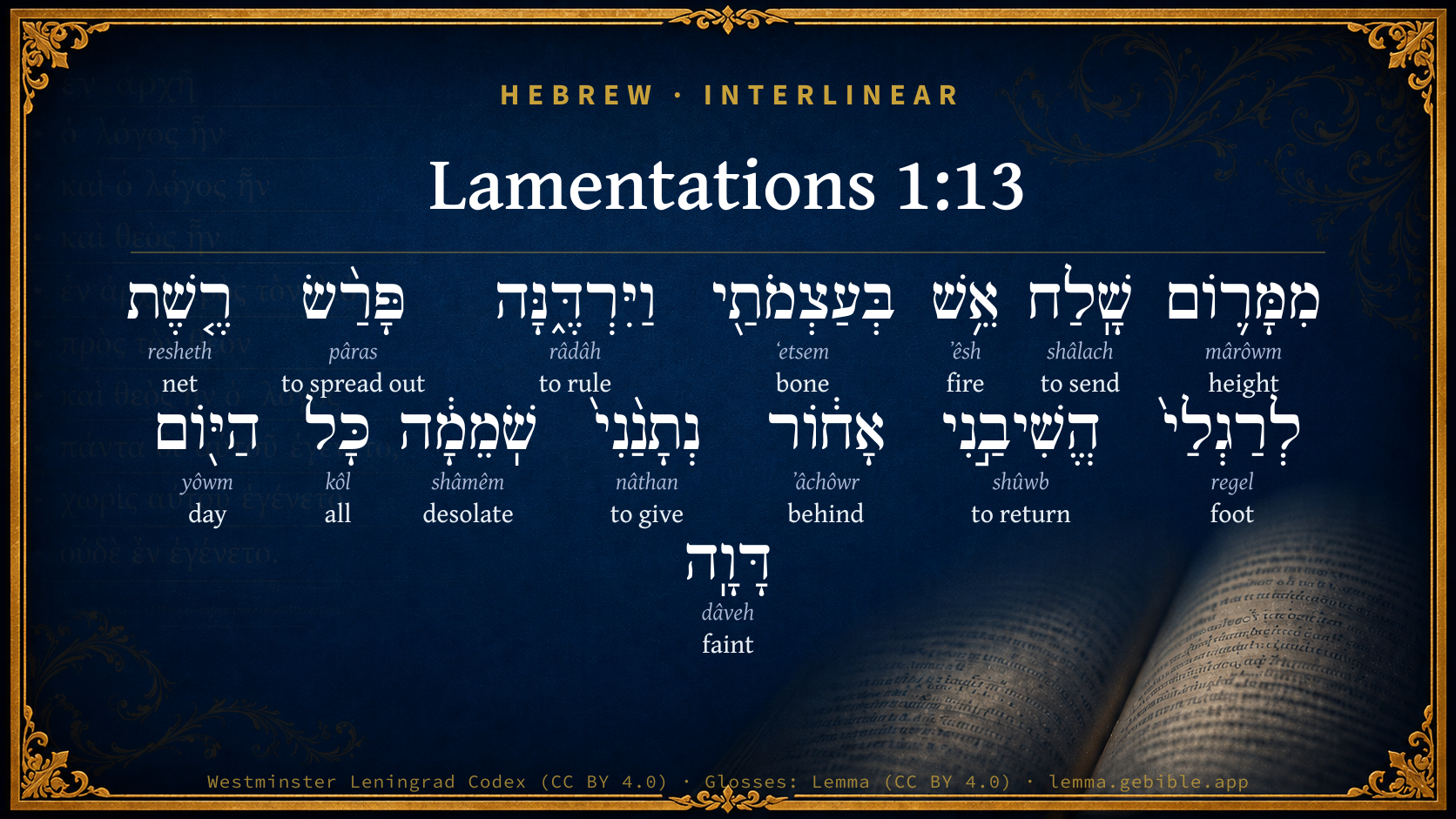
דָּוָֽה
dâveh
H1739
“faint”
Adjective, Adjective, Feminine, Singular, Absolute
Part of Speech
Adjective
Type
Adjective
Gender
Feminine
Number
Singular
State
Absolute
Full BDB Definition

Origin: from H1738

TWOT: 411b

faint, unwell - faint, weak - unwell, menstruous
  1. מִמָּר֛וֹם mârôwm H4791 “from · height” Preposition + Noun, Common, Masculine, Singular, Absolute
  2. שָֽׁלַח shâlach H7971 “to send” Verb, Qal, Perfect, 3rd Person, Masculine, Singular
  3. אֵ֥שׁ ʼêsh H784 “fire” Noun, Common, Both, Singular, Absolute
  4. בְּעַצְמֹתַ֖י ʻetsem H6106 “in/at · bones · my” Preposition + Noun, Common, Feminine, Plural, Construct + Suffix, Personal, 1st Person, Common, Singular
  5. וַיִּרְדֶּ֑נָּה râdâh H7287 “and · to rule · her” Conjunction + Verb, Qal, Sequential Imperfect, 3rd Person, Masculine, Singular + Suffix, Personal, 3rd Person, Feminine, Singular
  6. פָּרַ֨שׂ pâras H6566 “to spread out” Verb, Qal, Perfect, 3rd Person, Masculine, Singular
  7. רֶ֤שֶׁת resheth H7568 “net” Noun, Common, Feminine, Singular, Absolute
  8. לְרַגְלַי֙ regel H7272 “to/for · feet · my” Preposition + Noun, Common, Feminine, Dual, Construct + Suffix, Personal, 1st Person, Common, Singular
  9. הֱשִׁיבַ֣נִי shûwb H7725 “to return · me” Verb, Hiphil, Perfect, 3rd Person, Masculine, Singular + Suffix, Personal, 1st Person, Common, Singular
  10. אָח֔וֹר ʼâchôwr H268 “behind” Noun, Common, Masculine, Singular, Absolute
  11. נְתָנַ֨נִי֙ nâthan H5414 “to give · me” Verb, Qal, Perfect, 3rd Person, Masculine, Singular + Suffix, Personal, 1st Person, Common, Singular
  12. שֹֽׁמֵמָ֔ה shâmêm H8076 “desolate” Verb, Qal, Participle Active, Feminine, Singular, Absolute
  13. כָּל kôl H3605 “all of” Noun, Common, Masculine, Singular, Construct
  14. הַיּ֖וֹם yôwm H3117 “the · day” Particle, Definite Article + Noun, Common, Masculine, Singular, Absolute

About this verse

These counts appear in no published source. They are computed here, from the morphology-tagged text and Lemma’s own curated glosses. What Lemma adds →

15
words
15
distinct lemmas
Prophets
section

Notable vocabulary

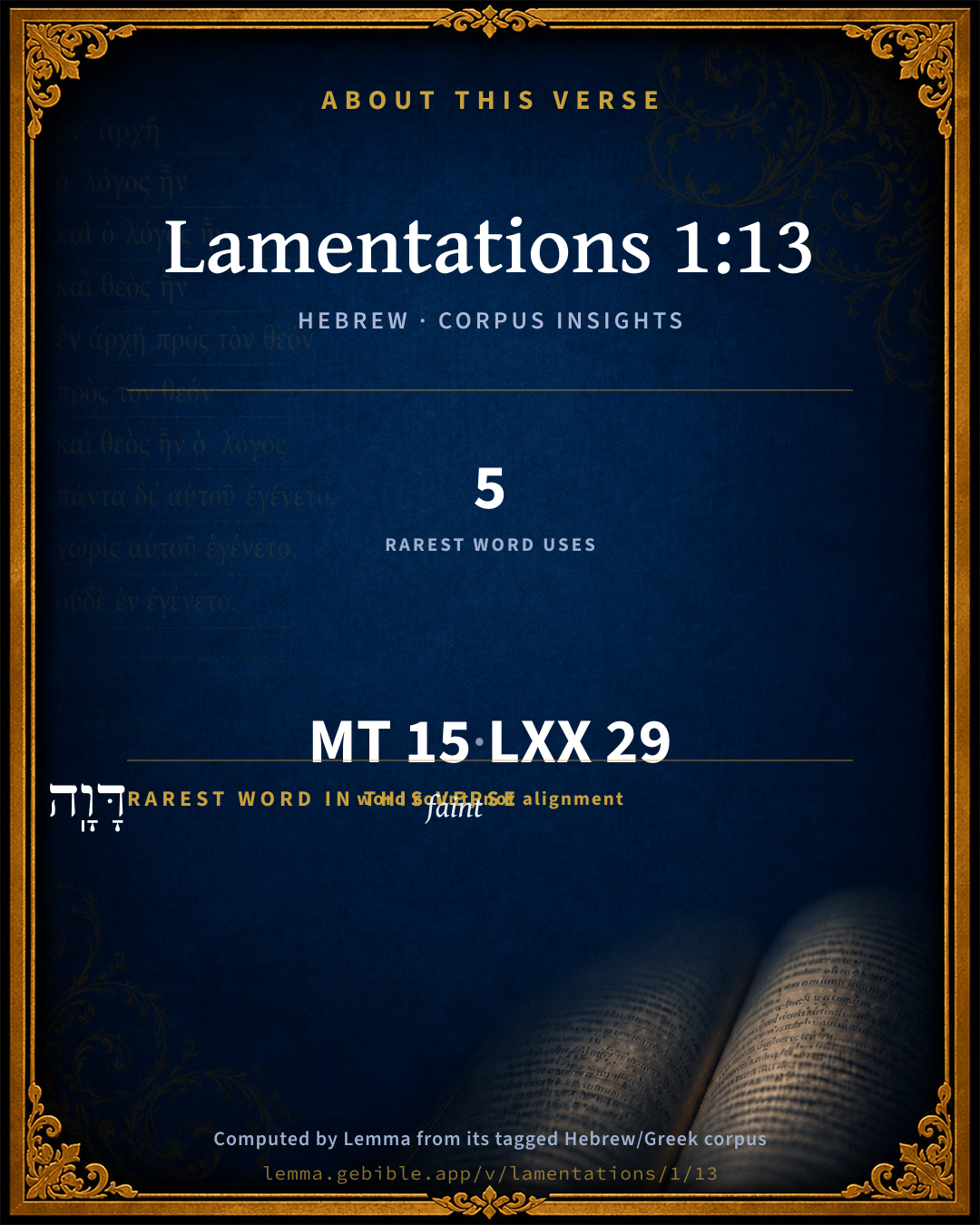
The rarest word here is דָּוָֽה faint H1739 — appearing just 5 times in the whole Hebrew Bible.

Shared distinctive vocabulary

דָּוָֽה faint H1739 occurs in 5 verses of the Hebrew Bible. Also found in:

Grammatical profile

  • 6 verbs
  • 8 nouns
  • 1 adjective

Verb forms

  • שָֽׁלַח Qal · Perfect
  • וַיִּרְדֶּ֑נָּה Qal · Sequential Imperfect
  • פָּרַ֨שׂ Qal · Perfect
  • הֱשִׁיבַ֣נִי Hiphil · Perfect
  • נְתָנַ֨נִי֙ Qal · Perfect
  • שֹֽׁמֵמָ֔ה Qal · Participle Active

Hebrew & Septuagint length

In English translation the verse runs 38 words from the Hebrew and 39 from the Septuagint (LXX English) — closely comparable.

A rough comparison of the two English renderings, which tokenize alike — not a word-level alignment.

Word counts can differ between the Hebrew and the Greek without any difference in meaning — e.g. the Hebrew direct-object marker אֵת has no separate Greek word, and Greek often adds the article ὁ.

In the original languages it is 15 Hebrew tokens and 29 Greek tokens — but the two are counted differently (Hebrew bundles its prefixes and suffixes into one token; the Greek is in lemma form), so that isn’t a like-for-like length.

Cross-references

27

Topical passages linked to Lamentations 1:13 in the Treasury of Scripture Knowledge — connected by theme and wording, ordered by reader-vote popularity; previews shown in the World English Bible.

  • Job 30:30 My skin grows black and peels from me. My bones are burned with heat.
  • Habakkuk 3:16 I heard, and my body trembled. My lips quivered at the voice. Rottenness enters into my bones, and I tremble in my place, Because I must wait quietly for the day of trouble, For the coming up of the people who invade us.
  • Job 19:6 Know now that God has subverted me, And has surrounded me with his net.
  • Psalms 22:14 I am poured out like water. All my bones are out of joint. My heart is like wax; It is melted within me.
  • Ezekiel 17:20 I will spread my net on him, and he shall be taken in my snare, and I will bring him to Babylon, and will enter into judgment with him there for his trespass that he has trespassed against me.
  • Psalms 66:11 You brought us into prison. You laid a burden on our backs.
  • Ezekiel 12:13 My net also will I spread on him, and he shall be taken in my snare; and I will bring him to Babylon to the land of the Chaldeans; yet shall he not see it, though he shall die there.
  • Nahum 1:6 Who can stand before his indignation? Who can endure the fierceness of his anger? His wrath is poured out like fire, and the rocks are broken apart by him.
  • Hebrews 12:29 for our God is a consuming fire.
  • Deuteronomy 28:65 Among these nations shall you find no ease, and there shall be no rest for the sole of your foot: but Yahweh will give you there a trembling heart, and failing of eyes, and pining of soul;
  • Deuteronomy 32:21–25 They have moved me to jealousy with that which is not God; They have provoked me to anger with their vanities: I will move them to jealousy with those who are not a people; I will provoke them to anger with a foolish nation.
  • Job 18:8 For he is cast into a net by his own feet, And he wanders into its mesh.
  • Psalms 31:10 For my life is spent with sorrow, My years with sighing. My strength fails because of my iniquity. My bones are wasted away.
  • Psalms 35:4 Let those who seek after my soul be disappointed and brought to dishonor. Let those who plot my ruin be turned back and confounded.
  • Psalms 70:2–3 Let them be disappointed and confounded who seek my soul. Let those who desire my ruin be turned back in disgrace.
  • Psalms 102:3–5 For my days consume away like smoke. My bones are burned as a firebrand.
  • Psalms 129:5 Let them be disappointed and turned backward, All those who hate Zion.
  • Isaiah 42:17 They shall be turned back, they shall be utterly disappointed, who trust in engraved images, who tell molten images, You are our gods.
  • Jeremiah 4:19–29 My anguish, my anguish! I am pained at my very heart; my heart is disquieted in me; I can't hold my peace; because you have heard, O my soul, the sound of the trumpet, the alarm of war.
  • Jeremiah 44:6 Therefore my wrath and my anger was poured forth, and was kindled in the cities of Judah and in the streets of Jerusalem; and they are wasted and desolate, as it is this day.
  • Lamentations 1:22 Let all their wickedness come before you; Do to them, as you have done to me for all my transgressions: For my sighs are many, and my heart is faint.
  • Lamentations 2:3–4 He has cut off in fierce anger all the horn of Israel; He has drawn back his right hand from before the enemy: He has burned up Jacob like a flaming fire, which devours round about.
  • Lamentations 4:17–20 Our eyes do yet fail [in looking] for our vain help: In our watching we have watched for a nation that could not save.
  • Lamentations 5:17 For this our heart is faint; For these things our eyes are dim;
  • Ezekiel 32:3 Thus says the Lord Yahweh: I will spread out my net on you with a company of many peoples; and they shall bring you up in my net.
  • Hosea 7:12 When they go, I will spread my net on them. I will bring them down like the birds of the sky. I will chastise them, as their congregation has heard.
  • 2 Thessalonians 1:8 giving vengeance to those who don't know God, and to those who don't obey the Gospel of our Lord Jesus,

Cross-references courtesy of OpenBible.info (CC BY 4.0).

Hebrew and Greek witnesses Masoretic Hebrew ↔ Greek Septuagint

The same verse in the two great witnesses to the Old Testament, shown verse-for-verse.

These are two independent witnesses, not word-aligned to each other, and the Septuagint is shown in lemma (dictionary) form.

Hebrew Lamentations 1:13 Masoretic · Westminster Leningrad Codex

מִמָּר֛וֹם שָֽׁלַח אֵ֥שׁ בְּעַצְמֹתַ֖י וַיִּרְדֶּ֑נָּה פָּרַ֨שׂ רֶ֤שֶׁת לְרַגְלַי֙ הֱשִׁיבַ֣נִי אָח֔וֹר נְתָנַ֨נִי֙ שֹֽׁמֵמָ֔ה כָּל הַיּ֖וֹם דָּוָֽה

From on high has he sent fire into my bones, and it prevails against them; He has spread a net for my feet, he has turned me back: He has made me desolate and faint all the day.

World English Bible · Public Domain

Greek LXX Lamentations 1:13 Septuagint · lemma form

ἐκ ὕψος αὐτός ἀποστέλλω πῦρ ἐν ὁ ὀστέον ἐγώ καταἄγω αὐτός διαπετάζω δίκτυον ὁ πούς ἐγώ ἀποστρέφω ἐγώ εἰς ὁ ὀπίσω δίδωμι ἐγώ ἀπο ἀναἵζω ὅλος ὁ ἡμέρα ὀδυνάω

MEM. He has sent fire from his lofty habitation, he has brought it into my bones: he has spread a net for my feet, he has turned me back: he has made me desolate and mourning all the day.

LXX2012 (modern English Septuagint) · Public Domain

Hebrew: Westminster Leningrad Codex (CC BY 4.0). Greek: Septuagint (public domain); English from LXX2012 (modern English Septuagint) (Public Domain). How the Septuagint differs from the Hebrew →

Commentary

Notes on Lamentations 1:13 from classic Christian and Jewish commentators (each source and its license shown beneath its notes). The classic Christian expositions comment on the surrounding passage and are grouped to its opening verse, so a note may address several verses; the Jewish commentaries on the Tanakh (Rashi and others) are per-verse, so they appear only where the commentator wrote on this verse.

Lemma curates 59 commentaries, every one of them public domain or Creative Commons licensed, each selected and text-cleaned for this edition rather than reprinted as found. About our sources →

Trapp's Complete Commentary

John Trapp

Lam 1:13 From above hath he sent fire into my bones, and it prevaileth against them: he hath spread a net for my feet, he hath turned me back: he hath made me desolate [and] faint all the day.

Ver. 13. From above hath he sent fire into my bones.] Like as when the marrow and natural moisture is dried up by a violent fever; or rather, as when the solid parts of bodies below are lightning-struck from above, and scorched by these sulphurous flames that pierce into them.

And it prevailed against them.] Or, And he ruled it - viz., the fire; i.e., He directed and disposed it.

He hath spread a net for my feet.] And so hampered me, an unruly creature, ut constricta fuerim in ruinam, that there is no escaping from him; yea, the more I strive to get out, the faster I stick.

He hath turned me back.] Laid me on my back.

He hath made me desolate and faint.] My calamities come thick, one in the neck of another; words are too weak to utter them; and yet here is very great copia and variety of words, so that Paschasius saith this book may well be called, The Lamentations of Lamentations; like as Solomon’s Song is called for its excellence, The Song of Songs.

John Trapp, A Commentary or Exposition upon All the Books of the Old and New Testament (1647–1656) — public domain. Text from a community e-Sword module.

The Biblical Illustrator

Joseph S. Exell

Lam_1:13

From above hath He sent fire into my bones.

Penetrating sorrows

1. This often mention of Gods hand teacheth this doctrine: When God punisheth us by the hands of the wicked, we are hardly brought to ascribe it to Him alone; and they from thinking that their own hand and power hath done it.

2. When God layeth afflictions upon us, they ransack the most secret parts that are in us.

3. God often bringeth His servants to the greatest misery that can be sustained by man.

4. God doth govern, and that in special manner, the particular course of all those afflictions which He layeth upon His people.

5. We can no more wind ourselves out of those afflictions that God layeth upon us, than the entangled soul can escape the net that compasseth him.

6. Nothing can go forward, or come to any good issue, but that only which the Lord furthereth.

7. It is God that giveth friends, health, etc.; and taketh all away at His pleasure.

8. According to the measure and continuance of Gods afflicting hand upon us, so must the measure and continuance of our sorrows be. (J. Udall.)

The Biblical Illustrator, edited by Joseph S. Exell (c. 1880s–1900s) — public domain. Text from a community e-Sword module.

Joseph Benson's Commentary

Lam 1:13-16. From above hath he sent fire into my bones — Calamities as consuming and as afflictive as fire in the bones. He hath spread a net for my feet — Hath brought me into a most miserable condition, in which I am so entangled that I cannot extricate myself nor escape from it. Thus the prophet teaches Jerusalem to look beyond the Babylonians, and to see the sin-avenging hand of God in her sufferings. As if he had said, It is God himself that hath sent these evils upon me; he hath stirred up my enemies against me, and they are no more than the rod of his anger. The yoke of my transgressions is bound by his hand, &c. — He has, as it were, gathered my iniquities and the iniquities of my people together, and made a yoke of them to put upon me, so that I am weighed down by them, and by the judgments inflicted on account of them. They are wreathed, and come up upon my neck — My punishments are twisted with my sins as cords to make them strong: I have a complication of judgments upon me, sword, famine, pestilence, captivity; and they are not only prepared for my neck, but are already put upon it. He hath made my strength to fall, &c. — All my valiant men, the strength of my nation, is broken, and I am so fallen that I am not able to rise again. The Lord hath trodden under foot all my mighty men, &c. — The destruction which is made by war is frequently expressed by treading under foot: see note on Jer 50:26. He hath called an assembly against me to crush, &c. — Instead of those solemn assemblies that were wont to be called together in the midst of me by the sound of trumpet, to celebrate my solemn feasts, God hath called an assembly of Chaldeans to lay me in ruins, and crush my people. The Lord hath trodden the daughter of Judah as in a wine-press — That people, which was formerly chosen by Jehovah, and secured against all violent attempts by his immediate and almighty protection, he has now given up to the fury of their enemies, to afflict them with such severity that their blood has been shed in the streets of Jerusalem as wine from the wine-press. For these things I weep, &c. — For these sore afflictions, and for my sins which have caused them, and for these tokens of divine wrath which I see in them I weep so plentifully, and am in such distress, that mine eye runneth down with water, because the comforter that should relieve my soul — Namely, God; is far from me — Hath withdrawn himself, is departed from me in displeasure, and beholds me afar off. My children are desolate — The other cities of Judah, under Jerusalem, the mother city, or my people, are wasted, destroyed, and made desolate, because the enemy hath prevailed — And effected his purpose.

Joseph Benson's Commentary on the Old and New Testaments (1811–1818) — public domain. Text from a community e-Sword module.

Tyndale Open Study Notes

Tyndale Open Resources

1:13 The destruction of Jerusalem at the hands of the Babylonians was like fire from heaven.

Tyndale Open Study Notes — © Tyndale Open Resources, licensed CC BY-SA 4.0. Text via the HelloAO Bible API.

Geneva Bible (1599)

Geneva Bible translators

This declareth that we should acknowledge God to be the author of all our afflictions to the intent that we might seek unto him for remedy.

Geneva Bible (1599) marginal notes — public domain. Text via Bolls.life.

Jamieson, Fausset & Brown

Robert Jamieson, A. R. Fausset & David Brown

bones--a fire which not only consumes the skin and flesh, but penetrates even to my "bones" (that is, my vital powers).

prevaileth against--not as ROSENMULLER, "He (Jehovah) hath broken them"; a sense not in the Hebrew.

net-- (Eze 12:13); image from hunting wild beasts. He has so entangled me in His judgments that I cannot escape.

turned me back--so that I cannot go forward and get free from His meshes.

Jamieson, Fausset & Brown — Commentary Critical and Explanatory on the Whole Bible (1871) — public domain (CC PDM 1.0). Text via the HelloAO Bible API.

John Calvin's Commentaries

The Prophet proceeds with the same subject, that God’s vengeance had raged most dreadfully agsinst Jerusalem. But employing a metaphor she says, that fire had been sent to her bones. They who interpret bones of fortified places, weaken the meaning of the Prophet. I take bones in their proper sense, ss though it was said, that God’s fire had penetrated into the inmost parts. This way of speaking often occurs in Scripture. By bones is denoted strength or valor. Hence David sometimes deplored, that his bones were vexed or troubled. (Psalm 6:2.) And Hezekiah said in his song

“As a lion he hath broken my bones.” (Isaiah 37:13.)

In the same sense the Prophet now says, that fire had been sent by God, which ruled in his bones, that is, which not only burnt the skin and the flesh, but also consumed the bones. רדה, rede, means also to take away or to receive: but as the former rendering is most commonly taken, I am disposed to follow it — that fire ruled in his bones

There is another similitude added, that God had spread a net before her feet; and thus he had taken away every means of escape. She intimates (for it is Jerusalem who speaks) that she had been ensnared by God’s judgments, so that she was bound over to ruin, as though she had fallen into toils or snares. It is stated in the third place, that she was desolate all the day, so that she sorrowed perpetually. By all the day is meant continually. It is then said, that she sorrowed without end, beyond measure, because she had been turned back by the nets of God, and her bones had been consumed by celestial fire: for the expression from above, ממרום, memerumn, is emphatical, for the Prophet means that it was no common or human burning; because what is ascribed to God exceeds what is human or earthly. It is, then, as though he had said, that it had been such a vengeance as betokened the dreadful power of God; for it was the same as though God had thundered from heaven. We now perceive the import of the words. It follows, —

John Calvin's Commentaries (1540-1563) — public domain. Text from the Calvin Translation Society English edition (1840s-50s) via the Christian Classics Ethereal Library (ccel.org). Calvin's coverage is partial (roughly two-thirds of the Bible); uncommented books and verses are honest gaps, never fabricated. The 19th-century editor's footnotes and remarks are omitted so the notes are faithfully Calvin's own voice.

Ellicott's Commentary for English Readers

(13) From above . . .—The words are probably figurative. The judgments that had fallen on Jerusalem were as a fire from heaven, piercing even to “the joints and marrow,” the innermost recesses of life.

He hath turned me back . . .—The phrase points not to the defeat and flight of battle, but, completing the figure of the net, paints the failure of every effort to escape. The word for “desolate” implies, as in the case of Tamar (2Sa_13:20), an utter, hopeless misery.

A Bible Commentary for English Readers, edited by Charles John Ellicott (1878–1897) — public domain. Text from a community e-Sword module.

The Cambridge Bible for Schools and Colleges

gen. ed. J. J. S. Perowne

13. Zion likens herself to one whose inmost parts are being consumed, as with flame. Cp. Jer_20:9; Job_30:30; Psa_102:3.

it prevaileth against] it subdueth, or, in the sense of the cognate root in Syriac, chastiseth.

He hath spread a net for my feet] Cp. Jer_50:24; Eze_12:13; Job_18:8 ff.

13–15. Notice the accumulation of figures under which the destruction of the city is represented, fiery rain, toils of a net, a blocking of the way, a yoke laid on the neck, a sacrificial banquet, the treading of grapes in a winepress.

The Cambridge Bible for Schools and Colleges (gen. ed. J. J. S. Perowne; Cambridge University Press, 1878–1918) — public domain. Text from a community e-Sword module.

John Gill's Exposition

From above hath he sent fire into my bones,.... Which the Targum interprets of her fortified cities, towns, or castles; as Jerusalem, more especially the temple, and the palaces of the king and nobles in it; which, though burnt by the fire of the Chaldeans, yet, this being according to the determination and by the direction of the Lord, is said to be sent from above, from heaven; so that they seemed to be as it were struck with lightning from heaven; unless it should be thought rather to be understood of the fire of divine wrath, of which the people of the Jews had a quick sense, and was like a burning fever in them:

and it prevails against them; or "it" (z); that is, the fire prevails against or rules over everyone of the bones, to the consumption of them: or rather, "he rules over it" (a); that is, God rules over the fire; directs it, and disposes of it, according to his sovereign will and pleasure, to the destruction of the strength of the Jewish nation:

he hath spread a net for my feet; in which she was entangled, so that she could not flee from the fire, and escape it, if she would. The allusion is to the taking of birds and wild beasts in nets; if God had not spread a net for the Jews, the Chaldeans could never have taken them; see Eze 12:13;

he hath turned me back; her feet being taken in the net, she could not go forward, but was obliged to turn back, or continue in the net, not being able to extricate her feet: or, "turned me upon my back"; as the Arabic version; laid me prostrate, and so an easy prey to the enemy; or, as the Targum,

"he hath caused me to turn the back to mine enemies:''

he hath made me desolate and faint all the day; the cities being without inhabitants; the land uncultivated; the state in a sickly and languishing condition; and which continued so to the end of the seventy years' captivity.

(z) "et desaeviit in ea", Munster, Tigurine version; "et contrivit ipsum"; so some in Vatablus. (a) "Et dominatus est ea", Montanus, Vatablus, Piscator.

John Gill's Exposition of the Whole Bible (1746–1763) — public domain (CC PDM 1.0). Text via the HelloAO Bible API.

Haydock's Catholic Bible Commentary

Bones: fortresses. (Theodoret) --- I am like one in a burning fever, Ezechiel xxiv. 4. (Calmet) --- Chastised. Literally, "instructed." This is the good effect of affliction. (Haydock)

George Leo Haydock (1774–1849), Haydock's Catholic Family Bible and Commentary, 1859 edition — public domain. Excludes Psalms (Douay-Rheims chapter numbering differs from Protestant) and Deuterocanonical books (Catholic canon only).

Matthew Poole's English Annotations

By

fire he means a judgment as consuming and as afflictive as fire in the bones, which had consumed the strength of the Jews.

He hath spread a net for my feet; that is, God had brought them into a condition wherein they were entangled, and could not get out. The holy man owneth God as the first cause of all the evil they suffered, and entitles God to their various kinds of afflictions, both in captivity and during the siege, looking beyond the Babylonians, who were the proximate instrumental cause.

Matthew Poole's English Annotations on the Holy Bible (1683–1685) — public domain. Text from a community e-Sword/MySword module.

Whedon's Commentary on the Bible

Daniel D. Whedon

13. From above — It is the fire of God, and so penetrates even to the bones.

Hath turned me back — Hath hedged up every avenue of escape, so that the poor victim recoils in sheer hopelessness.

Daniel D. Whedon (gen. ed.), Commentary on the Old and New Testaments (1874–1909) — public domain. Text from a community e-Sword module.

The Pulpit Commentary

Three figures fire, a net, sickness, for the calamities which have come upon Jerusalem. From above; i.e. from heaven. Spread a net for my feet, as though I were a wild beast. (comp. Jer_18:22) Turned me back. The consequence of being entangled in the net was that he could go no further, but fell into the hands of his pursuers.

Vers. 13, 14. Fourfold trouble from God.

I THE TROUBLE IS FROM GOD. This is the characteristic of it that the writer dwells upon with most concern.

1. We should recognize the Divine origin of trouble. We miss the meaning and purpose of it if we do not see the hand that sends it. Earthly means may be used, as the King of Babylon was the agent for the destruction of Jerusalem. But all punishment for sin is inflicted by the Judge of sin.

2. We should remember that trouble from God is most terrible trouble. It springs from that most fierce anger, the anger of outraged love. It is directed by almighty power and cannot be evaded or resisted. It stops the alleviation of the best consolations by flowing from the same source from which those consolations would come.

3. We should observe the purpose of trouble from God. He doth not willingly afflict. If he sends distress it is for an object. What is that object? It may be to punish sin; then let us search out the sin and repent of it, It may be to wean us from earth; then let us cease from the idolatry of carnal things. It may be to teach us our weakness; then let us learn humility in our trouble. It may be to train us in patience and faith and spirituality; then let these graces have their perfect work.

II THE TROUBLE IS FOURFOLD. It is various in form, touching one in one way and another most in a different way. But for each it is complex.

1. It burns as fire. At once it is felt to be fierce, poignant, and consuming. Thus does God seek to burn the chaff out of us.

2. It catches our feet like a net. God arrests the headlong career of folly with the net of trouble. It flings the heedless man to the ground, entangles his feet, and vexes his feelings. But it saves him from rushing on to his ruin. We may thank God for the distresses which stop our course when that runs in a wrong direction.

3. It gives us pain and faintness like a sickness. Thus are we humbled and subdued. The faintness of heart that sorrow brings is the best remedy for headstrong self-will and pride.

4. It burdens like a yoke. The transgressions bound and wreathed by the hand of God press upon the neck of the guilty. Several points in the image of a yoke may be observed.

(1) It is a weight oppressing and wearying;

(2) it is a constraint, hindering free action and imposing irksome conditions of motion;

(3) it is connected with other impediments;

(4) it presses very close upon our person;

(5) it is carried about with us wherever we go, burdening us in all scenes and all circumstances; and

(6) it is so "bound" and" wreathed" that it cannot be shaken off. Nevertheless, this trouble is sent for our good. It will be removed in due time if we repent and seek the grace of God in Christ. After it has gone, the relief from the distress of it will heighten the enjoyment of forgiveness.

The Pulpit Commentary (1880–1919), ed. H.D.M. Spence-Jones & Joseph S. Exell — public domain. Text from a community e-Sword module.

John Wesley's Explanatory Notes

Fire - A judgment as consuming, and afflictive as fire.

John Wesley, Explanatory Notes Upon the Whole Bible (1754–1765) — public domain. Text via the GEBible commentary corpus.

unfoldingWord translationNotes

Door43 World Missions Community

General Information:

In this section Jerusalem is portrayed as a woman speaking about herself. (See: Personification)

on high

This is an idiom. AT: "heaven" (See: Idiom)

he has sent fire into my bones, and it has conquered them

This speaks of Yahweh punishing Jerusalem as if Jerusalem were a person that Yahweh were punishing with fire. AT: "he has sent a painful punishment into my inner being, and it has destroyed me" or "he has sent a destructive punishment into the middle of Jerusalem, and it has destroyed the city" (See: Personification and Metaphor)

has sent fire into my bones

Here "fire" represents pain and "bones" represents one's inner being. AT: "has sent pain into my bones" or "has sent pain into my inner being" (See: Metonymy)

He has spread a net for my feet

This speaks of Yahweh punishing Jerusalem as if Jerusalem were a person that Yahweh had set a trap for. This refers to a type of trap usually used to catch an animal. (See: Personification and Metaphor)

turned me back

This is an idiom. AT: "prevented my from walking any further" (See: Idiom)

The yoke of my transgressions ... They are knit together and placed upon my neck

This speaks of the people of Jerusalem's sins as if they were a yoke bearing a heavy burden that Yahweh had placed on their necks. Also, this can be stated in active form. AT: "My transgressions are like a yoke that he has bound together with his hands and placed upon my neck" (See: Metaphor and Active or Passive)

given me over into their hands

"given me over into the hands of my enemies." Here their enemies' control is represented by their "hands." AT: "given my over to the control of my enemies" or "let my enemies defeat me" (See: Metonymy)

I am not able to stand

This is an idiom. AT: "I cannot resist them" (See: Idiom)

translationWords

on high

fire

turn

desolate

yoke

transgress

bind

hand

lord

unfoldingWord translationNotes — © Distant Shores Media and the Door43 World Missions Community, licensed CC BY-SA 4.0. Source: git.door43.org/Door43/en_tn.

Rashi

Rabbi Shlomo Yitzchaki (Rashi)

and it broke them Heb. וַיִרְדֶנָה, equivalent to וַיִרֶד אוֹתָה, and it broke it, [referring to each of his bones] through punishment and suffering. Therefore, the “nun” is punctuated with a “dagesh,” so that it is interpreted in the feminine singular, like יַעֲשֶׂנָה, he will do it; יְכַסְמֶנָה, he will gnaw at it; יִרְעֶנָה, will graze upon it; for עֶצֶם, bone, is in the feminine gender, as Scripture states (Ezek. 36:4): הָעֲצָמוֹת הַיְבֵשׁוֹת, the dry bones.” It broke each one. Another explanation: וַיִרְדֶנָה is like (Jud. 14:9): “and he separated it (וַיִרְדֵהוּ) into his hands.” It scrapes and separates the marrow from its midst.

Rashi on the Tanakh — English translations: “The Judaica Press complete Tanach with Rashi, translated by A. J. Rosenberg” (CC BY 4.0); “Pentateuch with Rashi's commentary by M. Rosenbaum and A.M. Silbermann, 1929-1934” (public domain); “The Metsudah Tanach series, Lakewood, N.J” (CC BY 4.0); and “The Book of Joshua, Metsudah Publications, 1997” (CC BY 4.0). Text via Sefaria.

Lesson kit

Teaching starters — assembled from the data on this page, not authored interpretation. Every prompt links to the verse data it draws on. Edit before teaching.

Lamentations, in the Prophets, opens this verse with 15 words (15 distinct Hebrew lemmas). Its most distinctive word is dâveh (“faint”). A historical commentator’s framing appears above. Read the whole chapter for the surrounding context.

Discussion questions

  1. The word dâveh carries the sense “faint.” How does it shape the verse?
  2. Leviticus 15:33 shares the word «faint» with this verse. How do the two illuminate each other?
  3. The translations on this page render this verse differently — a whole-verse word diff, not a word-by-word alignment. What might account for the different wordings?
  4. The verb «שָֽׁלַח» is Qal Perfect. How does its form color the action?
  5. Reading how Trapp's Complete Commentary and The Biblical Illustrator read this verse, where do the two commentators agree and where do they part?

Things to notice

Reading settings

Reading text

Shown beneath each verse's original-language words.

Old Testament
Old Testament edition

Read the OT as the Masoretic Hebrew (MT) or the Greek Septuagint (LXX).

English shown for the Greek Septuagint (in the Hebrew ↔ Greek comparison).

Comparing translations? Open the Compare panel on any verse page to stack up to four side by side.