Jeremiah 50:19

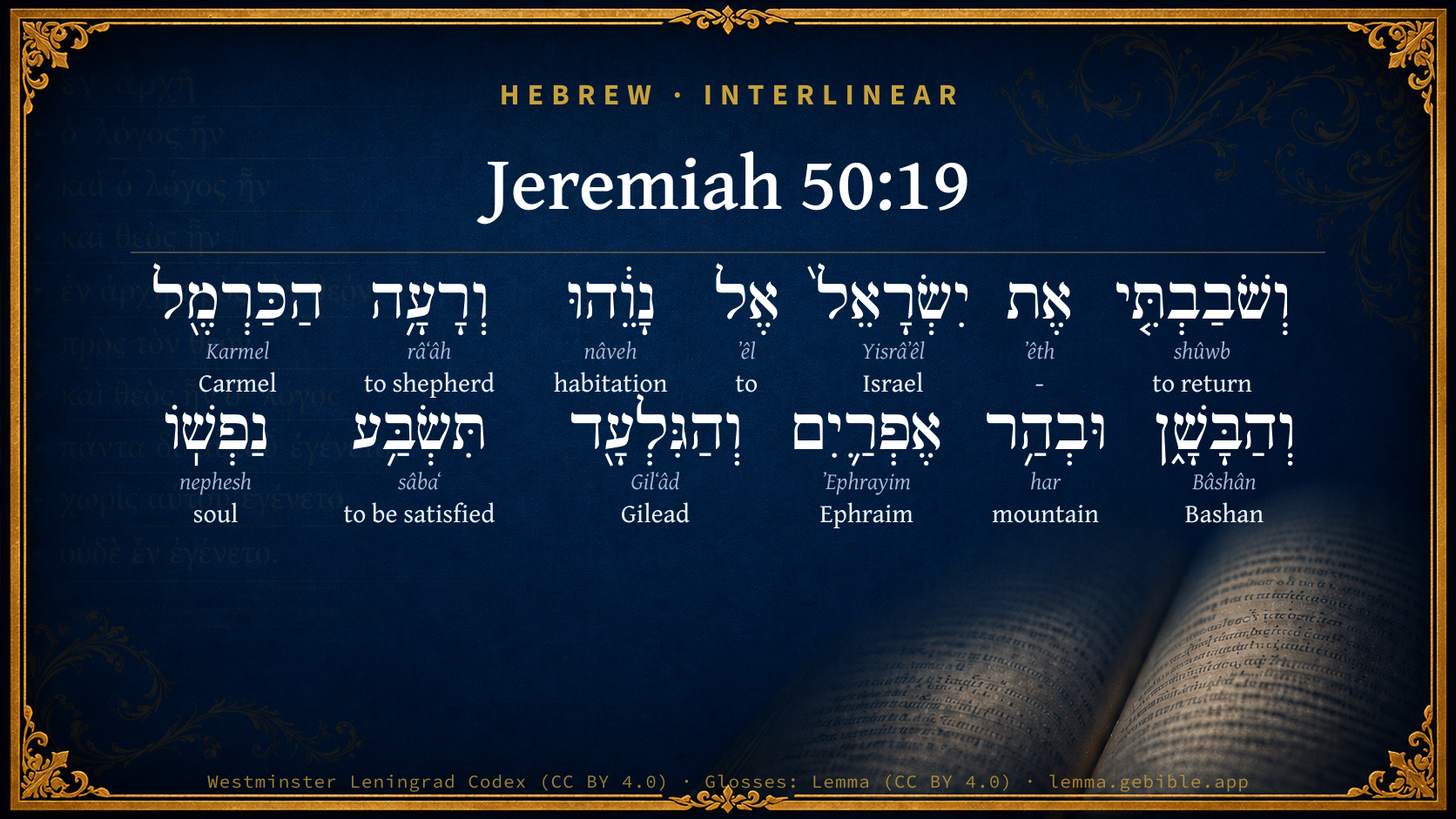
Hebrew (Westminster Leningrad Codex) Jeremiah 50:19 appears in the Hebrew Old Testament. The text above is from the Westminster Leningrad Codex. Each word links to its Strong’s number, a concise gloss, and parsing drawn from the Open Scriptures Hebrew Bible morphology. Click any word for its full Brown-Driver-Briggs (BDB) entry.
Download image
Cite this verse

Jeremiah 50:19 (World English Bible). Public Domain. Lemma interlinear Bible study tool, https://lemma.gebible.app/v/jeremiah/50/19.

Show BibTeX & RIS
BibTeX
RIS
English Translation
I will bring Israel again to his pasture, and he shall feed on Carmel and Bashan, and his soul shall be satisfied on the hills of Ephraim and in Gilead.
World English Bible · Public Domain
Download a study sheet

One document with this verse’s original text, its word-by-word gloss line, the meaning frame, cross-references with their text, attributed commentary, and full source and license credits — printable, and it pastes into notes with its structure intact.

This verse Autodidact and up

Study sheet (.html) Plain text (.txt)

A passage Seminary Student

Up to 50 verses in one chapter. A passage sheet keeps up to 6 commentary sources and 12 cross-references per verse, in the order this page ranks them, and says so on the sheet whenever that leaves anything out. Ask for a single verse and you get the Autodidact verse sheet above.

Everything on this page stays free to read, with no account — the sheet is a download of what is already on screen, not access to it.

Want to remove ads? Support Godless Engineer
Compare translations 3

The same verse in 3 English versions, stacked beneath the original-language interlinear above. Click any original word for its lexicon entry.

Each is an independent rendering of the whole verse — the interlinear is not word-aligned to these translations.

Highlighted words mark where these versions differ — a whole-verse word diff, not a word-by-word alignment.

  • World English Bible Public Domain
    I will bring Israel again to his pasture, and he shall feed on Carmel and Bashan, and his soul shall be satisfied on the hills of Ephraim and in Gilead.
  • King James Version Public Domain
    And I will bring Israel again to his habitation, and he shall feed on Carmel and Bashan, and his soul shall be satisfied upon mount Ephraim and Gilead.
  • unfoldingWord Literal Text CC BY-SA 4.0
    I will restore Israel to his homeland; he will graze on Carmel and Bashan. Then he will be satisfied in the hill country of Ephraim and Gilead.

unfoldingWord Literal Text — © unfoldingWord, licensed CC BY-SA 4.0. Word-aligned USFM3 via Door43 (git.door43.org/unfoldingWord/en_ult).

Versions to compare (up to 4)

3 of 4 selected

Show all 18 translations

Every available English version of this verse, each an independent rendering of the whole verse.

  • World English Bible Public Domain
    I will bring Israel again to his pasture, and he shall feed on Carmel and Bashan, and his soul shall be satisfied on the hills of Ephraim and in Gilead.
  • Berean Standard Bible Public Domain
    I will return Israel to his pasture, and he will graze on Carmel and Bashan; his soul will be satisfied on the hills of Ephraim and Gilead.
  • Majority Standard Bible Public Domain
    I will return Israel to his pasture, and he will graze on Carmel and Bashan; his soul will be satisfied on the hills of Ephraim and Gilead.
  • King James Version Public Domain
    And I will bring Israel again to his habitation, and he shall feed on Carmel and Bashan, and his soul shall be satisfied upon mount Ephraim and Gilead.
  • American Standard Version (1901) Public Domain
    And I will bring Israel again to his pasture, and he shall feed on Carmel and Bashan, and his soul shall be satisfied upon the hills of Ephraim and in Gilead.
  • Revised Version (1885) Public Domain
    And I will bring Israel again to his pasture, and he shall feed on Carmel and Bashan, and his soul shall be satisfied upon the hills of Ephraim and in Gilead.
  • Geneva Bible (1599) Public Domain
    And I will bring Israel againe to his habitation: hee shall feede on Carmel and Bashan, and his soule shall be satisfied vpon the mount Ephraim and Gilead.
  • Douay-Rheims (1899) Public Domain
    And I will bring Israel again to his habitation: and he shall feed on Carmel, and Bason, and his soul shall be satisfied in mount Ephraim, and Galaad.
  • Young's Literal Translation Public Domain
    And I have brought back Israel unto his habitation, And he hath fed on Carmel, and on Bashan. And in mount Ephraim, and on Gilead is his soul satisfied.
  • Literal Standard Version CC BY-SA 4.0
    And I have brought Israel back to his habitation, || And he has fed on Carmel and on Bashan; And his soul is satisfied on Mount Ephraim and on Gilead.
  • Unlocked Literal Bible CC BY-SA 4.0
    I will restore Israel to his homeland; he will graze on Carmel and Bashan. Then he will be satisfied in the hill country of Ephraim and Gilead.
  • unfoldingWord Literal Text CC BY-SA 4.0
    I will restore Israel to his homeland; he will graze on Carmel and Bashan. Then he will be satisfied in the hill country of Ephraim and Gilead.
  • Darby Bible Public Domain
    And I will bring Israel again to his pasture, and he shall feed on Carmel and Bashan, and his soul shall be satisfied upon mount Ephraim and in Gilead.
  • World Messianic Bible Public Domain
    I will bring Israel again to his pasture, and he will feed on Carmel and Bashan. His soul will be satisfied on the hills of Ephraim and in Gilead.
  • Webster's Bible Public Domain
    And I will bring Israel again to his habitation, and he shall feed on Carmel and Bashan, and his soul shall be satisfied upon mount Ephraim and Gilead.
  • Free Bible Version CC BY-SA 4.0
    I will lead the Israelites back to their pasturelands, to feed on Carmel and Bashan, to satisfy their appetites on the hills of Ephraim and Gilead.
  • Bible in Basic English Public Domain
    And I will make Israel come back to his resting-place, and he will get his food on Carmel and Bashan, and have his desire in full measure on the hills of Ephraim and in Gilead.
  • JPS Tanakh (1917) Public Domain
    And I will bring Israel back to his pasture, and he shall feed on Carmel and Bashan, and his soul shall be satisfied upon the hills of Ephraim and in Gilead.

Literal Standard Version (2020), Covenant Press — licensed CC BY-SA 4.0. Text via the HelloAO Bible API (eBible.org). Unlocked Literal Bible (unfoldingWord) — licensed CC BY-SA 4.0. Text via the HelloAO Bible API (eBible.org). unfoldingWord Literal Text — © unfoldingWord, licensed CC BY-SA 4.0. Word-aligned USFM3 via Door43 (git.door43.org/unfoldingWord/en_ult). Free Bible Version, Dr. Jonathan Gallagher — licensed CC BY-SA 4.0. Text via the HelloAO Bible API (eBible.org).

Word by word

More ways to search: Search by grammar → Find every occurrence → Compare this word →

Practice this passage: Drill this verse → Learn its vocabulary →

הַכַּרְמֶ֖ל
Karmel
H3760
“the · Carmel”
Particle, Definite Article + Noun, Proper
Part of Speech
Particle + Noun
Type
Proper
Full BDB Definition

Origin: the same as H3759

TWOT: 1042

Carmel = "garden-land" - a mountain on the Mediterranean coast of northern Israel, just below Haifa - a town in the mountains on the west side of the Dead Sea and south of Hebron
  1. וְשֹׁבַבְתִּ֤י shûwb H7725 “and · to return” Conjunction + Verb, Polel, Sequential Perfect, 1st Person, Common, Singular
  2. אֶת ʼêth H853 “-” Particle, Direct Object
  3. יִשְׂרָאֵל֙ Yisrâʼêl H3478 “Israel” Noun, Proper
  4. אֶל ʼêl H413 “to” Preposition
  5. נָוֵ֔הוּ nâveh H5116 “habitation · his” Noun, Common, Both, Singular, Construct + Suffix, Personal, 3rd Person, Masculine, Singular
  6. וְרָעָ֥ה râʻâh H7462 “and · to shepherd” Conjunction + Verb, Qal, Sequential Perfect, 3rd Person, Masculine, Singular
  7. וְהַבָּשָׁ֑ן Bâshân H1316 “and · the · Bashan” Conjunction + Particle, Definite Article + Noun, Proper
  8. וּבְהַ֥ר har H2022 “and · in/at · mountain of” Conjunction + Preposition + Noun, Common, Masculine, Singular, Construct
  9. אֶפְרַ֛יִם ʼEphrayim H669 “Ephraim” Noun, Proper
  10. וְהַגִּלְעָ֖ד Gilʻâd H1568 “and · the · Gilead” Conjunction + Particle, Definite Article + Noun, Proper
  11. תִּשְׂבַּ֥ע sâbaʻ H7646 “to be satisfied” Verb, Qal, Imperfect, 3rd Person, Feminine, Singular
  12. נַפְשֽׁוֹ nephesh H5315 “soul · his” Noun, Common, Both, Singular, Construct + Suffix, Personal, 3rd Person, Masculine, Singular

About this verse

These counts appear in no published source. They are computed here, from the morphology-tagged text and Lemma’s own curated glosses. What Lemma adds →

13
words
13
distinct lemmas
Prophets
section

Notable vocabulary

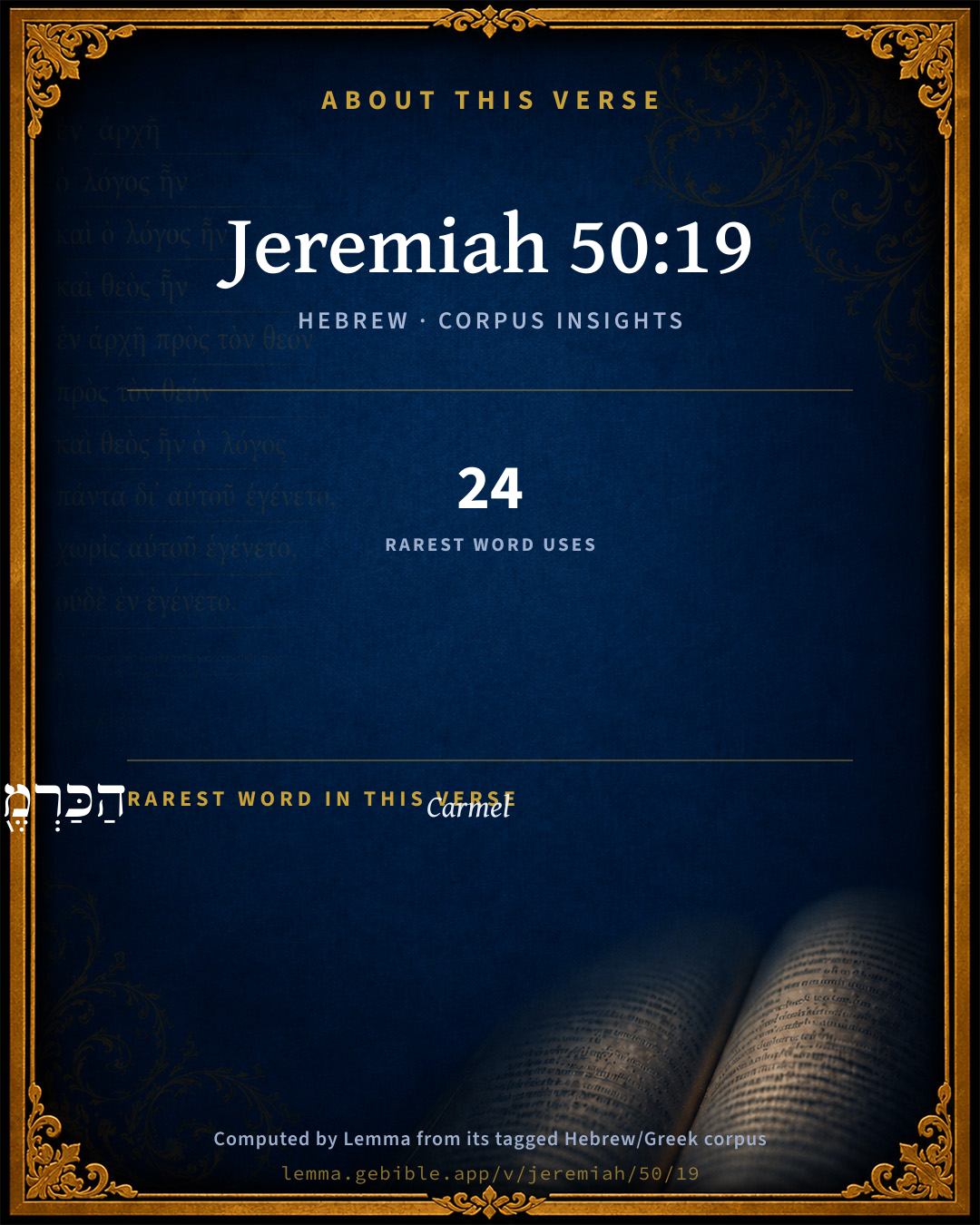
The rarest word here is הַכַּרְמֶ֖ל Carmel H3760 — appearing just 24 times in the whole Hebrew Bible.

Shared distinctive vocabulary

הַכַּרְמֶ֖ל Carmel H3760 occurs in 23 verses of the Hebrew Bible. Also found in:

Grammatical profile

  • 3 verbs
  • 8 nouns
  • 1 preposition
  • 1 particle

Verb forms

  • וְשֹׁבַבְתִּ֤י Polel · Sequential Perfect
  • וְרָעָ֥ה Qal · Sequential Perfect
  • תִּשְׂבַּ֥ע Qal · Imperfect

Cross-references

29

Topical passages linked to Jeremiah 50:19 in the Treasury of Scripture Knowledge — connected by theme and wording, ordered by reader-vote popularity; previews shown in the World English Bible.

  • Jeremiah 3:18 In those days the house of Judah shall walk with the house of Israel, and they shall come together out of the land of the north to the land that I gave for an inheritance to your fathers.
  • Jeremiah 23:3 I will gather the remnant of my flock out of all the countries where I have driven them, and will bring them again to their folds; and they shall be fruitful and multiply.
  • Jeremiah 24:6–7 For I will set my eyes on them for good, and I will bring them again to this land: and I will build them, and not pull them down; and I will plant them, and not pluck them up.
  • Jeremiah 30:10 Therefore don't you be afraid, O Jacob my servant, says Yahweh; neither be dismayed, Israel: for, behold, I will save you from afar, and your seed from the land of their captivity; and Jacob shall return, and shall be quiet and at ease, and none shall make him afraid.
  • Jeremiah 30:18 Thus says Yahweh: Behold, I will turn again the captivity of Jacob's tents, and have compassion on his dwelling-places; and the city shall be built on its own hill, and the palace shall be inhabited after its own manner.
  • Jeremiah 31:6 For there shall be a day, that the watchmen on the hills of Ephraim shall cry, Arise you, and let us go up to Zion to Yahweh our God.
  • Jeremiah 31:8–10 Behold, I will bring them from the north country, and gather them from the uttermost parts of the earth, [and] with them the blind and the lame, the woman with child and her who travails with child together: a great company shall they return here.
  • Jeremiah 31:14 I will satiate the soul of the priests with fatness, and my people shall be satisfied with my goodness, says Yahweh.
  • Ezekiel 34:13–14 I will bring them out from the peoples, and gather them from the countries, and will bring them into their own land; and I will feed them on the mountains of Israel, by the watercourses, and in all the inhabited places of the country.
  • Amos 9:14–15 I will bring back the captivity of my people Israel, And they will rebuild the ruined cities, and inhabit them; and they will plant vineyards, and drink wine from them. They shall also make gardens, And eat the fruit of them.
  • Micah 7:14 Shepherd your people with your staff, The flock of your heritage, Who dwell by themselves in a forest, In the midst of fertile pasture land, let them feed; In Bashan and Gilead, as in the days of old.
  • Numbers 32:1 Now the children of Reuben and the children of Gad had a very great multitude of cattle: and when they saw the land of Jazer, and the land of Gilead, that behold, the place was a place for cattle;
  • Joshua 17:15 Joshua said to them, If you are a great people, go up to the forest, and cut down for yourself there in the land of the Perizzites and of the Rephaim; since the hill-country of Ephraim is too narrow for you.
  • Song of Solomon 6:5 Turn away your eyes from me, For they have overcome me. Your hair is like a flock of goats, That lie along the side of Gilead.
  • Isaiah 33:9 The land mourns and languishes; Lebanon is confounded and withers away; Sharon is like a desert; and Bashan and Carmel shake off [their leaves].
  • Isaiah 35:2 It shall blossom abundantly, and rejoice even with joy and singing; the glory of Lebanon shall be given to it, the excellency of Carmel and Sharon: they shall see the glory of Yahweh, the excellency of our God.
  • Isaiah 65:9–10 I will bring forth a seed out of Jacob, and out of Judah an inheritor of my mountains; and my chosen shall inherit it, and my servants shall dwell there.
  • Jeremiah 31:25 For I have satiated the weary soul, and every sorrowful soul have I replenished.
  • Jeremiah 32:37 Behold, I will gather them out of all the countries, where I have driven them in my anger, and in my wrath, and in great indignation; and I will bring them again to this place, and I will cause them to dwell safely:
  • Jeremiah 33:7–12 I will cause the captivity of Judah and the captivity of Israel to return, and will build them, as at the first.
  • Jeremiah 50:4–5 In those days, and in that time, says Yahweh, the children of Israel shall come, they and the children of Judah together; they shall go on their way weeping, and shall seek Yahweh their God.
  • Ezekiel 11:17 Therefore say, Thus says the Lord Yahweh: I will gather you from the peoples, and assemble you out of the countries where you have been scattered, and I will give you the land of Israel.
  • Ezekiel 36:24 For I will take you from among the nations, and gather you out of all the countries, and will bring you into your own land.
  • Ezekiel 36:33 Thus says the Lord Yahweh: In the day that I cleanse you from all your iniquities, I will cause the cities to be inhabited, and the waste places shall be built.
  • Ezekiel 38:8 After many days you shall be visited: in the latter years you shall come into the land that is brought back from the sword, that is gathered out of many peoples, on the mountains of Israel, which have been a continual waste; but it is brought forth out of the peoples, and they shall dwell securely, all of them.
  • Ezekiel 39:25–29 Therefore thus says the Lord Yahweh: Now will I bring back the captivity of Jacob, and have mercy on the whole house of Israel; and I will be jealous for my holy name.
  • Obadiah 1:17–21 But in Mount Zion, there will be those who escape, and it will be holy. The house of Jacob will possess their possessions.
  • Micah 7:18 Who is a God like you, who pardons iniquity, And passes over the disobedience of the remnant of his heritage? He doesn't retain his anger forever, Because he delights in loving kindness.
  • Ezekiel 37:21–22 Say to them, Thus says the Lord Yahweh: Behold, I will take the children of Israel from among the nations, where they are gone, and will gather them on every side, and bring them into their own land:

Cross-references courtesy of OpenBible.info (CC BY 4.0).

Hebrew and Greek witnesses Masoretic Hebrew ↔ Greek Septuagint

The same verse in the two great witnesses to the Old Testament, shown verse-for-verse.

These are two independent witnesses, not word-aligned to each other, and the Septuagint is shown in lemma (dictionary) form.

Hebrew Jeremiah 50:19 Masoretic · Westminster Leningrad Codex

וְשֹׁבַבְתִּ֤י אֶת יִשְׂרָאֵל֙ אֶל נָוֵ֔הוּ וְרָעָ֥ה הַכַּרְמֶ֖ל וְהַבָּשָׁ֑ן וּבְהַ֥ר אֶפְרַ֛יִם וְהַגִּלְעָ֖ד תִּשְׂבַּ֥ע נַפְשֽׁוֹ

I will bring Israel again to his pasture, and he shall feed on Carmel and Bashan, and his soul shall be satisfied on the hills of Ephraim and in Gilead.

World English Bible · Public Domain

Greek LXX Structure differs

In the Septuagint, Jeremiah is about an eighth shorter than the Hebrew and arranges its material differently — the Oracles Against the Nations (Hebrew chapters 46–51) appear in the middle of the Greek book, after 25:13. Because the chapter and verse boundaries do not line up, a verse-for-verse comparison with the Hebrew is not shown.

A verse-for-verse comparison isn’t shown here because the chapters and verses don’t line up. Switch to the LXX edition with the MT / LXX toggle above to read the Greek directly.

Hebrew: Westminster Leningrad Codex (CC BY 4.0). Greek: Septuagint (public domain); English from a public-domain English Septuagint. How the Septuagint differs from the Hebrew →

Targum (Aramaic paraphrase)

1

The Targum is the ancient Jewish Aramaic paraphrase of the Hebrew Scriptures — an interpretive translation, not the Hebrew text itself. Onkelos (literal) and Pseudo-Jonathan (expansive) render the Torah, and Jonathan the Prophets. Coverage is partial: where no permissively-licensed English translation exists for a verse, only the Aramaic is shown. This is verse-level text, not a word-by-word alignment to the Hebrew.

  1. Targum Jonathan Prophets (Joshua–Malachi)
    וְאָתֵיב יַת יִשְׂרָאֵל לְאַתְרֵיהוֹן וְיִתְפַּרְנְסוּן בְּאַרְעָא כַרְמְלָא מַתְנָן וּבְטוּר בֵּית אֶפְרַיִם וְגִלְעָד וּמַקְדְשָׁא תִּשְׂבַּע נַפְשְׁהוֹן:

    (no public-domain English translation for this verse)

    Targum Jonathan — Aramaic: “Mikraot Gedolot” (public domain). English: “Sefaria Community Translation” (CC0 1.0 (public-domain dedication)); “London "Chaldee Paraphrase," 1871” (public domain). Text via Sefaria.

Commentary

Notes on Jeremiah 50:19 from classic Christian and Jewish commentators (each source and its license shown beneath its notes). The classic Christian expositions comment on the surrounding passage and are grouped to its opening verse, so a note may address several verses; the Jewish commentaries on the Tanakh (Rashi and others) are per-verse, so they appear only where the commentator wrote on this verse.

Lemma curates 59 commentaries, every one of them public domain or Creative Commons licensed, each selected and text-cleaned for this edition rather than reprinted as found. About our sources →

Trapp's Complete Commentary

John Trapp

Jer 50:19 And I will bring Israel again to his habitation, and he shall feed on Carmel and Bashan, and his soul shall be satisfied upon mount Ephraim and Gilead.

Ver. 19. And I will bring Israel again to his habitation.] Or, To his fold, or his pastures. See Jer 50:6; Jer 50:17.

John Trapp, A Commentary or Exposition upon All the Books of the Old and New Testament (1647–1656) — public domain. Text from a community e-Sword module.

Joseph Benson's Commentary

Jer 50:19-20. I will bring Israel again to his habitation — I will take care of Israel as a shepherd does of his flock, and bring them back to their ancient habitations, and to their former peace and plenty. By Israel here is meant the two tribes of Judah and Benjamin, the Levites and some Israelites who joined with them, after the carrying away of the ten tribes. “As several parts of this prophecy,” says Lowth, “relate to that mystical Babylon whose destruction is foretold Revelation 18., so these promises of grace and favour to the Jewish nation are chiefly to be understood of the general restoration of that people, which we may expect after the downfall of the anti-christian empire.” In those days the iniquity of Israel shall be sought for, and there shall be none — That is, I will be perfectly reconciled to them, as if they had never offended. The Hebrew language often expresses the utter ceasing of any thing by seeking and not finding it. This promise seems principally to respect the times of the gospel, and the remnant of the Jews that shall be saved according to the election of grace: compare Jer 31:34; Jer 33:8; Rom 11:5; Rom 11:26-27.

Joseph Benson's Commentary on the Old and New Testaments (1811–1818) — public domain. Text from a community e-Sword module.

Jamieson, Fausset & Brown

Robert Jamieson, A. R. Fausset & David Brown

(Isa 65:10; Eze 34:13-14).

Jamieson, Fausset & Brown — Commentary Critical and Explanatory on the Whole Bible (1871) — public domain (CC PDM 1.0). Text via the HelloAO Bible API.

Adam Clarke's Commentary

Verse 19. I will bring Israel again] This seems to refer wholly to the ten tribes; for Carmel, Bashan, Mount Ephraim, and Gilead, were in their territories.

Adam Clarke's Commentary on the Bible (1810–1826) — public domain. Text from a community e-Sword/MySword module.

John Calvin's Commentaries

Jeremiah pursues here the same subject, and sustains the minds of the faithful in their miseries, lest they should wholly despond. It is then the same as though he stretched forth his hand to the shipwrecked, or gave support to those lying down as it were lifeless; for exile to God’s children was not only sad, but was like death, because they perceived the vengeance of God as though they had been wholly repudiated. It was therefore necessary to give them some consolation, that they might not altogether despair. The object, then, of our Prophet now is, to encourage the Jews to bear patiently their troubles, and not to think the stroke inflicted on them to be fatal. Hence God promises a restoration to their own country, which would be an evidence of pardon and of mercy; for when God gathered his people, it was the same as though he had openly showed that their adoption remained unchanged, and that the covenant which seemed for a time to fail was still valid.

We now then see why Jeremiah spoke of the restoration of the people; and then he adds, to their own folds, or to their own habitation. This mode of speaking, we know, is found everywhere in the Prophets, for they compare God to a shepherd, and the Church to a flock of sheep. This similitude then is sufficiently common, nor could God better express how much he was concerned for the welfare of his people, than by setting himself forth as their shepherd, and by testifying that he would take care of his flock. But as we said at the beginning of the book, Jeremiah had a special reason for using this similitude, because he was from a town of pastures, and had been from his childhood among shepherds: there is therefore no wonder that he often uses expressions to which he had been accustomed; for education in a great measure forms the language of men. Though then the Prophet speaks according to the usual phraseology of Scripture, there is yet no doubt but that he retained, as it has been said elsewhere, his own habitual mode of speaking.

He then says, that after the people had been gathered, they would inhabit, rich and fertile mountains, even Carmel and Bashan. The fruitfulness of these mountains is spoken of in many places, but it is not necessary to quote them. The meaning however is, that God, after having again gathered his chosen people, would be as it were a faithful shepherd to them, so that they might feel assured that there would be not only a free return to their own country, but that God would be also the guardian of their safety, so as ever to protect them, to exercise care over them, to defend them against their enemies.

But that God might more fully set forth his kindness, he adds, and satisfied shall be his soul Soul here is to be taken for desire, as in many other places. Now the former doctrine ought to be borne in mind, that God is never so angry or displeased with his Church but that he remembers his covenant. Then, as to the faithful, after they have undergone their temporary punishment, God at length stretches forth his hand to them; nor is he once only propitious to them, but continues his mercy, and so cherishes them, that he is not less solicitous for their welfare than a shepherd is, to whom his flock is not less dear than his own life, so that he watches in the night, endures cold and heat, and also exposes himself to many dangers from robbers and wild beasts in order that he might protect his flock. But the Prophet points out as by the finger the very fountain of all this when he adds, —

John Calvin's Commentaries (1540-1563) — public domain. Text from the Calvin Translation Society English edition (1840s-50s) via the Christian Classics Ethereal Library (ccel.org). Calvin's coverage is partial (roughly two-thirds of the Bible); uncommented books and verses are honest gaps, never fabricated. The 19th-century editor's footnotes and remarks are omitted so the notes are faithfully Calvin's own voice.

Ellicott's Commentary for English Readers

(19) I will bring Israel again to his habitation.—Better, to his pasturage (as in Jer_10:25; Jer_23:3), as keeping up the figure of Jer_50:17. The “scattered sheep” was to be brought back and to find pasture. The regions named are the representatives of the most fertile districts of Palestine, Carmel and Mount Ephraim on the west (Eze_34:13), Bashan and Gilead on the east, of Jordan (Num_32:1; Mic_7:14).

A Bible Commentary for English Readers, edited by Charles John Ellicott (1878–1897) — public domain. Text from a community e-Sword module.

The Cambridge Bible for Schools and Colleges

gen. ed. J. J. S. Perowne

19. Assyria has already paid the penalty for its cruelty towards the people of God. Such too shall be the fate of Babylon.

pasture] her own fertile country, Palestine. Cf. Mic_7:14. The parts of the land mentioned are those which were most productive.

soul] as the seat of appetite. Cp. Jer_31:14.

The Cambridge Bible for Schools and Colleges (gen. ed. J. J. S. Perowne; Cambridge University Press, 1878–1918) — public domain. Text from a community e-Sword module.

John Gill's Exposition

And I will bring Israel again to his habitation,.... Or "fold" (u), or place of pasturage; for the metaphor of sheep is still continued. Israel designs not the tribes of Judah and Benjamin, and the Levites, and a few of the other tribes mixed with them only, but all Israel, together with Judah, as appears from Jer 50:20; and so this prophecy had not its full accomplishment at the Jews' return from the Babylonish captivity; but respects their future conversion, when all Israel shall be saved, and they will return to their own land. Kimchi says this refers to time yet to come; which he prefers to the other sense he mentions, of the return of the captivity of Babylon;

and he shall feed on Carmel and Bashan, and his soul shall be satisfied upon Mount Ephraim and Gilead; which, as they were all fruitful places, and had good pasturage, so they belonged to the ten tribes; which shows that it respects the return of them and the fulness of blessings, both temporal and spiritual, they shall then enjoy.

(u) "ad habitaculum", vel potius "caulam", Schmidt.

John Gill's Exposition of the Whole Bible (1746–1763) — public domain (CC PDM 1.0). Text via the HelloAO Bible API.

Albert Barnes' Notes on the Bible

Or, “I will bring Israel (the scared sheep) back to his pasturage (see Jer 50:7) and he shall graze etc.” The places named are the districts of Palestine most famous for their rich herbage.

Albert Barnes' Notes on the Bible (1834–1885) — public domain. Text from a community e-Sword/MySword module.

Haydock's Catholic Bible Commentary

Israel; the ten tribes, whose country is specified.

George Leo Haydock (1774–1849), Haydock's Catholic Family Bible and Commentary, 1859 edition — public domain. Excludes Psalms (Douay-Rheims chapter numbering differs from Protestant) and Deuterocanonical books (Catholic canon only).

Matthew Poole's English Annotations

This must be understood of Judah, which was part of that people who were called Israel, for to this day we have neither read nor heard of the ten tribes being brought back again to their habitation. The only difficulty is, how it is said that the Jews upon their return should feed upon Carmel and Bashan, and Mount Ephraim and Gilead, which were places that belonged not to the tribes of Judah and Benjamin: to which it is answered, that these places were granted to the Jews by Demetrius the father and the son, as we are told by Josephus, 1. 13. c. 5.8. These places were rich grounds for feeding cattle, therefore it is said

they shall feed on Carmel and Bashan, & c.

Matthew Poole's English Annotations on the Holy Bible (1683–1685) — public domain. Text from a community e-Sword/MySword module.

Whedon's Commentary on the Bible

Daniel D. Whedon

19. Again to his habitation,… Carmel and Bashan,… Ephraim and Gilead — The most famous localities for pasturage.

Daniel D. Whedon (gen. ed.), Commentary on the Old and New Testaments (1874–1909) — public domain. Text from a community e-Sword module.

The Pulpit Commentary

The flock restored. His habitation is an unfortunate rendering, which obscures the beautiful figure; read, his pasture (as in ver. 7). The places mentioned were all famous for their rich pasturage; (comp. Jer_22:6 Isa_33:9 Mic_7:14 (especially) Eze_34:13, 14 Son_4:1)

Vers. 19, 20. The forgiveness of God.

These words are a beautiful setting forth of God"s abundant pardon. Concerning it note how

I IT BRINGS UNSPEAKABLE JOY. In the former part of this chapter (cf. ver. 6) the prophet has pictured Israel and Judah like to a driven, hunted flock of sheep, never allowed to rest in peace, worried by fierce dogs, and hence in perpetual distress. But here there is a complete contrast. The flock feeds on Carmel and Bashan, the richest pastures. The most perfect rest is theirs. The lot of the flock told of in Psa_23:2 is theirs. So full of peace and joy are they. And the forgiveness of God does bring deep joy to the soul. The sense of such forgiveness is very delightful the realization that God doth no more remember our sin. And the manifestations of that forgiveness are also very blessed. For very generally God causes his providence to be gracious and kindly to that man whom he has pardoned. And the fruits of it are also blessed, in the character, the peace, the energy, the strength, it imparts. But

II IT IS CHALLENGED. "The iniquity of Israel shall be sought for" (ver. 20). There are those who question very much the Divine forgiveness, who maintain that the sin is still where it was. Often the forgiven man himself does this. He cannot "read his title clear;" he trembles at the future and cannot be persuaded that God has put away his sin. He is filled with doubts and fears. But often the seeking after the iniquity of God"s people is done malignantly. The enemies of God rejoice when they can find a solitary blot or blemish in the character of God"s children. What a yell of triumph they raise when they light on such a discovery! Satan is "the accuser of the brethren." He is ever on the search for their iniquity. And they who are of him are ready with the charge of cant, hypocrisy, etc.; refusing to believe that there can be any such person as a real saint of God. And pharisaically also Israel"s iniquity is frequently "sought for." See that elder son in the parable. (Lu 15) How slow he was to believe in anything but the hardened iniquity of his younger brother! A great deal may be urged in favour of his Slew of things. Such kindly treatment did seem unjust, putting bad and good on one level. He would not have objected as such men, and there have been and are myriads of them, do not object to show some little favour to a repentant sinner, after a long course of testing him and proving whether he was worthy of any further forgiveness; but to give him all at once such complete pardon, such elder sons never believe in that. And by some the iniquity of those whom God has pardoned is sought for philosophically. "Plato, Plato," said Socrates, "I do not see how God can forgive sins." And when we see, as we do see, how in the whole realm of nature every force goes on until it has produced its full effect there is no loss of force anywhere how can sin be made an exception? how can it be prevented from having its due and full effect, sad and terrible as that is? Philosophically speaking, there can be no forgiveness. What a man soweth, that must he also reap, in nature and measure, in kind and degree. Thus is God"s forgiveness challenged. But

III IT IS VINDICATED. Ver. 20, "The iniquity.., shall be sought for, and there shall be none; and the sins... and they shall not be found." The sacrifice and the Spirit of Christ are the vindication of God"s forgiveness. The former by vindicating the Divine righteousness in such forgiveness. For there are two ways of accomplishing this. One is the way of condign punishment. But God desires atonement, reconciliation, as well as vindication, and therefore this way will not serve. The other the way of repentance, the accepting the contrite confession of sin, and prayer for its forgiveness. And this is the way God has chosen. Cf. "I said I will confess... and thou forgavest," etc.; "The sacrifices of God are a broken spirit," etc. Now, this way of dealing with sinners vindicates God"s righteousness. For, though we cannot offer an adequate confession, repentance, and intercession, yet, in Christ, this has been done; and when, in sympathy with him, in "the fellowship of his sufferings," and "made conformable to his death," we make our confessions and prayers, they are accepted for the sake of him who has offered perfectly the spiritual sacrifice which we can offer only imperfectly. Now, this way of dealing with sinners vindicates God"s righteousness; yea, it causes sinners to be made the righteousness of God in him," that is, Christ. (2Co_5:21) God"s righteousness is thus made illustrious, conspicuous, as by no other means whatsoever. For when it is clearly seen, as in the kingdom of God it will be clearly seen,

(1) the depths whence the sinner has been drawn, and

(2) the glorious height of purity and excellence to which he has been by this grace of God upraised, that spectacle will silence all objections, and will prove that that way must have been a righteous way which has had such righteous results. And the Spirit of Christ, producing sanctity in the hearts and lives of believers, is the vindication of this way of grace to all eider sons, and, indeed, to all else who challenge what God has done.

CONCLUSION.

1. Rejoice in such forgiveness, that you have it to proclaim, to think of, to rest your soul upon.

2. Adore. What else can we do but sing our "Magnificats" to such a redeeming God? Who is a pardoning God like thee? And who hath grace so rich and free?

3. Come away from all self-trust, all reliance on your own deeds for justification and forgiveness.

4. Tremble, O unsaved one, to be found amongst those who have despised such grace. "How can we escape if we neglect so great salvation? C.

Vers. 19, 20. The feeding places of the flock.

Consider

I WHAT JEHOVAH HAD PROVIDED AND THE PEOPLE HAD LOST. Carmel and Bashan, Ephraim and Gilead, were not something altogether new. They were memories of the past as well as hopes of the future. Israel had been a scattered sheep. Out of Christ not only are we ourselves lost, but we have lost the use of the appropriate possessions of humanity. Really what God does in restoring his people is to bring them to something a great deal better than the places mentioned; but these places represent an actual, experienced good. And it is well that God should give us, as one aspect of the future, a restoration of all that was satisfying in the past.

II JEHOVAH IS ABOUT TO RESTORE. HOW WILL THE PEOPLE USE WHAT IS TO BE RESTORED? Restoration by itself will do nothing. If the man comes back to his possessions as he went away, then he can only misuse and squander as of old. The house swept and garnished only presented to the evil spirits a chance for greater riot and defilement than before. To the old land there comes back a new people. After tasting the bitterness of wanderings, they have tasted also the powers of the world to come old carnal temptations no longer charm, new spiritual considerations stand full in view. Formerly, even on Carmel and Bashan, Mount Ephraim and Gilead, there had been discontent, because, with all the goodness in these places, there was not enough for the carnal heart. But now, when things are used spiritually, there is enough and more than enough. If only we follow where God leads there will be ample provision and ample blessedness. Y.

The Pulpit Commentary (1880–1919), ed. H.D.M. Spence-Jones & Joseph S. Exell — public domain. Text from a community e-Sword module.

unfoldingWord translationNotes

Door43 World Missions Community

General Information:

Yahweh continues speaking to Jeremiah about Israel.

I will restore

The word "I" refers to Yahweh.

Israel to his homeland ... he will be satisfied

This refers collectively to all the people of Israel. AT: "the people of Israel to their homeland ... they will be satisfied" (See: Metonymy)

he will graze on Carmel and Bashan

Israel is spoken of as if they were sheep that eat grass. AT: "they will eat food that grows in Carmel and Bashan" (See: Metaphor)

In those days and at that time

These two phrases mean the same thing and emphasize that future time. See how you translated this in as Jeremiah 33:15. (See: Doublet)

iniquity will be looked for in Israel, but none will be found. I will inquire about the sins of Judah, but none will be found

These two lines mean basically the same thing. Together they emphasize that Yahweh will completely forgive the sins of the people of Israel. (See: Parallelism)

iniquity will be looked for in Israel, but none will be found

This can be stated in active form. AT: "Yahweh will look for iniquity in the people of Israel, but will not find any" (See: Active or Passive)

that I spare

They will escape the destruction of Babylon. This can be stated explicitly. AT: "that I allow to escape the destruction of Babylon" (See: Assumed Knowledge and Implicit Information)

translationWords

restore

Carmel

Bashan

Ephraim

Gilead

iniquity

sin

forgive

remnant

unfoldingWord translationNotes — © Distant Shores Media and the Door43 World Missions Community, licensed CC BY-SA 4.0. Source: git.door43.org/Door43/en_tn.

Rashi

Rabbi Shlomo Yitzchaki (Rashi)

and he shall pasture in the Carmel An expression of pasture.

Rashi on the Tanakh — English translations: “The Judaica Press complete Tanach with Rashi, translated by A. J. Rosenberg” (CC BY 4.0); “Pentateuch with Rashi's commentary by M. Rosenbaum and A.M. Silbermann, 1929-1934” (public domain); “The Metsudah Tanach series, Lakewood, N.J” (CC BY 4.0); and “The Book of Joshua, Metsudah Publications, 1997” (CC BY 4.0). Text via Sefaria.

Lesson kit

Teaching starters — assembled from the data on this page, not authored interpretation. Every prompt links to the verse data it draws on. Edit before teaching.

Jeremiah, in the Prophets, opens this verse with 13 words (13 distinct Hebrew lemmas). Its most distinctive word is Karmel (“Carmel”). A historical commentator’s framing appears above. Read the whole chapter for the surrounding context.

Discussion questions

  1. The word Karmel carries the sense “Carmel.” How does it shape the verse?
  2. Joshua 12:22 shares the word «Carmel» with this verse. How do the two illuminate each other?
  3. These translations render this verse differently. What is at stake in choosing one wording over another?
  4. The verb «וְשֹׁבַבְתִּ֤י» is Polel Sequential Perfect. How does its form color the action?
  5. Reading how Trapp's Complete Commentary and Joseph Benson's Commentary read this verse, where do the two commentators agree and where do they part?

Things to notice

Reading settings

Reading text

Shown beneath each verse's original-language words.

Old Testament
Old Testament edition

Read the OT as the Masoretic Hebrew (MT) or the Greek Septuagint (LXX).

English shown for the Greek Septuagint (in the Hebrew ↔ Greek comparison).

Comparing translations? Open the Compare panel on any verse page to stack up to four side by side.