
Lamentations 1:11

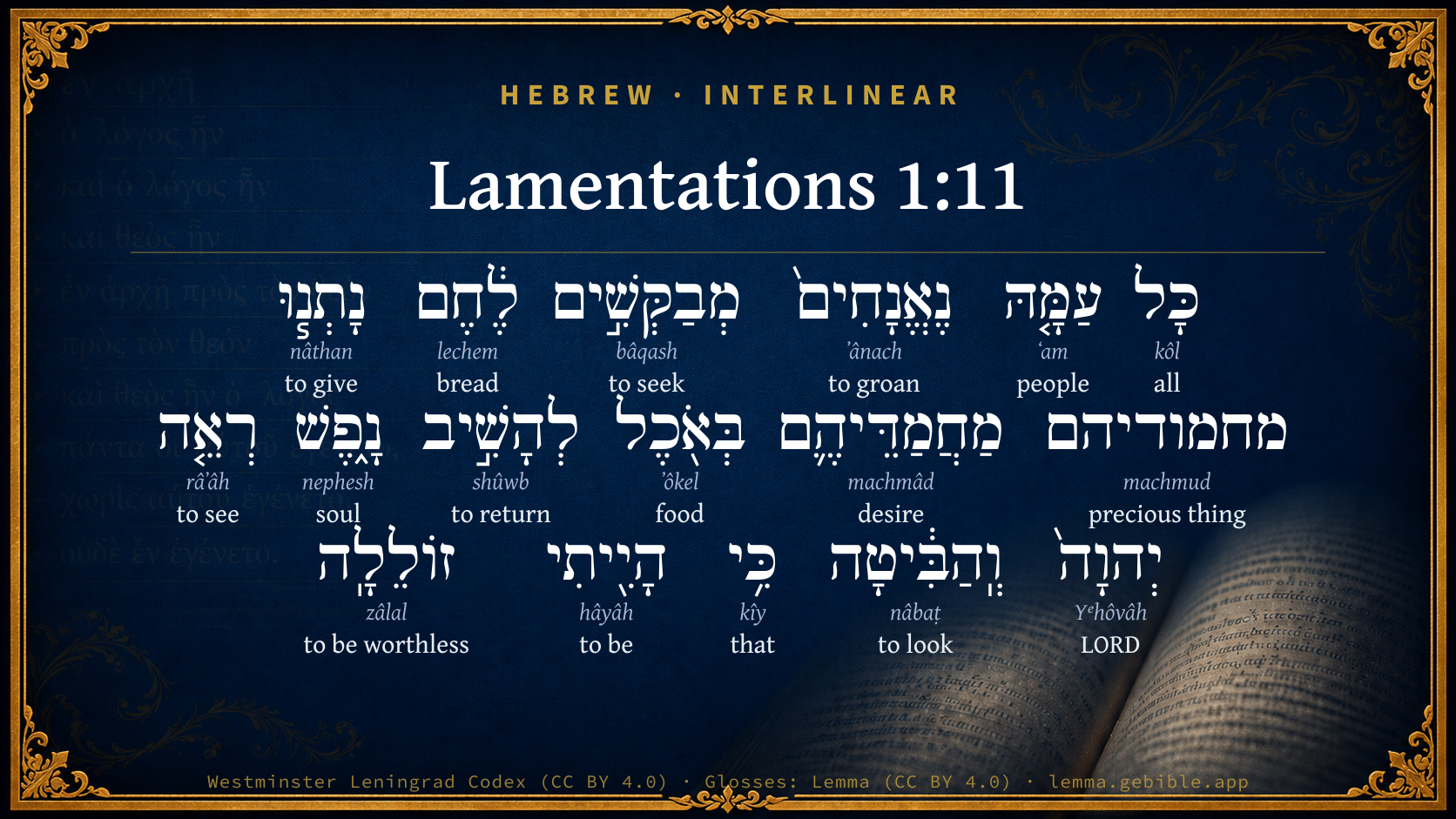
Hebrew (Westminster Leningrad Codex) Lamentations 1:11 appears in the Hebrew Old Testament. The text above is from the Westminster Leningrad Codex. Each word links to its Strong’s number, a concise gloss, and parsing drawn from the Open Scriptures Hebrew Bible morphology. Click any word for its full Brown-Driver-Briggs (BDB) entry.
Download image
Cite this verse

Lamentations 1:11 (World English Bible). Public Domain. Lemma interlinear Bible study tool, https://lemma.gebible.app/v/lamentations/1/11.

Show BibTeX & RIS
BibTeX
RIS
English Translation
All her people sigh, they seek bread; They have given their pleasant things for food to refresh the soul: Look, Yahweh, and see; for I am become abject.
World English Bible · Public Domain
Download a study sheet

One document with this verse’s original text, its word-by-word gloss line, the meaning frame, cross-references with their text, attributed commentary, and full source and license credits — printable, and it pastes into notes with its structure intact.

This verse Autodidact and up

Study sheet (.html) Plain text (.txt)

A passage Seminary Student

Up to 50 verses in one chapter. A passage sheet keeps up to 6 commentary sources and 12 cross-references per verse, in the order this page ranks them, and says so on the sheet whenever that leaves anything out. Ask for a single verse and you get the Autodidact verse sheet above.

Everything on this page stays free to read, with no account — the sheet is a download of what is already on screen, not access to it.

Want to remove ads? Support Godless Engineer
Compare translations 3

The same verse in 3 English versions, stacked beneath the original-language interlinear above. Click any original word for its lexicon entry.

Each is an independent rendering of the whole verse — the interlinear is not word-aligned to these translations.

Highlighted words mark where these versions differ — a whole-verse word diff, not a word-by-word alignment.

  • World English Bible Public Domain
    All her people sigh, they seek bread; They have given their pleasant things for food to refresh the soul: Look, Yahweh, and see; for I am become abject.
  • King James Version Public Domain
    All her people sigh, they seek bread; they have given their pleasant things for meat to relieve the soul: see, O LORD, and consider; for I am become vile.
  • unfoldingWord Literal Text CC BY-SA 4.0
    All her people are groaning, seeking bread. They have given their precious things for food to restore life. “See, Yahweh, and look, for I have become despised.” LAMEDH

unfoldingWord Literal Text — © unfoldingWord, licensed CC BY-SA 4.0. Word-aligned USFM3 via Door43 (git.door43.org/unfoldingWord/en_ult).

Versions to compare (up to 4)

3 of 4 selected

Show all 18 translations

Every available English version of this verse, each an independent rendering of the whole verse.

  • World English Bible Public Domain
    All her people sigh, they seek bread; They have given their pleasant things for food to refresh the soul: Look, Yahweh, and see; for I am become abject.
  • Berean Standard Bible Public Domain
    All her people groan as they search for bread. They have traded their treasures for food to keep themselves alive. Look, O LORD, and consider, for I have become despised.
  • Majority Standard Bible Public Domain
    All her people groan as they search for bread. They have traded their treasures for food to keep themselves alive. Look, O LORD, and consider, for I have become despised.
  • King James Version Public Domain
    All her people sigh, they seek bread; they have given their pleasant things for meat to relieve the soul: see, O LORD, and consider; for I am become vile.
  • American Standard Version (1901) Public Domain
    All her people sigh, they seek bread; They have given their pleasant things for food to refresh the soul: See, O Jehovah, and behold; for I am become abject.
  • Revised Version (1885) Public Domain
    All her people sigh, they seek bread; they have given their pleasant things for meat to refresh the soul: see, O LORD, and behold; for I am become vile.
  • Geneva Bible (1599) Public Domain
    All her people sigh and seeke their bread: they haue giuen their pleasant thinges for meate to refresh the soule: see, O Lord, and consider: for I am become vile.
  • Douay-Rheims (1899) Public Domain
    Caph. All her people sigh, they seek bread: they have given all their precious things for food to relieve the soul: see, O Lord, and consider, for I am become vile.
  • Young's Literal Translation Public Domain
    All her people are sighing -- seeking bread, They have given their desirable things For food to refresh the body; See, O Jehovah, and behold attentively, For I have been lightly esteemed.
  • Literal Standard Version CC BY-SA 4.0
    All her people are sighing—seeking bread, || They have given their desirable things || For food to refresh the body; See, O YHWH, and behold attentively, || For I have been lightly esteemed.
  • Unlocked Literal Bible CC BY-SA 4.0
    All her people groan as they search for bread. They have given their precious treasures for food to restore their lives. Look, Yahweh, and consider me, for I have become worthless.
  • unfoldingWord Literal Text CC BY-SA 4.0
    All her people are groaning, seeking bread. They have given their precious things for food to restore life. “See, Yahweh, and look, for I have become despised.” LAMEDH
  • Darby Bible Public Domain
    All her people sigh, they seek bread; they have given their precious things for food to revive [their] soul. See, Jehovah, and consider, for I am become vile.
  • World Messianic Bible Public Domain
    All her people sigh. They seek bread. They have given their pleasant things for food to refresh their soul. “Look, LORD, and see, for I have become despised.”
  • Webster's Bible Public Domain
    All her people sigh, they seek bread; they have given their pleasant things for food to relieve the soul: see, O LORD, and consider; for I am become vile.
  • Free Bible Version CC BY-SA 4.0
    All her people groan, looking for bread. They have spent what they value the most to buy food so they can stay alive. “Please, Lord, look and see what's happening to me,” she says. “It's as if I'm worthless!
  • Bible in Basic English Public Domain
    Breathing out grief all her people are looking for bread; they have given their desired things for food to give them life: see, O Lord, and take note; for she has become a thing of shame.
  • JPS Tanakh (1917) Public Domain
    All her people sigh, they seek bread; they have given their pleasant things for food to refresh the soul. 'See, O LORD, and behold, how abject I am become.'

Literal Standard Version (2020), Covenant Press — licensed CC BY-SA 4.0. Text via the HelloAO Bible API (eBible.org). Unlocked Literal Bible (unfoldingWord) — licensed CC BY-SA 4.0. Text via the HelloAO Bible API (eBible.org). unfoldingWord Literal Text — © unfoldingWord, licensed CC BY-SA 4.0. Word-aligned USFM3 via Door43 (git.door43.org/unfoldingWord/en_ult). Free Bible Version, Dr. Jonathan Gallagher — licensed CC BY-SA 4.0. Text via the HelloAO Bible API (eBible.org).

Word by word

More ways to search: Search by grammar → Find every occurrence → Compare this word →

Practice this passage: Drill this verse → Learn its vocabulary →

מחמודיהם
machmud
H4262
“precious things · their”
Noun, Common, Masculine, Plural, Construct + Suffix, Personal, 3rd Person, Masculine, Plural
Part of Speech
Noun
Type
Common
Gender
Masculine
Number
Plural
State
Construct
Full BDB Definition

Origin: from H2530

TWOT: 673

desirable, precious thing
  1. כָּל kôl H3605 “all of” Noun, Common, Masculine, Singular, Construct
  2. עַמָּ֤הּ ʻam H5971 “people · her” Noun, Common, Masculine, Singular, Construct + Suffix, Personal, 3rd Person, Feminine, Singular
  3. נֶאֱנָחִים֙ ʼânach H584 “groaned” Verb, Niphal, Participle Passive, Masculine, Plural, Absolute
  4. מְבַקְּשִׁ֣ים bâqash H1245 “seeking” Verb, Piel, Participle Active, Masculine, Plural, Absolute
  5. לֶ֔חֶם lechem H3899 “bread” Noun, Common, Both, Singular, Absolute
  6. נָתְנ֧וּ nâthan H5414 “to give” Verb, Qal, Perfect, 3rd Person, Common, Plural
  7. מַחֲמַדֵּיהֶ֛ם machmâd H4261 “desires · their” Noun, Common, Masculine, Plural, Construct + Suffix, Personal, 3rd Person, Masculine, Plural
  8. בְּאֹ֖כֶל ʼôkel H400 “in/at · food” Preposition + Noun, Common, Masculine, Singular, Absolute
  9. לְהָשִׁ֣יב shûwb H7725 “to return” Preposition + Verb, Hiphil, Infinitive Construct
  10. נָ֑פֶשׁ nephesh H5315 “soul” Noun, Common, Both, Singular, Absolute
  11. רְאֵ֤ה râʼâh H7200 “see” Verb, Qal, Imperative, 2nd Person, Masculine, Singular
  12. יְהוָה֙ Yᵉhôvâh H3068 “LORD” Noun, Proper
  13. וְֽהַבִּ֔יטָה nâbaṭ H5027 “and · look” Conjunction + Verb, Hiphil, Imperative, 2nd Person, Masculine, Singular + Suffix, h
  14. כִּ֥י kîy H3588 “that” Conjunction
  15. הָיִ֖יתִי hâyâh H1961 “to be” Verb, Qal, Perfect, 1st Person, Common, Singular
  16. זוֹלֵלָֽה zâlal H2151 “being worthless” Verb, Qal, Participle Active, Feminine, Singular, Absolute

About this verse

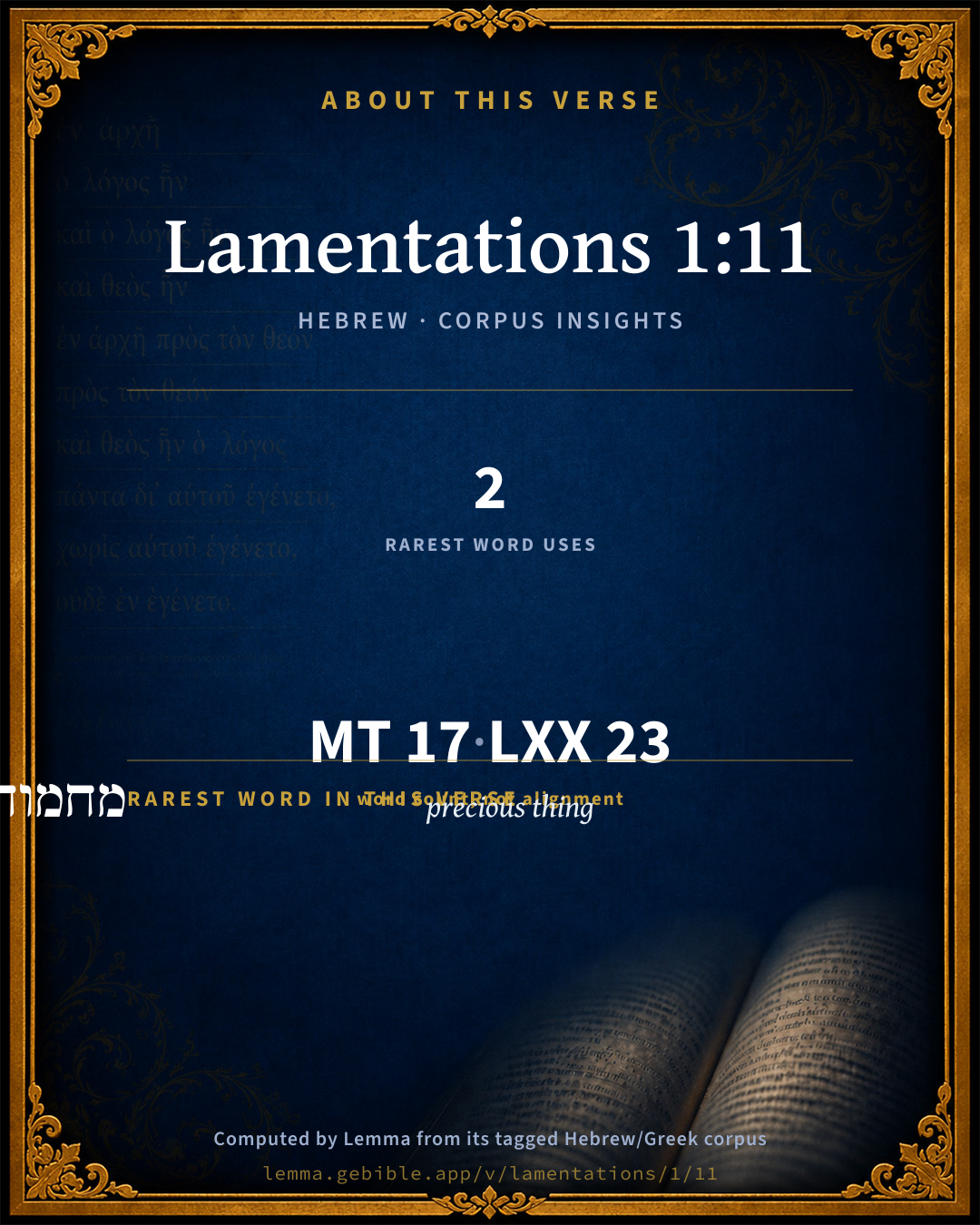
These counts appear in no published source. They are computed here, from the morphology-tagged text and Lemma’s own curated glosses. What Lemma adds →

17
words
17
distinct lemmas
Prophets
section

Notable vocabulary

The rarest word here is מחמודיהם precious thing H4262 — appearing just 2 times in the whole Hebrew Bible.

Shared distinctive vocabulary

מחמודיהם precious thing H4262 occurs in 2 verses of the Hebrew Bible. Also found in:

Grammatical profile

  • 8 verbs
  • 8 nouns
  • 1 conjunction

Verb forms

  • נֶאֱנָחִים֙ Niphal · Participle Passive
  • מְבַקְּשִׁ֣ים Piel · Participle Active
  • נָתְנ֧וּ Qal · Perfect
  • לְהָשִׁ֣יב Hiphil · Infinitive Construct
  • רְאֵ֤ה Qal · Imperative
  • וְֽהַבִּ֔יטָה Hiphil · Imperative
  • הָיִ֖יתִי Qal · Perfect
  • זוֹלֵלָֽה Qal · Participle Active

Hebrew & Septuagint length

In English translation the verse runs 28 words from the Hebrew and 28 from the Septuagint (LXX English) — the same length.

A rough comparison of the two English renderings, which tokenize alike — not a word-level alignment.

Word counts can differ between the Hebrew and the Greek without any difference in meaning — e.g. the Hebrew direct-object marker אֵת has no separate Greek word, and Greek often adds the article ὁ.

In the original languages it is 17 Hebrew tokens and 23 Greek tokens — but the two are counted differently (Hebrew bundles its prefixes and suffixes into one token; the Greek is in lemma form), so that isn’t a like-for-like length.

Cross-references

15

Topical passages linked to Lamentations 1:11 in the Treasury of Scripture Knowledge — connected by theme and wording, ordered by reader-vote popularity; previews shown in the World English Bible.

  • Jeremiah 52:6 In the fourth month, in the ninth day of the month, the famine was sore in the city, so that there was no bread for the people of the land.
  • Jeremiah 38:9 My lord the king, these men have done evil in all that they have done to Jeremiah the prophet, whom they have cast into the dungeon; and he is likely to die in the place where he is, because of the famine; for there is no more bread in the city.
  • Lamentations 2:12 They tell their mothers, Where is grain and wine? When they swoon as the wounded in the streets of the city, When their soul is poured out into their mothers' bosom.
  • Deuteronomy 28:52–57 They shall besiege you in all your gates, until your high and fortified walls come down, in which you trusted, throughout all your land; and they shall besiege you in all your gates throughout all your land, which Yahweh your God has given you.
  • 1 Samuel 30:11–12 They found an Egyptian in the field, and brought him to David, and gave him bread, and he ate; and they gave him water to drink.
  • 2 Kings 6:25 There was a great famine in Samaria: and, behold, they besieged it, until a donkey's head was sold for eighty [pieces] of silver, and the fourth part of a kab of dove's dung for five [pieces] of silver.
  • Job 40:4 "Behold, I am of small account. What shall I answer you? I lay my hand on my mouth.
  • Psalms 25:15–19 My eyes are ever on Yahweh, For he will pluck my feet out of the net.
  • Jeremiah 19:9 I will cause them to eat the flesh of their sons and the flesh of their daughters; and they shall eat everyone the flesh of his friend, in the siege and in the distress, with which their enemies, and those who seek their life, shall distress them.
  • Lamentations 1:9 Her filthiness was in her skirts; she didn't remember her latter end; Therefore is she come down wonderfully; she has no comforter: See, Yahweh, my affliction; for the enemy has magnified himself.
  • Lamentations 1:19–20 I called for my lovers, [but] they deceived me: My priests and my elders gave up the spirit in the city, While they sought them food to refresh their souls.
  • Lamentations 2:20 Look, Yahweh, and see to whom you have done thus! Shall the women eat their fruit, the children that are dandled in the hands? Shall the priest and the prophet be killed in the sanctuary of the Lord?
  • Lamentations 4:4–10 The tongue of the sucking child cleaves to the roof of his mouth for thirst: The young children ask bread, and no man breaks it to them.
  • Ezekiel 4:15–17 Then he said to me, Behold, I have given you cow's dung for man's dung, and you shall prepare your bread thereon.
  • Ezekiel 5:16–17 when I shall send on them the evil arrows of famine, that are for destruction, which I will send to destroy you: and I will increase the famine on you, and will break your staff of bread;

Cross-references courtesy of OpenBible.info (CC BY 4.0).

Hebrew and Greek witnesses Masoretic Hebrew ↔ Greek Septuagint

The same verse in the two great witnesses to the Old Testament, shown verse-for-verse.

These are two independent witnesses, not word-aligned to each other, and the Septuagint is shown in lemma (dictionary) form.

Hebrew Lamentations 1:11 Masoretic · Westminster Leningrad Codex

כָּל עַמָּ֤הּ נֶאֱנָחִים֙ מְבַקְּשִׁ֣ים לֶ֔חֶם נָתְנ֧וּ מחמודיהם מַחֲמַדֵּיהֶ֛ם בְּאֹ֖כֶל לְהָשִׁ֣יב נָ֑פֶשׁ רְאֵ֤ה יְהוָה֙ וְֽהַבִּ֔יטָה כִּ֥י הָיִ֖יתִי זוֹלֵלָֽה

All her people sigh, they seek bread; They have given their pleasant things for food to refresh the soul: Look, Yahweh, and see; for I am become abject.

World English Bible · Public Domain

Greek LXX Lamentations 1:11 Septuagint · lemma form

πᾶς ὁ λαός αὐτός καταστενάζω ζητέω ἄρτος δίδωμι ὁ ἐπιθύμημα αὐτός ἐν βρῶσις ὁ ἐπιστρέφω ψυχή ὁράω κύριος καί ἐπιβλέπω ὅτι γίγνομαι ἀτιμόω

CHAPH. All her people groan, seeking bread: they have given their desirable things for meat, to restore their soul: behold, Lord, and look; for she is become dishonored.

LXX2012 (modern English Septuagint) · Public Domain

Hebrew: Westminster Leningrad Codex (CC BY 4.0). Greek: Septuagint (public domain); English from LXX2012 (modern English Septuagint) (Public Domain). How the Septuagint differs from the Hebrew →

Commentary

Notes on Lamentations 1:11 from classic Christian and Jewish commentators (each source and its license shown beneath its notes). The classic Christian expositions comment on the surrounding passage and are grouped to its opening verse, so a note may address several verses; the Jewish commentaries on the Tanakh (Rashi and others) are per-verse, so they appear only where the commentator wrote on this verse.

Lemma curates 59 commentaries, every one of them public domain or Creative Commons licensed, each selected and text-cleaned for this edition rather than reprinted as found. About our sources →

Trapp's Complete Commentary

John Trapp

Lam 1:11 All her people sigh, they seek bread; they have given their pleasant things for meat to relieve the soul: see, O LORD, and consider; for I am become vile.

Ver. 11. All her people sigh.] And so think to ease their grief.

They shall seek bread.] The staff of life, which, without repair by nutrition, would be soon extinct so in the spiritual life, which made Job prefer the Word before his "necessary food." There is a "famine of the Word" which is much worse; {Amo 8:11 Isa 6:9-10} pray against it, and prevent it.

They have given their pleasant things for meat.] Which must be had at any rate; much more must the food of the soul. Our forefathers gave five marks, or more, for a good book; a load of hay for a few chapters of St James, or of St Paul, in English, saith Mr Foxe. {a} The Queen of Castile sold her jewels to furnish Columbus for his discovering voyage to the West Indies, when he had showed his maps, though our Henry VII, loath to part with money, slighted his proffers, and thereby the golden mines were found and gained to the Spanish crown. {b} Let no man think much to part with his pleasant things for his precious soul, or to sacrifice all that he hath to the service of his life, which, next to his soul, should be most dear unto him. Our ancestors in Queen Mary’s days were glad to eat the bread of their souls in peril of their lives.

To relieve the soul.] Heb., To make the soul come again; for A nimantis cuiusque vita in fuga est, Life must be fetched again by food when it is fainting away.

See, O Lord, and consider.] Quam delicata epulatrix facta sim; to what hard meat I am held, to how strait an allowance; see it, and be sensible of my prisoner’s pittance, and how I have made many a meal’s meat upon the promises when I have wanted bread, as that good woman once said.

{a} Acts and Mon., 750.

{b} Keckerm., Praefat. Geograph.

John Trapp, A Commentary or Exposition upon All the Books of the Old and New Testament (1647–1656) — public domain. Text from a community e-Sword module.

The Biblical Illustrator

Joseph S. Exell

Lam_1:11

All her people sigh, they seek bread.

Grief at losses

I. It is awful for the godly to be grieved with and take to heart their worldly losses--

(1) Because the things of this life are Gods blessings.

(2) They are necessary to support us here, and (being well used) to make us the fitter to serve Him.

2. For the preservation of the life, we must be willing to forego the dearest of these outward blessings.

(1) Because life is the most precious of all earthly things, they being given for the use of it, and not it for them.

(2) God hath given greater charge to preserve it than them.

3. In all our miseries we must seek relief only at Gods hands.

(1) He hath so commanded (Psa_50:15, etc.).

(2) All power to help is in His hands alone (2Ch_20:6).

4. No extremity can drive the godly from trusting in God, and praying to Him (Job_13:15; Psa_44:17). (J. Udall)

They have given their pleasant things for meat to relieve the soul.--

Surrender of luxuries for necessaries

Our forefathers gave five marks or more for a good book; a load of hay for a few chapters of St. James or of St. Paul, in English, saith Mr. Foxe. The Queen of Castile sold her jewels to furnish Columbus for his discovering voyage to the West Indies, when he had showed his maps, though our Henry VII, loath to part with money, slighted his offers, and thereby the gold mines were found and gained to the Spanish crown. Let no man think much to part with his pleasant things for his precious soul, or to sacrifice all that he hath to the service of his life, which, next to his soul, should be most dear to him. Our ancestors in Queen Marys days were glad to eat the bread of their souls in peril of their lives. (J. Trapp.)

The Biblical Illustrator, edited by Joseph S. Exell (c. 1880s–1900s) — public domain. Text from a community e-Sword module.

Jamieson, Fausset & Brown

Robert Jamieson, A. R. Fausset & David Brown

(Jer 37:21; Jer 38:9; Jer 52:6).

given . . . pleasant things for meat-- (Kg2 6:25; Job 2:4).

relieve . . . soul--literally, "to cause the soul or life to return."

for I am become vile--Her sins and consequent sorrows are made the plea in craving God's mercy. Compare the like plea in Psa 25:11.

Jamieson, Fausset & Brown — Commentary Critical and Explanatory on the Whole Bible (1871) — public domain (CC PDM 1.0). Text via the HelloAO Bible API.

Adam Clarke's Commentary

Verse 11. They have given their pleasant things] Jerusalem is compared to a woman brought into great straits, who parts with her jewels and trinkets in order to purchase by them the necessaries of life.

Adam Clarke's Commentary on the Bible (1810–1826) — public domain. Text from a community e-Sword/MySword module.

John Calvin's Commentaries

The Prophet here complains that all the citizens of Jerusalem were constantly groaning through want and famine. He first says, that all were sighing. The word “people” is collective, and hence he uses the plural number,נאנחיםץ , nanechim. Then he says that they were all sighing; but he expresses also the reason, because they were seeking bread. To seek bread is indeed common to all; but by this word he intimates extreme want., as though he had said, that they begged their bread. He then compares them to beggars, who go about here and there to seek bread.

He says also, that they gave the most precious things for meat, to recover the soul. Here he refers more clearly to famine, for he says that in a manner they suffered want. Others render the last clause, “to refresh the soul,” which is not unsuitable. But the Prophet no doubt meant to denote a deficiency as to the support of life, when he said, that they gave whatever precious thing they had to restore their souls, as it were from death to life.

A prayer follows, See, Jehovah, and look, for I am become vile. We said yesterday, that the complaints which humbled the faithful, and, at the same time, raised them to a good hope, and also opened the door to prayers, were dictated by the Spirit of God. Otherwise, when men indulge in grief, and torment themselves, they become exasperated; and then to be kindled by this irritation is a kind of madness. The Prophet, therefore, in order to moderate the intensity of sorrow, and the raging of impatience, recalls again the faithful to prayer. And when Jerusalem asks God to see and to look, there is an emphasis intended in using the two words; and the reason given does also more fully shew this, because she had become vile; so that the Church set nothing else before God, to turn him to mercy, but her own miseries. She did not, then, bring forward her own services, but only deplored her own miseries, in order that she might obtain the favor of God. It follows, —

John Calvin's Commentaries (1540-1563) — public domain. Text from the Calvin Translation Society English edition (1840s-50s) via the Christian Classics Ethereal Library (ccel.org). Calvin's coverage is partial (roughly two-thirds of the Bible); uncommented books and verses are honest gaps, never fabricated. The 19th-century editor's footnotes and remarks are omitted so the notes are faithfully Calvin's own voice.

Ellicott's Commentary for English Readers

(11) All her people sigh. . . .—The words which describe the famine at Jerusalem are in the present tense, either as painting the sufferings of the past with the vividness of the historic present, or because the sufferings still continued even after the capture of the city. The remnant that was left had to bring out their treasures, jewels, and the like, and offer them for bread.

To relieve the soul.—Better, to revive, literally, to bring back.

A Bible Commentary for English Readers, edited by Charles John Ellicott (1878–1897) — public domain. Text from a community e-Sword module.

The Cambridge Bible for Schools and Colleges

gen. ed. J. J. S. Perowne

11. The people have already given up their most valuable possessions, that they had hitherto hoarded, for bread. There is therefore nothing now between them and starvation.

meat] food. Cp. note on “oblations,” Jer_17:26.

vile] See on Jer_15:19.

The Cambridge Bible for Schools and Colleges (gen. ed. J. J. S. Perowne; Cambridge University Press, 1878–1918) — public domain. Text from a community e-Sword module.

John Gill's Exposition

All her people sigh,.... Not her priests only, Lam 1:4; but all the common people, because of their affliction, particularly for want of bread. So the Targum,

"all the people of Jerusalem sigh because of the famine;''

for it follows:

they seek bread; to eat, as the Targum; inquire where it is to be had, but in vain:

they have given their pleasant things for meat to relieve the soul: or, "to cause the soul to return" (x); to fetch it back when fainting and swooning away through famine; and therefore would give anything for food; part with their rich clothes, jewels, and precious stones; with whatsoever they had that was valuable in their cabinets or coffers, that they might have meat to keep from fainting and dying; to refresh and recruit their spirits spent with hunger:

see, O Lord, and consider; for I am become vile; mean, base, and contemptible, in the eyes of men, through penury and want of food; through poverty, affliction, and distress; and therefore desires the Lord would consider her case, and look with pity and compassion on her.

(x) "ad reducendum animam", Montanus, Piscator.

John Gill's Exposition of the Whole Bible (1746–1763) — public domain (CC PDM 1.0). Text via the HelloAO Bible API.

Albert Barnes' Notes on the Bible

Sigh ... seek - Are sighing ... are seeking. The words are present participles, describing the condition of the people. After a siege lasting a year and a half the whole country, far and near, would be exhausted.

To relieve the soul - See the margin, i. e. to bring back life to them. They bring out their jewels and precious articles to obtain with them at least a meal.

Albert Barnes' Notes on the Bible (1834–1885) — public domain. Text from a community e-Sword/MySword module.

Haydock's Catholic Bible Commentary

O. Hebrew of the Masorets, "It is." (Calmet) --- Protestants, "Is it nothing to you, all?" &c. (Haydock) --- But the Vulgate is much clearer, and approved by many Protestants, lu being often used as an exclamation, Genesis xvii. 18. (Calmet) --- Vintage. He has plundered all, ver. 22. (Haydock) --- The king took a great deal, and his general the rest, 4 Kings xxiv., and xxv. (Worthington)

George Leo Haydock (1774–1849), Haydock's Catholic Family Bible and Commentary, 1859 edition — public domain. Excludes Psalms (Douay-Rheims chapter numbering differs from Protestant) and Deuterocanonical books (Catholic canon only).

Matthew Poole's English Annotations

He speaketh probably with reference to the siege, after which the people had scarcely any pleasant things to exchange for bread. The whole body of the people was in a sad condition; and in a land that ordinarily flowed with milk and honey, they were at loss for bread to eat, and gave any thing for something to satisfy their hunger.

See, O Lord, and consider; for I am become vile: the prophet sends up a sudden ejaculation to God, much like that Lam 1:9. The argument he useth is drawn from the misery the people were in, expressed under the notion of being become vile, that is, miserable or contemptible.

Matthew Poole's English Annotations on the Holy Bible (1683–1685) — public domain. Text from a community e-Sword/MySword module.

Whedon's Commentary on the Bible

Daniel D. Whedon

11. Have given their pleasant things for meat, etc. — An eloquent suggestion of the terrible exigencies of the siege. “All that a man hath, will he give for his life.”

Daniel D. Whedon (gen. ed.), Commentary on the Old and New Testaments (1874–1909) — public domain. Text from a community e-Sword module.

The Pulpit Commentary

All her people sigh, etc. The sufferings of Jerusalem did not come to an end at the capture of the city. Some think that this verse relates solely to the miserable survivors. This is possible; at any rate, it includes the contemporaries of the writer. "Sigh" and "seek" are participles in the Hebrew. To relieve the soul; literally, to bring back the soul. The "soul," i.e. the principle of life, is conceived of as having for a time deserted the fainting frame. See, O Lord, etc. Another piteous cry of Jerusalem, preparing the way for the second half of the elegy.

The real need of the soul made manifest.

I REAL NEED CAN ONLY BE MADE MANIFEST BY PRACTICAL EXPERIENCE. The greatest need of the natural life is bread, taking the word "bread" as representative of all food. Clothing and Shelter, while they may indeed be reckoned as needs, are not needs after the same imperative fashion as food; and every one, however easily his dally bread comes to him, will assent to this same general truth that food is the great need of natural life. But he will only really feel this in such circumstances as are indicated in this verse. For a long while throe people of Jerusalem had found bread lying to their hands when they were hungry. They could buy it and have abundance of pleasant things beside. The feeling of their hearts was that they could not do without these pleasant things, and when at last they gave them up to keep body and soul together, it must have been with terrible pain they made the surrender. And what is true of bread for the natural life"s also true of the Bread coming down from heaven for the spiritual life. Christians, living in the midst of all manner of pleasant things of this world, with no lack of money to buy them and faculty to enjoy them, try to feel at the same time that more than all pleasant things are the grace, the life, the wisdom, the everflowing fulness of the Spirit, which come from Christ. But all the testimony of believers proves that the pleasant things need to be withdrawn before it can be apprehended that Christ is emphatically the Bread. It is when we lose relish of nature"s best contributions to our happiness that Christ comes forward, confident as ever in his power to satisfy us.

II THE VALUE OF TREASURES CAN ONLY BE KNOWN BY WHAT THE OWNER IS WILLING TO DO TO RETAIN THEM. All the pleasant things belonging to the community were already gone. The Sanctuary had been desecrated and pillaged. Much private property had doubtless gone. But some the owners would be able to hide jewels and such like wealth as went into small compass. Among these pleasant things would be family heirlooms, loving gifts, possessions with respect to which the receiver had said to the giver, "I will keep this thing till I die." But now the great pressure comes, and one pleasant thing after another goes for a few handfuls of corn. The soul is threatening to depart from the body and it must be turned back; "for what shall it profit a man, if he gain the whole world and lose his own soul?" And now notice that there are treasures of the heart, such treasures as come from faith in Christ and fidelity to him, which are not given up even to preserve natural life. Multitudes have gone willingly to death that thereby they might testify to the truth as it is in Jesus. They have laid firm hold of his own word, Whosoever will lose his life for my sake shall find it. Y. (Mat_16:25)

The Pulpit Commentary (1880–1919), ed. H.D.M. Spence-Jones & Joseph S. Exell — public domain. Text from a community e-Sword module.

John Wesley's Explanatory Notes

Bread - Even in a land that ordinarily flowed with milk and honey, they were at a loss for bread to eat. Given - And gave any thing for something to satisfy their hunger. Vile - Miserable or contemptible.

John Wesley, Explanatory Notes Upon the Whole Bible (1754–1765) — public domain. Text via the GEBible commentary corpus.

Keil & Delitzsch

C. F. Keil & F. Delitzsch

Besides this disgrace, famine also comes on her. All her people, i.e., the whole of the inhabitants of Jerusalem, sigh after bread, and part with their jewels for food, merely to prolong their life. The participles נאנחים, מכקשׁים, are not to be translated by preterites; they express a permanent condition of things, and the words are not to be restricted in their reference to the famine during the siege of the city (Jer 37:21; Jer 38:9; Jer 52:6). Even after it was reduced, the want of provisions may have continued; so that the inhabitants of the city, starved into a surrender, delivered up their most valuable things to those who plundered them, for victuals to be obtained from these enemies. Yet it is not correct to refer the words to the present sad condition of those who were left behind, as distinguished from their condition during the siege and immediately after the taking of the city (Gerlach). This cannot be inferred from the participles. The use of these is fully accounted for by the fact that the writer sets forth, as present, the whole of the misery that came on Jerusalem during the siege, and which did not immediately cease with the capture of the city; he describes it as a state of matters that still continues. As to מחמוּדיהם, see on Lam 1:7. השׁיב נפשׁ, "to bring back the soul," the life, i.e., by giving food to revive one who is nearly fainting, to keep in his life (= השׁיב רוּח); cf. Rut 4:15; Sa1 30:12, and in a spiritual sense, Psa 19:8; Psa 23:3. In the third member of the verse, the sigh which is uttered as a prayer (Lam 1:9) is repeated in an intensified form; and the way is thus prepared for the transition to the lamentation and suppliant request of Jerusalem, which forms the second half of the poem.

Keil & Delitzsch — Biblical Commentary on the Old Testament (1861–1891) — public domain (CC PDM 1.0). Text via the HelloAO Bible API. (Old Testament only.)

unfoldingWord translationNotes

Door43 World Missions Community

her people

The word "her" refers to Jerusalem which is described as if it were a woman. AT: "her inhabitants" or "the people of the city" (See: Personification)

bread

This refers to food in general. AT: "food" (See: Synecdoche)

They have given their precious treasures for food

This means they traded their wealth and their valuables in exchange for food. AT: "They have traded their precious treasures in exchange for food" (See: Assumed Knowledge and Implicit Information)

precious treasures

This refers to their valuable possessions.

to restore their lives

"to save their lives" or "to restore their strength"

Look, Yahweh, and consider me

Here Jerusalem speaks directly to Yahweh. (See: Personification)

Is it nothing to you, all you who pass by?

This rhetorical question is an accusation aganist the people who walk past Jerusalem and do not care about its well-being. This question can be written as a statement. AT: "All you who pass by should care more for my affliction!" (See: Rhetorical Question)

Is it nothing to you

Here Jerusalem continues to speak, but now to people who pass by instead of to Yahweh. (See: Personification)

Look and see

These words share similar meanings. Together they invite the reader to understand by seeing that no one has suffered so much. (See: Doublet)

the sorrow that is being inflicted on me

This can be stated in active form. AT: "the sorrow that Yahweh is inflicting upon me" (See: Active or Passive)

on the day of his fierce anger

Here the word "day" is used as an idiom. AT: "when he was fiercely angry" (See: Idiom)

translationWords

bread

precious

life

worthy

torment

anger

unfoldingWord translationNotes — © Distant Shores Media and the Door43 World Missions Community, licensed CC BY-SA 4.0. Source: git.door43.org/Door43/en_tn.

Lesson kit

Teaching starters — assembled from the data on this page, not authored interpretation. Every prompt links to the verse data it draws on. Edit before teaching.

Lamentations, in the Prophets, opens this verse with 17 words (17 distinct Hebrew lemmas). Its most distinctive word is machmud (“precious thing”). A historical commentator’s framing appears above. Read the whole chapter for the surrounding context.

Discussion questions

  1. How does “precious thing” (machmud) shape what this verse is saying?
  2. Lamentations 1:7 shares the word «precious thing» with this verse. How do the two illuminate each other?
  3. The translations on this page render this verse differently — a whole-verse word diff, not a word-by-word alignment. What might account for the different wordings?
  4. The verb «נֶאֱנָחִים֙» is Niphal Participle Passive. How does its form color the action?
  5. Reading how Trapp's Complete Commentary and The Biblical Illustrator read this verse, where do the two commentators agree and where do they part?

Things to notice

Reading settings

Reading text

Shown beneath each verse's original-language words.

Old Testament
Old Testament edition

Read the OT as the Masoretic Hebrew (MT) or the Greek Septuagint (LXX).

English shown for the Greek Septuagint (in the Hebrew ↔ Greek comparison).

Comparing translations? Open the Compare panel on any verse page to stack up to four side by side.