1 Samuel 3:5

Hebrew (Westminster Leningrad Codex) 1 Samuel 3:5 appears in the Hebrew Old Testament. The text above is from the Westminster Leningrad Codex. Each word links to its Strong’s number, a concise gloss, and parsing drawn from the Open Scriptures Hebrew Bible morphology. Click any word for its full Brown-Driver-Briggs (BDB) entry.
Download image
Cite this verse

1 Samuel 3:5 (World English Bible). Public Domain. Lemma interlinear Bible study tool, https://lemma.gebible.app/v/1-samuel/3/5.

Show BibTeX & RIS
BibTeX
RIS
English Translation
He ran to Eli, and said, Here am I; for you called me. He said, I didn't call; lie down again. He went and lay down.
World English Bible · Public Domain
Download a study sheet

One document with this verse’s original text, its word-by-word gloss line, the meaning frame, cross-references with their text, attributed commentary, and full source and license credits — printable, and it pastes into notes with its structure intact.

This verse Autodidact and up

Study sheet (.html) Plain text (.txt)

A passage Seminary Student

Up to 50 verses in one chapter. A passage sheet keeps up to 6 commentary sources and 12 cross-references per verse, in the order this page ranks them, and says so on the sheet whenever that leaves anything out. Ask for a single verse and you get the Autodidact verse sheet above.

Everything on this page stays free to read, with no account — the sheet is a download of what is already on screen, not access to it.

Want to remove ads? Support Godless Engineer
Compare translations 3

The same verse in 3 English versions, stacked beneath the original-language interlinear above. Click any original word for its lexicon entry.

Each is an independent rendering of the whole verse — the interlinear is not word-aligned to these translations.

Highlighted words mark where these versions differ — a whole-verse word diff, not a word-by-word alignment.

  • World English Bible Public Domain
    He ran to Eli, and said, Here am I; for you called me. He said, I didn't call; lie down again. He went and lay down.
  • King James Version Public Domain
    And he ran unto Eli, and said, Here am I; for thou calledst me. And he said, I called not; lie down again. And he went and lay down.
  • unfoldingWord Literal Text CC BY-SA 4.0
    And he ran to Eli and said, “Behold me, for you called to me.” But he said, “I did not call. Go back, lie down.” So he went and lay down.

unfoldingWord Literal Text — © unfoldingWord, licensed CC BY-SA 4.0. Word-aligned USFM3 via Door43 (git.door43.org/unfoldingWord/en_ult).

Versions to compare (up to 4)

3 of 4 selected

Show all 18 translations

Every available English version of this verse, each an independent rendering of the whole verse.

  • World English Bible Public Domain
    He ran to Eli, and said, Here am I; for you called me. He said, I didn't call; lie down again. He went and lay down.
  • Berean Standard Bible Public Domain
    He ran to Eli and said, “Here I am, for you have called me.” “I did not call,” Eli replied. “Go back and lie down.” So he went and lay down.
  • Majority Standard Bible Public Domain
    He ran to Eli and said, “Here I am, for you have called me.” “I did not call,” Eli replied. “Go back and lie down.” So he went and lay down.
  • King James Version Public Domain
    And he ran unto Eli, and said, Here am I; for thou calledst me. And he said, I called not; lie down again. And he went and lay down.
  • American Standard Version (1901) Public Domain
    And he ran unto Eli, and said, Here am I; for thou calledst me. And he said, I called not; lie down again. And he went and lay down.
  • Revised Version (1885) Public Domain
    And he ran unto Eli, and said, Here am I; for thou calledst me. And he said, I called not; lie down again. And he went and lay down.
  • Geneva Bible (1599) Public Domain
    And he ranne vnto Eli, and said, Here am I, for thou calledst me. But he said, I called thee not: goe againe and sleepe. And he went and slept.
  • Douay-Rheims (1899) Public Domain
    And he ran to Heli and said: Here am I: for thou didst call me. He said: I did not call: go back and sleep. And he went and slept.
  • Young's Literal Translation Public Domain
    And he runneth unto Eli, and saith, `Here `am' I, for thou hast called for me;' and he saith, `I called not; turn back, lie down;' and he goeth and lieth down.
  • Literal Standard Version CC BY-SA 4.0
    And he runs to Eli and says, “Here I [am], for you have called for me”; and he says, “I did not call; turn back, lie down”; and he goes and lies down.
  • Unlocked Literal Bible CC BY-SA 4.0
    Samuel ran to Eli and said, “Here I am, for you called me.” Eli said, “I did not call you; lie down again.” So Samuel went and lay down.
  • unfoldingWord Literal Text CC BY-SA 4.0
    And he ran to Eli and said, “Behold me, for you called to me.” But he said, “I did not call. Go back, lie down.” So he went and lay down.
  • Darby Bible Public Domain
    And he ran to Eli, and said, Here am I; for thou calledst me. And he said, I did not call: lie down again. And he went and lay down.
  • World Messianic Bible Public Domain
    He ran to Eli and said, “Here I am; for you called me.” He said, “I didn’t call. Lie down again.” He went and lay down.
  • Webster's Bible Public Domain
    And he ran to Eli, and said, Here am I; for thou calledst me. And he said, I called not; lie down again. And he went and lay down.
  • Free Bible Version CC BY-SA 4.0
    He ran to Eli, and said, “I'm here—you called me.” “I didn't call you,” Eli replied. “Go back to bed.” So Samuel went back to bed.
  • Bible in Basic English Public Domain
    And running to Eli he said, Here am I, for you said my name. And Eli said, I did not say your name; go to your rest again. So he went back to his bed.
  • JPS Tanakh (1917) Public Domain
    And he ran unto Eli, and said: 'Here am I; for thou didst call me.' And he said: 'I called not; lie down again.' And he went and lay down.

Literal Standard Version (2020), Covenant Press — licensed CC BY-SA 4.0. Text via the HelloAO Bible API (eBible.org). Unlocked Literal Bible (unfoldingWord) — licensed CC BY-SA 4.0. Text via the HelloAO Bible API (eBible.org). unfoldingWord Literal Text — © unfoldingWord, licensed CC BY-SA 4.0. Word-aligned USFM3 via Door43 (git.door43.org/unfoldingWord/en_ult). Free Bible Version, Dr. Jonathan Gallagher — licensed CC BY-SA 4.0. Text via the HelloAO Bible API (eBible.org).

Word by word

More ways to search: Search by grammar → Find every occurrence → Compare this word →

Practice this passage: Drill this verse → Learn its vocabulary →

עֵלִ֗י
ʻÊlîy
H5941
“Eli”
Noun, Proper
Part of Speech
Noun
Type
Proper
Full BDB Definition

Origin: from H5927

TWOT: None

Eli = "ascension" - descendant of Aaron through Ithamar and high priest and judge of Israel when Samuel entered service as a child
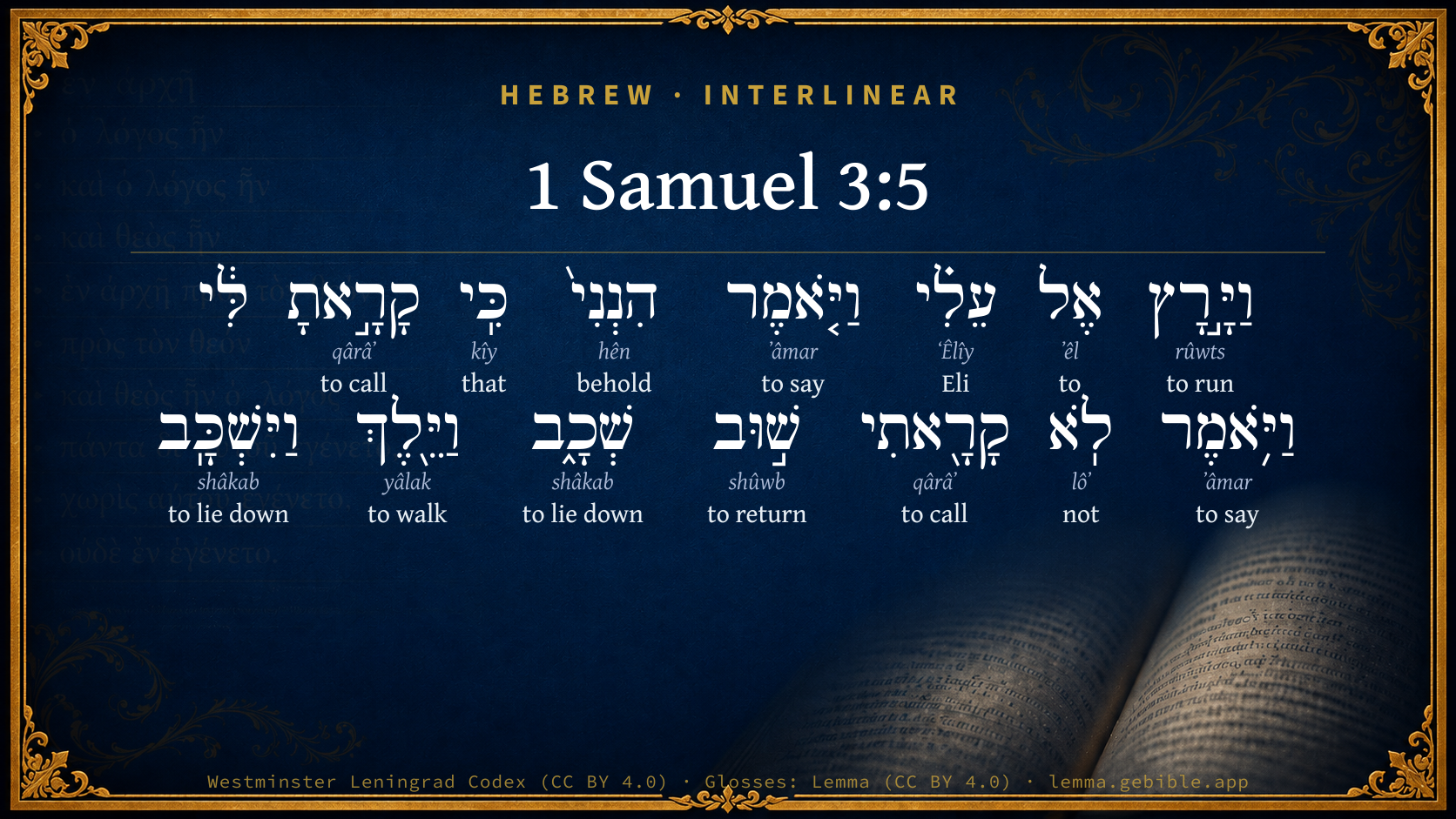
  1. וַיָּ֣רָץ rûwts H7323 “and · to run” Conjunction + Verb, Qal, Sequential Imperfect, 3rd Person, Masculine, Singular
  2. אֶל ʼêl H413 “to” Preposition
  3. וַיֹּ֤אמֶר ʼâmar H559 “and · to say” Conjunction + Verb, Qal, Sequential Imperfect, 3rd Person, Masculine, Singular
  4. הִנְנִי֙ hên H2005 “behold · me” Particle, Demonstrative + Suffix, Personal, 1st Person, Common, Singular
  5. כִּֽי kîy H3588 “that” Conjunction
  6. קָרָ֣אתָ qârâʼ H7121 “to call” Verb, Qal, Perfect, 2nd Person, Masculine, Singular
  7. וַיֹּ֥אמֶר ʼâmar H559 “and · to say” Conjunction + Verb, Qal, Sequential Imperfect, 3rd Person, Masculine, Singular
  8. לֹֽא lôʼ H3808 “not” Particle, Negative
  9. קָרָ֖אתִי qârâʼ H7121 “to call” Verb, Qal, Perfect, 1st Person, Common, Singular
  10. שׁ֣וּב shûwb H7725 “return” Verb, Qal, Imperative, 2nd Person, Masculine, Singular
  11. שְׁכָ֑ב shâkab H7901 “lie down” Verb, Qal, Imperative, 2nd Person, Masculine, Singular
  12. וַיֵּ֖לֶךְ yâlak H3212 “and · to walk” Conjunction + Verb, Qal, Sequential Imperfect, 3rd Person, Masculine, Singular
  13. וַיִּשְׁכָּֽב shâkab H7901 “and · to lie down” Conjunction + Verb, Qal, Sequential Imperfect, 3rd Person, Masculine, Singular

About this verse

These counts appear in no published source. They are computed here, from the morphology-tagged text and Lemma’s own curated glosses. What Lemma adds →

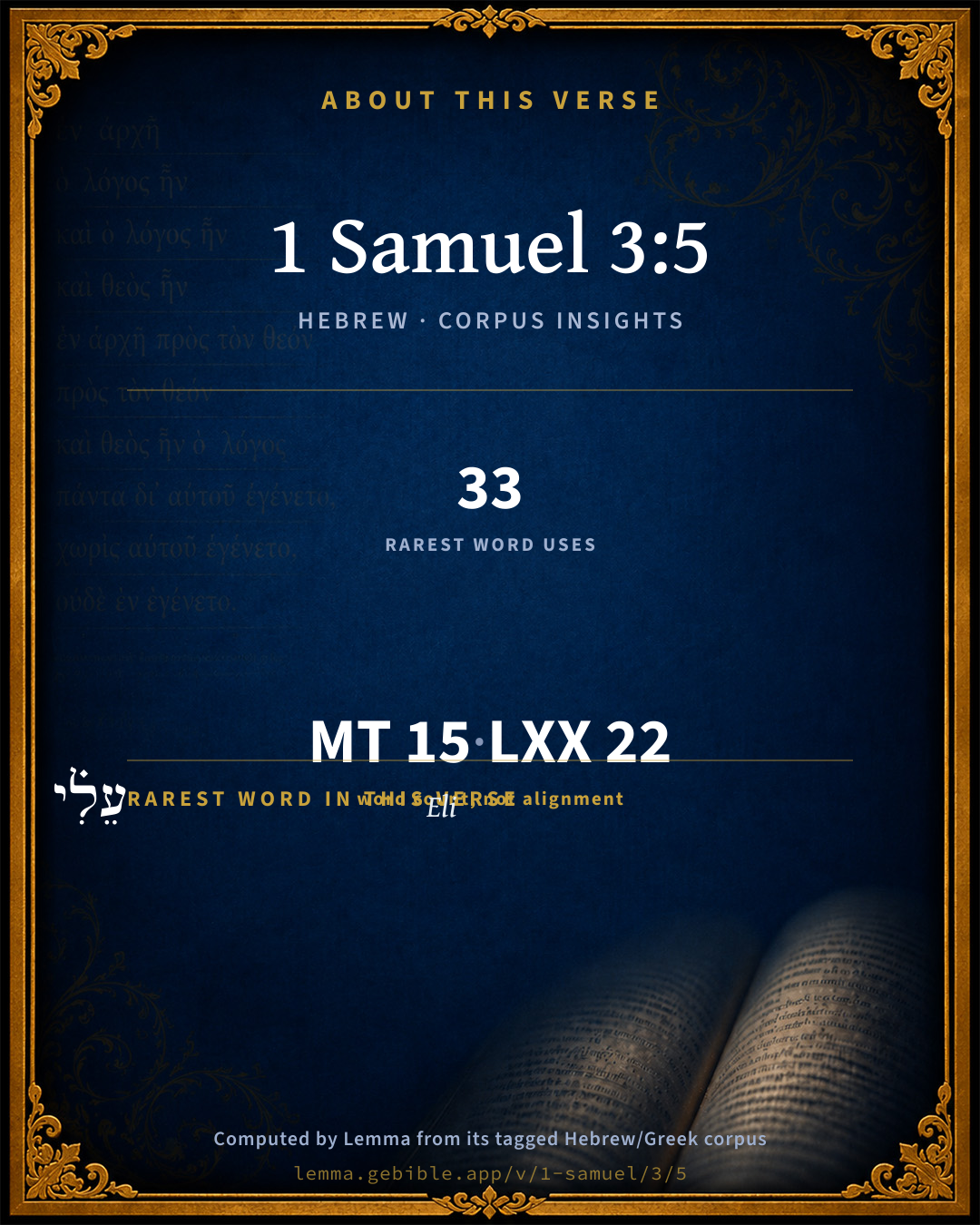
15
words
11
distinct lemmas
Historical
section

Shared distinctive vocabulary

עֵלִ֗י Eli H5941 occurs in 30 verses of the Hebrew Bible. Also found in:

Grammatical profile

  • 9 verbs
  • 1 noun
  • 2 prepositions
  • 1 conjunction
  • 2 particles

Verb forms

  • וַיָּ֣רָץ Qal · Sequential Imperfect
  • וַיֹּ֤אמֶר Qal · Sequential Imperfect
  • קָרָ֣אתָ Qal · Perfect
  • וַיֹּ֥אמֶר Qal · Sequential Imperfect
  • קָרָ֖אתִי Qal · Perfect
  • שׁ֣וּב Qal · Imperative
  • שְׁכָ֑ב Qal · Imperative
  • וַיֵּ֖לֶךְ Qal · Sequential Imperfect
  • וַיִּשְׁכָּֽב Qal · Sequential Imperfect

Repetition

Words recur within this verse — often emphatic in Hebrew:

  • וַיֹּ֤אמֶר to say H559 ×2
  • קָרָ֣אתָ to call H7121 ×2
  • שְׁכָ֑ב to lie down H7901 ×2

Hebrew & Septuagint length

In English translation the verse runs 26 words from the Hebrew and 34 from the Septuagint (LXX English) — closely comparable.

A rough comparison of the two English renderings, which tokenize alike — not a word-level alignment.

Word counts can differ between the Hebrew and the Greek without any difference in meaning — e.g. the Hebrew direct-object marker אֵת has no separate Greek word, and Greek often adds the article ὁ.

In the original languages it is 15 Hebrew tokens and 22 Greek tokens — but the two are counted differently (Hebrew bundles its prefixes and suffixes into one token; the Greek is in lemma form), so that isn’t a like-for-like length.

Hebrew and Greek witnesses Masoretic Hebrew ↔ Greek Septuagint

The same verse in the two great witnesses to the Old Testament, shown verse-for-verse.

These are two independent witnesses, not word-aligned to each other, and the Septuagint is shown in lemma (dictionary) form.

Hebrew 1 Samuel 3:5 Masoretic · Westminster Leningrad Codex

וַיָּ֣רָץ אֶל עֵלִ֗י וַיֹּ֤אמֶר הִנְנִי֙ כִּֽי קָרָ֣אתָ לִּ֔י וַיֹּ֥אמֶר לֹֽא קָרָ֖אתִי שׁ֣וּב שְׁכָ֑ב וַיֵּ֖לֶךְ וַיִּשְׁכָּֽב

He ran to Eli, and said, Here am I; for you called me. He said, I didn't call; lie down again. He went and lay down.

World English Bible · Public Domain

Greek LXX 1 Samuel 3:5 Septuagint · lemma form

καί τρέχω πρός ηλι καί εἶπον ἰδού ἐγώ ὅτι καλέω ἐγώ καί εἶπον οὐ καλέω σύ ἀναστρέφω καταεὕδω καί ἀναστρέφω καί καταεὕδω

And he ran to Heli, and said, Here am I, for you did call me: and he said, I did not call you; return, go to sleep; and he returned and went to sleep.

LXX2012 (modern English Septuagint) · Public Domain

Hebrew: Westminster Leningrad Codex (CC BY 4.0). Greek: Septuagint (public domain); English from LXX2012 (modern English Septuagint) (Public Domain). How the Septuagint differs from the Hebrew →

Targum (Aramaic paraphrase)

1

The Targum is the ancient Jewish Aramaic paraphrase of the Hebrew Scriptures — an interpretive translation, not the Hebrew text itself. Onkelos (literal) and Pseudo-Jonathan (expansive) render the Torah, and Jonathan the Prophets. Coverage is partial: where no permissively-licensed English translation exists for a verse, only the Aramaic is shown. This is verse-level text, not a word-by-word alignment to the Hebrew.

  1. Targum Jonathan Prophets (Joshua–Malachi)
    וּרְהַט לְוַת עֵלִי וַאֲמַר הָא אֲנָא אֲרֵי קְרֵיתָא לִי וַאֲמַר לָא קְרֵיתִי תּוּב שְׁכִיב וַאֲזַל וּשְׁכוּב:

    (no public-domain English translation for this verse)

    Targum Jonathan — Aramaic: “Mikraot Gedolot” (public domain). English: “Sefaria Community Translation” (CC0 1.0 (public-domain dedication)); “London "Chaldee Paraphrase," 1871” (public domain). Text via Sefaria.

Commentary

Notes on 1 Samuel 3:5 from classic Christian and Jewish commentators (each source and its license shown beneath its notes). The classic Christian expositions comment on the surrounding passage and are grouped to its opening verse, so a note may address several verses; the Jewish commentaries on the Tanakh (Rashi and others) are per-verse, so they appear only where the commentator wrote on this verse.

Lemma curates 59 commentaries, every one of them public domain or Creative Commons licensed, each selected and text-cleaned for this edition rather than reprinted as found. About our sources →

Trapp's Complete Commentary

John Trapp

1Sa 3:5 And he ran unto Eli, and said, Here [am] I; for thou calledst me. And he said, I called not; lie down again. And he went and lay down.

Ver. 5. And he ran unto Eli.] This showeth his diligence in attending on his blind master, though he were now but twelve years old, as saith Josephus.

And he went and lay down,] sc., To sleep; which he would not have done had he thought that the Lord had spoken to him. So if men did but consider that it is God that speaketh unto them by the mouth of his ministers, they would hear and heed much better.

John Trapp, A Commentary or Exposition upon All the Books of the Old and New Testament (1647–1656) — public domain. Text from a community e-Sword module.

Jamieson, Fausset & Brown

Robert Jamieson, A. R. Fausset & David Brown

he ran unto Eli, and said, Here am I; for thou calledst me--It is evident that his sleeping chamber was close to that of the aged high priest and that he was accustomed to be called during the night. The three successive calls addressed to the boy convinced Eli of the divine character of the speaker, and he therefore exhorted the child to give a reverential attention to the message. The burden of [the Lord's message] was an extraordinary premonition of the judgments that impended over Eli's house; and the aged priest, having drawn the painful secret from the child, exclaimed, "It is the Lord; let him do what seemeth him good." Such is the spirit of meek and unmurmuring submission in which we ought to receive the dispensations of God, however severe and afflictive. But, in order to form a right estimate of Eli's language and conduct on this occasion, we must consider the overwhelming accumulation of judgments denounced against his person, his sons, his descendants--his altar, and nation. With such a threatening prospect before him, his piety and meekness were wonderful. In his personal character he seems to have been a good man, but his sons' conduct was flagrantly bad; and though his misfortunes claim our sympathy, it is impossible to approve or defend the weak and unfaithful course which, in the retributive justice of God, brought these adversities upon him.

Next: 1 Samuel Chapter 4

Jamieson, Fausset & Brown — Commentary Critical and Explanatory on the Whole Bible (1871) — public domain (CC PDM 1.0). Text via the HelloAO Bible API.

The Cambridge Bible for Schools and Colleges

gen. ed. J. J. S. Perowne

5. And he ran] Note Samuel’s alacrity to serve the aged priest, his spiritual father.

The Cambridge Bible for Schools and Colleges (gen. ed. J. J. S. Perowne; Cambridge University Press, 1878–1918) — public domain. Text from a community e-Sword module.

John Gill's Exposition

And he ran unto Eli, and said here am I,.... He got out of his bed as fast as he could, and put on his clothes, and ran with all haste to the apartment where Eli lay, supposing he wanted some immediate assistance, which he was there ready to give him to the utmost of his ability; and he made the more haste, as knowing his age and infirmities, and being desirous, out of affection to him, to help him as soon as possible:

for thou calledst me; he took it to be the voice of Eli, partly because there was no other man in the tabernacle, it being in the middle of the night, or early in the morning, before the doors were opened, or any of the priests were come in to minister, and partly because the voice might be very much like Eli's, and which was done to direct him to him:

and he said, I called not, lie down again; he signified he wanted nothing, and so had no occasion to call him, nor had he, but bid him go to bed again, and sleep quietly:

and he went and lay down; and very probably fell asleep again.

John Gill's Exposition of the Whole Bible (1746–1763) — public domain (CC PDM 1.0). Text via the HelloAO Bible API.

Matthew Poole's English Annotations

He ran; showing his great faithfulness and diligence in the service, either of the Lord, or of his master Eli.

Matthew Poole's English Annotations on the Holy Bible (1683–1685) — public domain. Text from a community e-Sword/MySword module.

unfoldingWord translationNotes

Door43 World Missions Community

my son

Eli was not Samuel's true father. Eli speaks as if he were Samuel's father to show Samuel that he is not angry but that Samuel needs to listen to him. (See: Metaphor)

translationWords

son

unfoldingWord translationNotes — © Distant Shores Media and the Door43 World Missions Community, licensed CC BY-SA 4.0. Source: git.door43.org/Door43/en_tn.

Lesson kit

Teaching starters — assembled from the data on this page, not authored interpretation. Every prompt links to the verse data it draws on. Edit before teaching.

1 Samuel, in the Historical, opens this verse with 15 words (11 distinct Hebrew lemmas). Its most distinctive word is ʻÊlîy (“Eli”). A historical commentator’s framing appears above. Read the whole chapter for the surrounding context.

Discussion questions

  1. What does “Eli” (ʻÊlîy) contribute to the verse as a whole?
  2. 1 Samuel 1:3 shares the word «Eli» with this verse. How do the two illuminate each other?
  3. “to say” occurs 2× in this one verse. What is the effect of the repetition?
  4. These translations render this verse differently; the difference is in the English rendering, not the original. What questions does that raise?
  5. The verb «וַיָּ֣רָץ» is Qal Sequential Imperfect. How does its form color the action?
  6. Reading how Trapp's Complete Commentary and Jamieson, Fausset & Brown read this verse, where do the two commentators agree and where do they part?

Things to notice

Reading settings

Reading text

Shown beneath each verse's original-language words.

Old Testament
Old Testament edition

Read the OT as the Masoretic Hebrew (MT) or the Greek Septuagint (LXX).

English shown for the Greek Septuagint (in the Hebrew ↔ Greek comparison).

Comparing translations? Open the Compare panel on any verse page to stack up to four side by side.