
Jeremiah 4:28

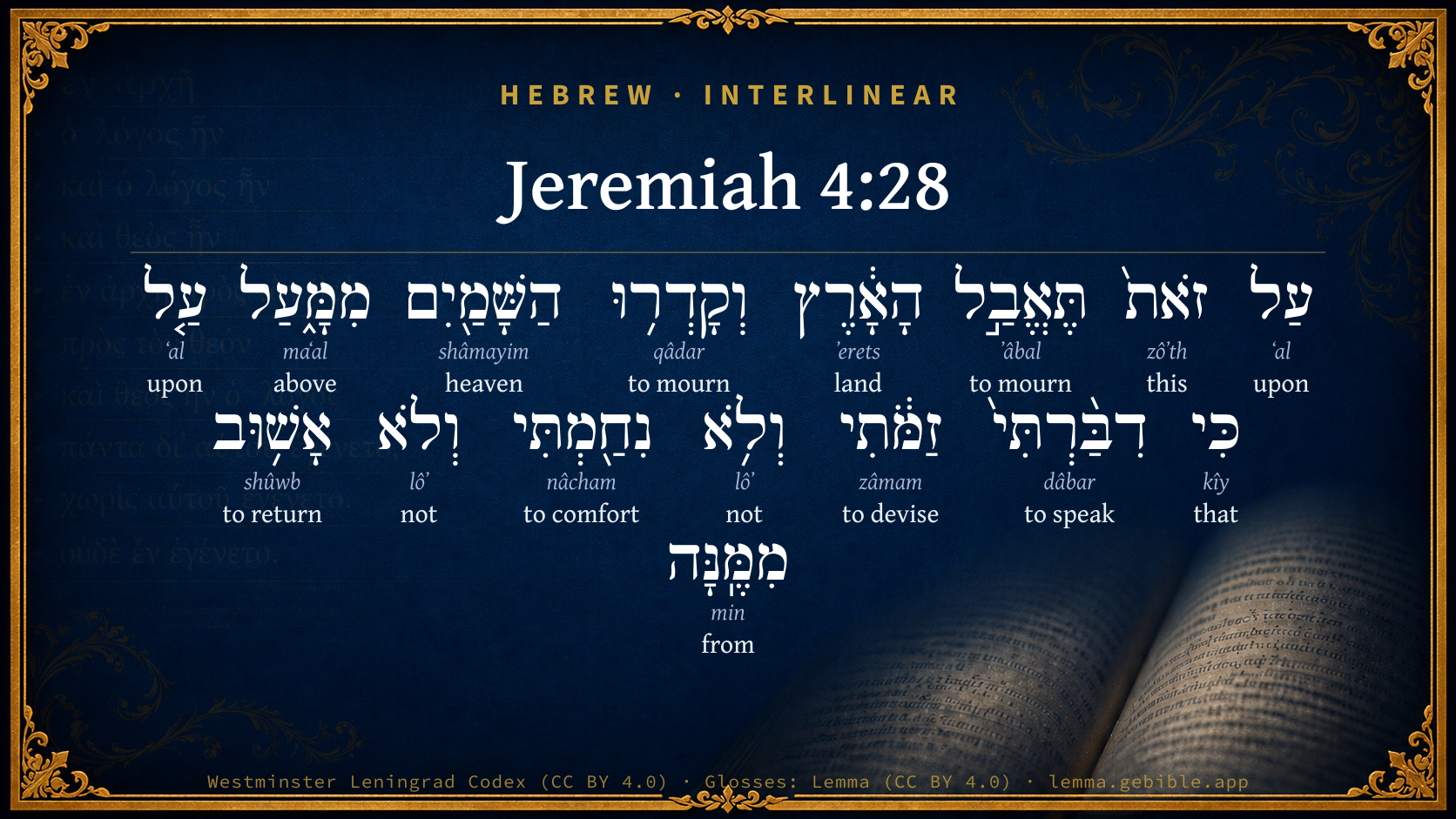
Hebrew (Westminster Leningrad Codex) Jeremiah 4:28 appears in the Hebrew Old Testament. The text above is from the Westminster Leningrad Codex. Each word links to its Strong’s number, a concise gloss, and parsing drawn from the Open Scriptures Hebrew Bible morphology. Click any word for its full Brown-Driver-Briggs (BDB) entry.
Download image
Cite this verse

Jeremiah 4:28 (World English Bible). Public Domain. Lemma interlinear Bible study tool, https://lemma.gebible.app/v/jeremiah/4/28.

Show BibTeX & RIS
BibTeX
RIS
English Translation
For this shall the earth mourn, and the heavens above be black; because I have spoken it, I have purposed it, and I have not repented, neither will I turn back from it.
World English Bible · Public Domain
Download a study sheet

One document with this verse’s original text, its word-by-word gloss line, the meaning frame, cross-references with their text, attributed commentary, and full source and license credits — printable, and it pastes into notes with its structure intact.

This verse Autodidact and up

Study sheet (.html) Plain text (.txt)

A passage Seminary Student

Up to 50 verses in one chapter. A passage sheet keeps up to 6 commentary sources and 12 cross-references per verse, in the order this page ranks them, and says so on the sheet whenever that leaves anything out. Ask for a single verse and you get the Autodidact verse sheet above.

Everything on this page stays free to read, with no account — the sheet is a download of what is already on screen, not access to it.

Want to remove ads? Support Godless Engineer
Compare translations 3

The same verse in 3 English versions, stacked beneath the original-language interlinear above. Click any original word for its lexicon entry.

Each is an independent rendering of the whole verse — the interlinear is not word-aligned to these translations.

Highlighted words mark where these versions differ — a whole-verse word diff, not a word-by-word alignment.

  • World English Bible Public Domain
    For this shall the earth mourn, and the heavens above be black; because I have spoken it, I have purposed it, and I have not repented, neither will I turn back from it.
  • King James Version Public Domain
    For this shall the earth mourn, and the heavens above be black; because I have spoken it, I have purposed it, and will not repent, neither will I turn back from it.
  • unfoldingWord Literal Text CC BY-SA 4.0
    Because of this the land will mourn, and the heavens will darken from above. Because I have spoken my plans and will not regret, and I shall not turn away from it. ts\*

unfoldingWord Literal Text — © unfoldingWord, licensed CC BY-SA 4.0. Word-aligned USFM3 via Door43 (git.door43.org/unfoldingWord/en_ult).

Versions to compare (up to 4)

3 of 4 selected

Show all 18 translations

Every available English version of this verse, each an independent rendering of the whole verse.

  • World English Bible Public Domain
    For this shall the earth mourn, and the heavens above be black; because I have spoken it, I have purposed it, and I have not repented, neither will I turn back from it.
  • Berean Standard Bible Public Domain
    Therefore the earth will mourn and the heavens above will grow dark. I have spoken, I have planned, and I will not relent or turn back.”
  • Majority Standard Bible Public Domain
    Therefore the earth will mourn and the heavens above will grow dark. I have spoken, I have planned, and I will not relent or turn back.”
  • King James Version Public Domain
    For this shall the earth mourn, and the heavens above be black; because I have spoken it, I have purposed it, and will not repent, neither will I turn back from it.
  • American Standard Version (1901) Public Domain
    For this shall the earth mourn, and the heavens above be black; because I have spoken it, I have purposed it, and I have not repented, neither will I turn back from it.
  • Revised Version (1885) Public Domain
    For this shall the earth mourn, and the heavens above be black: because I have spoken it, I have purposed it, and I have not repented, neither will I turn back from it.
  • Geneva Bible (1599) Public Domain
    Therefore shall the earth mourne, and the heauens aboue shall be darkened, because I haue pronounced it: I haue thought it, and will not repent, neither will I turne backe from it.
  • Douay-Rheims (1899) Public Domain
    The earth shall mourn, and the heavens shall lament from above: because I have spoken, I have purposed, and I have not repented, neither am I turned away from it.
  • Young's Literal Translation Public Domain
    For this doth the land mourn, And black have been the heavens above, because I have spoken -- I have purposed, And I have not repented, Nor do I turn back from it.
  • Literal Standard Version CC BY-SA 4.0
    For this the earth mourns, || And the heavens above have been black, || Because I have spoken—I have purposed, || And I have not relented, || Nor do I turn back from it.
  • Unlocked Literal Bible CC BY-SA 4.0
    For this reason, the land will mourn, and the heavens above will darken. For I have declared my intentions; I will not hold back; I will not turn from carrying them out.
  • unfoldingWord Literal Text CC BY-SA 4.0
    Because of this the land will mourn, and the heavens will darken from above. Because I have spoken my plans and will not regret, and I shall not turn away from it. ts\*
  • Darby Bible Public Domain
    For this shall the earth mourn, and the heavens above be black; because I have spoken it, I have purposed it, and will not repent, neither will I turn back therefrom.
  • World Messianic Bible Public Domain
    For this the earth will mourn, and the heavens above be black, because I have spoken it. I have planned it, and I have not repented, neither will I turn back from it.”
  • Webster's Bible Public Domain
    For this shall the earth mourn, and the heavens above be black: because I have spoken it, I have purposed it, and will not repent, neither will I turn back from it.
  • Free Bible Version CC BY-SA 4.0
    The earth will mourn and the heavens above will go dark. I have spoken; this is what I have ordered. I'm not going to stop or change my mind.”
  • Bible in Basic English Public Domain
    The earth will be weeping for this, and the heavens on high will be black: because I have said it, and I will not go back from it; it is my purpose, and it will not be changed.
  • JPS Tanakh (1917) Public Domain
    For this shall the earth mourn, and the heavens above be black; because I have spoken it, I have purposed it, and I have not repented, neither will I turn back from it.

Literal Standard Version (2020), Covenant Press — licensed CC BY-SA 4.0. Text via the HelloAO Bible API (eBible.org). Unlocked Literal Bible (unfoldingWord) — licensed CC BY-SA 4.0. Text via the HelloAO Bible API (eBible.org). unfoldingWord Literal Text — © unfoldingWord, licensed CC BY-SA 4.0. Word-aligned USFM3 via Door43 (git.door43.org/unfoldingWord/en_ult). Free Bible Version, Dr. Jonathan Gallagher — licensed CC BY-SA 4.0. Text via the HelloAO Bible API (eBible.org).

Word by word

More ways to search: Search by grammar → Find every occurrence → Compare this word →

Practice this passage: Drill this verse → Learn its vocabulary →

זַמֹּ֔תִי
zâmam
H2161
“to devise”
Verb, Qal, Perfect, 1st Person, Common, Singular
Part of Speech
Verb
Stem
Qal
Form
Perfect
Person
1st Person
Gender
Common
Number
Singular
Full BDB Definition

Origin: a primitive root

TWOT: 556

to have a thought, devise, plan, consider, purpose - (Qal) - to consider, fix thought upon - to purpose, devise - to plot (of evil intent)
  1. עַל ʻal H5921 “upon” Preposition
  2. זֹאת֙ zôʼth H2063 “this” Pronoun, Demonstrative, Feminine, Singular
  3. תֶּאֱבַ֣ל ʼâbal H56 “to mourn” Verb, Qal, Imperfect, 3rd Person, Feminine, Singular
  4. הָאָ֔רֶץ ʼerets H776 “the · land” Particle, Definite Article + Noun, Common, Both, Singular, Absolute
  5. וְקָדְר֥וּ qâdar H6937 “and · to mourn” Conjunction + Verb, Qal, Sequential Perfect, 3rd Person, Common, Plural
  6. הַשָּׁמַ֖יִם shâmayim H8064 “the · heaven(s)” Particle, Definite Article + Noun, Common, Masculine, Plural, Absolute
  7. מִמָּ֑עַל maʻal H4605 “from · above” Preposition + Adverb
  8. עַ֤ל ʻal H5921 “upon” Preposition
  9. כִּי kîy H3588 “that” Conjunction
  10. דִבַּ֨רְתִּי֙ dâbar H1696 “to speak” Verb, Piel, Perfect, 1st Person, Common, Singular
  11. וְלֹ֥א lôʼ H3808 “and · not” Conjunction + Particle, Negative
  12. נִחַ֖מְתִּי nâcham H5162 “to comfort” Verb, Niphal, Perfect, 1st Person, Common, Singular
  13. וְלֹא lôʼ H3808 “and · not” Conjunction + Particle, Negative
  14. אָשׁ֥וּב shûwb H7725 “to return” Verb, Qal, Imperfect, 1st Person, Common, Singular
  15. מִמֶּֽנָּה min H4480 “from · her” Preposition + Suffix, Personal, 3rd Person, Feminine, Singular

About this verse

These counts appear in no published source. They are computed here, from the morphology-tagged text and Lemma’s own curated glosses. What Lemma adds →

16
words
14
distinct lemmas
Prophets
section

Notable vocabulary

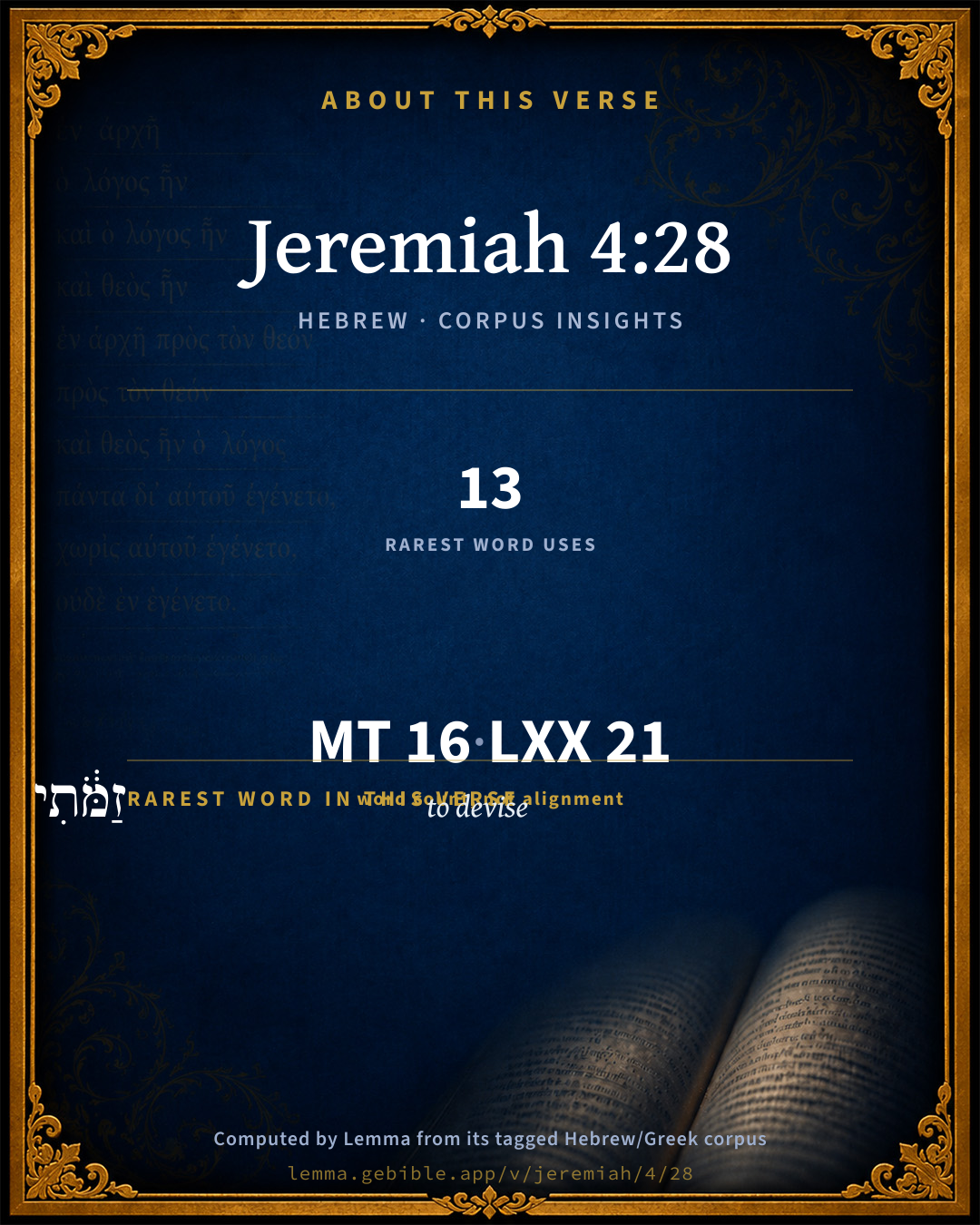
The rarest word here is זַמֹּ֔תִי to devise H2161 — appearing just 13 times in the whole Hebrew Bible.

Shared distinctive vocabulary

זַמֹּ֔תִי to devise H2161 occurs in 13 verses of the Hebrew Bible. Also found in:

Grammatical profile

  • 6 verbs
  • 2 nouns
  • 1 pronoun
  • 3 prepositions
  • 1 conjunction
  • 1 adverb
  • 2 particles

Verb forms

  • תֶּאֱבַ֣ל Qal · Imperfect
  • וְקָדְר֥וּ Qal · Sequential Perfect
  • דִבַּ֨רְתִּי֙ Piel · Perfect
  • זַמֹּ֔תִי Qal · Perfect
  • נִחַ֖מְתִּי Niphal · Perfect
  • אָשׁ֥וּב Qal · Imperfect

Repetition

Words recur within this verse — often emphatic in Hebrew:

  • עַל upon H5921 ×2
  • וְלֹ֥א not H3808 ×2

Hebrew & Septuagint length

In the original languages it is 16 Hebrew tokens and 21 Greek tokens — but the two are counted differently (Hebrew bundles its prefixes and suffixes into one token; the Greek is in lemma form), so that isn’t a like-for-like length.

Cross-references

31

Topical passages linked to Jeremiah 4:28 in the Treasury of Scripture Knowledge — connected by theme and wording, ordered by reader-vote popularity; previews shown in the World English Bible.

  • Numbers 23:19 God is not a man, that he should lie, Neither the son of man, that he should repent: Has he said, and will he not do it? Or has he spoken, and will he not make it good?
  • Isaiah 50:3 I clothe the heavens with blackness, and I make sackcloth their covering.
  • Jeremiah 12:4 How long shall the land mourn, and the herbs of the whole country wither? for the wickedness of those who dwell therein, the animals are consumed, and the birds; because they said, He shall not see our latter end.
  • Hosea 4:3 Therefore the land will mourn, And everyone who dwells therein will waste away. All living things in her, Even the animals of the field and the birds of the sky; Yes, the fish of the sea also die.
  • Isaiah 5:30 They will roar against them in that day like the roaring of the sea. If one looks to the land, behold, darkness and distress. The light is darkened in its clouds.
  • Joel 2:30–31 I will show wonders in the heavens and in the earth: Blood, fire, and pillars of smoke.
  • 1 Samuel 15:29 Also the Strength of Israel will not lie nor repent; for he is not a man, that he should repent.
  • Isaiah 14:24–27 Yahweh of Hosts has sworn, saying, Surely, as I have thought, so shall it happen; and as I have purposed, so shall it stand:
  • Isaiah 24:4 The earth mourns and fades away, the world languishes and fades away, the lofty people of the earth do languish.
  • Isaiah 33:8–9 The highways lie waste, the wayfaring man ceases: [the enemy] has broken the covenant, he has despised the cities, he doesn't regard man.
  • Isaiah 34:4 All the host of the sky shall be dissolved, and the heavens shall be rolled together as a scroll; and all their host shall fade away, as the leaf fades from off the vine, and as a fading [leaf] from the fig tree.
  • Isaiah 46:10–11 declaring the end from the beginning, and from ancient times things that are not [yet] done; saying, My counsel shall stand, and I will do all my pleasure;
  • Jeremiah 4:23–26 I saw the earth, and, behold, it was waste and void; and the heavens, and they had no light.
  • Jeremiah 7:16 Therefore don't you pray for this people, neither lift up a cry nor prayer for them, neither make intercession to me; for I will not hear you.
  • Jeremiah 12:11 They have made it a desolation; it mourns to me, being desolate; the whole land is made desolate, because no man lays it to heart.
  • Jeremiah 14:2 Judah mourns, and the gates of it languish, they sit in black on the ground; and the cry of Jerusalem is gone up.
  • Jeremiah 14:11–12 Yahweh said to me, Don't pray for this people for [their] good.
  • Jeremiah 15:1–9 Then said Yahweh to me, Though Moses and Samuel stood before me, yet my mind would not be toward this people: cast them out of my sight, and let them go forth.
  • Jeremiah 23:10 For the land is full of adulterers; for because of swearing the land mourns; the pastures of the wilderness are dried up. Their course is evil, and their might is not right;
  • Jeremiah 23:20 The anger of Yahweh shall not return, until he has executed, and until he have performed the intents of his heart: in the latter days you shall understand it perfectly.
  • Jeremiah 30:24 The fierce anger of Yahweh shall not return, until he has executed, and until he have performed the intents of his heart: in the latter days you shall understand it.
  • Ezekiel 24:14 I, Yahweh, have spoken it: it shall happen, and I will do it: I will not go back, neither will I spare, neither will I repent; according to your ways, and according to your doings, shall they judge you, says the Lord Yahweh.
  • Hosea 13:14 I will ransom them from the power of Sheol. I will redeem them from death! Death, where are your plagues? Sheol, where is your destruction? Compassion will be hidden from my eyes.
  • Joel 1:10 The field is laid waste. The land mourns, for the grain is destroyed, The new wine has dried up, And the oil languishes.
  • Matthew 27:45 Now from the sixth hour there was darkness over all the land until the ninth hour.
  • Mark 15:33 When the sixth hour had come, there was darkness over the whole land until the ninth hour.
  • Luke 23:44 It was now about the sixth hour, and darkness came over the whole land until the ninth hour.
  • Ephesians 1:9 making known to us the mystery of his will, according to his good pleasure which he purposed in him
  • Ephesians 1:11 in whom also we were assigned an inheritance, having been foreordained according to the purpose of him who works all things after the counsel of his will;
  • Hebrews 7:21 (for they indeed have been made priests without an oath), but he with an oath by him that says of him, "The Lord swore and will not change his mind, 'You are a priest forever, According to the order of Melchizedek'".
  • Revelation 6:12 I saw when he opened the sixth seal, and there was a great earthquake. The sun became black as sackcloth made of hair, and the whole moon became as blood.

Cross-references courtesy of OpenBible.info (CC BY 4.0).

Hebrew and Greek witnesses Masoretic Hebrew ↔ Greek Septuagint

The same verse in the two great witnesses to the Old Testament, shown verse-for-verse.

These are two independent witnesses, not word-aligned to each other, and the Septuagint is shown in lemma (dictionary) form.

Hebrew Jeremiah 4:28 Masoretic · Westminster Leningrad Codex

עַל זֹאת֙ תֶּאֱבַ֣ל הָאָ֔רֶץ וְקָדְר֥וּ הַשָּׁמַ֖יִם מִמָּ֑עַל עַ֤ל כִּי דִבַּ֨רְתִּי֙ זַמֹּ֔תִי וְלֹ֥א נִחַ֖מְתִּי וְלֹא אָשׁ֥וּב מִמֶּֽנָּה

For this shall the earth mourn, and the heavens above be black; because I have spoken it, I have purposed it, and I have not repented, neither will I turn back from it.

World English Bible · Public Domain

Greek LXX Structure differs

In the Septuagint, Jeremiah is about an eighth shorter than the Hebrew and arranges its material differently — the Oracles Against the Nations (Hebrew chapters 46–51) appear in the middle of the Greek book, after 25:13. Because the chapter and verse boundaries do not line up, a verse-for-verse comparison with the Hebrew is not shown.

A verse-for-verse comparison isn’t shown here because the chapters and verses don’t line up. Switch to the LXX edition with the MT / LXX toggle above to read the Greek directly.

On this verse, Joseph Benson's Commentary discusses the Septuagint’s reading. Read the note in Commentary ↓

Hebrew: Westminster Leningrad Codex (CC BY 4.0). Greek: Septuagint (public domain); English from a public-domain English Septuagint. How the Septuagint differs from the Hebrew →

Targum (Aramaic paraphrase)

1

The Targum is the ancient Jewish Aramaic paraphrase of the Hebrew Scriptures — an interpretive translation, not the Hebrew text itself. Onkelos (literal) and Pseudo-Jonathan (expansive) render the Torah, and Jonathan the Prophets. Coverage is partial: where no permissively-licensed English translation exists for a verse, only the Aramaic is shown. This is verse-level text, not a word-by-word alignment to the Hebrew.

  1. Targum Jonathan Prophets (Joshua–Malachi)
    עַל דָא תַּחְרוֹב אַרְעָא וִיקַבְּלוּן נְהוֹרֵי שְׁמַיָא מִלְעֵילָא עַל דִגְזָרִית בְּמֵימְרִי חֲשִׁיבִית בְעֵצָתִי אֶעְבְּדִינָהּ וְלָא אֲתַיבִינָהּ:

    (no public-domain English translation for this verse)

    Targum Jonathan — Aramaic: “Mikraot Gedolot” (public domain). English: “Sefaria Community Translation” (CC0 1.0 (public-domain dedication)); “London "Chaldee Paraphrase," 1871” (public domain). Text via Sefaria.

Commentary

Notes on Jeremiah 4:28 from classic Christian and Jewish commentators (each source and its license shown beneath its notes). The classic Christian expositions comment on the surrounding passage and are grouped to its opening verse, so a note may address several verses; the Jewish commentaries on the Tanakh (Rashi and others) are per-verse, so they appear only where the commentator wrote on this verse.

Lemma curates 59 commentaries, every one of them public domain or Creative Commons licensed, each selected and text-cleaned for this edition rather than reprinted as found. About our sources →

Trapp's Complete Commentary

John Trapp

Jer 4:28 For this shall the earth mourn, and the heavens above be black: because I have spoken [it], I have purposed [it], and will not repent, neither will I turn back from it.

Ver. 28. Because I have spoken it, &c.] Quod scrips; scrips, said Pilate, I will not alter it. See the like, Eze 24:13-14.

John Trapp, A Commentary or Exposition upon All the Books of the Old and New Testament (1647–1656) — public domain. Text from a community e-Sword module.

Joseph Benson's Commentary

Jer 4:28-29. For this shall the earth mourn, &c. — More expressions to set forth the dreadfulness of the judgment: he makes the elements to personate mourners. And the heavens above be black — Under sad calamities every thing looks dismal; even the heavens themselves do not seem to shine with their usual brightness. Because I have spoken it, I have purposed it, &c. — Blaney, following the LXX., changes a little the order of the words, and reads, “I have spoken, and do not repent: I have purposed, and will not recede from it.” God’s purpose of delivering up the Jews into the hands of Nebuchadnezzar was irreversible, because he foresaw that the greatest part of them would continue impenitent, and that it would be expedient and necessary, in order to their being humbled and brought to repentance, that they should be carried into captivity. Otherwise the removal of judgments, either those inflicted or threatened to be inflicted, is promised upon repentance, to which God frequently exhorted these Jews by his prophets. The whole city shall flee — The inhabitants of all ranks and qualities shall seek to escape the fury of the Chaldean army, chap. Jer 39:4. They shall go into thickets — Either upon the report of the coming of their enemies, the prophet hereby, as it were, deriding their confidence, or rather at the approach of their vast armies: for they were closely besieged before they fled, as appears 2Ki 25:4. Such a consternation there shall be upon them, that they shall run into every hole to hide themselves; thus Manasseh was taken among the thorns, 2Ch 33:11. The Hebrew is, באו בעבים, they shall go into the clouds; meaning, probably, dark places on the tops of hills, reaching, as it were, to the clouds, or among the cloudy shades of trees and groves that usually grew there. The LXX. render it, εισεδυσαν εις τα σπηλαια, they entered into the caves; adding, και εις τα αλση εκρυβησαν, they were hid in the groves. And climbed up upon the rocks — Namely, to save their lives. Every city shall be forsaken — There shall be an utter desolation, their cities being quite deserted, and none left to inhabit them.

Joseph Benson's Commentary on the Old and New Testaments (1811–1818) — public domain. Text from a community e-Sword module.

Tyndale Open Study Notes

Tyndale Open Resources

4:28 At funerals in Hebrew society, it was customary for people to mourn and be draped in black (cp. Isa 5:30; 50:3). The Lord had determined the people’s guilt, and he promised to be true to his word (Jer 5:10; 30:11, 24; Isa 5:30; 46:10-11).

Tyndale Open Study Notes — © Tyndale Open Resources, licensed CC BY-SA 4.0. Text via the HelloAO Bible API.

Jamieson, Fausset & Brown

Robert Jamieson, A. R. Fausset & David Brown

For this--on account of the desolations just described (Isa 5:30; Hos 4:3).

not repent-- (Num 23:19).

Jamieson, Fausset & Brown — Commentary Critical and Explanatory on the Whole Bible (1871) — public domain (CC PDM 1.0). Text via the HelloAO Bible API.

John Calvin's Commentaries

Jeremiah proceeds here with the same subject, and still introduces God as the speaker, that what is said might produce a greater effect. For this, he says, the land shall mourn. The mourning of the land is to be taken for its desolation; but he refers to what he had said before. He does not speak of the inhabitants of the land; for they who thus explain the passage, diminish much the force of the expression; for the Prophet here ascribes terror and sorrow to the very elements, which is much more striking than if he said, that all men would be in sorrow and grief. The same also must be thought of the heavens. Indeed, the latter clause proves that he does not speak of the inhabitants, but of the land itself, which, though without reason, seems yet to dread God’s vengeance. And thus the Prophet upbraids men with their insensibility; for when God appeared as judge from heaven, they were not touched with any fear. Mourn then shall the land, and covered shall be the heaven with darkness; that is, though men remain stupid, yet both heaven and earth shall feel how dreadful God’s judgment will be.

He afterwards adds, Because I have spoken. Some consider אשר, asher, what, to be understood between this sentence and the following verb: “Because I have spoken what I have purposed, and I have not repented.” But the concise phrase is not unsuitable: God first intimates, that he had pronounced the sentence, which would remain firm and unchangeable; as though he had said, “I have once for all declared by my servants what I will do.” For the prophets, we know, were the heralds of God’s vengeance: and as their doctrine was often despised, so at this day also the world obstinately rejects it; and as it often now derides all threatenings, so it happened then. But Jeremiah introduces here God as the speaker, as though he had said, “My servants have been despised by you; but they have said nothing but what I have commanded them: I am therefore the author of that sentence by which you ought to have been moved and roused.” In this sense it is that God testifies that he had spoken; for he transfers to himself what the Jews thought proceeded from the prophets, and hence supposed that they were at liberty to regard as nothing what the prophets pronounced against them: “I myself am He,” says God, “who has spoken.” So that we must understand a contrast here between God and the prophets; as though he had said, that the Jews in vain slumbered in their sins, because they thought they had to do only with mortals, since God himself had commanded his servants to denounce the ruin that was despised.

But that they might not think that God had thus spoken to cause a false alarm, (for hypocrites flatter themselves with this pretense, that God does not speak seriously, but that he frightens them with bugbears, as children are wont to be,) he says, that he had purposed. He had said before that he had spoken, that is, by his prophets; but what he means now by this word is, that the predictions which he had made known as to their destruction proceeded from his own secret counsel: “This,” he says, “has been decreed by me.”

He then adds, It has not repented me, and I will not turn from it. He briefly shews, that the Jews were now given up to death, that they might not think that God could be pacified as long as they followed their vices; for God had decreed to destroy them; and he had not only declared this by his prophets, but had also resolved within himself to do so. By the term repent, is to be understood a change; for God cannot, strictly speaking, repent, as nothing is hid from him; but he speaks, as I have lately stated, after a human manner: and every ambiguity is removed by the next phrase, when he says, I will not turn from it, that is, “I will not retract my sentence.” It follows —

John Calvin's Commentaries (1540-1563) — public domain. Text from the Calvin Translation Society English edition (1840s-50s) via the Christian Classics Ethereal Library (ccel.org). Calvin's coverage is partial (roughly two-thirds of the Bible); uncommented books and verses are honest gaps, never fabricated. The 19th-century editor's footnotes and remarks are omitted so the notes are faithfully Calvin's own voice.

Ellicott's Commentary for English Readers

(28) For this shall the earth mourn . . .—As with all true poets, the face of nature seems to the prophet to sympathise with human suffering. (Comp. Amo_8:9; Mat_24:29.)

A Bible Commentary for English Readers, edited by Charles John Ellicott (1878–1897) — public domain. Text from a community e-Sword module.

The Cambridge Bible for Schools and Colleges

gen. ed. J. J. S. Perowne

28. be black] be in mourning from sympathy. The following clauses should read I have spoken it and have not repented; I have purposed it, and will not turn back from it. So LXX. The verbs in the Hebrew were accidentally disarranged.

The Cambridge Bible for Schools and Colleges (gen. ed. J. J. S. Perowne; Cambridge University Press, 1878–1918) — public domain. Text from a community e-Sword module.

John Gill's Exposition

For this shall the earth mourn,.... That is, for the full end that will be made hereafter, though not now; the earth may be said to mourn when the inhabitants of it do; or when it is destroyed, and is become desolate, as the Targum, Jarchi, and Kimchi, explain it; when it is uncultivated and uninhabited:

and the heavens above be black; with thick clouds, and storms, and tempests; in allusion to mourners, that are clothed with black: these figures, of the earth's mourning, and the heavens being clothed in black, denote the horribleness of that dispensation, when there would be an utter destruction of the Jewish nation, church, and polity, of which Daniel prophesies, Dan 9:27,

because I have spoken it; in my word, as the Targum; in the Scriptures of the Old Testament, by Moses and the prophets:

I have purposed it; or I have thought of it, in my counsel, as the Targum; it was a thing deliberately devised and determined, and therefore can never be frustrated, or made void:

and will not repent; of what was purposed and predicted:

neither will I turn back from it; revoke, or retract it; it shall surely come to pass: the Jews, upon their return from the Babylonish captivity, and afterwards, might flatter themselves that a full end would not be made of them, because it was not then done; and therefore these several strong expressions are used, to confirm and assure them of it; for the word of God cannot fail, his counsel shall stand; he is not a man, that he should lie or repent; he will do all his pleasure.

John Gill's Exposition of the Whole Bible (1746–1763) — public domain (CC PDM 1.0). Text via the HelloAO Bible API.

Albert Barnes' Notes on the Bible

For ... - Because of this doom upon Judah.

I have purposed it - The Septuagint arrangement restores the parallelism:

For I have spoken, and will not repent,

I have purposed, and will not turn back from it.

Albert Barnes' Notes on the Bible (1834–1885) — public domain. Text from a community e-Sword/MySword module.

Haydock's Catholic Bible Commentary

Repented. Only a finite being can do this. God’s resolution is here unconditional and fixed.

George Leo Haydock (1774–1849), Haydock's Catholic Family Bible and Commentary, 1859 edition — public domain. Excludes Psalms (Douay-Rheims chapter numbering differs from Protestant) and Deuterocanonical books (Catholic canon only).

Matthew Poole's English Annotations

For this shall the earth mourn, and the heavens above be black; expressions to set forth the dreadfulness of the judgment; he makes the elements to personate mourners, a sad face of things above and below, a metaphor, and therein to shame the stupidity of his people.

Because I have spoken it: q.d. You would not believe either that my prophets spake, or what they said; now I tell you I speak myself, and what I have resolved upon I will not revoke; see Eze 24:13,14, and Jer 15:6; for I have purposed it; I have not spoken in my heat or fury, but upon mature deliberation; an anthropopathy; or, what the prophets have denounced I will ratify.

Matthew Poole's English Annotations on the Holy Bible (1683–1685) — public domain. Text from a community e-Sword/MySword module.

Whedon's Commentary on the Bible

Daniel D. Whedon

28, 29. For this, etc. — But once more does the prophet return to the sad story. In language more simple and intelligible he sets forth the coming desolation. The city shall be forsaken, and the people shall take refuge in the thickets and clefts of the rocks.

Daniel D. Whedon (gen. ed.), Commentary on the Old and New Testaments (1874–1909) — public domain. Text from a community e-Sword module.

The Pulpit Commentary

For this; i.e. because of the impending judgment. Be black. "To be black" is equivalent to "to put on mourning". (comp. Jer_8:21 Jer_14:2)

The Pulpit Commentary (1880–1919), ed. H.D.M. Spence-Jones & Joseph S. Exell — public domain. Text from a community e-Sword module.

John Wesley's Explanatory Notes

Mourn - Expressions to set forth the dreadfulness of the judgment; he makes the elements to personate mourners.

John Wesley, Explanatory Notes Upon the Whole Bible (1754–1765) — public domain. Text via the GEBible commentary corpus.

Scofield Reference Notes

C. I. Scofield

Marg

repent (See Scofield "Zec 8:14").

The Scofield Reference Bible (1917 edition), notes by C. I. Scofield — public domain. Text from a community e-Sword module.

Rashi

Rabbi Shlomo Yitzchaki (Rashi)

shall mourn Shall be destroyed.

I planned Heb. זמתי, an expression of thought.

for that which I spoke i.e., this retribution, and I will fulfill it.

and I will not turn back And I will not repent to think good thoughts about them.

Rashi on the Tanakh — English translations: “The Judaica Press complete Tanach with Rashi, translated by A. J. Rosenberg” (CC BY 4.0); “Pentateuch with Rashi's commentary by M. Rosenbaum and A.M. Silbermann, 1929-1934” (public domain); “The Metsudah Tanach series, Lakewood, N.J” (CC BY 4.0); and “The Book of Joshua, Metsudah Publications, 1997” (CC BY 4.0). Text via Sefaria.

Lesson kit

Teaching starters — assembled from the data on this page, not authored interpretation. Every prompt links to the verse data it draws on. Edit before teaching.

Jeremiah, in the Prophets, opens this verse with 16 words (14 distinct Hebrew lemmas). Its most distinctive word is zâmam (“to devise”). A historical commentator’s framing appears above. Read the whole chapter for the surrounding context.

Discussion questions

  1. How does “to devise” (zâmam) shape what this verse is saying?
  2. How does Genesis 11:6, which shares the word «to devise», read alongside this verse?
  3. What does the repetition of “upon” (2× in this one verse) do in this verse?
  4. These translations render this verse differently; the difference is in the English rendering, not the original. What questions does that raise?
  5. «תֶּאֱבַ֣ל» is a Qal Imperfect verb. How does that grammatical form shape the action described?
  6. Compare how Trapp's Complete Commentary and Joseph Benson's Commentary read this verse. Where do they agree or differ?

Things to notice

Reading settings

Reading text

Shown beneath each verse's original-language words.

Old Testament
Old Testament edition

Read the OT as the Masoretic Hebrew (MT) or the Greek Septuagint (LXX).

English shown for the Greek Septuagint (in the Hebrew ↔ Greek comparison).

Comparing translations? Open the Compare panel on any verse page to stack up to four side by side.