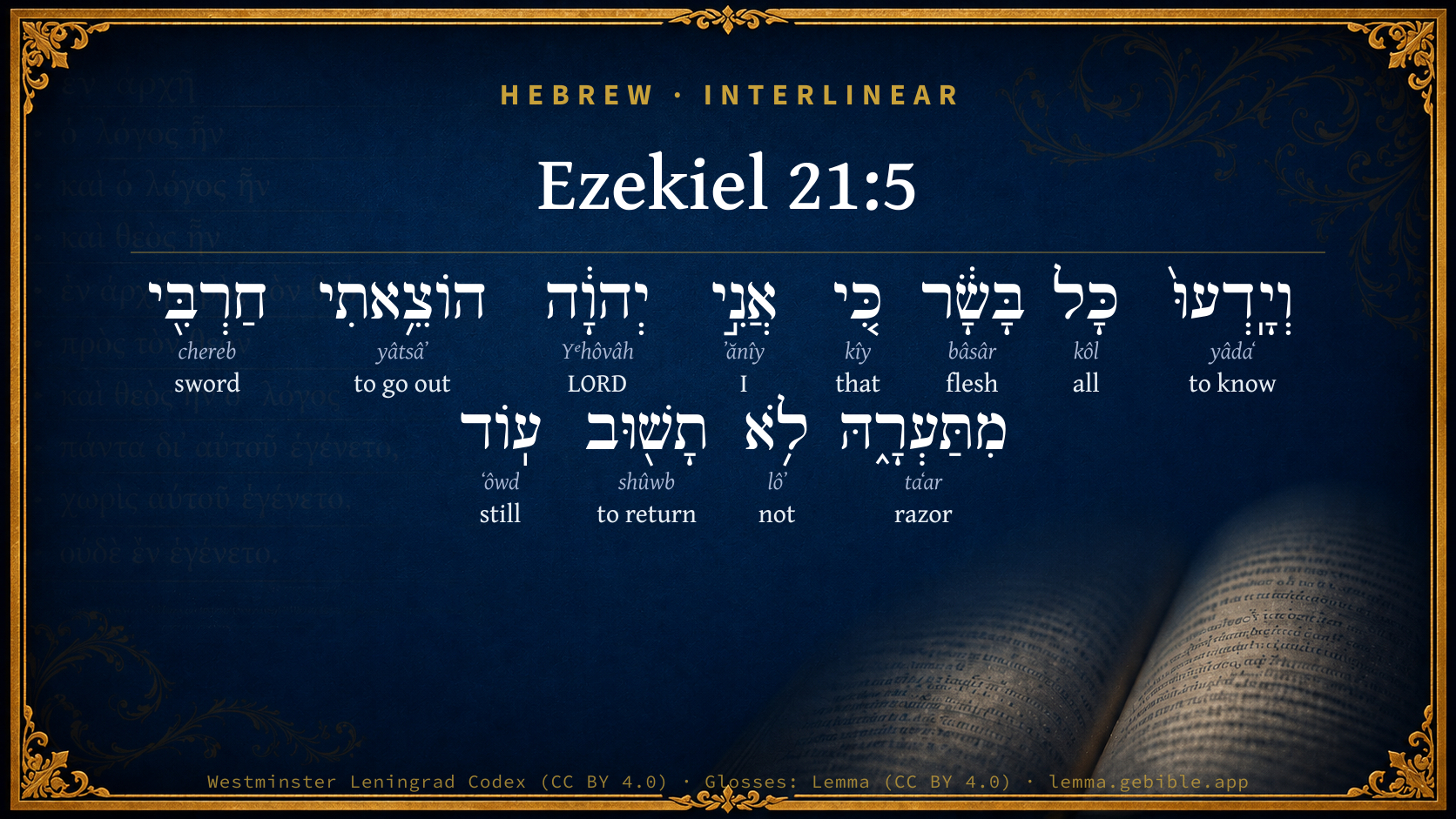
Ezekiel 21:5

Hebrew (Westminster Leningrad Codex) Ezekiel 21:5 appears in the Hebrew Old Testament. The text above is from the Westminster Leningrad Codex. Each word links to its Strong’s number, a concise gloss, and parsing drawn from the Open Scriptures Hebrew Bible morphology. Click any word for its full Brown-Driver-Briggs (BDB) entry.
Download image
Cite this verse

Ezekiel 21:5 (World English Bible). Public Domain. Lemma interlinear Bible study tool, https://lemma.gebible.app/v/ezekiel/21/5.

Show BibTeX & RIS
BibTeX
RIS
English Translation
and all flesh shall know that I, Yahweh, have drawn forth my sword out of its sheath; it shall not return any more.
World English Bible · Public Domain
Download a study sheet

One document with this verse’s original text, its word-by-word gloss line, the meaning frame, cross-references with their text, attributed commentary, and full source and license credits — printable, and it pastes into notes with its structure intact.

This verse Autodidact and up

Study sheet (.html) Plain text (.txt)

A passage Seminary Student

Up to 50 verses in one chapter. A passage sheet keeps up to 6 commentary sources and 12 cross-references per verse, in the order this page ranks them, and says so on the sheet whenever that leaves anything out. Ask for a single verse and you get the Autodidact verse sheet above.

Everything on this page stays free to read, with no account — the sheet is a download of what is already on screen, not access to it.

Want to remove ads? Support Godless Engineer
Compare translations 3

The same verse in 3 English versions, stacked beneath the original-language interlinear above. Click any original word for its lexicon entry.

Each is an independent rendering of the whole verse — the interlinear is not word-aligned to these translations.

Highlighted words mark where these versions differ — a whole-verse word diff, not a word-by-word alignment.

  • World English Bible Public Domain
    and all flesh shall know that I, Yahweh, have drawn forth my sword out of its sheath; it shall not return any more.
  • King James Version Public Domain
    That all flesh may know that I the LORD have drawn forth my sword out of his sheath: it shall not return any more.
  • unfoldingWord Literal Text CC BY-SA 4.0
    Then all flesh will know that I, Yahweh, have drawn my sword from its sheath. It will no longer hold back!’

unfoldingWord Literal Text — © unfoldingWord, licensed CC BY-SA 4.0. Word-aligned USFM3 via Door43 (git.door43.org/unfoldingWord/en_ult).

Versions to compare (up to 4)

3 of 4 selected

Show all 18 translations

Every available English version of this verse, each an independent rendering of the whole verse.

  • World English Bible Public Domain
    and all flesh shall know that I, Yahweh, have drawn forth my sword out of its sheath; it shall not return any more.
  • Berean Standard Bible Public Domain
    Then all flesh will know that I, the LORD, have taken My sword from its sheath, not to return it again.’
  • Majority Standard Bible Public Domain
    Then all flesh will know that I, the LORD, have taken My sword from its sheath, not to return it again.’
  • King James Version Public Domain
    That all flesh may know that I the LORD have drawn forth my sword out of his sheath: it shall not return any more.
  • American Standard Version (1901) Public Domain
    and all flesh shall know that I, Jehovah, have drawn forth my sword out of its sheath; it shall not return any more.
  • Revised Version (1885) Public Domain
    and all flesh shall know that I the LORD have drawn forth my sword out of its sheath; it shall not return any more.
  • Geneva Bible (1599) Public Domain
    That all flesh may knowe that I the Lord haue drawen my sworde out of his sheath, and it shall not returne any more.
  • Douay-Rheims (1899) Public Domain
    That all flesh may know that I the Lord have drawn my sword out of its sheath not to be turned back.
  • Young's Literal Translation Public Domain
    And known have all flesh that I, Jehovah, Have brought out My sword from its scabbard, It doth not turn back any more.
  • Literal Standard Version CC BY-SA 4.0
    And all flesh has known that I, YHWH, || Have brought out My sword from its scabbard, || It does not turn back anymore.
  • Unlocked Literal Bible CC BY-SA 4.0
    Then all flesh will know that I, Yahweh, have drawn my sword from its sheath. It will no longer hold back!'
  • unfoldingWord Literal Text CC BY-SA 4.0
    Then all flesh will know that I, Yahweh, have drawn my sword from its sheath. It will no longer hold back!’
  • Darby Bible Public Domain
    and all flesh shall know that I Jehovah have drawn forth my sword out of its sheath: it shall not return any more.
  • World Messianic Bible Public Domain
    All flesh will know that I, the LORD, have drawn my sword out of its sheath. It will not return any more.”’
  • Webster's Bible Public Domain
    That all flesh may know that I the LORD have drawn my sword out of its sheath: it shall not return any more.
  • Free Bible Version CC BY-SA 4.0
    Then the whole world will know that I, the Lord, have taken out my sword, and won't put it back again.
  • Bible in Basic English Public Domain
    And all flesh will see that I the Lord have taken my sword out of its cover: and it will never go back.
  • JPS Tanakh (1917) Public Domain
    (21-10) and all flesh shall know that I the LORD have drawn forth My sword out of its sheath; it shall not return any more.

Literal Standard Version (2020), Covenant Press — licensed CC BY-SA 4.0. Text via the HelloAO Bible API (eBible.org). Unlocked Literal Bible (unfoldingWord) — licensed CC BY-SA 4.0. Text via the HelloAO Bible API (eBible.org). unfoldingWord Literal Text — © unfoldingWord, licensed CC BY-SA 4.0. Word-aligned USFM3 via Door43 (git.door43.org/unfoldingWord/en_ult). Free Bible Version, Dr. Jonathan Gallagher — licensed CC BY-SA 4.0. Text via the HelloAO Bible API (eBible.org).

Word by word

More ways to search: Search by grammar → Find every occurrence → Compare this word →

Practice this passage: Drill this verse → Learn its vocabulary →

מִתַּעְרָ֑הּ
taʻar
H8593
“from · razor · her”
Preposition + Noun, Common, Both, Singular, Construct + Suffix, Personal, 3rd Person, Feminine, Singular
Part of Speech
Preposition + Noun
Type
Common
Gender
Both
Number
Singular
State
Construct
Full BDB Definition

Origin: from H6168

TWOT: 1692e

razor, sheath (making naked) - razor - sheath (of sword)
  1. וְיָֽדְעוּ֙ yâdaʻ H3045 “and · to know” Conjunction + Verb, Qal, Sequential Perfect, 3rd Person, Common, Plural
  2. כָּל kôl H3605 “all of” Noun, Common, Masculine, Singular, Construct
  3. בָּשָׂ֔ר bâsâr H1320 “flesh” Noun, Common, Masculine, Singular, Absolute
  4. כִּ֚י kîy H3588 “that” Conjunction
  5. אֲנִ֣י ʼănîy H589 “I” Pronoun, Personal, 1st Person, Common, Singular
  6. יְהוָ֔ה Yᵉhôvâh H3068 “LORD” Noun, Proper
  7. הוֹצֵ֥אתִי yâtsâʼ H3318 “to go out” Verb, Hiphil, Perfect, 1st Person, Common, Singular
  8. חַרְבִּ֖י chereb H2719 “sword · my” Noun, Common, Feminine, Singular, Construct + Suffix, Personal, 1st Person, Common, Singular
  9. לֹ֥א lôʼ H3808 “not” Particle, Negative
  10. תָשׁ֖וּב shûwb H7725 “to return” Verb, Qal, Imperfect, 3rd Person, Feminine, Singular
  11. עֽוֹד ʻôwd H5750 “still” Adverb

About this verse

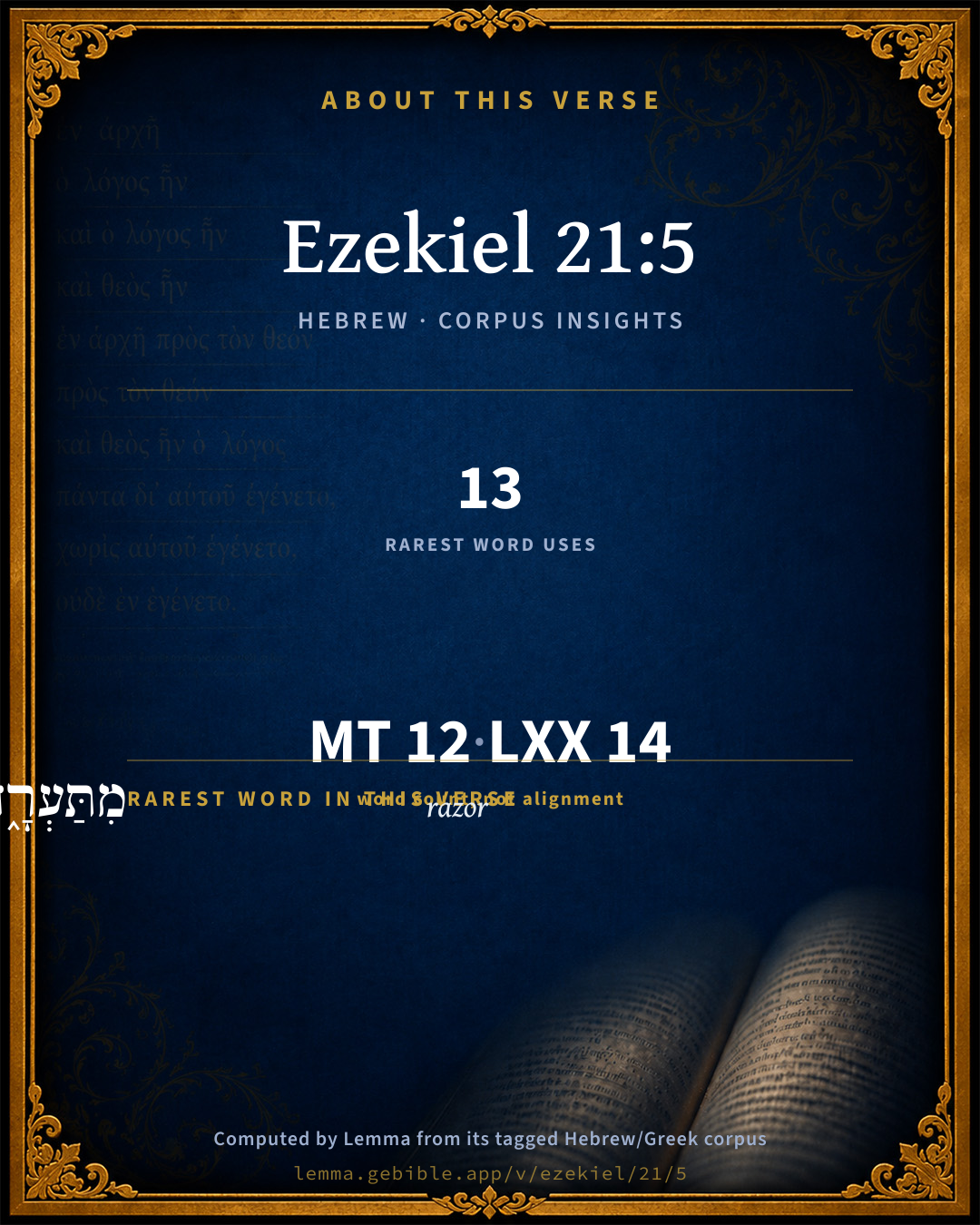
These counts appear in no published source. They are computed here, from the morphology-tagged text and Lemma’s own curated glosses. What Lemma adds →

12
words
12
distinct lemmas
Prophets
section

Notable vocabulary

The rarest word here is מִתַּעְרָ֑הּ razor H8593 — appearing just 13 times in the whole Hebrew Bible.

Shared distinctive vocabulary

מִתַּעְרָ֑הּ razor H8593 occurs in 13 verses of the Hebrew Bible. Also found in:

Grammatical profile

  • 3 verbs
  • 5 nouns
  • 1 pronoun
  • 1 conjunction
  • 1 adverb
  • 1 particle

Verb forms

  • וְיָֽדְעוּ֙ Qal · Sequential Perfect
  • הוֹצֵ֥אתִי Hiphil · Perfect
  • תָשׁ֖וּב Qal · Imperfect

Hebrew & Septuagint length

In English translation the verse runs 23 words from the Hebrew and 24 from the Septuagint (LXX English) — closely comparable.

A rough comparison of the two English renderings, which tokenize alike — not a word-level alignment.

Word counts can differ between the Hebrew and the Greek without any difference in meaning — e.g. the Hebrew direct-object marker אֵת has no separate Greek word, and Greek often adds the article ὁ.

In the original languages it is 12 Hebrew tokens and 14 Greek tokens — but the two are counted differently (Hebrew bundles its prefixes and suffixes into one token; the Greek is in lemma form), so that isn’t a like-for-like length.

Cross-references

10

Topical passages linked to Ezekiel 21:5 in the Treasury of Scripture Knowledge — connected by theme and wording, ordered by reader-vote popularity; previews shown in the World English Bible.

  • Ezekiel 21:30 Cause it to return into its sheath. In the place where you were created, in the land of your birth, will I judge you.
  • Nahum 1:9 What do you plot against Yahweh? He will make a full end. Affliction won't rise up the second time.
  • 1 Samuel 3:12 In that day I will perform against Eli all that I have spoken concerning his house, from the beginning even to the end.
  • Jeremiah 23:20 The anger of Yahweh shall not return, until he has executed, and until he have performed the intents of his heart: in the latter days you shall understand it perfectly.
  • Ezekiel 20:48 All flesh shall see that I, Yahweh, have kindled it; it shall not be quenched.
  • Numbers 14:21–23 but in very deed, as I live, and as all the earth shall be filled with the glory of Yahweh;
  • Deuteronomy 29:24–28 even all the nations shall say, Why has Yahweh done thus to this land? what means the heat of this great anger?
  • 1 Kings 9:7–9 then will I cut off Israel out of the land which I have given them; and this house, which I have made holy for my name, will I cast out of my sight; and Israel shall be a proverb and a byword among all peoples.
  • Isaiah 45:23 By myself have I sworn, the word is gone forth from my mouth [in] righteousness, and shall not return, that to me every knee shall bow, every tongue shall swear.
  • Isaiah 55:11 so shall my word be that goes forth out of my mouth: it shall not return to me void, but it shall accomplish that which I please, and it shall prosper in the thing whereto I sent it.

Cross-references courtesy of OpenBible.info (CC BY 4.0).

Hebrew and Greek witnesses Masoretic Hebrew ↔ Greek Septuagint

The same verse in the two great witnesses to the Old Testament, shown verse-for-verse.

These are two independent witnesses, not word-aligned to each other, and the Septuagint is shown in lemma (dictionary) form.

Hebrew Ezekiel 21:5 Masoretic · Westminster Leningrad Codex

וְיָֽדְעוּ֙ כָּל בָּשָׂ֔ר כִּ֚י אֲנִ֣י יְהוָ֔ה הוֹצֵ֥אתִי חַרְבִּ֖י מִתַּעְרָ֑הּ לֹ֥א תָשׁ֖וּב עֽוֹד

and all flesh shall know that I, Yahweh, have drawn forth my sword out of its sheath; it shall not return any more.

World English Bible · Public Domain

Greek LXX Ezekiel 21:5 Septuagint · lemma form

καί εἶπον μηδαμῶς κύριος κύριος αὐτός λέγω πρός ἐγώ οὐ παραβολή εἰμί λέγω οὗτος

and all flesh shall know that I the Lord have drawn forth my sword out of its sheath: it shall not return any more.

LXX2012 (modern English Septuagint) · Public Domain

Hebrew: Westminster Leningrad Codex (CC BY 4.0). Greek: Septuagint (public domain); English from LXX2012 (modern English Septuagint) (Public Domain). How the Septuagint differs from the Hebrew →

Targum (Aramaic paraphrase)

1

The Targum is the ancient Jewish Aramaic paraphrase of the Hebrew Scriptures — an interpretive translation, not the Hebrew text itself. Onkelos (literal) and Pseudo-Jonathan (expansive) render the Torah, and Jonathan the Prophets. Coverage is partial: where no permissively-licensed English translation exists for a verse, only the Aramaic is shown. This is verse-level text, not a word-by-word alignment to the Hebrew.

  1. Targum Jonathan Prophets (Joshua–Malachi)
    וַאֲמָרֵית קַבֵּיל בָּעוּתִי יְיָ אֱלֹהִים הָא אִינוּן אָמְרִין לִי הֲלָא מַמְתֵיל מַתְלִין הוּא:

    (no public-domain English translation for this verse)

    Targum Jonathan — Aramaic: “Mikraot Gedolot” (public domain). English: “Sefaria Community Translation” (CC0 1.0 (public-domain dedication)); “London "Chaldee Paraphrase," 1871” (public domain). Text via Sefaria.

Commentary

Notes on Ezekiel 21:5 from classic Christian and Jewish commentators (each source and its license shown beneath its notes). The classic Christian expositions comment on the surrounding passage and are grouped to its opening verse, so a note may address several verses; the Jewish commentaries on the Tanakh (Rashi and others) are per-verse, so they appear only where the commentator wrote on this verse.

Lemma curates 59 commentaries, every one of them public domain or Creative Commons licensed, each selected and text-cleaned for this edition rather than reprinted as found. About our sources →

Trapp's Complete Commentary

John Trapp

Eze 21:5 That all flesh may know that I the LORD have drawn forth my sword out of his sheath: it shall not return any more.

Ver. 5. Have drawn forth my sword.] And put it in commission; not to return till the circuit ended, till it hath done full execution.

John Trapp, A Commentary or Exposition upon All the Books of the Old and New Testament (1647–1656) — public domain. Text from a community e-Sword module.

Adam Clarke's Commentary

Verse 5. It shall not return any more.] That is, till all the work that I have designed for it is done. Nor did it; for Nebuchadnezzar never rested till he had subdued all the lands from the south to the north, from the Euphrates to the Nile.

Adam Clarke's Commentary on the Bible (1810–1826) — public domain. Text from a community e-Sword/MySword module.

Ellicott's Commentary for English Readers

(5) It shall not return any more—i.e., until it has fully accomplished its purpose. Other judgments upon Israel had been arrested in mercy—the sword had been returned to the scabbard while its work was still incomplete. This will go on to the end.

A Bible Commentary for English Readers, edited by Charles John Ellicott (1878–1897) — public domain. Text from a community e-Sword module.

John Gill's Exposition

Sigh, therefore, thou son of man, with the breaking of thy loins,.... As if thy loins were broke, and go as if they were, and sigh as thou goest; or as a woman in travail, having her hands upon her loins as ready to break, and in the utmost distress; or heave, and groan, and sigh, till the girdle of the loins is broke, and by these motions and gesture show the miserable state of this people, and how much thou art affected with it:

and with bitterness sigh before their eyes; in the sight and hearing of the captives at Babylon; who would take care, by some means or other, to inform their brethren at Jerusalem of it, how the prophet sighed and groaned, under an apprehension and assurance of a dreadful calamity coming upon them; using along with his sobs and sighs, and brinish tears, doleful words and bitter lamentations.

John Gill's Exposition of the Whole Bible (1746–1763) — public domain (CC PDM 1.0). Text via the HelloAO Bible API.

Haydock's Catholic Bible Commentary

Back, (ver. 30.) without doing execution, Jeremias l. 9. (Calmet)

George Leo Haydock (1774–1849), Haydock's Catholic Family Bible and Commentary, 1859 edition — public domain. Excludes Psalms (Douay-Rheims chapter numbering differs from Protestant) and Deuterocanonical books (Catholic canon only).

Matthew Poole's English Annotations

That they that smart and suffer may see and own God in their just sufferings, they that see and hear it may confess God’s doings herein.

It shall not return any more: in Eze 20:48 it is expressed thus, it shall not be quenched, for there it was a fire; here, it shall not return into the scabbard till it hath done full execution.

Matthew Poole's English Annotations on the Holy Bible (1683–1685) — public domain. Text from a community e-Sword/MySword module.

John Wesley's Explanatory Notes

Shall not return - It shall not return into the scabbard 'till it hath done full execution.

John Wesley, Explanatory Notes Upon the Whole Bible (1754–1765) — public domain. Text via the GEBible commentary corpus.

Rashi

Rabbi Shlomo Yitzchaki (Rashi)

‘Is he not an inventor of parables’ when I prophesy to them in language of parable and riddle, such as a forest and a fire consuming [trees] moist and dry.

Rashi on the Tanakh — English translations: “The Judaica Press complete Tanach with Rashi, translated by A. J. Rosenberg” (CC BY 4.0); “Pentateuch with Rashi's commentary by M. Rosenbaum and A.M. Silbermann, 1929-1934” (public domain); “The Metsudah Tanach series, Lakewood, N.J” (CC BY 4.0); and “The Book of Joshua, Metsudah Publications, 1997” (CC BY 4.0). Text via Sefaria.

Lesson kit

Teaching starters — assembled from the data on this page, not authored interpretation. Every prompt links to the verse data it draws on. Edit before teaching.

Ezekiel, in the Prophets, opens this verse with 12 words (12 distinct Hebrew lemmas). Its most distinctive word is taʻar (“razor”). A historical commentator’s framing appears above. Read the whole chapter for the surrounding context.

Discussion questions

  1. How does “razor” (taʻar) shape what this verse is saying?
  2. How does Numbers 6:5, which shares the word «razor», read alongside this verse?
  3. These translations render this verse differently; the difference is in the English rendering, not the original. What questions does that raise?
  4. «וְיָֽדְעוּ֙» is a Qal Sequential Perfect verb. How does that grammatical form shape the action described?
  5. Compare how Trapp's Complete Commentary and Adam Clarke's Commentary read this verse. Where do they agree or differ?

Things to notice

Reading settings

Reading text

Shown beneath each verse's original-language words.

Old Testament
Old Testament edition

Read the OT as the Masoretic Hebrew (MT) or the Greek Septuagint (LXX).

English shown for the Greek Septuagint (in the Hebrew ↔ Greek comparison).

Comparing translations? Open the Compare panel on any verse page to stack up to four side by side.