
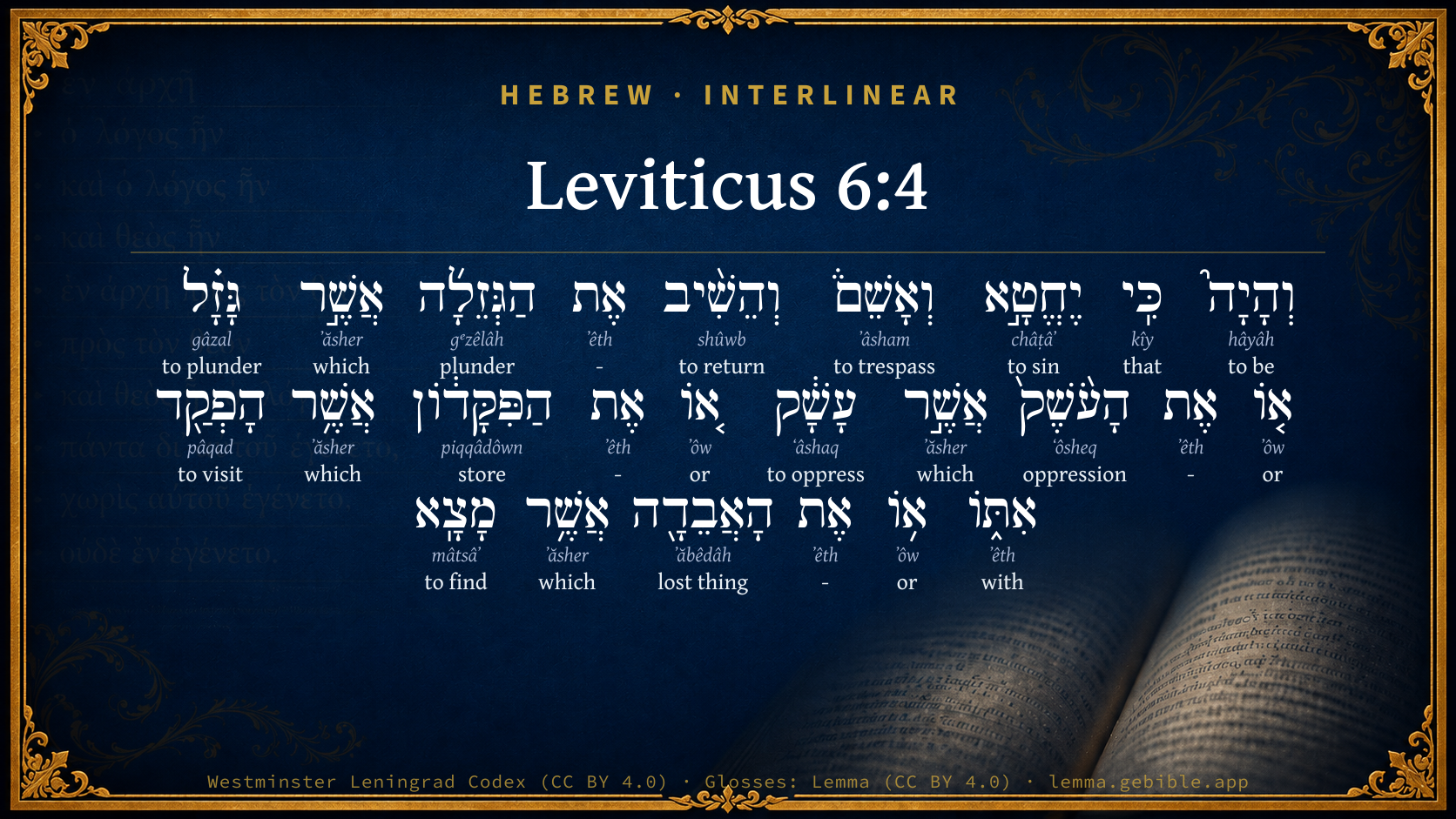
Leviticus 6:4

Hebrew (Westminster Leningrad Codex) Leviticus 6:4 appears in the Hebrew Old Testament. The text above is from the Westminster Leningrad Codex. Each word links to its Strong’s number, a concise gloss, and parsing drawn from the Open Scriptures Hebrew Bible morphology. Click any word for its full Brown-Driver-Briggs (BDB) entry.
Download image
Cite this verse

Leviticus 6:4 (World English Bible). Public Domain. Lemma interlinear Bible study tool, https://lemma.gebible.app/v/leviticus/6/4.

Show BibTeX & RIS
BibTeX
RIS
English Translation
then it shall be, if he has sinned, and is guilty, he shall restore that which he took by robbery, or the thing which he has gotten by oppression, or the deposit which was committed to him, or the lost thing which he found,
World English Bible · Public Domain
Highlights Full analysis ↓
Download a study sheet

One document with this verse’s original text, its word-by-word gloss line, the meaning frame, cross-references with their text, attributed commentary, and full source and license credits — printable, and it pastes into notes with its structure intact.

This verse Autodidact and up

Study sheet (.html) Plain text (.txt)

A passage Seminary Student

Up to 50 verses in one chapter. A passage sheet keeps up to 6 commentary sources and 12 cross-references per verse, in the order this page ranks them, and says so on the sheet whenever that leaves anything out. Ask for a single verse and you get the Autodidact verse sheet above.

Everything on this page stays free to read, with no account — the sheet is a download of what is already on screen, not access to it.

Want to remove ads? Support Godless Engineer
Compare translations 3

The same verse in 3 English versions, stacked beneath the original-language interlinear above. Click any original word for its lexicon entry.

Each is an independent rendering of the whole verse — the interlinear is not word-aligned to these translations.

Highlighted words mark where these versions differ — a whole-verse word diff, not a word-by-word alignment.

  • World English Bible Public Domain
    then it shall be, if he has sinned, and is guilty, he shall restore that which he took by robbery, or the thing which he has gotten by oppression, or the deposit which was committed to him, or the lost thing which he found,
  • King James Version Public Domain
    Then it shall be, because he hath sinned, and is guilty, that he shall restore that which he took violently away, or the thing which he hath deceitfully gotten, or that which was delivered him to keep, or the lost thing which he found,
  • unfoldingWord Literal Text CC BY-SA 4.0
    then it shall be, when he sins and he becomes guilty, then he shall return the robbery that he robbed or the extortion that he extorted or the deposit that was deposited with him or the lost property that he found

unfoldingWord Literal Text — © unfoldingWord, licensed CC BY-SA 4.0. Word-aligned USFM3 via Door43 (git.door43.org/unfoldingWord/en_ult).

Versions to compare (up to 4)

3 of 4 selected

Show all 18 translations

Every available English version of this verse, each an independent rendering of the whole verse.

  • World English Bible Public Domain
    then it shall be, if he has sinned, and is guilty, he shall restore that which he took by robbery, or the thing which he has gotten by oppression, or the deposit which was committed to him, or the lost thing which he found,
  • Berean Standard Bible Public Domain
    once he has sinned and becomes guilty, he must return what he has stolen or taken by extortion, or the deposit entrusted to him, or the lost property he found,
  • Majority Standard Bible Public Domain
    once he has sinned and becomes guilty, he must return what he has stolen or taken by extortion, or the deposit entrusted to him, or the lost property he found,
  • King James Version Public Domain
    Then it shall be, because he hath sinned, and is guilty, that he shall restore that which he took violently away, or the thing which he hath deceitfully gotten, or that which was delivered him to keep, or the lost thing which he found,
  • American Standard Version (1901) Public Domain
    then it shall be, if he hath sinned, and is guilty, that he shall restore that which he took by robbery, or the thing which he hath gotten by oppression, or the deposit which was committed to him, or the lost thing which he found,
  • Revised Version (1885) Public Domain
    then it shall be, if he hath sinned, and is guilty, that he shall restore that which he took by robbery, or the thing which he hath gotten by oppression, or the deposit which was committed to him, or the lost thing which he found,
  • Geneva Bible (1599) Public Domain
    When, I say, he thus sinneth and trespasseth, he shall then restore the robbery that he robbed, or the thing taken by violence which hee tooke by force, or the thing which was deliuered him to keepe, or the lost thing which he founde,
  • Douay-Rheims (1899) Public Domain
    Being convicted of the offence, he shall restore
  • Young's Literal Translation Public Domain
    `Then it hath been, when he sinneth, and hath been guilty, that he hath returned the plunder which he hath taken violently away, or the thing which he hath got by oppression, or the deposit which hath been deposited with him, or the lost thing which he hath found;
  • Literal Standard Version CC BY-SA 4.0
    then it has been, when he sins and has been guilty, that he has returned the plunder which he has violently taken away, or the thing which he has gotten by oppression, or the deposit which has been deposited with him, or the lost thing which he has found;
  • Unlocked Literal Bible CC BY-SA 4.0
    and if he has sinned and is found to be guilty, he must restore whatever he took by robbery or oppression, or that which was entrusted to him, or that which was lost but that he had found.
  • unfoldingWord Literal Text CC BY-SA 4.0
    then it shall be, when he sins and he becomes guilty, then he shall return the robbery that he robbed or the extortion that he extorted or the deposit that was deposited with him or the lost property that he found
  • Darby Bible Public Domain
    then it shall be, if he hath sinned and transgressed, that he shall restore what he robbed or that in which he hath defrauded, or the deposit, or the lost thing which he found,
  • World Messianic Bible Public Domain
    then it shall be, if he has sinned, and is guilty, he shall restore that which he took by robbery, or the thing which he has gotten by oppression, or the deposit which was committed to him, or the lost thing which he found,
  • Webster's Bible Public Domain
    \\6:11\\And he shall put off his garments, and put on other garments, and carry forth the ashes without the camp to a clean place.
  • Free Bible Version CC BY-SA 4.0
    If you have sinned and become guilty you must return what you have stolen or cheated from your victims, the deposit you took, the lost property you found,
  • Bible in Basic English Public Domain
    Then having taken off his linen robes and put on other clothing, he is to take it away into a clean place, outside the tent-circle.
  • JPS Tanakh (1917) Public Domain
    (5-23) then it shall be, if he hath sinned, and is guilty, that he shall restore that which he took by robbery, or the thing which he hath gotten by oppression, or the deposit which was deposited with him, or the lost thing which he found,

Literal Standard Version (2020), Covenant Press — licensed CC BY-SA 4.0. Text via the HelloAO Bible API (eBible.org). Unlocked Literal Bible (unfoldingWord) — licensed CC BY-SA 4.0. Text via the HelloAO Bible API (eBible.org). unfoldingWord Literal Text — © unfoldingWord, licensed CC BY-SA 4.0. Word-aligned USFM3 via Door43 (git.door43.org/unfoldingWord/en_ult). Free Bible Version, Dr. Jonathan Gallagher — licensed CC BY-SA 4.0. Text via the HelloAO Bible API (eBible.org).

Word by word

More ways to search: Search by grammar → Find every occurrence → Compare this word →

Practice this passage: Drill this verse → Learn its vocabulary →

הַפִּקָּד֔וֹן
piqqâdôwn
H6487
“the · store”
Particle, Definite Article + Noun, Common, Masculine, Singular, Absolute
Part of Speech
Particle + Noun
Type
Common
Gender
Masculine
Number
Singular
State
Absolute
Full BDB Definition

Origin: from H6485

TWOT: 1802f

deposit, store, supply
  1. וְהָיָה֮ hâyâh H1961 “and · to be” Conjunction + Verb, Qal, Sequential Perfect, 3rd Person, Masculine, Singular
  2. כִּֽי kîy H3588 “that” Conjunction
  3. יֶחֱטָ֣א châṭâʼ H2398 “to sin” Verb, Qal, Imperfect, 3rd Person, Masculine, Singular
  4. וְאָשֵׁם֒ ʼâsham H816 “and · to trespass” Conjunction + Verb, Qal, Sequential Perfect, 3rd Person, Masculine, Singular
  5. וְהֵשִׁ֨יב shûwb H7725 “and · to return” Conjunction + Verb, Hiphil, Sequential Perfect, 3rd Person, Masculine, Singular
  6. אֶת ʼêth H853 “-” Particle, Direct Object
  7. הַגְּזֵלָ֜ה gᵉzêlâh H1500 “the · plunder” Particle, Definite Article + Noun, Common, Feminine, Singular, Absolute
  8. אֲשֶׁ֣ר ʼăsher H834 “which” Particle, Relative
  9. גָּזָ֗ל gâzal H1497 “to plunder” Verb, Qal, Perfect, 3rd Person, Masculine, Singular
  10. א֤וֹ ʼôw H176 “or” Conjunction
  11. אֶת ʼêth H853 “-” Particle, Direct Object
  12. הָעֹ֨שֶׁק֙ ʻôsheq H6233 “the · oppression” Particle, Definite Article + Noun, Common, Masculine, Singular, Absolute
  13. אֲשֶׁ֣ר ʼăsher H834 “which” Particle, Relative
  14. עָשָׁ֔ק ʻâshaq H6231 “to oppress” Verb, Qal, Perfect, 3rd Person, Masculine, Singular
  15. א֚וֹ ʼôw H176 “or” Conjunction
  16. אֶת ʼêth H853 “-” Particle, Direct Object
  17. אֲשֶׁ֥ר ʼăsher H834 “which” Particle, Relative
  18. הָפְקַ֖ד pâqad H6485 “to visit” Verb, Hophal, Perfect, 3rd Person, Masculine, Singular
  19. אִתּ֑וֹ ʼêth H854 “with · him” Preposition + Suffix, Personal, 3rd Person, Masculine, Singular
  20. א֥וֹ ʼôw H176 “or” Conjunction
  21. אֶת ʼêth H853 “-” Particle, Direct Object
  22. הָאֲבֵדָ֖ה ʼăbêdâh H9 “the · lost thing” Particle, Definite Article + Noun, Common, Feminine, Singular, Absolute
  23. אֲשֶׁ֥ר ʼăsher H834 “which” Particle, Relative
  24. מָצָֽא mâtsâʼ H4672 “to find” Verb, Qal, Perfect, 3rd Person, Masculine, Singular

About this verse

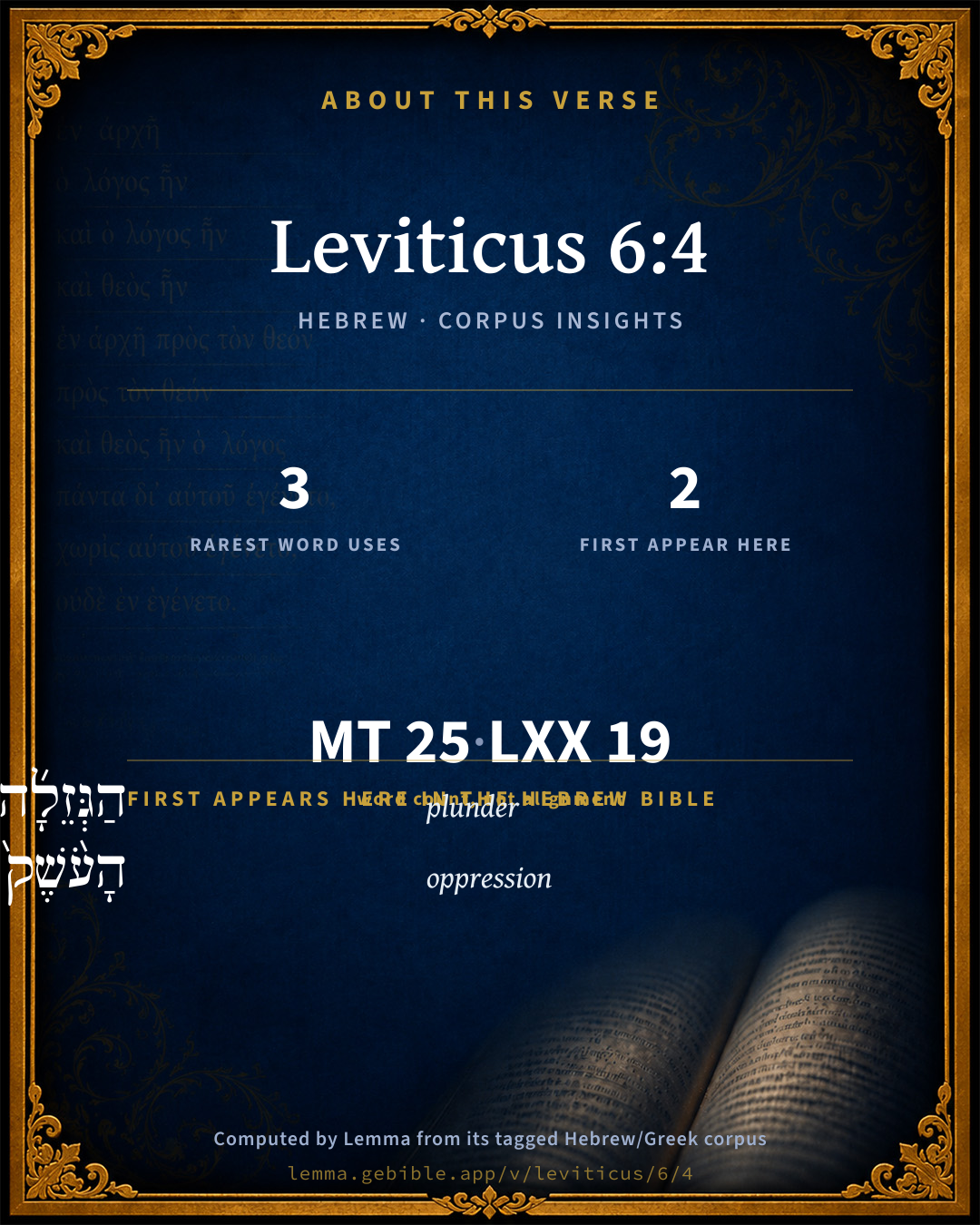
These counts appear in no published source. They are computed here, from the morphology-tagged text and Lemma’s own curated glosses. What Lemma adds →

25
words
17
distinct lemmas
Pentateuch
section

Notable vocabulary

The rarest word here is הַפִּקָּד֔וֹן store H6487 — appearing just 3 times in the whole Hebrew Bible.

First appearance in Scripture

These words make their first canonical appearance in the Hebrew Bible here:

  • הַגְּזֵלָ֜ה plunder H1500
  • הָעֹ֨שֶׁק֙ oppression H6233

Shared distinctive vocabulary

הַפִּקָּד֔וֹן store H6487 occurs in 3 verses of the Hebrew Bible. Also found in:

Grammatical profile

  • 8 verbs
  • 4 nouns
  • 1 preposition
  • 4 conjunctions
  • 8 particles

Verb forms

  • וְהָיָה֮ Qal · Sequential Perfect
  • יֶחֱטָ֣א Qal · Imperfect
  • וְאָשֵׁם֒ Qal · Sequential Perfect
  • וְהֵשִׁ֨יב Hiphil · Sequential Perfect
  • גָּזָ֗ל Qal · Perfect
  • עָשָׁ֔ק Qal · Perfect
  • הָפְקַ֖ד Hophal · Perfect
  • מָצָֽא Qal · Perfect

Repetition

Words recur within this verse — often emphatic in Hebrew:

  • אֲשֶׁ֣ר which H834 ×4
  • א֤וֹ or H176 ×3

Hebrew & Septuagint length

In English translation the verse runs 44 words from the Hebrew and 91 from the Septuagint (LXX English) — the Septuagint runs noticeably longer here. See the side-by-side →

A rough comparison of the two English renderings, which tokenize alike — not a word-level alignment.

Word counts can differ between the Hebrew and the Greek without any difference in meaning — e.g. the Hebrew direct-object marker אֵת has no separate Greek word, and Greek often adds the article ὁ.

In the original languages it is 25 Hebrew tokens and 19 Greek tokens — but the two are counted differently (Hebrew bundles its prefixes and suffixes into one token; the Greek is in lemma form), so that isn’t a like-for-like length.

Cross-references

12

Topical passages linked to Leviticus 6:4 in the Treasury of Scripture Knowledge — connected by theme and wording, ordered by reader-vote popularity; previews shown in the World English Bible.

  • Genesis 21:25 Abraham complained to Abimelech because of a water well, which Abimelech's servants had violently taken away.
  • Leviticus 4:13–15 "'If the whole congregation of Israel sins, and the thing is hidden from the eyes of the assembly, and they have done any of the things which Yahweh has commanded not to be done, and are guilty;
  • Leviticus 5:3–4 "'Or if he touches the uncleanness of man, whatever his uncleanness is with which he is unclean, and it is hidden from him; when he knows of it, then he shall be guilty.
  • Job 20:19 For he has oppressed and forsaken the poor. He has violently taken away a house, and he shall not build it up.
  • Job 24:2 There are people who remove the landmarks. They violently take away flocks, and feed them.
  • Isaiah 59:6 Their webs shall not become garments, neither shall they cover themselves with their works: their works are works of iniquity, and the act of violence is in their hands.
  • Ezekiel 18:7 and has not wronged any, but has restored to the debtor his pledge, has taken nothing by robbery, has given his bread to the hungry, and has covered the naked with a garment;
  • Ezekiel 18:12 has wronged the poor and needy, has taken by robbery, has not restored the pledge, and has lifted up his eyes to the idols, has committed abomination,
  • Ezekiel 18:18 As for his father, because he cruelly oppressed, robbed his brother, and did that which is not good among his people, behold, he shall die in his iniquity.
  • Amos 3:10 "Indeed they don't know to do right," says Yahweh, "Who hoard plunder and loot in their palaces."
  • Micah 2:2 They covet fields, and seize them; And houses, and take them away: And they oppress a man and his house, Even a man and his heritage.
  • Zephaniah 1:9 In that day, I will punish all those who leap over the threshold, who fill their master's house with violence and deceit.

Cross-references courtesy of OpenBible.info (CC BY 4.0).

Hebrew and Greek witnesses Masoretic Hebrew ↔ Greek Septuagint

The same verse in the two great witnesses to the Old Testament, shown verse-for-verse.

Here the Septuagint runs noticeably longer than the Hebrew — LXX2012 (modern English Septuagint) 91 words vs World English Bible 44. A rough length comparison of the two English translations, not a word-level alignment — read both below.

These are two independent witnesses, not word-aligned to each other, and the Septuagint is shown in lemma (dictionary) form.

Hebrew Leviticus 6:4 Masoretic · Westminster Leningrad Codex

וְהָיָה֮ כִּֽי יֶחֱטָ֣א וְאָשֵׁם֒ וְהֵשִׁ֨יב אֶת הַגְּזֵלָ֜ה אֲשֶׁ֣ר גָּזָ֗ל א֤וֹ אֶת הָעֹ֨שֶׁק֙ אֲשֶׁ֣ר עָשָׁ֔ק א֚וֹ אֶת הַפִּקָּד֔וֹן אֲשֶׁ֥ר הָפְקַ֖ד אִתּ֑וֹ א֥וֹ אֶת הָאֲבֵדָ֖ה אֲשֶׁ֥ר מָצָֽא

then it shall be, if he has sinned, and is guilty, he shall restore that which he took by robbery, or the thing which he has gotten by oppression, or the deposit which was committed to him, or the lost thing which he found,

World English Bible · Public Domain

Greek LXX Leviticus 6:4 Septuagint · lemma form

καί ἐκδύω ὁ στολή αὐτός καί ἐνδύω στολή ἄλλος καί ἐκφέρω ὁ κατακάρπωσις ἔξω ὁ παρεμβολή εἰς τόπος καθαρός

it shall come to pass, whenever he shall have sinned, and transgressed, that he shall restore the plunder which he has seized, or redress the injury which he has committed, or restore the deposit which was entrusted to him, or the lost article which he has found of any kind, about which he swore unjustly, he shall even restore it in full; and he shall add to it a fifth part besides; he shall restore it to him whose it is in the day in which he happens to be convicted.

LXX2012 (modern English Septuagint) · Public Domain

Hebrew: Westminster Leningrad Codex (CC BY 4.0). Greek: Septuagint (public domain); English from LXX2012 (modern English Septuagint) (Public Domain). How the Septuagint differs from the Hebrew →

Targum (Aramaic paraphrase)

2

The Targum is the ancient Jewish Aramaic paraphrase of the Hebrew Scriptures — an interpretive translation, not the Hebrew text itself. Onkelos (literal) and Pseudo-Jonathan (expansive) render the Torah, and Jonathan the Prophets. Coverage is partial: where no permissively-licensed English translation exists for a verse, only the Aramaic is shown. This is verse-level text, not a word-by-word alignment to the Hebrew.

  1. Targum Onkelos Torah (Genesis–Deuteronomy)
    וְיַשְׁלַח יָת לְבוּשׁוֹהִי וְיִלְבַּשׁ לְבוּשִׁין אָחֳרָנִין וְיַפֵּק יָת קִטְמָא לְמִבָּרָא לְמַשְׁרִיתָא לַאֲתַר דְכֵי

    (no public-domain English translation for this verse)

    Targum Onkelos — Aramaic: “Onkelos Genesis” (public domain); “Onkelos Exodus” (public domain); “Onkelos Leviticus” (public domain); “Onkelos Numbers” (public domain); “Onkelos Deuteronomy” (public domain). English: “Sefaria Community Translation” (CC0 1.0 (public-domain dedication)); “J.W. Etheridge. The Targums of Onkelos and Jonathan Ben Uzziel on the Pentateuch. London: Longmans, Green, 1862” (public domain). Text via Sefaria.

  2. Targum Pseudo-Jonathan Torah (Genesis–Deuteronomy)
    וִישַׁלַח יַת לְבוּשׁוֹי וְיִלְבַּשׁ לְבוּשִׁין חוֹרָנִין וִיהַנְפֵּק יַת קִיטְמָא לְמִיבָּרָא לְמַשְׁרִיתָא לַאֲתַר דְכֵי

    And he shall take off his vestments and put on other garments, and carry forth the ashes without the camp into a clean place.

    Targum Pseudo-Jonathan — Aramaic: “Targum Jonathan on Genesis” (public domain); “Targum Jonathan on Exodus” (public domain); “Targum Jonathan on Leviticus” (public domain); “Targum Jonathan on Numbers” (public domain); “Targum Jonathan on Deuteronomy” (public domain). English: “The Targum of Jonathan ben Uzziel, trans. J. W. Etheridge, London, 1862” (public domain). Text via Sefaria.

Commentary

Notes on Leviticus 6:4 from classic Christian and Jewish commentators (each source and its license shown beneath its notes). The classic Christian expositions comment on the surrounding passage and are grouped to its opening verse, so a note may address several verses; the Jewish commentaries on the Tanakh (Rashi and others) are per-verse, so they appear only where the commentator wrote on this verse.

Lemma curates 59 commentaries, every one of them public domain or Creative Commons licensed, each selected and text-cleaned for this edition rather than reprinted as found. About our sources →

Trapp's Complete Commentary

John Trapp

Lev 6:4 Then it shall be, because he hath sinned, and is guilty, that he shall restore that which he took violently away, or the thing which he hath deceitfully gotten, or that which was delivered him to keep, or the lost thing which he found,

Ver. 4. And is guilty.] Found guilty by a self-condemning conscience; which now, like Samson’s wife, conceals not the riddle, but tells all; as she said of our Saviour in Joh 4:29.

John Trapp, A Commentary or Exposition upon All the Books of the Old and New Testament (1647–1656) — public domain. Text from a community e-Sword module.

Ellicott's Commentary for English Readers

(4) Then it shall be, because he hath sinned, and is guilty.—Better, And it shall come to pass, token he hath so sinned, and acknowledged his guilt. (See Lev_4:22.) That is, when he has committed any of the aforementioned offences, and denied the sin with an oath, but afterwards voluntarily acknowledges his guilt without having been found out.

That he shall restore that . . . which he hath deceitfully gotten.—Better, then he shall restore, &c.

A Bible Commentary for English Readers, edited by Charles John Ellicott (1878–1897) — public domain. Text from a community e-Sword module.

John Gill's Exposition

Then it shall be, because he hath sinned and is guilty,.... Owns his guilt through remorse of conscience, and makes a confession of it; or otherwise, upon conviction, without such confession he was to pay double, see Exo 22:7 whereas, in this case it is only ordered:

that he shall restore that which he took violently away: whether money, goods, or cattle:

or the thing which he hath deceitfully gotten; by outwitting him, by extortion, by false accusation, or detention of wages:

or that which was delivered him to keep; in which he was unfaithful to his trust, be it what it will:

or the lost thing which he found; and denied he had it.

John Gill's Exposition of the Whole Bible (1746–1763) — public domain (CC PDM 1.0). Text via the HelloAO Bible API.

Haydock's Catholic Bible Commentary

Convicted, by his own conscience, and by the judgment of the priest to whom he has confessed his sin. The Hebrew expresses the different sorts of sins specified above, which the Vulgate denotes by the word offence.

George Leo Haydock (1774–1849), Haydock's Catholic Family Bible and Commentary, 1859 edition — public domain. Excludes Psalms (Douay-Rheims chapter numbering differs from Protestant) and Deuterocanonical books (Catholic canon only).

Matthew Poole's English Annotations

Because he hath sinned, and is guilty. This guilt of his being manifested, either by his refusing to swear when called to it, as in some of the cases alleged; or by his voluntary confession upon remorse, whereby he reapeth this benefit, that he only restores the principal with the addition of a fifth part; whereas if he were convicted of his fault, he was to pay double, Exo 22:9.

Matthew Poole's English Annotations on the Holy Bible (1683–1685) — public domain. Text from a community e-Sword/MySword module.

Whedon's Commentary on the Bible

Daniel D. Whedon

4. He shall restore — Fruits mete for repentance are required before ceremonialism; mercy, or a right state of heart, before sacrifice. Thus the Philippian jailer washed the stripes of Christ’s ambassadors before he received baptism at their hands. Where restitution is possible, it must be immediately made; where it is not immediately possible, it must be solemnly promised, and the promise must be performed as soon as practicable.

Daniel D. Whedon (gen. ed.), Commentary on the Old and New Testaments (1874–1909) — public domain. Text from a community e-Sword module.

The Pulpit Commentary

As before, the profit gained by fraud or violence is to be given up, and with it a fine is to be paid, amounting to one-fifth of the value of the thing appropriated.

The Pulpit Commentary (1880–1919), ed. H.D.M. Spence-Jones & Joseph S. Exell — public domain. Text from a community e-Sword module.

John Wesley's Explanatory Notes

Is guilty - This guilt being manifested by his voluntary confession upon remorse, whereby he reapeth this benefit, that he only restores the principal with the addition of a fifth part; whereas if he were convicted of his fault, he was to pay double, Exod. xxii, 9.

John Wesley, Explanatory Notes Upon the Whole Bible (1754–1765) — public domain. Text via the GEBible commentary corpus.

Rashi

Rabbi Shlomo Yitzchaki (Rashi)

‎ ופשט את בגדיו ‎ AND HE SHALL PUT OFF HIS GARMENTS — This is not compulsory (cf., however, Nachmanides) but it is a matter of decency so that he should not, through removing the ashes, soil the garments in which he has regularly to minister at the altar; in the clothes he wore when he boiled the pot for his master (a menial task) he should not pour out a glass of wine for him (an honourable office). On this account it states: And he shall put on other garments — inferior to those in which he ministers at the altar (Yoma 23b; Shabbat 114a).

והוציא את הדשן AND HE SHALL BRING OUT THE ASHES that were heaped upon the ash-heap (not the ashes mentioned in v. 3). When it accumulated and there was no more room on the wood-pile (מערכה) he carried it out; this was not compulsory every day, whilst the תרומת הדשן (the taking out of the pan of ashes commanded in v. 3) was a daily duty (Yoma 20a).

Rashi on the Tanakh — English translations: “The Judaica Press complete Tanach with Rashi, translated by A. J. Rosenberg” (CC BY 4.0); “Pentateuch with Rashi's commentary by M. Rosenbaum and A.M. Silbermann, 1929-1934” (public domain); “The Metsudah Tanach series, Lakewood, N.J” (CC BY 4.0); and “The Book of Joshua, Metsudah Publications, 1997” (CC BY 4.0). Text via Sefaria.

Ramban (Nachmanides)

Rabbi Moshe ben Nachman (Ramban / Nachmanides)

AND HE SHALL PUT OFF HIS GARMENTS, [AND PUT ON OTHER GARMENTS, AND CARRY FORTH THE ASHES WITHOUT THE CAMP UNTO A CLEAN PLACE]. the ashes from upon the altar. This was done from time to time when there was a need for it. when so much accumulated that there was no more room on the woodpile, then it was removed to a place outside the camp or Jerusalem. It is this latter subject which is the theme of the present verse. “This was not compulsory for him to do so, but it would be a matter of propriety, so that he should not soil the garments in which he regularly ministers at the altar, by the removal of the ashes to a place without the camp. Garments worn when boiling the pot for one’s master, one should not wear when pouring out a glass of wine for him. That is why He said, and he shall put on other garments — of [a quality] inferior [to those in which he ministers at the altar].” This is Rashi’s language. Now the intent of our Rabbis in this remark was to state that the taking of the ashes [to a place outside the camp] must be done with the priests wearing the priestly garments, and thus the other garments [mentioned in the verse] are not ordinary clothes. Thus I do not know the source for that which the Rabbi [Rashi] said, that “it was not compulsory” [that he remove the garments in which he performs the regular Divine Service, and put on other garments when taking out the ashes to a place outside the camp]. For it would appear that it is a positive commandment to the priest, that the garments in which he performs the acts of offering, including the [daily] lifting up of the ashes, be clean ones, and that he must not perform the regular Divine Service with those garments in which he takes the ashes [outside the camp]. This commandment [of the changing of the garments] is of the nature of a servant’s etiquette towards his master. Therefore the priests should have more expensive garments for performing the acts of offering, and ones of inferior quality for removing the ashes [to a place outside the camp or city of Jerusalem].All this is in accordance with this reasoning which the Rabbi [Rashi] wrote [i.e., that the removal of the ashes must be done in priestly garments]. But there are some of our Rabbis mentioned there in Tractate Yoma who say that the taking out of the ashes did not have to be done in priestly garments. Thus the verse stating, and he shall put on other garments means “ordinary clothes,” and this is also the plain meaning of the verse, commanding the priest that he should not soil the linen garments, which are the holy garments, with the taking out of the ashes; instead he is to put on ordinary clothes.

Ramban (Nachmanides) on the Tanakh — English translation: “Commentary on the Torah by Ramban (Nachmanides). Translated and annotated by Charles B. Chavel. New York, Shilo Pub. House, 1971-1976” (CC BY 4.0). Text via Sefaria.

Lesson kit

Teaching starters — assembled from the data on this page, not authored interpretation. Every prompt links to the verse data it draws on. Edit before teaching.

Leviticus, in the Pentateuch, opens this verse with 25 words (17 distinct Hebrew lemmas). Its most distinctive word is piqqâdôwn (“store”). The Greek Septuagint runs longer here. A historical commentator’s framing appears above. Read the whole chapter for the surrounding context.

Discussion questions

  1. The word piqqâdôwn carries the sense “store.” How does it shape the verse?
  2. 2 words here appear for the first time in Scripture. What is being introduced at this debut?
  3. Genesis 41:36 shares the word «store» with this verse. How do the two illuminate each other?
  4. “which” occurs 4× in this one verse. What is the effect of the repetition?
  5. Compared with the Hebrew, the Septuagint runs longer here. What questions does that raise?
  6. These translations render this verse differently. What is at stake in choosing one wording over another?
  7. The verb «וְהָיָה֮» is Qal Sequential Perfect. How does its form color the action?
  8. Reading how Trapp's Complete Commentary and Ellicott's Commentary for English Readers read this verse, where do the two commentators agree and where do they part?

Things to notice

Reading settings

Reading text

Shown beneath each verse's original-language words.

Old Testament
Old Testament edition

Read the OT as the Masoretic Hebrew (MT) or the Greek Septuagint (LXX).

English shown for the Greek Septuagint (in the Hebrew ↔ Greek comparison).

Comparing translations? Open the Compare panel on any verse page to stack up to four side by side.