Hosea 7:10

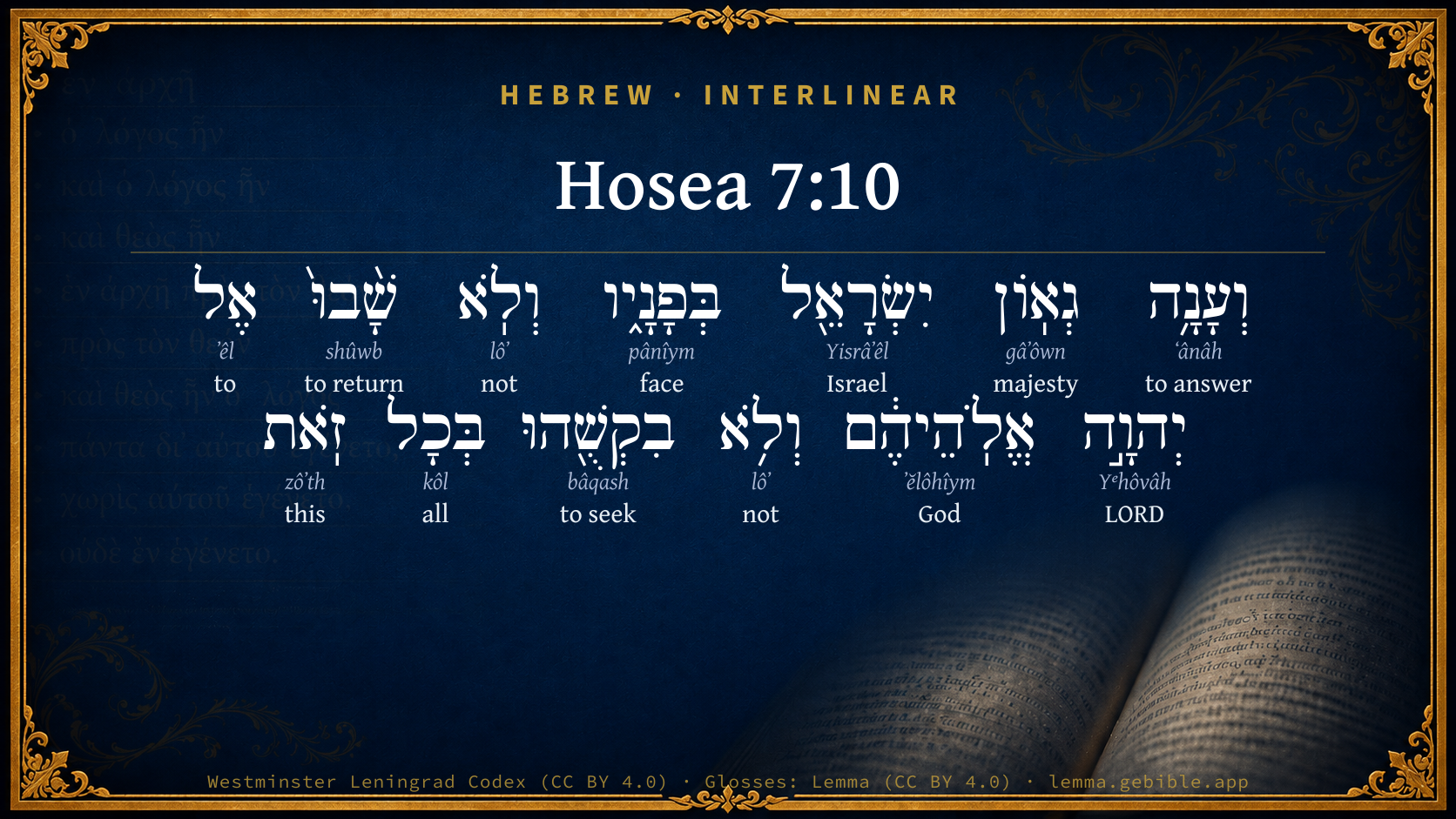
Hebrew (Westminster Leningrad Codex) Hosea 7:10 appears in the Hebrew Old Testament. The text above is from the Westminster Leningrad Codex. Each word links to its Strong’s number, a concise gloss, and parsing drawn from the Open Scriptures Hebrew Bible morphology. Click any word for its full Brown-Driver-Briggs (BDB) entry.
Download image
Cite this verse

Hosea 7:10 (World English Bible). Public Domain. Lemma interlinear Bible study tool, https://lemma.gebible.app/v/hosea/7/10.

Show BibTeX & RIS
BibTeX
RIS
English Translation
The pride of Israel testifies to his face; Yet they haven't returned to Yahweh their God, Nor sought him, for all this.
World English Bible · Public Domain
Download a study sheet

One document with this verse’s original text, its word-by-word gloss line, the meaning frame, cross-references with their text, attributed commentary, and full source and license credits — printable, and it pastes into notes with its structure intact.

This verse Autodidact and up

Study sheet (.html) Plain text (.txt)

A passage Seminary Student

Up to 50 verses in one chapter. A passage sheet keeps up to 6 commentary sources and 12 cross-references per verse, in the order this page ranks them, and says so on the sheet whenever that leaves anything out. Ask for a single verse and you get the Autodidact verse sheet above.

Everything on this page stays free to read, with no account — the sheet is a download of what is already on screen, not access to it.

Want to remove ads? Support Godless Engineer
Compare translations 3

The same verse in 3 English versions, stacked beneath the original-language interlinear above. Click any original word for its lexicon entry.

Each is an independent rendering of the whole verse — the interlinear is not word-aligned to these translations.

Highlighted words mark where these versions differ — a whole-verse word diff, not a word-by-word alignment.

  • World English Bible Public Domain
    The pride of Israel testifies to his face; Yet they haven't returned to Yahweh their God, Nor sought him, for all this.
  • King James Version Public Domain
    And the pride of Israel testifieth to his face: and they do not return to the LORD their God, nor seek him for all this.
  • unfoldingWord Literal Text CC BY-SA 4.0
    And the pride of Israel testifies against his face, and they have not returned to Yahweh their God, and they have not sought him in all this.

unfoldingWord Literal Text — © unfoldingWord, licensed CC BY-SA 4.0. Word-aligned USFM3 via Door43 (git.door43.org/unfoldingWord/en_ult).

Versions to compare (up to 4)

3 of 4 selected

Show all 18 translations

Every available English version of this verse, each an independent rendering of the whole verse.

  • World English Bible Public Domain
    The pride of Israel testifies to his face; Yet they haven't returned to Yahweh their God, Nor sought him, for all this.
  • Berean Standard Bible Public Domain
    Israel’s arrogance testifies against them, yet they do not return to the LORD their God; despite all this, they do not seek Him.
  • Majority Standard Bible Public Domain
    Israel’s arrogance testifies against them, yet they do not return to the LORD their God; despite all this, they do not seek Him.
  • King James Version Public Domain
    And the pride of Israel testifieth to his face: and they do not return to the LORD their God, nor seek him for all this.
  • American Standard Version (1901) Public Domain
    And the pride of Israel doth testify to his face: yet they have not returned unto Jehovah their God, nor sought him, for all this.
  • Revised Version (1885) Public Domain
    And the pride of Israel doth testify to his face: yet they have not returned unto the LORD their God, nor sought him, for all this.
  • Geneva Bible (1599) Public Domain
    And the pride of Israel testifieth to his face, and they doe not returne to the Lord their God, nor seeke him for all this.
  • Douay-Rheims (1899) Public Domain
    And the pride of Israel shall be humbled before his face: and they have not returned to the Lord their God, nor have they sought him in all these.
  • Young's Literal Translation Public Domain
    And humbled hath been the excellency of Israel to his face, And they have not turned back unto Jehovah their God, Nor have they sought Him for all this.
  • Literal Standard Version CC BY-SA 4.0
    And the excellence of Israel has been humbled to his face, || And they have not turned back to their God YHWH, || Nor have they sought Him for all this.
  • Unlocked Literal Bible CC BY-SA 4.0
    The pride of Israel testifies against him; however, they have not returned to Yahweh their God, nor have they sought him, in spite of all this.
  • unfoldingWord Literal Text CC BY-SA 4.0
    And the pride of Israel testifies against his face, and they have not returned to Yahweh their God, and they have not sought him in all this.
  • Darby Bible Public Domain
    And the pride of Israel testifieth to his face; and they do not return to Jehovah their God, nor seek him for all this.
  • World Messianic Bible Public Domain
    The pride of Israel testifies to his face; yet they haven’t returned to the LORD their God, nor sought him, for all this.
  • Webster's Bible Public Domain
    And the pride of Israel testifieth to his face: and they do not return to the LORD their God, nor seek him for all this.
  • Free Bible Version CC BY-SA 4.0
    Israel's pride testifies against him, but for all of this he still does not return to the Lord their God or look for him.
  • Bible in Basic English Public Domain
    And the pride of Israel gives an answer to his face; but for all this, they have not gone back to the Lord their God, or made search for him.
  • JPS Tanakh (1917) Public Domain
    And the pride of Israel testifieth to his face; but they have not returned unto the LORD their God, nor sought Him, for all this.

Literal Standard Version (2020), Covenant Press — licensed CC BY-SA 4.0. Text via the HelloAO Bible API (eBible.org). Unlocked Literal Bible (unfoldingWord) — licensed CC BY-SA 4.0. Text via the HelloAO Bible API (eBible.org). unfoldingWord Literal Text — © unfoldingWord, licensed CC BY-SA 4.0. Word-aligned USFM3 via Door43 (git.door43.org/unfoldingWord/en_ult). Free Bible Version, Dr. Jonathan Gallagher — licensed CC BY-SA 4.0. Text via the HelloAO Bible API (eBible.org).

Word by word

More ways to search: Search by grammar → Find every occurrence → Compare this word →

Practice this passage: Drill this verse → Learn its vocabulary →

גְאֽוֹן
gâʼôwn
H1347
“majesty of”
Noun, Common, Masculine, Singular, Construct
Part of Speech
Noun
Type
Common
Gender
Masculine
Number
Singular
State
Construct
Full BDB Definition

Origin: from H1342

TWOT: 299e

exaltation, majesty, pride - majesty, exaltation, excellence - of nations - of God - of the Jordan - pride, arrogance (bad sense)
  1. וְעָנָ֥ה ʻânâh H6030 “and · to answer” Conjunction + Verb, Qal, Perfect, 3rd Person, Masculine, Singular
  2. יִשְׂרָאֵ֖ל Yisrâʼêl H3478 “Israel” Noun, Proper
  3. בְּפָנָ֑יו pânîym H6440 “in/at · face(s) · his” Preposition + Noun, Common, Both, Plural, Construct + Suffix, Personal, 3rd Person, Masculine, Singular
  4. וְלֹֽא lôʼ H3808 “and · not” Conjunction + Particle, Negative
  5. שָׁ֨בוּ֙ shûwb H7725 “to return” Verb, Qal, Perfect, 3rd Person, Common, Plural
  6. אֶל ʼêl H413 “to” Preposition
  7. יְהוָ֣ה Yᵉhôvâh H3068 “LORD” Noun, Proper
  8. אֱלֹֽהֵיהֶ֔ם ʼĕlôhîym H430 “God(s) · their” Noun, Common, Masculine, Plural, Construct + Suffix, Personal, 3rd Person, Masculine, Plural
  9. וְלֹ֥א lôʼ H3808 “and · not” Conjunction + Particle, Negative
  10. בִקְשֻׁ֖הוּ bâqash H1245 “to seek · him” Verb, Piel, Perfect, 3rd Person, Common, Plural + Suffix, Personal, 3rd Person, Masculine, Singular
  11. בְּכָל kôl H3605 “in/at · all of” Preposition + Noun, Common, Masculine, Singular, Construct
  12. זֹֽאת zôʼth H2063 “this” Pronoun, Demonstrative, Feminine, Singular

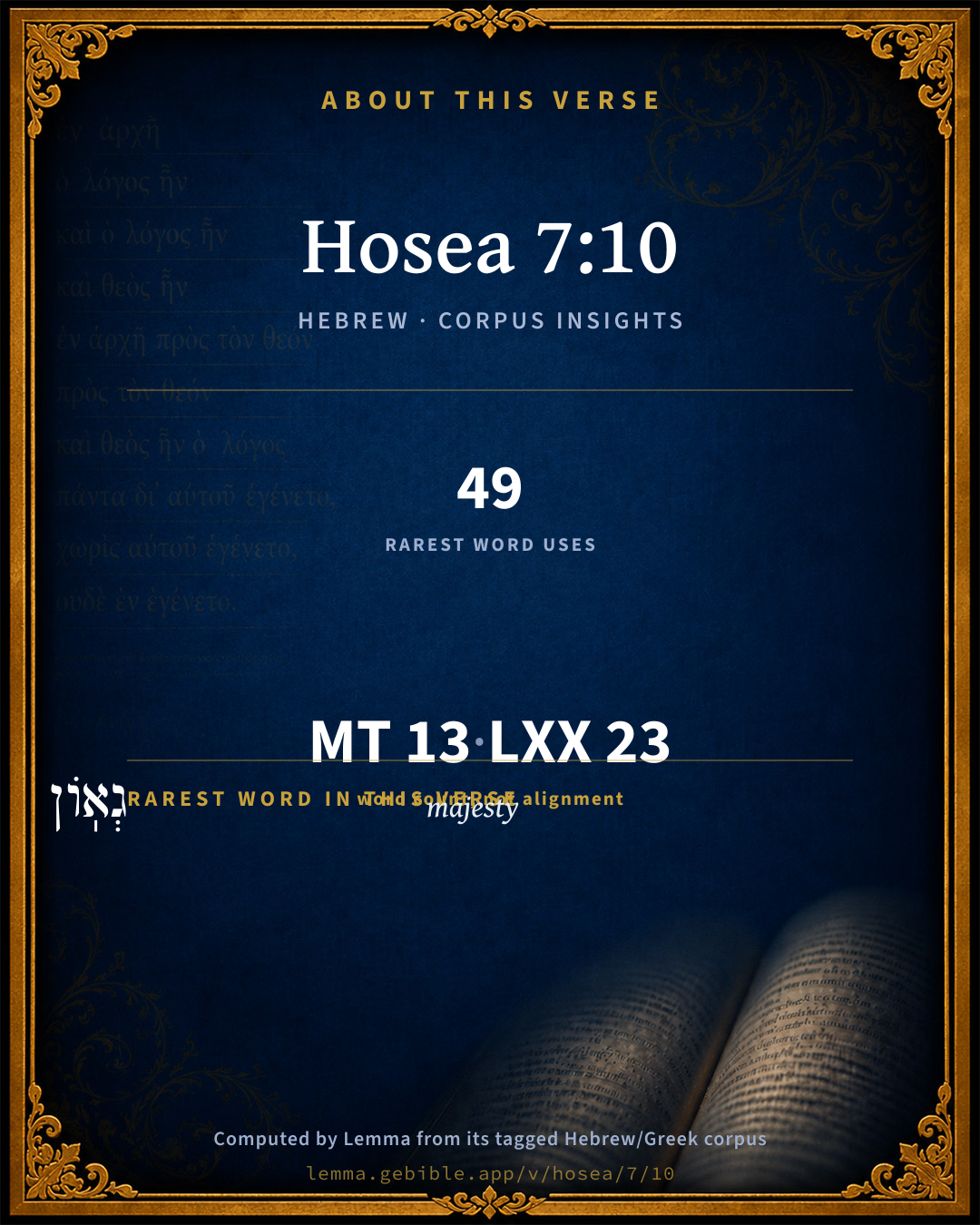
About this verse

These counts appear in no published source. They are computed here, from the morphology-tagged text and Lemma’s own curated glosses. What Lemma adds →

13
words
12
distinct lemmas
Prophets
section

Shared distinctive vocabulary

גְאֽוֹן majesty H1347 occurs in 45 verses of the Hebrew Bible. Also found in:

Grammatical profile

  • 3 verbs
  • 6 nouns
  • 1 pronoun
  • 1 preposition
  • 2 particles

Verb forms

  • וְעָנָ֥ה Qal · Perfect
  • שָׁ֨בוּ֙ Qal · Perfect
  • בִקְשֻׁ֖הוּ Piel · Perfect

Repetition

A word recurs within this verse — often emphatic in Hebrew:

  • וְלֹֽא not H3808 ×2

Hebrew & Septuagint length

In English translation the verse runs 22 words from the Hebrew and 31 from the Septuagint (LXX English) — the Septuagint runs noticeably longer here. See the side-by-side →

A rough comparison of the two English renderings, which tokenize alike — not a word-level alignment.

Word counts can differ between the Hebrew and the Greek without any difference in meaning — e.g. the Hebrew direct-object marker אֵת has no separate Greek word, and Greek often adds the article ὁ.

In the original languages it is 13 Hebrew tokens and 23 Greek tokens — but the two are counted differently (Hebrew bundles its prefixes and suffixes into one token; the Greek is in lemma form), so that isn’t a like-for-like length.

Cross-references

15

Topical passages linked to Hosea 7:10 in the Treasury of Scripture Knowledge — connected by theme and wording, ordered by reader-vote popularity; previews shown in the World English Bible.

  • Hosea 5:5 The pride of Israel testifies to his face. Therefore Israel and Ephraim will stumble in their iniquity. Judah also will stumble with them.
  • Isaiah 9:13 Yet the people have not turned to him who struck them, neither have they sought Yahweh of Hosts.
  • Psalms 53:2 God looks down from heaven on the children of men, To see if there are any who understood, Who seek after God.
  • Amos 4:6–13 "I also have given you cleanness of teeth in all your cities, And lack of bread in every town; Yet you haven't returned to me," says Yahweh.
  • Psalms 10:4 The wicked, in the pride of his face, Has no room in his thoughts for God.
  • Psalms 14:2 Yahweh looked down from heaven on the children of men, To see if there were any who did understand, Who did seek after God.
  • Proverbs 27:22 Though you grind a fool in a mortar with a pestle along with grain, Yet his foolishness will not be removed from him.
  • Jeremiah 3:3 Therefore the showers have been withheld, and there has been no latter rain; yet you have a prostitute's forehead, you refused to be ashamed.
  • Jeremiah 8:5–6 Why then is this people of Jerusalem slidden back by a perpetual backsliding? they hold fast deceit, they refuse to return.
  • Jeremiah 25:5–7 saying, Return you now everyone from his evil way, and from the evil of your doings, and dwell in the land that Yahweh has given to you and to your fathers, from of old and even forevermore;
  • Jeremiah 35:15–17 I have sent also to you all my servants the prophets, rising up early and sending them, saying, Return you now every man from his evil way, and amend your doings, and don't go after other gods to serve them, and you shall dwell in the land which I have given to you and to your fathers: but you have not inclined your ear, nor listened to me.
  • Hosea 6:1 "Come, and let us return to Yahweh; For he has torn us to pieces, And he will heal us; He has injured us, And he will bind up our wounds.
  • Hosea 7:7 They are all hot as an oven, And devour their judges. All their kings have fallen. There is no one among them who calls to me.
  • Zechariah 1:4 Don't you be like your fathers, to whom the former prophets proclaimed, saying: Thus says Yahweh of hosts, 'Return now from your evil ways, and from your evil doings;' but they did not hear, nor listen to me, says Yahweh.
  • Romans 3:11 There is no one who understands. There is no one who seeks after God.

Cross-references courtesy of OpenBible.info (CC BY 4.0).

Hebrew and Greek witnesses Masoretic Hebrew ↔ Greek Septuagint

The same verse in the two great witnesses to the Old Testament, shown verse-for-verse.

Here the Septuagint runs noticeably longer than the Hebrew — LXX2012 (modern English Septuagint) 31 words vs World English Bible 22. A rough length comparison of the two English translations, not a word-level alignment — read both below.

These are two independent witnesses, not word-aligned to each other, and the Septuagint is shown in lemma (dictionary) form.

Hebrew Hosea 7:10 Masoretic · Westminster Leningrad Codex

וְעָנָ֥ה גְאֽוֹן יִשְׂרָאֵ֖ל בְּפָנָ֑יו וְלֹֽא שָׁ֨בוּ֙ אֶל יְהוָ֣ה אֱלֹֽהֵיהֶ֔ם וְלֹ֥א בִקְשֻׁ֖הוּ בְּכָל זֹֽאת

The pride of Israel testifies to his face; Yet they haven't returned to Yahweh their God, Nor sought him, for all this.

World English Bible · Public Domain

Greek LXX Hosea 7:10 Septuagint · lemma form

καί ταπεινόω ὁ ὕβρις ἰσραήλ εἰς πρόσωπον αὐτός καί οὐ ἐπιστρέφω πρός κύριος ὁ θεός αὐτός καί οὐ ἐκζητέω αὐτός ἐν πᾶς οὗτος

And the pride of Israel shall be brought down before his face: yet they have not returned to the Lord their God, neither have they diligently sought him for all this.

LXX2012 (modern English Septuagint) · Public Domain

On this verse, The Pulpit Commentary discusses the Septuagint’s reading. Read the note in Commentary ↓

Hebrew: Westminster Leningrad Codex (CC BY 4.0). Greek: Septuagint (public domain); English from LXX2012 (modern English Septuagint) (Public Domain). How the Septuagint differs from the Hebrew →

Targum (Aramaic paraphrase)

1

The Targum is the ancient Jewish Aramaic paraphrase of the Hebrew Scriptures — an interpretive translation, not the Hebrew text itself. Onkelos (literal) and Pseudo-Jonathan (expansive) render the Torah, and Jonathan the Prophets. Coverage is partial: where no permissively-licensed English translation exists for a verse, only the Aramaic is shown. This is verse-level text, not a word-by-word alignment to the Hebrew.

  1. Targum Jonathan Prophets (Joshua–Malachi)
    וְיִמְאַךְ יְקָר יִשְׂרָאֵל וְאִינוּן חָזָן עַל דְלָא תָבוּ לְפוּלְחָנָא דַייָ אֱלָהָהוֹן וְלָא בְעוֹ מִן קֳדָמוֹהִי בְּכָל דָא:

    (no public-domain English translation for this verse)

    Targum Jonathan — Aramaic: “Mikraot Gedolot” (public domain). English: “Sefaria Community Translation” (CC0 1.0 (public-domain dedication)); “London "Chaldee Paraphrase," 1871” (public domain). Text via Sefaria.

Commentary

Notes on Hosea 7:10 from classic Christian and Jewish commentators (each source and its license shown beneath its notes). The classic Christian expositions comment on the surrounding passage and are grouped to its opening verse, so a note may address several verses; the Jewish commentaries on the Tanakh (Rashi and others) are per-verse, so they appear only where the commentator wrote on this verse.

Lemma curates 59 commentaries, every one of them public domain or Creative Commons licensed, each selected and text-cleaned for this edition rather than reprinted as found. About our sources →

Trapp's Complete Commentary

John Trapp

Hos 7:10 And the pride of Israel testifieth to his face: and they do not return to the LORD their God, nor seek him for all this.

Ver. 10. And the pride of Israel testifieth to his face] Sept. the ignominy, or impudence of Israel: q.d. They think to brave it out in a stout and stomachful way. Low they are, but not lowly; humbled, but not humble. God thrust him downward, as it were with a thump on the back; but he stood stouting it out with him; and so discovered a great deal of arrogance and folly. Plectimur, may such say, nec tamen flectimur; Corripimur sed non corrigimur (Salvian.). We have been stricken, but not sick; beaten, but not sensible, &c.; the drunkards’ ditty, Pro 23:35. When for all this, for all that God can do to tame them, and turn them again, they will on in their wicked ways, and not "accept the punishment of their iniquities"; not confess and forsake their sins, that they have mercy; not seek him, that is, come unto him by faith, Heb 11:6, and subject themselves unto him by true obedience, 2Ch 7:14, this is such a piece of pride as testifieth to men’s faces, that they deserve to be destroyed; this is wickedness with a witness; this is fastus adeo enormis atque notorius, saith Pareus, such horrible and notorious insolence, as is not to be endured. God complains of Israel for this with a sigh, Ah sinful nation, &c., and resolves upon revenge, Hos 7:12. {See Trapp on "Hos 5:5"} of turning to God. See Zec 1:3, and of seeking God, see Hos 5:15.

John Trapp, A Commentary or Exposition upon All the Books of the Old and New Testament (1647–1656) — public domain. Text from a community e-Sword module.

The Biblical Illustrator

Joseph S. Exell

Hos_7:10

They do not return to the Lord their God, nor seek Him for this.

Our sin

I. The duty of seeking God. In the Scriptures this stands for the whole of religion. Religion is thus substantially expressed for two reasons--because it is with God that we have principally to do. Our principal dependence is upon Him; our principal expectations are from Him; our principal connections are with Him. And because, before we can have anything to do with Him, we must find Him. Morally and spiritually considered, we are away from God, and God is away from us. We have left Him criminally, and He has left us penalty. Our first concern, therefore, is to find God, and for this purpose we are to seek after Him. See four purposes for which we are to seek God, and which enter essentially into genuine religion.

1. We are to seek to know Him. Here genuine religion begins.

2. We must seek to enjoy Him, and in order to this we must be reconciled. Till His anger is turned away from us, He cannot comfort us.

3. We are to seek to serve Him. He is our Master to obey and to wait upon.

4. We must seek to resemble Him. It is the essence of religion, to be like Him whom we worship. You cannot resemble His natural perfections; you can His moral perfections.

II. The neglect of this duty. They do not seek the Lord their God. Are there no exceptions? Yes, God always has His remnant. But the language of Scripture is awful upon this subject. Its language implies generality, if it does not imply universality. Glance at five classes of delinquents.

1. Infidels. Who deny, at least, the moral providence and government of God, and also a future state.

2. The profligate. These hide not their sin as Sodom, but publish it like unto Gomorrah.

3. The careless. Who are indifferent to everything of a religious nature.

4. Formalists. Who have a name that they live, but are dead.

5. Partial seekers. Whose goodness is like the morning cloud. Not always insincere at the time. Their religion is dependent upon external excitements. This is enough to refute the lies you find in all our churchyards, where every tombstone and every headstone tells you that all the parish has gone to heaven, or is going there.

III. The aggravation of this neglect. They seek not the Lord their God for all this. All what? How various and numerous are the means which God is providing, and which He perpetually employs as the prevention of sin and the excitements to holiness; or to induce men to seek the Lord their God. What are they? Profusion of benefits in nature, providence, and grace. The Scriptures, which men have in their own hand, and in their own tongue. Sending His ministers, so that men can hear the words of eternal life. The power of conscience. The various addresses, reproofs, admonitions, encouragements, derived from their various connections, father, mother, etc. Afflictions. Public calamities. The Jews were threatened with four very sore judgments.

1. From wild and noisome beasts.

2. From war.

3. From famine.

4. Pestilence.

Here we recently have awfully resembled them. The sermon was preached on the day of national humiliation on account of the cholera. But repentance is never produced by unmixed terror. Terror may drive, but goodness alone leads to repentance. You are not to yield entirely to the seducements of croaking and brooding. Close with a reflection, turning on the goodness of God and depravity of man. The goodness of God, who sees all sins, and yet forbears. The depravity of man, in that the beneficiaries are constantly neglecting and opposing their kind Benefactor. How the goodness of God and the depravity of man have been displayed in our country. Apply to individuals. Individualise you in your gratitude, your penitence, your danger, and your hope. (William Jay.)

Will not be humbled

1. God expects we should turn upon affliction.

2. Afflictions, if not sanctified, will never turn the heart.

3. It is a great aggravation of mens sins not to turn under afflictions.

4. Though afflictions may work repentance, yet such repentance is seldom true; it will not often sustain the trial.

5. True repentance is rather a seeking of Gods face than our own case from afflictions. (Jeremiah Burroughs.)

The Biblical Illustrator, edited by Joseph S. Exell (c. 1880s–1900s) — public domain. Text from a community e-Sword module.

The Preacher's Complete Homiletical Commentary

Joseph S. Exell (gen. ed.)

Hos_7:10. Pride is observed to defeat its own ends, by bringing the man who seeks esteem and reverence into contempt [Bolingbroke].

“Pride hath no other glass

To show itself, but pride; for supple knees

Feed arrogance, and are the proud man’s fees,” Shakspeare.

The Preacher's Complete Homiletical Commentary (gen. ed. Joseph S. Exell; Funk & Wagnalls, c. 1892) — public domain (pre-1929). A full-Bible homiletical/sermon-outline anthology covering 65 of 66 books (2 John is absent from the source module). Text from a community e-Sword module.

Jamieson, Fausset & Brown

Robert Jamieson, A. R. Fausset & David Brown

Repetition of Hos 5:5.

not return to . . . Lord . . . for all this--notwithstanding all their calamities (Isa 9:13).

Jamieson, Fausset & Brown — Commentary Critical and Explanatory on the Whole Bible (1871) — public domain (CC PDM 1.0). Text via the HelloAO Bible API.

Adam Clarke's Commentary

Verse 10. The pride of Israel] The same words as at Ho 5:6, where see the note. See Clarke on Ho 5:6.

Adam Clarke's Commentary on the Bible (1810–1826) — public domain. Text from a community e-Sword/MySword module.

John Calvin's Commentaries

The Prophet now confirms his previous doctrine, and speaks generally, that the pride of Israel shall bear testimony to him to his face, or shall humble him to his face. The word ענה, one, means, in Hebrew, “to testify,” and often, also, “to humble,” or “to afflict,” as it was stated in the fifth chapter; and the words of the Prophet are now the same, and both senses are appropriate. I do not, however, make much of this, for the design of the Prophet is clear; what he means is, that God had so openly chastised the Israelites, that they must have perceived his hand, except they were blind indeed, and that, being at the same time warned, they ought to have suppliantly humbled themselves. Whether then we read, “to testify” or “to humble,” the sense will be the same, and the design of the Prophet will appear to be the same. “The pride, then, of Israel will humble him to his face,” or, “the pride of Israel will testify to his face:” for the Prophet means, that however fiercely the Israelites might rise up against God, and be uncourteous to his Prophets and however perversely they might reject all teaching, and also excuse their own sins, yet all this would avail them nothing, since they were so cast down by their pride, that the Lord regarded them as convicted as much so as if their crime had been proved by many witnesses, and their mask now taken away; in short, there was no longer any doubt: this is what the Prophet means.

The pride, then, of Israel testifies, or, humbles him to his face; that is, though Israel had appeared hitherto inflexible against all admonitions, against all punishments, they were yet held as convicted; and, at the same time, they return not, he says, to their God, and seek him not for all these things We now perceive what I have said, that the previous complaint respecting the diabolical perverseness which so reigned in the people is here confirmed, so that their salvation was now past hope. And he says that they returned not to Jehovah their God; for they were running constantly after their idols, as we have before seen; yea, they were possessed with that inordinate zeal of which the Prophet speaks in the beginning of the chapter; but they returned not to Jehovah; they were wholly taken up with the multitude of their deities, and at the same time had no regard for God.

And when he says, their God, he conveys a strong reprobation; for God had manifested himself to them; yea, he had made himself plainly known to them by his law. That they then did not return to him, was not simply through ignorance or error; but through a diabolical madness, as if they wished of their own accord and deliberately to perish. God then calls himself here the God of Israel, not for honour’s sake, but that he might the more expose their ingratitude, and enhance their perfidiousness, because they had fallen away from him, and would not seek him.

What he means, when he says, For all these things, is, that every kind of remedy had been tried, and hence that their disease was wholly incurable. When we can do nothing in one way, we often try another. Now God had not tried in one way only to bring Israel back to himself, but he had tried all remedies. When no good followed, what was to be said, but the people were lost, and past all hope? This then is what the Prophet means here. It now follows —

John Calvin's Commentaries (1540-1563) — public domain. Text from the Calvin Translation Society English edition (1840s-50s) via the Christian Classics Ethereal Library (ccel.org). Calvin's coverage is partial (roughly two-thirds of the Bible); uncommented books and verses are honest gaps, never fabricated. The 19th-century editor's footnotes and remarks are omitted so the notes are faithfully Calvin's own voice.

Ellicott's Commentary for English Readers

(10) See Note on Hos_5:5.

A Bible Commentary for English Readers, edited by Charles John Ellicott (1878–1897) — public domain. Text from a community e-Sword module.

The Cambridge Bible for Schools and Colleges

gen. ed. J. J. S. Perowne

10. And the pride of Israel …] Repeated from Hos_5:5, just as Hos_12:9 a is repeated in Hos_13:4 a. It is not the prophet who speaks condemning a bad quality in his people, but Jehovah, Israel’s true Pride, and the source of Israel’s prosperity, who utters a solemn word of warning translated into act. How much more suitable this explanation is in such a context than either of the alternatives mentioned on Hos_5:5.

for all this] i.e. in spite of all this chastisement, comp. Isa_9:12; Isa_9:17; Isa_9:21.

The Cambridge Bible for Schools and Colleges (gen. ed. J. J. S. Perowne; Cambridge University Press, 1878–1918) — public domain. Text from a community e-Sword module.

John Gill's Exposition

And the pride of Israel testifieth to his face,.... See Gill on Hos 5:5; notwithstanding their weak and declining state, they were proud and haughty; entertained a high conceit of themselves, and of their good and safe condition; and behaved insolently towards God, and were not humbled before him for their sins. Their pride was notorious, which they themselves could not deny; they were self-convicted, and self-condemned:

and they do not return to the Lord their God; by acknowledgment of their sins, repentance for them, and reformation from them; and by attendance on his worship, from which they had revolted; so the Targum,

"they return not to the worship of the Lord their God:''

nor seek him for all this; though they are in this wasting, declining, condition, and just upon the brink of ruin, yet they seek not the face and favour of the Lord; they do not ask help of him, or implore his mercy; and though they have been so long in these circumstances, and have been gradually consuming for many years, yet in all this time they have made no application to the Lord, that he would be favourable, and raise their sinking state, and restore them to their former glory.

John Gill's Exposition of the Whole Bible (1746–1763) — public domain (CC PDM 1.0). Text via the HelloAO Bible API.

Albert Barnes' Notes on the Bible

And the pride of Israel testifieth to his face - His pride convicted him. All the afflictions of God humbled him not; yea, they but brought out his pride, which “kept him from acknowledging and repenting of the sins which had brought those evils upon him, and from “turning to God and seeking to Him” for remedy” . People complain of their “fortune” or “fate” or “stars,” and go on the more obstinately, to build up what God destroys, to prop up by human means or human aid what, by God’s providence, is failing; they venture more desperately, in order to recover past losses, until the crash at last becomes hopeless and final.

Nor seek Him for all this - God had exhausted all the treasures of His severity, as, before, of His love. He Himself marvels at His incorrigible and contumacious servant, as He says in Isaiah, “Why should ye be stricken anymore? Ye will revolt more and more” Isa 1:5. How is this? It follows, because they have “no heart.”

Albert Barnes' Notes on the Bible (1834–1885) — public domain. Text from a community e-Sword/MySword module.

Haydock's Catholic Bible Commentary

Humbled. Hebrew, "answer," chap. v. 5. Pride is visible on his face, though he be so much reduced. (Calmet) --- For all these sins Israel shall be severely punished. (Worthington)

George Leo Haydock (1774–1849), Haydock's Catholic Family Bible and Commentary, 1859 edition — public domain. Excludes Psalms (Douay-Rheims chapter numbering differs from Protestant) and Deuterocanonical books (Catholic canon only).

Matthew Poole's English Annotations

The pride of Israel testifieth to his face: see Hos 5:5. Their proud contempt of God and his threats, of the prophets and their warnings, is notorious.

They do not return to the Lord; they persist in sin without repentance, run away from God rather than return to him. Of this phrase,

return, see Hos 6:1.

Their God; who was theirs of old, who still would be theirs on fair terms, of whom they talk and boast.

Nor seek him; see this phrase Hos 5:15; they pray not, repent not, nor rely on God.

For all this; though so greatly, continually, and severely punished, though almost eaten up.

Matthew Poole's English Annotations on the Holy Bible (1683–1685) — public domain. Text from a community e-Sword/MySword module.

The Pulpit Commentary

And the pride of Israel testifieth to his face: and they do not return to the Lord their God, nor seek him for all this (amid all this). If with Keil and others

(1) we understand "the pride of Israel" to mean Jehovah the glory of Israel, and take the verb in the sense of "testify," the meaning will be that Jehovah bore witness to the face of Israel by the weakening and wasting of their kingdom, as portrayed in the preceding verse. We prefer

(2) to understand "the pride of Israel" in the souse of "the haughtiness" of Israel, and the verb in the sense of "being humbled," as at Hos_5:5. The real meaning, then, is expressed in the following rendering: And the haughtiness of Israel shall be humbled to his face. This humiliation is the effect of the wasting mentioned in the preceding verse; while the evidence of their humiliation is specified in the succeeding verse by their resorting to Egypt and repairing to Assyria from a consciousness of their helplessness. This rendering is countenanced by the LXX, both here and at Hos_5:5; while Rashi says, "The verb hg has the meaning of "humiliation." For all this. This emphasizes the obstinate blindness and perverseness of Ephraim, when, amid all the calamities and miseries of the kingdom both within and without, they turned not to Jehovah to solicit help and deliverance, but concluded treaties or made alliances with foreign nations in hope of being lifted up out of their national impotence. On this Aben Ezra makes the judicious remark: "They turned not to Jehovah as paupers who have nothing more to give foreign nations that they may help them.

They return not unto the Lord.

The life of man is a journey, and the sinner has taken the wrong road the road which leads to destruction.

I THE IMPORTANCE AND NECESSITY OF RETURNING UNTO THE LORD. The further the sinner proceeds the nearer he approaches final ruin, and the harder it is for him to reverse his steps.

II THE METHOD OF RETURNING UNTO THE LORD. The sinner must change his view of God and his view of himself. He must repent of sin and believe the gospel

III THE ENCOURAGEMENT TO RETURN UNTO THE LORD. There are the express directions, and the faithful promises of Heaven.

IV THE RESULTS OF RETURNING UNTO THE LORD, To return to God is to return to holiness and happiness, to peace and hope. Truly to return to him is to remain forever in his favor and his fellowship. T.

The Pulpit Commentary (1880–1919), ed. H.D.M. Spence-Jones & Joseph S. Exell — public domain. Text from a community e-Sword module.

Keil & Delitzsch

C. F. Keil & F. Delitzsch

"And the pride of Israel beareth witness to his face, and they are not converted to Jehovah their God, and for all this they seek Him not." The first clause is repeated from Hos 5:5. The testimony which the pride of Israel, i.e., Jehovah, bore to its face, consisted in the weakening and wasting away of the kingdom as described in Hos 7:9. But with all this, they do not turn to the Lord who could save them, but seek help from their natural foes.

Keil & Delitzsch — Biblical Commentary on the Old Testament (1861–1891) — public domain (CC PDM 1.0). Text via the HelloAO Bible API. (Old Testament only.)

unfoldingWord translationNotes

Door43 World Missions Community

General Information:

Yahweh is speaking.

The pride of Israel testifies against him

This describes "pride" as a person who testifies against the people of Israel in court. This means their prideful attitude and behavior show that they are guilty of no longer obeying Yahweh. (See: Personification)

nor have they sought him

Israel's lack of interest in Yahweh is spoken of as if he was lost and they were not trying to find him. AT: "nor have they tried to get him to pay attention to them" (See: Metaphor)

in spite of all this

Here "this" refers God allowing foreigners to defeat them and make them weak.

Ephraim is like a dove, gullible and without sense

Doves were thought to be foolish birds. (See: Simile)

Egypt ... Assyria

These were powerful nations that Israel could ask for help.

translationWords

proud

Israel

testimony

turn

Yahweh

God

seek

Ephraim

dove

Egypt

Assyria

unfoldingWord translationNotes — © Distant Shores Media and the Door43 World Missions Community, licensed CC BY-SA 4.0. Source: git.door43.org/Door43/en_tn.

Rashi

Rabbi Shlomo Yitzchaki (Rashi)

And the pride of Israel was humbled before Him Heb. וְעָנָה. And the glory of Israel was humbled and they saw; an expression of humility, and this is not a future tense but a past tense. Comp. (Isa. 6: 3) “And one called (וְקָרָא) to the other.” I heard that one called to the other. Also (Gen. 37:3) “and he made (וְעָשָׂה) for him a woolen shirt.” This too is a past tense. They have already been diminished and humbled, and, despite this, they did not return to the Lord.

Rashi on the Tanakh — English translations: “The Judaica Press complete Tanach with Rashi, translated by A. J. Rosenberg” (CC BY 4.0); “Pentateuch with Rashi's commentary by M. Rosenbaum and A.M. Silbermann, 1929-1934” (public domain); “The Metsudah Tanach series, Lakewood, N.J” (CC BY 4.0); and “The Book of Joshua, Metsudah Publications, 1997” (CC BY 4.0). Text via Sefaria.

Lesson kit

Teaching starters — assembled from the data on this page, not authored interpretation. Every prompt links to the verse data it draws on. Edit before teaching.

Hosea, in the Prophets, opens this verse with 13 words (12 distinct Hebrew lemmas). Its most distinctive word is gâʼôwn (“majesty”). The Greek Septuagint runs longer here. A historical commentator’s framing appears above. Read the whole chapter for the surrounding context.

Discussion questions

  1. What does “majesty” (gâʼôwn) contribute to the verse as a whole?
  2. Exodus 15:7 shares the word «majesty» with this verse. How do the two illuminate each other?
  3. “not” occurs 2× in this one verse. What is the effect of the repetition?
  4. Compared with the Hebrew, the Septuagint runs longer here. What questions does that raise?
  5. These translations render this verse differently; the difference is in the English rendering, not the original. What questions does that raise?
  6. The verb «וְעָנָ֥ה» is Qal Perfect. How does its form color the action?
  7. Reading how Trapp's Complete Commentary and The Biblical Illustrator read this verse, where do the two commentators agree and where do they part?

Things to notice

Reading settings

Reading text

Shown beneath each verse's original-language words.

Old Testament
Old Testament edition

Read the OT as the Masoretic Hebrew (MT) or the Greek Septuagint (LXX).

English shown for the Greek Septuagint (in the Hebrew ↔ Greek comparison).

Comparing translations? Open the Compare panel on any verse page to stack up to four side by side.