
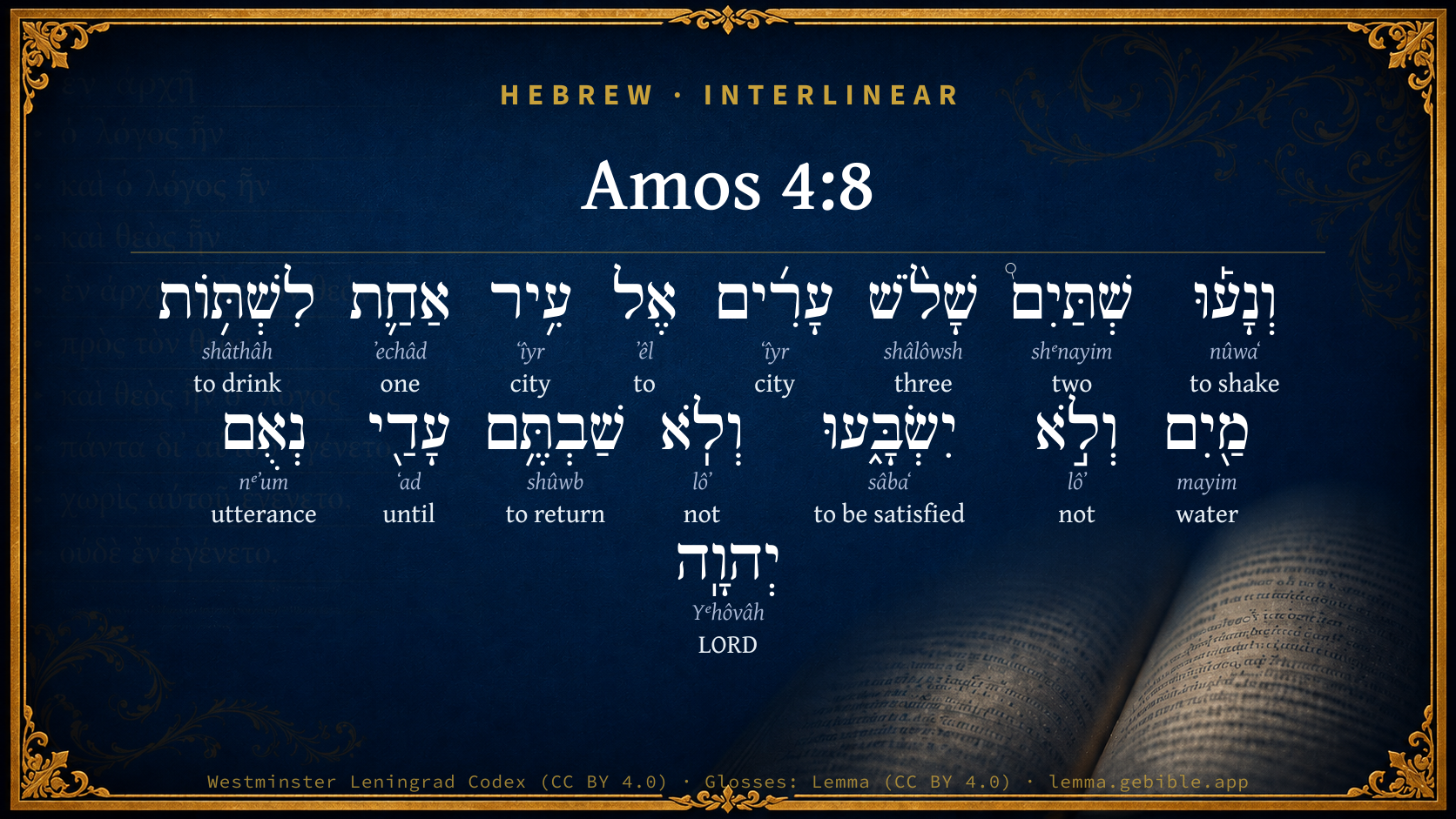
Amos 4:8

Hebrew (Westminster Leningrad Codex) Amos 4:8 appears in the Hebrew Old Testament. The text above is from the Westminster Leningrad Codex. Each word links to its Strong’s number, a concise gloss, and parsing drawn from the Open Scriptures Hebrew Bible morphology. Click any word for its full Brown-Driver-Briggs (BDB) entry.
Download image
Cite this verse

Amos 4:8 (World English Bible). Public Domain. Lemma interlinear Bible study tool, https://lemma.gebible.app/v/amos/4/8.

Show BibTeX & RIS
BibTeX
RIS
English Translation
So two or three cities staggered to one city to drink water, And were not satisfied: Yet you haven't returned to me," says Yahweh.
World English Bible · Public Domain
Download a study sheet

One document with this verse’s original text, its word-by-word gloss line, the meaning frame, cross-references with their text, attributed commentary, and full source and license credits — printable, and it pastes into notes with its structure intact.

This verse Autodidact and up

Study sheet (.html) Plain text (.txt)

A passage Seminary Student

Up to 50 verses in one chapter. A passage sheet keeps up to 6 commentary sources and 12 cross-references per verse, in the order this page ranks them, and says so on the sheet whenever that leaves anything out. Ask for a single verse and you get the Autodidact verse sheet above.

Everything on this page stays free to read, with no account — the sheet is a download of what is already on screen, not access to it.

Want to remove ads? Support Godless Engineer
Compare translations 3

The same verse in 3 English versions, stacked beneath the original-language interlinear above. Click any original word for its lexicon entry.

Each is an independent rendering of the whole verse — the interlinear is not word-aligned to these translations.

Highlighted words mark where these versions differ — a whole-verse word diff, not a word-by-word alignment.

  • World English Bible Public Domain
    So two or three cities staggered to one city to drink water, And were not satisfied: Yet you haven't returned to me," says Yahweh.
  • King James Version Public Domain
    So two or three cities wandered unto one city, to drink water; but they were not satisfied: yet have ye not returned unto me, saith the LORD.
  • unfoldingWord Literal Text CC BY-SA 4.0
    Two or three cities staggered to another city to drink water, but were not satisfied. Yet you have not returned to me— this is Yahweh’s declaration.

unfoldingWord Literal Text — © unfoldingWord, licensed CC BY-SA 4.0. Word-aligned USFM3 via Door43 (git.door43.org/unfoldingWord/en_ult).

Versions to compare (up to 4)

3 of 4 selected

Show all 18 translations

Every available English version of this verse, each an independent rendering of the whole verse.

  • World English Bible Public Domain
    So two or three cities staggered to one city to drink water, And were not satisfied: Yet you haven't returned to me," says Yahweh.
  • Berean Standard Bible Public Domain
    People staggered from city to city for water to drink, but they were not satisfied; yet you did not return to Me,” declares the LORD.
  • Majority Standard Bible Public Domain
    People staggered from city to city for water to drink, but they were not satisfied; yet you did not return to Me,” declares the LORD.
  • King James Version Public Domain
    So two or three cities wandered unto one city, to drink water; but they were not satisfied: yet have ye not returned unto me, saith the LORD.
  • American Standard Version (1901) Public Domain
    So two or three cities wandered unto one city to drink water, and were not satisfied: yet have ye not returned unto me, saith Jehovah.
  • Revised Version (1885) Public Domain
    So two or three cities wandered unto one city to drink water, and were not satisfied: yet have ye not returned unto me, saith the LORD.
  • Geneva Bible (1599) Public Domain
    So two or three cities wandred vnto one citie to drinke water, but they were not satisfied: yet haue ye not returned vnto me, saith the Lord.
  • Douay-Rheims (1899) Public Domain
    And two and three cities went to one city to drink water, and were not filled: yet you returned not to me, saith the Lord.
  • Young's Literal Translation Public Domain
    And wandered have two or three cities, Unto the same city to drink water, And they are not satisfied, And ye have not turned back unto Me, An affirmation of Jehovah.
  • Literal Standard Version CC BY-SA 4.0
    And two or three cities have wandered, || To the same city to drink water, || And they are not satisfied, || And you have not turned back to Me,” || A declaration of YHWH.
  • Unlocked Literal Bible CC BY-SA 4.0
    Two or three cities staggered to another city to drink water, but were not satisfied. Yet you have not returned to me —this is Yahweh's declaration.
  • unfoldingWord Literal Text CC BY-SA 4.0
    Two or three cities staggered to another city to drink water, but were not satisfied. Yet you have not returned to me— this is Yahweh’s declaration.
  • Darby Bible Public Domain
    And two, three, cities wandered unto one city, to drink water, and were not satisfied: yet have ye not returned unto me, saith Jehovah.
  • World Messianic Bible Public Domain
    So two or three cities staggered to one city to drink water, and were not satisfied; yet you haven’t returned to me,” says the LORD.
  • Webster's Bible Public Domain
    So two or three cities wandered to one city, to drink water; but they were not satisfied: yet have ye not returned to me, saith the LORD.
  • Free Bible Version CC BY-SA 4.0
    People wandered from town to town looking for water, yet were still thirsty. But still you did not return to me, declares the Lord.
  • Bible in Basic English Public Domain
    So two or three towns went wandering to one town looking for water, and did not get enough: and still you have not come back to me, says the Lord.
  • JPS Tanakh (1917) Public Domain
    So two or three cities wandered unto one city to drink water, and were not satisfied; yet have ye not returned unto Me, saith the LORD.

Literal Standard Version (2020), Covenant Press — licensed CC BY-SA 4.0. Text via the HelloAO Bible API (eBible.org). Unlocked Literal Bible (unfoldingWord) — licensed CC BY-SA 4.0. Text via the HelloAO Bible API (eBible.org). unfoldingWord Literal Text — © unfoldingWord, licensed CC BY-SA 4.0. Word-aligned USFM3 via Door43 (git.door43.org/unfoldingWord/en_ult). Free Bible Version, Dr. Jonathan Gallagher — licensed CC BY-SA 4.0. Text via the HelloAO Bible API (eBible.org).

Word by word

More ways to search: Search by grammar → Find every occurrence → Compare this word →

Practice this passage: Drill this verse → Learn its vocabulary →

וְנָע֡וּ
nûwaʻ
H5128
“and · to shake”
Conjunction + Verb, Qal, Sequential Perfect, 3rd Person, Common, Plural
Part of Speech
Conjunction + Verb
Stem
Qal
Form
Sequential Perfect
Person
3rd Person
Gender
Common
Number
Plural
Full BDB Definition

Origin: a primitive root

TWOT: 1328

to quiver, totter, shake, reel, stagger, wander, move, sift, make move, wave, waver, tremble - (Qal) - to wave, quiver, vibrate, swing, stagger, tremble, be unstable - to totter, go tottering - vagabond (participle) - (Niphal) to be tossed about or around - (Hiphil) - to toss about - to shake, cause to totter - to shake, disturb - to cause to wander
  1. שְׁתַּיִם֩ shᵉnayim H8147 “two” Adjective, Cardinal number, Feminine, Dual, Absolute
  2. שָׁלֹ֨שׁ shâlôwsh H7969 “three” Adjective, Cardinal number, Feminine, Singular, Absolute
  3. עָרִ֜ים ʻîyr H5892 “cities” Noun, Common, Feminine, Plural, Absolute
  4. אֶל ʼêl H413 “to” Preposition
  5. עִ֥יר ʻîyr H5892 “city” Noun, Common, Feminine, Singular, Absolute
  6. אַחַ֛ת ʼechâd H259 “one” Adjective, Cardinal number, Feminine, Singular, Absolute
  7. לִשְׁתּ֥וֹת shâthâh H8354 “to drink” Preposition + Verb, Qal, Infinitive Construct
  8. מַ֖יִם mayim H4325 “water(s)” Noun, Common, Masculine, Plural, Absolute
  9. וְלֹ֣א lôʼ H3808 “and · not” Conjunction + Particle, Negative
  10. יִשְׂבָּ֑עוּ sâbaʻ H7646 “to be satisfied” Verb, Qal, Imperfect, 3rd Person, Masculine, Plural
  11. וְלֹֽא lôʼ H3808 “and · not” Conjunction + Particle, Negative
  12. שַׁבְתֶּ֥ם shûwb H7725 “to return” Verb, Qal, Perfect, 2nd Person, Masculine, Plural
  13. עָדַ֖י ʻad H5704 “until · me” Preposition + Suffix, Personal, 1st Person, Common, Singular
  14. נְאֻם nᵉʼum H5002 “utterance of” Noun, Common, Masculine, Singular, Construct
  15. יְהוָֽה Yᵉhôvâh H3068 “LORD” Noun, Proper

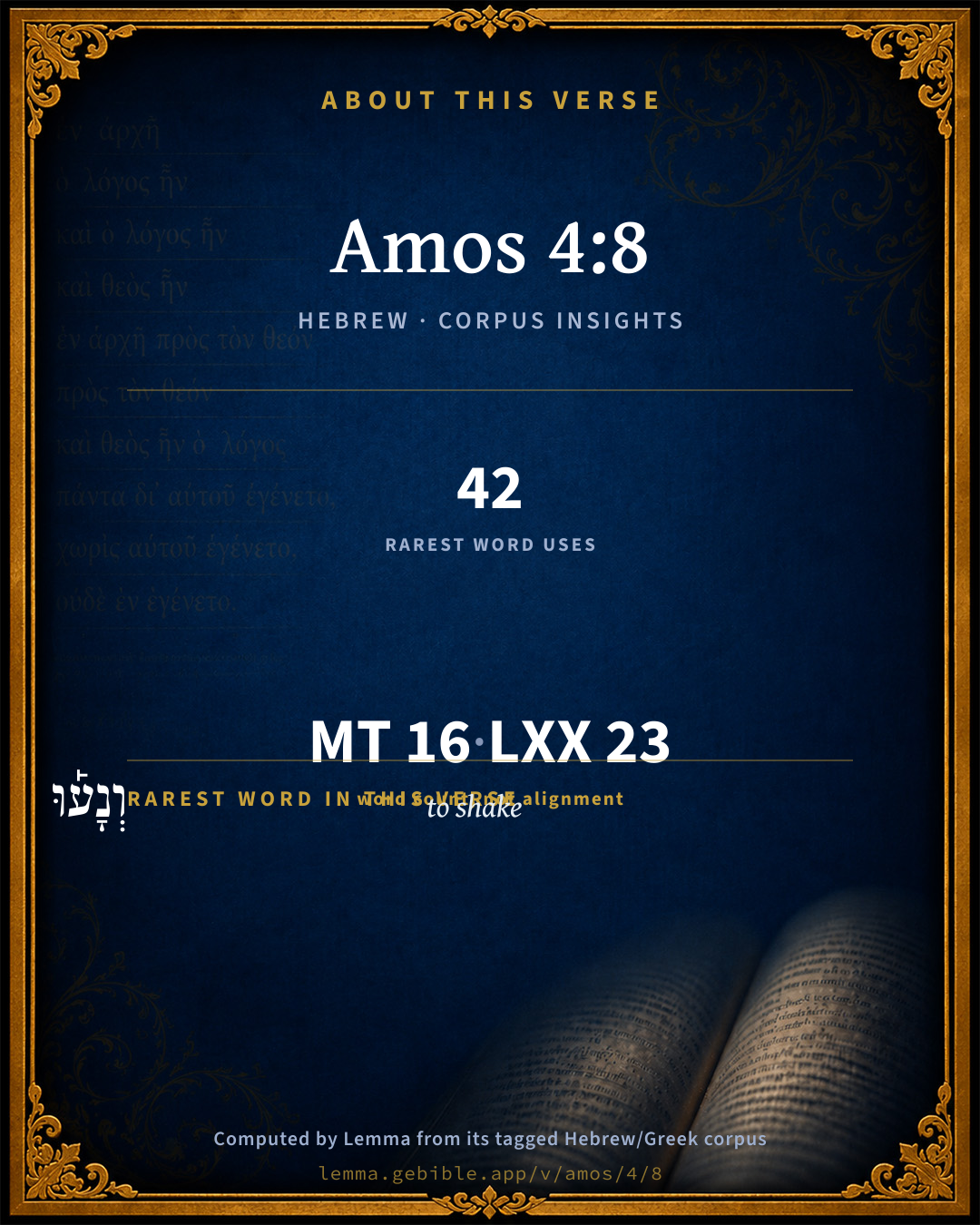
About this verse

These counts appear in no published source. They are computed here, from the morphology-tagged text and Lemma’s own curated glosses. What Lemma adds →

16
words
14
distinct lemmas
Prophets
section

Shared distinctive vocabulary

וְנָע֡וּ to shake H5128 occurs in 36 verses of the Hebrew Bible. Also found in:

Grammatical profile

  • 4 verbs
  • 5 nouns
  • 3 adjectives
  • 2 prepositions
  • 2 particles

Verb forms

  • וְנָע֡וּ Qal · Sequential Perfect
  • לִשְׁתּ֥וֹת Qal · Infinitive Construct
  • יִשְׂבָּ֑עוּ Qal · Imperfect
  • שַׁבְתֶּ֥ם Qal · Perfect

Repetition

Words recur within this verse — often emphatic in Hebrew:

  • עָרִ֜ים city H5892 ×2
  • וְלֹ֣א not H3808 ×2

Hebrew & Septuagint length

In English translation the verse runs 24 words from the Hebrew and 33 from the Septuagint (LXX English) — closely comparable.

A rough comparison of the two English renderings, which tokenize alike — not a word-level alignment.

Word counts can differ between the Hebrew and the Greek without any difference in meaning — e.g. the Hebrew direct-object marker אֵת has no separate Greek word, and Greek often adds the article ὁ.

In the original languages it is 16 Hebrew tokens and 23 Greek tokens — but the two are counted differently (Hebrew bundles its prefixes and suffixes into one token; the Greek is in lemma form), so that isn’t a like-for-like length.

Cross-references

11

Topical passages linked to Amos 4:8 in the Treasury of Scripture Knowledge — connected by theme and wording, ordered by reader-vote popularity; previews shown in the World English Bible.

  • Amos 4:6 "I also have given you cleanness of teeth in all your cities, And lack of bread in every town; Yet you haven't returned to me," says Yahweh.
  • 1 Kings 18:5 Ahab said to Obadiah, Go through the land, to all the springs of water, and to all the brooks: peradventure we may find grass and save the horses and mules alive, that we not lose all the animals.
  • Haggai 1:6 You have sown much, and bring in little. You eat, but you don't have enough. You drink, but you aren't filled with drink. You clothe yourselves, but no one is warm, and he who earns wages earns wages to put them into a bag with holes in it."
  • Isaiah 41:17–18 The poor and needy seek water, and there is none, and their tongue fails for thirst; I, Yahweh, will answer them, I, the God of Israel, will not forsake them.
  • Jeremiah 3:7 I said after she had done all these things, She will return to me; but she didn't return: and her treacherous sister Judah saw it.
  • Jeremiah 14:3–4 Their nobles send their little ones to the waters: they come to the cisterns, and find no water; they return with their vessels empty; they are disappointed and confounded, and cover their heads.
  • Jeremiah 23:14 In the prophets of Jerusalem also I have seen a horrible thing: they commit adultery, and walk in lies; and they strengthen the hands of evil-doers, so that none does return from his wickedness: they are all of them become to me as Sodom, and the inhabitants of it as Gomorrah.
  • Ezekiel 4:16–17 Moreover he said to me, Son of man, behold, I will break the staff of bread in Jerusalem: and they shall eat bread by weight, and with fearfulness; and they shall drink water by measure, and in dismay:
  • Hosea 7:10 The pride of Israel testifies to his face; Yet they haven't returned to Yahweh their God, Nor sought him, for all this.
  • Amos 4:9–11 I struck you with blight and mildew many times in your gardens and your vineyards; And your fig trees and your olive trees have the swarming locust devoured: Yet you haven't returned to me," says Yahweh.
  • Micah 6:14 You shall eat, but not be satisfied. Your humiliation will be in your midst. You will store up, but not save; And that which you save I will give up to the sword.

Cross-references courtesy of OpenBible.info (CC BY 4.0).

Hebrew and Greek witnesses Masoretic Hebrew ↔ Greek Septuagint

The same verse in the two great witnesses to the Old Testament, shown verse-for-verse.

These are two independent witnesses, not word-aligned to each other, and the Septuagint is shown in lemma (dictionary) form.

Hebrew Amos 4:8 Masoretic · Westminster Leningrad Codex

וְנָע֡וּ שְׁתַּיִם֩ שָׁלֹ֨שׁ עָרִ֜ים אֶל עִ֥יר אַחַ֛ת לִשְׁתּ֥וֹת מַ֖יִם וְלֹ֣א יִשְׂבָּ֑עוּ וְלֹֽא שַׁבְתֶּ֥ם עָדַ֖י נְאֻם יְהוָֽה

So two or three cities staggered to one city to drink water, And were not satisfied: Yet you haven't returned to me," says Yahweh.

World English Bible · Public Domain

Greek LXX Amos 4:8 Septuagint · lemma form

καί συνἀθροίζω δύο καί τρεῖς πόλις εἰς πόλις εἷς ὁ πίνω ὕδωρ καί οὐ μή ἐνπίμπλημι καί οὐ ἐπιστρέφω πρός ἐγώ λέγω κύριος

And the inhabitants of two or three cities shall be gathered to one city to drink water, and they shall not be satisfied: yet you⌃ have not returned to me, says the Lord.

LXX2012 (modern English Septuagint) · Public Domain

Hebrew: Westminster Leningrad Codex (CC BY 4.0). Greek: Septuagint (public domain); English from LXX2012 (modern English Septuagint) (Public Domain). How the Septuagint differs from the Hebrew →

Targum (Aramaic paraphrase)

1

The Targum is the ancient Jewish Aramaic paraphrase of the Hebrew Scriptures — an interpretive translation, not the Hebrew text itself. Onkelos (literal) and Pseudo-Jonathan (expansive) render the Torah, and Jonathan the Prophets. Coverage is partial: where no permissively-licensed English translation exists for a verse, only the Aramaic is shown. This is verse-level text, not a word-by-word alignment to the Hebrew.

  1. Targum Jonathan Prophets (Joshua–Malachi)
    וְיִשְׁתַּלְהוּן תַּרְתֵּין תְּלַת קִרְוִין לְקַרְתָּא חֲדָא לְמִשְׁתֵּי מַיָא וְלָא יִסְבְּעוּן וְלָא תַבְתּוּן לְפוּלְחָנִי אֲמַר יְיָ:

    (no public-domain English translation for this verse)

    Targum Jonathan — Aramaic: “Mikraot Gedolot” (public domain). English: “Sefaria Community Translation” (CC0 1.0 (public-domain dedication)); “London "Chaldee Paraphrase," 1871” (public domain). Text via Sefaria.

Commentary

Notes on Amos 4:8 from classic Christian and Jewish commentators (each source and its license shown beneath its notes). The classic Christian expositions comment on the surrounding passage and are grouped to its opening verse, so a note may address several verses; the Jewish commentaries on the Tanakh (Rashi and others) are per-verse, so they appear only where the commentator wrote on this verse.

Lemma curates 59 commentaries, every one of them public domain or Creative Commons licensed, each selected and text-cleaned for this edition rather than reprinted as found. About our sources →

Trapp's Complete Commentary

John Trapp

Amo 4:8 So two [or] three cities wandered unto one city, to drink water; but they were not satisfied: yet have ye not returned unto me, saith the LORD.

Ver. 8. So two or three cities wandered] Necessity is a hard weapon: and want of water will make men wander far and part with anything for it; as Lysimachus did with his kingdom, sacrificing his estate to the service of his life. Oh that we were as solicitous for our souls! Those good souls, Psa 84:7, went "from strength to strength," travelled many a mile to see God’s face, though but in that dark glass of the ceremonies. The good Shunammite went every sabbath and new moon to the prophet. Our forefathers were unweariable in making out after the means, which we vilipend, and make no reckoning of.

To drink water] Rain water; for in those countries (as Jerome testifieth, who lived there many years, and therefore knew the situation and nature thereof) they have but few springs, and no considerable rivers, but only Jordan; and are therefore glad to keep rain water in cisterns for all uses; being much afflicted with thirst and drought, if it rain not.

But they were not satisfied] Either because there was not enough to be had; or by a singular curse of unsatisfiableness, see Hag 1:6. {See Trapp on "Hag 1:6"}

Yet have ye not returned unto me] Usque ad me, so far as me. You have made some faint overtures and essays of returning, but they have not reached out unto me; they have not amounted to the full measure of a sound conversion. Plectimur, may you well say, nec tamen flectimur: corripimur, sed non corrigimur (Salvian). God rained not upon us that we might return unto him, and learn righteousness, Isa 26:10, that we might pour out a prayer when his chastening was upon us, Isa 26:16; Isa 26:18. But we, alas, have done nothing less; "we have turned every one to his own way"; and done what in us lies to defeat God and undo ourselves by our incorrigibleness and uncurableness.

John Trapp, A Commentary or Exposition upon All the Books of the Old and New Testament (1647–1656) — public domain. Text from a community e-Sword module.

Geneva Bible (1599)

Geneva Bible translators

They could not find water enough where they had heard say it had rained.

Geneva Bible (1599) marginal notes — public domain. Text via Bolls.life.

Jamieson, Fausset & Brown

Robert Jamieson, A. R. Fausset & David Brown

three cities wandered--that is, the inhabitants of three cities (compare Jer 14:1-6). GROTIUS explains this verse and Amo 4:7, "The rain fell on neighboring countries, but not on Israel, which marked the drought to be, not accidental, but the special judgment of God." The Israelites were obliged to leave their cities and homes to seek water at a distance [CALVIN].

Jamieson, Fausset & Brown — Commentary Critical and Explanatory on the Whole Bible (1871) — public domain (CC PDM 1.0). Text via the HelloAO Bible API.

John Calvin's Commentaries

Marking the difference, the Prophet relates, that two or three cities had come to one, to seek drink, and that they were not satisfied, because the waters failed on account of so large a number: for though the fountains could have supplied the inhabitants, yet when such a multitude flowed from every quarter, the very fountains became exhausted. The Prophet thus aggravates the punishment brought by God on the Israelites; for so great was the thirst, that whole cities had recourse to fountains, where they heard that there was any water. It was indeed an unusual thing for inhabitants to leave their own city and to run to another to seek water, like wild beasts who, when satiated with prey, run far for water: but it is an unwonted thing for men to undertake a long journey for the sake of finding drink: for they dig wells for themselves, and seek water by their own industry, when rivers do not flow, or when fountains do not supply them with drink. When therefore men are forced to leave their own homes and to seek water at a distance, and when they exhaust the fountains, it is a portend which ought to be observed.

But how was it that the Israelites took no notice of God’s hand, which was then as it were visible? Hence then, as they repented not, their obstinate blindness became quite evident. They were no doubt terrified with fear and harassed by grief; but all this produced no effect, for they continued in their sins, took delight in their own superstitions, and pursued the same life as before. Since then they divested not themselves of their own character, nor ceased to provoke continually the wrath of God, their hopeless and incorrigible obstinacy is here manifestly proved. This was the Prophet’s design. It follows —

John Calvin's Commentaries (1540-1563) — public domain. Text from the Calvin Translation Society English edition (1840s-50s) via the Christian Classics Ethereal Library (ccel.org). Calvin's coverage is partial (roughly two-thirds of the Bible); uncommented books and verses are honest gaps, never fabricated. The 19th-century editor's footnotes and remarks are omitted so the notes are faithfully Calvin's own voice.

The Cambridge Bible for Schools and Colleges

gen. ed. J. J. S. Perowne

8. wandered &c.] would totter … but would not be satisfied: the frequentative tenses are continued. Eastern cities are dependent largely for their water upon underground cisterns in which the rain is collected and stored; but the quantity thus supplied in the more fortunate city would not suffice for the wants of so many more than its normal inhabitants. The word rendered wander means properly to move with an unsteady, uncertain gait, to totter; it is thus used of one drunken (Isa_24:20; Isa_29:9, Psa_107:27 [R.V. stagger]), or blind (Lam_4:14), or, as Psa_59:15 and here, of one exhausted for want of food (cf. of beggars, Psa_109:10). Cf. ch. Amo_8:12. For droughts in Palestine, cf. Deu_11:17; Deu_28:22; 1Ki_8:35; 1Ki_17:1 ff.; Jer_3:3; Jer_14:2-6; Hag_1:10 f.

The Cambridge Bible for Schools and Colleges (gen. ed. J. J. S. Perowne; Cambridge University Press, 1878–1918) — public domain. Text from a community e-Sword module.

John Gill's Exposition

So two or three cities wandered unto one city, to drink water,.... Two or three cities, that is, the inhabitants of them, being without water, went up and down in quest of any city or place where they could find water for themselves and cattle to drink:

but they were not satisfied; could not get enough for their present use and much less to carry back with them to supply them for any length of time; such a scarcity there was of it in other parts; see Kg1 18:5;

yet have ye not returned unto me, saith the Lord; this had no more effect upon them than the other to relinquish their former courses, and return unto the Lord by humiliation and repentance.

John Gill's Exposition of the Whole Bible (1746–1763) — public domain (CC PDM 1.0). Text via the HelloAO Bible API.

Albert Barnes' Notes on the Bible

Two or three cities wandered into one city - Those then who were punished, were more than those who were reprieved. The word “wandered” literally, “trembled,” expresses the unsteady reeling gate of those exhausted, in quest of food . They staggered through weakness, and uncertain, amid the general drought, whither to betake themselves. This was done, not in punishment but to heal. God paused, in order to give them opportunity to repent; in deed, His long-suffering only showed to themselves and to others, that they would not; “and ye returned not not Me; saith the Lord.”

Albert Barnes' Notes on the Bible (1834–1885) — public domain. Text from a community e-Sword/MySword module.

Matthew Poole's English Annotations

Two or three, a certain for an uncertain number,

cities, the places for the inhabitants, by a usual metonymy,

wandered unto one city to drink water: it seems to imply that they travelled at some uncertainty, as they do who wander and rove about. It is not unlikely but that in the prophet’s times the story might be well known and fresh in memory, though here no mention is made of these cities.

But they were not satisfied; either that city they went to had not enough for them, or durst not part with it; or, though they quenched their thirst, yet because they must return back to their own dry and waterless cities, or because God withdrew his blessing, they were never the better, or else not much or long the better.

Yet have ye not returned unto me: see Amo 4:6.

Matthew Poole's English Annotations on the Holy Bible (1683–1685) — public domain. Text from a community e-Sword/MySword module.

The Pulpit Commentary

This want of rain produced great dearth of water to drink, and persons had to go long distances to procure supplies. Wandered; literally trembled, staggered, as spent and exhausted by thirst. The word is used in Psa_59:15 Psa_109:10. The supply thus used was soon exhausted, and brought no permanent relief.

The Pulpit Commentary (1880–1919), ed. H.D.M. Spence-Jones & Joseph S. Exell — public domain. Text from a community e-Sword module.

John Wesley's Explanatory Notes

Not satisfied - Either that had not enough for them, or durst not part with it.

John Wesley, Explanatory Notes Upon the Whole Bible (1754–1765) — public domain. Text via the GEBible commentary corpus.

unfoldingWord translationNotes

Door43 World Missions Community

Two or three cities staggered

Here "cities" represents the people of those cities. AT: "The people of two or three cities staggered" (See: Metonymy)

I afflicted you with blight and mildew

Here "afflicted you" represents afflicting their crops. AT: "I afflicted your crops with blight and mildew" or "I destroyed your crops with blight and mildew" (See: Metonymy)

blight

This is a disease that dries and kills plants. It is caused by the hot wind from the desert.

mildew

This is another disease that kills plants.

you have not returned to me

Returning to God represents submitting again to him. See how you translated this in Amos 4:6. AT: "you have not submitted again to me" (See: Metaphor)

this is Yahweh's declaration

Yahweh speaks of himself by name to express the certainty of what he is declaring. See how you translated these words in Amos 2:11. AT: "this is what Yahweh has declared" or "this is what I, Yahweh, have declared" (See: First, Second, or Third Person)

translationWords

afflicted

vineyard

fig

olive

locust

unfoldingWord translationNotes — © Distant Shores Media and the Door43 World Missions Community, licensed CC BY-SA 4.0. Source: git.door43.org/Door43/en_tn.

Lesson kit

Teaching starters — assembled from the data on this page, not authored interpretation. Every prompt links to the verse data it draws on. Edit before teaching.

Amos, in the Prophets, opens this verse with 16 words (14 distinct Hebrew lemmas). Its most distinctive word is nûwaʻ (“to shake”). A historical commentator’s framing appears above. Read the whole chapter for the surrounding context.

Discussion questions

  1. What does “to shake” (nûwaʻ) contribute to the verse as a whole?
  2. Genesis 4:12 shares the word «to shake» with this verse. How do the two illuminate each other?
  3. “city” occurs 2× in this one verse. What is the effect of the repetition?
  4. The translations on this page render this verse differently — a whole-verse word diff, not a word-by-word alignment. What might account for the different wordings?
  5. The verb «וְנָע֡וּ» is Qal Sequential Perfect. How does its form color the action?
  6. Reading how Trapp's Complete Commentary and Geneva Bible (1599) read this verse, where do the two commentators agree and where do they part?

Things to notice

Reading settings

Reading text

Shown beneath each verse's original-language words.

Old Testament
Old Testament edition

Read the OT as the Masoretic Hebrew (MT) or the Greek Septuagint (LXX).

English shown for the Greek Septuagint (in the Hebrew ↔ Greek comparison).

Comparing translations? Open the Compare panel on any verse page to stack up to four side by side.