Zechariah 9:8

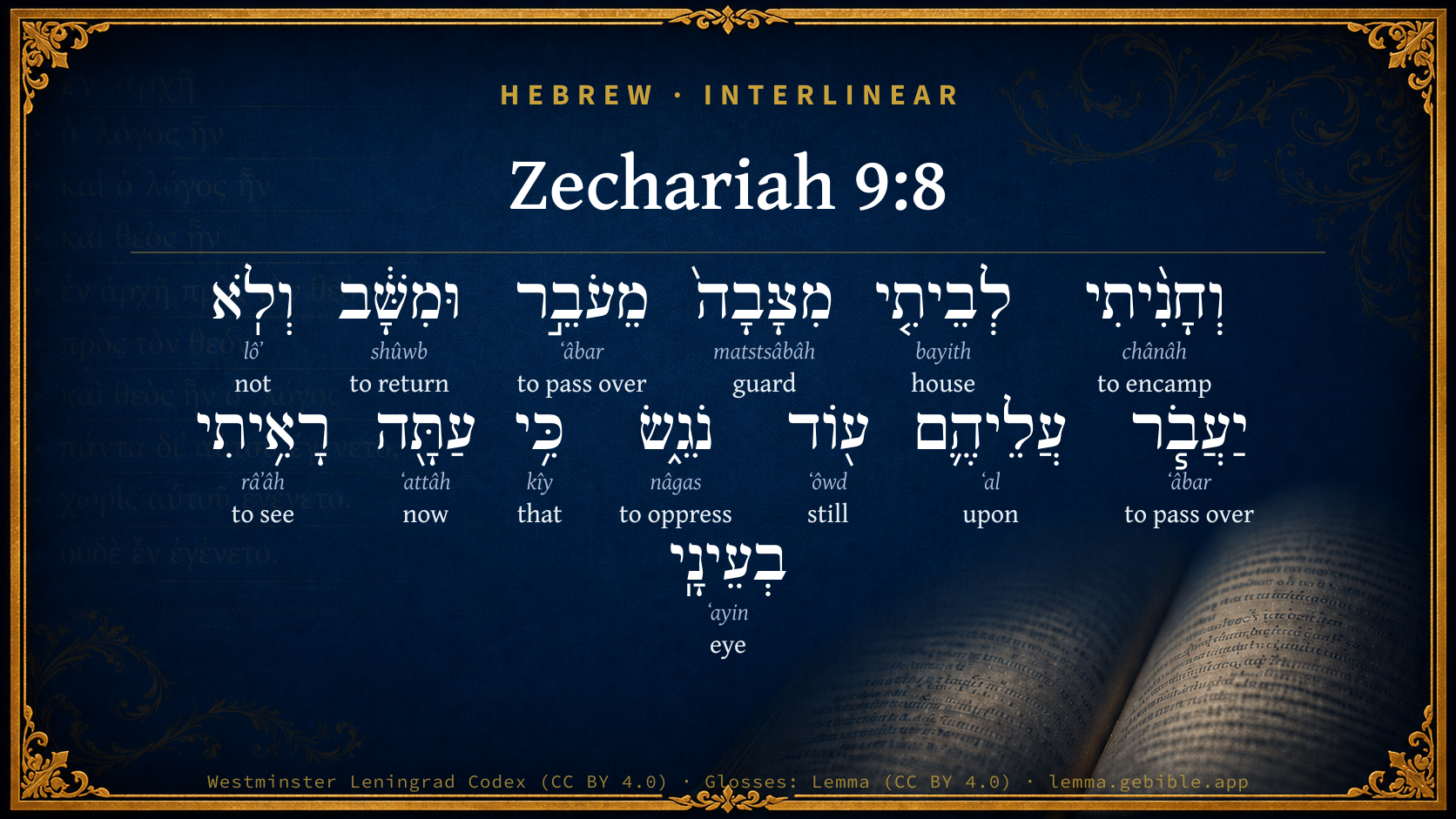
Hebrew (Westminster Leningrad Codex) Zechariah 9:8 appears in the Hebrew Old Testament. The text above is from the Westminster Leningrad Codex. Each word links to its Strong’s number, a concise gloss, and parsing drawn from the Open Scriptures Hebrew Bible morphology. Click any word for its full Brown-Driver-Briggs (BDB) entry.
Download image
Cite this verse

Zechariah 9:8 (World English Bible). Public Domain. Lemma interlinear Bible study tool, https://lemma.gebible.app/v/zechariah/9/8.

Show BibTeX & RIS
BibTeX
RIS
English Translation
I will encamp around my house against the army, That none pass through or return; And no oppressor will pass through them any more: For now I have seen with my eyes.
World English Bible · Public Domain
Download a study sheet

One document with this verse’s original text, its word-by-word gloss line, the meaning frame, cross-references with their text, attributed commentary, and full source and license credits — printable, and it pastes into notes with its structure intact.

This verse Autodidact and up

Study sheet (.html) Plain text (.txt)

A passage Seminary Student

Up to 50 verses in one chapter. A passage sheet keeps up to 6 commentary sources and 12 cross-references per verse, in the order this page ranks them, and says so on the sheet whenever that leaves anything out. Ask for a single verse and you get the Autodidact verse sheet above.

Everything on this page stays free to read, with no account — the sheet is a download of what is already on screen, not access to it.

Want to remove ads? Support Godless Engineer
Compare translations 3

The same verse in 3 English versions, stacked beneath the original-language interlinear above. Click any original word for its lexicon entry.

Each is an independent rendering of the whole verse — the interlinear is not word-aligned to these translations.

Highlighted words mark where these versions differ — a whole-verse word diff, not a word-by-word alignment.

  • World English Bible Public Domain
    I will encamp around my house against the army, That none pass through or return; And no oppressor will pass through them any more: For now I have seen with my eyes.
  • King James Version Public Domain
    And I will encamp about mine house because of the army, because of him that passeth by, and because of him that returneth: and no oppressor shall pass through them any more: for now have I seen with mine eyes.
  • unfoldingWord Literal Text CC BY-SA 4.0
    I will camp around my land against enemy armies, so no one can pass through or return, for no oppressor will overrun them, for now I see with my own eyes!

unfoldingWord Literal Text — © unfoldingWord, licensed CC BY-SA 4.0. Word-aligned USFM3 via Door43 (git.door43.org/unfoldingWord/en_ult).

Versions to compare (up to 4)

3 of 4 selected

Show all 18 translations

Every available English version of this verse, each an independent rendering of the whole verse.

  • World English Bible Public Domain
    I will encamp around my house against the army, That none pass through or return; And no oppressor will pass through them any more: For now I have seen with my eyes.
  • Berean Standard Bible Public Domain
    But I will camp around My house because of an army, because of those who march to and fro, and never again will an oppressor overrun My people, for now I keep watch with My own eyes.
  • Majority Standard Bible Public Domain
    But I will camp around My house because of an army, because of those who march to and fro, and never again will an oppressor overrun My people, for now I keep watch with My own eyes.
  • King James Version Public Domain
    And I will encamp about mine house because of the army, because of him that passeth by, and because of him that returneth: and no oppressor shall pass through them any more: for now have I seen with mine eyes.
  • American Standard Version (1901) Public Domain
    And I will encamp about my house against the army, that none pass through or return; and no oppressor shall pass through them any more: for now have I seen with mine eyes.
  • Revised Version (1885) Public Domain
    And I will encamp about mine house against the army, that none pass through or return: and no oppressor shall pass through them any more: for now have I seen with mine eyes.
  • Geneva Bible (1599) Public Domain
    And I will campe about mine House against the armie, against him that passeth by, and against him that returneth, and no oppressour shall come vpon them any more: for now haue I seene with mine eyes.
  • Douay-Rheims (1899) Public Domain
    And I will encompass my house with them that serve me in war, going and returning, and the oppressor shall no more pass through them: for now I have seen with my eyes.
  • Young's Literal Translation Public Domain
    And I have pitched for My house a camp, Because of the passer through, and of the returner, And pass not through against them again doth an exactor, For, now, I have seen with My eyes.
  • Literal Standard Version CC BY-SA 4.0
    And I have pitched a camp for My house, || Because of the passer through, and of the returner, || And an exactor does not pass through against them again, || For now, I have seen with My eyes.
  • Unlocked Literal Bible CC BY-SA 4.0
    I will camp around my land against enemy armies, so no one can pass through or return, for no oppressor will overrun them, for now I see with my own eyes!
  • unfoldingWord Literal Text CC BY-SA 4.0
    I will camp around my land against enemy armies, so no one can pass through or return, for no oppressor will overrun them, for now I see with my own eyes!
  • Darby Bible Public Domain
    And I will encamp about my house because of the army, because of those that pass by and that return; and the exactor shall not pass through them any more: for now have I seen [it] with mine eyes.
  • World Messianic Bible Public Domain
    I will encamp around my house against the army, that no one pass through or return; and no oppressor will pass through them any more: for now I have seen with my eyes.
  • Webster's Bible Public Domain
    And I will encamp about my house because of the army, because of him that passeth by, and because of him that returneth: and no oppressor shall pass through them any more: for now have I seen with my eyes.
  • Free Bible Version CC BY-SA 4.0
    I will make my camp in my Temple to guard it from invaders, and no oppressors will conquer them, for now I myself am keeping watch.
  • Bible in Basic English Public Domain
    And I will put my forces in position round my house, so that there may be no coming and going: and no cruel master will again go through them: for now I have seen his trouble.
  • JPS Tanakh (1917) Public Domain
    And I will encamp about My house against the army, that none pass through or return; and no oppressor shall pass through them any more; for now have I seen with Mine eyes.

Literal Standard Version (2020), Covenant Press — licensed CC BY-SA 4.0. Text via the HelloAO Bible API (eBible.org). Unlocked Literal Bible (unfoldingWord) — licensed CC BY-SA 4.0. Text via the HelloAO Bible API (eBible.org). unfoldingWord Literal Text — © unfoldingWord, licensed CC BY-SA 4.0. Word-aligned USFM3 via Door43 (git.door43.org/unfoldingWord/en_ult). Free Bible Version, Dr. Jonathan Gallagher — licensed CC BY-SA 4.0. Text via the HelloAO Bible API (eBible.org).

Word by word

More ways to search: Search by grammar → Find every occurrence → Compare this word →

Practice this passage: Drill this verse → Learn its vocabulary →

מִצָּבָה֙
matstsâbâh
H4675
“guard”
Noun, Common, Feminine, Singular, Absolute
Part of Speech
Noun
Type
Common
Gender
Feminine
Number
Singular
State
Absolute
Full BDB Definition

Origin: from H4673

TWOT: 1398f

guard, watch, army
  1. וְחָנִ֨יתִי chânâh H2583 “and · to encamp” Conjunction + Verb, Qal, Perfect, 1st Person, Common, Singular
  2. לְבֵיתִ֤י bayith H1004 “to/for · house · my” Preposition + Noun, Common, Masculine, Singular, Construct + Suffix, Personal, 1st Person, Common, Singular
  3. מֵעֹבֵ֣ר ʻâbar H5674 “from · passing over” Preposition + Verb, Qal, Participle Active, Masculine, Singular, Absolute
  4. וּמִשָּׁ֔ב shûwb H7725 “and · from · returning” Conjunction + Preposition + Verb, Qal, Participle Active, Masculine, Singular, Absolute
  5. וְלֹֽא lôʼ H3808 “and · not” Conjunction + Particle, Negative
  6. יַעֲבֹ֧ר ʻâbar H5674 “to pass over” Verb, Qal, Imperfect, 3rd Person, Masculine, Singular
  7. עֲלֵיהֶ֛ם ʻal H5921 “upon · them” Preposition + Suffix, Personal, 3rd Person, Masculine, Plural
  8. ע֖וֹד ʻôwd H5750 “still” Adverb
  9. נֹגֵ֑שׂ nâgas H5065 “oppressing” Verb, Qal, Participle Active, Masculine, Singular, Absolute
  10. כִּ֥י kîy H3588 “that” Conjunction
  11. עַתָּ֖ה ʻattâh H6258 “now” Adverb
  12. רָאִ֥יתִי râʼâh H7200 “to see” Verb, Qal, Perfect, 1st Person, Common, Singular
  13. בְעֵינָֽי ʻayin H5869 “in/at · eyes · my” Preposition + Noun, Common, Both, Dual, Construct + Suffix, Personal, 1st Person, Common, Singular

About this verse

These counts appear in no published source. They are computed here, from the morphology-tagged text and Lemma’s own curated glosses. What Lemma adds →

14
words
13
distinct lemmas
Prophets
section

Notable vocabulary

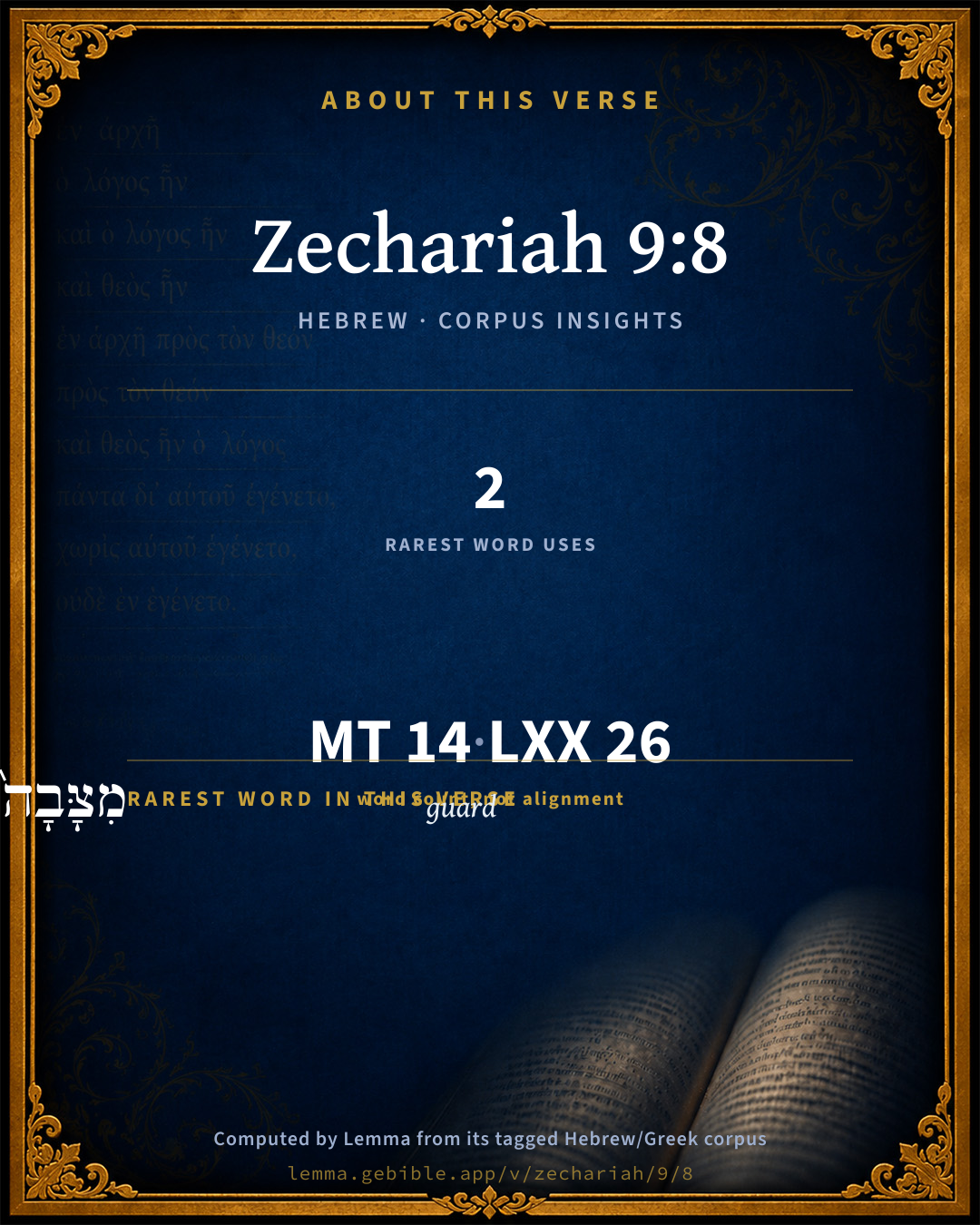
The rarest word here is מִצָּבָה֙ guard H4675 — appearing just 2 times in the whole Hebrew Bible.

Shared distinctive vocabulary

מִצָּבָה֙ guard H4675 occurs in 2 verses of the Hebrew Bible. Also found in:

Grammatical profile

  • 6 verbs
  • 3 nouns
  • 1 preposition
  • 1 conjunction
  • 2 adverbs
  • 1 particle

Verb forms

  • וְחָנִ֨יתִי Qal · Perfect
  • מֵעֹבֵ֣ר Qal · Participle Active
  • וּמִשָּׁ֔ב Qal · Participle Active
  • יַעֲבֹ֧ר Qal · Imperfect
  • נֹגֵ֑שׂ Qal · Participle Active
  • רָאִ֥יתִי Qal · Perfect

Repetition

A word recurs within this verse — often emphatic in Hebrew:

  • מֵעֹבֵ֣ר to pass over H5674 ×2

Hebrew & Septuagint length

In English translation the verse runs 32 words from the Hebrew and 40 from the Septuagint (LXX English) — closely comparable.

A rough comparison of the two English renderings, which tokenize alike — not a word-level alignment.

Word counts can differ between the Hebrew and the Greek without any difference in meaning — e.g. the Hebrew direct-object marker אֵת has no separate Greek word, and Greek often adds the article ὁ.

In the original languages it is 14 Hebrew tokens and 26 Greek tokens — but the two are counted differently (Hebrew bundles its prefixes and suffixes into one token; the Greek is in lemma form), so that isn’t a like-for-like length.

Cross-references

35

Topical passages linked to Zechariah 9:8 in the Treasury of Scripture Knowledge — connected by theme and wording, ordered by reader-vote popularity; previews shown in the World English Bible.

  • Isaiah 54:14 In righteousness shall you be established: you shall be far from oppression, for you shall not be afraid; and from terror, for it shall not come near you.
  • Isaiah 52:1 Awake, awake, put on your strength, Zion; put on your beautiful garments, Jerusalem, the holy city: for henceforth there shall no more come into you the uncircumcised and the unclean.
  • Isaiah 60:18 Violence shall no more be heard in your land, desolation nor destruction within your borders; but you shall call your walls Salvation, and your gates Praise.
  • Jeremiah 31:12 They shall come and sing in the height of Zion, and shall flow to the goodness of Yahweh, to the grain, and to the new wine, and to the oil, and to the young of the flock and of the herd: and their soul shall be as a watered garden; and they shall not sorrow any more at all.
  • Joel 3:16–17 Yahweh will roar from Zion, And thunder from Jerusalem; And the heavens and the earth will shake; But Yahweh will be a refuge to his people, And a stronghold to the children of Israel.
  • Genesis 32:1–2 Jacob went on his way, and the angels of God met him.
  • Exodus 3:9 Now, behold, the cry of the children of Israel has come to me. Moreover I have seen the oppression with which the Egyptians oppress them.
  • 2 Samuel 16:12 It may be that Yahweh will look on the wrong done to me, and that Yahweh will requite me good for [his] cursing of me this day.
  • Psalms 34:7 The angel of Yahweh encamps round about those who fear him, And delivers them.
  • Psalms 72:4 He will judge the poor of the people. He will save the children of the needy, And will break the oppressor in pieces.
  • Psalms 125:1–2 Those who trust in Yahweh are as Mount Zion, Which can't be moved, but remains forever.
  • Isaiah 31:5 As birds hovering, so will Yahweh of Hosts protect Jerusalem; he will protect and deliver [it], he will pass over and preserve [it].
  • Isaiah 52:12 For you shall not go out in haste, neither shall you go by flight: for Yahweh will go before you; and the God of Israel will be your rearward.
  • Ezekiel 39:29 neither will I hide my face any more from them; for I have poured out my Spirit on the house of Israel, says the Lord Yahweh.
  • Daniel 11:27–29 As for both these kings, their hearts shall be to do mischief, and they shall speak lies at one table: but it shall not prosper; for yet the end shall be at the time appointed.
  • Daniel 11:40–45 At the time of the end shall the king of the south contend with him; and the king of the north shall come against him like a whirlwind, with chariots, and with horsemen, and with many ships; and he shall enter into the countries, and shall overflow and pass through.
  • Amos 9:15 I will plant them on their land, And they will no more be plucked up out of their land which I have given them," says Yahweh your God.
  • Exodus 3:7 Yahweh said, "I have surely seen the affliction of my people who are in Egypt, and have heard their cry because of their taskmasters, for I know their sorrows.
  • 2 Kings 23:29 In his days Pharaoh Necoh king of Egypt went up against the king of Assyria to the river Euphrates: and king Josiah went against him; and [Pharaoh Necoh] killed him at Megiddo, when he had seen him.
  • 2 Kings 24:1 In his days Nebuchadnezzar king of Babylon came up, and Jehoiakim became his servant three years: then he turned and rebelled against him.
  • Psalms 46:1–5 God is our refuge and strength, A very present help in trouble.
  • Isaiah 4:5 Yahweh will create over the whole habitation of Mount Zion, and over her assemblies, a cloud and smoke by day, and the shining of a flaming fire by night; for over all the glory will be a canopy.
  • Isaiah 26:1 In that day shall this song be sung in the land of Judah: we have a strong city; salvation will he appoint for walls and bulwarks.
  • Isaiah 33:20–22 Look on Zion, the city of our solemnities: your eyes shall see Jerusalem a quiet habitation, a tent that shall not be removed, the stakes of it shall never be plucked up, neither shall any of the cords of it be broken.
  • Jeremiah 46:2 Of Egypt: concerning the army of Pharaoh Necoh king of Egypt, which was by the river Euphrates in Carchemish, which Nebuchadrezzar king of Babylon struck in the fourth year of Jehoiakim the son of Josiah, king of Judah.
  • Jeremiah 46:13 The word that Yahweh spoke to Jeremiah the prophet, how that Nebuchadrezzar king of Babylon should come and strike the land of Egypt.
  • Ezekiel 28:24–25 There shall be no more a pricking brier to the house of Israel, nor a hurting thorn of any that are round about them, that did despite to them; and they shall know that I am the Lord Yahweh.
  • Daniel 11:6–7 At the end of years they shall join themselves together; and the daughter of the king of the south shall come to the king of the north to make an agreement: but she shall not retain the strength of her arm; neither shall he stand, nor his arm; but she shall be given up, and those who brought her, and he who became the father of her, and he who strengthened her in those times.
  • Zechariah 2:1–13 I lifted up my eyes, and saw, and, behold, a man with a measuring line in his hand.
  • Zechariah 12:8 In that day Yahweh will defend the inhabitants of Jerusalem. He who is feeble among them at that day will be like David, and the house of David will be like God, like the angel of Yahweh before them.
  • Zechariah 14:11 Men will dwell therein, and there will be no more curse; but Jerusalem will dwell safely.
  • Acts 7:34 I have surely seen the affliction of my people that is in Egypt, and have heard their groaning. I have come down to deliver them. Now come, I will send you into Egypt.'
  • Revelation 20:1–3 I saw an angel coming down out of heaven, having the key of the abyss and a great chain in his hand.
  • Revelation 20:9 They went up over the breadth of the earth, and surrounded the camp of the saints, and the beloved city. Fire came down out of heaven from God, and devoured them.
  • Daniel 11:10–16 His sons shall war, and shall assemble a multitude of great forces, which shall come on, and overflow, and pass through; and they shall return and war, even to his fortress.

Cross-references courtesy of OpenBible.info (CC BY 4.0).

Hebrew and Greek witnesses Masoretic Hebrew ↔ Greek Septuagint

The same verse in the two great witnesses to the Old Testament, shown verse-for-verse.

These are two independent witnesses, not word-aligned to each other, and the Septuagint is shown in lemma (dictionary) form.

Hebrew Zechariah 9:8 Masoretic · Westminster Leningrad Codex

וְחָנִ֨יתִי לְבֵיתִ֤י מִצָּבָה֙ מֵעֹבֵ֣ר וּמִשָּׁ֔ב וְלֹֽא יַעֲבֹ֧ר עֲלֵיהֶ֛ם ע֖וֹד נֹגֵ֑שׂ כִּ֥י עַתָּ֖ה רָאִ֥יתִי בְעֵינָֽי

I will encamp around my house against the army, That none pass through or return; And no oppressor will pass through them any more: For now I have seen with my eyes.

World English Bible · Public Domain

Greek LXX Zechariah 9:8 Septuagint · lemma form

καί ὑποἵστημι ὁ οἶκος ἐγώ ἀνάστημα ὁ μή διαπορεύομαι μηδέ ἀνακάμπτω καί οὐ μή ἐπιἔρχομαι ἐπί αὐτός οὐκέτι ἐκἐλαύνω διότι νῦν ὁράω ἐν ὁ ὀφθαλμός ἐγώ

And I will set up a defence for my house, that they may not pass through, nor turn back, neither shall there any more come upon them one to drive them away: for now have I seen with my eyes.

LXX2012 (modern English Septuagint) · Public Domain

On this verse, Keil & Delitzsch discusses the Septuagint’s reading. Read the note in Commentary ↓

Hebrew: Westminster Leningrad Codex (CC BY 4.0). Greek: Septuagint (public domain); English from LXX2012 (modern English Septuagint) (Public Domain). How the Septuagint differs from the Hebrew →

Targum (Aramaic paraphrase)

1

The Targum is the ancient Jewish Aramaic paraphrase of the Hebrew Scriptures — an interpretive translation, not the Hebrew text itself. Onkelos (literal) and Pseudo-Jonathan (expansive) render the Torah, and Jonathan the Prophets. Coverage is partial: where no permissively-licensed English translation exists for a verse, only the Aramaic is shown. This is verse-level text, not a word-by-word alignment to the Hebrew.

  1. Targum Jonathan Prophets (Joshua–Malachi)
    וְאַשְׁרֵי בְּבֵית מַקְדְשִׁי שְׁכִינַת יְקָרִי וּתְקוֹף דְרַע גְבוּרְתִּי כְּשׁוּר דְאֶשָׁא מוּקַף לָהּ סְחוֹר סְחוֹר מִדְעָדֵי וּמִדְתָאֵיב וְלָא יֶעְבַּר עֲלֵיהוֹן עוֹד שׁוּלְטַן אֲרֵי כְעַן גְלֵית גְבוּרְתִּי לְאוֹטָבָא לְהוֹן:

    (no public-domain English translation for this verse)

    Targum Jonathan — Aramaic: “Mikraot Gedolot” (public domain). English: “Sefaria Community Translation” (CC0 1.0 (public-domain dedication)); “London "Chaldee Paraphrase," 1871” (public domain). Text via Sefaria.

Commentary

Notes on Zechariah 9:8 from classic Christian and Jewish commentators (each source and its license shown beneath its notes). The classic Christian expositions comment on the surrounding passage and are grouped to its opening verse, so a note may address several verses; the Jewish commentaries on the Tanakh (Rashi and others) are per-verse, so they appear only where the commentator wrote on this verse.

Lemma curates 59 commentaries, every one of them public domain or Creative Commons licensed, each selected and text-cleaned for this edition rather than reprinted as found. About our sources →

Trapp's Complete Commentary

John Trapp

Zec 9:8 And I will encamp about mine house because of the army, because of him that passeth by, and because of him that returneth: and no oppressor shall pass through them any more: for now have I seen with mine eyes.

Ver. 8. And I will encamp about mine house] Though it be otherwise but ill fenced and fortified; yet I will see it safeguarded and secured from the inroads and incursions of enemies, who are ranging up and down, and not only robbing, but ravishing, Psa 10:9. For what was Alexander but an arch-pirate, a strong thief, as the pirate whom he had taken told him to his teeth? And whether here be intimated by these words,

because of him that passeth by, and him that returneth] something of Alexander’s voyages, who passed by Judaea into Egypt, and to Ammon’s oracle with his army, and thence returned to Persia by the same way, not hurting the Jews, or something about the many expeditions of the Seleucidae and Lagedae to and fro from Egypt to Syria, and back again, among which hurly burly the Jews’ state stood fast, though sometime a little shaken; I dare not say (saith a learned interpreter), it may be both those and all other the like dangers are here generally comprised.

And no oppressor shall pass through them any more] Chald. No sultan; not the Turkish tyrant, Lord of Greece, as Zec 9:13, say those that take the text of the Jews’ glorious state at last. Calvin thinks that by this clause be only expounds what he had figuratively said before. Danaeus takes it of violence and opression among themselves, or of wringing and vexing by their own rulers; they shall be free from violence both abroad and at home.

For now have I seen with mine eyes] i.e. I have taken good notice of it, I have seen, I have seen, as Exo 3:7, and mine eye hath affected mine heart. I have well observed that the enemy is grown unsufferably insolent, and am therefore come to rescue and relieve my people. The Chaldee hath it thus, I have now revealed my power to do them good; Aben Ezra makes these to be the prophet’s words of himself, q.d. I have seen all this in a manifest vision. But this is frigidum imo insulsum, saith Calvin, an odd conceit; unless we refer it (with Montanus) to the following words, and make this the sense (which yet I like not so well), Behold, I see in the spirit, with the eyes of my mind, the Lord Christ coming and entering, with state, the city and temple.

John Trapp, A Commentary or Exposition upon All the Books of the Old and New Testament (1647–1656) — public domain. Text from a community e-Sword module.

Joseph Benson's Commentary

Zec 9:8. I will encamp about my house — About this temple, and my church, of which this temple is an emblem, that I may defend it from all its enemies. Because of the army — The Persian and Grecian army marching to and fro through Judea. The Hebrew is literally, I will encamp about my house as a garrison, the word מצבה, here used, meaning properly a military guard set to keep watch and ward against any hostile approach. “The purport of this passage is, that, while these revolutions were taking place in the neighbouring states, God would act as a guard in favour of his household, or family, against the armies that were marching forward and backward, so as not to suffer any enemy to come near to molest them; for which purpose his eyes, he says, were now, that is, at the time he was speaking of, continually upon the watch.” — Blayney. Many think this alludes to the Maccabees, who were defenders of the house of God against Antiochus Epiphanes. They were as a wall of brass round about the sanctuary. From their days God preserved the temple against the profanation of strangers, till after the death of Jesus Christ, when he forsook it entirely; choosing the Christian Church for his temple, and making it his peculiar care to watch over, encamp round about, and protect it. And no oppressor shall pass through any more — Or rather, any longer. None of those that now threaten to invade or oppress them shall prosper in their attempts against them. For now have I seen with mine eyes — I am not regardless of my people, but look upon their condition with an eye of pity and compassion.

Joseph Benson's Commentary on the Old and New Testaments (1811–1818) — public domain. Text from a community e-Sword module.

Keil & Delitzsch

C. F. Keil & F. Delitzsch

Whilst the heathen world falls under the judgment of destruction, and the remnant of the heathen are converted to the living God, the Lord will protect His house, and cause the King to appear in Jerusalem, who will spread out His kingdom of peace over all the earth. Zac 9:8. "I pitch a tent for my house against military power, against those who go to and fro, and no oppressor will pass over them any more; for now have I seen with my eyes. Zac 9:9. Exult greatly, O daughter Zion; shout, daughter Jerusalem: behold, thy King will come to thee: just and endowed with salvation is He; lowly and riding upon an ass, and that upon a foal, the she-ass's son. Zac 9:10. And I cut off the chariots out of Ephraim, and the horses out of Jerusalem, and the war-bow will be cut off: and peace will He speak to the nations; and His dominion goes from sea to sea, and from the river to the ends of the earth." Chânâh, to encamp, to pitch a tent. לביתי, dat. commod. "for my house," for the good of my house. The house of Jehovah is not the temple, but Israel as the kingdom of God or church of the Lord, as in Hos 8:1; Hos 9:15; Jer 12:7, and even Num 12:7, from which we may see that this meaning is not founded upon the temple, but upon the national constitution given to Israel, i.e., upon the idea of the house as a family. In the verse before us we cannot think of the temple, for the simple reason that the temple was not a military road for armies on the march either while it was standing, or, as Koehler supposes, when it was in ruins. מצּבה stands, according to the Masora, for מצּבא = מן־צבא, not however in the sense of without an army, but "on account of (against) a hostile troop," protecting His house from them. But Bttcher, Koehler, and others, propose to follow the lxx and read מצּבה, military post, after Sa1 14:12, which is the rendering given by C. B. Michaelis and Gesenius to מצּבה. But this does not apply to חנה, for a post (מצּבה, that which is set up) stands up, and does not lie down. מצּבה is more precisely defined by מעבר וּמשּׁב, as going through and returning, i.e., as an army marching to and fro (cf. Zac 7:14). There will come upon them no more (עליהם, ad sensum, referring to בּיתי) nōgēs, lit., a bailiff or taskmaster (Exo 3:7), then generally any oppressor of the nation. Such oppressors were Egypt, Asshur, Babel, and at the present time the imperial power of Persia. This promise is explained by the last clause: Now have I seen with mine eyes. The object is wanting, but it is implied in the context, viz., the oppression under which my nation sighs (cf. Exo 2:25; Exo 3:7). ‛Attâh (now) refers to the ideal present of the prophecy, really to the time when God interposes with His help; and the perfect ראיתי is prophetic.

God grants help to His people, by causing her King to come to the daughter Zion. To show the magnitude of this salvation, the Lord calls upon the daughter Zion, i.e., the personified population of Jerusalem as a representative of the nation of Israel, namely the believing members of the covenant nation, to rejoice. Through מלכּך, thy King, the coming one is described as the King appointed for Zion, and promised to the covenant nation. That the Messiah is intended, whose coming is predicted by Isaiah (Isa 9:5-6), Micah (Mic 5:1.), and other prophets, is admitted with very few exceptions by all the Jewish and Christian commentators.

(Note: See the history of the exposition in Hengstenberg's Christology.)

לך, not only to thee, but also for thy good. He is tsaddı̄q, righteous, i.e., not one who has right, or the good cause (Hitzig), nor merely one righteous in character, answering in all respects to the will of Jehovah (Koehler), but animated with righteousness, and maintaining in His government this first virtue of a ruler (cf. Isa 11:1-4; Jer 23:5-6; Jer 33:15-16, etc.). For He is also נושׁע, i.e., not σώζων, salvator, helper (lxx, Vulg., Luth.), since the niphal has not the active or transitive sense of the hiphil (מושׁיע), nor merely the passive σωζόμενος, salvatus, delivered from suffering; but the word is used in a more general sense, endowed with ישׁע, salvation, help from God, as in Deu 33:29; Psa 33:16, or furnished with the assistance of God requisite for carrying on His government. The next two predicates describe the character of His rule. עני does not mean gentle, πραΰ́ς (lxx and others) = ענו, but lowly, miserable, bowed down, full of suffering. The word denotes "the whole of the lowly, miserable, suffering condition, as it is elaborately depicted in Isa 53:1-12" (Hengstenberg). The next clause answers to this, "riding upon an ass, and indeed upon the foal of an ass." The ו before על עיר is epexegetical (Sa1 17:40), describing the ass as a young animal, not yet ridden, but still running behind the she-asses. The youthfulness of the animal is brought out still more strongly by the expression added to עיר, viz., בּן־אתנות, i.e., a foal, such as asses are accustomed to bear (עתנות is the plural of the species, as in כּפיר אריות, Jdg 14:5; שׂעיר העזּים, Gen 37:31; Lev 4:23). "Riding upon an ass" is supposed by most of the more modern commentators to be a figurative emblem of the peacefulness of the king, that He will establish a government of peace, the ass being regarded as an animal of peace in contrast with the horse, because on account of its smaller strength, agility, and speed, it is less adapted for riding in the midst of fighting and slaughter than a horse. But, in the first place, this leaves the heightening of the idea of the ass by the expression "the young ass's foal" quite unexplained. Is the unridden ass's foal an emblem of peace in a higher degree than the full-grown ass, that has already been ridden?

(Note: We may see how difficult it is to reconcile the emphasis laid upon the ass's foal with this explanation of the significance of the ass, from the attempts made by the supporters of it to bring them into harmony. The assertion made by Ebrard, that עיר denotes an ass of noble breed, and בּן־אתנות signifies that it is one of the noblest breed, has been already proved by Koehler to be a fancy without foundation; but his own attempt to deduce the following meaning of this riding upon a young ass from the precepts concerning the sacrifices, viz., that the future king is riding in the service of Israel, and therefore comes in consequence of a mission from Jehovah, can be proved to fail, from the fact that he is obliged to collect together the most heterogeneous precepts, of which those in Num 19:2; Deu 21:3, and Sa1 6:7, that for certain expiatory purposes animals were to be selected that had never borne a yoke, have a much more specific meaning than that of simple use in the service of Jehovah.)

And secondly, it is indeed correct that the ass was only used in war as the exception, not the rule, and when there were no horses to be had (cf. Bochart, Hieroz. i. p. 158, ed. Ros.); and also correct that in the East it is of a nobler breed, and not so despised as it is with us; but it is also a fact that in the East, and more especially among the Israelites, it was only in the earlier times, when they possessed no horses as yet, that distinguished persons rode upon asses (Jdg 5:10; Jdg 10:4; Jdg 12:14; Sa2 17:23; Sa2 19:27), whereas in the time of David the royal princes and kings kept mules for riding instead of asses (Sa2 13:29; Sa2 18:9; Kg1 1:33; 38:44); and from the time of Solomon downwards, when the breeding of horses was introduced, not another instance occurs of a royal person riding upon an ass, although asses and mules are still constantly used in the East for riding and as beasts of burden; and lastly, that in both the ancient and modern East the ass stands much lower than the horse, whilst in Egypt and other places (Damascus for example), Christians and Jews were, and to some extent still are, only allowed to ride upon asses, and not upon horses, for the purpose of putting them below the Mohammedans (for the proofs, see Hengstenberg's Christology, iii. pp. 404-5). Consequently we must rest satisfied with this explanation, that in accordance with the predicate עני the riding of the King of Zion upon the foal of an ass is an emblem, not of peace, but of lowliness, as the Talmudists themselves interpreted it. "For the ass is not a more peaceful animal than the horse, but a more vicious one" (Kliefoth).

Keil & Delitzsch — Biblical Commentary on the Old Testament (1861–1891) — public domain (CC PDM 1.0). Text via the HelloAO Bible API. (Old Testament only.)

Scofield Reference Notes

C. I. Scofield

because of him

There seems to be a reference here to the advance and return of Alexander (Zec 9:13) after the battle of Issus, who subdued the cities mentioned in Zec 9:1-6, and afterward returned to Greece without harming Jerusalem. But the greater meaning converges on the yet future last days (See Scofield "Act 2:17") as the last clause of verse Zec 9:8 shows, for many oppressors have passed through Jerusalem since the days of Alexander.

The Scofield Reference Bible (1917 edition), notes by C. I. Scofield — public domain. Text from a community e-Sword module.

Geneva Bible (1599)

Geneva Bible translators

He showeth that God’s power only shall be sufficient to defend his Church against all adversaries be they never so cruel, or assemble their power never so often.

That is, God hath now seen the great injuries and afflictions wherewith they have been afflicted by their enemies.

Geneva Bible (1599) marginal notes — public domain. Text via Bolls.life.

Jamieson, Fausset & Brown

Robert Jamieson, A. R. Fausset & David Brown

encamp about-- (Psa 34:7).

mine house--namely, the Jewish people (Zac 3:7; Hos 8:1) [MAURER]. Or, the temple: reassuring the Jews engaged in building, who might otherwise fear their work would be undone by the conqueror [MOORE]. The Jews were, in agreement with this prophecy, uninjured by Alexander, though he punished the Samaritans. Typical of their final deliverance from every foe.

passeth by . . . returneth--Alexander, when advancing against Jerusalem, was arrested by a dream, so that neither in "passing by" to Egypt, nor in "returning," did he injure the Jews, but conferred on them great privileges.

no oppressor . . . pass through . . . any more--The prophet passes from the immediate future to the final deliverance to come (Isa 60:18; Eze 28:24).

seen with mine eyes--namely, how Jerusalem has been oppressed by her foes [ROSENMULLER] (Exo 3:7; Exo 2:25). God is said now to have seen, because He now begins to bring the foe to judgment, and manifests to the world His sense of His people's wrongs.

Jamieson, Fausset & Brown — Commentary Critical and Explanatory on the Whole Bible (1871) — public domain (CC PDM 1.0). Text via the HelloAO Bible API.

Adam Clarke's Commentary

Verse 8. I will encamp about mine house] This may apply to the conquests in Palestine by Alexander, who, coming with great wrath against Jerusalem, was met by Jaddua the high priest and his fellows in their sacred robes, who made intercession for the city and the temple; and, in consequence, Alexander spared both, which he had previously purposed to destroy. He showed the Jews also much favour, and remitted the tax every seventh year, because the law on that year forbade them to cultivate their ground. See this extraordinary account in Joseph. Antiq. lib. xi., c. 8, s. 5. Bishop Newcome translates: "I will encamp about my house with an army, so that none shall pass through or return."

Adam Clarke's Commentary on the Bible (1810–1826) — public domain. Text from a community e-Sword/MySword module.

John Calvin's Commentaries

He concludes what he had been speaking of, — that God would be the guardian of his chosen people, so as to repel on every side the violent assaults of enemies. It is then the same as though he had said, “though the Church is not strongly fortified, it shall yet be impregnable, for God’s protection is of more value than all human strength, than all aids and helps.” God then compares himself here to a moat and a bulwark, and other kinds of fortresses, I will be, he says, a camp to my house. He mentions here house rather than city, that the Jews might feel confident that there was sufficient help in God alone, though they might dwell in a private house or in a cottage. “My Church, though it be a small house, will I yet surround with my defences, so as to render it safe from all harm.”

He says, from the army; and then, from him that passes through, and from him that returns. He places the army in opposition to the house; and thus he exhorts the Jews, not to regard their own strength, but to know that God alone is far better shall all armies. Though then the whole world united together and collected all its forces, he still bids them to be calmly confident, for God alone would be sufficient to put to flight all armies. And according to the same meaning he refers to him that passes through and who returns; as though he had said, “Though enemies may wander through the whole earth and occupy it from one end to the other, yet I will cause my house to remain safe.” By him that returns, he intimates, that though enemies renewed their armies the second and the third time, yet God’s strength would be always sufficient to check their assaults. In a word, what is here taught is the perpetuity of the safety of God’s people, for he will never be wearied in defending them, nor will his power be ever lessened. It often happens that those who with the best intention succor their neighbors, by degrees grow wearied, or they may have their efforts prevented by various events; but the Prophet tells us, that God is not like men, wearied or unable, after having once helped his people and repelled their enemies; for he will be always ready to aid his people, were enemies to renew the battle a hundred times.

By enemy then he means forces; by passing through, the obstinate cruelty of enemies; and by returning, new wars, which one undertakes, when disappointed of his hope, by collecting a new army and repairing his strength.

At length he adds, And pass shall no more the extortioner through them. This sentence explains what he had figuratively expressed, — that though the Jews had been exposed to the will of their enemies, yet God would not hereafter suffer them to be unjustly treated and to be plundered as they had been: for under the name of extortioner he includes all plunderers who had spoiled the miserable Jews of their goods. Then he says, For I have seen with mine eyes. It would be frigid, nay insipid, to explain this clause as some do, that is, as though the Prophet had said, — that he related what had been made known to him from above: for on the contrary God testifies here, that he had seen with his eyes how cruelly and disgracefully the Jews had been treated. And some, while they regard God as the speaker, very unwisely give this explanation, — that God already foresaw what he would do. But evidently God assigns here, as I have said, a reason why he purposed to deliver the Jews from injuries, and for the future to keep them safe and defend them; and the reason given is, because he saw what grievous wrongs they were suffering. And the Prophet speaks according to the usual manner adopted in Scripture; for though nothing is hid from God’s eyes, yet he is rightly said to see what he takes notice of, and what he declares must be accounted for before his tribunal. Though then God saw even before the creation of the world what was to take place afterward in all ages, yet he is rightly said to see what he begins to call to judgment. The Jews indeed thought they were neglected by him; for the Scripture everywhere says, that God closes his eyes, is asleep, lies down, forgets, cares not, when he hides himself and appears not as the avenger of wrongs. Hence, on the other hand, the Lord declares here, that he saw with his eyes those things which were not to be tolerated, inasmuch as enemies had passed all bounds, and had so far advanced and indulged in wantonness, that their pride and cruelty were become intolerable.

John Calvin's Commentaries (1540-1563) — public domain. Text from the Calvin Translation Society English edition (1840s-50s) via the Christian Classics Ethereal Library (ccel.org). Calvin's coverage is partial (roughly two-thirds of the Bible); uncommented books and verses are honest gaps, never fabricated. The 19th-century editor's footnotes and remarks are omitted so the notes are faithfully Calvin's own voice.

Ellicott's Commentary for English Readers

(8) Amid all these dangers, Israel is promised, under Divine protection, a certain immunity.

Because of the army.—This is the meaning of the word as pointed in the Hebrew text, but some, altering the vocalisation, would render it “as a garrison;” and others, as LXX., “a column.”

Him that passeth . . . returneth.—Pusey refers these words directly to “Alexander, who passed by with his army on the way to Egypt, and returned, having founded Alexandria,” but this appears to us to be too special an application of an expression which occurs in a general sense in Zec_7:14; Exo_32:27; Eze_35:7. The promise, however, was undoubtedly fulfilled when Alexander entered Jerusalem, prostrated himself before the high priest, and treated the Jews with peculiar favour.

Oppressor.—The same word that is used in Zec_10:4. (Comp. Isa_3:12; Isa_60:17.)

Have I seen.—Compare Exo_3:7. In the estimation of the man of little faith, God only sees when He actively interferes.

A Bible Commentary for English Readers, edited by Charles John Ellicott (1878–1897) — public domain. Text from a community e-Sword module.

The Cambridge Bible for Schools and Colleges

gen. ed. J. J. S. Perowne

8. about mine house] Rather, for my house. It is a kind of dativus commodi. I will pitch my camp for (the sake of, the protection of) my house, i.e. either of the Temple, or of the people. Comp. Zec_3:7, note.

because of] Lit. from, which may mean, so as to defend it from the army, from him that passeth by, &c. The R. V. renders, against the army, that none pass through or return.

that passeth by, and … that returneth] This is referred by Pusey to “Alexander, who passed by with his army on his way to Egypt, and returned having founded Alexandria.” But the use of the phrase in the more general sense of “going backward and forward,” both in this Book (Zec_7:14, note) and in the only other places where it occurs in the O. T. (Exo_32:27; Eze_35:7), shews that the reference is more general, to the overrunning of the land by an invading army. The fact that of the four places in which alone this phrase occurs two are in this Book and one in each division of the Book, is in favour, so far as it goes, of a single authorship.

now have I seen with mine eyes] God is said to “see,” when He so takes notice of the actions of men as to interpose, as He here promises to do, for the deliverance of His people and the destruction of their enemies. Exo_2:25; Exo_3:7; Exo_3:9. Comp. Zec_9:1 supra. “Nihil aliud exprimere verba possunt, quam velle Jovam in populum suum ejusque hostes jamjam intentos habere oculos, ut illum servet, hos perdat.” Maurer.

The story of Alexander’s visit to Jerusalem, as it is gathered from Josephus (Ant. Bk. xi. c. 8) and from the Talmud is thus related by Dean Stanley. After the conquest of Tyre and Gaza, Alexander had approached Jerusalem, when “suddenly from the city emerged a long procession, the whole population streamed out, dressed in white. The priestly tribe, in their white robes; the High Priest, apparently the chief authority in the place, in his purple and gold attire, his turban on his head, bearing the golden plate on which was inscribed the ineffable name of Jehovah … It was at the sunrise of a winter morning, long afterwards observed as a joyous festival, when they stood before the king. To the astonishment of the surrounding chiefs Alexander descended from his chariot and bowed to the earth before the Jewish leader. None ventured to ask the meaning of this seeming frenzy, save Parmenio alone. ‘Why should he, whom all men worship, worship the High Priest of the Jews?’ ‘Not him,’ replied the king, ‘but the God whose High Priest he is I worship. Long ago, when at Dium in Macedonia, I saw in my dreams such an one in such an attire as this, who urged me to undertake the conquest of Persia and succeed’ … Hand in hand with the High Priest, and with the priestly tribe running by his side, he entered the sacred inclosure, and offered the usual sacrifice, saw with pleasure the indication of the rise of the Grecian power in the prophetic books, granted free use of their ancestral laws, and specially of the year of jubilee inaugurated so solemnly a hundred years before under Nehemiah, promised to befriend the Jewish settlements of Babylonia and Media, and invited any who were disposed to serve in his army with the preservation of their sacred customs.” Jewish Church, Vol. iii., Lect. xlvii. Without denying that the story is in a legendary dress, we may admit the “probability” of Alexander’s visit to Jerusalem, and the certainty that the city was spared, and the people favoured by him, in accordance with the terms of Zechariah’s prophecy.

The Cambridge Bible for Schools and Colleges (gen. ed. J. J. S. Perowne; Cambridge University Press, 1878–1918) — public domain. Text from a community e-Sword module.

John Gill's Exposition

And I will encamp about my house, because of the army,.... Of profane and wicked men, persecutors and heretics, who rose up in great numbers in the first ages of Christianity against the church, the house of God, where he dwells, which consisted of persons called from among the Gentiles as before; in order to protect and defend them from that great company which opposed them, the Lord encamped about them, partly by his angels, Psa 34:7 and partly by his ministers, set for the defence of the Gospel; but chiefly by his own power and presence, who is as a fire round about them. The Targum is,

"and I will cause my glorious Shechinah to dwell in the house of my sanctuary, and the strength of the arm of my power shall be as a wall of fire round about it.''

Because of him that passeth by, and because of him that returneth; either that his people might pass and repass with safety, who attended the worship and service of his house; or because of Satan and wicked men, who go to and fro, seeking to do all the mischief they can to the saints of the most High. This may, in a literal sense, respect the care of God over the Jewish nation, his church and people, in the times of Alexander, who passed to and fro without distressing them; or in the times of the Lagidae and Seleucidae, the kings of Egypt and Syria, during whose commotions, and their passing to and fro against each other, and against them, were still continued a kingdom.

And no oppressor shall pass through them any more; or "exactor" (q); satisfaction for the sins of God's people being exacted, required, and demanded of Christ their surety, it has been given; wherefore no exactor shall pass through them, or over them, to require it of them; not the law, for they are freed by Christ from the exaction, curse, and condemnation of it; not justice, for that is fully satisfied, and infinitely well pleased with the righteousness of Christ; nor Satan, the accuser of the brethren, requiring punishment to be inflicted, which, though he may do it, will be of no avail against them; nor the Jewish tutors and governors, who exacted of the people obedience, not only to the law of Moses, but to the traditions of the elders; since Christ has redeemed his from this vain conversation, Christians are entirely free from that yoke of bondage. This shows that this prophecy is not to be literally understood, since it is certain, that, after the delivery, of it, there were oppressors or exactors among the Jews in a literal sense: Antiochus and others oppressed them before the birth of Christ; they paid tribute to the Romans in his time; he was born at the time of a Roman tax; and, after his death, Titus Vespasian destroyed their nation, and city and temple: or, if it is, "any more" must be understood of a long time, as it were, before they were utterly oppressed.

For now I have seen with mine eyes; these are either the words of God the Father, looking with pleasure upon his church and people, about whom he encamps; and upon the satisfaction his Son has given to the divine justice for their sins, whereby they are free from all exactions and oppressions: or of the Prophet Zechariah, as Aben Ezra thinks, who saw with his eyes, in the visions of the night, all that is contained in this prophecy: and now, inasmuch as all this predicted was to be fulfilled in, or near, or about the times of Christ, therefore next follows a glorious prophecy of his coming.

(q) "exactor", Pagninus, Montanus, Junius & Tremellius, Piscator, Cocceius.

John Gill's Exposition of the Whole Bible (1746–1763) — public domain (CC PDM 1.0). Text via the HelloAO Bible API.

Albert Barnes' Notes on the Bible

And I will encamp about my house - (for my house’s sake) because of the army “Because,” it is added in explanation, “of him that passeth by and of him that returneth;” Alexander, who passed by with his army, on his way to Egypt, and “returned,” having founded Alexandria.

It was a most eventful march; one of the most eventful in the history of mankind. The destruction of the Persian empire, for which it prepared, was in itself of little moment; Alexander’s own empire was very brief. As Daniel had foretold, he came, cast down Persia “to the ground, waxed very great, and when he was strong, the great horn was broken” Dan 8:7-8. But with the marvelous perception which characterized him, he saw and impressed upon his successors the dependibleness of the Jewish people. When he came into Judaea, he sent to the high priest for aid against Tyre and for the like tribute as he used to pay to Darius, promising that he would not repent of choosing the friendship of the Macedonians . The high priest refused on the ground of the oath, by which his people were bound in fealty to the earthly king of kings, whom Alexander came to subdue.

Alexander threatened to teach all, through its fate, to whom fealty was due. This, after the conquest of Gaza, he prepared to fulfill. He came, he saw, he was conquered . Jaddua and his people prayed to God. Taught by God in a dream not to fear, he went to meet the conqueror. The gates of the city were thrown open. There marched out, not an army such as encountered the Romans, but as he had been taught, a multitude in white garments, and the priests going belove in their raiment of fine linen. The high priest, in his apparel of purple and gold, having on his head the mitre, and on it the golden plate , whereon was written the name of God, advanced alone, and the Conqueror, who was expected to give the city to be plundered, and the high priest to be insulted and slain, kissed the name of God, recognizing in the priest one whom lie had seen in the like dress in a dream, who had bidden him, when hesitating, cross to Asia; for that he would go before his army and deliver the Persian empire to him.

The result is related to have been, that Alexander promised to allow the Jews in Judea to live according to their own laws, remitted the tribute of every seventh year, acceded beforehand to the terms to be proposed by those in Babylonia and Media, and that many Jews joined his army, under condition that they might live under their own laws.

Rationalism, while it remains such, cannot admit of Daniel’s prophecies which the high priest showed him, declaring that a Greek should destroy the Persian empire, which Alexander rightly interpreted of himself. But the facts remain; that the conqueror, who, above most, gave way to his anger, bestowed privileges almost incredible on a nation, which under the Medes and Persians had been “the most despised part of the enslaved;” made them equal in privileges to his own Macedonians , who could hardly brook the absorption of the Persians, although in inferior condition, among themselves .

The most despised of the enslaved became the most trusted of the trusted. They became a large portion of the second and third then known cities of the world. They became Alexandrians, Antiochenes, Ephesians , without ceasing to be Jews. The law commanded faithfulness to oaths, and they who despised their religion respected its fruits.

The immediate successors of Alexander, Ptolemy Lagi and Antiochus Nicator, followed his policy; Ptolemy especially on the ground of the fealty shown to Darius; Nicator, as having observed their faithfulness as soldiers, who had served with him ; but they were so enrolled on this visit to Jerusalem. The pagan kings multiplied, in their own purpose, faithful subjects to themselves; in God’s design, they prepared in Asia and Egypt a seed-plot for the Gospel. The settlement of the Jews at Alexandria formed the language of the Gospel; that wonderful blending of the depth of the Hebrew with the clearness and precision of the Greek. Everywhere the seed of the preparatory dispensation was sown, to be fostered, grow and ripen with the harvest of the Gospel.

For now have I seen with Mine eyes - This is the counterpart of what the Psalmists and pious people so often pray, “Awake to help me and behold” Psa 59:4; “Look down from heaven, behold and visit this vine” Psa 80:14; Psa 9:13; “Look upon my trouble from them that hate me” “Look upon my affliction and my trouble; look upon my enemies, for they are many” Psa 25:18-19; “Look upon my adversity and deliver me” Psa 119:153; “O Lord, behold my affliction” (Lam 1:9, add 11; Lam 2:20); “Behold, O Lord, for I am in distress” Lam 1:20; “Look and behold my reproach” Lam 5:1; “Open Thine eyes, O Lord, and see” Isa 37:17; Dan 9:18; “Look clown from heaven, and behold from the habitation of Thy holiness and glory” Isa 63:15. With God, compassion is so intrinsic an attribute, that He is pictured as looking away, when He does not put it forth. With God, to behold is to help.

Albert Barnes' Notes on the Bible (1834–1885) — public domain. Text from a community e-Sword/MySword module.

Haydock's Catholic Bible Commentary

War; the Machabees. (Challoner) --- They stood up like a wall for the people and the temple. (Calmet) --- Hebrew, "my house, on account of those going," &c. I will protect it better than an army. (Haydock) --- After the Machabees, God preserved the temple from profanation till he abandoned it after the death of Christ. (Calmet) --- Yet Pompey penetrated into the most holy place, and Crassus plundered the treasury. Both felt the effects of their impiety, and had no farther success. --- Oppressor; tax-gatherer, (Haydock) sent by foreign tyrants. (Menochius) --- Till the Machabees, particularly Hircan, (Calmet) or Simon, his father, (Haydock) threw off the yoke, the Jews were always subject (Calmet) either to the Persians, to Syria, or to Egypt. (Haydock) --- Hircan’s son, Aristobulus, took the title king, and governed in peace. (Calmet)

George Leo Haydock (1774–1849), Haydock's Catholic Family Bible and Commentary, 1859 edition — public domain. Excludes Psalms (Douay-Rheims chapter numbering differs from Protestant) and Deuterocanonical books (Catholic canon only).

Matthew Poole's English Annotations

I will encamp about; pitch, not the tents of travellers and shepherds. but of an army, God in the midst of his own hosts, and angels among them, guardians, too.

Mine house; this material temple, but as it is an emblem of the church.

Because of the army; of the Persian and Grecian army, whose march lay either through or near to Judea and Jerusalem. Armies are very troublesome, costly, and dangerous in all their marches; the people of God, his city, and temple, shall be as garrisoned and fortified, as if secured by an host; God will have angels pitch their tents round about those that fear the Lord. Judea was a thoroughfare to the Egyptian and Syrian armies, to the Grecian and Persian; an unadvised attempt to stop Pharaoh-necho in his passage through once cost Josiah his life; but God will be a guard to his people, whilst their enemies are moving. All this was accomplished in the times of Alexander and his successors; in midst of those wars, though the Jews suffered somewhat, yet they were mightily defended by their God.

No oppressor shall pass through them any more; as formerly, when they had ingress, egress, regress at their pleasure, as if lords of the soil, and of the people too.

For now have I seen with mine eyes; I ever saw it, but now I manifest that I take notice of it purposely to redress it: I see how vilely they use my people; they shall do so no more. I behold

mischief and spite, to requite it, as Psa 10:14.

Matthew Poole's English Annotations on the Holy Bible (1683–1685) — public domain. Text from a community e-Sword/MySword module.

The Pulpit Commentary

While the heathen world suffers the judgment of God, he protects his own people. I will encamp about (for the protection of) my house. God"s house, or family, is the kingdom and Church of Israel, as Hos_8:1. Septuagint, Uposthsomai tw oikw mou anasthma , "I will erect a fortification for my house." Because of the army. It may also be translated "against," or "from;" i.e. to defend it from the hostile army. Others, pointing differently, render, "as a garrison," or "rampart." Because of (against) him that passeth by, etc. Against all hostile attacks. The phrase, "him that passeth by and him that returneth," is used of an enemy making incursions, or attacking at various points. (see note on Zec_7:14) The Vulgate gives the whole clause thus: Circumdabo domum meam ex his, qui militant mihi euntes et revertentes, "I will defend my house with a guard chosen from those who serve me and do my will," i.e. angels. But this seems far from the signification of the Hebrew. Pusey restricts the meaning to the proceedings of Alexander, who passed by Judaea on his way to Egypt, and returned by the same route, without doing any injury to Jerusalem. Here comes in the Talmudic story related by Josephus ("Ant.," 11:8). The Jews "repaid the protection of Persia with a devoted loyalty, which prompted them to refuse the demand of submission made by Alexander during the siege of Tyre. He marched to chastise them after the fall of Gaza, and the beautiful city had already risen before his view on the hill of Zion, when he found the high priest Jaddua waiting his approach at the watch station of Sapha, clad in his robes of gold and purple, and followed by a train of priests and citizens in pure white. The conqueror bowed in reverence to the Holy Name upon the high priest"s frontlet; and, being asked by Parmenio the reason of his conduct, said that in a dream at Dium, he had seen the God of Jaddua, who encouraged him to pass over into Asia, and promised him success. Then entering Jerusalem, he offered sacrifice in the temple, heard the prophecy of Daniel about himself; and granted certain privileges to all the Jews throughout his empire. The desire to honour a shrine so celebrated as, the Jewish temple is quite in accordance with the conduct of Alexander at Ilium and Ephesus, Gordium and Tyre. The privileges he is said to have conferred upon the Jews were enjoyed under his successors, and some minor matters have been adduced in confirmation of the story. On the other hand, the classical writers are entirely silent on the subject, and the details of Josephus involve grave historical inconsistencies. It seems not an unreasonable conjecture that the story is an embellishment of some incident that occurred when the high priest came to Gaza to tender the submission of the Jews. But we must not dismiss it without a remark on the vast influence which the conquests of Alexander had in bringing the Jews into closer relations with the rest of Asia, and so preparing them to fulfil their ultimate destiny as Christians" (P. Smith, "History of the World," 1:60, etc). Oppressor. The word is used for "taskmaster" in Exo_3:7. Septuagint, exelaunwn , "one who drives away;" Vulgate, exactor. This latter rendering would imply that Israel would no longer have to pay tribute to foreign nations, but should henceforward be independent. For now have I seen with mine eyes. It is as though, during Israel"s calamities, God had not looked upon her; but now he notices her condition, and interposes for her succour. (comp. Exo_2:25 Exo_3:7, 9 Act_7:34) This is done by sending the personage mentioned in the following section.

The Pulpit Commentary (1880–1919), ed. H.D.M. Spence-Jones & Joseph S. Exell — public domain. Text from a community e-Sword module.

John Wesley's Explanatory Notes

I will encamp - To defend it from all its enemies. Mine house - This temple, but as it is an emblem of the church. The army - Of the Persian and the Grecian army, whose march lay through Judea.

John Wesley, Explanatory Notes Upon the Whole Bible (1754–1765) — public domain. Text via the GEBible commentary corpus.

unfoldingWord translationNotes

Door43 World Missions Community

I will camp around my land

God is speaking about himself as if he were an army that was protecting his land. AT: "I will protect my land" (See: Metaphor)

for now

"For at that time"

I see with my own eyes

Here "my own eyes" represent Yahweh's personal attention. AT: "I will personally watch over my land" (See: Metonymy)

translationWords

oppress

watch

unfoldingWord translationNotes — © Distant Shores Media and the Door43 World Missions Community, licensed CC BY-SA 4.0. Source: git.door43.org/Door43/en_tn.

Rashi

Rabbi Shlomo Yitzchaki (Rashi)

And I will encamp beside My house against a garrison I will encamp beside My house to protect it from those who set up a garrison and raiders, that they should not set these up against it. A similar word is used in (Isa. 29:7) “and all those stationed around her, and those who trap her.” It is also possible to interpret מִצָבָה as מִצָבָא, with an ‘alef’ [meaning against a host].

for now I have seen with My eyes Now I have seen their distress with My eyes, although until now I have hidden My countenance from them.

Rashi on the Tanakh — English translations: “The Judaica Press complete Tanach with Rashi, translated by A. J. Rosenberg” (CC BY 4.0); “Pentateuch with Rashi's commentary by M. Rosenbaum and A.M. Silbermann, 1929-1934” (public domain); “The Metsudah Tanach series, Lakewood, N.J” (CC BY 4.0); and “The Book of Joshua, Metsudah Publications, 1997” (CC BY 4.0). Text via Sefaria.

Lesson kit

Teaching starters — assembled from the data on this page, not authored interpretation. Every prompt links to the verse data it draws on. Edit before teaching.

Zechariah, in the Prophets, opens this verse with 14 words (13 distinct Hebrew lemmas). Its most distinctive word is matstsâbâh (“guard”). A historical commentator’s framing appears above. Read the whole chapter for the surrounding context.

Discussion questions

  1. What does “guard” (matstsâbâh) contribute to the verse as a whole?
  2. 1 Samuel 14:12 shares the word «guard» with this verse. How do the two illuminate each other?
  3. “to pass over” occurs 2× in this one verse. What is the effect of the repetition?
  4. The translations on this page render this verse differently — a whole-verse word diff, not a word-by-word alignment. What might account for the different wordings?
  5. The verb «וְחָנִ֨יתִי» is Qal Perfect. How does its form color the action?
  6. Reading how Trapp's Complete Commentary and Joseph Benson's Commentary read this verse, where do the two commentators agree and where do they part?

Things to notice

Reading settings

Reading text

Shown beneath each verse's original-language words.

Old Testament
Old Testament edition

Read the OT as the Masoretic Hebrew (MT) or the Greek Septuagint (LXX).

English shown for the Greek Septuagint (in the Hebrew ↔ Greek comparison).

Comparing translations? Open the Compare panel on any verse page to stack up to four side by side.