
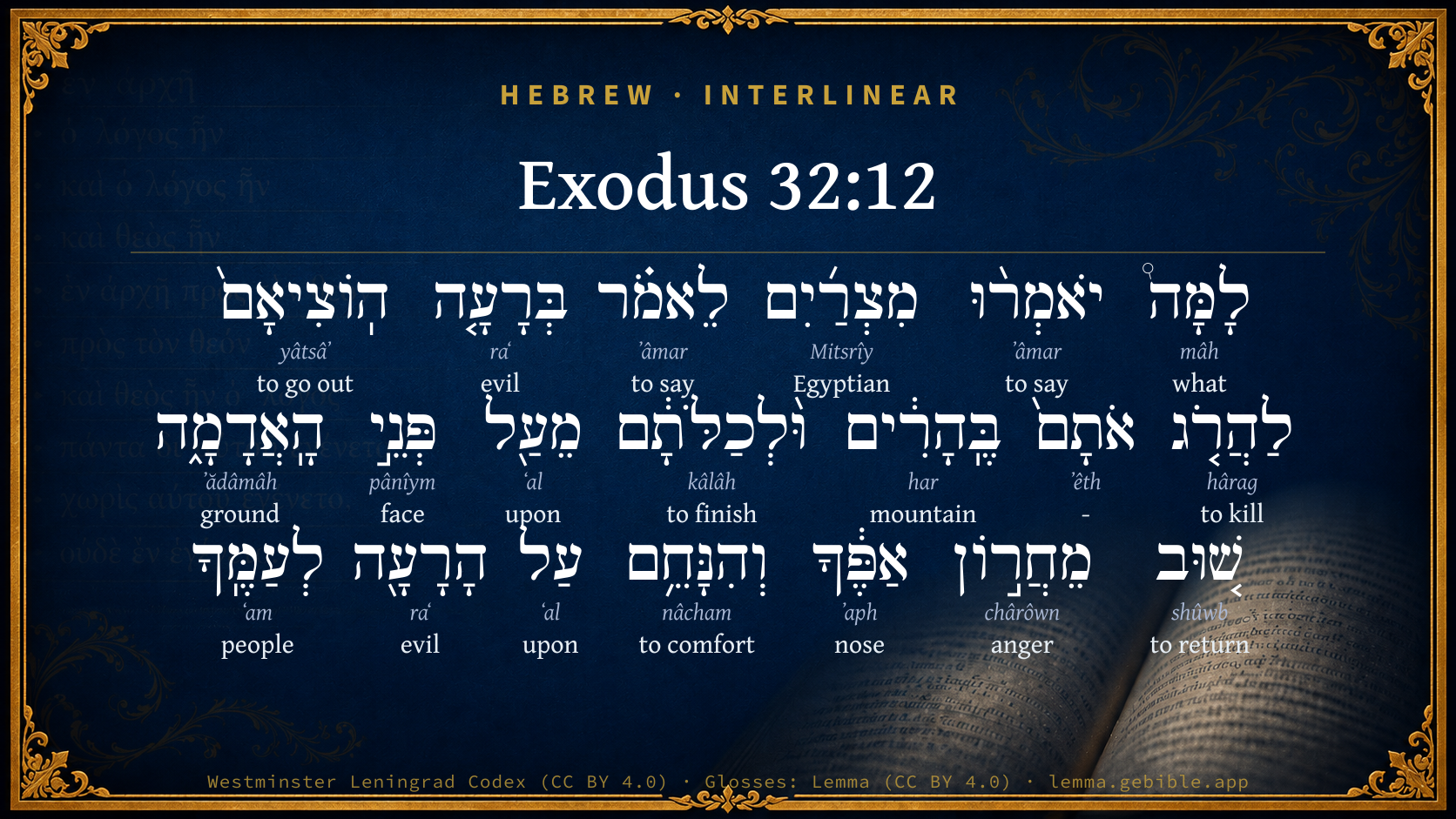
Exodus 32:12

Hebrew (Westminster Leningrad Codex) Exodus 32:12 appears in the Hebrew Old Testament. The text above is from the Westminster Leningrad Codex. Each word links to its Strong’s number, a concise gloss, and parsing drawn from the Open Scriptures Hebrew Bible morphology. Click any word for its full Brown-Driver-Briggs (BDB) entry.
Download image
Cite this verse

Exodus 32:12 (World English Bible). Public Domain. Lemma interlinear Bible study tool, https://lemma.gebible.app/v/exodus/32/12.

Show BibTeX & RIS
BibTeX
RIS
English Translation
Why should the Egyptians speak, saying, 'He brought them forth for evil, to kill them in the mountains, and to consume them from the surface of the earth?' Turn from your fierce wrath, and repent of this evil against your people.
World English Bible · Public Domain
Download a study sheet

One document with this verse’s original text, its word-by-word gloss line, the meaning frame, cross-references with their text, attributed commentary, and full source and license credits — printable, and it pastes into notes with its structure intact.

This verse Autodidact and up

Study sheet (.html) Plain text (.txt)

A passage Seminary Student

Up to 50 verses in one chapter. A passage sheet keeps up to 6 commentary sources and 12 cross-references per verse, in the order this page ranks them, and says so on the sheet whenever that leaves anything out. Ask for a single verse and you get the Autodidact verse sheet above.

Everything on this page stays free to read, with no account — the sheet is a download of what is already on screen, not access to it.

Want to remove ads? Support Godless Engineer
Compare translations 3

The same verse in 3 English versions, stacked beneath the original-language interlinear above. Click any original word for its lexicon entry.

Each is an independent rendering of the whole verse — the interlinear is not word-aligned to these translations.

Highlighted words mark where these versions differ — a whole-verse word diff, not a word-by-word alignment.

  • World English Bible Public Domain
    Why should the Egyptians speak, saying, 'He brought them forth for evil, to kill them in the mountains, and to consume them from the surface of the earth?' Turn from your fierce wrath, and repent of this evil against your people.
  • King James Version Public Domain
    Wherefore should the Egyptians speak, and say, For mischief did he bring them out, to slay them in the mountains, and to consume them from the face of the earth? Turn from thy fierce wrath, and repent of this evil against thy people.
  • unfoldingWord Literal Text CC BY-SA 4.0
    Why should the Egyptians say, saying, ‘He brought them out with evil intent, to kill them in the mountains and to destroy them from on the face of the ground’? Turn from your burning nose and repent from the evil to your people.

unfoldingWord Literal Text — © unfoldingWord, licensed CC BY-SA 4.0. Word-aligned USFM3 via Door43 (git.door43.org/unfoldingWord/en_ult).

Versions to compare (up to 4)

3 of 4 selected

Show all 18 translations

Every available English version of this verse, each an independent rendering of the whole verse.

  • World English Bible Public Domain
    Why should the Egyptians speak, saying, 'He brought them forth for evil, to kill them in the mountains, and to consume them from the surface of the earth?' Turn from your fierce wrath, and repent of this evil against your people.
  • Berean Standard Bible Public Domain
    Why should the Egyptians declare, ‘He brought them out with evil intent, to kill them in the mountains and wipe them from the face of the earth’? Turn from Your fierce anger and relent from doing harm to Your people.
  • Majority Standard Bible Public Domain
    Why should the Egyptians declare, ‘He brought them out with evil intent, to kill them in the mountains and wipe them from the face of the earth’? Turn from Your fierce anger and relent from doing harm to Your people.
  • King James Version Public Domain
    Wherefore should the Egyptians speak, and say, For mischief did he bring them out, to slay them in the mountains, and to consume them from the face of the earth? Turn from thy fierce wrath, and repent of this evil against thy people.
  • American Standard Version (1901) Public Domain
    Wherefore should the Egyptians speak, saying, For evil did he bring them forth, to slay them in the mountains, and to consume them from the face of the earth? Turn from thy fierce wrath, and repent of this evil against thy people.
  • Revised Version (1885) Public Domain
    Wherefore should the Egyptians speak, saying, For evil did he bring them forth, to slay them in the mountains, and to consume them from the face of the earth? Turn from thy fierce wrath, and repent of this evil against thy people.
  • Geneva Bible (1599) Public Domain
    Wherefore shall the Egyptians speake, and say, He hath brought them out maliciously for to slay them in the mountaines, and to consume them from the earth? turne from thy fearce wrath, and change thy minde from this euill towarde thy people.
  • Douay-Rheims (1899) Public Domain
    Let not the Egyptians say, I beseech thee: He craftily brought them out, that he might kill them in the mountains, and destroy them from the earth: let thy anger cease, and be appeased upon the wickedness of thy people.
  • Young's Literal Translation Public Domain
    why do the Egyptians speak, saying, For evil He brought them out to slay them among mountains, and to consume them from off the face of the ground? turn back from the heat of Thine anger, and repent of the evil against Thy people.
  • Literal Standard Version CC BY-SA 4.0
    Why do the Egyptians speak, saying, He brought them out in calamity to slay them among mountains, and to consume them from off the face of the ground? Turn back from the heat of Your anger, and relent from this calamity against Your people.
  • Unlocked Literal Bible CC BY-SA 4.0
    Why should the Egyptians say, 'He led them out with evil intent, to kill them in the mountains and to destroy them from the face of the earth?' Turn from your burning anger and relent from this punishment on your people.
  • unfoldingWord Literal Text CC BY-SA 4.0
    Why should the Egyptians say, saying, ‘He brought them out with evil intent, to kill them in the mountains and to destroy them from on the face of the ground’? Turn from your burning nose and repent from the evil to your people.
  • Darby Bible Public Domain
    Why should the Egyptians speak, and say, For misfortune he has brought them out, to slay them on the mountains, and to annihilate them from the face of the earth? Turn from the heat of thine anger, and repent of this evil against thy people!
  • World Messianic Bible Public Domain
    Why should the Egyptians talk, saying, ‘He brought them out for evil, to kill them in the mountains, and to consume them from the surface of the earth’? Turn from your fierce wrath, and turn away from this evil against your people.
  • Webster's Bible Public Domain
    Why should the Egyptians speak and say, For evil did he bring them out, to slay them in the mountains, and to consume them from the face of the earth? Turn from thy fierce wrath, and repent of this evil against thy people.
  • Free Bible Version CC BY-SA 4.0
    Why should the Egyptians be able to say, ‘He brought them out with the evil purpose of killing them in the mountains, wiping them off the face of the earth’? Turn from your fierce anger. Please change your mind over the threat against your people.
  • Bible in Basic English Public Domain
    Why let the Egyptians say, He took them out to an evil fate, to put them to death on the mountains, cutting them off from the earth? Let your wrath be turned away from them, and send not this evil on your people.
  • JPS Tanakh (1917) Public Domain
    Wherefore should the Egyptians speak, saying: For evil did He bring them forth, to slay them in the mountains, and to consume them from the face of the earth? Turn from Thy fierce wrath, and repent of this evil against Thy people.

Literal Standard Version (2020), Covenant Press — licensed CC BY-SA 4.0. Text via the HelloAO Bible API (eBible.org). Unlocked Literal Bible (unfoldingWord) — licensed CC BY-SA 4.0. Text via the HelloAO Bible API (eBible.org). unfoldingWord Literal Text — © unfoldingWord, licensed CC BY-SA 4.0. Word-aligned USFM3 via Door43 (git.door43.org/unfoldingWord/en_ult). Free Bible Version, Dr. Jonathan Gallagher — licensed CC BY-SA 4.0. Text via the HelloAO Bible API (eBible.org).

Word by word

More ways to search: Search by grammar → Find every occurrence → Compare this word →

Practice this passage: Drill this verse → Learn its vocabulary →

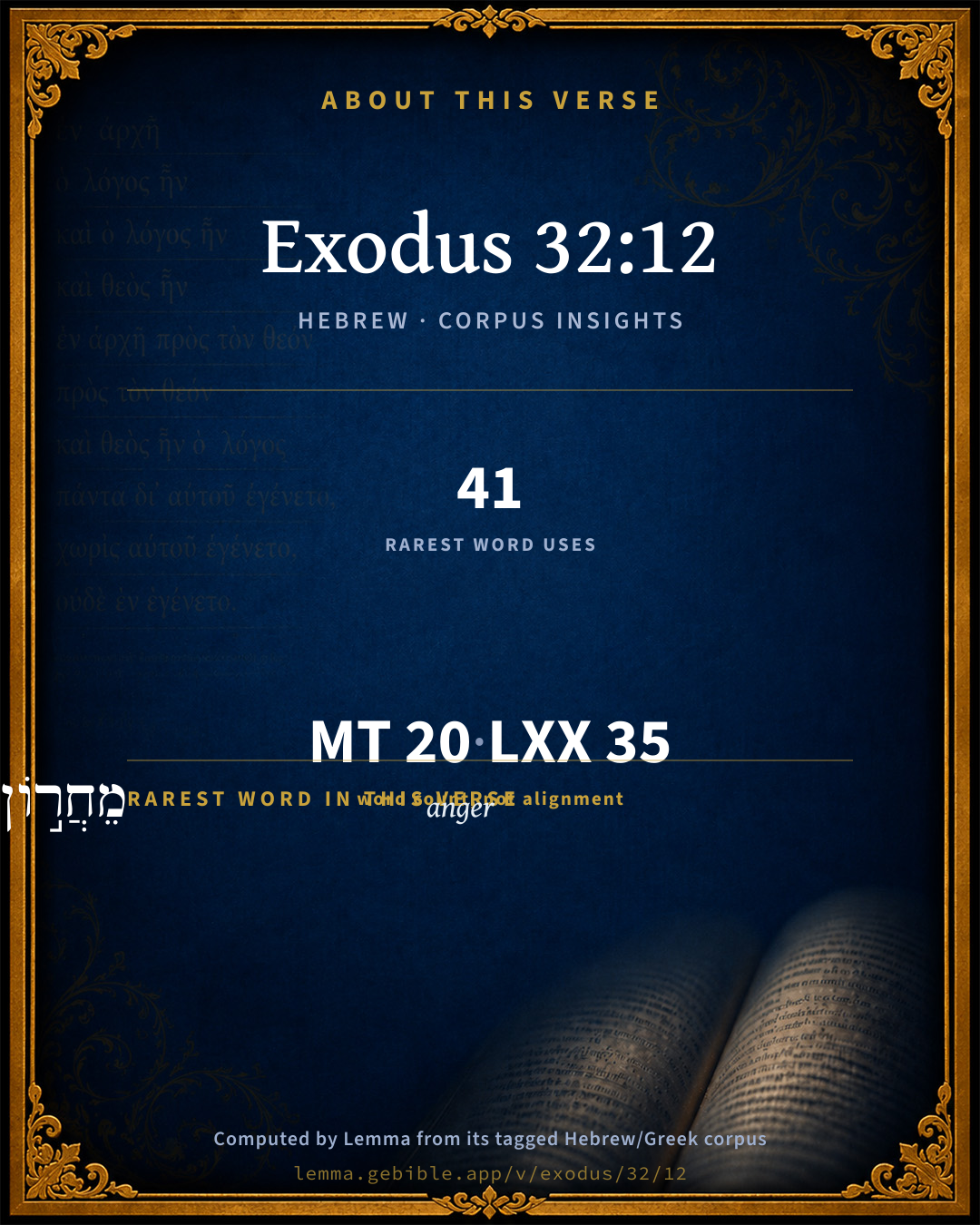
מֵחֲר֣וֹן
chârôwn
H2740
“from · anger of”
Preposition + Noun, Common, Masculine, Singular, Construct
Part of Speech
Preposition + Noun
Type
Common
Gender
Masculine
Number
Singular
State
Construct
Full BDB Definition

Origin: from H2734

TWOT: 736a

anger, heat, burning (of anger) - always used of God's anger
  1. לָמָּה֩ mâh H4100 “to/for · what” Preposition + Particle, Interrogative
  2. יֹאמְר֨וּ ʼâmar H559 “to say” Verb, Qal, Imperfect, 3rd Person, Masculine, Plural
  3. מִצְרַ֜יִם Mitsrîy H4713 “Egyptian” Noun, Proper
  4. לֵאמֹ֗ר ʼâmar H559 “to say” Preposition + Verb, Qal, Infinitive Construct
  5. בְּרָעָ֤ה raʻ H7451 “in/at · evil” Preposition + Noun, Common, Feminine, Singular, Absolute
  6. הֽוֹצִיאָם֙ yâtsâʼ H3318 “to go out · them” Verb, Hiphil, Perfect, 3rd Person, Masculine, Singular + Suffix, Personal, 3rd Person, Masculine, Plural
  7. לַהֲרֹ֤ג hârag H2026 “to kill” Preposition + Verb, Qal, Infinitive Construct
  8. אֹתָם֙ ʼêth H853 “- · them” Particle, Direct Object + Suffix, Personal, 3rd Person, Masculine, Plural
  9. בֶּֽהָרִ֔ים har H2022 “in/at the · mountains” Preposition, Determined + Noun, Common, Masculine, Plural, Absolute
  10. וּ֨לְכַלֹּתָ֔ם kâlâh H3615 “and · to finish · them” Conjunction + Preposition + Verb, Piel, Infinitive Construct + Suffix, Personal, 3rd Person, Masculine, Plural
  11. מֵעַ֖ל ʻal H5921 “from · upon” Preposition + Preposition
  12. פְּנֵ֣י pânîym H6440 “face(s) of” Noun, Common, Both, Plural, Construct
  13. הָֽאֲדָמָ֑ה ʼădâmâh H127 “the · ground” Particle, Definite Article + Noun, Common, Feminine, Singular, Absolute
  14. שׁ֚וּב shûwb H7725 “return” Verb, Qal, Imperative, 2nd Person, Masculine, Singular
  15. אַפֶּ֔ךָ ʼaph H639 “nose · your” Noun, Common, Masculine, Singular, Construct + Suffix, Personal, 2nd Person, Masculine, Singular
  16. וְהִנָּחֵ֥ם nâcham H5162 “and · comfort” Conjunction + Verb, Niphal, Imperative, 2nd Person, Masculine, Singular
  17. עַל ʻal H5921 “upon” Preposition
  18. הָרָעָ֖ה raʻ H7451 “the · evil” Particle, Definite Article + Noun, Common, Feminine, Singular, Absolute
  19. לְעַמֶּֽךָ ʻam H5971 “to/for · people · your” Preposition + Noun, Common, Masculine, Singular, Construct + Suffix, Personal, 2nd Person, Masculine, Singular

About this verse

These counts appear in no published source. They are computed here, from the morphology-tagged text and Lemma’s own curated glosses. What Lemma adds →

20
words
17
distinct lemmas
Pentateuch
section

Shared distinctive vocabulary

מֵחֲר֣וֹן anger H2740 occurs in 40 verses of the Hebrew Bible. Also found in:

Grammatical profile

  • 7 verbs
  • 9 nouns
  • 2 prepositions
  • 2 particles

Verb forms

  • יֹאמְר֨וּ Qal · Imperfect
  • לֵאמֹ֗ר Qal · Infinitive Construct
  • הֽוֹצִיאָם֙ Hiphil · Perfect
  • לַהֲרֹ֤ג Qal · Infinitive Construct
  • וּ֨לְכַלֹּתָ֔ם Piel · Infinitive Construct
  • שׁ֚וּב Qal · Imperative
  • וְהִנָּחֵ֥ם Niphal · Imperative

Repetition

Words recur within this verse — often emphatic in Hebrew:

  • יֹאמְר֨וּ to say H559 ×2
  • בְּרָעָ֤ה evil H7451 ×2
  • מֵעַ֖ל upon H5921 ×2

Hebrew & Septuagint length

In English translation the verse runs 41 words from the Hebrew and 45 from the Septuagint (LXX English) — closely comparable.

A rough comparison of the two English renderings, which tokenize alike — not a word-level alignment.

Word counts can differ between the Hebrew and the Greek without any difference in meaning — e.g. the Hebrew direct-object marker אֵת has no separate Greek word, and Greek often adds the article ὁ.

In the original languages it is 20 Hebrew tokens and 35 Greek tokens — but the two are counted differently (Hebrew bundles its prefixes and suffixes into one token; the Greek is in lemma form), so that isn’t a like-for-like length.

Cross-references

23

Topical passages linked to Exodus 32:12 in the Treasury of Scripture Knowledge — connected by theme and wording, ordered by reader-vote popularity; previews shown in the World English Bible.

  • Numbers 14:13–16 Moses said to Yahweh, Then the Egyptians will hear it; for you brought up this people in your might from among them;
  • Deuteronomy 9:28 lest the land whence you brought us out say, Because Yahweh was not able to bring them into the land which he promised to them, and because he hated them, he has brought them out to kill them in the wilderness.
  • Exodus 32:14 Yahweh repented of the evil which he said he would do to his people.
  • Joshua 7:9 For the Canaanites and all the inhabitants of the land will hear of it, and will compass us round, and cut off our name from the earth: and what will you do for your great name?
  • Genesis 6:6 Yahweh was sorry that he had made man on the earth, and it grieved him in his heart.
  • Deuteronomy 13:17 There shall cleave nothing of the devoted thing to your hand; that Yahweh may turn from the fierceness of his anger, and show you mercy, and have compassion on you, and multiply you, as he has sworn to your fathers;
  • Deuteronomy 32:26–27 I said, I would scatter them afar, I would make the memory of them to cease from among men;
  • Deuteronomy 32:36 For Yahweh will judge his people, Repent himself for his servants; When he sees that [their] power is gone, There is none [remaining], shut up or left at large.
  • Joshua 7:26 They raised over him a great heap of stones, to this day; and Yahweh turned from the fierceness of his anger. Therefore the name of that place was called "The valley of Achor" to this day.
  • Ezra 10:14 Let now our princes be appointed for all the assembly, and let all those who are in our cities who have married foreign women come at appointed times, and with them the elders of every city, and the judges of it, until the fierce wrath of our God be turned from us, until this matter be dispatched.
  • Psalms 74:18 Remember this, that the enemy has mocked you, Yahweh. Foolish people have blasphemed your name.
  • Psalms 78:38 But he, being merciful, forgave iniquity, and didn't destroy them. Yes, many times he turned his anger away, And didn't stir up all his wrath.
  • Psalms 79:9–10 Help us, God of our salvation, for the glory of your name. Deliver us, and forgive our sins, for your name's sake.
  • Psalms 85:3 You have taken away all your wrath. You have turned from the fierceness of your anger.
  • Psalms 90:13 Relent, Yahweh! How long? Have compassion on your servants!
  • Psalms 106:45 He remembered for them his covenant, And repented according to the multitude of his loving kindnesses.
  • Ezekiel 20:9 But I worked for my name's sake, that it should not be profaned in the sight of the nations, among which they were, in whose sight I made myself known to them, in bringing them forth out of the land of Egypt.
  • Ezekiel 20:14 But I worked for my name's sake, that it should not be profaned in the sight of the nations, in whose sight I brought them out.
  • Ezekiel 20:22 Nevertheless I withdrew my hand, and worked for my name's sake, that it should not be profaned in the sight of the nations, in whose sight I brought them forth.
  • Amos 7:3 Yahweh relented concerning this. "It shall not be," says Yahweh.
  • Amos 7:6 Yahweh relented concerning this. "This also shall not be," says the Lord Yahweh.
  • Jonah 3:9 Who knows whether God will not turn and repent, and turn away from his fierce anger, so that we might not perish?"
  • Zechariah 8:14 For thus says Yahweh of hosts: "As I thought to do evil to you, when your fathers provoked me to wrath," says Yahweh of Hosts, "and I didn't repent;

Cross-references courtesy of OpenBible.info (CC BY 4.0).

Hebrew and Greek witnesses Masoretic Hebrew ↔ Greek Septuagint

The same verse in the two great witnesses to the Old Testament, shown verse-for-verse.

These are two independent witnesses, not word-aligned to each other, and the Septuagint is shown in lemma (dictionary) form.

Hebrew Exodus 32:12 Masoretic · Westminster Leningrad Codex

לָמָּה֩ יֹאמְר֨וּ מִצְרַ֜יִם לֵאמֹ֗ר בְּרָעָ֤ה הֽוֹצִיאָם֙ לַהֲרֹ֤ג אֹתָם֙ בֶּֽהָרִ֔ים וּ֨לְכַלֹּתָ֔ם מֵעַ֖ל פְּנֵ֣י הָֽאֲדָמָ֑ה שׁ֚וּב מֵחֲר֣וֹן אַפֶּ֔ךָ וְהִנָּחֵ֥ם עַל הָרָעָ֖ה לְעַמֶּֽךָ

Why should the Egyptians speak, saying, 'He brought them forth for evil, to kill them in the mountains, and to consume them from the surface of the earth?' Turn from your fierce wrath, and repent of this evil against your people.

World English Bible · Public Domain

Greek LXX Exodus 32:12 Septuagint · lemma form

μήποτε εἶπον ὁ αἰγύπτιος λέγω μετά πονηρία ἐκἄγω αὐτός ἀποκτείνω ἐν ὁ ὄρος καί ἐκ ἀναἁλίσκω αὐτός ἀπό ὁ γῆ παύω ὁ ὀργή ὁ θυμός σύ καί ἵλεως γίγνομαι ἐπί ὁ κακία ὁ λαός σύ

Take heed lest at any time the Egyptians speak, saying, With evil intent he brought them out to kill them in the mountains, and to consume them from off the earth; cease from your wrathful anger, and be merciful to the sin of your people,

LXX2012 (modern English Septuagint) · Public Domain

Hebrew: Westminster Leningrad Codex (CC BY 4.0). Greek: Septuagint (public domain); English from LXX2012 (modern English Septuagint) (Public Domain). How the Septuagint differs from the Hebrew →

Targum (Aramaic paraphrase)

2

The Targum is the ancient Jewish Aramaic paraphrase of the Hebrew Scriptures — an interpretive translation, not the Hebrew text itself. Onkelos (literal) and Pseudo-Jonathan (expansive) render the Torah, and Jonathan the Prophets. Coverage is partial: where no permissively-licensed English translation exists for a verse, only the Aramaic is shown. This is verse-level text, not a word-by-word alignment to the Hebrew.

  1. Targum Onkelos Torah (Genesis–Deuteronomy)
    לְמָא יֵימְרוּן מִצְרָאֵי לְמֵימַר בְּבִישְׁתָּא אַפֶּקְתִּנוּן לְקַטָלָא יָתְהוֹן בֵינֵי טוּרַיָא וּלְשֵׁיצָיוּתְהוֹן מֵעַל אַפֵּי אַרְעָא תּוּב מִתְּקוֹף רוּגְזָךְ וְאָתֵיב מִן בִּשָׁתָא דְמַלֶלְתָּא לְמֶעְבַּד לְעַמָךְ:

    (no public-domain English translation for this verse)

    Targum Onkelos — Aramaic: “Onkelos Genesis” (public domain); “Onkelos Exodus” (public domain); “Onkelos Leviticus” (public domain); “Onkelos Numbers” (public domain); “Onkelos Deuteronomy” (public domain). English: “Sefaria Community Translation” (CC0 1.0 (public-domain dedication)); “J.W. Etheridge. The Targums of Onkelos and Jonathan Ben Uzziel on the Pentateuch. London: Longmans, Green, 1862” (public domain). Text via Sefaria.

  2. Targum Pseudo-Jonathan Torah (Genesis–Deuteronomy)
    לְמָא דֵין יֵימְרוּן מִצְרָאֵי דְמִשְׁתַּיְירִין לְמֵימָר בְּבִישָׁא אַנְפֵּיקִינוּן לְקַטְלָא יַתְהוֹן בֵּינֵי טַוְורַיָא תָּבוֹר וְחֶרְמוֹן וְשִירְיוֹן וְסִינַי וּבְגִין לְשֵׁיצָאָה יַתְהוֹן מֵעַל אַנְפֵּי אַרְעָא תּוּב מִתְקוֹף רוּגְזָךְ וִיהֱוֵי תוֹהוּ קֳדָמָךְ עַל בִּישְׁתָּא דְמַלֵּילַת לְמֶעְבַּד לְעַמָּךְ

    Why should the Mizraee who are remaining say, It was for evil that He led them out, to kill them among the mountains of Tabor and Hermon, and Sirion and Sinai, and to destroy them from the face of the earth? Turn from Thy strong anger, and let there be relenting before Thee over the evil that Thou hast threatened to do unto Thy people.

    Targum Pseudo-Jonathan — Aramaic: “Targum Jonathan on Genesis” (public domain); “Targum Jonathan on Exodus” (public domain); “Targum Jonathan on Leviticus” (public domain); “Targum Jonathan on Numbers” (public domain); “Targum Jonathan on Deuteronomy” (public domain). English: “The Targum of Jonathan ben Uzziel, trans. J. W. Etheridge, London, 1862” (public domain). Text via Sefaria.

Commentary

Notes on Exodus 32:12 from classic Christian and Jewish commentators (each source and its license shown beneath its notes). The classic Christian expositions comment on the surrounding passage and are grouped to its opening verse, so a note may address several verses; the Jewish commentaries on the Tanakh (Rashi and others) are per-verse, so they appear only where the commentator wrote on this verse.

Lemma curates 59 commentaries, every one of them public domain or Creative Commons licensed, each selected and text-cleaned for this edition rather than reprinted as found. About our sources →

Trapp's Complete Commentary

John Trapp

Exo 32:12 Wherefore should the Egyptians speak, and say, For mischief did he bring them out, to slay them in the mountains, and to consume them from the face of the earth? Turn from thy fierce wrath, and repent of this evil against thy people.

Ver. 12. Repent of this evil.] God’s repenting is mutatio rei, non Dei; effectus, non affectus; facti, non consilii; not a change of his will, but of his work.

John Trapp, A Commentary or Exposition upon All the Books of the Old and New Testament (1647–1656) — public domain. Text from a community e-Sword module.

Joseph Benson's Commentary

Exo 32:12-13. Turn from thy fierce wrath — Not as if he thought God were not justly angry, but he begs that he would not be so greatly angry as to consume them. Let mercy rejoice against judgment; repent of this evil — Change the sentence of destruction into that of correction; against thy people — Which thou broughtest up out of Egypt, for whom thou hast done so great things. Wherefore should the Egyptians say, For mischief did he bring them out — Israel is dear to Moses, as his kindred, as his charge; but it is the glory of God that he is most concerned for. If Israel could perish without any reproach to God’s name, Moses could persuade himself to sit down contented; but he cannot bear to hear God reflected on; and therefore this he insists upon, Lord, what will the Egyptians say? They will say, God was either weak, and could not, or fickle, and would not complete the salvation he begun. Remember Abraham — Lord, if Israel be cut off, what will become of the promise?

Joseph Benson's Commentary on the Old and New Testaments (1811–1818) — public domain. Text from a community e-Sword module.

Geneva Bible (1599)

Geneva Bible translators

Or, blaspheme.

Or, repent.

Geneva Bible (1599) marginal notes — public domain. Text via Bolls.life.

The Cambridge Bible for Schools and Colleges

gen. ed. J. J. S. Perowne

12. For evil] i.e. with an evil purpose. Cf. Deu_9:28 b.

the mountains] viz. of the Sinaitic Peninsula.

The Cambridge Bible for Schools and Colleges (gen. ed. J. J. S. Perowne; Cambridge University Press, 1878–1918) — public domain. Text from a community e-Sword module.

John Gill's Exposition

Wherefore should the Egyptians speak and say,.... Those that remained, as the Targum of Jonathan, who were not drowned in the Red sea: a good man will be concerned for the honour and glory of God among the enemies of his people, that their mouths may not be opened to blaspheme the Lord and speak ill of his ways, see Jos 7:9 and this is sometimes an argument with God himself, not to do that to his people they deserve, lest it should give occasion to the enemy to speak reproachfully, insult, and triumph, Deu 32:26.

for mischief did he bring them out, to slay them in the mountains, and to consume them from the face of the earth; that he brought them out of Egypt, not with a good but ill design; not to bring them into the land of Canaan, as they promised themselves, but to destroy them in the mountains; not to erect them into a great kingdom and nation, which should make a considerable figure in the world, but to cut them off from being a people at all: the mountains where they now were, were Sinai and Horeb, and there might be others thereabout, among which they were encamped: the Targum of Jonathan is,"among the mountains of Tabor, and Hermon, and Sirion, and Sinai:"

turn from thy fierce wrath, and repent of this evil against thy people; not that there is any turning or shadow of turning with God, or any change of his mind, or any such passions and affections in him as here expressed; but this is said after the manner of men concerning him, when he alters the course of his dealings with men according to his unalterable will, and does not do the evil threatened by him, and which the sins of men deserve.

John Gill's Exposition of the Whole Bible (1746–1763) — public domain (CC PDM 1.0). Text via the HelloAO Bible API.

Haydock's Catholic Bible Commentary

Craftily. Hebrew, "with a malicious design." Moses insinuates, that the glory of God is interested not to punish the Hebrews, lest the Gentiles should blaspheme, particularly as the land of Chanaan seemed to be promised unconditionally to the posterity of Abraham, who were now, all but one, to be exterminated. (Haydock)

George Leo Haydock (1774–1849), Haydock's Catholic Family Bible and Commentary, 1859 edition — public domain. Excludes Psalms (Douay-Rheims chapter numbering differs from Protestant) and Deuterocanonical books (Catholic canon only).

Matthew Poole's English Annotations

In the mountains, i.e. in or at Mount Sinai, the plural number for the singular; or, in this mountainous desert.

Matthew Poole's English Annotations on the Holy Bible (1683–1685) — public domain. Text from a community e-Sword/MySword module.

John Wesley's Explanatory Notes

Turn from thy fierce wrath - Not as if he thought God were not justly angry, but he begs that he would not be so greatly angry as to consume them. Let mercy rejoice against judgment; repent of this evil - Change the sentence of destruction into that of correction, against thy people which thou broughtest up out of Egypt - For whom thou hast done so great things? Wherefore should the Egyptians say, For mischief did he bring them out - Israel is dear to Moses, as his kindred, as his charge; but it is the glory of God that he is most concerned for. If Israel could perish without any reproach to God's name, Moses could persuade himself to sit down contented; but he cannot bear to hear God reflected on; and therefore this he insists upon, Lord, What will the Egyptians say? They will say, God was either weak, and could not, or fickle, and would not compleat the salvation he begun.

John Wesley, Explanatory Notes Upon the Whole Bible (1754–1765) — public domain. Text via the GEBible commentary corpus.

Scofield Reference Notes

C. I. Scofield

repent

(See Scofield "Zec 8:14").

The Scofield Reference Bible (1917 edition), notes by C. I. Scofield — public domain. Text from a community e-Sword module.

unfoldingWord translationNotes

Door43 World Missions Community

General Information:

Moses continues to reason with God not to destroy Israel.

Why should the Egyptians say, 'He led them out ... to destroy them from the face of the earth?'

Moses used this question to try to persuade God not to destroy his people. This rhetorical question can be translated with a statement. AT: If you destroy your people, the Egyptians might say, 'He led them out ... to destroy them from the face of the earth.' (See: Rhetorical Question)

face of the earth

"from the surface of the earth" or "from the earth"

Turn from your burning anger

"Stop your burning anger" or "Stop being so angry"

your burning anger

Moses speaks of God's anger as if it were a fire that was burning. AT: "your terrible anger" (See: Metaphor)

Call to mind Abraham

"Remember Abraham" or "Think about Abraham"

you swore

"you made an oath" or "you solemnly promised"

They will inherit it forever

God speaks about them possessing the land as if they would inherit it. AT: "They will possess it forever" (See: Metaphor)

translationWords

evil

face

Abraham

Isaac

Isaac

Jacob

servant

oath

descend

inherit

eternity

unfoldingWord translationNotes — © Distant Shores Media and the Door43 World Missions Community, licensed CC BY-SA 4.0. Source: git.door43.org/Door43/en_tn.

Rashi

Rabbi Shlomo Yitzchaki (Rashi)

והנחם AND REPENT — form another resolution, viz., to do them good,

על הרעה INSTEAD OF THE EVIL You have thought to bring upon them.

Rashi on the Tanakh — English translations: “The Judaica Press complete Tanach with Rashi, translated by A. J. Rosenberg” (CC BY 4.0); “Pentateuch with Rashi's commentary by M. Rosenbaum and A.M. Silbermann, 1929-1934” (public domain); “The Metsudah Tanach series, Lakewood, N.J” (CC BY 4.0); and “The Book of Joshua, Metsudah Publications, 1997” (CC BY 4.0). Text via Sefaria.

Lesson kit

Teaching starters — assembled from the data on this page, not authored interpretation. Every prompt links to the verse data it draws on. Edit before teaching.

Exodus, in the Pentateuch, opens this verse with 20 words (17 distinct Hebrew lemmas). Its most distinctive word is chârôwn (“anger”). A historical commentator’s framing appears above. Read the whole chapter for the surrounding context.

Discussion questions

  1. The word chârôwn carries the sense “anger.” How does it shape the verse?
  2. Exodus 15:7 shares the word «anger» with this verse. How do the two illuminate each other?
  3. “to say” occurs 2× in this one verse. What is the effect of the repetition?
  4. These translations render this verse differently. What is at stake in choosing one wording over another?
  5. The verb «יֹאמְר֨וּ» is Qal Imperfect. How does its form color the action?
  6. Reading how Trapp's Complete Commentary and Joseph Benson's Commentary read this verse, where do the two commentators agree and where do they part?

Things to notice

Reading settings

Reading text

Shown beneath each verse's original-language words.

Old Testament
Old Testament edition

Read the OT as the Masoretic Hebrew (MT) or the Greek Septuagint (LXX).

English shown for the Greek Septuagint (in the Hebrew ↔ Greek comparison).

Comparing translations? Open the Compare panel on any verse page to stack up to four side by side.