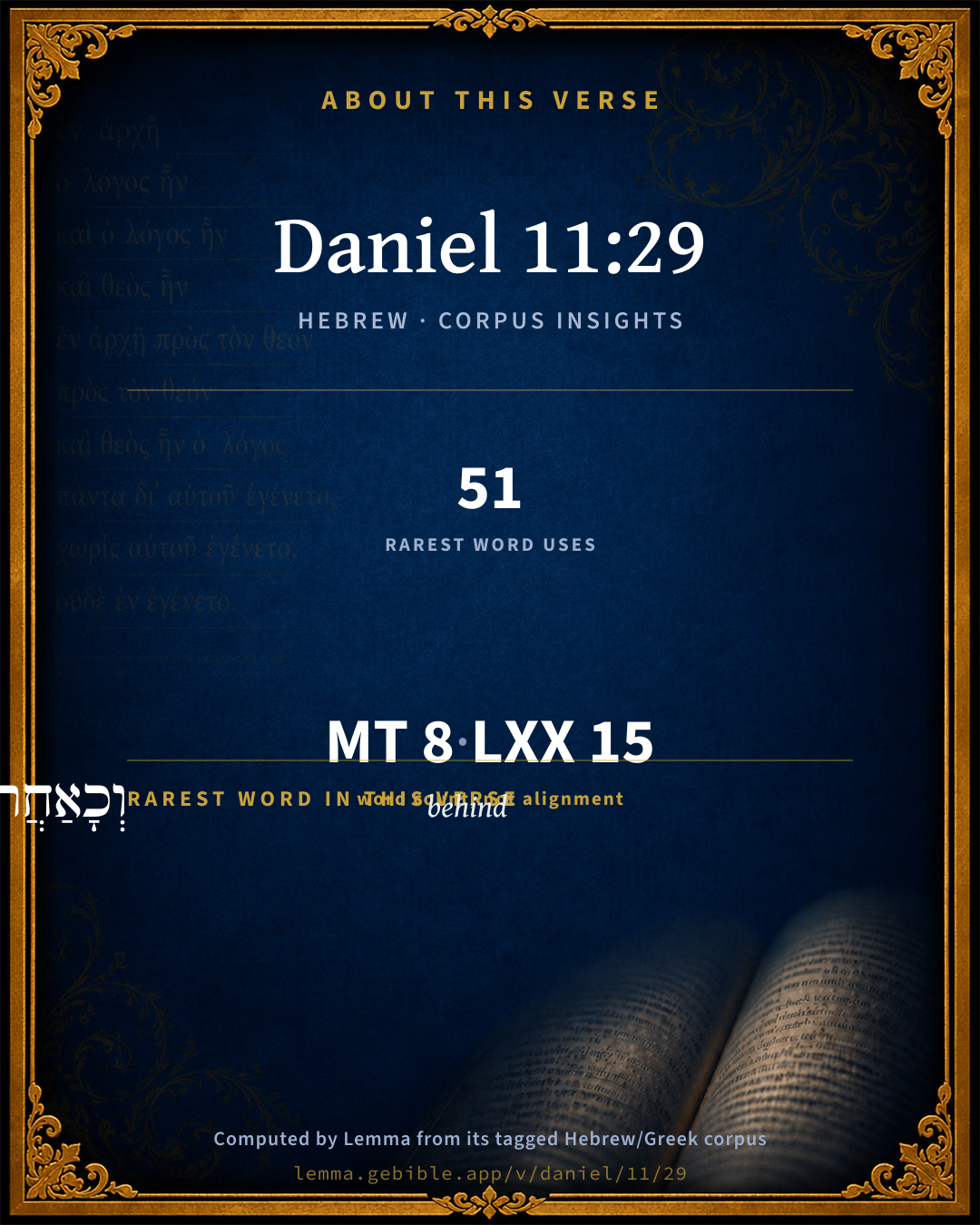
Daniel 11:29

Hebrew (Westminster Leningrad Codex) Daniel 11:29 appears in the Hebrew Old Testament. The text above is from the Westminster Leningrad Codex. Each word links to its Strong’s number, a concise gloss, and parsing drawn from the Open Scriptures Hebrew Bible morphology. Click any word for its full Brown-Driver-Briggs (BDB) entry.
Download image
Cite this verse

Daniel 11:29 (World English Bible). Public Domain. Lemma interlinear Bible study tool, https://lemma.gebible.app/v/daniel/11/29.

Show BibTeX & RIS
BibTeX
RIS
English Translation
At the time appointed he shall return, and come into the south; but it shall not be in the latter time as it was in the former.
World English Bible · Public Domain
Download a study sheet

One document with this verse’s original text, its word-by-word gloss line, the meaning frame, cross-references with their text, attributed commentary, and full source and license credits — printable, and it pastes into notes with its structure intact.

This verse Autodidact and up

Study sheet (.html) Plain text (.txt)

A passage Seminary Student

Up to 50 verses in one chapter. A passage sheet keeps up to 6 commentary sources and 12 cross-references per verse, in the order this page ranks them, and says so on the sheet whenever that leaves anything out. Ask for a single verse and you get the Autodidact verse sheet above.

Everything on this page stays free to read, with no account — the sheet is a download of what is already on screen, not access to it.

Want to remove ads? Support Godless Engineer
Compare translations 3

The same verse in 3 English versions, stacked beneath the original-language interlinear above. Click any original word for its lexicon entry.

Each is an independent rendering of the whole verse — the interlinear is not word-aligned to these translations.

Highlighted words mark where these versions differ — a whole-verse word diff, not a word-by-word alignment.

  • World English Bible Public Domain
    At the time appointed he shall return, and come into the south; but it shall not be in the latter time as it was in the former.
  • King James Version Public Domain
    At the time appointed he shall return, and come toward the south; but it shall not be as the former, or as the latter.
  • unfoldingWord Literal Text CC BY-SA 4.0
    At the appointed time he will return and come into the South. But this last time it will not be as before.

unfoldingWord Literal Text — © unfoldingWord, licensed CC BY-SA 4.0. Word-aligned USFM3 via Door43 (git.door43.org/unfoldingWord/en_ult).

Versions to compare (up to 4)

3 of 4 selected

Show all 18 translations

Every available English version of this verse, each an independent rendering of the whole verse.

  • World English Bible Public Domain
    At the time appointed he shall return, and come into the south; but it shall not be in the latter time as it was in the former.
  • Berean Standard Bible Public Domain
    At the appointed time he will invade the South again, but this time will not be like the first.
  • Majority Standard Bible Public Domain
    At the appointed time he will invade the South again, but this time will not be like the first.
  • King James Version Public Domain
    At the time appointed he shall return, and come toward the south; but it shall not be as the former, or as the latter.
  • American Standard Version (1901) Public Domain
    At the time appointed he shall return, and come into the south; but it shall not be in the latter time as it was in the former.
  • Revised Version (1885) Public Domain
    At the time appointed he shall return, and come into the south; but it shall not be in the latter time as it was in the former.
  • Geneva Bible (1599) Public Domain
    At the time appointed he shall returne, and come toward the South: but the last shall not be as the first.
  • Douay-Rheims (1899) Public Domain
    At the time appointed he shall return, and he shall come to the south, but the latter time shall not be like the former.
  • Young's Literal Translation Public Domain
    At the appointed time he turneth back, and hath come against the south, and it is not as the former, and as the latter.
  • Literal Standard Version CC BY-SA 4.0
    At the appointed time he turns back, and has come against the south, and it is not as the former, and as the latter.
  • Unlocked Literal Bible CC BY-SA 4.0
    At the appointed time he will return and come against the South again. But this time it will not be as before.
  • unfoldingWord Literal Text CC BY-SA 4.0
    At the appointed time he will return and come into the South. But this last time it will not be as before.
  • Darby Bible Public Domain
    At the set time he shall return, and come towards the south; but not as the former time shall be the latter;
  • World Messianic Bible Public Domain
    “He will return at the appointed time and come into the south; but it won’t be in the latter time as it was in the former.
  • Webster's Bible Public Domain
    At the time appointed he shall return, and come towards the south; but it shall not be as the former, or as the latter.
  • Free Bible Version CC BY-SA 4.0
    At the time predicted he will return to invade the south again, but this time it won't be like before.
  • Bible in Basic English Public Domain
    At the time fixed he will come back and come into the south; but in the later time it will not be as it was before.
  • JPS Tanakh (1917) Public Domain
    At the time appointed he shall return, and come into the south; but it shall not be in the latter time as it was in the former.

Literal Standard Version (2020), Covenant Press — licensed CC BY-SA 4.0. Text via the HelloAO Bible API (eBible.org). Unlocked Literal Bible (unfoldingWord) — licensed CC BY-SA 4.0. Text via the HelloAO Bible API (eBible.org). unfoldingWord Literal Text — © unfoldingWord, licensed CC BY-SA 4.0. Word-aligned USFM3 via Door43 (git.door43.org/unfoldingWord/en_ult). Free Bible Version, Dr. Jonathan Gallagher — licensed CC BY-SA 4.0. Text via the HelloAO Bible API (eBible.org).

Word by word

More ways to search: Search by grammar → Find every occurrence → Compare this word →

Practice this passage: Drill this verse → Learn its vocabulary →

וְכָאַחֲרֹנָֽה
ʼachărôwn
H314
“and · like/as the · behind”
Conjunction + Preposition, Determined + Adjective, Adjective, Feminine, Singular, Absolute
Part of Speech
Conjunction + Preposition + Adjective
Type
Adjective
Gender
Feminine
Number
Singular
State
Absolute
Full BDB Definition

Origin: from H309

TWOT: 68e

behind, following, subsequent, western - behind, hindermost, western (of location) - later, subsequent, latter, last (of time)
  1. לַמּוֹעֵ֥ד môwʻêd H4150 “to/for the · appointed time” Preposition, Determined + Noun, Common, Masculine, Singular, Absolute
  2. יָשׁ֖וּב shûwb H7725 “to return” Verb, Qal, Imperfect, 3rd Person, Masculine, Singular
  3. וּבָ֣א bôwʼ H935 “and · to enter” Conjunction + Verb, Qal, Sequential Perfect, 3rd Person, Masculine, Singular
  4. בַנֶּ֑גֶב negeb H5045 “in/at the · south” Preposition, Determined + Noun, Common, Masculine, Singular, Absolute
  5. וְלֹֽא lôʼ H3808 “and · not” Conjunction + Particle, Negative
  6. תִהְיֶ֥ה hâyâh H1961 “to be” Verb, Qal, Imperfect, 3rd Person, Feminine, Singular
  7. כָרִאשֹׁנָ֖ה riʼshôwn H7223 “like/as the · first” Preposition, Determined + Adjective, Ordinal number, Feminine, Singular, Absolute

About this verse

These counts appear in no published source. They are computed here, from the morphology-tagged text and Lemma’s own curated glosses. What Lemma adds →

8
words
8
distinct lemmas
Prophets
section

Shared distinctive vocabulary

וְכָאַחֲרֹנָֽה behind H314 occurs in 48 verses of the Hebrew Bible. Also found in:

Grammatical profile

  • 3 verbs
  • 2 nouns
  • 2 adjectives
  • 1 particle

Verb forms

  • יָשׁ֖וּב Qal · Imperfect
  • וּבָ֣א Qal · Sequential Perfect
  • תִהְיֶ֥ה Qal · Imperfect

Hebrew & Septuagint length

In English translation the verse runs 27 words from the Hebrew and 23 from the Septuagint (LXX English) — closely comparable.

A rough comparison of the two English renderings, which tokenize alike — not a word-level alignment.

Word counts can differ between the Hebrew and the Greek without any difference in meaning — e.g. the Hebrew direct-object marker אֵת has no separate Greek word, and Greek often adds the article ὁ.

In the original languages it is 8 Hebrew tokens and 15 Greek tokens — but the two are counted differently (Hebrew bundles its prefixes and suffixes into one token; the Greek is in lemma form), so that isn’t a like-for-like length.

Cross-references

7

Topical passages linked to Daniel 11:29 in the Treasury of Scripture Knowledge — connected by theme and wording, ordered by reader-vote popularity; previews shown in the World English Bible.

  • Isaiah 14:31 Howl, gate; cry, city; you are melted away, Philistia, all of you; for there comes a smoke out of the north, and there is no straggler in his ranks.
  • Daniel 8:19 He said, Behold, I will make you know what shall be in the latter time of the indignation; for it belongs to the appointed time of the end.
  • Daniel 10:1 In the third year of Cyrus king of Persia a thing was revealed to Daniel, whose name was called Belteshazzar; and the thing was true, even a great warfare: and he understood the thing, and had understanding of the vision.
  • Daniel 11:23 After the league made with him he shall work deceitfully; for he shall come up, and shall become strong, with a small people.
  • Daniel 11:25 He shall stir up his power and his courage against the king of the south with a great army; and the king of the south shall war in battle with an exceeding great and mighty army; but he shall not stand; for they shall devise devices against him.
  • Acts 17:26 He made from one blood every nation of men to dwell on all the surface of the earth, having determined appointed seasons, and the boundaries of their dwellings,
  • Galatians 4:2 but is under guardians and stewards until the day appointed by the father.

Cross-references courtesy of OpenBible.info (CC BY 4.0).

Hebrew and Greek witnesses Masoretic Hebrew ↔ Greek Septuagint

The same verse in the two great witnesses to the Old Testament, shown verse-for-verse.

These are two independent witnesses, not word-aligned to each other, and the Septuagint is shown in lemma (dictionary) form.

Hebrew Daniel 11:29 Masoretic · Westminster Leningrad Codex

לַמּוֹעֵ֥ד יָשׁ֖וּב וּבָ֣א בַנֶּ֑גֶב וְלֹֽא תִהְיֶ֥ה כָרִאשֹׁנָ֖ה וְכָאַחֲרֹנָֽה

At the time appointed he shall return, and come into the south; but it shall not be in the latter time as it was in the former.

World English Bible · Public Domain

Greek LXX Daniel 11:29 Septuagint · lemma form

εἰς καιρός καί εἰςἔρχομαι εἰς αἴγυπτος καί οὐ εἰμί ὡς ὁ πρῶτος καί ὁ ἔσχατος

At the set time he shall return, and shall come into the south, but the last expedition shall not be as the first.

LXX2012 (modern English Septuagint) · Public Domain

On this verse, The Pulpit Commentary discusses the Septuagint’s reading. Read the note in Commentary ↓

Hebrew: Westminster Leningrad Codex (CC BY 4.0). Greek: Septuagint (public domain); English from LXX2012 (modern English Septuagint) (Public Domain). How the Septuagint differs from the Hebrew →

Commentary

Notes on Daniel 11:29 from classic Christian and Jewish commentators (each source and its license shown beneath its notes). The classic Christian expositions comment on the surrounding passage and are grouped to its opening verse, so a note may address several verses; the Jewish commentaries on the Tanakh (Rashi and others) are per-verse, so they appear only where the commentator wrote on this verse.

Lemma curates 59 commentaries, every one of them public domain or Creative Commons licensed, each selected and text-cleaned for this edition rather than reprinted as found. About our sources →

Trapp's Complete Commentary

John Trapp

Dan 11:29 At the time appointed he shall return, and come toward the south; but it shall not be as the former, or as the latter.

Ver. 29. At the time appointed.] After two years.

And come toward the south.] Toward Egypt. { 1Ma 1:29}

But it shall not be as the former.] Expedition, Dan 11:25.

Or as the latter.] Mentioned Dan 11:40. God oft crosseth the wicked in the height of their hopes. {Job 20:6}

John Trapp, A Commentary or Exposition upon All the Books of the Old and New Testament (1647–1656) — public domain. Text from a community e-Sword module.

Joseph Benson's Commentary

Dan 11:29-30. At the time appointed — Namely, by God. At the time determined by the divine providence, he shall return and come toward the south — He shall march into Egypt again. Antiochus perceiving that his fine-woven policy was unravelled, and that the two brothers, Philometor and Euergetes, instead of wasting and ruining each other in war, had laid aside their mutual dissensions, and provided for their common safety and interest by making peace, and agreeing to reign jointly, was so offended, that he prepared war much more eagerly and maliciously against both than he had before against one of them. Early, therefore, in the spring he set forward with his army, and passing through Cœlosyria, came into Egypt; and the inhabitants of Memphis submitting to him, he came by easy marches down to Alexandria. But it shall not be as the former — That is, this expedition shall not be so successful as his former ones: for the ships of Chittim shall come against him — That is, the ships which brought the Roman ambassadors, namely, Popilius Lænas and his companions; who came from Italy, touched at Greece, and arrived in Egypt, at the supplication of the Ptolemies, to command a peace between the contending kings: see an account of this matter in the note on Dan 8:23. The reason of the Romans acting in this imperious manner, and of Antiochus so readily obeying, was, as Polybius suggests, the total conquests that Æmilius the Roman consul had just made of the kingdom of Macedonia. Therefore he shall be grieved and return — It was a great mortification to Antiochus to be so humbled, and so disappointed of his expected prey. He led back his forces into Syria, says Polybius, grieved and groaning, but thinking it expedient to yield to the times for the present. And have indignation against the holy covenant — Or, the law of God. Antiochus being disappointed in his designs upon Egypt, vented all his fury upon the Jews; for he detached Apollonius with an army of twenty-two thousand men, who coming to Jerusalem slew great multitudes, plundered the city, set fire to it in several places, and pulled down the houses and walls round about it. Then they built, on an eminence in the city of David, a strong fortress, which might command the temple; and issuing from thence they fell upon those who came to worship, and shed innocent blood on every side of the sanctuary, and defiled it; so that the temple was deserted and the whole service omitted; the city was forsaken of its natives, and became a habitation of strangers. So shall he do, he shall even return, &c. — After his return to Antioch, he published a decree which obliged all persons, upon pain of death, to conform to the religion of the Greeks; and so the Jewish law was abrogated, the heathen worship was set up in its stead, and the temple itself was consecrated to Jupiter Olympus. In the transacting of these matters he had intelligence with them that forsook the holy covenant — Namely, Menelaus and the other apostate Jews of his party, who were the king’s chief instigators against their religion and country: see 1Ma 1:41-64; 2Ma 6:1-9. “It may be proper to stop here, and reflect a little, how particular and circumstantial this prophecy is concerning the kingdoms of Egypt and Syria, from the death of Alexander to the time of Antiochus Epiphanes. There is not so complete and regular a series of their kings; there is not so concise and comprehensive an account of their affairs, to be found in any author of those times. The prophecy is really more perfect than any history. No one historian hath related so many circumstances, and in such exact order of time, as the prophet hath foretold them; so that it has been necessary to have recourse to several authors, Greek and Roman, Jewish and Christian; and to collect something from one, and something from another, for the better explaining and illustrating the great variety of particulars contained in this prophecy. The prophecy indeed is wonderfully exact, not only to the time of Antiochus Epiphanes, but beyond that time.” So that we may conclude in the words of the inspired writer; No one could thus declare the times and seasons but He who hath them in his own power: see Act 1:7; and Bishop Newton.

Joseph Benson's Commentary on the Old and New Testaments (1811–1818) — public domain. Text from a community e-Sword module.

Tyndale Open Study Notes

Tyndale Open Resources

11:29-35 Antiochus IV invaded the south [Egypt] . . . once again (see Polybius, Histories 29.1). • The warships from western coastlands refers to the Romans. The Roman general Popilius Laenas drew a circle in the sand, forced Antiochus to stand inside it, and made him decide whether to return home or prepare for war with Rome before exiting the circle. Fearing the Roman fleet, Antiochus chose to withdraw and return home. He then vented his anger and humiliation against the Jews, the people of the holy covenant. He took Jerusalem in 167 BC and rewarded those who would come over to him. He polluted the altar (see Dan 8:9-14, 23-26), stopped the sacrifices, set up a statue of the Greek god Zeus in the Temple, and harassed and killed whoever refused to forsake the covenant (see 1 Maccabees 1:62-64; cp. Dan 9:27; Matt 24:15).

Tyndale Open Study Notes — © Tyndale Open Resources, licensed CC BY-SA 4.0. Text via the HelloAO Bible API.

Jamieson, Fausset & Brown

Robert Jamieson, A. R. Fausset & David Brown

At the time appointed--"the time" spoken of in Dan 11:27.

return--his second open invasion of Egypt. Ptolemy Philometer, suspecting Antiochus' designs with Physcon, hired mercenaries from Greece. Whereupon Antiochus advanced with a fleet and an army, demanding the cession to him of Cyprus, Pelusium, and the country adjoining the Pelusiac mouth of the Nile.

it shall not be as the former--not successful as the former expedition. Popilius Loenas, the Roman ambassador, met him at Eleusis, four miles from Alexandria, and presented him the decree of the senate; on Antiochus replying that he would consider what he was to do, Popilius drew a line round him with a rod and said, "I must have a reply to give to the senate before you leave this circle." Antiochus submitted, and retired from Egypt; and his fleets withdrew from Cyprus.

or as the latter--that mentioned in Dan 11:42-43 [TREGELLES]. Or, making this the third expedition, the sense is "not as the first or as the second" expeditions [PISCATOR]. Rather "not as the former, so shall be this latter" expedition [GROTIUS].

Jamieson, Fausset & Brown — Commentary Critical and Explanatory on the Whole Bible (1871) — public domain (CC PDM 1.0). Text via the HelloAO Bible API.

Adam Clarke's Commentary

Verse 29. At the time appointed he shall return] Finding that his treachery was detected, and that the two brothers had united their counsel and strength for their mutual support, he threw off the mask; and having collected a great army early in the spring, he passed through Coelesyria; entered Egypt; and the inhabitants of Memphis having submitted to him, he came by easy marches to Alexandria. But, says the prophet, "it shall not be as the former or as the latter:" he had not the same success as the former, when he overthrew the Egyptian army at Pelusium; nor as the latter, when he took Memphis, and subdued all Egypt, except Alexandria. See the reason.

Adam Clarke's Commentary on the Bible (1810–1826) — public domain. Text from a community e-Sword/MySword module.

John Calvin's Commentaries

First of all, the angel says, Antiochus should return a short time afterwards and take possession of Egypt. This was the fruit of that pretended peace and perfidious friendship which has already been mentioned. For the uncle and nephew banqueted together in mutual distrust, as the angel has already stated, and as we found in the 27th verse of this chapter. This deception was shortly afterwards dissolved, when Antiochus, without any reasonable impulse, returned to Egypt. In this way he shewed his want of nothing but an opportunity for breaking the truce, and he only delayed it for a time, because he had no wish to oppress his nephew in haste. This, then, is one point. We may take the word מועד mogned, “time,” for a period divinely predetermined; but as this explanation may seem too forced, I am contented with the common one. He shall return, then, for a time, and shall come, says he, to Egypt; but the latter exposition shall not be like the former; for the whole preparation for war which had struck such terror into Egypt should lose its effect. He had seized on a portion of the kingdom, and King Ptolemy Philometor was besieged when Publius Popilius arrived, of whom the angel will presently speak. For the cause of his return is added, —

John Calvin's Commentaries (1540-1563) — public domain. Text from the Calvin Translation Society English edition (1840s-50s) via the Christian Classics Ethereal Library (ccel.org). Calvin's coverage is partial (roughly two-thirds of the Bible); uncommented books and verses are honest gaps, never fabricated. The 19th-century editor's footnotes and remarks are omitted so the notes are faithfully Calvin's own voice.

Ellicott's Commentary for English Readers

(29) At the time appointed—i.e., in God’s own time. According to 1Ma_1:29, it was after two years were fully expired since his return to Syria that Antiochus made another attack upon Jerusalem. This attack was made after his return from Egypt.

But it shall not be.—No such success attended him at the latter as at the former invasion.

A Bible Commentary for English Readers, edited by Charles John Ellicott (1878–1897) — public domain. Text from a community e-Sword module.

The Cambridge Bible for Schools and Colleges

gen. ed. J. J. S. Perowne

29. Antiochus’ ‘third’ Egyptian expedition (b.c. 168).

the time appointed] the time fixed in the counsels of God.

but it shall not be in the latter time as in the former] this expedition will not be as successful as the previous one.

The Cambridge Bible for Schools and Colleges (gen. ed. J. J. S. Perowne; Cambridge University Press, 1878–1918) — public domain. Text from a community e-Sword module.

John Gill's Exposition

At the time appointed he shall return, and come toward the south,.... At the time appointed of God, he should return from Syria again to Egypt; which was his third expedition thither, and was occasioned by the Alexandrians setting up the brother of Ptolemy Philometor for king; wherefore he hastened to Egypt with a large army, under a pretence of restoring the deposed king; but in reality to seize the kingdom for himself (y):

but it shall not be as the former, or as the latter; this expedition should not succeed so well as the two former, as it did not; he could not carry his point, neither subdue Egypt, nor get any of the two brothers into his hands, as he had done before; the reason of which follows:

(y) See the Universal History, vol. 9. p. 282, 409.

John Gill's Exposition of the Whole Bible (1746–1763) — public domain (CC PDM 1.0). Text via the HelloAO Bible API.

Albert Barnes' Notes on the Bible

At the time appointed - In the purposes of God. See the notes at Dan 11:27. That is, at the time when God shall design to accomplish his own purposes in regard to him. The idea is, that there was a definite period in the Divine Mind in which all this was to be done, and that when this should occur Antiochus would return again to invade Egypt.

He shall return, and come toward the south - With an intention of invading Egypt. The occasion of this invasion was, that after the departure of Antiochus, leaving Ptolemy in possession of Egypt, or having professedly given up the kingdom to him, Ptolemy suspected the designs of Antiochus, and came to an agreement with his brother Physcon, that they should share the government between them, and resist Antiochus with their united power. To do this, they hired mercenary troops from Greece. Antiochus, learning this, openly threw off the mask, and prepared to invade Egypt again, 167 b.c. He sent his fleet to Cyprus to secure possession of that island, and led his army toward Egypt to subdue the two brothers, designing to annex the whole country to his dominions.

But it shall not be as the former, or as the latter - At the first invasion or the second. In these he was successful; in this he would not be. The reason of his want of success is stated in the following verse - that by the aid which the two brothers had obtained from abroad, as expressed in the next verse, they would be able to oppose him.

Albert Barnes' Notes on the Bible (1834–1885) — public domain. Text from a community e-Sword/MySword module.

Matthew Poole's English Annotations

Come toward the south, i.e. Egypt, to fight against Ptolemy and his wife Cleopatra, sister to Antiochus.

But it shall not be as the former, or as the latter; this shall not be so prosperous as the two former expeditions, but shall fail of his victory and booty.

Matthew Poole's English Annotations on the Holy Bible (1683–1685) — public domain. Text from a community e-Sword/MySword module.

Whedon's Commentary on the Bible

Daniel D. Whedon

29. It shall not be, etc. — Rather, not as the former shall be the latter. This campaign “into the south” (168 B.C.) shall not be successful as was the last (Dan_11:25-27).

Daniel D. Whedon (gen. ed.), Commentary on the Old and New Testaments (1874–1909) — public domain. Text from a community e-Sword module.

The Pulpit Commentary

At the time appointed he shall return, and come toward the south; but it shall not be as the former, or as the latter. The LXX does not differ from this materially, save that it has Egypt, as usual, for south, and asserts that the king of the north entered Egypt. Theodotion is also in practical agreement with the Massoretie text. The Peshitta is much shorter, and differs very much from the above, as well as from all the other versions, "And he shall do in the former and in the latter." There seems to have been something omitted, The Vulgate gives a different rendering of the last clause, "The last shall not be like the former." The reference is to the second expedition of Antiochus into Egypt. His two nephews, whose quarrels and rivalries he had hoped to utilize for his own purposes, were now to appearance reconciled; they agreed to a joint occupation of the throne. It is supposed this second expedition was intended, if possible, to break up this agreement.

The Pulpit Commentary (1880–1919), ed. H.D.M. Spence-Jones & Joseph S. Exell — public domain. Text from a community e-Sword module.

John Wesley's Explanatory Notes

Toward the south - Egypt, to fight against Ptolemy. But - This shall not be so prosperous as the two former expeditions, but shall fail both of his victory and booty.

John Wesley, Explanatory Notes Upon the Whole Bible (1754–1765) — public domain. Text via the GEBible commentary corpus.

Keil & Delitzsch

C. F. Keil & F. Delitzsch

In order that he might bring Egypt wholly under his power, he undertook a new expedition thither (וּבא ישׁוּב, he comes again). But this expedition, like the first, was not successful (כ־כ, as-so, cf. Jos 14:11; Eze 18:4). For the ships of Chittim come against him. כּתּים ציּים, ships the Chittaei, for כּתּים מיד צים, Num 24:24, whence the expression is derived כּתּים is Cyprus with its chief city Κίττιον (now Chieti or Chitti); see under Gen 10:4. Ships coming from Cyprus are ships which come from the west, from the islands and coasts of the Mediterranean. In 1 Macc. 1:1 and 8:5 כּתּים is interpreted of Macedonia, according to which Bertholdt and Dereser think of the Macedonian fleet with which the Roman embassy sailed to Alexandria. This much is historically verified, that the Roman embassy, led by Popillius, appeared with a fleet in Alexandria, and imperiously commanded Antiochus to desist from his undertaking against Egypt and to return to his own land (Liv. xlv. 10-12). The lxx have therefore translated these words by: καὶ ἥξουσι ̔Ρηωμαῖοι καὶ ἐχώσουσιν αὐτὸν καὶ ἐμβριμήσονται αὐτῷ, and correctly, so far as the prophecy has received the first historical accomplishment in that factum. ונכאה, he shall lose courage, is rightly explained by Jerome: non quod interierit, sed quod omnem arrogantiae perdiderit magnitudinem.

(Note: The historical facts have been briefly and conclusively brought together by Hitzig thus: "On the complaint of the Alexandrians the Roman senate sent an embassage, at the head of which was C. Popillius Laenas (Polyb. xxix. 1; Liv. xliv. 19). After being detained at Delos (Liv. xliv. 29), they set sail to Egypt after the battle at Pydna (Liv. xlv. 10). Here he met Antiochus four Roman miles from Alexandria, and presented to him the message of the senate. When Antiochus explained that he wished to lay the matter before his counsellors, Popillius described with the staff he carried on his hand a circle round the king, and commanded him to give his answer before he left this circle. Antiochus, confounded by the circumstance, submitted and withdrew from Egypt (Liv. xlv. 12; Polyb. xxix. 11; Appian, Syr. c. 66; Justin. xxxiv. 3).")

וזעם ושׁב, not: he was again enraged, for nothing is said of a previous זעם. ושׁב, and he turned round (back) from his expedition against Egypt. Since he was not able to accomplish anything against the נגב (the south), he turns his indignation against Judah to destroy the covenant people (cf. Dan 11:28). The ושׁב in Dan 11:30 resumes the ושׁב in Dan 11:30, so as further to express how he gave vent to his anger. Hitzig's interpretation of the first ושׁב of the return to Palestine, of the second, of the return from Palestine to Antiochus, is not justified. ויבן, he shall observe, direct his attention to the Jews who forsook the holy covenant, i.e., the apostate Jews, that he might by their help execute his plans against the Mosaic religion - partim ornando illos honoribus, partim illorum studiis ad patriam religionem obliterandam comparatis obsecundando, as C. B. Michaelis excellently remarks; cf. 1 Macc. 1:11-16 with 2:18.

Keil & Delitzsch — Biblical Commentary on the Old Testament (1861–1891) — public domain (CC PDM 1.0). Text via the HelloAO Bible API. (Old Testament only.)

Scofield Reference Notes

C. I. Scofield

come toward the south

Antiochus Epiphanes’ second expedition against Egypt. Stopped by the mandate of Rome, Dan 11:30, he turns against the Jews:

The Scofield Reference Bible (1917 edition), notes by C. I. Scofield — public domain. Text from a community e-Sword module.

unfoldingWord translationNotes

Door43 World Missions Community

ships of Kittim will come against him

The ships represent the army coming in those ships. AT: "an army will come from Kittim in ships in order to fight his army" (See: Metonymy)

Kittim

This may refer to a settlement on the island of Cyprus in the Mediterranean Sea. (See: How to Translate Names)

He will be furious against the holy covenant

"He will hate the holy covenant"

will show favor to those

"will act in favor for those" or "will help those"

translationWords

appoint

turn

holy

covenant

favor

forsake

unfoldingWord translationNotes — © Distant Shores Media and the Door43 World Missions Community, licensed CC BY-SA 4.0. Source: git.door43.org/Door43/en_tn.

Rashi

Rabbi Shlomo Yitzchaki (Rashi)

After a time Heb. לַמּוֹעֵד, after a time.

but this coming will not be as successful as the first one mentioned above (verse 7): “A scion of her roots will arise etc.,” in which the king of the north succeeded over the king of the south, or like the last, meaning this second time, about which we said: “and he will return to his land” with many possessions.

Rashi on the Tanakh — English translations: “The Judaica Press complete Tanach with Rashi, translated by A. J. Rosenberg” (CC BY 4.0); “Pentateuch with Rashi's commentary by M. Rosenbaum and A.M. Silbermann, 1929-1934” (public domain); “The Metsudah Tanach series, Lakewood, N.J” (CC BY 4.0); and “The Book of Joshua, Metsudah Publications, 1997” (CC BY 4.0). Text via Sefaria.

Lesson kit

Teaching starters — assembled from the data on this page, not authored interpretation. Every prompt links to the verse data it draws on. Edit before teaching.

Daniel, in the Prophets, opens this verse with 8 words (8 distinct Hebrew lemmas). Its most distinctive word is ʼachărôwn (“behind”). A historical commentator’s framing appears above. Read the whole chapter for the surrounding context.

Discussion questions

  1. How does “behind” (ʼachărôwn) shape what this verse is saying?
  2. Genesis 33:2 shares the word «behind» with this verse. How do the two illuminate each other?
  3. The translations on this page render this verse differently — a whole-verse word diff, not a word-by-word alignment. What might account for the different wordings?
  4. The verb «יָשׁ֖וּב» is Qal Imperfect. How does its form color the action?
  5. Reading how Trapp's Complete Commentary and Joseph Benson's Commentary read this verse, where do the two commentators agree and where do they part?

Things to notice

Reading settings

Reading text

Shown beneath each verse's original-language words.

Old Testament
Old Testament edition

Read the OT as the Masoretic Hebrew (MT) or the Greek Septuagint (LXX).

English shown for the Greek Septuagint (in the Hebrew ↔ Greek comparison).

Comparing translations? Open the Compare panel on any verse page to stack up to four side by side.