
Ezekiel 18:17

Hebrew (Westminster Leningrad Codex) Ezekiel 18:17 appears in the Hebrew Old Testament. The text above is from the Westminster Leningrad Codex. Each word links to its Strong’s number, a concise gloss, and parsing drawn from the Open Scriptures Hebrew Bible morphology. Click any word for its full Brown-Driver-Briggs (BDB) entry.
Download image
Cite this verse

Ezekiel 18:17 (World English Bible). Public Domain. Lemma interlinear Bible study tool, https://lemma.gebible.app/v/ezekiel/18/17.

Show BibTeX & RIS
BibTeX
RIS
English Translation
who has withdrawn his hand from the poor, who has not received interest nor increase, has executed my ordinances, has walked in my statutes; he shall not die for the iniquity of his father, he shall surely live.
World English Bible · Public Domain
Download a study sheet

One document with this verse’s original text, its word-by-word gloss line, the meaning frame, cross-references with their text, attributed commentary, and full source and license credits — printable, and it pastes into notes with its structure intact.

This verse Autodidact and up

Study sheet (.html) Plain text (.txt)

A passage Seminary Student

Up to 50 verses in one chapter. A passage sheet keeps up to 6 commentary sources and 12 cross-references per verse, in the order this page ranks them, and says so on the sheet whenever that leaves anything out. Ask for a single verse and you get the Autodidact verse sheet above.

Everything on this page stays free to read, with no account — the sheet is a download of what is already on screen, not access to it.

Want to remove ads? Support Godless Engineer
Compare translations 3

The same verse in 3 English versions, stacked beneath the original-language interlinear above. Click any original word for its lexicon entry.

Each is an independent rendering of the whole verse — the interlinear is not word-aligned to these translations.

Highlighted words mark where these versions differ — a whole-verse word diff, not a word-by-word alignment.

  • World English Bible Public Domain
    who has withdrawn his hand from the poor, who has not received interest nor increase, has executed my ordinances, has walked in my statutes; he shall not die for the iniquity of his father, he shall surely live.
  • King James Version Public Domain
    That hath taken off his hand from the poor, that hath not received usury nor increase, hath executed my judgments, hath walked in my statutes; he shall not die for the iniquity of his father, he shall surely live.
  • unfoldingWord Literal Text CC BY-SA 4.0
    That son does not oppress anyone or take interest that is too high or make too much profit for a loan, but he carries out my decrees and walks according to my statutes; that son will not die for his father’s sin: He will surely live!

unfoldingWord Literal Text — © unfoldingWord, licensed CC BY-SA 4.0. Word-aligned USFM3 via Door43 (git.door43.org/unfoldingWord/en_ult).

Versions to compare (up to 4)

3 of 4 selected

Show all 18 translations

Every available English version of this verse, each an independent rendering of the whole verse.

  • World English Bible Public Domain
    who has withdrawn his hand from the poor, who has not received interest nor increase, has executed my ordinances, has walked in my statutes; he shall not die for the iniquity of his father, he shall surely live.
  • Berean Standard Bible Public Domain
    He withholds his hand from harming the poor and takes no interest or usury. He keeps My ordinances and follows My statutes. Such a man will not die for his father’s iniquity. He will surely live.
  • Majority Standard Bible Public Domain
    He withholds his hand from harming the poor and takes no interest or usury. He keeps My ordinances and follows My statutes. Such a man will not die for his father’s iniquity. He will surely live.
  • King James Version Public Domain
    That hath taken off his hand from the poor, that hath not received usury nor increase, hath executed my judgments, hath walked in my statutes; he shall not die for the iniquity of his father, he shall surely live.
  • American Standard Version (1901) Public Domain
    that hath withdrawn his hand from the poor, that hath not received interest nor increase, hath executed mine ordinances, hath walked in my statutes; he shall not die for the iniquity of his father, he shall surely live.
  • Revised Version (1885) Public Domain
    that hath withdrawn his hand from the poor, that hath not received usury nor increase, hath executed my judgments, hath walked in my statutes; he shall not die for the iniquity of his father, he shall surely live.
  • Geneva Bible (1599) Public Domain
    Neither hath withdrawen his hand from the afflicted, nor receiued vsurie nor increase, but hath executed my iudgements, and hath walked in my statutes, he shall not die in the iniquitie of his father, but he shall surely liue.
  • Douay-Rheims (1899) Public Domain
    That hath turned away his hand from injuring the poor, hath not taken usury and increase, but hath executed my judgments, and hath walked in my commandments: this man shall not die for the iniquity of his father, but living he shall live.
  • Young's Literal Translation Public Domain
    From the afflicted he hath turned back his hand, Usury and increase he hath not taken, My judgments he hath done, In My statutes he hath walked, He doth not die for the iniquity of his father, He doth surely live.
  • Literal Standard Version CC BY-SA 4.0
    He has turned back his hand from the afflicted, || He has not taken usury and increase, || He has done My judgments, || He has walked in My statutes, || He does not die for the iniquity of his father, || He surely lives.
  • Unlocked Literal Bible CC BY-SA 4.0
    That son does not oppress anyone or take interest that is too high or make too much profit for a loan, but he carries out my decrees and walks according to my statutes; that son will not die for his father's sin: He will surely live!
  • unfoldingWord Literal Text CC BY-SA 4.0
    That son does not oppress anyone or take interest that is too high or make too much profit for a loan, but he carries out my decrees and walks according to my statutes; that son will not die for his father’s sin: He will surely live!
  • Darby Bible Public Domain
    he hath withdrawn his hand from the poor, hath not received usury nor increase, hath executed my judgments, [and] walked in my statutes: he shall not die for the iniquity of his father, he shall certainly live.
  • World Messianic Bible Public Domain
    who has withdrawn his hand from the poor, who hasn’t received interest or increase, has executed my ordinances, has walked in my statutes; he shall not die for the iniquity of his father. He shall surely live.
  • Webster's Bible Public Domain
    That hath taken off his hand from the poor, that hath not received interest nor increase, hath executed my judgments, hath walked in my statutes; he shall not die for the iniquity of his father, he shall surely live.
  • Free Bible Version CC BY-SA 4.0
    He refuses to do wrong and does not charge interest or make a profit on loans. He keeps my regulations and follows my laws. A man like that won't die because of his father's sins, he will certainly live!
  • Bible in Basic English Public Domain
    Who has kept his hand from evil-doing and has not taken interest or great profits, who has done my orders and been guided by my rules: he will certainly not be put to death for the evil-doing of his father; life will certainly be his.
  • JPS Tanakh (1917) Public Domain
    that hath withdrawn his hand from the poor, that hath not received interest nor increase, hath executed Mine ordinances, hath walked in My statutes; he shall not die for the iniquity of his father, he shall surely live.

Literal Standard Version (2020), Covenant Press — licensed CC BY-SA 4.0. Text via the HelloAO Bible API (eBible.org). Unlocked Literal Bible (unfoldingWord) — licensed CC BY-SA 4.0. Text via the HelloAO Bible API (eBible.org). unfoldingWord Literal Text — © unfoldingWord, licensed CC BY-SA 4.0. Word-aligned USFM3 via Door43 (git.door43.org/unfoldingWord/en_ult). Free Bible Version, Dr. Jonathan Gallagher — licensed CC BY-SA 4.0. Text via the HelloAO Bible API (eBible.org).

Word by word

More ways to search: Search by grammar → Find every occurrence → Compare this word →

Practice this passage: Drill this verse → Learn its vocabulary →

וְתַרְבִּית֙
tarbîyth
H8636
“and · interest”
Conjunction + Noun, Common, Feminine, Singular, Absolute
Part of Speech
Conjunction + Noun
Type
Common
Gender
Feminine
Number
Singular
State
Absolute
Full BDB Definition

Origin: from H7235

TWOT: 2103f

increment, usury, interest, bonus
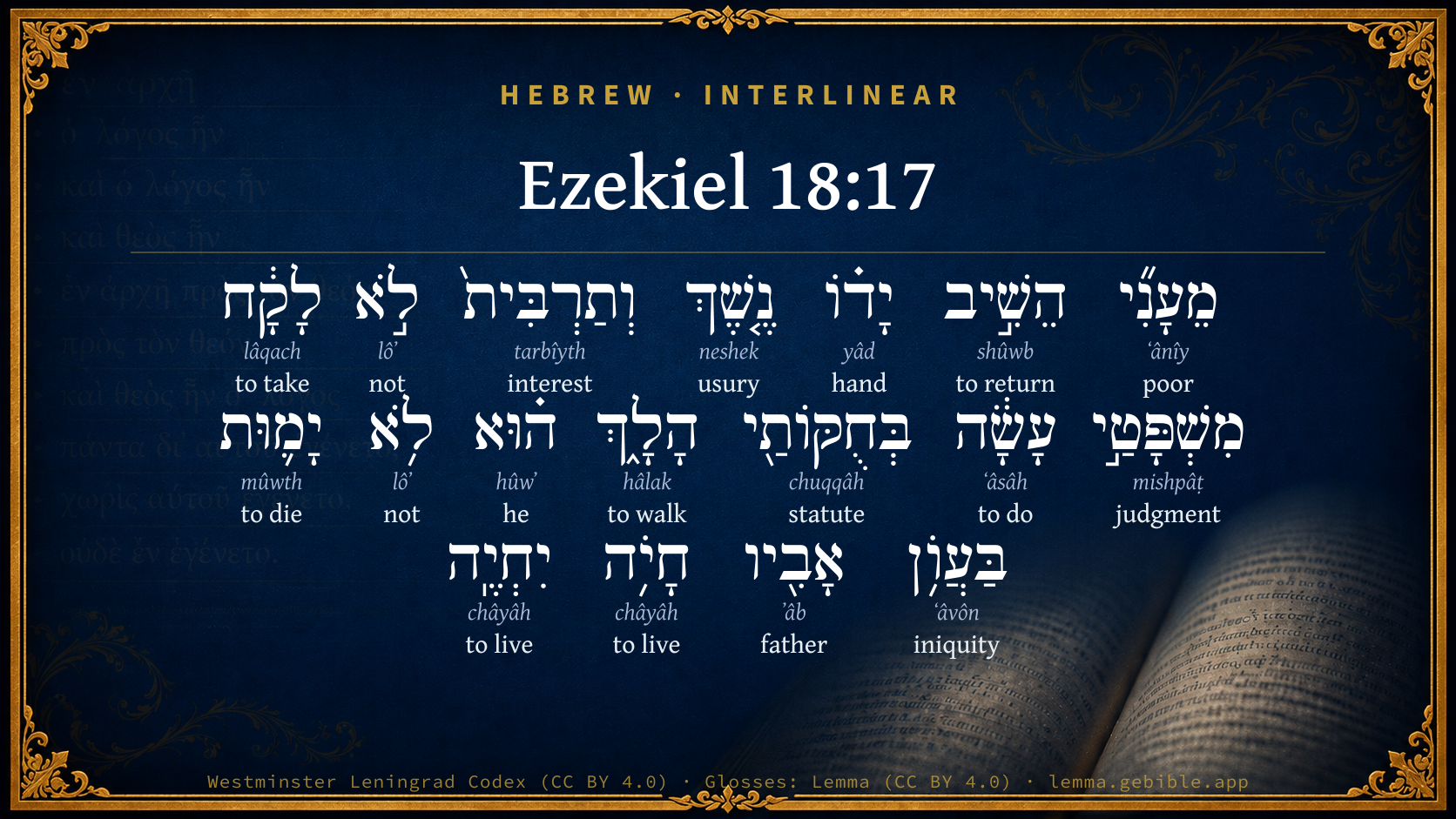
  1. מֵעָנִ֞י ʻânîy H6041 “from · poor” Preposition + Adjective, Adjective, Masculine, Singular, Absolute
  2. הֵשִׁ֣יב shûwb H7725 “to return” Verb, Hiphil, Perfect, 3rd Person, Masculine, Singular
  3. יָד֗וֹ yâd H3027 “hand · his” Noun, Common, Both, Singular, Construct + Suffix, Personal, 3rd Person, Masculine, Singular
  4. נֶ֤שֶׁךְ neshek H5392 “usury” Noun, Common, Masculine, Singular, Absolute
  5. לֹ֣א lôʼ H3808 “not” Particle, Negative
  6. לָקָ֔ח lâqach H3947 “to take” Verb, Qal, Perfect, 3rd Person, Masculine, Singular
  7. מִשְׁפָּטַ֣י mishpâṭ H4941 “judgments · my” Noun, Common, Masculine, Plural, Construct + Suffix, Personal, 1st Person, Common, Singular
  8. עָשָׂ֔ה ʻâsâh H6213 “to do” Verb, Qal, Perfect, 3rd Person, Masculine, Singular
  9. בְּחֻקּוֹתַ֖י chuqqâh H2708 “in/at · statutes · my” Preposition + Noun, Common, Both, Plural, Construct + Suffix, Personal, 1st Person, Common, Singular
  10. הָלָ֑ךְ hâlak H1980 “to walk” Verb, Qal, Perfect, 3rd Person, Masculine, Singular
  11. ה֗וּא hûwʼ H1931 “he” Pronoun, Personal, 3rd Person, Masculine, Singular
  12. לֹ֥א lôʼ H3808 “not” Particle, Negative
  13. יָמ֛וּת mûwth H4191 “to die” Verb, Qal, Imperfect, 3rd Person, Masculine, Singular
  14. בַּעֲוֺ֥ן ʻâvôn H5771 “in/at · iniquity of” Preposition + Noun, Common, Both, Singular, Construct
  15. אָבִ֖יו ʼâb H1 “father · his” Noun, Common, Masculine, Singular, Construct + Suffix, Personal, 3rd Person, Masculine, Singular
  16. חָיֹ֥ה châyâh H2421 “to live” Verb, Qal, Infinitive Absolute
  17. יִחְיֶֽה châyâh H2421 “to live” Verb, Qal, Imperfect, 3rd Person, Masculine, Singular

About this verse

These counts appear in no published source. They are computed here, from the morphology-tagged text and Lemma’s own curated glosses. What Lemma adds →

18
words
16
distinct lemmas
Prophets
section

Notable vocabulary

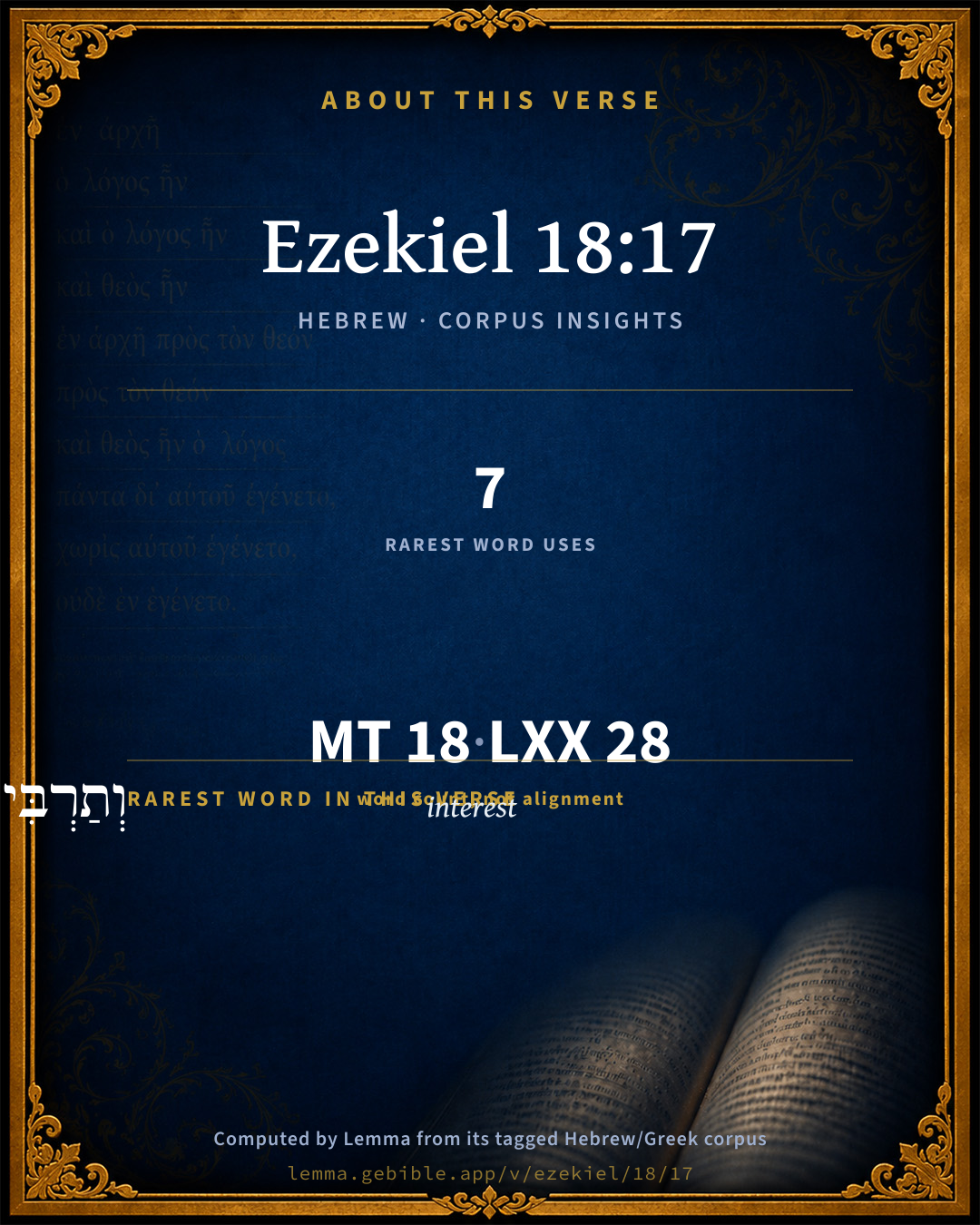
The rarest word here is וְתַרְבִּית֙ interest H8636 — appearing just 7 times in the whole Hebrew Bible.

Shared distinctive vocabulary

וְתַרְבִּית֙ interest H8636 occurs in 6 verses of the Hebrew Bible. Also found in:

Grammatical profile

  • 7 verbs
  • 7 nouns
  • 1 adjective
  • 1 pronoun
  • 2 particles

Verb forms

  • הֵשִׁ֣יב Hiphil · Perfect
  • לָקָ֔ח Qal · Perfect
  • עָשָׂ֔ה Qal · Perfect
  • הָלָ֑ךְ Qal · Perfect
  • יָמ֛וּת Qal · Imperfect
  • חָיֹ֥ה Qal · Infinitive Absolute
  • יִחְיֶֽה Qal · Imperfect

Repetition

Words recur within this verse — often emphatic in Hebrew:

  • חָיֹ֥ה to live H2421 ×2
  • לֹ֣א not H3808 ×2

Hebrew & Septuagint length

In English translation the verse runs 38 words from the Hebrew and 37 from the Septuagint (LXX English) — closely comparable.

A rough comparison of the two English renderings, which tokenize alike — not a word-level alignment.

Word counts can differ between the Hebrew and the Greek without any difference in meaning — e.g. the Hebrew direct-object marker אֵת has no separate Greek word, and Greek often adds the article ὁ.

In the original languages it is 18 Hebrew tokens and 28 Greek tokens — but the two are counted differently (Hebrew bundles its prefixes and suffixes into one token; the Greek is in lemma form), so that isn’t a like-for-like length.

Cross-references

24

Topical passages linked to Ezekiel 18:17 in the Treasury of Scripture Knowledge — connected by theme and wording, ordered by reader-vote popularity; previews shown in the World English Bible.

  • Ezekiel 18:8–9 he who has not given forth on interest, neither has taken any increase, who has withdrawn his hand from iniquity, has executed true justice between man and man,
  • Leviticus 18:4 You shall do my ordinances, and you shall keep my statutes, and walk in them: I am Yahweh your God.
  • Leviticus 18:26 You therefore shall keep my statutes and my ordinances, and shall not do any of these abominations; neither the native-born, nor the stranger who lives as a foreigner among you;
  • Leviticus 18:30 Therefore you shall keep my charge, that you do not practice any of these abominable customs, which were practiced before you, and that you do not defile yourselves with them: I am Yahweh your God.'"
  • Job 29:16 I was a father to the needy. The cause of him who I didn't know, I searched out.
  • Proverbs 14:31 He who oppresses the poor shows contempt for his Maker, But he who is kind to the needy honors him.
  • Proverbs 29:7 The righteous care about justice for the poor. The wicked aren't concerned about knowledge.
  • Proverbs 29:14 The king who fairly judges the poor, His throne shall be established forever.
  • Jeremiah 16:11–13 Then shall you tell them, Because your fathers have forsaken me, says Yahweh, and have walked after other gods, and have served them, and have worshiped them, and have forsaken me, and have not kept my law;
  • Jeremiah 16:19 Yahweh, my strength, and my stronghold, and my refuge in the day of affliction, to you shall the nations come from the ends of the earth, and shall say, Our fathers have inherited nothing but lies, [even] vanity and things in which there is no profit.
  • Jeremiah 22:16 He judged the cause of the poor and needy; then it was well. Wasn't this to know me? says Yahweh.
  • Ezekiel 3:21 Nevertheless if you warn the righteous man, that the righteous not sin, and he does not sin, he shall surely live, because he took warning; and you have delivered your soul.
  • Ezekiel 18:13 has given forth on interest, and has taken increase; shall he then live? he shall not live: he has done all these abominations; he shall surely die; his blood shall be on him.
  • Ezekiel 18:19–21 Yet say you, Why does not the son bear the iniquity of the father? when the son has done that which is lawful and right, and has kept all my statutes, and has done them, he shall surely live.
  • Ezekiel 18:28 Because he considers, and turns away from all his transgressions that he has committed, he shall surely live, he shall not die.
  • Ezekiel 20:18 I said to their children in the wilderness, Don't you walk in the statutes of your fathers, neither observe their ordinances, nor defile yourselves with their idols.
  • Ezekiel 20:30 Therefore tell the house of Israel, Thus says the Lord Yahweh: Do you pollute yourselves after the manner of your fathers? and play you the prostitute after their abominations?
  • Ezekiel 33:13 When I tell the righteous, that he shall surely live; if he trust to his righteousness, and commit iniquity, none of his righteous deeds shall be remembered; but in his iniquity that he has committed, therein shall he die.
  • Ezekiel 33:15–16 if the wicked restore the pledge, give again that which he had taken by robbery, walk in the statutes of life, committing no iniquity; he shall surely live, he shall not die.
  • Daniel 4:27 Therefore, O king, let my counsel be acceptable to you, and break off your sins by righteousness, and your iniquities by showing mercy to the poor; if there may be a lengthening of your tranquillity.
  • Malachi 3:7 From the days of your fathers you have turned aside from my ordinances, and have not kept them. Return to me, and I will return to you," says Yahweh of Hosts. "But you say, 'How shall we return?'
  • Matthew 18:27–35 The lord of that servant, being moved with compassion, released him, and forgave him the debt.
  • Matthew 23:29–33 "Woe to you, scribes and Pharisees, hypocrites! For you build the tombs of the prophets, and decorate the tombs of the righteous,
  • Luke 19:8 Zacchaeus stood and said to the Lord, "Behold, Lord, half of my goods I give to the poor. If I have wrongfully exacted anything of anyone, I restore four times as much."

Cross-references courtesy of OpenBible.info (CC BY 4.0).

Hebrew and Greek witnesses Masoretic Hebrew ↔ Greek Septuagint

The same verse in the two great witnesses to the Old Testament, shown verse-for-verse.

These are two independent witnesses, not word-aligned to each other, and the Septuagint is shown in lemma (dictionary) form.

Hebrew Ezekiel 18:17 Masoretic · Westminster Leningrad Codex

מֵעָנִ֞י הֵשִׁ֣יב יָד֗וֹ נֶ֤שֶׁךְ וְתַרְבִּית֙ לֹ֣א לָקָ֔ח מִשְׁפָּטַ֣י עָשָׂ֔ה בְּחֻקּוֹתַ֖י הָלָ֑ךְ ה֗וּא לֹ֥א יָמ֛וּת בַּעֲוֺ֥ן אָבִ֖יו חָיֹ֥ה יִחְיֶֽה

who has withdrawn his hand from the poor, who has not received interest nor increase, has executed my ordinances, has walked in my statutes; he shall not die for the iniquity of his father, he shall surely live.

World English Bible · Public Domain

Greek LXX Ezekiel 18:17 Septuagint · lemma form

καί ἀπό ἀδικία ἀποστρέφω ὁ χείρ αὐτός τόκος οὐδέ πλεονασμός οὐ λαμβάνω δικαιοσύνη ποιέω καί ἐν ὁ πρόσταγμα ἐγώ πορεύομαι οὐ τελευτάω ἐν ἀδικία πατήρ αὐτός ζωή ζάω

and has turned back his hand from unrighteousness, has not received interest or usurious increase, has wrought righteousness, and walked in my ordinances; he shall not die for the iniquities of his father, he shall surely live.

LXX2012 (modern English Septuagint) · Public Domain

On this verse, The Cambridge Bible for Schools and Colleges discusses the Septuagint’s reading. Read the note in Commentary ↓

Hebrew: Westminster Leningrad Codex (CC BY 4.0). Greek: Septuagint (public domain); English from LXX2012 (modern English Septuagint) (Public Domain). How the Septuagint differs from the Hebrew →

Targum (Aramaic paraphrase)

1

The Targum is the ancient Jewish Aramaic paraphrase of the Hebrew Scriptures — an interpretive translation, not the Hebrew text itself. Onkelos (literal) and Pseudo-Jonathan (expansive) render the Torah, and Jonathan the Prophets. Coverage is partial: where no permissively-licensed English translation exists for a verse, only the Aramaic is shown. This is verse-level text, not a word-by-word alignment to the Hebrew.

  1. Targum Jonathan Prophets (Joshua–Malachi)
    מִמַסְכֵּנָא לָא אֲתֵיב יְדֵהּ חִבּוּלְיָא וְרִבִּיתָא לָא נְסִיב דִינִי עֲבִיד בִּקְיָמֵי הֲלִיךְ הוּא לָא יְמוּת בְּחוֹבֵי אֲבוּהִי מֵיחָא יְחֵי:

    (no public-domain English translation for this verse)

    Targum Jonathan — Aramaic: “Mikraot Gedolot” (public domain). English: “Sefaria Community Translation” (CC0 1.0 (public-domain dedication)); “London "Chaldee Paraphrase," 1871” (public domain). Text via Sefaria.

Commentary

Notes on Ezekiel 18:17 from classic Christian and Jewish commentators (each source and its license shown beneath its notes). The classic Christian expositions comment on the surrounding passage and are grouped to its opening verse, so a note may address several verses; the Jewish commentaries on the Tanakh (Rashi and others) are per-verse, so they appear only where the commentator wrote on this verse.

Lemma curates 59 commentaries, every one of them public domain or Creative Commons licensed, each selected and text-cleaned for this edition rather than reprinted as found. About our sources →

Trapp's Complete Commentary

John Trapp

Eze 18:17 [That] hath taken off his hand from the poor, [that] hath not received usury nor increase, hath executed my judgments, hath walked in my statutes; he shall not die for the iniquity of his father, he shall surely live.

Ver. 17. See on Eze 18:8-9.

John Trapp, A Commentary or Exposition upon All the Books of the Old and New Testament (1647–1656) — public domain. Text from a community e-Sword module.

Jamieson, Fausset & Brown

Robert Jamieson, A. R. Fausset & David Brown

taken off his hand from the poor--that is, abstained from oppressing the poor, when he had the opportunity of doing so with impunity.The different sense of the phrase in Eze 16:49, in reference to relieving the poor, seems to have suggested the reading followed by FAIRBAIRN, but not sanctioned by the Hebrew, "hath not turned his hand from," &c. But Eze 20:22 uses the phrase in a somewhat similar sense to English Version here, abstained from hurting.

Jamieson, Fausset & Brown — Commentary Critical and Explanatory on the Whole Bible (1871) — public domain (CC PDM 1.0). Text via the HelloAO Bible API.

Adam Clarke's Commentary

Verse 17. He shall not die for the iniquity of his father] He shall no more be affected by his father's crimes, than his father was benefited by his grandfather's righteousness.

Adam Clarke's Commentary on the Bible (1810–1826) — public domain. Text from a community e-Sword/MySword module.

John Calvin's Commentaries

Now at last he concludes: he shall not die through his father’s iniquity; he shall surely live. He does not repeat that this is just, yet we must understand it so; but he stops at the immediate effect, since God’s blessing awaits all the just, as Isaiah says surely there is a reward to the just, (Isaiah 3:10;) and the Prophet exclaims as if it were believed with difficulty: for, since we see all things revolving promiscuously in the world, we directly imagine either that God is at rest in heaven, or that chance governs all things here on earth. But we must strive against this perverse supposition, and determine, as Isaiah teaches, that there is a reward for the just. The Prophet now expresses this, while a difficult question arises from the passage; for he says that he is just who has kept the law, and so God will bestow a recompense upon. him: hence these two things are connected together, and the question which I mentioned arises from the former clause; for the whole Scriptures teach that no one is just, and that none can be justified by the law. But these things are contrary to each other; to be just and worthy of reward through keeping the law, since none is just, all are transgressors, all devoid of justice, and so but one remedy remains — that of seeking our safety from the gratuitous mercy of God. But although, at first sight, this kind of it consistency disturbs the rude and partially-exercised commentator, yet this solution is easy, since, strictly speaking, justice is the observance of the law. If any one asks, then, what justice is, the proper definition is, the observance of law. Why so? Because the law, as I said yesterday, lays down the solid rule of justice; whoever observes it will be esteemed just; and thus justification is properly said to be placed in works. But, on the other hand, Scripture pronounces what is very true, and entirely confirmed by experience, that no one can satisfy the law, and, on account of this defect, we are all deprived of justification by works. What I have said may be made much clearer by many testimonies of Scripture. Not the hearer of the law, says Paul, in the second chapter of the epistle to the Romans, but the doer of the law, shall be justified, (Romans 2:13.) There Paul speaks naturally, that those are just who conform their whole life to the obedience of God’s law. So also John, in his canonical epistle: He who does righteousness is righteous. (1 John 3:7.) Now, if any one asks whether any perfect observer of the law can be found, or one who does justice in every respect, the answer is at hand, that we are all by nature very far gone from all righteousness, and all our senses and affections are enemies which contend against God’s law, as Paul teaches: The whole soul of man is perverse, and we are not fit to think anything of ourselves, and that all our sufficiency is of God, since we are slaves of sin. (Romans 8:7; 2 Corinthians 3:5; Romans 11.) But it would be superfluous to heap together many testimonies. Let it suffice, then, that we are by nature all together rebels against God, so that not the slightest particle of good can be found in us. As far as concerns the faithful, they aspire indeed to righteousness, but lamely, and at a great distance from their aim; they often wander from the way, and they often fall, so that they do not satisfy the law, and hence require God’s pity. Hence we must come to the second kind of righteousness, which is improperly so called, namely, that which we obtain from Christ. He who does righteousness is righteous. (l John 3:7.) None of us does it; but Christ, who fulfilled the law, is esteemed just before God. Hence it is necessary that we should be approved by God through his righteousness; that is, it is imputed to us, and we are accepted through his righteousness. Hence justification by faith, as it is called, is not properly righteousness; but on account of the defect of true righteousness, it is necessary to fly to this as to a sacred anchor; and Paul, in the tenth chapter to the Romans, explains this briefly and clearly. The righteousness of the law, says he, thus speaks: He who has done these things shall live in them; but the righteousness of faith says, He who has believed shall be just. The Apostle here speaks of a double righteousness — that of the law and of faith: he says, that the righteousness of the law is situated in works, since no one is thought just unless he fulfills the law. (Romans 10:5-8.) Since all are far distant from this standard, another is added and substituted, namely, that we may embrace the righteousness of Christ by faith, and so become just, by another righteousness without us: for if any one again objects that justification by the law is superfluous, I answer, that it profits us in two ways; first, because the law brings in those convicted of their own unrighteousness to Christ. This, then, is one fruit of the law, that we renounce our own righteousness, when our iniquity so discloses itself, that it compels us to be silent before God, as we formerly saw. A more fruitful result follows; because, when God regenerates his elect, he inscribes a law on their hearts and in their inward parts, as we have elsewhere seen, and shall see again in the thirty-sixth chapter. (Jeremiah 31:33; Ezekiel 36:26, 27.) But the difficulty is not yet solved; because the faithful, even if regenerated by God’s Spirit, endeavor to conform themselves to God’s law, yet, through their own weakness, never arrive at that point, and so are never righteous: I answer, although the righteousness of works is mutilated in the sons of God, yet it is acknowledged as perfect, since, by not imputing their sins to them, he proves what is his own. Hence it happens, that although the faithful fall back, wander, and sometimes fall, yet they may be called observers of the law, and walkers in the commandments of God, and observers of his righteousness. But this arises from gratuitous imputation, and hence also its reward. The works of the faithful are not without reward, because they please God, and pleasing God, they are sure of remuneration. We see, then, how these things are rightly united, that no one obeys the law, and that no one is worthy of the fruits of righteousness, and yet that God, of his own liberality, acknowledges as just those who aspire to righteousness, and repay them with a reward of which they are unworthy. When, therefore, we say that the faithful are esteemed just even in their deeds, this is not stated as a cause of their salvation, and we must diligently notice that the cause of salvation is excluded from this doctrine; for, when we discuss the cause, we must look nowhere else but to the mercy of God, and there we must stop. But although works tend in no way to the cause of justification, yet, when the elect sons of God were justified freely by faith, at the same time their works are esteemed righteous by the same gratuitous liberality. Thus it still remains true, that faith without works justifies, although this needs prudence and a sound interpretation; for this proposition, that faith without works justifies is true and yet false, according to the different senses which it bears. The proposition, that faith without works justifies by itself, is false, because faith without works is void. But if the clause “without works” is joined with the word “justifies,” the proposition will be true, since faith cannot justify when it is without works, because it is dead, and a mere fiction. He who is born of God is just, as John says. (1 John 5:18.) Thus faith can be no more separated from works than the sun from his heat yet faith justifies without works, because works form no reason for our justification; but faith alone reconciles us to God, and causes him to love us, not in ourselves, but in his only begotten Son. Now, therefore, that question is solved, when the Prophet teaches that life is reposed in the just, even if they are born of wicked and unholy parents.

Lastly, we must notice the word “life,” since the word “living” ought not to be understood only of life on earth, but looks to eternal life: and here some expositors are mistaken: for because they could not free themselves from those difficulties which I lately explained, they interpreted the words of Moses in a civil sense — He who has done these things shall live in them. But Moses is speaking of life eternal. Hence we must hold, not only that a reward is promised in this life to the just observers of the law, but that eternal life is also a promised reward. Besides, as I have said, since we are all destitute of righteousness, so we thought not to hope for any reward, since we are all under the law and under the curse, as Paul says: neither is there any means of escape, as Paul again says, (Galatians 3:10, 13,) unless we fly with complete and abject faith to the mercy of God alone, and to the satisfaction by which Christ has reconciled us to his Father. Here I shall finish.

John Calvin's Commentaries (1540-1563) — public domain. Text from the Calvin Translation Society English edition (1840s-50s) via the Christian Classics Ethereal Library (ccel.org). Calvin's coverage is partial (roughly two-thirds of the Bible); uncommented books and verses are honest gaps, never fabricated. The 19th-century editor's footnotes and remarks are omitted so the notes are faithfully Calvin's own voice.

The Cambridge Bible for Schools and Colleges

gen. ed. J. J. S. Perowne

17. taken off his hand] withdrawn his hand—so as not to injure or oppress—the poor. LXX. reads: from iniquity, but cf. ch. Eze_20:22.

The Cambridge Bible for Schools and Colleges (gen. ed. J. J. S. Perowne; Cambridge University Press, 1878–1918) — public domain. Text from a community e-Sword module.

John Gill's Exposition

As for his father,.... It shall be otherwise with him:

because he cruelly oppressed; or, "oppressed an oppression"; or, "with an oppression" (i); oppressed the poor, and had no mercy on them, but used them in the most rigorous manner:

spoiled his brother by violence; took away the spoil of his brother; spoiled him of his substance; did injury to his person and property, and all the mischief that lay in his power:

and did that which is not good among his people; neighbours, citizens, and countrymen; did nothing which was good, as he ought to have done; but everything that was bad, which he should not have done:

lo, even he shall die in his iniquity: and for it; it shall not be forgiven him; he shall be punished for it with death, with the death of affliction; and with corporeal death, as a punishment for sin; and with eternal death, dying in his sins, and in a state of impenitence. These instances, put every way, most clearly show the equity of God; the justness of his proceedings in providence; and how inapplicable the proverb in Eze 18:2 was to them; and that such that sin, and continue therein, shall die for their own iniquities, and not for the sins of others.

(i) "oppressit oppressionem", Pagninus, Montanus; "oppressit oppressione", Vatablus, Junius & Tremellius.

John Gill's Exposition of the Whole Bible (1746–1763) — public domain (CC PDM 1.0). Text via the HelloAO Bible API.

Matthew Poole's English Annotations

Taken off his hand from the poor; withdrawn his hand from hurting or wronging the poor, though he had power and might to do it securely.

That hath not received usury, & c. see Eze 18:8,9, where these particulars are explained.

Matthew Poole's English Annotations on the Holy Bible (1683–1685) — public domain. Text from a community e-Sword/MySword module.

Whedon's Commentary on the Bible

Daniel D. Whedon

17. Taken off his hand from the poor — Many scholars believe that the LXX. text is preferable, “withdrawn his hand from iniquity,” following Eze_18:8. (See also Eze_20:22.)

Daniel D. Whedon (gen. ed.), Commentary on the Old and New Testaments (1874–1909) — public domain. Text from a community e-Sword module.

John Wesley's Explanatory Notes

Hath taken off - Withdrawn his hand from hurting or wronging the poor, tho' he had power to do it securely.

John Wesley, Explanatory Notes Upon the Whole Bible (1754–1765) — public domain. Text via the GEBible commentary corpus.

Rashi

Rabbi Shlomo Yitzchaki (Rashi)

From the poor he kept his hand back from harming him.

Rashi on the Tanakh — English translations: “The Judaica Press complete Tanach with Rashi, translated by A. J. Rosenberg” (CC BY 4.0); “Pentateuch with Rashi's commentary by M. Rosenbaum and A.M. Silbermann, 1929-1934” (public domain); “The Metsudah Tanach series, Lakewood, N.J” (CC BY 4.0); and “The Book of Joshua, Metsudah Publications, 1997” (CC BY 4.0). Text via Sefaria.

Lesson kit

Teaching starters — assembled from the data on this page, not authored interpretation. Every prompt links to the verse data it draws on. Edit before teaching.

Ezekiel, in the Prophets, opens this verse with 18 words (16 distinct Hebrew lemmas). Its most distinctive word is tarbîyth (“interest”). A historical commentator’s framing appears above. Read the whole chapter for the surrounding context.

Discussion questions

  1. What does “interest” (tarbîyth) contribute to the verse as a whole?
  2. Leviticus 25:36 shares the word «interest» with this verse. How do the two illuminate each other?
  3. “to live” occurs 2× in this one verse. What is the effect of the repetition?
  4. These translations render this verse differently. What is at stake in choosing one wording over another?
  5. The verb «הֵשִׁ֣יב» is Hiphil Perfect. How does its form color the action?
  6. Reading how Trapp's Complete Commentary and Jamieson, Fausset & Brown read this verse, where do the two commentators agree and where do they part?

Things to notice

Reading settings

Reading text

Shown beneath each verse's original-language words.

Old Testament
Old Testament edition

Read the OT as the Masoretic Hebrew (MT) or the Greek Septuagint (LXX).

English shown for the Greek Septuagint (in the Hebrew ↔ Greek comparison).

Comparing translations? Open the Compare panel on any verse page to stack up to four side by side.