
Ezekiel 8:13

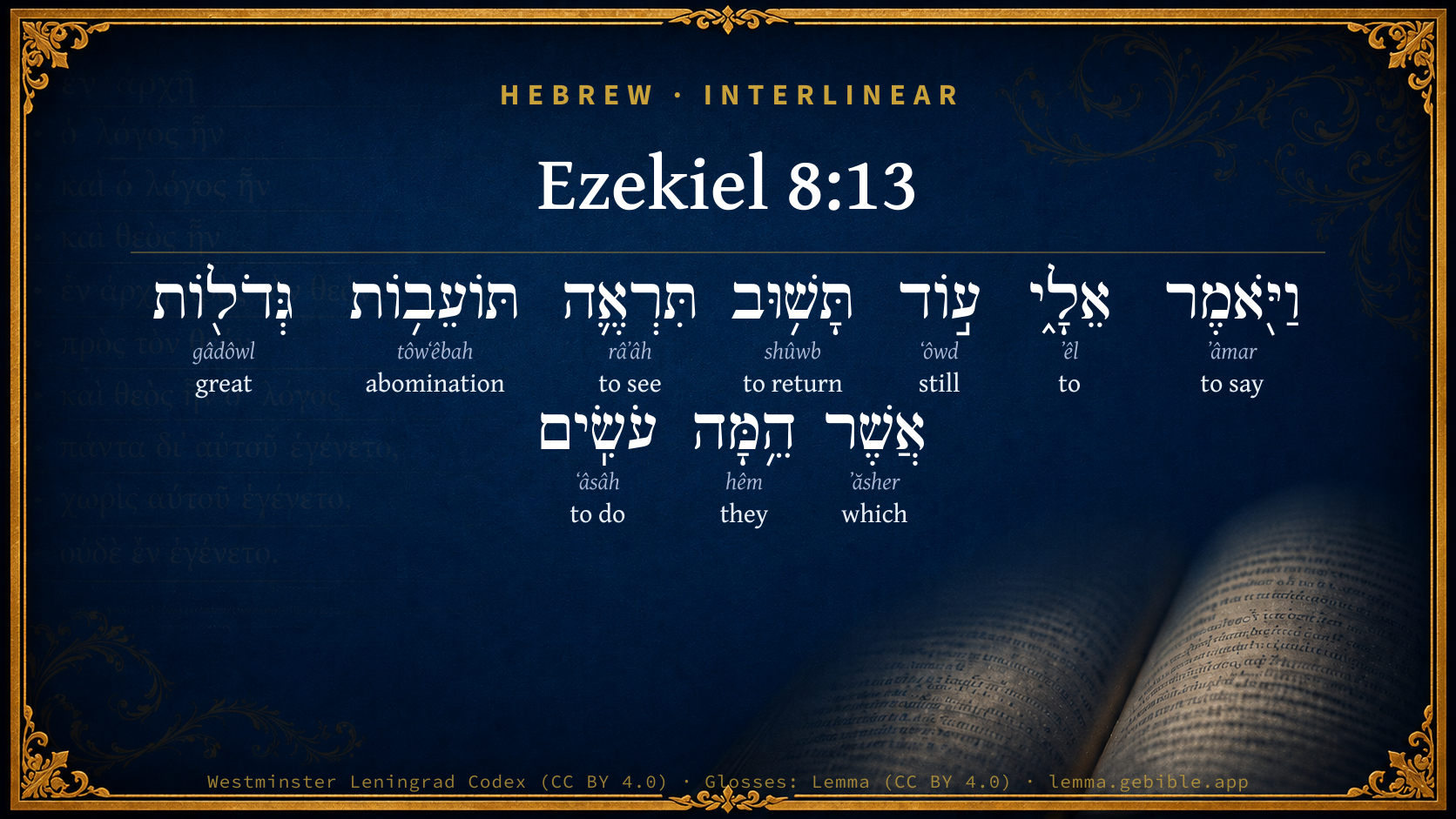
Hebrew (Westminster Leningrad Codex) Ezekiel 8:13 appears in the Hebrew Old Testament. The text above is from the Westminster Leningrad Codex. Each word links to its Strong’s number, a concise gloss, and parsing drawn from the Open Scriptures Hebrew Bible morphology. Click any word for its full Brown-Driver-Briggs (BDB) entry.
Download image
Cite this verse

Ezekiel 8:13 (World English Bible). Public Domain. Lemma interlinear Bible study tool, https://lemma.gebible.app/v/ezekiel/8/13.

Show BibTeX & RIS
BibTeX
RIS
English Translation
He said also to me, You shall again see yet other great abominations which they do.
World English Bible · Public Domain
Download a study sheet

One document with this verse’s original text, its word-by-word gloss line, the meaning frame, cross-references with their text, attributed commentary, and full source and license credits — printable, and it pastes into notes with its structure intact.

This verse Autodidact and up

Study sheet (.html) Plain text (.txt)

A passage Seminary Student

Up to 50 verses in one chapter. A passage sheet keeps up to 6 commentary sources and 12 cross-references per verse, in the order this page ranks them, and says so on the sheet whenever that leaves anything out. Ask for a single verse and you get the Autodidact verse sheet above.

Everything on this page stays free to read, with no account — the sheet is a download of what is already on screen, not access to it.

Want to remove ads? Support Godless Engineer
Compare translations 3

The same verse in 3 English versions, stacked beneath the original-language interlinear above. Click any original word for its lexicon entry.

Each is an independent rendering of the whole verse — the interlinear is not word-aligned to these translations.

Highlighted words mark where these versions differ — a whole-verse word diff, not a word-by-word alignment.

  • World English Bible Public Domain
    He said also to me, You shall again see yet other great abominations which they do.
  • King James Version Public Domain
    He said also unto me, Turn thee yet again, and thou shalt see greater abominations that they do.
  • unfoldingWord Literal Text CC BY-SA 4.0
    Then he said to me, “Turn again and see the other great abominations that they are doing.”

unfoldingWord Literal Text — © unfoldingWord, licensed CC BY-SA 4.0. Word-aligned USFM3 via Door43 (git.door43.org/unfoldingWord/en_ult).

Versions to compare (up to 4)

3 of 4 selected

Show all 18 translations

Every available English version of this verse, each an independent rendering of the whole verse.

  • World English Bible Public Domain
    He said also to me, You shall again see yet other great abominations which they do.
  • Berean Standard Bible Public Domain
    Again, He told me, “You will see them committing even greater abominations.”
  • Majority Standard Bible Public Domain
    Again, He told me, “You will see them committing even greater abominations.”
  • King James Version Public Domain
    He said also unto me, Turn thee yet again, and thou shalt see greater abominations that they do.
  • American Standard Version (1901) Public Domain
    He said also unto me, Thou shalt again see yet other great abominations which they do.
  • Revised Version (1885) Public Domain
    He said also unto me, Thou shalt again see yet other great abominations which they do.
  • Geneva Bible (1599) Public Domain
    Againe he saide also vnto me, Turne thee againe, and thou shalt see greater abominations that they doe.
  • Douay-Rheims (1899) Public Domain
    And he said to me: If thou turn thee again, thou shalt see greater abominations which these commit.
  • Young's Literal Translation Public Domain
    And He saith unto me, `Again thou dost turn, thou dost see great abominations that they are doing.'
  • Literal Standard Version CC BY-SA 4.0
    And He says to me, “Turn again, [and] see [the] great abominations that they are doing.”
  • Unlocked Literal Bible CC BY-SA 4.0
    Then he said to me, “Turn again and see the other great abominations that they are doing.”
  • unfoldingWord Literal Text CC BY-SA 4.0
    Then he said to me, “Turn again and see the other great abominations that they are doing.”
  • Darby Bible Public Domain
    And he said unto me, Yet again thou shalt see great abominations which they do.
  • World Messianic Bible Public Domain
    He said also to me, “You will again see more of the great abominations which they do.”
  • Webster's Bible Public Domain
    He said also to me, Turn thee yet again, and thou shalt see greater abominations that they do.
  • Free Bible Version CC BY-SA 4.0
    The Lord went on to tell me, “You're going to see them doing even more disgusting things than these!”
  • Bible in Basic English Public Domain
    Then he said to me, You will see even more disgusting things which they do.
  • JPS Tanakh (1917) Public Domain
    He said also unto me: 'Thou shalt again see yet greater abominations which they do.'

Literal Standard Version (2020), Covenant Press — licensed CC BY-SA 4.0. Text via the HelloAO Bible API (eBible.org). Unlocked Literal Bible (unfoldingWord) — licensed CC BY-SA 4.0. Text via the HelloAO Bible API (eBible.org). unfoldingWord Literal Text — © unfoldingWord, licensed CC BY-SA 4.0. Word-aligned USFM3 via Door43 (git.door43.org/unfoldingWord/en_ult). Free Bible Version, Dr. Jonathan Gallagher — licensed CC BY-SA 4.0. Text via the HelloAO Bible API (eBible.org).

Word by word

More ways to search: Search by grammar → Find every occurrence → Compare this word →

Practice this passage: Drill this verse → Learn its vocabulary →

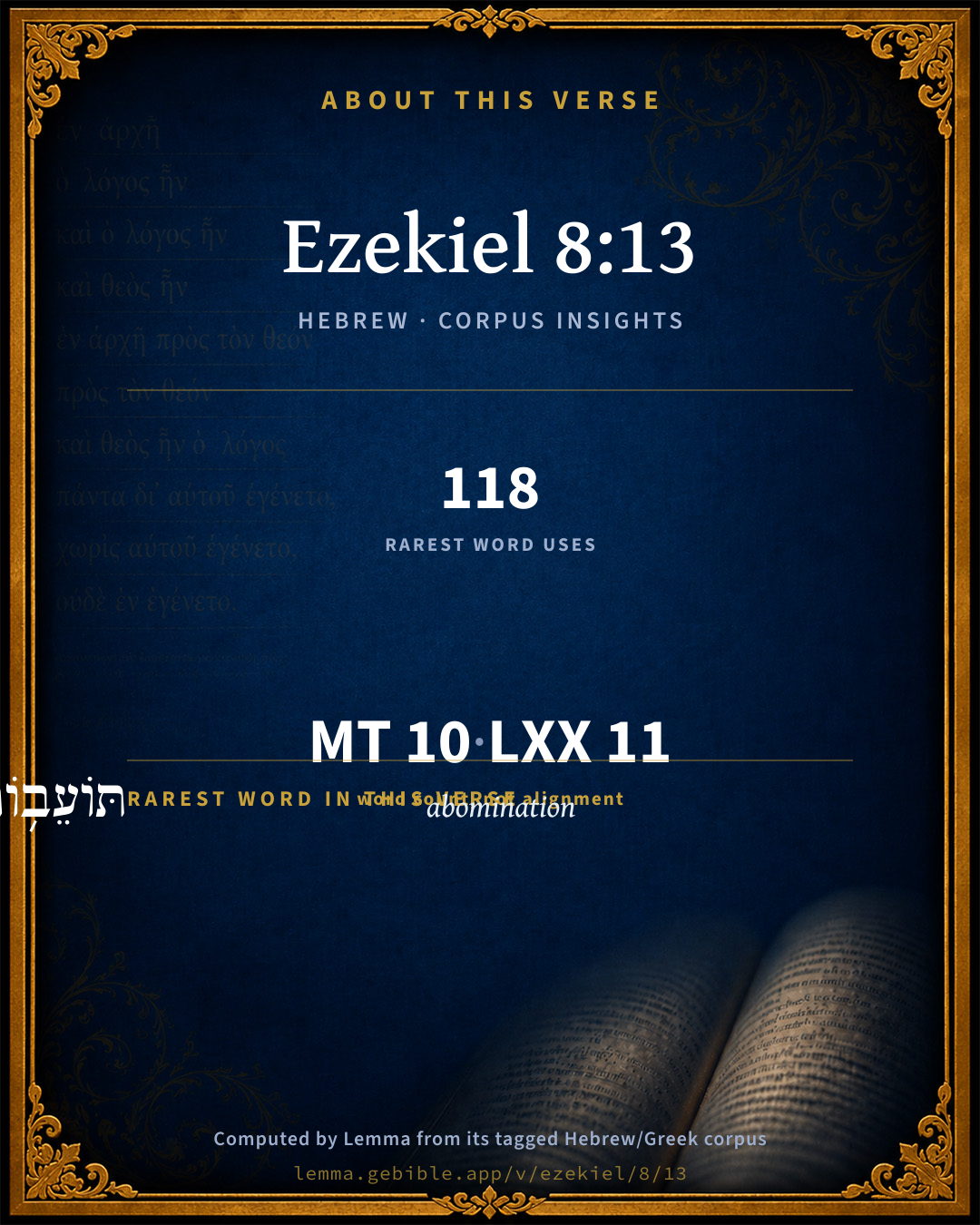
תּוֹעֵב֥וֹת
tôwʻêbah
H8441
“abominations”
Noun, Common, Feminine, Plural, Absolute
Part of Speech
Noun
Type
Common
Gender
Feminine
Number
Plural
State
Absolute
Full BDB Definition

Origin: act part of H8581

TWOT: 2530a

a disgusting thing, abomination, abominable - in ritual sense (of unclean food, idols, mixed marriages) - in ethical sense (of wickedness etc)
  1. וַיֹּ֖אמֶר ʼâmar H559 “and · to say” Conjunction + Verb, Qal, Sequential Imperfect, 3rd Person, Masculine, Singular
  2. אֵלָ֑י ʼêl H413 “to · me” Preposition + Suffix, Personal, 1st Person, Common, Singular
  3. ע֣וֹד ʻôwd H5750 “still” Adverb
  4. תָּשׁ֥וּב shûwb H7725 “to return” Verb, Qal, Imperfect, 2nd Person, Masculine, Singular
  5. תִּרְאֶ֛ה râʼâh H7200 “to see” Verb, Qal, Imperfect, 2nd Person, Masculine, Singular
  6. גְּדֹל֖וֹת gâdôwl H1419 “great” Adjective, Adjective, Feminine, Plural, Absolute
  7. אֲשֶׁר ʼăsher H834 “which” Particle, Relative
  8. הֵ֥מָּה hêm H1992 “they” Pronoun, Personal, 3rd Person, Masculine, Plural
  9. עֹשִֽׂים ʻâsâh H6213 “doing” Verb, Qal, Participle Active, Masculine, Plural, Absolute

About this verse

These counts appear in no published source. They are computed here, from the morphology-tagged text and Lemma’s own curated glosses. What Lemma adds →

10
words
10
distinct lemmas
Prophets
section

Grammatical profile

  • 4 verbs
  • 1 noun
  • 1 adjective
  • 1 pronoun
  • 1 preposition
  • 1 adverb
  • 1 particle

Verb forms

  • וַיֹּ֖אמֶר Qal · Sequential Imperfect
  • תָּשׁ֥וּב Qal · Imperfect
  • תִּרְאֶ֛ה Qal · Imperfect
  • עֹשִֽׂים Qal · Participle Active

Hebrew & Septuagint length

In English translation the verse runs 16 words from the Hebrew and 14 from the Septuagint (LXX English) — closely comparable.

A rough comparison of the two English renderings, which tokenize alike — not a word-level alignment.

Word counts can differ between the Hebrew and the Greek without any difference in meaning — e.g. the Hebrew direct-object marker אֵת has no separate Greek word, and Greek often adds the article ὁ.

In the original languages it is 10 Hebrew tokens and 11 Greek tokens — but the two are counted differently (Hebrew bundles its prefixes and suffixes into one token; the Greek is in lemma form), so that isn’t a like-for-like length.

Cross-references

4

Topical passages linked to Ezekiel 8:13 in the Treasury of Scripture Knowledge — connected by theme and wording, ordered by reader-vote popularity; previews shown in the World English Bible.

  • Ezekiel 8:6 He said to me, Son of man, see you what they do? even the great abominations that the house of Israel do commit here, that I should go far off from my sanctuary? but you shall again see yet other great abominations.
  • Jeremiah 9:3 They bend their tongue, [as it were] their bow, for falsehood; and they are grown strong in the land, but not for truth: for they proceed from evil to evil, and they don't know me, says Yahweh.
  • Ezekiel 8:15 Then said he to me, Have you seen [this], son of man? you shall again see yet greater abominations than these.
  • 2 Timothy 3:13 But evil men and impostors will grow worse and worse, deceiving and being deceived.

Cross-references courtesy of OpenBible.info (CC BY 4.0).

Hebrew and Greek witnesses Masoretic Hebrew ↔ Greek Septuagint

The same verse in the two great witnesses to the Old Testament, shown verse-for-verse.

These are two independent witnesses, not word-aligned to each other, and the Septuagint is shown in lemma (dictionary) form.

Hebrew Ezekiel 8:13 Masoretic · Westminster Leningrad Codex

וַיֹּ֖אמֶר אֵלָ֑י ע֣וֹד תָּשׁ֥וּב תִּרְאֶ֛ה תּוֹעֵב֥וֹת גְּדֹל֖וֹת אֲשֶׁר הֵ֥מָּה עֹשִֽׂים

He said also to me, You shall again see yet other great abominations which they do.

World English Bible · Public Domain

Greek LXX Ezekiel 8:13 Septuagint · lemma form

καί εἶπον πρός ἐγώ ἔτι ὁράω ἀνομία μέγας ὅς οὗτος ποιέω

And he said to me, You shall see yet greater iniquities which these do.

LXX2012 (modern English Septuagint) · Public Domain

Hebrew: Westminster Leningrad Codex (CC BY 4.0). Greek: Septuagint (public domain); English from LXX2012 (modern English Septuagint) (Public Domain). How the Septuagint differs from the Hebrew →

Targum (Aramaic paraphrase)

1

The Targum is the ancient Jewish Aramaic paraphrase of the Hebrew Scriptures — an interpretive translation, not the Hebrew text itself. Onkelos (literal) and Pseudo-Jonathan (expansive) render the Torah, and Jonathan the Prophets. Coverage is partial: where no permissively-licensed English translation exists for a verse, only the Aramaic is shown. This is verse-level text, not a word-by-word alignment to the Hebrew.

  1. Targum Jonathan Prophets (Joshua–Malachi)
    וַאֲמַר לִי עוֹד תְּתוּב תֶּחֱזַי תּוֹעֵיבָן רַבְרְבָן דְאִינוּן עָבְדִין:

    (no public-domain English translation for this verse)

    Targum Jonathan — Aramaic: “Mikraot Gedolot” (public domain). English: “Sefaria Community Translation” (CC0 1.0 (public-domain dedication)); “London "Chaldee Paraphrase," 1871” (public domain). Text via Sefaria.

Commentary

Notes on Ezekiel 8:13 from classic Christian and Jewish commentators (each source and its license shown beneath its notes). The classic Christian expositions comment on the surrounding passage and are grouped to its opening verse, so a note may address several verses; the Jewish commentaries on the Tanakh (Rashi and others) are per-verse, so they appear only where the commentator wrote on this verse.

Lemma curates 59 commentaries, every one of them public domain or Creative Commons licensed, each selected and text-cleaned for this edition rather than reprinted as found. About our sources →

Matthew Henry's Commentary

Here we have,

I. More and greater abominations discovered to the prophet. He thought that what he had seen was bad enough and yet (Eze 8:13): Turn thyself again, and thou shalt see yet greater abominations, and greater still, Eze 8:15, as before, Eze 8:6. There are those who live in retirement who do no think what wickedness there is in this world; and the more we converse with it, and the further we go abroad into it, the more corrupt we see it. When we have seen that which is bad we may have our wonder at it made to cease by the discovery of that which, upon some account or other, is a great deal worse. We shall find it so in examining our own hearts and searching into them; there is a world of iniquity in them, a great abundance and variety of abominations, and, when we have found out much amiss, still we shall find more; for the heart is desperately wicked, who can know it perfectly? Now the abominations here discovered were, 1. Women weeping for Tammuz, Eze 8:14. An abominable thing indeed, that any should choose rather to serve an idol in tears than to serve the true God with joyfulness and gladness of heart! Yet such absurdities as these are those guilty of who follow after lying vanities and forsake their own mercies. Some think it was for Adonis, an idol among the Greeks, other for Osiris, an idol of the Egyptians, that they shed these tears. The image, they say, was made to weep, and then the worshippers wept with it. They bewailed the death of this Tammuz, and anon rejoiced in its returning to life again. These mourning women sat at the door of the gate of the Lord's house, and there shed their idolatrous tears, as it were in defiance of God and the sacred rites of his worship, and some think, with their idolatry, prostrating themselves also to corporeal whoredom; for these two commonly went together, and those that dishonoured the divine nature by the one were justly given up to vile affections and a reprobate sense to dishonour the human nature, which nowhere ever sunk so far below itself as in these idolatrous rites. 2. Men worshipping the sun, Eze 8:16. And this was so much the greater an abomination that it was practised in the inner court of the Lord's house at the door of the temple of the lord, between the porch and the altar. There, where the most sacred rites of their holy religion used to be performed, was this abominable wickedness committed. Justly might God in jealousy say to those who thus affronted him at his own door, as the king to Haman, Will he force the queen also before me in the house? Here were about twenty-five men giving that honour to the sun which is due to God only. Some think they were the king and his princes; it should rather seem that they were priests, for this was the court of the priests, and the proper place to find them in. Those that were entrusted with the true religion, had it committed to their care and were charged with the custody of it, they were the men that betrayed it. (1.) They turned their backs towards the temple of the Lord, resolvedly forgetting it and designedly slighting it and putting contempt upon it. Note, When men turn their backs upon God's institutions, and despise them, it is no marvel if they wander endlessly after their own inventions. Impiety is the beginning of idolatry and all iniquity. (2.) They turned their faces towards the east, and worshipped the sun, the rising sun. This was an ancient instance of idolatry; it is mentioned in Job's time (Job 31:26), and had been generally practised among the nations, some worshipping the sun under one name, others under another. These priests, finding it had antiquity and general consent and usage on its side (the two pleas which the papists use at this day in defence of their superstitious rites, and particularly this of worshipping towards the east), practised it in the court of the temple, thinking it an omission that it was not inserted in their ritual. See the folly of idolaters in worshipping that as a god, and calling it Baal - a lord, which God made to be a servant to the universe (for such the sun is, and so his name Shemesh signified, Deu 4:19), and in adoring the borrowed light and despising the Father of lights.

II. The inference drawn from these discoveries (Eze 8:17): "Hast thou seen this, O son of man! and couldst thou have thought ever to see such things done in the temple of the Lord?" Now, 1. he appeals to the prophet himself concerning the heinousness of the crime. Can he think it is a light thing to the house of Judah, who know and profess better things, and are dignified with so many privileges above other nations? Is it an excusable thing in those that have God's oracles and ordinances that they commit the abominations which they commit here? Do not those deserve to suffer that thus sin? Should not such abominations as these make desolate? Dan 9:27. 2. He aggravates it from the fraud and oppression that were to be found in all parts of the nations: They have filled the land with violence. It is not strange if those that wrong God thus make no conscience of wronging one another, and with all that is sacred trample likewise upon all that is just. And their wickedness in their conversations made even the worship they paid to their own God an abomination (Isa 1:11, etc.): "They fill the land with violence, and then they return to the temple to provoke me to anger there; for even their sacrifices, instead of making an atonement, do but add to their guilt. They return to provoke me (they repeat the provocation, do it, and do it again), and, lo, they put the branch to their nose" - a proverbial expression denoting perhaps their scoffing at God and having him in derision; they snuffed at his service, as men do when they put a branch to their nose. Or it was some custom used by idolaters in honour of the idols they served. We read of garlands used in their idolatrous worships (Act 14:13), out of which every zealot took a branch which they smelled to as a nosegay. Dr. Lightfoot (Hor. Heb. in John 15.6) gives another sense of this place: They put the branch to their wrath, or to his wrath, as the Masorites read it; that is, they are still bringing more fuel (such as the withered branches of the vine) to the fire of divine wrath, which they have already kindled, as if that wrath did not burn hot enough already. Or putting the branch to the nose may signify the giving of a very great affront and provocation either to God or man; they are an abusive generation of men. 3. he passes sentence upon them that they shall be utterly cut off: Therefore, because they are thus furiously bent upon sin, I will also deal in fury with them, Eze 8:18. They filled the land with their violence, and God will fill it with the violence of their enemies; and he will not lend a favourable ear to the suggestions either, (1.) Of his own pity: My eye shall not spare, neither will I have pity; repentance shall be hidden from his eyes; or, (2.) Of their prayers: Though they cry in my ears with a loud voice, yet will I not hear them; for still their sins cry more loudly for vengeance than their prayers cry for mercy. God will now be as deaf to their prayers as their own idols were, on whom they cried aloud, but in vain, Kg1 18:26. Time was when God was ready to hear even before they cried and to answer while they were yet speaking; but now they shall seek me early and not find me, Pro 1:28. It is not the loud voice, but the upright heart, that God will regard.

Matthew Henry's Commentary on the Whole Bible (1708–1710) — public domain (CC PDM 1.0). Text via the HelloAO Bible API.

Trapp's Complete Commentary

John Trapp

Eze 8:13 He said also unto me, Turn thee yet again, [and] thou shalt see greater abominations that they do.

Ver. 13. Turn thee yet again,] q.d., Little didst thou think, Ezekiel, that thy countrymen of Jewry were so prodigiously abominable as now thou seest! and what more sure than sight?

John Trapp, A Commentary or Exposition upon All the Books of the Old and New Testament (1647–1656) — public domain. Text from a community e-Sword module.

The Preacher's Complete Homiletical Commentary

Joseph S. Exell (gen. ed.)

Third and fourth abomination (Eze_8:13-18)

EXEGETICAL NOTES.—Eze_8:13-14. The seer is led from the secret chamber back to the point at which he had first approached to the precincts of the Temple (Eze_8:3). He stands now at its northern entrance, not at the entrance to the inner court as in the former case, “and, behold, the women weeping for Tammuz were sitting there.” Whether they were without or within the Temple walls is not stated, but they were in the attitude of mourners. Jeremiah bears witness (Jer_7:11; Jer_44:17) to the activity of women at this period in the service of idolatry, though he does not mention their devotion to Tammuz. Nor is it mentioned anywhere else, and no satisfactory explanation has been given of it. Conjectures are abundant—often wide of the mark. They have too readily accepted this weeping and that of the Syrians, Greeks, &c., for Adonis, or the Egyptians for Osiris, as standing on the same ground. It might be no forceful objection against such comparison to say that the rites in those countries involved rejoicings as well as lamentations, and that they were accompanied with “unbridled license and excess.” But surely we may believe that if the women of Jerusalem indulged in the gross orgies common to Adoniac worship, Jeremiah was not the man to have shunned all reference to their wickedness. Whether the “Babylonian legend,” deciphered from an ancient tablet, and which tells of “a goddess, widow of Duzi, the ‘Son of Life,’ descending through the seven circles ‘of the land of invisibility,’ and reascending after various vicissitudes,” indicates the quarter from which the weeping for Tammuz was derived, is of no consequence as yet. “The Speaker’s Commentary,” while mentioning the legend, acknowledges that its purport and its influence are utterly obscure. The habit of the Jewish women, somehow or another, must have demoralised themselves and those related to them, and so was regarded as an “abomination.”

Eze_8:15. The seer had to observe great abominations (Eze_8:6), then great abominations they were doing (Eze_8:13), and now greater abominations than these he had already seen. His view had gone from general idol-worship to secret worship among the magnates of Jerusalem, afterwards from open debasement of the women to utter defiance of God in the priestly portion of the Temple. The climax of evil in warfare is reached when the soldiers become rebels, when works of darkness are substituted for the whole attire of light.

Eze_8:16. Again Ezekiel is taken further, to a point from which he can inspect the spot “between the porch and the altar,” a sacred place in the inner court where the priests gathered together apparently only in seasons of extraordinary interest, such as a national fast (Joe_2:17). On that hallowed ground he saw “as it were twenty-five men.” Fairbairn calls them men “of priestly rank, the princes of the sanctuary,” and considers the number was made up of the High Priest and the twenty-four heads of the courses of the priests which had been arranged by David. He takes them as representing “the whole priesthood.” Is it not better to regard the number, as the Seventy was, as a historical number, and intended to show nothing more than that the priesthood even was not wholly loyal to God? Consecrated for His worship in the place where He had chosen to put His name, they were seen “with their backs towards the temple of the Lord, and their faces to the east, and they worshipped the sun toward the east.” The worship of the sun, so common in many countries, had already been practised in Judea, and was put down in Josiah’s reforming reign (2Ki_23:5; 2Ki_23:11). It was too deeply rooted and too attractive to be overturned by a transient revival of purer worship; and here it is seen to have seduced the guardians of that worship.

Eze_8:17. The scenes which had been unfolded in the seer’s vision were in palpable contrariety to the worship of the Lord, but the forms of apostasy he had observed were of little account, “a light thing to the house of Judah:” they would disregard God if they disregarded the rights of their brethren, “for they filled the land with violence, and returned,” i.e., gone back again and again to their evil doings, “to provoke me to anger, and,” something especially offensive is singled out for mention, “lo, they put the branch to their nose.” The explanations of this obscure phrase, which refer it to a rite of heathen worship in which a branch was carried in the hand, or raised to the mouth, do not agree with the words: Moreover, the context has left the sphere of religion for that of morals, and would suggest some action not directly religious—at any rate, some very gratuitous evil deed. But there is no tolerable accounting for the words, and the conclusion to which Fairbairn comes seems reasonable: “One would expect the clause to denote something that rendered their sinful ways peculiarly obnoxious to God, and nothing would more readily do this than feelings of fancied security and insolent scorn.” So he surmises that it must have reference to some insulting kind of proceedings. The result would be a correspondence between their conduct and the position which the Lord was driven to take—urgent prayers but no reply (Eze_8:18). “I will show them the back, and not the face, in the day of their calamity” (Jer_18:17).

HOMILETICS

EMOTIONAL WORSHIP (Eze_8:14)

This abomination in worship is not described by Ezekiel, as it has been by many interpreters, as gross and licentious. And though, probably, it deserved such epithets, yet the one term which he employs, “weeping,” suggests a course that leads far from holiness and love. We see the dominance of the emotions in worship—

I. In sensuous procedure. Weeping at one time, shouting at another, processions and extravagant gestures, are specimens of the actions to which the indulged emotions prompt. That those manifestations might appear when any feeling is casually and strongly moved need not surprise; but that they should be made a regular part of the service throws doubt on their genuineness, and brands them as unworthy of the God who is Spirit and Truth. If the spirit of the prophets is subject to the prophets, why should not the emotions also be?

II. In the persons chiefly affected. More readily than men, women are stirred on the emotional side of their nature. Let that side be controlled so as to stand in due proportion to the other sides, and it will help to fill worship with the tone befitting One who is loved for His love. But when it is unduly fostered, when it is fascinated to extravagant assertion of itself, a deteriorating effect must follow. For then the influence of womanly emotion, which should keep clear our family life and purify it when muddied, not only loses its efficacy, but tends to render it turbid and malarious. Women stand in a perilous position when they allow free scope to their emotions in worship. They make it an offence to God, however devoted and continuous it may be.

III. In a wrong estimate of the objects. Legends which have no truth, or so scanty an item of it that prehistoric studies and mythological suggestions are needed to find it; imaginary evils; a morbid craving for some excitement to break into the idleness of life, or into the trials which seek for the relief of change, these “beguile women of her tears,” and draw into sentimental and fantastic expressions of devotion. True, the gross aspects of emotional worship may be little manifested in modern Christendom; but emotions still count for something in worship; and we do well to remind ourselves that however deeply we feel awe in what are called sacred or holy places, however moved by a dim religious light or music, by prayer or pathetic preaching, that the worship engendered from such feelings does no more in the perfect will of God than idol images or clouds of incense. We need truth to originate and regulate emotions.

“Let Christian women, instead of wasting in sickly and carnal sentimentality the tender and susceptible natures which God has given them, weep with them that weep, heal the bruises of the suffering members of the Church, and minister to those who need temporal or spiritual help. Let them, instead of weeping over fictitious tales of morbid love and carnal sorrows, consecrate their fine sensibilities to the active promotion of the glory of Him who is altogether lovely, and whose bitter sufferings for us should call forth our tears of gratitude and glowing love. Let them try to resemble Mary, who, in her devotion, when all others were gone, stood at the sepulchre of her crucified Lord weeping, and so had her tears dried up by the risen Saviour Himself.”—Fausset.

WILFUL WORSHIP (Eze_8:16)

All forms of worship are not equally dishonouring to the only Lord. However foolish, corrupted, or exaggerated some of them may be, the climax in evil is assigned to that which springs from the determination of men to turn their backs upon Him who has revealed Himself to them. Their worship is—

I. Against knowledge. The spot at which the twenty-five men carried on their worship indicated a priestly office. Of that office it was said, “The priest’s lips should keep knowledge, and they should seek the law at his mouth, for he is the messenger of the Lord of hosts.” But here were men disowning their highest functions, doing despite to the law they were appointed to observe, who “loved darkness rather than the light,” and fell under the condemnation passed upon those who forsake their own mercies. It is hard on a father that he should be disobeyed by his child, and the hardest point of such disobedience is when it is done notwithstanding clear knowledge of his commands.

II. In desecration of the temple. Sun-worship would have been sinful anywhere; this had its aggravation in that it was conducted in the place where God’s honour dwelt. They provoked Him to His face. They deliberately polluted with their abominations that which He ordained to be holy. And though there be no such sacred place now, yet may we learn that if we take our self-pleasings in where we and others worship, we erect barriers between us and our Lord. We sin against Him and sin against our brethren.

III. In preference of the creature to the Creator. The altar was the spot on which God received the signs of homage due to Him. They turned their backs on it and insulted Him by rendering homage to the sun. The east was more to them than the threat or the promise of the God of their fathers; the seen more reverenced than the unseen; a dead object chosen rather than the living God. Thus they were guilty of treason, and under the awful ban of those who are without excuse! Alas! a similar procedure may be found still under the shadow of the Cross. “If we sin wilfully after that we have received the knowledge of the truth”—how could professing Christians regard these words as true if it were not for sad examples to illustrate them? How many preach for self or the world! How many enter into places of worship rather to be considered respectable, to please a patron, to acknowledge an unknown God, than to “rejoice in God through Jesus Christ the Lord!” Surely we all need to try our ways in worship, to realise the Light which is ever searching our services, not that it may find fault, but that it may show our faults, so that we shall repent of our errors and form a pure and steadfast regard to the Lord alone. Then, when we cease from the creature, we shall worship the Lord in the beauty of holiness, seeking not our own glory, but the glory of Him who is greatly to be feared and had in reverence.

RELIGION AND MORALITY (Eze_8:17)

The “abominations” were meant to make a deep impression upon the seer as to the religious condition of his people in their own metropolis. But more was to be observed. The evils which were seen in the Temple were surpassed throughout the land; and he is asked to institute a comparison between worship and conduct, religion and morality. Among the elements which bring religion and morality into comparison are these—

I. They are distinguished from each other. Religion has reference to visible and invisible objects in which some kind of force is supposed to reside, and which are rarely men. When they are human beings, real or imaginary, they have ascribed to them certain attributes which separate them from ordinary men. Morality has reference to the men whom we think of, speak to, act with or on. This distinction, however, does not imply separation of the two spheres.

II. They are intimately associated. Religion and morality may be separated in thought; they cannot be in practice. This is not to be understood to say that a religious man cannot exist without some kind of moral conduct, or a moral man without some friendly or unfriendly attitude towards religion. It is to say that a man’s religious sentiments have always some influence upon his social actions, even if image or sun worship could be shown never to have let their rill of religious thought flow into the stream of moral requirements. It may be that a man who worships an idol, or says there is no God, is irreproachable in his morals. Allowing that there might be no question as to the reality of individual cases, yet are they rare. They are exceptions to the general rule that a high morality depends upon a true religion. This is manifest where the God of Israel, the only true God, is served or disobeyed. His religion is inextricably mingled up with morality. Whosoever gives due honour to the Lord God accepts every moral obligation. The love of God and the righteousness of God produce love and rectitude in all relations. And should it be said that His professed worshippers are often unfaithful, dishonourable, impure, self-seeking in regard to man, it can be replied that such persons do not possess the religion pure and undefiled before God and the Father. If they went out from it, they were not of it. They never knew Jesus the Holy One or His Father. They swell the instances which show that an irreligious class or nation must be, on the whole, immoral—a moral class or nation, on the whole, religious.

III. They are unfairly estimated. The bearing of the question put to the prophet defines not only a set of opinions which held that it was not an evil thing to resort to idol-worship, but also that it was even a lighter evil to commit flagrant injustice towards each other. Both religion and morality were under-estimated; and such a course implied that if a man kept up forms of worship, he might be a tyrant, a cheat, or seducer, and be at ease! Against the notion that morality is of less consequence than religion, this appeal to Ezekiel takes an unfaltering stand. It signifies that men who supposed that acts of worship allowed them liberty to set at nought the rights of the poor and needy provoked the Lord deeply. It signifies that by the former course they had put God far away, had removed the great restraint against wrong-doings, and in the latter sent violent dealings into every circle of social life in which they could press their selfish interest. It signifies that men who were more careful to pay their idolatrous worship than to do justly and love mercy were preparing for themselves a fearful doom. Whether religion is to be more highly valued than morality is a vain question. The doctrine of God our Saviour insists on their interfusion as parts of doing His will. When sects, churches, societies, speak lightly of a man’s bad conduct because he is a recognised member; when it is judged more expedient to bend the head or knees, to wave incense, to weep over fancies or pictures, to say the words of a creed, to make reverence towards the east, to have a form of godliness, than it is to keep evil thoughts down, or to do fairly to every man, or to live unspotted from the world; when there is an attempt to palliate covetousness, misrepresentations, unkindness, on the ground that they belong to the reign of “mere morality”—then the standard of God must be lifted up, “Neither fornicators, nor idolaters, nor adulterers, nor effeminate, nor thieves, nor covetous, nor drunkards, nor railers, nor extortioners shall inherit the kingdom of God.” On the other hand, when it is maintained that religion is of no force to form a moral life; when palliation is made for worldly and unrighteous conduct on the ground that the doers make no profession of faith in the Christian’s God, then we must affirm that the religion of Christ is a religion of righteousness, and that they who make light of Him will go on in darkness, and so will reap the fruit of their own ways.

The Preacher's Complete Homiletical Commentary (gen. ed. Joseph S. Exell; Funk & Wagnalls, c. 1892) — public domain (pre-1929). A full-Bible homiletical/sermon-outline anthology covering 65 of 66 books (2 John is absent from the source module). Text from a community e-Sword module.

Keil & Delitzsch

C. F. Keil & F. Delitzsch

Third Abomination: Worship of Thammuz

Eze 8:13. And He said to me, Thou shalt yet again see still greater abominations which they do. Eze 8:14. And He brought me to the entrance of the gate of the house of Jehovah, which is towards the north, and behold there sat the women, weeping for Thammuz. Eze 8:15. And He said to me, Dost thou see it, O son of man? Thou shalt yet again see still greater abominations than these. - The prophet is taken from the entrance into the court to the entrance of the gate of the temple, to see the women sitting there weeping for Thammuz. The article in הנּשׁים is used generically. Whilst the men of the nation, represented by the seventy elders, were secretly carrying on their idolatrous worship, the women were sitting at the temple gate, and indulging in public lamentation for Thammuz. Under the weeping for Thammuz, Jerome (with Melito of Sardis and all the Greek Fathers) has correctly recognised the worship of Adonis. "תּמּוּז, Θαμμούζ or Θαμμούς," says Jerome, "whom we have interpreted as Adonis, is called Thamuz both in Hebrew and Syriac; and because, according to the heathen legend, this lover of Venus and most beautiful youth is said to have been slain in the month of June and then restored to life again, they call this month of June by the same name, and keep an annual festival in his honour, at which he is lamented by women as though he were dead, and then afterwards celebrated in songs as having come to life again." This view has not been shaken even by the objections raised by Chwolson in his Ssaabins (II. 27. 202ff.), his relics of early Babylonian literature (p. 101), and his Tammuz and human-worship among the ancient Babylonians. For the myth of Thammuz, mentioned in the Nabataean writings as a man who was put to death by the king of Babylon, whom he had commanded to introduce the worship of the seven planets and the twelve signs of the zodiac, and who was exalted to a god after his death, and honoured with a mourning festival, is nothing more than a refined interpretation of the very ancient nature-worship which spread over the whole of Hither Asia, and in which the power of the sun over the vegetation of the year was celebrated. The etymology of the word Tammuz is doubtful. It is probably a contraction of תּמזוּז, from מזז = מסס, so that it denotes the decay of the force of nature, and corresponds to the Greek ἀφανισμὸς ̓Αδώνιδος (see Hvernick in loc.).

Keil & Delitzsch — Biblical Commentary on the Old Testament (1861–1891) — public domain (CC PDM 1.0). Text via the HelloAO Bible API. (Old Testament only.)

John Calvin's Commentaries

He now mentions the third kind of idolatry by which the Jews polluted the temple; for this was a kind of sin peculiar to females; and we know that they were always more addicted to such wickedness. Satan, indeed, fascinates men always more than enough, but in women recklessness reigned more than superstition. They had therefore a female worship in bewailing Thammuz. Who Thammuz was is uncertain. Jerome translates it Adonis, and Adonis was beloved by Venus, as the poets trifle; and when torn to pieces by a boar, he was turned into a flower of sweetest odor; and in honor of Venus women yearly solemnized by lamentations the death of that beautiful youth; but it is not probable that this rite prevailed in Judaea, because we do not read that this lamentation was practiced in the neighboring regions, but in Greece and Asia Minor I refer it rather to Osiris, for, as we said before, the Jews were neighbors to the Egyptians — hence they adopted various rites from them; but we know that Osiris was yearly wept for by the Egyptians, and that great pollution occurred; for they carried the virile member on a pole in procession, and called it Phallus; and women also showed their parts to the idol, as if offering themselves to debauchery. This was a most disgraceful spectacle. But I conjecture that the Jews had adopted this rite when the women bewailed Thammuz. Here also we perceive, that when once Satan has prevailed, and cast men into deep depravity, they despise all moderation, nay, are reduced to more than brutal stupor. Who would think this could occur, that women should be reduced to such a pitch of defilement, when they had been taught in the doctrine of the law from their early childhood. But when God’s temple was open to such pollutions, we see the Jews so blinded by madness, that God already was showing signs of his extreme vengeance, since he had endured them up to this point.

John Calvin's Commentaries (1540-1563) — public domain. Text from the Calvin Translation Society English edition (1840s-50s) via the Christian Classics Ethereal Library (ccel.org). Calvin's coverage is partial (roughly two-thirds of the Bible); uncommented books and verses are honest gaps, never fabricated. The 19th-century editor's footnotes and remarks are omitted so the notes are faithfully Calvin's own voice.

The Cambridge Bible for Schools and Colleges

gen. ed. J. J. S. Perowne

13. Turn thee yet again] See Eze_8:6.

The Cambridge Bible for Schools and Colleges (gen. ed. J. J. S. Perowne; Cambridge University Press, 1878–1918) — public domain. Text from a community e-Sword module.

John Gill's Exposition

He said also unto me, turn thee yet again,.... Towards the north, as before; See Gill on Eze 8:6;

and thou shall see greater abominations that they do; or: "the great abominations"; for so the words may be strictly rendered; nor does it appear that what follows, though great abominations, were greater than the creeping things, four footed beasts, and other idols, or dunghill gods, portrayed upon the walls, which the elders of Israel burnt incense to.

John Gill's Exposition of the Whole Bible (1746–1763) — public domain (CC PDM 1.0). Text via the HelloAO Bible API.

Matthew Poole's English Annotations

Thou shalt see, represented in this vision,

greater abominations; either because added to all the rest, or because some circumstances in these make them more abominable than what before was represented. Or it may be taken for very great, as when the word is applied to cities, Deu 1:28; 6:10; 9:1; to stones, Jos 10:11,27; 1Ki 7:10; David’s wars, 1Ch 22:8; kingdoms, Jer 28:8; and to the marvellous works of God, Job 5:9; 9:10; Psa 136:4; and generally our version keeps to the positive degree, though here they render it by the comparative, and in the 6th verse of this chapter the very selfsame expression is rendered great (not greater) abominations. We need not then perplex our reader with a long discourse, to show wherein these latter sins are greater than the former mentioned; they are all very great.

They do; now they are doing these things; instead of worshipping the true God on the sabbath, as he required all his people, the leaders of the people are on the sabbath of the Lord offering incense to their detestable idols.

Matthew Poole's English Annotations on the Holy Bible (1683–1685) — public domain. Text from a community e-Sword/MySword module.

John Wesley's Explanatory Notes

Greater - Either because added to all the rest: or, because some circumstances in these make them more abominable.

John Wesley, Explanatory Notes Upon the Whole Bible (1754–1765) — public domain. Text via the GEBible commentary corpus.

Lesson kit

Teaching starters — assembled from the data on this page, not authored interpretation. Every prompt links to the verse data it draws on. Edit before teaching.

Ezekiel, in the Prophets, opens this verse with 10 words (10 distinct Hebrew lemmas). Its most distinctive word is tôwʻêbah (“abomination”). A historical commentator’s framing appears above. Read the whole chapter for the surrounding context.

Discussion questions

  1. What does “abomination” (tôwʻêbah) contribute to the verse as a whole?
  2. How does Ezekiel 8:6, which shares this passage’s theme, read alongside this verse?
  3. The translations on this page render this verse differently — a whole-verse word diff, not a word-by-word alignment. What might account for the different wordings?
  4. «וַיֹּ֖אמֶר» is a Qal Sequential Imperfect verb. How does that grammatical form shape the action described?
  5. Compare how Matthew Henry's Commentary and Trapp's Complete Commentary read this verse. Where do they agree or differ?

Things to notice

Reading settings

Reading text

Shown beneath each verse's original-language words.

Old Testament
Old Testament edition

Read the OT as the Masoretic Hebrew (MT) or the Greek Septuagint (LXX).

English shown for the Greek Septuagint (in the Hebrew ↔ Greek comparison).

Comparing translations? Open the Compare panel on any verse page to stack up to four side by side.