Ezekiel 21:30

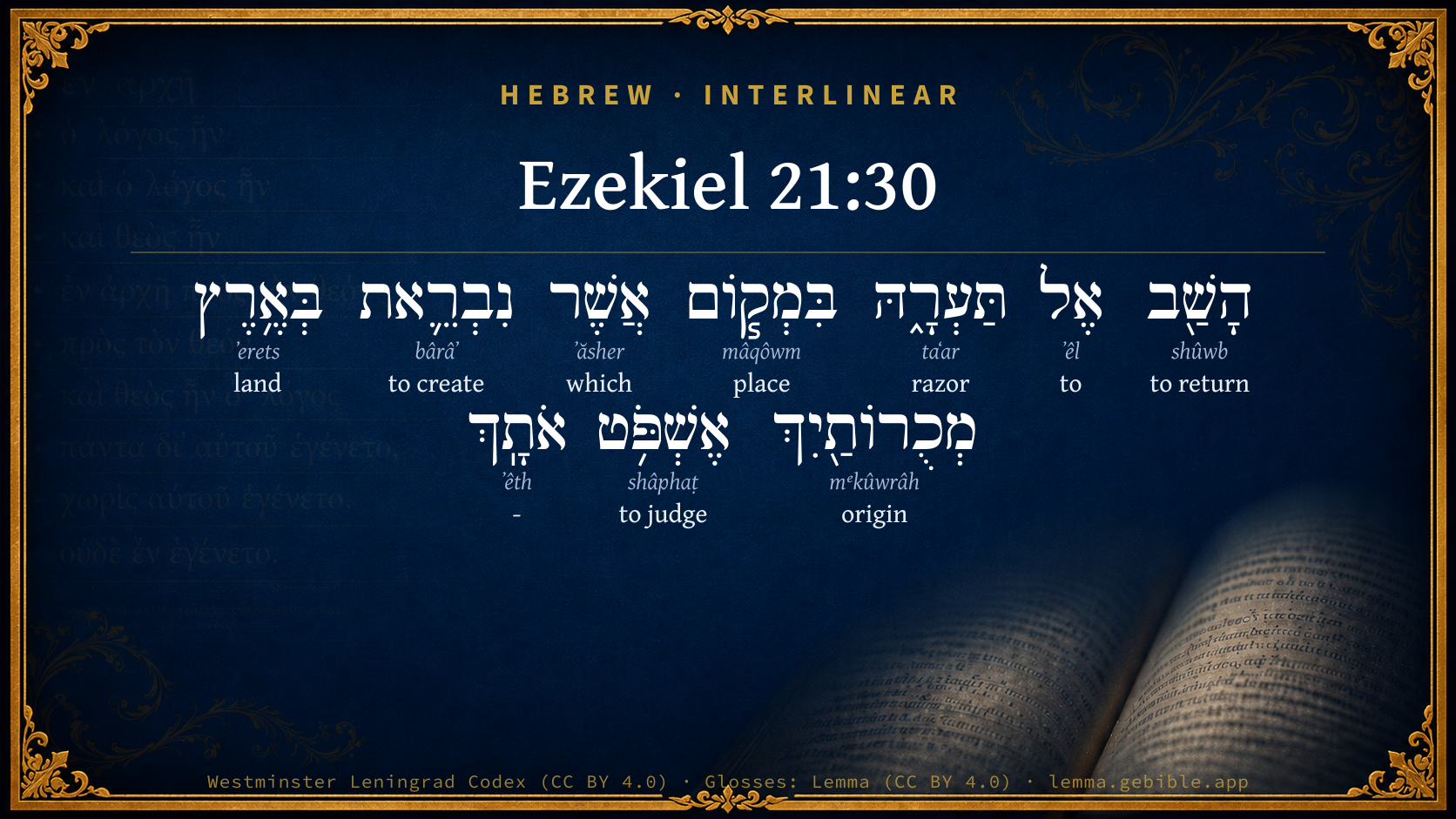
Hebrew (Westminster Leningrad Codex) Ezekiel 21:30 appears in the Hebrew Old Testament. The text above is from the Westminster Leningrad Codex. Each word links to its Strong’s number, a concise gloss, and parsing drawn from the Open Scriptures Hebrew Bible morphology. Click any word for its full Brown-Driver-Briggs (BDB) entry.
Download image
Cite this verse

Ezekiel 21:30 (World English Bible). Public Domain. Lemma interlinear Bible study tool, https://lemma.gebible.app/v/ezekiel/21/30.

Show BibTeX & RIS
BibTeX
RIS
English Translation
Cause it to return into its sheath. In the place where you were created, in the land of your birth, will I judge you.
World English Bible · Public Domain
Download a study sheet

One document with this verse’s original text, its word-by-word gloss line, the meaning frame, cross-references with their text, attributed commentary, and full source and license credits — printable, and it pastes into notes with its structure intact.

This verse Autodidact and up

Study sheet (.html) Plain text (.txt)

A passage Seminary Student

Up to 50 verses in one chapter. A passage sheet keeps up to 6 commentary sources and 12 cross-references per verse, in the order this page ranks them, and says so on the sheet whenever that leaves anything out. Ask for a single verse and you get the Autodidact verse sheet above.

Everything on this page stays free to read, with no account — the sheet is a download of what is already on screen, not access to it.

Want to remove ads? Support Godless Engineer
Compare translations 3

The same verse in 3 English versions, stacked beneath the original-language interlinear above. Click any original word for its lexicon entry.

Each is an independent rendering of the whole verse — the interlinear is not word-aligned to these translations.

Highlighted words mark where these versions differ — a whole-verse word diff, not a word-by-word alignment.

  • World English Bible Public Domain
    Cause it to return into its sheath. In the place where you were created, in the land of your birth, will I judge you.
  • King James Version Public Domain
    Shall I cause it to return into his sheath? I will judge thee in the place where thou wast created, in the land of thy nativity.
  • unfoldingWord Literal Text CC BY-SA 4.0
    Return the sword to its sheath. In the place of your creation, in the land of your origin, I will judge you!

unfoldingWord Literal Text — © unfoldingWord, licensed CC BY-SA 4.0. Word-aligned USFM3 via Door43 (git.door43.org/unfoldingWord/en_ult).

Versions to compare (up to 4)

3 of 4 selected

Show all 18 translations

Every available English version of this verse, each an independent rendering of the whole verse.

  • World English Bible Public Domain
    Cause it to return into its sheath. In the place where you were created, in the land of your birth, will I judge you.
  • Berean Standard Bible Public Domain
    Return the sword to its sheath! In the place where you were created, in the land of your origin, I will judge you.
  • Majority Standard Bible Public Domain
    Return the sword to its sheath! In the place where you were created, in the land of your origin, I will judge you.
  • King James Version Public Domain
    Shall I cause it to return into his sheath? I will judge thee in the place where thou wast created, in the land of thy nativity.
  • American Standard Version (1901) Public Domain
    Cause it to return into its sheath. In the place where thou wast created, in the land of thy birth, will I judge thee.
  • Revised Version (1885) Public Domain
    Cause it to return into its sheath. In the place where thou wast created, in the land of thy birth, will I judge thee.
  • Geneva Bible (1599) Public Domain
    Shall I cause it to returne into his sheath? I will iudge thee in the place where thou wast created, euen in the land of thine habitation.
  • Douay-Rheims (1899) Public Domain
    Return into thy sheath. I will judge thee in the place wherein thou wast created, in the land of thy nativity.
  • Young's Literal Translation Public Domain
    Turn `it' back unto its scabbard, In the place where thou wast produced, In the land of thy birth I do judge thee.
  • Literal Standard Version CC BY-SA 4.0
    Turn [it] back to its scabbard; I judge you || In the place where you were produced, || In the land of your birth.
  • Unlocked Literal Bible CC BY-SA 4.0
    Return the sword to its sheath. In the place of your creation, in the land of your origin, I will judge you!
  • unfoldingWord Literal Text CC BY-SA 4.0
    Return the sword to its sheath. In the place of your creation, in the land of your origin, I will judge you!
  • Darby Bible Public Domain
    Restore [it] to its sheath. I will judge thee in the place where thou wast created, in the land of thy birth.
  • World Messianic Bible Public Domain
    Cause it to return into its sheath. In the place where you were created, in the land of your birth, I will judge you.
  • Webster's Bible Public Domain
    Shall I cause it to return into its sheath? I will judge thee in the place where thou wast created, in the land of thy nativity.
  • Free Bible Version CC BY-SA 4.0
    Sword, go back to where you came from! I'm going to judge you right where you were created, in your homeland.
  • Bible in Basic English Public Domain
    Go back into your cover. In the place where you were made, in the land from which you were taken, I will be your judge.
  • JPS Tanakh (1917) Public Domain
    (21-35) Cause it to return into its sheath! — In the place where thou wast created, in the land of thine origin, will I judge thee.

Literal Standard Version (2020), Covenant Press — licensed CC BY-SA 4.0. Text via the HelloAO Bible API (eBible.org). Unlocked Literal Bible (unfoldingWord) — licensed CC BY-SA 4.0. Text via the HelloAO Bible API (eBible.org). unfoldingWord Literal Text — © unfoldingWord, licensed CC BY-SA 4.0. Word-aligned USFM3 via Door43 (git.door43.org/unfoldingWord/en_ult). Free Bible Version, Dr. Jonathan Gallagher — licensed CC BY-SA 4.0. Text via the HelloAO Bible API (eBible.org).

Word by word

More ways to search: Search by grammar → Find every occurrence → Compare this word →

Practice this passage: Drill this verse → Learn its vocabulary →

מְכֻרוֹתַ֖יִךְ
mᵉkûwrâh
H4351
“origins · your”
Noun, Common, Feminine, Plural, Construct + Suffix, Personal, 2nd Person, Feminine, Singular
Part of Speech
Noun
Type
Common
Gender
Feminine
Number
Plural
State
Construct
Full BDB Definition

Origin: from the same as H3564 in the sense of dipping

TWOT: 1033c

origin
  1. הָשַׁ֖ב shûwb H7725 “return” Verb, Hiphil, Imperative, 2nd Person, Masculine, Singular
  2. אֶל ʼêl H413 “to” Preposition
  3. תַּעְרָ֑הּ taʻar H8593 “razor · her” Noun, Common, Both, Singular, Construct + Suffix, Personal, 3rd Person, Feminine, Singular
  4. בִּמְק֧וֹם mâqôwm H4725 “in/at · place of” Preposition + Noun, Common, Masculine, Singular, Construct
  5. אֲשֶׁר ʼăsher H834 “which” Particle, Relative
  6. נִבְרֵ֛את bârâʼ H1254 “to create” Verb, Niphal, Perfect, 2nd Person, Feminine, Singular
  7. בְּאֶ֥רֶץ ʼerets H776 “in/at · land of” Preposition + Noun, Common, Both, Singular, Construct
  8. אֶשְׁפֹּ֥ט shâphaṭ H8199 “to judge” Verb, Qal, Imperfect, 1st Person, Common, Singular
  9. אֹתָֽךְ ʼêth H853 “- · you” Particle, Direct Object + Suffix, Personal, 2nd Person, Feminine, Singular

About this verse

These counts appear in no published source. They are computed here, from the morphology-tagged text and Lemma’s own curated glosses. What Lemma adds →

10
words
10
distinct lemmas
Prophets
section

Notable vocabulary

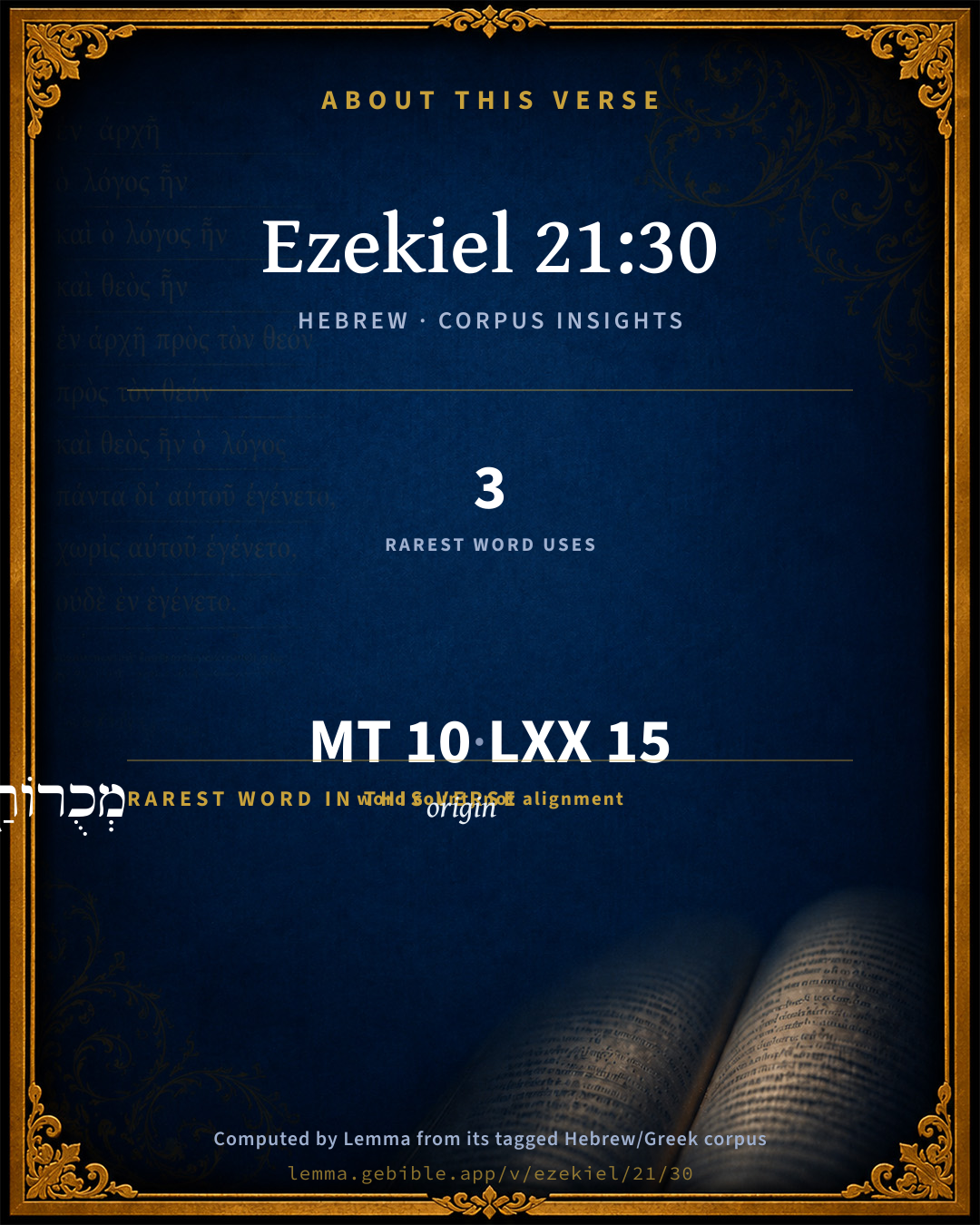
The rarest word here is מְכֻרוֹתַ֖יִךְ origin H4351 — appearing just 3 times in the whole Hebrew Bible.

Shared distinctive vocabulary

מְכֻרוֹתַ֖יִךְ origin H4351 occurs in 3 verses of the Hebrew Bible. Also found in:

Grammatical profile

  • 3 verbs
  • 4 nouns
  • 1 preposition
  • 2 particles

Verb forms

  • הָשַׁ֖ב Hiphil · Imperative
  • נִבְרֵ֛את Niphal · Perfect
  • אֶשְׁפֹּ֥ט Qal · Imperfect

Hebrew & Septuagint length

In English translation the verse runs 24 words from the Hebrew and 18 from the Septuagint (LXX English) — closely comparable.

A rough comparison of the two English renderings, which tokenize alike — not a word-level alignment.

Word counts can differ between the Hebrew and the Greek without any difference in meaning — e.g. the Hebrew direct-object marker אֵת has no separate Greek word, and Greek often adds the article ὁ.

In the original languages it is 10 Hebrew tokens and 15 Greek tokens — but the two are counted differently (Hebrew bundles its prefixes and suffixes into one token; the Greek is in lemma form), so that isn’t a like-for-like length.

Cross-references

7

Topical passages linked to Ezekiel 21:30 in the Treasury of Scripture Knowledge — connected by theme and wording, ordered by reader-vote popularity; previews shown in the World English Bible.

  • Genesis 15:14 I will also judge that nation, whom they will serve. Afterward they will come out with great substance.
  • Jeremiah 47:6–7 You sword of Yahweh, how long will it be before you be quiet? put up yourself into your scabbard; rest, and be still.
  • Ezekiel 16:38 I will judge you, as women who break wedlock and shed blood are judged; and I will bring on you the blood of wrath and jealousy.
  • Ezekiel 16:3–4 and say, Thus says the Lord Yahweh to Jerusalem: Your birth and your birth is of the land of the Canaanite; the Amorite was your father, and your mother was a Hittite.
  • Ezekiel 21:4–5 Seeing then that I will cut off from you the righteous and the wicked, therefore shall my sword go forth out of its sheath against all flesh from the south to the north:
  • Ezekiel 28:13 You were in Eden, the garden of God; every precious stone adorned you: ruby, topaz, emerald, chrysolite, onx, jasper, sapphire, turquoise, and beryl. Gold work of tambourines and of pipes was in you. In the day that you were created they were prepared.
  • Ezekiel 28:15 You were perfect in your ways from the day that you were created, until unrighteousness was found in you.

Cross-references courtesy of OpenBible.info (CC BY 4.0).

Hebrew and Greek witnesses Masoretic Hebrew ↔ Greek Septuagint

The same verse in the two great witnesses to the Old Testament, shown verse-for-verse.

These are two independent witnesses, not word-aligned to each other, and the Septuagint is shown in lemma (dictionary) form.

Hebrew Ezekiel 21:30 Masoretic · Westminster Leningrad Codex

הָשַׁ֖ב אֶל תַּעְרָ֑הּ בִּמְק֧וֹם אֲשֶׁר נִבְרֵ֛את בְּאֶ֥רֶץ מְכֻרוֹתַ֖יִךְ אֶשְׁפֹּ֥ט אֹתָֽךְ

Cause it to return into its sheath. In the place where you were created, in the land of your birth, will I judge you.

World English Bible · Public Domain

Greek LXX Ezekiel 21:30 Septuagint · lemma form

καί σύ βέβηλος ἄνομος ἀποἡγέομαι ὁ ἰσραήλ ὅς ἥκω ὁ ἡμέρα ἐν καιρός ἀδικία πέρας

Turn, rest not in this place wherein you were born: in your own land will I judge you.

LXX2012 (modern English Septuagint) · Public Domain

On this verse, Joseph Benson's Commentary discusses the Septuagint’s reading. Read the note in Commentary ↓

Hebrew: Westminster Leningrad Codex (CC BY 4.0). Greek: Septuagint (public domain); English from LXX2012 (modern English Septuagint) (Public Domain). How the Septuagint differs from the Hebrew →

Targum (Aramaic paraphrase)

1

The Targum is the ancient Jewish Aramaic paraphrase of the Hebrew Scriptures — an interpretive translation, not the Hebrew text itself. Onkelos (literal) and Pseudo-Jonathan (expansive) render the Torah, and Jonathan the Prophets. Coverage is partial: where no permissively-licensed English translation exists for a verse, only the Aramaic is shown. This is verse-level text, not a word-by-word alignment to the Hebrew.

  1. Targum Jonathan Prophets (Joshua–Malachi)
    וְאַתְּ חַיָב קְטָלָא רַשִׁיעָא רַבָּא דְיִשְׂרָאֵל דִמְטָא יוֹם תַּבְרֵיהּ עִדַן תּוּשְׁלְמַת חוֹבוֹהִי:

    (no public-domain English translation for this verse)

    Targum Jonathan — Aramaic: “Mikraot Gedolot” (public domain). English: “Sefaria Community Translation” (CC0 1.0 (public-domain dedication)); “London "Chaldee Paraphrase," 1871” (public domain). Text via Sefaria.

Commentary

Notes on Ezekiel 21:30 from classic Christian and Jewish commentators (each source and its license shown beneath its notes). The classic Christian expositions comment on the surrounding passage and are grouped to its opening verse, so a note may address several verses; the Jewish commentaries on the Tanakh (Rashi and others) are per-verse, so they appear only where the commentator wrote on this verse.

Lemma curates 59 commentaries, every one of them public domain or Creative Commons licensed, each selected and text-cleaned for this edition rather than reprinted as found. About our sources →

Trapp's Complete Commentary

John Trapp

Eze 21:30 Shall I cause [it] to return into his sheath? I will judge thee in the place where thou wast created, in the land of thy nativity.

Ver. 30. Shall I cause it to return?] No, but it shall still eat your flesh and drink your blood, till none remaineth.

In the land of thy nativity.] In thine own nest, and on thine own dunghill.

John Trapp, A Commentary or Exposition upon All the Books of the Old and New Testament (1647–1656) — public domain. Text from a community e-Sword module.

Joseph Benson's Commentary

Eze 21:30-32. Shall I cause it to return into his sheath? — Shall the sword that is drawn to execute the judgments of God upon Ammon be put up in its sheath before it has done its work? Surely not. I will judge thee in the place where thou wast created — That is, where thy nation first received its existence: thou shalt not be carried captive, but shalt be destroyed in thy own land. I will pour out mine indignation upon thee — Which shall overwhelm thee as with a flood, and sweep thy nation into ruin. I will blow against thee, &c. — To melt thee as it were in a furnace. See Eze 22:20-21. And deliver thee into the hand of brutish men — The LXX. read, ανδρων βαρβαρων τεκταινοντων διαφθορας, of barbarous men, artificers of destruction; or, as we render it, skilful to destroy. Thou shalt be for fuel to the fire — Thy country and cities shall be destroyed by fire. Thy blood shall be in the midst of the land — A slaughter shall be made of thee in every part of thy country, and thy blood shall appear everywhere. Thou shalt be no more remembered — The Jewish people still subsist, but the Ammonites are lost in the mass of mankind, and have been long forgotten.

Joseph Benson's Commentary on the Old and New Testaments (1811–1818) — public domain. Text from a community e-Sword module.

Tyndale Open Study Notes

Tyndale Open Resources

21:30-32 The sword would return . . . to its sheath, not to rest there, but to accomplish the Lord’s judgment against its own country, Babylon. God would also pour out . . . fury and the fire of his anger on Babylon. It had no special protection simply because God had used it as his tool in judging others. Judgment may have begun with God’s household (1 Pet 4:17), but it did not end there. God’s judgment included the pagan nations around Judah.

Tyndale Open Study Notes — © Tyndale Open Resources, licensed CC BY-SA 4.0. Text via the HelloAO Bible API.

Jamieson, Fausset & Brown

Robert Jamieson, A. R. Fausset & David Brown

Shall I cause it to return into his sheath--namely, without first destroying Ammon. Certainly not (Jer 47:6-7). Others, as the Margin, less suitably read it imperatively, "Cause it to return," that is, after it has done the work appointed to it.

in the land of thy nativity--Ammon was not to be carried away captive as Judah, but to perish in his own land.

Jamieson, Fausset & Brown — Commentary Critical and Explanatory on the Whole Bible (1871) — public domain (CC PDM 1.0). Text via the HelloAO Bible API.

Adam Clarke's Commentary

Verse 30. I will judge thee] This seems to refer to Nebuchadnezzar, who, after his return from Jerusalem, became insane, and lived like a beast for seven years; but was afterwards restored, and acknowledged the Lord.

Adam Clarke's Commentary on the Bible (1810–1826) — public domain. Text from a community e-Sword/MySword module.

Ellicott's Commentary for English Readers

(30) Shall I cause it to return?—There is nothing in the original to indicate either a question, or that this is spoken in the first person. It is addressed to the Ammonites, “Return it” (the sword) “into his sheath;” and it means that all resistance will be vain, the coming destruction cannot be averted. And this judgment is to be executed in the Ammonites’ own country: they are to be destroyed at home.

A Bible Commentary for English Readers, edited by Charles John Ellicott (1878–1897) — public domain. Text from a community e-Sword module.

The Cambridge Bible for Schools and Colleges

gen. ed. J. J. S. Perowne

30. Shall I … return] Return it into its sheath! Ammon is commanded to put back his sword to its sheath; his dreams of conquests abroad are vain, he shall be visited and destroyed in his own land. On “nativity” cf. Eze_16:3.

The Cambridge Bible for Schools and Colleges (gen. ed. J. J. S. Perowne; Cambridge University Press, 1878–1918) — public domain. Text from a community e-Sword module.

John Gill's Exposition

Thou shalt be for fuel for the fire,.... Easily consumed, as briers and thorns cast into a furnace; such are wicked men to the fire of God's wrath:

thy blood shall be in the midst of the land; such large numbers shall be slain everywhere, that the land shall flow with the blood of them; who shall lie unburied, and rot, and putrefy upon the ground:

thou shalt be no more remembered; but lie in everlasting oblivion, as they do to this day; the name of an Ammonite being nowhere mentioned and heard of:

for I the Lord have spoken it; who never alters the thing that is gone out of his lips; and sooner shall heaven and earth pass away than one word of his. The Targum is,

"for I the Lord have decreed by my word;''

and his counsel shall stand, and every purpose and resolution of his shall be accomplished.

Next: Ezekiel Chapter 22

John Gill's Exposition of the Whole Bible (1746–1763) — public domain (CC PDM 1.0). Text via the HelloAO Bible API.

Haydock's Catholic Bible Commentary

Sheath. The sword of Babylon, after raging against many nations, was shortly to be judged and destroyed at home by the Medes and Persians. (Challoner) --- After Nabuchodonosor had chastised the nations around for 18 years, after the ruin of Jerusalem, he returned and died in peace. Yet he first became like a beast, ver. 31., and Daniel iv. 30. The rest of the prophecy regards his successors. Cyrus waged war upon them, and Baltassar was slain in a conspiracy. See Isaias xlvii., and Jeremias l. (Calmet) --- At last the sword fell upon Babylon itself. (Worthington)

George Leo Haydock (1774–1849), Haydock's Catholic Family Bible and Commentary, 1859 edition — public domain. Excludes Psalms (Douay-Rheims chapter numbering differs from Protestant) and Deuterocanonical books (Catholic canon only).

Matthew Poole's English Annotations

Some read it without interrogation, as an advice to the Ammonites to put up the sword they had drawn for their defence, as being to no purpose to resist. If it be an interrogation, it is such as more vehemently denieth, God will by no means suffer the sword to be sheathed; in this sense it refers to the sword of the Chaldeans.

Will judge thee; plead, condemn, and execute too.

Where thou wast created; explained by that which follows; though they might boast of their ancient original, and their safe and impregnable strengths, yet God will bring a sword into those very places, and there they should perish.

Matthew Poole's English Annotations on the Holy Bible (1683–1685) — public domain. Text from a community e-Sword/MySword module.

The Pulpit Commentary

Shall I cause it, etc.? The question of the Authorized Version suggests a negative answer, as though the speaker were Jehovah, and the sheath that of his sword. The Revised Version, which translates it, with Keil, the LXX, and the Vulgate, as an imperative, deals with it as addressed to the Ammonites. They am told to sheath their sword; it would be of no avail against the sharp, glittering weapon of Jehovah. Their judgment would soon come on them in their own land, not, as in the case of Judah, in the form of exile. (comp. Eze_25:1-8 as an expansion of the prophet"s thought)

The Pulpit Commentary (1880–1919), ed. H.D.M. Spence-Jones & Joseph S. Exell — public domain. Text from a community e-Sword module.

John Wesley's Explanatory Notes

Shall I cause it - God will by no means suffer the sword to be sheathed. Judge thee - Condemn, and execute.

John Wesley, Explanatory Notes Upon the Whole Bible (1754–1765) — public domain. Text via the GEBible commentary corpus.

unfoldingWord translationNotes

Door43 World Missions Community

General Information:

Yahweh continues giving Ezekiel his message to the people of Ammon.

Return the sword to its sheath

"Later the sword will be put back in its sheath." This speaks of the soldiers withdrawing from attacking Jerusalem, by saying that Yahweh's sword is put back in its sheath. AT: "But later the soldiers will return their swords to their sheaths, for the time of slaughter will be over" (See: Metaphor and Assumed Knowledge and Implicit Information)

sheath

This is something that holds and covers a sword when no one is using it. See how you translated this in Ezekiel 21:3.

In the place of your creation

The word "creation" may be expressed as a verb. AT: "In the place that I created you" (See: Abstract Nouns)

I will pour out my indignation on you

This speaks of Yahweh punishing the Babylonians because of his indignation against them as if his indignation were a liquid that he poured out of a container upon them. AT: "I will punish you because of indignation against you" or "Out of my anger I will punish you" (See: Metaphor)

I will fan the fire of my rage against you

This compares Yahweh's rage to a consuming fire. AT: "I will bring my rage upon you like a blazing fire" or "I will punish you in my fierce anger" (See: Metaphor)

the hand of cruel men

The "hand" of the men refers to their control. AT: "the control of cruel men" (See: Metonymy)

craftsmen of destruction

"men who cause great destruction"

translationWords

sword

create

judge

hand

unfoldingWord translationNotes — © Distant Shores Media and the Door43 World Missions Community, licensed CC BY-SA 4.0. Source: git.door43.org/Door43/en_tn.

Rashi

Rabbi Shlomo Yitzchaki (Rashi)

wicked man, sentenced to be slain Liable to be slain for your wickedness.

prince of Israel Zedekiah.

at the time of the final iniquity At the time the measure has become filled and the final iniquity, which fills the measure, has arrived.

Rashi on the Tanakh — English translations: “The Judaica Press complete Tanach with Rashi, translated by A. J. Rosenberg” (CC BY 4.0); “Pentateuch with Rashi's commentary by M. Rosenbaum and A.M. Silbermann, 1929-1934” (public domain); “The Metsudah Tanach series, Lakewood, N.J” (CC BY 4.0); and “The Book of Joshua, Metsudah Publications, 1997” (CC BY 4.0). Text via Sefaria.

Lesson kit

Teaching starters — assembled from the data on this page, not authored interpretation. Every prompt links to the verse data it draws on. Edit before teaching.

Ezekiel, in the Prophets, opens this verse with 10 words (10 distinct Hebrew lemmas). Its most distinctive word is mᵉkûwrâh (“origin”). A historical commentator’s framing appears above. Read the whole chapter for the surrounding context.

Discussion questions

  1. How does “origin” (mᵉkûwrâh) shape what this verse is saying?
  2. How does Ezekiel 16:3, which shares the word «origin», read alongside this verse?
  3. These translations render this verse differently. What is at stake in choosing one wording over another?
  4. «הָשַׁ֖ב» is a Hiphil Imperative verb. How does that grammatical form shape the action described?
  5. Compare how Trapp's Complete Commentary and Joseph Benson's Commentary read this verse. Where do they agree or differ?

Things to notice

Reading settings

Reading text

Shown beneath each verse's original-language words.

Old Testament
Old Testament edition

Read the OT as the Masoretic Hebrew (MT) or the Greek Septuagint (LXX).

English shown for the Greek Septuagint (in the Hebrew ↔ Greek comparison).

Comparing translations? Open the Compare panel on any verse page to stack up to four side by side.